



Abstract
Previous research suggests that prisoners have a higher rate of disability than non-institutionalized adults. This study used nationally representative data to update the prevalence rate, identify correlates of disability, and evaluate disability-related disparities in use of prison-based educational services, vocational programs, and work assignments. Data were obtained from 18,185 prisoners interviewed in the 2004 Survey of Inmates in State and Federal Correctional Facilities. Survey logistic regression procedures were conducted using Stata 13. Disability prevalence remained substantially higher among prisoners than among the non-institutionalized population. Prisoners were more likely to report specific learning, sensory, and speech-related disabilities than non-institutionalized adults. Prisoners with at least one type of disability had more criminogenic risk factors and come from a more disadvantaged background than prisoners without disability. Prisoners with disabilities were also less likely to utilize vocational programs and work assignments but were more likely to use educational programs than prisoners without disabilities. In summary, 41% of prisoners reported a disability, most commonly, learning disabilities. Prisoners with disabilities were identified as an at-risk group for recidivism, given their pre-incarceration experiences, and limited vocational and work-related training received in prison.
Current population estimates indicate that between 13% and 22% of non-institutionalized Americans have a disability, including 11% of non-institutionalized 18- to 44-year-old adults (Brault, 2012; Centers for Disease Control and Prevention, 2009; Houtenville, Brucker, & Lauer, 2014). All adults living with disabilities may face a variety of challenges within the scope of their daily lives, including environmental barriers to health care, employment, education, and other basic services; lower levels of income and access to permanent housing; increased health care and caregiving needs and corresponding costs; and disability-related discrimination (Field & Jette, 2007). Fortunately, awareness of disability as an important public health issue has increased over the past two decades (Krahn, Walker, & Correa-De-Araujo, 2015). For example, Healthy People 2020 includes 20 objectives that prioritize understanding and improving quality of life for people living with disabilities (U.S. Department of Health and Human Services, 2011). However, despite our strides in understanding disability among non-institutionalized adults, virtually all population-based health and disability surveys exclude institutionalized populations, including those in state and federal prisons.
A notable exception is the Survey of Inmates in State and Federal Correctional Facilities (SISFCF), a nationally representative sample of prisoners that provides a unique forum to expand our understanding of disability among adults in the penal system (Bureau of Justice Statistics, 2007). At the end of 2013, 1.55 million adults were incarcerated in state and federal prisons, and the number of prisoners has continued to increase annually over the past four decades (Carson, 2014; Carson & Daniela, 2013). These adults are at an elevated risk for firearm-related spinal cord injuries and other traumatic injuries resulting from violent behavior and victimization (Buchanan, 2014; Ragucci, Gittler, Balfanz-Vertiz, & Hunter, 2001). Using a nationally representative dataset of prisoners collected in 1997 with slightly different indicators of disability, Maruschak and Beck (2001) found that 31% of state prisoners and 23% of federal prisoners self-reported living with a disability. A small number of international studies have identified high rates of disability among small samples of prisoners. For example, Alm and Andersson (1997) found that 64% of adult prisoners (n = 61) reported literacy difficulties; Samuelsson, Gustavsson, Herkner, and Lundberg (2000) found that 19% experienced dyslexia (n = 48), and Jensen, Lindgren, Meurling, Ingvar, and Levander (1999) reported that 55% of the 45 male prisoners sampled had attention-deficit/hyperactivity disorder (ADHD). These prevalence rates are substantially higher than the non-institutionalized population of similar age (Houtenville, 2013; Centers for Disease Control and Prevention, 2013), indicating some level of increased risk of disability among institutionalized adults. Since the release of the Maruschak and Beck (2001) report, the prevalence of disability among non-institutionalized adults in the United States has gradually increased (National Center for Health Statistics, 2014). However, there has been no updated national estimate of disability prevalence among state and federal prisoners beyond 1997. Research identifying the correlates of disability among a nationally representative sample of prisoners is needed to understand the extent of the problem and shed light on extant and future policies to prevent or reduce the burden of disability among prisoners (Finn, 2005; Krienert, Henderson, & Vandiver, 2003).
To our knowledge, researchers have yet to investigate whether use of correctional treatment programming varies between prisoners with and without disabilities. Evidence suggests that offenders with disabilities have high recidivism rates (Klimecki, Jenkinson, & Wilson, 1994; Zakopoulou et al., 2013; Zhang, Katsiyannis, Barrett, & Willson, 2007), but successful reintegration into society is more likely when prisoners with disabilities are afforded work assignments in correctional facilities (Hassan & Gordon, 2003; Mawhorr, 1997; Nuttall, Hollmen, & Staley, 2003). Given that successful completion of educational, work, and vocational training programs has the potential to reduce recidivism rates (Katsiyannis, Ryan, Zhang, & Spann, 2008; Nuttall et al., 2003; Vacca, 2008; Wilson, Gallagher, & MacKenzie, 2000), it is essential that all prisoners, regardless of disability status, be provided the opportunity to take advantage of these assignments and programs when they are available.
The purpose of this study is threefold. First, we provide an updated estimate of disability prevalence using data from a nationally representative, epidemiological survey of adults in state and federal prisons. Second, we examine an array of differential risk and protective factors for prisoners with and without disabilities to broaden our understanding of why prisoners exhibit higher rates of disability than the non-institutionalized population. Third, we compare the differential rates of prison-based employment and vocational and educational program use between prisoners with and without indicators of disability. We hypothesize that disability prevalence will remain higher in prisons than in the non-institutionalized population, and that pre-incarceration indicators of low socioeconomic status and high-risk criminal behavior will be associated with having a disability in the prison setting. We also expect that prisoners with disabilities will be less likely to report participating in educational and vocational programs or work assignments when compared with prisoners without disabilities.
Method
Data were obtained from the nationally representative 2004 Survey of Inmates in State Correctional Facilities and the 2004 Survey of Inmates in Federal Correctional Facilities (Bureau of Justice Statistics, 2007). This dataset is the most recent wave of a repeated cross-sectional study conducted at irregular intervals since 1979 (e.g., data were collected in 1974, 1979, 1986, 1991, 1997, and 2004). Prisons were selected using a dual-stage stratified sampling design (prisons were randomly selected in the first stage, and inmates were systematically selected within prisons during the second stage). Further documentation describing the complex sampling design and inclusion criteria is available from the Bureau of Justice Statistics (2007).
To ensure adequate sex representation due to the relatively small number of females incarcerated, the largest 14 male prisons and seven largest female prisons were non-randomly sampled (three of these prisons housed males and females). These state prisons were pre-selected because they house the largest inmate population according to the Bureau of Justice Statistics (BJS) census in 2000. The remaining 1,387 male and 350 female state prisons were stratified by census geographic region and sex, and sorted by population size. From this database, 211 male and 58 female prisons were probabilistically selected for inclusion proportionally to size within each stratum using a randomly generated starting point.
Similarly, two federal prisons (both housing males, one housing both males and females) were selected with certainty due to their size. The remaining 131 male and 17 female federal prison facilities (a list also derived from the BJS census) were then grouped according to security level (administrative, high, medium, low, or minimum) and sex and sorted by size. From this file, a stratified probability sample of 30 male and seven female federal prisons was drawn; resulting in a final federal prison sample, including 32 male and eight female prisons. For both state and federal prisons, a small number of “reserve” prisons were randomly selected for inclusion to replace facilities that did not consent to participate.
The second stage of sampling for state prisoners was conducted by assigning an identification number to each inmate who had spent the night in each selected prison 1 day during September of 2002 (Bureau of Justice Statistics, 2007). A computer-generated algorithm with a random starting point and predetermined skip interval was used to select inmates to be interviewed. For federal prisoners, a similar procedure was used; however, inmates serving sentences for drug-related offenses were systematically undersampled to ensure variability in crime type. This undersampling was necessary due to the high rate of drug offenders in federal prisons (more than 50% of the federal inmate population; Carson & Daniela, 2013). A total of 13,098 males and 3,054 females in state prisons and 3,347 males and 1,009 females in federal prisons were sampled using this methodology.
In sum, 14,499 state and 3,686 federal prisoners were surveyed using both direct in-person interviewing (for demographic information) and computer-assisted personal interviewing due to the sensitive nature of many items on the questionnaire. The response rate was 89.8% in the state sample and 86.7% in the federal sample (Bureau of Justice Statistics, 2007).
Measures: Independent and Dependent Variables
Disability
Disability was measured using eight questions adapted from the National Adult Literacy Survey (NALS), conducted in 1992 by the National Center for Educational Statistics (1992). Prisoners were asked the following questions: (a) “Does a mental health condition keep you from participating fully in work, school, or other activities?” (b) “Do you have difficulty seeing ordinary newsprint, even when wearing glasses?” (c) “Do you have difficulty hearing a normal conversation, even when wearing a hearing aid?” (d) “Do you have a learning disability, such as dyslexia or attention deficit disorder?” (e) “Do you have a speech impairment, such as a stutter or lisp?” (f) “Do you use a cane, wheelchair, walker, hearing aid, or other aids to help you with your daily activities?” (g) “Have you ever been enrolled in special education classes or SPED?” and (h) “Do you consider yourself to have a disability?”
Using the established World Health Organization’s (2001) International Classification of Functioning, Disability and Health as a framework, response categories were combined to reflect disability across six domains: sensory (Items 2 and 3), assistive device use (motor impairment or hearing aids; Item 6), learning (Items 4 and 7), speech (Item 5), mental health condition (Item 1), and self-reported disability (Item 8). In accordance with previous research (Harlow, 1998), each domain was dummy coded, as participants may have reported impairment in multiple domains.
The prevalence and correlates of disability among prisoners were examined because several types of disabilities, such as intellectual and learning disabilities (Bexkens, Ruzzano, Collot d’Escury-Koenigs, Van der Molen, & Huizenga, 2014), and reading, writing, and mobility challenges (Baker & Ireland, 2007; Buchanan, 2014; Ragucci et al., 2001; Svensson, 2011; Zakopoulou et al., 2013), have been related to low inhibitory control and criminal behavior.
Educational program, vocational program, and employment assignment utilization in prison
Each respondent was asked, “Do you now have a work assignment outside this prison facility for which you leave the prison grounds?” and “Do you have a work assignment here, either inside this facility or on the facility grounds?” On- and off-premise work assignments were dichotomized into “currently employed” or “not currently employed.” Educational and vocational program utilization was assessed using the following two items: “Since your admission [to prison], have you ever been in any vocational or job-training program, excluding prison work assignments?” and “Since your admission, have you ever been in another educational program? [exclude vocational training].” These variables were also dichotomized into “vocational program utilization” (or no vocational program utilization) and “educational program utilization” (or no educational program utilization) since admission.
Pre-incarceration risk factors
Pre-incarceration risk was measured using five self-reported measures: (a) “Have you ever been shot at with a gun? (excluding military combat)” (b) “Before you were admitted to prison, had you ever been physically abused?” (c) “Did [the crime] take place in your own neighborhood or somewhere else?” (d) age at first arrest, and (e) cumulative number of lifetime arrests as reported on a criminal history calendar. These measures were included because violence-related injuries, including gunshot wounds (Ragucci et al., 2001), are a leading cause of disability among this population (National Spinal Cord Injury Statistical Center, 2013). Each of these measures was included in this study to reflect indicators of exposure to violence-related injury, which has the potential to result in serious injury or physical disability (Maschi, Viola, Morgen, & Koskinen, 2015; Zhang, Barrett, Katsiyannis, & Yoon, 2011).
Early home environment
Six measures were included to evaluate the quality of prisoner’s home environment before age 18. These items included parental (or guardian) incarceration, receipt of welfare or public assistance, living in public housing, living in a foster home, peer delinquency, and abuse by a parent or caretaker before age 18. These measures were included in this study because poverty (Zhang et al., 2011), unemployment, neighborhood instability, familial problems (Zakopoulou et al., 2013), violence (Zhang et al., 2011), or criminal behavior (Mallett, 2012), and abuse (Maschi et al., 2015; Zakopoulou et al., 2013) are strongly related to violence in adulthood. Some international studies of prisoners have suggested that delinquent and criminal behavior is a manifestation of specific learning difficulties, psycho-emotional disorders, and behavioral problems that emerge during early adolescence (Zakopoulou et al., 2013). Therefore, these measures were evaluated as correlates of disability in the present study of prisoners.
Covariates
Offense characteristics
The most severe offense for which each respondent was serving a sentence was included as a covariate (including violent, property, drug, or public order offenses). Due to significant differences in the number of prisoners with disabilities housed in state and federal prisons (Maruschak & Beck, 2001), type of prison (state or federal) was included as a covariate in all analyses. Type of offense committed was included in all analyses for two reasons: (a) Violence has been identified as a leading cause of injury; particularly, spinal cord injuries (Buchanan, 2014; National Spinal Cord Injury Statistical Center, 2013; Ragucci et al., 2001); and (b) offenders are housed in state and federal prisons based upon the jurisdiction in which the crime was committed. For example, most prisoners housed in state prisons were serving sentences for violent (54%) or property (19%) offenses in 2012. These offenses are largely felonies committed against individual persons or one particular state. Federal prisons, however, house drug-related offenders, such as those convicted of possession, trafficking, or mass distribution (51% of the federal prison population in 2012; Carson, 2014). In general, federal prisons house offenders convicted of crimes that transcend state lines or occur in the designated federal jurisdiction, such as racketeering, web-based crimes, fraud, extortion, or immigration (Carson, 2014). Given these qualitative differences between state and federal penal populations, prison type (state or federal) was controlled in all analyses.
Demographic information
Respondent’s race and ethnicity were reported independently in accordance with U.S. Census Bureau (2011) guidelines and were coded as White (non-Hispanic), Black (non-Hispanic), Hispanic, or “other” race (non-Hispanic). Ages were calculated from self-reported birth date, and interviewers determined the biological sex of the respondent using direct observation and/or the sex-specific prison environment. When the respondents’ sex was not readily apparent, the interviewer asked the inmate to self-report their sex. Pre-incarceration educational attainment included a measure of the highest level of educational achievement, and employment status was measured using this item: “During the month before your arrest on [date], did you have a job or businesses?” The item was dichotomized into “employed” or “not employed” before arrest.
Analytic Methods
All analyses were survey weighted due to the unequal probability of selection into this sample (Bureau of Justice Statistics, 2007). Descriptive analyses comparing prisoners with and without disabilities were conducted using survey mean and chi-square methods. Bivariate and multivariate survey logistic regression procedures were used to examine the relationships between pre-incarceration environment, context, and demographics by disability status. The relationship between disability and educational program, vocational program, and work assignment utilization in prison was assessed using three stratified survey logistic regression methods. All analyses were conducted using Stata 13 (StataCorp, 2013).
Results
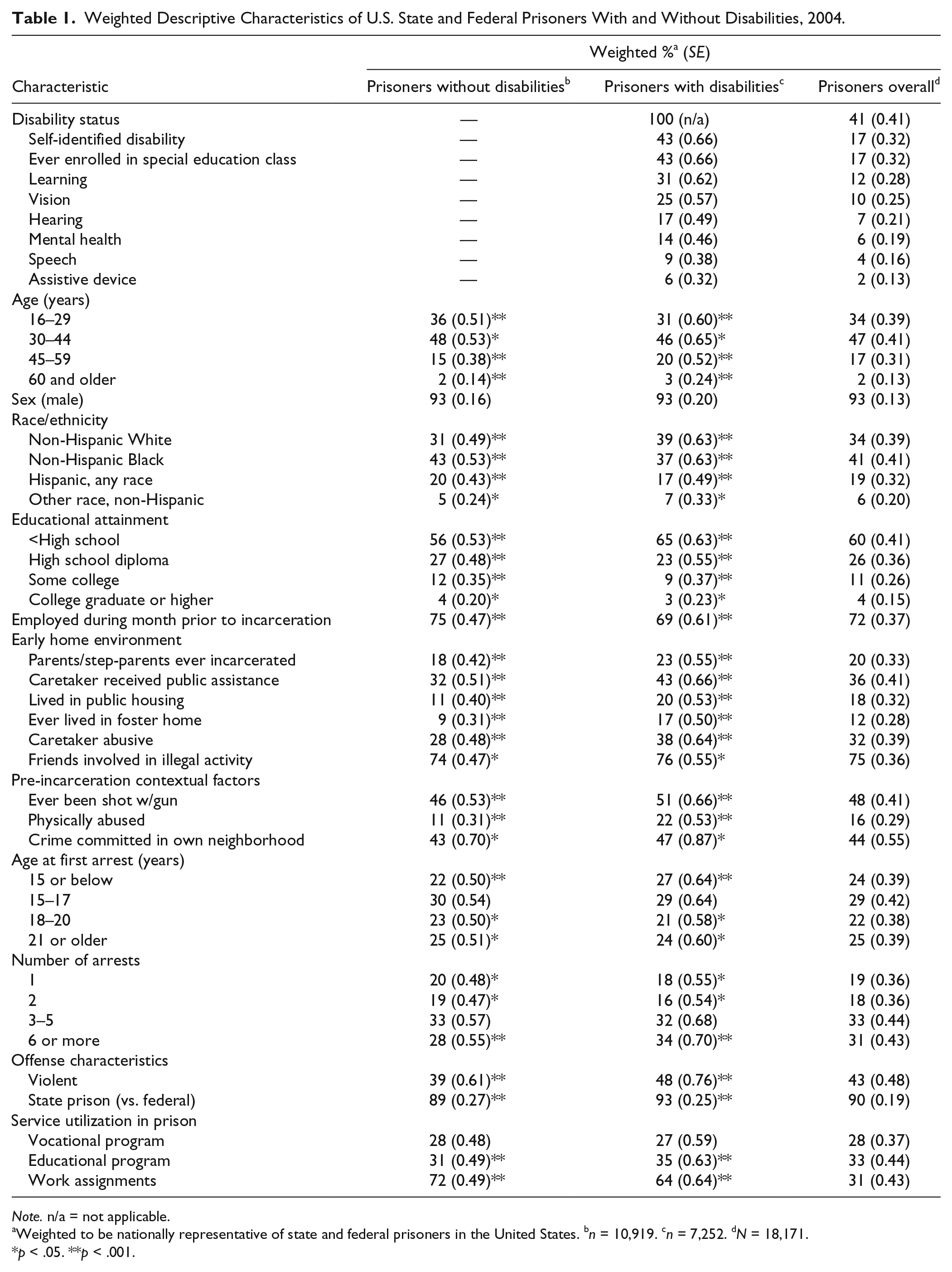
Table 1 displays sample characteristics, descriptive information about prisoners’ pre-incarceration environment, contextual factors, offense characteristics, and service utilization in prison. Of the 18,171 prisoners included in this dataset, 7,252 (41%) self-reported a disability in at least one domain. Among these prisoners who reported at least one form of disability, 31% had specific learning disabilities, 43% have taken special education classes, 43% “self-identified” as having a disability, 25% reported vision deficits, and 17% reported hearing problems. Prisoners included in this sample were 41% Black and 93% male. Nearly half of the participants were between the ages of 30 and 44 (47%). Most prisoners did not have a high school diploma; however, 72% were employed in the month before incarceration. The demographic distribution of this sample is reflective of the prison population in 2015 (Glaze & Kaeble, 2014).
Weighted Descriptive Characteristics of U.S. State and Federal Prisoners With and Without Disabilities, 2004.
Note. n/a = not applicable.
Weighted to be nationally representative of state and federal prisoners in the United States. bn = 10,919. cn = 7,252. dN = 18,171.
p < .05. **p < .001.
One third of prisoners’ caretakers received welfare or public assistance when they were growing up (36%) and had abusive parents (32%); nearly half had ever been shot at with a gun (48%). Most prisoners in this sample were first arrested before age 18 and had at least three lifetime arrests. In addition, although educational and vocational program utilization was low, work assignments were commonly used (69%) among prisoners.
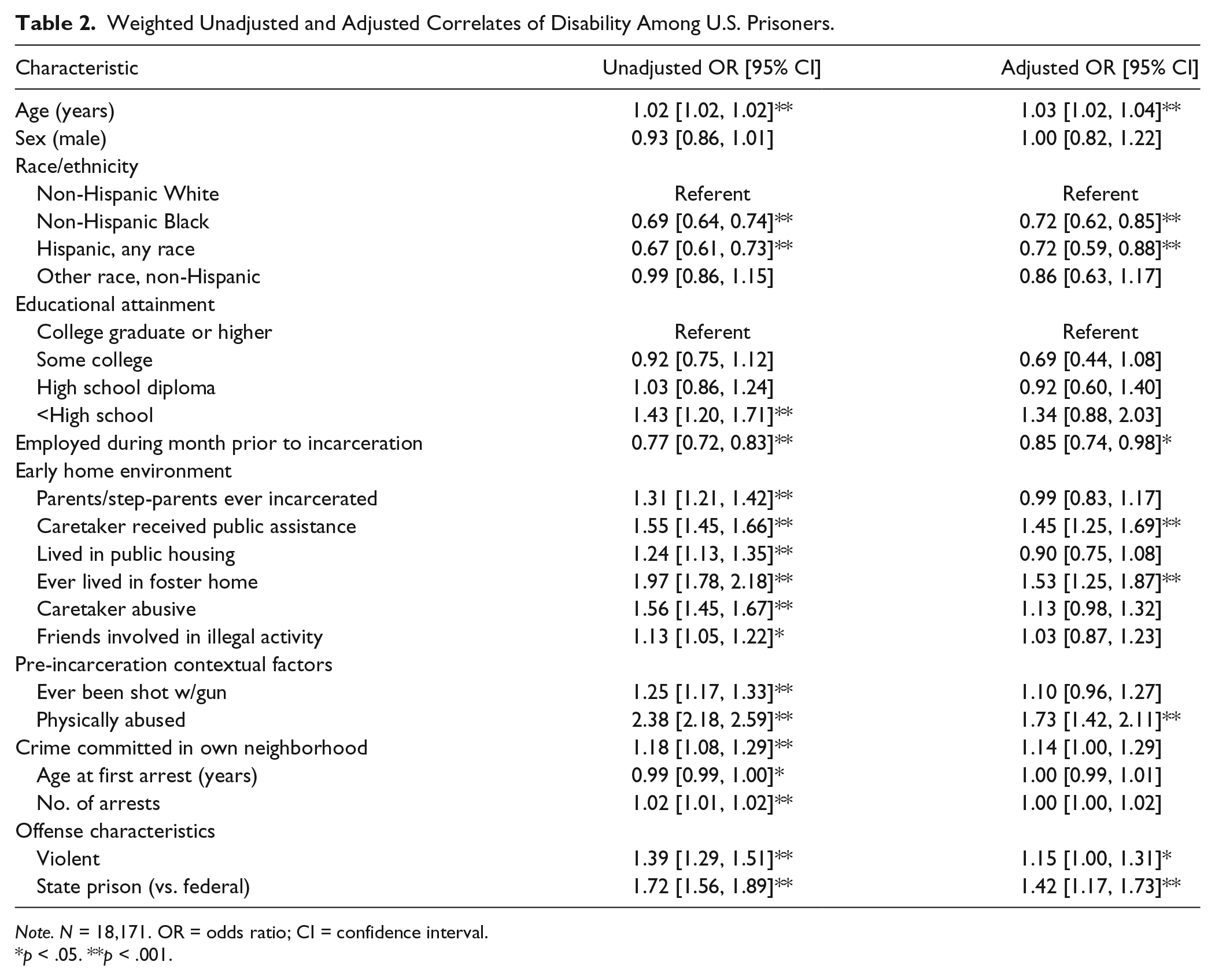
Table 2 displays the bivariate and multivariate relationships between demographic characteristics, pre-incarceration environment, contextual factors, and offense-related measures by disability status. Associations between prisoner disability status and age, race, ethnicity, and employment during the month before incarceration were observed when relevant covariates were included in the multivariate model. In addition, prisoners who had a caretaker who received welfare and prisoners who reported ever living in a foster home had 1.45 and 1.53 times the odds of having a disability, respectively. In addition, prisoners who were physically abused had 1.73 times the odds of having a disability compared with those who did not report physical abuse. Furthermore, prisoners with disability were more likely to be incarcerated for a violent crime and be housed in state prisons compared with prisoners without disabilities.
Weighted Unadjusted and Adjusted Correlates of Disability Among U.S. Prisoners.
Note. N = 18,171. OR = odds ratio; CI = confidence interval.
p < .05. **p < .001.
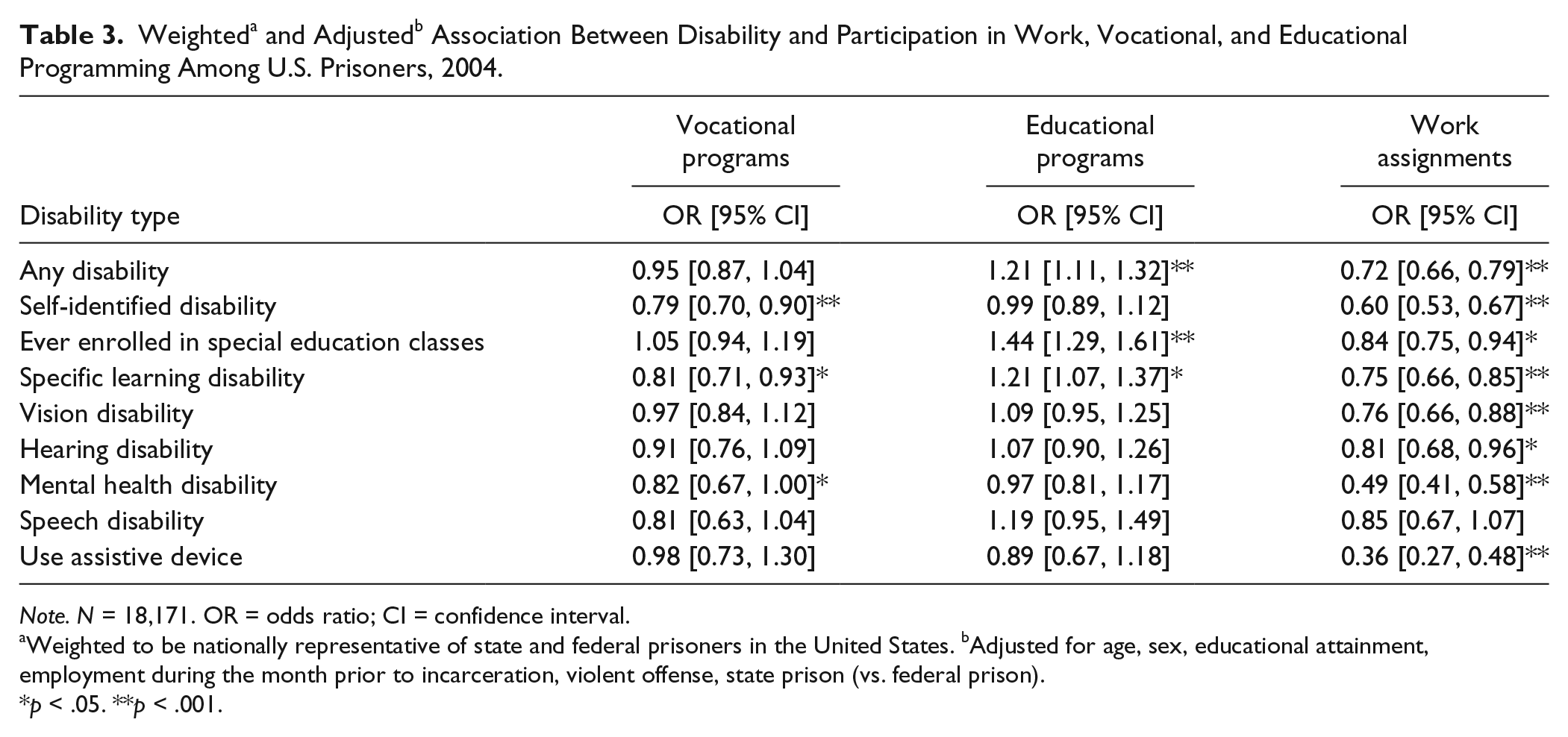
Finally, we hypothesized that prisoners with disabilities would be less likely to utilize educational programs, vocational programs, and work assignments within the prison system (see Table 3). Prisoners with at least one indicator of disability were 21% more likely to participate in educational programs but 28% less likely to participate in work assignments than prisoners who did not report any disability indicators. When deconstructed by disability domain, prisoners with a self-reported disability were less likely to participate in vocational programs and work assignments than prisoners without a self-reported disability. Prisoners with a learning disability were 19% and 25% less likely to participate in vocational programs and work assignments, respectively; however, they were more likely to utilize educational programs. Those with a vision or hearing disability were less likely (24% and 19%) to use work assignments than prisoners without vision or hearing disabilities. Prisoners who reported a mental health disability were 18% less likely to participate in vocational programs and 51% less likely to use work assignments than those without a mental health disability. There were no differences in program participation between prisoners with and without speech disabilities. Finally, prisoners who reported using an assistive device were 64% less likely to participate in work assignments than prisoners who did not use an assistive device.
Note. N = 18,171. OR = odds ratio; CI = confidence interval.
Weighted to be nationally representative of state and federal prisoners in the United States. bAdjusted for age, sex, educational attainment, employment during the month prior to incarceration, violent offense, state prison (vs. federal prison).
p < .05. **p < .001.
Discussion
Results suggest that disability is substantially more prevalent among incarcerated adults (at 41%) than the general population adults (estimates range from 12% to 22%; Brault, 2012; Centers for Disease Control and Prevention, 2009; Houtenville et al., 2014). Among prisoners with at least one form of disability, 31% had specific learning disabilities, 43% had taken special education classes, 43% “self-identified” as having a disability, 25% reported vision deficits, and 17% reported hearing problems. In a study of the prevalence of disability among non-institutionalized adults aged 18 to 44 years (Brault, 2012), only 2% of disabilities were attributable to learning, 1% to vision, and 1% to hearing disabilities. Similarly, the prevalence of assistive device use was slightly lower among prisoners (2%) with a disability than similar-age non-institutionalized adults (1%; Brault, 2012; Centers for Disease Control and Prevention, 2009).
Several pre-incarceration risk factors emerged; particularly regarding early life experiences such as living in a foster home, having a caretaker who received welfare, and having experienced physical abuse. Finally, while all prisoners were equally likely to participate in vocational programs, prisoners with specific learning disabilities were more likely than prisoners without disabilities to use educational programs. Importantly, prisoners with at least one indicator of disability were less likely to utilize prison-based work assignments than prisoners without disability.
These findings of disability prevalence and the pattern of the most common disabilities are consistent with published reports of prevalence and patterns of disability among juveniles in the U.S. criminal justice system (Quinn, Rutherford, Leone, Osher, & Poirier, 2005; Rutherford, Bullis, Anderson, & Griller-Clark, 2002; Shelton, 2006) as well as in the United Kingdom (Hayes, Shackell, Mottram, & Lancaster, 2007; Winter, Holland, & Collins, 1997), where prevalence of special education and specific learning disabilities ranges from 31% to 46%. Particularly noteworthy are the parallels observed among this adult sample of prisoners and the youth in the juvenile justice system. Specifically, youth with disabilities in the juvenile justice system and adults with disabilities in the prison system experience an earlier onset of criminal behavior, longer length of criminal careers, and are incarcerated (or detained) for more serious crimes compared with adults in prison and juveniles in detention without disabilities (Hassan & Gordon, 2003; Winter et al., 1997; Zhang et al., 2011). The patterns suggest that many juvenile offenders with disabilities may later present in the adult criminal justice system.
Recidivism rates for former prisoners with disabilities are higher than for prisoners without disabilities (Matta Oshima, Huang, Jonson-Reid, & Drake 2010; Hassan & Gordon, 2003; Klimecki et al., 1994; Zakopoulou et al., 2013; Zhang et al., 2007), and unemployment is a robust predictor of recidivism (Klimecki et al., 1994; Lipsey & Cullen, 2007; Needels, 1996; Pearson, Lipton, Cleland, & Yee, 2002; Waghorn, Chant, White, & Whiteford, 2004; Wilson et al., 2000). For example, Brault (2012) and colleagues found that, among non-institutionalized adults aged 21 to 64 years, roughly 41% of adults with a disability and 79% of adults without a disability were employed at the time of the interview. In the current study, we found that 69% of prisoners with at least one indicator of disability (72% of prisoners overall) were employed during the month prior to incarceration. These findings have important implications for prison policies, as the prison setting provides a unique opportunity for correctional rehabilitation in the form of therapy, educational, vocational, and/or job-training experiences. While detained, prisoners with disabilities should receive specialized vocational programs, educational programs, and work assignments that accommodate their disability that may improve correctional program utilization and recidivism (Ward, 2009); however, programs available have been described as “fundamentally inadequate” (Hassan & Gordon, 2003). Notably, research also suggests that prisoners with disabilities are less likely to be successful when given work assignments in correctional facilities (Hayes, 2007; Mawhorr, 1997; Rack, 2005) when work opportunities are even available (Hyun, Hahn, & McConnell, 2013, Rack, 2005). Under Title II of the Americans With Disabilities Act (ADA; 1990), inmates are entitled to participate in programs that may benefit their well-being. As prisoners with disabilities face greater disadvantage educationally, vocationally, and in their home environments, attention should focus on how rehabilitative opportunities might be structured to reflect the unique needs of prisoners with disabilities in the correctional system. In light of these findings, attention should be devoted to policies and processes that increase uptake and completion of prison-based vocational, educational programs, and work assignments for all inmates; and afford special accommodations as necessary to those with disabilities. These special accommodations should be similar to those provided to non-institutionalized populations. For instance, it may be necessary to provide not only remedial classes but also educational supports (e.g., reading specialists to address dyslexia, magnifying glasses or screen readers for those with poor vision) to help prisoners with disabilities succeed.
A primary aim of this study was to update the prevalence rate of disability in the prison setting from the 1997 SISFCF. However, due to modifications in disability-identifying questions between survey administrations, direct comparisons in overall disability prevalence across samples were not possible. However, the measurement of specific learning, speech, hearing, and vision-related disabilities was consistent over time; therefore, these rates may be compared across survey years. The estimated prevalence of these disability types was similar between 1997 and 2004, but trends suggest increased prevalence in several categories, a finding also observed within a population of non-institutionalized adults (Institute on Disability, 2013). Specifically, the prevalence of specific learning disability increased by 3 percentage points (from 10% in 1997 to 13% in 2004), hearing disability increased slightly (from 6% in 1997 to 7% in 2004), and vision disability increased by 2 percentage points (from 8% in 1997 to 10% in 2004), while speech disability prevalence rates were largely unchanged.
Study Limitations
Several limitations of this study should be acknowledged. First, these data are more than a decade old; however, this is the most updated and comprehensive dataset of its kind among prisoners in the United States. Despite the age of the data, the demographic distribution of participants in this sample reflects the current composition of prisoners nationwide, according to the Federal Bureau of Prisons (Federal Bureau of Prisons, 2015; Glaze & Kaeble, 2014). Therefore, we are confident that these results reflect today’s prison environment. Furthermore, given the consistently declining correctional budgets, there is little evidence that these relationships will have changed largely over the past 10 years. Second, we were unable to directly update the prevalence of disability, given the change in measurement between survey years. Third, all data were self-reported and are subject to the limitations associated with self-report data, including recall biases (Roberts & Wells, 2010) and discordance between self-reported measures (e.g., arrest history) and official records (Marquis, 1981). Finally, the dataset did not include indicators of the age of disability onset; therefore, we were unable to determine if disabilities emerged before incarceration, while incarcerated, or between prison sentences. Despite these limitations, this large epidemiological study of disability among prisoners is unique, in that we were able to measure a variety of domains of disability, identify differential risk and protective factors between prisoners with and without disabilities, and evaluate the degree of service utilization that occurs in prison settings among an underresearched, institutionalized population of adults. Notably, data on the disability prevalence in prison settings are scarce, and this study provides a glimpse into the magnitude of the problem in an underexplored population.
Conclusion
According to Krienert and colleagues (2003),
There are acknowledged gaps in the information regarding the number of inmates with disabilities and the types of services provided to those who are recognized within institutional populations as having disabilities. The lack of information is surprising given the proportion of inmates that prior research indicates are affected. It also raises questions as to whether states are providing services to meet the needs of this special offender population.
This study helps close these gaps suggested by Krienert and colleagues. The results from this study suggest that adults with disabilities are overrepresented in the prison population. Some disabilities, such as specific learning and sensory impairments, may affect prisoners’ ability to successfully participate in the educational or vocational programs without accommodations. These prisoners with disabilities have also experienced greater disadvantage in terms of low income, foster care, and history of abuse than prisoners without disabilities. Furthermore, even after controlling for other relevant factors, prisoners with disabilities started their criminal careers earlier, had a greater number of lifetime arrests, and were more likely to have committed a violent offense than prisoners without a disability in this sample. These findings are consistent with patterns observed in the juvenile justice system (Winter et al., 1997; Zhang et al., 2011); therefore, additional research should be devoted to understanding the systemic factors that give rise to and perpetuate greater disadvantage and criminal activity by those who experience disability. Future studies on this topic should seek to understand the prevalence of disability and rehabilitative opportunities available to other populations under correctional supervision, including jail inmates, probationers, and parolees. Furthermore, it is of particular importance that prisoners with disabilities are afforded equal access and accommodations to participate in vocational and educational programs, as well as work assignments while incarcerated to reduce the risk of future recidivism.
Footnotes
Author Contribution
Jennifer M. Reingle Gonzalez conceptualized the study, obtained and managed the dataset, and drafted the manuscript. M. Brad Cannell and Katelyn K. Jetelina conducted data analyses and assisted in writing the manuscript. Katherine Froehlich-Grobe assisted in writing the manuscript.
Authors’ Note
The Committee for the Protection of Human Subjects at the University of Texas School of Public Health has determined that secondary analyses of these data are exempt from human subjects review.
Declaration of Conflicting Interests
The author(s) declared no potential conflicts of interest with respect to the research, authorship, and/or publication of this article.
Funding
The author(s) received no financial support for the research, authorship, and/or publication of this article.