



Abstract
Career and Technical Education (CTE) offers the potential for disadvantaged student subpopulations to utilize high school toward preparation for the workforce by encouraging specific career pathways. Yet, to date, very little is known about the intersection of CTE programs and disability. In this study, we conducted a systematic literature review of the vocational education and career readiness literatures, with a particular focus on students with disabilities and, specifically, intellectual disabilities, to identify best practices. Results show that few studies differentiate programs on the basis of disability type, and of those that do, intellectual disability was one of multiple disability types represented in studies. Moreover, the majority of studies focused on preparation of students with disabilities for low wage work, and very few focused on a more sophisticated career pathway and/or postsecondary education and training. Given the current policy climate that focuses on college and career readiness, the paucity of CTE and disability-focused studies in the literature is troublesome, and calls for more targeted research studies to be conducted to inform policy and practice.
Recent educational policy, including federal policy efforts like the reauthorization of the Elementary and Secondary Education Act, has emphasized the importance of college and career readiness for high school aged youth. Included in this focus are adolescents with a variety of disability types. Among students with disabilities (SWD), these efforts focus on transition services in two clear forms: (a) preparation for immediate employment and (b) enrolling in postsecondary education (PSE). This focus on transition was codified in the Individuals With Disabilities Education Improvement Act (IDEA) of 2004. Thus, more recent legislation designed to affect all students, coupled with the prioritization of transition services in secondary special education, has led to a context where SWD have enhanced protective policy structures to ensure access to college and career readiness programs. As a result, they have more promising postschool outcomes today than ever before (Sanford et al., 2011; Shogren, Wehmeyer, Palmer, Rifenbark, & Little, 2015; Wehman et al., 2015).
College and career readiness has been overtly prioritized and integrated in high schools for all students (U.S. Department of Education, 2010a, 2010b) via the Common Core State Standards (CCSS). The CCSS have, to date, been adopted by 42 states, the District of Columbia, and four territories. Meanwhile, 37 states have working definitions of college readiness, and 16 states now require each high school student to complete a college preparatory curriculum to earn their diploma (Mishkind, 2014). Although states are increasingly adopting definitions of college and career readiness for all students, in most cases, the emphasis has either solely focused on college readiness, or states have used the same definition for both college readiness and career readiness (College & Career Readiness & Success Center, 2017; McMurrer, Frizzell, & McIntosh, 2013). Intentionally or not, these narrow definitions give the impression that college is the only means to competitive employment. This approach is problematic for students who aspire to (or must, based on other constraints) enter the workforce immediately after high school. Thus, now more than ever, policy drives the prioritization of success in college and career outcomes for all students, including those with disabilities. One avenue through which this prioritization could be made even more prominent is by ensuring that SWD have access to and benefit from targeted vocational education and preparation, which is commonly referred to as Career and Technical Education (CTE).
Specifically, based on overlapping elements of several policy initiatives, the Every Student Succeeds Act (ESSA) of 2015, the Carl D. Perkins Act (Perkins) of 1984, and the Workforce Innovation Opportunity Act (WIOA) of 2014, it is becoming increasingly urgent to better understand how educators prepare SWD for college and careers. Reviewing the CTE literature is one approach that helps to inform this objective. In particular, it is important to clarify which students have access to what programs so that appropriate policy decisions can be made to improve postschool outcomes for all students. Furthermore, clarification of the existing evidence of the relationship between participation in different programs and educational and social outcomes for SWD is necessary to inform those same policy decisions. In this article, we address both of these aims through a systematic review of the literature of CTE, with a specific focus on SWD, and an even more prominent focus on students with intellectual disabilities (ID). Despite long-standing and recent innovations regarding policies that promote preparation for PSE and employment for people with disabilities, to date, there has been no systematic review of the literature that pertains to the intersection of education and preparation for work for this specific population. In this study, we sought to address this gap to increase awareness for researchers, policy makers, and practitioners.
The focus on students with ID was intentional due to the exceptionally poor postschool outcomes this population faces in comparison with students with other types of disabilities, such as lower wages, higher rates of unemployment, and less access to PSE (Newman et al., 2011). Furthermore, students with ID have little opportunity to engage in competitive, meaningful employment based on typical transitions into segregated work settings (Morningstar, Kurth, Wehmeyer, & Shogren, 2017). Despite such outcomes and the college and career readiness initiatives aimed at all students, a career readiness definition for students with ID is not yet formed. Thus, a systematic review of the CTE literature in this context is consistent with the shared policy goals (specifically, successful employment and adequate preparation of youth for the workforce) between the special education and CTE systems.
Policy Context
The policy context for college and career readiness, particularly as it pertains to SWD, is framed by three salient sets of policies. The first set of policies indicate the importance of providing transition services for SWD as detailed in the most recent authorized version of the IDEA that was passed in 2004. A second set of policies pertain to the provision of workforce development and training: WIOA of 2016 and the Perkins of 1984. A third set of policies emphasize the joint goals of college and career readiness for all public school students completing their secondary education, which are the ESSA of 2015 and the CCSS initiative. All three sets of policies are reviewed below, and their individual and intersecting elements are considered.
Special Education
In the special education system, the individualized education program (IEP) is the cornerstone to service delivery (Yell, 2016). With regard to transition, the IEP has specific requirements to ensure that IEP teams will help students prepare for adult life. IEP transition planning includes the development of postsecondary goals, also known as the “transition” goals, which are one of several required parts of the IEP document once the student reaches age 16. As further specified in IDEA (2004), postsecondary goals must be (a) measureable, (b) stated to occur after high school, (c) age appropriate, and (d) based on student’s interests and preferences (IDEA, 2004, Section 300.320). Furthermore, SWD must have specified goals in two areas: employment and PSE and training. Thus, through the IEP process as governed by the IDEA, SWD have the right to receive transition services that are individualized to meet their unique needs and focus on college and career readiness (IDEA, 2004).
CTE
At the federal level, the Perkins Act (first passed in 1984), is instrumental in funding CTE through block grants to states. In the most recent reauthorization of the Perkins Act, CTE was specifically linked to preparing students for PSE. More recently, models for CTE course delivery have included new waves of Career Academies, Linked Learning models (started in California and now just beginning to proliferate), and the formation of other specialized academies (see, for example, Jacoby & Dougherty, 2016; Visher & Stern, 2015). Moreover, after being called vocational education for decades, the 2006 reauthorization of Perkins precipitated a change in name (and focus; for example, pathways to PSE) to CTE.
Accountability
Federal funding of general education and related accountability structures has most recently been codified as the ESSA. ESSA is the latest iteration of the Elementary and Secondary Education Act, and provides unprecedented incorporation of CTE, as well as a recognition of its role in providing an appropriately balanced education (ESSA, 2015; Perkins Collaborative Resource Network, n.d.). This renewal comes even as individual states have already leveraged the college and career readiness movement as a way to update their secondary school curricula and requirements (see, for example, Arkansas’s Smart Core requirements). ESSA and college and career readiness are just the most recent domestic policy manifestations of the long-running linkages between public education and a recognition of the need to prepare a workforce to meet the changing demands of the economy (Callahan, 1964; Dougherty & Lombardi, 2016; Grubb & Lazerson, 2005; Labaree, 1997; Lazerson & Grubb, 1974).
There are important sections of ESSA that also affect the relationship between the experiences of SWD and their preparation for postsecondary experiences, particularly employment. For instance, ESSA includes stated definitions of digital and blended learning. The law defines digital learning as “any instructional practice that effectively uses technology to strengthen a student’s learning experience” (§7112), and “blended learning” as “a formal education program that leverages both technology and face-to-face instructional approaches” (§7112). It is critical to ensure that SWD are exposed to technology in blended learning environments in general and special education settings to ensure they have equal opportunity to learn technology skills that are relevant to the job market, and additional training, after high school. CTE offers a setting in which this type of technology exposure could occur.
Systems of Support
The WIOA of 2016, enacted to reform the nation’s workforce through the U.S. Department of Labor, also influences the experiences of SWD with regard to education and preparation for work. WIOA is meant to improve access to education and workforce services by encouraging increased interagency collaboration, which has been linked to best practice in secondary special education and transition (Kohler, 1996). Specifically, WIOA focuses on creating more coordinated and efficient agency lines so that education, training, and employment and reemployment opportunities, including unemployment support, can be improved for more disadvantaged populations, including those with disabilities (U.S. Department of Labor, 2016). Although the focus of WIOA is more on systems of support and less on individuals, it is influential in this context because it has the potential to build the necessary capacity for adults with disabilities, such that they will have increased opportunities to find jobs they are qualified for and keep them. Importantly, WIOA prioritizes preparing adults with disabilities for jobs that will be in the integrated workforce, and not deemed as “supported employment” in segregated settings, which has been a typical employment outcome for students with ID (Morningstar et al., 2017).
Finally, in addition to the provisions relating to postsecondary transition services for SWD, the U.S. Department of Education has more recently promoted a widening of the postsecondary options for SWD to attend 4-year colleges and universities. These options are available primarily through the Office of Postsecondary Education’s “Transition and Postsecondary Programs for Students with Intellectual Disabilities” (TPSID; U.S. Department of Education, 2016b), a funding competition intended for higher education institutions to build inclusive, high-quality programs for students with ID to access and participate in college. Among others, one focus of the TPSID grants is to improve access to competitive employment through inclusive work experiences and PSE. To date, there are 26 TPSID programs in place at college and universities nationwide and a national coordinating center (Think College, 2016).
The intersection and overlap of these laws has resulted in a policy climate that encourages a more expanded and diverse array of postschool options for SWD that could influence both CTE access and delivery. The Perkins Act paved the way for CTE to emerge as a viable secondary pathway for SWD, and more recent reauthorizations have emphasized PSE and disadvantaged populations, including those with disabilities. The ESSA prioritizes college and career readiness for all students, and defines digital and blended learning in an attempt to ensure access to technology tools in secondary schools prior to entering the workforce. WIOA ensures the structural capacity is in place to increase employment services and opportunities for disadvantaged populations. Finally, more recent funding opportunities from the federal government encourages SWD have access to higher education. The purpose of the current study was to conduct a systematic literature review of CTE with a focus on SWD, particularly ID, with the aim to arrive at a better understanding of what programs exist for students with ID. By putting the research in conversation with the existing policies and recent policy developments, a more nuanced perspective on future policy making and program development should be possible.
Method
This study was conducted within the context of a larger systematic review of the CTE literature base conducted by Dougherty and Lombardi (2016). As specified in the larger study, the databases ERIC, PsycInfo, and EconLit were searched with the following keyword combinations: “vocational education,” “career and technical education,” “work,” and “career.” We used the combination of the first two terms (“vocational education” or “career and technical education”), followed by both of the latter terms (“career” and “work”) in both possible orderings. Furthermore, all studies that included college-aged and adult samples were eliminated in an attempt to focus solely on the secondary level. After sifting through an initial pool of 650 unique peer-reviewed publications spanning the years of 1946 through 2015, the final analytic sample of the larger study included 301 articles or books.
From this larger sample (n = 301), we selected only those studies that had been coded as noting a specific focus on or recognition of SWD. Studies addressing SWD were identified using the coding process that occurred in the larger study, where a set of coding categories and decision rules were established. These coding categories organized and cataloged the sample characteristics and program features of the pool of articles. The sample characteristics were focus on males, females, Black or Latino students, SWD, or students from families with lower incomes. The program features were programs that were curriculum-based, were situated in nonschool settings, included school and business partnerships, focused on particular occupations, addressed the transition process to PSE or work, served disengaged youth, or addressed outcomes related to employment or high school completion. In addition to the coding categories and decision rules developed in the larger study, we further refined categories that were pertinent to SWD for the current secondary analysis. The additional coding categories we included were (a) disability type (e.g., did the article report disability categories in the sample?), (b) whether or not job interviewing was a specific skill taught to SWD as part of the study, (c) details about PSE (e.g., did the article report any variables on PSE enrollment, completion, or matriculation?), and (d) whether or not the IEP was part of the study (e.g., integration of IEP goals into the curriculum, mention of accommodations or supports across various classrooms).
Three researchers coded the articles. Before coding all articles, the researchers independently coded a subset of articles (n = 8). Then, the coders met to discuss any disagreements to reconcile and refine the coding instrument and/or decision rules. There were four rounds of this initial pilot process, resulting in 44 articles (51%) of the total number of articles coded in this fashion. The remaining 49% of articles were coded by an individual researcher, and then 15% of these articles were coded by a secondary coder to calculate interrater reliability. Interrater reliability was calculated as a percent agreement, where the total number of agreed-upon codes (numerator) was divided by the total number of possible codes (denominator). Of the 15% of articles that were double-coded, interrater reliability was 90%.
Results
In the current study, we identified 89 articles concerning SWD. After coding for disability type, the articles were divided into three coding groups: SWD, SWD&ID, and students with ID. Studies that were coded as SWD either did not identify a disability type (e.g., coded disability as yes/no) or did not include ID as one of the disability types that comprised the study sample (n = 57). SWD&ID included any study that included students with ID in addition to other disability type (n = 28). Finally, the coding group ID included studies that solely focused on students with ID (n = 4). The coding groups were created due to the low sample size of articles regarding only students with ID. The subgroup SWD&ID is meant to capture the remainder of the research that discusses this population, even though combined with other disability types. Figure 1 shows all coding categories and the percentages of studies included in these categories. Appendix lists the citations for all 89 articles and shows a tabulated version of the coding decisions. Next, we describe the findings by coding category.

Percentage of studies identified for SWD (n = 57), SWD&ID (n = 28), and SWID (n = 4) among the coding categories.
SWD (Without ID)
We identified 57 studies that were coded as SWD, which meant none of the study samples included students with ID. The disability categories that were captured from the literature included (a) autism spectrum disorder, (b) deafness, (c) emotional disturbance, (d) hearing impairment, (e) multiple disabilities, (f) orthopedic impairment, (g) other health impairment, (h) specific learning disability, (i) speech or language impairment, (j) traumatic brain injury, and (k) visual impairment. Of these studies, 20 (35%) were data-based, six (11%) mentioned students of low socioeconomic status (SES), two (4%) identified the use of some technology, 26 (46%) referred to a specific curriculum, two (4%) utilized portfolios, 21 (37%) discussed nonschool settings, four (7%) mentioned business partnerships, six (11%) were occupation based, and 17 (30%) mentioned PSE.
SWD (Including ID)
Thirty-two studies were coded as SWD&ID, which is when ID is one of multiple disability categories included in study samples. Twenty-three (82%) studies were data-based, one (4%) included students from a low SES, no studies mentioned the use of technology or a business partnership, 11 (39%) utilized a curriculum, 9 (24%) discussed nonschool settings, four (14%) included occupation specific content, and 12 (31%) mentioned PSE.
Students With ID (Only Included ID)
There were four studies (about 4.5%) that included samples of students with ID only (Baer, Daviso, Flexer, Queen, & Meindl, 2011; Dietrich, 1980; Ehrsten & Izzo, 1988; White, 1983). Of the four studies, none of them discussed technology use, portfolios, curricula, high school graduation, or school to business partnerships. Three studies explored hourly waged employment, and two mentioned PSE. Three of the four studies were data-based.
In addition to the coding categories that were the focus of the current study, the four ID only articles were quite diverse with regard to type of article and content covered. As mentioned, three of the four were data-based studies (Baer et al., 2011; Dietrich, 1980; White, 1983). In one of these studies (Baer et al., 2011), predictors of employment were the focus. Findings showed that inclusion in general education courses was a significant predictor of enrollment in postsecondary, whereas completion of CTE courses was not a significant predictor. The second (Dietrich, 1980) focused on “vocational mainstreaming” (p. 101) and included a sample of students without disabilities and students with ID, described with the outdated term “educable mentally retarded.” The study was focused on the validation of a measure of vocational skills in a typical workplace (e.g., relationships with coworkers, listening to directions, attendance, independence, concentration, etc.). Findings showed that across all measure subscales students with ID scored lower than their peers without disabilities. The third (White, 1983) focused on employers as the unit of analysis and sought to validate career-related competencies that were prioritized in career education curricula. The non-data-based article (Ehrsten & Izzo, 1988) presented a conceptual model to employers when considering hiring and training of adults with disabilities in the workforce.
Finally, we examined the distribution of the articles by journal. Figure 2 shows this distribution. The largest concentration of articles (44%) were published in the journal Career Development and Transition for Exceptional Individuals (CDTEI), and the second largest number (19%) were published in the Journal for Vocational Special Needs Education. The remainder of the journals represented had published either two or three articles. Although not shown in Figure 2, there were other journals that had published a sole article that was included in our study, but due to the low frequency these journals are not depicted.
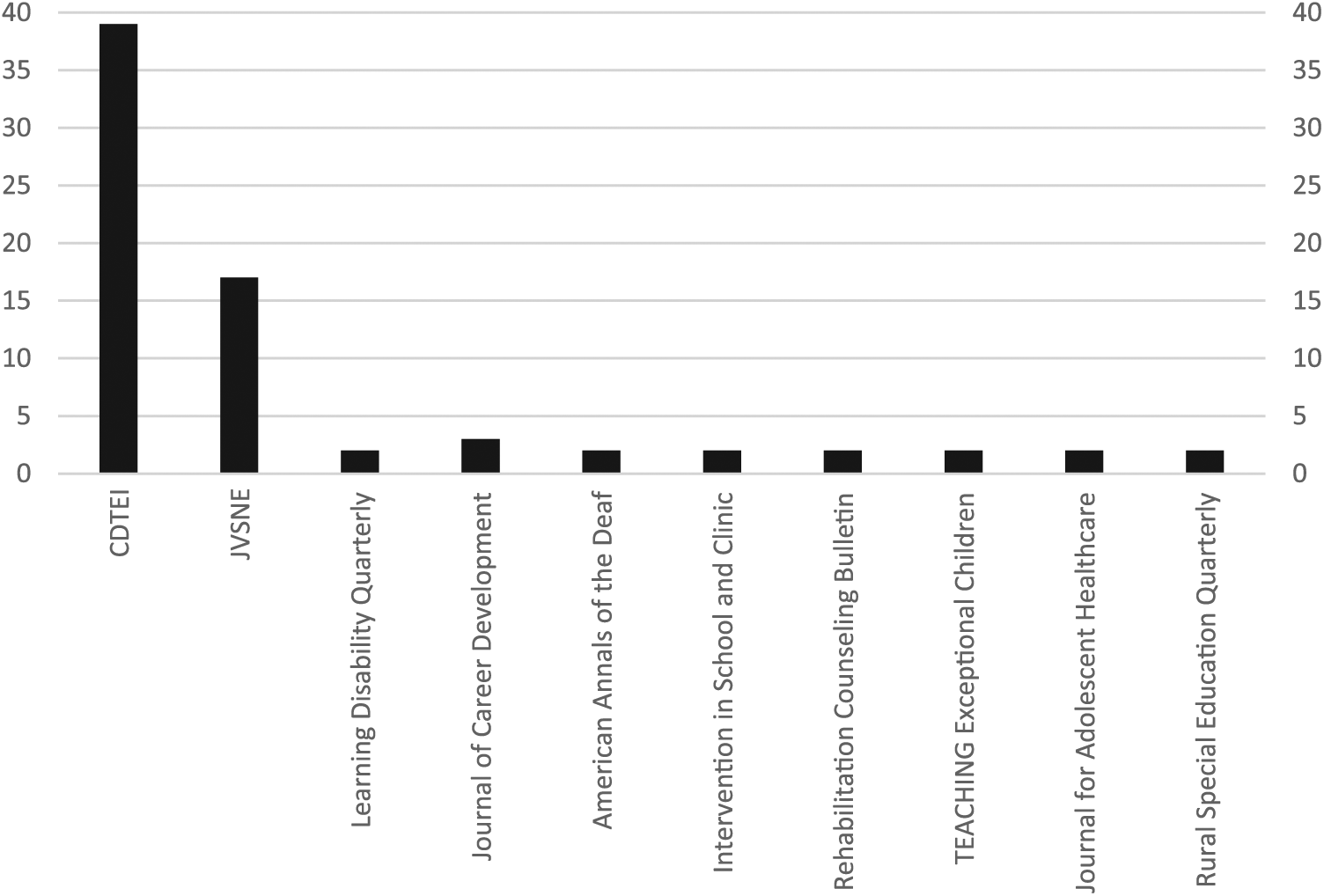
Frequency of articles by journal (n = 89).
Discussion
The purpose of this study was to examine the research literature that involves SWD and CTE through a systematic literature review. Specifically, we sought to address how students with ID may compare to their peer with other disabilities within the CTE literature. This study’s purpose serves a broader aim to better understand the intersection between the CTE literature and SWD and, particularly, those with ID so that future research and policy regarding vocational preparation and workforce readiness will be inclusive of all students, with and without disabilities. By first understanding the existing offerings and the related evidence of effectiveness, better connections between the policy context (as emphasized in ESSA, WIOA, and the Perkins Act) and appropriately targeted subsequent research studies can be prioritized to prepare SWD for college and careers.
Overall, a sizable number of articles (44%) that address the intersection of disability and CTE over several decades have been published in one journal, CDTEI. This journal is published in association with the Division on Career Development and Transition within the Council for Exceptional Children professional organization, and specializes in research content focused on secondary special education and career development for adolescents with disabilities. It is not surprising that this particular journal houses so many articles that address the disability and CTE intersection, but it is somewhat troubling that there are so few articles on this topic covered across other prominent CTE journals. Very few to no articles were published in CTE-focused journals that might not focus on disability (e.g., Journal of Career Development, Journal of Career and Technical Education), suggesting that SWD have unique support needs that do not translate to supports for people without disabilities with regard to employment. The lack of articles addressing this intersection in CTE journals may inadvertently suggest SWD should remain in a separate system and receive separate services, contrary to decades-long efforts toward a more integrated, inclusive workforce (Morningstar et al., 2017).
It is further troubling that only four studies were identified that address CTE and students with ID in particular. Among the four studies, three were data-based, indicating a sizable gap in the secondary special education and transition and CTE literature bases with regard to empirical research studies. In a closer examination of the four studies, notable findings varied. In a correlational study (Baer et al., 2011), researchers found CTE course-taking at the secondary level was not a significant predictor of PSE enrollment. In another study, while the focus was on validation of a vocational skills measure, students with ID scored significantly lower than their peers without disabilities across multiple workplace skills (Dietrich, 1980). The other two articles, one data-based and the other not data-based, focused on employers and their expectations of students with ID (Ehrsten & Izzo, 1988; White, 1983).
These findings emphasize the critical need for further research on students with ID and CTE settings. The small number of studies, as well as the fact that three of the four are more than 30 years old, illustrates the scarcity of knowledge in the field with regard to effective practices and evidence-based practices, and also suggests students with ID have limited access to CTE programs and opportunities. Second, among those studies coded as SWD and SWD&ID, there is a lack of reporting on disability categories, and when reported, categories are often lumped together. Breaking out study samples by category is important in future research so that practitioners can make meaningful decisions about postschool planning.
Relationship to the Current Policy Context
Given that many states have adopted definitions of college and career readiness that place a heavy emphasis on college as the main avenue for career readiness, the importance of examining this literature base cannot be understated. Students with ID have limited access to PSE as compared with their peers with other disabilities (Newman et al., 2011). It is imperative for this population to explore multiple avenues for gaining the skills necessary to be career ready, including CTE. Despite this need, the results of this literature review suggest that research has not yet explored an exhaustive list of potential paths to careers for SWD, which has many policy implications. Specifically, notable themes emerged from our systematic review in employment and technology use, both of which should be considered within the larger policy context.
Employment
In examining the secondary analysis as a whole, it is promising that employment is such a clear focus for SWD, including students with ID. Yet, it is troubling that employment included only a focus on simple job skills, wages earned, and whether or not a student was employed. Articles rarely discussed careers and occupations as outcomes for SWD, in particular, suggesting that the scope of the focus on preparation for work not only excluded skill development in general but also overlooked such development for SWD specifically. Creating opportunities for SWD is important, as is expanding scholarship on the effects of these opportunities. However, more must be done to increase the likelihood that SWD will successfully establish not only initial employment but also a career pathway that allows for wage and skill growth over time. Failure to promote such growth, and failure to study innovative models to promote such growth, would likely result in overreliance of SWD, especially students with ID, on other social policies, which would imply failure of Perkins and WIOA for this population. When people with ID obtain and maintain competitive employment within their communities, they are less likely to rely on assistance from the government, which has been shown to decrease the amount spent on programs like Supplemental Security Income (SSI) and Social Security Disability Insurance (President’s Committee for People with Intellectual Disabilities, 2011). Despite the obvious economic benefit to the country as a whole, students with ID are not engaging in competitive employment at the same rate as their peers without disabilities (Newman et al., 2011). As such, it is crucial to examine the impact of Perkins and WIOA for people with ID.
In addition to the economic benefits of exploring the connections between CTE and people with ID, there are moral implications to consider. Individuals without ID typically follow the natural progression of joining the workforce or PSE, while many people with ID are not accessing those opportunities at the same rates as their peers, with and without disabilities (Newman et al., 2011). Every individual deserves the opportunity to achieve a fulfilling, meaningful life as a productive citizen. Oftentimes that includes the opportunity to obtain and maintain to a satisfying career. Policies must be in place that explicitly and effectively address the lack of access that people with ID experience with regard to preparation for a career.
It is known that community-based employment settings are potentially beneficial for students with ID in terms of employment training (Cihak, Alberto, Kessler, & Taber, 2004). CTE capitalizes on these experiences for the general population, but there were only two studies that focused on students with ID in the literature review. In fact, one particular study found that community business professionals may be less willing to partner with high schools to create meaningful work experiences for adolescents with disabilities, as opposed to their peers without disabilities (Carter et al., 2009); meanwhile, another study showed a clear communication gap between responsibilities of the professionals who work with SWD in CTE settings (e.g., special educators, CTE teachers), such as providing and sharing student information and coordinating services (Schmalzried & Harvey, 2014). Importantly, both of these articles highlight barriers in the current systems that leave this subgroup with more limited options for work experience.
Similarly, although CTE programs in general have established business partnership in the community (Dougherty & Lombardi, 2016), the findings in the current study suggest that very few business partnerships are offered to SWD. If and when connections with employers and local businesses are made in the community, those opportunities should be made available to students with all types of disabilities as well. As part of these efforts, there is an opportunity for special education policy makers, nonprofits, and advocates to educate and inform employers about the ways in which they can be less fearful and more inclusive of individuals with disabilities. Furthermore, businesses that have successfully employed or worked with people with disabilities (specifically those with ID) may be an avenue for educating hesitant businesses via workshops, meetings, and so on orchestrated by policy makers, advocates, and practitioners.
Technology use
Among individual policies, some are more explicit than others in thinking about how technology can be used to enhance learning and career preparation for SWD. For instance, ESSA (2015) clearly establishes the importance of digital and blended learning for all students, including those with disabilities. One environment in which SWD may gain exposure to technology is within CTE. Given this, the literature review highlights a lack of opportunity for SWD (including ID) to engage with technology in the CTE environment. We found no studies that examined SWD and the use of technology. As was made clear in our literature review, the connection between technology use in CTE and SWD is a glaring gap that researchers have not yet explored. Preliminary research has been conducted on embedding information technology literacy into the secondary special education context (Lombardi et al., 2017). Although promising findings have resulted, this study was not conducted in a CTE context. Specific to the subgroup ID, the use of technology (specifically, computer-aided instruction) has been shown to be a promising practice in increasing success for students with ID in the workplace (Mechling & Ortega-Hurndon, 2007; Riffel et al., 2005). It would seem appropriate to utilize the field of CTE for students with ID and their understanding and use of technology as a means to career readiness. Unfortunately, the literature has not explored this connection for students with ID and a potentially significant resource for this population has remained undiscovered in the literature.
Despite the considerable overlap in the goals of the policies discussed previously (ESSA, IDEA, Perkins, WIOA, CCSS), this literature review highlights significant gaps in the ways in which the current policies and systems could work together to achieve improved employment outcomes for youth. Specifically, many of the policies emphasize “all students,” but students with ID can be left out of the conversation or, as in this case, the scholarship. The current study returned only four articles with an exclusive focus on students with ID since 1946. Four articles related to students with ID constitute only 1% of the initial article pool, and less than 5% of all articles on SWD. Thus, articles on SWID constitute a substantial underrepresentation of scholarship relative to their representation in the population (about 7% of all SWD). Students with ID are involved in schools and communities that include CTE; yet, the relationship between the two has remained underexplored. Given the poor outcomes for students with ID and the policy initiatives stating the importance of ensuring that all students are college and career ready, it is imperative that the relationship between this population and the CTE literature is addressed in greater depth.
Study Limitations
As previously mentioned, this study utilized a systematic literature review. Although attempts were made to capture the full breadth of the research base in vocational education and CTE, it is possible that some of the literature on CTE was not captured in the search due to differing key words or the inability to locate articles from the specified databases. Perhaps most notably, our inclusion criteria were limited to the secondary level. Thus, it is possible there are CTE-like programs geared toward adult populations that were not captured in our review. This was intentional, however, so that we may gain a better understanding of the current state of the high school years as a mechanism for change for SWD and preparation for adult life.
Future Research and Policy Implications
Given the findings from the current study, it is clear that SWD are not actively participating in or the focus of research studies in the CTE environment in a manner that is proportional to their need or their prevalence in the general population. This absence in the literature exists despite the rich overlap of policies designed to serve students with and without disabilities as they prepare for the workforce. Policy makers should explore what populations of students are accessing CTE and be inclusive of SWD when creating policies and decisions regarding CTE. Therefore, we suggest that future CTE policies should be more explicit in their inclusion of SWD and special education researchers and practitioners should be explicit about including CTE professionals in the development of student plans. Specifically, researchers might consider investigating special education programs, including those that serve students with ID, as a way to understand and study the extent to which career preparation exists and is efficacious. As part of such partnerships, researchers should focus on evaluating the effects of current efforts and highlighting examples that show promise as opportunities for replication.
In addition, given everything known about students with ID and success in postschool employment, research should focus on incorporating evidence-based practices into CTE for students with ID. For example, the use of video modeling in a CTE environment for a student with ID may result in promising findings that will encourage and move the forward the relationship between special education and CTE. Finally, future studies should explore the impact of access and participation in CTE has on students with ID.
The current study highlighted and confirmed the significant gap in the research between the CTE and special education fields. Given the small sample of studies for students with ID in CTE scholarship, future research endeavors should attempt to bridge this gap between CTE research and students with ID. This will only be achieved if educators and researchers from both special education and CTE are open to the possibility of working more collaboratively and increasing inclusion for students with ID. Of those studies that may be at the intersection of special education and CTE, it is imperative to collect data on disability categories and limit the practice of merging categories (e.g., “other”) in data analyses.
Ultimately, CTE has the potential to provide a pivotal platform for SWD to gain access to career pathways. Prioritization of such studies must occur, and could eventually lead to more promising career opportunities and improved quality of life for a population of students who have historically experienced more dismal outcomes.
Footnotes
Appendix

| Citation | Subgroup focus |
Outcomes |
Secondary analysis |
||||||||||||||||
|---|---|---|---|---|---|---|---|---|---|---|---|---|---|---|---|---|---|---|---|
| Historical/philosophical in focus | Domestic | Males | Females | SWD | Black/Latino | Low SES | Curriculum based | Nonschool setting | School/business partnerships | Occupation based | Transition | Disengaged youth | Employment | High school graduation | Disability category | Interviews | Postsecondary education | IEP | |
| Baer, Daviso, Flexer, Queen, and Meindl (2011) | 0 | 1 | 1 | 1 | 1 | 1 | 0 | 1 | 1 | 0 | 0 | 1 | 0 | 1 | 0 | 1 | 0 | 1 | 1 |
| Baer et al. (2003) | 0 | 1 | 1 | 1 | 1 | 0 | 0 | 0 | 0 | 0 | 0 | 1 | 0 | 1 | 0 | 1 | 1 | 1 | 1 |
| Bellamy, Wilcox, Rose, and McDonnell (1985) | 0 | 1 | 0 | 0 | 1 | 0 | 0 | 1 | 1 | 0 | 0 | 1 | 0 | 1 | 0 | 0 | 0 | 1 | 1 |
| Benz and Halpern (1993) | 0 | 1 | 0 | 1 | 1 | 0 | 0 | 0 | 0 | 0 | 0 | 0 | 0 | 1 | 0 | 1 | 1 | 1 | 0 |
| Benz and Kochhar (1996) | 1 | 1 | 0 | 0 | 1 | 0 | 0 | 1 | 1 | 0 | 0 | 1 | 0 | 1 | 0 | 0 | 0 | 1 | 0 |
| Bisconer, Stodden, and Porter (1993) | 0 | 1 | 0 | 0 | 1 | 0 | 0 | 0 | 0 | 0 | 0 | 0 | 0 | 1 | 0 | 1 | 0 | 0 | 0 |
| Bonds (2003) | 0 | 1 | 0 | 0 | 1 | 0 | 0 | 0 | 0 | 0 | 0 | 1 | 0 | 1 | 0 | 1 | 0 | 1 | 1 |
| Bozick and Dalton (2013) | 0 | 1 | 1 | 1 | 1 | 1 | 1 | 1 | 0 | 0 | 1 | 0 | 0 | 0 | 0 | 0 | 0 | 1 | 0 |
| Brown, Berkell, and Schmelkin (1992) | 0 | 1 | 0 | 0 | 1 | 0 | 0 | 0 | 0 | 0 | 0 | 0 | 0 | 0 | 0 | 1 | 0 | 0 | 0 |
| Cacich and Dosch (1983) | 0 | 1 | 0 | 0 | 1 | 0 | 0 | 1 | 1 | 0 | 0 | 1 | 0 | 1 | 0 | 1 | 0 | 0 | 0 |
| Carter et al. (2010) | 0 | 1 | 1 | 1 | 1 | 1 | 1 | 0 | 0 | 0 | 0 | 0 | 0 | 1 | 0 | 1 | 1 | 1 | 0 |
| Carter et al. (2009) | 0 | 1 | 0 | 0 | 1 | 0 | 0 | 0 | 0 | 1 | 1 | 0 | 0 | 1 | 0 | 0 | 1 | 0 | 0 |
| Casale-Giannola (2012) | 0 | 1 | 0 | 0 | 1 | 0 | 0 | 1 | 0 | 0 | 1 | 0 | 0 | 0 | 0 | 0 | 0 | 0 | 1 |
| Cobb and Hasazi (1987) | 0 | 1 | 0 | 0 | 1 | 0 | 0 | 0 | 0 | 0 | 0 | 1 | 0 | 1 | 1 | 1 | 0 | 1 | 1 |
| Cobb and Johnson (1997) | 1 | 1 | 0 | 0 | 1 | 0 | 0 | 1 | 1 | 0 | 0 | 1 | 0 | 1 | 0 | 0 | 0 | 0 | 0 |
| Collet-Klingenberg (1998) | 0 | 1 | 0 | 0 | 1 | 0 | 0 | 1 | 1 | 0 | 0 | 1 | 1 | 1 | 0 | 1 | 0 | 0 | 1 |
| Colley and Jamison (1998) | 0 | 1 | 0 | 0 | 1 | 0 | 0 | 1 | 1 | 0 | 0 | 1 | 0 | 1 | 1 | 1 | 0 | 1 | 1 |
| Danzig and Aljarrah (1999) | 0 | 1 | 1 | 1 | 1 | 1 | 0 | 1 | 0 | 0 | 0 | 0 | 0 | 0 | 0 | 0 | 0 | 0 | 0 |
| Davis and Bullis (1990) | 0 | 1 | 0 | 0 | 1 | 0 | 0 | 1 | 0 | 0 | 0 | 1 | 0 | 1 | 0 | 1 | 0 | 0 | 0 |
| Dietrich (1980) | 0 | 1 | 0 | 0 | 1 | 0 | 0 | 0 | 0 | 0 | 1 | 0 | 0 | 1 | 0 | 1 | 0 | 0 | 0 |
| Domenico and Jones (2007) | 1 | 1 | 0 | 1 | 1 | 0 | 1 | 0 | 0 | 0 | 0 | 0 | 1 | 1 | 1 | 0 | 0 | 0 | 0 |
| Ehrsten and Izzo (1988) | 0 | 1 | 0 | 0 | 1 | 0 | 0 | 1 | 1 | 0 | 0 | 1 | 0 | 0 | 0 | 1 | 0 | 0 | 1 |
| Elrod, Cahalane, and Combe (1997) | 0 | 1 | 0 | 0 | 1 | 0 | 0 | 1 | 1 | 0 | 1 | 0 | 0 | 1 | 0 | 1 | 1 | 0 | 0 |
| Evanciew (2001) | 0 | 1 | 0 | 0 | 1 | 0 | 0 | 1 | 1 | 0 | 0 | 0 | 0 | 0 | 0 | 1 | 0 | 0 | 0 |
| Everson, Zhang, and Guillory (2001) | 0 | 1 | 0 | 0 | 1 | 0 | 0 | 0 | 0 | 0 | 0 | 1 | 0 | 1 | 0 | 1 | 0 | 1 | 1 |
| Fleming and Fairweather (2012) | 0 | 1 | 1 | 1 | 1 | 1 | 1 | 0 | 0 | 0 | 0 | 1 | 0 | 1 | 1 | 1 | 0 | 1 | 0 |
| Flexer, Baer, Simmons, and Shell (1997) | 0 | 1 | 0 | 0 | 1 | 0 | 0 | 0 | 0 | 0 | 0 | 1 | 0 | 1 | 0 | 0 | 0 | 1 | 0 |
| Flexer, Daviso, Baer, Queen, and Meindl (2011) | 0 | 1 | 1 | 1 | 1 | 1 | 0 | 1 | 1 | 0 | 0 | 1 | 0 | 1 | 0 | 1 | 0 | 1 | 1 |
| Habeck and Szymanski (1999) | 0 | 1 | 0 | 0 | 1 | 0 | 0 | 0 | 0 | 0 | 0 | 1 | 0 | 1 | 0 | 1 | 0 | 0 | 0 |
| Haber and Sutherland (2008) | 0 | 1 | 0 | 0 | 1 | 0 | 0 | 0 | 0 | 0 | 0 | 0 | 0 | 0 | 0 | 0 | 0 | 0 | 1 |
| Harvey (2002) | 0 | 1 | 1 | 1 | 1 | 1 | 1 | 0 | 0 | 0 | 0 | 0 | 0 | 1 | 0 | 1 | 0 | 1 | 1 |
| Harvey and Pellock (2003) | 0 | 1 | 0 | 0 | 1 | 0 | 0 | 0 | 0 | 0 | 0 | 0 | 0 | 0 | 0 | 1 | 0 | 1 | 1 |
| Harvey and Pellock (2004) | 0 | 1 | 0 | 0 | 1 | 0 | 0 | 0 | 0 | 0 | 0 | 0 | 0 | 0 | 0 | 1 | 0 | 0 | 1 |
| Harvey, Cotton, and Koch (2007) | 0 | 1 | 0 | 0 | 1 | 0 | 0 | 0 | 0 | 0 | 0 | 0 | 0 | 0 | 0 | 1 | 0 | 1 | 1 |
| Hazelkorn and Lombard (1991) | 0 | 1 | 0 | 0 | 1 | 0 | 0 | 1 | 0 | 0 | 0 | 0 | 0 | 0 | 0 | 0 | 0 | 0 | 0 |
| Heady and Porter (1981) | 0 | 1 | 0 | 0 | 1 | 0 | 1 | 1 | 1 | 0 | 0 | 0 | 1 | 1 | 1 | 0 | 0 | 1 | 0 |
| Hiltenbrand and Newton (1980) | 1 | 1 | 0 | 0 | 1 | 0 | 0 | 1 | 0 | 0 | 0 | 0 | 0 | 1 | 0 | 1 | 0 | 0 | 0 |
| Hoisch, Karen, and Franzini (1992) | 0 | 1 | 0 | 0 | 1 | 0 | 0 | 1 | 1 | 0 | 0 | 0 | 0 | 1 | 0 | 1 | 0 | 0 | 0 |
| Hudson, Schwartz, Sealander, Campbell, and Hensel (1988) | 0 | 1 | 0 | 0 | 1 | 0 | 0 | 0 | 0 | 0 | 0 | 0 | 0 | 1 | 1 | 1 | 0 | 1 | 0 |
| Hughes, Karp, Fermin, and Bailey (2005) | 0 | 1 | 0 | 0 | 1 | 0 | 0 | 1 | 0 | 0 | 0 | 1 | 0 | 1 | 1 | 0 | 0 | 1 | 0 |
| Hughey (1989) | 0 | 1 | 0 | 0 | 1 | 0 | 0 | 1 | 1 | 0 | 0 | 1 | 0 | 1 | 0 | 0 | 1 | 0 | 1 |
| Hutchinson, Versnel, Chin, and Munby (2008) | 0 | 1 | 0 | 0 | 1 | 0 | 0 | 0 | 1 | 0 | 1 | 0 | 0 | 1 | 0 | 1 | 0 | 0 | 1 |
| Izzo (1987) | 0 | 1 | 0 | 0 | 1 | 0 | 0 | 1 | 1 | 0 | 0 | 1 | 0 | 0 | 0 | 0 | 0 | 0 | 1 |
| Kamens, Dolyniuk, and Dinardo (2003) | 0 | 1 | 0 | 0 | 1 | 0 | 0 | 0 | 0 | 0 | 0 | 0 | 0 | 0 | 0 | 1 | 0 | 0 | 1 |
| Kantor and Lowe (2000) | 1 | 1 | 1 | 1 | 1 | 0 | 0 | 0 | 0 | 0 | 0 | 0 | 0 | 1 | 1 | 0 | 0 | 0 | 0 |
| Keim, Rak, and Fell (1982) | 0 | 1 | 0 | 0 | 1 | 0 | 0 | 1 | 1 | 0 | 0 | 0 | 0 | 1 | 0 | 1 | 0 | 0 | 1 |
| Knight and Rieck (1997) | 0 | 1 | 0 | 0 | 1 | 0 | 0 | 0 | 1 | 1 | 0 | 0 | 0 | 1 | 0 | 0 | 1 | 0 | 0 |
| Kochhar (1997) | 0 | 1 | 0 | 0 | 1 | 0 | 0 | 0 | 0 | 0 | 0 | 1 | 0 | 0 | 0 | 0 | 0 | 0 | 0 |
| Kochhar and West (1995) | 0 | 1 | 0 | 0 | 1 | 0 | 0 | 1 | 1 | 0 | 0 | 1 | 0 | 1 | 0 | 0 | 0 | 0 | 1 |
| Kohler (1994) | 0 | 1 | 1 | 1 | 1 | 0 | 0 | 1 | 1 | 0 | 0 | 1 | 0 | 0 | 0 | 1 | 0 | 0 | 0 |
| Kolstoe (1996) | 1 | 1 | 0 | 0 | 1 | 0 | 0 | 0 | 0 | 0 | 0 | 1 | 0 | 1 | 0 | 1 | 0 | 0 | 1 |
| Kolstoe (1981) | 1 | 1 | 0 | 0 | 1 | 0 | 0 | 0 | 0 | 0 | 0 | 1 | 0 | 1 | 1 | 1 | 0 | 0 | 1 |
| Kymes (2004) | 1 | 1 | 0 | 0 | 1 | 0 | 0 | 0 | 0 | 0 | 0 | 0 | 1 | 1 | 1 | 0 | 0 | 0 | 0 |
| Levesque et al. (2008) | 0 | 1 | 1 | 1 | 1 | 1 | 1 | 0 | 0 | 0 | 0 | 1 | 0 | 1 | 1 | 1 | 0 | 0 | 1 |
| Lindsey and Blalock (1993) | 0 | 1 | 0 | 0 | 1 | 0 | 0 | 1 | 1 | 0 | 0 | 0 | 0 | 1 | 0 | 0 | 1 | 0 | 1 |
| Lombard, Hazelkorn, and Neubert (1992) | 0 | 1 | 0 | 0 | 1 | 0 | 0 | 0 | 0 | 0 | 0 | 0 | 0 | 1 | 1 | 1 | 0 | 0 | 1 |
| Lynch and Reimer (1997) | 0 | 1 | 0 | 0 | 1 | 0 | 0 | 0 | 0 | 0 | 0 | 0 | 0 | 1 | 0 | 1 | 0 | 0 | 1 |
| McCoy (1987) | 0 | 0 | 0 | 0 | 1 | 0 | 0 | 1 | 1 | 0 | 0 | 1 | 0 | 1 | 0 | 0 | 0 | 0 | 0 |
| McNally and Harvey (2001) | 0 | 1 | 0 | 0 | 1 | 0 | 0 | 0 | 0 | 0 | 0 | 0 | 0 | 1 | 0 | 0 | 0 | 0 | 1 |
| Meehan and Hodell (1986) | 0 | 1 | 0 | 0 | 1 | 0 | 0 | 0 | 0 | 0 | 0 | 0 | 0 | 1 | 0 | 1 | 0 | 0 | 1 |
| Menchel (1984) | 0 | 1 | 0 | 0 | 1 | 0 | 0 | 1 | 0 | 0 | 0 | 1 | 0 | 1 | 0 | 1 | 0 | 1 | 0 |
| Minskoff and DeMoss (1993) | 0 | 1 | 0 | 0 | 1 | 0 | 0 | 1 | 0 | 0 | 0 | 1 | 0 | 0 | 0 | 1 | 0 | 1 | 1 |
| Monahan (2003) | 1 | 1 | 0 | 0 | 1 | 0 | 0 | 0 | 0 | 0 | 0 | 0 | 0 | 1 | 0 | 1 | 0 | 1 | 1 |
| Morningstar (1997) | 0 | 1 | 0 | 0 | 1 | 1 | 0 | 1 | 1 | 0 | 1 | 1 | 0 | 1 | 0 | 1 | 0 | 1 | 1 |
| Nadolsky (1981) | 0 | 1 | 0 | 0 | 1 | 0 | 0 | 1 | 0 | 0 | 0 | 0 | 0 | 1 | 0 | 0 | 0 | 0 | 0 |
| Nelson, Fischer, and Rubenstein (1985) | 0 | 1 | 0 | 0 | 1 | 0 | 0 | 0 | 1 | 0 | 0 | 1 | 0 | 1 | 0 | 1 | 0 | 0 | 0 |
| Neubert (1986) | 0 | 1 | 0 | 0 | 1 | 0 | 0 | 0 | 0 | 0 | 0 | 0 | 0 | 0 | 0 | 0 | 0 | 0 | 1 |
| Okolo and Sitlington (1988) | 0 | 1 | 0 | 0 | 1 | 0 | 0 | 1 | 1 | 0 | 0 | 1 | 0 | 0 | 0 | 1 | 0 | 1 | 1 |
| Owens-Johnson and Johnson (1999) | 0 | 1 | 0 | 0 | 1 | 0 | 0 | 1 | 0 | 0 | 0 | 1 | 1 | 1 | 1 | 1 | 1 | 0 | 0 |
| Patten (1981) | 0 | 1 | 0 | 0 | 1 | 0 | 0 | 0 | 0 | 0 | 0 | 0 | 0 | 1 | 0 | 0 | 0 | 0 | 1 |
| Peterson (1986) | 0 | 1 | 0 | 0 | 1 | 0 | 0 | 0 | 0 | 0 | 0 | 0 | 0 | 1 | 0 | 0 | 0 | 0 | 0 |
| Porter and Stodden (1986) | 0 | 1 | 0 | 0 | 1 | 0 | 0 | 1 | 0 | 1 | 0 | 0 | 0 | 1 | 0 | 0 | 0 | 1 | 1 |
| Rabren, Carpenter, Dunn, and Carney (2014) | 0 | 1 | 1 | 1 | 1 | 1 | 0 | 1 | 1 | 0 | 0 | 0 | 0 | 1 | 1 | 1 | 1 | 1 | 1 |
| Razeghi (1981) | 0 | 1 | 0 | 0 | 1 | 0 | 0 | 0 | 0 | 0 | 0 | 0 | 0 | 1 | 0 | 0 | 0 | 0 | 1 |
| Retish and Greenan (1991) | 0 | 1 | 0 | 0 | 1 | 0 | 0 | 1 | 1 | 0 | 0 | 0 | 0 | 1 | 0 | 0 | 0 | 0 | 1 |
| Sarkees-Wircenski and Wircenski (1994) | 0 | 1 | 0 | 0 | 1 | 0 | 0 | 0 | 0 | 0 | 0 | 0 | 0 | 1 | 0 | 0 | 1 | 0 | 1 |
| Satcher (1994) | 0 | 1 | 0 | 0 | 1 | 0 | 0 | 0 | 0 | 0 | 0 | 1 | 0 | 0 | 0 | 1 | 0 | 0 | 0 |
| Sitlington and Okolo (1987) | 0 | 1 | 0 | 0 | 1 | 0 | 0 | 1 | 0 | 0 | 1 | 0 | 0 | 0 | 0 | 1 | 0 | 0 | 1 |
| Sowers and Powers (1989) | 0 | 1 | 0 | 0 | 1 | 0 | 0 | 0 | 0 | 0 | 0 | 0 | 0 | 1 | 0 | 1 | 0 | 0 | 0 |
| Spruill and Kallio (1994) | 0 | 1 | 1 | 1 | 1 | 0 | 0 | 1 | 1 | 0 | 1 | 1 | 0 | 1 | 1 | 1 | 0 | 0 | 1 |
| Szymanski, Hanley-Maxwell, and Asselin (1990) | 0 | 1 | 0 | 0 | 1 | 0 | 0 | 0 | 0 | 0 | 0 | 0 | 1 | 1 | 1 | 0 | 0 | 0 | 0 |
| Taylor and Servage (2012) | 0 | 0 | 1 | 1 | 1 | 1 | 0 | 0 | 1 | 0 | 1 | 1 | 0 | 0 | 0 | 0 | 0 | 1 | 0 |
| Trainor, Smith, and Kim (2012) | 0 | 1 | 0 | 0 | 1 | 0 | 0 | 0 | 1 | 0 | 0 | 1 | 0 | 1 | 0 | 1 | 1 | 0 | 1 |
| Wehman and Barcus (1985) | 0 | 1 | 0 | 0 | 1 | 0 | 0 | 0 | 0 | 1 | 0 | 0 | 0 | 1 | 1 | 0 | 1 | 0 | 0 |
| Weisenstein (1991) | 0 | 1 | 0 | 0 | 1 | 0 | 0 | 1 | 0 | 0 | 0 | 0 | 1 | 1 | 1 | 1 | 0 | 0 | 1 |
| West (1988) | 1 | 1 | 0 | 0 | 1 | 0 | 0 | 1 | 1 | 0 | 0 | 1 | 0 | 1 | 0 | 0 | 0 | 0 | 1 |
| White (1983) | 0 | 1 | 0 | 0 | 1 | 0 | 0 | 1 | 0 | 0 | 1 | 0 | 0 | 1 | 0 | 1 | 0 | 0 | 0 |
| Winn and Hay (2009) | 0 | 0 | 0 | 0 | 1 | 0 | 0 | 0 | 0 | 0 | 0 | 1 | 0 | 1 | 0 | 0 | 0 | 1 | 0 |
| Wisniewski, Alper, and Schloss (1991) | 0 | 1 | 0 | 0 | 1 | 0 | 0 | 0 | 1 | 0 | 0 | 1 | 0 | 1 | 0 | 1 | 0 | 0 | 1 |
Note. Full references are provided in the reference list with an asterisk. 1 = yes, 0 = no. SWD = students with disabilities; SES = socioeconomic status; IEP = individualized education program.
Declaration of Conflicting Interests
The author(s) declared no potential conflicts of interest with respect to the research, authorship, and/or publication of this article.
Funding
The author(s) received no financial support for the research, authorship, and/or publication of this article.