




Abstract
In the United States, employment rates among individuals with disabilities are persistently low but vary substantially. In this study, we examined the relationship between employment outcomes and features of the state and county physical, economic, and policy environment among a national sample of individuals with disabilities. To do so, we merged a set of state- and county-level environmental variables with data from the 2009–2011 American Community Survey accessed in a U.S. Census Research Data Center. We estimated regression models of employment, work hours, and earnings as a function of disability, personal characteristics, and these environmental features. We found that economic conditions and physical environmental variables had stronger associations than policy variables with employment outcomes. Although the estimated importance of environmental variables was small relative to individual disability and personal characteristics, our results suggest that these variables may present barriers or facilitators to employment that can explain some geographic variation in employment outcomes across the United States.
Keywords
In the United States, employment rates among working-age individuals with disabilities have continuously been substantially lower than those among individuals without disabilities. Among people aged 16 and older, for example, 66% of those who did not have a disability and 23% of those who had a disability were employed in 2014 (U.S. Census Bureau, 2015a). Economic disparities remain for people with disabilities who do work; for example, they earn less, on average, than people without disabilities (Yin, Shaewitz, & Megra, 2014). In 2014, median annual earnings among people with disabilities were US$21,232, substantially less than the median annual earnings of those without disabilities (US$31,324; U.S. Census Bureau, 2015b). Part of this difference may be due to the fact that workers with disabilities are less likely to work full-time than those without disabilities (U.S. Census Bureau, 2015c).
While employer attitudes, willingness to pay for workplace accommodations, and a number of unobservable factors may influence employment outcomes, the fact that employment outcomes vary substantially across states suggests that differences in state and local economic, policy, or other environmental characteristics play an important role in shaping employment opportunities for people with disabilities. The 2012 5-year American Community Survey (ACS) reveals employment rates that range from a low of 25.3% in West Virginia to a high of 52.8% in North Dakota. There is also substantial variation within states. For example, most counties in Arizona (including Pima County, where Tucson is located, and Maricopa County, where Phoenix is located) have employment rates of 30% to 40% for this population. However, Coconino County has employment rates higher than 40% and several counties have employment rates lower than 30%.
This variation provides an opportunity to learn about factors that could improve employment outcomes for people with disabilities. From a theoretical perspective, this variation is consistent with the social model of disability, which posited that an individual’s medical condition or impairment, assistive devices, and characteristics of his or her physical, social, policy, and economic environments are major determinants of participation in social activities such as employment (Verbrugge & Jette, 1994). If these environmental factors vary across states and counties, we would expect to find differences in employment outcomes. The International Classification of Functioning, Disability and Health (ICF) grouped the determinants of employment into three domains that affect outcomes: (a) underlying “health conditions,” (b) “personal characteristics,” and (c) “environmental characteristics” (World Health Organization, 2001). We used this framework to review the existing literature and structure our analyses.
The literature has provided substantial evidence of differences in employment by the first domain, health characteristics, using various national and administrative data sets. People with sensory impairments have been more likely to be employed than those with physical impairments, and members of both of these groups have been more likely to be employed than those with mental impairments (Berry & Caplan, 2010; Brucker, Houtenville, & Lauer, 2015; Houtenville, Sevak, O’Neill, & Cardoso, 2013; Maestas, Mullen, & Strand, 2013; O’Neill, Kaczetow, Pfaller, & Verkuilen, 2017; Weathers & Wittenburg, 2009; Wittenburg & Nelson, 2006).
Studies have documented differences by the second ICF domain, personal characteristics. Researchers have consistently found that older age was associated with lower employment rates in various national subpopulations of individuals with disabilities, including people with physical impairments or chronic health conditions (Ipsen, 2006), Social Security Disability Insurance (SSDI) and Supplemental Security Income (SSI) participants (Mamun, O’Leary, Wittenburg, & Gregory, 2011; Stapleton, Honeycutt, & Schechter, 2010), participants in State Medicaid Buy-In (MBI) Programs (Ireys, Gimm, & Liu, 2009), and vocational rehabilitation (VR) clients (Mwachofi, Broyles, & Khaliq, 2009). Research findings on gender, race, ethnicity, and employment outcomes have differed (Ipsen, 2006; Ireys et al., 2009; Mwachofi et al., 2009).
In this study, we focused on the third ICF domain, environmental characteristics, and divided these characteristics into four areas: (a) policy environment, (b) economic environment, (c) physical environment and amenities, and (d) population characteristics. Although this domain covers many factors, it has not been the subject of as much empirical research as the others.
The policy environment related to individuals with disabilities is shaped at the national level by programs such as SSDI or policies such as the Americans With Disabilities Act (ADA), at the state level by state VR programs, and the interplay of both programs such as SSI or Medicaid. Studies have documented positive and negative effects of the ADA (Acemoglu & Angrist, 2001; Beagle & Stock, 2003; DeLeire, 2003) and of public disability benefit programs (Bound, 1989; Chen & van der Klaauw, 2008; French & Song, 2014; Haveman & Wolfe, 1984; Maestas et al., 2013; Parsons, 1980; von Wachter, Song, & Manchester, 2011) on employment. At the state level, studies have documented associations between employment rates and differences in VR agencies and programs (Stapleton et al., 2010). Differences in rehabilitation rates—the percentage of people served by VR agencies who are employed when their case is closed—may reflect the availability of an adequate, well-coordinated system of employment services and supports. Research shows that some states with MBI Programs have higher employment rates (Ireys et al., 2009). States’ SSDI and SSI allowance rates also vary. These differences may reflect not only systemic variation in disability determination processes but also differences in state demographic or economic factors (Strand, 2002). Recent work by Manchester (2015), for example, suggests that the high rates of SSDI participation by young adults in northern New England states can be attributed to a mixture of state policy and economic and population health factors.
The local economic environment may affect the actual opportunities that are available. People with disabilities were disproportionately affected by the most recent recession (Livermore & Honeycutt, 2015) and some studies have found that county-level per capita income (Botticello, Chen, & Tulsky, 2012; Cunningham & Altman, 1993) and employment rates (Cunningham & Altman, 1993) were related to employment for selected subpopulations of individuals with disabilities. A related literature has shown how the local economy influences SSI/SSDI application. Nichols, Schmidt, and Sevak (2017) found that county unemployment rates are related to adult SSI application, Autor and Duggan (2003) found that shifts in state-level labor demand predict changes in SSDI participation, and Black, Daniel, and Sanders (2002) found that local earnings growth is related to both SSDI and SSI participation.
The physical environment and local amenities may also impact employment for individuals with disabilities. Transportation (Whiteneck et al., 2004), weather conditions (Wee & Paterson, 2009), and personal safety (Brucker, 2015) have all been reported as barriers to employment for various subpopulations of individuals with disabilities. Living in an urban area has been associated with lower employment rates among individuals with spinal cord injuries (Botticello et al., 2012). One study found that individuals with disabilities living in areas with high levels of illegal drug use had poorer labor market outcomes (Richardson, Wood, & Keer, 2013).
Our research constitutes an effort to move the literature forward by examining associations between a broad set of environmental characteristics and employment outcomes in a national sample of individuals with disabilities, to understand how those characteristics facilitate or impede employment. We hypothesized that employment outcomes for individuals with disabilities vary with these characteristics, when holding health and personal characteristics constant. More specifically, we aimed to address the following research questions:
As some environmental factors may be more malleable, understanding their relationship to employment outcomes is important for shaping policies that aim to improve employment outcomes for individuals with disabilities. In addition to employment, we also examined hours of work and earnings among individuals who were working, given the evidence that disparities exist even among those who are working (U.S. Census Bureau, 2015b).
Method
Data
The ACS, collected by the U.S. Census Bureau, is the largest nationally representative survey in the United States. It provides detailed demographics and information on employment and income annually. Researchers have used a sequence of six questions in the ACS about vision, hearing, ambulatory, cognitive, self-care, and independent living difficulties to identify individuals with disabilities (Burkhauser, Houtenville, & Tennant, 2014). We used the pooled 2009–2011 ACS data to have adequate sample sizes for individuals with disabilities at the county level.
Although the ACS contains detailed information on individual characteristics, it has limited information about the policy, economic, and social environment in which the respondents live. To augment the analysis file with this information, we compiled data on state and county environmental variables from a number of external sources (see Table 1), including published estimates of county characteristics from the 5-year 2007–2011 ACS. We merged the state and county variables with the ACS analysis file using state and county geocodes. The publicly available versions of the ACS do not fully report county of residence, so we used a restricted version of the data that is available only in U.S. Census Research Data Centers. The 2009–2011 ACS data were the most recently available pooled file with geocodes when the study was conducted.
Variables and Sources Used in Analysis.
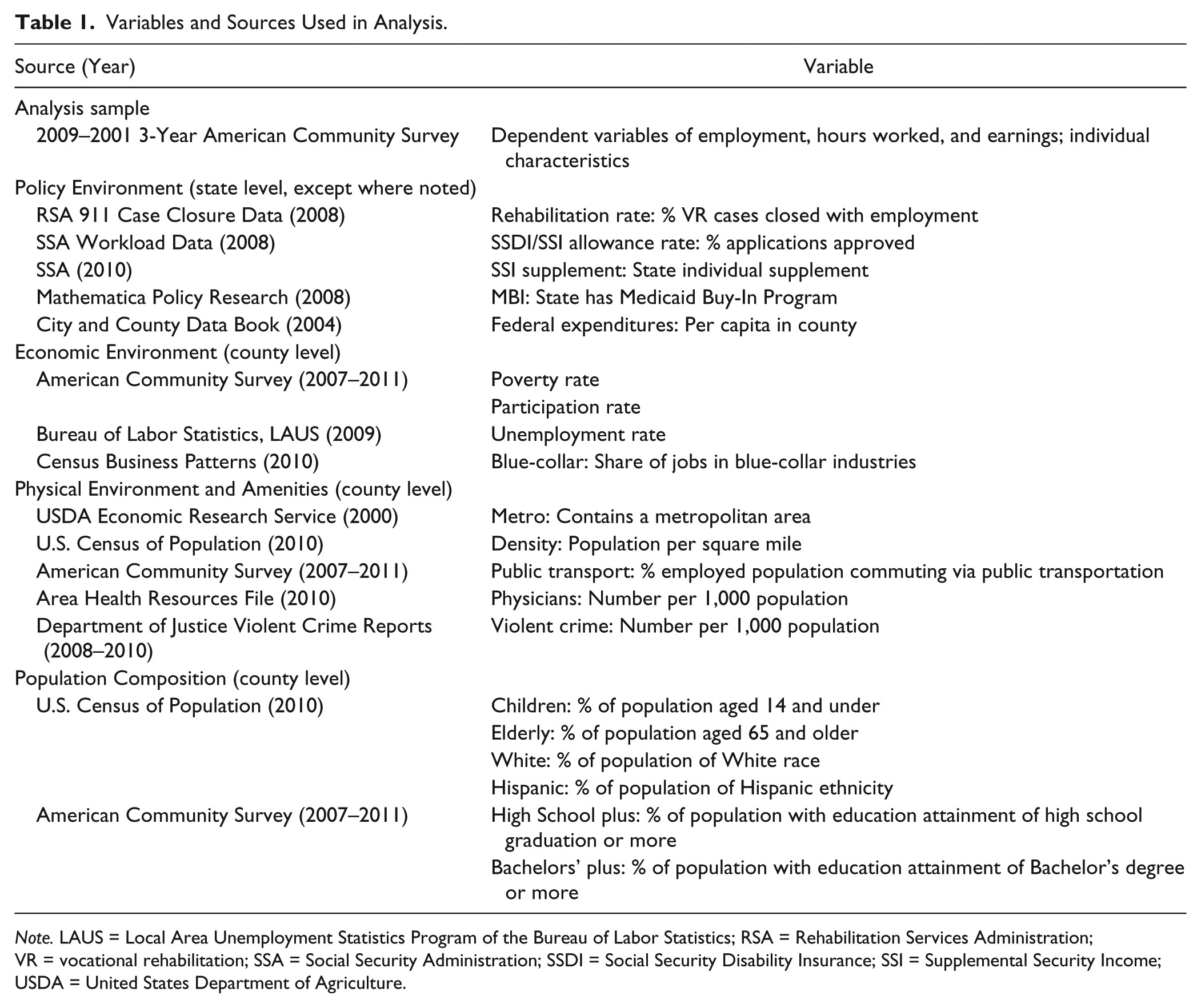
Note. LAUS = Local Area Unemployment Statistics Program of the Bureau of Labor Statistics; RSA = Rehabilitation Services Administration; VR = vocational rehabilitation; SSA = Social Security Administration; SSDI = Social Security Disability Insurance; SSI = Supplemental Security Income; USDA = United States Department of Agriculture.
Sample
The analytic sample included approximately 599,000 community-dwelling individuals with disabilities aged 25 to 59, in 50 states and the District of Columbia. We excluded individuals living in institutions because they are not likely to be employed, and we limited the age range to avoid postsecondary enrollment and retirement as competing outcomes. The sample can be generalized to the entire noninstitutionalized U.S. population aged 25 to 59. Roughly 51% of the weighted ACS sample of community-dwelling individuals with disabilities is female, 16% is of Black race, and 12% is Hispanic (Sevak, Houtenville, Brucker, & O’Neill, 2015).
Measures
Dependent variables
We used three different measures of employment: employment, weekly hours of work, and annual earnings. Each of these measures were available at the individual level in the ACS data. We used the natural log of weekly hours and annual earnings in regressions.
Independent variables
We included a number of independent variables that were available in the ACS data. Disability was measured using the standard ACS disability questions which ask whether a person has an ambulatory, cognitive hearing, independent living, self-care, or visual impairment. We also included measures for age, gender, race and ethnicity, educational attainment, and marital and veteran’s status. We created variables from external, publicly available sources (see Table 1) in four categories: policy environment, economic environment, physical environment and amenities, and population characteristics.
We included five measures of the policy environment that we determined to be most relevant to employment among persons with disabilities, all but one of which are state-level characteristics. First, we included the rehabilitation rate in the state, or the percentage of individuals who received employment services through the state VR agency and were employed when their case was closed. Higher rehabilitation rates may reflect a better system of employment supports, and as a result, we expect them to be associated with higher employment, hours, and earnings. The mean rehabilitation rate was 57.5% (see Table 2). Second, we included two measures related to Social Security disability benefits, which theoretically should be negatively associated with employment outcomes as they make receipt of disability benefits more likely or more attractive. The first, the allowance rate, with a mean of 26.5%, is the percentage of SSI and SSDI applicants who are approved to receive benefits. The second measure is the dollar amount of the state SSI supplement for individual recipients. Its mean, which includes states with no supplement, is US$44. We also included an indicator for whether the state has a MBI Program. The MBI program offers Medicaid coverage to people with disabilities who are working and are earning more than the allowable limits for regular Medicaid. Because the program is designed to encourage working people with disabilities to earn more income without the risk of losing health care coverage, we expect it to be positively associated with employment outcomes. Seventy percent of the sample members live in a state with an MBI program. Finally, we included the amount of federal aid per capita the county received, as a proxy for the fiscal health of the local government. We did not have a prior expectation on whether this variable would be related to employment rates, but we include it because there is evidence that state-level fiscal distress is related to SSI caseloads (Kubik, 2003).
Means of Environmental Variables Among Individuals With Disabilities.
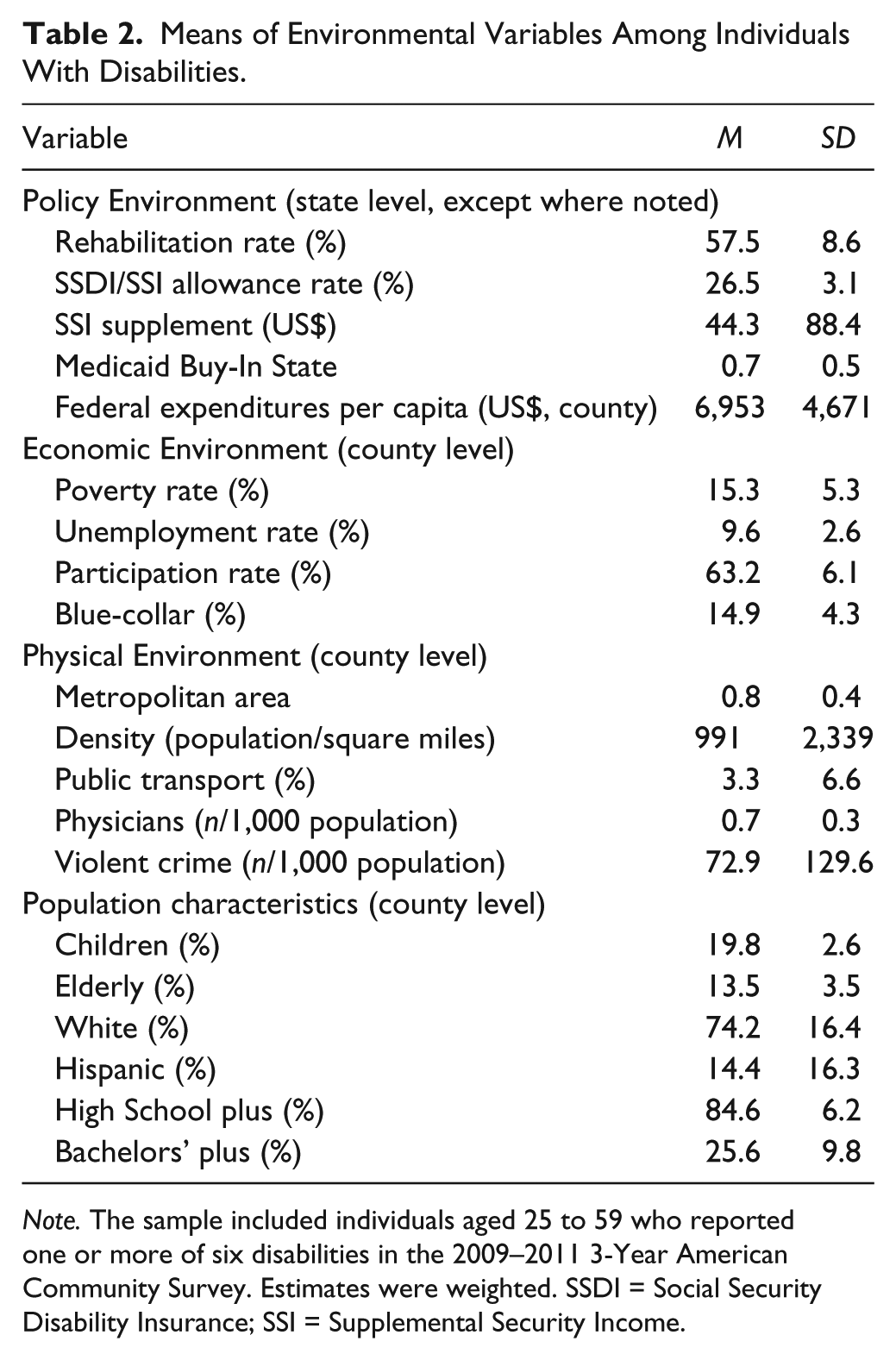
Note. The sample included individuals aged 25 to 59 who reported one or more of six disabilities in the 2009–2011 3-Year American Community Survey. Estimates were weighted. SSDI = Social Security Disability Insurance; SSI = Supplemental Security Income.
We included four county-level measures of the economic environment that capture slightly different features of the local economy. In general, we expected individuals living in counties with more robust economies to have better employment outcomes. We included the county poverty rate, which has a mean of 15.3%, as a measure of the economic well-being at the bottom of the income distribution. We also included the county unemployment rate, which has a mean of 9.6%, to describe labor market opportunities. Third, we included the labor force participation rate, which reflects labor supply and may reflect local variation in social norms regarding withdrawal from the labor force. Finally, we included the percentage of jobs in blue-collar industries as a measure of the composition of jobs in the county.
The third set of variables captured the physical environment and local amenities that may be facilitators or barriers to employment for individuals with disabilities. These included two measures of metropolitan status and density, the percentage of workers who use public transportation to commute to work, the number of physicians per 1000 people in the population, and the number of violent crimes per 1000 people in the population.
Last, we included county-level population characteristics. These included measures of the distribution of age, race, and educational attainment. Although this article does not focus on these characteristics, we controlled for them because both disability prevalence and employment outcomes vary by demographic characteristics and geography (Houtenville et al., 2013).
Model Specification
Using population weights provided in the ACS, we estimated linear regression models of three employment outcomes: employment, log weekly hours of work, and log earnings. Linear regression models were used for all three models for ease of interpretation of estimates. We included as predictors the set of environmental variables described above. We controlled for types of disability using six indicator variables for each of the six ACS disability questions, which are not mutually exclusive. We controlled for demographic characteristics that have been shown in the literature to be related to labor supply of individuals with disabilities (Sevak et al., 2015), and controls for the nine census divisions to absorb regional differences in employment.
Results
Employment
Table 3 provides coefficients and p values from a linear regression model of a dichotomous measure of employment that equals one if the individual is employed and zero otherwise. Estimates can be interpreted as percentage point differences in the probability of employment associated with incremental differences in the explanatory variable, when controlling for measures of environmental and individual characteristics.
Estimates From Employment Regressions Among Individuals With Disabilities.

Note. Sample included individuals aged 25 to 59 who reported one or more of six disabilities in the 2009–2011 3-Year ACS. Regression estimated using weights and controls for nine Census divisions. SSDI = Social Security Disability Insurance; SSI = Supplemental Security Income; HS = high school; ACS = American Community Survey.
p < .10. **p < .05. ***p < .001.
The regression estimates show that some environmental variables were statistically significant predictors of employment, but in general, the magnitudes were small. We discuss the results by the four categories of environmental variables, followed by results for individual characteristics.
Among the policy variables, only the state SSI supplement was associated with significant differences in employment. This effect was small, however, with the coefficient magnitude implying that an individual living in a state with an SSI supplement US$100 higher than average was 0.0077 less likely to be employed. This was about 2% of the overall employment rate of 37% for persons with disabilities. Differences in the rehabilitation rate, allowance rate, presence of a MBI program, and federal expenditures were not associated with statistically significant differences in employment rates.
All four economic variables had statistically significant coefficients that were larger than those for the policy variables. To get a richer sense of the implied magnitudes of the regression estimates on employment, we consider differences in the independent variables of 20%. For example, if a person were residing in a county that had a 20% higher level of poverty than the mean county poverty rate across the nation (18% as opposed to 15%), the person would have a −0.006 percentage point lower likelihood of employment than other similar persons, holding all else constant. Similarly, a 20% higher county unemployment rate was associated with a 2% lower employment rate, while a 20% higher labor force participation rate was associated with a 12.6% higher employment rate. Individuals living in counties where a larger share of jobs were in blue-collar industries were also significantly more likely to be employed, but the magnitude was very small.
We found that a number of characteristics of the physical environment were associated with significant differences in employment rates. Higher population densities, higher concentrations of physicians, and higher rates of violent crime were associated with lower employment rates. Although the estimated magnitudes for physicians and violent crime were very small, the estimated magnitude for population density was very large. A 20% lower population density was associated with employment rates more than double the mean rate. The coefficient on metropolitan area was not significant, but the results for density, physicians, and violent crime together paint a picture of lower employment rates in urban areas.
Three of the population measures were significantly associated with differences in employment rates. Individuals living in counties where the White proportion of the population was 20% lower were about 3% more likely to be employed. Counties with larger proportions of Hispanic people had significantly higher employment rates but the implied magnitude was miniscule. In addition, a 20% larger share of college graduates was associated with a 1% higher employment rate.
In contrast to the small coefficients for environmental characteristics, the estimated coefficients for individual characteristics reported at the bottom of Table 3 were quite large. There were significant differences in employment by specific types of disability, gender, age, race, ethnicity, educational attainment, and marital and veteran’s status. These estimates are consistent with findings in Sevak et al. (2015), and we report them here mainly to provide a contrast and context for the estimated coefficients on the environmental variables.
Hours and Earnings
Table 4 presents results from separate regressions of hours of work and earnings among individuals who are working. We estimated both of the regressions using the natural log of the dependent variable so coefficient estimates illustrate the percentage change in hours or earnings associated with a unit difference in the explanatory variable. As with our discussion of the magnitude of coefficients in the employment regression, we discuss magnitude with respect to a 20% difference in continuous explanatory variables.
Estimates From Hours and Earnings Regressions Among Employed Individuals With Disabilities.
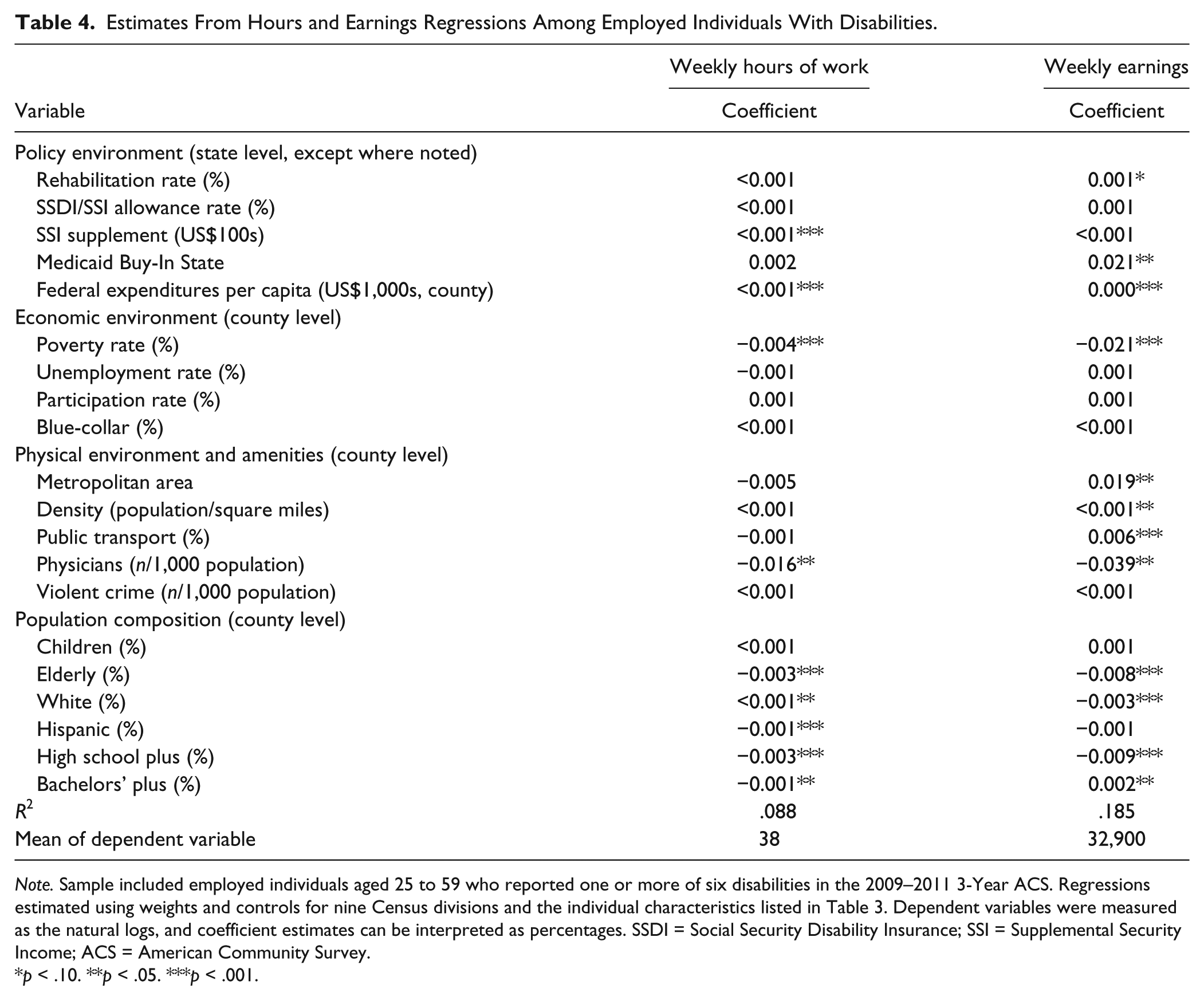
Note. Sample included employed individuals aged 25 to 59 who reported one or more of six disabilities in the 2009–2011 3-Year ACS. Regressions estimated using weights and controls for nine Census divisions and the individual characteristics listed in Table 3. Dependent variables were measured as the natural logs, and coefficient estimates can be interpreted as percentages. SSDI = Social Security Disability Insurance; SSI = Supplemental Security Income; ACS = American Community Survey.
p < .10. **p < .05. ***p < .001.
Several policy variables were significant predictors of hours of work and earnings, but again, the magnitudes were generally small. The state SSI supplement was significantly and negatively associated with hours of work but the magnitude was close to zero and it had no significant relationship with earnings. Workers in states with a MBI Program had 2% higher earnings but did not have significantly different hours of work. Higher federal expenditures were positively and significantly associated with both hours and earnings but the implied magnitude was also close to zero.
Unlike the findings for employment, for the county economic characteristics, only the poverty rate had a significant relationship with hours and earnings. Individuals in counties with a 20% higher poverty rate worked 1% fewer hours and had 6% lower earnings. Neither the unemployment rate, participation rate, or blue-collar share was associated with significant differences in hours or earnings.
Many of the physical environment and amenity variables were statistically significant in either the hours or earnings regression, but again the estimates were generally small. In some cases, variables associated with larger urban environments were associated with better outcomes—for example, individuals living in counties with a metropolitan area earned 1.9% more and those living in counties with a higher percentage of individuals using public transportation earned more. As with employment, a higher concentration of physicians was associated with poorer employment characteristics.
Finally, we found a number of significant associations between population characteristics and hours and earnings. Hours of work varied significantly but marginally with the percentage of the population that was elderly, White, or Hispanic. Earnings were also lower in counties with a larger share of elderly or White residents. Oddly, a 20% higher concentration of high school graduates was associated with 5% fewer hours worked and 15% lower earnings. Earnings were slightly higher with a greater concentration of college graduates. As with the coefficient estimates for the employment regression, coefficient estimates for individual characteristics were large (available upon request).
Subgroup Analyses
The fact that a number of environmental variables were significant but small predictors of employment outcomes suggests that there may be some subpopulations for whom these characteristics mattered more. To examine whether the estimated relationship between covariates and employment outcomes varies by type of disability, we estimated regressions of employment, hours, and earnings, separately for individuals who report affirmatively to each of the six ACS disability questions. We do not include these estimates in the article due to complex Census disclosure constraints regarding release of output for multiple subgroups, but in general, the estimates were small, like the coefficients estimated on the full sample. In some cases, magnitudes were slightly larger for individuals with one type of disability and smaller and not significant for individuals with other types of disabilities. Some exceptions stand out—employment outcomes of individuals with ambulatory disabilities were mostly related to the environmental variables. Specifically, living in a state with a MBI Program was significantly associated with employment and higher earnings only for individuals with ambulatory disabilities. The estimated relationship between higher earnings and living in metro areas was also much larger among individuals with ambulatory disabilities. As a whole, few of the contextual variables were significant predictors among individuals with hearing and vision disabilities, the two groups with substantially higher employment rates (Houtenville et al., 2013).
Discussion
Our research explored state and county factors that could explain the substantial variation in employment outcomes across geographic areas, controlling for disability status and other individual characteristics. We hypothesized that differences in state and local economic, policy, or physical characteristics play important roles in shaping employment opportunities, yet our results suggest that differences in these factors across states and counties were associated with only small differences in employment outcomes. Overall, however, our results provide further evidence of the greater importance of individual-level characteristics in influencing employment.
At the state and local policy level, we found small or no associations between employment and state and local policies. The positive relationship between earnings and the state-level rehabilitation rates and the MBI Program is consistent with earlier literature (Ireys et al., 2009; Stapleton et al., 2010). The small relative magnitude of our findings is not surprising when considering the labor force as a whole, as employment decisions on the part of individuals are largely dictated by individual-level characteristics without much individual-level consideration of state and local policies. Of more interest, however, is the fact that some policy variables were associated with differences in employment outcomes for some subpopulations of persons with disabilities. Such findings suggest that the nuances of disability policy that do not drive aggregate employment rates of individuals with disabilities may have a impact on outcomes of some select subgroups from state to state or county to county.
Additional research is needed to explore some of our other findings. First, higher state SSI supplement amounts were associated with slightly lower employment rates and fewer hours worked among those who worked. We are not aware of other research that has documented this. Given our use of cross-sectional data, however, we cannot determine whether the provision of state supplemental funds affected employment or whether the provision of funds was a response to regional economic concerns.
Our findings across the economic and physical environment paint a picture that suggests that individuals living in poor, densely populated areas with high unemployment rates were less likely to be employed. These findings are consistent with some studies in the literature which have shown the relationship between income and employment rates (Botticello et al., 2012; Cunningham & Altman, 1993) and the negative impact of recessions on individuals with disabilities (Livermore & Honeycutt, 2015; Nichols et al., 2017). While this is not surprising, our finding that urban amenities like access to public transportation and high numbers of physicians were actually associated with lower rates of employment among the general population is unexpected. Botticello, Chen, and Tulsky (2012) found that living in an urban area is associated with lower employment rates for people with spinal cord injuries, but both of these urban characteristics could be viewed as facilitators of increased employment. Additional research which examines the linkage between public transportation and employment opportunities within an urban catchment area can explore part of this paradox. In addition, workforce development programs that target persons living in urban areas should consider engaging with local health care providers to ensure that employment is included as an ongoing treatment goal.
However, among individuals who were employed, living in a metropolitan area and having high levels of access to public transportation were associated with higher earnings. The fact that the relationship between these variables is positive for one employment outcome and negative for another seems counterintuitive. However, the factors associated with higher earnings may restrict labor demand and hence be associated with lower rates of employment.
One variable with a particularly large estimated relationship with employment is the county labor force participation rate among the full working-age population. Although the unemployment rate is generally used as a measure of labor demand, the participation rate reflects labor supply. Our finding that individuals with disabilities are more likely to be working if they are living in an area where a larger share of all people work could be due to social norms that encourage employment.
Limitations
There are some limitations to our study. First, omitted variable bias may be a concern. While our linking of the ACS file with numerous external sources expanded our ability to examine environmental factors, there were likely additional variables that could have further enhanced our research. For instance, details about the severity of disability could have provided further information about the relationship among disability, employment, and environmental factors but was not available in the ACS. Next, while we did include some variables related to the demand for labor, we did not specifically include any variables that would directly reflect employer hiring attitudes and intentions.
As our dataset spanned part of the Great Recession, it may be that the conditions that would improve outcomes substantially did not exist in any of the counties during the time period we observed. In addition, environmental conditions may matter more for some subgroups than for others, such as individuals with ambulatory impairments. Future research should examine whether economic conditions, policies, and other features of the environment may matter more for some subgroups or individuals than they do for others.
Conclusion
In conclusion, our study found that both economic conditions and physical environment had stronger associations with employment than policy variables, but that no environmental variables were as strongly associated with outcomes as individual health and personal characteristics. Our results should not be interpreted to suggest that economic factors and policies are of minimal importance and cannot substantially improve employment outcomes. Rather, our results suggest that efforts to improve employment outcomes for the general public and for persons with disabilities need to span multiple fronts. Policies directed toward individuals must be framed within a full understanding of the broader environmental context. As an example, where certain individual characteristics such as age, gender, and race are fixed, other individual characteristics such as educational attainment can be changed. However, efforts to improve educational attainment must take into account local economic factors to improve opportunities within that particular environment and its available jobs.
Footnotes
Authors’ Note
The authors retain sole responsibility for any errors or omissions.
Declaration of Conflicting Interests
The author(s) declared no potential conflicts of interest with respect to the research, authorship, and/or publication of this article.
Funding
The author(s) disclosed receipt of the following financial support for the research, authorship, and/or publication of this article: This project was funded by the U.S. Department of Health and Human Services, National Institute for Disability, Independent Living and Rehabilitation Research under cooperative agreement 90RT5017-01-01 for the Rehabilitation and Research Training Center on Individual Characteristics Related to Employment Among Individuals with Disabilities. The findings do not necessarily represent the policy of the Department of Health and Human Services, and you should not assume endorsement by the Federal Government.