



Abstract
Using data from the Current Population Survey, the authors studied self-employment among people with work limitations in the United States. They found that self-employment rates are higher among workers with limitations compared with workers without limitations. Furthermore, the self-employment differential increases with education and age. This investigation of possible explanations has revealed that expected wage differences between self-employed people and employees are similar between disability groups but average work hours are lower and more variable among the self-employed with work limitations. This evidence is consistent with the view that people with disabilities might choose self-employment because of non-monetary motives.
Keywords
At a time of declining labor force participation among people with disabilities and steadily increasing disability rolls (Autor & Duggan, 2006), a better understanding of the incentives and disincentives that people with disabilities face in the labor market is crucial for designing effective policies to encourage greater labor force participation among people with disabilities. Recent studies based on the U.K. data (Boylan & Burchardt, 2002; Jones & Latreille, 2011) and European data (Pagán-Rodríguez, 2009, 2011b) show that self-employment is an important work option for people with disabilities, with higher average self-employment rates for workers with disabilities compared with workers without disabilities.
The existing literature documenting this intriguing relationship between self-employment and disability is in its early stages, and it is not clear whether disability and self-employment are causally related for any individual. Furthermore, the estimation of the difference in the likelihood of being self-employed (SE) between people with and without disabilities is complicated by two methodological issues: unobserved heterogeneity among the individuals and selection into the labor force. The choice between self-employment and paid employment is observed only for those who work; consequently, estimates of the self-employment differential based on a sample of workers can be biased. The selection issue is particularly important because labor force participation is strongly influenced by health.
This article contributes to the literature in a number of ways. First, this study is the first to our knowledge to systematically study self-employment among persons with disabilities in the United States. In the analysis, we used cross-sectional data from the 2000–2015 March Current Population Survey (CPS), a large-scale nationally representative survey of the U.S. non-institutional population. These data are well-suited to explore the relationship between self-employment and disability. Because the likelihood of being SE and having a disability is relatively small, having a large CPS sample size is essential. In this analysis, the CPS definition of self-employment includes those individuals working as independent contractors but excludes persons holding salaried jobs in private companies, government, and non-profit organizations (Hipple, 2010).
Second, we estimated the self-employment differential using a model that accounts for selection into the labor force and controls for a rich set of demographic and socioeconomic variables. In addition, we considered potentially confounding effects of participating in government programs, such as Social Security Disability Insurance (SSDI), Supplemental Security Income (SSI), and Medicaid—factors that have not been explored in the literature so far.
Finally, we considered a possible explanation for the observed higher self-employment rates among people with disabilities by focusing on the relative importance of employer discrimination, which, in this article, is equivalent to wage discrimination, and non-monetary motives. To distinguish between these options, we compared earnings, wages, and work hours among groups of workers classified by disability status and employment type.
Self-employment—a complex labor market activity phenomenon—has provided motivation for a considerable body of research. The theoretical literature has proposed attitude toward risk, managerial ability, and access to capital as main explanations for the decision to become SE (Evans & Jovanovic, 1989; Kihlstrom & Laffont, 1979; Lucas, 1978). Signifying the complexity of the self-employment concept, the fast-growing empirical literature has found links between self-employment and a variety of factors, including expected SE to employee earnings differential, non-monetary motives (e.g., flexibility of choosing work hours and location, and job autonomy), labor market conditions, government policy affecting tax law, and generosity of social programs, health insurance, and family background (Blanchflower, 2004).
Health as a potential determinant of the self-employment decision has, however, received little attention so far. Yet, some emerging evidence has suggested that health may play an important role in the decision to become SE (Blanck, Sandler, Schmeling, & Schartz, 2000; Boylan & Burchardt, 2002; Jones & Latreille, 2011). Using survey data from the United Kingdom, Boylan and Burchardt (2002) showed that on average, among those in paid work, men with disabilities were about 4 percentage points and women with disabilities were about 2 percentage points more likely to be SE than their counterparts without disabilities, although these differences became smaller after controlling for age and education.
Utilizing the same data from the United Kingdom but from a different survey year, Jones and Latreille (2011) found that 21.3% of employed men with disabilities are SE, compared with 17.4% of employed men without disabilities; the corresponding figures for women are 9.3% and 7.3%, respectively. The authors also found that after controlling for other factors, the unexplained differences were about 2 percentage points for both men and women. Interestingly, when estimation accounts for the fact that the sample of those persons who work is not random, these differences increase to 5.9 percentage points for men and 2.9 percentage points for women.
Pagán-Rodríguez (2009) used data from the European Community Household Panel for the 1995–2001 period for 13 European countries to study self-employment incidence in Europe. His results revealed that on average people with disabilities are more likely to be SE than people without disabilities in most European countries, with exception of men in Belgium, for whom self-employment rates are higher among those without disabilities. The differences in self-employment rates vary across countries and are not statistically significant in some of them.
The relationship between self-employment and disability in the United States has largely been unexplored. Two notable exceptions are the report by Fairlie and Meyer (1996), who studied racial differences in self-employment rates, and Zissimopoulos and Karoly (2007), who explored transitions to self-employment from wage and salary work among older workers. Both studies reported statistically significant effects of disability controls when modeling self-employment. Compared with the prior studies, in this study, we focus directly on the relationship between self-employment and disability and explore potential explanations for the self-employment gap.
It is possible that the onset of a work limitation may trigger a change in one’s preferences over monetary and non-monetary aspects of a job. Someone facing a disability but willing to work might place more weight on conditions such as ability to choose his or her own work schedule or work location, which makes self-employment an attractive option. Pagán-Rodríguez (2009) found that the levels of satisfaction with job, type of job, and working conditions of SE people with disabilities are often higher than those reported by employees with disabilities. The evidence is not entirely conclusive, as the satisfaction differential is comparable with that of workers without disabilities, who also reported more satisfaction when SE (Pagán-Rodríguez, 2011a).
The second possibility is that people with work limitations are “pushed” into self-employment by employer discrimination. While qualitative evidence in Boylan and Burchardt (2002) revealed employer discrimination as an often-cited reason for becoming SE, evidence found in Jones and Latreille (2011) seemed to favor the voluntary choice explanation as relatively more important compared with the discrimination explanation. Based on interviews with entrepreneurs with disabilities, Blanck et al. (2000), in a case study of Iowa’s Entrepreneurs With Disabilities Program (EWD), also provided evidence of employer discrimination experienced by people with disabilities and suggested that self-employment increases work opportunities for people with disabilities.
Third, monthly limits on earning levels imposed by public programs such as SSDI and SSI may encourage greater use of self-employment because flexibility regarding work hours may make it easier to comply with these earning limits when SE. Similarly, having these sources of income available may create an incentive to use self-employment as an “easy” employment option like “partial retirement” (Fuchs, 1982).
Finally, the fact that self-employment rates are higher among people with work limitations appears to be at odds with studies that emphasized that people with greater health care needs and demand for private health insurance may be deterred from self-employment (Fairlie, Kapur, & Gates, 2011; Velamuri, 2012; Wellington, 2001). Because private health insurance is commonly obtained through an employer, and people with disabilities have greater medical needs, one might assume that people with disabilities would prefer paid employment to self-employment. One complication to this argument, however, is that people with disabilities may have additional sources of health insurance, such as government-provided Medicare and Medicaid (Kennedy & Blodgett, 2012). For example, working-age adults who are SSDI beneficiaries become eligible for Medicare after a 2-year waiting period.
Method
The two objectives of this study were to (a) estimate the difference in the probability of being SE between workers with and without disabilities and (b) investigate employer discrimination as a possible explanation for the difference. This section describes our analytical approaches for each objective in turn.
We will assume that an individual,


where

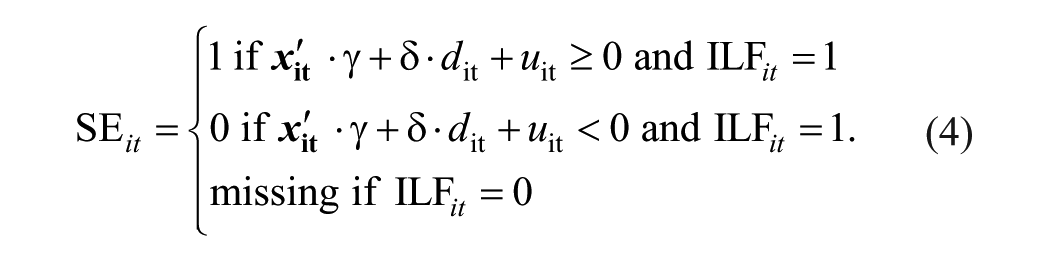
If we assume that
One way to estimate Model (3) - (4) is to use the full maximum likelihood approach. This method, however, is computationally demanding. An alternative and computationally more convenient approach is a two-step procedure proposed by Heckman (1979). We experimented with both approaches with similar results. In this article, we report estimates from the two-step procedure. To simplify exposition of our results, we report linear probability estimates of self-employment Equation (4). In this case, parameter δ, to which we refer as the self-employment differential, represents the adjusted difference in self-employment rates between study participants with and without disabilities and is measured in percentage points.
In the second part of the analysis, we explored employer discrimination as a possible reason for differential self-employment rates between workers with and without disabilities. The investigation of discrimination was based on a comparative analysis of earnings, work hours, and wages among different groups of workers. Consistent with the prior literature, we viewed statistically significant difference in earnings or wages across different groups of workers as evidence of discrimination (Altonji & Blank, 1999). Specifically, we hypothesized that in the case of employer discrimination, these differences should be more favorable toward self-employment among people with work limitations.
Consider two employment sectors—the self-employment (SE) and paid employment (PE) sectors—and two groups of workers—people with work limitations (worklim) and people without work limitations (able). If employees with disabilities experience employer discrimination, then their wage rate in paid employment,
This argument assumes that productivity losses associated with having a work limitation are the same in both employment sectors. In the context of the hypothesis, employer discrimination means that employees with disabilities are paid less compared with their equally qualified non-disabled counterparts, while accounting for productivity loss associated with disability.
Data
The analysis used cross-sectional data from the 2000–2015 March supplement of the CPS—a nationally representative survey of about 60,000 households targeted at the U.S. non-institutionalized civilian population. Because the fraction of SE workers with disabilities in the population is relatively small (0.2%), having a large sample size is a key data requirement.
As the official data source of statistics on employment in the United States, the CPS provides reliable measures of employment and self-employment status—the second important data requirement for the analysis. To determine employment status, we use employment during the previous year obtained from the following question: “Did [you] work at a job or business at any time during [YEAR]?” The main dependent variable, whether a person is SE or a wage and salary worker, is derived from the question asking about class of employment: “Were you employed by a government, by a private company, a nonprofit organization, or were you SE (or working in a family business)?” Respondents who answered “self-employed” were asked additionally “Is this business incorporated?” to distinguish between SE in incorporated and unincorporated businesses. Following a conventional approach, we considered self-employment in unincorporated businesses only and treated self-employment in incorporated business as regular employment.
To identify data patterns consistent with employer discrimination, we compared differences in earnings, hours, and wages between SE individuals and paid employees (PEs) by disability type. The dependent variables in this part of the analysis, earnings and hourly wages, were based on the CPS measures of last year annual earnings, weekly work hours, and weeks of work.
The disability measure was obtained from the question about work limitations: “Does anyone in this household have a health problem or disability which prevents them from working or which limits the kind or amount of work they can do? [If so,] who is that?” While the terms disability and work limitation are used interchangeably in this article, it should be mentioned that the work limitation measure may not be perfectly capturing the population with disabilities. Hale (2001) criticized it because, on one hand, this measure may exclude some people with disabilities (e.g., people with disabilities that are not work limiting) but, on the other hand, this measure may include persons without disabilities (e.g., people with temporary illnesses or conditions such as flu or a broken leg). Despite these concerns, the work limitation measure has been widely used in economic literature to study employment circumstances of people with disabilities (Burkhauser, Daly, Houtenville, & Nargis, 2002; Hotchkiss, 2004a, 2004b). One advantage of this measure is its availability in the CPS over a long period of time using the same survey questions.
Finally, the CPS collects a rich set of information on individual characteristics, job characteristics, geographic location, income sources/amounts, and health insurance sources, which allows us to conduct a detailed multivariate analysis. The analytical sample consists of working-age (21–64 years) civilian individuals. We excluded from the sample people who reported working in agricultural industries or being employed in the armed forces during the previous year. Multivariate analysis requires unemployment rates from the previous year, which we estimated using CPS data from previous waves. Table 1 reports summary statistics of selected variables used in the analysis.
Summary Statistics for the Study.

Note. All variables except for age are binary, 1 = yes, 0 = no. Data source is the 2000–2015 March CPS. Sample consists of civilians ages 21 to 61 years, excluding workers in agricultural industries. The number of observations is 811,373 for males and 903,300 for females. SS = social security; SSI = supplemental security income; CPS = Current Population Survey.
Results
Estimation of the Self-Employment Differential
We started by plotting self-employment rates among workers by work limitation status for the years between 2000 and 2015 (see Figure 1). As can be seen, during the period, self-employment rates of workers with work limitations were higher by about 5 percentage points compared with those without limitations. Next, we estimated the self-employment gap controlling for observed heterogeneity among the respondents and for sample selection.
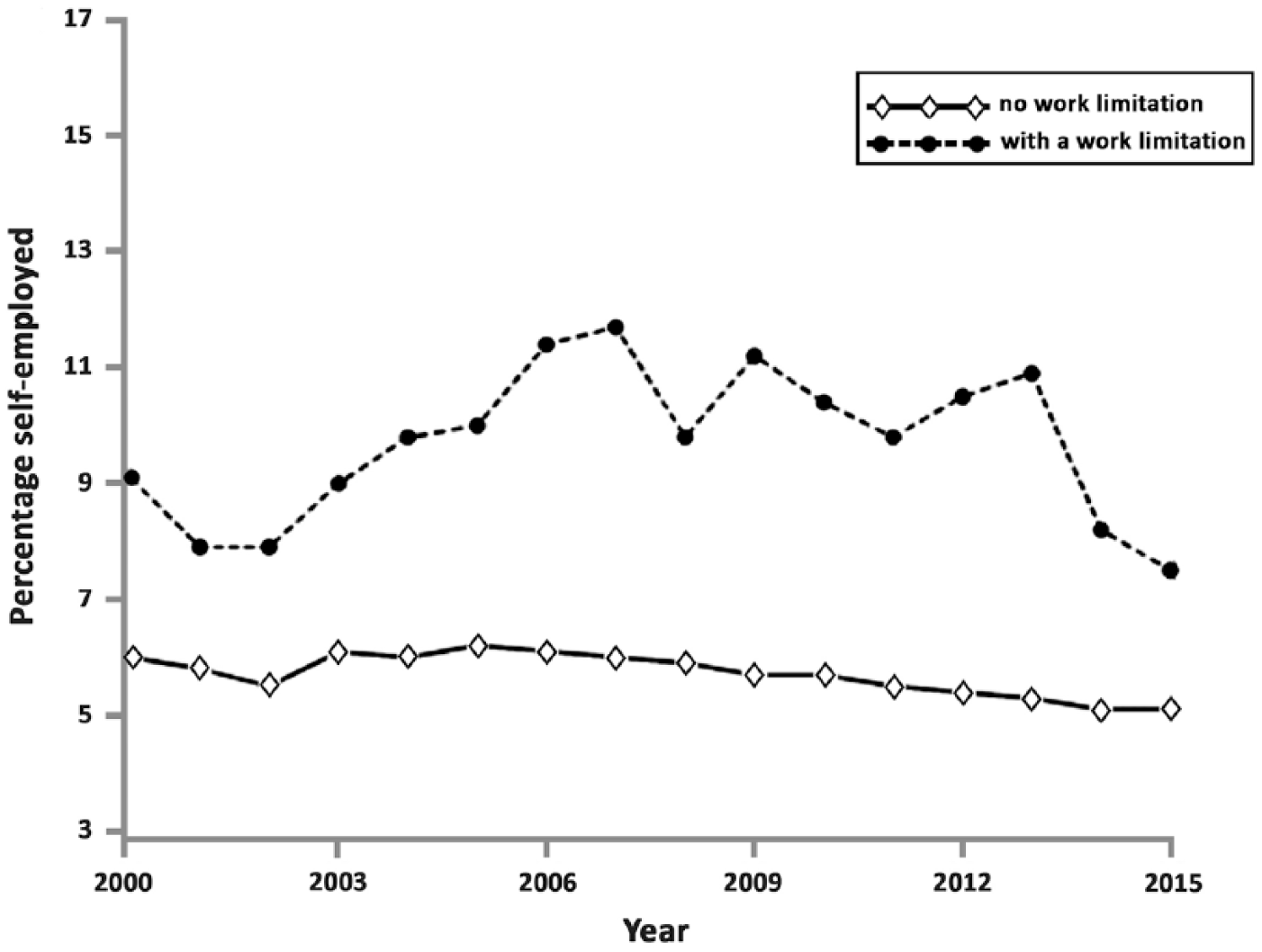
Self-employment rates among workers with and without work limitations.
Table 2 reports the estimates of Equation (4) for three progressively more comprehensive model specifications and separately for each gender. For both men and women, a positive relationship between having a work limitation and being SE remained after controlling for other factors, with the self-employment differential being 3.1 percentage points for men and 2.4 percentage points for women. Furthermore, our estimates are in the range of estimates obtained in Jones and Latreille (2011) who used data from the United Kingdom—1.6 percentage points for men and 1.7 percentage points for women with sample selection ignored, and 5.9 percentage points for men and 2.9 percentage points for women with adjustments for sample selection.
Work Limitation Effect on the Probability of Being Self-Employed.

Note. The table reports linear probability estimates of whether one was self-employed during the previous year. Data source is the 2000–2015 March CPS. Sample is civilians ages 21 to 61 years. Included in each of the models and not shown in the table are year and state fixed effects, four age indicators, four educational-level indicators, three race categories, marital status, industry dummy indicators, number of kids under 16, and current and last year unemployment rate. The estimation employs Heckman’s two-step procedure to account for sample selection into the labor force and normalized CPS sample weights. SS = social security; SSI = supplemental security income; CPS = Current Population Survey.
p < .10. **p < .05. ***p < .01.
The addition of indicators of receiving SSDI or SSI cash benefits and of being covered by Medicare or Medicaid health insurance did not noticeably affect the work limitation estimates, which remained close to those in the baseline model, if not larger. While it is possible that participation in these programs affects the decision to become SE, the results in Table 2 indicate no support for the idea.
Self-Employment Differential by Age, Race, and Education
Table 3 explores how the self-employment differential varies by age, race, and education. It reports three sets of Equation (4) estimates; in each case, the work limitation indicator interacted with age, race, or education.
Work Limitation Effect on the Probability of Being Self-Employed by Age, Race, and Education.

Notes. The table shows linear probability estimates of whether one was self-employed during the previous year. Data source is the 2000–2015 March CPS. Sample is civilians ages 21 to 61 excluding workers in non-agricultural industries. WL is an indicator of having a work limitation. See footnote in Table 2 for variables included in the estimation but not shown in the table. WL = worker with a work limitation; CPS = Current Population Survey.
p < .05. ***p < .01.
A striking feature is the strong monotonic increase in the self-employment differential, δ, with age and education for both men and women. For men, the self-employment differential started at 1.5 percentage points for the 21- to 30-year age group and increased to 4.8 percentage points for those ages 51 to 61 years. For women, the differential went from 1.1 percentage points to 4.2 percentage points for the corresponding age groups. For both genders, the estimates are strongly statistically significant for those ages 41 to 50 years and ages 51 to 61 years.
Although the relationship between education and self-employment may not be linear (Van Der Sluis, Van Praag, & Vijverberg, 2008), the differences in self-employment rates between individuals with and without work limitations clearly increased with education, from 2.9 percentage points for men with less than high school education to 4.9 percentage points for men with a college degree, and from 0.7 percentage points to 5.4 percentage points for women with the corresponding educational attainments.
The self-employment gap varied by race as well. For men, African Americans showed the lowest increase in the probability of self-employment associated with having a work limitation: 2.2 percentage point versus 3.6 percentage points for White workers and 4.9 percentage points for workers of other races. The corresponding numbers for women were 2.1 percentage points versus 2.7 percentage points and 2.2 percentage points, respectively. All estimates are statistically significant at the 1% level.
To sum, results in Table 3 show that the self-employment gap was not uniform across age, education, and racial categories, with larger differences concentrated among individuals who were White, older, and better educated.
Work Hours and Earnings
Our finding of relatively larger self-employment differences among more advantaged groups seems to suggest that the decision to become SE may be a voluntary choice for at least some people with work limitations. In what follows, we explore in more detail an alternative explanation for the self-employment gap—employer discrimination.
Tables 4 and 5 offer descriptive statistics of annual work hours and earnings by disability status, employment type, and gender. As can be seen, annual work hours were substantially lower among individuals with work limitations for both types of employment. For men, an average number of work hours among the SE with work limitations was 1,490, which is close to an average of 1,479 for employees with limitation, but considerably lower than the corresponding numbers of 2,174 and 2,106 for non-work-limited SE and PEs, respectively.
Annual Work Hours by Class of Worker and Work Limitation Type.
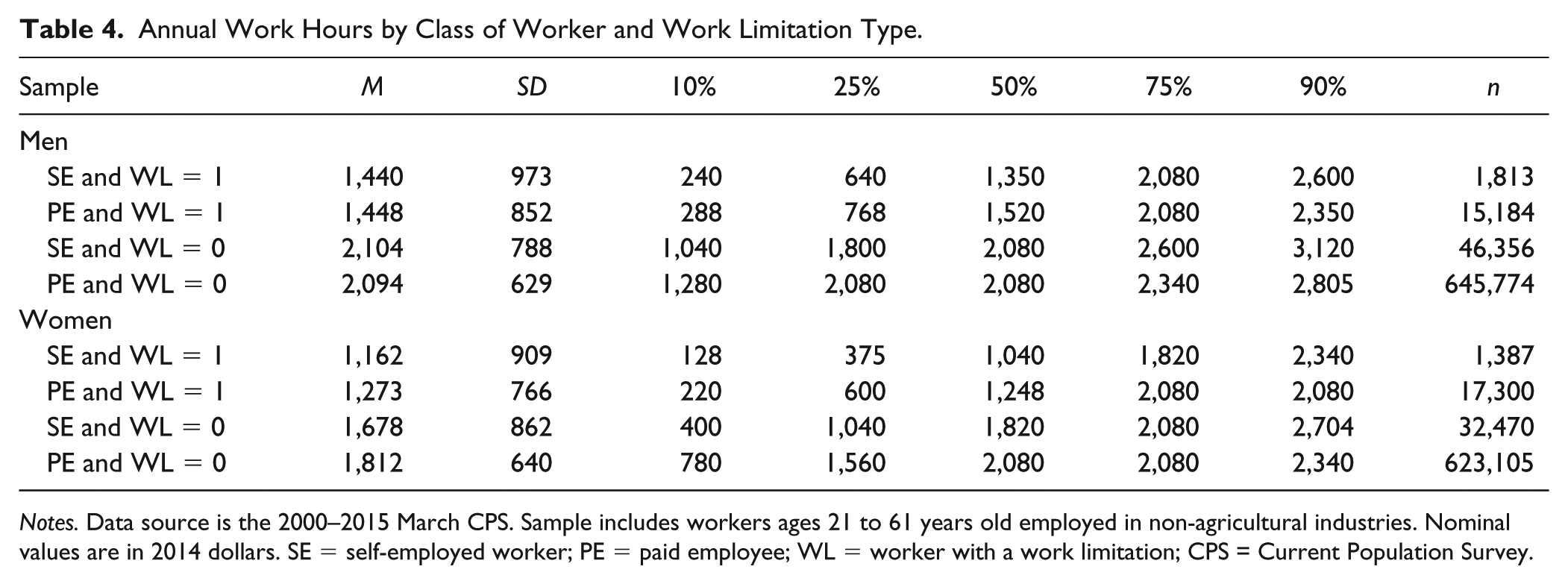
Notes. Data source is the 2000–2015 March CPS. Sample includes workers ages 21 to 61 years old employed in non-agricultural industries. Nominal values are in 2014 dollars. SE = self-employed worker; PE = paid employee; WL = worker with a work limitation; CPS = Current Population Survey.
Annual Earnings by Class of Worker and Work Limitation Type (in Thousands of Dollars).

Note. Data source is the 2000–2015 March CPS. Sample includes workers ages 21 to 61 years employed in non-agricultural industries. Nominal values are in 2014 dollars. SE = self-employed worker; PE = paid employee; WL = worker with a work limitation; CPS = Current Population Survey.
The distributions of work hours for persons with work limitations were stretched further to the left, highlighting the tendency of people with work limitations to be in part-time employment, which is consistent with results provided in studies from the previous literature (Hotchkiss, 2004b; Schur, 2003). Another important feature is that the variability of work hours was largest for the SE with limitations. This suggests that for workers with disabilities, who may require non-standard work hours arrangement, self-employment allows more flexibility in accommodating this preference.
Interestingly, compared with men, the pattern of work hours for SE women without work limitations was somewhat closer to that of women with work limitations: Work hours were substantially lower, especially in the left end of the distribution, and their variability was high. It has been argued that preference for flexibility in work hours is an important factor of the self-employment decision for women (Lombard, 2001), for whom self-employment may be a closer substitute for part-time work and labor market inactivity compared with men (Georgellis & Wall, 2005).
Regardless of employment sector, annual earnings of workers with limitations were much lower than those of workers without limitations, which underscores that having disability tends to reduce productivity and work hours (see Table 5). On average, individuals with limitations earned about half as much as workers without limitations. Furthermore, within each work limitation group, the SE made less on average than other PEs.
Turning to average income differences between SE and PEs, we see that SE/PE income differences were somewhat larger (i.e., less negative) among people with work limitations. Thus, for men on average, the SE/PE income difference was about US$6,000 for men with work limitations and about US$7,000 for men without work limitations. For women, corresponding numbers were US$7,000 and US$11,000, respectively. Formal testing indicates that these numbers are not significantly different at conventional levels for men but are significant for women.
Log Earnings and Log Wages
To probe further, we decomposed the SE/PE difference in average log earnings into a sum of two components: the difference in average log hours and the difference in average log hourly wage rates, as follows:

where y, h, and w are natural logarithms of earnings, work hours, and wages, respectively. Indexes SE and PE indicate the self-employment and paid employment sectors.
Table 6 shows the results of the decomposition. The first two columns of Table 6 report average log earnings for the SE,
Decomposition of SE/PE Difference in Average Log Earnings by Work Limitation Status.
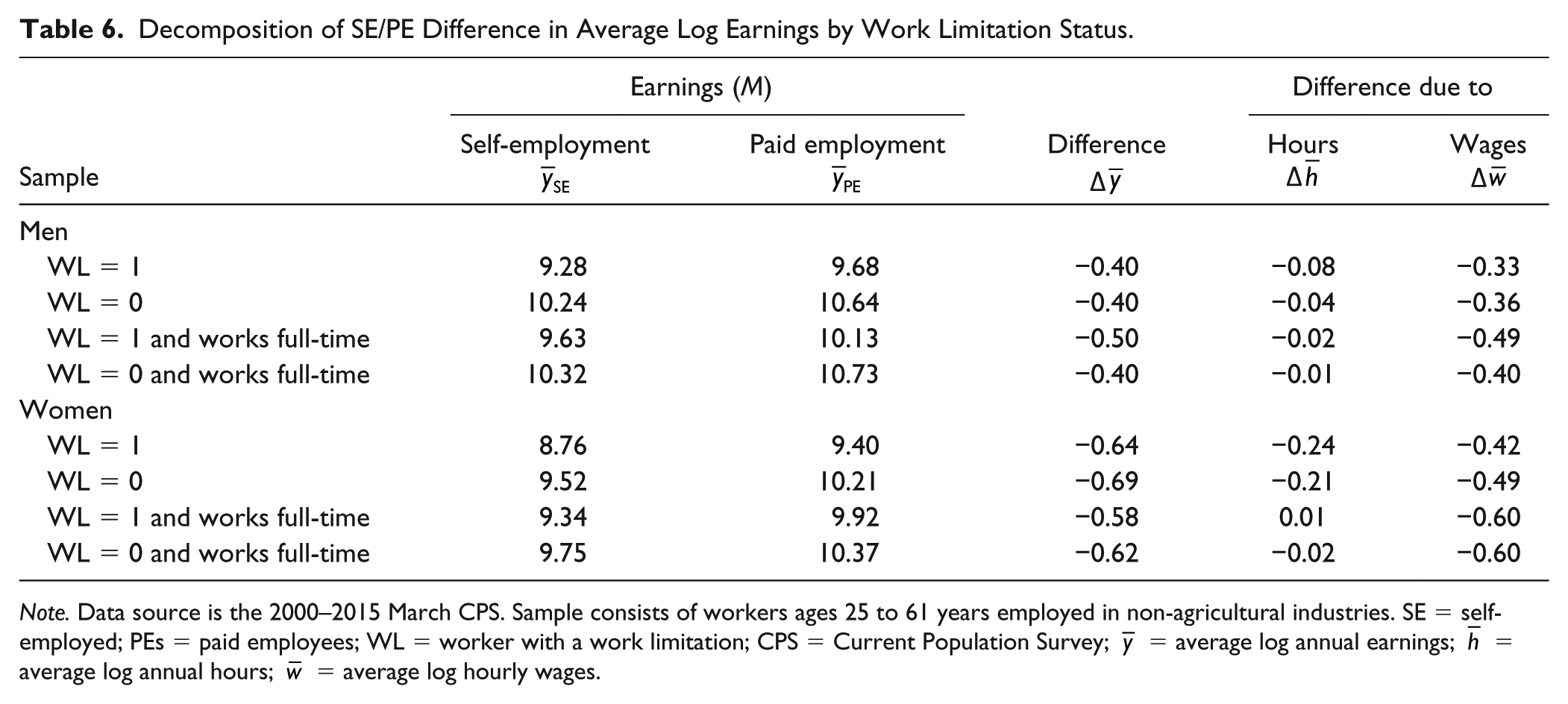
Note. Data source is the 2000–2015 March CPS. Sample consists of workers ages 25 to 61 years employed in non-agricultural industries. SE = self-employed; PEs = paid employees; WL = worker with a work limitation; CPS = Current Population Survey;
Similarly to earnings in levels, magnitudes of SE/PE differences in log earnings were comparable for individuals with and without work limitations. For full-time workers, the differences in log earnings were almost entirely accounted for by SE/PE differences in wages, which in turn were similar for people with and without work limitations. Recall we hypothesized that if workers with disabilities are pushed into self-employment by employer discrimination, then the average SE/PE wage differences should be more favorable (i.e., less negative) among workers with disabilities compared with their counterparts without disabilities. We see no such evidence in Table 6 for full-time workers. The differences are the same for women and appear, if anything, to be more negative for men.
In the combined samples of individuals working full- and part-time, the evidence is less clear cut. Here, we still see that SE/PE earnings differences were comparable between disability groups. But SE/PE wage differences appeared to be somewhat less negative for individuals with work limitations, in particular for women. This might indicate that part-time workers with disabilities experience some employer discrimination. However, it also might reflect possibly lower productivity levels among the part-time employees with disabilities compared with part-time SE workers without disabilities.
Oaxaca Decomposition of Self/Paid Wages Differences
The analysis above does not take into account likely compositional differences in the samples of SE people and employees, which may mask true differences in wage rates. To investigate this, we used an Oaxaca-type decomposition of the SE/PE differences in average log wages. Specifically, for each of the four work hours/gender groups, we estimated two earnings equations, one for the SE and the other for wage-and-salary workers:

where

where
Table 7 shows that the average negative differences in wage rates between the self-employment and paid employment sectors resulted on one hand from large negative differences in wage structures in two sectors,
Oaxaca Decomposition of Self/Paid Difference in Average Log Hourly Wage Rate by Work Limitation Status.
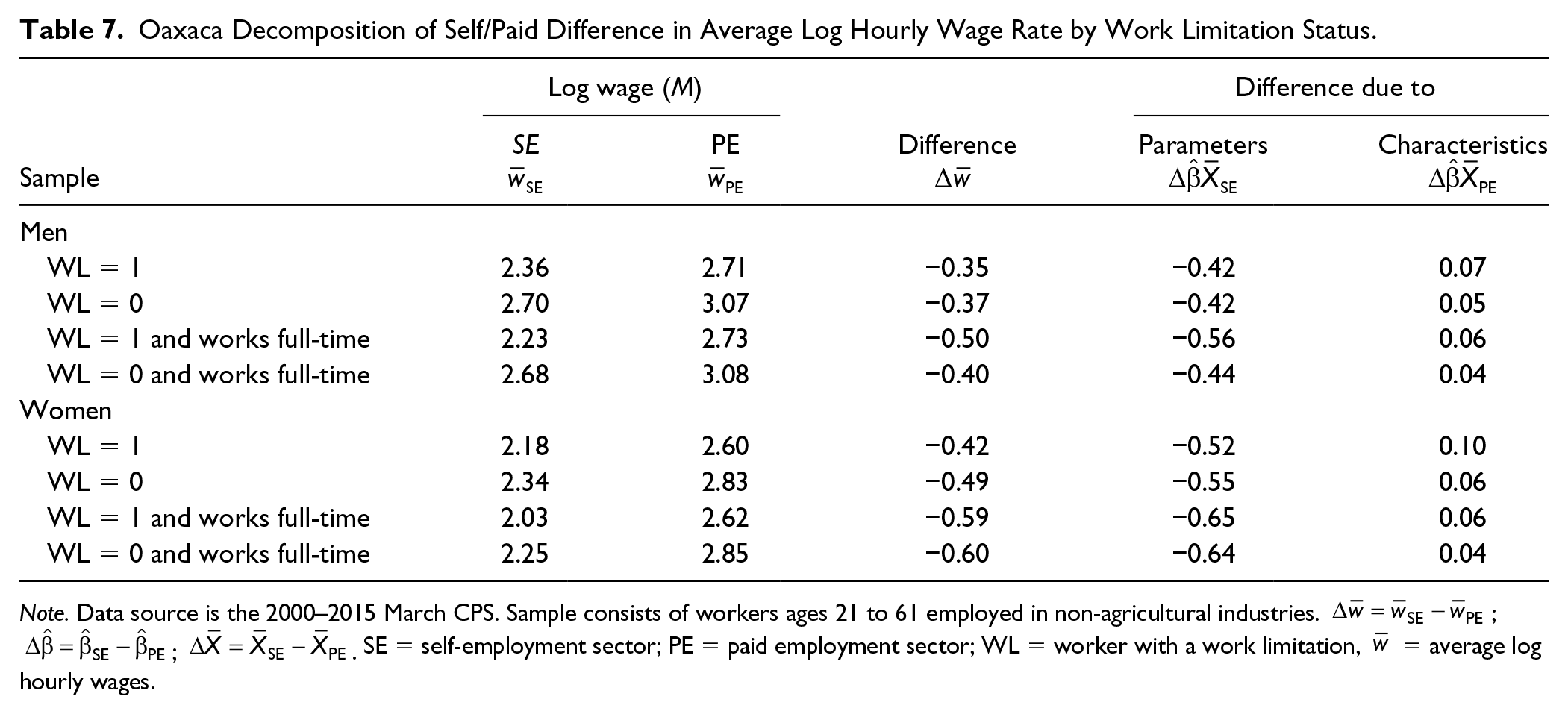
Note. Data source is the 2000–2015 March CPS. Sample consists of workers ages 21 to 61 employed in non-agricultural industries.
To summarize, earnings of people with disabilities were substantially lower compared with earnings of people without disabilities. The lower earnings among people with disabilities were observed in both employment sectors and likely reflect the productivity loss associated with having a disability. Earnings of SE persons with disabilities were the lowest among four employment sector/disability groups. Finally, the expected SE/PE earnings and wage differentials do not appear more favorable toward self-employment for workers with disabilities.
Discussion
Using the 2000–2015 March CPS data, we estimated that self-employment rates were 3.5 percentage points higher for male workers with work limitations and 2.6 percentage points higher for female workers with work limitations, compared with workers without limitations. In addition, we found that the self-employment gap varies strongly with age, education, and race. The gap was larger for more educated and older, and thus more experienced, workers.
Our finding of higher prevalence rates of self-employment among more advantaged groups of workers is consistent with the idea that individuals choose self-employment because of non-monetary motives. However, we did not find evidence on earnings and wages in this study to support the discrimination explanation. In particular, the expected self-employment/paid employment wage differential among workers with disabilities does not appear to be more favorable toward self-employment as compared with that of workers without disabilities.
A caveat regarding our employer discrimination analysis should be mentioned. This analysis explores discrimination as reflected in earnings/wage inequality and is based on those who work. It is possible, however, that employer discrimination may manifest itself in forms other than earnings, such as making it harder for people with disabilities to get hired or an unwillingness to provide adequate accommodations. Furthermore, we found that for women working part-time, the evidence against employer discrimination was less strong and needs further investigation.
The existing literature on self-employment and other forms of non-standard employment seems to agree that non-monetary motives play an important role in the occupational choice of people with disabilities. These individuals might chose such employment options because of better accommodations between the needs imposed by their disabilities and their work environment (Boylan & Burchardt, 2002; Hotchkiss, 2004b; Jones & Latreille, 2011; Pagán-Rodríguez, 2009; Pagán-Rodríguez, 2011a, 2011b; Schur, 2002, 2003). This view advocates for public policies encouraging self-employment among people with disabilities as a way to increase their labor market participation, social involvement, and possibly job satisfaction (Pagán-Rodríguez, 2009, 2011a).
The article provides some support for this view. In particular, work hours are generally lower and more variable among SE people with disabilities, which might suggest that they choose self-employment at least in part because of the flexibility it offers with regard to work hours. At the same time, our results show that earnings are substantially lower among SE workers compared with PEs, and yet still lower for SE people with disabilities, raising concern that SE workers with disabilities might experience double productivity loss—one from disability and another from working for himself or herself. If so, this invites a set of questions: Are non-monetary gains from working independently worth the income loss? Should policy promoting self-employment try to mitigate the negative income effect of self-employment? Should policies focus on improving accommodations for people with disabilities at regular job places?
Better understanding of the mechanism behind the self-employment gap is needed to answer these questions and identify effective policy solutions. While higher likelihood of self-employment among the advantaged groups who are less likely to experience discrimination seems to support the view of self-employment as a choice, another interpretation is possible. Perhaps individuals with more work experience and adequate finances can afford to respond to discrimination by becoming SE. The choice of less advantaged individuals with disabilities, on the contrary, can be restricted either to remain in suboptimal paid employment or to drop from the labor force.
The patterns found in the data are consistent with the choice hypothesis but can be argued to be consistent with the discrimination hypothesis. Different mechanisms would call for different policies. In the first case, policies that aim to encourage self-employment by eliminating barriers are needed. In the second case, a combination of policies to encourage greater self-employment and reduce employer discrimination would be needed.
Footnotes
Declaration of Conflicting Interests
The author(s) declared no potential conflicts of interest with respect to the research, authorship, and/or publication of this article.
Funding
The author(s) received no financial support for the research, authorship, and/or publication of this article.