



Abstract
With transition litigation on the rise in recent years, educators need access to current legal trends in special education. Traditionally, educators have been dependent on researchers and attorneys to report on the implications of legal cases to guide the education and services for students with disabilities. In response to this, the Three Dimensions of FAPE Rubric (FAPE3DR) was created to help educators analyze legal cases in a timely manner. Specifically, the authors applied this rubric to five recent legal cases that were decided in favor of the family or transition-age youth. Findings are reported within the scope of broader transition issues.
As a student nears the time to leave high school, it is important that preparations for adulthood are well underway (U.S. Department of Education, Office of Special Education and Rehabilitative Services, 2017). Secondary transition for a student with a disability under the Individuals With Disabilities Education Improvement Act of 2004 (IDEA 2006) includes planning and services that prepare a student to move from school to postschool activities in the areas of postsecondary training, education, employment, and, where appropriate, independent living skills (§300.320(b)). Within the individualized education program (IEP), both the transition-age student with the disability and the parents or legal guardians (“parent”) of those students have legal rights (Prince, Plotner, & Gothberg, 2019). In a recent keynote at the Division for Career Development and Transition Conference, Yell (2018) showed that litigation involving transition-related cases has steadily increased since the 2004 reauthorization of IDEA, making it critical to the education community to understand the nuances of these cases.
When a student with a disability turns 16, they are entitled to secondary transition planning and services under the IDEA 2004 (2006). Schools provide an array of supports and services for transition-age youth to support their movement from high school into adult roles. The U.S. Department of Education, Office of Special Education and Rehabilitative Services (2017) states, Under IDEA, States and school districts must make FAPE available to all eligible children with disabilities in mandatory age ranges. FAPE includes the provision of special education and related services at no cost to the parents in conformity with a properly developed IEP. Each child with a disability must receive FAPE in the least restrictive environment (LRE), and, to the maximum extent appropriate, must be educated with children who do not have disabilities. The LRE requirements apply to transition services, including employment-related transition services, and apply equally to the employment portion of the student’s program and placement. (p. 8)
Schools are held accountable for providing free and appropriate public education (FAPE) under IDEA 2004 (2006) and when they fail to do so, they can fail the individuals they set out to serve. Bateman and Yell (2019) shared that when parents and teachers cannot settle their differences at the IEP meeting, either party may request a due process hearing. Additionally, the losing party in a due process hearing may file suit in state or federal court . . . when a parent does file . . . a court may take to impose a penalty on the school district. (p. 23)
Thus, schools can incur costly legal expenses in terms of resources, finances, and reputation.
Legal Framework
Militello, Schimmel, and Eberwein (2009) found that educators lack a fundamental understanding of school law not because of avoidance but rather because of a lack of training. In an increasingly litigious society wherein families file a broad range of claims against school systems, it is essential that educators have at least a basic understanding of school law (Russo, 2015). Students who receive special education services constitute 13% of the school-age population (National Center for Education Statistics, 2018); yet, special education is the most highly litigated area in the field of education (Katsiyannis, Counts, Popham, Ryan, & Butzer, 2016). Thus, a school’s work to address the needs of students with disabilities and creating district policies according to school law can prove challenging. Policy development or changes are usually reactive and are often made after a case has been litigated or a law has been mandated (Russo, 2015).
Prince, Katsiyannis, and Farmer (2013) made a call for the need for increased attention on the legal findings of FAPE for transition-age youth served under IDEA since its 2004 reauthorization. The 2004 reauthorization articulated responsibilities of state and local education agencies in the provisions of services for these individuals. While Prince et al. (2013) began a movement of renewed interest in legal reviews of secondary transition cases, the methods used were criticized as incomplete, calling to attention the need for a systematic review process (Zirkel, 2018). The current study focuses on the last 5 years of transition cases building from the work of Prince, Plotner, and Yell (2014) and Petcu, Yell, Cholewicki, and Plotner (2014). Petcu et al. (2014) analyzed 24 cases from 2005 to 2013, utilizing a 7-point framework for coding cases: (a) development of the transition plan, (b) participants in the IEP meeting, (c) assessment of a student’s strengths and interests when developing the transition plan, (d) parent involvement in transition planning, (e) postsecondary goals, (f) agencies and persons responsible for the provision of transition services, and (g) age-appropriate transition assessment. (p. 67)
The most recent and comprehensive review of cases was performed by Zirkel in 2018. His review focused on cases from 2000 to 2016 and provided outcomes, frequencies, and longitudinal trends of rulings. In his commentary, Zirkel (2018) described his coding system in three parts: procedural or substantive characterization of FAPE, outcome of the ruling, and documentation notes. He further described a coding mechanism as the following: “the original draft of the spreadsheet included columns for subcategories of the framework, such as assessment and goals, and subcategories from the seemingly analogous IEP issue of FBAs-BIPs (Zirkel, 2017), which were entitlement, appropriateness, and implementation” (p. 140). However, this coding was not applied to this study, because “the decisions generally lacked sufficient detail to code these variables” (Zirkel, 2018, p. 140).
In 2017, the Supreme Court issued a decision, Endrew F. v. Douglas County School District RE-1 (Endrew), that has the potential to change the definition of “appropriate” in what constitutes a FAPE where appropriate depends on the child’s circumstances (O’Brien, 2018). In the Supreme Court’s ruling on the case, Chief Justice Roberts held that to meet its substantive obligation under the IDEA, a school must offer an IEP reasonably calculated to enable a child to make progress appropriate in light of the child’s circumstances.
Purpose
This study extends previous research in two ways. First, the authors focus on legal cases where the family was the prevailing party. The authors use the term family to refer to the parent, guardian, or transition-aged youth in the case. Second, in response to Zirkel’s (2018) call for “empirical analyses of judicial outcomes” (p. 139), the research team developed a coding structure to answer the following research questions:
Method
The source of data for this study was LRP’s Special Ed Connection® (2018), a comprehensive database of fully searchable case law, federal policy, and regulations. The authors performed a Boolean search using the term %secondary transition within the Judicial Decisions (IDEA/504) identifier from January 1, 2014, to October 31, 2018. The date of the last case search was November 15, 2018. If a case had rulings at multiple levels (e.g., U.S. District Court and U.S. Court of Appeals), the ruling that came from a higher court was retained. One exception to this rule was Somberg v. Utica Community Schools (2017), because the ruling by the lower court was more relevant to our review of secondary transition planning and services. The final number of included cases equaled 35 for Research Question 1.
To determine the cases for Research Question 2, the authors screened the cases using the following analysis: (a) Was secondary transition included as part of the decision? (b) Was the transition plan or services deemed insufficient? and (c) Was the family successful in pursuing their claim? Thirteen cases met these criteria. The first and second authors developed a list of IEP transition-specific terms within each case: transition assessment, postsecondary goals, transition plan, transition services, summary of performance, school completion, and IEP meeting components. The third author coded each of the 13 cases included in Question 2, and the first and second authors analyzed the findings.
Finally, for Research Question 3, the authors coded the cases where the transition issue was also deemed the central theme of the case. In these six cases, the authors applied the Three Dimensions of FAPE Rubric (FAPE3DR; Prince, 2018). The FAPE3DR rubric was checked by experts in the field for face and content validity. The categories on the rubric were based on publications from Yell and colleagues (Yell, Katsiyannis, Ennis, & Losinski, 2013; Yell, Katsiyannis, Ennis, Losinski, & Christle, 2016), Zirkel and Bauer (2016), and Zirkel (2018). The authors analyzed each case based on substantive (Yell et al., 2016), procedural (Yell et al., 2013), and implementation dimensions (Zirkel & Bauer, 2016). Each subcategory had keywords that were searched for within each case.
When the term was found, the coder decided if the term was included as procedural information (e.g., citing IDEA 2004 regulations or citing a precedential case) or relevant to the current case, creating a coding structure at three levels: not applicable, contextual, and relevant. If none of the keywords were identified in the case, the subcategory was scored with a 0, or not applicable. If a keyword was identified in the case, and the coder deemed its inclusion as background knowledge (e.g., citing another case or IDEA 2004 regulations), it was scored with a 1, or contextual. If a keyword was identified in the case, and the coder deemed its inclusion as relevant to the case—in that the district did or did not include this component—it was scored with a 2, or relevant. The FAPE3DR (Prince, 2018) is provided in Table 1.
Three Dimensions of FAPE Rubric (FAPE3DR).
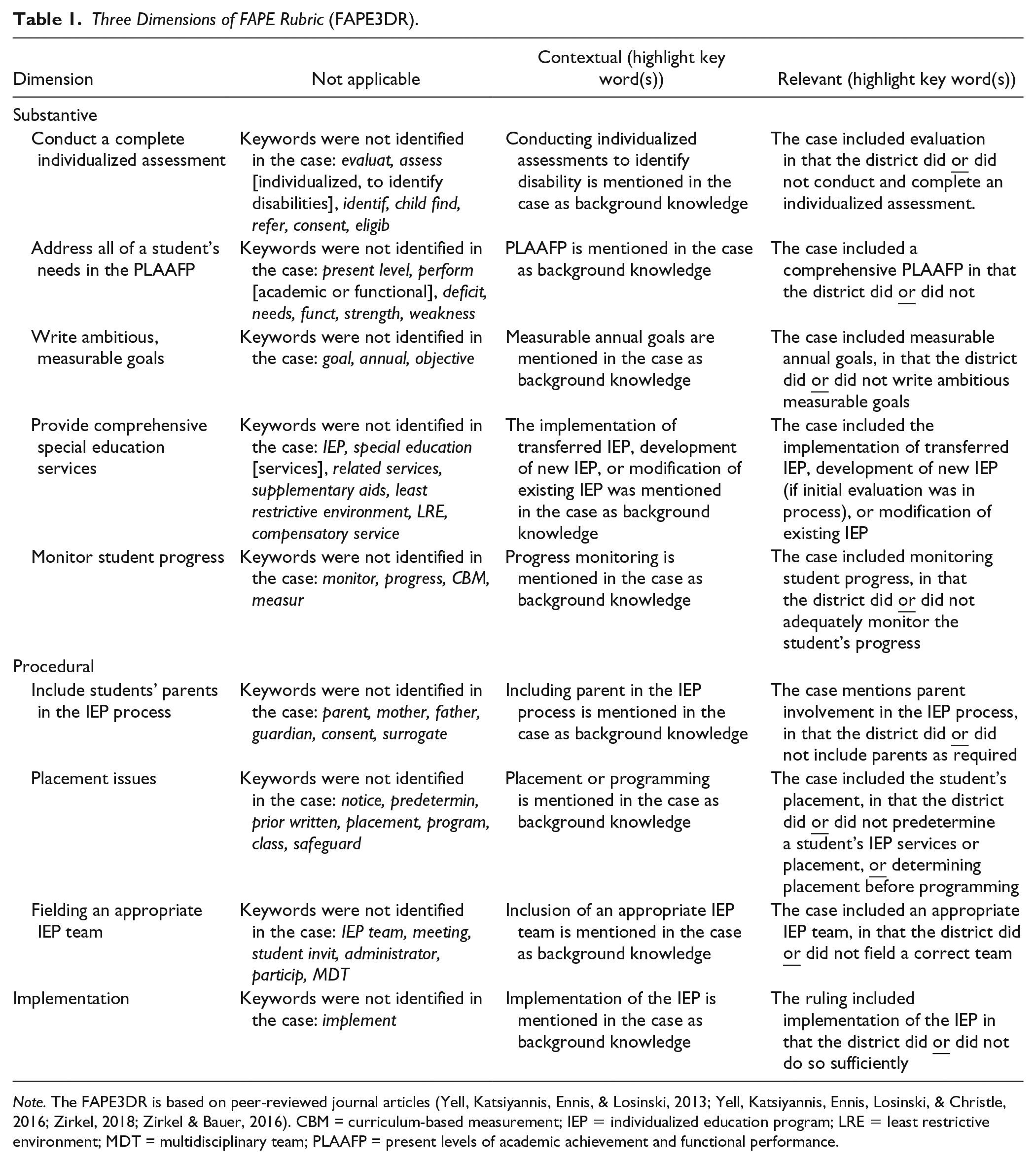
Note. The FAPE3DR is based on peer-reviewed journal articles (Yell, Katsiyannis, Ennis, & Losinski, 2013; Yell, Katsiyannis, Ennis, Losinski, & Christle, 2016; Zirkel, 2018; Zirkel & Bauer, 2016). CBM = curriculum-based measurement; IEP = individualized education program; LRE = least restrictive environment; MDT = multidisciplinary team; PLAAFP = present levels of academic achievement and functional performance.
Interrater Reliability (IRR)
For Research Question 3, the first and third authors coded the five cases where judgments supported the family’s claim(s) and where transition was the central issue of the case, to determine what secondary transition terms were included. For the initial IRR, the first and third authors coded three cases using the FAPE3DR. Initial IRR for leveled coding was 89%, indicating a strong positive interrater agreement (McHugh, 2012). When the two remaining cases were coded by the first and third authors, and combined with the first three, IRR remained strongly positive. The final number of agreements (n = 38) divided by the total possible agreements (n = 45) and multiplied by 100 yielded a final IRR of 84% across all cases (Albano, 2017). Scorers then met to assess IRR and discuss disagreements until discrepancies were resolved.
Results
In response to Research Question 1, in terms of longitudinal trend of included 35 cases by year, the researchers considered judgments that supported the family’s claim(s). Across the 5-year span, families successfully pursued their claims in 13 cases. The highest number of successful claims occurred in 2016 and 2017 at four cases per year.
Among the 13 cases where the family was successful in pursuing their IDEA claim(s), the authors evaluated the presence of secondary transition requirements that were relevant to the content of the case. Of the six secondary transition requirements included in our analyses, transition plan and transition services were included in all 13 cases. Postsecondary goals (n = 7) was the second most frequently included requirement, followed by age-appropriate transition assessments (AATAs; n = 6). In the area of school completion, diploma tracks or options were included in five cases. Among IEP meeting components, requirements for the age of majority were included in two cases, and student invitation to the IEP meeting where secondary transition is discussed was included in one case. The summary of performance was not included in any of the 13 cases. A summary of these cases is provided in Table 2.
Cases Decided From 2014 to 2018 That Included Secondary Transition Where the Family Was the Prevailing Party.

Note. IDEA = Individuals With Disabilities Education Act; SLD = specific learning disability; IEP = individualized education program; ADHD = attention deficit hyperactivity disorder; FAPE = free, appropriate public education; ID = intellectual disability.
For Research Question 3, the authors narrowed the focus to cases where judgments supported the family’s claim(s), and a secondary transition issue was the central issue of the case. The first and third authors reviewed the 13 cases from Question 2, made independent judgments about the role that secondary transition played in the case (primary or secondary), and came to consensus. Question 3 analyses included five cases, Gibson v. Forest Hills Local School District (2016), Hill v. District of Columbia (2016), Forest Grove School District v. Student (2017), S.G.W. v. Eugene School District (2017), and Somberg v. Utica Community Schools (2017), which are summarized in Table 3. For these cases, the first and third authors independently coded each case across substantive, procedural, and implementation components of the IEP. Perfect agreement occurred in four components across all five cases: measurable goals, special education services, monitor progress, and predetermining placement. Of these, special education services were coded as relevant in all five cases; predetermining placement was coded as relevant in five cases; and measurable goals and monitor progress were coded as relevant by both coders in four cases.
Cases Decided From 2014 to 2018 Where Secondary Transition Was the Central Issue.
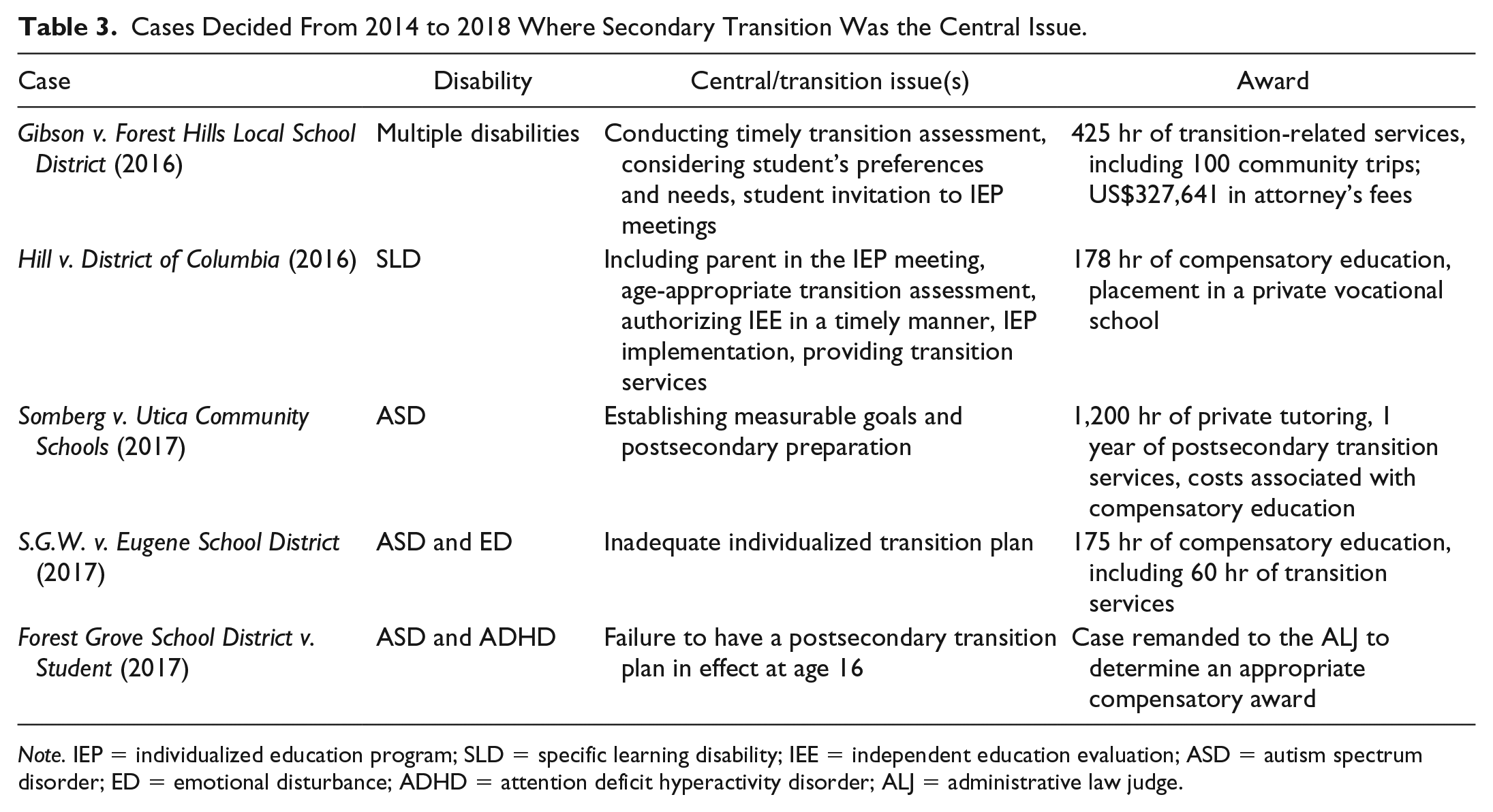
Note. IEP = individualized education program; SLD = specific learning disability; IEE = independent education evaluation; ASD = autism spectrum disorder; ED = emotional disturbance; ADHD = attention deficit hyperactivity disorder; ALJ = administrative law judge.
Leveled agreement disparities existed among the coders with the inclusion of IEP team members in S.G.W. v. Eugene School District (2017) and implementation of the IEP in Gibson v. Forest Hills Local School District (2016). Coders agreed on the presence of these IEP components within the case but disagreed on whether they were not applicable, contextual, or relevant. In the subcategory of IEP team members, coders agreed on relevant presence in three cases and not applicable in two cases. Similarly, in implementation of the IEP, coders agreed on the relevant presence in three cases and not applicable in two cases. In the subcategory of individualized assessment, one coder deemed it as relevant in Forest Grove School District v. Student (2017), while the other deemed it not applicable. Greater disparities existed in the subcategories of present levels, and parents with equal leveled disagreements occurring in two cases for each subcategory. Leveled agreements in these subcategories occurred in four cases.
Discussion
FAPE remains a fertile area of disagreement for special education (Katsiyannis et al., 2016). Based on our review, there is a need for districts to be responsive to litigation and provide comprehensive education and secondary transition services that give students the best chance at making educational progress, while also protecting themselves from costly legal proceedings. Over the last 5 years, an increasing number of cases that included secondary transition either as the central or secondary issue have been decided in favor of the family. Of note is the increasing number of cases that include compensatory education and awards that include attorney fees.
In Gibson v. Forest Hills Local School District (2016), Chloe Gibson was a child with a cognitive disability and seizure disorder that negatively affected her academic and functional performance. When Chloe reached high school, the IEP team decided her needs would be appropriately met at a high school that had a program that emphasized functional life skills, though her parents strongly preferred their daughter be placed in a local high school program that emphasized postsecondary competitive employment. The Gibsons claimed their daughter did not make adequate progress in the non-vocational program, because her IEP goals did not prepare her for postsecondary employment. The independent hearing officer sided with the parents, which resulted in an award of 480 hr of compensatory education. Although the Gibsons were the prevailing party in this hearing, they were dissatisfied with the outcome of the hearing and appealed the decision.
As the list of transition-related allegations grew, the parents noted the district failed to invite a Chloe to IEP meetings that included transition planning. The district cited concerns about her ability to tolerate a lengthy, contentious IEP meeting that addressed issues above her cognitive level as sufficient reason to not invite the student. The district also failed to conduct transition assessments, and they did not take other steps to ensure that the team considered the student’s preferences and interests. The district contended that Chloe’s preferences, which were documented via voluntary choices among classroom tasks that included stapling, shredding documents, and wiping tables, provided an accurate picture of her vocational interests and skills. Although Chloe had performed job-related tasks such as folding napkins and wiping tables in the classroom setting, the court pointed out that the district’s prolonged failure to conduct a formal transition assessment prevented it from identifying the student’s preferences and interests.
Ultimately, the 6th U.S. Circuit Court of Appeals ruled in favor of the parents. Regardless of the conditions of the IEP meeting or the nature of the parties’ poor relationship, the court noted that the team could have modified or structured the meeting in a way that made the student’s attendance easier. The court also ordered the district to reimburse the parents for the cost of the private assessment they obtained to identify the student’s postsecondary transition needs, skills, preferences, and interests. Concluding the district had an obligation to provide secondary transition services, the court ordered it to pay for 590 hours of transition services that included 100 trips into the community and totaled US$35,398. Parents were also entitled to US$300,000 in attorney’s fees.
Implications for School Personnel
Provision of FAPE for a child with a disability is multidimensional. Using the FAPE3DR (Author’s name removed, 2018), the authors identified multiple errors of school districts in conjunction with secondary transition planning and services, including Child Find (Board of Education of the Wappingers Central School District, 2017; Joaquin v. Friendship Public Charter School, 2015), not including parents in placement decisions (Middleton v. District of Columbia, 2018), and unrealistic IEP goals (Jefferson County Board of Education v. Lolita, 2014). School districts cannot curtail the administrative policies of IDEA. In Forest Grove School District v. Student (2017), the District intended to introduce new evidence related to the appropriateness of a student’s secondary transition plan in District Court, rather than making an appeal to the administrative law judge (ALJ). Similarly, in B.G. v. Ocean City Board of Education (2015), a former student with an undisclosed medical condition was not provided sufficient time or notification to prepare and present evidence in their case. School districts should also heed the secondary transition planning and service provision requirements. In this review, multiple cases included districts’ lack of AATAs, invalid postsecondary goals, incompatible academic tracking, and failure to include transition-aged students in their planning process.
Implications for Policy, Procedures, and Practices
Educators focus on three primary areas when conducting transition planning: (a) meeting the federal compliance requirements, (b) creating a quality transition plan, and (c) creating transition plans that are legally defensible. While IDEA (2004) does not specifically define compliance, the law allowed for the U.S. Department of Education to create 20 indicators that states must report on annually (20 U.S.C. 1416(a)(3)(B)). In 2006, the Office of Special Education Programs (OSEP) created IDEA, Part B Indicator 13, requiring eight components for states to report on annually to achieve compliance: Percent of youth with IEPs aged 16 and above with an IEP that includes appropriate measurable postsecondary goals that are annually updated and based upon an age appropriate transition assessment, transition services, including courses of study, that will reasonably enable the student to meet those postsecondary goals, and annual IEP goals related to the student’s transition service needs. There also must be evidence that the student was invited to the IEP Team meeting where transition services are to be discussed and evidence that, if appropriate, a representative of any participating agency was invited to the IEP Team meeting with the prior consent of the parent or student who has reached the age of majority. (20 U.S.C. 1416(a)(3)(B))
States must ensure their schools meet these minimal requirements; however, many states have moved beyond compliance to create policy mandates or strongly recommended procedures for increasing the quality of transition plans. For example, Rhode Island uses a rubric for Indicator 13 monitoring that uses a Likert-type scale (0–3 points) for assessing the eight secondary transition IEP requirements: 0 for non-compliance, 1 for compliance at the developing—beginning level of performance, 2 for accomplished—achievement of mastery level, and 3 for exemplary—highest level of performance (Rhode Island Department of Education, 2016). Arkansas, Colorado, Idaho, Ohio, Rhode Island, and Utah have all implemented a statewide transition capacity building institute where districts bring teams to create an annual transition program action plan based on the evidence-based and promising practices (EBPPs) for transition education and services found in the Taxonomy for Transition Programming 2.0 (Kohler, Gothberg, Fowler, & Coyle, 2016) using National Technical Assistance Center on Transition’s (NTACT) transitionprogramtool.org. This innovative planning process has been shown to increase stakeholder collaboration in the transition planning process (Gothberg, Bukaty, & Kohler, 2018). In addition, the districts from these states have shown an increase in compliance, plan completion, and student outcomes (Kohler, Gothberg, & Sterenberg, 2019).
As shown in this study, there has been a rise in transition litigation across the country since the indicators were defined, especially in the use of AATA. While Indicator 13 only focuses on the minimum requirements allowed for IEPs, the Endrew F. v. Douglas County School District (2017) Supreme Court decision set the tone that de minimus or the minimum is not enough. The minimum requirement for AATA is an annual update, but judges around the country have been ruling in favor of using the AATA data to drive the plan. In the case of Somberg v. Utica Community Schools (2017), the ALJ found a FAPE violation for the transition plan: Even though the IEP listed transition assessments, there was no connection to the goals and services. To increase legally defensible IEPs for transition-age youth, IEP team members could benefit from the national transition center’s resources, especially the National Technical Assistance Center on Transition’s (NTACT) Age Appropriate Transition Assessment Toolkit (NTACT, 2016) and the National Secondary Transition Technical Assistance Center (NSTTAC) Indicator 13 Checklist (NSTTAC, 2012). While clear legal guidance has not been fully defined on what is enough, state departments and local districts would be well advised to shift their focus beyond compliance to policies and procedures that promote high-quality and relevant transition IEPs.
A promising policy that is gaining momentum in several districts around the country is the procedure of triangulating transition IEP goals with the industry standards for postsecondary education or training, employment, and independent living. The process includes conducting a baseline analysis of the student’s present level in regard to the industry standard, determining the gap between the present level and achieving the standard, and finally creating the annual IEP goals needed to close the gap (Gothberg, Peterson, Peak, & Sedaghat, 2015; Lowenthal & Bassett, 2012; Peterson et al., 2013). Districts that have focused on this process report a decrease in complaints that could lead to litigation and an increase in successful student outcomes (Gothberg & Peterson, 2017), including districts in Colorado, Massachusetts, Michigan, and Nebraska (Burden & Peterson, 2017; Gothberg, Brezensk, & Krefeld-Freier, 2018).
Limitations and Future Directions
While multiple reviews of secondary transition legal cases have been performed this decade, this review extends previous literature by focusing on cases where families successfully pursued their legal claims and by applying a systematic review tool, the FAPE3DR (Prince, 2018), to analyze these cases. While the identification of included cases was comprehensive and replicable within the Special Ed Connection® database, it is possible that the authors missed a case within this relatively short time frame. While the cases included in this review were heard in district and appellate courts, it should be noted that application of these rulings should not be generalized to other parts of the country.
Future studies should apply the FAPE3DR to other special education legal topics and be used within the broader policy community. Second, existing resources will be tested to determine (a) what resources educators find most useful to support high-quality transition planning with students and their families and (b) what resource implementation correlates with reduced parent complaints and ultimately legal cases. Finally, the authors will continue to follow transition litigation, especially those cases conducted in the aftermath of Endrew F. v. Douglas County School District (2017) to assist transition leaders in creating a high-quality, relevant, and legally defensible planning process for all transition-age students with an IEP.
Footnotes
Declaration of Conflicting Interests
The author(s) declared no potential conflicts of interest with respect to the research, authorship, and/or publication of this article.
Funding
The author(s) disclosed receipt of the following financial support for the research, authorship, and/or publication of this article: Dr. Prince and Mr. Still would like to acknowledge Iowa State University’s (ISU) School of Education and the ISU Office of Financial Aid for their funding contributions of Mr. Still’s undergraduate research assistantship.
