



Abstract
Despite critical social work’s (CSW) growing popularity, its praxes and associated policies have thus far remained largely discursive. This situation can be attributed to several factors, including social workers’ attitudes, training, and education and the nature of the systems and organizations employing them. In this article, we contend that besides these viable inhibiting factors, CSW has yet to become a widely used praxis as a result of some of its intrinsic characteristics and the encounter between them and the social work profession. The main part of this article offers guiding principles for promoting critical social work action (CSWA). These principles, which are largely based upon and inspired by fundamentals of Paulo Freire’s genuine pedagogical action, include dialectic practice and policy-making; impatient patience; exemption from neutrality; redefining rationality; humanization, liberation, and transformation; and the formulation of alternatives to silence.
“Social workers uncover and make explicit a certain dream about social relations, which is a political dream.”
Introduction
In recent years, critical social work (CSW) has become a widely utilized term describing many and varying approaches, ideas, praxes, policies, and other manifestations of professional ideologies. Generally speaking, common to most ideas referred to as CSW are a number of elements. The first is their criticism of social status quos that constitute oppressive social structures, as well as the policies that support those status quos. The second is their perception of social workers as being partially responsible for the maintenance of such structures via the professional decisions that they make and the policies that they implement. Third is their observation that social workers can and should be active and leading participants in challenging and rectifying social injustices (Weiss-Gal, Levin & Krumer-Nevo, 2014). Under this general framework, CSW can manifest itself in various streams of social work, including primarily structuralist (Mullaly, 1997), anti-oppressive (Pierson, 2002), radical, Marxist, socialist (Ferguson & Woodward, 2009; Fook, 1993), feminist (Dominelli, 2002), anti-discriminatory (Thompson, 2006), inclusive, anti-racist, or cultural awareness approaches (Spencer, Lewis, & Gutierrez, 2000), as well as in human rights–based praxes (Ife, 2001) and certain postmodern and poststructuralist perspectives (Parton, 2009).
CSW entails certain paradigmatic and pragmatic shifts in how social workers implement social policy. In direct correspondence with Paulo Freire’s critical pedagogy (Freire, 2018) and the fundamental link it proposes between critical consciousness and the emancipation of people suffering oppression and discrimination, social workers guided by CSW notions are expected to reexamine—and if necessary reposition themselves vis à vis—their relationship to their professional knowledge, power, and identity (Garrett, 2013). As such, CSW accepts that service users ultimately possess the know-how regarding their lives; are worthy partners in decision-making processes; and reflect highly complex, unique, individual, and class subjective conceptions of social reality. This perspective does not abandon views of social workers as knowledgeable professionals, but rather acknowledges them as both symbolic and significant participants, alongside their clients, in an array of power interactions (Levin, 2012).
CSW is associated with, but is not identical to, areas of practice that have developed in social work over the years, such as social policy practice, community work, citizens’ rights–based work, or culturally sensitive practice (Healy, 2014). While indeed corresponding with some of the same domains of thought and ethics as these praxes, CSW is not inherently confined to a specific level of intervention or even a unique set of skills. Rather, it is a framework for analyzing social situations and confronting social policy intended to generate change in social elements identified as causing injustices.
In the United States, the Code of Ethics of the National Association of Social Workers (NASW) resonates with ideas associated with some elements of CSW (e.g., “Social workers should engage in social and political action that seeks to ensure that all people have equal access to the resources, employment, services, and opportunities they require to meet their basic human needs and to develop fully”; NASW, 2017, p. 3). In addition, the Council on Social Work Education’s (CSWE’s) Educational Policy and Accreditation Standards have, for several years now, included rhetoric and components that arguably promote, or at least certainly do not oppose, a critical inclination in social work (“Social workers understand strategies designed to eliminate oppressive structural barriers to ensure that social goods, rights, and responsibilities are distributed equitably; and that civil, political, environmental, economic, social, and cultural human rights are protected”; CSWE, 2015, p. 7). Furthermore, social work’s global definition, approved by the International Federation of Social Workers and the International Association of Schools of Social Work in 2014, also echoes critical aspects of the profession (“Social work is a practice-based profession and an academic discipline that promotes social change and development, social cohesion, and the empowerment and liberation of people”).
Nonetheless, despite its general prevalence in social work discourse in the United States and other countries (Levin, in progress; Reisch & Jani, 2012), the CSW praxis is still limited in scope in the United States and elsewhere (Curry-Stevens, 2015; Levin, 2015; Weiss-Gal et al., 2014) and has been so for several years (Reisch, 2005). The current article employs an international, cross-country, professional perspective to examine this issue and the reasons behind it.
Thus far, several such reasons have been suggested in the literature. First, in many respects social work praxes and many intervention protocols are grounded in therapeutic models that link service users’ problems to their own individual difficulties or shortcomings. Accordingly, many of the praxes and policies with which social workers are familiar are aimed at enhancing service users’ ability to be better adapted and equipped to address their life circumstances, rather than at advancing social or societal change (Weiss-Gal, 2008). Second, social work professionalization processes and adjunct policy guidelines have heretofore promoted positivist, objective expertise among social workers (Gray, Coates, & Yellow Bird, 2008), which can lead to attaining and maintaining what is mostly a paternalistic position that does not easily integrate with efforts toward the dismantlement of social power structures or narrowing disparities. Third, the fact that in most countries social work licensing is issued by statutory agencies, which in turn also employ many social workers in the public sector, renders it virtually impossible in many cases to act for change through praxes engaged in within such agencies (McDonald, 2006). Moreover, all of the aforementioned should also be viewed against a backdrop of social policies and institutional structures that, for various reasons, too often discourage and suppress service users’ actual empowerment (Gibson, Britten, & Lynch, 2012).
Without detracting from the potency of such inhibiting factors, this article contends that due to some of its essential paradoxes, as well as the convergence between the tensions that such paradoxes elicit and the social work policy and praxis milieu, CSW has thus far not produced sufficient actionable efforts. In pragmatic terms, we assert that the promotion of genuine social change through social work direct practice and social policy depends upon addressing some of the innate traits of the encounter between critical discourse and the desire for social change in social work.
What Exactly Is the Problem?
Arguably, critical social thinking confronts social workers with some core issues concerning their professional identities and guiding social policies, which may be summarized using the following questions.
Is Social Work Political?
Since its inception, social work has found pride and uniqueness in the fact that unlike many other mental health areas of intervention, its praxes and associated theories aspire to introduce a societal perspective into the process of resolving individual problems (Weiss-Gal, 2008; Zastrow, 2013). However, this perspective and the extent to which it can and should be applied are varyingly interpreted. In short, its interpretations range between “softer” calls for practitioners to be merely aware of the structural forces involved in the creation and perpetuation of service users’ problems, and more “orthodox” views that dictate the actual incorporation of societal perspectives into all analyses of, and responses to, such problems. In many respects, CSW discourse definitively exposes the deep fragmentation in social work’s identity associated with this broad range of interpretations, as well as this fragmentation’s relationship with the built-in tension with which social work has had to cope in the fraught space between professionalization and politics.
While not turning CSW discourse into concrete action renders it accessible to broader professional audiences, it sustains a discipline that often talks the (political) talk without walking the (political) walk (Hardina, 2000). Like other professions striving to be recognized as scientific disciplines (Zreik, 2009), social work has often resorted to using pseudo-neutral concepts to assess, manage, treat, evaluate, and regulate problems and interventions, as well as adopting unbiased positions and institution-friendly organizations in order to assert itself as knowledgeable and distinguishable from other fields (Gray et al., 2008). Distant from this attempt is CSW, which presumes social work to be essentially political in that it is founded on the recognition that no social thought or action exists outside the context of oppressive power relations and policies (Healy, 2014).
Is Social Work Ready?
Social workers’ public image is one of conflicting extremities (Olin, 2013). On the one hand, social workers are perceived as hard-working, often altruistic, public servants. On the other hand, social work practitioners are often the target of public scrutiny and criticism. The self-identity of social workers, both in frontline and policy-making positions, has been found to contain high levels of self-blame, secondary stressors, and challenges deriving from practitioners’ experience of having to fulfill society’s and decision-makers’ far-reaching expectations without adequate resources (e.g., Ulrich et al., 2012). Thus, we ask whether, considering such a context, social work is currently stable enough to soundly merge critical notions into its unique praxis without paying a high price in terms of practitioners’ abilities—whether actual or felt—to generate genuine social change.
Such a price can manifest itself in the form of new identity extremes. For example, under the totality and vast potential damage of harmful power structures and without opportunities and time to review the dynamic and interwoven circumstances and policies under which such structures are maintained, social workers may internalize a sense of powerlessness. However, when activist and radical notions at the core of CSW are not processed through meaningful discussion and deep reflection to address their complexity, they might generate overzealous, intemperate reactions among practitioners and policy-makers, which could lead to deep disappointment when change is not immediately produced on a large scale.
The current state of affairs daily compels social workers to somehow find a balance between confident professionalism and reexamined expertise; between humanist universalism and constructivist relationalism; and between positivist discourse and critical action. In this vein, McKee (2003) suggests that [t]he problem is not the diversity of our ways of looking per se, but the difficulty we experience when we try to excavate them and describe them to each other and the lack of conversational space wherein such dialogue is welcomed and nurtured. (p. 405)
Can CSW Ever “Go Mainstream?”
The essence of critical thinking is the examination of injustices in the social context. As such, it is dependent upon the existence of injustices to be criticized. In social work, such injustices involve damaging social structures, harmful social policies, and social work’s role within institutions largely defined, established, and regulated by precisely the same structures and policies (Strier & Breshtling, 2016). For CSW to sustain and flourish, it must take on forms and natures that can be broadly discussed among practitioners and policy-makers; include assumptions to which most social workers can relate; and accord with universal values and truths by which social work is guided. It must cease to be a prerogative and be obliged to make the transition from theoretical margins to practical and policy mainstream. If CSW wishes to become a strand in social work’s DNA, it is obligated to become a conventional, normative praxis among social workers.
Having said that, initial studies on the attitudes of social work practitioners and policy-makers in public health and social welfare agencies toward CSW suggest that those who are guided by it derive a great deal of motivation to do so from their sense of uniqueness, as well as from the personal satisfaction and gratification achieved when undermining traditional or conventional institutional norms. This is especially true of social workers who work with families who have been receiving social services for a long time and favorably (and flatteringly) compare current assistance with previous, less satisfactory encounters (Levin, 2015). Thus, CSW must, over time, find ways to remain innovative and exciting while growing in popularity, and broaden its recognition as relevant for social workers to consider. Beyond this challenge lie conceptual questions that have yet to be determined regarding the fundamental ability of any critical notion to be embraced by the social work “masses” without losing some of its essential oppositional characteristics.
Resulting from the aforementioned issues concerning viewing social work as political, its inherent paradigmatic and identity-related tensions, and the challenges facing CSW within the social work institutional and policy mainstream is a currently unfathomable gap between CSW discourse and action. This gap is perpetuated by, and in turn magnifies, two disconnects that possibly hinder the development of a deeper, more prevalent critical praxis in social work. First is a falsely perceived disconnect between social work intervention levels. In most Western countries, social work has historically derived knowledge from classic psychology and psychotherapy (Coady & Lehmann, 2016; Weiss-Gal, 2008), while CSW offers alternative ways of achieving change that correspond more to advocacy, activist, participatory, and inclusive practices (Healy, 2014). In certain cases, perhaps in its effort to distinguish itself from conventional approaches to social work, CSW has focused mainly on interventions beyond the level of individual service users (Salas, Sen, & Segal, 2010). However, in doing so, CSW discourse has reinforced an artificial disconnect between individual or family and community or policy intervention levels, errantly rendering itself irrelevant to most social workers who engage in direct and often emotion-based work with their clients (Hepworth, Rooney, Dewberry Rooney, & Strom-Gottfried, 2012).
Second is a fruitless disconnect between social work practitioners, policy-makers, and academia. While such a segregation is inherent to many professional disciplines (e.g., Cheek, Corlis, & Radoslovich, 2009), CSW has often exacerbated it, deepening the lack of trust habitually found between these three entities. Akin to radical social work, CSW views social institutions (such as academia) as inherently oppressive; perceives knowledge as created in heavily biased power structures; and promotes practices that challenge conventional power norms (Wehbi & Turcotte, 2007). At the same time, social work practitioners and policy-makers often describe critical theories generated by academia as irrelevant to their work settings and the multifaceted nature of the problems they encounter (Healy, 2014). Yet, despite this, documented partnerships between CSW practitioners and scholars are growing in scope in terms of both social action and social work education and research (Joubert, 2006; Reisch, 2013). Nonetheless, unanswered questions regarding each side’s position within the critical modus operandi reinforce the perceived disconnect between them and conceal essential opportunities for creating interfaces founded on potentially common goals.
Consequent to the above-described challenges and the disconnects to which they are related is what can verbosely be defined as CSW’s self-imploding potential. As long as critical discourse remains declarative and CSW praxes are not incorporated into daily social work praxes and binding social policies, such discourse, practices, and policies all suffer possible stagnation and underdevelopment. Discourse that is not challenged by concrete and applied realities risks diminishing over time or, worse, sustaining popularity through over-simplification and flattening. Conversely, practice and policy that are not sturdily linked to supporting discourse or theory jeopardize losing their distinctive nature and becoming immersed in existing, perhaps less desired, praxes.
Where Do We Go from Here? Suggestions for Critical Social Action in Social Work Practice and Policy
This article seeks to outline suggestions for an actionable approach to applying CSW discourse to social services’ praxes and policies. This approach, which we term critical social work action (CSWA), occurs in the intersection between CSW discourse, practical change-making, and optimism. The CSWA principles offered herein are largely based on, built upon, and inspired by the fundamentals of Paulo Freire’s genuine pedagogical action (2018), which is considered related to anti-oppressive, radical, and participatory trends in CSW (Hegar, 2012). As such, they are founded on adding pedagogical elements to the CSW praxis—providing possible resolutions to some of the tensions mentioned in the previous section—through recognizing the power of humility, partnership, and dialectical norms in incorporating critical action into social work policy and consequent praxes.
Dialectic Practice and Policy-making
CSWA assumes that any existence of harmful social situations involves oppressors, oppressed, and bystanders. Therefore, it includes interventions aimed not only at lifting the oppressed or influencing the oppressors, but also at utilizing methods designed to impact both groups simultaneously. In this sense, CSWA does not tolerate practice or policy that is focused on strengthening individuals, families, or communities without simultaneously addressing the broad consequences of the injustice for society or oppressive forces therein. This approach differs from other approaches to social change (e.g., empowerment; Hardina, 2011) in that it addresses not only structural change but also asymmetries in society at all levels of intervention. For example, rather than organizing communities and encouraging them to take an active part in changing unjust policies, CSWA would promote approaching policy change through identifying the differential effects of a policy on certain members of the community and deeply addressing their individual and collective needs, while at the same time working together with potential partners outside the community (including but not limited to professionals, decision-makers, and politicians) to influence the conditions under which such a policy was created. Such dialectics are often linked to, and can be achieved through, dialogue (Shor & Freire, 1987). This dialogue should occur in as many instances as possible and entails two main components.
The first dialogue component is a genuinely new relationship with knowledge. Critical social workers and social work policy-makers who seek to promote CSWA are expected not only to expose themselves to new types of knowledge and be open-minded theretoward; they are also required to actively and actually use the new information they have learned to promote change. CSWA entails perceiving service users (of all sorts, including children; Levin, 2012; Marmor, Levin & Katz, 2017) as intellectuals whose extent of relevant social knowledge may even supersede that which service providers and regulators possess. In CSWA, social workers and policy-makers are made responsible for creating opportunities for mutual learning beyond mutual listening and expertise. It is this humility that creates venues for actual power shifts (Freire, 2018). In this vein, Gibson et al. (2012) contended that mutual learning among service users and service providers can potentially make spaces for creating new knowledge. For example, Juliá and Kondrat (2005) described the advantages of dialogical praxes in a consultation project in rural India aimed at allowing children with cerebral palsy to sit near their classmates. One of the children’s mothers shared her solution, which was to tie a sari to the ceiling as a sling that comfortably supported a child while allowing for freedom of movement. They concluded that “[t]he solution was as ingenious [. . . ] And it was not a solution that would have occurred to the urban-based Vidya Sagar consultants” (p. 549). Alternatively, when service users’ input and voices are disregarded by decision-makers and mutual learning does not take place, the services developed for them might diverge quite widely from what they actually need (Willard & Luker, 2006).
The second component of CSWA dialogue is pedagogical method. CSW is sometimes confused with activities guided by postmodern propositions (Garrett, 2013). Although some similarities can be found between critical and postmodern approaches’ perceptions of social power disparities, their basic paradigmatic assumptions are far from bearing much resemblance. In fact, when placing CSW within a paradigmatic debate, it appears to accord more with realism than with positivism, postmodernism, or even constructivism (for a detailed discussion on critical realism, see McEvoy & Richards, 2006). As such, methodical thinking is inherent thereto. While CSWA dialogues’ content is never prescribed, its method is universal (Shor & Freire, 1987). Thus, dialectic CSWA must develop and utilize unique systematic interventions, which are complex in the sense that they methodically and simultaneously use dialogue to influence oppressive, oppressed, and silencing policies and social mechanisms involved in the creation of social injustice. For example, practical occurrences of such methodicalness can be found in McKee’s (2003) principles of transformative dialogue. These principles propose focusing on systematically and mutually understanding frames of thought and theoretical assumptions in cases of disagreement, rather than vigorously debating facts, thus creating spaces of “second-order” learning that have the potential to undermine institutionalized hierarchies of knowledge. In its capacity as the generator and conceptualizer of knowledge, and as an educator of social workers and an informer of policy-makers, academia could play a vital role in promoting dialectic CSWA.
Impatient Patience
As mental health professionals and decision-makers who often work with service users facing acute or chronic crises, social workers are trained and encouraged to be patient, tolerant, empathic listeners. CSWA would require social workers to accept the invitation Freire extended to them in his 1988 address (translated in Freire & Moch, 1990) and practice “impatient patience” (p. 96). CSWA encourages social workers to not confuse or contrast emotional or containing relations with service users with a passion for change. In Freire’s words, for a social worker “being patient alone is a disaster” (p. 96).
Thus, CSWA urges social workers to dismiss the choice that social structures and some institutional policies have imposed upon them between being agents of the state (hence softening citizens’ resistance and enhancing service users’ emotional satisfaction with the services provided them) and agents of change (able to undermine or destabilize the status quo; Ledwith, 2001). CSWA assumes professionalism will always be second to citizenship and beckons social workers to view the institutions that employ them and that form policies that shape their practices and other social realities not as representations of silencing motivations but as infrastructures for them to mold en route to and as part of their civic commitment to change. As such, social work that includes CSWA is political in essence and is expected to incorporate politics into the social work identity. An interesting example of this is the growing number of social workers opting to run for elected office in the United States. In their case, not only are statutory institutions and social change not perceived as essentially contradicting each other, but they are unified in order to promote broad social transformations (Lane & Humphreys, 2011). As resistance and backlash are a natural consequence of social change (Shor & Freire, 1987), CSWA would demand not only the creation of new relevant knowledge or critical practices for social workers, but also the generation of adequate resources and policies for support, guidance, and encouragement through their struggles for actual change.
Exemption from Neutrality
Linked to CSWA’s political nature is its requirement for service providers’ and policy-makers’ ideological awareness and positioning. In the debate regarding social work’s partial dependence upon “neutral empiricist” assessment tools and professional methodologies, CSWA offers social work and social policy-makers relief from what it views as skewed approaches to knowing and urges them to substitute neutrality with ideology (Freire & Moch, 1990). In CSWA, personal critical ideology is not considered bias, but rather is expected to be an espoused perspective assisting practitioners and policy-makers in decision-making processes. As such, they are expected to choose between being neutral, biased, or knowledgeable, with the latter alone being associated with CSWA (Freire & Moch, 1990). An instructive example of this choice is the recently introduced Poverty-Aware Paradigm in social work practice. Therein, “[t]he ethics of solidarity translates into practice when social workers take a stance and behave as partners of their service-users in their struggle against poverty” (Krumer-Nevo, 2015, p. 1802). But CSWA does not suffice with exercising one’s ideology. It views dialogue, and dialectic goals, as a platform for the development of existing, and the creation of new, critical ideological concepts. CSWA entails critical reflection on CSW, challenges stagnation, and promotes ongoing development of context-relevant ideas.
Redefining Rationality
Rationality in social work and social policy has traditionally been defined as the quality involved in making decisions based on evidence or on what are considered commonly accepted professional facts (Rosen, 2003). CSWA assumes an alternative meaning to this term, according to which rationality also entails the coherence between one’s actions, one’s knowledge and beliefs about such actions, and a strong awareness of the context wherein interventions are carried out. Thus, the first element of rationality in CSWA is adopting a problem-solving approach. Hegar (2012), for example, illustrates problem-solving approaches deriving from a Freirian perspective, all of which have in common a consistent parity-promoting value base that is translated into action through a process of continuous dialogue with service users and correspondence with professionals’ ideologies and beliefs.
A second element of rationality in CSWA concerns using wisdom when picking battles or causes. Freirian genuine action urges activists to “know what is possible” (Freire & Moch, 1990, p. 96), set clear goals and objectives for change, and undertake feasible campaigns. While wisdom does not attest to projects’ scope or size, it promotes a rational ex-ante examination of the accord between the goals of interventions and policies and the resources available for achieving them. The irrational act of overextending activists, policy implementers, and other resources is considered a sure and proven way to render critical struggles forlorn (Hardina & Obel-Jorgensen, 2009; Shor & Freire, 1987).
Third, CSWA’s rational problem-solving approach requires exploring new ways of defining interventions’ and policies’ desired outcomes. When trying to position CSW theory ontologically and methodologically, it is reasonable to contend that it may dwell in the diversely defined space that extends between modernism and postmodernism. Consequently, in terms of goal placement, CSWA does not aspire to resolve social conflicts, flatten them, or eradicate them, but rather accepts them as inherent components of society upon which social struggles play out (Freire, 2018). Moreover, rational reactions to problems created on various levels dictate defining objectives both at the individual or family level of intervention as well as therebeyond. In this sense, rational CSWA draws from what, in some instances, has been termed societal social work, or a societal method of social work (Brueggemann, 2006). Examples of such an approach can be widely found in the basic assumptions, goals, and practices of the Alliance for Strong Families and Communities (http://alliance1.org) in the United States. While not self-identified as such, this program incorporates several elements associated with this approach.
Humanization, Liberation, and Transformation
Dehumanization is a trigger for CSWA and occurs when social injustices corrode the oppressed’s sense of self and worth, creating a culture of silence and placation (Freire, 2018). Yet the peril of dehumanization exists not only in the relationship between easily identified oppressive and oppressed forces in society. It might also habitually reside in relationships between the oppressed and social service providers (Carroll & Minkler, 2000). For instance, when social workers are educated on social groups or phenomena in a way that flattens the individual differences among people, dehumanization can ensue even when teachers advocate a generalizable perspective merely in order to amplify the collective consequences of unjust policies. For example, highlighting single mothers’ low access to knowledge in certain areas might create the sense that they would constitute ineffective partners in decision- and policy-making. Dehumanization can also take place toward professionals themselves. Studies have suggested that social workers who are trained in Western countries often take on a unified professional identity, one largely associated with White, upper-middle-class therapists, regardless of their ethnic, cultural, or economic backgrounds (Alon-Tamir, 2010). Humanization, on the other hand, would extend the ability to learn about social structures and policies and respond to them in a way that builds on, rather than eliminates, human differences. An illustrative example of this concept appears in Johnston-Goodstar’s (2013) description of a project involving Native American youth that was aimed at achieving educational and transformative goals in their lives. Therein, the youths’ unique experiences were utilized to reinforce their strengths, identify oppressive social structures, and, together with them, influence educational programs promoting the celebration of diversity among young people rather than those addressing it as a problem that needed solving. Paraphrasing Freire (1990), who contended that social work is inherently pedagogical, as well as Ledwith’s statement on education (2001), social work is located in the interface of liberation and domestication. So, social workers and policy-makers employing CSWA are considered skilled learners who, as implied heretofore, uncover harmful trends in society and communicate them, creating new and ever-evolving understandings and solutions. Such discovery, learning, exposure, and evolution through rational dialogue are also considered milestones in social workers’ paths toward liberation (Carroll & Minkler, 2000; Gibson et al., 2012). Consistent with Freire’s theory of oppression (2000), liberation too must be diachronic, as oppression weighs heavily both on the ones who suffer from it and those who uphold it (Shor & Freire, 1987). True liberation, or CSWA’s main objective, must thus also result in transformation; in how social structures and policies are employed to abuse power; in the formation of internal silencing mechanisms among the excluded and discriminated; and in the content and form of social work intervention and preceding education and policy.
Alternatives to Silence
CSWA does not suffice with impacting structures and policies that impose silence upon oppressed groups. If it is to be considered effective, it aims to propose ways of replacing silence with transformed statements. CSWA thus includes activities that specifically address terminology, words used to describe the world, and depictions of reality that tolerate or perpetuate oppression (Freire, 2018; Mishna & Bogo, 2007). Some propositions for such activities vis-a-vis social work and social policy are already available. For example, Narayan (2000) pointed to several situations wherein Freirian ideas were watered down in social work discourse and policy in ways that rendered them impossible to develop. Freeman (1996) described the stratification of “self-reliance” as a term underhandedly used to consolidate oppressive professional trends and policies in the United States. Consistent with the qualities of CSW, CSWA promotes the usage of justice-promoting language to analyze social problems, forge informal and formal communications with service users in dialogues, include service users’ own words and narratives in all professional and policy-making processes, and generally pay attention to the words used to describe phenomena and the oppressive or liberational trends they serve. Considering that linguistic elements are an instructive example of how CSWA condenses ideology, meaning, and symbolism (Carroll & Minkler, 2000) into specific activities that can realistically be expected to generate social change, we chose to sum up this segment with a short exemplar (Table 1) of an alternative lexicon for CSWA jargon for use in social work and social policy.
(Suggestions for) Alternative CSWA terminologies.
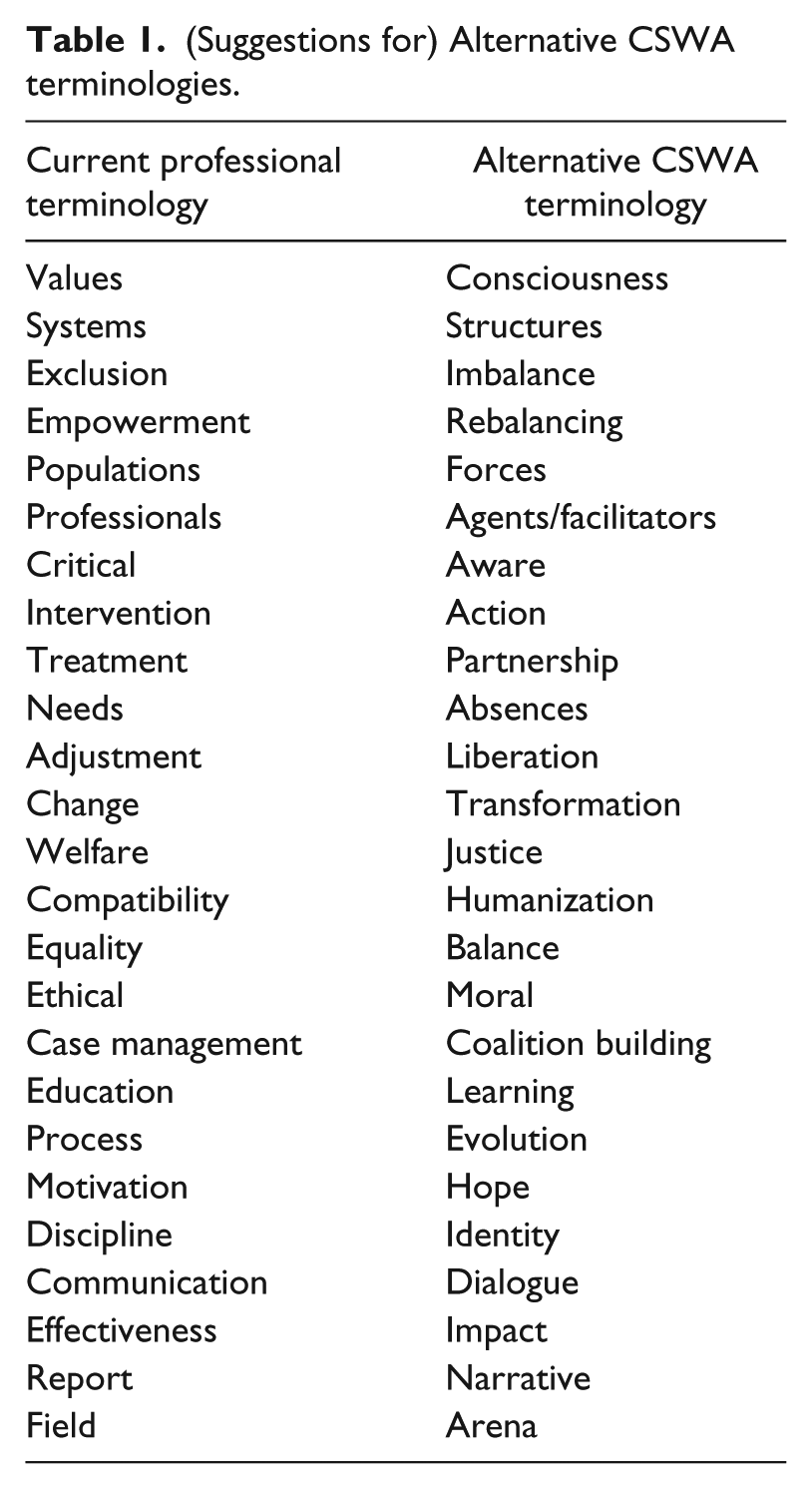
This lexicon can be used anywhere social work takes place. The introduction of terms therefrom into social work education programs could over time spark interesting shifts in how social workers, service users, policy-makers, and even the public understand what social work is. In other words (literally so), any genuine professional partaking in liberation would thus be facing and changing silencing or oppressive elements within the social work internal discourse and dialogue with policy as well.
Conclusion
Social work and social policy, through all their diverse applications, address individual, family, or community distress occurring in social constructs. Such constructs are not static; change is ever-present in the social realm. Our proposals for CSWA guidelines are the outcome of our reaction to, and perception of, some challenges currently facing CSW that, when added to other known limiting factors, greatly impede its implementation and development. It is our belief that enhancing CSW’s contribution to social workers’ practice will broaden the profession’s ability to counter the harsh social injustices its beneficiaries face. For the sake of parsimony, the current list focuses on the conceptualization of some major challenges in CSW discourse and the introduction of some basic principles of CSWA. It therefore is not meant to be all-inclusive, but rather to suggest some perspectives on the relationship between reflection and action for social workers, social work administration, social policy-makers, and social work scholars who seek to genuinely incorporate CSW into the effort of resolving individual, family, or societal problems. Clearly, the voices of social service users are missing from the ideas offered, which, by their nature, constitute a professional and disciplined internal discussion. Future research and theory are hereby invited to continue where we left off, enriching our suggestions with additional examples, conceptualizations, and perspectives.
Footnotes
Disposition editor: Sondra J. Fogel
Declaration of Conflicting Interests
The author(s) declared no potential conflicts of interest with respect to the research, authorship, and/or publication of this article.
Funding
The author(s) received no financial support for the research, authorship, and/or publication of this article.