



Abstract
Posttraumatic stress disorder (PTSD) may not fully explain why some who experience war feel as though their assumptive world and sense of meaning has been shattered. Two concepts mentioned in the literature that address this feature of trauma are moral injury and spiritual injury. This work reports on qualitative findings from postgroup interviews with 18 participants who completed a spiritually integrated eight-session group intervention known as Search for Meaning. The group is designed to deal directly with issues of moral and spiritual wounds. This article discusses three main themes related to (a) the group process, (b) spiritual struggles and repair, and (c) the role of the group leaders. The findings support the call for specialized interventions to supplement mainstream PTSD treatments.
Keywords
Who are these? Why sit they here in twilight? Wherefore rock they, purgatorial shadows, Drooping tongues from jaws that slob their relish, Baring teeth that leer like skulls’ tongues wicked? Stroke on stroke of pain,—but what slow panic, Gouged these chasms round their fretted sockets? Ever from their hair and through their hand palms Misery swelters. Surely we have perished Sleeping, and walk hell; but who these hellish?
1
Although an appreciation of the deleterious impact of combat on the emotional well-being of soldiers has been recognized for centuries (see Ray, 2008), far too often the social response has been either to ignore such injuries or to question the original mental fitness of the afflicted. Bogacz (1989), describing the state of affairs in England, notes that following the numbing reality of the First World War, the populace grappled with the enormity of the crisis then known as shell shock or war neuroses. Their concerns, abetted by the powerful words of literary figures, such as poet Wilfred Owen (see Fussell, 2013), led to the formation of a special government committee to explore the true nature of this malady. As Bogacz (1989) reports, as the work commenced, and personal testimony mounted, the prevailing assumptions of the citizenry were torn asunder, when it became clear that Shell-shock could not be tamed, it could not be safely attributed solely to misfits, mental degenerates or weak men of the lower orders; rather it was an impervious leveler of classes. For a generation raised to believe in the exercise of the will, it represented a signal defeat: even the strongest man [sic] could fall victim to it. (pp. 247-248)
It appears as if each generation must rediscover war trauma and then scramble to find ways to effectively respond. However, the post-Vietnam experience seemed to seriously pierce the denial of those who viewed such behavior by veterans as a form of malingering and was, in part, the impetus for the introduction of posttraumatic stress disorder (PTSD) in the Diagnostic and Statistical Manual of Mental Disorders (3rd ed.; DSM-III; American Psychiatric Association) in 1980. It also appears that as warfare has changed, so has the trauma experienced, and individual responses to it. In guerilla warfare, it is often impossible to decipher friend from foe, and in the most distressing situations, the enemy could include small children and seemingly innocent families. Danger lurks everywhere, provoking a needed hypervigilance, and in comparison with pre-Vietnam era wars, soldiers are more likely to fire a weapon and to be cognizant that they had killed another (Jinkerson, 2016; Purcell, Koenig, Bosch, & Maguen, 2016; Vargas, Hanson, Kraus, Drescher, & Foy, 2013).
In the case of Vietnam, reports of atrocities shocked the public, and even more so, when it became apparent that some were committed by Americans. The context in which these life and death dramas unfolded was something few civilians could ever comprehend. The damage done to the psyche was only compounded when these soldiers, often placed in untenable positions, lost faith in their leaders, country, and even God (Bunkers, 2008; Currier, McCormick, & Drescher, 2015; Fontana & Rosenheck, 2004; Hodgson & Carey, 2017; Jinkerson, 2016; McCormack & Ell, 2017). Where a welcoming nation could have served as a needed balm for the wounds suffered, instead, many faced hostility and condemnation (e.g., the use of the label “baby killers”; Kinghorn, 2012; Purcell et al., 2016).
Given the nature of post-Vietnam military operations, and the war on terror, trauma continues to be a pervasive problem among veterans and has a global impact on society. Traumatic experiences, now widely recognized in a variety of contexts, have been the subject of increased scrutiny. As our understanding of the phenomenon expands and deepens, our recognition of the nuanced ways that trauma affects the lives of individuals has become more sensitive as well. Trauma is particularly hazardous to emotional health, when the precipitating events negatively challenge our fundamental beliefs about the self, our world, and life in general which are, at times, beyond our awareness. In fact, it is argued that such beliefs, captured under the term the assumptive world, can be shattered in the face of particularly traumatic events (Frank, 1974; Janoff-Bulman, 1992; Tedeschi & Calhoun, 2004). There are any number of unfortunate events that can damage these deeply held assumptions, but few are as impactful as war. Trauma in modern warfare results from such experiences as witnessing atrocities, injuring or killing others, and a sense of betrayal by leaders. One may not only be the victim, or bear witness to troubling events, but also be the perpetrator of acts that run counter to one’s personal values (Shay, 2014).
Certainly, the trauma of war can result in the development of PTSD, but as some looked closer, they discerned that PTSD does not fully explain why so many veterans felt as if their life was empty and meaningless. One discriminating element to consider when assessing the ravage of war on individual lives is the degree to which sentinel moments during the period of active duty challenge a soldier’s assumptive world. Two distinct, yet overlapping, concepts mentioned in the literature that describe this feature of trauma are moral injury and spiritual injury (Hodgson & Carey, 2017; Kopacz & Connery, 2015; Litz et al., 2009; Shay, 2014; Sreenivasan, Smee, & Weinberger, 2014; Vargas et al., 2013). Litz et al. (2009) describe moral injury as “an act of transgression that creates dissonance and conflict because it violates assumptions and beliefs about right and wrong and personal goodness” (p. 638). Shay (2014), respecting another dimension of the military experience, notes that moral injury also arises from a sense of betrayal, particularly by those in authority. The issue is the basic loss of trust in self and others, causing one to be constantly on guard, leading to an urge to remain isolated from others, and, at times, engaging in harmful behaviors. Certainly, many of these behaviors are consistent with PTSD, yet moral injury can be present without the flight/fight/freeze-type responses seen in PTSD. Speaking to this important distinction, Jinkerson (2016) observes, Though moral injury and PTSD likely often co-occur, moral injury does not develop through an experience of physiological distress. Instead it develops through a moral conflict in which one’s actions, or the actions of one’s peers or leaders, are demonstrably inconsistent with one’s moral code. (p. 125)
Drawing attention to the spiritual aspect of trauma, Hodgson and Carey (2017) argue that in the case of military trauma, moral injury is, in essence, an affliction of the soul, involving one’s basic integrity, and overall spiritual well-being. Similarly, in examining the relationship between spirituality/religion and PTSD among combat veteran, Berg (2011) uses the term spiritual injury to describe damage to one’s sense of coherence, meaning, and hope that can result from military trauma. The author argues that “PTSD is profoundly a spiritual disorder” (p. 3) and advocates for PTSD programming that treats the whole person—interventions that go beyond primarily focusing on the bioneurological aspects.
Although definitions of moral and spiritual injury are still in the process of being refined in the literature, with no clear consensus, there are some obvious overlapping features. Both types of experiences involve a shattering of one’s foundational belief system and an ensuing struggle with meaning-making resulting from stressful/traumatic life events. Also, a person may experience an array of symptoms such as guilt and shame, a sense of betrayal, lack of trust, anger, struggles with forgiveness, a negative self-image, moral concerns, loss or test of spiritual/religious beliefs, as well as an overall sense of disconnectedness with one’s deeper self, other people, and the wider world (for some this can include a sense of disconnection with one’s sacred source; Harris, Park, Currier, Usset, & Voecks, 2015; Hodgson & Carey, 2017; Koenig et al., 2018). A clear point of distinction is that spiritual injury scholars consider the spiritual aspect of trauma as primary (i.e., trauma is interpreted as an existential crisis), whereas moral injury experts prioritize the moral and ethical impact (spirituality may or may not be considered a factor).
Although appropriate attention has been placed on developing interventions that are designed to alleviate the imprint of PTSD, what can be done to help repair the assumptive system, enhance spiritual well-being where appropriate, and restore a sense of meaning in life? This article reports on one group intervention, designed to address these sensitive topics with veterans. It begins by briefly reviewing historic trends in group work with this population.
The Evolution of Group Work With Veterans
The use of group modalities with war veterans arose primarily because the demand for services outstripped the ability to provide individual therapy and treatment (Blair, 1943; Grotjahn, 1947; Weinberg, 1945). However, the basic goals of these early initiatives are largely consistent with similar efforts today. Thus, Shaskan and Jolesch (1944) saw the purpose of the group . . . as a vehicle whereby the individual can relive that period of his life whence his present trouble originates is three-fold. I) To relieve the individual of those feelings of isolation which a deep-seated problem gives him. 2) To demonstrate to him the universality of his problem through the knowledge that other members of the group share in it. 3) To stimulate his search for a solution since he can no longer conceal his problem from society as he has in many instances been successfully doing.
2
(p. 576)
As the use of groups became more commonplace in military settings, it was recognized that they had a distinct therapeutic role, and unsurprisingly, many pioneering efforts drew from tenants of psychotherapy, with an emphasis on matters of transference and countertransference, and the inner conflict suffered by veterans (Ackerman, 1946; Friend & Sullivan, 1947; Kline & Dreyfus, 1948). From the beginning days of group work with veterans, to today, it has been recognized that this method is particularly effective when cohesion develops among members, mimicking the camaraderie many had enjoyed previously with their military peers (Grotjahn, 1947; Keenan, Lumley, & Schneider, 2014; Rozynko & Dondershine, 1991). If established, this sense of belonging created a safe environment for the sharing of one’s stories. Like all such groups, it is comforting, and liberating, to understand that one is not alone (Beehler, Clark, & Eisen, 2014; Blair, 1943; Dreikurs, 1959; Gakkoucis & Kaufman, 1988; Paster, 1945; Walker & Nash, 1981). In those cases where specific content and powerful feelings had been repressed, the outpouring of emotion produced a sense of catharsis (Ackerman, 1946; Egendorf, 1975; Frick & Bogart, 1982; Schwartz, 1945; Sherman, 1943). Another important early, and now well-recognized, finding is that the group setting could become a place veterans would process feelings of guilt, in particular survivor’s guilt (Brende, 1981; Egendorf, 1975; Friend & Sullivan, 1947; Gakkoucis & Kaufman, 1988; Keenan et al., 2014; Paster, 1945; Scurfield, Corker, Gongla, & Hough, 1984; Shatan, 1973).
Group work in the Vietnam era, at least in some quarters, moved in new directions. It can be argued that the structure and process of these new groups were a direct response to the nature of combat these soldiers experienced, and the rejection so many felt when they returned stateside. Here, feelings of betrayal ran high, and in the worst situations, participants felt as if they had been expendable pawns in a no-win game. In response, the support and help groups that emerged at the time were less likely to be conceived as classically therapeutic. These groups featured an egalitarian ethos, where leaders were seen primarily as an equal member, with the expectation that they too would share their inner thoughts and feelings along the way. Such groups spoke to power concerns and dealt openly with feelings of anger and rage. In time, they became known as rap groups (Brende, 1981; Egendorf, 1975; Gakkoucis & Kaufman, 1988; Scurfield et al., 1984; Shatan, 1973; Walker, 1983). In describing the unique nature of rap groups, Gakkoucis and Kaufman (1988) suggest, “These groups provided a veteran with a setting in which he or she could talk about Vietnam and establish a support network. Although there was an important therapeutic element, the emphasis was on communality and shared commitment” (p. 93). Interestingly, Scurfield et al. (1984) observed that although a focus on the control of symptoms is common in therapy groups with veterans, in rap groups “providing a forum to clarify one’s values and perspectives on the Vietnam War stood out as the major theme” (p. 15).
Finally, given how modern warfare has affected the lives of soldiers, in particular, those events that led to moral and spiritual wounding, it is not surprising that there has been a budding interest in group processes with a frank spiritual focus (Bormann, Thorp, Wetherell, & Golshan, 2008; Lapierre, 1997; Smothers & Koenig, 2018; Zinnbauer & Camerota, 2004). In reviewing a range of spiritual practices with veterans, Smith-MacDonald, Norris, Raffin-Bouchal, and Sinclair (2017) concluded, To improve the therapeutic clinical outcomes for veterans, the integration of positive spiritual coping as a bona fide modality seems reasonable and timely. On the basis of evidence from this review, spiritual interventions targeting PTSD and other mental health issues may have a therapeutic effect and serve as a salve to psychosocial distress. (p. e1937)
Attending to the spiritual needs of soldiers is not a novel idea. George Washington requested more chaplains during the French-Indian wars, and in 1775 the Continental Congress approved a pay scale for members of the clergy serving in the military. From there, the role of pastoral counselors, and the presence of clergy in the field of battle, has a long and distinct history (Wukovits, 2018).
This work reports preliminary qualitative data on a spiritually integrated group intervention known as Search for Meaning (SFM). This intervention is designed to deal directly with issues of moral and spiritual wounds. In many ways, SFM builds upon two traditions in military life—a focus on the spiritual and religious lives of soldiers and the use of group modalities to help them deal with the aftershock of war.
The Study
The SFM group, attended by combat veterans suffering from PTSD, was conducted at a Veteran’s Administration (VA) hospital located in a large U.S. city. Group members were recruited internally through personal contact and email messages made to various departments to solicit clinician referrals within the VA hospital. Recruitment took place during a 4-week period before the start of each wave of the intervention. Participants were screened for eligibility. Inclusion criteria consisted of the following: (a) a veteran classification, (b) 18 or older, and (c) a documented PTSD diagnosis. Those with active psychosis, active suicidal intent, or moderate to severe cognitive impairment (as determined by the short Mini-Mental State Examination) were excluded from the study. Participation was voluntary. All participants signed an informed consent form and HIPAA authorization. The study was approved by the university Internal Review Board where the first and second authors are employed.
Interviews were conducted with study participants at the start, and end, of each wave of the SFM intervention (there were four waves over a 14-month period; two interviews were conducted with each participant). In total, 23 study participants completed initial interviews, whereas 18 completed postintervention interviews. Initial interviews lasted approximately 1 to 1.5 hours, whereas postintervention interviews lasted between 30 and 60 minutes. Although a portion of the postintervention interview involved a recap and clarification of the pregroup interviews (referred to as “member checking” in qualitative research), the bulk of the second interview was devoted to ascertaining veterans’ impressions of the group process (e.g., What did you like most about the SFM classes, and why? What did you like least, and why?) and the impact participation had on their lives (e.g., “As a result of taking the SFM group, has anything changed in how you are able to make sense of, or find meaning related to, your trauma experience?”).
All interviews were conducted face-to-face and audio-recorded. A semistructured interview format was used. Participants received US$20 gift cards for each completed interview. This report presents finding from postgroup interviews with the 18 participants who completed the SFM intervention.
Analysis
The first author and four PhD level graduate student researchers coded the data using the consensual qualitative analysis (CQR) approach (Hill et al., 2005; Hill, 2012). All researchers received training in CQR before the analysis began. A hallmark of this approach is that multiple researchers code the same data both collectively and independently and then meet to compare their work and resolve discrepancies through consensus (interrater reliability). In addition, CQR involves external auditors whose role is to review and provide feedback on the work of the primary team members who are conducting the analysis. The second and fourth authors functioned as external auditors for the current study. It should be noted that this work reflects only one phase of an extensive analysis of the entire data set, and future research will rely heavily on quantitative methods.
The SFM Intervention
SFM is an 8-week mindfulness-informed psychoeducational and processing group with a spiritual/existential/cognitive focus designed to begin the journey of examining spiritual injury associated with combat-related posttraumatic stress. Moral injury is discussed in the group. However, similar to the work of Berg (2011) and Hodgson and Carey (2017), spiritual injury is treated as a primary concept that subsumes the more specific concept of moral injury. Each session is 90 minutes. The intervention is led by co-therapists: a chaplain and mental health clinician both trained in trauma treatment. Group leaders espouse a variety of traditions and all spiritual belief systems, including atheism, are accepted within the group. Veterans are encouraged to explore their spiritual wounds openly, particularly those that challenge their spiritual beliefs. See Table A1 in the appendix for a session-by-session outline of topics covered in the SFM group intervention.
Demographics
Participants’ age ranged from 35 to 71 years. Seventeen identified as male, and one as female. A majority of participants self-identified as Christian (six Baptist, four Catholic, two Methodist, one Pentecostal, and three general Christianity [including “non-denominational,” “Protestant,” and “Christian]), whereas one respondent stated they were “exploring,” and another responded “none.” Twelve participants reported enlisting during the Vietnam war era, whereas the remaining enlisted after this era. Eight served in the Army, four in the Marines, three in the Airforce, and three in the Navy. No participants were still active duty at the time of the study.
Findings
As noted above, 18 of 23 original study members completed a follow-up interview at the conclusion of the eight-session SFM group. This report focuses on three main theme areas that emerged from these follow-up interviews, including (a) the group process, (b) spiritual struggles and repair, and (c) the role of the group leaders.
The Group Process
As was detailed above, a range of differing group processes have been extensively used to help traumatized veterans since the World War II (WWII) era. Regardless of whether such groups have been considered educational, therapeutic, or simply support or rap groups, common themes emerge. The experience was no different here. Not surprisingly, once in a group, the veteran understood that others had similar experiences, and hence, they were not alone. As one Vietnam era Marine put it, You’re not the lone wolf out there alone by yourself thinking these things, there’s other people just like me that have the same thoughts . . . I wasn’t the only one traumatized by events, other people were traumatized also.
In a similar vein, a veteran of two conflicts added, “You really realize, you know, you’re with your own kind. We’ve all seen this thing and we’ll be alright.”
Although responses of this nature can be anticipated in any group that comprises people with common issues and similar life experiences, the importance of this step cannot be minimized. So many veterans have gone years without seeking help, and the nature of PTSD can lead many to distrust others and refrain from interacting with strangers. Establishing this basic groundwork is essential to the effectiveness of a group that is designed to foster change in the life of participants. Certainly, the ability to develop a bedrock level of trust speaks to the skill of formal and informal group leaders that emerge. Some in this study expressed some surprise at how comfortable they became opening up to others. Here are the observations of two who served in the Army: I don’t talk too much to my family and things, but when I come here my sessions with my psychologist or practitioner, I feel more comfortable talking now, than I ever, than I ever have been. Not holding a lot in like I had before . . . Like I told the chaplain, it makes you get away from that fear that if you talk about things that are bothering you, ain’t nobody gonna handcuff you, and lock you up. I mean a lot of things you talk about, and it just kinda, it helps. You know, . . . you breathe easy, you know, you take heaviness off your chest after a session, and you talked about something that you really care about, and you leave and you just feel a hell of a lot better.
From the first attempts to use group process to help veterans dealing with trauma, catharsis has been understood as a key element to the healing process. Leaders of groups have also advised that creating a safe space for members to openly share their anger is necessary. In the SFM group, the relationship between trauma and anger is explored, as well as strategies to manage it. Thus, it is not surprising that this is highlighted as a helpful aspect of the group. One Vietnam era vets speaks to this, I can let more things go now. Whereas before, not that I would confront them, but the anger, and the deep feelings, and the sickness within me would be there . . . Rather than letting it just sit there and eat on you, and just pile it up, and I think Search for Meaning, where the example they gave in there was we sometimes let this anger pile up on us, one thing makes you angry then the next, then the next, then the next, and all of a sudden you can’t hold it anymore.
Far more common in this particular group were issues related to guilt, most importantly, appreciating the context of their life during wartime, and of great significance, self-forgiveness. After participating in the SFM group, some veterans felt they had finally come to terms with the reality of their situation, resulting in remarks like, “I accept the fact now that I did what I was ordered to do.” With that, many acknowledge that there is still work to be done, for example, “I still feel guilt. I still feel grief for other people that died—caught in the middle, that weren’t taking sides or nothing. And I accept the fact that is what is, and what was.” Naturally, one aspect of moral trauma are difficult and haunting memories. The natural urge is to repress such thoughts, and destructive behavior can arise when such memories cannot be shaken and become overwhelming. In a remark that would certainly suggest welcome headway has been made, one former soldier said, “I’m not afraid to face them anymore. They’re not pleasant, but I’m not really afraid to face them.”
Spiritual Struggles and Repair
Because war can shatter deeply held assumptions, beliefs, and values about life; the moral character of people; and the meaningfulness of existence, it can be anticipated that many veterans question spiritual and religious precepts. Paradoxically, even questioning such beliefs can produce anxiety—some participants mentioned feeling guilty about doubting a higher power. One important aspect of the SFM group, according to some, is that the permission was there to openly question their beliefs in a group context. One veteran suggested that they had permission to argue with God, adding, “He needs to be able to know how you feel, and you should be able to voice your opinion. That was something else that was able to come up through the group this time.”
More than any single item, it would appear that this group was especially helpful in prompting veterans to confront, and process, their anger at their notion of God, for what they had suffered. As one group member reported, “I used to feel like God didn’t give a damn. Some days I still feel like that.” Speaking to the struggle that still plagues many, one soldier addressed his doubts head on, “I try to believe in God, a lot. If I didn’t, I think it would be a lot harder to handle the past situations . . . . But I don’t know if God believes in me.”
By allowing a forum to express anger, and doubts in a supportive environment, some veterans appear to have taken a new perspective on the troubling situations that have had a lasting imprint on their life. For example, Even though you ask God to change things, do this, and you pray to Him, but people don’t do what God wants them to do sometimes. One thing he does is give people choices in what they do. And, a lot of times, you know, we put the blame on God when sometimes really the blame shouldn’t be put, on God, it should be put on the people who done those things to you. . . . Discussing that helped me with that.
If there was one universal comment that summarized where many veterans landed after wrestling with spiritual matters, and their belief in God, it would be, “I don’t put the blame on God as much as I used to. I put the blame on people in charge . . .”
Moving past anger at God is one step toward drawing on spirituality and religious practices as a source of social support, for those who have been previously inclined to do so. Some members were able to take this step. For instance, one veteran suggested, A deeper spirituality is what I came out with. . . I’m more peaceful inside, with the spirituality, than I was before . . . inner peace . . . I feel that growing within me. . . It seems like it had, you know, like a blanket over a fire.
Similarly, “Now I will talk to God about things, not just everyday things, but I talk to him about other things that happen in this life.”
However, as the title of this group suggests, there is a larger quest at hand. Since the work of those such as Victor Frankl (1963), and later explorations in the area of posttraumatic growth (Tedeschi & Calhoun, 2004), the hope is that individuals can derive meaning from even the most devastating events. Here, the desire is that people not only recover and regain their equilibrium after traumatic events but actually draw from these trying times to reach a new stage of personal development, marked, at least in part, by a sense of inner peace.
Attendance in an 8-week long group is not going to ameliorate all of participants’ issues and concerns, nor help them come to closure, or a complete understanding, about the traumatic events they faced. Although it cannot be proclaimed with certainty, perhaps this veteran sums up how many of his peers feel when he states that the group “Got the wheels turning. I’m working on changing, that’s all I can do, is work and try. You know? It’s a process. It ain’t gonna happen overnight. . . It’s a process for that flower to bloom.” The reality is that only half of respondents experienced a shift in how they make sense of their time in war and combat. This occurred mostly through reframing (e.g., “It’s part of war, people make bad decisions, it’s not my fault, God did not abandon me”). For the remaining half, answers to the “why” question was less forthcoming. Getting to the point, one veteran says, “don’t think Vietnam you could find meaning to, it’s just one of those things you can’t. There’s no meaning to it.” Adding to this, one veteran acknowledges, “I can’t make sense out of it. That’s why I’m up here.”
What the group did do was at least cause some of the attendees to try to process, in a different way, what has unfolded in their lives. “I don’t know,” one participant remarked, “I don’t think I found why it happened . . . But I’m workin’ on it . . . at least I’m starting to think.” Because of the nature of the group, and the proclivities of the membership, spiritual themes were present. For example, Sometimes there’s not no answers to anything. They just happen, you’re not going to never know why. Sometimes you just have to go through some things to find out exactly what He is trying to teach you or show you.
The idea that God has a lesson or a purpose is noted in this veteran’s observation; “I think God uses those things to try to pull you closer to Him, but God doesn’t allow these things, He doesn’t make them happen.” One member of the group did not expect immediate answers: I think they’ll be made comprehensible as He deems the right time. In other words, I’ve learned that you take your problems—I can’t solve my problems, there’s no way. I have to put them out here on the table and let Him solve them when He feels the time’s right.
At least from these self-reports, the content and processes that unfolded in the SFM group did have an appreciable impact on some veterans’ appraisals of their military experience, and in many ways, their selves. One veteran credited the group with . . . Making me realize that I am a human being. I am worth something. I do count for something, no matter how many bad things happened that I had to do, and then no matter how many personal screw ups I myself made in my personal life. I’m not useless, I’m not worthless. I am somebody . . . God forgives me for what I did, he knows I didn’t do it on purpose.
Taking this one step further, one veteran felt the group gave him a sense of direction, and in essence, It was a form of hope that I’m supposed to be able to do something with my life to give God the glory. So basically, from the first day to the last day, it’s a tool for me. I will never forget some of the things I learned in there. I’ll never forget some of the people that spoke from the heart.
Getting to the essence of it all, one member again likely speaking for many peers, proclaimed the goal as “just trying to become a better person. And trying to become one with myself, and not be at war within myself.”
The Role of the Group Leaders
Although the style and focus of group work has changed over time, some of the issues faced by leaders have remained relatively constant. Whether couched as matters of transference and countertransference, or poised in less traditional terms, it is clear that leaders, even those who view themselves as equal partners, must strive to manage a potentially intense group process. When veterans feel a sense of betrayal, a group leader can become a symbol of all those in position of authority who have failed them (Frick & Bogart, 1982; Paster, 1945; Walker & Nash, 1981). In practice, it means the therapist must be able to tolerate hearing difficult stories and tales that may offend their own values and morals. As Keenan et al. (2014) write, “therapists must be willing to hear the story of the trauma unflinchingly, while knowing in their hearts that they could have behaved in the same way, under the same circumstances, no matter how horrifying the act” (p. 547). This can be emotionally trying work and requires the helper to monitor their own secondary trauma and emotional numbing that could impede their effectiveness (Brende, 1981; Keenan et al., 2014; Shatan, 1973; Walker, 1983).
Allowing group members to work through their feelings is vitally important, and as evidence of a helpful group process, one member stated, He (the chaplain) didn’t try to change me. There were some people in the group that are very religious. They, you know, go to church every Sunday and things like that. That’s their beliefs, again nobody’s going to change me. Not that I’m going to be afraid to say something wrong. Be called a sinner, you know. I can open up to the chaplain.
Looking back, one member believes the group facilitators actually pushed them to explore the nature of their faith a bit deeper: Something he (chaplain) said actually made me question God, and then I went through about a week of turmoil. Then I searched more with the bible and talking to God and it came out that . . . It actually strengthened my faith more, because it made me search more.
The ability to explore these deep and personal beliefs in a group context clearly puts pressure on professional leaders to help shape a culture and atmosphere that promotes respect for the individual and underscores that all are present in an emotionally safe environment. Although the responses directly above represent the experiences of group members with one of the co-leaders (the chaplain), it would appear that there are some lessons to be learned here that may be transferable to other like efforts. The most frequent comment among this group was that the chaplain was “down to earth,” suggesting the ability to be relatable as a fellow veteran. In many ways echoing this theme, one member admitted, “I got a higher respect for, men of the cloth. They can be like us. They’re not as pious as I thought they were.” The other issue at hand might best be described as the ability to maintain a largely neutral stance. Consider this response, “The good thing about the chaplain that was really good was we talked about religion, we talked about spirituality, we talked about forgiveness, but it all didn’t fall into the religious aspect, it was down to earth.”
In all cases, the number one concern of the leader is the well-being of group members. Although several participants found catharsis to be therapeutic, it is important to keep in mind that there are times when the airing of intense feelings is not helpful, especially for group members who may react negatively to high expressed emotion. In one of the rare negative reactions to the SFM group, one participant argued it was akin to an “emotional fight club.” She noted, Hearing other people retell trauma makes me upset. So, this has already made me very raw, being in this group. So, we need to like counterbalance this, and make this . . . as soothing an experience as we can, cause we’re gonna be dealing with stuff that will retrigger all of us. When I heard that man’s voice go up, or when he started to cuss, I’m like, these things are bringing back all of my, traumatization . . . it’s really hard for me to sit here. But that was never addressed.
Because of these issues, it is common to call for co-therapists as a method to effectively shepherd groups of this nature and manage the emotional reactions of all participants including the leaders themselves. In the SFM group, the chaplain and the mental health practitioner work together to help foster a positive emotional climate. In the groups that were conducted as part of this study, the chaplain took the lead addressing topics related to spirituality and religion, including struggles with meaning-making, shattered assumptions, and moral injury, whereas the mental health clinician contributed their expertise regarding PTSD diagnosis, as well as issues such as guilt and shame, struggles with negative self-identity, meaning-making, and forgiveness (issues that have both psychosocial and spiritual components).
Finally, because one is working with veterans, it is likely leaders with military experience may more quickly earn the trust of members. Although this might provide an initial head start, trust is likely earned session by session, as the material discussed moves from the surface to the most personal and painful content.
Conclusion
Perhaps summing up the feelings of many of the veterans in the SFM group, one member states, “We’re still a work in progress. . . and once you understand that, you can understand things don’t happen overnight.” Spiritual beliefs and practices are a key element of the assumptive world for many (Antonovsky, 1980; Fallot, 2007; Fallot & Heckman, 2005; Peres, Moreira-Almeida, Nasello, & Koenig, 2007; Shaw, Joseph & Linley, 2005), and although one’s spiritual orienting system can be shattered by trauma, spiritual beliefs can also be a source of meaning and coherence—it is a place where many turn to at the most difficult times of life (Bryant-Davis & Wong, 2013; Draucker et al., 2011; Knapik, Martsolf, & Draucker, 2008; Pargament, Murray-Swank, & Tarakeshwar, 2005; Peres et al., 2007). Prayer, mantras, religious rituals, and the like can provide relief in times of grief, anxiety, and other intense feeling states (Koenig et al., 2017; Oman & Bormann, 2015a). Faith communities can be a font of emotional and tangible support. However, these same beliefs and practices can also be a source of considerable strain and conflict (Exline, Yali, & Sanderson, 2000; Kopacz & Connery, 2015; Stauner, Exline, & Pargament, 2016; Wortmann, Park, & Edmondson, 2011). If the veteran has engaged in acts which are felt to be at odds with spiritual norms, values, and laws, this may lead to extreme guilt and shame. What is most important for helpers to understand is that the situations described in this study are not rare, and it was the recognition of these realities that led to the development of the concept of moral and spiritual wounds. The SFM group was specifically designed to address these kinds of issues.
It is not suggested that the SFM intervention, or any like group, is sufficient for providing holistic care to service members. Instead, the group is seen as a needed complement to other standard services. Those same services, from individual therapy to medication, may be necessary to prepare a client emotionally to take advantage of a group process. Repair of the assumptive world takes time. In this study, one veteran expressed some frustration with the SFM group in this way, “For me, didn’t give me any answers totally . . . I’d like to have this big, booming voice come out and say (participant’s name), you’re alright. I don’t think that’s going to happen, though.” Although it is unlikely that any intervention can help one find the answers to the most vexing life questions, nonetheless, the response of participants in the SFM group indicates that their experience was a positive one. The ability to find a place where one is accepted and feels safe to share one’s most troubling memories, and inner-most thoughts, is a notable achievement given the impact of PTSD and spiritual wounds. Although not all were able to fully derive meaning from their traumatic experience, members felt free to explore their religious and spiritual beliefs and values, and in this alone some found solace. Because spiritual/moral wounds and PTSD can co-occur for service members who experience trauma, specialized, spiritually based interventions, like SFM, are needed.
The SFM intervention represents an integrated care approach in line with the U.S. Department of Veterans Affairs and Department of Defense Integrated Mental Health Strategy (Nieuwsma et al., 2013). Military chaplains play an important role in attending to the overall mental health of service members, including the spiritual/meaning-making component. The SFM intervention was created through the collaborative efforts of a chaplain and mental health providers (clinical psychologist, clinical social worker) who recognized a gap in current PTSD treatments and is a model for how military chaplains and mental health providers could work together to provide integrative care for those with PTSD. Cross-disciplinary opportunities for collaboration and training among chaplains and mental health providers are needed.
It is important to note that this study is based on a qualitative research design with a relatively small sample size and represents the words of a group of veterans at one Midwestern VA hospital. Therefore, no claim can be made regarding generalizability of findings. However, as this study was conducted, the SFM intervention has been manualized and expanded to 10 weeks (based on participant feedback). The authors are currently conducting a multisite outcome study (using quantitative surveys) which is expected to lead to an even clearer understanding of the impact of the SFM intervention.
Footnotes
Appendix
Outline of Topics Covered in Search for Meaning.
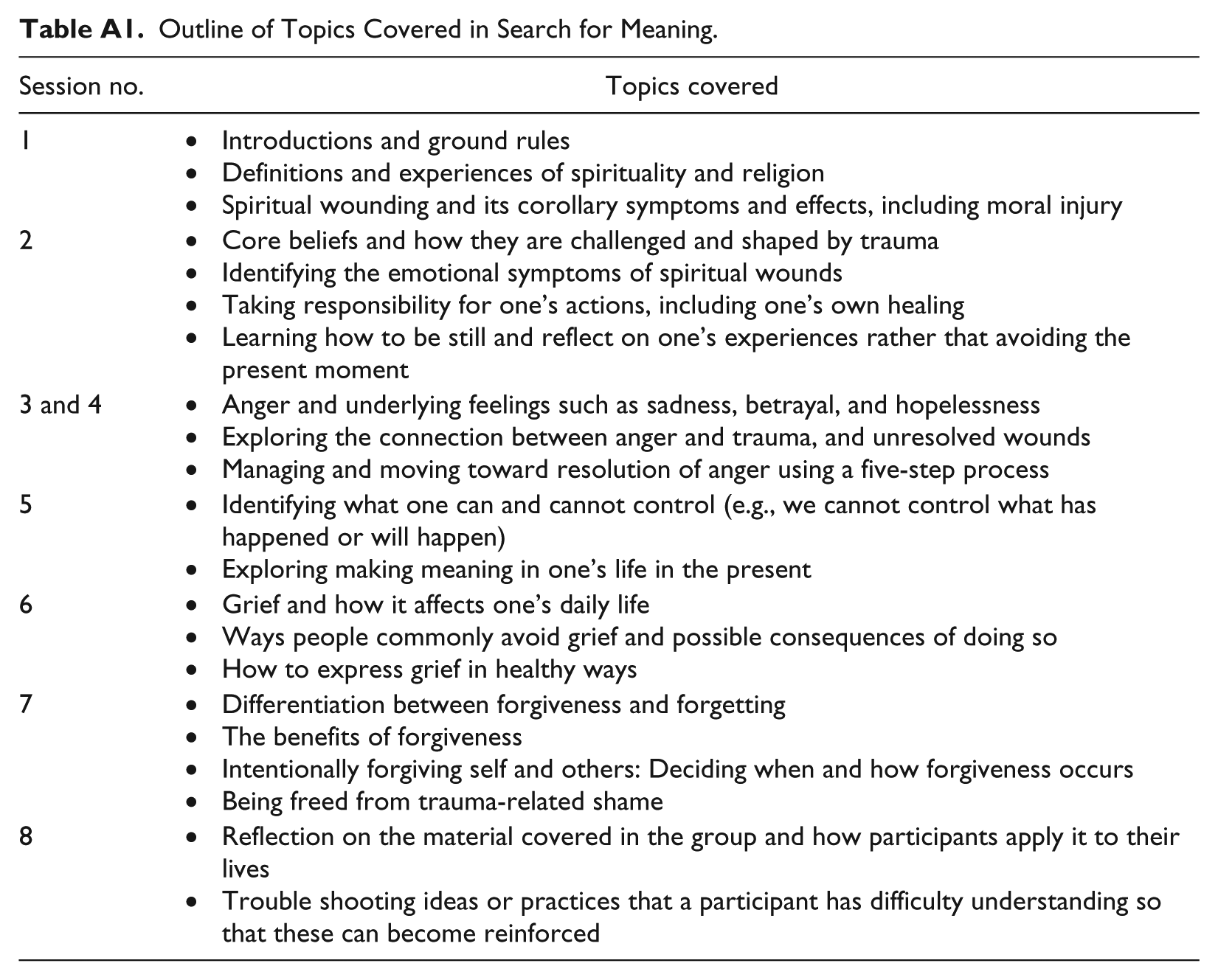
| Session no. | Topics covered |
|---|---|
| 1 | • Introductions and ground rules • Definitions and experiences of spirituality and religion • Spiritual wounding and its corollary symptoms and effects, including moral injury |
| 2 | • Core beliefs and how they are challenged and shaped by trauma • Identifying the emotional symptoms of spiritual wounds • Taking responsibility for one’s actions, including one’s own healing • Learning how to be still and reflect on one’s experiences rather that avoiding the present moment |
| 3 and 4 | • Anger and underlying feelings such as sadness, betrayal, and hopelessness • Exploring the connection between anger and trauma, and unresolved wounds • Managing and moving toward resolution of anger using a five-step process |
| 5 | • Identifying what one can and cannot control (e.g., we cannot control what has happened or will happen) • Exploring making meaning in one’s life in the present |
| 6 | • Grief and how it affects one’s daily life • Ways people commonly avoid grief and possible consequences of doing so • How to express grief in healthy ways |
| 7 | • Differentiation between forgiveness and forgetting • The benefits of forgiveness • Intentionally forgiving self and others: Deciding when and how forgiveness occurs • Being freed from trauma-related shame |
| 8 | • Reflection on the material covered in the group and how participants apply it to their lives • Trouble shooting ideas or practices that a participant has difficulty understanding so that these can become reinforced |
Disposition editor: Sondra J. Fogel
Authors’ Note
The views expressed in this article are those of the authors and do not necessarily represent the views of the US Department of Veterans Affairs. This material is the result of work supported with resources and the use of facilities at the Richard L. Roudebush Veterans Affairs Medical Center in Indianapolis, IN, USA where the first and second authors hold a without compensation (WOC) position, and the third and fourth authors are employed.
Declaration of Conflicting Interests
The author(s) declared no potential conflicts of interest with respect to the research, authorship, and/or publication of this article.
Funding
The author(s) disclosed receipt of the following financial support for the research, authorship, and/or publication of this article: This work was supported by Covenant Health in the form of a “Faith, Spirituality, and Health Research Grant” [grant number 4190033].
