




Abstract
This study examined how adverse childhood experiences (ACEs) shape selection of college majors that commonly lead to social service jobs. Using a sample of 722 college students, this study explored differences in total ACEs and prevalence of specific ACEs among students studying social work, criminology, and human services compared with students in a non-social science field and those in other social science majors. Compared with students reporting no ACEs, students reporting four or more ACEs were more likely to study social work (RRR = 3.74, 95% CI = 1.97–7.08), criminology (RRR = 2.51, 95% CI = 1.28–4.93), or another social science (RRR = 2.88, 95% CI = 1.34–6.20) than a non-social science major. There was no significant difference in total ACEs between students studying human services and a non-social science.
Introduction
Social service providers assist individuals in reaching their highest level of functioning through careers in child protection, corrections, substance abuse and mental health treatment, housing supports and services, and more. In these positions, social service workers frequently interact with individuals who have prior trauma. Adversity that occurs prior to the age of 18 has been categorized as adverse childhood experiences (ACEs) and include acts of physical, emotional, and sexual abuse, neglect from caretakers, and family dysfunction. ACEs have been linked to poorer physical health (Felitti et al., 1998; Jackson et al., 2019; Testa & Jackson, 2020), mental health (Colburn et al., 2021; Karatekin, 2018), and executive functions (Lund et al., 2020), along with career outcomes such as unemployment (Liu et al., 2013), gender-wage gaps (Robst, 2008), and employment barriers (Topitzes et al., 2016).
Along with serving individuals with a history of ACEs, it may also be that social service providers have a personal history of ACEs. Theoretically, individuals who received help for early trauma may be encouraged to pursue a social service career to find meaning in their careers. It may also be that exposure to social service workers at an early age—as a result of trauma—may make individuals more aware of social service careers. Using a sample of 722 U.S. college students, this study will explore history of ACEs among undergraduate and graduate students. Differences in total ACEs will be explored by college major to identify whether students studying a social service major have greater ACEs history than non-social service majors. The study will also explore prevalence of specific ACEs within particular majors.
Literature Review
Research has explored how childhood adversity is related to career choices, in which social service workers have been found to report increased ACEs compared with the general population (Aykanian & Mammah, 2022; Elliott & Guy, 1993; Howard et al., 2015; Keesler, 2018; Lee et al., 2017; Steen et al., 2021). Particularly, research found a greater prevalence of physical abuse (Elliott & Guy, 1993), sexual abuse (Elliott & Guy, 1993; Keesler, 2018; Steen et al., 2021), emotional abuse (Howard et al., 2015), emotional neglect (Howard et al., 2015), mental illness (Howard et al., 2015; Keesler, 2018; Steen et al., 2021), and parental separation/divorce (Keesler, 2018) among social service workers than the general population (Merrick et al., 2018).
Additional research has explored ACEs among college students. Research with social work majors has consistently found increased prevalence of ACEs compared with other college majors (Black et al., 1993; Branson et al., 2019; Conrad, 2020; Rompf & Royse, 1994; Russel et al., 1993) and the general population (Negrete, 2020; Thomas, 2016). Further research by Rompf and Royse (1994) offers support that early trauma may influence career decisions. In Rompf and Royse’s (1994) research study, students indicated prevalence of trauma experiences and then reported whether this experience influenced their career choice. Among social work majors, 39% reported that they selected their career because of an ACE. In contrast, only 14% of non-social work students reported that an ACE influenced their career selection.
There is limited evidence as to whether ACEs are more or less common in social service majors outside of social work (i.e., criminal justice or human services). Kirk and Dollar’s (2002) study offers some cursory evidence. Their research surveyed students majoring in sociology, criminology, social work, and human development regarding past trauma. With all social service majors as one homogonous group, they found similar prevalence of child abuse and sexual abuse across the full sample compared with the general U.S. population (Merrick et al., 2018). However, they did not report trauma prevalence within certain majors to better understand heterogeneity.
Despite limited research on ACEs with criminal justice and human services majors, some research sheds light on how prior trauma may impact selection of college major. For example, Li et al. (2021) surveyed Hispanic criminal justice majors, finding students with negative views toward the police to have less desire to work in law enforcement compared with students with positive views. Moreover, students who voluntarily made contact with the police—through situations such as asking for help from police or providing police with information—were more likely to report career aspirations to work in law enforcement. Meanwhile, research by Eren et al. (2019) found criminal justice majors who reported past victimization had more pessimistic views toward the criminal justice system, including views that the system was unfair and that justice is not frequently served. However, students reporting past victimization were also more likely to report that they majored in criminal justice to have a job for which they could make a difference and protect others from oppression. Although their research did not directly compare ACEs between criminal justice and non-criminal justice majors, findings suggest that even negative experiences may motivate someone to enter this field with the goal of changing the system. Woodside et al. (2003) explored student motivations to enter the human services major and found personal experiences to significantly influence selection of college major. Prior experiences receiving human services was particularly related to majoring in human services. Similar research by Collins et al. (1994) found patterns of parental issues, abusive relationships, and familial disruptions to influence selection of college major among human services students.
The Present Study
Although prior research has found increased ACEs among social service workers, limited research has explored ACEs among certain social service majors. While ACEs among social work majors has received considerable attention, it is unclear whether this trend can be extended to additional social service majors. Many social service positions are open to graduates with degrees in social work, criminal justice, and human services, among others, and it is important to understand whether individuals with different backgrounds vary in life experiences.
This study will address the following research questions:
These questions will be answered using a sample of undergraduate and graduate students in the United States with oversampling of students in social work, criminology, and human services. We hypothesize social service majors will have greater total ACEs than non-social service majors.
Methods
Sample
Data were collected in fall 2019 at three universities located in the Midwestern and Southern United States. Participants were recruited through convenience sampling, in which researchers distributed paper surveys during class and through an online survey. Courses from a variety of disciplines were targeted to obtain a representative sample of students. However, given the background of the principal investigator along with personal interest among instructors, there were a disproportionate number of instructors with backgrounds in social work, criminology, and human services who allowed researchers to survey their students. Along with in-class distribution of surveys, the survey was also available online via Qualtrics and distributed to students through an email link. Surveys took approximately 10 minutes to complete and responses were provided via a self-report questionnaire. The research study was approved by the principal investigator’s institutional review board. Data were collected according to the guidelines in the Declaration of Helsinki. Informed consent was obtained from all participants, and researchers received data without identifying information.
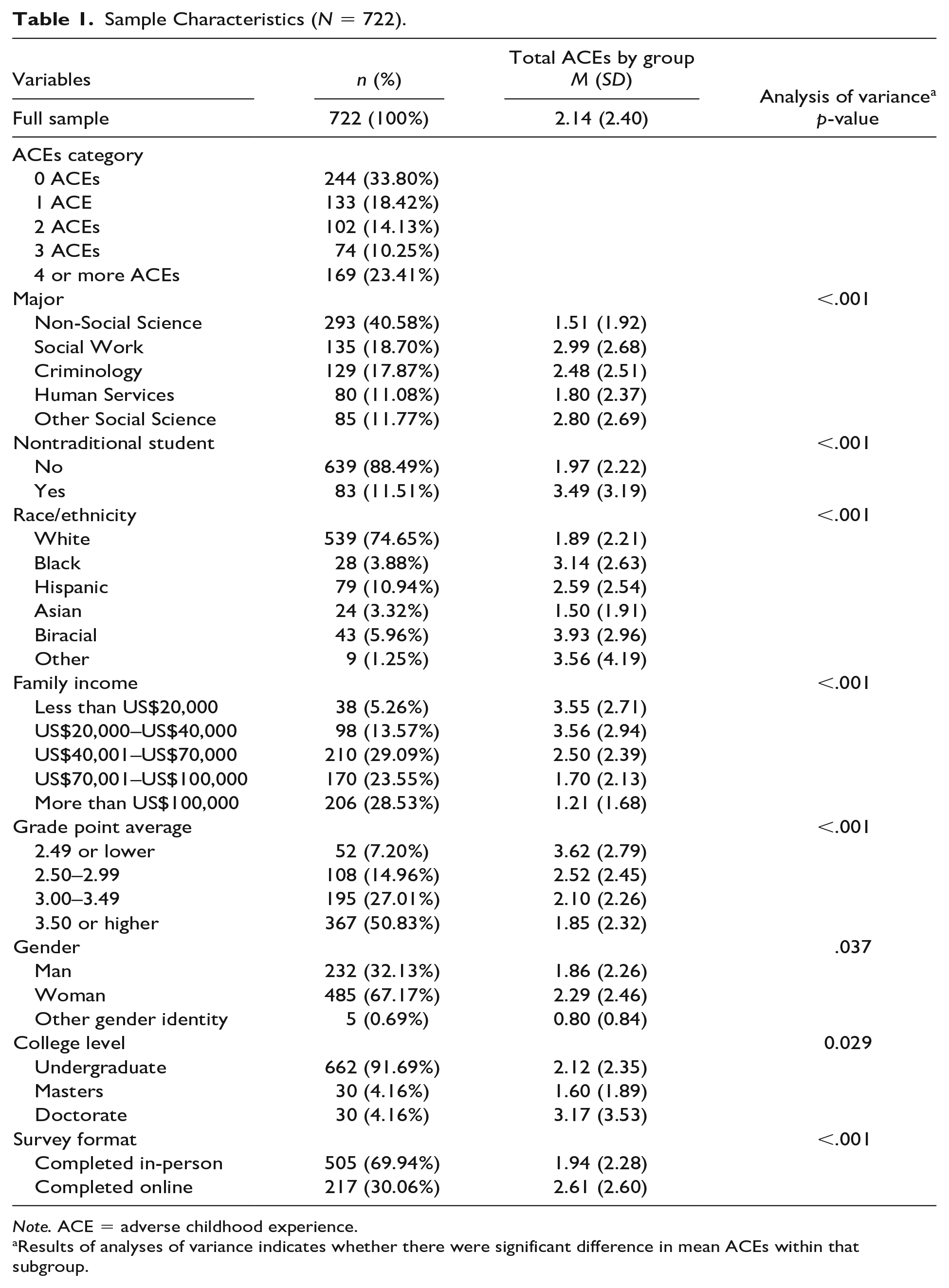
A total of 809 students participated in the study. There were missing data for 87 participants (11%) on one of the independent or dependent variables, who were subsequently dropped from analyses. This resulted in an analytic sample size of 722 individuals. Within the analytic sample, 70% completed the paper survey in-class while 30% completed the online Qualtrics survey. Characteristics of the analytic sample are available in Table 1.
Sample Characteristics (N = 722).
Note. ACE = adverse childhood experience.
Results of analyses of variance indicates whether there were significant difference in mean ACEs within that subgroup.
Variables
Dependent Variable
Students self-reported their “current major of study” with a selection of majors chosen from the most commonly surveyed courses, including social work, criminology, anthropology, sociology, human services, and education, along with a box to write-in their college major. Given small cell sizes for most majors, we then categorized majors into the following groups: social work, criminology, human services, other social sciences (e.g., sociology, anthropology, economics, political science, among others), and non-social sciences (e.g., engineering, business, biology, among others). While human services is not generally considered a social science major, we have pulled it apart from “non-social sciences” due to its overlap in future careers with those in social work and criminology. Many social service positions will accept bachelor’s degrees in human services from job candidates.
Independent Variable and Covariates
Adverse Childhood Experiences
Experiences of trauma during childhood were based on the original ACE study conducted by the Centers for Disease Control and Prevention and Kaiser Permanente (Felitti et al., 1998). Respondents were prompted to “consider experiences that happened while you were growing up, during your first 18 years of life.” They then responded as to whether (yes = 1, no = 0) each of 17 events related to childhood maltreatment and household dysfunction had occurred. Based on these 17 events, participants could have experienced up to 10 total ACEs consisting of physical abuse, emotional abuse, sexual abuse, physical neglect, emotional neglect, parental divorce or separation, and household experiences of mental illness, domestic violence, substance abuse, or incarceration. Each affirmative response was counted as one occurrence of an adverse experience. However, the total number of ACEs is lower than the total number of events as affirmative responses to several statements accounted for the same ACE. For example, if a participant responded affirmatively to either “You didn’t have enough to eat, had to wear dirty clothes, and had no one to protect you” or “Your parents were too drunk or high to take care of you or take you to the doctor if you needed it,” they were considered to have experienced physical neglect: this counted as one ACE. The total number of ACEs were calculated following guidance by the National Council of Juvenile and Family Court Judges (2019). The measure had good internal consistency reliability (α = 0.80).
Two ACEs variables were created: a count variable which summed the total ACEs and a categorical ACEs variable which categorized ACEs based on whether individuals reported zero ACEs, one ACE, two ACEs, three ACEs, or four or more ACEs. While the count variable allows for ease of interpretation, the categorical ACEs variable allows for a comparison with the original ACEs study conducted by Felitti et al. (1998) along with further research conducted by the Centers for Disease Control and Prevention, in which ACEs are reported by category. The analytic sample reported a mean of 2.14 ACEs (SD = 2.40) with 23% reporting four or more ACEs (see Table 1).
Covariates
Demographic and academic covariates were collected via participant self-report and included gender, nontraditional student, racial/ethnic group, family income, level of college coursework, and grade point average (GPA). Given that we collected surveys through in-person and online surveys, we further controlled for survey format. For the purposes of this study, students were classified as “non-traditional” if they were aged 25 years or older.
Statistical Analyses
First, bivariate analyses were used to explore the relationship between ACEs and college major. We tabulated the proportion within each major who had experienced each ACE and conducted chi-square analyses to understand between-group differences. To understand differences in ACEs by college major while controlling for covariates, we conducted a multinomial logistic regression model. College major was inputted as the dependent variable, with “non-social science major” as the base outcome. ACEs was inputted as the independent variable, using the categorical ACEs variable. Aforementioned covariates were included in the model. Relative risk ratio (RRR) is the commonly reported effect size for multinomial logistic regression and can be interpreted similarly to the interpretation of odds ratios, in which relative risk ratio above 1.00 indicates that students were more likely to be in that category relative to students in non-social sciences. Analyses were specified using Stata/MP 16.0 (StataCorp, 2019).
Results
Prevalence of Total ACEs
Analyses of variance exploring total ACEs by the categorical variables found significant differences across each variable (see Table 1). Total ACEs were lowest among non-social science majors (M = 1.51, SD = 1.92) and human services majors (M = 1.80, SD = 2.37), and heightened among students studying social work (M = 2.99, SD = 2.68), criminology (M = 2.48, SD = 2.51), and other social sciences (M = 2.80, SD = 2.69). Post hoc Tukey’s tests found significant differences in total ACEs between non-social science majors with social work, criminology, and other social sciences, yet not between non-social science majors and human services majors. Human services majors also had significant differences in total ACEs with students majoring in social work and other social sciences. There was no significant difference in total ACEs among students in social work, criminology, and other social sciences. Looking at the covariates, total ACEs were highest among students who were nontraditional (M = 3.49, SD = 3.19), a race of Black (M = 3.14, SD = 2.63) or Biracial (M = 3.93, SD = 2.96), family income of less than US$20,000 (M = 3.55, SD = 2.71) or US$20,000– US$40,000 (M = 3.56, SD = 2.94), GPA of 2.49 or lower (M = 3.62, SD = 2.79), and doctorate-level coursework (M = 3.17, SD = 3.53). Students completing the survey online also reported higher total ACEs (M = 2.61, SD = 2.60). Supplemental regression analyses were run with total ACEs (as a continuous variable) predicted by major and covariates (see Supplemental Table 1). Social work, criminology, and other social science majors had significantly heightened ACEs, as did nontraditional students. ACEs were significantly lower among individuals from higher-income families and with higher GPAs. Students in doctoral programs and completing the survey online were no longer statistically significant in multivariate regression analyses.
Additional supplemental analyses explored which major carried the heaviest burden of ACEs (see Supplemental Table 2). Across the full sample, 34% reported no ACEs while 23% reported four or more ACEs. Heightened burden of ACEs was reported among students in social work, criminology, and other social sciences, in which roughly one-third of each group experienced four or more ACEs compared with only 14% of students outside of the social sciences and 18% of students in human services. Non-social science majors (43%) and human services majors (39%) were most likely to report zero ACEs, compared with 24% of social work students, 28% of criminology students, and 22% of other social science students.
Prevalence of Specific ACEs
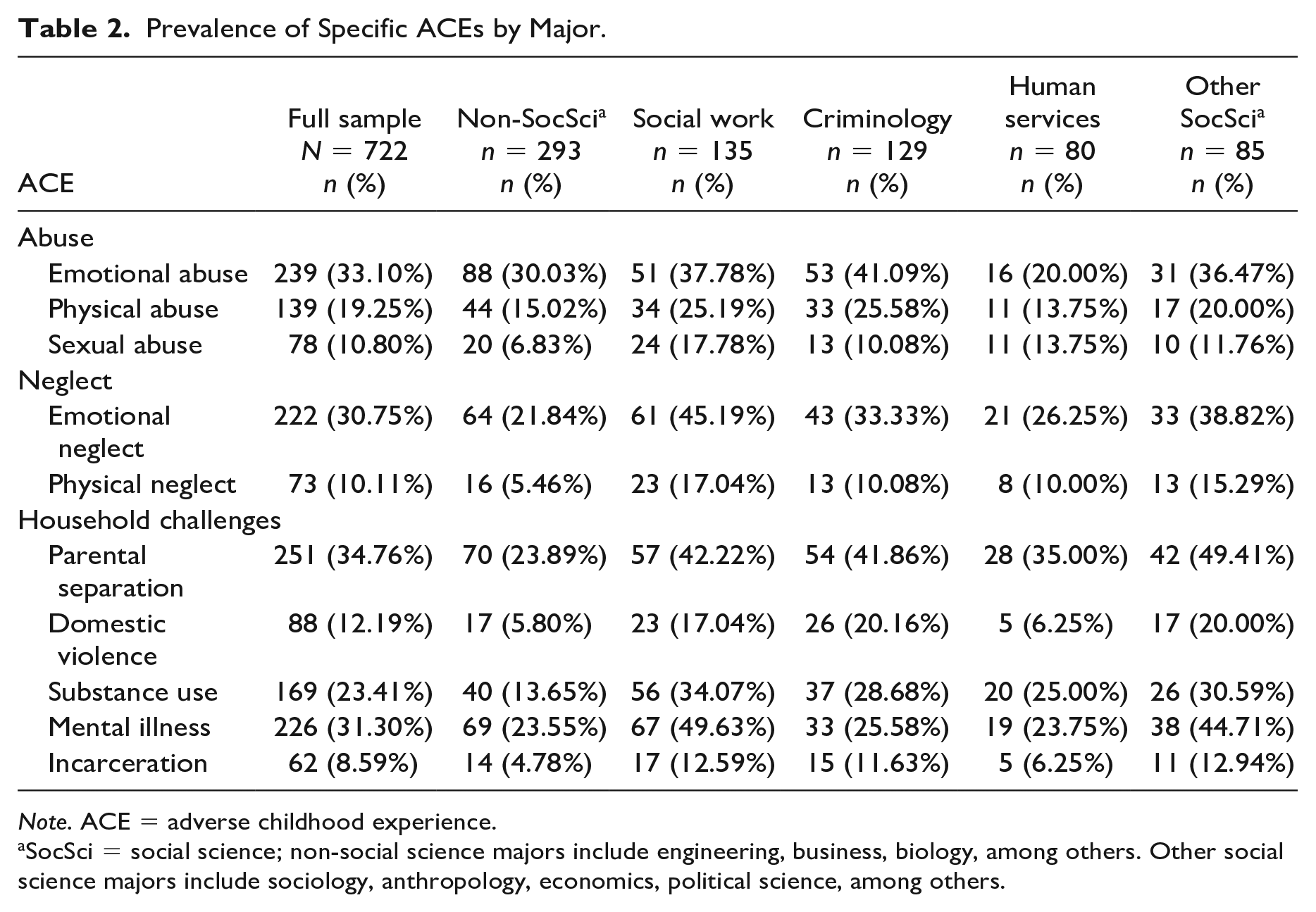
Table 2 displays the prevalence of each specific ACE, in which the most commonly reported ACEs were parental separation/divorce (35%), emotional abuse (33%), and emotional neglect (31%). Incarceration of a household member (9%), physical neglect (10%), sexual abuse (11%), and household domestic violence (12%) had the lowest prevalence. Results of chi-square analyses found prevalence of each ACE significantly varied across the college majors. Non-social science majors reported lowest prevalence for most ACEs, with the exception of emotional abuse and physical abuse, in which human services majors reported the lowest prevalence. Meanwhile, social work students reported highest prevalence of sexual abuse (18%), emotional neglect (45%), physical neglect (17%), familial substance use (34%), and familial mental illness (50%). Criminology students were most likely to report emotional abuse (41%), physical abuse (26%), and domestic violence (20%). Other social science students had the highest prevalence of reporting parental separation or divorce (49%) and familial incarceration (13%).
Prevalence of Specific ACEs by Major.
Note. ACE = adverse childhood experience.
SocSci = social science; non-social science majors include engineering, business, biology, among others. Other social science majors include sociology, anthropology, economics, political science, among others.
Results of Multinomial Logistic Regression Analyses
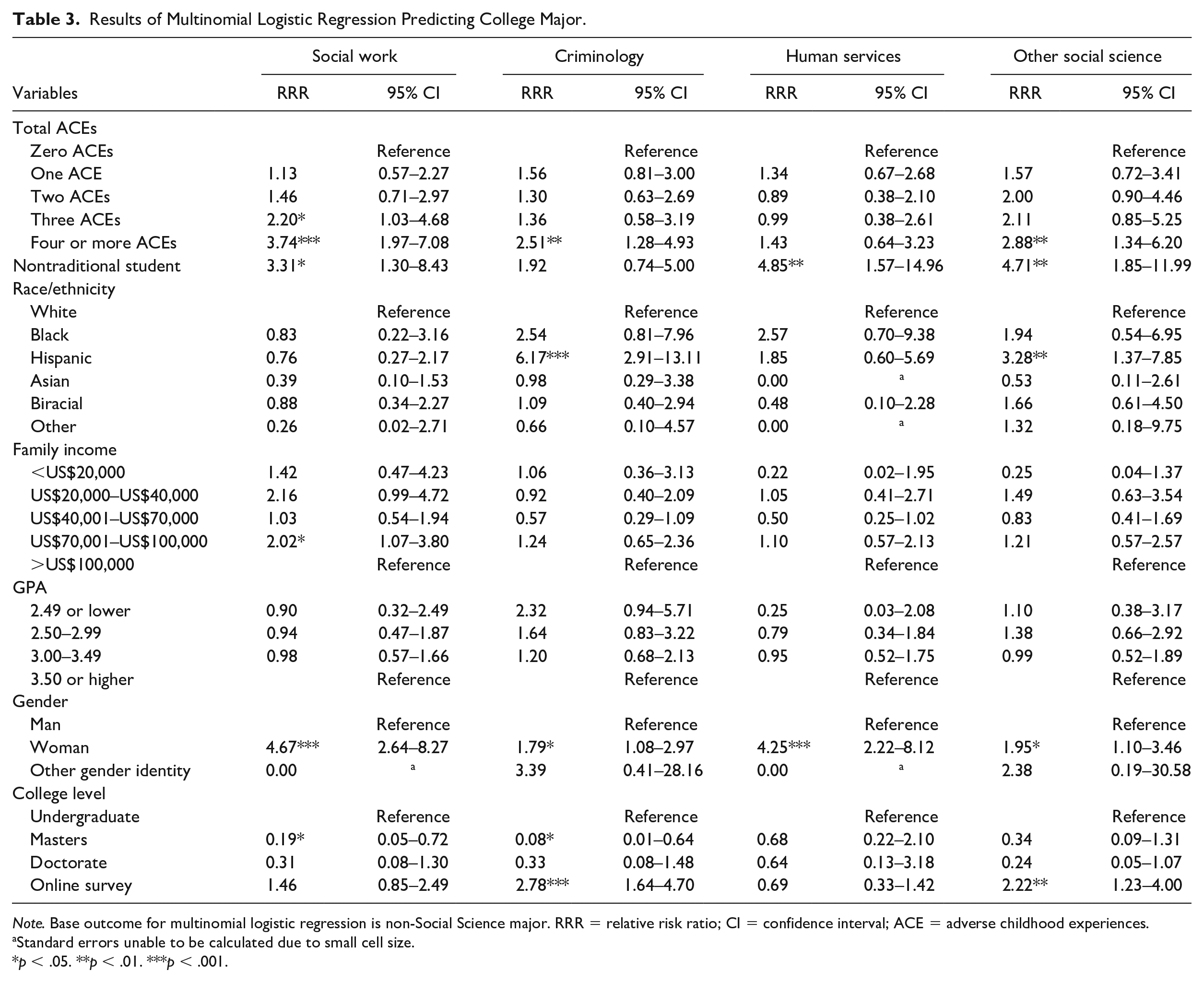
Multinomial logistic regression analyses were conducted to identify differences in total ACEs by major, controlling for covariates (see Table 3). Compared with students who reported no ACEs, students who reported three ACEs (RRR = 2.20, 95% CI = 1.03–4.68) or four ACEs (RRR = 3.74, 95% CI = 1.97–7.08) were 2 to 3 times more likely to major in social work than a non-social science. Similarly, compared with students who reported no ACEs, students who reported four or more ACEs (RRR = 2.51, 95% CI = 1.28–4.93) were nearly three times more likely to major in criminology than a non-social science. Compared with students who reported no ACEs, students reporting four or more ACEs (RRR = 2.88, 95% CI = 1.34–6.20) were nearly 3 times more likely to major in another social science than a non-social science. There were no significant differences in majoring in human services versus a non-social science by ACEs. Taken together, our results demonstrate that students who had experienced a greater number of ACEs were more likely to major in social work, criminology, or another social science.
Results of Multinomial Logistic Regression Predicting College Major.
Note. Base outcome for multinomial logistic regression is non-Social Science major. RRR = relative risk ratio; CI = confidence interval; ACE = adverse childhood experiences.
Standard errors unable to be calculated due to small cell size.
p < .05. **p < .01. ***p < .001.
Many of the covariates also predicted college major. Nontraditional students were more likely to study social work (RRR = 3.74, 95% CI = 1.97–7.08), criminology (RRR = 2.51, 95% CI = 1.28–4.93), and another social science (RRR = 2.88, 95% CI = 1.34–6.20). Hispanic students were more likely to study criminology (RRR = 6.17, 95% CI = 2.91–13.11) and another social science (RRR = 3.28, 95% CI = 1.37–7.85) than white students. Students with family income of US$70,001–US$100,000 (RRR = 2.02, 95% CI = 1.07–3.80) compared with students with family income above US$100,000 were more likely to study social work. Compared with men, women were also more likely to major in social work (RRR = 4.67, 95% CI = 2.64–8.27), criminology (RRR = 1.79, 95% CI = 1.08–2.97), human services (RRR = 4.25, 95% CI = 2.22–8.12), and another social science (RRR = 1.95, 95% CI = 1.10–3.46) than a non-social science. Masters-level students were less likely to major in social work (RRR = 0.19, 95% CI = 0.05–0.72) and criminology (RRR = 0.08, 95% CI = 0.01–0.64). Finally, students who completed the survey online were more likely to major in criminology (RRR = 2.78, 95% CI = 1.64–4.70) and another social science (RRR = 2.22, 95% CI = 1.23–4.00).
Discussion
This study sought to examine differences in total ACEs and specific adverse experiences by college major. We hypothesized that social service majors would have heightened ACEs compared with non-social service majors. Most of the results supported our hypotheses: Students in social work, criminology, and other social sciences were more likely to report four or more ACEs compared with students outside of social sciences. However, there were no significant differences in ACEs between students in human services and non-social sciences. The unexpected finding regarding human service majors may be due to insufficient sample sizes, as only 80 human services students were studied. Survey bias may also have played a role. Human service majors were more likely to complete the survey in-person than other majors and in-person respondents reported fewer ACEs. It may also be that human services student have inherently different backgrounds than other social service students, in which supplemental analyses found human service students were higher income than other social service students.
Exploring major differences in specific ACEs suggests that life experiences may shape career interests and postsecondary coursework. Particularly, social work students experienced high rates of physical abuse, sexual abuse, neglect, and familial substance abuse or mental illness. These experiences align with future careers of social work students, with research finding most social work graduates work with children and families or individuals with mental illness (Salsberg et al., 2019). It may be that students received significant assistance during childhood from social workers, which then motivated them to enter that field. Encounters in child welfare or mental health may also provide individuals with feelings of enhanced self-efficacy in these domains, resulting in a decision to pursue a field of study for which they felt knowledgeable.
Criminology majors had heightened prevalence of emotional abuse, physical abuse, and household domestic violence. Given that the majority of criminology majors have a desire to work in law enforcement postgraduation (Yim, 2009), interactions with law enforcement throughout these childhood experiences may have played a role in their decisions to pursue this career. Law enforcement officers are the typical first responders to domestic violence and also play a considerable role in removing children from unsafe homes. As a result, it may be that children with these experiences have positive associations with law enforcement officers as the individuals who removed them from a harmful environment. On the other hand, in line with research by Eren et al. (2019), it may be that negative experiences with law enforcement also motivated individuals to enter the criminology field as a way to tackle oppression. Meanwhile, although criminology majors had a higher prevalence of familial incarceration compared with non-social science majors, there was no statistically significant difference compared with social work and other social science majors. Further research using qualitative methods should explore this to better understand motivations of studying criminology among individuals who had an incarcerated family member. Theoretically, history of familial incarceration may both serve as a deterrent and motivator to study criminology. If students had an incarcerated family member due to child physical abuse, then they may also have a positive view of the criminal justice system. However, if the student feels their family member was unfairly treated by the criminal justice system, they may choose to study social work or another social science, which may allow them a pathway to assist offenders or create systemic changes.
For human services majors, despite no difference in total ACEs with non-social science majors, they had increased prevalence of household challenges, namely, parental separation/divorce and household substance use. Family services and addictions are common career paths for human service workers (U.S. Bureau of Labor Statistics, 2021), and it may be that individuals with experiences of household challenges select human services to subsequently help others with similar challenges. Meanwhile, human service majors had lower prevalence of child abuse and neglect compared with students in social work and criminology. Given that states have only been recently accepting bachelor’s degrees outside of social work for child welfare positions (Phagan-Hansel, 2018), it may be that individuals with a history of child maltreatment were more likely to interact with professionals with a social work background. Interactions with social workers may subsequently result in a social work major rather than human services, despite many child welfare positions now being open to human services majors.
Implications for Practice
This study has implications for staff in higher education and social services. For college career counselors, incorporating student’s trauma history into career decision-making may help shape their career goals. Students who disclose prior ACEs may find greater connection to fellow students and meaning in coursework within social work or criminal justice majors. For social service faculty, students should be educated on the potential for past trauma to impact their future work—both positively and negatively. Particularly, Lee et al. (2017) found child welfare workers with heightened ACEs to experience increased job stress. However, Howard et al. (2015) found child welfare workers with increased ACEs to have less burnout and higher compassion satisfaction. In addition, Greenberg et al.’s (2018) research found increased empathy among adults with childhood trauma. Taken together, these findings suggest that the effect of ACEs on helping professionals varies by individual. For individuals who have worked through their trauma, they may have increased resilience and insight that allows them to identify with clients and have more empathy. For other workers, secondary traumatic experiences may simply exacerbate prior traumas and lead to further impairment. Students should be educated on positive coping strategies to manage their life experiences. Regardless, an understanding that social service workers have their own histories of trauma is critical for social service agencies. It is imperative that agencies create environments that promote positive well-being for staff.
Moreover, it is critical that social service students are educated about self-disclosure of trauma to future clients. Self-disclosure is generally considered a controversial technique and most social service workers opt to limit their use of self-disclosure with clients (Knight, 2012). Prior research with clients receiving psychotherapy has found clients to report both positive and negative results from practitioner self-disclosure (Audet, 2011). Specifically, self-disclosure has the potential to create boundary issues and establish a more personal relationship between the worker and client in instances where professionalism should be maintained. However, self-disclosure can be used to build rapport and establish credibility/competence on a certain life experience. Hanson’s (2007) research supports both viewpoints, in which clients receiving psychotherapy predominantly reported therapist self-disclosure to be helpful although there were instances in which self-disclosure was perceived by clients to be unhelpful.
Given both the positive and negative consequences of self-disclosure, it is important that social service workers are educated on its use with clients to understand appropriate situations to utilize self-disclosure and the best way to do so. It appears that this education component is lacking: Prior research with social service workers and students found respondents felt poorly educated on use of self-disclosure with clients (Alsina, 2020; Knight, 2012). Additional research by Knight (2014) found social work practicum students felt uncomfortable discussing self-disclosure with field supervisors. Thus, educating social service students on proper use of self-disclosure, along with its consequences, is critical. We would recommend incorporating education on self-disclosure into clinical practice courses along with discussions on self-disclosure into seminars for social work practicum and other internship courses.
Limitations
This study has several limitations which should be considered. First, since the sample was pulled from a limited number of universities located in the Midwestern and Southern United States, the sample is not representative of college students across the country nor of all adults. While the sample’s demographics are representative of the selected universities, they are not in line with the demographics of all college students in the country, in which this study was overrepresentative of white and female students. The sample is also not representative of all majors related to social services, as it only contains an oversampling of students in social work, criminology, and human services. Several majors—such as psychology and sociology—had too few students included in the study to include as a separate category.
In addition, ACEs were self-reported by participants, which is subject to bias. Due to social desirability bias, participants may be unlikely to report adversities that vary from social norms. However, the use of self-administered questionnaires to collect sensitive information has been found to reduce social desirability bias (Bowling, 2005; Tourangeau & Smith, 1996). While this bias may still be present, we hope that the use of pen-and-paper surveys and computer surveys would provide increased feelings of anonymity to accurately provide responses. Although, supplemental analyses suggest that differences in data collection may have played a role in survey responses. To reach as many college students as possible, we collected data both in-person during class and online. Given the time constraints of in-class survey collection along with the reluctance of instructors to give up instruction time for research, the dual method of survey collection allowed us to access a broader number of students. We explored differences in reporting of ACEs based on format (i.e., survey completed in-person during class or online), finding participants who completed the survey online reported significantly higher mean total ACEs than participants who completed the survey in-class. Several reasons may account for these differences. It may be that online surveys offered increased feelings of privacy compared with in-person surveys in which classmates are sitting a few feet away. Differences may also appear due to selection bias. For in-person surveys, few students in the class declined to complete the survey since it was part of their standard class time. However, for online surveys, students were simply emailed a link to complete the survey on their own time. It may be that students with greater ACEs were more intrigued by the study topic and thus more likely to complete the survey. Regardless of the reason for differences in reporting by format type, we included survey format type in the regression analyses to minimize bias in findings. We would recommend future research explore self-report of ACEs and the role of survey modality to reduce bias. Finally, the cross-sectional nature of the study prevents causal inferences from being made. However, given that ACEs are specific to adversity prior to the age of 18 and college begins for most students at 18 years or older, we would anticipate that the majority of ACEs occurred prior to the start of college and selection of college major. Although, it may be some students selected their major during childhood, and the ACE occurred after college major had been selected. Regardless, the cross-sectional nature only allows us to theorize reasons for differences between majors. Further research using longitudinal or qualitative means should explore this research question further.
Conclusion
This study provides valuable insight into history of ACEs for students from several key social services majors. Students outside of the social sciences reported significantly fewer ACEs compared with those in social work, criminology, and other social science majors. This study extends prior research finding that social service workers and students within the social work major have increased ACEs compared with the general population. Since these students are likely to go on to work with individuals who have experienced trauma, it is imperative that they are educated on how personal trauma may impact future work. Social service agencies must create environments that enable positive well-being. Qualitative research is needed to understand specific mechanisms by which life experiences influence selection of college majors.
Footnotes
Disposition editor: Cristina Mogro-Wilson
Declaration of Conflicting Interests
The author(s) declared no potential conflicts of interest with respect to the research, authorship, and/or publication of this article.
Funding
The author(s) received no financial support for the research, authorship, and/or publication of this article.

Supplemental Material
Supplemental material for this article is available online.
References
Supplementary Material
Please find the following supplemental material available below.
For Open Access articles published under a Creative Commons License, all supplemental material carries the same license as the article it is associated with.
For non-Open Access articles published, all supplemental material carries a non-exclusive license, and permission requests for re-use of supplemental material or any part of supplemental material shall be sent directly to the copyright owner as specified in the copyright notice associated with the article.
