



Abstract
Background:
Aggression and irritability are common challenges in children with autism spectrum disorder (ASD), often requiring pharmacological management. Divalproex, an anticonvulsant and mood stabilizer, is used off-label for these symptoms, but its effectiveness remains unclear. This systematic review evaluates the efficacy and safety of divalproex in managing aggression and irritability in children with ASD.
Methods:
A systematic review was conducted following PRISMA guidelines, registered with PROSPERO (CRD420251029754). Searches were performed in PubMed, Embase, PsycINFO, and Web of Science, identifying studies involving children with ASD treated with divalproex, valproic acid, or valproate sodium. Data were extracted on study design, sample size, intervention details, outcomes, and adverse effects.
Results:
Ten studies met inclusion criteria, comprising three randomized controlled trials, one open-label trial, and six case reports. Intravenous (IV) divalproex demonstrated rapid reductions in aggression, suggesting potential for acute stabilization. However, oral divalproex produced inconsistent results for chronic aggression and irritability. Adverse effects included weight gain, sedation, and behavioral activation, with toxicity risks in polypharmacy settings.
Discussion/Conclusion:
Divalproex may offer value for acute management of aggression in children with ASD when administered intravenously. Its role in chronic management is less clear, with inconsistent outcomes and notable side effects. Clinicians should prioritize regular serum monitoring and consider alternative options for chronic use. Further research is needed to clarify its clinical role, particularly in diverse patient populations.
Introduction
Aggression and irritability are common behavioral challenges in children with autism spectrum disorder (ASD), often disrupting family dynamics, educational progress, and social interactions (Hirota et al., 2020; Mazurek and Sohl, 2016). Despite the availability of U.S. Food and Drug Administration-approved treatments such as risperidone and aripiprazole, these medications are associated with metabolic side effects, leading clinicians to consider alternative options, including off-label use of divalproex (Alsayouf et al., 2021; Gupta and Gupta, 2024; Hellings, 2023; Im, 2021; Owens and Nemeroff, 2003). This systematic review evaluates the clinical utility of divalproex—an anticonvulsant and mood stabilizer known in its various forms as divalproex sodium, valproic acid (VPA), and valproate sodium—for managing aggression and irritability in children with ASD (Gupta and Gupta, 2024; Owens and Nemeroff, 2003).
Divalproex is primarily indicated for epilepsy and bipolar disorder, where it modulates neuronal excitability through several mechanisms: inhibition of voltage-gated sodium and T-type calcium channels, enhancement of gamma-aminobutyric acid signaling, and reduction of excitatory neurotransmission (Rahman et al., 2024). These neurobiological effects have made it an appealing candidate for managing behavioral dysregulation in ASD (Rahman et al., 2024). However, its application in this population is complicated by variable outcomes, with some studies reporting improvements in irritability and aggression, while others note adverse effects, including weight gain, sedation, and behavioral activation (Grier et al., 2019; Nanau and Neuman, 2013; Zarate et al., 1999).
The therapeutic role of divalproex in ASD remains controversial, particularly regarding its inconsistent impact on aggression and its safety profile in pediatric populations (Grier et al., 2019; Nanau and Neuman, 2013; Zarate et al., 1999). This systematic review synthesizes existing evidence, differentiating outcomes by route of administration (intravenous [IV] vs. oral), clinical context (acute vs. chronic management), and concurrent medications. By clarifying the conditions under which divalproex may be effective or harmful, this review aims to guide clinical decision making and identify priorities for future research.
Methods
A PROSPERO-registered systematic review (CRD420251029754) was conducted in accordance with PRISMA guidelines, using controlled vocabulary and Boolean operators. Searches were performed across PubMed, Embase, PsycINFO, and Web of Science on December 28, 2024 (Fig. 1; Supplementary Data). Covidence software was used to manage article screening. All studies were independently reviewed and extracted by at least two reviewers, with discrepancies resolved through input from a third reviewer. Inclusion criteria were studies published in English after 1994, involving patients under 18 years of age with a diagnosis of ASD (or a comparable Diagnostic and Statistical Manual of Mental Disorders, Fourth Edition diagnosis), and reporting on aggression or irritability before, during, or after treatment with VPA, valproate sodium, or divalproex sodium. Exclusion criteria included studies involving adults, publications prior to 1994, and non-English articles.
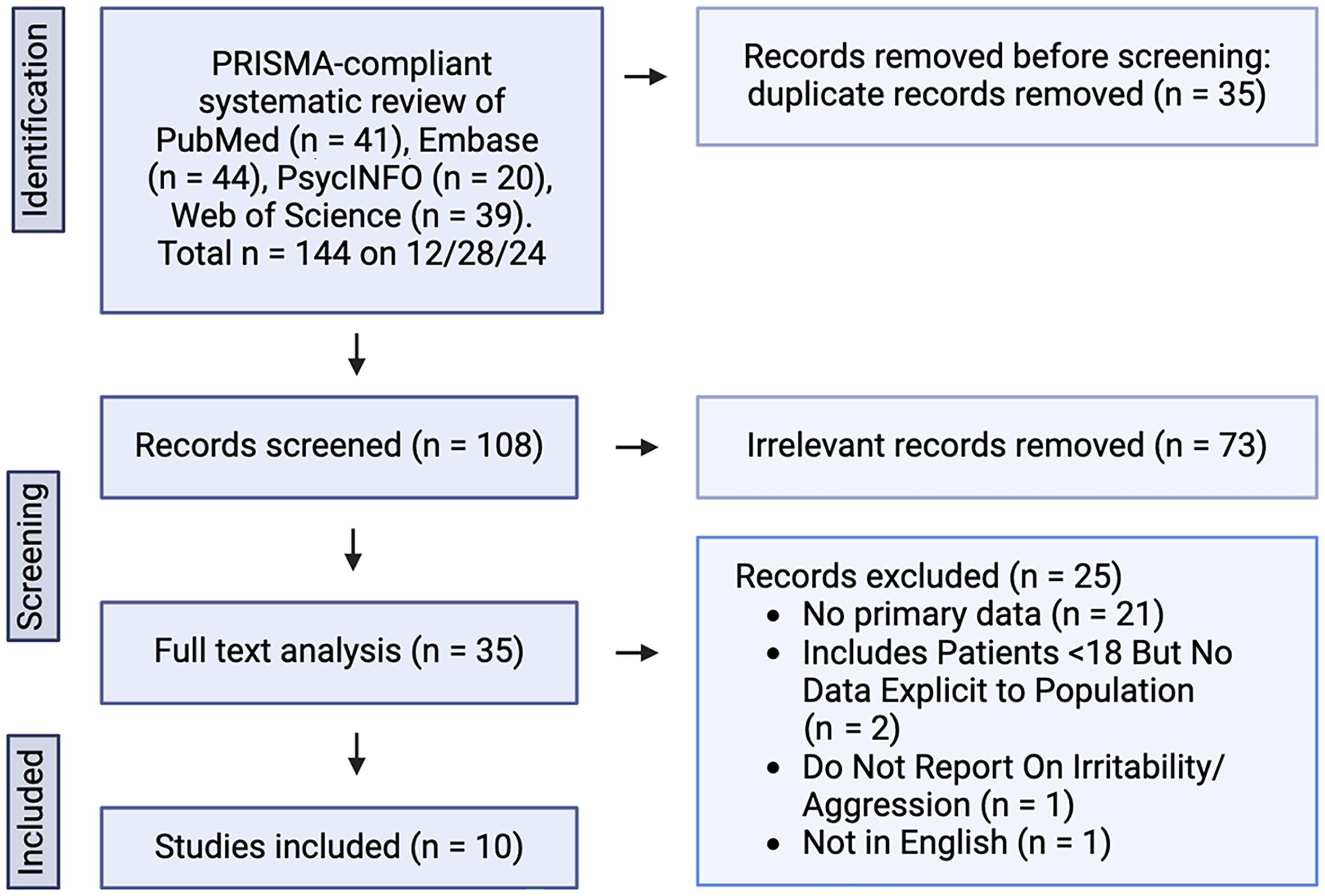
PRISMA flow diagram of study selection.
Initial data extraction occurred on December 28, 2024, and included study design, sample size, ASD diagnosis, intervention details, outcome measures, treatment effects, and reported side effects. Primary outcomes were changes in aggression and irritability. Secondary outcomes included changes in repetitive or compulsive behaviors. Additional variables extracted included participant demographics, comorbidities, concurrent medications, treatment dosage, serum drug levels, and adverse effects. Each study was rated using a modified version of the Oxford Center for Evidence-Based Medicine scale (Table 1), and risk of bias was assessed using the Risk Of Bias In Non-randomized Studies – of Interventions (ROBINS-I) tool. As this review did not involve new data collection and only analyzed previously published studies, ethical approval and informed consent were not required. Due to heterogeneity in study designs, results were synthesized narratively. Tables and figures were created using Microsoft Word.
Summary of Included Studies with Quality of Evidence Rating
ABC-I, Aberrant Behavior Checklist—Irritability Subscale; CGI-I, Clinical Global Impressions—Improvement; C-YBOCS, Children’s Yale–Brown Obsessive Compulsive Scale; IV, intravenous; NA, not applicable; OAS, Overt Aggression Scale; VPA, valproic acid.
Results
Study selection
A total of 108 unique articles were identified. After title and abstract screening, 73 articles were excluded. Following full-text review, 25 additional articles were excluded, leaving 10 articles for data extraction. Veenstra-VanderWeele (2010) was included with the caveat that, although the primary focus of the study was not divalproex, it reported relevant findings on self-aggression in a patient with multiple co-occurring diagnoses and concurrent medications.
Randomized controlled trials
Efficacy for irritability
Anagnostou et al. (2006) evaluated divalproex sodium for irritability associated with fluoxetine in a double-blind, placebo-controlled trial of 13 boys (mean age = 9.5). Diagnoses included autistic disorder (10), Asperger disorder (2), and Pervasive Developmental Disorder–Not Otherwise Specified (PDD-NOS) (1). Participants were psychotropic-free, except for one on risperidone. Phase 1 randomized participants to divalproex sodium or placebo. Phase 2 introduced fluoxetine (10 mg daily) to six participants, titrated as tolerated to therapeutic effect. Divalproex sodium levels averaged 71.25 ± 23.52 μg/mL at week 0 and 69.75 ± 31.93 μg/mL at week 8. Irritability remained stable in the divalproex group, whereas the placebo group exhibited increased irritability on Modified Overt Aggression Scale (OAS-Modified) subscores (t = 2.847, p = 0.047, d = 3.1).
Hollander et al. (2006) conducted an 8-week double-blind, placebo-controlled trial in 13 participants (ages 5–17, mean = 9.5) with ASD. One participant was on an established treatment regimen for risperidone. Nine participants received oral divalproex sodium, titrated every 4 days from 125 mg/day to achieve therapeutic levels (50–100 μg/mL). Compulsive behaviors significantly improved in the divalproex group based on Children’s Yale–Brown Obsessive–Compulsive Scale (C-YBOCS) scores compared with placebo (t = 2.22, p = 0.05, d = 11). Although irritability and aggression were reported as adverse effects (33% and 11%, respectively), these were not systematically evaluated as outcome measures.
Hollander et al. (2010) assessed divalproex sodium in 27 children (ages 5–17) with autistic disorder (23) and Asperger’s syndrome (4). Participants with significant baseline irritability or aggression (OAS-Modified ≥13 or Aberrant Behavior Checklist—Irritability Subscale [ABC-I] ≥18) were randomized to divalproex (16) or placebo (11). Doses were adjusted to therapeutic serum levels (≥50 μg/mL). Divalproex significantly improved irritability (62.5% vs. 9.1%; odds ratio [OR] = 16.7, p = 0.008) and ABC-I scores (t = −2.09, p = 0.048, d = 22.7).
Adverse effects
Across these three randomized controlled trials (RCTs), adverse effects included weight gain, fatigue, agitation, insomnia, and irritability. One participant withdrew from the Anagnostou et al. (2006) study due to fluoxetine-related irritability, one participant withdrew from the Hollander et al. (2006) study due to lack of efficacy, and three withdrew from the Hollander et al. (2010) study, including two due to unspecified adverse effects.
Open-label trial
Efficacy for irritability
Hollander et al. (2001) conducted an open-label study in 14 patients (ages 5–40, mean = 18) with ASD (10), Asperger disorder (2), and PDD-NOS (2). Patients received oral divalproex sodium (125–2500 mg/day), titrated to therapeutic levels (50–100 μg/mL) over an average of 10.7 ± 12.3 months. Stable concurrent medications included Selective Serotonin Reuptake Inhibitors, atypical neuroleptics, benzodiazepines, and alpha-1 agonists. Among the 10 children, 80% (8/10) were sustained responders on the Clinical Global Impressions—Improvement scale.
Adverse effects
Reported side effects included fatigue or sedation (four), behavioral activation (three), and weight gain (two), with two discontinuations due to adverse effects.
Case reports
Efficacy for aggression and irritability
In most case reports, aggression was assessed based on clinical observation and descriptive documentation; only Hilty et al. (1998) and Carta et al. (2024) reported quantitative measurement using OAS.
Hilty et al. (1998) described IV valproate for acute agitation in an 8-year-old girl with autistic disorder on concurrent risperidone (2 mg twice daily) and benztropine (1 mg twice daily). A single 2000 mg IV dose (40 mg/kg) administered over 15 minutes reduced her OAS score from 28 to 4 and 0 within 15 minutes. Oral valproate (1000 mg twice daily) maintained improvement over 6 months.
Taskiran and Coffey (2013) treated a 7-year-old boy with PDD-NOS using valproate (97 μg/mL therapeutic level) and aripiprazole. After multiple regimen changes, a final combination of valproate and paliperidone led to reduced impulsivity and minor aggression.
Pritchard et al. (2014) reported on a 16-year-old boy with atypical autism whose aggression resolved following gradual withdrawal of sodium valproate. The patient had been receiving 1600 mg/day, and aggressive episodes dropped from 6.1 to 0.5 per week as the medication was tapered over 50 weeks. Notably, no aggression was observed in the past 20 weeks postwithdrawal.
Carta et al. (2024) administered a 20 mg/kg IV bolus of VPA to an 11-year-old boy with ASD, followed by a 24-hour infusion and tapered oral dosing. OAS-Modified scores improved from 49 to 0.
Safety concerns
Ivanov et al. (2006) described a 10-year-old girl with ASD on VPA (up to 1000 mg/day) and concurrent risperidone and topiramate. Although initial improvements were noted, aggression and impulsivity worsened, with increased risperidone doses causing two toxic episodes (levels: 194 and 126 μg/mL) with lethargy and seizure activity.
Veenstra-VanderWeele (2010) described a 13-year-old girl with ASD and polypharmacy (divalproex, risperidone, fluoxetine, melatonin). Aggression and irritability worsened over time with medication adjustments. Riluzole raised divalproex levels above the therapeutic range, leading to fatigue, poor intake, and elevated liver enzymes, prompting discontinuation.
Risk of bias
Using the ROBINS-I tool, Anagnostou et al. (2006), Hollander et al. (2006), and Hollander et al. (2010) were rated as low risk of bias due to appropriate randomization, blinding, and outcome clarity. Hollander et al. (2001) had moderate risk of bias due to lack of blinding and concurrent medications. Hilty et al. (1998), Ivanov et al. (2006), Veenstra-VanderWeele (2010), Taskiran and Coffey (2013), Pritchard et al. (2014), and Carta et al. (2024) had serious risk of bias due to uncontrolled designs and medication confounds.
Discussion
This systematic review evaluated the evidence for divalproex in managing aggression and irritability in children with autism. The findings reveal a complex and context-dependent profile, with notable differences between acute and chronic use, as well as substantial variability in therapeutic outcomes.
Divalproex appears most effective for acute behavioral stabilization when administered intravenously. Studies by Hilty et al. (1998) and Carta et al. (2024) reported rapid reductions in aggression following IV valproate administration, suggesting that this route may offer a viable option for crisis management in children with severe aggression. These findings align with the pharmacokinetic profile of IV valproate, which allows for a rapid onset of therapeutic effects.
In contrast, the efficacy of oral divalproex for chronic management is inconsistent. While Hollander et al. (2010) demonstrated significant reductions in irritability, other studies reported mixed or even negative outcomes for aggression, including worsening symptoms in some cases (Ivanov et al., 2006; Veenstra-VanderWeele, 2010). These discrepancies may reflect differences in dosing strategies, serum drug levels, patient profiles, and the presence of concurrent medications. Notably, both Ivanov et al. (2006) and Veenstra-VanderWeele (2010) reported symptom exacerbation when divalproex levels dropped below the therapeutic range. Conversely, Veenstra-VanderWeele (2010) also observed toxicity due to elevated levels when riluzole was coadministered, highlighting the importance of serum level monitoring in polypharmacy settings.
The adverse effect profile of divalproex includes weight gain, sedation, and fatigue—side effects that are especially concerning in pediatric populations. Behavioral activation, a paradoxical reaction, was also reported and may worsen symptoms in some children (Hollander et al., 2001). The risk of toxicity in the context of drug–drug interactions is particularly important to consider, especially in patients receiving multiple psychotropic agents (Veenstra-VanderWeele, 2010). The potential for behavioral dysregulation is further illustrated by Pritchard et al. (2014), who documented a significant reduction in aggression following the discontinuation of sodium valproate. While this case contrasts with those reporting therapeutic benefits, it raises the possibility that divalproex may worsen aggression in select individuals. Incorporating these divergent findings allows for a more nuanced understanding of the drug’s behavioral effects and emphasizes the importance of individualized risk–benefit evaluations.
When evaluating treatment options, it is helpful to compare divalproex with other pharmacological approaches for severe, treatment-resistant aggression in children with ASD, particularly clozapine. Clozapine has been examined in small cohorts, case reports, and retrospective analyses, with reported response rates ranging from 50% to 60% (Beherec et al., 2011; Berloffa et al., 2024; da Rosa et al., 2024; Pimenta de Figueiredo et al., 2024). Like divalproex, it has shown potential in reducing aggression; however, its use is constrained by serious risks, including seizures, sialorrhea, weight gain, neutropenia, and myocarditis. Compared with clozapine, divalproex may have a more moderate safety profile, but its efficacy appears less consistent, particularly in the context of long-term oral treatment (Beherec et al., 2011; Berloffa et al., 2024; da Rosa et al., 2024; Pimenta de Figueiredo et al., 2024). While both agents may benefit select populations, clozapine is typically reserved for individuals who have failed multiple antipsychotic trials. This comparison highlights the need for personalized, closely monitored treatment strategies for managing severe behavioral dysregulation in ASD.
Conclusion
This review synthesizes findings from both RCTs and observational studies, offering a broad perspective on divalproex use in children with ASD. However, several limitations warrant consideration, including small sample sizes, short study durations, and heterogeneity in design. Many studies also excluded patients with comorbid psychiatric or medical conditions, limiting generalizability. Furthermore, the lack of standardized outcome measures for aggression hinders direct comparisons across studies (American Psychiatric Association, 1994).
Clinically, divalproex may serve a role in acute behavioral stabilization, particularly through IV administration for severe aggression. To date, only two case reports have examined IV divalproex for managing aggression, and before conclusions can be drawn about its utility, larger double-blind studies of IV administration are needed. However, its utility in chronic management remains clear due to inconsistent efficacy and notable side effects. Careful assessment of individual factors—including comorbidities, concurrent medications, and risk for adverse effects—is essential before initiating treatment. Regular serum monitoring is strongly recommended, especially in polypharmacy contexts, to ensure efficacy while minimizing the risk of toxicity.
Future research should focus on larger, multicenter RCTs using standardized, validated measures of aggression and irritability. Biomarker studies, including assessments of serum VPA levels and pharmacogenetic markers, may help identify subgroups most likely to benefit from divalproex. Comparative trials of IV versus oral divalproex, particularly in real-world clinical settings involving polypharmacy, are also needed to better guide treatment decisions.
Footnotes
Authors’ Contributions
D.V.: Conceptualizing and designing the project, obtaining and analyzing data, interpreting results, drafting and revising the article, and approving the final version. E.J.: Conceptualizing and designing the project and obtaining data. J.W.: Conceptualizing and designing the project and obtaining data. B.C.: Drafting and revising the article and approving the final version.
Disclosures
The authors declare no conflicts of interest. No financial or institutional relationships with commercial entities, including pharmaceutical companies, influenced the development, analysis, or presentation of this work.
Supplementary Material
Supplementary Data
References
Supplementary Material
Please find the following supplemental material available below.
For Open Access articles published under a Creative Commons License, all supplemental material carries the same license as the article it is associated with.
For non-Open Access articles published, all supplemental material carries a non-exclusive license, and permission requests for re-use of supplemental material or any part of supplemental material shall be sent directly to the copyright owner as specified in the copyright notice associated with the article.
