



Abstract
Objectives/Background:
Clozapine is the treatment of choice for treatment-resistant schizophrenia (TRS), yet it remains underutilized in child and adolescent psychiatry. This study aimed to assess knowledge, clinical skills, attitudes, and perceived barriers related to clozapine use among child and adolescent psychiatry professionals in Türkiye.
Methods:
A cross-sectional online survey was distributed to child and adolescent psychiatry residents, specialists, and academics across Türkiye via professional email lists and messaging groups. The questionnaire assessed sociodemographic characteristics, clozapine prescribing experience, perceived barriers, self-rated competence, training exposure, and attitudes toward clozapine. Group comparisons were performed using chi-square tests.
Results:
A total of 517 professionals participated (180 residents, 212 specialists, and 125 academics). Only 30.0% had prescribed clozapine in the past 12 months, and 28.6% had received specific clozapine training. Barriers were common across all groups, with concerns about medication adherence (43.2%–58.0%), blood test compliance (56.8%–65.6%), and side effects being most frequently endorsed. A clear experience-related gradient emerged: residents reported significantly more barriers, lower self-rated competence, and greater reluctance to prescribe than specialists and academics. Clinicians without inpatient access reported more barriers and lower confidence and were less likely to have gained meaningful clozapine experience during residency (35.2% vs. 66.0%, p < 0.001) or to have observed clozapine’s superiority firsthand (57.7% vs. 79.7%, p < 0.001). Despite these barriers, 92.3% of respondents acknowledged clozapine’s superior efficacy compared with other antipsychotics.
Conclusions:
This nationwide survey, the largest to examine clozapine-related attitudes among child and adolescent psychiatry professionals globally, reveals substantial gaps in training, confidence, and service infrastructure in Türkiye. While efficacy is widely recognized, safety concerns and monitoring-related barriers, particularly among less experienced clinicians and those without inpatient access, limit appropriate prescribing. Findings underscore the unmet need for structured residency training programs, national clinical guidelines, and expanded service infrastructure to ensure equitable access to clozapine for youth with TRS.
Keywords
Introduction
Schizophrenia is a severe, chronic psychiatric disorder affecting approximately 0.7% of the population worldwide, and a substantial proportion of patients show inadequate response to first-line antipsychotic treatment (Cho et al., 2020; Subramaniam et al., 2021; Wold et al., 2023). Approximately 30% of patients meet criteria for treatment-resistant schizophrenia (TRS), a condition associated with persistent symptoms, functional decline, greater caregiver burden, and increased health care use (Diniz et al., 2023; Pandey and Kalita, 2022). According to the Treatment Response and Resistance in Psychosis Working Group, TRS is defined by the persistence of clinically significant symptoms despite adequate trials of at least two different non-clozapine antipsychotics at appropriate dose and duration, accompanied by marked functional impairment (Howes et al., 2017).
Across international guidelines, clozapine is consistently recommended as the most effective pharmacological intervention for TRS (Correll et al., 2022; Correll and Howes, 2021). Although approximately one-third of patients meet criteria for TRS, clozapine remains markedly underutilized, accounting for only around 5% of antipsychotic prescriptions and often being initiated after substantial delays despite clear indications (Law et al., 2023; Olfson et al., 2016; Silveira et al., 2015; Thien and O’Donoghue, 2019).
Current evidence demonstrates clozapine’s superiority in reducing overall symptom burden and decreasing long-term mortality and suicide risk in individuals with TRS (Masdrakis and Baldwin, 2023; Vermeulen et al., 2019; Wagner et al., 2021). For these reasons, clozapine is the only antipsychotic approved by the U.S. Food and Drug Administration (FDA) specifically for TRS in adults and is recommended as a first-line option for TRS by the American Psychiatric Association and other major guideline bodies (Kelly et al., 2025).
In child and adolescent psychiatry, clozapine use remains off-label in most countries. There is no formal regulatory guidance for its initiation, monitoring, or discontinuation in the pediatric population. Nevertheless, clinicians frequently rely on clozapine off-label in severe, treatment-refractory cases (Pimenta de Figueiredo et al., 2024; Walker et al., 2025). Existing meta-analyses and clinical trials suggest that clozapine is beneficial and clinically superior to other antipsychotics in youth with TRS (Adnan et al., 2022; Salazar de Pablo et al., 2024).
Despite its therapeutic advantages, clozapine is associated with several potentially serious adverse reactions, including agranulocytosis, neutropenia, myocarditis, seizures, and metabolic complications, which have historically necessitated intensive and continuous monitoring (Pinioti et al., 2025; Smessaert et al., 2024). Recent consensus statements support a structured yet risk-stratified approach to hematological and clinical monitoring rather than uniform mandatory schedules, reflecting evolving evidence and post-risk evaluation and mitigation strategy (REMS) regulatory changes (Meyer and Rubio, 2025; Wagner et al., 2023).
International research consistently identifies significant barriers limiting clozapine use in routine clinical care, including clinician-related concerns (confidence, perceived competence, side-effect anxiety, uncertainty regarding monitoring), patient- and caregiver-related concerns (fear of adverse events, treatment burden), and service-level limitations (laboratory access, lack of standardized pathways) (Farooq et al., 2019; Oloyede et al., 2023). Surveys conducted across different countries consistently report that, although psychiatrists generally acknowledge clozapine’s efficacy, they remain hesitant to prescribe it due to safety concerns, logistical challenges, and limited training (Grover et al., 2015; Rezaie et al., 2022; Tungaraza and Farooq, 2015).
Despite these findings, research focusing specifically on clinicians working in child and adolescent psychiatry is scarce (Cirulli, 2005; Walker et al., 2024). Existing studies emphasize a lack of formal training, insufficient structured protocols, and absence of clear organizational pathways for pediatric clozapine initiation and monitoring (Walker et al., 2024).
To date, no published study has systematically evaluated knowledge, clinical skills, attitudes, and perceived barriers regarding clozapine use among child and adolescent psychiatry professionals in Türkiye. Although surveys have examined antipsychotic prescribing patterns and clinician views in Türkiye (Çakır et al., 2021), clozapine-focused research in the pediatric mental health workforce is lacking.
This study therefore aims to assess the knowledge, clinical skills, attitudes, concerns, and perceived barriers related to clozapine use among child and adolescent psychiatry professionals in Türkiye and to identify service and training needs to support safe and appropriate prescribing.
Methods
Study design
This study employed a descriptive, cross-sectional survey design to assess knowledge, skills, attitudes, and perceived barriers related to clozapine use among child and adolescent psychiatry professionals in Türkiye. The study involved no clinical intervention and consisted exclusively of an online, self-administered questionnaire. The study protocol was approved by the institutional ethics committee, and electronic informed consent was obtained from all participants prior to survey initiation.
Participants
The target population comprises all child and adolescent psychiatry professionals actively practicing in Türkiye at the time of data collection. Eligible participants included board-certified child and adolescent psychiatrists (specialists), psychiatry residents currently enrolled in child and adolescent psychiatry specialty training programs, and academic faculty (assistant professors, associate professors, and full professors) working in child and adolescent mental health departments. According to membership records from the Turkish Association for Child and Adolescent Psychiatry (ÇOGEPDER), the national workforce at the time of data collection included 282 academic faculty, 767 specialists, and 682 residents in training, yielding a total eligible population of 1731 professionals.
No restrictions were applied regarding age, gender, years in practice, or workplace setting (university hospitals, training and research hospitals, state hospitals, or private institutions). Practice settings encompassed outpatient clinics, inpatient psychiatric units, private practice, Child and Adolescent Substance Addiction Treatment Centers, Child Advocacy Centers, and Multidisciplinary Child and Adolescent Mental Health Centers. Participation was voluntary and anonymous, and no financial or other incentives were provided.
Survey administration
The survey was administered electronically using Google Forms. The survey link was distributed via professional email mailing lists and a closed instant messaging group (WhatsApp) comprising child and adolescent psychiatry specialists, residents, and academic faculty across Türkiye. Responses were collected anonymously, without personal identifiers, and stored in a secure password-protected institutional database accessible only to the research team.
Survey content
The questionnaire comprises eight domains. The first domain assessed sociodemographic and professional characteristics, including clinical title/role (resident, specialist, or academic faculty), years of professional experience, and clinical setting (outpatient clinic, inpatient unit, private practice, child and adolescent substance addiction treatment center, child advocacy center, or multidisciplinary child and adolescent mental health center). The second domain evaluated clozapine prescribing experience, including whether respondents had prescribed clozapine in the past 12 months. The third domain assessed perceived barriers to clozapine use, encompassing adverse-effect concerns, monitoring burden, infrastructural limitations, family-related concerns, and limited clinical experience. The fourth domain examined self-perceived clinical competence across core tasks: identifying treatment-resistant psychosis, providing pretreatment counseling, managing adverse effects, conducting psychiatric and physical monitoring, and safely discontinuing clozapine. The fifth domain assessed training exposure and educational needs related to clozapine. The sixth domain explored recommendations to support clozapine use, including training opportunities, guideline access, and service infrastructure improvements. The seventh domain evaluated attitudes and beliefs about clozapine efficacy, safety, and clinical role. The eighth domain included free-text comments, allowing respondents to provide additional perspectives.
Two items were specifically designed to assess misconceptions about clozapine: “Clozapine is associated with higher mortality” and “The risk of agranulocytosis remains constant over treatment.” The former contradicts meta-analytic evidence demonstrating that clozapine reduces long-term mortality (Vermeulen et al., 2019), while the latter conflicts with established data showing that agranulocytosis risk is highest during the first 6 months of treatment and decreases substantially thereafter (Smessaert et al., 2024). Responses were recorded dichotomously (agree/disagree).
Instrument adaptation
Survey items were adapted from three previously published international studies (Rezaie et al., 2022; Tungaraza and Farooq, 2015; Walker et al., 2024). Questions were culturally and contextually adapted to reflect clinical practice in Türkiye. Additional items were developed to address pediatric-specific prescribing barriers, family-related concerns, and service-level constraints. Written permission for adaptation was obtained from corresponding authors.
Statistical analysis
Data were analyzed using IBM SPSS Statistics (Version 26.0). Descriptive statistics were calculated as means, standard deviations, medians, and ranges for continuous variables and frequencies and percentages for categorical variables. Normality was assessed via skewness and kurtosis. Group comparisons for categorical variables were performed using Chi-square (χ2) tests. Statistical significance was defined as p < 0.05.
Results
Sample characteristics
At the time of data collection, membership records from the Turkish Association for Child and Adolescent Psychiatry (ÇOGEPDER) listed 282 academic faculty, 767 child and adolescent psychiatry specialists, and 682 residents in training in Türkiye. The survey link was distributed to this national workforce via email lists and closed WhatsApp groups restricted to child and adolescent psychiatry clinicians. Based on these figures, the survey achieved participation rates of 44.3% for academic faculty (125 of 282), 27.6% for specialists (212 of 767), and 26.4% for residents (180 of 682). A total of 517 child and adolescent psychiatry professionals completed the survey, including 180 residents (34.8%), 212 specialists (41.0%), and 125 academics (24.2%) (Table 1).
Baseline Clinical and Professional Characteristics
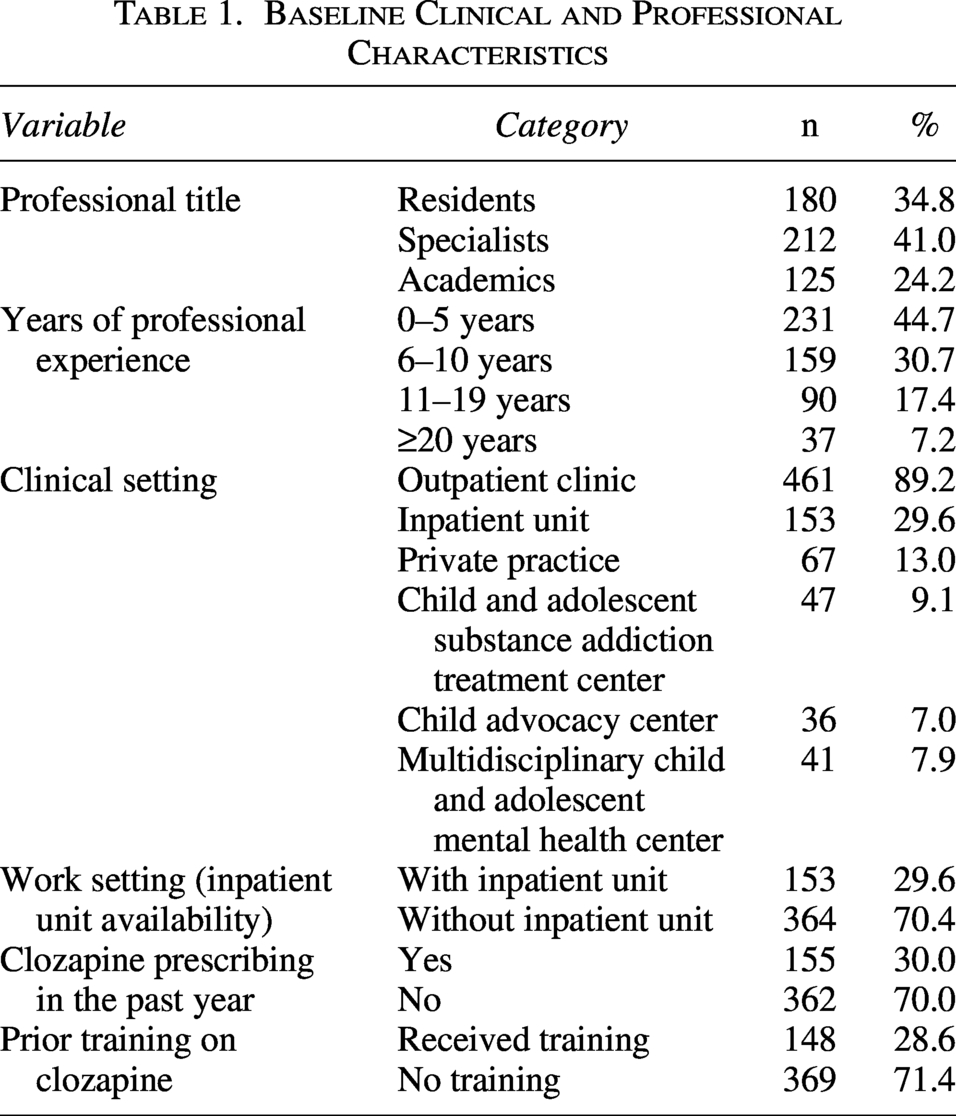
The majority reported working in outpatient clinics (89.2%); 29.6% worked in an inpatient unit, 13.0% in private practice, 9.1% in a Child and Adolescent Substance Addiction Treatment Center, 7.0% in a Child Advocacy Center, and 7.9% in a Multidisciplinary Child and Adolescent Mental Health Center. Overall, 29.6% of respondents worked in settings with an inpatient unit, whereas 70.4% worked without an inpatient unit. In the previous 12 months, only 30.0% reported prescribing clozapine to at least one patient, and 28.6% reported having received specific training on clozapine.
Barriers to clozapine use
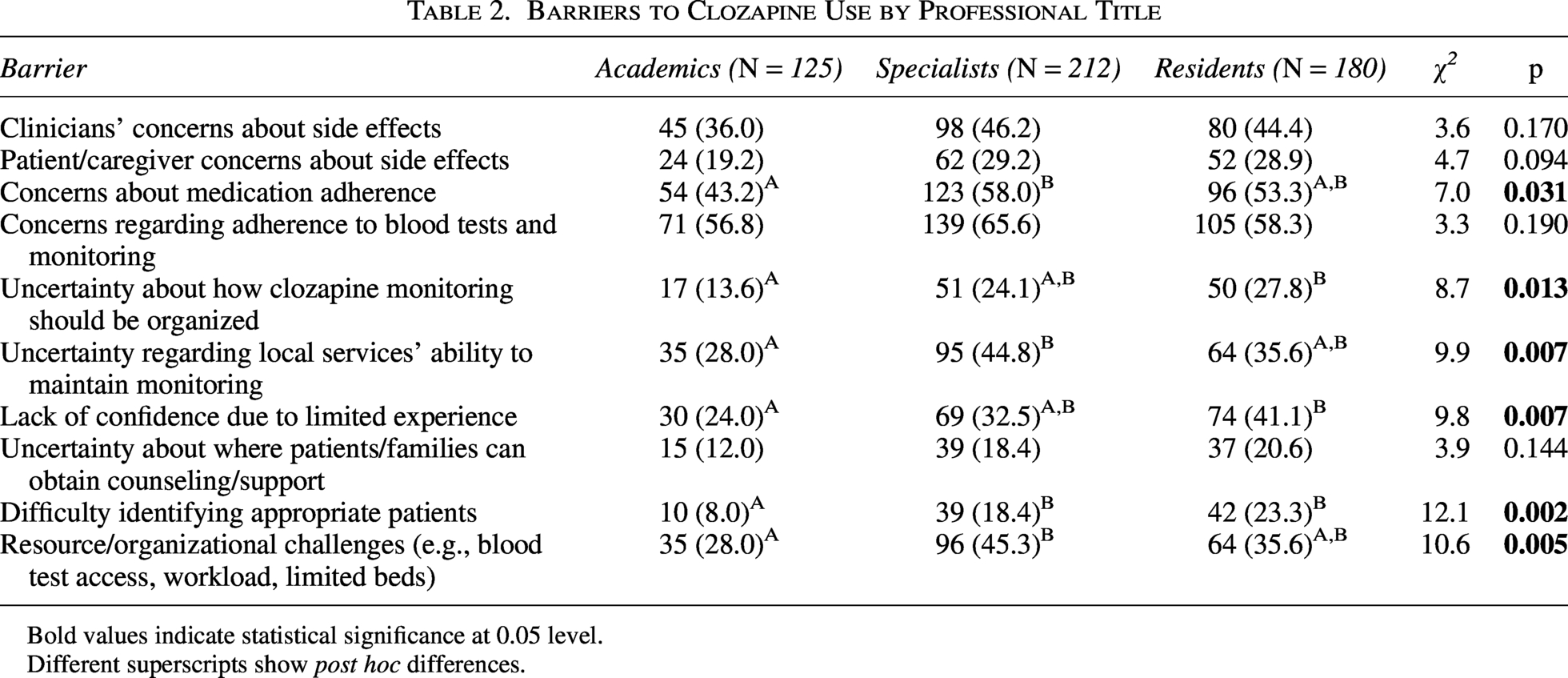
Table 2 summarizes the proportion of participants who endorsed each item as a barrier to prescribing clozapine. Across all groups, concerns about medication adherence were more frequently reported by specialists (58.0%) than by academics (43.2%; χ2 = 7.0, p = 0.031); residents (53.3%) did not differ significantly from either group.
Barriers to Clozapine Use by Professional Title
Bold values indicate statistical significance at 0.05 level.
Different superscripts show post hoc differences.
Several organizational and confidence-related barriers also differed by professional title. Uncertainty about how clozapine monitoring should be organized differed significantly between groups (χ2 = 8.7, p = 0.013), with residents (27.8%) reporting higher rates than academics (13.6%). Concerns about local services’ ability to maintain ongoing clozapine monitoring were reported by 44.8% of specialists and 35.6% of residents, compared with 28.0% of academics (χ2 = 9.9, p = 0.007). Lack of confidence due to limited experience was significantly more frequent among residents (41.1%) than academics (24.0%), while specialists (32.5%) did not differ significantly from either group (χ2 = 9.8, p = 0.007).
Difficulty identifying appropriate patients for clozapine was also more common among specialists (18.4%) and residents (23.3%) than academics (8.0%; χ2 = 12.1, p = 0.002). Finally, resource and organizational challenges (e.g., access to blood tests, heavy workload, limited inpatient beds) were most frequently endorsed by specialists (45.3%), followed by residents (35.6%) and academics (28.0%; χ2 = 10.6, p = 0.005).
By years of experience and inpatient service availability
Supplementary analyses by years of professional experience (Supplementary Table S1) showed a numerical trend for lack of confidence due to limited experience, ranging from 41.1% among clinicians in their first 5 years to 24.3% among those with ≥20 years; however, pairwise differences were not statistically significant after correction for multiple comparisons (χ2 = 11.3, p = 0.010). Difficulty identifying appropriate patients was significantly more common among clinicians with ≤5 years of experience (23.8%) than those with 11–19 years (10.0%), while other experience groups showed intermediate rates (χ2 = 13.9, p = 0.003). Resource and organizational challenges were significantly more frequent among clinicians with 6–10 years of experience (43.4%) than those with ≥20 years (18.9%; χ2 = 8.2, p = 0.043).
When stratified by inpatient service availability (Supplementary Table S2), clinicians working without an inpatient unit were significantly more likely to report multiple barriers, including clinicians’ side-effect concerns, patient/caregiver side-effect anxiety, concerns about medication adherence, uncertainty about how monitoring should be organized, doubts about local service capacity, lack of confidence due to limited experience, difficulty identifying suitable patients, and resource/organizational challenges.
Perceived competence in clozapine-related clinical tasks
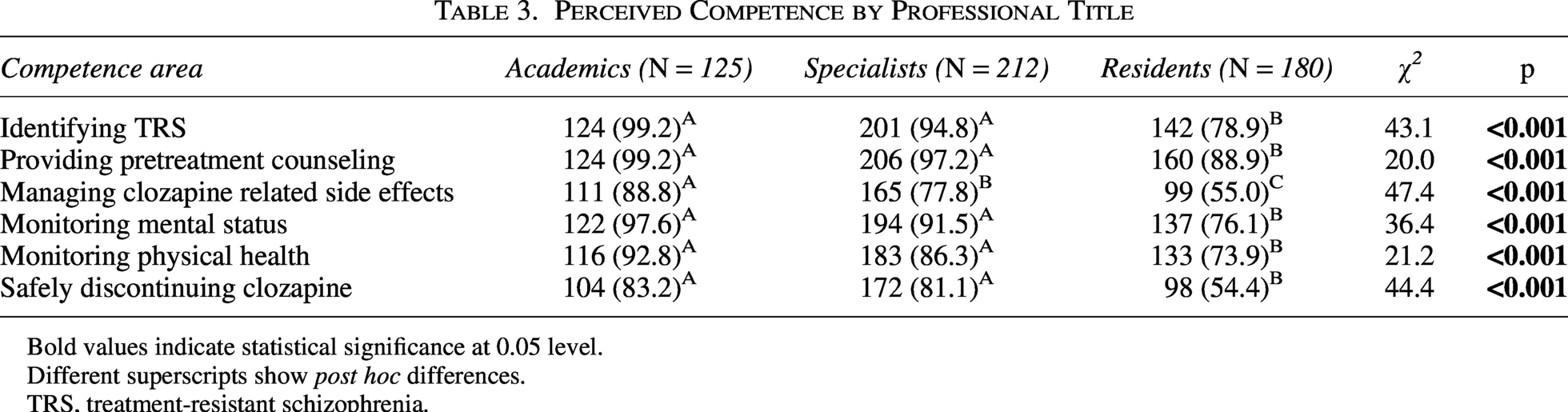
Perceived competence across six key domains is presented in Table 3. Academics reported the highest levels of self-rated competence across all domains, followed by specialists, with residents consistently reporting the lowest levels; all between-group differences were statistically significant.
Perceived Competence by Professional Title
Bold values indicate statistical significance at 0.05 level.
Different superscripts show post hoc differences.
TRS, treatment-resistant schizophrenia.
Nearly all academics and specialists, and the majority of residents, reported feeling competent in identifying TRS (99.2%, 94.8%, and 78.9%, respectively; χ2 = 43.1, p < 0.001). A similar pattern was observed for providing pretreatment counseling about clozapine, where reported competence was high among academics (99.2%) and specialists (97.2%), but significantly lower among residents (88.9%; χ2 = 20.0, p < 0.001). More pronounced differences were evident for complex management tasks. Competence in managing clozapine-related side effects was endorsed by 88.8% of academics, 77.8% of specialists, and 55.0% of residents (χ2 = 47.4, p < 0.001). For monitoring mental status during clozapine treatment, 97.6% of academics, 91.5% of specialists, and 76.1% of residents felt competent (χ2 = 36.4, p < 0.001). Competence in monitoring physical health was reported by 92.8% of academics, 86.3% of specialists, and 73.9% of residents (χ2 = 21.2, p < 0.001). Finally, confidence in safely discontinuing clozapine was similarly high among academics (83.2%) and specialists (81.1%), but significantly lower among residents (54.4%; χ2 = 44.4, p < 0.001).
Clinicians working in settings with an inpatient unit reported significantly higher competence in managing clozapine-related side effects than those without an inpatient unit (83.7% vs. 67.9%; χ2 = 13.5, p < 0.001). For other domains, competence was generally high in both groups and did not differ significantly (Supplementary Table S3). Perceived competence increased monotonically with years of experience for all six domains (all p < 0.05; Supplementary Table S4).
Attitudes toward clozapine
Attitudes toward clozapine by professional title are presented in Table 4. Across all groups, there was broad consensus that clozapine is more effective than other antipsychotics, with endorsement rates of 88.8% among academics, 92.5% among specialists, and 94.4% among residents, with no significant difference between groups (χ2 = 3.3, p = 0.191). Only a small minority considered clozapine to be safer than other antipsychotics (academics: 8.0%, specialists: 9.0%, residents: 11.7%; χ2 = 1.3, p = 0.511). The preference to try other treatment approaches before starting clozapine was endorsed by 100.0% of academics, 99.1% of specialists, and 98.3% of residents (χ2 = 2.1, p = 0.343).
Attitudes Toward Clozapine by Professional Title

Bold values indicate statistical significance at 0.05 level.
Different superscripts show post hoc differences.
Post hoc analyses showed no significant differences between groups after correction for multiple comparisons.
Several safety- and confidence-related attitudes varied by professional title. Agreement that initiating clozapine is difficult was high across all groups (academics 76.0%, specialists 85.4%, residents 86.1%; χ2 = 6.5, p = 0.039); however, pairwise differences were not statistically significant after correction for multiple comparisons. Reluctance to prescribe clozapine due to life-threatening complications was significantly higher among residents (68.9%) than academics (52.8%), with specialists showing intermediate rates (67.0%; χ2 = 9.5, p = 0.009). Similarly, concerns about drug–drug interactions were significantly more frequent among residents (65.6%) than academics (42.4%), with specialists again showing intermediate rates (54.7%; χ2 = 16.1, p = 0.001).
Regarding perceived indications and experience, difficulty identifying suitable patients for clozapine was significantly more common among residents (42.2%) than academics (22.4%), with specialists showing intermediate rates (33.0%; χ2 = 13.1, p = 0.001). Having personally observed clozapine’s superiority over other antipsychotics was significantly more common among academics (72.0%) than residents (55.0%), with specialists showing intermediate rates (67.5%; χ2 = 10.9, p = 0.004). Beliefs that clozapine is not appropriate for children and adolescents were relatively uncommon across all groups (academics: 8.8%, specialists: 5.7%, residents: 9.4%; χ2 = 2.2, p = 0.331).
In analyses stratified by inpatient service availability (Supplementary Table S5) and years of professional experience (Supplementary Table S6), clinicians without an inpatient unit were more likely to endorse that initiating clozapine is difficult (89.6% vs. 68.6%; χ2 = 34.0, p < 0.001), to report reluctance due to life-threatening complications (71.2% vs. 47.7%; χ2 = 25.8, p < 0.001), and to struggle with identifying suitable patients (39.8% vs. 19.0%; χ2 = 21.0, p < 0.001). In contrast, clinicians with an inpatient unit more often reported having gained good clozapine experience during residency (66.0% vs. 35.2%; χ2 = 41.6, p < 0.001) and having personally observed clozapine’s superiority (79.7% vs. 57.7%; χ2 = 22.8, p < 0.001).
Two items assessed misconceptions about clozapine (Table 4). The statement “Clozapine is associated with higher mortality” was endorsed by 17.6% of academicians, 17.0% of specialists, and 28.3% of residents (χ2 = 8.7, p = 0.013). Similarly, the belief that “the risk of agranulocytosis remains constant over treatment” was endorsed by 12.8% of academicians, 17.9% of specialists, and 22.2% of residents (χ2 = 4.4, p = 0.110).
Discussion
This study represents the first comprehensive, nationwide assessment of knowledge, clinical skills, attitudes, and perceived barriers related to clozapine use among child and adolescent psychiatry professionals in Türkiye. Of the 1731 child and adolescent psychiatry professionals registered in Türkiye at the time of data collection, 517 (29.9%) participated in the survey, including 180 resident doctors (26.4% of 682), 212 specialist doctors (27.6% of 767), and 125 academicians (44.3% of 282). This response rate compares favorably with previous national surveys in psychiatry (Grover et al., 2015; Tungaraza and Farooq, 2015). Our findings reveal that while the efficacy of clozapine is widely acknowledged, significant gaps in training, confidence, and service infrastructure persist, particularly among less experienced clinicians and those working in settings without inpatient units.
Several key findings merit attention. First, only 30% of respondents reported prescribing clozapine to at least one patient in the past 12 months, and merely 28.6% had received specific training on clozapine. Second, barriers to clozapine use were common across all professional groups, with concerns about medication adherence, blood test compliance, and side effects being the most frequently endorsed. Third, there was a clear gradient in perceived competence and confidence levels, with academics consistently reporting higher levels than specialists, and specialists higher than residents. Finally, clinicians working without access to inpatient services reported significantly more barriers and lower confidence compared with those with inpatient access.
Consistent with international literature, including systematic reviews and recent surveys in child and adolescent psychiatry, barriers related to monitoring, training, and service organization were common in our sample (Farooq et al., 2019; Walker et al., 2024). In our sample, uncertainty about how monitoring should be organized (13.6%–27.8%) and concerns about local services’ ability to maintain monitoring (28.0%–44.8%) were endorsed by substantial proportions of clinicians, underscoring the need for standardized protocols and enhanced service infrastructure in Türkiye.
The clear experience-related gradient observed in our study, with less experienced clinicians and residents reporting more barriers, lower competence, and greater reluctance to prescribe clozapine, aligns with findings from multiple international surveys. Tungaraza and Farooq (2015) reported that nearly one-third of UK consultant adult psychiatrists (a title equivalent to specialist doctors in Türkiye) had not prescribed clozapine in more than a year, largely due to limited experience and confidence (Tungaraza and Farooq, 2015). In Serbia, Ignjatovic Ristic and colleagues (2021), in a nationwide survey of adult psychiatrists, found that fear of agranulocytosis was the greatest barrier (68% endorsement), followed by weight gain (56%) and sedation (39%), with experience level influencing prescribing comfort (Ignjatovic Ristic et al., 2021). Our findings that 41.1% of residents endorsed lack of confidence due to limited experience, compared with 32.5% of specialists and 24.0% of academics, highlight the critical need for enhanced training during residency.
The low rate of clozapine-specific training (28.6%) observed in our study is particularly concerning given the robust evidence supporting clozapine as the treatment of choice for TRS in both adult and pediatric populations. A recent meta-analysis by Adnan and colleagues (2022) confirmed that clozapine is safe and efficacious in childhood and adolescent-onset schizophrenia, with superior efficacy compared with other antipsychotics in both short-term and long-term follow-up (Adnan et al., 2022). Prior work suggests that structured educational interventions during training improve clinicians’ competence and willingness to prescribe clozapine (Freudenreich et al., 2013; Zarzar, 2024). Our findings strongly support these recommendations and suggest that similar educational initiatives should be prioritized in Türkiye.
A particularly notable finding is the significant association between inpatient service availability and multiple indicators of clozapine prescribing comfort and competence. Clinicians without inpatient access endorsed more barriers, reported lower confidence, expressed greater reluctance due to life-threatening complications, and had more difficulty identifying suitable patients. These clinicians were also less likely to have gained meaningful clozapine experience during residency and to have personally observed clozapine’s superiority. This aligns with findings by Walker et al. (2024), who found that the lack of access to inpatient beds and the absence of clear organizational pathways for initiation are major logistical hurdles preventing the wider adoption of clozapine in youth services (Walker et al., 2024). Consequently, without established protocols to support initiation in outpatient settings, a significant proportion of eligible children and adolescents may be denied access to evidence-based treatment solely due to infrastructural limitations rather than clinical contraindications. While basic monitoring requirements such as complete blood count and cardiac markers are generally accessible across clinical settings, therapeutic drug monitoring (TDM) of clozapine serum levels, which can optimize dosing and improve outcomes, remains unavailable in most centers in Türkiye.
Encouragingly, the vast majority of respondents acknowledged clozapine’s superior efficacy compared with other antipsychotics, and few believed clozapine to be inappropriate for children and adolescents. These findings suggest that negative attitudes toward clozapine’s efficacy are not the primary driver of underutilization in our sample. Rather, safety concerns, particularly regarding serious adverse effects, appear more influential. Over two-thirds of specialists and residents reported reluctance to prescribe clozapine due to concerns about potentially fatal complications, significantly higher than academics. This pattern of high efficacy recognition paired with safety-driven reluctance mirrors findings from a nationwide survey of adult psychiatrists in Iran by Rezaie et al. (2022), where 74% believed clozapine was more effective, yet 40% were discouraged by safety concerns (Rezaie et al., 2022).
Notably, the recent elimination of the FDA’s REMS requirement for clozapine in the United States (February 2025) reflects growing recognition that overly burdensome monitoring may itself impede access to evidence-based care (Kameg, 2025). Similarly, recent global Delphi consensus guidelines recommended discontinuing routine neutrophil monitoring after two years of stable treatment (Siskind et al., 2026). These evolving international recommendations should be considered in the development of Turkish national guidelines.
Monitoring-related barriers were among the most frequently endorsed obstacles in our study. Concerns regarding patient adherence to hematological monitoring (complete blood count) were reported by approximately 60% of respondents across all professional groups. Notably, while hematological monitoring is generally accessible across clinical settings in Türkiye, TDM of clozapine serum levels, which can optimize dosing, confirm adherence, and improve clinical outcomes, remains unavailable in the vast majority of centers. This represents a significant infrastructural gap that limits evidence-based clozapine management. Clinicians without inpatient access reported greater uncertainty about monitoring organization and local services’ capacity to maintain monitoring. These findings align with the systematic review by Verdoux et al. (2018), which identified mandatory blood monitoring as one of the most frequently cited institutional barriers internationally (Verdoux et al., 2018).
Our findings have several important implications for clinical practice and health policy in Türkiye. First, there is an urgent need for structured clozapine training programs integrated into child and adolescent psychiatry residency curricula. Such programs should include both didactic instruction and supervised clinical experience in clozapine initiation, titration, monitoring, and adverse effect management. Second, the development of national clinical guidelines specific to pediatric clozapine use, including clear indications, monitoring protocols, and management algorithms, would provide much-needed standardization and support for clinicians. Third, expanding access to inpatient services or developing alternative models for supervised clozapine initiation may help address structural barriers faced by clinicians working in outpatient-only settings.
This study has several strengths. Previous surveys examining clinician attitudes toward clozapine in child and adolescent psychiatry have been limited by small sample sizes, which precluded adequately powered subgroup analyses by professional title, years of experience, or practice setting (Cirulli, 2005; Walker et al., 2024). The present study overcomes this limitation, enabling robust comparisons across clinician subgroups. Furthermore, with a 29.9% response rate from a well-defined national sampling frame of 1731 registered professionals, our findings demonstrate strong representativeness of the Turkish child and adolescent psychiatry workforce. In contrast, some larger surveys in the adult psychiatry literature, despite achieving higher absolute participant numbers, have reported lower response rates or drawn from less clearly defined populations, potentially limiting their generalizability (Grover et al., 2015). This sample size enabled meaningful subgroup analyses by professional title, years of experience, and practice setting characteristics. The study is also the first nationwide assessment of clozapine-related knowledge, attitudes, and barriers among child and adolescent psychiatry professionals in Türkiye.
Several limitations should be acknowledged. First, the cross-sectional design precludes causal inferences regarding the relationships between barriers, attitudes, and prescribing behavior. Second, response rates varied by professional title (44.3% for academics, 27.6% for specialists, and 26.4% for residents), and nonresponse bias may have influenced results. Third, all data were self-reported and may be subject to social desirability bias. Fourth, the survey did not assess actual prescribing rates or patient outcomes. Fifth, we did not collect data on hospital type or geographic region; thus, potential variations attributable to institutional resources or regional health care infrastructure could not be examined. Although our sampling frame included child and adolescent psychiatrists from all regions of Türkiye, the actual geographic distribution of respondents remains unknown.
Future research should examine the effectiveness of targeted educational interventions in improving clinician knowledge, confidence, and prescribing practices. Studies examining patient and caregiver perspectives on clozapine would complement our clinician-focused findings and inform patient-centered approaches to care.
Conclusions/Clinical Significance
In conclusion, this nationwide survey reveals substantial gaps in training, confidence, and service infrastructure related to clozapine use among child and adolescent psychiatry professionals in Türkiye. While clozapine’s efficacy is widely recognized, concerns about side effects, monitoring requirements, and life-threatening complications, particularly among less experienced clinicians and those without inpatient access, constitute significant barriers to appropriate prescribing. These findings underscore the urgent need for enhanced residency training, development of national clinical guidelines, and expansion of service infrastructure to support safe and timely clozapine initiation for children and adolescents with TRS. Addressing these barriers is essential to ensure that young patients who may benefit from clozapine have equitable access to this uniquely effective treatment.
Authors’ Contributions
M.T. and D.M.K. conceptualized the study, designed the survey instrument, and coordinated data collection. C.Y. and E.A. ran analyses, created tables, and drafted the methods and results sections. G.S.D. and D.B. contributed to the introduction and discussion, performed literature review, and assisted with data interpretation. C.E. and E.C. oversaw the article, supervised the analysis process, and drafted most of the discussion. M.T. and E.C. provided final approval of the version to be published. All authors reviewed drafts, provided edits, and approved the final article.
Footnotes
Acknowledgment
The authors acknowledge and thank the child and adolescent psychiatry professionals across Türkiye who generously participated in this survey.
Author Disclosure Statement
The authors have no conflicts of interest to disclose.
Data Availability Statement
The data supporting the findings of this study are available from the corresponding author upon reasonable request.
Ethics Approval
This study was approved by the Clinical Research Ethics Committee of Ankara Bilkent City Hospital (Decision No: TABED 2-25-1585, Date: October 15, 2025) and conducted in accordance with the Declaration of Helsinki.
Informed Consent Statement
Electronic informed consent was obtained from all participants prior to survey completion.
Supplemental Material
References
Supplementary Material
Please find the following supplemental material available below.
For Open Access articles published under a Creative Commons License, all supplemental material carries the same license as the article it is associated with.
For non-Open Access articles published, all supplemental material carries a non-exclusive license, and permission requests for re-use of supplemental material or any part of supplemental material shall be sent directly to the copyright owner as specified in the copyright notice associated with the article.
