




Abstract
An understanding of learning theories can help adult educators become more effective practitioners and meet the needs of the learners they serve. Adult educators who understand how individuals learn can be better prepared to use effective strategies during the learning process. This article addresses the use of concept maps as a strategy to engage adult learners in critical analysis, a skill educators often aim to help learners strengthen. The discussion situates within four learning theories: cognitivist, constructivist, transformative, and social learning. Examples from different contexts using concept maps and connections between theories, learning process, locus of learning, teacher’s role, manifestation in adult education, and activities are presented. The article concludes with putting concept maps and critical analysis into practice in formal and nonformal settings.
“Concept maps have their theoretical foundation in constructivist theory and focus on learners’ active construction of knowledge individually and socially.”
Learning theories can help adult educators become more effective practitioners and meet the needs of the learners they serve. Understanding how adults’ best learn through different lenses provides insights into the learning process and strategies to foster critical analysis. In this article, we focus on four learning theories and discuss their manifestation in adult education through concept mapping to engage learners in critical analysis. We conclude with strategies on how to use concept maps in formal and nonformal settings as well as areas for future research.
This article draws on a literature review of peer-reviewed journal articles of adult educators using concept maps to foster critical analysis primarily in empirical studies. The purpose of this article is to address the following questions: How can concept mapping help promote critical analysis? How does the use of concept maps foster adult learners’ critical analysis in different contexts? We define critical analysis as an assessment based on careful systematic evaluation. Critical analysis involves processes of reflection, higher-order thinking, and synthesis leading to meaningful learning, knowledge construction, perspective transformation, or solving of community problems. Hill’s (2005) previous work focuses on concept maps as a strategy to foster meaningful learning and practical suggestions for constructing maps. This article expands the discussion by focusing on critical analysis of empirical studies and provides a visual organization of theory to practice application. Based on our analysis and interpretation of the literature, we developed chart and graphical representations of concept maps in formal and nonformal settings.
Theoretical Foundations of Concept Maps
Concept map use in education began in the 1970s when Joseph Novak and his research team at Cornell University applied them in their work with science students (Novak, 2010; Novak & Cañas, 2006; Novak & Gowin, 1984). Later, educators utilized concept maps as a strategy to increase meaningful learning in other subject areas. In contexts such as business and government, concept maps represented expert knowledge of individuals and groups. Concept maps have their theoretical foundation in constructivist theory and focus on learners’ active construction of knowledge individually and socially.
Novak and his team used Ausubel’s (1963) philosophical beliefs when using concept maps. Ausubel (1963) viewed rote learning and meaningful learning on a continuum. Specifically, if learning is not meaningful, one will have difficulty recalling the information, concepts, and ideas. Novak (2010) argued concept maps can facilitate higher-order learning so knowledge can be contextually applied in a variety of situations as cognitive structures are modified. Rote memorization is not wrong, but if learners do not understand meaning, the information most likely will not develop into new knowledge. Fostering meaningful learning is at the core philosophy of concept map use and, specifically, the use of concept maps for fostering critical analysis within formal and nonformal education settings.
What Is a Concept Map?
A review of the literature indicates concept maps have become a highly effective method to facilitate critical analysis. A concept map is a schematic device for representing a set of concept meanings embedded in a framework of propositions (Novak & Gowin, 1984). It provides a visual representation of conceptual meanings used to develop meaningful learning on an individual level and shared meaning with others. Using computer software or by hand, one creates a web diagram to explore knowledge and gather and share information to represent these meanings (Merrill, 2003).
Figure 1 displays our concept map of a concept map, a visual of knowledge construction. Each concept map should begin with a question in mind. In this case, the concept map answers the questions, “What is a concept map?” There are three main hierarchies, or vertical strands, in the map. A concept map shows hierarchies of words as labels for concepts. It also shows propositional relationships through linking words connecting concepts (the words in circles or bubbles). In addition, a concept map shows crosslinks displaying interrelationships between concepts through connecting words (the words not in circles and in between concepts). Within concepts maps, these hierarchies (vertical strands), propositional relationships (the connections between concepts), and crosslinks (links between hierarchies or strands) articulate knowledge construction and can foster meaningful learning.
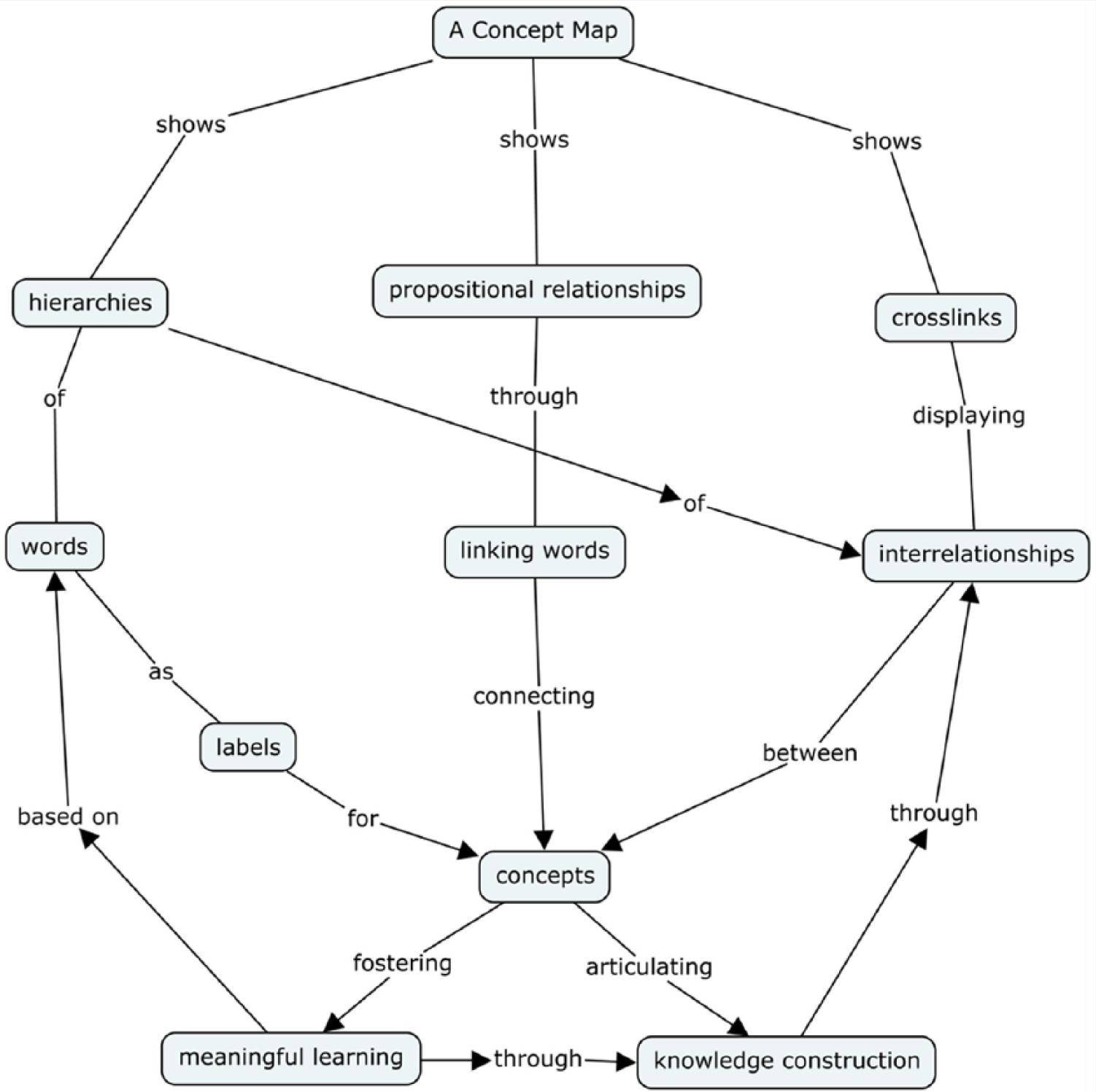
Concept map of a concept map.
Concept mapping fosters meaningful learning by allowing the learner to integrate new concepts into an existing cognitive structure. For example, if learners are asked to create a concept map that displays their understanding of a philosophy, such as behaviorism, each learner’s map may have commonalities, but each would look different based on the learner’s previous knowledge. The instructor might examine the propositional relationships and how linking words portray valid connections and concepts. This is an example of the process of critical analysis that takes place in the formation of a concept map and one that may engage learners within multiple learning theory approaches.
Critical Analysis and Learning Theories: From Theory to Practice
In this section, we focus on four adult learning theories that involve critical analysis: cognitivist, constructivist, transformative, and social learning. These theories involve individual or social construction of knowledge and incorporate reflection as a way to critically analyze content, experience, context, interaction, or systems. Based on the premise of these theories, concept maps can be a strategy for engaging adult learners in critical analysis in formal and nonformal education. Within this analysis, we define formal education as within a system of highly structured learning activities leading to degrees, and nonformal education, a complement, supplement, or alternative to the formal system (Brennan, 1997). Although these learning theories have similarities, such as the integral role of critical analysis, they also possess differences in the learning process, locus of learning, and the teacher’s role.
Cognitivist Learning Theory
In cognitivist learning, focusing on internal mental processing, concept maps can foster cognitive development as adult learners build new knowledge on previous knowledge to form new mental schema or internal cognitive structures (Piaget, 1972). Instructors using concept maps help students develop the capacity and skills to learn new knowledge and structure content for learners in formal education and subject areas such as computer programming, in which “the ability to express information and knowledge diagrammatically” is important (Keppens & Hay, 2008, p. 40). As a further example, adult students use concept maps in medical schools to recall content and diagnose by visualizing and critically analyzing symptoms and connections in body systems (Atay & Karabacak, 2012). In a Turkish study, Atay and Karabacak’s (2012) experimental group of nursing students used concept maps to develop care plans, which “was an important factor in increasing critical thinking disposition” (p. 236). Physiology students who used concept maps had higher problem-solving exam grades and demonstrated a statistically significant difference from students who did not use concept maps (González, Palencia, Umaña, Galindo, & Villafrade, 2008).
Within nonformal education, Jafari, Akhavan, and Akhtari (2011) worked with Iranian tunnel experts and reported concept maps had “meaningful effects” (p. 250) on participants’ capability to produce knowledge, valued as important to generate and communicate expert knowledge. In a nonformal continuing professional education setting, Greene, Lubin, Slater, and Walden’s (2013) study suggested concept maps allow educators to critically analyze prior knowledge and current information from sessions to “restructure existing schema” (p. 296).
These examples illustrate how concept mapping can foster cognitive development over time as well as the ability for learners to think critically by learning how to learn. Furthermore, concept mapping is an assessment tool for developing plans and solving problems. Concept mapping also may provide a strategy adult educators can use to help students build on previous vocabulary and integrate new concepts for students and employees to understand interconnections in knowledge making.
Constructivist Learning Theory
In constructivist learning, focusing on constructing meaning from experience, a concept map can be a strategy to integrate new knowledge from experience through the internal construction of reality by the individual (Ausubel, 1963). Reflection allows the adult learner to become aware of the integration of new knowledge sources. By concept mapping with self-reflective journaling, adult learners can prioritize ideas, critically analyze concepts, and make decisions about what is meaningful to them. Learning how to think and evaluate content helps students make meaning of information and construct new knowledge at a deeper level. Instructors using concept maps can facilitate and negotiate meanings with the learner.
In formal education, González et al.’s (2008) study of physiology students demonstrated how instructors facilitated meaning construction with learners based on their concept maps, resulting in higher learning outcomes. In dental education, Hay, Tan, and Whaites (2010) explored concept mapping as a supplemental form of learning and an alternative means of testing. Their study comparing adult learners with traditional aged college students indicated adult learners’ concept maps immediately reflected an “integration of theory and work practice” (Hay et al., 2010, pp. 588-589), which traditional testing failed to do. Learners indicated the integration of life experience was important to their learning process, and the instructors saw richer connections in content with concept maps than in traditional assessment, which may have disadvantaged the learner.
Conceição, Baldor, and Desnoyers (2009) conducted a study of adult learners using concept maps to synthesize knowledge from theory, research, and models in an online course that used group discussions, concept maps, and a collaborative team project. Study results indicated students who used concept maps did a better job prioritizing information, integrating concepts, and confirming and constructing knowledge. In this study, the use of concept maps was especially effective when students were learning new theories because they could critically analyze complex concepts and connect them with previous knowledge. Students’ engagement in critical analysis through concept maps helped them make meaningful use of knowledge constructively.
In a nonformal workplace setting, Pegg’s (2007) research explored school leadership through participatory research and suggested concept maps helped teams explore everyday experiences in their work as administrators at various levels. Concept maps were used to help the learners and the researcher “establish a picture of the way in which concepts of learning were used . . . by leaders in their daily lives” (Pegg, 2007, p. 265). Administrators processed and critically analyzed how they learned to lead by examining linkages.
Concept mapping can be a strategy to help learners identify linkages and connect content to their lived experiences. Within these examples, connecting new ideas to life experience, including practitioner-based learning, was important to helping adult learners foster meaning. Concept mapping generated individual and group meaning making and critical analysis.
Transformative Learning Theory
In transformative learning, emphasizing changing learner preconceptions and worldview, the learning process focuses on the critical reflection of assumptions (Mezirow, 1991). The instructor’s role is to foster critical reflection with the ultimate goal of student development of thought and understanding. For example, Kandiko, Hay, and Weller (2013) explained the process of reflection and dialogue students went through when creating concept maps over a formal education course. In this case, students modified meaning making over time, challenging previous assumptions. The authors asserted social and psychological meaning making through the learning process with concept maps is complicated and difficult to categorize as individual or social. Furthermore, they considered feedback on concept maps as a process of dialogue with the student rather than simply assessment:
Having a series of concept maps can facilitate dialogue between students’ personal understanding of public knowledge and the understanding of others, such as instructors and peers. Reflection on maps created over time can allow both student and instructor to engage in dialogue about the student’s development of thought and understanding. (Kandiko et al., 2013, pp. 82-83)
Within management learning in nonformal workplace meetings, Gray (2007) discusses important strategies and includes concept mapping as an essential input to the learning process. Concept mapping on individual and group levels can help adult learners critically analyze and reflect on incidents and metaphors, which can foster transformative learning. This analysis promotes positive change in individual, team, and organizational processes.
These examples highlight the use of concept mapping to foster transformative learning at individual and group levels, including between student and instructor, the entire class and the instructor, or teams in the workplace. Concept mapping may foster a critical analysis of assumptions for learners and instructors as they negotiate meaning. The concept mapping process also may foster disorienting dilemmas and bring a greater understanding of them.
Social Learning Theory
Within social learning, emphasizing fostering learning through social interaction with others, concept maps can be a strategy to cooperatively, critically analyze problems and potential solutions for change through observation and modeling (Bandura, 1977). Reflection and collaborative learning with concept maps allows individuals to become aware of systems in which they are situated. The instructor or facilitator plays an important role in providing a knowledge map for learners to model behavior through attention, situating the activity within a relevant social context, reinforcing learner behavior through feedback and rewards, and using strategies that keep the learner motivated to complete the task.
Moni and Moni (2008) examined group concept maps within formal physiology classes. Students examined logic and understanding as teams, critically analyzing content as a group and generating one concept map for assessment. In another formal physiology context, González et al. (2008) reported students talked to each other about their concept maps of physiology, which helped them self-reflect and recognize misconceptions in connections. This peer learning was an important part of the process of concept map development in a social context.
The exploration of social learning using concept maps included continuing professional education for teachers. Rye, Landenberger, and Warner (2013) studied professional development for middle and secondary science teachers in team project-based learning within a summer program. The program focused on project-based learning units investigating and critically analyzing content about local watersheds. Teachers learned computer-based concept mapping and exchanged ideas with peers with different levels of expertise. After learning about the strategy and returning to the classroom, teachers and students collaboratively used concept mapping to critically analyze content, plan as teams, and organize lessons. By modeling each other’s behavior, learning was based on the interactions of participants, their behavior, and the environment.
As a further example, Meagher-Stewart et al.’s (2012) study focused on 90 health care practitioners working in public health. The professionals developed concept maps in small groups in a nonformal setting, which served as “meaningful ways for participants to clarify the connections between people and concepts, and to understand the role of various types of communities of practice in stimulating evidence informed decision making” (p. 727). Concept maps served as strategy to foster critical analysis within communities of practice.
These examples suggest concept mapping and social learning theory can be an important framework for fostering critical analysis. Peer exchange and development of maps within continuing professional development and formal education served to help learners critically analyze content and problems and make connections. Concept mapping also served as a strategy to critically analyze social contexts to foster change in practice within specific professions like teaching and health care.
Putting Concept Maps and Critical Analysis Into Practice
Concept maps can be used as a strategy in a variety of ways in formal and nonformal adult education settings: assessment, project development, problem solving, brainstorming, and sharing and exchanging information. As an assessment tool, concept maps can serve as a diagnostic pre-assessment before a module or as a formative evaluation tool during the learning activities.
In formal education, concept maps can supplement a reflection. Learners can work together in constructing a concept map through their shared understanding of a situation for organizational and community change and problem solving. In addition, students can map course readings by picking and reading three articles, then immediately mapping them to demonstrate relationships among concepts. For paper development, students can submit a concept map of a paper they plan to write. The instructor provides feedback before students start writing papers. This strategy can help students conceptualize their paper and understand relationships, particularly good for literature reviews. Case studies provide another example. First, students work in groups to map out the case. After participating in online groups to discuss course readings, students develop a second concept map based on the new knowledge they acquired through discussion (Daley, Cañas, & Stark-Schweitzer, 2007).
In health care formal education, nursing and medical students can develop concept maps of the care they will provide before clinical, using client and applying learned theories. During clinical, tutors and students discuss relationships in client data, use and response of medications, diagnostic test/results medical regimen, and client responses incorporated in the care plan. Concept maps can be updated and refined throughout the shift to reflect more knowledge and increased understanding. This activity can facilitate student’s ability to critically think and link theory to practice, help students focus on client interrelationships rather than being task focused, and help students identify and clarify misunderstandings before new learning is built on incorrect assumptions (Adema-Hannes & Parzen, 2005).
In nonformal settings, individuals can use concept maps to brainstorm ideas, develop thoughts about issues in a meeting, and generate ideas through visual images and symbols. Software allows individuals to share and collaboratively edit such ideas. The same approach applies to individual or group problem solving. Individuals can attend a meeting and use a concept map to organize information about a problem or subject. Pulling together information already known to the group can help members understand new information as discussed. Another approach is to generate new ideas by connecting life experience or practice in a community setting.
For any subject area, concept maps can help adult learners acquire new vocabulary and concepts and make sense of them by connecting known concepts to new concepts. When learners individually use concept maps and share meaning over time, this process can show developmental knowledge and reflection. Students can recall and share critical incidents to compare and contrast situations.
Table 1 compares these four learning theories indicating the learning process, locus of learning, teacher’s role, and manifestation in adult education and provides examples of concept map activities for adults.
Concept Mapping and Learning Theories
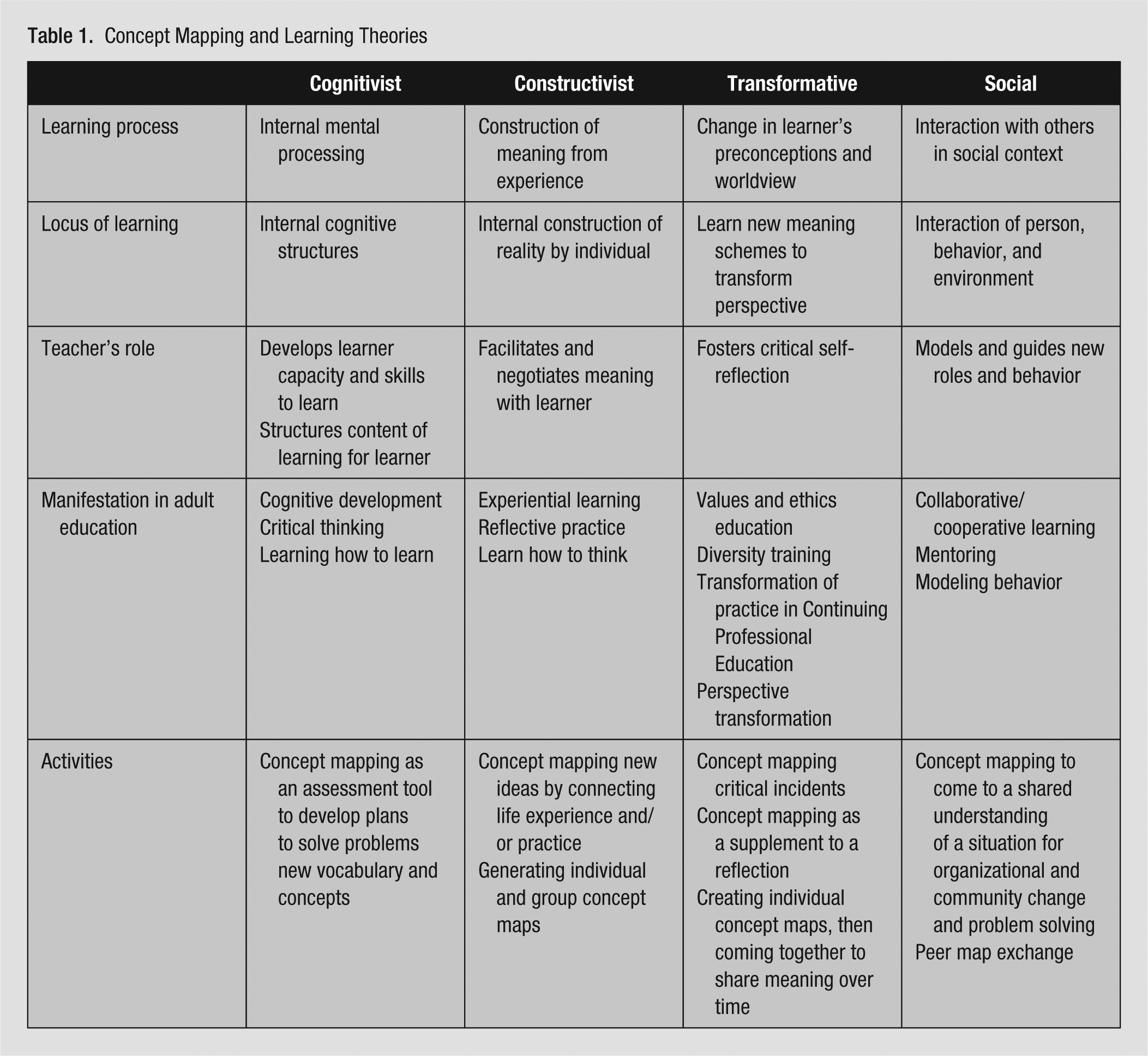
Figure 2 shows a graphical representation of a concept map used in adult education courses and nonformal settings as a strategy for critical analysis. Based on our analysis and interpretation of the literature, this example provides a synthesis of the concepts and examples addressed in this article.
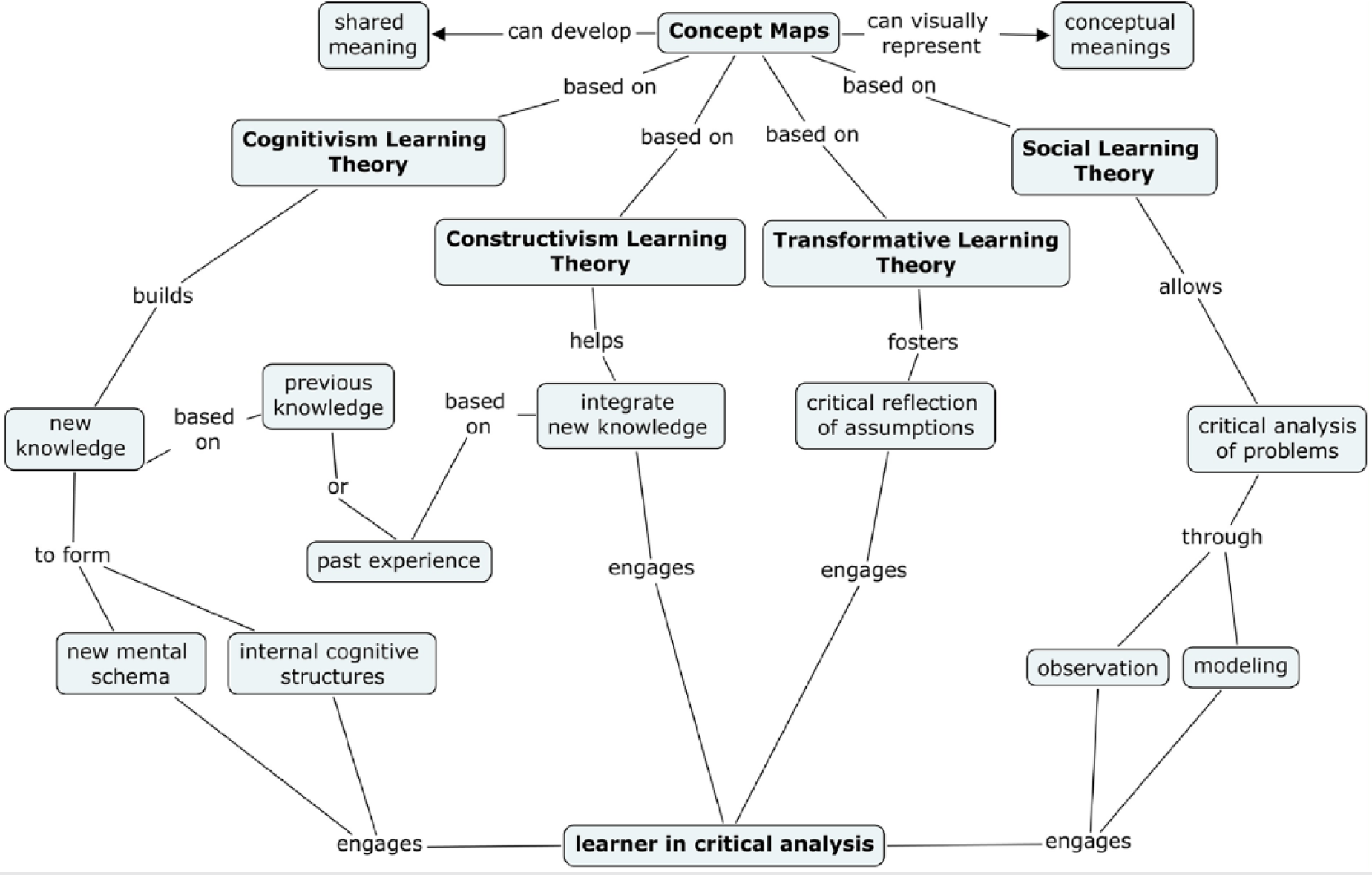
Graphical representation of concept mapping and critical analysis.
Future Research and Conclusion
This literature review focused on a multitude of formal and nonformal settings, such as dental education, computer courses, teacher continuing professional education, health care professional communities of practice, workplace meetings, and collaborative online learning. In such settings, learners have used concept mapping to foster critical analysis skills within cognitivist, constructivist, transformative, and social learning frameworks.
Future research is needed to examine how concept maps can be a strategy to help learners understand and critically analyze forces of oppression and domination. For example, concept mapping conflicts in social settings, such as community organizing, may facilitate a more in-depth individual and cooperative critical analysis of power and learning. In nonformal community organizations settings, adult educators could integrate concept mapping to foster shared meaning making and an understanding of social problems and generate community-based solutions to address issues of self-identified importance. For example, neighborhood associations, parent organizations, and other social action groups could benefit from the concept mapping process and product to foster critical analysis. Concept mapping also may provide a way for adult learners with limited knowledge of a shared language, such as English, to collaboratively learn, foster awareness of group diversity, and build community. Additional studies in nonformal settings are needed to broaden our understanding of critical approaches and diverse contexts in which concept mapping may be used.
Adult educators can become more effective practitioners by using concept maps in diverse educational settings; the process of concept mapping can help meet the needs of the learners they serve. By making connections between the fields of concept mapping and adult education, we can broaden our understanding from theory to practice. Concept maps can easily integrate into any setting that involves reflection and critical analysis. The examples provided can be a starting point for any adult educator trying to incorporate theoretical knowledge into practical application.
Footnotes
Conflict of Interest
The author(s) declared no potential conflicts of interest with respect to the authorship and/or publication of this article.
Funding
The author(s) received no financial support for the research, authorship, and/or publication of this article.
Author Biographies
Susan M. Yelich Biniecki, PhD, is an assistant professor of adult and continuing education at the Kansas State University College of Education. Her research focuses on culture, knowledge construction, and international adult education in nonformal and formal settings. She teaches courses online and face-to-face at the K-State Olathe campus and Fort Leavenworth.
Simone C. O. Conceição, PhD, is a professor of adult and continuing education leadership at the University of Wisconsin–Milwaukee School of Education. She teaches courses and conducts research in the areas of learning design, curriculum development, adult learning, online education, and the impact of the use of technology for teaching and learning.