




Abstract
This article provides an account of a group of adult Chinese immigrants learning English at a cultural center serving the local Asian community. The focus of this teacher-research descriptive case study is on learner experiences as they relate to transition theory and Confucian learner principles and as these materialized through classroom participation. Using transition theory as a lens, the article establishes connections with Confucian learning principles as they emerged in the data collected. Therefore, study findings are presented under four themes: Self, Situation, Strategies, and Support. In view of the Confucian philosophy of learning, the participants’ stories illustrate their understanding of teacher authority, collaborative learning, function of effort, and pursuit of lifelong learning. Thus, the article examines how the learners were adapting or struggling with different daily life aspects that require the use of the English language. Learning English served as catalyst for the adult learners to achieve their goals in the new community and culture.
“In the learning environment, there are opportunities to learn from different individuals. Being aware of other learners’ successes and mistakes benefits the group”
In 2018, the Asian Pacific American Data webpage reported that 1.3% of the U.S. total population were Chinese Americans. In addition, Population USA reported that in 2020, in Central Texas, where the study took place, 5.4% of the total population were Asian. A study of suburban growth patterns of Asian Indians and Chinese populations reported the growth rate in Central Texas to be considerably higher than the national average for Asian immigrants (Skop & Li, 2005). More recently, White et al. (2015) indicated that persons born in Asia are the second most populous group of Texas immigrants. Despite the benefits, it would represent for instructors and learners, there is a lack of research on adult Chinese learners enrolled in ESL (English as a second language) courses. This article aims to add to this body of research while documenting the experiences of adult Chinese students learning English at an Asian cultural center. In particular, the focus is learner behaviors related to transition theory and Confucian learner principles as these materialized through classroom participation. Gaining knowledge about this group of learners can help instructors plan relevant lesson as well as gain understanding of what makes these learners unique. The research questions include:
What are the experiences of Chinese adults learning English at an Asian cultural center?
What learner behaviors and characteristics illustrate transition in an English class for adult Chinese immigrants?
Background
According to Martin (2011), “In the 1800s, a Chinese emigrant’s decision to leave home was based on economics rather than on attraction to the religious or political freedom offered by the United States” (p. 93). In fact, Chinese immigrants were among the most warranted for contract labor in the early 19th century. Wu (2017) reports that the first Chinese immigrants arrived in the United States in 1820. Many came because of the California Gold Rush of 1849, and the latter population were recruited to Texas by railroads (Pew Research Center, 2012). Chinese immigrants were the first Asian immigrant group to arrive in Texas (Rhoads, 2016).
In 1870, Houston and Texas Central Railroad contracted 250 Chinese immigrants to construct the railroads between Houston and Dallas (Rhoads, 2016; Texas Time Travel, n.d.). The following decade, an increase in Chinese immigrants arouse in Texas because Southern Pacific contracted approximately 2,600 laborers (Rhoads, 2016). As one report stated, “Chinese labor provided the massive workforce needed to build the majority of the Central Pacific’s difficult route” (Chinese Americans, n.d.) and were cheap contract labor. However, The Chinese exclusion Act of 1882 was a gatekeeping law preventing Chinese immigrant labor from entering U.S. land (Chinese Americans, n.d.). Wu (2017) explained that “passage of the act represented the outcome of years of racial hostility and anti-immigrant agitation by White Americans” (para 1). Nevertheless, the Chinese exclusion Act was repealed in 1943 (Texas Time Travel, n.d.) but in Texas, the Chinese immigrant population reached its peak in 1900. Texas was the only state to be allowed an exception as to the immigration of Chinese (Rhoads, 2016). After the Chinese Act of 1882, General John J. Pershing was permitted to immigrate Pershing Chinese because they aided his invasion into Mexico in 1917.
Today, there are many differences from the 19th century which set apart Chinese immigrants. After the repeal of the Chinese Act of 1882, the group of Chinese immigrants to the United States changed drastically. The New Immigrants, as Rhoads (2016) named them, immigrated from north and central China as compared to Old Immigrants who were from the Canton region of south China and spoke Cantonese. The New Immigrants speak Mandarin and are mostly from China’s professional elites. Also, they are no longer considered sojourners because they arrive in the United States permanently to stay and bring their families along, whereas, before, mainly men were immigrating as contract labor. Immigrating to the United States with their families and with the purpose to stay, Chinese culture and traditions are an important aspect for this population. Among these is Confucianism, a school of thought which principles are deeply embedded in Chinese culture. The emphasis is on education, shared heritage culture, goodness and virtue, agency, and wisdom.
In this study, Confucianism and transition theory are presented as complementary and interconnected (see Figure 1). The yin and yang symbols are a metaphor to visually represent the two concepts as both separate and interdependent. The four characteristics of Confucianism are embedded in the discussion of study findings when examining the different transitions present in the participants’ narratives. Using transition theory as a lens, we were able to establish connections with Confucian learning principles as they emerged in the data collected. In addition, this framework supports our beliefs that:
Knowing about the learners’ culture and life transitions is crucial to offering meaningful language instruction.
The instructor must keep learners’ cultural values in mind to optimize the learning environment.
Adults face many challenges acculturating to the new host society and go through different life transitions depending on their individual stories.
The instructor must use learner-centered, real-life activities to establish connections to the learners’ culture, knowledge, and learning needs.

Conceptual framework.
As adults and immigrants, English learners’ lives are complex. They experience cultural adaptation in a different way and have individual learning goals.
Confucian Philosophy of Learning
Confucianism has teachings for all, is the dominant value system in Chinese society, and is a powerful influence shaping Chinese culture (Lu et al., 2001). Confucius engaged in systematic philosophical inquiry and advocated for people’ natural curiosity to understand the world (Sun, 2008). He viewed the past as a reservoir of truth to devise solutions to contemporary problems and establish social order. Confucius emphasized the importance of caring about the people around us, showing reverence and respect. In this view, transformative opportunities are present in everyday rituals, how we dress and eat, etiquette, courtesy, virtue, social morality, and music. Thus, Zhang (2008) presents the characteristics of the Confucian learner to include (a) teacher authority, (b) collaborative learning, (c) function of effort, and (d) pursuit of lifelong learning.
Teacher authority
To rule by virtue is like the way the North Star rules, standing in its place with all the other stars revolving around it and playing court to it. (The Analects, 2.1, Chin, 2014, p. 12)
Although this quote speaks to those who were in government during Confucius’ time, it compares with the teacher’s position of power. For Confucius, those in authority should lead their subjects and disciples by virtue. A common stereotype around Asian learners is that they are quiet, passive, and reserved. This notion may be attributed to the role of the teacher in the classroom as an authority figure. Traditionally, teachers in the Asian culture are regarded as having a higher status. In Confucianism, the expectation is for members of society to respect the teacher and for learners to obey him (Merriam et al., 2007).
Collaborative learning
When the three of us are walking [xing], I am bound to find my teachers there. I would single out the good points in others and try to follow them, and I would notice their bad points and try to correct them in myself. (The Analects, 7.22, Chin, 2014, p. 107)
In the learning environment, there are opportunities to learn from different individuals. Being aware of other learners’ successes and mistakes benefits the group. The Confucian learner values learning in collaboration with others. For Confucius, the “focus of education is on social rather than individual development. The moral values he advocated were ultimately related to governing and regulating social relationships” (Palmer, 2001, p. 25). Thus, everyone has their own place for their specific skills and relationships with people (Chuang, 2007). Social harmony is the result of following these rules.
Function of effort
I will not give a person or a boost or a start if he does not know the frustration of trying to solve a difficult problem or the frenzy one would get into when trying to put an idea into words. After I have shown a student one corner of a square, if he does not come back with the other three, I will not repeat what I have done. (The Analects, 7.8, Chin, 2014, p. 100)
Success is the result of effort not just sheer academic aptitude. For Confucius, everyone is fundamentally good, teachable, and perfectible through personal and communal endeavor (Tay, 2010). Confucius taught everyone regardless social class or age. “Effort is considered as the most important attribute for Chinese adult learners to make their studies successful . . . lack of time, rather than lack of interest, is the major barrier . . .” (Zhang, 2008, p. 55). Diligence, effort, and persistence are valued traits. In fact, Palmer (2001) state, “Confucius expected his students to be motivated and active learners” (p. 3). However, Confucius believed that success in learning required engagement and effort and kept students accountable for their own learning.
Pursuit of lifelong learning
At fifteen, I set my heart on learning. At thirty, I found balance through the rites. At forty, I was free from doubts about myself. At fifty, I understood what Heaven intended me to do. At sixty, I was attuned to what I heard. At seventy, I followed what my heart desired without overstepping the line. (The Analects, 2.4, Chin, 2014, p. 13)
Confucius speaks of self-cultivation and devoting life to the pursuit of learning. Learning cannot be limited to book learning but should be oriented to life itself (Kim, 2004, p. 117). Learning is not restricted to formal education but rather, it occurs throughout the life journey of the individual. Lifelong learning is an “ongoing process which sustains throughout the life of an individual, beginning from the time of his birth till his death” (Tahira et al., 2011, p. 32). Therefore, education should be available to all, irrespective of social class and age.
Transition Theory
Anderson et al. (2012) defined transition as “any event or nonevent resulting in change in relationships, routines, assumptions, and roles” (p. 39). Rather than having some endpoint, a transition is a process over time that includes phases of assimilation and continuous appraisal as people move in, through and out of an event/nonevent (Anderson et al., 2012, p. 59). These researchers describe transition as a 4S System: Self, Situation, Support, and Strategies.
The personal characteristics and psychological resources of the individual Self include socioeconomic status, sex, age, health, ego development, personality, outlook, and values. Situation calls for “an examination of the current crisis to clearly define the issues” (Mims et al., 2009, p. 594). Support consists of systems (e.g., family, friends, institutions) and options (which can be actual, perceived, utilized, or created) available in the individual’s environment. Strategies are coping responses available to the person in transition. Successfully coping with transition involves balancing assets and liabilities.
Self
Schlossberg (2011) discussed the self as personal characteristics and psychological resources. Personal characteristics refer to individuals’ socioeconomic status, gender, sexual orientation, age, state of health, and ethnicity. Psychological resources include “ego development, optimism, self-efficacy, commitments, values, spirituality and resilience” (Anderson et al., 2012, p. 78). Moreover, Schlossberg (2011) referred to the Self in the context of transition as “inner strength for coping with the situation” (p. 2). Individuals in transition are viewed in their physical and biological states and their mental and emotional states.
Situation
Situation refers to assessment of the conditions and environment precipitating the transition. Situation is influenced by factors such as trigger, timing, control, role change, duration, previous experience with a similar transition, concurrent stress, and assessment (Anderson et al., 2012, p. 59). In other words, how, when, what, where something happens, who participates, and previous experiences have an impact on the situation.
Strategies
Coping responses to transition, or strategies modifying the situation, controlling the meaning of the problem, and aiding in managing the stress in the aftermath (Pearlin & Schooler, 1978; Schlossberg, 2011). Strategies are ways in which individuals protect themselves from the consequences of transition. In other words, these are the actions that the learners perform and the decisions they make to take a course, to apply themselves, to study hard, and creating relevant social networks.
Support
Anderson et al. (2012) explain that “the types of support people receive are classified according to their sources: family relationships, network of friends, institutions and communities where they work/attend” (p. 84). Thus, people, institutions, and community are the main sources of support. In the classroom, the classmates, the teacher, the program coordinator, and the education organization are the support.
Methods
The focus of this teacher-research descriptive case study is on learner behaviors related to transition theory and Confucian learner principles as these materialized through classroom participation. Teacher-research focuses on problems identified by teachers, and it provides a means of enabling teachers to reflect on their own practice (Ellis, 1997; Kincheloe, 2003). Thus, this article provides an account of a group of adult Chinese immigrants learning English at a community cultural center in the United States. The center offers three free English courses: Introductory English (survival in America), Intermediate English (basic reading, writing, and speaking), and Advanced English (job application, social conversations). Data for the study come from the Intermediate English course where Jan was the ESL instructor and Clarena played the role of observer and researcher. The community cultural center does not provide a structure for conducting the classes or performing student assessment. We planned interactive activities using pictures, handouts, immigration storytelling, sketches, dialogues built by learners, role-play of real-life situations, and learners’ travel/activity pictures. Jan has volunteered at the community cultural center since 2015, and every semester, he has a new group of learners. They enjoy his classes because of his student-centered approach. There are no grades assigned, and interaction is casual and respectful.
Study Participants
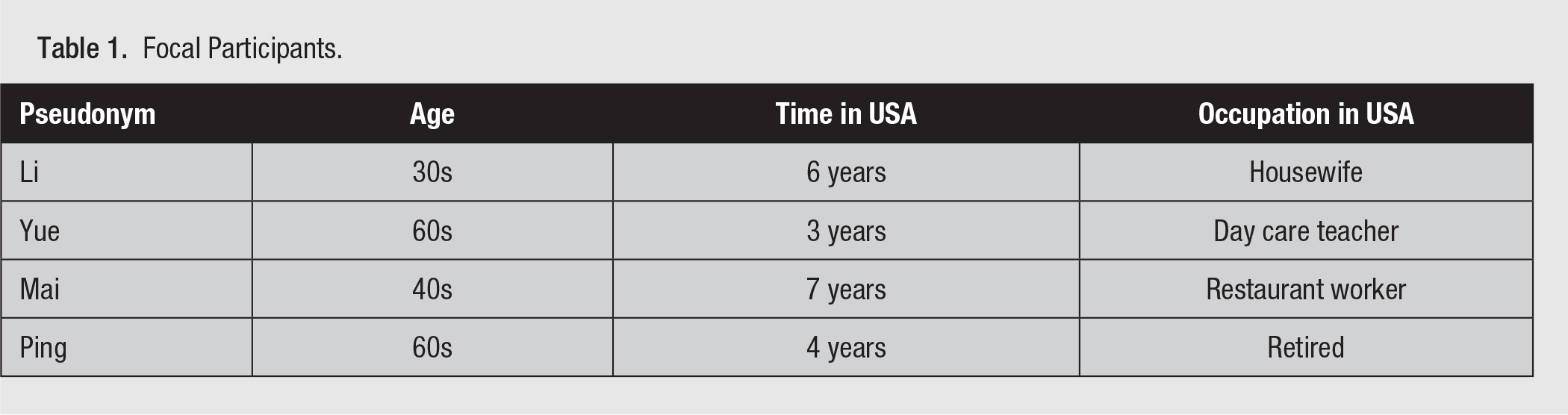
There were 12 learners in class, all of them were of Chinese origin, (3 males, 9 females). The class met during 14 weeks on Saturdays for 90 minutes. The learners’ education ranged from third-grade level to a medical doctor. The average number of learners attending a lesson each week was nine students; rarely all 12 students came to class. Therefore, attendance was the main criterion used to select the focal study participants. Qualitative research calls for gaining understanding of the participants’ perspectives and lives in depth and it is a common practice to have a small number of participants who are key informants of the phenomenon under study (Merriam, 2009; Patton, 2002). The article focuses on the stories of the learners who attended class at least 80% of the time: Li, Yue, Mai, and Ping (see Table 1). They actively participated in class and were eager to share their stories and inquiries with the teacher. Looking at these four participants provided us with a variety of examples to illustrate the different aspects of the case study.
Focal Participants.
Data Collection
A research journal recording main happenings of the class, critical events, and classroom activities constitutes the main source of data collection. Critical events (Mertova, 2013) were unique, illustrative, and confirmatory events related to the learners’ immigration experiences and adaptation to the new language-culture. After each class, as a research team, we identified data that spoke to the principles of Confucian learning and how to approach the lesson plan for the next lesson. We reflected on appropriate content to teach, the questions we should pursue further, and the meaning of student behaviors. Building on the work of Bogden and Biklen (2007), the class happenings were recorded and classified as descriptive and reflective field notes.
Descriptive field notes
Reconstruction of dialogue captured participants’ key quotes and statements. Description of the learners provided details of their attire, appearance, and delivery of information through their participation. Accounts of critical events related to the learners’ immigration experiences and language-culture learning journeys. Depiction of class activities illustrated students’ individual and collective participation. A set of questions were explored verbally and in writing throughout the different lessons to obtain significant information, including demographics (e.g., age, occupation, family, time living in the United States), the students’ immigration stories, their views of the role of the teacher and their role as learners, and their motivations to learn English. Sample questions asked during the lessons include: What is your immigration story? Please describe a significant event connected to your present life adapting to your community in the United States. What motivates you to attend ESL classes? How long have you been studying English? How and when do you use English outside the classroom? Please describe the role of the ESL teacher. What do you expect from your teacher? What do you think are your obligations as a learner? These questions are connected to the study framework as they inquire about life transitions and how the learners envisioned the role of the instructor and their relationship with him.
Reflective field notes
These are key takeaways gained from each encounter throughout the research experience. We reflected on the application of Confucian learning principles and transition theory throughout the semester. As teachers and researchers, we realized that keeping anecdotal records and informal conversations were more productive and useful strategies for the implementation of this study. The learners were not confident enough to conduct an interview in English, and we did not speak their native language or have access to an interpreter. Protecting their identities to keep them from harm or embarrassment was a concern. We aimed to gain knowledge to create instruction strategies that best fit this group of learners. They were homogeneously from Chinese descent and a relatively new group for us. Thus, it was critical to recognize and reflect on our shortcomings. We realized that our previous strategies and experiences teaching ESL may not necessarily translate well for this group. We monitored for findings to reveal organically and connected them to the study framework. Thus, we held long conversations and took notes on relevant information and continually reflected on the data being collected.
Data Analysis
We met frequently to discuss the data and followed Yin’s (2016) data analysis steps. Compiling the data involved transcribing, classifying, and getting data ready for analysis. Disassembling the data meant conducting different rounds of coding and used existent categories namely the 4S System and Confucian learning principles. We conducted open coding to chunk the data into small units and attached a descriptor to each of the units. For axial coding, we grouped the codes into categories. Next, selective coding, we identified themes to express the content of each of the groups of codes we had identified in the axial coding step. Reassembling the data entailed grouping and sequencing the pieces of data and identifying substantive information. We conducted detailed, repeated readings of the field notes to identify meaningful class examples and learners’ stories related to transition theory and Confucian learning principles.
Interpreting the data, we drew from the study framework to figure out how both theories interacted together while trying to make sense of the learners’ stories. Therefore, we followed a deductive analysis process and used existent categories namely the 4S System and Confucian learning principles to map out study findings (see Figure 2). Finally, drawing conclusions, involved repeatedly reading, thinking, discussing, and reflecting on the data to make decisions on what to present as study findings.
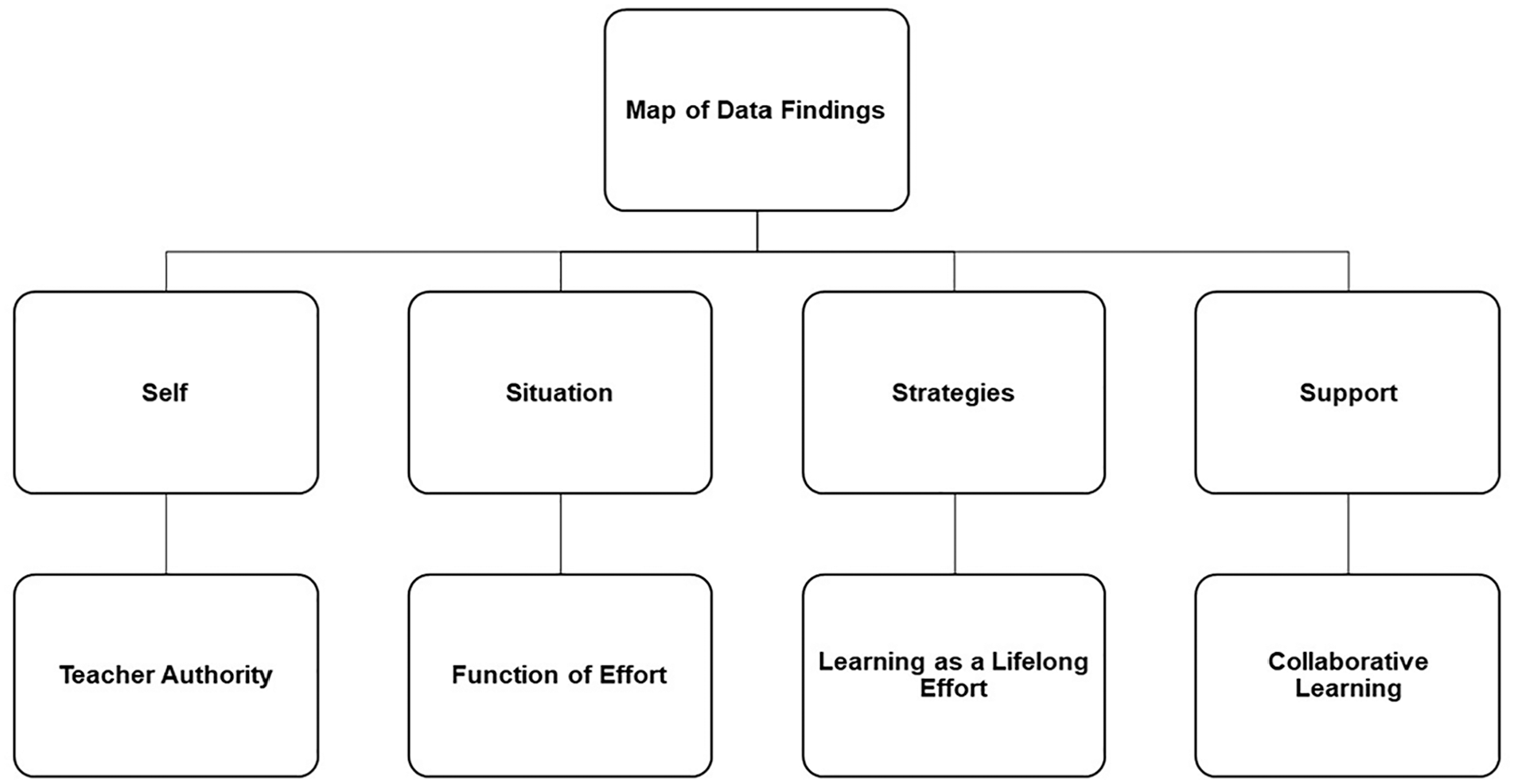
Data analysis map.
Findings
Findings are presented through Self, Situation, Strategies, and Support. Under each of these components, study findings related to Confucian learning principles are presented as they emerged from the data.
Self
The learners’ socioeconomic statuses varied, some worked in service jobs, others were retirees. They were motivated to integrate to the new environment in terms of language learning and community participation. They attended class for personal reasons, which also showed their sense of meaning and purpose. Mai and Yue stated: “I want to speak better English at the work.” Ping said: “I want to hold conversations with my grandchildren more effectively.” Li explained: “I’m optimistic to learn.” They were all eager to learn English and showed willingness to face challenges and ambiguities of the new society.
Concerning teacher authority, the students viewed the teacher as the holder of knowledge and placed him on a pedestal. During different interactions, they explained that “Culturally, the teacher holds power and respect” (Mai). Despite their age, and him being younger, they insisted that the instructor entered the classroom first and held the door open for him. In general, the students showed awareness of themselves and their belief that the teacher is an authority figure. The ESL instructor sometimes took advantage of this sentiment to enforce rules of classroom participation. A noisy classroom was accepted if the students were engaged in the topic at hand. It was fine to speak Mandarin as far as it helped understand a concept. For instance, talking about Halloween some students needed to speak in Mandarin to explain the meaning of words that did not have a literal translation because they did not have the concept of these words.
Sometimes students were shy to ask questions because it meant interrupting the teacher during the lesson. Li said: I am from China and I am married to a U.S. citizen. That has influenced my desire to learn English. Most of the students ask me for help to translate for them if they don’t know how to say it in English.
Li was younger than most of the people in class and was usually very outspoken. She had a better grasp of English than most yet remained very respectful of the teacher to the point of hesitating to ask questions in class. She explained that “I do not want to disappoint the teacher or ask questions that disrupt the order of the lesson.” Li and the other students wanted to be respectful of the teacher’s authority. They always addressed the instructor as “teacher” to show respect.
In one class session, reviewing plural forms of nouns Yue had a confused look on her face when the instructor said that the plural form for “person” can be either “people” or “persons.” However, she did not raise her hand to ask a question. He noticed Yue’s facial reaction but was also intrigued by her reluctance to communicate what was the matter. When asked, Yue explained: “last week you wrote on the board . . . ‘people’ is plural for person” and she pointed to her notebook. The instructor explained that both terms were acceptable, but “people” was preferred, to which Yue replied: “I understand, I didn’t mean to contradict.” In general, the students seemed reluctant to ask questions because it meant interrupting the teacher. As Mai and Ping said: “You are the master . . . You talk, we listen . . . You are wise.” “We are just learners; we will follow his advice. He knows more.”
Situation
The major triggers to attend the English class were their urge to communicate with their families or at work. Li said: “I want to communicate with my husband. He is a native speaker and I want to be fluent in English to have long conversations with him.” Ping explained: My grandchildren were born U.S . . . they speak English fluently, but we cannot communicate all the time. I want to be able to tell them stories, and to play with them . . . and not worry about language barrier.
All four students expressed their desire to participate in social activities in the community.
Regarding duration, their transition to the United States was long-term and permanent, which required learning English. They sought to integrate into their communities by learning to communicate effectively with neighbors and family members, who play a big part of this lasting change. Li explained: “My son was born here; English is his first language. When he grows, I need to speak with him in English well.”
There was some degree of stress related to role change during transition. Yue shared: “In China I was a medical doctor, in U.S., I work at a daycare because my English no good enough.” Ping explained: “I was a retired teacher; in retiring my life changed.” Concurrent stresses, for some included the imminent challenge to pass the citizenship test. Li, Ping, and Yue were studying for the U.S. citizenship test. Mai had already passed the citizenship test. In her case however, isolation was a source of stresses as her immediate family lived in China. One time, she requested: “Teacher, how can I make a letter to inviting my family to visit U.S.? I have difficulty writing that letter . . . my English is not so good.” During the class, the instructor demonstrated how to write the letter and fulfill the requirement for a U.S. tourist visa.
Looking at function of effort, the students believed in hard work and dedicated time to studying the language. Attending class 80% of the time or more speaks to their commitment to learn. Li and Ping explained, “If I study hard, I will pass citizenship test and all my goals will realize.” Yue said: “I learn something new every day I come to class. I must apply myself to become fluent speaker.”
Mai explained: I came to U.S. seven years ago. I work for a Chinese restaurant. I deliver food to the customers. One time, a customer placed a sign on his door telling to call when I arrived. I was unsure about this phone call. I didn’t know what to say.
During class, we created a short script that could help Mai the next time that she had to face a similar situation. It read:
Hello, may I please speak with Todd?
Speaking
Hello, Todd. This is Mai from Dragonfly restaurant. I’m here to deliver the food you ordered.
OK. Thanks. I’ll be at the front door in a minute.
Thank you! I’ll see you in a minute.
During class, one of the students pretended to be Todd, and Mai was able to execute the conversation rather well at the end of the lesson. Here, Mai and her classmates demonstrated effort and commitment to learning English for actual communication purposes.
Strategies
Strategies are ways in which individuals protect themselves from the consequences of transition. In this case, becoming fluent in English and the need to use the language in everyday situations are consequences of their transition. Attending the center, building a support network, and taking English lessons were strategies they adopted to navigate transition. The learners opted for hard work and dedication to learn English for instrumental purposes. This strategy is in Confucian learning principles explained as a lifelong learning effort. As an example, Yue and Mai agreed that “Taking one class is not enough . . . To improve in English we have to study hard.” Most students were motivated to integrate with their new host community. Some needed to practice English because they had failed the oral portion of the citizenship exam or were getting ready to take it. Others needed to learn English to communicate more effectively with family members and at their jobs. They wanted to improve their English skills to apply them for long-term goals. They were studious and attended at least 80% of the meetings.
Ping shared: “I am retired teacher from Hong Kong; I am learning English to communicate with my grandchildren who grew up here.” Ping was eager to participate in class when relevant topics (e.g., neighborhood and community) were discussed. He said: “I like my neighborhood. I enjoy walking in the community park. Discussing the neighborhood and what we like about it was a fun class. I tell about my community and the park I go.”
The four focal participants became members of the cultural center to improve their lifestyle in the new country. Their strategies included building friendships and leveraging toward a more cooperative approach to learning, studying hard, and asking for additional work outside the classroom.
Support
The English class became a support system as learners transitioned to the larger community. They felt responsible for each other’s successes in class. They had side conversations with each other during class to make clarifications in Mandarin without interrupting the lesson. They praised each other when someone gave a correct answer or was successful at a class activity. If a student made a mistake, they would help prove the answer and smile simultaneously to be friendly and respectful.
The cultural center was also an instrumental support and provided a space to experience their culture away from their native country while learning English. The instructor was a crucial support and resource by providing the opportunity to ask questions and clarify doubts. During a class meeting, Li had a confused look on her face when discussing the word penny, so the instructor asked if she needed clarification. At first, she hesitated and apologized that her question may not be relevant. Encouraged by the instructor, she explained: “sometimes I still have trouble using currencies especially when shopping. The clerk asked me for a dime. I gave her all the coins I had in my purse. Teacher, please explain currency . . . money?” Thus, the instructor gave a mini lesson on currency using actual U.S. coins and the monetary equivalent of penny, dime, nickel, and quarter.
Through collaborative learning, the language barrier between students and instructor seemed to be less obvious. The instructor identified stronger language learners in class and relied on them to translate for others. Yue benefited from this strategy. For her, collaborating with classmates and groupwork were crucial. One time, learning about adjectives, they were working in groups of four and received different magazine clippings, the task was to use as many adjectives as possible to describe what they saw in the pictures. This meant a group discussion speaking only in English. The class seemed to enjoy the activity, especially Yue who reported, “I am excited to collaborate and learn. I love groupwork and learn from classmates.”
Discussion
We were able to realize the individual learning needs of the students, how they envisioned the role of the teacher, and gain understanding about their willingness to work in collaboration (Goodman et al., 2006). The Self in terms of psychological resources (Anderson et al., 2012) manifested through the learners’ optimism, commitment, values, and resilience studying English and adapting to the new community. The learners showed inner strength (Schlossberg, 2011) coping with the different challenges that the new language, culture, and community presented to them. The ESL class became a space for reflection and important component of Confucianism. The Confucian perspective states that learning results from reflection; without the ability to be reflective, learning is not possible (Wang & King, 2006). Learning is not just the acquisition of knowledge but a continuous process, an incomplete task.
Situation was demonstrated by the learners’ urge to communicate with family members and people at work, their role changes in terms of occupation and profession, their desire to remain in the United States and become American citizens (Anderson et al., 2012). In line with study findings, Goodman et al. (2006) recommend instructors to listen to adults in transition to facilitate exploration and provide a framework for adults to better understand their situation and cope more creatively.
Regarding Strategy (Anderson et al., 2012), the learners were intentional attending the class to build friendships, learn in collaboration, and study hard. As stated by Lu et al. (2001, p. 489), Confucian work ethics include the creation of dedicated, motivated, responsible, and educated individuals and a sense of commitment, organizational identity, and loyalty to various institutions. The learners’ transition impacted their lives at the personal and professional levels. Their stories, learning English became a catalyst to adapt to the new community and participate in everyday life events fully.
The learners’ stories reflected the many support systems they found in the community cultural center, classmates, employers, families, and neighbors (Anderson et al., 2012). They had a specific purpose in mind when learning English, passing the citizenship test, communication at work and with neighbors, and telling stories to their grandchildren.
Confucian traditions play a positive role in Chinese society in encouraging people to learn throughout their lives (Zhang, 2008). Learning is the cultivation of the inner experience so that learners can deepen their knowledge about how to be human and how to transform their lives into meaningful existence. As Ping reminded us in class, “Together we learn always, more, and fast!.” Exploiting strong connections and accommodating collaborative relationships in the classroom enhance the learning process for the Confucian learner.
Recommendations for Practice
Teacher authority is the first principle illustrated in Confucianism. It is essential to be mindful of cultural traditions such as the ideas presented in this article where the learners viewed their teacher as an authority figure. It is equally important to acknowledge that the teacher-student power relationship is naturally unequal. Even when instructors attend to student learning needs, they make many decisions based on their expertise on language teaching, curriculum design, and lesson planning. The second Confucian learning principle relates to collaborative learning and the support obtained from classmates and group learning activities. In cultures where communal learning is important, learning in collaboration plays a central role. At the same time, it is important for these groups that the individual shares talents and serves others. For example, having learners with higher literacy skills support and serve as mentors for other learners in class was a strategy that we used in the lessons. Third, function of effort refers to dedication and hard work from the part of the learner. The teacher should design lessons and create opportunities for the learners to explore their curiosity and actively engage in learning. The fourth Confucian principle is pursuit of lifelong learning, in other words, learning goes beyond the classroom to include the different aspects of the lives of the learners. To this effect, the instructor should encourage learners to develop new skills and acquire knowledge regardless of their age or life goals. In summary, gaining knowledge about the students’ native cultural norms can help instructors to clarify misunderstandings so that students have appropriate expectations for successful intercultural communication. Instructors could identify projects and class activities to highlight students’ cultures. Listening to the students’ stories and their learning goals may prove helpful to create a sense of familiarity and comfort.
In the ESL classroom, immigrant learners experience different types of transition. Some are anticipated such as retirement and getting married; some are unanticipated transitions such as occupational changes (e.g., Yue went from being a medical doctor to becoming a daycare teacher). All of these resulted in life changes that the instructor should keep in mind when considering the goals of the lesson. Gaining knowledge about the different transitions that immigrant adults face while relocating and adapting to a new social environment benefit the instructor. The learners bring with them individual characteristics, psychological resources, different sources of stress and coping mechanisms. These conditions are unique to each cultural group but knowing that students count with personal resources and strategies to deal with difficulties can help the instructor when planning what support to offer. As stated before, support comes from family, friends, institutions, and the community; the instructor is only one of those sources of support.
Footnotes
Conflict of Interest
The author(s) declared no potential conflicts of interest with respect to the research, authorship, and/or publication of this article.
Funding
The author(s) received no financial support for the research, authorship, and/or publication of this article.

Author Biographies
Clarena Larrotta is a full professor of adult, professional, and community education at Texas State University, USA. Using engaged scholarship and Freirean/participatory approaches, her research interests focus on best teaching practices and action research related to adult literacy, family literacy, and language-culture teaching/learning.
Jan Adversario holds a PhD in Adult, Professional, and Community Education from Texas State University. He teaches English as a Second Language to adult learners at Austin Community College. His research interests include literacy, adult education, second language acquisition, multicultural learning, and experiential learning.