




Abstract
This exploratory qualitative case study investigates how graduate students in education experience, attribute, and combat academic boredom. Three areas of concern are addressed: (a) the contributing factors to boredom, (b) how attributional style (internal vs. external) relates to coping with boredom, and (c) the differences between combating class-related boredom and learning-related boredom. Results showed that the onset of boredom was mostly influenced by a lack of interest, lack of utility value, and autonomy frustration. This study extended the existing literature by discovering an interaction between students’ attributional style and their coping strategies for boredom during classroom instruction. Specifically, students who argued that the instructor should hold more responsibility for boredom in class tended to take avoidance coping as their primary strategy (e.g., doodling). By comparison, students who opted to approach the problem positively (e.g., taking notes) are prone to attribute internally. Attribution does not appear to have a mediating effect on the relationship between experience of boredom and coping strategies for learning-related boredom. Implications for graduate and adult education and findings in the context of recent theoretical frameworks are discussed.
Emotions are critical to cognitive development and optimal learning (Linnenbrink-Garcia & Pekrun, 2011). Although the study of academic motivation has long been a focus of educational psychology, only more recently has research on academic emotions been undertaken in earnest (e.g., Acee et al., 2010). Academic emotions refer to those that are directly linked to learning outcomes (Pekrun & Linnenbrink-Garcia, 2012). A review of boredom research in educational settings suggested boredom is some combination of an objective lack of neurological excitement and a subjective psychological state of dissatisfaction, frustration, or disinterest, all of which result from a lack of stimulation (Vogel-Walcutt et al., 2012). As a self-disruptive academic emotion, boredom often contributes adversely toward motivation, cognition, and overall performance (Pekrun & Linnenbrink-Garcia, 2012).
Although academic boredom is common among K-12 students (Macklem, 2015), many interrelated social and psychological processes involved throughout adolescence could have rendered it difficult to isolate and explore boredom within educational contexts (e.g., Pekrun & Stevens, 2010). Thus, the majority of studies on academic boredom have focused on the effects of boredom on undergraduate students’ learning outcomes (Tze et al., 2016). Moreover, most of the studies were grounded in control-value theory (e.g., Hutton et al., 2019; Pekrun, 2006). The theory assumes that (a) boredom is induced when academic activities are perceived by the student as lacking subjective value, and (b) intense boredom takes place under conditions of very high or low control over one’s achievement (Pekrun, 2006). Following Pekrun’s endeavor, researchers have also started to (a) investigate boredom through qualitative and mixed-methods inquiries, (b) focus on the coping strategies for boredom, and (c) address boredom among graduate students (e.g., Finkielsztein, 2020; Sharp et al., 2017). To date, there has been only one study on academic boredom among graduate students, and the research was conducted in Poland through qualitative inquiry (Finkielsztein, 2020). The participants were 365 full-time students at the University of Warsaw, and the bulk of the respondents (68%) were students with at least a bachelor’s degree. Through frequency and content analysis, the researcher found that educational burnout was the leading contributor to boredom.
Graduate Student as Adult Learner
A graduate student is someone who has earned a bachelor’s degree and is pursuing additional education in a specific field. The two main graduate degrees are the master’s degree and the doctoral degree (Education USA, n.d.). Graduate programs are attended by nontraditional students seeking to enhance their professional skills. There has recently been a large increase in the number of nontraditional graduate students. Between 1987 and 2007, the number of graduate students aged ≥40 years increased 87% . However, nontraditional graduate students have been under-researched by adult education researchers (Hegarty, 2011).
Learner Experience of Academic Boredom and Their Coping Strategies
Learner experience of academic boredom is classified into class-related boredom and learning-related boredom (Tze et al., 2016). Class-related boredom is better understood than students’ academic boredom associated with studying (Goetz et al., 2012). While class-related and learning-related boredom highly correlate (r = .73), learning-related boredom negatively correlates with learning outcomes more than class-related boredom (Pekrun et al., 2011). Therefore, not surprisingly, learning-related boredom is receiving more and more attention in the academic boredom literature.
Students not only experience boredom but also use diverse coping strategies to combat this negative emotion. Eren and Coskun (2016) discovered that coping strategies can work as interventions and play a mediating role between the experience of boredom and academic outcomes. Examples of coping strategies include daydreaming, texting, doodling, and turning to social media (e.g., Sharp et al., 2017). To better understand boredom coping strategies among K-12 students, Nett et al. (2010) developed a boredom coping scale (BCS) based on strategies for coping with stress (Holahan et al., 1996). Although coping strategies vary by age, the dimensions in each theoretical model are constant, such as approach versus avoidance or problem-focused versus emotion-focused (Lazarus & Folkman, 1984). For example, high school students were more likely to engage in avoidance coping than college students (Zeidner, 1996).
Current Study
Although the experience of boredom among students is universal, little attention has been paid to understanding boredom among graduate students. This may be due in part to the myth that graduate students are not affected by poor instruction and that, as responsible and self-accountable adults, they do not fall prey to distractions. Yet, boredom may present a critical challenge to graduate students. Graduate students worldwide report 6 times higher depression rates than the general public (Evans et al., 2018), and boredom, listed frequently as an indicator of depression, can also trigger it (e.g., Newell et al., 2012; Weir, 2013). Thus, the first objective of the current exploratory study was to identify what contributes to academic boredom among graduate students.
When compared with anger and anxiety, boredom is strongly and inversely correlated with intrinsic motivation (Pekrun et al., 2002), and student motivation is a critical concept in understanding boredom in educational settings (Eren & Coskun, 2016). Although many students may be equally motivated to perform a task, the sources of their motivation may differ. Motivation can be either extrinsic or intrinsic (Deci & Ryan, 1985). Prior literature suggested multiple factors that motivate an individual to pursue a graduate degree in education. While some find the intellectual challenge of getting a graduate education degree rewarding, others are driven by external rewards of a degree completion in the form of professional gain (e.g., Hinkle et al., 2014). Given the high extrinsic motivational feature, it is likely that graduate students in education would be better candidates for boredom experiences due to that the very lack of intrinsic value of achievement activities is critical for the instigation of boredom (Pekrun et al., 2010).
Coping is integral to adaptation and survival when faced with adversity. People select a way of coping in accordance with their cognitive appraisal of the threatening situation with which they are faced (Lazarus & Folkman, 1984). The way people explain the occurrence of an event predicts the type of coping strategy they choose to cope with it. In other words, causal attribution may be a key explanatory mechanism in understanding differences in coping strategies (e.g., Peterson & Seligman, 1987). To date, minimal research has been conducted on the effects of attribution on coping with academic boredom or the processes that might underlie these effects. Therefore, this study’s second objective was to explore the connection between students’ attributional style and their coping strategies.
Theoretical Rationales
Attribution theory
Attributions mediate adaptive and maladaptive behavior patterns of an individual confronted with negative life events (Hong et al., 1999). Attribution theory proposes a process in which the student’s causal attribution of outcomes triggers the emotions and expectations, and influences students’ future efforts when engaging in similar tasks (Weiner, 1986). The notion of the internal attribution versus external attribution has been particularly influential in educational research (Heider, 1958). Internal attribution is assigning the cause of behavior or mental state to internal characteristics, such as attributing one’s boredom to the lack of personal interest, whereas external attribution is assigning the cause of behavior or mental state to external characteristics, for example, arguing that the instructor is responsible for student’s boredom in the classroom.
Approach-avoidance coping model
While this study is a qualitative inquiry, Nett et al.’s (2010) coping model was used to (a) better capture the possible interactions between students’ attributional style and their coping strategies, (b) divide interactions into logical layers that are easy to understand, and (c) give a common language and reference point for both professionals and practitioners. This coping model is two-dimensional: one distinguishes between approach and avoidance, and the other identifies the focus of the coping strategy as either cognitive or behavioral (see Table 1).
Classification Examples of Students’ Strategies of Coping With Boredom.

To facilitate the understanding of the intersections between people’s attribution and coping, the authors classified the coping strategies only by one dimension (approach vs. avoidance).
Research Questions
The U.S. educational system, including higher education, is based on the pedagogical model (Knowles et al., 2005). The pedagogical model assigns full responsibility for making all teaching and learning decisions to the instructor. However, as students mature, their need and capacity to take ownership of their learning, and the need to communicate and reflect on their learning experiences increase (e.g., A. Y. Kolb & Kolb, 2005; Mezirow, 2000; Rothes et al., 2017). When these needs are not met, frustration and boredom may ensue. Graduate degree is meant to be the pinnacle of one’s educational career, but the path to earning one is not always smooth. Little is known about boredom among the students at the final educational level. Moreover, little is known about the differences between combating boredom during classroom instruction and when completing out-of-class assignments.
To address the identified knowledge gap in the academic boredom literature, the following three questions guided this study:
Method
Research Design
Considering the complexity of academic boredom as an individual’s affective experience and the lack of predetermined outcome (Yin, 2014), we conducted an exploratory case study. Multiple case studies (Yin, 2014) were used because this permits an in-depth examination of each case as well as pinpointing the contingency factors that distinguish them. Furthermore, this methodology was considered particularly appropriate to answer our research questions that are qualitative in nature (Eisenhardt, 1989). Ten graduate students were recruited through age-based purposive sampling (see Table 2). All participants were pursuing education-related graduate programs such as curriculum and instruction, educational psychology, school counseling, and educational technology.
Participant Information.
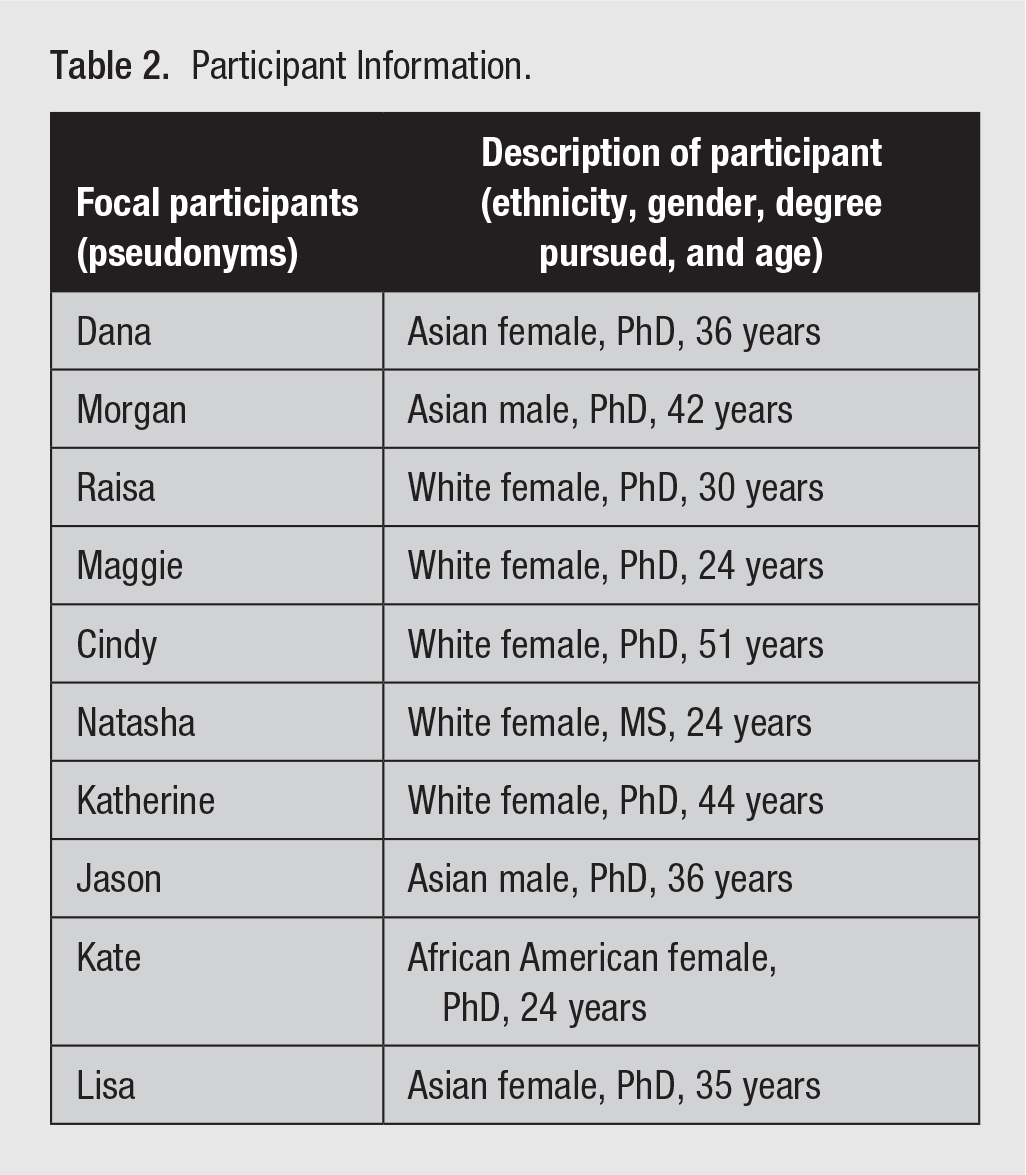
Although academic boredom is a universal emotion across all ages, younger graduate students may experience it differently than older ones (e.g., Larson & Richards, 1991). Given the wide age distribution of graduate students, it is critical to take age into account when examining academic boredom.
Data Collection
First, all participants received a recruitment email. Through email, participants were informed of the purpose of the study, that their participation was voluntary, and that they could opt out at any time without any penalty or loss of benefits. Written consent was obtained from all who agreed to be interviewed. All participants were assigned pseudonyms to protect their identity.
Data were collected from multiple sources over a 1-year period: (a) one open-ended, in-depth interview with each student (each about 60 min); (b) two focus group interviews with the students (each about 60 min); and (c) one story-telling session with each student (each about 30 min).
The interview protocol consisted of two sets of open-ended questions. The first set of questions focused on students’ boredom experiences (e.g., “Have you ever felt bored as a graduate student and why?” “What do you think are the main ingredients of a boring lecture?”). The second set of questions asked students about their causal attribution of boredom (e.g., “As for academic boredom, who should take more responsibility for boredom, instructor or student?”). Following these interviews, to identify the interaction between attribution and coping, participants were divided into two focus groups based on their attribution styles (internal vs. external). Focus group leader asked participants, as a group, to reflect on their coping strategies for boredom during instruction (e.g., “What do you do when you feel bored in class?”). Story-telling was conducted to detect the differences between coping during instruction and out of classroom while doing research assignments. The participants were required to write about a day that they felt extremely bored while doing a research assignment and describe how they coped (“What motivates you to keep going when you feel bored while working on your research assignment?”).
Data Analysis
As the study focus was on how students experience, attribute, and cope with boredom, we began by identifying themes that addressed these broad issues. The analysis was approached with a constant comparative approach, by iterating among data, previous research, and the authors’ own emergent theoretical ideas (e.g., Strauss & Corbin, 1998).
As we began to see the evidence of multiple contributors to academic boredom and the interaction between attribution and coping among most participants, coding was developed to capture the contributors, interaction, and coping strategies systematically. Figures 1 to 3 illustrate the overall data structure that moved from the basic first-order codes to aggregated theoretical dimensions of the data. Figure 2 also presents the connection between students’ causal attribution and their coping style. This type of data structure model was first recommended by Corley and Gioia (2004) and has become a popular and rigorous method for elucidating the details of qualitative data analysis (e.g., Humberd et al., 2015).
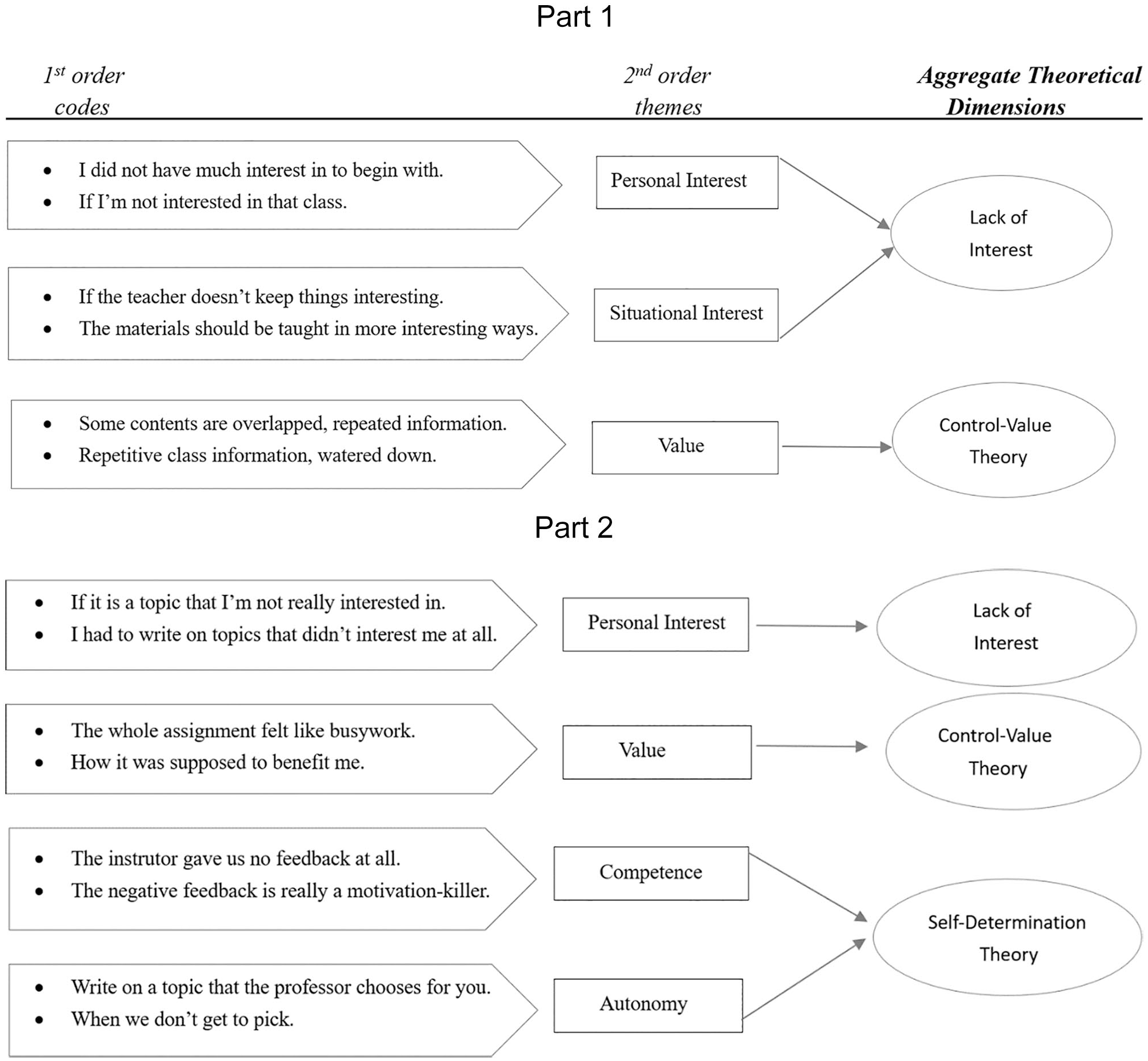
Part 1: Overview of data structure for Research Question 1: Contributors of boredom during instruction; Part 2: Overview of data structure for Research Question 1: Contributors of boredom while doing research assignment.
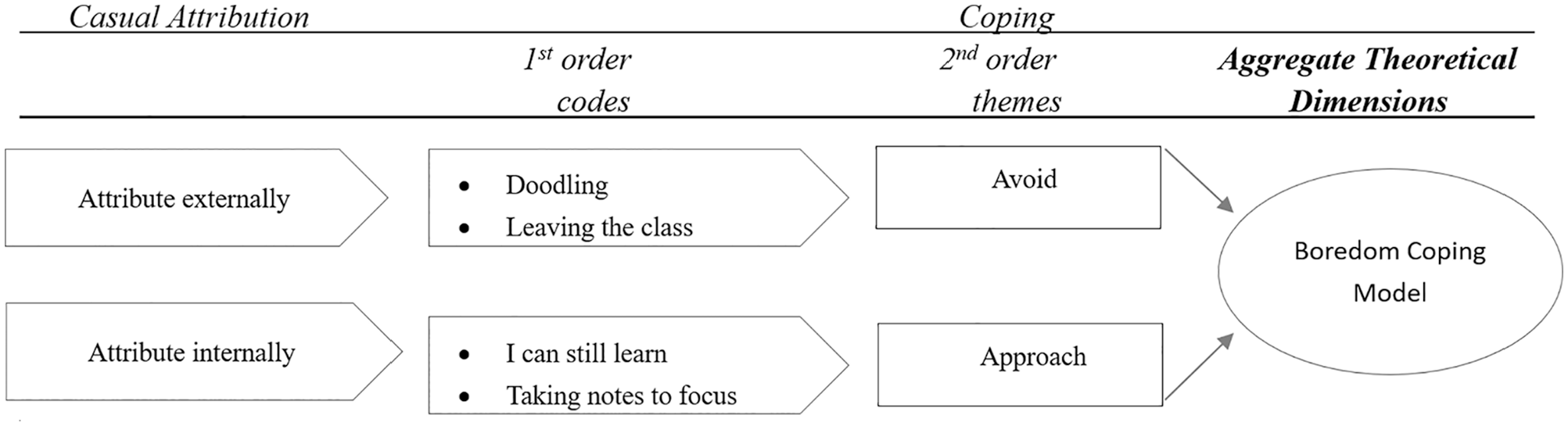
Overview of data structure for Research Question 2: the interaction between attribution style and coping strategies in combating boredom during instruction.

Overview of data structure for Research Question 3: Coping strategies in combating boredom while doing research assignment.
The first step of analysis focused on interpreting the data at a basic level by making provisional categories and first-order coding. In this stage, we sought to uncover the basic story of the data by capturing the perspectives of the participants and then moved to a higher level of understanding of the data. For example, the basic story of the data is that the participants felt bored when receiving negative feedback or not being allowed to pick their research project topic. The higher level of understanding is identifying the presence of the two elements (competence and autonomy) of self-determination theory (Deci & Ryan, 1985) in students’ stories. The second order of themes is presented in the middle column of Figures 1 to 3. The final stages of analysis focused on interpreting the connections among these emerging themes, by gathering the second-order themes into the aggregated theoretical dimensions, illustrated in the far-right columns of all the figures.
Results
In studying the experience, attribution, and coping of boredom among graduate students in education, we found that all participants regardless of the age had experienced boredom in class and out of class while doing research assignment. The onset of boredom can be influenced both by environmental factors and by personal factors. In addition, students’ causal attribution influences how they cope (approach or avoid) with boredom during instruction but not out of classroom while doing research assignments. Furthermore, the data revealed that almost all participants approach learning-related boredom through motivational regulation (e.g., goal-orientation and interest enhancement) regardless of their attribution style and age.
Multiple Contributors to Boredom
Boredom and lack of interest/active engagement
Our data analysis revealed that half of the participants specified “interest” as a contributing factor to boredom, for example, “I had to complete small research assignment on topics that didn’t interest me at all.” Besides personal interest, more participants mentioned situational interest. Natasha explained, “I believe that when I am bored in class, it is because the material being taught could be taught in more inviting and interesting ways,” and “A teacher with a monotone voice who simply stands at the front of the classroom and reads the never-ending onslaught of text-heavy PowerPoint slides.” Lack of interest (either personal or situational) appears to be the most common contributor to both class-related and studying-related boredom. However, in light of experiential learning (D. A. Kolb, 2014), lack of opportunities for adult learners to engage intellectually and emotionally might be the underlying reason, considering (a) significant positive relationship exists between hands-on activities and student interest (e.g., Holstermann et al., 2010), (b) adults learn best through active participation, and (c) situational interest can develop into personal interest, which leads to students’ reengagement overtime (Harackiewicz et al., 2008).
Boredom and lack of utility value/instrumental learning
Students are bored when they perceive academic activities as lacking in meaning and subjective value (Pekrun, 2006). Relatedly, in line with the “instrumental” part of transformative learning (Mezirow, 2000), more than half of the participants mentioned “failure to achieve a specific short-term objective” as one of the contributors. As Kate explained, “Sometimes the class is watered down, and I feel like I don’t learn anything.” Similarly, Natasha and Raisa noted, “I did not understand the need for this assignment or saw how it was supposed to benefit me,” and “The whole research assignment (e.g., summary of book chapters and annotated bibliography) felt like busywork, it did not add to my knowledge.”
Boredom and lack of autonomy/self-directed learning
Autonomy is an innate psychological need (Ryan & Deci, 2000), and it promotes the pursuit of challenging experiences in our academic life (e.g., the journey of degree attainment). Students usually feel genuinely intrigued when they get to pick an assignment because people generally like to feel in control of their own life and want to self-direct (Merriam, 2001). As Maggie and Kate explained, “I feel bored if I don’t get to pick what I really want to do,” and “Writing some research assignments usually have a prompt, sometimes you are forced to write a topic that the professor chooses for you.”
Attribution and Coping During Classroom Instruction
Six participants argued that the instructor should hold more responsibility, proposing that “The teacher is in charge of their classroom, and they should ensure that students have a good experience while they are there,” “The instructor should create lessons that will maintain our focus and help us to learn,” and “Teachers are expected to motivate students and make their class enjoyable.” Among them, five adopted avoidance coping as their primary strategy to combat boredom in class, such as doodling, working on an assignment that interest them, thinking about leaving the classroom, or even leaving the class. As Jason said, “If I find myself getting bored in a class, I’ll just leave the class.” By comparison, participants who opted to approach the problem positively such as taking notes and drinking coffee to focus are prone to attribute the onset of boredom internally. They held that “Students have to do their part to keep themselves interested and involved, as sometimes the teacher can only do so much,” “No matter how energetic and enthusiastic the instructor is, the student will not learn if he or she does not attend to the class,” and “Students can have control for their own boredom by staying positive, having an open mind, and being willing to participate in class.”
Combating Boredom Out of Class While Doing Assignment
Unlike coping with boredom in class, nine out of 10 participants (regardless of their attributional style) approach combating academic boredom out of class positively via motivational regulation (or regulation of motivation). Strategies for motivational regulation can be classified into the following forms (Wolters, 2003):
Self-consequating (e.g., “I reward myself after completing some difficult tasks,” or “The fact that it is for a grade and I will fail if I don’t complete the assignment”);
Goal-orientation (e.g., “I can always learn something out of it,” or “I‘m motivated by my degree that I will receive at the end of my schooling, which comes with a new name PhD”);
Interest enhancement (e.g., “I try to find an angle that does interest me,” or “I suck on peppermint to concentrate”).
In addition, one participant (Maggie) copes by seeking out support from others (“Whether it be teachers or colleagues who help me get through difficult research assignments, or friends and family who give me emotional support and remind me of my goal of finishing the assignment/research”).
Discussion
Research Question 1: What Factors Lead to Academic Boredom Among Graduate Students of Education?
This study conforms to previous findings; adults attend academic courses mainly because they find them interesting and important (Rothes et al., 2017). Interest is a powerful motivator that energizes learning and engagement. Adult learners are relevancy-oriented, in that they must see a reason for learning something. One of the assumptions of the andragogical model is the need to know. Adults need to know why they need to learn something before undertaking to learn it. They are motivated to invest considerable energy into learning if they know the benefits of learning and the negative consequences of not learning it (e.g., Lieb & Goodlad, 2005; Ouellette-Schramm, 2019).
The current exploratory case study highlighted important contributors of studying-related boredom. Although the theoretical influence of perceived autonomy supports has been discussed in Pekrun et al.’s (2010) control-value theory, most research on academic boredom focuses on proximal antecedents (i.e., perceived control and value) and not on the influence of distal situations (i.e., perceived autonomy) on students’ experiences with boredom (Tze et al., 2014). The building of personal autonomy, not simply learning helpful information, is the most important dimension of self-directed learning. Adults feel the need to take responsibility for their own decisions. Choice, personal endorsement, and positive academic ability beliefs can help adult learners optimize their learning experience by helping them to appreciate the worth of their nontraditional learning journey (e.g., Rothes et al., 2017).
Research Question 2: How Does Students’ Attribution Relate to Their Coping Strategies?
This study extended the academic boredom literature by discovering the interactions between students’ causal attribution of boredom and their coping style. We learned that attribution has a mediating effect on the relationship between the experience of boredom and coping strategy. This finding confirms Macklem’s (2015) study results, which demonstrated that attributional thinking affects student motivation to work toward their goals. Specifically, a positive attributional style is associated with greater use of adaptive/approaching coping styles and lesser use of maladaptive/avoidance coping styles to deal with problems (Goli et al., 2014; Welbourne et al., 2007).
One way to overcome severe deficits in motivation resulting from maladaptive attributions is Attributional Retraining (AR). AR is an engagement-enhancing treatment designed to offset the dysfunctional explanatory thinking that can stem from unpleasant learning experiences (Haynes et al., 2009). AR is a promising intervention for boredom as it may help students feel more in control; lack of control is an antecedent of boredom (Pekrun et al., 2010).
To date, AR has been primarily used to address academic boredom among K-12 students (e.g., Robertson, 2000). It may not work as well on adults, as maturity may lead to rigidity. As they accumulate life experiences, adult learners tend to develop mental habits, biases, and presuppositions that may cause them to close their minds to new perspectives and alternative ways of thinking (e.g., Taylor & Marienau, 2016). Our study results warrant further research on AR interventions, focusing on adult learners.
Research Question 3: Are There Any Differences Between Combating Class-Related Boredom and Studying-Related Boredom?
With regard to combating boredom while doing out-of-class research assignments, the data presented a different story. Nine participants reported approaching this issue via regulation of motivation. An important aspect of self-regulated learning, regulation of motivation involves purposefully initiating and maintaining one’s willingness to strive for a particular task or goal. Adult learners are goal-oriented. From an andragogical perspective, as one matures, his or her time perspective changes from one of postponed application of knowledge to immediacy of application; thus, the orientation toward learning changes from one of subject-centered to one of problem-centered (Kenner & Weinerman, 2011; Knowles et al., 2014). Graduate students may leave a class out of boredom, but they are more problem-motivated and self-directed than K-12 or traditional undergraduate students. If the task they are engaged in directly leads to achieving their personal learning goals, then they will be energized to engage in projects and complete them regardless of how they feel about these tasks.
One participant alleviated studying-related boredom by reaching out to their social support group. Academic emotion is a complex phenomenon, partially because its boundaries stretch beyond the education settings to the broader social context in which the learner is placed. More specifically, academic attitudes and behaviors are deeply influenced by social agents in the learner’s environment, whether these be teachers, parents, or friends.
Implications for graduate education
External factors such as teacher dislike do not seem to cause serious problems among graduate students. However, as most of the adult learning is self-directed, motivated by highly practical reasons and personal interest (e.g., Morris, 2019; Rigby & Ryan, 2018), lack of interest, lack of utility value, and autonomy frustration are the key contributing factors of academic boredom.
Emotions are functionally important to students’ motivation (Pekrun et al., 2002). Although our study was not intended to examine motivation, motivation emerged as a theme early in the data analysis. Motivation can be examined in terms of its quantity (being more or less motivated) and in terms of quality—there are different types of motivation (intrinsic vs. extrinsic), and some types are believed to result in better educational outcomes than others (Deci & Ryan, 2000). Given the high extrinsic motivational feature of some graduate students in education (e.g., lack of utility value, motivated by degree attainment), the divide between academia and professional relevance is at the core of graduate education for adult learners. Consequently, these justify pointing out some guidelines for practice:
The adult educator must recognize both the learner’s specific short-term objectives and long-term goals. Helping people achieve a long-term goal may involve both instrumental learning and communicative learning (Mezirow, 2000). For example, if a graduate student’s long-term goal is to become a certified behavioral analyst, then the program faculty should work together with the student to (a) break down the goal into more manageable short-term objectives such as completing independent fieldwork and passing licensing exams and (b) keep the long-term goal in sight when boredom occurs. Schooling is a future-oriented investment. In general, future goals provide direction in life and sustain achievement motivation in the face of setbacks and motivational obstacles (e.g., Phalet et al., 2004; Roumell, 2019).
Knowledge results from the interaction between theory and experience (D. A. Kolb, 2014). Adult educators should capitalize on the experience of adult learner and create a learning environment in which graduate students share professional experiences and learn to analyze them through academic lenses. For example, K-12 teachers often apply behaviorist principles to increase productive behavior by rewarding students with a special treat for good performance. However, extrinsic reinforcers (e.g., toys or money) are most likely to undermine intrinsic motivation when initial interest in an activity is high (e.g., Deci et al., 2001). Therefore, adult educators can encourage adult learners to replicate the finding by conducting an empirical study with their peers who have K-12 teaching experience. This is significant as it leads to a relevant and immediate context of application for them.
Adult educators need to make an intellectual case for the importance of learning and place more emphasis on the practical value of new knowledge learned in a graduate program in achieving students’ career goals (Morris, 2019; Rothes et al., 2017). Specifically, the educators need to relate the subject matter to the needs and concerns of adult learners, and create conditions to experience learning in the “real” world. For example, whereas adult learners understand that statistical skills will be beneficial during their future professional practice, they often fail to see how statistics are useful for them in the present (Kirk, 2002). This is partially because adult learners are seldom engaged in real-life projects that require quantitative data analysis. A solution to this challenge lies in the use of self-data (authentic data collected by students from a real-world sample) in statistics instruction. Self-data is more meaningful and personally relevant to adult learners and will make them see data analysis as instruments of inquiry rather than as mere classroom exercises.
As informed by one case in this study, social support was also linked to positive coping with learning-related boredom. Adult educators are uniquely positioned to provide adult learners with social support because they have a shared experience and, therefore, can offer problem-focused assistance.
Equipped with this information, adult educators are in a better position to educate the graduate school population and empower them to perform at more personally rewarding and meaningful levels.
Implications for future research
Although able to collect and utilize data on enrollment and degrees awarded, graduate education community for the most part lack deep knowledge of adult learners’ perceived quality of learning experience. Coping is not the entire story of boredom in educational settings. Some findings concerning boredom are likely to be underestimated; consequently, this is a critical need to pursue this line of investigation in future. Future research can relate boredom to graduate students’ learning outcomes, psychological well-being, and their retention as boredom can lead to truancy and dropping out. For decades, attrition from doctoral programs has averaged between 40% and 70% (e.g., Gardner & Gopaul, 2012). Although research on doctoral student attrition is readily available, findings only confirm that the decision to exit one’s program is multidimensional and dynamic. More recently, however, researchers have learned that retention has less to do with what the student brings to the university and more to do with what happens to the student after they have been admitted, such as the program structure or culture (Bain et al., 2011). For example, students who are in an unsupportive instructional or discouraging research environments may be more likely to experience boredom and then depart from the program.
As an exploratory case study, this study provided extensive and in-depth description of how graduate students in education experience, attribute, and combat academic boredom. However, to build a strong foundation for generalization of findings and conclusions, quantitative research studies are recommended. Given that a plausible association was found between attribution styles and coping strategies in combating boredom, the next step is to increase the sample size so that a quantitative follow-up (i.e., a sequential exploratory mixed-methods study) may be conducted. As graduate students in education are most likely going to become teachers, or people who influence or train teachers, learning their viewpoints on boredom can help us understand how the issue is being addressed now and how to better address it in the future.
Limitations
Although age was taken into consideration in sampling, no age differences were found, likely due partly to the sample size. Furthermore, there was only one master’s student in the sample, making the conclusions of this study more applicable to doctoral students in education. All participants are at different stages of their academic journey; seven of them had become college or university faculty members by the time this manuscript was completed. Thus, future studies should examine whether academic boredom fluctuates over time (e.g., first year of graduate school and achieving doctoral candidacy) to demystify the underlying reasons of boredom from a different perspective.
No single variable captures boredom. Boredom proneness, a personality factor that makes an individual to appraise a situation as boring (e.g., Farmer & Sundberg, 1986), can moderate the state of boredom. O’Hanlon (1981) discovered that students who claim to get bored easily are more likely to regard lectures as boring than those who claim to not get bored. Relatedly, boredom is highly correlated with depression. Boredom and depression are alike, as both are related to decreased arousal (e.g., Macklem, 2015). Considering the high rates of depression among graduate students, boredom proneness should be a control variable for future studies.
Graduate programs vary greatly depending on the discipline. For example, graduate program length is discipline- and field-specific. Furthermore, domain differences in knowledge structures and in the organization of research affect the way graduate students experience learning and can influence their educational outcomes. Therefore, while boredom is evident among graduate students in education, it remains to be seen whether it affects graduate students in other domains.
Footnotes
Conflict of Interest
The author(s) declared no potential conflicts of interest with respect to the authorship, and/or publication of this article.
Funding
The author(s) received no financial support for the research, authorship, and/or publication of this article.

Author Biographies