



Abstract
Literature reviews map the research landscape in a topic area, identify gaps that new research can address, or frame a future research project. Literature reviews inform research and are integral to developing evidence-based policies. In adult education, systematic, critical, integrative, and historical reviews have been conducted. Scoping reviews, however, have yet to be widely adopted, although they can provide adult educators with a systematic process for reviewing a heterogeneous body of literature in adult education. This article explores why scoping reviews are a good fit for adult education and presents a systematic approach to conducting scoping reviews. The paper presents an expanded nine-step scoping review process that begins with the conception of an idea and ends with writing a manuscript for publication. The article discusses best practices, highlights challenges, and provides suggestions to help adult education researchers avoid common pitfalls when conducting scoping reviews.
“Setting clear search criteria can provide a framework for a clearly delineated review and transparency of the process for readers.”
Introduction
A literature review is an overview and synthesis of existing scholarship on a specific topic to inform research and is integral to developing evidence-based policies (Cronin et al., 2008). Literature reviews map the research landscape in a topic area, identify gaps that new research can address, or frame a future research project.
Literature reviews can be part of a research paper, appearing after the introduction and before the methodology section. These reviews are focused and limited to the topic and methodology that inform the research. They primarily serve to contextualize the research and highlight the gaps in the existing scholarship that the research paper will address. In addition, these literature reviews provide a justification for the research.
Literature reviews can also be stand-alone papers where the research is the literature review. These literature reviews generally synthesize a large body of scholarship and provide a comprehensive understanding of a topic (Mertens, 2014) that could develop new conceptual and theoretical frameworks and identify areas for future research. With an average of 8,666 articles published daily in 2018, these stand-alone literature reviews are gaining importance (To & Yu, 2020).
There are various kinds of literature reviews, including critical reviews, narrative reviews, systematic reviews, meta-analyses, and umbrella reviews. Grant & Booth (2009) analyzed fourteen different literature review types and noted that their list was not comprehensive. Different literature reviews serve different purposes and are better suited for some academic fields than others. For example, systematic reviews are appropriate in the health sciences, where understanding the efficacy of medical interventions is essential. The scoping review, on the other hand, can provide adult educators with a systematic process for reviewing a heterogeneous body of literature in adult education.
Types of Literature Reviews.
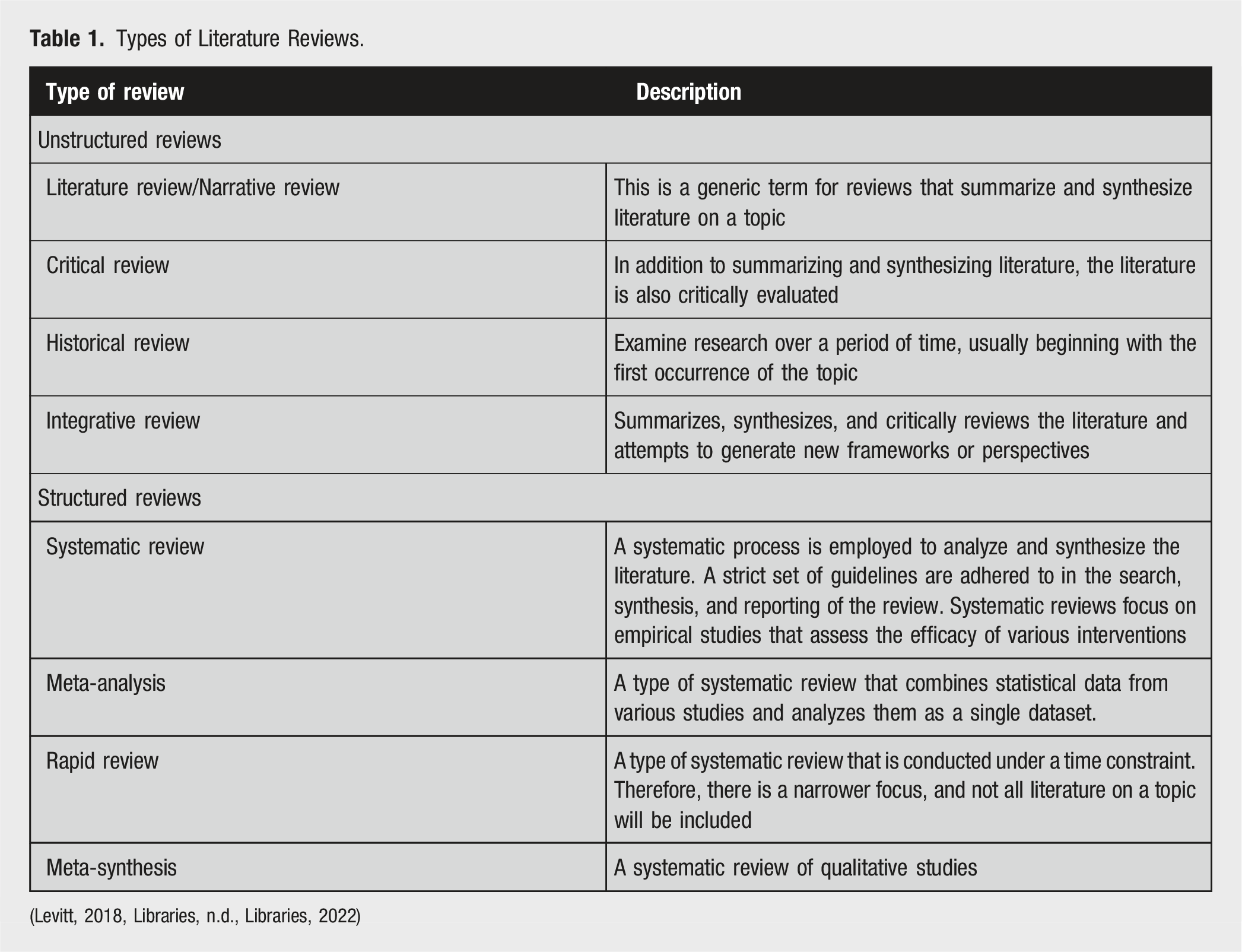
In adult education, systematic reviews, critical reviews, integrative reviews, and historical reviews have been conducted (Dyke, 2006; Gray & Crosta, 2019; Kim et al., 2016).
Scoping Reviews
Scoping reviews are structured reviews that adopt the systematic process of a systematic review. However, they differ in that they analyze a broader base of literature that includes both quantitative and qualitative studies. The scoping review has its roots in the social sciences, integrating qualitative and quantitative studies in literature reviews (Thomas et al., 2017). In addition, it is rooted in subjectivist epistemology that embraces a heterogeneity of data (Thomas et al., 2020), including qualitative or quantitative empirical studies, opinion pieces, commentaries, etc.
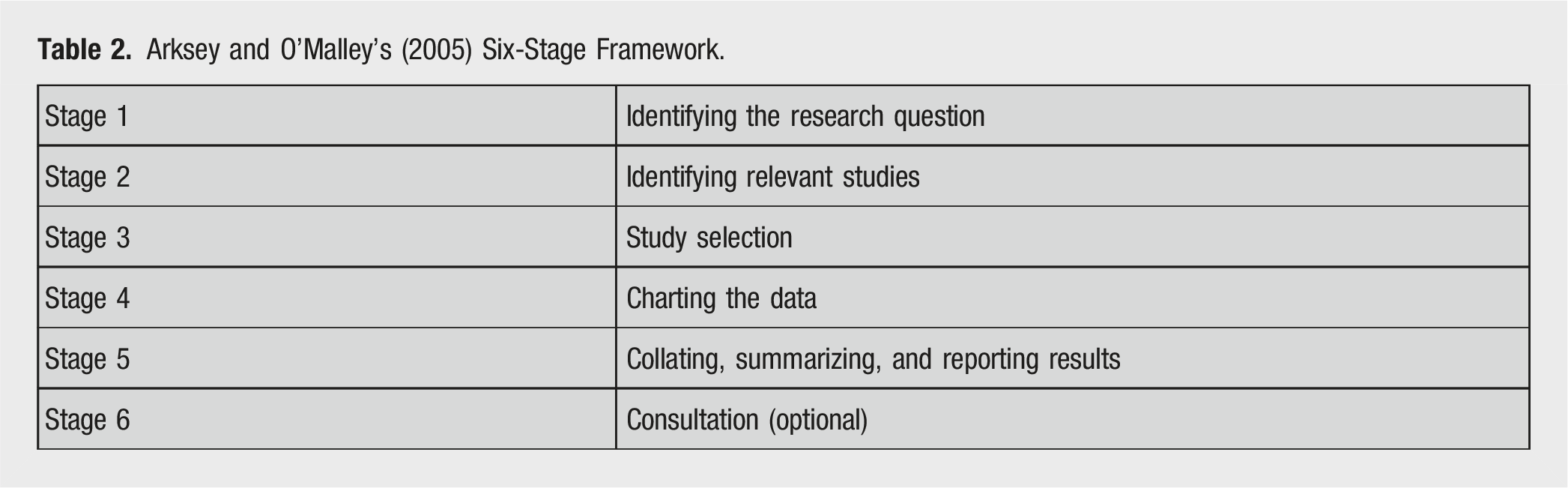
Arksey and O’Malley’s (2005) Six-Stage Framework.
While the scoping review is a relatively new type of literature review, it has quickly gained popularity. It is now the second most common form of literature review in medical education (Maggio et al., 2021). Scoping reviews have yet to be widely adopted by adult education researchers, only appearing in the adult education literature very recently in Bullen and Roberts’ 2021 and Kim et al., 2023 article. However, scoping reviews can be an effective methodology for adult education researchers as they fall at the intersection of structured and unstructured reviews. They utilize a structured process for reviewing different types of articles.
Interpretivist paradigms, prioritizing how individuals interpret the world rather than seeing an objective, value-free world, inform qualitative research that dominates adult education scholarship. Eighty-eight percent of the articles in three leading adult education journals utilized a qualitative research methodology (Boeren, 2018; Fejes & Nylander, 2015). Structured reviews like systematic reviews and meta-analyses might not be the best fit for adult education since they focus on quantitative studies, while adult education prioritizes qualitative research. Meta-syntheses use qualitative data but are generally limited to empirical studies (Levitt, 2018). The scoping review, on the other hand, can provide adult educators with a systematic process for reviewing a heterogeneous body of literature in adult education including quantitative and qualitative studies, policy papers, opinion pieces, and reviews.
Arksey and O’Malley’s (2005) six stage framework begins with identifying the research question and ends with optional expert consultations (see Table 2). For researchers who are new to conducting scoping reviews, this guidance can be insufficient. Basic questions of “Should I conduct a scoping review?” and “How do I report the findings of the scoping review?” are left unanswered. Challenging decisions of assembling a research team are not addressed by Arksey and O’Malley (2005) or Levac (2010). Westphaln et al., (2021), in their enhancement to the scoping review methodology, discuss team dynamics as a part of stage 1 to be addressed after the research question has been identified.
Nine-Step Approach to Conducting Scoping Reviews.

Drawing from personal experiences leading scoping reviews (Samuel et al., 2021), this paper discusses best practices for conducting scoping reviews, highlights challenges, and provides suggestions to help adult education researchers avoid common pitfalls. To exemplify the process, I draw from two scoping review publications: (1) a scoping review on continuous professional development for healthcare professionals (Samuel et al., 2021) and (2) a scoping review on transformative learning for tertiary non-Indigenous students (Bullen & Roberts, 2021). While these nine steps are framed in the context of scoping reviews, they can be used to guide any type of structured literature review. Elements of these steps can also be utilized to conduct unstructured literature reviews.
Step 1: Deciding to Do a Scoping Review
The first step in the literature review process is deciding whether to do a scoping review versus other types of literature reviews. There are four reasons to conduct a scoping review: (1) to look at the breadth and type of research, (2) to summarize existing research, (3) to identify gaps in the research literature, and (4) to consider if a systematic review can be undertaken on a topic (Arksey & O’Malley, 2005). A distinguishing feature of a scoping review is that, in addition to summarizing and synthesizing the literature, it helps identify gaps in the literature. Scoping reviews are also uniquely positioned to review the broad base of literature and assess if sufficient research exists to conduct a systematic review.
Scoping reviews are selected when researchers want to use a structured approach to conducting a review while simultaneously having the scope to include a variety of literature. Unstructured reviews might seem overwhelming in their open approach. A structured approach provides researchers with a clear roadmap on what to do. Helpful questions that can inform the decision to conduct a scoping review are: • What data do I want to include in my literature review? • Do I want to conduct a comprehensive overview of the literature? • Would a structured process be helpful?
Scoping reviews are open and exploratory and are undertaken to study the broad landscape of a topic focusing on breadth (Thomas et al., 2020). For example, a scoping review was the appropriate choice to explore the broad landscape of continuing professional development (CPD) in health professions through a systematized and replicable process (Author and others, 2021).
Step 2: Assembling the Team
Individual researchers can conduct scoping reviews. However, working in teams is highly recommended. While Arksey and O’Malley (2005) do not raise the issue of research teams, Levac et al., (2010) encourage assembling a research team. It is a good idea to build the research team after deciding to conduct a scoping review, and a topic has been identified. Assembling a research team at this stage is advisable because they can help define the research question and the scope of the review.
Assembling a research team is recommended for all structured reviews. A research team is valuable as a team approach strengthens the validity and reliability of the review process. A research team should, at a minimum, comprise two members consisting of a content area expert and a methodology expert. Larger teams help to spread out the workload of the literature review, but this must be done carefully.
It is advisable to work with familiar collaborators or peers since their working styles are already known. When working with a team, an initial group meeting to discuss the proposed scoping review and publication timeline is advisable. This meeting allows team members to assess their workloads and decide if they can commit to the project. The discussion should also address the author order on the resulting publication and workload expectations from each team member. Having these conversations at the beginning of the process ensures clear expectations.
The scoping review paper on CPD in the health professions (Samuel et al., 2021), consisted of four members, each with a specific area of expertise that would enhance the overall project. The team comprised a methodology expert, a healthcare professional, an expert on CPD, and an expert on adult education. Although the team members were familiar with each other, an initial meeting addressed the roles and expectations of each member and the author order for the resulting manuscript.
Step 3: Developing the Research Question
Developing a research question for the scoping review helps frame the review. It defines the inclusion and exclusion criteria for the review and parameters of the review, such as the population to explore and the types of primary sources, such as other syntheses, empirical studies, commentaries, newspaper articles, etc. (Arksey & O’Malley, 2005). Unstructured reviews begin with a loosely defined research purpose. Structured reviews, however, require a well-defined research question to provide structure to the review process.
Questions that begin with what and how lend themselves well to scoping reviews. For example, Bullen and Roberts (2021) used a broad what question: What is known about transformative learning for non-Indigenous students completing tertiary Indigenous Studies education? This question identifies specific parameters for the literature, such as: focused on transformative learning, in the context of tertiary Indigenous Studies education, with a study population of non-Indigenous students.
The review on CPD in the health professions (Samuel et al., 2021) was framed by the research question: What is the current landscape of literature reviews focused on the impact of CPD on health professionals’ performance defined as behavior change and/or patient outcomes? Certain inclusion-exclusion criteria were identified in the question itself. For example, the literature focused on CPD, the population was health professionals, and the articles had to address behavior change and/or patient outcomes.
Step 4: Identifying Relevant Articles
Arksey and O’Malley (2005) discuss conducting a search on various electronic databases, hand-searching reference lists, searching gray literature and organizational publications, and including conference abstracts and proceedings to ensure a comprehensive scoping review.
The success of a scoping review depends on identifying appropriate databases and developing a broad search strategy.
Databases should be selected based on where journals of the discipline are primarily indexed. For example, adult education journals are usually indexed in Scopus, PsychINFO, Web of Science, and ERIC. Therefore, these databases must be included when reviewing adult education literature. Governmental or official repositories might need to be included to capture policy documents.
Bullen and Roberts (2021), for their review on transformative learning in Indigenous studies, searched ProQuest, PsychINFO, and Web of Science databases to ensure a comprehensive search strategy. The review on CPD in the health professions (Samuel et al., 2021) focused on healthcare professions. Therefore, PubMed, Embase, CINAHL, Scopus, ERIC, and PsychINFO were selected, as these databases index health professions literature.
Database identification is then followed by identifying appropriate search terms, which requires identifying conceptual synonyms. For example, a scoping review on informal learning should also search for coaching, mentoring, and self-directed learning since all these activities could be defined as informal learning. It is highly advisable to have a trained librarian conduct the search to ensure that the search parameters are optimized for each database. Furthermore, the contents of some databases might overlap, and new resources might become available. Trained librarians will be able to refine searches and ensure that all relevant resources are included.
It is essential to use as many analogous terms as possible to retrieve a comprehensive body of literature during the search. So, for the review on CPD in the health professions, search keywords included “continuous professional education,” “continuing medical education,” “continuing education,” “lifelong learning,” “professional development.” When working in a team, at a minimum, this process can take three weeks, including deciding on the search terms, piloting the search, refining terms, and re-running the search.
A logistic decision that teams need to make concerns the software platform the team will use to analyze the data. Covidence, Distiller, Endnote, MS Excel, and Google Sheets are various software platforms that can be used. It is best to use the platform most team members are familiar with and have access to.
Arksey and O’Malley (2005) note that refining the search criteria can reduce the number of citations retrieved from the databases. However, this should be done cautiously since narrowing the scope of the search criteria could lead to potential articles being overlooked in the data mining exercise.
Step 5: Article Selection
After retrieving citations, the next step is to conduct a title and abstract review. At least two researchers should independently review every article. This ensures validity and reliability in the process. If discrepancies arise between the two researchers, a third researcher can act as the tiebreaker (Levac et al., 2010). A consensus must be reached if the team comprises only two members. Levac et al., (2010) also recommend team meetings at the start, middle, and end of the process.
In the four-member research team on the CPD in the health professions review, two team members independently reviewed an initial set of 30 titles and abstracts guided by the inclusion and exclusion criteria (Levac et al., 2010). The other team members joined in to discuss questionable records. This process must be clearly described in the manuscript in the interest of transparency. Unfortunately, Bullen and Roberts (2021) do not discuss this process in their manuscript, so it is unclear if they adhered to these best practices.
Step 6: Charting the Data
After identifying articles, the next stage involves extracting data from the articles. Levac et al., (2010) provide four clear guidelines. First, the research team should decide upon the variables to extract from the texts guided by the research question. Second, this is an iterative process. Therefore, other variables might appear during the extraction process, or some variables might prove ineffective. Third, at least two team members should independently extract data from a sample of five to ten articles and norm the data extraction process. Finally, a thematic content analysis is needed.
Initial Extraction Table.

Final Extraction table.

Step 7: Collating, Summarizing, and Reporting Results
Levac et al., (2010) lay out three distinct steps for summarizing and reporting results: (1) a descriptive numerical analysis and qualitative thematic analysis, (2) reporting the results in alignment with the research question, and (3) looking for overarching themes and discussing implications for future research.
There is little guidance on what type of qualitative thematic analysis to conduct. However, this also offers flexibility for researchers. Researchers can adopt any analytical approach, but it is best to be guided by the research question. There is scope here for conceptual and theoretical frameworks to be used to analyze the data.
For descriptive numerical analysis of the data, the CPD in the health professions scoping review (Samuel et al., 2021) included information such as publication dates of the articles, the population/s, etc. The focus was on what readers would like to know and the story the data was to convey. While it is important to provide numbers for these pieces of data, the findings should be reported through patterns that emerge from the literature. A listing of statistics becomes meaningless unless they are presented within a context. When looking at a broad landscape, it was interesting to report that most of the articles on CPD in the health professions originated from Europe. While English was the predominant language, empirical studies had been conducted in various languages, including German, Hebrew, and Afrikaans. The global interest in CPD was clearly seen through these numerical data points.
The thematic analysis process was iterative, where the data was analyzed and broad categories identified, which were then refined into meaningful themes. Through this process, it was possible to identify gaps in the literature.
Step 8: Consultation (Optional)
Levac et al. (2010) highly recommend including stakeholders in the review process and having them review the findings. This ensures that relevant literature is not overlooked and the findings are meaningful to the relevant stakeholders.
Adult education researchers embrace a participatory approach to research, and this step provides that opportunity. The scoping review by Bullen and Roberts (2021) focuses on Australian non-Indigenous student experiences. Therefore, Australian non-Indigenous students would be one stakeholder group to include in the process. The review on CPD in healthcare professions (Samuel et al., 2021) was reviewed by an expert in CPD and a healthcare expert to confirm the findings.
Step 9: Structuring the Scoping Review Manuscript
Scoping review manuscripts should be structured in adherence to the Preferred Reporting Items for Systematic reviews and Meta-Analyses extension for Scoping Reviews (PRISMA-ScR) (Tricco et al., 2018).
Title
The title of a scoping review needs to clearly identify the article as a scoping Review. For example, Bullen and Roberts (2021) titled their article, Transformative learning within Australian Indigenous studies: A scoping Review of Non-Indigenous student experiences in tertiary indigenous studies education.
Abstract
PRISMA-ScR recommends that the abstract be structured to include background, objectives, methodology, results, and conclusion. However, individual journal guidelines should also be considered. For example, the journal Academic Medicine requires that abstracts be structured as purpose, methods, results, and conclusion. Whereas the journal Higher Education Research and Development has an unstructured format for abstracts.
Introduction
The introduction provides contextual background, and identifies the problem and gap in the literature. The introduction should set up the gap in the literature the scoping review addresses. It must also explicitly state the research question.
Methods
The processes undertaken to identify relevant articles, select the articles, and chart the data should be articulated in detail in the methods section. This section should provide sufficient information for another researcher to replicate the scoping review. This section presents the PRISMA-ScR flow diagram to provide a visual overview of the data selection process. See Figure 1 for a sample flow chart. Sample PRISMA flowchart.
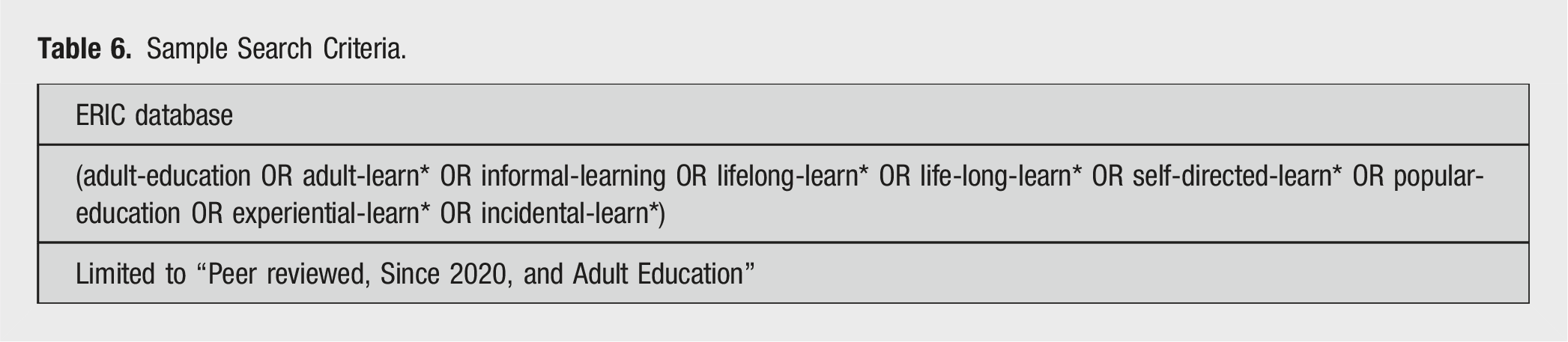
Sample Search Criteria.
Results
The results section should present a summary of the numerical data extracted when collating and synthesizing the findings. This is followed by presenting the qualitative themes. A comprehensive table that lists all the included articles and pertinent pieces of information should be included. The number of tables included in this section depends on the journal though many journals now allow for supplemental digital content. The review process can also guide the tables and figures that are included in the final manuscript.
Discussion
The manuscript should end with a summary of the scoping review, its limitations, and, where possible, some implications for practice.
Discussion and Conclusion
There are strengths and challenges to conducting scoping reviews that need to be considered. A scoping review is a systematic approach to exploratory literature reviews. Its uniqueness is that it provides the flexibility that an analysis of the heterogeneous body of adult education literature requires, as it can include qualitative and quantitative studies, commentaries, opinion papers, white papers, and other forms of gray literature. The incorporation of different types of publications into a literature review allows for the inclusion of more voices and enables the exploration of where most publications on a topic are occurring. The choice of publication formats can highlight trends and gaps in the literature.
Alongside the flexibility, scoping reviews are guided by a systematic process that is rigorous, transparent, and replicable. The clearly laid out process helps guide the research. There is clarity on what needs to be done and how things need to be reported, which can be particularly helpful for novice researchers who might be new to conducting literature reviews. The iterative process of the scoping review is forgiving of missteps along the way and allows researchers to revisit different parts of the review process and refine it as needed.
A primary challenge with conducting scoping reviews is the required time commitment. Especially when working in teams, scoping reviews can take up to a year to complete. The flexibility and iterative process of the scoping review also add to the time commitment. Such a long process runs the risk that the review might be out of date by the time it is submitted for publication. To avoid this, an updated search must be conducted closer to manuscript submission. Since scoping reviews look at the breadth of a topic, they can get unwieldy if they do not have clear parameters and a focused research question. Despite these challenges, scoping reviews can be a good fit for reviewing the literature in adult education.
The nine steps outlined in this article are versatile enough to be adapted to any literature review. For example, using a team-based approach can enhance the validity and reliability of the review. Setting clear search criteria can provide a framework for a clearly delineated review and transparency of the process for readers. While the structure of a manuscript is informed by the chosen journal, suggestions such as incorporating the type of review in the title or including a diagrammatic representation of data selection can enhance all literature reviews.
In this paper, I have discussed why scoping reviews are appropriate for adult education and provided steps for conducting scoping reviews. However, the nine steps discussed in this paper extend beyond scoping reviews to all types of literature reviews. Adapting these steps can benefit researchers in adult education. Researchers and students new to literature reviews might find these steps helpful in guiding the literature review process.
Future research can delve into a deeper analysis of the differences between the types of literature reviews. For example, conducting a scoping review versus an integrative review. The landscape of literature reviews is vast and constantly expanding. As adult education researchers undertake literature reviews, they should add methodologies such as scoping reviews to their repertoire.
Footnotes
Declaration of Conflicting Interests
The author declared no potential conflicts of interest with respect to the research, authorship, and/or publication of this article.
Funding
The author received no financial support for the research, authorship, and/or publication of this article.
