



Abstract
This study examines how Adult Education (AE) is framed in Tanzanian print media using a mixed-method approach. This study involved content analysis of four newspapers: Mwananchi, Habari Leo, The Citizen, and Daily News, along with 50 key informant interviews. Articles from 2016 to 2021 were analyzed using framing theory and an explanatory research design. The findings indicate a predominant focus on the positive aspects of AE initiatives in newspapers. However, this one-sided representation may hinder stakeholders from addressing AE challenges and limit public understanding of AE policies, complexities, challenges, and potential solutions. This study recommends that newspapers should engage in more comprehensive investigative coverage on AE, highlight challenges, and collaborate with AE experts to ensure accurate and balanced coverage.
“The newspapers emphasized how AE imparts skills and raised awareness of issues that affect individuals and communities.”
Introduction
The influence of media framing on public perceptions and policy attitudes is important for understanding how information is processed and interpreted (Davis, 2018). Framing not only shapes the presentation of but also influences who is held accountable. By encoding messages and considering factors such as placement, keywords, repetition, tone, symbols or images, catchphrases, and metaphors, framing plays a pivotal role in delivering stories to the audience (Scheufele & Tewksbury, 2007; Sosale & Moreno, 2016). In news articles, framing influences how the public understands the information. According to Davis (2018) and McCallum et al. (2022), frames that emphasize conflict, morality, and uncertainty attract more public attention than those that focus on economy and policy. Additionally, negative events are more engaging than positive ones (Davis, 2018; Sosale & Moreno, 2016).
It is important to note that formal education occurs within a structured learning environment such as schools, colleges, and universities and follows a structured curriculum, whereas informal education emphasizes practical skills and personal interests, often acquired through everyday experiences. This study focuses on Adult Education (AE) in Tanzania, which was chosen as the focus area because of its national importance. Since the Arusha Declaration in 1967, AE has emphasized acquiring literacy and skills for modernization (Fute et al., 2022). Consequently, the media has given considerable attention to Adult and Non-Formal Education. On the other hand, Adult and Non-Formal Education, is flexible and may include both formal and informal approaches (Ministry of Education Vocational and Training MoEVT, 2016). Over time, AE evolved into a significant strategy for addressing political, socioeconomic, and cultural problems. According to Mushi (2010), AE can be defined more broader to encompass any organized educational activity outside of the formal school system. These activities, whether short- or long-term, aim to enhance the knowledge and skills of individuals and communities, contributing to human capital development, increased productivity and improved health outcomes. AE is an essential tool for empowering the public and assisting marginalized groups in becoming critical citizens and achieving self-fulfillment (UNESCO, 2019). The current study aligns with ongoing efforts to rejuvenate Adult Education in Tanzania, including the implementation of a new education policy and the launch of the National Adult Literacy and Mass Education Rolling Strategy-NALMERS (MoEST, 2020).
Despite its importance, the coverage of AE in Tanzanian print media has declined in recent years, suggesting a lower status accorded to AE (Mushi, 2021; Mwaikokesya and & Mushi, 2017). This trend suggests a diminishing emphasis on AE issues, with coverage often prioritizing attention-grabbing statements and events, potentially overshadowing substantive discussions of the field. The aim of this study is to explore how AE is framed and presented in Tanzanian print media. Using framing theory, the study analyzes how language is used to emphasize the significance of AE issues and attract public attention (Davis, 2018). Framing theory explains how frames are constructed and how they influence public perception of information. Additionally, it describes the media’s selection process, which encompasses the inclusion and exclusion of content in media coverage. The findings of this study indicate an overall positive tone in AE coverage, with newspapers emphasizing the successes and achievements of AE initiatives. However, coverage often lacks depth and comprehensive analysis, resulting in an unbalanced representation of AE issues. While this study focuses on general frames rather than on individual media organizations, it provides valuable insights into journalists’ perspectives on AE and contributes to a better understanding of how AE is framed in Tanzanian print media.
Adult Education Context
The Tanzanian education system is structured, starting with two years of pre-primary, followed by seven years of primary education, 4 years of lower secondary education, 2 years of higher secondary education, 3 years of bachelor’s studies and 2 years or more years of post-graduate studies. Additionally, there are programs for Adult and Non-Formal Education-ANFE and Technical and Vocational Education Training - TVET (MoEST, 2020). The Education and Training Policy of 1995 provides a framework for adult and lifelong learning, with objectives that include providing education, promoting lifelong learning, improving living standards, and raising awareness of issues such as HIV/AIDS prevention (MoEST, 2020).
The policy encourages collaboration between the government and various education providers such as NGOs, businesses, associations, unions, and religious institutions (Mushi, 2010). The Institute of Adult Education (IAE), which was established in 1975, is a key organization, responsible for organizing and overseeing AE operations. It is responsible for training administrators and teachers, conducting mass education programs, and publishing research findings. The AE programs cater to individuals with diverse educational backgrounds, including adults, special education students, youth, workers, women, primary school dropouts and the elderly. AE activities are divided into three categories, education without formal qualifications, education leading to qualifications equivalent to the formal system and education for adults within the formal system (Mushi, 2010). The latter aims to address youth illiteracy and provide an alternative pathway to secondary education for dropouts or under-performing students (MoEST, 2020).
Print Media and Adult Education
In Tanzania, print media have historically played a significant role in disseminating information on AE, particularly during the 1970s and 1980s. During this period, print media promoted AE by providing knowledge on socioeconomic activities, such as political education, health, agriculture, skill development; and community issues (Mpogolo, 1984). The information published in the print media aimed to improve health, enhance agricultural productivity and revenue, and explain the nation’s policy of socialism and self-reliance (Lasway, 1989). Additionally, print media published practical articles tailored for readers such as “Do It Yourself” and “Improve Yourself Information” (Comings, 1995).
These articles served as catalysts for independent study, offering resources for reading, writing, and numeracy skills. Additionally, the offered insights into better farming techniques that aligned with advancements in agriculture. Civic education was also a prominent feature, enlightening readers about their rights, responsibilities and addressing current societal issues. As noted by Beriri (2018), factors such as life experience, goal orientation, self-directedness and motivation for learning significantly influence adult learners’ engagement and learning outcomes. Therefore, journalists’ coverage on AE, by contextualizing educational content within adult learners’ realities, resulted in these articles actively contribute to the development of problem-solving skills, encouraging readers to apply their knowledge to real-world challenges. Mayoka (1999) notes that newspapers employed various techniques, such as using large font sizes, simple language, pictures, and diagrams, to make the content easily understandable. This approach demonstrated the journalists’ commitment to creating news and feature articles that were reader-friendly, educational, and informative.
Tanzanian Media Reporting: Context and Perspective
The quality of journalism in Tanzania has been a concern in recent years, with much the print media focusing on calendar events such as press conferences, court reporting, government statements, and workshops (Spurk & Katunzi, 2018). Media stories in Tanzania often consist of reprinted press releases, shallow business reporting, and superficial coverage of important topics such as gold mining and the economy (Powell, 2017). A study conducted in 2017 found that 72% of news stories depend heavily on scheduled events, with 67% of sources coming from government agencies, indicating a dependence on a single source that can negatively impact news quality (Spurk & Katunzi, 2018). The one-sided reporting limits alternative viewpoints and hinders the public’s ability to make informed decisions on issues that affect them, including education. The media rarely conducts in-depth analyses or raises questions of accountability, resulting in a lack of comprehensive reporting on education-related concerns, including the AE field, despite government initiatives to support education.
Method
The study aimed to analyze the framing of AE in Tanzanian print media between 2016 and 2021. It was conducted in Dar es Salaam City, recognized as significant news production center, representing at least 20% of the country’s news coverage (Spurk & Katunzi, 2022). To gain a better understanding of how AE is framed in Tanzanian print media, a mixed-methods approach was employed, integrating both quantitative and qualitative content analysis methodologies. Quantitative analysis focused on quantifying texts, images, and other forms of communication to identify distinct elements and framing patterns, while qualitative analysis delved deeper into interview transcripts to explore respondents’ perspectives (Farrow et al., 2020).
Four newspapers were purposively selected for their extensive coverage of various topics, including economy, health, agriculture, and education as well as their popularity and professionalism (MCT, 2019; Spurk & Katunzi, 2017, 2018). The selected newspapers included Mwananchi, Habari Leo, The Citizen, and Daily News. It is important to note the distinction between Kiswahili newspapers, which primarily cater to the general public, while English newspapers are more likely to influence policymaking, especially among executives (GeoPoll, 2018). Ownership was also considered with Daily News and Habari Leo as government-owned dailies, while The Citizen and Mwananchi are privately owned daily newspapers.
Data collection involved content analysis and interviews with 50 key informants (Farrow et al., 2020; Kleinheksel et al., 2020). A total of 267 articles on AE were collected from 8760 newspapers. These articles comprised 161 news articles, 76 featured articles, 13 editorials, and 17 opinion articles that were published on issues related to AE. Each article was scanned and organized in a structured folder format, which included details such as the newspaper name, year, month, page number, position on the page, and size. Articles were filtered to differentiate between those related to general education from those specifically AE. The key informants represented various institutions including media practitioners, such as editors and journalists, key education officials such as District Adult Education Officer-DAEOs, AE administrators, owners of open schools, program officers, and public relations officers. The selection of informants was based on their expertise as media practitioners, knowledge of AE, their experience in implementing AE programs, and involvement in handling institutional to explore how AE news is framed, frequency of print media coverage on AE, themes explored in the coverage, and perspective of key actors regarding AE coverage. The interviews lasted between 45 minutes to 1 hour and were documented using a combination of note-taking and tape recording. Quantitative data were analyzed using descriptive statistics, while thematic analysis was employed to organize and interpret qualitative data. This approach provided a nuanced understanding of AE coverage in Tanzanian print media, highlighting framing patterns.
Findings
The study examined how AE issues are framed in Tanzanian print media, focusing on the techniques used in articles to evoke particular interpretations or responses. Through a detailed analysis of the content, key informant interviews and framing methods, the study reveals the predominant ways in which AE issues are presented to the public. This examination provides valuable insights into the narratives that shape public understanding and perception of AE in Tanzania.
Dominant Frames in Adult Education
Key Frames in the Coverage of Adult Education Coverage in Tanzanian Print Media
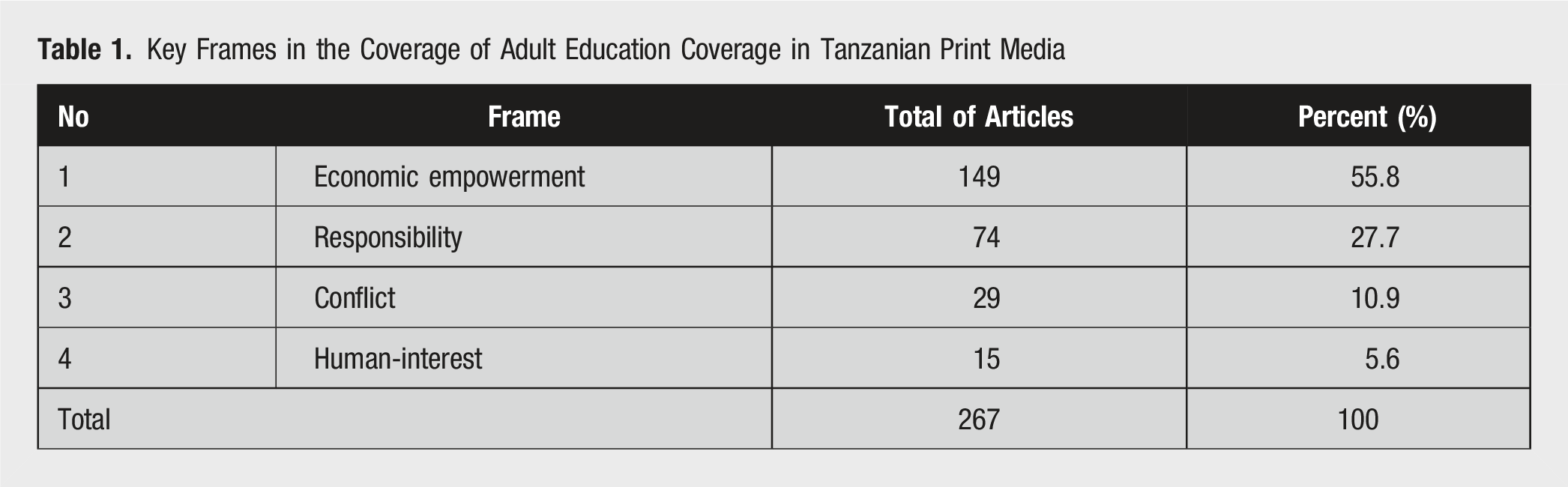
The findings indicate that economic empowerment was the most prevalent frame in the newspapers, followed by responsibility, conflict, and human-interest. This suggests that media coverage of AE initiatives focuses heavily on their socioeconomic implications. Furthermore, the findings reveal a noteworthy trend wherein AE news mainly relies on sources directly affiliated with AE initiatives, who can be seen as interested parties. This reliance on specific sources significantly impacts the presentation of AE news. This implies that these partners benefit from the news, which could influence how it is framed.
Economic Empowerment Frame
The news coverage focused on economic empowerment in the context of AE, emphasizing positive outcomes and acquisition of knowledge through tailored AE initiatives. This was the most common theme, accounting for 55.8 % of the analyzed articles. For example, articles such as, “PM’s programme equips over 6000 youth with employment skills,” emphasize the importance of empowerment programmes such as “IPOSA,” “GIRLS Inspire,” Notably, initiatives such as “Empowering Girls through Education” and XPRIZE were portrayed as promoting skill development for job creation, positioning these skills as immediately applicable to different contexts. Another article, “Mbinu zitakazowasaidia wahitimu kufanikiwa katika soko la ajira” (Strategies that will help graduates succeed in the job market) (Mwananchi, October 8, 2021), emphasized the importance of equipping graduates with essential employment skills.
The positive framing of AE was reinforced through terms such as “entrepreneurship,” “beneficiaries,” “skills development,” “sharpening,” “helping.” Metaphors such as “Ujasiriamali” (entrepreneurship), “Wafunidishwa” (taught), “Kujengewa uwezo” (empowerment), “Mafunzo” (training), “Wanufaika” (beneficiaries), and “Nje ya mfumo rasmi” (non-formal system) contributed to expressing a positive attitude toward AE. The phrase “Elimu mbadala” (alternative education) further emphasized the importance of AE in providing alternative avenues for individuals who may have lacked access to or completed formal schooling. Similarly, the term “Kunufaisha” (meaning benefit) reiterated the idea that learners can gain advantages by engaging in formal, expanding their knowledge and skills enhancing their competitiveness in the job market.
Responsibility Frame
Articles within this frame focus on various aspects of AE initiatives, including government support, community-driven efforts, and awareness campaigns. These issues are all explored within the context of personal development. The responsibility aspect is the second most common theme found in AE coverage, accounting for 27.7% of the total articles. These articles highlight the commitment of Tanzanian government agencies and organizations in addressing the challenges faced by individuals and communities. For example, the article “Majaliwa atoa maagizo 9 elimu watu wazima” (Majaliwa issues nine directives on Adult Education), highlights the government’s focus on improving AE. Similarly, article such as, “Asilimia 20 ya Watanzania mbumbumbu, aibu kwa taifa” (20% of Tanzanians are illiterate) and “3500 Songea hawajui kusoma” (3500 people in Songea cannot read) raise concerns about the adult illiteracy, emphasizing its societal impact.
Articles such as, “Tuwalinde Watoto na mimba za utotoni” (let us protect children from teenage pregnancies) (Habari Leo October 6, 2021), and “Nyang’hwale walivyopunguza mimba, utoro shuleni” (How Nyang’hwale reduced pregnancies and school dropouts), which showcase the effectiveness of community-driven initiatives in addressing the issue of teenage pregnancies. Additionally, the article, “Mbinu za kumsaidia mtoto aliyefanyiwa ukatili wa kingono” (Strategies to help a child who has experienced sexual abuse) (Mwananchi, October 2021) provides guidance on supporting individuals who have experienced trauma, underscoring the importance of assistance and understanding.
Furthermore, articles such as, “Campaign to fight against schoolgirls pregnancy nears” (The Citizen, July 25, 2017) and “Men join breastfeeding campaigns by supporting lactating mothers” (Daily News, September 3, 2018), addressing pressing issues and promote collective responsibility. Another article titled “Making Environment Education Compulsory” (Daily News, April 24, 2019) advocates for environmental awareness and emphasizes the role of individuals and communities in addressing environmental issues. Moreover, “Villagers graduate in literacy scheme” addresses illiteracy within communities. While, “Literacy rate in Tanzania improves” shows the government’s efforts, along with NGOs and CBOs to promote AE and reduce illiteracy rates, especially in underserved areas.
Terms such as “Msione Aibu” (Don’t feel ashamed), “20% of Tanzanians illiterate” and “Aibu” (Shame) are used in these articles to reduce stigma with illiteracy. The term “Maagizo” (directives) indicates the government’s proactive role in addressing adult illiteracy in Tanzania. Articles such as “Re-entry policy: The future is bright for teen mothers,” “Marekani yapongeza waliopata ujauzito kurudi shule” (America applauds those who got pregnant for returning to school) and “Kongole serikali kuweka historia ya arudi shule” (Congratulations to the government for making history by allowing return to school) (Mwananchi) highlight the positive impact of allowing teenage mothers to return to school. As a result, the articles demonstrate a commitment among stakeholders to address societal challenges through initiatives, campaigns, and awareness programs.
Conflict Frame
The conflict frame is a notable but less dominant theme in AE coverage, representing 10.9 % of articles. This frame reveals conflicting opinions between the government and various stakeholders, such as the international community, NGOs, civil society, and lawmakers. To illustrate this conflict frame, the study will focus on examples related to teenage mothers, demonstrating how different perspectives contribute to a complex narrative within the realm of AE. Notably, articles such as “TAMWA hits at women MPs over teen mothers,” “Uproar over JPM ban on teen mothers,” “MPs split on proposal to allow teenage mothers back to school” (The Citizen) and “PM closes debate on teen mothers” (The Citizen) adopt an alarmist tone, reflecting the tension and discord surrounding the government’s decisions. In the context of AE, these articles highlight a particular controversy related to the treatment of teenage mothers within the education system. The government’s decision to prohibit teenage mothers from returning to school after giving birth becomes a focal point of contention. The articles called for continued debate and advocacy for teenage mothers’ rights to access education, as evidenced in the article “Don’t be silenced in teen mum debate CSOs, vow.” These conflicts and debates underscore the multifaceted nature of AE-related issues and their implications for policy, societal norms, and individual rights.
Human-Interest Frame
The human-interest frame is the least frequently occurring theme in AE coverage, accounting for only 5.6% of the articles. These articles highlight the personal stories of individuals who have overcome obstacles and pursued further education through AE programs. One specific article, “Shigongo alivyojiunga chuo kikuu akiwa na elimu ya msingi” (How Shigongo joined university with primary education) (Mwananchi, May 13, 2021), shares the inspiring journey of an individual who, despite lacking a secondary school education, enrolled in the university through Recognition of Prior Learning (RPL) examinations. Another article, titled “Wanaofeli mitihani wana nafasi ya kufanya vyema” (those who fail exams have a chance to perform well) (Habari Leo), encourages learners to persist in their educational pursuits despite setbacks. The term “Waliokatisha masomo” (school dropouts) emphasizes AE’s role as a second chance for those who may have dropped out of the formal schooling system, positively impacting both individuals and communities.
Perspectives on Media Coverage and AE Initiatives
The analysis revealed a majority of the articles had a positive tone, using real-life stories to emphasize the tangible benefits of various initiatives. One key informant explained that, “journalists used terminology such as ‘entrepreneurship’, ‘beneficiaries’, ‘skills development’, ‘sharpening’, and ‘helping’ to highlight the significance of AE in providing knowledge, skills, and alternative paths to education for those who were unable to access or complete formal schooling. The article also emphasizes terms such as ‘training’, ‘empowerment’, ‘skills’, ‘kunufaisha’ (benefit) and ‘Elimu mbadala’, (alternative education) to stress the importance of AE in equipping learners with necessary knowledge and skills to be competitive in the job market.”
However, some journalists expressed concerns that an exclusive focus on the positive aspects of AE might have certain risks. They contended that this one-sided coverage may limit opportunities for policymakers, stakeholders and the government to effectively address the challenges within the AE sector. Some newspapers’ accounts showed contradictions, with some respondents stating that such positive coverage was a result of the articles being event-driven and focusing solely on the information shared during these events. As noted by one key informant, “this lack of critical engagement by journalists was not beneficial for the field of AE and thus journalists should also highlight the challenges they face in reporting AE issues.”
The finding indicate that certain articles employed unfriendly language in their coverage, using words such as “Mbumbumbu,” which translates to someone who is ignorant, or “Aibu” meaning shame. As one journalist pointed out, “discriminative words do not promote AE, but instead hinders its process. If you inform someone that this is education for ‘Ngumaburu’, meaning education for the illiterate ‘Mbumbumbu’ or ‘Aibu’, anyone who aspires to join AE programmes would not be encouraged to do so because of the way people perceive them.” Such terminology discourages adult learner from enrolling in AE programmes due to fear of being labeled as “Mbumbumbu” or “Aibu.” As such, this negative language adversely impacts adult learners’ self-esteem.
Further analysis of the articles indicates that external funders and development partners played a significant role in generating media coverage of AE issues. While their involvement can enhance the visibility of AE, it also raises concerns about potential biases in the news coverage. The frequent use of development partners as primary sources may inadvertently frame issues in a way that benefits these partners, thereby influencing the overall narrative. The analysis reveals that various stakeholders contributed to news coverage about AE issues in Tanzania. Specifically, the reviewed articles showed that 48.4% were sourced from project funders and policymakers. Development partners contributed 28.5% of the coverage, while government representative made up 19.9%. However, the Ministry of Education, Science, and Technology (MoEST) and the Institute of Adult Education (IAE) had relatively low contributions to the news about AE issues, at 11.2% and 3.7%, respectively.
Figure 1 illustrates the frequency of sources cited in different newspapers from 2016 to 2021, categorized by type, in the analyzed articles. The graph shows how often different types of sources were used, providing insights into the distribution and balance of these sources used in media coverage of AE issues. Sources of adult education information (2016–2021).
Discussion
AE coverage was largely positive, with newspapers generally framing AE as a catalyst for social progress and economic empowerment. The newspapers emphasized how AE imparts skills and raised awareness of issues that affect individuals and communities. The coverage emphasizes the government and organizations’ commitment to addressing societal challenges and promoting economic empowerment through AE initiatives. These initiatives include projects, campaigns, and strategies designed to address community issues. The articles cover a range of themes, such as, sexual and reproductive health, gender, nutrition, environmental awareness, parenting skills, language, voting, marketing, and financial literacy. The goal is to increase awareness of these important societal issues and encourage individuals to participate in AE programs.
The articles also feature personal testimonies from beneficiaries, which demonstrate the impact of AE initiatives, such as teenage mothers return to school, Qualifying Test (QT) and Recognition of Prior Learning examination (RPL). These articles emphasize the importance of AE in promoting inclusive and equitable education. However, conflicting viewpoints arise, particularly regarding issue of teenage mothers’ exclusion from school. This conflict between the government and other stakeholders received regular coverage, leading to increased public discussion on the intersection of education, morality and human rights within the AE landscape. This aligns with the framing theory, which suggest that media portrayals have the power to influence public perception and drive collective action.
The current media coverage of AE focuses mainly on events, which allows for quick production but fails to address broader systematic or societal issues. This type of coverage tends to emphasize individual behavior and events, often relying heavily on development partners as sources of information. As a result, while external funders and partners significantly contribute to media narrative, the government institutions responsible for AE play a lesser role in informing the public. When development partners dominate as primary sources, there is a risk that the framing of AE issues align with their specific agendas, potentially skewing the narrative in their favor. This reliance on external funding can shape public perception and policy discussions, highlighting certain aspects of AE while downplaying others. Therefore, it is essential to critically evaluate the sources of information in media coverage to ensure a balanced and comprehensive understanding of AE issues. The current portrayal often results in an unbalanced representation, as positive aspects and success stories are highlighted, while critical issues such as soft skills, budget, training quality, curriculum framework, and monitoring and evaluation are overlooked (Mourão et al., 2018). Additionally, the exclusion of journalists’ personal views, limits the diversity of perspectives presented in the articles (McIntyre & Gibson, 2016). This approach is perceived as an attempt to avoid criticism or ignore weaknesses within AE, which could result in flawed decisions-making and hinder a comprehensive understanding of its impact. It is important to recognize that journalists have a role in shaping public perception and the sources they use significantly influence the information presented (Anderson, 2017).
In the context of AE, newspapers prioritize attention-grabbing statements when coverage events. This sensationalistic approach focuses on highlighting dramatic or controversial elements rather than substantive content. As such, the public’s understanding of AE becomes distorted, as the complexities of issues are overlooked. As argued by Haw (2020), sensationalism has negative consequences as citizens are not sufficiently informed about important AE issues that directly affect their wellbeing. As a result, policymakers may prioritize immediate visibility over a comprehensive understanding of the broader AE landscape, which discourages interest and comprehension of AE issues. Moreover, these articles frequently rely on anecdotal evidence or individual quotes instead of empirical data to support their claims. According to Hoeken and Hustinx (2009), anecdotal evidence or quotes are subjective because they come from a single individual, overlooking the broader context of experiences. This approach tends to downplay the challenges and limitations of AE initiatives, such as the difficulties in implementing effective training.
The inverted pyramid structure used in newspapers for AE coverage aims to offer readers with quick access to information. However, this approach often oversimplifies complex issues and lacks thorough analysis and background information. Putri (2022) notes that while the inverted pyramid allows readers to grasp the essential aspects of news articles, it fails to provide deeper implications and context of AE. Balancing conciseness and detail prove challenging, and the inverted pyramid hinders in-depth analysis, critical evaluation, and storytelling. This structure suggests a lack of critical examination of AE initiatives due to editorial biases or a desire to conform to government or organizational narratives. Furthermore, details about AE interventions are often relegated to the end of articles as general background knowledge, which, while helpful, fails to effectively convey crucial information.
Conclusion
The media’s coverage of Adult Education (AE) is generally positive, characterized by informative and easily understandable articles. However, this focus often overlooks critical areas needing improvement, such as budget constraints, the limited visibility of AE and training quality provided. This narrow perspective results in a limited range of voices and viewpoints, which may lead to biased or unbalanced coverage of AE issues. Consequently, the public struggles to understand the full context of AE, resulting in an imbalanced representation. To address this, the media should adopt a more comprehensive and investigative approach, that highlights both the positive and negative aspects of AE. Incorporating the principles of andragogy, the art and science of adult learning defined by Knowles (1980), can significantly enhance the effectiveness of AE coverage. Andragogy emphasizes the unique characteristics and learning needs of adult learners, such as their self-directedness, goals-orientation, and preference for collaborative learning environments. By understanding these principles, journalists can better appreciate the complexities of AE and present more nuanced and accurate coverage. Collaboration with AE experts and practitioners can further enrich journalists’ insights, helping to reduce potential biases in their coverage. Such partnership can ensure that the coverage accurately reflects the complexities of AE policies, challenges, and potential solutions. By presenting a well-rounded view, the media can better educate the public, enabling them to make informed decisions and fostering a more accurate understanding of AE’s role in society.
Footnotes
Declaration of Conflicting Interests
The author(s) declared no potential conflicts of interest with respect to the research, authorship, and/or publication of this article.
Funding
The author(s) received no financial support for the research, authorship, and/or publication of this article.
