



Abstract
Although most work teams use meetings as a tool for accomplishing their objectives, there is little research examining meeting-related variables in teams. In this article, we propose a new construct, team meeting attitudes (TMA), that involves individuals’ thoughts, feelings, and evaluations of team meetings. We constructed a scale that measures individuals’ TMA, and we report on the scale’s psychometric properties, including test-retest reliabilities, over four measurement occasions. Using a sample of engineering project design teams, intraclass correlations of repeated measurements suggested that TMA appeared to emerge over time. Moreover, our TMA scale, aggregated to the team level using the mean, had direct effects on time spent in team meetings, perceptions of team meeting effectiveness, and team potency. Mean TMA were also indirectly related to team task performance through team potency. These findings were interpreted as supportive of activity regulation and action theories because teams with high means on TMA may have members who view team meetings as conducive to goal accomplishment and not as interruptive.
One can scarcely imagine a job in which meetings do not occur. As Scott, Rogelberg, and Allen (2010) recently noted, meetings are a constitutive part of work life, providing an avenue for information exchange, decision making, coordination, planning, and monitoring progress, each of which is an essential component of the team processes that are associated with team performance. Extrapolating from the theory of activity regulation as it has been applied to the workplace (see Zijlstra, Roe, Leonora, & Krediet, 1999), effective meeting management is likely to be particularly important for teams because of their members’ inherent interdependence, especially when teams have objectives that involve complex and dynamic work requiring intensive interactions. Activity regulation theory, among others, suggests that meetings are less of an interruption, and perhaps even welcomed, when they are viewed as highly relevant to the individual’s work goals. Indeed, recent research has found that employees reported more positive job attitudes and well-being when their meetings were with interdependent rather than independent coworkers (Rogelberg, Warr, Leach, & Burnfield, 2006). Accordingly, work team meetings may be one situation in which meetings could be viewed favorably by attendees.
Despite the relevance of meetings as a major vehicle for team interactions, there is a dearth of empirical research that focuses on factors that contribute to meeting effectiveness, emergent states, and performance in the context of teamwork. Some exceptions include Beck and Keyton’s (2009) qualitative study of a team’s weekly meetings, and Sonnentag and Volmer’s (2009) study on expertise and self-efficacy in software design teams. However, the preponderance of research involving team meetings uses meetings only as a context within which to study other variables of interest, and these variables are rarely linked explicitly to team meeting effectiveness and its consequences (see Schwartzman, 1986).
In the present research, we focus particular attention on the attitudes that individuals have toward team meetings. The proposed construct, team meeting attitudes (TMA), is one that may have considerable relevance to perceived team meeting effectiveness. In this study, we define TMA and describe the development of a self-report measure of this construct. We then report on an empirical study involving a sample of student engineering design teams in which meetings were frequently used to plan and execute team tasks.
Team Meeting Attitudes
In keeping with the definition of attitudes in general, we conceptualize TMA as the extent to which an individual evaluates team meetings with some degree of favor or disfavor (see Eagly & Chaiken, 1993). In essence, TMA are attitudes that team members harbor regarding doing work and spending time, in team meetings. These attitudes are not targeted solely at meetings held within a particular team; instead, we see them as general attitudes about team meetings that are shaped, theoretically, both by the individual’s history or experience with various team meetings and by his or her dispositional characteristics. It is, in our view, surprising that TMA have not been studied as they may have the potential to exert direct effects on perceptions of team meeting effectiveness, emergent states, team processes, and, in so doing, team performance. Clearly, if such links were established, there would be implications for the placement of employees in teams or for tailoring work assignments to employee preferences. Furthermore, the identification of work units or individuals with negative attitudes toward team meetings might suggest the need to examine how team meetings are managed and, possibly, to develop relevant interventions.
As mentioned above, the target of one’s TMA is not a specific team and its meetings but, rather, the concept of team meetings itself. We propose that the TMA construct involves an individual’s attitude toward spending time, doing work, and making decisions in team meetings, which would likely facilitate the team’s ability to communicate, coordinate, plan, strategize, and complete work activities. Accordingly, TMA are potentially facilitative of both transition (e.g., mission analysis) and action (e.g., systems monitoring) phases of Marks, Mathieu, and Zaccaro’s (2001) taxonomy of team process (see Sonnentag & Volmer, 2009). During transition processes, TMA will help the team formulate an effective strategy that will lay the foundation for successful idea implementation during work execution and action phases. Furthermore, during action phases, teams with members who are high on TMA are likely to hold meetings to examine the potential need to adapt strategies due to environmental changes. Finally, we posit that TMA are relevant to interpersonal processes specified by Marks et al., as meetings are the likely venue for forming conflict management tendencies, task cohesion, team identity, and emotional regulation (see Beck & Keyton, 2009). Individuals with favorable TMA will, theoretically, view meetings as a necessary vehicle that facilitates many team processes needed to develop team member capabilities and for maximizing team effectiveness. Conversely, individuals with unfavorable TMA may try to avoid meetings and try to get the team to do as little as possible during team meetings. Such behaviors could damage the team’s ability to work effectively as a unit and engender negative feelings about the team and its members.
In our view, the above conceptualization of the TMA construct is different from other related constructs. Meeting satisfaction (see Rogelberg, Allen, Shanock, Scott, & Shuffler, 2010) refers to a facet of job satisfaction targeted toward all types of meetings the individual currently attends as part of his or her job and not specifically toward meetings in teams. An individual could be generally dissatisfied with the array of committee, departmental, and staff meetings he or she is expected to attend, although there is still a very real possibility that his or her TMA are positive given the variety of personal and situational influences on construct. For example, the individual could believe that team meetings are necessary for team effectiveness due to personal experiences and training. He or she may also feel involved and engaged in current team meetings because of their smaller size, members’ mutual interdependence, and opportunities to affect the team’s outcomes. In addition, Rogelberg et al.’s (2010) meeting satisfaction construct focuses on an individual’s satisfaction with current organizational meetings, not a more focused enthusiasm to do work and make decisions in team meetings.
Another construct that bears a theoretical relation to TMA is individualistic orientation, as discussed by Rogelberg et al. (2006). However, whereas individualistic orientation involves the extent to which individuals prefer to rely on themselves, as opposed to a larger group, to meet work objectives, the construct is not focused specifically at the team context. Moreover, to the extent that individuals view their own work effectiveness as dependent on others, it is quite possible that they will experience a wide range of TMA levels. This is because the members must make use of others’ contributions to complete their own work, and holding team meetings and working in team meetings should facilitate individual goal completion. Finally, we believe TMA are distinct from preferences for teamwork and predispositions toward teamwork (Campion, Medsker, & Higgs, 1993; Kline, 1999) because these latter constructs were described as very general inclinations toward teamwork and not solely toward meetings in teams.
Implications for TMA at the Team Level
We rely on the seminal construct classification taxonomies delineated by Chan (1998) and Kozlowski and Klein (2000) to operationalize TMA at the team level. We see the most value in operationalizing team-level TMA as an additive construct. Under this operationalization, each team member’s TMA contributes additively to the team’s overall level of TMA, meaning the more that members see team meeting activities as favorable, the more they will tend to experience positive team processes, emergent states, and, possibly, performance. According to the additive model, the team’s TMA score should be operationalized using the mean of the scores of the individual team members. High team means on TMA suggest that most members view frequent team meetings, and engaging in meaningful task activities in team meetings, as important. Teams with high mean TMA will therefore be expected to have frequent, well-planned meetings, which could help them to be organized, coordinated, confident in their work, high in trust (because members attend meetings and deliver on commitments), and focused on the task at hand during team meetings. Over time, patterns of such behaviors will likely build the team into a capable, high-performing unit in which members develop effective team- and task-related skills.
Note that the additive approach to aggregation does not assume within-team agreement (see Chan, 1998). Team members’ personal attitudes are not theorized to necessarily coalesce around a common, shared perception of the favorability of team meetings. That is, although TMA will likely be influenced by team memberships, we posit that TMA are internal views held by team members that are influenced by many sources, such as individual dispositions and the quality of previous experiences with teams, among others. This is in contrast to shared-unit constructs (Kozlowski & Klein, 2000), such as group affective tone; the theory underlying those constructs suggests that their development emerges, in large part, from shared experiences and contextual forces that drive similarity in perspectives among members of a work unit (see George, 1990). In keeping with the definition of TMA, the referent of the items we developed to measure the construct of TMA is the individual, not the team, and a complex interplay of individual dispositions and environmental features will explain an individual’s TMA. Just as with operationalizing personality, cognitive ability, and the like at the team level, the mean simply indicates how much TMA a given team, collectively, has (see Barrick, Stewart, Neubert, & Mount, 1998; O’Neill & Allen, 2011).
Measurement of TMA
Following the deductive approach to measure development (Jackson, 1970; Nunnally, 1978), we used the theoretical positioning of the TMA construct as the basis of the measure shown in Table 1. Items were written with the intention of capturing the construct’s global content space, which involves the favorability of an individual’s thoughts and feelings, toward (a) spending time in team meetings, (b) meeting frequently, (c) performing substantive task work in meetings, (d) using team meetings to consult others and to receive task updates, and (e) using team meetings to make decisions. Working deductively from this criterion space, one author wrote a preliminary eight-item measure to operationalize the TMA construct. The other author reviewed the items and suggested minor changes, which were discussed in the context of a laboratory meeting with the input of other attendees (e.g., graduate students, research assistants) until consensus was reached. Our goal was to investigate the extent to which the resulting eight-item measure demonstrates empirical promise in terms of capturing the proposed TMA construct and showing associations, as theorized, with team meeting effectiveness, emergent states, and, indirectly, team performance.
Item Properties of the Team Meeting Attitudes (TMA) Scale

Note: n = 330.
Reverse-keyed item.
Hypotheses
TMA Over Time
Earlier we argued that TMA will be influenced both by an individual’s previous exposure to team meetings, his or her dispositions, and also current team memberships. It is this latter source of influence that we discuss here. The current sample was composed of student engineering design teams working interdependently for 6.5 months on a major design project. This project was a major focus for students as it was very intensive, involved weekly meetings in design workshops, and numerous additional self-scheduled meetings, all of which culminated in a high-profile design showcase. We measured TMA at four time points, beginning prior to team formation, and on 2-month intervals thereafter. One advantage of measuring TMA over time was that it allowed us to investigate the effects of team membership on TMA. Recall that we have described the construct of TMA such that, prior to team formation, TMA should exhibit little within-team agreement because membership in the team and the team’s meeting management style cannot yet be a factor in the development of TMA. However, it was our understanding that the teams that were the focus of this research were likely the dominant teams in which students were currently involved. Moreover, because the average age of individuals in our sample was quite low (M = 19), there is reason to believe that earlier experiences with teams were limited as compared with employees in team-based organizations. Thus, TMA were particularly susceptible to influence from membership in the current teams.
Given all this, we were able to examine the effect of membership in those teams on the emergence of team-level TMA. That is, although there should be little within-team agreement prior to team formation—because these teams were the dominant team in many of the students’ lives—we expected that some within-team convergence in TMA would occur over time. Had team members been involved in multiple teams, we would expect that variability in individuals’ experiences with those teams, including team meetings, would limit convergence of team members’ TMA in any one team. However, being part of a single, highly interdependent team that involved intensive interaction created the potential for heavy influence of the development of TMA. Moreover, the fact that the participants were generally quite young suggests that TMA were unlikely to have reached the level of stability expected from a sample of highly experienced employees that, over the course of their lifetimes, have been a part of many teams that may have crystallized their perspectives on team meetings.
The above arguments suggest that within-team TMA, in the current sample, would be expected to converge over time. Also expected is that between-team heterogeneity will increase over time. As team members work in teams that vary on the quality of member interactions in meetings, team meeting efficiency, and meeting effectiveness, one could argue that teams will also become more heterogeneous on TMA over time. To the extent that teams varied in their team meeting climate, team-level TMA would likely also become heterogeneous over time.
Hypothesis 1: Within-team homogeneity and between-team heterogeneity on TMA, as measured by intraclass correlations (ICC), will increase over time.
TMA and Team Meeting–Related Process Criteria
Above, we alluded to the possibility that additive (mean) TMA could be associated with perceived team meeting effectiveness. That is, the more team members tend to hold positive attitudes about team meetings, the more likely it is that team meetings will be characterized by an organized approach, clear objectives, premeeting planning, efficiency, attendance, and punctuality (see Leach, Rogelberg, Warr, & Burnfield, 2009). Action theory makes the general argument that hassles, or anything that stifles an individuals’ progression toward goals, will be met with resistance and negative attitudes (Zohar, 1999). Accordingly, it suggests that teams with high means on TMA may have members with positive perceptions of team meeting effectiveness because individuals will likely not see meetings as disruptive and as hassles that interfere with primary task execution. In fact, they may see meetings as instrumental to goal attainment given their positive view of team meetings and task interdependence (see Luong & Rogelberg, 2005). Accordingly, we would expect that high team mean scores on TMA could have benefits for perceived meeting effectiveness. Accordingly, we predicted the following:
Hypothesis 2: TMA, operationalized as the team mean, will be positively related to perceived team meeting effectiveness.
In addition to perceived team meeting effectiveness, time spent in meetings could be associated with mean levels of TMA. Time spent in meetings is a relevant criterion for establishing the importance of the TMA construct because meeting time has been related positively to job satisfaction when work is interdependent and negatively when work is independent (Rogelberg et al., 2006). In line with action and activity regulation theories, which suggest that people are open to events perceived as conducive to goal accomplishment and resent activities that might impede reaching objectives, we predicted the following:
Hypothesis 3: TMA, operationalized as the team mean, will be positively related to the amount of time teams spend in meetings.
TMA and Team Emergent States
According to Marks et al. (2001), emergent states are properties characterizing the team that emerge only after the team has developed a history through interaction, common interpretation of events, and recurring work cycles. In the present research, we investigated the emergent state of team potency, which is the extent to which the team is confident in its general ability to succeed and perform well (Shea & Guzzo, 1987). A meta-analysis reported a corrected relationship between potency and team performance of .37 (Gully, Joshi, Incalcaterra, & Beaubien, 2002). Furthermore, Hecht, Allen, Klammer, and Kelly (2002) found that team potency contributed to the prediction of team performance even after controlling for the team members’ cognitive ability. In sum, the team potency–team performance relationship appears to be robust.
We believe team-level TMA may be linked to team potency. Using an additive approach to operationalization, teams with high TMA mean scores might be expected to report more confidence in their ability to be effective. As suggested above, high TMA mean scores ought to lead to more effective meetings, and groups that generate repeated cycles of effective meetings may be particularly likely to develop confidence in their ability to succeed as a work unit. Invoking action theory, teams that have members with high TMA will likely be confident in their team’s ability to perform because they hold effective meetings and, therefore, these meetings will tend to be viewed as a valuable resource for facilitating individual and team objectives. Moreover, teams composed of members who are open to meeting frequently and working during meetings, and who see team meetings as important, may engage in sensemaking activities (Weick, 1995) during meetings that mutually reinforce positive confidence beliefs. For example, these teams will have frequent meetings within which positive attributions regarding the current state of affairs are likely to be emphasized, and potentially problematic future hurdles are recognized and handled. Conversely, teams whose members hold less positive TMA might have meeting atmospheres that are unproductive, and, accordingly, members may engage in sensemaking that involves questioning the team’s likelihood of reaching its goals. Thus,
Hypothesis 4: TMA, operationalized as the team mean, will be positively related to team potency.
Indirect Effects of TMA on Team Task Performance
In an environment where the task is difficult, the team’s confidence in its ability to succeed may be especially relevant for effective performance. Given the complexity and breadth of the engineering team design projects and the TMA–team performance linkage described above, team potency is a logical antecedent of team task performance in the current study. Furthermore, as suggested earlier, the mean operationalization of TMA is likely to relate positively to team potency. A less persuasive argument can be made for a direct association between TMA and team task performance. In our view, such attitudes are logical precursors to effective processes and emergent states but not directly linked to team task performance. Accordingly, we posit an indirect effect such that TMA will influence team task performance through its relationship with team potency. Note that we are not describing a mediation model; rather, our hypothesis of an indirect effect identifies team potency as a linking mechanism through which TMA will be associated with team task performance (see Mathieu & Taylor, 2006). In sum, we predicted the following:
Hypothesis 4: TMA, operationalized as the team mean, will indirectly and positively influence team task performance through team potency.
Method
Participants and Teamwork Context
Participating in this study were 344 team members assigned to 81 engineering project design teams that worked together from September 2009 to April 2010. There were 61 four-person teams and 20 five-person teams (85% team members = male; M age = 18.6 years, SD = 2.4) 1 . All team members were enrolled in a 1st-year engineering design course at a large university in Ontario, Canada. The students worked intensively for 6.5 months on several small projects as well as a major design project, the latter of which served as the basis for the team task performance measure used in the current research. The major design project required teams to research and develop a design concept that would demonstrate, in an educational and innovative manner, the functionality of an environmentally friendly technology of their choosing. Teams worked with technologies involving hydro, wind, geothermal, solar, human kinetics, and so on.
We observed teams for approximately 100 hours during team training and during their design studios (weekly, mandatory team project design sessions). One clear theme emerging from these observations was that the team members directed a tremendous amount of energy, pride, and interest toward the team projects. This is not surprising given that, collectively, approximately 45% of grades from this course were reserved for team assignments and that the major design project, which involved a prototype and lengthy report (approx. 100 pages), accounted for 27.5% of course grades. Moreover, the teams presented their major project at a high-profile design showcase, similar to a science fair, attended by the city mayor, university president, engineering dean and faculty, and the general public. The other theme that emerged was that each individual team member acquired expertise in a specific design area (e.g., turbines, axles, electrical and power); accordingly, task and outcome interdependence were very high in these teams and the vast majority of team members were very motivated toward team achievements.
Procedure
TMA were measured at four time points: The 1st day of design studios before individuals were assigned to teams (Time 1), then 6 weeks (Time 2), 4.5 months (Time 3), and 6 months (Time 4) later. This allowed us to confirm scale internal consistency and scale-score stability. All other measures were taken at Time 4 only.
Measures
Team meeting attitudes
As mentioned earlier, TMA were measured with an eight-item scale developed for this research (see Table 1). The stem of the items was “When working on group projects . . .” in order to be consistent with our specification that the target of TMA is team meetings in general, not attitudes toward a particular team’s meetings. We applied a 5-point Likert-type scale ranging from strongly disagree (1) to strongly agree (5).
Team meeting time
Time spent in team meetings was calculated based on team members’ responses to two items: (a) “Please indicate the number of team meetings—outside of studio time—that your team held since February 1st” and (b) “Please indicate the average length of these meetings, in minutes.” February 1st referred to Time 3. For each team member, we multiplied the scores on these two items and then averaged the resulting values within teams. Thus, the team meeting time measure was the average of team members’ estimates of time spent in non-course-scheduled meetings, in minutes (Time 4).
Perceived team meeting effectiveness
With slight adaptations from Leach et al. (2009), we administered a nine-item self-report scale measuring perceived team meeting effectiveness. The scale included items assessing perceptions of the adequacy of the frequency of team meetings and the effectiveness, efficiency, attendance, time wasted, promptness, and goal achievements in team meetings, which were identified in early meetings research as key factors of meeting effectiveness (Leach et al., 2009). We employed a 7-point Likert-type scale ranging from strongly disagree (1) to strongly agree (7). Cronbach’s alpha was .89 (Time 4).
Team potency
We used a 7-item measure of team potency that was slightly adapted from Guzzo, Yost, Campbell, and Shea (1993) to fit the current study’s context. Specifically, the word group was changed to team and one item referring to influencing the organization was dropped. An example item from the scale employed is “My team believes it can be very productive.” We used a 5-point Likert-type scale. Cronbach’s alpha was .92 (measured at Time 4).
Team task performance
Team task performance was a multidimensional composite score based on the project reports graded by seven experienced course administrators who rated an average of 11.57 project reports each. Teams were scored on dimensions such as problem definition, design methodology, and engineering validation. To control for different rater scoring styles, and consistent with previous research, we standardized scores within raters using a z distribution (O’Neill & Allen, 2011). The maximum possible raw score was 25, and the observed minimum and maximum raw score was 12.50 and 25.00, respectively (Time 4).
Handling Missing Data
Clearly, group researchers whose work relies on data collected at the individual level and its aggregation are best served by high response rates and, thus, minimal missing data (Allen, Stanley, Williams, & Ross, 2007; Newman & Sin, 2009). In the present study, we were relatively fortunate in this regard. Across time points, the lowest individual-level response rate was 92% and the lowest within-team response rate was 50% (2 of 4 members responded). Nonetheless, we gave careful consideration to the missing data issue. A common practice in studies involving aggregation of individual responses to the group level is to retain for analyses only those teams exceeding a certain proportion of responding team members (for a review, see Allen et al., 2007). The argument is that it is better to have fewer complete teams than it is to have more, but incomplete, teams. However, recent computer simulation research examining group-level constructs operationalized at the team level using the mean (Maloney, Johnson, & Zellmer-Bruhn, 2010) clearly advises against the use of such practices. It would appear that the loss of statistical power associated with deleting teams outweighs the importance of ensuring that only teams with high response rates are included. Thus, current research supported our decision to include all 81 teams in the analyses.
Data Aggregation Issues
As argued earlier, TMA scores were not theoretically required to converge within teams to support aggregation because the measure we developed does not target a specific team. Instead, the TMA scale uses the self as the referent so as to tap general attitudes toward team meetings that may be a function of not only current team memberships but also previous exposure to meetings, related individual experiences, and, potentially, individual dispositions. As we measured TMA over four occasions, however, we were interested in investigating the extent to which TMA would converge over time. We expected some TMA convergence over time because the teams were, for most individuals, the most important and consequential teams in which they worked. Thus, we report ICC for TMA in our test of Hypothesis 1 below.
Perceived team meeting effectiveness and team potency are shared-unit constructs and, thus, within-team agreement and between-team variance must be demonstrated to support aggregation. For these constructs, we report ICC(1), the interchangeability of the individual group members’ ratings; ICC(2), the reliability of the group mean; and rwg( j ), the within-group agreement of member ratings. For perceived team meeting effectiveness, ICC(1) = .31, ICC(2) = .64, and rwg( j ) = .91; for team potency, ICC(1) = .32 and ICC(2) = .65, and rwg( j ) = .98. We also report ICC for team members’ reports of time spent in team meetings to support the construct validity of our measure. ICC(1) was .82 and ICC(2) was .94, indicating that team members strongly agreed in their ratings and that there were substantial between group differences (rwg( j ) was inappropriate for this scale because rwg( j ) would have an undefined null distribution). Aggregation statistics of this magnitude suggests meaningful clustering of responses by team membership and support aggregation.
Results
TMA Item Statistics and Factor Analysis
Table 1 contains item-total correlations and factor loadings associated with a one-factor exploratory factor analysis. The majority of item-total correlations were in the acceptable range (see Nunnally, 1978), and factor loadings generally exceeded suggested cutoffs of .30 to .40 (Zwick & Velicer, 1982). Item-total correlations and factor loadings were lowest for Items 1, 3, and 4, which appear to involve attitudes about decision making and working in meetings. The remaining items appear to tap a preference for the frequency of meetings. Nevertheless, we consider preferences for decision making in meetings, working in meetings, and the frequency of meetings as content that is integral to our definition of TMA. Indeed, a trade-off in scale construction is between content coverage and reliability, and in this case we opted for greater breadth of the construct as opposed to the maximization of reliability and, consequently, item-total correlations and factor loadings (Morey, 2000).
Regarding our decision to adopt a one-factor solution, we first present results of EFA. Although the Scree plot was supportive of a single factor, we supplemented this somewhat subjective procedure with parallel analysis. In this case, parallel analysis involved using O’Connor’s (2000) program to compute 1,000 random data sets with the same number of scale items and cases as the current data set (TMA items only). We then retained the number of factors exceeding the 95th percentile of the distribution of factor sizes (i.e., eigenvalues) for each factor number (i.e., I to VIII) in the random data sets. The parallel analysis clearly supported a one-factor solution for the eight-item measure of TMA.
Although the EFA findings were supportive of a one-factor solution, we pressed on by evaluating two confirmatory factor-analytic models. We report the following recommended indices: chi-square, comparative fit index (CFI), root mean square error of approximation (RMSEA), and the standardized root mean square residual (SRMR). We first ran a one-factor model, which resulted in an acceptable model fit by most standards: χ2 = 66.48, CFI = .90, RMSEA = .09, and SRMR = .06. We also ran a two-factor model that loaded items related to doing work and making decisions in team meetings on the first factor (Items 1, 3, 4) and items related to the frequency of team meetings loading on the second factor (Items 2, 5, 6, 7, and 8). The two-factor model had a very slight, but significant (
Internal Consistency and Test-Retest Reliability of the TMA Scale
Cronbach’s alpha reliability for the TMA scale was acceptable across all time points (Time 1 α = .72, Time 2 α = .78, Time 3 α = .78, and Time 4 α = .79). The repeated measurements of the TMA scale allowed us to compute test-retest reliability coefficients; across the four measurement occasions, the average zero-order correlation was .52. Not surprisingly, measures taken closer in time correlated more strongly than did measures taken further apart in time. The strongest correlation involved Time 3 and Time 4 (r = .71); the weakest correlation involved Time 1 and Time 4 (r = .32). The ICC(1), computed using a one-way random effects model, was .53, indicating that 53% of the across-time variance in scale scores was attributable to participants. These coefficients of stability are supportive of our expectations that scores would not be perfectly correlated across time, likely because of team membership experiences, yet the scores would show substantial signs of consistency due to individuals’ unique internal preferences, attributes, and previous experiences that likely influence TMA.
TMA Measurement Time Period for Hypothesis Testing
As we had multiple measures of the TMA construct, we needed to choose the most appropriate time point at which TMA was measured for hypothesis testing. We decided that the optimal measurement occasion was the third time period, approximately 8 weeks before final projects were due. Our reasoning was based on methodological and theoretical issues. We wanted to capture TMA prior to assessing the three criterion variables we expected TMA to predict, that is, time spent in meetings, perceived meeting effectiveness, and team potency, to minimize common method bias. We did not choose an earlier measurement of TMA because we wanted to allow time for the team context, such as team membership, to influence the development of TMA in these relatively inexperienced participants.
Tests of Hypotheses
Hypothesis 1 suggested that TMA at Time 1 would not show high between-group variance relative to within-team agreement, as assessed by ICC, but, that over time, team members’ TMA would be affected by their current team membership such that within-team agreement and between-team heterogeneity would increase. Figure 1 contains ICC(1) and ICC(2) values plotted across time. Time 1 ICC values were not significantly different from zero, whereas the remaining three time periods had ICC that were highly significant (all p < .001). Thus, it would appear that ICC increased mainly in the first 6 weeks, and then stabilized, thereby partially supporting Hypothesis 1.
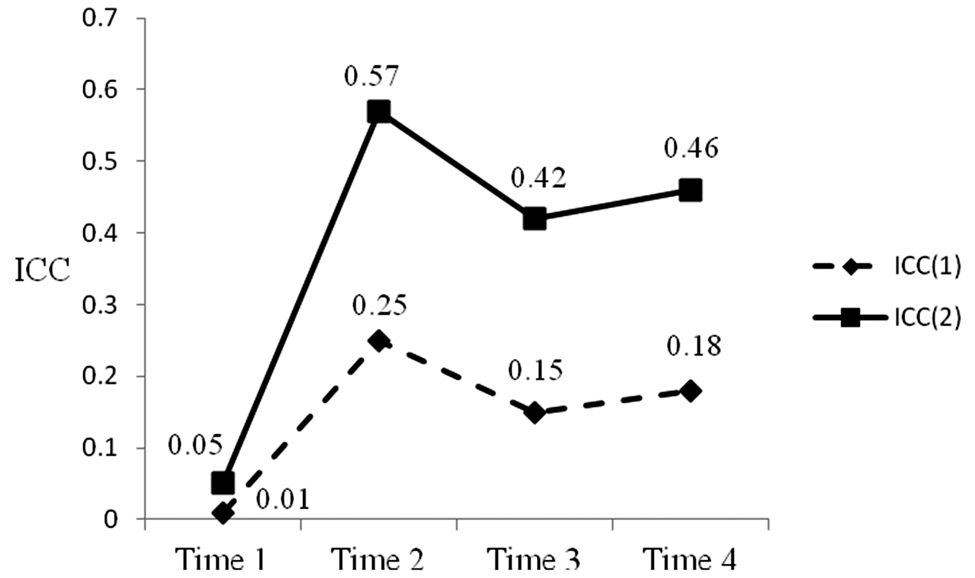
ICC appear to increase from Time 1 to Time 2, after which they become relatively stable.
Given the above findings, it could be argued that Time 2 TMA could be a viable time point at which to use TMA in testing the remaining hypothesis. We chose to stick with the third time point, however, because it was closer in temporal proximity to the occurrence of the criterion variables, meaning that it would likely be more developed and more relevant for meeting activities and team potency at that later time. Thus, remaining hypotheses were tested with TMA measured at Time 3, as planned a priori.
Hypothesis 2 and 3 predicted that TMA, operationalized as the team mean, would be positively related to perceived team meeting effectiveness and to time spent in meetings, respectively. Mean TMA was positively related to perceived team meeting effectiveness, r = .37, p < .01, and to time spent in meetings, r = .39, p < .001 (see Table 2). Thus, Hypotheses 2 and 3 were supported. Hypothesis 4 was also supported in that mean TMA was positively related to team potency, r = .43, p < .001.
Correlations Involving Team-Level Study Variables
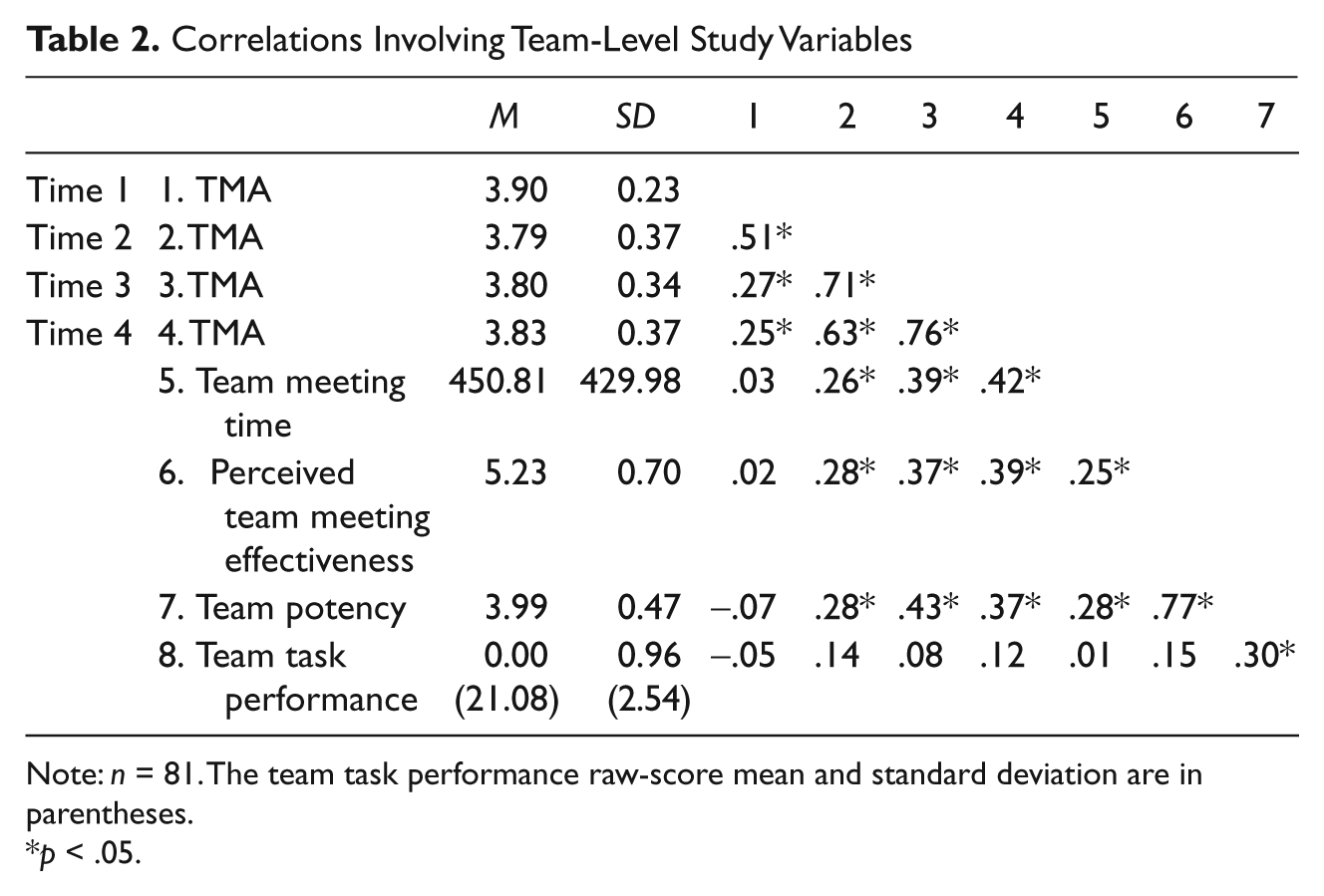
Note: n = 81. The team task performance raw-score mean and standard deviation are in parentheses.
p < .05.
To test the mediation models, we used an adapted version of the Sobel test (Sobel, 1990), which has the goal of testing the significance of the indirect effect of the exogenous variable (i.e., TMA) on the terminal endogenous variable (i.e., team task performance; see MacKinnon, Fritz, Williams, & Lockwood, 2007). An indirect effect is supported when the confidence limits of the indirect effect do not include zero. Hypothesis 5 posited that TMA, operationalized as the team mean, would indirectly influence team task performance through team potency. The indirect relationship involves taking into account the unstandardized relationship between TMA and team potency (b = .61, SE = .14) and between team potency and team task performance (b = .61, SE = .22). The indirect effect of TMA on team task performance was .37 and the confidence interval did not include zero (.10 to .72). We can interpret this as suggesting that team task performance increases by .37 units through team potency for every unit increase in TMA. This supports our prediction of the indirect effect of TMA on team task performance.
Discussion
The focus of the current research is on the thoughts and feelings that people have about team meetings. Accordingly, we began with the basic observation that people seem to vary in terms of their team meeting attitudes, and we hypothesized that these attitudes, considered at the team level and operationalized in terms of the team mean, have implications for team processes, emergent states, and outcomes. We drew on the theories involving activity regulation (Zijlstra et al., 1999), action (Zohar, 1999), and sensemaking (see Weick, 1995) to suggest that teams with high means on TMA may effectively manage meetings, meet frequently, and have favorable performance-related confidence beliefs. That is, members of such teams would likely view meetings as needed activities for primary task advancement and goal attainment, and, as a result, experience meetings within which members develop confidence in the team’s capacity to meet its objectives on schedule. Whereas some organizational meetings are viewed as tangential to an employee’s job, and thus undesirable and to be avoided (see Rogelberg et al., 2006), team meetings will often be viewed as facilitative of team work when the work is interdependent. In support of these arguments, our results suggest that means on TMA were positively associated with team meeting time, perceptions of meeting effectiveness, and team potency. Moreover, there was evidence that TMA influenced team task performance indirectly through team potency. In what follows we explore the implications of these findings for research and practice.
Implications for Research and Future Directions
In our view, the current study makes at least two major contributions to research on team meetings. First, we identified a largely unexamined, but potentially important, individual difference construct (i.e., TMA), developed a scale for its measurement, and advanced some initial evidence regarding its psychometric properties and construct validity. This new measure appears to have desirable properties, such as reasonable variance, item-total correlations and factor loadings, internal consistency reliability, and temporal stability. Test-retest reliability coefficients suggested that 53% of the variance in scale scores, over time, was due to stable individual differences (among other influences of stability). Moreover, ICC(1) values representing the proportion of variance explained in ratings of TMA ranged from .01 at Time 1 to .25 at Time 2, suggesting that team membership has the potential to shape TMA. Specifically, between 15% and 25% of the variance in individuals’ TMA scores was attributable to team membership. This leaves substantial room for individual differences such as traits and previous experiences with teams to affect TMA, but it is consistent with our prediction that current team memberships matter. Indeed, that the teams we studied were likely the major source of participants’ team experience might explain why these experiences influenced. Taken together, we see the current TMA scale as a potentially useful tool for advancing research on team meetings and team effectiveness.
A second major contribution of this research is that, in a sample of comparable teams performing interdependent and consequential work over time, we found evidence suggesting that team-level TMA exerted indirect effects on team task performance through team potency. The implications that TMA have for teamwork, however, may be complex and depend on other factors—including task interdependence. Consider that Rogelberg et al. (2006) found a positive relationship between time spent in meetings and job satisfaction when interdependence was high but that the relationship was negative when interdependence was low. Extrapolating from that study, and consistent with action theory, it seems possible that in teams with low interdependence, high mean TMA may actually hinder teamwork. This is because members high on TMA may want to do a lot of work in team meetings and meet often, which might lead to inefficiencies. Furthermore, spending unnecessary time in team meetings could contribute to feelings of fatigue and higher workload (see Luong & Rogelberg, 2005). This could happen in low-interdependence teams that are high on TMA because the individuals’ tasks, not dependent on others, will be interrupted by superfluous meetings.
We offer three directions for future research. First, an examination of the incremental validity of TMA is an important, pressing need. In the current study, we were not able to examine the extent to which TMA increments the prediction of performance over that contributed by related constructs, such as meeting attitudes (Rogelberg et al., 2010), individualistic orientation (as discussed by Rogelberg et al., 2006), or preferences for teamwork (Kline, 1999). We believe that there exists potential for TMA to be sufficiently different from these related constructs for incremental prediction to be supported. Second, it would be interesting to conduct controlled studies that allow for examination of the quality of team experiences and meeting effectiveness on TMA. Here we suggest that TMA will be affected by current group memberships; although our ICC data are somewhat consistent with this suggestion, more controlled studies that can better investigate cause-and-effect relationships would be helpful. Finally, examining the potential for multidimensionality in the TMA measure could be advantageous. Subscales targeting attitudes toward meeting frequency, doing work in meetings, length of meetings, and making decisions in meetings may not be perfectly correlated.
Implications for Practice
It appears that teams whose members, on average, see greater value in team meetings as indicated by the TMA scale, report stronger team potency, and, hence, can outperform teams with members who tend to see less value in team meetings. Thus, pending further validation work, a measure such as the TMA scale might be useful as an assessment tool, facilitating better selection and/or placement of team members. Of course, we are not suggesting that TMA scores should receive particular privilege over other valid person characteristics used in such decisions. Selecting for teamwork—both generically and for the jigsaw puzzles of particular teams—is an extremely complex endeavor (Allen & West, 2005), and, clearly, the present evidence does not speak to the relative value of the TMA measure over other possible predictors. All else being equal, however, if given a choice between a team member who sees considerable value in team meetings versus one who dismisses their value, the present preliminary evidence supports selecting the former.
A further implication for practice is that information gleaned from the TMA measure might be useful for those charged with developing and managing teams. For example, if team leaders are aware (and, hence, forewarned) that several team members have unfavorable TMA, they might be well advised to structure teamwork, and task assignments, in ways that minimize the number or length of meetings and/or that provide team members with a fair amount of control over the scheduling and conduct of meetings. Alternatively, although little is yet known about the malleability of TMA, it might be that leaders who are aware of negative TMA among their team members could develop interventions that, over time, could serve to reshape these attitudes. For example, making meetings relevant to individuals’ goals, and following solid design and implementation principles, would be a starting point and would be consistent with theory (for more practical recommendations, see Allen, Rogelberg, & Scott, 2008; Rogelberg, Scott, & Kello, 2007).
Strengths and Limitations
Because of its longitudinal, multimethod measurement design, the present study allowed us to minimize common method bias by testing hypotheses involving variables measured at different times and with different measurement methods. Although we acknowledge that such design features do not allow for as much control as do those that characterize experimental research, they do add support for the linkages we observed between variables. Moreover, it was informative to examine empirically how ICC values changed across time to document increases in within-group agreement and between-group heterogeneity.
There were limitations to the current research. First, team members were, in general, young and likely had little exposure to meetings compared with more mature individuals who have substantial organizational tenure and job experience. This is a limitation because it suggests that TMA was likely more influenced by team membership than it would be in an employment context comprising individuals with much more exposure to teamwork. As described earlier, TMA are general attitudes about meetings in teams and are not theorized to be dictated by membership in a single team. Instead, membership in many teams over the course of an individual’s lifespan, combined with individual difference variables, ought to ultimately result in relatively stable levels of TMA. The present study involved young participants who had little experience working in teams and whose perceptions of teams may have been quite malleable. Thus, we suspect that the impact of membership in the current teams affected TMA more than it would in more experienced employees who are concurrent members of numerous teams.
It is an open question whether TMA that are crystallized, and not extensively affected by current team memberships, will have implications for team processes, emergent states, and team effectiveness. In the current study, we cannot rule out the possibility that TMA were in part predictive of team meeting effectiveness and team potency because TMA were so heavily influenced by team memberships in the present context. However, we do not see cause to believe that the convergence of TMA in the current teams was entirely responsible for our findings either. Instead, we see TMA as a unique construct that has potential implications for team-related variables even when not affected by the current team in which the individual belongs. As outlined earlier, positive TMA could be expected to result in more efficacious meetings and beliefs in the team’s ability to perform. The current study provided some initial empirical evidence in support of these propositions, and we are cautiously optimistic that team members’ TMA could be important even when their individual TMA were solidified by long histories of previous experiences in teams. This proposition, however, awaits further testing.
A second limitation is that two items in the TMA scale had relatively low item-total correlations. We retained these items for content validity reasons and, indeed, there is a trade-off between content validity and item-total correlations. Writings by test construction and psychometric experts have suggested that one often needs to retain items with low item-total correlations to capture the entire breadth of the construct. Loevinger (1954) argued that higher interitem correlations can actually lower construct validity because extremely reliable scales contain essentially redundant items. More recently, others have supported Loevinger’s position by positing that many constructs contain at least a small amount of heterogeneity, and, from a validity point of view, it is necessary to capture that heterogeneity at the expense of some internal consistency reliability (Morey, 2000). For all of these reasons, we see the current decision to include all the TMA items as defensible.
Footnotes
Acknowledgements
The authors are grateful to Sheerin Thussu for her help in the early stages of this work and to members of the TeamWork Lab for their assistance with data collection.
The author(s) declared no potential conflicts of interest with respect to the research, authorship, and/or publication of this article.
The author(s) disclosed receipt of the following financial support for the research, authorship, and/or publication of this article: Support for this research was provided from the Social Sciences & Humanities Research Council in the form of a Doctoral Fellowship (No. 767-2007-1439) to the first author and a research grant (No. 410-2007-0742) to the second author.