



Abstract
Meetings are a significant investment for organizations and the groups that comprise them, but the small group literature has often neglected the direct study of meetings. This article closes the special issue on work meetings by exploring the costs associated with unnecessary or poorly facilitated meetings and proposes a three-stage model that groups and organizations may use to assure that the time invested in meetings is more likely to deliver a return on the resources invested.
Keywords
Meetings are critical venues for groups and teams. Group decision making, problem solving, sense making, and communication come to life in meetings. As discussed throughout this special issue, meetings are a common organizational activity. Estimates suggest that most organizations devote between 7% and 15% of their personnel budgets to meetings (Romano & Nunamaker, 2001). To help put this into context, consider a 1995 Xerox estimate of direct meeting costs in their 24,000-employee manufacturing and development unit. Using meeting time and salaries of employees, they found direct meeting costs of US$100.4 million a year (Romano & Nunamaker, 2001). Focusing on meetings as a direct object of study (vs. a setting for the study of other related topics) can aid the small groups literature by providing evidence regarding specific behavioral choices leaders and members might make within group settings that have implications both within and outside of the group meeting (Galanes, 2003). It also appears that group meetings function as key venues for sense making that shape global perceptions and attitudes about the organization and its members (Raes, Glunk, Heijltjes, & Roe, 2007).
Overall, group meetings are a significant financial investment for organizations. Based on the authors’ informal surveying of dozens of HR leaders in Fortune 500 firms, shockingly, organizations do little or nothing to assess the return on this meeting investment or to take substantive steps to assure the investment is a good one. There is certainly enough empirical and anecdotal data to suggest that time is not being used as effectively as possible in meetings (Romano & Nunamaker, 2001). In one sample of managers, more than one third of time in meetings was considered unproductive (Green & Lazarus, 1991). Respondents in this same study also indicated that two thirds of meetings failed to achieve their prespecified goals.
Wasted time in meetings has direct monetary costs in the form of salary and benefit dollars associated with participants’ time. It also has many additional indirect costs, including opportunity costs, which is time lost that could be used to do more productive activities (Rogelberg, Scott, & Kello, 2007); employee stress and fatigue (Luong & Rogelberg, 2005); and job dissatisfaction and less organizational commitment (Rogelberg, Allen, Shanock, Scott, & Shuffler, 2010). Doyle and Straus (1982) further discuss an intriguing concept of meeting recovery syndrome, that is, time spent cooling off due to frustration. A related demand is time spent making retrospective sense of what transpired and what it means (e.g., complaining to others about the meeting, discussing critical meeting incidents; Schwartzman, 1989; Weick, 1995).
Although the problem of too many meetings seems to be a common one (Luong & Rogelberg, 2005), having too few meetings may also be associated with costs that are less tangible but no less important. Generally, when meetings are well facilitated, employees tend to want more of them. Groups and organizations that have too few meetings, particularly regarding topics about which employees may feel anxious (e.g., change initiatives, downsizing), run the risk of (a) depriving employees of needed information and insight, thus heightening uncertainty, and (b) diminishing key employee attitudes like job satisfaction, communication satisfaction, organizational identification, and turnover intentions (Downs & Hazen, 1977; Johnson, Bernhagen, Miller, & Allen, 1996). Indeed, a host of negative, unintended responses can be expected when leaders withhold information and avoid employees’ efforts to reduce uncertainty in meetings (Clampitt, DeKoch, & Cashman, 2000; Johnson et al., 1996). Thus, any assessment of a group or organization’s meetings should account for the dangers of both meeting underload and overload, and the issues of meeting quantity and quality could be considered in tandem.
The above outcomes—whether associated with too many or too few meetings, or poorly facilitated meetings—compounded across employees and across the organization, may serve to derail organizational health, well-being, and effectiveness. How meetings are managed has implications not just for the economic health of the organization or group but also the physical and emotional health of its members. We propose a three-stage model for systemically diagnosing and working to improve the use and effectiveness of meetings at work. Stage 1 assesses the organization’s investment in meetings. Stage 2 assesses the return on the meeting investment. Stage 3 involves formulating and implementing a change strategy.
Stage 1: Assess the Organization’s Investment in Meetings
There are a number of ways of doing an estimated cost accounting of time spent in meetings. At the most basic level, over the span of a day or week, employees are asked to document the number of meetings attended and time spent in those meetings. Using this information along with salary information, an investment in meetings can be calculated by person, unit, division, or the entire organization by day or week. One can then extrapolate that dollar figure over a year to create a yearly index. Take for instance the following example. John Doe spends 4 hours a day in meetings. John’s full salary (including benefits) is US$182,500 a year, or US$500 a day. As John spends half of his time in meetings, the organization is investing US$250 a day in his meeting activity or more than US$90,000 a year. These calculations can next be extended to all employees in John’s department. Data can then be aggregated across departments and location to assess the wisdom of the organization’s overall investment in meetings. Every organization should have some sense of their meeting investment, just as they monitor other organizational expenses.
Stage 2: Assess Return on Meeting Investment
Creating an estimated return on an organization’s meeting investment starts with collecting data on meeting effectiveness. Literature on group effectiveness informs this evaluation. Group scholars for decades have identified a wide range of common group problems and challenges, including social loafing, pressures to conform, incomplete discussion of information, premature consensus, and inability to weigh information effectively (e.g., Latane, Williams, & Harkins, 1979; Maier, 1967).
Estimates of meeting effectiveness can be derived in two principal ways, and using both methods together is ideal to minimize measurement biases (Conway & Lance, 2010). First, employees complete a survey reporting on effectiveness and value of meetings attended. This can be done concurrent with the assessment of time in meetings in Stage 1. The measures used by O’Neil and Allen (this issue) as well as those used by Kauffeld and Lehmann-Willenbrock (this issue) could be useful for this purpose. For example, O’Neil and Allen focused primarily on developing and validating a measure of team meeting attitudes that captures employees’ thoughts, feelings, and evaluations of team meetings. Kauffeld and Lehmann-Willenbrock provided measures of meeting success such as team productivity as well as many specific interaction processes that occur during meetings that contribute to effective meetings.
Second, trained observers internal or external to the organization attend a broad sampling of meeting and after conducting follow-up interviews, provide estimates of overall meeting effectiveness and value of meetings. In this issue, the Kohler, Cramton, and Hinds, and Beck, Littlefield, and Weber utilize interviews or observation methods for these evaluations of effectiveness and meeting value. Organizations could use their methods as a guide to conduct this step. Using this effectiveness information, an estimation can be made of the percentage of useful time versus unproductive time in meetings overall as well as the percentage of meetings that were actually necessary (i.e., overage). Estimated return on investment indices could be calculated using these effectiveness percentages along with total time in meetings and daily wages.
Table 1 displays cost and return on investment estimates from a hypothetical organization. In this example, the meeting overage cost represents salary costs associated with meetings that were viewed as unnecessary (e.g., many managers have regularly scheduled staff meetings that are called out of habit rather than to achieve any type of distinct agenda). Efficiency costs represent wasted dollars associated with unproductive time.
Yearly Meeting Activity and Time-Lost Cost Indices
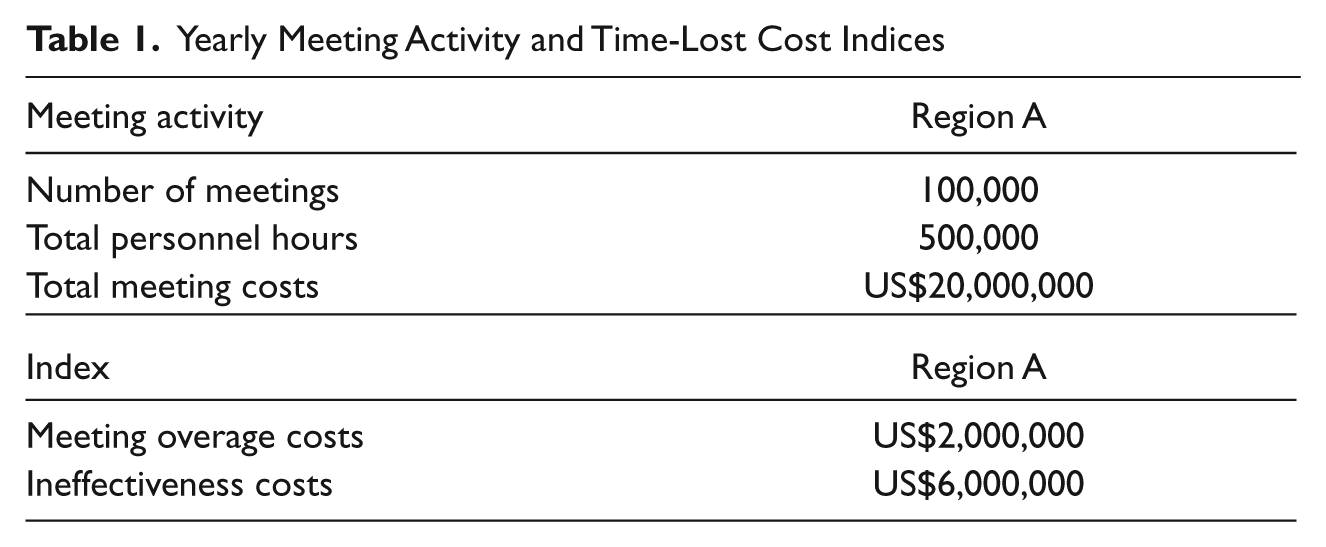
In this example, the organization documented that 100,000 meetings were conducted in the previous year (274 meetings a day). This equated to 500,000 personnel hours (a 1-hour meeting attended by 5 people equals 5 personnel hours). Those 500,000 personnel hours can then be multiplied by the average fully loaded hourly personnel costs. In this example, the average hourly personnel cost is US$40. Taken together, this organization invested US$20,000,000 in meetings this past year. Stage 2 data suggested that 10% of these meetings were completely unnecessary (e.g., just not needed, called out of habit). Therefore, 10% of the US$20,000,000 represents a meeting overage cost (US$2,000,000). Stage 2 also suggested that 30% of time spent in meetings was unproductive. This was likely due to ineffective group processes or poor facilitation of the meeting itself. This percentage of wasted time equates to a US$6,000,000 ineffectiveness cost.
Using the calculations from information such as that listed in the table, an organization can create a number of hypothetical situations to further motivate action. For example,
if the number of unwarranted or excessive meetings were reduced by X%, the organization would recover approximately Y dollars per week.
if meeting management or efficiency were enhanced by X%, the organization would recover an additional Y dollars per week.
Stage 3: Formulate and Implement a Change Strategy
Prior to formulating an intervention strategy, the organization may desire additional diagnostic work to better inform a plan, which is particularly helpful if the organization holds meetings in which members represent different national cultures. As Kohler et al. (this issue) found, meeting norms—expectations regarding the purpose, content, structure, and timing of meetings as well as the roles of participants—can vary widely across cultures. What we have found helpful in our own consultation work with organizations are surveys, interviews, or focus groups on the following topics about group meeting planning, content, and facilitation:
Productive and counterproductive leader and participant behaviors identified in the groups literature such as encouraging participation and fostering constructive conflict resolution
Meeting preparation and follow-through issues
Meeting scheduling (e.g., advance notice)
Appropriateness around the number of meetings called (too few or too many)
Existence and quality of training around meeting facilitation
Satisfaction with the quality and quantity of information shared in meetings
Feedback received, if any, regarding performance in meetings
Decision-making approaches used (e.g., majority vote) in meetings
Participant evaluation of other participants meeting attitudes and behaviors
Leader evaluation of other participants meeting attitudes and behaviors
Participant evaluation of leader meeting attitudes and behaviors
Results from the above diagnostic efforts can drive the organization’s choice of change strategy in pursuit of better meetings. The change strategy could have a number of components: (a) build feedback and accountability systems for groups, (b) create high-fidelity training and team leader development systems, and (c) establish productive cultural practices.
Increase Feedback and Accountability
To motivate performance and promote positive change, employees and group leaders need to receive feedback on their performance in meetings. At the same time, this feedback can be monitored so that ultimately there is accountability for poor performance in meetings and recognition for good performance in meetings. Most organizations have a performance appraisal system in place whereby a supervisor evaluates his or her direct report on a variety of job-relevant dimensions. Given the frequency of meetings at work, one such dimension should focus on effective meeting leadership and participation. Similarly, many organizations use multisource feedback systems to provide feedback on key competencies to their leaders. Behaviors around effective meeting leadership and participation should be one such competency on which peers, direct reports, and supervisors weigh in. For example, we have used in our consulting work prompts such as “The meeting leader . . .
provides an agenda before the meetings he or she calls.
starts meetings on time.
runs meetings effectively.
comes prepared to meetings.
uses meeting time strategically (to address critical issues).
covers relevant issues at the meetings.
creates an environment where people are comfortable disagreeing in meetings.
listens carefully and actively during meetings.
does not allow any one individual to dominate the meeting.”
At the very least, feedback can be provided at a departmental level by assuring that an organization’s annual employee survey contains content addressing time and effectiveness of meetings.
Training/Leadership Development
Skills in effectively running meetings, managing group processes, and group leadership are essential for an organization to promote. This starts with basic classroom training focused on the design of effective meetings. Skills training can include topics such as the strategic use of agendas, time management, group process facilitation, and minute taking (Leach, Rogelberg, Warr, & Burnfield, 2009). From our experiences working with client organizations, it is apparent that many managers believe that their group meeting skills are above average. This is similar to research showing that people have a tendency to think they are above average on just about any dimension (Baumeister & Finkel, 2010), such as intelligence, even though it is impossible for everyone to be above average. Given this, more individual-based training is needed where the manager is either coached directly by someone who observes their behavior in meetings or by having managers go through a development assessment center that addresses meeting activities. For example, from the Beck et al. article we learned that managers may filter what they say in public meetings and be more forthright in private meetings. A coach observer can provide customized feedback around whether too much censoring is occurring and whether these actions are undermining trust and the credibility of the manager. Individual-based training on meeting success is particularly relevant for those leaders going through on-boarding (transition to a new leadership position). Do these leaders have the skills to be effective stewards of others’ time in their new role?
Introducing a Strategic Meeting Design Focus Into the Organization’s Culture
A strategic meeting design focus refers to sensitizing the organizational population that time in group work meetings is an investment that should be carefully managed. Cultural practices can then be designed to support the effective use of meetings. For example, Amazon Corporation implemented a two-pizza guideline (Deutschman, 2004); that is, the number of people attending a meeting should not exceed the number of people that could be fed with two pizzas. Another best-practice example comes from Intel Corporation, which decorates its conference rooms with a standard set of posters asking: Do you know the purpose of this meeting? Do you have an agenda? Do you know your role? Another example from Intel is that every new employee of all ranks and jobs are required to take the company’s course on effective meetings (“The State of Meetings Today,” 2004).
Conclusion
Recovery of wasted group time and effort in needless or ineffective meetings is an opportunity for organizations—an opportunity with tremendous return on investment implications. This article describes a three-stage process and approach for maximizing the potential of meetings for groups and organizations. Successful organizations do not treat meetings as a necessary evil; rather they view them as an organizational phenomenon that can be actively managed and leveraged. Bad meetings do not need to be considered a norm of organizational life. Ultimately, successful organizations realize that improving just one meeting per week can lead to significant benefits for the organization while also contributing to the health and motivation of employees.
Footnotes
The author(s) declared no potential conflicts of interest with respect to the research, authorship, and/or publication of this article.
The author(s) received no financial support for the research, authorship, and/or publication of this article.