




Abstract
We examined the moderating roles of team psychological safety and relationship conflict on the relationship between two forms of team cognitive diversity—expertise and expertness diversity—and team performance. We found that when team psychological safety was lower, rather than higher, expertise diversity was more negatively related to team performance, but conversely, expertness diversity was more positively related to team performance. When team relationship conflict was lower, rather than higher, expertness diversity was more positively related to team performance. Our findings advance a contingency view of the effects of cognitive diversity on team performance and suggest several implications for theory and practice.
With organizations increasingly using self-managed teams for decision-making and problem-solving (Haas, 2010; Mathieu, Maynard, Rapp, & Gilson, 2008), how a team’s diversity affects its performance remains an important research area (Milliken & Martins, 1996; Williams & O’Reilly, 1998). Although a majority of team diversity research has focused on demographics such as race or sex (see van Knippenberg & Schippers, 2007, for a recent review), researchers have repeatedly called for more attention to cognitive diversity (i.e., diversity in “information, knowledge, and perspectives” [van Knippenberg & Schippers, 2007, p. 527]; see also Jackson, Joshi, & Erhardt, 2003; Milliken & Martins, 1996). Cognitive diversity should be more directly task-relevant or job-related than demographic diversity, especially for decision-making or knowledge-based tasks, as it is “associated with skill-based and informational differences among work group members” (Joshi & Roh, 2009, p. 600; see also Jehn, Northcraft, & Neale, 1999; Simons, Pelled, & Smith, 1999; Webber & Donahue, 2001).
Cognitive diversity exists in many forms and is a natural characteristic of any team. Recently, van der Vegt, Bunderson, and Oosterhof (2006) called attention to the distinction between two types of task-related cognitive diversity. The first is expertise diversity, which is variation within the team in the “types of knowledge, skills, and capabilities team members possess as a result of education, experience, and natural ability” (Dahlin, Weingart, & Hinds, 2005; van der Vegt et al., 2006, p. 877; italics added); examples include educational background diversity and functional background diversity. The second is expertness diversity, that is the extent to which team members differ in their “level of expertise (i.e., the expert-ness)” at performing the team’s task (van der Vegt et al., 2006, p. 877; italics in original); examples include diversity in training on a task and diversity in the level of knowledge of a task. Expertness differs from general mental ability in that it refers specifically to “task-related competencies” rather than to more general cognitive abilities (van der Vegt et al., 2006, p. 877). To illustrate the difference between diversity in expertise and in expertness, a top management team composed of the heads of various functions such as marketing, finance, engineering, and human resources may be diverse in expertise due to members’ differences in functional background, but may also be diverse in expertness at integrating acquisitions due to differences among team members in the number and complexity of acquisitions integrated during their prior work experience.
Much of the existing research on the various forms of expertise and expertness diversity has focused on their main or mediated effects on performance (e.g., Knight et al., 1999) or has used dependent variables other than performance (Dahlin et al., 2005; Jackson et al., 1991; van der Vegt et al., 2006). As with most diversity research (Joshi & Roh, 2009; Kearney, Gebert, & Voelpel, 2009), research on these forms of diversity has produced inconsistent results, prompting calls for the examination of potential moderators or contingency factors (Jackson et al., 2003; Simons et al., 1999; van Knippenberg, De Dreu, & Homan, 2004). Consistent with this contingency perspective, we examined the moderating effects of a team’s immediate affective context on the relationships between cognitive diversity and team performance. A diverse team’s immediate context, or its “discrete diversity context,” is “the immediate environment in which interpersonal interactions between diverse team members occur” (Joshi & Roh, 2007, p. 6). Researchers have suggested that the affective context of a team should influence the dynamics of diversity within the team because it may affect team members’ comfort in expressing diverse opinions and perspectives and their ability to integrate those perspectives to perform team tasks (e.g., van Knippenberg & Schippers, 2007). The specific aspects of the immediate affective context of a team that we chose to examine are psychological safety and relationship conflict. Although many variables could capture a team’s immediate affective context, we focused on psychological safety and relationship conflict as they have been the focus of a large amount of research, and prior research evidence suggests that they may be critical contextual factors moderating the effects of diversity on team performance (e.g., Gibson & Gibbs, 2006; Gibson & Vermeulen, 2003; Joshi & Roh, 2007).
Our study seeks to contribute to research and practice in several ways. We attempt to better understand two forms of cognitive diversity that researchers have noted are relatively understudied compared with demographic characteristics (Jackson et al., 2003; Milliken & Martins, 1996; van der Vegt et al., 2006; van Knippenberg et al., 2004). Examining these types of diversity is important because, relative to demographic diversity, expertise and expertness dimensions of cognitive diversity should more accurately capture the underlying attributes of teams that relate directly to task performance, especially for problem-solving and knowledge-work teams (van Knippenberg & Schippers, 2007). Furthermore, by examining team psychological safety and relationship conflict as moderators, our study offers a contingency model of the effects of cognitive diversity on performance, which researchers have argued might help to explain some of the mixed findings in team diversity research (Joshi & Roh, 2007, 2009; Lawrence, 1997; van Knippenberg & Schippers, 2007; Williams & O’Reilly, 1998), and provide guidance to managers on when expertise and expertness diversity are most likely to benefit or harm the performance of teams in their organizations.
Theory and Hypotheses
Expertise and expertness diversity are both particularly relevant in teams working on problem-solving or knowledge-based tasks (Gladstein, 1984; Mohammed & Ringseis, 2001), which are the focus of this study. Such tasks are intellective tasks in which the range of information, as well as the abilities of members to process and work through the complexities of the task, has a strong bearing on the team’s performance (McGrath, 1984). Prior research suggests that both expertise and expertness diversity could potentially have positive or negative effects on team performance—that is, they could be beneficial or harmful to teams (see reviews by Mathieu et al., 2008 and Milliken & Martins, 1996). The contingency view of the effects of diversity suggests that the direction and magnitude of effects will depend on contextual conditions facing the team.
Expertise diversity represents variety in type, source, or category of relevant knowledge among team members (Harrison & Klein, 2007). Thus, team members with differing bases of expertise are expected to bring varied knowledge, perspectives, and approaches to a team’s task, creating the potential for a wider range of ideas being applied (Hoffman & Maier, 1961). The information/decision-making perspective on diversity argues that this greater amount and variety of information should benefit a team working on problem-solving or knowledge-based tasks, resulting in a positive relationship between expertise diversity and team performance (Williams & O’Reilly, 1998). However, the very same variety of ideas and perspectives that could potentially improve team performance of a team diverse in expertise could also reduce the potential benefits or even harm team performance. As Hambrick, Cho, and Chen (1996) observed, “[a]lthough heterogeneity may provide wider cognitive resources, it may also create gulfs or schisms that make the exchange of information difficult” (p. 663). Furthermore, research suggests that unique information is more difficult to integrate in diverse teams (Mohammed & Ringseis, 2001). As a consequence, expertise diversity could result in process losses due to difficulties in integrating the diverse perspectives and ideas represented in the group, which may weaken the potential benefits of the variety of perspectives and may even result in a negative relationship between expertise diversity and team performance. Thus, sometimes expertise diversity “may engender outright distrust and acrimony, as widely dissimilar group members may have different vocabularies, paradigms, and even objectives. . . . [such that] their aggregate cognitive endowment can become a net liability” (Hambrick et al., 1996, p. 663).
Expertness diversity is a type of disparity diversity, or diversity that represents differences in the level of valued resources or assets possessed by team members (Harrison & Klein, 2007). Expertness diversity occurs when one or more members in a team have better ability to perform the task than do others and can exist at any average level of team expertness. This type of diversity is prevalent in work teams and represents an interesting, but as yet understudied, aspect of team diversity (van der Vegt et al., 2006). Much of the prior literature argues that “more is better” when it comes to team composition variables that have to do with the level (rather than type) of cognitive resources available, such as expertness (Bell, 2007). Obviously, it would be desirable to have all team members uniformly high in expertness for a task, and prior related research on team composition in cognitive ability suggests that the average level of team cognitive ability has a small to medium positive effect on team performance (e.g., Bell, 2007; Devine & Philips, 2001), leading us to expect a positive relationship between mean team expertness level and team performance. However, because our interest here is in variation in expertness and not its mean level, we develop our arguments and test our hypotheses, controlling for the mean level of expertness in a team. Researchers have noted that examining such variation is important in developing a more complete picture of the dynamics of expertness in teams (e.g., Devine & Philips, 2001). Thus, our research question is: Controlling for mean team expertness, how does team expertness diversity affect team performance? As with expertise diversity, the literature suggests contrasting potential effects.
Arguments for both the potentially positive as well as negative effects of expertness diversity on team performance are rooted in theories of power and status (Harrison & Klein, 2007; van der Vegt et al., 2006). For team tasks such as problem-solving or decision-making, which Steiner (1972) classified as disjunctive tasks, the superior expertness of one or a few members can cause the entire team to perform well. However, this assumes that the power structure in the team is such that members with higher expertness have greater say in the team’s task performance than those with lower expertness. The literature suggests that in the average team, this is in fact a likely outcome. Researchers typically find that team members who are higher in expertness are afforded greater power and status by others (Bunderson, 2003; van der Vegt et al., 2006). Consequently, they have greater voice and influence in defining and conducting the team’s task, although those that are relatively lower in expertness are allowed less influence (e.g., Driskell & Salas, 1991; Ibarra, 1992). Prior research suggests that such a distribution of influence, which results in those with the highest expertness having the greatest influence over task performance, should result in superior performance (Barry & Stewart, 1997; Ilgen, Hollenbeck, Johnson, & Jundt, 2005; Tziner & Eden, 1985). However, in some cases, a power structure that is based on and matches the expertness levels of team members may not materialize. This is particularly likely for self-managed teams, which are the focus of our study, as the self-management aspect makes such tasks “discretionary” in Steiner’s (1972) conceptualization. In such teams, group members decide how to organize and work on the task and collectively need to agree on the distribution of roles, responsibilities, and authority. As a result, there is the potential for status contests as a consequence of a mismatch between expertness levels and relative influence of team members. These status contests may be manifested in negative team dynamics such as “within-unit competition, suppression of voice, reduced (quality of) communication, and interpersonal undermining” (Harrison & Klein, 2007, p. 1201), all of which can harm team performance on knowledge-based tasks.
Consistent with the contrasting performance effects of expertise and expertness diversity that are theoretically suggested by the literature, empirical research has not found consistent main effects. For example, in top management team composition research, some scholars have reported a positive relationship between educational background diversity (which is the most common form of expertise diversity studied) and performance (Hambrick et al., 1996), although others have found no significant effect (Bantel & Jackson, 1989). Also, a recent meta-analysis reported an overall small negative effect of educational background diversity on team performance (Bell, Villado, Lukasik, Briggs, & Belau, 2007). Similarly, results for the effects of functional background diversity on team performance have been mixed (see Mathieu et al., 2008, p. 438). To date, little research exists linking expertness diversity to team outcomes. Van der Vegt and colleagues (2006) found that in teams diverse in expertness, members are more likely to help those who are seen as more expert; however, the study did not include predictions about team performance. Although there is not a body of research linking expertness diversity to team performance, the literature on cognitive ability diversity suggests some parallels for predicting the likely effects of expertness diversity. Cognitive ability diversity is also a type of disparity diversity that is likely to generate status dynamics similar to those generated by expertness diversity. Within this literature, some studies have reported a positive relationship between cognitive ability diversity and team performance (e.g., Barrick, Stewart, Neubert, & Mount, 1998), although others have reported a negative relationship (e.g., Devine, 1999).
Thus, overall the literature and empirical findings suggest both positive and negative effects of expertise and expertness diversity on team performance. Consequently, researchers have called for a contingency approach focused on understanding how contextual factors affect whether a particular type of diversity has a positive or negative effect on a team (Joshi & Roh, 2007; Lawrence, 1997; Williams & O’Reilly, 1998). Indeed, it might not be possible to fully understand how cognitive diversity affects team performance without taking into account whether or not conditions in the team facilitate or impede the surfacing, discussing, and combining of various perspectives or the application of expertness to the team’s task. Thus, in this study we examine how the effects of expertise and expertness diversity on team performance are moderated by team psychological safety and relationship conflict, both variables that prior research suggests are important aspects of the internal affective context of a team.
Team Psychological Safety and Relationship Conflict as Moderators of Cognitive Diversity-Team Performance Relationships
As critical elements of a team’s immediate affective context (Gibson & Vermeulen, 2003; Joshi & Roh, 2007), team psychological safety and relationship conflict may affect the dynamics of diversity in a team, thus potentially moderating the effects of diversity on team performance (Gibson & Gibbs, 2006; Kirkman, Rosen, Tesluk, & Gibson, 2006; Simons et al., 1999; van Knippenberg et al., 2004). 1 Psychological safety and relationship conflict may be particularly important to self-managed teams that are diverse in expertise and expertness because they may influence team members’ comfort in sharing ideas, challenging each other, accepting others’ opinions, or offering alternatives (Joshi & Roh, 2007; Marks, Mathieu, & Zaccaro, 2001). This argument is consistent with prior research findings that such aspects of the internal team context “can set specific constraints and opportunities that either enhance or minimize the direct effects of work team diversity on performance” (Joshi & Roh, 2009, p. 601).
Team psychological safety
Team psychological safety is defined as a “shared belief that the team is safe for interpersonal risk taking” (Edmondson, 1999, p. 354). For several reasons, we argue that psychological safety will moderate the relationship between team expertise diversity and team performance. Expertise diversity creates the potential for the expression of divergent perspectives due to varying member expertise, which can provide the team with a greater range of information (Hoffman & Maier, 1961; Williams & O’Reilly, 1998). However, whether or not the team performs better depends on the extent to which members are able to surface, effectively discuss, and integrate the various perspectives resulting from their expertise diversity, which is often a challenge for teams (Dahlin et al., 2005; Homan et al., 2008; Homan, van Knippenberg, van Kleef, & De Dreu, 2007; van Knippenberg et al., 2004). Higher psychological safety can reduce this challenge by creating a context in which members are more comfortable expressing their unique perspectives, challenging and seeking elaboration of ideas, and integrating ideas into a team solution (Edmondson, 1999; Gibson & Gibbs, 2006). Thus, higher psychological safety in a team creates conditions that may help teams to more effectively use their diverse perspectives on a task, thereby benefiting team performance.
In contrast, lower psychological safety may stifle unique information that could be obtained from the diverse expertise of team members and may make it more challenging to discuss and integrate the information into the team’s outputs. Unique information is less likely than common knowledge to be shared in teams with lower psychological safety due to the perceived risks associated with unique perspectives (Edmondson, 1999; Shin & Zhou, 2007; West, 2002). Lower psychological safety also reduces the likelihood that team members will engage one another in a way that challenges, elaborates, and integrates ideas into solutions to team tasks (Shin & Zhou, 2007). Rather, lower psychological safety could create process losses during the surfacing and integrating of the ideas of team members diverse in expertise (Edmondson, 1999). Essentially, when individuals do not feel safe expressing different opinions, there is an increase in coordination difficulties resulting in process losses, which not only negate potential benefits from expertise diversity but may result in performance losses as well. Taken together, the lack of unique perspectives, poor interaction dynamics, and greater process losses overall would decrease team performance (Hambrick et al., 1996; Steiner, 1972). Thus, we propose:
Hypothesis 1: Team psychological safety will moderate the relationship between team expertise diversity and team performance, such that the relationship will be positive when psychological safety is higher and negative when psychological safety is lower.
In contrast to our expectation of negative effects of lower psychological safety for the dynamics of expertise diversity, we make the opposite moderating argument in the case of expertness diversity. This is because the beneficial effects of psychological safety proposed in the literature rest, in part, on the assumption that team members with varied backgrounds and experiences will be equally capable of contributing high-quality ideas and perspectives that ultimately contribute to team performance. On the contrary, expertness diversity, by definition, assumes that all individuals are not equally capable of contributing valued inputs to team performance. As discussed earlier, in teams that are diverse in the expertness levels of members, it is optimal for team performance that the more expert members have greater influence over team task performance (e.g., Barry & Stewart, 1997; Ilgen et al., 2005; Tziner & Eden, 1985), an arrangement that is, on average, likely to emerge in self-managed teams (Bunderson, 2003; Driskell & Salas, 1991; Ibarra, 1992; van der Vegt et al., 2006).
The level of team psychological safety can serve to reinforce or interfere with this distribution of influence. Higher psychological safety in a team is likely to facilitate contributions by all members, including those with lower expertness (Edmondson, 1999; 2003). The resultant effort taken in discussing potentially lower-quality contributions, or the integration of inferior ideas, may result in lower team performance. That is, in teams diverse in expertness, it is likely that the equal input across members resulting from higher psychological safety could work to the detriment of the team because the psychologically safe context would afford members with lower expertness the same opportunities to express their ideas and influence the team’s task performance as it would members with higher expertness. In contrast, when team psychological safety is lower, members with lower expertness (and thus lower status) may be hesitant to take the interpersonal risk of injecting their potentially lower-quality ideas and perspectives into the team’s discussions (Edmondson, 1999). Instead, they are likely to let members with higher expertness take the lead, and may take on the roles of helpers in the process (van der Vegt et al., 2006). This arrangement will allow members with higher expertness to drive more of the team’s task activities, ultimately resulting in higher team performance. The lower psychological safety may not present as much of an interaction risk for members with high expertness because of their higher status, thus affecting their likelihood of providing input less than that of lower-expertness members. Therefore, we predict:
Hypothesis 2: Team psychological safety will moderate the relationship between team expertness diversity and team performance, such that the relationship will be more strongly positive the lower the psychological safety in the team.
Team relationship conflict
Teams vary in the extent to which they experience conflict while working on a task (Jehn, 1995). Our interest in this study is in the level of conflict present as a part of the affective context or climate in which team interactions take place, rather than in other aspects of conflict such as conflict emergence or the conflict management process (Behfar, Peterson, Mannix, & Trochim, 2008). Researchers have differentiated primarily between task and relationship conflict in teams (e.g., De Dreu, 2006; Jehn, 1995), with some researchers further separating process conflict from task conflict (Jehn & Mannix, 2001). Between task and relationship conflict, the former is sometimes proposed to have positive effects on team performance because it is argued that it helps teams make more informed decisions (e.g., Van de Vliert & De Dreu, 1994). However, research findings for the effects of task conflict on team performance have been mixed (De Dreu & Weingart, 2003; de Wit, Greer, & Jehn, 2012). A recent meta-analysis found that the effect of team task conflict on team performance is –.01 and is contingent on factors such as the organizational level of the team and the criterion used to assess performance (de Wit et al., 2012). In this study, we controlled for the potential effects of task conflict and focused primarily on relationship conflict as it is more theoretically relevant for our arguments regarding the role of moderators that make up the immediate affective context of a team.
Recent meta-analyses have found that in a majority of extant research, relationship conflict has negative effects on team performance and satisfaction (De Dreu & Weingart, 2003; de Wit et al., 2012). Important to our arguments here is that the findings for relationship conflict support the “traditional information processing perspective that conflict interferes with information processing capacity and therefore impedes task performance, especially when tasks are complex and demand high levels of cognitive activity” (De Dreu & Weingart, 2003, p. 747). Because the type of task that our study is focused on demands high cognitive activity, we expect that the effects of relationship conflict will be deleterious for the relationships between both types of cognitive diversity and team performance.
The interference in team information processing caused by high relationship conflict is particularly important for teams diverse in expertise, as the conflict is likely to negate the very benefits afforded by such diversity. That is, high relationship conflict will make it difficult for team members to effectively express, discuss, and integrate the various perspectives deriving from their different bases of expertise and to come up with an effective solution to the team’s task (Jehn, 1995; Jehn et al., 1999). In contrast, when there is low relationship conflict, not only is the context likely to be more conducive to discussion and the integration of diverse perspectives, but the team is also likely to use less time and fewer cognitive resources dealing with the conflict, thus allowing for a better focus on task performance (De Dreu & Weingart, 2003; Jehn et al., 1999). Thus, we expect:
Hypothesis 3: Team relationship conflict will moderate the relationship between expertise diversity and team performance, such that the relationship will be more strongly positive the lower the relationship conflict in the team.
We expect that the moderating role of relationship conflict on the effect of expertness diversity will be similar to that for the effect of expertise diversity, but for different theoretical reasons. As stated earlier, in teams diverse in expertness, members with higher expertness have greater power and influence over the definition and performance of the team’s task, and those with lower expertness tend to take on a helping role (van der Vegt et al., 2006), an arrangement that should result in positive team performance (e.g., Barry & Stewart, 1997; Ilgen et al., 2005; Tziner & Eden, 1985). Prior research suggests that this arrangement of power and influence is more likely to be supported when there is lower, rather than higher, relationship conflict in the team (Sell, Lovaglia, Mannix, Samuelson, & Wilson, 2004). Thus, we expect a positive effect of expertness diversity on team performance when relationship conflict in a team is low.
In contrast, because conflict in teams tends to transfer from one domain into another (Greer, Jehn, & Mannix, 2008), team members may be more likely to dispute a status ordering based on level of expertness when relationship conflict in a team is high. In discussing the relationship between power, status, and conflict, Sell and colleagues (2004) suggest that conflict may function as a “power unbalancing mechanism,” whereby those of lower status in a team contest the more dominant role of higher-status members in the functioning of the team (p. 57). In such a case, the negative environment and status contests created by higher relationship conflict may make members with higher expertness reluctant or unable to contribute ideas and effort or to take the lead on task performance. In addition, it may make members with lower expertness less willing to play their more typical helping role. Consequently, team performance is likely to suffer. Thus, we expect:
Hypothesis 4: Team relationship conflict will moderate the relationship between expertness diversity and team performance, such that the relationship will be more strongly positive the lower the relationship conflict in the team.
Method
Sample
We tested our hypotheses using a sample of 736 students enrolled in a master’s program in information technology (IT) management, randomly organized into 196 teams of three to five people each, in several sections of a capstone IT course at a large university in France. The participants were on average 22.5 years old, 59.5% were female, and 95.2% were of French nationality. Due to university regulations, we were not allowed to collect data on race or ethnicity. The students completed a semester-long IT project focused on using IT tools such as databases to solve a complex business problem as part of the course requirements. The team project grade constituted a significant portion (i.e., 30%) of a student’s grade for the course.
The project was designed as a capstone experience in that it drew on knowledge from prior courses within the master’s program. Therefore, prior performance in the program was relevant to performance in the project. Given that the project required breadth and depth of knowledge, expertise and expertness diversity were both relevant to team performance. The project was also aimed at enhancing students’ teamwork skills. Thus, the instructors monitored team process during the semester to ensure that each team worked on the task regularly and interdependently, and to identify and rectify social loafing. Over the course of the semester, teams also submitted several updates on their progress (e.g., initial idea, project plan, meeting agendas, etc.) as well as on team process, but these were not graded. The instructors provided feedback on the scope of the projects based on the project idea description and the project plan, but did not provide feedback based on the other interim submissions (i.e., meeting agendas and status updates).
We chose this type of task because there is prior evidence that when a task is nonroutine and complex, task-related cognitive diversity will have an important impact on team performance (Gladstein, 1984; Mohammed & Ringseis, 2001). Our choice of university graduate students as our sample is consistent with a long existing line of research examining diversity using such populations (van Knippenberg & Schippers, 2007). Our use of a non-U.S. sample is consistent with a recent trend toward broadening diversity research by using samples from other countries, such as the Netherlands (van der Vegt et al., 2006) and Korea (Shin & Zhou, 2007), and with calls for more diversity research to be conducted outside the United States (Joshi & Roh, 2007).
With consent from participants, we collected data from university records, as well as through a web-based survey. The survey, which assessed team psychological safety and conflict, was administered during the semester when more than half of the time allocated for the project had elapsed. This time point was chosen as it allows enough time for the phenomena of interest to develop, and because most of the actual work on a project tends to be performed in the second half of a team’s lifespan (Gersick, 1988), psychological safety and conflict at that point can be expected to influence the teams’ task performance. To minimize translation errors, the surveys were translated from English into French by one individual and then back-translated into English by a different individual in accordance with commonly accepted translation procedures (Brislin, 1980). A few minor discrepancies between the two English versions were resolved. At the end of the project, each team was assigned a team grade for the project by the course instructor, which was obtained from the instructor with consent from the participants.
Measures
Independent variables
As an indicator of expertise diversity, we used a team’s diversity in the educational backgrounds of its members operationalized as undergraduate majors (see Dahlin et al., 2005, for a similar operationalization). Because this is a variety type of diversity (Harrison & Klein, 2007), we computed it using Blau’s (1977) heterogeneity index: (1—ΣPi2), where Pi is the proportion of the group in the ith undergraduate major category. Information on each participant’s undergraduate major was obtained from university records with the participant’s prior consent. Using the university’s classification scheme, undergraduate major was classified into sciences (61%), social sciences (34%), literature (2%), management, (1%), and international program (2%).
To assess the level of a team member’s expertness for the team task, we used the respondent’s cumulative grade point average (CGPA) up to that point in the master’s program. Because the team project was a capstone project requiring team members to draw on their prior courses in the program, their CGPA for prior courses going into the team project can be considered a good indicator of the students’ expertness in the preparation and skills needed to work on the team project. We acknowledge that a CGPA reflects not just expertness but also motivation and other factors. As such, although not perfect, CGPA provides a reasonable approximation of level of expertness for the task in our context. Also, because the master’s program follows a cohort format, students were very familiar with their teammates and although grades were not released publicly, it was well understood within each cohort who the good or high performing students were. Consistent with guidelines for measuring a disparity type of diversity (Harrison & Klein, 2007), we computed expertness diversity as the standard deviation of the current CGPAs of team members (Bedeian & Mossholder, 2000). Information on each participant’s CGPA for prior courses taken in the program, current as of the semester in which the data were collected, was obtained from university records with the participant’s consent.
Dependent variable
Team performance was measured as the grade assigned to a team’s project by the course instructor. To validate the grading, another instructor who taught other sections of the same course graded 46 of the team projects independently. The intraclass correlation between the grades provided by the two instructors for these 46 teams was .926 (p < .001), indicating a very high level of agreement. The common team grade made up 30% of each team member’s individual grade. Grades were computed from a total of 20 points, and averaged 11.78, with a range of 3 to 19, providing sufficient variance to examine team performance.
Moderator variables and task conflict
The moderator variables and task conflict were assessed using individual responses to the questionnaire survey, which were aggregated to the team level. The appropriateness of aggregating individual responses to the team level was ascertained based on analyses of rwg, ICC(1) and ICC(2) (Bliese, 2000; James, Demaree & Wolf, 1984). Discriminant validity between psychological safety and task and relationship conflict was assessed using confirmatory factor analysis, which indicated an acceptable fit for a three-factor solution (χ2 = 307.76, df = 62, p < .01, RMSEA = .10, NNFI = .94, CFI = .96), which was better than the fit for one-factor and two-factor solutions. We measured psychological safety using Edmondson’s (1999) 7-item measure. A sample item is: “The unique skills and talents of members of this team are valued and used by other members” (α = .82). A team’s psychological safety was computed as the average of individual scores on the measure (rwg = .90; ICC(1) = .09; ICC(2) = .27, F = 1.28, p < .05). We assessed team relationship conflict using a 3-item scale used by Jehn and Mannix (2001). A sample item is: “How often do people get angry while working in your team?” A team’s level of conflict was computed as the average of individual responses (α = .86, rwg = .90; ICC(1) = .07; ICC(2) = .21, F = 1.27, p < .05). Similarly, we assessed team task conflict using a 3-item scale used by Jehn and Mannix (2001). A sample item is: “How often do you have disagreements within your team about the task of the project you are working on?” (α = .83). Individual responses were averaged to the team level (rwg = .86; ICC(1) = .07; ICC(2) = .23, F = 1.30, p < .05). Although the ICC(2) values were lower than desired, the ICC(1) values were in line with values often observed in field samples, and the F-statistics indicated significant mean differences across teams; also, the low ICC(2) values stem partly from the small unit sizes in the sample (Bliese, 2000). Thus, we proceeded to examine our hypotheses at the team level of analysis.
Control variables
Based on prior research (Cohen & Bailey, 1997; Kozlowski & Bell, 2003), we tested several team characteristics as potential control variables. The significant ones included team size and team average age. Thus, we included them as control variables in the regression analyses, in addition to the team’s average expertness level (average CGPA) and task conflict.
Results
The means, standard deviations, and intercorrelations for the variables are shown in Table 1. Before testing our moderating hypotheses, we centered all of the independent variables (Aiken & West, 1991). We tested the hypotheses using a 3-step moderated regression analysis (Table 2). We entered the control variables (i.e., team size, team average age, team average expertness, and team task conflict) in Step 1, the independent variables (i.e., team expertise diversity and expertness diversity) and moderator variables (i.e., psychological safety and team relationship conflict) in Step 2, and the interaction terms calculated by multiplying the centered independent and moderator variables in Step 3. Analyses of the variation inflation factor (VIF) indicated that multicollinearity was of little concern. To establish the significance of the unique effect of each interaction term, we entered all four interaction terms simultaneously in the regression equation. Although this is a very common procedure employed in organizational studies for testing multiple interaction effects, researchers have advised caution in interpreting the results of such a block test (e.g., Jaccard & Dodge, 2009; Jaccard & Turrisi, 2003). Specifically Jaccard and Turrisi (2003) observed that “When two separate interaction terms are included in the regression equation . . . then the coefficient for a given interaction term is interpreted . . . with the proviso that the other two-way interaction (as well as all other covariates) is statistically held constant” (p. 68). Thus, our test of each of the four interaction effects described below assumes that the other three interaction effects are held constant. Furthermore, in our presentation of findings, we report the percentage of unique variance accounted for by each interaction term when entered separately. The zero-order correlations (Table 1) indicate that the diversity variables did not have a significant direct relationship with the two moderators, ruling out an alternative model in which psychological safety and relationship conflict mediate the effects of expertise and expertness diversity on team performance.
Means, Standard Deviations, Reliabilities, and Correlations Among Study Variables.

Note. N = 196. Correlations greater than .15 are significant at the p < .05 level. Scale reliabilities are in parentheses along the diagonal.
Hierarchical Regression Results Predicting Team Performance.
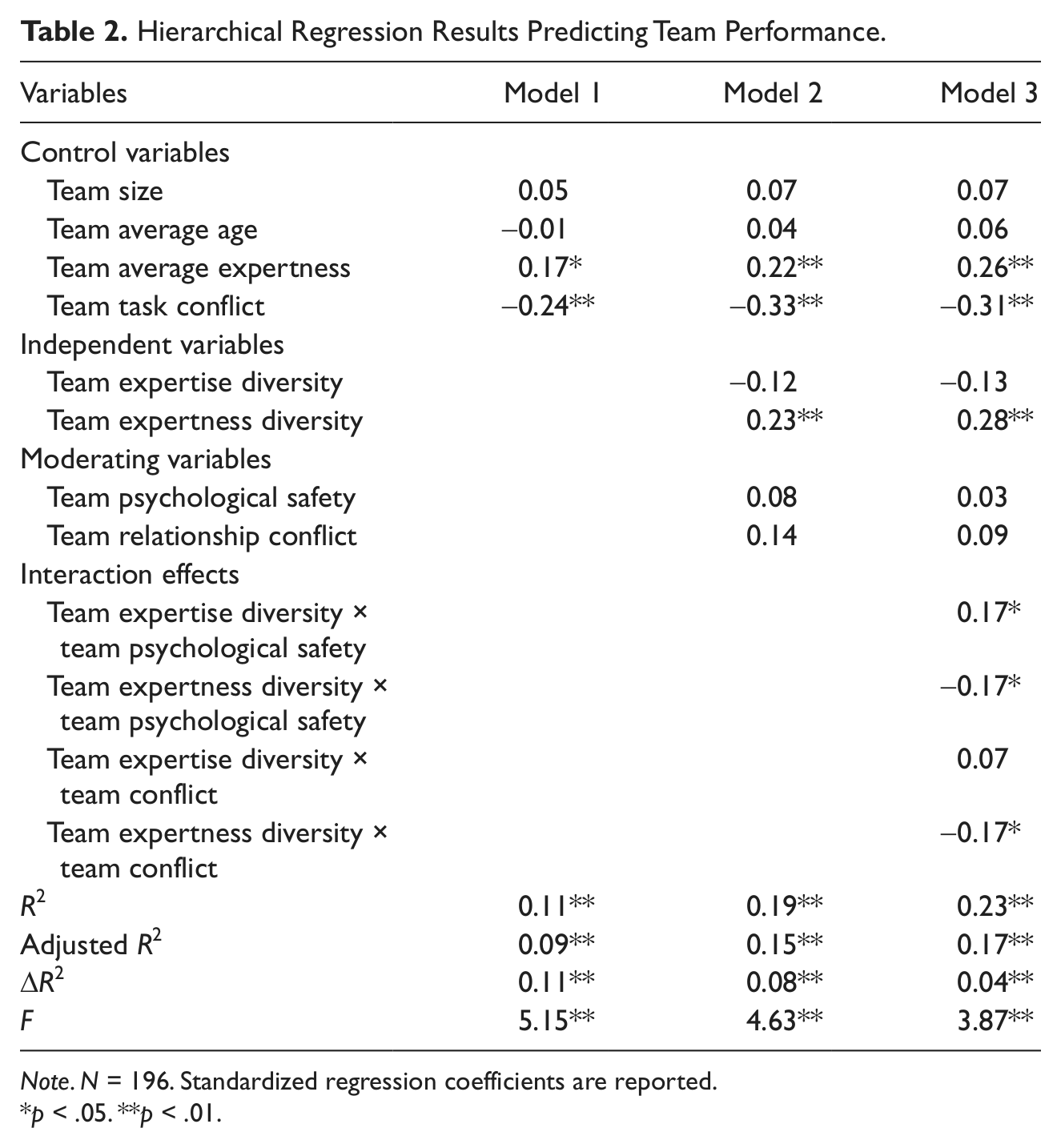
Note. N = 196. Standardized regression coefficients are reported.
p < .05. **p < .01.
Hypothesis 1 stated that team psychological safety would moderate the effects of a team’s expertise diversity on team performance. The interaction of expertise diversity and team psychological safety was significant (β = .17, p < .05) and accounted for 2.2% of variance explained (p < .05) when entered alone. Consistent with Aiken and West (1991), we examined the nature of the significant interaction by plotting the regression lines for the relationship between team expertise diversity and team performance at high and low levels of psychological safety, represented by the values at one standard deviation above and below the mean respectively (Figure 1). The plot indicates that the relationship between expertise diversity and team performance is slightly positive, but statistically nonsignificant (t = .41, p > .10) when psychological safety is higher, but is significantly negative (t = −2.81, p < .01) when psychological safety is lower. Thus, Hypothesis 1 was supported for lower levels of psychological safety, but not for higher levels.
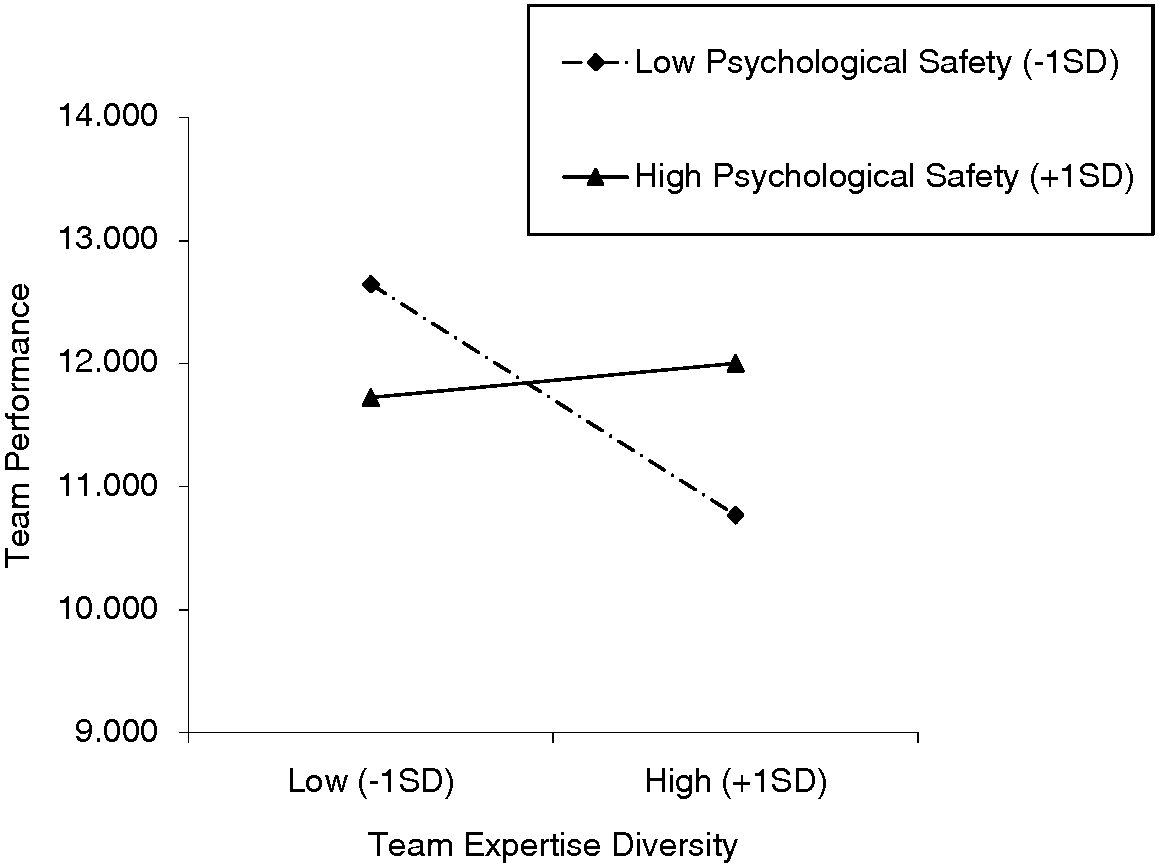
Interaction of team psychological safety with team expertise diversity in predicting team performance.
Hypothesis 2 stated that team psychological safety would moderate the effects of a team’s expertness diversity on team performance. The interaction of team expertness diversity and team psychological safety was significant (β = –.17, p = .05) and accounted for 1.9% of variance explained (p = .05) when entered alone. The plot of the moderation (Figure 2) indicates that, as predicted in Hypothesis 2, there was a more positive relationship between expertness diversity and team performance when team psychological safety was lower (t = 3.42, p < .001), rather than higher (t = 1.03, p > .10). Thus, Hypothesis 2 was supported.
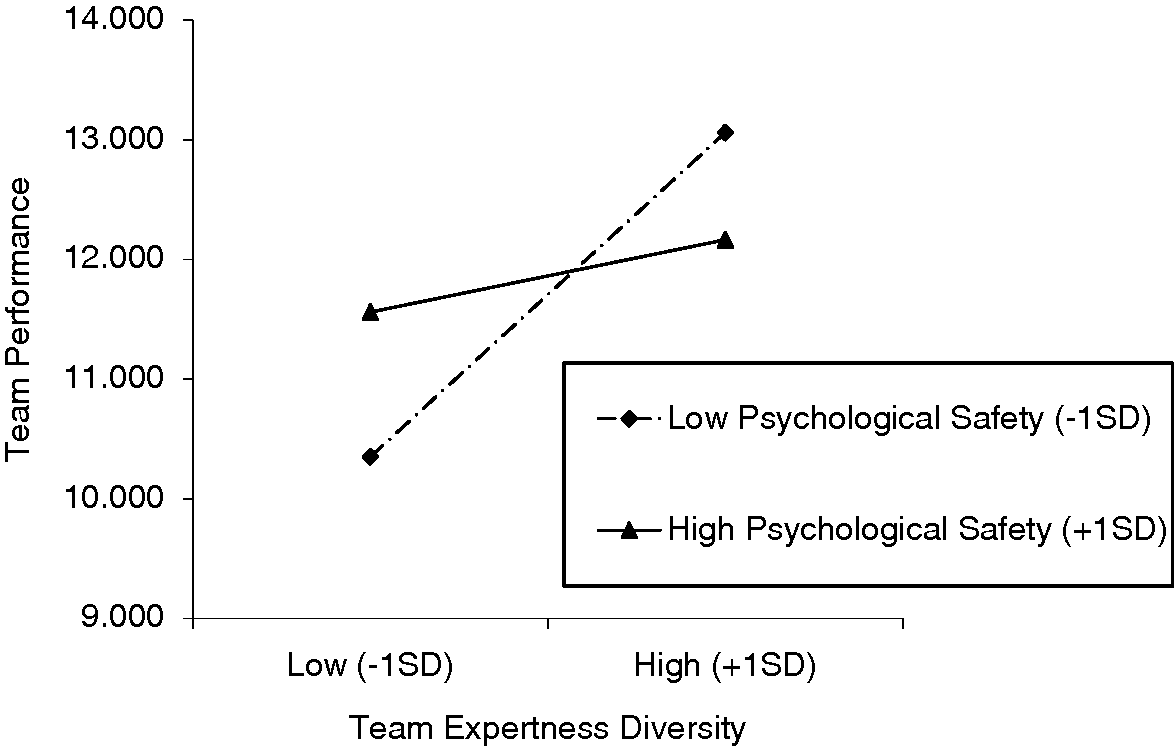
Interaction of team psychological safety with team expertness diversity in predicting team performance.
Hypothesis 3 stated that team relationship conflict would moderate the effects of expertise diversity on team performance. The interaction of expertise diversity and team relationship conflict was not significant (β = .07, p > .10). Thus, Hypothesis 3 was not supported.
Hypothesis 4 stated that team relationship conflict would moderate the effects of expertness diversity on team performance. The interaction of team expertness diversity and team conflict was significant (β = –.17, p < .05) and accounted for 1.9% of variance explained (p < .05) when entered alone. The interaction plot (Figure 3) indicates that the relationship between expertness diversity and team performance was more strongly positive when team conflict was lower (t = 3.66, p < .001), rather than higher (t = 1.10, p > .10). Thus, Hypothesis 4 was supported.
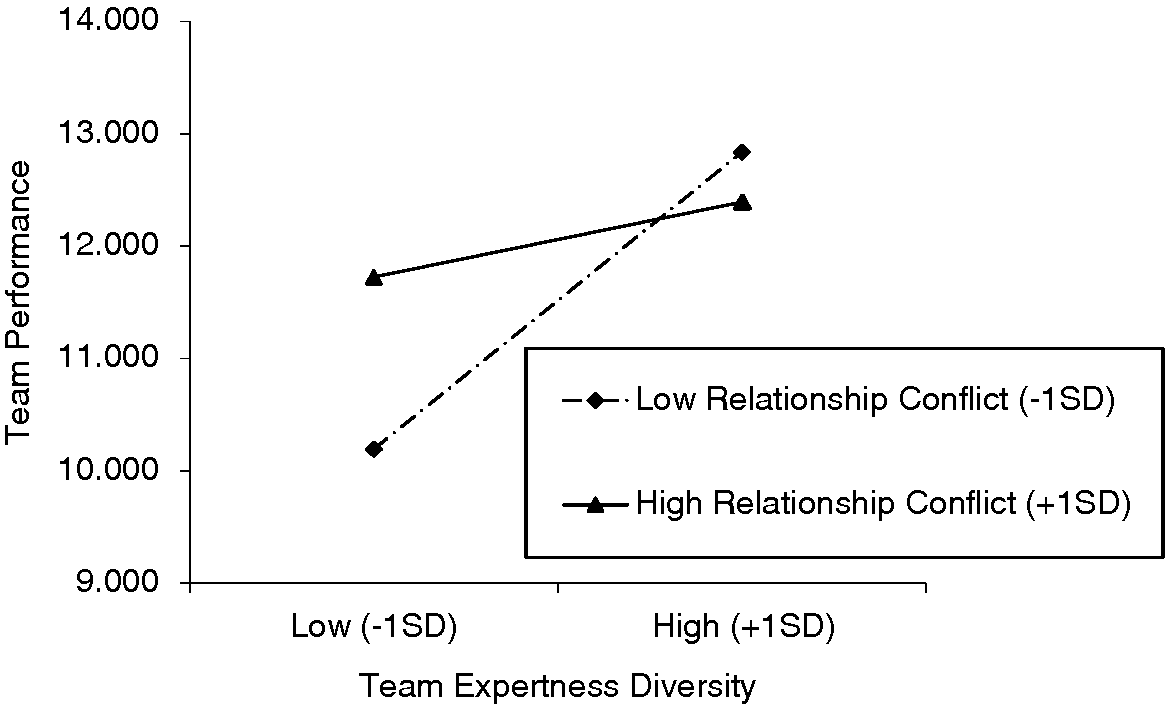
Interaction of team relationship conflict with team expertness diversity in predicting team performance.
Discussion
We examined the effects of two forms of cognitive diversity—expertise and expertness—on team performance. In line with a contingency perspective of diversity (Lawrence, 1997; Simons et al., 1999; van Knippenberg & Schippers, 2007), we focused on how two important aspects of a team’s immediate affective context—psychological safety and relationship conflict—moderated the effects of these types of cognitive diversity on team performance. Our contingency model is based on the idea that the immediate affective context of a team likely influences the dynamics of cognitive diversity by facilitating (or inhibiting) the surfacing and integration of differing information, opinions, and perspectives of various team members. Furthermore, we expected the contingency effects to generate different outcomes depending on the type of cognitive diversity under examination. Our results generally support our research model and generate new insights for both theory and practice.
Theoretical Implications
Our findings suggest several theoretical implications. First, we found that when team psychological safety was lower, the relationship between expertise diversity and team performance was negative but the relationship between expertness diversity and team performance was positive. Our finding of a harmful effect of lower psychological safety on the relationship between expertise diversity and team performance is consistent with other research on moderators of this relationship, including effectiveness of debate and discussion of ideas (Simons et al., 1999), team identification (van der Vegt & Bunderson, 2005), and transformational leadership (Shin & Zhou, 2007).
Finding a beneficial consequence of lower psychological safety in teams with high expertness diversity, however, contrasts with much of the literature arguing that higher levels of psychological safety create a positive context in which team members can better interact across different diversity dimensions such as nationality (Gibson & Gibbs, 2006), thereby resulting in a positive relationship between diversity and team performance. Our finding may be explained by examining the types of diversity studied. Much of the prior research that suggests that lower psychological safety has negative consequences for diverse teams (e.g., Gibson & Gibbs, 2006) also assumes that every member of the team is equally capable of contributing high quality ideas and inputs. However, in the case of expertness diversity, this assumption does not hold because this type of diversity is a disparity type, which by definition assumes unequal abilities to contribute to the team’s task. Our findings suggest that psychological safety as a contextual influence on the effects of team inputs may, in fact, have different effects depending on the type of diversity considered or the nature of the team task. Our findings are similar to those for cohesion. Although cohesion creates a positive context for facilitating team performance in general (Beal, Cohen, Burke, & McLendon, 2003), for some types of teams and tasks, higher cohesion can lead to lower performance through team cognition problems such as groupthink (Janis, 1971), which are less likely when there is lower cohesion.
Importantly, our findings underscore the importance of differentiating among the various theoretical mechanisms underpinning different types of diversity (Harrison & Klein, 2007; van Knippenberg & Schippers, 2007). Although most research on the effects of cognitive diversity relies on the information/decision-making perspective (Williams & O’Reilly, 1998), we were careful to differentiate this theoretical rationale, which we used in the case of expertise diversity, from the theoretical foundations of the effects of expertness diversity; as a disparity type of diversity, expertness diversity is better understood using theories of power and status (Harrison & Klein, 2007; van der Vegt et al., 2006).
Second, in line with recent meta-analyses on the effects of conflict in teams (De Dreu & Weingart, 2003; de Wit et al., 2012), we found that the relationship between expertness diversity and team performance was more strongly positive when team relationship conflict is lower, rather than higher. This finding supports the view that lower levels of conflict are necessary for the formation of an expertness-based status ordering in a team diverse in expertness, so that those with the greatest expertness can drive the team task, and those with lower expertness play a supporting role (Sell et al., 2004; van der Vegt et al., 2006).
Third, our study answers calls for contingency models of diversity in contrast to the main effect models that dominate existing research (Jackson et al., 2003; Joshi & Roh, 2009; Kearney et al., 2009; van Knippenberg & Schippers, 2007). We demonstrate that the effects of expertise and expertness diversity may be contingent on other team factors. Thus, our study provides some insight into the “black box” of the complex relationships that explain the outcomes of diversity (Lawrence, 1997). An interesting avenue for future research into the contingent effects of these types of diversity as well as other forms of cognitive diversity is examining their interactive effects on team performance.
Managerial Contributions
Researchers have noted the importance of cognitive diversity while also observing that little research exists on such diversity to guide managerial action (Olson, Parayitam, & Bao, 2007). The main implication of our findings is that managers ought to carefully monitor and manage the levels of psychological safety and relationship conflict in teams as they can influence how cognitive diversity affects team performance. In teams that are diverse in expertise, managers should intervene by coaching members in establishing a psychologically safe context (Hackman & Wageman, 2005). Also, in managing teams with large differences in expertness, managers should assess team relationship conflict and assist the teams in reducing it.
Recommendations for enhancing team performance often include the notion that all team members should be given equal opportunities for input and that all member input should be given fair consideration (Katzenbach & Smith, 2003). However, our findings suggest that these recommendations may apply only to those teams with a relative balance in expertness among members. In teams with more varying levels of expertness, those with the highest levels of expertness should be allowed more influence over team process and outcomes (van der Vegt et al., 2006). We are certainly not suggesting that managers ought to artificially reduce team psychological safety. Indeed, it is not necessary to lower team psychological safety to produce positive performance in teams that are diverse in expertness (which would, according to our findings, also negate positive effects of expertise diversity). Rather, managers can focus on helping teams align role allocation within teams to fit with individuals’ levels of expertness for particular aspects of the task. Consistent with the team mental model and transactive memory literature (e.g., Moreland, 1999), team members need to be made aware of who knows what in the team so that they can more effectively determine role allocation within the team such that there is a match between expertness levels and influence. Such team process interventions can certainly be carried out within the context of psychologically safe teams and may even be facilitated in such teams.
Limitations and Suggestions for Future Research
In interpreting and using our findings, some of the potential limitations of the study should be kept in mind. We used a student sample, which is similar to several important studies on diversity (Dahlin et al., 2005; Harrison, Price, Gavin, & Florey, 2002; Mohammed & Ringseis, 2001; van der Vegt et al., 2006) and has its advantages, but also has the potential to limit generalizability. Thus, whereas this sample allowed us to collect complete data on a large number of teams over a period of time, it may not reflect issues such as organizational politics that are more common in field teams. From a measurement perspective, although our ICC(1) values were in line with the norm for field samples and our F-statistics indicated significant between-team mean differences (Bliese, 2000), our ICC(2) values were lower than the ideal. They could have contributed to the non-finding in Hypothesis 3, and as such the non-finding should be interpreted with caution. Another potential reason for our non-findings could be the relatively low variance in undergraduate majors represented in our sample. Although this level of variation falls within the usual range for studies of other forms of diversity (e.g., race; see Martins, Milliken, Wiesenfeld, & Salgado, 2003) and for many master’s programs as well as for many technology-focused organizations, it might have also contributed to the non-finding for Hypothesis 3.
The task that our teams worked on, although meaningful in terms of personal consequences, was limited to one type and is thus a boundary condition of our findings. Although variation in task type was outside the scope of our study, we encourage future research to examine whether our findings hold for different types of tasks (based on interdependence, complexity, etc.). Due to practical limitations, and the need for model parsimony, we chose two major types of cognitive diversity in this study. Future research should examine other types of cognitive diversity, such as diversity in attitudes and values, using a contingency approach. In this study, we limited our focus to two aspects of the immediate affective context of a team that prior research suggests are critical to self-managed teams working on complex problem-solving tasks. However, this focus is a boundary condition of our findings, and we encourage future research that examines other, less affective aspects of the team’s immediate context such as transactive memory systems, task interdependence, team tenure, and team leadership structure. In addition, researchers could also examine effects of a team’s broader context, such as industry and occupational demography (Joshi & Roh, 2009).
Finally, our finding regarding the positive effect of lower psychological safety in teams that are diverse in expertness suggests a potentially negative aspect of this typically positive element of team functioning. It suggests a need for further research on circumstances (e.g., short-term vs. long-term and complex vs. simple tasks) under which lower psychological safety may have beneficial effects and higher psychological safety may have deleterious effects on team functioning. We acknowledge the possibility that our findings might only apply to teams with shorter tenure, because the teams in our study worked on their projects for the duration of one semester. The results could be different for long-term teams, and thus future researchers should attempt to examine these effects in teams with longer time frames.
Conclusion
Our study sought to expand our understanding of the circumstances under which a team’s expertise and expertness diversity have beneficial or harmful effects on team performance. Our findings support a contingency approach to understanding the effects of cognitive diversity in teams (Lawrence, 1997; Simons et al., 1999; van Knippenberg & Schippers, 2007) and add to prior empirical research using contingency frameworks that have incorporated time (Harrison et al., 2002), context (Joshi & Roh, 2009; Martins et al., 2003), and interaction media (Gibson & Gibbs, 2006) into models of the effects of diversity. Our findings also point out the importance of cognitive diversity, and in particular expertness diversity, in influencing team performance. The results are interesting both from the theoretical and pragmatic perspectives. From a theoretical perspective, they point out the complexities of the effects of diversity in interaction with team dynamics. In so doing, they suggest some explanations for inconsistent findings in prior research. From a pragmatic perspective, they provide guidance to managers in more mindfully managing cognitively diverse teams.
Footnotes
Declaration of Conflicting Interests
The author(s) declared no potential conflicts of interest with respect to the research, authorship, and/or publication of this article.
Funding
The author(s) received no financial support for the research, authorship, and/or publication of this article.
Research Presented at the 2012 Conference of the Interdisciplinary Network for Group Research