



Abstract
This article is third in a series of four describing and integrating a multidimensional approach for measuring and understanding small group process. The construct of cohesion is reviewed and the multidimensional approach is applied to evidence, both conceptual and empirical, resulting from studies of cohesion. Observations and conclusions are discussed regarding cohesion and its current state.
The purpose of this article is to apply the multidimensional system to the empirical literature on cohesion, thereby illustrating in a systematic way the welter of approaches to an often investigated but poorly understood phenomenon. In reviewing the literature, we focused on studies of small groups published in the last twenty years. Although our list is not exhaustive, it is a fairly complete representation of cohesion studies using therapy, encounter, and analogue groups.
Cohesion is one of the more frequently investigated variables in small group process (Bednar and Kaul, 1978; Dies, 1979). The attention that it has received, however, has not created a clear or integrated picture of its determinants and effects. In discussing this dismal state of affairs, Kaul and Bednar (forthcoming) state: “Despite their apparent utility in the practice of group work, however, cohesion and cohesiveness have been a spectacular embarrassment in group theory and research. Over thirty years of effort has not enabled us to achieve an acceptable definition of terms. . . . There is an intractability somewhere in the concepts or in our approaches to their comprehension.” We believe the problem resides in both: The concepts lack consensual definition and approaches to investigating them remain unsystematic.
One issue concerning conceptual definition, discussed in the first article (Fuhriman et al., 1984), is whether the whole is greater than the sum of the parts. Within this issue is a second problem: Variable definitions are often too vague to apply concise and more sophisticated measurement techniques. Since the first widely accepted definition of cohesion as “the total field of forces which act on members to remain in the group”(Festinger et al., 1950: 164), definitions have focused on a collective whole. However, these have typically been operation-alized as members’ attraction to each other or members’ attraction to the group. In such cases, the attraction of individual members to the group is assessed individually and the scores are averaged to represent the collective whole. This assumes that the whole is no greater than the sum of the parts. Evans and Jarvis (1980), in their review of cohesion, concluded that the most common definition for cohesion is member attraction to the group. However, they argued for cohesion being defined in broader terms that more closely represent the gestalt of the whole group. Fuhriman and Barlow (1982), surveying thirty years of attempts to define the concept, suggested that cohesion is to group therapy what relationship is to individual therapy. More specifically, they concurred with Yalom (1975) and Slavson (1964) that cohesion is the composite of member-member, member-therapist, and member group relationships. This tripartite definition appears consonant with Evans and Jarvis’s (1980) suggestion that cohesion represents the group whole. With the greater specificity that these recent theoretical contributions represent, there may be hope for an operationalization of cohesion that is congruent with the definition of the construct. Accomplishment of this would add significantly in clarifying the concept of cohesion.
Attempts to understand cohesion empirically have been as elusive as attempts to define it. The result has been a body of studies that is generally unintegrated and uneven in methodological strength. One of the primary weaknesses has stemmed from the lack of consistency in the definition and measurement of the concept. Thus in attempting to compare the results of several studies, one is never confident that the same concept is under study. Moreover, cohesion as a variable has not been investigated systematically in a manner capable of delineating the determinants, effects, and development of cohesion in small groups. Despite the fact that cohesion has been explored empirically in relation to nearly a dozen variables, the conclusions from these studies remain a disparate smorgasboard. Varying measurement methodologies often make it difficult to compare across studies that employ similar variables and almost impossible to integrate conclusions about cohesion and different variables. One response to this smorgasboard of variables is to examine the measurement parameters of cohesion studies carefully.
Without clearly articulated measurement parameters to compare process variables, the explanatory power across process studies is seriously compromised because the parameters of the different conceptual boxes being investigated are left unstated. Parameters should separate variables within a study so that variables from that study can be clearly understood and cleanly compared with those same variables across studies [Burlingame et al. 1984].
Systematic attention to the measurement parameters of individual cohesion studies should assist in an integration of the literature thus far, as well as suggest how cohesion might be examined in future studies. The multidimensional process classification system (Burlingame et al., 1984) identifies different parameters of small groups along four dimensions, combined and crossed as in a cube moving through a fourth dimension (Figure 1). The first dimension is Person, a delineation of the most prominent units of observation or analysis in group process. This represents the “who” of the investigation. The second dimension is the Variable Function, which describes the definitional complexity of the process variables, or the “what” under investigation. The third dimension is Measurement Strategy, or “how” a variable is observed and quantified. The last dimension is Time, which attends to “when” the variable is measured with respect to the group’s development. The empirical literature on cohesion will be discussed with respect to each of these four dimensions.

A Multidimensional Approach
Cohesion: The Person Dimension
The Person dimension describes the unit of observation and the unit of analysis being used by the researcher. This dimension includes four elements typically examined in group research: individual member, leader, relational subgroups, and the collective or total group. These four categories are used in two different ways in the literature. First, they are used to classify what the investigator observes, or the unit of observation. Second, they are used to classify a researcher’s unit of analysis for statistical manipulation. For any particular study, the unit of observation and the unit of analysis may or may not be the same.
Most of the 25 studies we reviewed assessed cohesion with the member as the unit of observation (Table 1). That is, each individual in the group (leaders excepted) was assessed for actions or reactions relevant to cohesion. Typically, this measure was either a five-item scale by Gross (1957), and eleven-item scale by Lieberman et al. (1973), or a modification of one or the other. However, of the 42 assessments of cohesion that used a member unit of observation, only two employed member unit of analysis (Liberman, 1970; Yalom et al., 1967); both studies tracked individual members with related variables. One study (Lott and Lott, 1961) reported a subgroup as well as a group unit of analysis. The rest (39 measures) used a group unit of analysis. Such a pairing is not unusual in research; we group data points and create a mean in order to make the analysis more manageable. With regard to cohesion, however, this practice brings us back to the question, is cohesion a phenomenon of the group, or the individual, or of both? Use of a group mean is simply the sum of the parts. Recent conceptual definitions of cohesion suggest that it is a larger gestalt. However, reference to Table 1 indicates that prevailing practice in the investigation of cohesion treats it as a member phenomenon.
Cohesion Studies Summarized by Person Dimension

NOTE: O = Unit of Observation; A = Unit of Analysis.
A study that selected the member as both the unit of observation and the unit of analysis warrants further mention. Yalom and Rand (1966) included four measures of cohesion in their study. All four had an individual member unit of observation with a group unit of analyses. One of these measures, an assessment of members’ satisfaction with the session, was also analyzed on a member by member basis; each member’s score was averaged separately over the first six meetings and over the following six meetings to give the person’s “meeting-to-meeting” score. Thus using the member as the unit of observation and the unit of analysis allowed the researcher to track an individual’s change or development over time. Similarly, congruence between units of observation and analyses allow tracking leader, relational subgroups, or the total group.
A number of studies employed the group as both the unit of observation and the unit of analysis. Dies and Hess (1971) tape-recorded group sessions and trained judges to rate the group’s cohesion during randomly chosen five-minute segments along a unidimensional scale. Flowers, Booraem, and Hartman (1981) rated the collective frequency with which group members visually attended to the speaker as an indice of cohesion. Kirshner, Dies, and Brown (1978) used the duration of a group hug at the conclusion of the group as a behavioral measure of cohesion. And in a behavioral study of the reinforcement of cohesion, Liberman (1970) chose the Interaction Process Analysis code (IPA; Bales, 1950) and the Sign Process Analysis-Interpersonal Affect Code (SPA-IAC; Mills, 1964) as measures of cohesion. Both scoring systems rate group behavior and generate group scores. Whether these examples of a group unit of observation/analysis are more effective or accurate measures of cohesion than others might be, remains to be decided. However, by employing the same unit of observation and analysis, the fidelity of the phenomenon and its numerical representation is made more likely.
In addition to illustrating which elements of the group have been observed and analyzed, Table 1 also indicates those elements that have not been included. In a glaring way, it is evident that the leader has not been, and the relational subgroups have seldom been the units of study with regard to cohesion. Although some (Dies, 1979; Yalom, 1975) have described the potential impact a leader has on a group, and Liberman (1970) has demonstrated the capacity of the leader to reinforce cohesive behavior in the group, the empirical literature is bereft of the leader’s perception of group cohesiveness. Similarly lacking is a disposition toward observing and analyzing the behaviors of dyads, triads, and so on that contribute to cohesion. The recommendation by Yalom (1975) and Fuhriman and Barlow (1982) that cohesion be considered as the member-member, member-therapist, and member-group relationships in a group, can now be understood as encompassing the possible units of analyses and observation in the most comprehensive terms. Whereas with other process variables the breadth of the unit of measurement may not be at issue, the conceptual definition of cohesion dictates using more than the individual member unit of observation.
The pattern revealed in Table 1 creates both encouragement and cause for concern. The uniformity in the unit of observation suggests that cohesion is generally being assessed from the same perspective (member), thereby making comparison of results across studies more feasible. However, the general absence of leader, relational subgroup, and collective group ratings creates a discrepancy between empirical measurement strategy and conceptual definition.
Cohesion: The Variable Function Dimension
A second parameter in the measurement of small groups is the variable function dimension. The relationship among variables can be clarified by disinguishing between antecedent variables and response variables. Antecedent variables are defined as events or characteristics occurring in a group that are investigated without regard for preceding events or characteristics in the group. These are generally measures of naturally occurring behaviors, although they may also be experimentally induced. Response variables are characteristics of events occurring in a group that temporally coincide with or follow a prespecified and measurable antecedent variable. With the response function, the primary purpose is in identifying the effect of the response variable. Although this description of variable functions encompasses both correlational and quasi-experimental research designs, its proposed value lies in the consideration it focuses on construct, itself. To understand process variables in small groups more fully, we need to know both what determines and contributes to a process variable, and what effects it has on other variables (process or outcome). Distinguishing between antecedent and response functions and applying these across a body of studies helps explain and evaluate the definition of a construct.
A consideration of the cohesion literature from the perspective of variable function reveals a strong tendency to research cohesion as a response variable. Cohesion was treated as a response variable in twenty of the studies we reviewed, whereas five examined cohesion as an antecedent (Table 2). The determinants of cohesion that have been explored thus far include self-disclosure and feedback (Bednar and Battersby, 1976; Evensen and Bednar, 1978; Jacobs, 1977; Kirshner et al., 1978; Lee and Bednar, 1977; Martin and Jacobs, 1980; Ribner, 1974; Stokes et al., 1983), pregroup training (Bugen, 1977; Bednar and Battersby, 1976; Evensen and Bednar, 1978; Piper et al., 1984; Shipley, 1977; Yalom et al., 1967) composition (Bugen, 1977; D’Augelli, 1973), and compatability (Costell and Koran, 1972; Yalom and Rand, 1966; Yalom et al., 1967). Although strong links between these variables and cohesion have been demonstrated, they constitute only a portion of the determinants that have been theoretically related to cohesion (Fuhriman and Barlow, 1982; Yalom, 1975; Cartwright, 1968). A broader selection of antecedent variables is necessary if cohesion is to become a less intractable concept.
Cohesion Studies Summarized by Variable Function Dimension

Because of the size and complexity of this study, only the two variables relevant to the present article are represented.
Of the five studies that treated cohesion as an antecedent variable, two investigated outcome as a response function (Flowers et al., 1981; Yalom et al., 1967) and one studied communication level and conformity as responses to cohesion (Lott and Lott, 1961). Additionally, cohesion was paired with leader style as an antecedent variable (Hurst et al., 1978), and cohesion was studied alone for its development over time (Peteroy, 1983). This infrequency with which cohesion has been studied as an antecedent is of particular concern for two reasons. One stems from a thorough discussion of cohesion as a curative factor by Yalom (1975). He distinguishes between cohesion and other curative factors by suggesting that although cohesion seems to be therapeutic in its own right, it may also be a condition for the occurrence of other curative factors. Process research could be well served, therefore, by studying other curative factors as responses to cohesion. A second cause for concern relates to the research finding that cohesion is predictive of outcome (Yalom et al., 1967). The relationship of a process variable to outcome is important enough to warrant further research to replicate and further describe this relationship.
In addition to categorizing variables in a manner that demonstrates what has and has not been studied, the Variable Function dimension describes the temporal relationship of variables in a way that promotes a more careful comparison of results across studies. For example, cohesion and self disclosure were investigated in three different ways by Evensen and Bednar (1978), Flowers et al. (1981), and Kirshner et al., (1978). Evensen and Bednar employed both variables as responses to risk-taking disposition and pregroup structure, and found that high risk takers exposed to the behavioral structure condition were involved in more self-disclosure and reported high levels of group cohesion. Flowers, Booraem, and Hartman treated cohesion and self-disclosure as antecedent variables and found that subjects experienced more improvement on problems disclosed in highly cohesive group sessions. Kirshner, Dies and Brown manipulated self-disclosure in an antecedent function, studied cohesion as a response, and found that higher levels of disclosure produced greater group cohesiveness Although all three of these studies can be represented in a general way as showing a positive relationship between self-disclosure and cohesion, greater specificity is made possible through design and measurement parameters. In the first study, both variables were related to common antecedent, but without making a direct correlation between cohesion and self-disclosure. Therefore, the significance of the relationship between the two response variables cannot be determined. In the second study, cohesion and self-disclosure were correlated as antecedent variables, and a positive relationship was found. In the third study, cohesion was examined subsequently to the manipulation of self-disclosure, and a significant positive link was established. These three studies produced compatible findings, making an integrated conclusion easier. Had these studies produced conflicting results, however, an explanation of the variable functions might have been one way of clarifying the results.
It appears, therefore, that cohesion has been investigated in concert with a number of variables, but that this represents only a fraction of the relevant determinants and effects ascribed to cohesion in the theoretical literature. The variable function dimension offers an opportunity to categorize variables in a manner that encourages more breadth and balance in the empirical definition of cohesion. More importantly, however, the dimension explains one of four sets of measurement parameters that governs the manner in which empirical results can be interpreted and integrated across studies.
Cohesion: The Measurement Strategy Dimension
The measurement strategy dimension classifies “how” the process variable is measured. The assumption underlying this dimension is that varying measurement methods may obtain varying results. The multidimensional classification system includes six categories describing how a variable might be measured. Physical indices include nonverbal and physiological aspects of behaviors in the group. These may be of interest as they index less easily measured phenomena. The second category, verbal style, describes the form in which people are communicating without respect to the content or topic. Examples include types of responses such as reflections, confrontations, and statements of agreement. Verbal content is the category of measures that describes the topics of conversation in a group. A rating of self-disclosure by intimate or nonintimate content would fall in this category. Overt behavior categorizes subjective elements of a group’s interaction that are nontheless assessable by an expert rater. Thus an expert could rate an individual’s interpersonal behavior for genuineness, empathy, and warmth. Covert behaviors are constructs not readily observable by a clinician or trained rater. They include thoughts, emotions, and perception, and thus can only be evaluated by the group member in question. The sixth category is therapeutic intervention. This assesses the rationale of particular techniques used by a group leader or member. Phenomena of leader skill or goals of pretraining for members fall in this category.
Applying the measurement strategy dimension to the cohesion studies in Table 3 reveals a relatively homogeneous approach to the investigation of cohesion in terms of measurement strategy. All but one study used a covert behavior instrument for at least one measure of cohesion, and 16 studies relied on that exclusively. Typically, these are self-report measures of attraction to group or other members, attitudes toward group, or degree of investment in the group’s purpose.
Cohesion Studies Summarized by Measurement Strategy Dimension
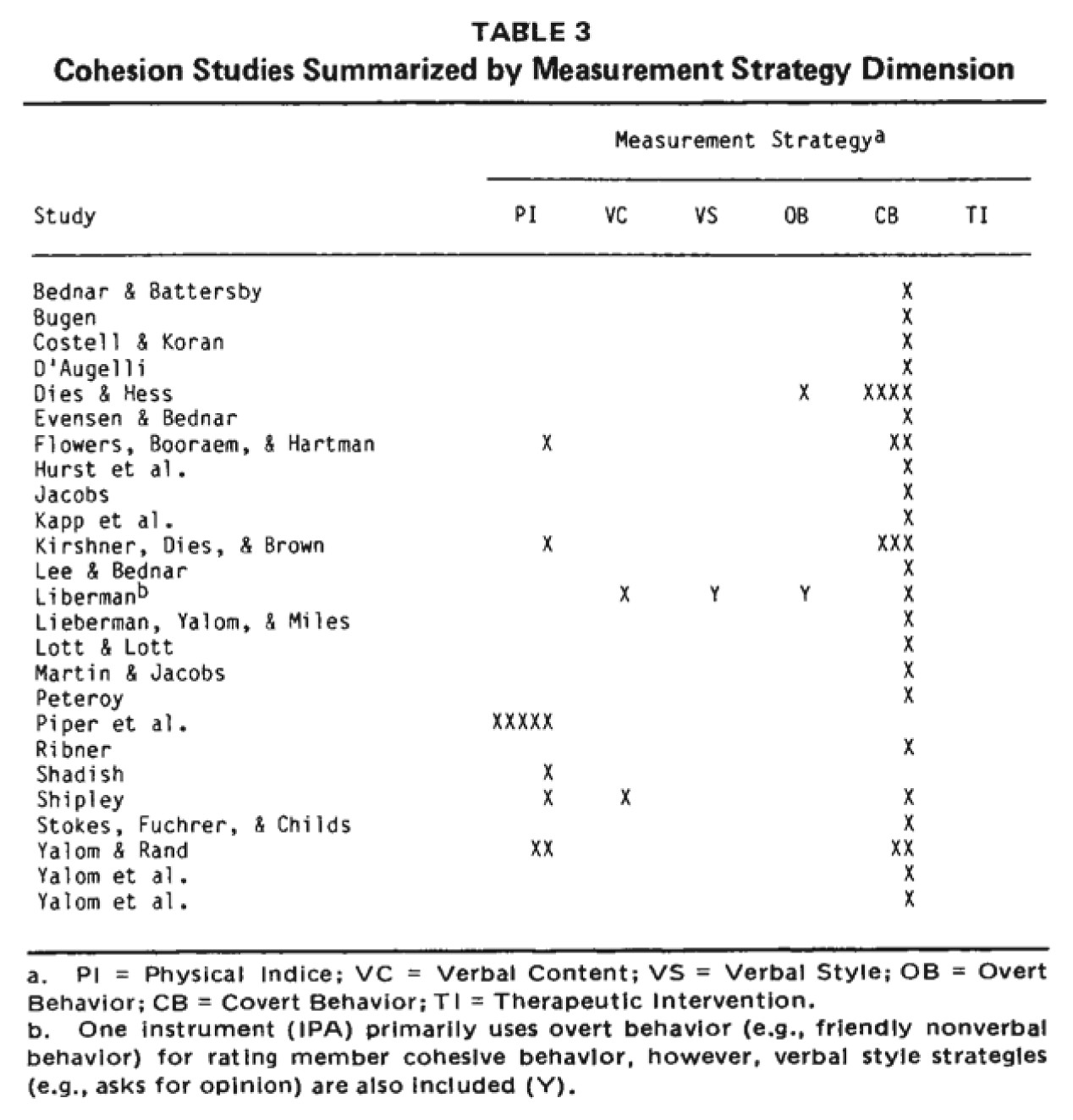
PI = Physical Indice; VC = Verbal Content; VS = Verbal Style; OB = Overt Behavior; CB = Covert Behavior; TI = Therapeutic Intervention.
One instrument (IPA) primarily uses overt behavior (e.g., friendly nonverbal behavior) for rating member cohesive behavior, however, verbal style strategies (e.g., asks for opinion) are also Included (Y).
Of the remaining categories of measurement strategy, physical indice is the next most often employed. Investigators have measured cohesion with attendance (Piper et al., 1984; Shadish, 1980; Yalom and Rand, 1966), early termination (Piper et al., 1984; Yalom and Rand, 1966), physical seating distance (Piper et al., 1984; Shipley, 1977), promptness (Piper et al., 1984), duration of a group hug (Kirshner et al., 1978), and eye contact with other speakers (Flowers et al., 1981).
Two studies have employed measures involving overt behavior to quantify cohesion. Dies and Hess (1971) trained experts to rate behaviors such as shared participation, emotional support, and interpersonal trust by assigning a single numerical value for each five-minute segment of tape. Liberman (1970) selected two categories from the Interaction Process Analysis (Bales, 1950) code, which rates friendliness and agreement. As with the IPA in general, the observer rates overt behavior and verbal style. In addition to the IPA, Liberman used a rating system based on the Sign Process analysis-Interpersonal Affect Code (Mills, 1964), which rates verbal content. These two measures were used on alternate sessions to rate actual, ongoing behavior. Verbal content was also the measurement strategy of one of three measures of cohesion used by Shipley (1977). Hypothesizing that groups high in cohesion could be expected to engage in more self-disclosure and feedback, he trained observers in a rating system that consisted of those two categories and a third one that tallied “other” statements.
Thus when we consider the assessment of cohesion according to the measurement strategy employed, it appears very lopsided. Is the heavy reliance on covert strategy because it fits best with the construct of cohesion, because it is the easiest to apply, or because of a lack of suitable measures? The literature is replete with criticisms of self-report measures (Kazdin, 1978). This yea-nay controversy may be as applicable to cohesion as to other variables. There are, as well, other issues that pertain to a covert behavior strategy for cohesion. First of all, assessment by covert behavior relies on a member unit of observation. As discussed earlier, reliance on this unit of observation is restrictive if one attends to recent conceptual definitions of cohesion. Second, when a construct is poorly defined or operationalized, it is difficult to select an appropriate measurement strategy. Most cohesion studies describe the cohesion measure without mentioning how it operation-alizes the construct of cohesion. Third, if cohesion is a developmental phenomenon, then a body of studies that trace cohesion’s development with frequent measures is clearly called for. However, covert behavior measurement strategies do not lend themselves to repeated measures very well. Strategies of overt behavior, verbal behavior, and physical indices are necessary to the adequate plotting of cohesion over time.
A major problem inherent in this dimension is that various measures of cohesion are seldom correlated, and thus little is known about the equivalence of different cohesion measures. A laudable exception to this tendency is the study by Flowers et al., (1981). They found a significant correlation among their three measures of cohesion: number of members trusted, member satisfaction with group, and attention to the speaker with eye contact. A more frequent situation is to report significant relationships on more than one measure but not to intercorrelate them, or, for the study not to address the issue at all.
The difficulty in comparing results across studies that use measures as diverse as a five-item covert measure of attraction and a record of group attendance is not difficult to recognize. The issue is not which is most valid, but first, are they equivalent and do they have construct validity. Until these issues have been resolved, the measurement strategy dimension provides a means of categorizing studies in a manner that ensures a more accurate interpretation or conclusion.
Cohesion: The Time Dimension
The time dimension describes “when” process variables are measured. At the very least, time punctuates group process by defining the occurrence of measurement; more profoundly, time influences group process. “Time heals all wounds” is an adage that reflects the property of change intrinsic in time. For ease in graphic representation, Figure 1 represents time as an arrow. However, the multidimensional nature of process research can be understood in greater detail if we refract the passage of time and distinguish between time as measurement and time as development. This is particularly appropriate in the case of cohesion, which is regarded by theorists (Yalom, 1975; Tuckman, 1965) as influenced by group development. Time as measurement refers to a variable that is related to or needs to be held constant. For example, a researcher may administer an instrument in all treatment groups at eight hours. Many times, one sampling point is sufficient and the decision is merely a matter of when. Or, to decrease sampling error, two or more times are chosen. Time as development conveys a more complex construct, one worthy of investigation in its own right. It implies that the process variable under consideration changes over time in a systematic manner. Thus there is an interaction effect between time and the variable. As time becomes a more complex construct, the decisions encountered by the researcher become more numerous: how many measurement points are appropriate, when should they begin, how should they be spaced, and so on.
Unfortunately, development literature offers little basis from which to make these decisions. Nevertheless, the times at which a developmental variable is measured may well affect the results.
Because of the widespread agreement that cohesion is developmental in nature, analogue studies take on a special distinction with regard to cohesion. Analogue studies employ short, artifical groups. Due to the lack of empirical detail concerning the development of cohesion in the early hours of group, we have chosen to identify analogue studies in the time dimension for greater clarity.
Table 4 indicates that in eleven of the cohesion studies reviewed, time was defined as a measurement point. Most of the self-disclosure and feedback studies fit in this category. Of the studies that viewed time developmentally, the number of assessments ranged from two to five measurement points. Studies evaluating cohesion over time range from eight weeks (Kirshner et al., 1978; Piper et al., 1984) to 30 months (Kapp et al., 1964).
Cohesion Studies Summarized by Time Dimension
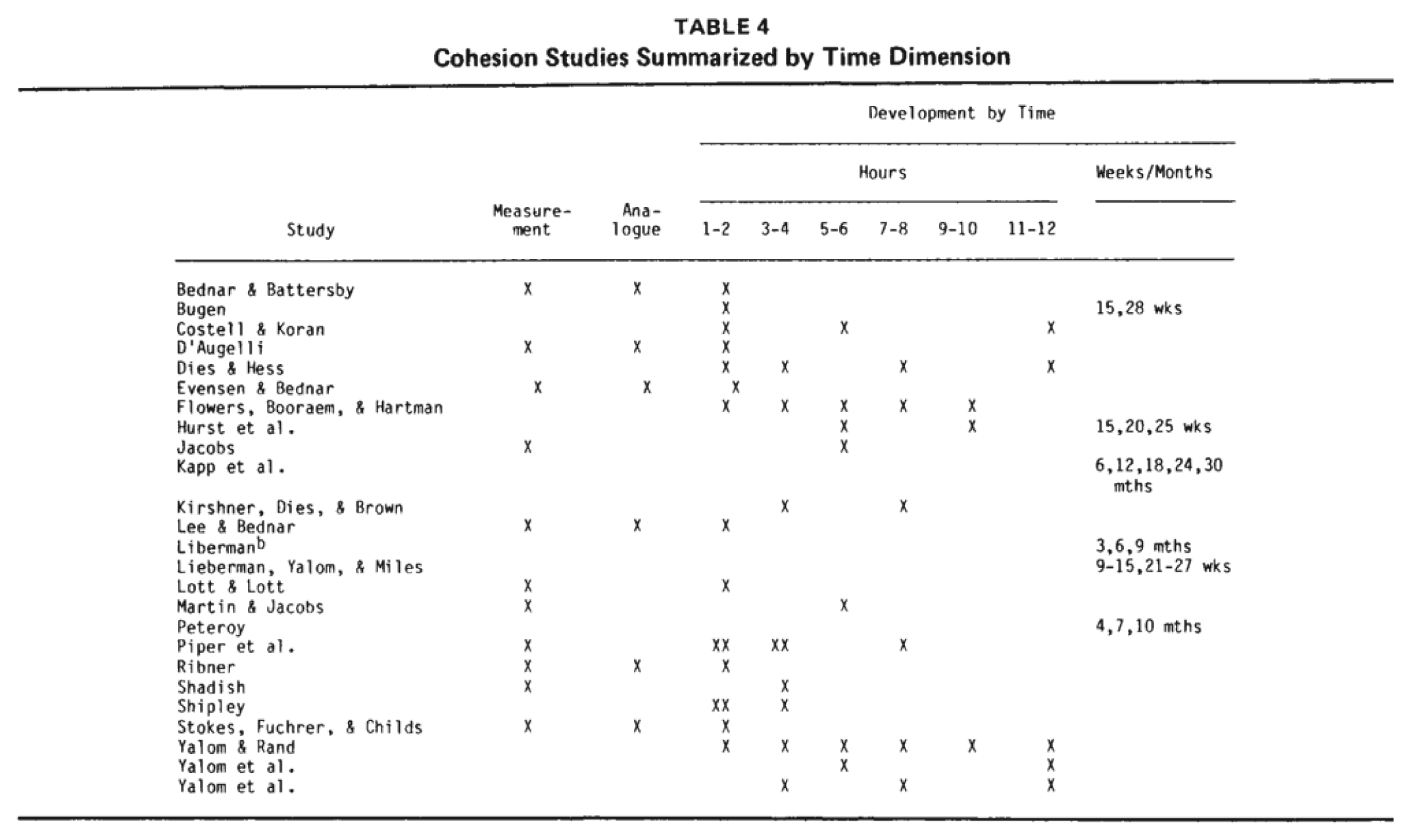
Because cohesion seems to be a process variable that involves maturation, it is surprising that so many studies have measured cohesion at just one moment in time. Collapsing the time dimension to a single data point may eliminate data as important as differences between members or differences between treatment conditions. It is therefore difficult to compare cohesion studies that address time as development with studies that address time as measurement. This difficulty becomes even more troublesome with analogue studies, in which group development is, in effect, collapsed to a minimum (e.g., two hours). How do we compare cohesion in a study that meets for two hours or less, with cohesion that results from 12, 20, or 40 hours of a shared experience? It has been argued elsewhere (Stone, 1984) that analogue studies are of value at the exploratory level of research. In that case, the time dimension of the present system can organize studies by their temporal measurement strategies in a manner that will allow results to be compared in a more relevant manner. By systematically comparing cohesion results in analogue studies with cohesion results from the early hours of small groups, we may come to helpful conclusions about how group development proceeds. On the other hand, the specific components of cohesion may preclude the use of analogue studies in cohesion research.
The time dimension brings to focus a number of additional concerns regarding cohesion. For example, how do we choose time points for measuring cohesion? Thus far it has been a matter of clinical intuition, guessing, or convenience. Programmatic, multidimensional research of cohesion could demonstrate temporal patterns (e.g., unimodal curves, plateaus) that would guide researchers in choosing measurement points. In a related way, one might ask, is cohesion at the sixth hour in a 12-hour group comparable to cohesion at the sixth hour in 24-hour group? A more careful consideration of the time dimension might aid in understanding the roles of expectation and time duration in the pattern of group development.
Time is another facet of cohesion contributing to the noncohesiveness of the literature. The prevalence of attending to time as measurement without also attending to time as development, and the irregular choice of sampling points in studies that do include a developmental variable, inhibit the emergence of patterns that could benefit clinicians and researchers alike. A multidimensional approach to cohesion will, it is hoped, enhance the appreciation of time’s function in the cohesion variable and provide structure that will be helpful in plotting its course.
Cohesion Considered Multidimensionally
In describing the problems that have impeded progress in group process research, we indicated the need for a multidimensional perspective (Fuhriman et al., 1984). The categorical system introduced in the second article (Burlingame et al., 1984) has been illustrated in this article through an application to the cohesion literature. This multidimensional approach, by identifying measurement parameters common to group process research, provides a system for summarizing empirical literature and for designing future studies. In addition, the measurement specificity provided by this approach may contribute to the empirical literature and for designing future studies. In addition, the measurement specificity provided by this approach may contribute to the empirical definition of variables in a manner such that conceptual definitions are enriched.
Having described and employed the four dimensions in reviewing the cohesion literature, we would like to raise two major corollaries. First, equal to the importance of the separate measurement parameters is the interaction of the parameters. For example, if the person and time dimensions are examined simultaneously, it may be that the leader contributes significantly to higher or lower levels of cohesion in the early hours of the group but is eclipsed by member-member or member-group relations as time passes into the middle and later stages of group life. Second, there has been a tendency in a regrettably large proportion of studies to collapse dimensions without acknowledging either the collapse or its effect. For example, the leader and relational subgroup aspects of cohesion have typically been ignored in the person dimension; less frequently, time-as-development has been collapsed to a single measurement. The melting of relevant dimensions robs a process variable of rich detail.
Examination of three studies illustrates how the collective dimensions can aid in understanding the literature. These investigations are methodologically strong and demonstrate the benefits of programmatic research. We would suggest, however, that the cohesion results can be clarified further Bednar and Battersby (1976), Lee and Bednar (1977), and Evensen and Bednar (1978) investigated the effects of group structure. Unexpectedly, they found conflicting results about the impact of group structure on cohesion. Bednar and Battersby examined the effect of three pregroup cognitively mediated messages on early group development and found that specific behavioral instructions were associated with the highest levels of group cohesion. The purpose of a followup study by Lee and Bednar (1977) was to determine the effects of in-group behavioral structure on high- and low risk-disposition group participants. Results showed that high-structure (greater specificity) conditions were associated with the lowest levels of group cohesion. However, an investigation of four variations of pregroup cognitive and behavioral structure on high and low risk disposition participants (Evensen and Bednar, 1978) discovered that the behavioral structure condition was associated with the highest level of cohesion. The differences in results between studies were briefly discussed as issuing from the demand prescriptions of the structure in the second study. Another means of understanding is provided through recourse to the present classification system. Each of the three studies used the same covert behavior of cohesion, the same member units of observation and analysis, and all were analogue studies. However, even though all three studies employed an independent variable, dependent variable analogue design, the variables functioned differently in the Lee and Bednar study. Because of the analogue nature of the study and its short duration (90 minutes), with each administration of the cohesion measure following directly after a 30-minute experimental condition, cohesion and structure occurred simultaneously. In the studies by Bednar and Battersby, and Evensen and Bednar, the structure was pregroup, and the effective relationship between structure and group cohesion was sequential rather than coincidental. Thus there appears to be a temporal relationship between group structure and group cohesion. Whereas cohesion meets the definition response variable by either following, or temporally coinciding with, a prespecified antecedent variable, these two temporal aspects of the response variable may produce differing levels of cohesion.
The preceding analysis not only illustrates the integration of empirical results, but highlights an aspect of the function; that is, whereas the antecedent-response distinction in some ways reflects that of independent and dependent variables, the latter is strictly a design parameter whereas the former attends to the temporal functioning of the construct itself. There is, then, an interaction between time and the constructs being measured that manifests in the variable function, and this is registered in the results.
A caveat here seems timely. Although the purpose of this article has been to review the cohesion literature with a system that appears both discriminating and robust, it has not been our intent to imply that the studies fail to measure up and we should start over. To the contrary, the multidimensional approach provides the framework in which to view studies with sufficient perspective that one is not required to compare only the most rigorous studies in making substantive conclusions. A categorical approach allows for a weighing and balancing of data on their own merits.
Toward the goal of bridging the gap between the conceptual and empirical definitions of cohesion, the multidimensional approach highlights areas of needed investigation. The first regards the person dimension and the need for investigation across all four categories in order to reflect the complexity of recent conceptual definitions. Second, there is a need for more antecedent-response investigations that examine cohesion in both functions. Specifically, determinants of cohesion drawn from the theoretical literature could be examined as antecedent variables and cohesion could be investigated as an antecedent to other curative factors (i.e., insight, catharsis). Finally, the developmental characteristics of cohesion could be explored thoroughly to understand better how cohesion develops across time. The separation and consideration of measurement parameters could enhance process research and thereby lead to more specific outcome research.
Although the multidimensional approach is broad in scope, there are important elements of empirical investigations to which it does not attend. First, construct validity is assumed and not assessed in any manner by the approach. For example, it does not assess the equivalency between conceptual and operational definitions of cohesion. A second limitation of the multidimensional approach is that it does not attend to psychometric properties of the individual instruments. The measurement parameters of an instrument are categorized without reference to whether appropriate reliability exists. If this does not exist, then the results produced by that particular instrument need to be attenuated. Third, although the conceptual complexity of a variable is partially assessed by the variable function dimension, no clear assessment of the adequacy of the study’s design is taken into consideration. For the person who employs a multidimensional approach in reviewing or designing research studies, these additional issues require appropriate attention.
When approaching an area of literature in small group process, one must first ask if studies can be compared, and if so, how that is to be done. Comparing apples and oranges is difficult, and in the cohesion literature, has produced considerable confusion. Many of the cohesion studies cannot be compared with each other. When comparison is appropriate, then tracking the measurement parameters of the studies will allow for more sensible and sound conclusions to be drawn. The same “if” and “when” questions apply to the larger area of small group process. We can make more of the data through a categorical approach.
Thus we return to the point of departure in our articulation of the need for a multidimensional approach to small group process. Being caught between defining process by explaining the parts based on the results of the whole and defining the whole as the result of the individual parts has resulted in pocketsful of information. The multidimensional approach to small group process can help us create a whole that is more than the sum of the parts.
Footnotes
Stuart Drescher is a doctoral student at the University of Utah.
Gary Burlingame is a psychologist at the Comprehensive Clinic and Assistant Professor in Clinical Psychology at Brigham Young University.
Addie Fuhriman is Chairperson of the Department of Educational Psychology at the University of Utah.
AII three authors are involved in group therapy practice and research.