



Abstract
This research introduces the concept of feeling known—or the belief that others have developed accurate opinions of one’s traits and characteristics—to the team literature. Various theoretical streams posit that acquiring a sense of being known and understood is a central human motivation that leads to positive outcomes for individuals. The present research links team member’s sense of feeling known with team member’s reports of interpersonal trust, personal learning, and project satisfaction in a large sample of project teams. Using a longitudinal study design, this research finds that feeling known is indeed a strong predictor of proximal and distal team member outcomes. Additional analyses reveal that team members’ sense of feeling known plays a role in predicting outcomes for both face-to-face and virtual team members, despite the fact that virtual team members report feeling less known than face-to-face team members. The practical significance of these results is discussed.
Keywords
As much as we want to go and run the world from our bedrooms, in our slippers, we are humans, and we need to be touched, seen, and heard. Account executive at Sabre Inc., member of a virtual team
1
Undeniably, one of the most basic human needs is the need to be understood, to receive acknowledgment of one’s unique qualities and characteristics, to be humanized. Social psychologists have long documented the importance of this need in our interpersonal interactions with others (Seyle & Seyle, 2007). More recently, work psychologists from various theoretical orientations have also produced evidence of the importance of this basic human need in the context of our work lives. For example, scholarship in the area of positive organizational psychology has shown that through talking and storytelling, employees bring others’ opinions of them closer to their own self-image, which makes employees intelligible to themselves and aids the development of their professional identities (Gergen, 1994). Similarly, Creed and Scully (2000) describe how when gay, lesbian, bisexual, and transgendered employees sense an alignment between their self-views and others’ views of them, they contribute to their organizations more fully as they feel enabled to act in authentic and genuine ways. Further, the literature on familiarity shows that when individuals have deeper interpersonal knowledge of each other’s skills, perspective, and interpersonal style, they work together better and are more committed to staying together (Gruenfeld, Mannix, Williams, & Neale, 1996; Harrison, Mohammed, McGrath, Florey, & Vanderstoep, 2003). New research on relational or individual-focused transformational leadership shows that followers respond with increased motivation and better performance when they feel leaders understand their unique strengths, preferences, and needs (Kouzes & Posner, 2007; Wang & Howell, 2010). Even research within sports psychology shows that when athletes feel their coaches truly know them, they train harder, and are more committed to the coach and the sport (Jowett & Clark-Carter, 2006). Taken together, these empirical works from the employment context provide clear evidence that employees attach much importance to feeling individuated, understood, and humanized, and they experience various positive outcomes when they feel so.
Although so many streams of research have pointed to the importance of this basic human need, there is no common language that has been used to describe this phenomenon. The central goal of the present paper is to provide such common language by introducing the notion of the sense of feeling known. The sense of feeling known is defined here as one’s idiosyncratic belief that others have formed accurate impressions of one’s traits and characteristics, that they get who one is as a unique individual. When individuals develop a sense of feeling known, they feel uplifted and empowered because others have acknowledged their uniqueness and individuality. Based on a diverse set of theories, including theories of identity negotiation and identity development (Swann, 1984, 1990), of impression management (Goffman, 1959), of metaperception (Elfenbein, Eisenkraft, & Ding, 2009), and of social presence (Garrison, Anderson, & Archer, 2000; Short, Williams, & Christie, 1976), this article develops the theoretical case for the concept of feeling known.
A second goal is to examine the role of the feeling known concept for team member outcomes in the context of project teams. Because teams are social entities, relational constructs, such as the sense of feeling known, have important implications for the positive experiences of team members. For example, a team member who feels known–or who believes that fellow teammates understand her behaviors, beliefs, preferences, and values–is likely to trust her teammates, to enjoy working with her team, and to learn from her team experience. In contrast, a team member who does not feel known–or who believes that fellow teammates have not individuated him and have not gotten to know him as a person–is unlikely to trust his teammates, to enjoy his team experience, or to learn much from it. The account executive quoted at the beginning of this article captured this idea best when he or she said: “we are humans, and we need to be touched, seen, and heard.”
In sum, building on prior literature that informs the feeling known concept, and keeping our own experiences as human beings and as employees in mind, the idea of feeling known is conceptually developed and empirically tested.
Feeling Known
The Case for the Concept of Feeling Known
The concept of the sense of feeling known—or the belief that others understand and have formed accurate impressions of one’s behaviors, beliefs, preferences, and values—represents a natural extension of self-verification theory (Swann, 1984, 1990). Self-verification theory argues that one core motive individuals have in their social relationships is to acquire support for their self-views. Much research has documented that individuals are in fact driven to communicate and confirm their self-views, and that they engage in a variety of active and passive self-verification strategies in order to achieve this goal (Swann & Read, 1981). Active strategies are designed to give others information about oneself in order to bring others’ views closer to one’s own self-views. An example of an active strategy is when individuals display symbols and signs about themselves, such as dress, hairstyle, choice of car, or choice of hobbies or activities. Passive strategies are designed to protect individuals from perceiving nonconfirmatory feedback that could shatter one’s self-views. An example of a passive strategy is when individuals selectively attend only to those behaviors exhibited by others that confirm their self-identities. In short, self-verification is a process whereby individuals’ psychological need to acquire self-confirmation causes them to project and collect information about themselves in order to craft and to sustain their self-identities.
Self-verification theory further predicts that achieving self-verification leads to a host of positive outcomes, including increased positive affect, the display of more intimacy to one’s partner, smoother interpersonal interactions, increased interaction satisfaction, and greater desire to continue the relationship. For example, Burke and Stets (1999) found that when newlyweds agreed on what each other’s spousal roles are supposed to be, they reported less depression and distress, enhanced feelings of self-esteem and mastery, increased trust in the spouse, and greater emotional attachment to the spouse. Furthermore, positive effects of self-verification have been documented in relationships other than marital relationships. Polzer, Milton, and Swann (2002) reported that when members of MBA student teams who worked together for an entire semester accurately assessed teammates’ standing on 11 personal qualities, teams’ creative task performance improved.
Though it appears that research has strongly supported the central role of self-verification for positive interpersonal outcomes, such a conclusion may be somewhat misleading. At issue is the lack of consistency between the theoretical concept of self-verification and the operationalization of this concept in research. Theoretically, self-verification is about bringing others’ views of one’s self closer to one’s own views of one’s self. Operationally, however, self-verification is indexed by some measure of interpersonal congruence, which is defined as the degree of consistency between an individual’s assessment of his/her personal qualities and characteristics, and the assessments of those same qualities and characteristics by another individual or a group of other individuals. For example, congruence has been measured with self-other difference scores (used in Burke & Stets, 1999; Katz, Beach, & Anderson, 1996; Polzer et al., 2002), with the interaction effect of self × others’ ratings (used in De La Ronde & Swann, 1998; Swann, De La Ronde, & Hixon, 1994; Swann & Pelham, 2002), or with various correlational or variance-based approaches. Unfortunately, however, while the presence of interpersonal congruence may suggest that an individual has been successful at bringing another individual’s views closer to his/her own self-views (i.e., self-verification), it may suggest just the opposite— that the individual has redefined his/her views of him/herself to more closely match how others see him/her (i.e., self-categorization). Furthermore, the presence of interpersonal congruence may not even result from any identity negotiation process (i.e., self-verification or self-categorization). Rather, congruence may simply indicate that individuals and their raters agree; that they hold an objectively similar view of reality. In brief, studies documenting the positive outcomes of self-verification may have simply shown that interpersonal congruence—not self-verification per se—has practical utility for individuals in various types of relationships. 2 It follows that measures of interpersonal congruence may not be the best approach to capturing the achievement of self-verification.
More importantly, even if it could be argued that self-verification could be reasonably operationalized with a congruence measure (Swann, Milton, & Polzer, 2000), there is conceptual confusion between the objective achievement of self-verification on the one hand, and the subjective determination an individual makes that he/she has achieved self-verification on the other. The presence of interpersonal congruence may well demonstrate that self-verification has been achieved in reality. However, as self-verification theory itself explains, individuals continuously monitor others’ views of them to ensure that they are consistent with their own self-views. If they determine that others view them in a consistent manner, individuals are happy because they feel self-verified. Conversely, if they determine that others do not see them in a self-verifying manner, they are dissatisfied and motivated to work even harder to bring others to see them more consistently. In other words, what matters is not whether individuals and their raters agree on individuals’ traits and characteristics in some objective sense, but that individuals feel others agree with them about who they are. Hence, individuals’ determination that they have achieved self-verification is a perceptual, idiosyncratic judgment based on whatever feedback individuals have received, and on their own interpretation of that feedback. Again, an objective measure of interpersonal congruence may or may not capture individuals’ beliefs that they have achieved self-verification.
For example, perceivers’ ratings of individuals’ personalities may be in perfect alignment with individuals’ self-ratings, yet individuals may fail to sense that perceivers in fact know them well. The opposite is quite possible too—that is, perceivers’ ratings of individuals’ personalities may be misaligned with individuals’ own self-ratings, yet individuals may feel that perceivers know them well. Therefore, interpersonal congruence or lack thereof is not equivalent to individuals’ belief that others do or do not know them: When objective agreement is high, individuals might or might not feel verified, and vice versa when objective agreement is low. This line of reasoning is consistent with research that has documented that accuracy and beliefs about accuracy are not the same thing (Swann & Gill, 1997). Perhaps more importantly, it is consistent with theories of social construction (Berger & Luckmann, 1967; Salancik & Pfeffer, 1978; Stryker & Statham, 1985), which suggest that reality is in the eye of the beholder, as well as with empirical research that has shown that perceived reality is the most important factor in determining employees’ attitudes and behaviors (Breaux, Munyon, Hochwarter, & Ferris, 2009; Ferris, Adams, Kolodinsky, Hochwarter, & Ammeter, 2002).
This discussion, therefore, identifies an important void in self-verification theory—there appears to be a missing link in the logical sequence of events suggested by the theory. Specifically, I propose that the behavioral act of eliciting self-verification is connected to positive individual outcomes through the sense of feeling known. First, individuals communicate information about themselves through various self-verification strategies. These strategies often bring others to see individuals in a self-verifying manner, which could reasonably be documented by some objective measure of interpersonal congruence. Second, based on the type of feedback individuals collect and on how they idiosyncratically interpret that feedback, individuals reach their own determination regarding whether or not they have successfully achieved self-verification. This determination is best captured by simply asking individuals to what extent they feel known, to what extent they believe that others can or cannot accurately describe their behaviors, beliefs, preferences, and values. Third, the degree to which individuals feel known translates into certain outcomes, such as happiness, relationship satisfaction, and desire to continue the relationship.
In sum, I argue that feeling known is the most direct outcome of individuals’ efforts to elicit self-verification—it represents their own assessment of whether or not they have successfully achieved self-verification. As such, it is a perceptual judgment, an idiosyncratic belief that individuals form based on how they interpret others’ behaviors toward them. Importantly, this belief may or may not coincide with objective reality; yet, it may be a more direct and a more important determinant of individual behavior and the outcomes individuals achieve than objective reality (Breaux et al., 2009; Ferris et al., 2002; Salancik & Pfeffer, 1978). Furthermore, because individuals’ sense of feeling known is perceptual in nature, measures of interpersonal congruence are not well suited to meaningfully capture this new construct. Hence, the present research develops and uses a self-report scale to directly assess individuals’ sense of feeling known, or their belief that they have successfully achieved self-verification and that others know who they are.
Linking the Sense of Feeling Known to Other Theoretical Perspectives
In addition to self-verification theory (Swann, 1984, 1990), a number of other theories and empirical studies suggest that developing a sense of feeling known is a central human motivation. Specifically, metaperception theories explain that perceivers use feedback from their social landscape to determine their relative standing with others (Elfenbein et al., 2009), and that they often reflect on the impressions they make on others (Carlson & Furr, 2009). Similarly, theories of impression management hold that individuals are highly motivated to establish and maintain impressions that are congruent with the perceptions they want to convey to others (Goffman, 1959). This motivation causes them to engage in various impression management (or self-presentation) strategies that are designed to help individuals achieve their interpersonal goals (Thornton, Lovley, Ryckman, & Gold, 2009). Finally, theories of social presence have long discussed the importance to individuals to experience a state of being there (Short et al., 1976), and have more recently proposed that individuals are highly motivated to project themselves to others (Garrison et al., 2000).
Furthermore, these and other theoretical approaches also explain why it is important for individuals to feel known. Metaperception theory proposes that sensing who knows us allows individuals to make more accurate decisions about whom to approach for help, to invite out, or to collaborate with. Interacting with those who know us also reduces the chance for conflict, disagreements, false impressions, and miscommunication (Elfenbein et al., 2009). Research on familiarity—or the degree to which people know each other on a deep, personal level—shows that teams composed of familiar members outperform teams composed of strangers (Gruenfeld et al., 1996). Finally, research on social presence has linked this concept to various learning-related outcomes (Dunlap & Lowenthal, 2009; Richardson & Swan, 2003). Hence, it appears that individuals experience important subjective and objective outcomes when they develop a sense of feeling known.
In brief, the concept of feeling known appears to represent an important human need that, when satisfied, leads to numerous positive outcomes for individuals. This concept has been implied but not explicitly developed in prior theoretical and empirical works. The discussion above attempted to make the case for the concept of feeling known. Next, I turn to the role team members’ sense of feeling known plays for acquiring important team member outcomes, such as trust, satisfaction, and learning.
Hypotheses Development
The Role of Feeling Known for Team Member Outcomes
Individual team member outcomes are an important dimension of overall team effectiveness. As Hackman and Wageman (2005) stated, “We do not count as effective any team for which the net impact of the group experience on members’ learning and well-being is more negative than positive” (p. 272). Specifically, team members may learn new skills and become more aware of personal strengths, and they may derive a sense of personal well-being and satisfaction from their team experience. This research examines a dynamic model of team member outcomes (Figure 1) in which team members’ initial sense of feeling known sets the stage for positive team member outcomes via its influence on perceptions of interpersonal trust and later sense of feeling known. Based on Hackman and Wageman’s descriptions of team member outcomes, the model focuses on the following two outcomes: perceptions of personal learning and project satisfaction.
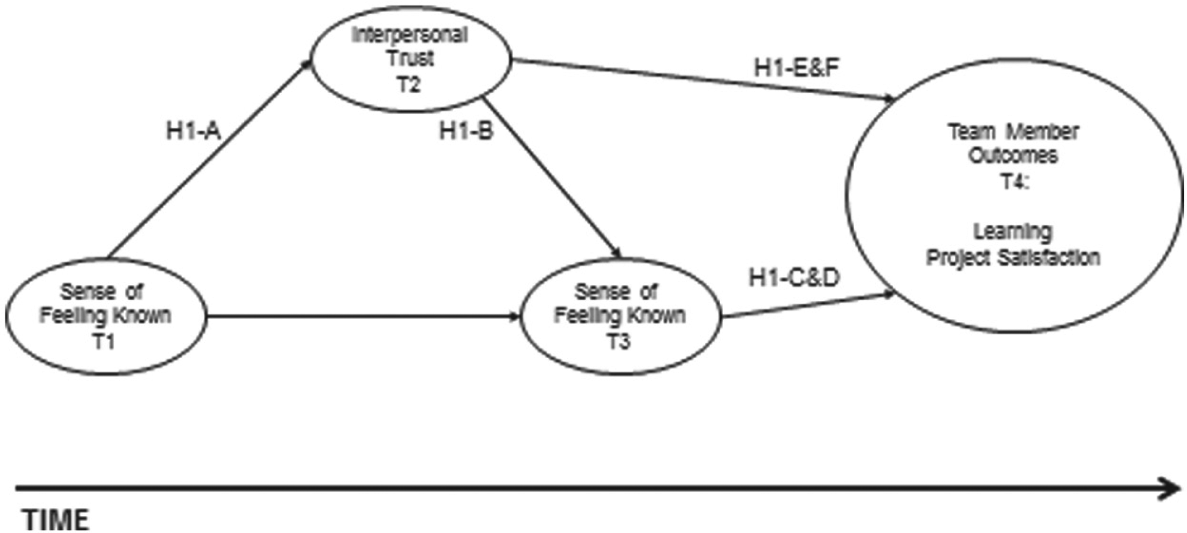
Theoretical model of the relationships between feeling known, interpersonal trust, and team member outcomes over time.
The Interplay Between Feeling Known and Interpersonal Trust
Interpersonal trust—most often defined as one’s willingness to be vulnerable to the actions of others based on one’s positive expectations of the intentions or behaviors of others (Mayer, Davis, & Schoorman, 1995; Rousseau, Sitkin, Burt, & Camerer, 1998)—has received much research attention in the team literature. The present research contributes to this literature by linking interpersonal trust to team members’ sense of feeling known. There are at least two reasons why trust should be an immediate (or proximal) outcome of team members’ belief that others know them well. First, when individuals feel understood and valued, “joined, seen and felt, known, and not alone” (Kahn, 1998, p. 39), they experience affective attachment toward others (Swann & Ely, 1984). Because affect serves as information in evaluating others’ trustworthiness (Williams, 2001), positive affect causes individuals to “perceive others through rose-colored glasses, resulting in a heightened experience of trust” in others (Jones & George, 1998, p. 534; Lount, 2010). Put simply, people tend to like those who they believe know them well (Swann, 1990), and as a result, they are more likely to trust such individuals.
Second, in ongoing teams especially, team members tend to be quite focused on building interpersonal relationships (Saunders & Ahuja, 2006). Both the self-verification literature and the trust literature paint feeling known and trust, respectively, as key ingredients in the relationship-building process. Specifically, the self-verification literature states that the very reason why individuals desire to achieve self-verification is so that they can have smooth social interactions and positive connections with others. The trust literature states that the central criterion for a high-quality, positive relationship is the establishment of trust between the parties. Since both phenomena are integral to the building of positive interpersonal relationships, they must be linked, with feeling known most likely serving as an informational input in one’s decision to trust others. Indeed, Burke and Stets (1999) theorized and found that achieving self-verification served as the foundation for establishing trust in marital relationships. In sum, both theory and research support the notion that trust is an immediate (or proximal) outcome of individuals’ sense of feeling known. Therefore,
Hypothesis 1A: Team members’ sense of feeling known early in the team lifespan is positively associated with interpersonal trust later in the team lifespan.
In addition to the positive effects of feeling known on the development of interpersonal trust, trust is also expected to amplify team members’ sense of feeling known. Trust affects future cognitions, affect, and behaviors. For example, trust enables people to work cooperatively (Williams, 2001), to engage in more citizenship behaviors toward others (McAllister, 1995), and to develop positive relationships with others (Jones & George, 1998). The more individuals interact with each other in these positive ways, the more likely they are to believe that they are getting to know others, and that others are getting to know them, too. In addition, when individuals trust others, they are more likely to disclose more personal information about themselves (Walther & Burgoon, 1992). As more and more personal information is exchanged, both parties are likely to feel as if they are learning about each other and getting to know each other better. Thus,
Hypothesis 1B: Team members’ trust in fellow teammates early in the team lifespan is positively associated with their sense of feeling known later in the team lifespan.
Linking Feeling Known to Team Member Outcomes
When team members feel known, they experience a sense of psychological safety (Edmondson, 1999). Among the various positive effects of psychological safety is the facilitation of learning (Dutton & Heaphy, 2003; Ibarra, 2003). Specifically, employees are more likely to learn new skills when they can experiment freely, take risks, and feel less vulnerable should they make mistakes. Furthermore, when team members feel known, they may be intrinsically motivated to contribute to their team more fully by taking on extra roles or challenging assignments. In the process, team members may learn new skills, or they may discover they have qualities and strengths that they did not previously recognize they possessed. Indeed, the literature on online education has made a strong case for the role of social presence—a concept related to feeling known—for student learning. This literature has argued that since learning is a “very human activity,” the more people feel individuated, the more likely they are to be motivated to learn (Knowles, 1990, p. 129). Research within the community of inquiry model (Garrison, 2011) has in fact linked perceptions of social presence to learning (Dunlap & Lowenthal, 2009; Richardson & Swan, 2003). Hence,
Hypothesis 1C: Team members’ sense of feeling known early in the team lifespan is positively associated with team members’ perceptions of personal learning later in the team lifespan.
One central outcome of achieving a sense of being known, understood, and valued is the experience of positive affect (Kahn, 1998; Swann, Kwan, Polzer, & Milton, 2003; Swann, Polzer, Seyle, & Ko, 2004; Swann, Stein-Seroussi, Giesler, 1992). First, when individuals feel known, they feel like things are “as they should be,” which is an important epistemic concern most individuals strive to satisfy (Swann et al., 2004, p. 12). Second, when individuals feel known, they feel good because they believe they will have satisfying social interactions where their self-views will be honored. Overall then, the sense of feeling known engenders positivity, which is an important determinant of job satisfaction (Brief & Weiss, 2002). It follows that the sense of feeling known predicts team members’ satisfaction with their project experience.
Hypothesis 1D: Team members’ sense of feeling known early in the team lifespan is positively associated with team members’ reports of project satisfaction later in the team lifespan.
Linking Interpersonal Trust to Team Member Outcomes
The model tested here expects that trust also predicts learning and project satisfaction. Specifically, trust should facilitate learning because it encourages team members to reflect on each other’s task performance without fear of being seen as incompetent. Such honest conversations about areas of strengths and improvements are likely to motivate team members to generate goals and plans for personal and/or professional development and learning (Edmondson, 2004). Trust should also increase team members’ satisfaction with their project experience because it leads to greater camaraderie among teammates, and it motivates teammates to exert effort and achieve high-performance goals (McAllister, Bigley, Tan, & Kamdar, 2005). Therefore,
Hypothesis 1E: Team members’ reports of interpersonal trust early in the team lifespan are positively associated with team members’ perceptions of personal learning later in the team lifespan.
Hypothesis 1F: Team members’ reports of interpersonal trust early in the team lifespan are positively associated with team members’ reports of project satisfaction later in the team lifespan.
Feeling Known in Face-to-Face and Virtual Project Teams
Business organizations are employing virtual teams in ever-increasing numbers (DuFrene & Lehman, 2012; Turmel, 2010). A substantial literature exists that documents the ways in which virtual teams differ from or are the same as face-to-face teams, including several meta-analyses (Baltes, Dickson, Sherman, Bauer, & LaGanke, 2002; Fjermestad, 2004; Mesmer-Magnus, DeChurch, Jimenez-Rodriguez, Wildman, & Shuffler, 2011). To build on this literature, I examine how team type (face-to-face vs. virtual) may affect the role team members’ sense of feeling known plays in predicting trust, project satisfaction, and learning.
Specifically, the model in Figure 1 is expected to hold in both face-to-face and virtual teams. However, theories of social uncertainty (e.g., Fiol & O’Connor, 2005; Hogg, 2001; Reicher, Spears, & Postmes, 1995) suggest that team members’ sense of feeling known may play a more important role in predicting outcomes for virtual team members than for face-to-face team members. This is because virtual team members operate in weak contexts where there are fewer contextual cues to guide behavior. Weak contexts make individuals especially motivated to look for sense-making and interpretive tools in order to understand reality and decide on appropriate behaviors. The feeling that others get one’s traits and characteristics might serve to dispel some of the social uncertainty experienced by virtual team members. Therefore, virtual team members are especially likely to benefit from developing a sense of feeling known, more so than fellow face-to-face team members.
To better understand why the sense of feeling known is expected to be a stronger predictor of team member outcomes in virtual teams compared to face-to-face teams, consider the psychological experiences of virtual team members documented in the literature. On top of reporting a heightened sense of social uncertainty (Spears & Lea, 1994), virtual team members have reported experiencing deindividuation (Barkhi, Jacob, & Pirkul, 1999), feelings of anonymity (George & Sleeth, 2000), isolation (Cascio, 2000), loss of social identity (Wiesenfeld, Raghuram, & Garud, 1999), and disconnectedness from fellow teammates (Bell & Kozlowski, 2002). In other words, fundamental human needs—such as the need to form meaningful connections with others (Baumeister & Leary, 1995) and the need for self-verification (Swann, 1984, 1990)—are often not satisfied in virtual contexts. When such central needs are not met, virtual team members are not likely to be fully and positively engaged with the team experience. However, achieving at least some degree of feeling known may be more psychologically rewarding for virtual team members than for fellow face-to-face team members (who may take feeling known for granted). Hence, the sense of feeling known may be a more important predictor of team member psychological states and outcomes in virtual than in face-to-face project teams.
Past research provides preliminary support for this conjecture. Adams, Roch, and Ayman (2005) reported that team member familiarity with other teammates positively influenced project satisfaction and decision speed in virtual but not in face-to-face teams. To the extent that familiarity is akin to feeling known, Adams et al.’s research suggests that achieving a sense of feeling known might in fact benefit members of virtual teams more so than members of face-to-face teams.
Hypothesis 2: Feeling known will be a stronger predictor of team member proximal outcome (e.g., trust) and distal outcomes (e.g., perceptions of personal learning, project satisfaction) in virtual teams than in face-to-face teams.
Method
Research Setting
The data for the present study was collected as part of an internal project conducted by the Department of Psychology at a large Midwestern (USA) university. The goal was to learn whether Psychology 101 students would gain a better understanding of the research process if they carried out an actual research project of their own. Another goal was to examine student outcomes when students work on virtual versus face-to-face project teams—an important issue in its own right considering the increased demand for web-based classes.
All registered Psychology 101 students (N = 532) were grouped into 134 four-member teams. The teams worked on a project called The Psychological Detective, which accounted for 20% of students’ final course grade. The project involved conducting a research study on a topic of the teams’ choosing, and using a methodology of the teams’ choosing. Some teams employed the survey method and investigated topics such as gender differences in volunteering, and the effects of having breakfast on school performance. Other teams performed experiments, and examined topics such as the relationship between customers’ attire and receiving customer service in apparel stores.
The Psychological Detective project lasted for the duration of the semester, and consisted of four phases, each phase building on the prior. In Phase I, idea generation (weeks 2 through 4), teams generated a research idea and produced a short written description of their idea. In Phase II, literature review and hypothesis (weeks 5 through 7), teams wrote a literature review, stated a testable hypothesis, and provided justification for it by incorporating information from the empirical articles they had read. In Phase III, study design (weeks 8 and 9), teams developed data collection plans and produced a short report describing their proposed procedures. Finally, in Phase IV, data collection, analysis, and interpretation (weeks 10 through 12), teams collected data, analyzed it, and wrote a final report. Teams were required to meet at least once during each project phase. Teaching assistants guided teams through the project by providing feedback on written assignments, answering student questions, and providing general advice. Teams could not move forward to the next project phase without the approval of their assigned teaching assistant.
Participants and Procedures
Participants (N = 532) were 58% female, 81% Caucasian, and 62% freshmen. Mean self-reported college-earned GPA was 3.09 (first semester freshmen reported their high school GPA; 3.73). Participants were grouped into 134 teams, as follows: all students enrolled in one of the five sections of the course (n = 108) were grouped in 26 face-to-face teams. Students from the other four class sections (n = 424) were assigned to 108 virtual teams. To reduce the likelihood of face-to-face interactions among the virtual team members, each virtual team was comprised of one student from each of the four class sections. Further, face-to-face teams were free to meet in person in a location of their choosing, but virtual teams were asked to log into specially created chatrooms and to conduct their meetings online.
Concurrent with their work on the project, students completed four web-based surveys where they reported on their project experiences and opinions. One survey was completed at the end of each project phase. Students were given 1 week to complete each survey; two reminders were sent during the week. Response rates were as follows: 94.4% for T1 survey, 93.6% for T2 survey, 97.2% for T3 survey, and 94.6% for T4 survey.
Three types of manipulation checks were collected through the four surveys. First, it was important that teams in this study had no prior relationship history. Hence, the T1 survey asked participants to report whether they knew any of their teammates from interactions prior to this project. No student assigned to the 26 face-to-face teams knew his/her teammates from prior interactions; some students on three of the 108 virtual teams were previously acquainted. Overall then, the random assignment of students to teams proved largely successful—there were no objective differences in feeling known between teams.
Second, it was important that face-to-face and virtual teams were equally engaged with the project. Hence, the T1 and T2 surveys asked participants to report on the length of their team meetings. 100% of the face-to-face teams finished their meetings within two hours, whereas 80% of the virtual teams did so; the other 20% took an extra hour to finish (consistent with prior research where virtual teams need more time). Also on the T1 and T2 surveys, participants reported on what communication media they used to stay connected in between required meetings: phone, texting, email, online chatting, Facebook, or in-person interactions. Email was by far the most popular communication tool, with over 95% of both face-to-face and virtual teams reporting using email to stay connected. In contrast, face-to-face teams employed more phone (23% vs. 16%), texting (23% vs. 10%) and in-person interactions (50% vs. 5%) than virtual teams, while virtual teams employed more online chatting (12% vs. 4%) and Facebook (16% vs. 10%) than face-to-face teams. Overall then, these data shows that all teams were actively engaged with the project, and that their patterns of communication media use were consistent with the study manipulation (i.e., face-to-face teams using more personal media to connect; virtual teams using more online media to connect).
Finally, it was important to track whether the virtual teams chose to engage in any face-to-face interaction. Hence, the T3 and T4 surveys asked virtual participants to report whether they met in person to work on the project. Nineteen teams had met in person by T3, and an additional 24 teams had met in person by T4. Overall then, 65 of the 108 virtual teams used primarily virtual communication to interact (virtual teams), and the other 43 teams used a combination of virtual and face-to-face communication to interact (hybrid teams).
Measures
Feeling Known
To assess participants’ beliefs that their teammates know them, a five-item scale was developed for this research (see appendix). The items were based on the theory of self-verification and identity negotiation (Swann, 1990, 2010), which argues that a successful identity negotiation process results in individuals feeling that their identities have been verified (i.e., they feel the other knows them). Participants reported on their sense of feeling known on the T1 and T3 surveys. Reliability was α = .84 at T1 and .81 at T3. Exploratory factor analyses revealed that all items load on one factor with item loadings ranging between .67 and .83. A confirmatory factor analysis (CFA) on the items was also performed to ensure the items reflect the feeling known construct (CFA results are reported below).
Interpersonal Trust
To assess participants’ trust in their teammates, Schoorman, Mayer, and Davis’s (1996) nine-item measure of interpersonal trust was used. Consistent with Mayer, Davis, and Schoorman’s (1995) and McAllister’s (1995) definitions of trust, Schoorman et al.’s trust scale assesses an individual’s idiosyncratic decision to make oneself vulnerable to or dependent upon the actions of another. Sample items are: “I would be willing to let my teammates have complete control over the future of this project,” and “I would share my opinion about sensitive issues with my teammates, even if my opinion was unpopular.” Participants reported on their trust in fellow teammates on the T2 survey. Reliability was α = .82.
Team member Outcomes
The team member outcomes in this research are personal learning and project satisfaction. Participants reported on their personal learning and project satisfaction on the T4 survey. To assess participants’ perceptions of personal learning, six items were written based on Hackman and Wageman’s (2005) conceptual description. The items refer to gaining new skills, discovering previously unsuspected qualities, and learning how to work on a team (see appendix). Reliability was α = .93. To assess participants’ project satisfaction—a concept analogous to that of work satisfaction—a three-item scale (Purvanova & Bono, 2009) was used. The items refer to experiencing a sense of enthusiasm for and enjoyment of the project. A sample item is “I found enjoyment in our project.” Reliability was α = .89.
Measurement Analyses
In the present research, all hypotheses are cast at the individual level of analysis, consistent with the theoretical meaning of the constructs—i.e., individual team member beliefs and perceptions. ICC tests (Bliese, 2000) confirm that team members’ reports of their sense of feeling known, interpersonal trust, and various outcomes are best treated as individual-level data. Specifically, ICC results show nonsignificant ICC(1)s ranging from –.01 to .02, as well as low ICC(2)s ranging from –.04 to .06.
To assess the convergent and discriminant validity of the individual-level constructs of feeling known, interpersonal trust, perceptions of personal learning, and project satisfaction, a CFA was performed. The CFA for the measurement model yielded an acceptable fit to the data (χ2 = 343.84, df = 224, p < .01, CFI = 0.96, SRMR = .04, RMSEA = .08). Furthermore, results indicated that a three-factor model (in which the two outcome variables constituted a single latent factor, and feeling known and trust represented the two other latent factors) did not provide a better fit to the data (χ2 = 767.32, df = 467, p < .01, CFI = 0.88, SRMR = .07, RMSEA = .13).
Structural equation modeling was used to test the hypothesized models. Consistent with recommendations by Anderson and Gerbing (1988), measurement error was modeled into the structural models by setting the error variance for each latent construct to be equal to [(1– reliability) * observed variance]. With respect to fit indices, I follow recommendations made by Hu and Bentler (1995), who suggest reporting the standardized root mean residual (SRMR) along with one of several other indices—e.g., the incremental fit index (IFI), the comparative fit index (CFI), or the root mean square error of approximation (RMSEA). Specifically, I report χ2, IFI, SRMR, and RMSEA. While different authorities disagree on what values indicate a good model fit (Maruyama, 1998), the following common rules are used here: for the IFI, values greater than .90 are considered indicative of a good fit to the data; for the SRMR, values less than .05 are interpreted as a good fit to the data and below .08 as adequate fit to the data; for the RMSEA, values less than .06 are used as the cutoff for good model fit (Hu & Bentler, 1995; Jöreskog & Söbrom, 1993; Maruyama, 1998; Schumacker & Lomax, 2004).
Results
Table 1 shows the zero-order correlations between feeling known, interpersonal trust, and the two outcomes of interest—personal learning and project satisfaction. These zero-order correlational analyses provide preliminary support hypotheses H1A through H1F. However, a more sophisticated test of these hypotheses entails the simultaneous estimation of the links depicted in Figure 1. Hence, I focus on results obtained via structural equation modeling (SEM; see Table 2). Results in Table 2 show that the models were a good fit to the data for the two outcomes—for personal learning, χ2learning = 0.52, p = .47; IFI = 1.00, SRMR = 0.01, RMSEA = .00, and for project satisfaction, χ2satisfaction = 0.46, p = .50; IFI = .97, SRMR = 0.01, RMSEA = .00.
Means, standard deviations, and intercorrelations between individual-level variables.
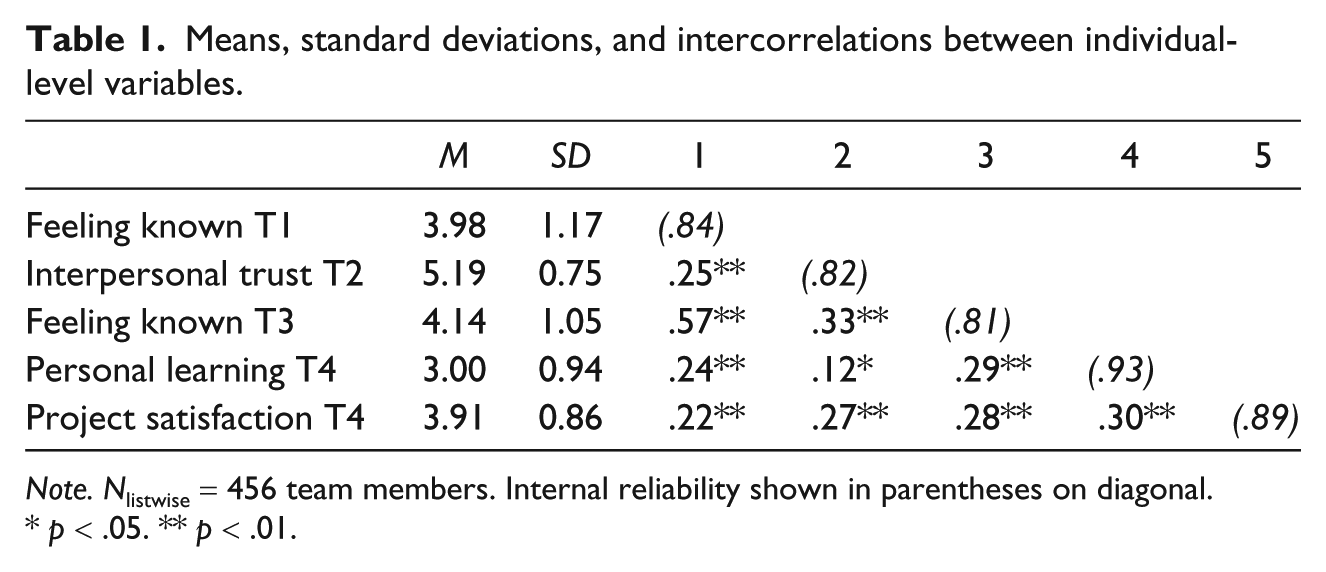
Note. Nlistwise = 456 team members. Internal reliability shown in parentheses on diagonal.
p < .05. ** p < .01.
SEM results.
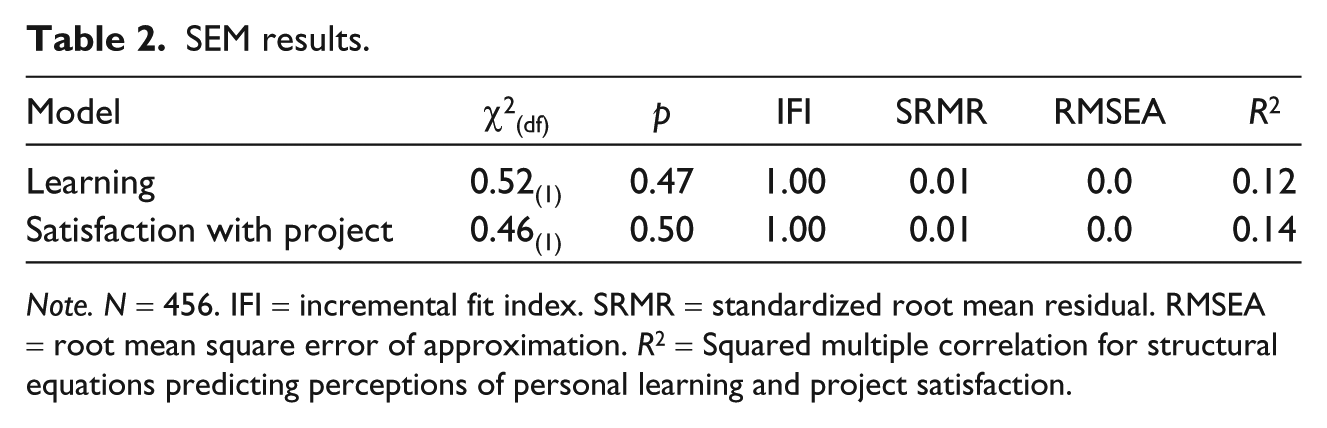
Note. N = 456. IFI = incremental fit index. SRMR = standardized root mean residual. RMSEA = root mean square error of approximation. R2 = Squared multiple correlation for structural equations predicting perceptions of personal learning and project satisfaction.
Parameter estimates for the two models are shown in Figures 2-3 (above arrows). These estimates speak to hypotheses H1A through H1F. H1A stated that feeling known predicts interpersonal trust. As seen in Figures 2-3, this hypothesis was confirmed (β = .31, p > .01). H1B, which expected that interpersonal trust would influence later sense of feeling known, was also confirmed (β = .18, p > .05). H1C and H1D expected that feeling known will predict the team member outcomes of personal learning and project satisfaction, respectively. Figures 2-3 show strong positive relationships between feeling known and learning (β = .34, p < .01), as well as between feeling known and project satisfaction, (β = .24, p < .01). Finally, H1E and H1F expected that interpersonal trust will predict the team member outcomes of personal learning and project satisfaction, respectively. Figures 2 and 3 show that trust was not significantly associated with personal learning (β = .01, p > .05), but was significantly associated with project satisfaction (β = .18, p < .05). Taken as a whole, results provide clear support for all but one of the H1 subhypotheses. The most important result is that feeling known was a strong predictor of interpersonal trust (proximal outcome), and personal learning and project satisfaction (distal outcomes), as expected.

Structural equation model for learning. Significant paths in bold. Parameter estimates above the arrows are from the model fitted to the entire set of teams (face-to-face, virtual, and hybrid) in testing H1. Parameter estimates below the arrows are from the model fitted to the subset of face-to-face and virtual teams only in testing H2 (estimates in the face-to-face teams are presented first; and in the virtual teams, second).

Structural equation model for project satisfaction. Significant paths in bold. Parameter estimates above the arrows are from the model fitted to the entire set of teams (face-to-face, virtual, and hybrid) in testing H1. Parameter estimates below the arrows are from the model fitted to the subset of face-to-face and virtual teams only in testing H2 (estimates in the face-to-face teams are presented first; and in the virtual teams, second).
H2 anticipated that while feeling known will predict team member proximal and distal outcomes in both face-to-face and virtual teams, the links in the virtual teams will be stronger. To provide a strong test of this hypothesis, data from the 43 hybrid teams (i.e., the virtual teams who augmented their virtual meetings with face-to-face meetings) were excluded from the H2 analyses. In effect, then, the two endpoints of virtuality—face-to-face communication only versus virtual communication only—were examined in testing this hypothesis. Hence, the final dataset for testing H2 consisted of 248 virtual team members grouped into 65 virtual teams, and 108 face-to-face team members grouped into 26 face-to-face teams.
Visual inspection of the parameter estimates in Figures 2 and 3 (below arrows) suggests preliminary support for the conjecture that feeling known is more strongly related to interpersonal trust among members of virtual teams than face-to-face teams (βftf = .09, p > .05 vs. βv = .30, p < .01). Further, feeling known appears more strongly related to personal learning among the virtual (βv = .46, p > .01) than the face-to-face team members (βftf = .24, p < .05).
To formally test H2, I employed the multiple group analysis procedure in SEM (see Table 3). First, I imposed structural parameter constraints, forcing the model to fit in both data subsets simultaneously. Next, to test whether the links involving feeling known are stronger among the virtual versus face-to-face team members as hypothesized, I freed the links from feeling known to trust, and from feeling known to the two outcomes, and then compared the fit of these partially constrained models to that of the fully constrained models. An improvement in model fit would indicate that these links vary significantly among face-to-face versus virtual team members (Jöreskog & Söbrom, 1993). However, improvement in model fit was not observed either in the personal learning model (χ2difference-learning = 4.47, p = .10), or in the project satisfaction model (χ2difference-satisfaction = 1.60, p = .45). Hence, the links involving feeling known are not significantly stronger in the virtual teams. 3 H2 was not supported. For completeness, Table 4 provides the means, standard deviations, and variable intercorrelations in the face-to-face, purely virtual, and hybrid (or semivirtual) teams.
Multiple group SEM results.

Note. Noverall = 311, nftf team members = 88, nvirtual team members = 223. IFI = incremental fit index. SRMR = standardized root mean residual. RMSEA = root mean square error of approximation. R2 = Squared multiple correlation for structural equations predicting perceptions of personal learning and project satisfaction. FTF = face-to-face.
The following two links were freed—(1) T1 feeling known to T2 interpersonal trust, and (2) T3 feeling known to T4 personal learning.
The following two links were freed—(1) T1 feeling known to T2 interpersonal trust, and (2) T3 feeling known to T4 project satisfaction.
Means, standard deviations, and intercorrelations between individual-level variables in each team type.

Note. Nlistwise = 88 face-to-face team members, 223 purely virtual team members, and 145 hybrid (i.e., semivirtual) team members. Internal reliability shown in parentheses on diagonal.
p < .05. **p < .01.
Supplemental Results
Though not formally hypothesized, data are available to examine the development of team members’ sense of feeling known over time across team types. Table 4 reports the means and standard deviations of T1 and T3 feeling known. Visual inspection of these results reveals that virtual team members report consistently lower sense of feeling known than face-to-face and hybrid team members. This is indeed corroborated by ANOVA tests in which team type (i.e., face-to-face vs. virtual vs. hybrid) predicted T1 and T3 feeling known. Because of unequal group sizes, I report Welch’s F-test here; results were as follows: at T1, F(2,492) = 3.69, p = .03, and at T3, F(2,512) = 5.38, p < .01. As suggested by the visual inspection of the means, Tukey’s tests showed that virtual team members were lower than both face-to-face and hybrid team members initially (3.85v vs. 4.04ftf and 4.17h) and over time (3.95v vs. 4.34ftf and 4.30h). Furthermore, repeated measures tests showed that only face-to-face team members gained significantly in their sense of feeling known over time, t(99) = 2.19, p = .03; the gains among virtual and hybrid team members did not reach traditional levels of significance, t(236) = 1.89, p = .06, and t(152) = 1.73, p = .09, respectively.
Discussion
The central contribution of this study is twofold: First, it introduced a new concept to the literature—the sense of feeling known, and second, it demonstrated that team members’ sense of feeling known plays an important role in predicting proximal and distal team member outcomes across team types (e.g., face-to-face, virtual, and hybrid teams). I elaborate on these issues below.
Theoretical Contribution
The sense of feeling known is a central human motivation; it represents the need to feel as if others get who we are as unique individuals, not just as anonymous, deindividuated employees or team members. Although a variety of organizationally relevant theories invoke this concept (e.g., relational and individual-focused transformational leadership theories; Kouzes & Posner, 2007; Wang & Howell, 2010; theories of intrateam interpersonal ties and team member familiarity; Balkundi & Harrison, 2006; Gruenfeld et al., 1996; theories of social presence, Garrison et al., 2000), they do not develop it fully or examine it directly. To help make the theoretical case for the sense of feeling known, I built most heavily on Swann’s theory of self-verification (Swann, 1984, 1990). Briefly, this theory explains how individuals ensure that others know them (e.g., through employing various active and passive self-verification strategies), as well as why individuals are motivated to do so (e.g., to achieve smooth social interactions and a sense of predictability). What the sense of feeling known adds to this existing theoretical framework is the notion that individuals must perceive that others know them before they can experience the positive outcomes of achieving self-verification. If, for whatever idiosyncratic reason, individuals do not believe that others know them, then the objective achievement of self-verification becomes a moot point. This argument is consistent with much research in the social construction tradition that has shown than perceptions of reality are what truly drive human behavior and attitudes (Breaux et al., 2009; Ferris et al., 2002).
The theoretical distinction between the objective achievement of self-verification and the perceptual judgment individuals make to determine whether others know them or not, also speaks to the importance of developing a measure of feeling known. This is because measures of self-verification—such as self-other agreement and other interpersonal congruence measures that are typically used in research on self-verification—are not capable of capturing individuals’ beliefs that others know them due to their objective nature. Specifically, as argued earlier, there is no guarantee that objective accuracy will coincide with individuals’ sense of feeling known: even when accuracy is high, individuals might or might not feel known, and vice versa when accuracy is low. The present study contributed to the literature by developing a direct measure of the sense of feeling known.
Empirical Contribution
In addition to developing the theoretical basis for the sense of feeling known (and a direct measure of this concept), the present research also demonstrated the usefulness of this new concept in a large sample of project teams, and using a longitudinal study design. Specifically, this study showed that team members’ sense of feeling known predicted team members’ interpersonal trust (proximal outcome), and project satisfaction and perceptions of personal learning (distal outcomes) in face-to-face, virtual, and hybrid project teams. These results fit well with existing literature that has examined concepts similar to the sense of feeling known.
For example, the model tested in this study showed how team members’ sense of feeling known and perceptions of interpersonal trust feed into each other over time. When individuals feel known, they are more likely to willingly make themselves vulnerable to the actions of others (i.e., to trust others), as anticipated by Burke and Stets’s (1999) research. Further, as discussed in Walther’s theory of hyperpersonal effects, when individuals trust others, they are more likely to self-disclose more information, thus helping improve their sense that others know them even further (e.g., Walther & Burgoon, 1992). Hence, this study contributes to the literature on trust by highlighting an important mechanism through which positive interpersonal relationships based on trust are developed.
In addition, the study also showed that when team members develop a sense of feeling known early on in their team experience, they experience positive individual outcomes—such as better learning and higher project satisfaction—later on in their team experience. This finding builds on the literature within the community of inquiry model (Garrison, 2011), which has shown how a similar concept—that of social presence—aids team members’ learning (Dunlap & Lowenthal, 2009; Richardson & Swan, 2003) and satisfaction (Rourke & Anderson, 2002). In addition, while most team research focuses on team-level outcomes (e.g., team cohesion, team performance), the outcomes obtained by individual team members deserve more research attention (Hackman & Wageman, 2005). The findings of this study help elucidate how team members could achieve important positive outcomes. Thus, these findings could help guide team leaders in their efforts to make the team undergo an overall better experience for both teams and the individuals who comprise those teams.
Virtuality and Feeling Known
The sample used to test the main model of this study allowed an examination of the impact of virtuality on team members’ sense of feeling known. First, the study showed that when the two endpoints of virtuality are examined (i.e., face-to-face communication vs. virtual communication), feeling known was at least as influential in virtual team settings as in face-to-face team settings. As the quote at the beginning of this article suggests, virtual team members still need “to be touched, seen, and heard” (Kirkman Rosen, Gibson, Tesluk, & McPherson, 2002, p. 73)—a need most likely exacerbated by the low social presence (Burke & Chidambaram, 1999) and the large relational void virtual team members have been found to experience (e.g., Barkhi et al., 1999; George & Sleeth, 2000; Wiesenfeld et al., 1999). This finding suggests another practical implication—leaders tasked with leading virtual teams might benefit from helping virtual team members develop a sense of feeling known as early in their team experience as possible in order to help them overcome some of the challenges imposed on them by the poor communication environment.
Second, supplemental analyses reported on the development of team members’ sense of feeling known over time. These analyses showed that virtual team members were lower on feeling known than face-to-face and hybrid team members both initially (i.e., at T1) and over time (i.e., at T3, or 2 months later). It is instructive to remember that by the T3 survey, all teams had spent an average of 6 to 9 hr in required team meetings, and had stayed connected through a variety of media between meetings. This finding has interesting implications for theories of communication because older communication theories make different predictions compared to newer communication theories regarding the development of relationships. For example, traditional theories—such as social presence theory (Short et al., 1976)—argue that participants in poor communication environments do not experience the social presence of their fellow interactants as fully as participants in rich communication environments. Hence, they are likely to believe that their fellow interactants do not perceive them as unique individuals. In contrast, newer communication theories—such as media naturalness theory (DeRosa, Hantula, Kock, & D’Arcy, 2004; Kock, 2002), and the social information processing theory of computer-mediated communication (Walther, 1992; Walther & Burgoon, 1992)—argue that humans are adaptive, that they can learn to use any communication medium successfully with time, and that they in fact purposefully disclose more information about themselves in order to make themselves known to others. Hence, the positive functioning of virtual teams and their members is not a matter of if; it is a matter of when.
The present research supported the traditional prediction that virtual teams would lag behind on relational construct, such as the sense of feeling known, relative to face-to-face teams and—in this study—hybrid teams. Importantly, one prior longitudinal study found that even after 4 weeks of team interactions, members of virtual teams reported lower feelings of social presence than members of face-to-face teams (Burke & Chidambaram, 1999). Taken together, these results suggest that some perceptions may be immune to adaptation. For instance, individuals may be biased toward virtual media, believing that it simply cannot replace the human touch afforded by face-to-face media. Alternatively, the virtual communication media may create objective difficulties associated with relationship-building online. Consistent with past research (Burke & Chidambaram, 1999), the present findings help establish boundaries around newer communication theories.
Implications for Practice and Future Research
The main practical implication of the present results is that because feeling known emerged as a strong predictor of team member outcomes, organizations and team leaders alike should work to increase team members’ sense of feeling known. Such initiatives should be especially important in virtual teams, where feelings of social presence (Burke & Chidambaram, 1999) and of feeling known (present research) are consistently low over time, yet achieving even a low degree of feeling known is an asset to team members. In fact, as noted in a large-scale qualitative field study of virtual teams (Malhotra, Majchrzak, & Rosen, 2007), when team leaders encouraged team members to share personal stories, teams functioned more effectively. Given that the number two complaint of virtual team members (after logistical issues) is inadequate and unsatisfying social interactions (Rosen, Furst, & Blackburn, 2006), such simple interventions might help increase team members’ sense of feeling known, which may in turn facilitate team effectiveness.
In fact, many in the practitioner literature have speculated that virtual teams should begin their lifespan with a face-to-face team meeting. The practical effects of such an intervention could be examined. Future research could explore whether the exchange of high-quality personal information at the beginning of the team lifespan (e.g., hobbies vs. place of residence) may help virtual teams gain in their sense that they know fellow teammates and that fellow teammates know them well. If such practices show positive results, organizations and virtual team leaders could easily adapt them to ensure a positive psychosocial experience for team members.
Limitations and Strengths
One of the most obvious limitations of this research is that it used student teams and not organizational employees. However, care was taken to offset this limitation in at least the following ways: First, unlike the vast majority of student teams studied in the team literature, the student teams in this study worked on a real project that represented 20% of their final class grade. This ensured that students took the project seriously and were invested in it (as corroborated by the team meetings attendance data and anecdotal evidence reported by the teaching assistants and class instructors). Second, this project spanned over an entire academic semester (roughly four months), and involved four required team meetings. This feature of the study design helped avoid a frequent criticism faced by teams research—i.e., that team members do not really experience teamliness because they know they will not be working together again.
Another limitation of this research is that the feeling known measure tapped participants’ feelings that others have gotten to know them, but not participants’ feelings that they have gotten to know others. As suggested by an anonymous reviewer, it is possible that when team members feel they know their teammates, they function better in teams. Knowing others might be especially important in virtual teams as it might help make interactions more predictable and it might also decrease the need to constantly monitor or second-guess others’ actions. Further, it is also possible that team members are more likely to feel known when they feel they know others on their team. In other words, individuals might assume that others know them when they feel they know others. Future research should investigate the role of knowing others on team member outcomes, and on the development of team members’ own beliefs that others know them.
A third limitation of this research is that there was a large difference in the sample sizes of the three types of team members followed in this research (nftf = 108, nv = 248, and nh = 165). This means that the analyses might have been overly influenced by trends in the virtual team members’ data. This concern is softened by the fact that results in face-to-face teams were still consistent with theory and prior research. For example, the sense of feeling known was related to team member outcomes, as expected based on the broader literature. Still, it would have been beneficial to collect qualitative data from the study participants specifically asking them to retrospect on whether or not they felt known, and the degree to which that impacted their experiences. Future research would benefit from a more qualitative approach to this issue.
Finally, H2 was tested with a subset of the data only; specifically, members of hybrid teams—or teams that started out as virtual but eventually added face-to-face interactions—were excluded from the H2 analysis. The reason for this decision was that this hypothesis was built to test the two extreme ends of team virtually—purely face-to-face teams versus purely virtual teams. Importantly, this reflects the reality of virtual teams in industry as field studies of virtual teams report that these teams rarely, if ever, use face-to-face communication (Majchrzak, Malhotra, Stamps, & Lipnack, 2004). At the same time, however, many teams employed by business organizations today are composed of groups of colocated employees, or in other words, are hybrid teams that mix face-to-face with virtual communication. Therefore, there is much value in future research examining how hybrid teams differ from, and in what ways they might be similar to, face-to-face and virtual teams. It is important to note that the zero-order correlations reported in Table 4 suggest that hybrid teams are equally influenced by team members’ sense of feeling known.
The present study also has a number of strengths. First, the study spanned over roughly a four-month long period, involved an interdependent project with each project phase building on the preceding one, and followed a sizable number of face-to-face and virtual teams. Second, each variable in the team member outcomes model was measured at a different point in time, thus controlling for threats associated with momentary mood states, as well as for common method variance which frequently plagues cross-sectional studies. Third, the study focused on an infrequently examined facet of overall team effectiveness—team member outcomes—hence answering calls in the team literature for developing a fuller understanding of team effectiveness.
Conclusion
The contribution of this research is that it brought together theories of identity development and theories of team processes and effectiveness, in order to introduce a new concept—the sense of feeling known—and to then understand how team members’ sense of feeling known impacts team member outcomes in traditional and nontraditional types of teams. Results confirmed the importance of the sense of feeling known for team member perceptions of interpersonal trust, personal learning, and project satisfaction in face-to-face, virtual, and hybrid teams. These results are practically important because they suggest that in order to improve team member outcomes, team leaders, especially leaders of virtual teams, may wish to encourage more personal interactions within their teams in an effort to stimulate the development of the sense of feeling known.
Footnotes
Appendix
Declaration of Conflicting Interests
The author(s) declared no potential conflicts of interest with respect to the research, authorship, and/or publication of this article.
Funding
The author(s) received no financial support for the research, authorship, and/or publication of this article.