



Abstract
We provide an empirical examination of peer justice climate, defined as team-level judgments of the fairness with which coworkers generally treat one another, and justice climate, defined as team-level judgments of the fairness with which the team is collectively treated by an authority figure. Based on previous theoretical work, we tested a hierarchical structural model determining that peer justice climate was best represented as three first-order factors, which combine into a single second-order dimension. We found a similar two-level structure for justice climate. We also found that the relationship between peer justice climate and team satisfaction was mediated by cooperative team process.
Keywords
Over the past several decades, scholars have accumulated impressive evidence attesting to the important role that justice perceptions play in work organizations (Cropanzano, Stein, & Nadisic, 2011). These research findings have culminated in a number of meta-analyses showing that justice perceptions are related to important work-related outcomes, such as performance, satisfaction, cooperation, and conflict (Cohen-Charash & Spector, 2001; Colquitt, Conlon, Wesson, Porter, & Ng, 2001; Fassina, Jones, Uggerslev, 2008; A. Li & Cropanzano, 2009a). That is, when treated unfairly, employees may respond with negative attitudes and behaviors. In contrast, when treated fairly, employees often exhibit desirable work attitudes and behaviors (e.g., Cropanzano, Li, & Benson 2011; Konovsky & Freeman, 2000).
Most of the past justice research tends to focus on fairness perceptions at the individual level of analysis. That is to say, researchers have emphasized the extent to which an individual employee considers whether he or she has been treated fairly by others. As Konovsky and Freeman (2000) noted over a decade ago, “almost wholly absent from consideration has been the influence of higher-order factors on procedural justice including culture and organization or group-level procedural justice antecedents and consequences” (p. 504). In response to this criticism, research has provided evidence suggesting that team members often come to share common evaluations of fairness (e.g., Colquitt, 2007; Colquitt, Zapata-Phelan, & Roberson, 2005; A. Li & Cropanzano, 2009b). These fairness evaluations have come to be known as justice climate, defined as the shared perceptions that a unit has been treated (un)fairly (Erdogan & Bauer, 2010; Naumann & Bennett, 2000; Walumbwa, Hartnell, & Oke, 2010). Recent empirical studies have found that justice climate is related to key outcomes such as individual and unit performance. Justice climate has also been found to explain additional variance in individuals’ attitudes and behaviors beyond the effects of individual justice perceptions (e.g., Mossholder, Bennett, & Martin, 1998).
Despite these encouraging findings, one limitation of the justice climate literature should be noted. Most of these studies tend to emphasize the fairness with which people are treated by those in power. In other words, supervisors, or to a lesser extent the entire organization, are perceived as the sources of action that may shape the justice climate within a unit. This focus on supervisors or organizations as sources of justice perceptions is not particularly surprising, however. The climate literature in general tends to consider organizational policies and procedures, as well as managers’ behavioral norms, as the basis on which shared perceptions within a unit are formed (Schein, 2004; Simons & Roberson, 2003).
Nevertheless, this view, when taken by itself, is incomplete. Work team climate is also influenced by how coworkers treat one another (cf. Kuenzi & Schminke, 2009). In contrast to the almost exclusive focus on supervisor/organization as the source of justice climate, justice research at the individual level has pursued a multi-foci justice approach, demonstrating that justice perceptions may emanate from sources other than authority figures. These alternative sources of (un)fair treatment can include individuals who are not in a formal power relationship with the target person. For example, customers and—the topic of our present investigations—coworkers have been found to be important sources of (in)justice (e.g., Lavelle, McMahan, & Harris, 2009; Lavelle, Rupp, & Brockner, 2007; Rupp & Cropanzano, 2002; Rupp, McCance, Spencer, & Sonntag, 2008; Thatcher & Bagger, 2011).
In a review of the justice climate literature, Rupp, Bashshur, and Liao (2007) cogently pleaded that “more research is needed that explores justice climate from a multifoci perspective” (p. 371). Addressing this limitation is the construct of peer justice climate (or peer justice in short). Peer justice climate is defined as the collective perception that individuals—who work together within the same unit and who do not have formal authority over each other—judge the extent to which they treat one another fairly (Cropanzano, Li, et al., 2011). This concept has also been referred to as intraunit justice climate (e.g., by Cropanzano, Li, & James, 2007; A. Li & Cropanzano, 2009b). The construct of peer justice climate is predicated on the premise that employees may serve as a powerful force for shaping the level of justice that coworkers experience (Cropanzano et al., 2007). To our knowledge, only one published empirical study has investigated peer justice climate. Cropanzano, Li, et al. (2011) found that interpersonal and procedural peer justice climate each explained additional variance in team processes beyond the effects of their individual level counterparts. In addition, they also found that peer justice climate influenced team performance and team citizenship behaviors through their effects on these teamwork processes. The present study aims to build on the literature on justice climate and peer justice climate in three important ways.
First, there is some disagreement regarding the structure of unit-level justice. Cropanzano and colleagues (Cropanzano et al., 2007; A. Li & Cropanzano, 2009b) theorized that peer justice climate includes three dimensions (i.e., distributive, procedural, and interpersonal justice). Despite this, Cropanzano, Li, et al. (2011) only included procedural and interpersonal justice in their initial study, opting to leave out distributive justice from their analysis. Ambrose and Schminke (2007), however, argued that only interpersonal justice is relevant when the source of justice is one’s coworkers, stating that “allocation decisions and the procedures used to make those decisions are not the role of coworkers” (p. 404). Therefore, we build upon the previous research and examine the factor structure of peer justice climate by including all three of its proposed dimensions.
Second, some recent research has suggested that individuals form a global justice evaluation of an entity rather than distinguishing among the different justice dimensions (Ambrose & Schminke, 2009). Although initial research has suggested that there is considerable promise in examining a unidimensional model of justice (relative to a facet model), the work has been done at the individual level (Jones & Martens, 2009). In the present study, we bring this body of literature to the unit level by evaluating peer justice climate and justice climate as higher-level constructs with three justice dimensions serving as their indicators, respectively.
Third, past research has shown that peer justice climate and justice climate influence team outcomes through mechanisms such as teamwork process (Cropanzano, Li, et al., 2011) and team cooperative norms (Lin, Tang, Li, Wu, & Lin, 2007). However, these studies tend to examine one source of justice perceptions at a time. Therefore, it is unclear whether the effects of one source of justice perceptions become muted in the presence of justice perceptions from an alternative source. We build on past research by including peer justice climate and justice climate in the mediation models, thereby allowing us to evaluate their effects simultaneously.
Justice Climate
In the years since Lind and colleagues (Lind, Kray, & Thompson, 1998) noted that “most of the potential information about the fairness of any given authority or institution lies in collective, not personal, experience” (p. 19), research on unit-level justice has blossomed into a significant body of literature quantitatively summarized by a recently published meta-analysis (Whitman, Caleo, Carpenter, Horner, & Bernerth, 2012). The scholarly interest in justice climate is propelled by at least three phenomena. First, organizations have become increasingly reliant on teams to organize their workforces (Colquitt, Noe, & Jackson, 2002). This has encouraged researchers to devote attention to work-relevant team processes, such as fairness (Colquitt, 2007). Second, single-level analyses have come to be viewed as increasingly inadequate for examining complex phenomena in organizations. In many firms, it is common for individuals to be embedded in teams which are in turn embedded in even higher-level organizational units (Guzzo & Shea, 1992). Third, research on the third-party justice has demonstrated that individuals not only respond to the fairness that they experience personally, but care about the extent to which others in their social network are treated fairly and react accordingly (cf. Rupp et al., 2007; Skarlicki, Ellard, & Kelln, 1998; Skarlicki & Kulik, 2005).
Although Mossholder and colleagues (1998) were rightfully credited for being the first to elevate justice research from the individual level to the unit level (which they termed justice context), the term justice climate did not enter the fairness lexicon until 2000 when it was first coined by Naumann and Bennett (2000). Naumann and Bennett defined it as “group-level cognition about how a work group as a whole is treated” (p. 882). Their seminal work has spawned an impressive and growing body of research. Summaries of this literature can be found in A. Li and Cropanzano (2009b). Succinctly put, justice climate has been found to account for incremental variance beyond the effects of fairness at the individual level (Liao & Rupp, 2005; Mossholder et al., 1998; Naumann & Bennett, 2000). Justice climate was shown to be related to a host of work-related attitudes and behaviors, such as helping behavior (Naumann & Bennett, 2000), job satisfaction (Mossholder et al., 1998), voice behavior (Hsiung, 2012), intention to stay (Griffin, 2010), organizational citizenship behavior (X. Chen, Lam, Naumann, & Schaubroeck, 2005; Cho & Dansereau, 2010; Ehrhart, 2004; Walumbwa et al., 2010; Walumbwa, Wu, & Orwa, 2008), mental health (Spell & Arnold, 2007), unit-level burnout (Kroon, van de Voorde, & van Veldhoven, 2009; Moliner, Martínez-Tur, Peiró, Ramos, & Cropanzano, 2005), unit performance (Akgün, Keskin, & Byrne, 2010; Colquitt et al., 2002; W. C. Kim & Mauborgne, 1993; Lipponen & Wisse, 2010; Luo, 2008; Naumann & Bennett, 2002; Simons & Roberson, 2003), managerial trust (Dayan, Di Benedetto, & Colak, 2009), and unit identification/commitment (Deery & Iverson, 2005; Hakonen & Lipponen, 2008; Hammer, Bayazit, & Wazeter, 2009; Johnson, Korsgaard, & Sapienza, 2002).
Justice climate has also been found to play a moderating role in a number of studies. For example, justice climate interacted with leader–member exchange differentiation to predict organizational commitment, satisfaction with coworkers, and withdrawal behaviors (Erdogan & Bauer, 2010), with proactive personality to predict organizational citizen behavior (OCB) (N. Li, Liang, & Crant, 2010), with discrimination claiming to predict discrimination dispute (Wallace, Edwards, Mondore, & Finch, 2008), and with group identification and professional commitment to predict employee silence (Tangirala & Ramanujam, 2008).
Despite these encouraging findings, one conceptual issue awaits to be addressed. As noted previously, justice climate has been defined by Naumann and Bennett (2000) as a shared cognition of how well a group has been treated. A pertinent question is: Treated by whom (Cropanzano et al., 2007)? Most of the available studies explicitly refer to the supervisor/organization as the source of justice in their definition and measure of justice climate. For example, Hsiung (2012) defined procedural justice climate as “a group-level cognition regarding the procedural justice of organizational authorities” (p. 353, italics added). Similarly, Griffin (2010) defined interactional justice climate as “the shared perceptions of how the group of employees are treated by those in authority” (p. 313, italics added). Moliner and colleagues (2005) defined justice climate as “shared justice perceptions about their organization and their own supervisor” (p. 101, italics added). The emphasis on supervisors/organizations as the source of justice climate in most of these studies is not particularly surprising. Supervisors are often perceived as climate engineers who “shape the meaning employees attribute to these organizational characteristics” and “play an important role in the development of climate” (Walumbwa et al., 2010, p. 520). The importance of supervisors/organizations as the source of justice experience for an entire unit is also demonstrated by studies pointing to servant or ethical leadership as one of the antecedents of justice climate (e.g., Ehrhart, 2004; Walumbwa et al., 2008, 2010).
Nevertheless, the source of the justice climate has not been explicitly specified in other studies (exemplified by the definition used by Naumann & Bennett, 2000, and some others), raising at least two conceptual difficulties. First, as Rupp and colleagues (2007) noted, “failing to specify the source of justice in justice measures, or averaging across sources, could at worst lead to spurious results, or at best yield justice effects that are difficult to interpret” (p. 360). An example vividly demonstrating this difficulty is provided by Cropanzano and colleagues (2007) who compare one group wherein everyone treats one another fairly, but has been treated unfairly by the management with another group wherein everyone treats each other unfairly even though the group as a whole has been treated fairly by the management. Both groups may report the same level of justice climate, if a measure sans the source of justice perception is employed. As Cropanzano and colleagues (2007) noted, this situation is awkward, as it masks the vastly different psychological experiences that the two groups may have.
Second, there are also practical considerations. When a source of justice perceptions is specified, individuals may be able to reflect upon the fairness that they have experienced from the designated source. A common reference point for all members of the same unit may reduce the variability in their responses that might otherwise arise should the source be omitted. Statistically, this approach may reduce construct contamination and increase the precision with which it is operationalized, thereby also enhancing the size of its correlation with relevant outcome variables (for similar arguments, see Lavelle et al., 2007, 2009). In contrast, when the source of justice perception is omitted, individuals are left to gauge their experience of fairness, which may be influenced by different sources (such as coworkers, customers, or supervisors). As individuals’ fairness evaluations vary from one source to another, the level of sharedness within a unit is therefore reduced, thereby attenuating the relationship between justice climate and outcome variables.
Peer Justice Climate: A Closer Investigation
To overcome these difficulties, it is important that research at the unit-level focus on the source from which justice perceptions originate. This argument is consistent with the multifoci justice literature that is based on the premises that (a) there are a number of entities in each individual’s social environment that are capable of acting either fairly or unfairly, (b) these different sources may not exhibit a uniform level of fairness, such that one person may be treated fairly by one source but less so by the other, and (c) individuals are capable of distinguishing justice perceptions emanating from these different sources. One implication of the multifoci framework of justice is that it broadens the source of justice hitherto focusing exclusively on supervisors and organizations to include other sources, such as coworkers.
The emphasis on coworkers as a source of fairness perceptions is justified given the increasing utilization of work teams in organizations. Underscoring this sentiment, Lavelle and his colleagues (2007) noted that “coworkers are becoming an increasingly important source of fairness of all kinds” (p. 844). Empirical support for the role of coworkers as an important source of justice perceptions can be located in the social psychology and the management literature. For example, De Cremer (2002) found that being treated with respect by one’s teammates was related to individuals’ perceptions of inclusiveness and contribution toward the team. Similarly, Lavelle and colleagues (2007) found that individuals’ commitment toward their work group mediated the relationship between work group procedural fairness (the extent to which coworkers use fair procedures in making decisions in the team) and citizenship behaviors directed toward coworkers.
It is interesting to compare the paradigmatic attributes of these studies with those on justice climate. On the one hand, Lavelle et al. (2007) focused only on the individual level of analysis, although this study has the strength of considering different sources of fairness (e.g., the supervisor and coworkers). On the other hand, justice climate research has the strength of considering the unit level of analysis, though it does not consider the important role of coworkers in forming fairness perceptions. Bridging these two bodies of research is the construct of peer justice climate, defined as the shared perceptions of the extent to which coworkers treat each other with fairness. In their theoretical model, Cropanzano and colleagues (2007) and A. Li and Cropanzano (2009b) argued that peer justice climate, similar to its individual level counterpart, should include three parallel dimensions.
Distributive peer justice climate refers to the extent to which the rewards that group/team members receive are appropriate, based on their contributions. Equity theory states that perceptions of distributive fairness derive from the comparison of one’s own input/output ratio with the same ratio of a similar other. Although team members do not determine each other’s pay in most teams, they may vary in terms of the effort they put forth on behalf of the team. Therefore, distributive peer justice climate is high when team members believe that the rewards that other members receive are warranted given the effort they exert toward the team’s goals. In contrast, distributive justice is low when the rewards that some team members might receive are disproportional to their worth as evidenced by the effort that they put forth. For example, some team members receive the same rewards as everyone else does, even though their workload is particularly light in comparison to others.
Procedural peer justice climate refers to the extent to which team members use fair procedures to make decisions. Leventhal (1976) articulated a number of rules to govern the decision-making process to achieve a high level of procedural fairness, such as allowing each person to voice their dissent and making decisions in a consistent and accurate fashion. As an increasing number of teams in organizations are afforded the prerogative to manage their daily activities, a climate of procedural peer justice has become all the more important. When the level of procedural peer justice climate is high, team members use fair process to manage the decision-making process in the team following the rules prescribed by Leventhal (1976). In contrast, a low level of procedural peer justice climate in a team is characterized by such things as some team members being shunned from the decision-making process and no consistent guidelines being followed.
Interpersonal peer justice climate refers to the extent to which members within the same unit treat each other in an interpersonally fair manner. A high level of interpersonal peer justice climate exists when team members treat each other in a respectful manner and refrain from using inappropriate language and gestures in their interactions.
As these three dimensions tap into different aspects of individuals’ justice experiences, they should be at least somewhat distinguishable. In partial support of this, Cropanzano, Li, et al. (2011) found that procedural and interpersonal peer justice climates were distinct from each other. This was evidenced by the results of their confirmatory factor analyses showing that a two-factor structure provided a better fit to the data than did a one-factor structure. Despite their earlier theoretical model, Cropanzano, Li, et al. (2011) did not include distributive justice in their empirical validation study. Therefore, it was unclear whether distributive justice was distinct from the other two dimensions or whether the inclusion of distributive peer justice climate might otherwise alter the factor structure. Here, we test the full structural model by including measures of all peer justice climate dimensions.
While the above arguments suggest a conceptualization of peer justice climate as a three-factor construct, there is another possibility. Various justice scholars have argued that individuals may use their justice experience to form an overall perception of the way they have been treated (e.g., Ambrose & Schminke, 2009; Cropanzano & Ambrose, 2001; Lind, 2001). Inherent in this overall justice model is that the various dimensions of justice provide the basis which individuals rely on to derive an overall opinion of how they have been treated by a justice source. Ambrose and Schminke (2007) articulated three benefits that an overall justice construct offers over specific justice dimensions. First, overall justice provides a more accurate representation of individuals’ justice experience relative to discrete justice dimensions. Second, a focus on overall justice allows researchers to evaluate the total impact that justice has relative to other variables (such as leadership and organizational culture) that may also impact work attitudes and behaviors. Stated differently, the use of specific justice dimensions offers a piecemeal and incomplete view of the effect of an individual’s comprehensive justice judgment. Third, the use of an overall justice construct offers a more parsimonious approach to theorize about the effects of justice at work, since researchers tend to make identical predictions on the effects of all three dimensions. Empirical evidence supports this view. For instance, Ambrose and Schminke (2009) found that overall justice mediated the relationship between the three dimensions of justice perceptions and outcome variables (for similar findings, see Jones & Martens, 2009).
Although these initial investigations on overall justice are promising, they have been conducted at the individual level. James and McIntyre (1996) argued that individuals may develop various types of workplace perceptions (psychological climate), such as leader support, facilitation, and role stress, among others. These first-order factors can be accounted for by a higher-order, general psychological climate factor, or PCg, which denotes the individual’s assessment of the overall climate in the work environment (to what extent one is harmed or helped).
Building on this finding, Rupp and colleagues (2007) argued that James and McIntyre’s framework can be applied to the unit level. They posited the existence of a Cg factor, a general high-order climate that focuses on justice. Based on these considerations, we argue that there is an alternative way to conceptualize the relationship between peer justice climate and justice climate and their dimensions. Specifically, justice perceptions may be operationalized as a composite or aggregate construct, such that an overall perception of justice is indicated by the various justice dimensions (Figure 1). That is, justice perceptions can be considered as a two-level structure, with the first-level indicators representing the various dimensions of justice, and the second-level representing the overall perception of justice. These arguments are consistent with those of McGonigle and Hauenstein (2000), who also found a hierarchical structure of justice. Therefore, we examine the possibility of peer justice climate and justice climate as composite variables by proposing the following hypothesis:
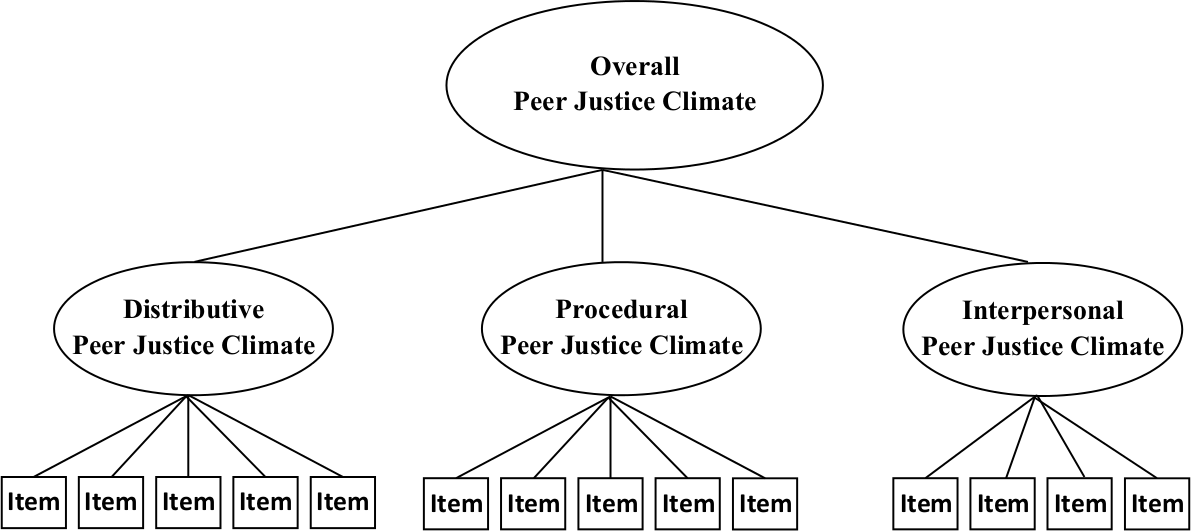
Peer justice climate.
Effects of Peer Justice Climate and Justice Climate
With the structural concerns addressed in the last section, we turn our attention to the effects of peer justice climate and justice climate, as well as to the process variable mediating these effects. Specifically, we focus on the effects of peer justice climate and justice climate on two indicators of team effectiveness: team performance and team satisfaction, and how these effects may be mediated by cooperative teamwork process. This model is presented in Figure 2.
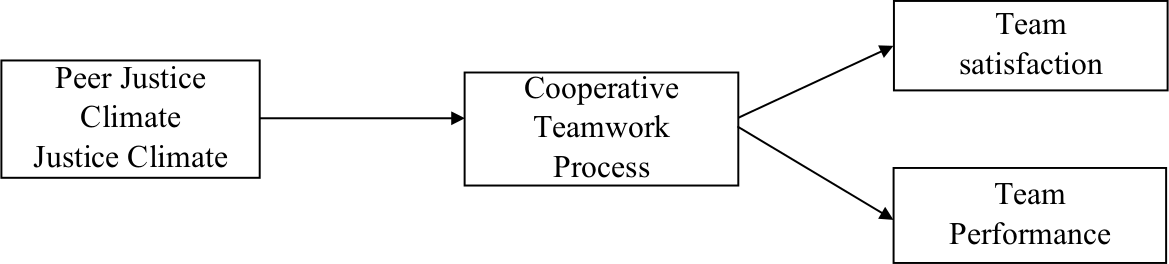
Hypothesized model.
In recent years, there has been a significant surge in research interest in the construct of teamwork process, defined as “members’ interdependent acts that convert inputs to outcomes through cognitive, verbal, and behavioral activities directed toward organizing taskwork to achieve collective goals” (Marks, Mathieu, & Zaccaro, 2001, p. 357). Many different taxonomies of teamwork process have been proposed to further explicate this construct (e.g., Hoegl & Gemuenden, 2001; Ilgen, Hollenbeck, Johnson, & Jundt, 2005; Kozlowski & Ilgen, 2006; Marks et al., 2001), most of which explicitly include cooperative teamwork as one of the key elements (Kozlowski & Ilgen, 2006). Cooperative teamwork process includes, among others, two components essential to team effectiveness—cooperation and communication. Lester, Meglino, and Korsgaard (2002) argued that these two processes, communication and cooperation, serve three important functions. First, they allow team members to understand and learn about each other’s knowledge, capacities, and skills. Second, they facilitate the completion of task requirements by coordinating group efforts and regulating information flow. Third, they provide an environment where team members are able to share information with each other without inhibition, which may build a higher level of interpersonal relationships in the team.
A low level of justice climate, whereby a team is collectively treated poorly by an outside authority (e.g., not being paid in proportion to their effort, being deprived of their voice in the decision-making process, or being treated with no respect and dignity), or peer justice climate, whereby they mistreat each other (characterized by team members taking undeserving credits, using inaccurate or inconsistent procedures to manage the decision-making process, and treating each other with disrespect), may create friction and acrimony among team members (Cropanzano, Li, et al., 2011). Since unfair treatment signals social exclusion, it may reduce one’s desire to interact and cooperate with one’s teammates. In contrast, fair treatment by an authority figure (justice climate) or by each other (peer justice climate) may allow one to maintain a positive identity, which may provide an impetus for cooperative teamwork behavior. This argument is also consistent with research on the group engagement model of justice (Tyler & Blader, 2003). Consistent with this argument, Cropanzano, Li, et al. (2011) found that peer justice was related to teamwork processes, two dimensions of which were communication with teammates and coordination.
Past research has linked perceptions of being treated fairly to positive feelings and cognition about the source of these perceptions (Barsky & Kaplan, 2007; Barsky, Kaplan, & Beal, 2011). In a similar manner, when individuals are treated fairly by their teammates (peer justice climate) and authority figures (justice climate), and when these feeling are shared among team members, they may consider the work environment as pleasant and satisfactory. In addition, social exchange theory posits that fairness communicates the symbolic message of respect (in other words, being treated fairly means one is a respected member of a unit), thus allowing team members to achieve a high level of self-worth and esteem, which in turn may increase their willingness to perform at a higher level to contribute to the successful performance of the team (Tyler & Blader, 2003).
Past research has identified cooperative teamwork process as a key mechanism mediating the relationship between organizational characteristics and criterion variables such as performance and team member reactions (Cropanzano, Li, et al., 2011; Lin et al., 2007). In a similar vein, when team members perceive an environment characterized by a high level of fairness, they may engage in more cooperative behaviors, which may in turn improve the performance of the team and foster a satisfactory team experience (LePine, Piccolo, Jackson, Mathieu, & Saul, 2008).
Method
Research Participants and Procedure
We tested our hypotheses with 47 teams of undergraduate students enrolled in the business school of a large state university. Team members were cohorts of students newly admitted into the business college. As part of the program requirements, team members were required to work on several semester-long team projects in their core classes. In all classes, team members were graded based on their collective performance, which created a high level of interdependence among them. Consequently, these were analogous to real-world teams with practical consequences for their members. Team membership was determined by the instructors and remained stable across all of the classes.
A panel design was employed in the present study. Participants received an email from the first author soliciting their assistance in this study. Those who indicated their willingness to participate were given a survey which they completed and returned through email to the first author. The data collection at Time 1 occurred 11 weeks after the inception of the teams. The timing for this first wave of data collection was based on the consideration that team members needed sufficient time to get to know each other and to develop a shared perspective on justice.
Out of a total of 219 students in these 47 teams, 175 of them responded to the first survey, resulting in an initial response rate of 80%. The sample included one two-person team, 17 three-person teams, 23 four-person teams, and six five-person teams. The average team size was 3.72. The data collection at Time 2 occurred four weeks later. Virtually, everyone who responded to the Time 1 survey responded to the Time 2 survey (with the exception of four individuals). Given the high response rate in Time 2, we decided to analyze Time 1 data based on all of the participants in Time 1 and the Time 2 data based on all of the participants in Time 2. The mean age of the participants was 21.27 (SD = 3.63). Among them, 69.5% were males. In exchange for their voluntary participation, students earned extra credit toward their final grade in their management class.
Instruments: Time 1
For self-report measures, participants responded using a seven-point Likert scale ranging from 1 = strongly disagree to 7 = strongly agree. We describe each measure in the following sections.
Peer justice climate
Respondents were instructed to focus on their team members when responding to the peer justice climate measures. Distributive justice refers to the extent to which team members believe that the grade they receive is commensurate with their effort. Although team members did not control the distribution of the grade (the instructor did), team members did have the abilities to decide the amount of effort they put into the project. When respondents were instructed to respond to the measure in reference to their teammates, they considered the ratio of input (effort) and output (grade) of their teammates. If they believed that the grades that some team members received were disproportional to the contribution that they made to the team, they would experience a low level of distributive justice that was caused by their teammates. Distributive justice was measured with a five-item scale (α = .89, A. Li & Cropanzano, 2009b). A sample item is “the grades that my teammates receive for the projects reflect the efforts they have put into the work.” Procedural justice refers to the perceived fairness of the procedures and decision-making process within the team. When team members believe they experience low procedural justice by, for example, not having a voice in the decision-making process, they would attribute the low procedural justice to their teammates. Procedural justice was measured with a five-item scale (α = .78, Cropanzano, Li, et al., 2011). One sample item of this measure is “my teammates are able to express their views and feelings about the way decisions are made in the team.” Finally, interpersonal justice, which refers to the perceived quality of interpersonal treatment from teammates, was measured with a four-item scale (α = .73, Cropanzano, Li, et al., 2011). An example item is “teammates put each other down (reverse scored).”
Justice climate
Respondents were instructed to focus on their instructor when responding to the justice climate measures. Distributive justice was measured with a three-item scale (α = .95) developed by Colquitt (2001). A sample item is “the grade that our team receives for the project is justified given our performance.” Procedural justice was measured with a six-item scale (α = .89) developed by Masterson (2001). This measure reflected the extent to which team members perceived the procedures used to arrive at the project grade were fair. A sample item from this scale is “the procedure provides useful information regarding the grade decision and its implementations.” Interpersonal justice was measured with a four-item scale (α = .75), also developed by Masterson (2001). This scale assessed the degree to which the instructor treated team members with dignity and respect. A sample item of this measure is “our team is treated with kindness and consideration.”
Instruments: Time 2
Team performance
The team project included multiple components. Specifically, each team was required to identify the knowledge and skills needed for their newly created company and to develop methods so that members of the team could acquire the skills and knowledge. Each team received grades for these components of the project throughout the semester, which they used as the basis for their distributive justice judgment. At the end of the semester and as part of the project requirements, each team submitted a report summarizing their assigned activities as part of the group. A teaching assistant who was blind to the hypotheses of this study independently graded the reports. A grade ranging between 1 (lowest) and 10 (highest) was awarded to each team’s project. With the permission of the instructor and participants, we were able to gain access to the grade for each team on this report.
Team satisfaction
Team satisfaction was assessed using a six-item scale (α = .88) developed and validated by Michalisin, Karau, and Tangpong (2004). A sample item of this measure is “I enjoy working with my teammates.”
Cooperative teamwork process
We measured cooperative teamwork process among team members with a seven-item scale (α = .83) developed by Lester and colleagues (2002). A sample item from this scale was “members of my team enjoy talking to each other.”
Results
Preliminary Considerations: Data Aggregation
Means, standard deviations, reliabilities, and intercorrelations are presented in Table 1. Because individual team members provided the scale responses, there must be sufficient within-team agreement to warrant aggregation to the unit level. We computed the within-group interrater agreement index (rwg(j)), the intra-class coefficient ICC(1), and the group mean reliability ICC(2). The mean rwg(j) values were as follows: distributive peer justice climate, .66; procedural peer just climate, .79; and interpersonal peer justice climate, .81. With the exception of distributive justice, the mean rwg(j) values for the other variables were all equal to or greater than .70, a conventional cut-off for acceptable within-unit agreement. Since the mean rwg(j) value for distributive justice was only slightly lower than the cut-off, we decided to include it in the subsequent analyses. The ICC(1) and ICC(2) for the peer justice climate measures were: distributive peer justice climate, .26 and .57; procedural peer justice climate, .14 and .38; and interpersonal peer justice climate, .25 and .55. The ICC(1) and ICC(2) coefficients were also generally supportive.
Means, Standard Deviations, and Intercorrelations of Measured Variables at the Unit Level.
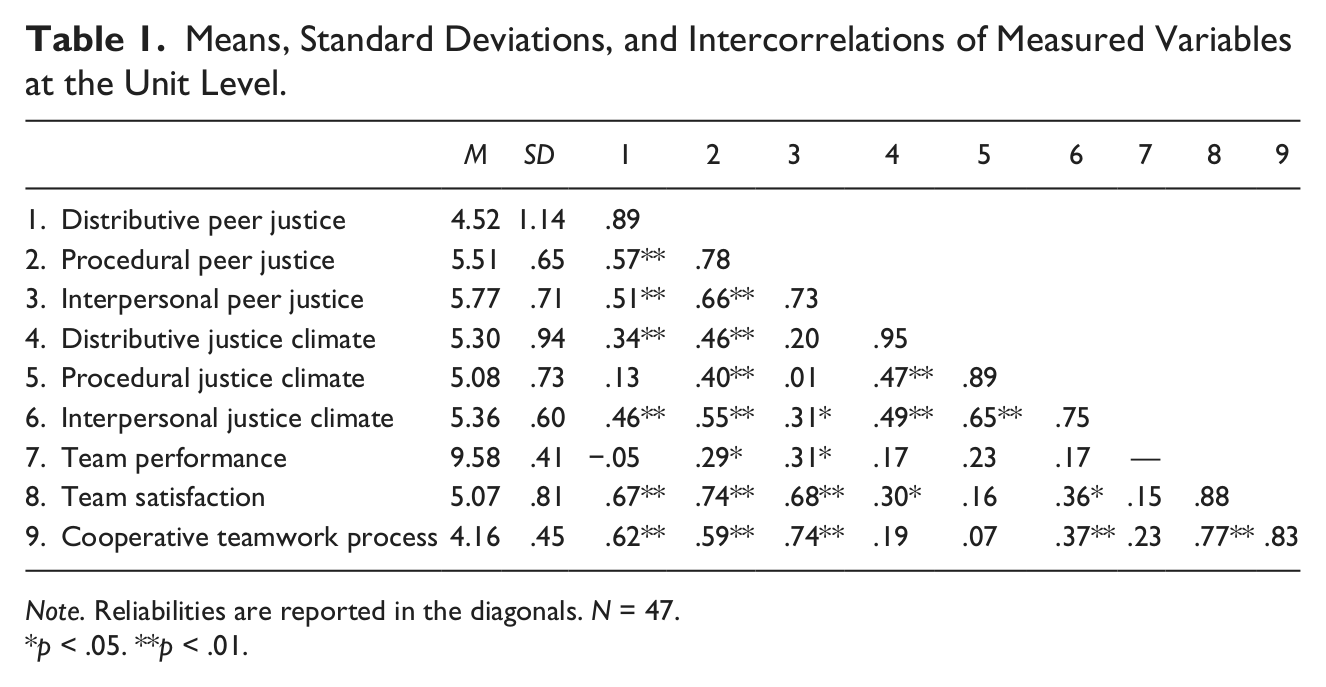
Note. Reliabilities are reported in the diagonals. N = 47.
p < .05. **p < .01.
The rwg(j) values for justice climate were similar to those for peer justice climate: distributive justice climate, .69; procedural justice climate, .82; and interpersonal justice climate, .75. The ICC(1) and ICC(2) for the measures were: distributive justice climate, .20 and .49; procedural justice climate, .18 and .44; and interpersonal justice climate, .03 and .11. With the exception of interpersonal justice climate, the rest of the ICC values compare favorably with those reported by others (Liao & Rupp, 2005; Simons & Roberson, 2003). The ICC(1) value for interpersonal justice climate was quite low. The one-way analysis of variance (with interpersonal justice climate as the dependent variable and team number as the independent variable) was not statistically significant, F(46,128) = 1.13, p = .30. In addition, our ICC(2) values were relatively low, probably due to the small team size. Our results should be considered conservative, given the unreliability of group means that attenuated the effect sizes (Bliese & Halverson, 1998; Hofmann & Jones, 2005).
Finally, the rwg(j) scores were team satisfaction, .70, and cooperative teamwork process, .89. The ICC(1) and ICC(2) were team satisfaction, .20 and .48; and cooperative teamwork process, .29 and .60. Based on this, we aggregated all scale scores to the team level.
Hypotheses 1 and 2: Structural Model
We first tested Hypothesis 1, anticipating that peer justice climate is a three-factor construct. This model treats distributive, procedural, and interpersonal justice as distinct concepts. The three-factor structure (without the second-order factor, and with the covariance among the factors constrained to zero) did not provide a very good fit to the data, χ2 = 337.073, df = 77, χ2/df = 4.38; IFI = .82; CFI = .82; RMSEA = .14. Since most of the fit indexes did not meet the established cutoffs considered to be reasonably good fit (e.g., CFI and IFI should be .90 or above and RMSEA should be .10 or below, Bentler, 1990), Hypothesis 1 was not supported.
Hypothesis 2a states that peer justice climate is a second-order factor with the three first-order justice dimensions (distributive, procedural, and interpersonal peer justice climate) loaded onto it. In other words, we argued that the relationship among the three dimensions can be accounted for by the higher-level construct of peer justice climate. Our proposed model represents an acceptable fit, χ2 = 204.992, df = 74, χ2/df = 2.77; IFI = .91; CFI = .91; RMSEA = .10. To further buttress this contention, we compared our predicted structure to three plausible alternatives that are suggested by the literature.
First, we decided to directly compare our posited aggregate peer justice climate structure with a three-factor model (without the second-order factor, and with the covariance among the factors constrained to zero). The three-factor structure, as we demonstrated previously, was a much worse fit. The difference between the two models was significant, Δχ2 = 132.09, p < .001. A two-factor alternative is suggested by Tyler and Blader’s (2000) group engagement model. Tyler and Blader emphasize the distinction between distributive and procedural justice, viewing interpersonal fairness as overly narrow. For that reason, we compared our model with a two-factor model that combined procedural and interpersonal justice into one factor. Our aggregate model provides a significantly better fit than the two-factor model, χ2 = 212.336, df = 76, χ2/df = 2.79; IFI = .91; CFI = .90; RMSEA = .10; Δχ2 = 7.34, p < .05. Finally, we know of no scholars who would propose a one-factor structure for organizational justice. For completeness, however, we also compared our model to an alternative one-factor structure. The results for the one-factor model represented a relatively poor fit, χ2 = 636.19, df = 77, χ2/df = 2.98; IFI = .61; CFI = .61; RMSEA = .20. When compared with the one-factor model, our model fit the data better, Δχ2 = 431.2, p < .001. Results of these analyses support Hypothesis 2a.
Hypothesis 2b states that justice climate, akin to peer justice climate, is an aggregate construct with the three dimensions loaded onto a second-order overall justice climate variable. We first examined a one-factor model that included all the items. The model provided a poor fit to the data, χ2 = 613.23, df = 65, χ2/df = 9.43; IFI = .61; CFI = .60; RMSEA = .22. We then examined a three-factor model that constrained all the covariance among the factors to zero. The model also provided a poor fit to the data, χ2 = 257.97, df = 65, χ2/df = 3.97; IFI = .86; CFI = .86; RMSEA = .13. Finally, we examined justice climate as a second-order factor with the three first-order justice dimensions loaded onto it. In other words, we argued that the relationship among the three dimensions can be accounted for by the higher-level construct of justice climate. The resulting model provided a much better fit to the data, χ2 = 124.41, df = 62, χ2/df = 2.01; IFI = .96; CFI = .96; RMSEA = .076. The aggregate model of justice climate was superior to the one-factor model, Δχ2 = 488.8, p < .001, and the three-factor model, Δχ2 = 133.56, p < .001, of justice climate. Therefore, results of our study support Hypothesis 2b.
Hypotheses 3 Through 7: Causal Model
We tested the two mediation models with SEM. Owing to the small sample size, we used the means of the three peer justice climate dimensions as indicators of peer justice climate and the means of the three justice climate dimensions as indicators of justice climate. We also created parcels of items for team satisfaction and cooperative teamwork process. Items in each scale were randomly assigned to one of two item parcels. We tested the two mediation models separately. The first model includes team satisfaction as the dependent variable. The fit indexes of the model are as follows: χ2 = 59.03, df = 30, χ2/df = 1.97; IFI = .99; CFI = .99; RMSEA = .145. The second model includes performance as the dependent variable. The fit indexes of the model are as follows: χ2 = 54.16, df = 23, χ2/df = 2.36; IFI = .98; CFI = .98; RMSEA = .172.
In both models, the RMSEA value was greater than .10, indicating poor model fit. However, past research has demonstrated that RMSEA is extremely sensitive to sample size, and the value tends to increase with smaller sample size (F. Chen, Curran, Bollen, Kirby, & Paxton, 2008). Therefore, past research suggested that “CFI was also found to be preferable when sample size is small” (K. H. Kim, 2005, p. 387). These results suggest that these two models exhibited acceptable model fit. We used these two models to test the hypotheses.
Hypothesis 3 states that peer justice climate (3a) and justice climate (3b) are related to cooperative teamwork process. The path linking peer justice climate (β = .96, p < .05) to cooperative teamwork process was significant, whereas the one linking justice climate (β = −.08, ns) to cooperative teamwork process was not. Therefore, Hypothesis 3 was partially supported. Hypothesis 4 states that peer justice climate (4a) and justice climate (4b) are related to team satisfaction. The path linking peer justice climate (β = −.02, ns) to team satisfaction was not significant, nor was the one linking justice climate (β = −.10, ns) to team satisfaction, therefore no support was found for Hypothesis 4. Hypothesis 5 states that peer justice climate (5a) and justice climate (5b) are related to team performance. The path linking peer justice climate (β = .44, ns) to team performance was not significant, nor was the one linking justice climate (β = .15, ns) to team performance. Therefore, Hypothesis 5 was not supported.
Hypothesis 6a states that cooperative teamwork process mediates the relationship between peer justice climate and team satisfaction. We used bootstrapping to compute the indirect effects. The indirect effects of peer justice climate on team satisfaction via cooperative teamwork process (β = .93, p < .05) was significant. Hypothesis 6b states that cooperative teamwork process mediates the relationship between justice climate and team satisfaction. The indirect effects of justice climate on team satisfaction via cooperative teamwork process (β = −.08, ns) was not significant. Therefore, Hypothesis 6 was partially supported.
Hypothesis 7a states that cooperative teamwork process mediates the relationship between peer justice climate and team performance. The indirect effects of peer justice climate on team performance via cooperative teamwork process (β = −.23, ns) was not significant. Hypothesis 7b states that cooperative teamwork process mediates the relationship between justice climate and team performance. The indirect effects of justice climate on team performance via cooperative teamwork process (β = .02, ns) was not significant. These results fail to find support for Hypothesis 7.
Discussion
To date, we know of only one published empirical investigation of peer justice climate (Cropanzano, Li, et al., 2011). Even this single study was theoretically incomplete, as it only considered procedural and interpersonal peer justice climates without concurrently investigating distributive peer justice climate. The purpose of the present study was to build upon this limited earlier work. Our research goals fell into three broad categories. First, we examined the structure of peer justice climate, especially the organization of its three dimensions, in closer detail. Second, we examined whether peer justice climate and justice climate formed second-order constructs indicated by their first-order, specific justice dimensions. Third, we examined cooperative teamwork process as the mechanism mediating the effects of peer justice climate and justice climate on team performance and team satisfaction. We consider each of these in the following sections.
One important contribution that our study makes is the investigation of the factor structure of peer justice climate. We found that the three-factor structure of peer justice climate, previously proposed by Cropanzano and his colleagues (2007), did not adequately fit our data. Unlike past research, which tends to treat fairness as possessing a two- or three- (or even four-) factor structure, our second prediction conceptualized and examined peer justice climate as a composite variable with the specific fairness dimensions serving as first-order indicators of a second-order overall justice factor. Results indicate that the composite structure of peer justice climate provided a better fit to the data than did each of these alternative structures. Similarly, the three-factor model of justice climate provided a marginal fit. Once again, fit was improved when the three first-order factors were treated as indicators of a composite factor, which we labeled overall justice climate.
These findings are consistent with a surging research interest that explores employees’ overall justice perceptions in lieu of individual fairness dimensions (cf. Ambrose & Schminke, 2009; Choi, 2008), and should serve as a guide to future inquiries on unit-level fairness. Theoretically, the conceptualization of justice as a composite variable is further consistent with fairness heuristic theory (Lind, 2001), which holds that individuals use cognitive shortcuts or heuristics to process fairness-related information. That is, once individuals have formed a heuristic judgment of a target, subsequent information they encounter will be interpreted and judged within their already established overall justice framework. Fairness heuristics are a global fairness evaluation that is distinguished from individual justice dimensions (Van den Bos & Lind, 2002).
We conceptualized overall justice climate as a second-order construct indicated by the three justice dimensions, consistent with the work of McGonigle and Hauenstein (2000). This is only one approach. At the individual level of analysis, other justice scholars have opted to develop a separate measure of overall justice perceptions that is independent from the justice dimensions (Ambrose & Schminke, 2009). Future research should examine the merits of these two operationalizations at the individual and the unit levels of analysis. We recommend that two principles should be used to guide the choice between these two operationalizations of overall justice perceptions. First, the choice should be guided by theory. For example, if researchers have reasons to believe that employees may form justice perceptions on each justice dimension independent from their overall justice perceptions, then they should create a separate measure of overall justice perceptions rather than create the overall justice perceptions based on individual justice dimensions (as we did in this study). Second, the choice should also be guided by pragmatic reasons such as the predictability of the measurement. To our knowledge, there has been no empirical study comparing the predictability of these two operationalizations of overall justice perceptions, which is an important avenue for future research.
Our study was also the first to simultaneously examine justice climate and peer justice climate and the process through which they are related to team outcomes. We found that the effects of peer justice climate on team satisfaction were mediated by cooperative teamwork process. These findings are consistent with past research showing that teamwork process played an important role in channeling the effects of collective justice perceptions (Cropanzano, Li, et al., 2011). However, it is also important to note that the other mediation models that we proposed were not supported with this data set. Broadly speaking, there are two classes of explanations suggesting why these null findings may have occurred—methodological and theoretical. Methodologically speaking, it is noteworthy that the relevant sample size is the number of teams (as opposed to individuals). Since only so many student teams were formed, our sample was relatively small. This might have reduced statistical power. Likewise, the relatively few participants in some teams attenuated the size of the ICC(2) values. These two factors—number of teams and size of the teams—might have created Type II errors. If so, then future research with a larger set of participants could have found support for our model. Before attributing these null results to the size of the sample and the teams, it is worthwhile to consider theoretical questions.
Mayer and Kuenzi (2010) proposed a model positing that the relationship between justice climate and team outcomes is mediated through four mechanisms (rather than only one, as in the present study): Social identity, social exchange, social information processing, and affect infusion. Future research should empirically validate the model proposed by Mayer and Kuenzi (2010) and examine its generalizability to justice perceptions from other sources. There is another theoretical issue worth considering. Peer justice climate and justice climate are distinct constructs. In retrospect, there is no reason to presume that these two sources of fairness would impact outcome variables through the same mediator. Perhaps scholars should consider a more complete model of fairness, which contains separate mechanism for each. This more comprehensive model would be worth developing and testing.
Our results suggest that peer justice climate appeared to have stronger effects than did justice climate. We emphasize that our results should not be viewed as implying that justice climate is unimportant or even that it is less important than peer justice climate. As we have noted, past research has shown that justice climate is related to work-related outcomes, such as performance and citizenship behavior (e.g., Liao & Rupp, 2005; Whitman et al., 2012). In the present study we were interested in fairness within teams. Therefore, we selected variables that were relevant to this focus, such as cooperation with teammates. Justice climate, in contrast, pertains to how the team is treated by those in power. Had we chosen criterion variables that pertained to supervision (e.g., supervisory satisfaction) or to the organization as a whole (e.g., organizational commitment), we would likely have found stronger results for justice climate relative to those for peer justice climate (cf. Howes, Cropanzano, Grandey, & Mohler, 2000; Lavelle et al., 2009). Consequently, we argue that justice climate and peer justice climate are important predictors, though they likely have stronger or weaker relationships depending on which criterion variables are at issue. Therefore, future research should follow Cropanzano and colleagues’ (2007) recommendation that “it would be useful for scholars to include both variables (peer justice and justice climate) in their research” (p. 425).
Limitations
While the results of our findings are promising, no one paper can fully resolve all theoretical questions. For this reason, we will turn our attention to series of limitations, discussing how these were addressed. These issues should act as a guide to future inquiry.
One possible limitation, which concerns generalizability, is the use of college students as subjects. We made this choice for practical reasons. In this regard, it is useful to recognize that, while justice climate is a reasonably well-established construct, peer justice climate is a relatively untested idea. Given these challenges in exploring a new construct with the resulting lack of paradigmatic consensus, we decided to employ a research design that allowed us a great deal of control and measurement precision. There was a second reason for selecting the present sample. Our study sought to replicate and extend the earlier work of Cropanzano, Li, et al. (2011). Their initial research, as we have noted, was promising but also limited in a number of ways. Notably, Cropanzano, Li, et al. did not assess distributive peer justice climate. To keep our results comparable to the earlier work, we employed a similar sample. Given this, we can have greater confidence that our findings are comparable to those obtained in the previous investigation.
For all that, it is important to emphasize that this present sample does not lack external validity. Compeau, Marcolin, Kelley, and Higgins (2012) argued that “using student subjects is also appropriate when similar meanings can be ascribed to the task/setting for student subjects” (p. 1102). We believe that this condition is met in the present study. Specifically, our study attempts to understand how perceptions of justice characterizing a work environment may influence the way employees work with each other in a unit, the collective performance of the unit, and their attitudinal response. The teams used in the present study were engaged in actual—not simulated—real-world tasks. Team members’ performance had concrete consequences for their academic success. Therefore, perceptions of fairness were highly salient and accessible to this sample as they are to work teams operating in organizational contexts. Moreover, the setting shared many similarities with teams in work organizations. For example, team members spent considerable time interacting with each other, worked on multiple projects together, shared common goals, and their efforts were directly linked to their real world performance. These characteristics greatly strengthen the external validity of the present study. Nevertheless, future research should move beyond the present context and reexamine our findings in a variety of different settings (Guzzo & Shea, 1992).
Another potential concern is that many, though not all, of our variables were assessed via self-report, which may raise concerns with common method variance (CMV). In the present study, steps were taken to alleviate this concern, and they seem to have been successful. First, we followed the advice of Podsakoff, MacKenzie, Lee, and Podsakoff (2003), who argued that one way to control for CMV is to collect data from different sources. As noted in our “Method” section, we used a nonself-report performance measure—the group’s actual grade. Second, we also followed Podsakoff and colleagues’ (2003) recommendation to utilize a time lag between the measurement of the predictors and the outcome variables. Third, results of our confirmatory factor analysis (CFA) analyses consistently demonstrated that a one-factor structure of peer justice climate and justice climate (as opposed to the composite model) provided a poor fit to the data relative to other factor structures, a finding that would have been impossible should CMV account for a significant amount of the shared variance of the studied variables.
Our sample size was rather modest, thereby reducing the power to detect significant effects. The small sample size may also be particularly problematic since we relied on SEM to analyze the mediation models, which may render the results less reliable. Future research should reexamine our findings using a larger sample of teams that each includes more team members.
Practical Implications
Our study reinforces the message from Cropanzano, Li, et al. (2011) that organizations should take care to create an environment where employees treat each other fairly. As we demonstrated in this study, peer justice climate had somewhat stronger effects than did justice climate. An important implication of this finding is that organizations should not only evaluate the fairness of organizational and supervisory distribution, procedures, and interpersonal interactions, but should also attend to the justice perceptions coming from one’s team members. For example, management may include peer justice climate audit as part of the team evaluation process, similar to a 360° performance evaluation. Management should also clearly communicate the importance of treating fellow coworkers fairly in their interactions within a team setting. Finally, firms should also provide ethical leadership to model proper conducts for employees.
Footnotes
Declaration of Conflicting Interests
The authors declared no potential conflicts of interest with respect to the research, authorship, and/or publication of this article.
Funding
The authors received no financial support for the research, authorship, and/or publication of this article.