




Abstract
Previous research on teams has found that agreeableness is one of the strongest personality predictors of team performance, yet one of the weakest personality predictors of individual-level job performance. In this study, we examined why teams with more agreeable members perform better. Data were collected across 4 months at 5 points in time from 107 project teams. We found that agreeableness affects performance through communication and cohesion and that communication precedes cohesion in time. Furthermore, we found that virtualness moderated the relationships between agreeableness and communication, as well as between agreeableness and team performance, such that teams only benefitted from high levels of agreeableness when interacting face-to-face.
The increasingly important role of teams in organizations has led to a heightened need to understand how to help teams become more effective (Kozlowski & Ilgen, 2006). One focus of performance research is on the composition of teammates’ characteristics such as their knowledge, skills, abilities, or personalities (J. Mathieu, Maynard, Rapp, & Gilson, 2008). In fact, a recent quantitative review (Bell, 2007) of the effects of teammates’ personalities found that agreeableness has the strongest relationship with team performance in field settings. Likewise, Mount, Barrick, and Stewart (1998) found that individual-level agreeableness was the strongest predictor of performance in jobs that involve teamwork (c.f., Barrick, Mitchell, & Stewart, 2003; Stewart, 2003). An important question from these findings is, “Why do teams with more agreeable members perform better?” Yet, this critical question has received only limited research attention, which is surprising given its importance to team performance (Bell, 2007). In this study, we aim to address this gap by pursuing possible linking mechanisms between agreeableness and performance in teams. Some research has shown that personality traits may have an indirect effect on team performance through teamwork processes or states (e.g., Peterson, Martorana, Smith, & Owens, 2003); however, very little research focuses on the indirect effects of agreeableness. We propose that the harmonious natures of agreeable people lead to better communication and cohesion among teammates, which ultimately translates into better team performance.
The mechanisms between team inputs such as agreeableness and team outcomes such as performance are more complicated than most team research implies. One growing distinction in the literature is between behavior-based team processes and affective-based emergent states (Marks, Mathieu, & Zaccaro, 2001). On one hand, communication taps the behaviors of teammates and is a traditional team process. On the other hand, cohesion is a team state that emerges from team members’ attitudes and feelings and often becomes shared among teammates. However, the distinct roles of these unique team constructs are not likely to be observed in cross-sectional data. Hence, we heed the call “to pursue more complex approaches to the study of team effectiveness” (J. Mathieu et al., 2008, p. 414) by measuring team processes and states over time (Ancona, Okhuysen, & Perlow, 2001). Specifically, we argue that affect-based emergent states such as cohesion need more time to develop than behavior-based interactions such as communication.
Although agreeableness has been shown to have a positive effect on team performance (Bell, 2007), certain conditions may strengthen or weaken this relationship. For example, media richness theory (Daft & Lengel, 1984) suggests that richer, personal communication media are more effective to communicate important issues compared with leaner, less rich media. On one hand, face-to-face interactions offer a rich information flow among teammates where not only the content of discussions is communicated but also the delivery style, which can include tone of voice, emphasis, inflection, and body language. It may be that teammates need to interact face-to-face for agreeableness to improve team dynamics and performance. On the other hand, when teams use more technology-mediated interaction such as texting, email, and phone calls, the information richness is drastically reduced. As such, although virtual interactions can be more efficient, they may limit the positive effects of agreeableness. To better understand the effects of agreeableness on teams, we also posit that the impact of agreeableness on team processes will change depending on the nature of the team’s interactions. We argue that teams interacting face-to-face will reap more process and performance benefits from agreeableness than teams interacting virtually.
We contribute to the literature on team performance in three distinct ways. First, we explore communication and cohesion as mechanisms between agreeableness and performance. Knowing how agreeableness affects performance will help managers and teams better understand how to maximize the benefits of the composition of personalities within teams. Second, we explore the moderating effects of virtualness on the relationships between agreeableness and communication, cohesion, and performance. It may be that the benefits of agreeable team members are lost in more virtual team environments, which would extend the literature on virtual teams (Martins, Gilson, & Maynard, 2004). Finally, we explore the temporal sequence of a behavior-based team process (communication) and an affective-based emergent state (cohesion). The hypothesized model is presented in Figure 1.
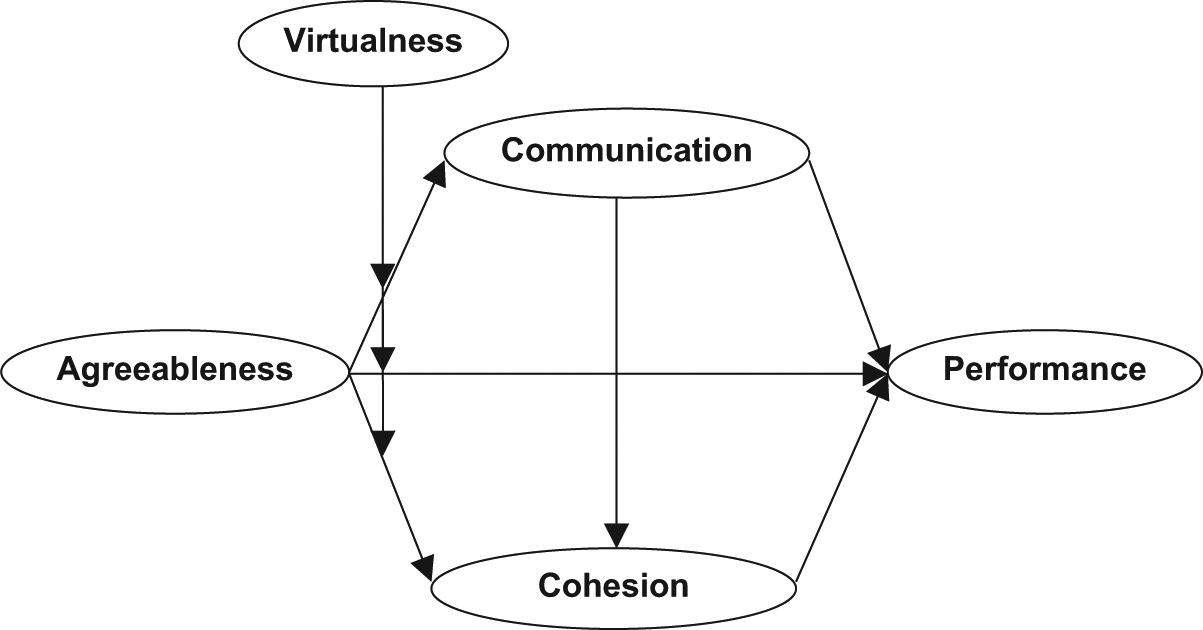
Model of hypothesized team-level relationships.
Agreeableness
The personality trait of agreeableness is socially oriented and relates to the way people interact with others. Costa and McCrae (1992) discovered six sub-facets of agreeableness that include trust, straightforwardness, altruism, compliance, modesty, and tender-mindedness. Agreeable people tend to be thoughtful, sympathetic, and cooperative and often see other people this way. In a team context, the interdependent nature of work requires members to interact and depend on each other for information and support. This effective coordination integrates diverse ideas and contributions within the team unit, and cooperative behaviors from agreeable teammates facilitate this integration (Graziano, Jensen-Campbell, & Hair, 1996).
The average level of agreeableness within a team has been shown to relate positively to team performance (Halfhill, Nielsen, & Sundstrom, 2008; Halfhill, Nielsen, Sundstrom, & Weilbaecher, 2005; Neuman, Wagner, & Christiansen, 1999), and this relationship has been substantiated meta-analytically for teams in field studies (Bell, 2007). However, attempts at establishing mediation models that elucidate how agreeableness affects team performance have not received much empirical support (Barrick, Stewart, Neubert, & Mount, 1998; van Vianen & De Dreu, 2001). It is thought that agreeableness enables better interpersonal facilitation and positive social situations that are harmonious instead of competitive (Bell, 2007). At the group level, collective agreeableness may translate as cooperation, consensus orientation, and conflict management (Halfhill et al., 2005). Halfhill and colleagues (2008) suggested that the personality trait of agreeableness connotes an interpersonal orientation necessary for effective group performance.
It is also thought that teams composed of more agreeable people should exhibit more effective social functioning within the group (Neuman et al., 1999). Peeters, Rutte, van Tuijl, and Reymen (2008) found that design processes (i.e., creation, planning, and cooperation) mediated the impact of agreeableness and conscientiousness on team performance for robotics design teams, but such findings are quite limited. Yet, despite these deficiencies in the research, agreeableness has also been linked to several other team dynamics. For example, agreeableness has been shown to relate to cooperative behaviors (LePine & Van Dyne, 2001), contextual performance (Mohammed, Mathieu, & Bartlett, 2002), satisfaction with the team (Peeters, Rutte, van Tuijl, & Reymen, 2006), and less conflict in teams (Graziano et al., 1996). One important mechanism for agreeableness in teams is communication.
Communication
Communication is one of the most fundamental teamwork process behaviors and has been widely researched in the team context (Barker et al., 2000; Hanlon & Taylor, 1991; J. Mathieu et al., 2008; Smith et al., 1994). In teams, communication is critical in providing, assessing, and synthesizing team members’ inputs. If members do not communicate, the unique ideas of each member will not be shared. According to Marks and colleagues (2001), communication is necessary for several teamwork dynamics including strategy formulation and planning, systems monitoring, coordination, motivation/confidence building, and affect management. In essence, communication is a general foundation on which specific processes are built, which allows teamwork to move forward to task completion.
The type of interpersonal interaction surrounding communication between agreeable members tends to be very highly supportive and collaborative. For example, Woolley, Chabris, Pentland, Hashmi, and Malone (2010) found that how group members communicated with each other (e.g., social sensitivity and conversational turn-taking) positively related to group performance. Agreeable members of a team encourage others to contribute, support each other’s unique perspectives, and help establish a safe environment for the sharing of information (Graziano et al., 1996). As information and ideas are shared, agreeable team members are more likely to promote constructive criticism in ways that allow for more effective decision-making processes. In addition, better communication will ultimately improve team performance as information is shared and vetted in a collaborative climate. In sum, the quality and frequency of communication are likely to be important means by which agreeable team members help to improve team performance. Therefore, we propose that communication will mediate the impact of agreeableness on team performance.
Cohesion
While communication is one of the most researched team processes, cohesion is one of the most researched emergent states (Chang & Bordia, 2001; J. Mathieu et al., 2008). Cohesion taps the attitudes and feelings of teammates, rather than their actions or behaviors, making it an emergent state in teams rather than an action-oriented team process (Marks et al., 2001). Cohesion is also widely considered a multidimensional construct (Beal, Cohen, Burke, & McLendon, 2003; Zaccaro, 1991) made up of task-oriented and social-oriented elements (Marks et al., 2001; van Vianen & De Dreu, 2001; Wellen & Neale, 2006). Task cohesion refers to the level of commitment that teammates have to the common task, while social cohesion refers to the interpersonal attraction and pride teammates feel toward their group. Social cohesion is related to one’s feeling of commitment, and researchers have found that agreeableness is positively related to an employee’s commitment to his or her organization (Erdheim, Wang, & Zickar, 2006).
Cohesion plays an important role in teams as an outcome (e.g., Harrison, Price, & Bell, 1998; Smith et al., 1994; Wellen & Neale, 2006), as well as an important linking mechanism between team inputs and outcomes (e.g., Barrick et al., 1998; Chiocchio & Essiembre, 2009; van Vianen & De Dreu, 2001). For example, the broadening use of project teams has increased attention on key factors in promoting project success and cohesion and is thought to help in those tasks that require solidarity and synergy between contributors (Chiocchio & Essiembre, 2009). However, although the relationship between cohesion and performance is well-established in the literature (Chiocchio & Essiembre, 2009; J. Mathieu et al., 2008), its linking role with personality traits and performance is less clear. Researchers studying personality in teams have hypothesized that cohesion mediates the impact of agreeableness on team performance (Barrick et al., 1998; van Vianen & De Dreu, 2001), yet no one to date has found evidence of this mediating relationship. One possible reason for the lack of findings is the cross-sectional nature of much of the team composition research. The measurement of constructs at multiple points in time may be necessary to understand the development of these psychological states (J. E. Mathieu et al., 2008).
We follow the suggestions from scholars and argue that another way agreeableness is able to improve performance in teams is through its effects on cohesion. Teams with more agreeable teammates should feel stronger bonds and a stronger sense of commitment to the team as well. Thus, we propose that in addition to communication, cohesion mediates the relationship between team-level agreeableness and performance.
Process Versus Emergent State
One important aspect of team dynamics is the distinction between behavior-based processes and affective- or cognitive-based states. Marks and colleagues (2001) differentiate between true team processes, which are inherently behavioral as they represent interactions between team members, and emergent states, which surface over time and can be inputs to subsequent processes and outcomes. Common processes are communication, cooperation, or conflict, while common emergent states are cohesion, group affective tone, or efficacy. Although the distinction is logically and theoretically sound, the field has not provided much direct empirical evidence of the distinctions between these two types of intermediary mechanisms in teams. One reason for the lack of findings distinguishing processes and emergent states may be the scarcity of teams’ data collected at more than one point in time. This weakness is understandable given the sample size challenges of studying teams and the added difficulty of studying ever-evolving teams over time. However, to better understand the differences between processes and states, such data are necessary.
We argue that cohesion needs more time to develop than communication because interaction-based constructs such as communication do not rely on team-specific antecedents that emergent states rely on. Some evidence of cohesion developing after a period of time was provided by Mullen and Copper (1994) in their meta-analysis. They conducted a cross-lagged panel correlation analysis and found that cohesion developed after teams had time to work and perform together. Gully, Devine, and Whitney (1995) questioned this conclusion by arguing that the various studies included in the meta-analysis failed to measure cohesion at the appropriate time intervals to warrant any temporal conclusions. More recently, Chiocchio and Essiembre (2009) reasoned that a minimum of 4 weeks of team interaction is needed for cohesion to be found. Although some of the prior research has conflicting views of the temporal nature of cohesion, the evidence suggests that cohesion develops gradually over time.
In addition, research shows that communication specifically leads to cohesion (Carron, 1988; Widmeyer & Williams, 1991). For example, Widmeyer and Williams (1991) found that communication is an antecedent of cohesion. In addition, Carron (1988) identified communication among team members as a contributor to team cohesion by reasoning that communication allows group members to develop similar beliefs and attitudes and to be more likely to conform to group norms. Research has also shown that communication can enhance a feeling of group closeness (Plutchik, 1981).
We argue that cohesion is an overall property of a combined team unit, which does not exist before a team is formed, and comes into existence only after teams have had sufficient time to interact and establish norms. By contrast, communication is not dependent on such a foundation to occur. It is an interaction-based process that starts as soon as team members begin interacting in a given context. Said differently, emergent states require time to surface within a team. Thus, by differentiating the timing of the measurement of processes and emergent states, we aim to demonstrate that cohesion develops after communication in teams.
Virtual Versus Face-to-Face Interactions
Although researchers have found a relationship between team-level agreeableness and performance (Barrick et al., 1998; Bell, 2007; van Vianen & De Dreu, 2001), as well as possible mediating mechanisms such as cooperative behaviors (LePine & Van Dyne, 2001) and contextual performance (Mohammed et al., 2002), these findings are far from consistent (e.g., Beersma et al., 2003). The variability in these findings may be due to various contextual factors that influence how agreeableness affects performance. For example, teams are often given autonomy to structure the ways in which they work and interact. In today’s technology-driven world, team member communication may incorporate myriad forms including a combination of face-to-face meetings, phone calls, emails, or texts. Although purely virtual teams exist, especially when geographic boundaries prohibit face-to-face interaction (e.g., Rutkowski, Saunders, Vogel, & van Genuchten, 2007), the level of virtualness in traditionally structured teams is also becoming more relevant to understanding team dynamics (Martins et al., 2004).
Two theories suggest that the media used in communication affects interpersonal interaction. Social presence theory (Short, Williams, & Christie, 1976) proposes that communication is effective when the social presence, or awareness, of a communication medium matches the level of interpersonal involvement needed to be successful on a task. Media richness theory (Daft & Lengel, 1984) suggests that richer, personal media are more effective for communicating important issues rather than leaner, less rich media. In addition, Kiesler and Sproull (1992) note that electronic communication lacks social context cues, making it hard for individuals to adapt to social structure, roles, and situational norms. Thus, when social context cues are weak, people feel distant from others and subsequently produce more self-centered and unregulated behavior (Kiesler & Sproull, 1992).
Research on virtual teams supports the belief that virtual team interactions are less rich than face-to-face team interactions. Virtual teams tend to have lower levels of trust (Wilson, Straus, & McEvily, 2006), collaborative behaviors (Hill, Bartol, Tesluk, & Langa, 2009), cohesion (Driskell, Radtke, & Salas, 2003; Hambley, O’Neill, & Kline, 2007), state positive affect (Johnson, Bettenhausen, & Gibbons, 2009), team innovation (Gibson & Gibbs, 2006), and team performance (Becker-Beck, Wintermantel, & Borg, 2005). For example, research shows that team-member attributions are more extreme in virtual environments where rich face-to-face interactions are limited (Vignovic & Thompson, 2010). Vignovic and Thompson (2010) found that short emails lacking a conversational tone led recipients to perceive lower levels of extraversion, agreeableness, and trustworthiness in their teammates. Hancock and Dunham (2001) found that individuals rated their conversation partners lower on agreeableness (as well as the other Big Five personality traits) when communication occurred via computer versus face-to-face. Markey and Wells (2002) noted that participants in Internet group-chat rooms “tended to see little difference among the personalities of their interaction partners” (p. 144) when such differences did exist. Finally, Driskell and colleagues (2003) found that virtualness made it more difficult to interpret the communication of others.
However, despite the drawbacks of virtualness, there are some key advantages as well. Beyond efficiency and management of geographically dispersed teams, researchers have argued that trust is not as important as information symmetry and good communication for virtual teams to perform well (Aubert & Kelsey, 2003). In addition, Kiesler and Sproull (1992) indicated that computer-mediated communication reduces social context cues, which can overcome social inhibitions, encourage communication across social or psychological boundaries, and deregulate group behavior. van der Kleij, Maarten Schraagen, Werkhoven, and De Dreu (2009) found that people adapt to virtual team interactions over time. Specifically, they noted that the initial differences in communication patterns between face-to-face and video-mediated teams eventually disappeared. Likewise, Wilson et al. (2006) found that trust deficits in virtual teams compared with face-to-face teams eroded. Finally, Lowry, Roberts, Romano, Cheney, and Hightower (2006) found that virtualness minimized the process losses of increased team size.
Although some contingency findings have been reported with team-level agreeableness, reward structure, and performance (Beersma et al., 2003), no research to date has examined the contingency role that virtualness may play in the relationship between agreeableness and team dynamics or performance. We believe that this is a fertile area of research that needs to be addressed given the ever-expanding role of technology in workplace communication and the belief that teammates likely mix some forms of virtual interactions as they work together on common tasks.
We believe that agreeableness thrives in the richer social contexts such as face-to-face interactions. Less rich social contexts such as those using a lot of technology do not allow agreeableness to be well observed to benefit team performance. Virtual teams potentially lose the social context cues that exist when people interact face-to-face (see Kiesler & Sproull, 1992). The positive interpersonal interaction that agreeable group members experience while communicating can be lost in a highly virtual environment. Hence, the research on the effects of virtualness on team dynamics lead us to argue that virtualness in teams will moderate the impact of team agreeableness on communication, cohesion, and performance such that teams that use more face-to-face interactions will have a positive association between agreeableness and these constructs, while agreeableness will not associate positively with these constructs for teams that use more virtual interactions. Stated formally,
Method
Procedures and Sample
The data came from a large data-collection effort (Bradley, Klotz, Postlethwaite, & Brown, 2013; Bradley, Postlethwaite, Klotz, Hamdani, & Brown, 2012). At the beginning of the semester, 593 undergraduate students from a large university course were randomly assigned to five-person project teams that remained intact for the duration of the semester. Precedent exists to study student teams for a semester to capture the effects of variables over time in the study of teams (e.g., LeDoux, Gorman, & Woehr, 2012). To create a more realistic team experience, each team took part in a team-building exercise to establish goals and set norms. In addition, 30% of each student’s class grade depended on his or her team’s performance on multiple assignments, which increased the interdependence within the teams and thus the realness of the team experience. At designated intervals, team members completed online surveys assessing internal team dynamics. The measures for personality, communication, cohesion, and virtualness were collected from these surveys. Only teams in which at least three members provided complete data were included in the final sample and 10 teams were dropped because they provided no responses for virtualness. After class withdrawals, nonresponses, and otherwise unusable data were removed, the final sample consisted of 107 teams of 513 people for an average team size of 4.8 people.
Measures
We averaged ratings for the independent variables in the study to create team-level variables and report aggregation statistics where applicable. Following the guidance from Podsakoff, MacKenzie, Lee, and Podsakoff (2003), we reduced possible effects from common method bias in two primary ways. First, we measured the constructs at different points in time. Second, we incorporated an independent assessment of team performance by trained raters.
Agreeableness
We assessed the agreeableness of all team members at Time 1 using the 10-item scale from the International Personality Item Pool (IPIP; Goldberg et al., 2006). Examples of items include, “I take time out for others” and “I am not really interested in other people’s problems” (reverse coded). The scale is available in the public domain and has been validated and shown to have adequate reliability. The reliability (α) in our sample is .83. We used averages to form the team scores but did not include aggregation statistics due to the scale being an additive index (Chan, 1998).
Communication
We measured communication at Times 3 and 4 using the eight-item scale developed by Mohrman, Ledford, and Demming (1987) and reported in Hanlon and Taylor (1991) to assess the level of communication of ideas within teams. We chose to use a measure that focused on communicating ideas because this study focuses on work teams where ideas, and the communication of them, are an important success factor for team performance. Example items include, “I often talk about opportunities for improvement I have noticed” and “I keep my ideas about our team’s work to myself” (reverse-coded). The reliability (α) in our sample is .74, and checks for aggregation yielded only marginally acceptable levels, which may be due to the individual referent structure of the items and possible additive nature of the index—that is, the scale might have functioned more similarly to an additive index rather than a scale in which the measure would be expected to converge within the team (Chan, 1998), Mdn rwg = .95, M rwg = .90, intraclass correlation (ICC) [1] = .05, ICC [2] = .22, F = 1.28, p < .05.
Cohesion
We measured cohesion at Times 3 and 4 with the five-item scale for social cohesion from the Group Environment Questionnaire developed by Widmeyer, Brawley, and Carron (1985). We used social cohesion as opposed to task cohesion because the effects of the interpersonally oriented personality trait of agreeableness are more likely to go through social rather than task cohesion. Example items include, “Our team would like to spend time together outside of class” and “I am not going to miss members of this team when the semester ends” (reverse-coded). The reliability (α) in our sample is .73 and checks for aggregation yielded acceptable levels, rwg = .95, ICC [1] = .12, ICC [2] = .56, F = 2.29, p < .01.
Virtualness
The degree or intensity of virtual work is generally assessed by measuring the amount of time spent interacting through technology (Gajendran & Harrison, 2007). We assessed the level of virtualness in team interactions at Time 2. We chose to measure virtualness at Time 2 to give enough time for teams to work together and establish relationships and interaction norms. Furthermore, we believe that the level of virtualness used by a team will remain fairly constant throughout the lifespan of the group. We incorporated a measure with a 5-point scale that asked how each team worked together. The options were as follows: 1 = entirely virtual communications (all communications were through email, phone, etc., no face-to-face communications), 2 = mostly virtual communications, 3 = half virtual communications and half face-to-face communications, 4 = mostly face to face communications, and 5 = entirely face-to-face communications. Checks for aggregation yielded acceptable levels, Mdn rwg = .89, M rwg = .83, ICC [1] = .21, ICC [2] = .57, F = 2.34, p < .01.
Team performance
Teams submitted a written paper based on a business project appropriate for the course. The project required teams to use performance-assessment models to analyze their own team’s performance. Teams used various team development, group process, and task performance models in the assessment. The team project was due at Time 5, which was the end of the 4-month course. The projects were rated for performance by expert raters who assessed the content and quality of each project. Specifically, they rated the clarity of written communication, quality of evidence used, accuracy of solutions provided, and appropriate use of management concepts. To increase consistency, the raters were trained together in the use of a standardized rating key developed for the course. In addition, the evaluations were discussed as a group, and discrepancies were adjusted accordingly. Finally, multiple raters rated a subset of the projects, and the interrater reliability was .80.
Controls
Five variables assessed at Time 1 were controlled for in the study: the average levels of conscientiousness, extraversion, emotional stability, openness to experience, and content knowledge within each team. Conscientiousness, extraversion, and openness to experience, as well as emotional stability, a reverse load of neuroticism, comprise the remaining four of the Big Five personality dimensions and were assessed using the IPIP measure of the Big Five personality dimensions (Goldberg et al., 2006). Because the Big Five personality traits are intercorrelated, we felt that it was critical to control for the other four to determine the effects of agreeableness beyond the effects of the other four traits. Content knowledge was used to control for the task-specific knowledge differences among the members in the study and was assessed using an individual’s initial test score in the course.
Results
Descriptive Statistics
Table 1 presents the means, standard deviations, and correlations among all the variables in the study. Of note, agreeableness correlates with communication and cohesion at Time 4 (r = .26 and .29, respectively), and communication and cohesion at Time 4 correlate with team performance (r = .25 and .31, respectively). In addition, the controlled variables show some correlations. For example, content knowledge correlates with communication at Time 3 (r = .21).
Means, Standard Deviations, and Correlations Between Variables (N = 107 teams).

p < .05. **p < .01.
Hypothesized Relationships
To test Hypotheses 1 and 2, we used the standard three-step test for mediation (Baron & Kenny, 1986), which states that mediation is supported if (a) the independent variable associates with the dependent variable, without the mediator included; (b) the independent variable associates with the mediator, without the dependent variable included; and (c) if the mediator associates with the dependent variable, with the independent variable included in the model. As can be seen from the tables, agreeableness did not have a direct association with team performance. However, many scholars have concluded that the first step is not necessary to establish indirect effects in mediation (J. E. Mathieu & Taylor, 2006; Shrout & Bolger, 2002). Hence, we pursue an indirect-effects model of mediation in this study.
Hypothesis 1 formed the basis for our examination of communication mediating the relationship between average team agreeableness and team performance. As shown in Table 2, the test for the mediating effect of communication at Time 3 was not supported. However, at Time 4, Steps 2 and 3 of the test for mediation were found. Next, we completed the same steps for Hypothesis 2, which focused on the potential mediating effect of cohesion on the relationship between average team agreeableness and team performance. Once again, the test for the mediating effects at Time 3 was not supported, as shown in Table 3. Similar to communication in Hypothesis 1, support was found for the mediating effects of cohesion during Time 4. Therefore, while neither Hypothesis 1 nor Hypothesis 2 was supported during Time 3, both were supported in Time 4.
Regression Results Testing Whether Communication Mediated the Relationship Between Agreeableness and Team Performance (N = 107 teams).
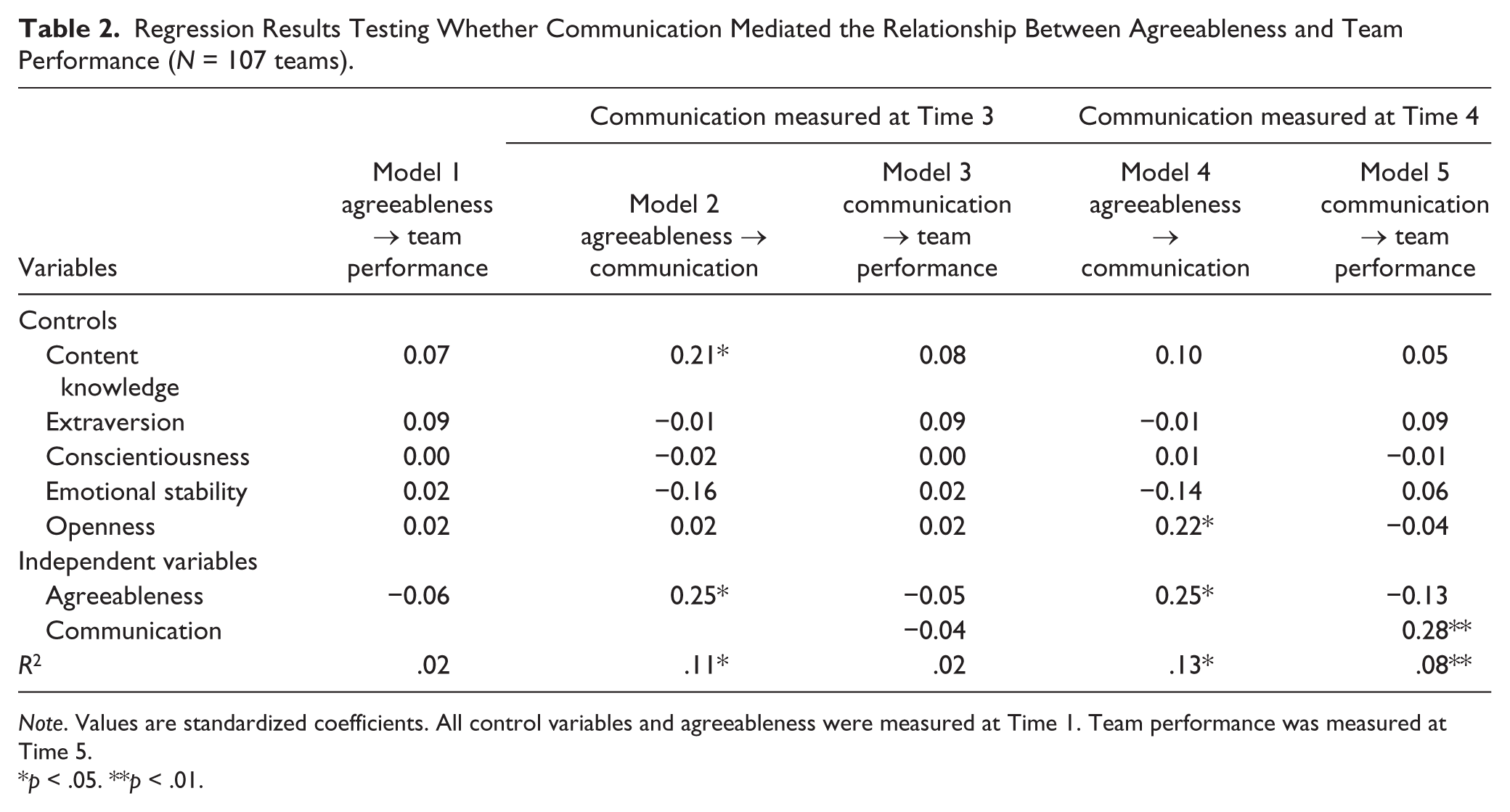
Note. Values are standardized coefficients. All control variables and agreeableness were measured at Time 1. Team performance was measured at Time 5.
p < .05. **p < .01.
Regression Results Testing Whether Cohesion Mediated the Relationship Between Agreeableness and Team Performance (N = 107 teams).

Note. Values are standardized coefficients. All control variables and agreeableness were measured at Time 1. Team performance was measured at Time 5.
p < .05. **p < .01.
To test Hypothesis 3 (that communication precedes cohesion in the mediation model), we used guidance from the literature to test two multiple mediator models, one model with communication preceding cohesion and the other with cohesion preceding communication. The joint significance test (MacKinnon, Lockwood, Hoffman, West, & Sheets, 2002; Taylor, MacKinnon, & Tein, 2008) states that there is sufficient justification for a two mediator model if three paths are significant: (a) the independent variable’s impact on the first mediator, (b) the first mediator’s impact on the second mediator, and (c) the second mediator’s impact on the dependent variable (controlling for all previous variables). The collection of data for hypothesized mediators at different time periods further strengthens the test of the double mediation model.
Table 4 presents the results for the double-mediation regression analysis testing whether communication at Time 3 and cohesion at Time 4 mediate the effects between agreeableness and performance. As can be seen from the table, the initial requirement for double mediation is met because agreeableness relates to communication (Time 3) after control variables are included as covariates, β = .25, ΔR2 = .05, p < .05. Next, the second requirement is met because communication relates to cohesion (Time 4), after agreeableness and the control variables are included, β = .34, ΔR2 = .11, p < .01. Finally, the third requirement for double mediation is met because cohesion is related to team performance (Time 5) when agreeableness, communication, and the control variables are included, β = .40, ΔR2 = .13, p < .01.
Regression Results Testing Whether Communication and Cohesion Mediate the Relationship Between Agreeableness and Team Performance (N = 107 teams).
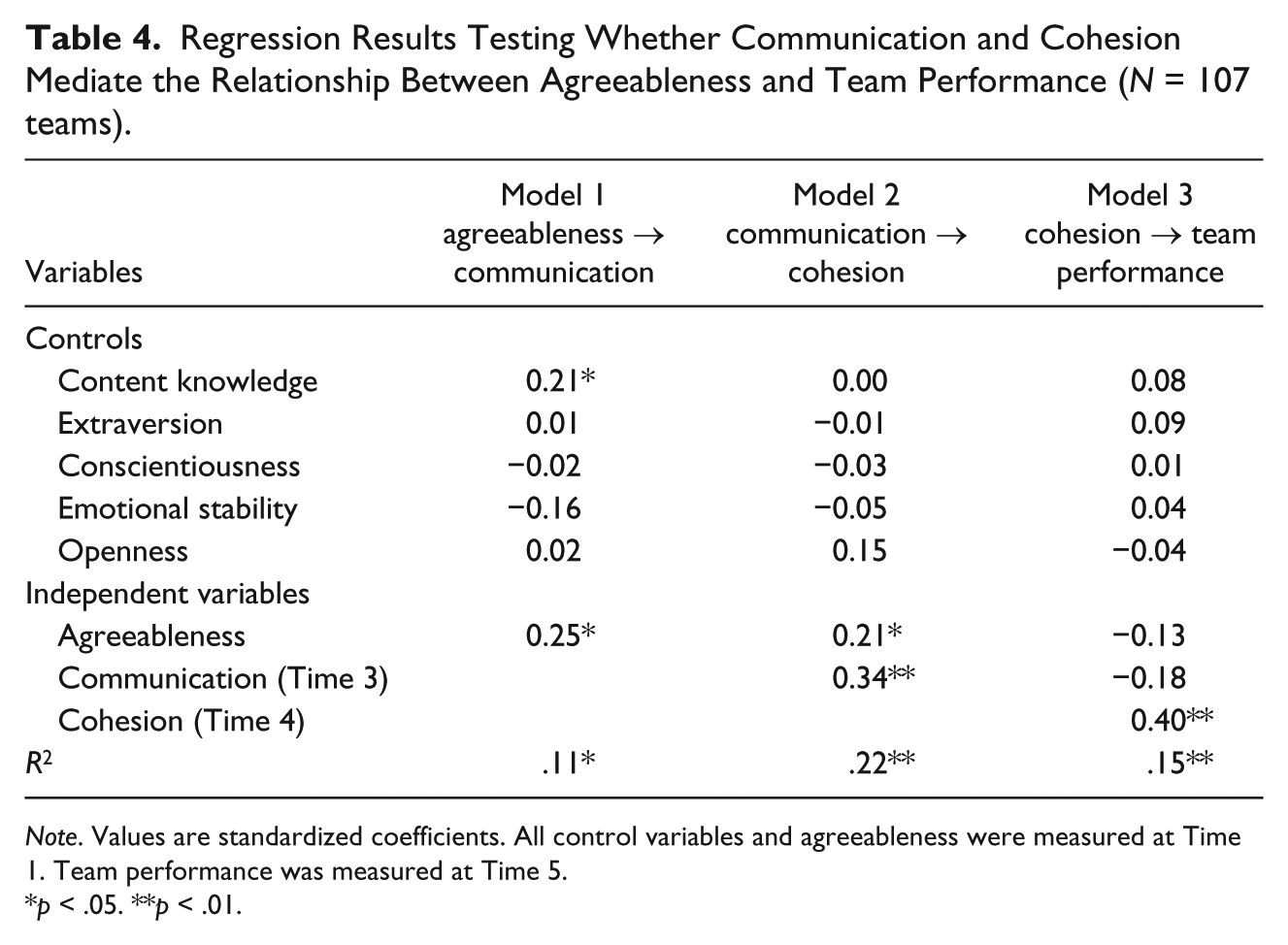
Note. Values are standardized coefficients. All control variables and agreeableness were measured at Time 1. Team performance was measured at Time 5.
p < .05. **p < .01.
Table 5 presents the results for the double-mediation regression analysis testing whether cohesion precedes communication in the indirect effects between agreeableness and performance. We used a measure of cohesion at Time 3 (instead of Time 4) and a measure of communication at Time 4 (instead of Time 3) and reran the previous double-mediation analyses. As can be seen from Table 5, the first of the three requirements for double mediation is not met, and agreeableness did not relate to cohesion at Time 3, although the other two requirements are met. Thus, we find support that communication appears to come before cohesion but no support that cohesion comes before communication. These results provide support for Hypothesis 3.
Regression Results Testing Whether Cohesion precedes Communication in Mediating the Relationship Between Agreeableness and Team Performance (N = 107 teams).
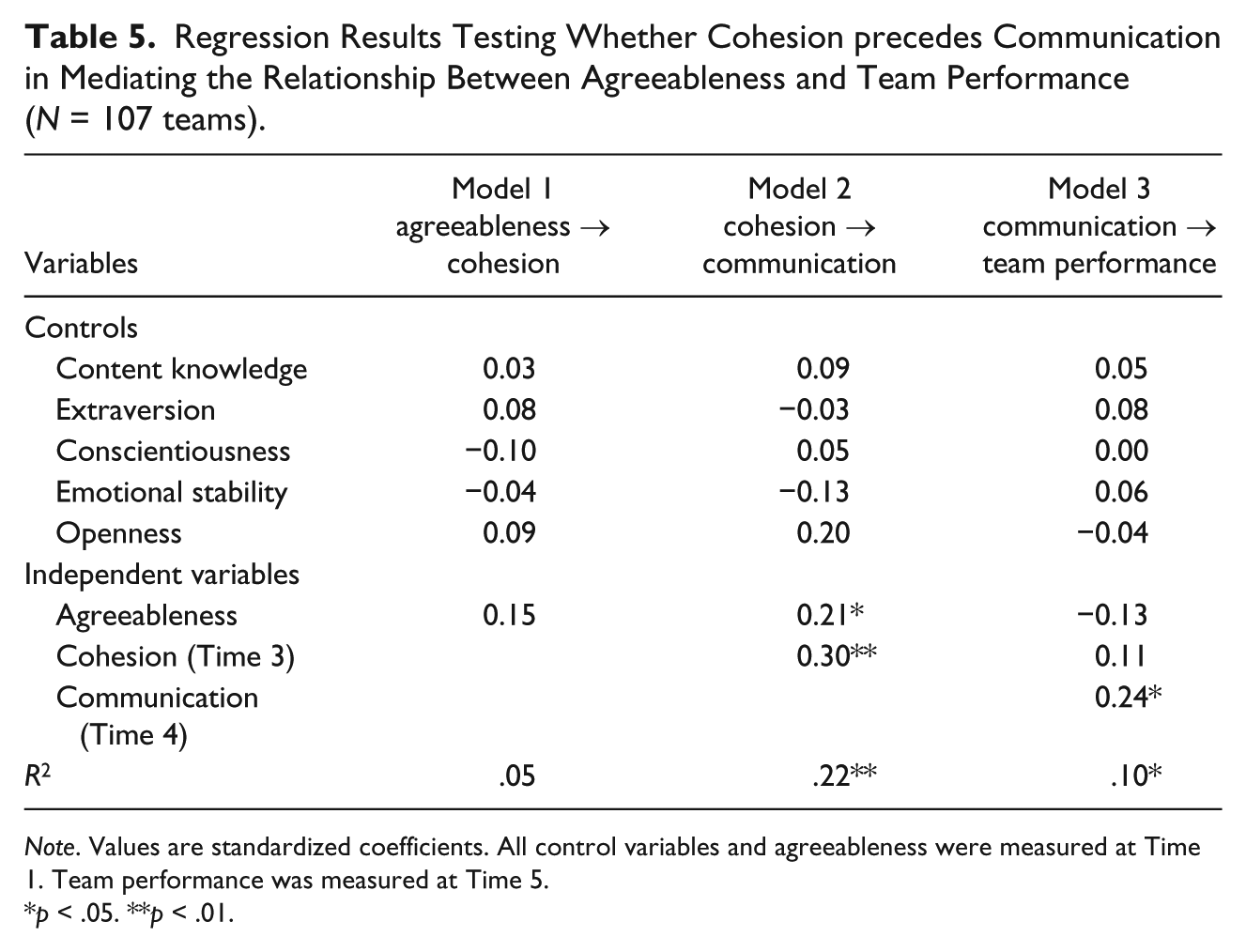
Note. Values are standardized coefficients. All control variables and agreeableness were measured at Time 1. Team performance was measured at Time 5.
p < .05. **p < .01.
Hypothesis 4 states that the degree of virtual interactions a team uses will moderate the impact of agreeableness on communication, cohesion, and performance such that more virtualness will minimize the positive impact of agreeableness on each construct. To test Hypothesis 4, we ran five separate moderator regression analyses (predicting communication and cohesion at Times 3 and 4, and performance). In the first step, the five controlled variables of content knowledge, extraversion, openness to experience, conscientiousness, and emotional stability are included in the model predicting communication. In the second step, the main effects of agreeableness and virtualness are included. In the third and final step, the interaction term of agreeableness and virtualness is included. As can be seen from Table 6, the interaction term predicting communication at Time 3 is significant in Step 3, β = −.21, p < .05, and adding the interaction term increased R2 by .04 from .13 to .17. In addition, the interaction term predicting team performance is significant in Step 3, β = −.28, p < .01, and adding the interaction term increased R2 by .08 from .01 to .09. However, the interaction term was not significant when predicting communication at Time 4, β = −.04, p = .65, or cohesion at Time 3, β = −.15, p = .14, or at Time 4, β = −.13, p = .18.
Moderated Regression Analysis Results: Virtualness as a Moderator of the Agreeableness and Communication, Cohesion, and Team-Performance Relationships.
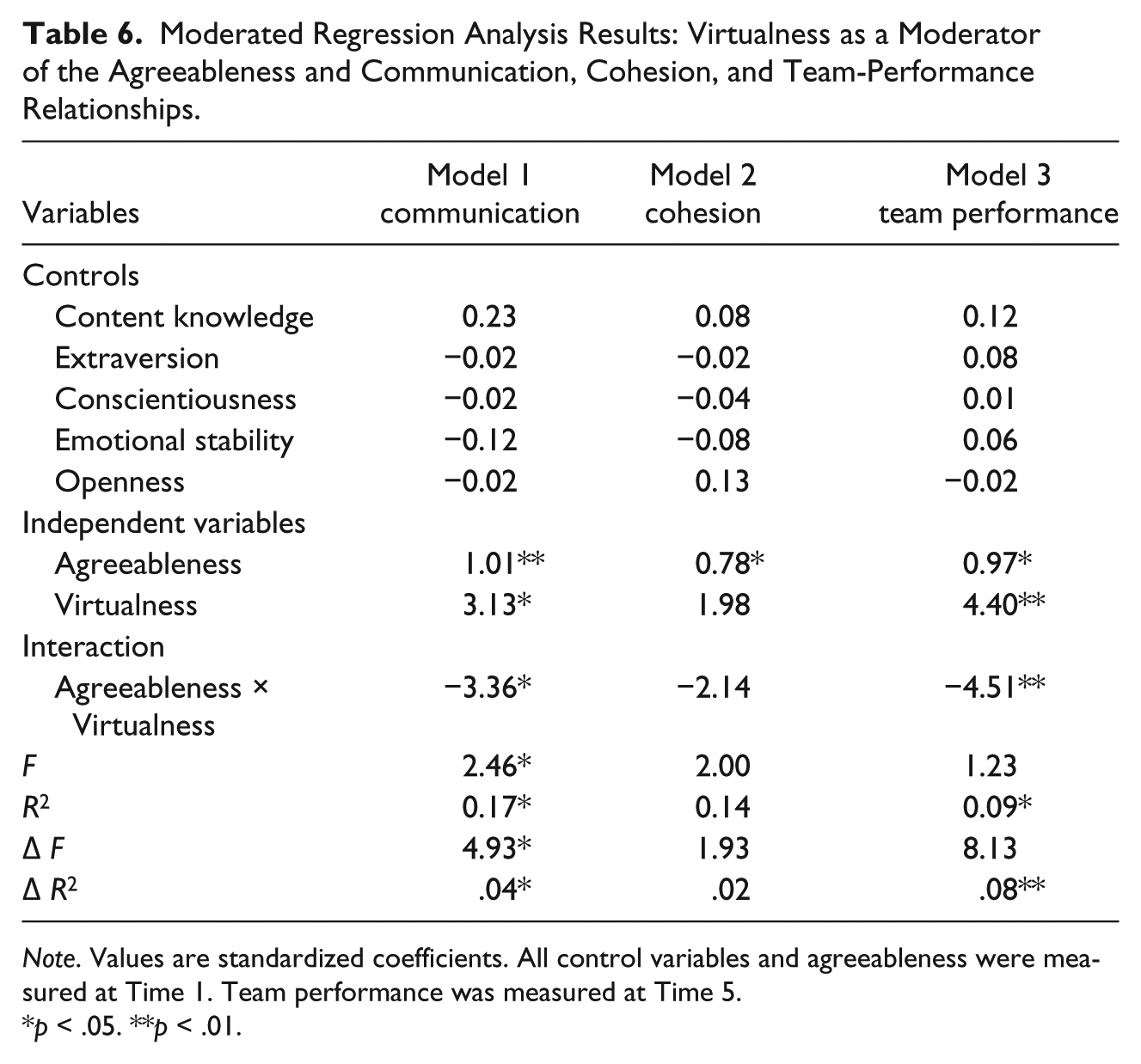
Note. Values are standardized coefficients. All control variables and agreeableness were measured at Time 1. Team performance was measured at Time 5.
p < .05. **p < .01.
To interpret the two significant interactions, we graphed them (Figures 2 and 3) at one standard deviation above and below the mean using centered independent variables (Cohen, Cohen, West, & Aiken, 2003). Figure 2 illustrates that when teams interact face-to-face, a positive effect of agreeableness on team communication exists. However, when teams interact virtually, this positive effect disappears. Figure 3 illustrates that when teams interact face-to-face, a positive effect of agreeableness on team performance exists. However, when teams interact virtually, this positive association actually becomes negative. Thus, Hypothesis 4a predicting communication and Hypothesis 4c predicting performance were supported, but Hypothesis 4b predicting cohesion was not.

Interaction of team average agreeableness and virtualness predicting team communication.
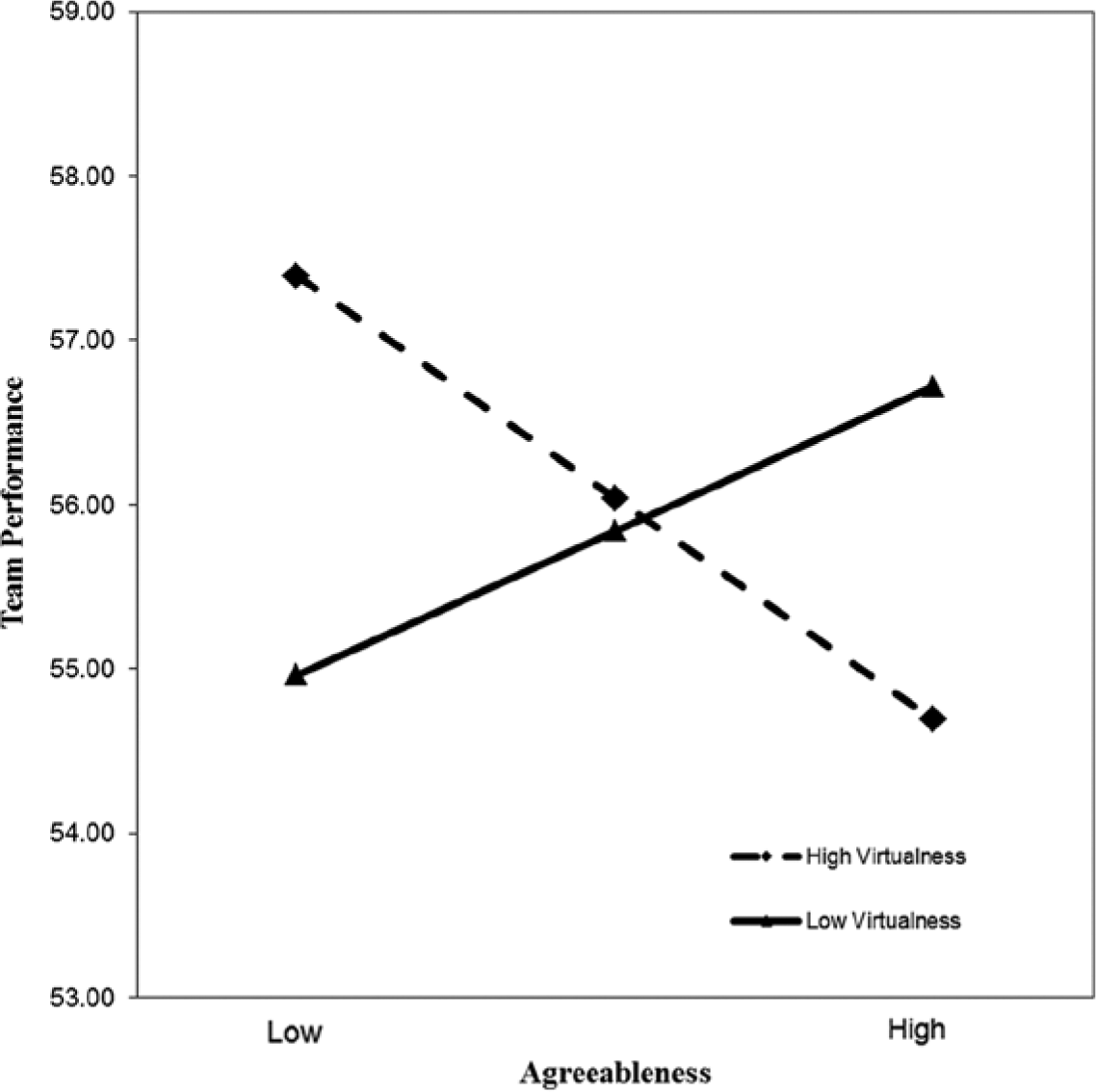
Interaction of team average agreeableness and team virtualness predicting team performance.
Discussion
Although research shows that agreeableness is important in teams (Bell, 2007), the nature of how it affects team processes, emergent states, and performance is much less clear. While we must remain cautious in drawing causal inferences, the data collected at different points in time from 107 project teams provide evidence that communication and cohesion help to translate the agreeable tendencies of team members into improved team performance. In addition, the study offers some preliminary support that communication, an interaction-based process, precedes cohesion, an affect-based emergent state, in the temporal development of team dynamics and performance. Thus, the appropriate timing of measurement of certain team-intermediary mechanisms may depend on their process or state natures. It is likely that state-like measures such as cohesion, trust, and commitment require more time and team interaction to form than interaction-based processes. Finally, the study provides evidence that an important moderator of the impact of agreeableness on team communication and performance is the degree of virtualness of team interactions. We found that highly agreeable teams had better communication and performance only when interacting face-to-face. Interestingly, low agreeableness teams interacting virtually performed about as well as high agreeableness teams interacting face-to-face. We now discuss the implications, limitations, and future research avenues of this study.
Theoretical Implications
Contrary to some findings in the literature (e.g., Ellis et al., 2003), we find that more agreeable teams communicate more ideas than less agreeable teams. Some scholars have proffered that too much agreeableness may impair the levels of creativity that exists in the team because of a lack of critical and challenging communications. However, without enough agreeableness, teams will not be able to effectively draw out the novel information, unique perspectives, and insights from team members. Without this social facilitator trait, team interactions suffer, which will ultimately affect the performance of the team.
Another important theoretical implication of this study is the finding that the behavior-based team process (communication) came before the affect-based emergent state (cohesion) in the model. Although team researchers have conceptually distinguished these two unique mediators in I-P-O models of team performance (Marks et al., 2001), little prior work has explicitly examined their temporal distinction. Thus, the timing of the measurement of such constructs is critical to our improved understanding of how they operate within teams. While interaction-based mediators such as communication or conflict occur immediately in a team’s life cycle, attitude- or feeling-based mediators develop from team interactions and, thus, require more time to form. This study shows that emergent states need time to develop, which is consistent with the findings of previous researchers (Terborg, Castore, & DeNinno, 1976).
An additional implication of this study is the finding that virtualness moderates the impact of team agreeableness on communication and team performance. In teams using mostly face-to-face interactions, there was a positive relationship between agreeableness on one hand and communication and performance on the other. It appears that these teams were able to access the benefits of this trait to improve functioning and ultimately increase performance. However, in teams using mostly virtual interaction, there was no significant relationship between agreeableness and communication and a negative association between agreeableness and performance. It may be that these teams were not able to access this helpful trait or reap the social advantages through improved communication. Likewise, technology may interfere with effective communication (Driskell et al., 2003) as well as restrict one’s ability to recognize the personality traits of his or her teammates (e.g., Hancock & Dunham, 2001; Markey & Wells, 2002, Vignovic & Thompson, 2010). Interestingly, teams with low levels of agreeableness that interacted virtually had slightly higher performance than those with high levels of agreeableness that interacted face-to-face. It appears that face-to-face interaction is necessary for agreeableness to benefit teams or for disagreeableness to damage teams. This finding is important to theoretical models used in researching virtual teams (cf., Schiller & Mandviwalla, 2007, for a review) such as swift trust theory (Jarvenpaa & Leidner, 1998), social presence theory (Lind, 1999; Short et al., 1976; Warkentin & Beranek, 1999), and the Big Five personality model.
Managerial Implications
This study provides useful managerial implications. First, if a team has a high level of agreeableness, the manager may want to encourage more face-to-face time to reap the benefits of this potential asset, but if a team has a low level of agreeableness, the manager may want to encourage more virtual interactions mediated through technology. Agreeable teammates should also be encouraged to promote team communication of information and ideas. In addition, teams with a large amount of virtual interactions will likely benefit from some face-to-face interactions, at least initially, to build trust and enhance the integration of team-member inputs. Second, an interesting extension of this thinking pertains to managing teams with difficult members. If a team has a highly disagreeable member (i.e., a bad apple), a manager could structure more virtual and less face-to-face interactions to limit the impact of the bad apple. The loss in information richness in more virtual interactions reduces the contagion of the member’s negativity and, thus, may help protect team processes and ultimately improve collective performance. Third, while agreeableness in teams helps facilitate team dynamics and effectiveness, other research has shown that too much agreeableness can also hinder them (Ellis, et al., 2003). As noted earlier, Wang, Chen, Tjosvold, and Shi’s (2010) findings suggest that for teams high in agreeableness, it is necessary to have a minority of team members with lower levels of agreeableness to generate constructive controversy. Managers must find an effective balance between enough agreeableness, harmony, and social integration on the one side and conflict, debate, and constructive criticism on the other. Considering the team’s primary activity and typical output (e.g., Sundstrom, De Meuse, & Futrell, 1990) may inform such decisions. For example, advice/involvement teams producing unique decisions, proposals, and recommendations may benefit more from open-minded discussion and disagreement and, in turn, the inclusion of a few less agreeable team members than will production/service teams with continuous work cycles and consistent outputs.
Limitations
One potential limitation of this study is the use of an undergraduate student sample, which may weaken the generalizability of the results to teams in organizations that exist for longer periods of time and have a stronger impact on teammates’ real lives. However, the students worked in real project teams, and a significant portion of their class grade (30%) was directly tied to their team’s performance. The teams also experienced a team-building exercise to build relationships, form goals, and establish rules and consequences for team behavior. Thus, a meaningful level of interdependence and realness existed within the teams.
A second potential weakness of the study is the limited analyses used to establish the temporal order of communication, the behavior-based team process, cohesion, and the affective-based emergent state. These preliminary results rest on agreeableness associating with communication at Time 3 but not associating with cohesion at Time 3. Greater attention to the nature and impact of these time-based dynamics, along with more sophisticated temporal analyses, would be a very fruitful pursuit of future research.
A third potential limitation of the study is the nature of the communication measure, which had weaker justification for aggregation than cohesion. While the results for within-group interrater agreement (Rwg) were acceptable, and the F statistic was marginally acceptable, the ICC(2) result was below the common .70 standard at .22. This issue may be due to the great deal of complexity in team communication such as from its structure and function, quantity and quality, and type and patterns, which may have squeezed out important detail in the communication interactions in these teams. In addition, the individual referent structure of the items may have contributed to this issue. It may be that the scale operated more like an additive index and less like a scale where convergence within the team is expected and important to establish team-level constructs (Chan, 1998). For example, team-level averages for personality constructs (such as our use of agreeableness) need no aggregation statistics to support their use at the team-level of analysis because convergence within a team on individual-level personality is neither required nor expected.
Finally, the use of a one-item scale to measure virtualness may be problematic. The item was developed for this study, and therefore, it has not been shown to demonstrate adequate psychometric properties. However, the finding that virtualness moderates the impact of team agreeableness on communication and team performance is consistent with the majority of findings on the impact of virtualness on team dynamics (see Becker-Beck et al., 2005; Driskell et al., 2003; Hancock & Dunham, 2001; Markey & Wells, 2002; Vignovic & Thompson, 2010). In addition, the student sample may have a higher degree of virtualness than workplace teams due to the greater technological awareness of younger generations.
Directions for Future Research
Future research should continue to explore the similarities and differences between interaction-based processes, and affective- or attitude-based emergent states to better understand how they operate within traditional I-P-O models of team performance. The well-established theoretical distinction (Marks et al., 2001), and recent use of the distinction in talking about team-mediating mechanisms (e.g., J. Mathieu et al., 2008), encourage the pursuit of more empirical evidence to support unique functions of the two types of mediating mechanisms. We find that emergent states come after processes, but there may be instances where the reverse order is true, such as in well-established teams. For example, in well-established teams, group norms may already exist prior to the display of teamwork and interactional processes. This phenomenon may be the most evident in military teams and religious groups or other groups of people who are highly identified with the organization they represent. High organizational identification likely creates a natural relationship with other team members that may compensate for a lack of time spent together. Finally, limitations of our study may have prevented us from making stronger conclusions. In general, more emphasis should be devoted to better understanding how these two fundamental types of mediating mechanisms function consistently and also uniquely in team-performance models.
In addition, future research should explore the conditions when agreeableness improves or hinders the communication of ideas. It may be that a curvilinear relationship between agreeableness on one hand and idea communication and performance on the other explains this difference. After all, teams need an adequate level of agreeableness to function, but too much agreeableness may stifle creative processes and hinder performance. This may account for the contradictory findings regarding the helpful or detrimental role of agreeableness on creativity (see Ellis et al., 2003). On the other hand, a more creative task may require more conflict and less agreeableness than a less creative task. Regarding virtualness, future research should replicate the current findings with other measures of virtualness.
While we measured the average level of agreeableness within a team for the current study, the variance of levels of agreeableness within a team should also be considered. For example, research by Wang and colleagues (Wang et al., 2010) suggests that high levels of team agreeableness alone may be insufficient to encourage constructive controversy and that diversity in team-member agreeableness is beneficial for the generation of open-minded discussion. Based on their findings, the authors concluded that “agreeable people help to develop a positive group climate and social cohesion but should be supplemented with a few low agreeable team members who can act as stimuli as they question others and challenge different perspectives” (p. 150). Hence, the role of agreeableness within a team may be more complex than has been previously suggested. Therefore, scholars should continue the exploration of varying levels of agreeableness within a team to study the effect of a disagreeable deviant member.
Conclusion
Agreeableness is one of the most important personality traits for team performance (Bell, 2007), perhaps due to its emphasis on cooperation and facilitation, which may help others feel comfortable and contribute in social situations. We found that more agreeable teams communicate more and have higher levels of cohesion, which should ultimately help them perform better than less agreeable teams. In addition, the more the team interacts virtually, the less these benefits are realized. These findings were reported with data collected at different points in time from 107 project teams, which helps strengthen the conclusions and the ordering of intermediary mechanisms from process (communication) to emergent state (cohesion). The results improve our understanding of why agreeableness is helpful in team settings and provide future avenues of exploration.
Footnotes
Declaration of Conflicting Interests
The author(s) declared no potential conflicts of interest with respect to the research, authorship, and/or publication of this article.
Funding
The author(s) received no financial support for the research, authorship, and/or publication of this article.