



Abstract
Much of our knowledge of team information processing has been influenced by the hidden-profile paradigm. In this review, we employ the input–mediator–outcome (IMO) team effectiveness framework to organize a systematic and comprehensive review of the knowledge accumulated in this area during the last three decades. The use of the IMO framework highlights important aspects of team dynamics that have received limited attention in past studies. Building on our analysis of the literature, we discuss significant theoretical questions that remain to be answered and propose methodological changes that would broaden and enhance our current understanding of team information processing. We suggest that the hidden-profile paradigm has reached maturity in terms of the permutations of Stasser and Titus’s original conceptualization and conclude by proposing that future research should move toward exploring novel settings that move closer toward embracing the dynamic and complex nature of team information processing.
The ability of groups to share and use information is critical for group coordination and decision making. A seminal study of group information processing behavior conducted by Stasser and Titus in 1985 helped initiate a prominent and interdisciplinary area of groups and teams research known as the hidden-profile paradigm (Stasser, 1988). In the classic version of the paradigm, teams are presented with information about a few discrete choice alternatives—for example, candidates for student council president (e.g., Stasser, Taylor, & Hanna, 1989; Stasser & Titus, 1985, 1987), the suspects identified in a homicide investigation (e.g., Stasser & Stewart, 1992), or candidates for a university position (e.g., Postmes, Spears, & Cihangir, 2001)—and are asked to discuss these choices and select the best option. As a team, participants have enough information to make an informed decision; however, no individual has access to all the information. Instead, information is distributed in a combination of shared information (available to all team members) and unshared information (unevenly distributed among participants, usually only available to a single individual). As a result, teams can only make the most accurate decision provided that they effectively pool the information from all members. However, Stasser and Titus (1985) found that, instead of sharing all information, team members consistently focused on shared information at the expense of unshared information and that this bias toward shared information produced suboptimal team decisions.
Over the past three decades, that ground breaking study has been replicated many times and has inspired scholars in the fields of psychology, management, and communication to examine factors that contribute to a more effective information exchange and better decision making in team settings. Theoretical explanations for the observed failure of teams to choose the best alternative and solve hidden profiles vary. One explanation is that shared information is mentioned more during group decision making because it has a greater chance of being mentioned, as it can potentially be sampled from the minds of several members, in contrast to unshared information that can only be sampled from one memory (Stasser, 1992a; Stasser et al., 1989; Stasser & Titus, 1987). On the contrary, social-psychological explanations such as social validation (Boos, Schauenburg, Strack, & Belz, 2013; Mojzisch, Schulz-Hardt, Kerschreiter, Brodbeck, & Frey, 2008; Parks & Cowlin, 1996) and mutual enhancement (Henningsen & Henningsen, 2004; Wittenbaum, Hubbell, & Zuckerman, 1999), suggest that shared information is repeated more because it is evaluated as valuable, relevant, and important on realization that other team members possess the same information (Postmes et al., 2001). In addition, several alternative explanations rest on the observation that the team’s final decisions are strongly influenced by individual members’ initial preferences which are, by design, biased with shared information (Faulmüller, Kerschreiter, Mojzisch, & Schulz-Hardt, 2010; Faulmüller, Mojzisch, Kerschreiter, & Schulz-Hardt, 2012; Gigone & Hastie, 1993, 1997; Greitemeyer & Schulz-Hardt, 2003; Minas, Potter, Dennis, Bartelt, & Bae, 2014).
Research on hidden-profile effects has also been the subject of three separate meta-analyses (Lu, Yuan, & McLeod, 2012; Mesmer-Magnus & DeChurch, 2009; Reimer, Reimer, & Czienskowski, 2010). All of the meta-analyses provide support for Stasser and Titus’s original findings regarding shared information bias and suboptimal team decisions. Drawing on and augmenting the knowledge produced from these recent meta-analyses, the work presented here offers a forward looking perspective based on a comprehensive and systematic review of the last three decades of the hidden-profile literature. However, given these recent meta-analyses and previously published reviews of the hidden-profile literature (e.g., Wittenbaum, Hollingshead, & Botero, 2004), is a review of the literature needed at this time? We believe the answer is yes, for three central reasons. First, even though the meta-analytic studies have made undoubtedly valuable contributions to the literature by cumulatively analyzing existing research on team information processing, meta-analysis by nature is not equivalent to a systematic, comprehensive review and integration of a literature. By design, meta-analytic techniques require researchers to focus on a limited number of variables that previous researchers have explored and deemed to be important; in other words, meta-analyses can summarize and clarify what we already believe to be important, but these techniques typically do not examine other important factors that may not have received adequate attention from the research community. In contrast to meta-analysis, systematic reviews of literature allow researchers to examine a broad range of variables, create a comprehensive review of the extant body of knowledge, identify trends, pinpoint areas in need of more research, and offer perspectives qualitatively different from those available from meta-analyses.
Second, at different developmental stages of the hidden-profile literature, researchers have indeed provided reviews of this literature (e.g., Stasser, 1992b, 1999; Stasser & Titus, 2003; Wittenbaum & Stasser, 1996), with the latest review being published in 2004 (Wittenbaum et al., 2004). In their review, Wittenbaum and colleagues presented an overview of the major findings of the collective information sharing literature from its inception in 1985 until 2003. However, since this review, the hidden-profile literature has grown significantly; a search on the Web of Science database revealed that the number of articles that have cited the original article by Stasser and Titus (1985) has grown from 160 in 2003 to 530 in 2015. Similarly, according to Google Scholar, the number of articles that have cited Stasser and Titus (1985) has grown from 283 in 2003 to more than 1,300 articles by the end of 2014. We believe that it is time to cast a critical eye on the state of the literature, to document how and in which directions the field has progressed from its inception to the present, and to identify and describe areas now particularly well suited to future research endeavors.
Finally, in addition to extending Wittenbaum and colleagues’ work to include recent research progress in the hidden-profile literature, we offer two additional contributions to the literature in our review. First, in alignment with recent advancements in the literature on team effectiveness, we review and analyze the knowledge accumulated during the last three decades using a new perspective—namely, that of the input–mediator–outcome (IMO) team-effectiveness framework (Mathieu, Maynard, Rapp, & Gilson, 2008). A similar approach was followed by Lu and colleagues (2012) in their meta-analysis of hidden-profile research although, as a meta-analysis, only one input variable (communication technology) was included. Using the IMO perspective to organize a systematic and comprehensive literature review, we believe, better integrates research from multiple disciplines and better facilitates the identification of areas ripe for future exploration. Second, and pursuant to calls for more emphasis on organizational context (e.g., Rousseau & Fried, 2001), our use of the IMO framework offers a more meso perspective (House, Rousseau, & Thomas-Hunt, 1995; McGrath, Arrow, & Berdahl, 2000; Rousseau & House, 1994) and highlights aspects of the literature that fit the view of teams as complex, dynamic, and adaptive systems that are embedded in a larger organizational context.
The remainder of the article is organized as follows. We first review the IMO framework and discuss how this framework enables us to offer an updated perspective regarding the hidden-profile literature. We then describe how we selected the articles for this review. Following this section, we use the IMO framework to organize and review the work published during the last three decades. Based on this IMO-framed analysis of the literature, we identify and describe in detail research opportunities for future work, and suggest which methodologies and contexts might further enhance future research outcomes in the areas we identify. We close with a summary of our primary findings and a call for research that embraces the increasingly dynamic and complex nature of team information processing.
An IMO Perspective
To date, much of the hidden-profile literature, either implicitly or explicitly, has been grounded in the input–process–output (IPO) framework (McGrath, 1984). This framework has been the most prominent model of team effectiveness and has served as a valuable guide in the development of empirical and theoretical investigations across different areas of small group research. While remaining the cornerstone of team effectiveness studies, over the years, the IPO model has been modified, extended, and enhanced into more elaborate models (e.g., Cohen & Bailey, 1997; Hackman & Morris, 1975; Ilgen, Hollenbeck, Johnson, & Jundt, 2005; Mathieu et al., 2008; McGrath et al., 2000), the most recent one being the IMO framework developed by Mathieu and colleagues (2008).
The IMO framework addresses three major criticisms of the IPO model. First, the IMO framework embraces a meso and multilevel approach (House et al., 1995; Klein & Kozlowski, 2000; McGrath et al., 2000; Rousseau & House, 1994) to the study of teams and explicitly recognizes that individuals are nested in teams, which are in turn nested in an organizational context, with each layer being affected by both inner and outer layers. Second, using the term mediator instead of process, the IMO model responds to concerns raised about the nature of processes in the IPO framework (see Ilgen et al., 2005; Marks, Mathieu, & Zaccaro, 2001) and differentiates processes from emergent states. Finally, the IMO framework appreciates the critical role that time plays in team functioning and recognizes the dynamic nature of teams.
The IMO framework can serve as a valuable guide in highlighting important aspects of team dynamics that are overlooked in the IPO model. Wittenbaum and colleagues’ (2004) review of the hidden-profile literature suggested that the IPO framework has limited our understanding of the complexities inherent in the hidden-profile paradigm in that the majority of the hidden-profile research is devoted to investigating individual and team-level factors that affect the efficiency of only one team process: the information-exchange process.
Notwithstanding the importance of this process and its driving factors, recent advancements in small group research continue to illustrate that a process does not exist in isolation; it interacts with other processes and emerging states, influences them, and is influenced by them (Kozlowski & Ilgen, 2006; Marks et al., 2001). For example, research on team conflict shows that conflict in a team influences emergent states such as trust, cohesion, and respect (Jehn, Greer, Levine, & Szulanski, 2008) and is influenced by emergent states such as shared identity (Hinds & Mortensen, 2005). Building on the idea of increasing attention to the dynamic relationship between team processes and emergent states, we argue that to understand team information sharing, we need to embrace the complexities of team dynamics and take into account the role of emerging states and other related processes; consequently, we use the IMO framework here as a guide for this endeavor.
Method
We employed several search strategies to pinpoint exemplar studies that have influenced the existing state of the hidden-profile literature. We started by conducting computerized searches in Web of Science, Scholars Portal, and ABI Inform databases using relevant keywords. Then, we added to our list studies reviewed in the latest systematic review of the literature (Wittenbaum et al., 2004) and the three meta-analyses on this topic (Lu et al., 2012; Mesmer-Magnus & DeChurch, 2009; Reimer, Reimer, & Czienskowski, 2010). We set four criteria for selecting studies to be included in our review. First, we only focused on empirical studies (excluding conceptual and review papers). Second, we included studies that were published in peer-reviewed journals (excluding book chapters, conference presentations, and dissertations). Third, we concentrated on articles in which hidden profile is the key concept of the article and authors have sought to understand and explain factors that contribute to the inefficient exchange and integration of unshared information in a hidden-profile setting. In rare cases, we selected an article that was not framed as a hidden-profile study (e.g., de Wit, Jehn, & Scheepers, 2013; Rink & Ellemers, 2010) but used a similar experimental setting that made the article’s findings relevant to the hidden-profile literature. Finally, we only included articles that were written in English; thus, for example, we did not discuss research reported in an article written in German by Greitemeyer and colleagues (Greitemeyer, Schulz-Hardt, & Frey, 2003) and discussed in Faulmüller and colleagues’ (2012) work.
Finally, we used the Web of Science portal to search for articles that have cited Stasser and Titus’s (1985) original study. As of January 2015, 530 documents in 40 research areas have cited this article. Using the criteria described above, we reviewed these articles and included a few additional articles in our review of the hidden-profile literature, for a total of 96 empirical articles. 1 We organized these selected articles based on their key research questions and assigned them to the appropriate categories (i.e., team member-level inputs, team-level inputs, organization- and context-level inputs, team processes, and emergent states) in the IMO framework. Figure 1 shows an IMO-based framework within which key inputs and mediators are identified and their relationships with each other, information processing, and decision quality are highlighted. In the next section, we present key findings in each area.
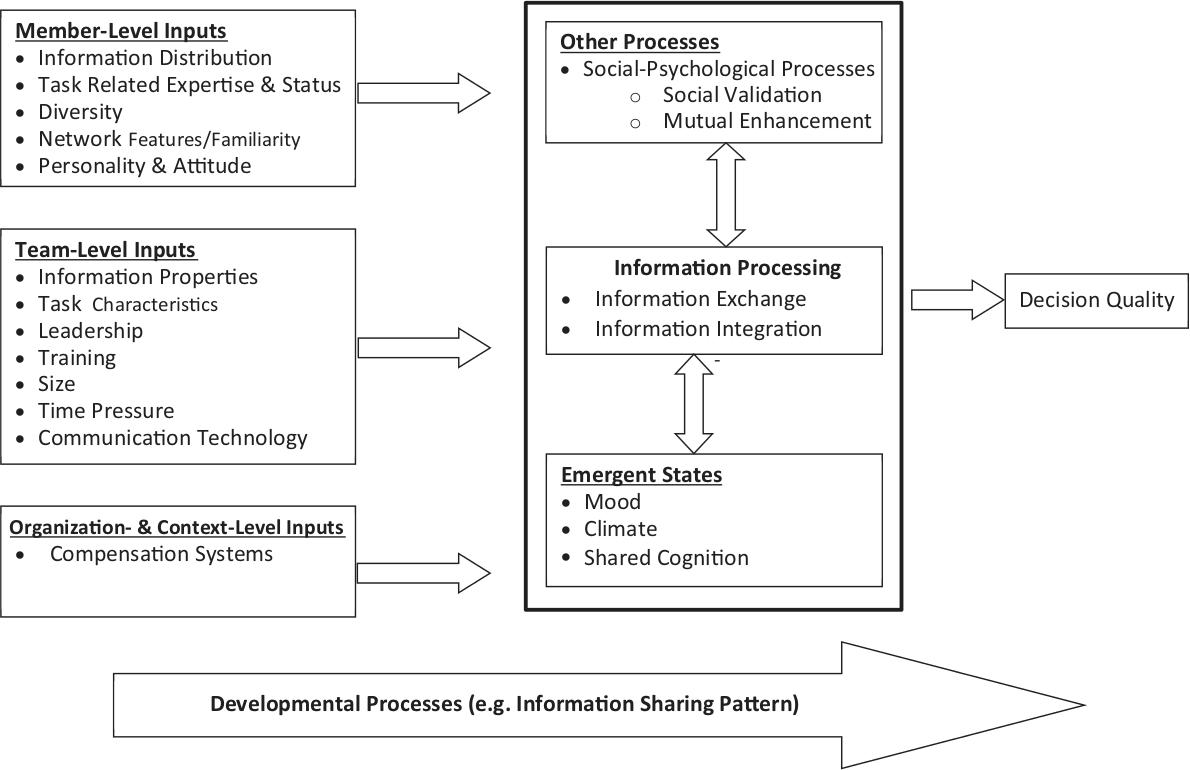
An IMO-based framework highlighting key inputs, mediators, and outputs and their relationships.
Inputs
Team Member–Level (Composition) Inputs
Team composition or member-level inputs (Mathieu et al., 2008) refer to the individual team members’ attributes, such as competencies (i.e., knowledge, skills, and abilities), personality, attitudes, status, and demographic characteristics (Bell, 2007; Mathieu et al., 2008). Research in different domains of small group research has explored the composition inputs and showed that these factors influence various team processes and emergent states. In the hidden-profile literature, however, many of these factors have received none or very limited attention. Information distribution and task-related expertise are the two main individual-level factors that have been extensively studied. Besides these two factors, status and experience, bio-demographic and task-related diversity, network features and familiarity, and team member personality and attitude have received some attention and have been examined in a few studies. In this section, we will review these attributes and their impact on team information exchange and decision-making processes.
Information distribution
Information distribution is the central concept of the hidden-profile paradigm and is somehow manipulated in all studies in this paradigm. In the current section, we review studies that have focused on investigating how the distribution of information influences information sharing bias and a team’s ability to solve hidden profiles. These studies fall into two main categories: dissent in initial preferences and information overlap.
Dissent in initial preferences
The first group of studies that examine information distribution is built on the premise that information distribution influences initial preferences, which seem to play a critical role in the observed information bias. The seeds of this idea were planted in the original formulation of the hidden-profile paradigm by Stasser and Titus (1985) who argued that biased distribution of information may result in individual members preferring alternatives that they would not have chosen had they had full access to unbiased information. Stasser and Titus postulated that diverse initial preferences, compared with homogeneous preferences, would encourage more extensive and efficient information exchange. Although their empirical findings did not support this argument, it built the foundations for other researchers who followed their lead and found support for Stasser and Titus’s propositions by employing more nuanced empirical designs (e.g., Brodbeck, Kerschreiter, Mojzisch, Frey, & Schulz-Hardt, 2002; Dennis, Hilmer, & Taylor, 1997; Hightower & Sayeed, 1996; Klocke, 2007; Schulz-Hardt, Brodbeck, Mojzisch, Kerschreiter, & Frey, 2006).
Teams with conflicting initial preferences in Stasser and Titus’s study were composed of two subgroups who received information supporting different suboptimal choices. In other words, even though these teams were designed to have conflicting initial preferences, none of the team members had received information supporting the optimal choice. Hightower and Sayeed (1996) found that fully diverse teams (in which each member received information supporting a different candidate as well as the optimal candidate) exchanged more unique information and were more likely to solve the hidden profile. In addition, their analyses showed that the actual initial preferences of team members did not fully match the expected preferences. Coming across similar findings, Brodbeck and colleagues (2002) conducted analyses based on actual preferences and found that dissent in initial preferences is associated with the dissemination of unshared information and better decisions. In addition, they found that minority/majority teams in which the minority preferred the optimal choice outperformed teams in which all members preferred suboptimal choices. Building on these findings, Schulz-Hardt and colleagues (2006) showed that diversity in prediscussion preferences, either in the form of majority/minority or full diversity, improved the quality of the decisions, particularly if the correct choice had at least one proponent in the team.
Overall, these studies suggest that diversity in initial preferences, particularly when at least one member prefers the optimal choice, improves information dissemination as well as the quality of the decisions made. However, it should be noted that preference diversity could also have a negative impact on the decision-making process by increasing the chance of decision refusal (Nijstad & Kaps, 2008). Nijstad and Kaps (2008) found that when each member had strong negative information about one decision alternative, team discussion tended to focus on the negative information and most teams (80%) refused to make any decision. Therefore, although dissent in the initial preferences seems to increase information dissemination, it might also have some downsides.
Information overlap
In addition to the abovementioned studies that examined the impact of information distribution through its influence on initial preferences, there are other studies that examined the impact of information distribution independent of its influence on individual preferences. Two key findings have emerged from studies in this category. First, in alignment with the principles of the information sampling model (Stasser & Titus, 1985, 1987), research shows that a higher proportion of unshared information to shared information results in a greater dissemination of unshared information (Cruz, Boster, & Rodriguez, 1997; Hightower & Sayeed, 1995; Stasser & Titus, 1987), although the proportion of recalled unshared information (i.e., the absolute number of recalled unshared items to the absolute number of total unshared items) remains lower than the proportion of recalled shared information (Stasser et al., 1989).
Second, research in this area shows that the influence of a piece of information on a team’s final decision depends on the number of members who are aware of that information in advance of the team discussion (Gigone & Hastie, 1993; Schittekatte, 1996; Schittekatte & Van Hiel, 1996). In other words, partially shared information (i.e., available to more than one member) has a greater chance of influencing team discussion.
Task-related expertise
A question that has motivated several researchers is whether information held by an expert, or an experienced member, is valued during team discussion. Research in this area shows that an expert’s information is valued only when both the expert and other team members are informed about the existence of expertise (Emich, 2012; Franz & Larson, 2002; Stasser, Stewart, & Wittenbaum, 1995; Stasser, Vaughan, & Stewart, 2000; Stewart & Stasser, 1995). In addition, there is evidence suggesting that the majority of team members should be aware of the presence of an expert on the team for an individual’s expertise to be recognized and leveraged during team discussion (Baumann & Bonner, 2013). Therefore, when other team members are not aware of an individual’s expertise (or only a minority is aware), forewarning the expert does not increase the dissemination of information uniquely held by the expert. Furthermore, research suggests that a competitive team environment might hinder a team from leveraging an expert’s knowledge (Toma, Vasiljevic, Oberle, & Butera, 2013). In fact, Toma, Vasiljevic and colleagues (2013) found that in a competitive setting, teams who were aware of the presence of expertise exchanged less unshared information compared with teams who were not informed about the presence of the expert.
Status and experience
Prior task experience and status of a team member seem to have an influence on the value put on the information in her or his possession. For example, Hollingshead (1996a) found that critical information that was possessed by low-status members received less attention from other team members and was less likely to be discussed. Similarly, Wittenbaum (1998, 2000) found that individuals with prior task experience put equal emphasis on shared and unshared information. Wittenbaum further argued that unshared information held by experienced members is more likely to be mentioned because the experienced member is perceived as more competent, resulting in a higher evaluation and reception of his or her comments by other members.
Diversity
Information distribution among team members is by nature a source of diversity (Rink & Ellemers, 2010) in a team. Due to the integral role of information distribution in the hidden-profile literature, in our review of the literature, we devoted a separate section to the impact of information distribution on team information processing. 2 In the current section, we review studies that have looked at other forms of diversity and how they interact with task-related information diversity to influence team information sharing and decision-making processes. We use task-related and bio-demographic dichotomy (Horwitz & Horwitz, 2007) to categorize these studies. According to Horwitz and Horwitz (2007), bio-demographic diversity refers to innate and observable characteristics (e.g., sex, race, and age) and task-related diversity refers to acquired characteristics such as education or organizational tenure.
Bio-demographic diversity
Ethnic diversity is the only form of bio-demographic diversity that has been examined in terms of its impact on team information processing. Consistent with broader research on team diversity (Horwitz & Horwitz, 2007; Williams & O’Reilly, 1998), empirical findings on the impact of ethnic diversity on team information processing in a hidden-profile setting are mixed. Kooij-de Bode and colleagues (Kooij-de Bode, van Knippenberg, & van Ginkel, 2008) found that ethnically homogeneous teams outperformed ethnically diverse teams, both under fully shared information and distributed information. However, findings of a study by Phillips, Northcraft, and Neale (2006) offer evidence contrary to the previous study. In Phillips and colleagues’ study, ethnically homogeneous teams showed lower levels of awareness of their unique information. Sawyer, Houlette, and Yeagley (2006) showed that the interaction between ethnicity and other forms of diversity (e.g., job function) matters. These scholars found that teams in which ethnicity crosscut job function outperformed ethnically homogeneous teams and convergent teams (i.e., teams in which members of an ethnic subgroup are also members of a job function subgroup).
Task-related diversity
A study by Rink and Ellemers (2010) offers the only investigation of task-related diversity in a hidden-profile setting. Recognizing information distribution as deep-level, task-related diversity, Rink and Ellemers posited and showed that when information diversity is combined with another source of deep-level, task-related diversity such as decision rules, team members are able to benefit from diversity by actively integrating their unique knowledge into the decision-making processes.
In sum, these studies show that the impact of diversity on team information processing is more complicated than a simple main effect and more research is needed before any kind of conclusion can be reached.
Network features and familiarity
Research suggests that social ties (i.e., familiarity) among team members interact with knowledge ties (i.e., information distribution) to influence a team’s ability to effectively process information and solve a hidden-profile task (Gruenfeld, Mannix, Williams, & Neale, 1996; Phillips, Mannix, Neale, & Gruenfeld, 2004). Although initial research suggested that familiarity has a positive impact on team information processing (Gruenfeld et al., 1996), further analyses of the interaction between social ties and information distribution (Phillips et al., 2004) showed that the simple presence of familiarity among some team members does not predict more effective information processing and that this relationship is more complicated than a simple main effect.
Personality and attitude
Although there is a wealth of research on personality and attitude of individual team members in various domains of team dynamics research (e.g., Bell, 2007; Liu, McLeod, & Moore, 2015), there has been relatively little research on these concepts and their influence on team performance under hidden-profile settings. Only recently, Van Knippenberg, Van Ginkel, and Kooij-de Bode (Kooij-de Bode, van Knippenberg, & van Ginkel, 2010; van Knippenberg, Kooij-de Bode, & van Ginkel, 2010) have examined the relationship between negative affectivity and information processing in a hidden-profile task. These scholars showed that team members’ negative affectivity positively influenced team decision quality through increasing task-related information elaboration under hidden-profile conditions, but not when information was fully shared among team members (Kooij-de Bode et al., 2010). Furthermore, they found that individual members’ negative affectivity interacted with team mood so that when team members were low in negative affectivity, the quality of decision making in teams with a positive mood was lower than teams with a negative or neutral mood. This effect disappeared in teams with members high in negative affectivity. In other words, negative affectivity compensated for the detrimental effects of a positive mood (van Knippenberg et al., 2010).
Team-Level Inputs
In this section, we review research on the effect of various team-level inputs on team performance in a hidden-profile task. We have organized the pertinent studies under the following categories: information properties, task characteristics, team leadership, team training, team size, time pressure, and communication technology.
Information properties
Even though information is the integral element of the hidden-profile studies, the effect of information properties on team decision making has received little research attention (Stewart & Stewart, 2001). In this section, we review research on information load, presentation, and structure.
Information load
Amount of information that is available to decision makers (Stasser & Titus, 1987; that is, information load) was among the first set of factors that was examined for its impact on a team’s ability to process information. Extending the information-sampling model (Stasser & Titus, 1985), Stasser and Titus (1987) argued that a high information load increases the bias toward discussing shared information. As predicted, they found that unshared information has a higher chance to be recalled when members have less information to process. While Schittekatte (1996) was able to replicate these findings, Hightower and Sayeed (1995) did not find any support for the effect of information load on discussion bias for face-to-face teams. Findings of two recent meta-analyses (Lu et al., 2012; Reimer, Reimer, & Czienskowski, 2010) support Stasser and Titus’s (1987) speculation and provide evidence that a high information load exacerbates discussion bias with shared information.
Information presentation
According to the information-sampling model (Stasser & Titus, 1985, 1987), the likelihood that a piece of information is mentioned at the team level depends on the probability that one team member recalls and mentions that piece of information during a team discussion. A small number of researchers have pursued the question of whether the salience of unshared information, and its recall probability, could be enhanced by employing different presentation techniques. For instance, Schittekatte and Van Hiel (1996) found that putting unshared information in a bold font significantly increased its chance of being mentioned and used during discussion, particularly when the unshared info was known by only one member (compared with partially shared information). Using a recall task, Stewart and colleagues (Stewart & Stewart, 2001; Stewart, Stewart, Tyson, Vinci, & Fioti, 2004) found that presenting information using pictures instead of words increased the recall likelihood of a piece of information (shared or unshared). Considering the small number of studies and the fact that the studies on pictorial presentation of data used a recall task, instead of a decision-making task, it is not possible to draw any conclusions based on this evidence.
Information structure
In recent years, two common aspects of information structure in the hidden-profile studies, namely, cue uniqueness (i.e., each cue providing information about only one of the decision alternatives; Reimer, Kuendig, Hoffrage, Park, & Hinsz, 2007; Reimer, Reimer, & Hinsz, 2010) and cue independence (i.e., information pieces being semantically independent; Fraidin, 2004) have been challenged. Research by Reimer and colleagues (Reimer et al., 2007; Reimer, Reimer, & Hinsz, 2010) showed that the presence of cues that provide information relevant to all decision alternatives (i.e., common cue) enables team members to compare the choice alternatives on common cues and make a more informed decision that is less biased than shared information. Examining cue interdependence, Fraidin (2004) argued and showed that when interdependent information items are allocated to one individual, they are perceived as more important as compared with a condition in which they are separated. The increased salience of information items improved their chance of being remembered and discussed, which led to more accurate decisions.
Task characteristics
Even though the majority of hidden-profile studies followed the experimental design introduced by Stasser and Titus (1985), there are some variations in different aspects of the study design. Researchers have examined how various task characteristics such as task importance (e.g., Larson, Foster-Fishman, & Keys, 1994), task structure (e.g., Greitemeyer, Schulz-Hardt, Brodbeck, & Frey, 2006; Savadori, Van Swol, & Sniezek, 2001), number of decision alternatives (e.g., Parks & Cowlin, 1995), and familiarity with the task (e.g., Parks & Cowlin, 1996) can influence information sharing and decision-making processes. In this section, we discuss the three aspects of the design that have received the most attention: access to information, perception of task solvability, and the hidden-versus-apparent nature of the profile.
Access to information
In a classic hidden-profile study, team members do not have access to information during team discussions and should rely on their memory to recall relevant information. However, some researchers have varied this aspect of the design and in a few studies researchers have given participants full access (e.g., Cruz, Henningsen, & Smith, 1999; Graetz, Boyle, Kimble, Thompson, & Garloch, 1998; Gruenfeld et al., 1996; Lavery, Franz, Winquist, & Larson, 1999; Savadori et al., 2001), partial access (e.g., Parks & Cowlin, 1996), or informed access (e.g., Bowman & Wittenbaum, 2012; Postmes et al., 2001) to information.
Research suggests that access to information during discussion can improve both exchange (Bowman & Wittenbaum, 2012; Hollingshead, 1996b) and integration (Parks & Cowlin, 1996) of unshared information. With unshared information having a lower chance of being recalled by a single individual who holds that information, it is likely that information is not mentioned during a team discussion simply because participants cannot recall it (Hollingshead, 1996b). Therefore, access to information during discussion can increase an exchange of unshared information (Bowman & Wittenbaum, 2012; Hollingshead, 1996b) and even reverse discussion bias (i.e., more emphasis on unshared information; Bowman & Wittenbaum, 2012). Furthermore, in a high information load, access will facilitate the managing of large amounts of information (Savadori et al., 2001) and increase the exchange of both shared and unshared information. In addition to increasing information recall and exchange, access to information could improve information integration and the quality of the final decision by reducing the number of mistakes in recalling information (Lightle, Kagel, & Arkes, 2009) and providing a verification mechanism (Parks & Cowlin, 1996).
Perception of task solvability
Building on Laughlin’s conceptualization of intellective and judgmental tasks (Laughlin, 1980; Laughlin & Ellis, 1986), Stasser and Stewart (1992) argued that the failure to discuss unshared information is partly due to perception of task solvability and that whether members believe that a correct solution for the problem exists. If so, they will focus on finding the correct answer instead of trying to reach consensus. As a result, perception of task solvability should trigger a search for and discussion of unshared information (Stasser & Stewart, 1992). Although Stasser and Stewart found evidence supporting the influence of task demonstrability, similar results were not obtained in other studies.
For instance, Schittekatte (1996) found no difference in the use of unshared information between teams who perceived the task as a problem that has a correct solution (i.e., solve condition) and those who perceived the task to be a matter of judgment (Schittekatte, 1996; that is, judge condition). However, teams in the solve condition were less likely to reach consensus. Campbell and Stasser (2006) found no difference between the quality of decisions made by face-to-face-teams in solve and judge conditions. In addition, teams in the judge condition were able to recall a higher proportion of shared information. Finally, Stewart and Stasser (1998) found no effect in decision quality of teams in solve and judge conditions although teams in the solve condition revealed marginally more critical clues.
To further complicate the situation, Mesmer-Magnus and DeChurch (2009) found significant results for the effect of task demonstrability on information sharing in a meta-analysis of 72 studies. However, it should be noted that this finding is based on these researchers’ evaluation of task demonstrability, whereas the abovementioned null effects are obtained from direct manipulation of task demonstrability.
Presence of hidden profile
The term hidden profile refers to a study design in which information in possession of each team member misleads her or him to choose the suboptimal alternative. The effect of presence of the hidden profile on team information sharing and decision-making processes has been examined in various studies including the three meta-analyses conducted in recent years (Lu et al., 2012; Mesmer-Magnus & DeChurch, 2009; Reimer, Reimer, & Czienskowski, 2010). Meta-analyses findings on this issue are to some extent contradictory. On one hand, these studies showed that the presence of a hidden profile attenuates discussion bias (Reimer, Reimer, & Czienskowski, 2010) and accentuates the positive effect of information sharing on the quality of the team’s decision (Mesmer-Magnus & DeChurch, 2009). On the other hand, Lu and colleagues (2012) found that teams in the hidden-profile condition, compared with teams in which each team member had full access to information, are 8 times less likely to choose the best alternative.
Leadership
Research on the information-management role of a team leader in hidden-profile settings shows that team leaders, compared with other team members, ask more questions, repeat more shared and unshared information, and gradually increase their emphasis on unshared information (Larson, Christensen, Abbott, & Franz, 1996; Larson, Christensen, Franz, & Abbott, 1998). These findings suggest that leaders enhance their team decision-making quality by revisiting already-pooled information and keeping it within the team’s focus of attention (Larson et al., 1996). However, recent research on leader’s narcissism (Nevicka, Ten Velden, De Hoogh, & Van Vianen, 2011) shows that, contrary to team members’ positive perception of leadership effectiveness, narcissistic leaders negatively influence team performance by inhibiting the exchange of information between group members.
With respect to different leadership styles, research shows that whereas participative leaders discuss more information (both shared and unshared), directive leaders put more emphasis on unshared information by repeating unshared information originally held by themselves or others (Larson, Foster-Fishman, & Franz, 1998). In addition, directive leaders play an active information-management role that is highly biased toward reaching a consensus that supports that leader’s prediscussion preference (Cruz et al., 1999; Larson, Foster-Fishman, & Franz, 1998). So it seems that leadership style interacts with information held by a leader to influence the quality of a team’s decision (Larson, Foster-Fishman, & Franz, 1998). Whereas a directive leader, whose prediscussion preference supports the suboptimal choice, can bias the team decision toward the suboptimal choice, an informed, directive leader, who has access to information that supports the optimal choice, can play a significant role in eliminating decision bias and reversing the ineffectiveness of teams at exchanging and integrating unshared information (Cruz et al., 1999; Henningsen, Henningsen, Jakobsen, & Borton, 2004).
Training
Researchers have employed a number of training interventions geared toward improving information exchange and integration in a hidden-profile setting (e.g., Deiglmayr & Spada, 2011; Klocke, 2007; Larson, Christensen, et al., 1998; Larson et al., 1994; Mennecke, 1997; Stasser et al., 1989; Waddell, Roberto, & Yoon, 2013). These interventions are based on training participants regarding sharedness and preference biases (e.g., Klocke, 2007), advising them to be aware of these biases during team discussion (e.g., Klocke, 2007; Larson et al., 1994), and offering strategies that could help them overcome these biases; strategies such as focusing on reviewing the available information in the first half of the team discussion (Mennecke, 1997; Stasser et al., 1989), spending the first 5 min of a team discussion to plan (Larson et al., 1994), refraining from making any decision until they feel that all the information has been discussed (Larson, Christensen, et al., 1998), and using a devil’s advocate to inject some disagreement into team discussions (Waddell et al., 2013).
In terms of training outcomes, although these interventions have been effective in improving some aspects of team decision making, none of them have led to solid improvement of the final decision. For example, Stasser and colleagues (1989) and Larson and colleagues (1994) reported that trained teams discussed more information, but the discussion advantage of shared information stayed intact and teams spent more time discussing information that was available to all of them. Similarly, in Klocke’s (2007) study, both training interventions (i.e., training on sharedness bias and preference bias) were successful in improving the information exchange and teams who had received training on preference bias focused more on discussing preference-inconsistent information. However, none of the interventions significantly influenced the quality of the final decision.
Team size
The information sampling model (Stasser & Titus, 1985, 1987) predicts that an increase in team size shifts discussion toward shared information. This prediction was put to the test in both experimental settings (Cruz et al., 1997; Stasser et al., 1989) and using a simulation based on the DISCUSS model of team decision making (Stasser, 1992a). These studies supported the prediction of the information sampling model and showed that larger teams focused more on shared information, leading to higher failure rates in detecting hidden profiles. In addition, two recent meta-analyses provided further evidence in support of these findings and showed that discussion bias with shared information increases with the group size (Lu et al., 2012; Reimer, Reimer, & Czienskowski, 2010). However, it should be noted that Stasser and Stewart (1992) did not observe any difference in the quality of the decisions made by a three-person or a six-person team. Similarly, Mennecke (1997) found no relationship between team size and information sharing among teams using group support systems. Overall, considering the results of meta-analyses studies, empirical evidence on the positive impact of group size on information bias is to a great extent consistent.
Time pressure
Empirical evidence is consistent in showing that time pressure hinders the discussion of unshared information and the likelihood of solving a hidden-profile task. Although teams working under time pressure discuss information at a faster rate and exchange more facts per time unit (Kelly & Karau, 1999; Parks & Cowlin, 1995), Reimer, Reimer, and Hinsz (2010) found that teams working under time pressure pooled the lower proportion of their information, with the sampling bias (i.e., proportion of discussed shared and unshared information) remaining unaffected. In addition, time pressure is shown to hinder a team’s ability to choose the best alternative (Bowman & Wittenbaum, 2012; Kelly & Karau, 1999; Reimer, Reimer, & Hinsz, 2010). Conducting a meta-analysis on 37 studies in 20 publications, Reimer, Reimer, and Czienskowski (2010) concluded that time pressure negatively affects team information processing in decision-making tasks (both hidden-profile and non-hidden-profile tasks) and attenuates discussion bias favoring shared information.
Communication technology
Among the inputs studied in the context of hidden-profile studies, communication technology has one of the longest histories. Starting with Stasser’s (1988) modeling of group decision making based on the premises of the information sampling model (Stasser & Titus, 1985, 1987), researchers have been interested in the role of communication technology in information exchange and integration in hidden-profile settings. The majority of this research focuses on the communication mode (i.e., face-to-face vs. use of group support systems) and mechanisms through which group support systems can improve or hinder the quality of team information processing. The abundance of these studies has led to two meta-analytic investigations on the role of communication technology on team information processing and decision making (see Lu et al., 2012; Mesmer-Magnus, DeChurch, Jimenez-Rodriguez, Wildman, & Shuffler, 2011). The meta-analysis conducted by Lu and colleagues (2012) focused on studies in which a hidden-profile task was used. Meta-analytic results from this study indicate no significant difference either in pooling of unique information or in solving hidden profiles between groups that communicated face-to-face versus those who used computer-mediated communication.
Unlike the previous meta-analysis, Mesmer-Magnus and colleagues (2011) did not limit their analyses to studies in which a hidden-profile task was used and included a broader range of studies examining information sharing in teams (Mesmer-Magnus et al., 2011). In addition, building on Kirkman and Mathieu’s (2005) conceptualization of team virtuality, these authors used a more elaborate measure to distinguish different levels of virtuality. Results of this meta-analysis indicate that virtuality enhances the pooling of unique information but hinders overall discussion of information (shared or unshared). This study further suggests the possibility of a curvilinear relationship between virtuality and information sharing with low levels of virtuality improving information sharing and high levels of virtuality hindering it.
Given how recent and comprehensive these two meta-analyses are, we refer readers to them for more detailed information concerning the input variable of communication technology.
Organization- and Context-Level Inputs
The IMO framework includes the perspective that teams are entities embedded in and influenced by organizational systems and their surrounding environments (Mathieu et al., 2008). Human resource systems, organizational climate, multiteam systems coordination, and culture of the host country are examples of such factors (Mathieu et al., 2008). In our search for studies that relate to organizational and contextual influences on team performance in a hidden-profile setting, we were able to identify only four relevant studies; these studies examine the impact of accountability and incentive systems.
Researchers have argued that accountability should reduce the discussion bias toward shared information and lead to a revealing of more unshared information. Contrary to their expectation, Stewart, Billings, and Stasser (1998) found that accountable groups did not mention and discuss more unshared information. In contrast, Scholten, van Knippenberg, Nijstad, and De Dreu (2007) found that teams that expected to be held accountable for their decision-making process were more concerned about the sufficiency of the available information, repeated unshared information more often, and were more likely to choose the correct decision alternative. Even though both of these studies examined the issue of accountability, they differ in one important detail, which is the focus of accountability; participants in Stewart and colleagues’ (1998) study were held accountable for their decision outcome while those in Scholten and colleagues’ (2007) study were accountable for the decision-making process (see Scholten et al., 2007, for a detailed discussion on the differences between process and outcome accountability and their impact on team decision making). Therefore, as discussed by Scholten and colleagues, while process accountability seems to enhance a team’s decision-making process by increasing systematic information processing, outcome accountability seems to have some detrimental effects on the decision-making process by increasing the “desire to please the audience” (Scholten et al., 2007, p. 541).
In addition to the abovementioned studies, research on team climate (Steinel, Utz, & Koning, 2010; Toma & Butera, 2009) also relates to organization-level inputs in that researchers have manipulated the incentive system (a context-level factor) to induce a cooperative/competitive climate. Considering that team climate is an emergent state, we decided to discuss these studies under the section on emergent states.
Overall, our review of inputs at the individual, team, and organizational levels of analysis suggests that while researchers continue to focus on the central concept of information distribution, inquiries have expanded in this area to include numerous aspects and permutations of this distribution. In addition, research on team-level inputs represents expanded knowledge concerning a wide variety of factors. In particular, and not surprisingly, given the centrality of information in the hidden-profile paradigm, researchers have worked collectively to explicate nuances in information properties and task characteristics and their effects on team outcomes. Comparing individual- and team-level inputs, it is clear that the team-level inputs represent a wider variety in the existing literature. Almost absent, however, are explications at the organizational or contextual levels framed as inputs, suggesting a possible bias for bottom-up versus top-down meso approaches in terms of inputs. In the next section, we review work focused on mediating relationships in the hidden-profile literature.
Mediators: Team Processes and Emergent States
As mentioned previously, the IMO framework is built on the work of Marks and colleagues (2001) in that it distinguishes between processes and emergent states. Unlike member-level and team-level inputs, research on these mediating mechanisms that translate the effect of various inputs into team performance (Ilgen et al., 2005) in a hidden-profile setting is very scarce. In what follows, we will review research on the role of emergent states in team information sharing and decision-making processes. Then, we will discuss the current state of the literature regarding team processes.
Emergent States
Emergent states are cognitive, motivational, and affective states (Marks et al., 2001) that emerge as team members interact (Marks et al., 2001); these states are influenced by inputs at different levels of analysis as well as team processes and other emergent states (Marks et al., 2001). Even though some emergent states such as trust, cohesion, and empowerment have been studied for decades, in recent years we have seen a proliferation of studies on various emergent states such as mood, affect, shared mental models, and transactive memory systems (TMS). In this section, we review research on three categories of emergent states that have received attention in the hidden-profile paradigm.
Team mood
Research at the individual level shows that positive and negative moods can influence individual judgment (Forgas, 1995) and information processing capacity (for reviews, see Forgas, 2006; Martin & Clore, 2001). Yet, studies examining the effect of mood on team information processing are scarce with contradictory results.
Contrasting the effect of happy and sad moods on team performance in a hidden-profile task, Bramesfeld and Gasper (2008) found that team members who were experiencing positive feelings tended to move beyond their initial preferences and consider the full range of information that was available to the team, resulting in a focus on unique and critical information rather than common information. In contrast to the preceding findings, van Knippenberg and colleagues (2010) found that a sad mood improves team performance by facilitating information elaboration. These authors argued that team members in a positive mood are more likely to experience satisfaction with their initial preference and conform to the emerging consensus without considering new information. Building on the affect infusion model (Forgas, 1995), van Knippenberg and colleagues (2010) argued that individuals are not equally affected by mood; instead, individual dispositions interact with mood and may override the influence of transient moods. The authors speculated that a high level of trait negative affect among team members may weaken “the detrimental influence of positive mood state on information processing” (p. 734). An experimental exploration of these hypotheses supported their propositions.
In an attempt to shed new light on the contradictory findings of the previous studies, Emich (2014) examined how intragroup affective patterns (i.e., various combinations of team members with positive, neutral, and negative moods) influences team performance. Emich (2014) found that while individuals experiencing a positive mood “were better able to combine and analyze information presented,” those who were experiencing a negative mood “read the case well and were able to share critical details with their team” (p. 129). In this study, the presence of at least one member experiencing a positive mood resulted in more information requests, more unique information being shared, and a higher rate of correct solutions. However, teams in which all three members were experiencing negative affect also shared more unique information than the control teams (i.e., all members experiencing a neutral affect) and chose the correct solution at a high rate. Emich (2014) speculated that this finding could be due to the fact that individuals experiencing negative affect process information carefully and share information critical for solving the case.
Taken together, these three studies suggest that the impact of mood on team information processing is more complicated than a simple main effect. Future research needs to take into account the interaction between team mood and individual dispositions as well as intragroup affective patterns. In addition, researchers need to pay attention to team members’ actual mood during individual and group time. For example, in Emich’s (2014) study, participants watched short videos that were meant to influence their mood. Emich measured their mood after watching the video and assigned them to teams based on these responses. Although these responses showed each individual’s actual mood at the time, considering that participants spent some time alone to review task information individually, their mood could have changed during this time. Therefore, the mood that team members experienced at the time of their team discussion might differ from what they reported after watching the videos. Distinguishing between individual mood during individual and team time could answer some of the questions raised by Emich.
Team climate
Past research offers various definitions of team or workgroup climate (see Anderson & West, 1998, for more details); the IMO framework adopts the conceptualization put forward by Pirola-Merlo, Hartel, Mann, and Hirst (2002), which defines climate as “the set of norms, attitudes, and expectations that individuals perceive to operate in a specific social context” (p. 564). In alignment with this definition, in this section we discuss three studies that satisfy the boundary conditions set by this conceptualization of team climate.
Challenging the prevalent assumption in the hidden-profile studies that team members work cooperatively to improve the quality of their team decision (Wittenbaum et al., 2004), two groups of researchers (i.e., Steinel et al., 2010; Toma & Butera, 2009) have examined the impact of cooperative/competitive climate on information processing in a hidden-profile setting. Empirical evidence obtained from these studies suggest that when incentive structure encourages cooperation and rewards individuals based on their team performance, individuals develop prosocial motivation and work toward improving the quality of the team decision (Steinel et al., 2010). Accordingly, in such an environment, individuals tend to freely share the private and valuable information (Steinel et al., 2010; Toma & Butera, 2009). In contrast, when the incentive structure promotes competition and rewards individual performance, team members develop proself motivations that result in withholding, and even falsifying, important information that could contribute to the quality of their team decision making (Steinel et al., 2010; Toma & Butera, 2009). In addition, research suggests that in a competitive setting, individuals who have different initial preferences are less likely to disconfirm their preferences (Toma & Butera, 2009; Toma, Gilles, & Butera, 2013) and that the inferior quality of the decisions in a competitive climate is mediated by the lack of disconfirmation and not the lower pooling of unshared information (Toma & Butera, 2009).
Beyond research on competitive and cooperative team climate, we were able to identify only one more study in relation to team climate. In this study, Postmes et al. (2001) focused on the critical versus consensual team norms and found that the quality of the final decision was significantly higher in teams with a critical thinking norm compared with teams with consensual norms. In addition, the evaluation of the importance of shared information was higher in teams with consensual norms, with this factor mediating the effect of the team norm on the quality of the decision.
Shared cognition
A series of studies by van Ginkel and her colleagues (van Ginkel, Tindale, & van Knippenberg, 2009; van Ginkel & van Knippenberg, 2008, 2009) has made a significant contribution to our knowledge of how some aspects of shared cognition influence a team’s performance in a hidden-profile setting. Through these studies, these scholars introduced shared task representation as a team cognition construct facilitating information sharing and decision-making processes. Empirical evidence obtained from these studies shows that a shared task representation that stresses task-related information elaboration improves the quality of team decision making especially when team members realize that they share the same task representation (van Ginkel & van Knippenberg, 2008).
In addition, van Ginkel and her colleagues (2009) found that spending some time as a team to collectively reflect on the task and its information requirements (i.e., team reflexivity) helps a team to develop an appropriate and shared understanding of the task and its information elaboration requirements. In particular, team reflexivity can play an important role when not all members hold an appropriate task representation that emphasizes information exchange and integration.
Finally, building on the findings of previous studies, van Ginkel and van Knippenberg (2009) proposed that knowledge about information distribution in a team (i.e., who knows what) influences the decision-making performance because it affects team members’ understanding of the task and leads to a shared task representation that stresses the importance of task-related information elaboration. They further hypothesized that reflecting on the task would strengthen the effect of knowledge about information distribution on task representation. These authors found that reflection interacted with knowledge about information distribution to affect the quality of decision making and that task representation and information elaboration mediated this relationship.
While van Ginkel and her colleagues developed the idea of shared task representation, Liljenquist, Galinsky, and Kray (2004) focused on development of a counterfactual mind-set, defined as exploration of “alternative realities to past events” (p. 264). These authors argued that activating a counterfactual mind-set can influence individuals’ behavior in future events in unrelated contexts through promoting an analytical processing style and encouraging the search for information that is inconsistent with existing hypotheses. Results of their experimental study showed that activation of a counterfactual mind-set can benefit team decision making and information sharing processes only if activation happens at the team level and not the individual level.
Team Processes
As mentioned previously, the IMO framework builds on Marks and colleagues’ (2001) conceptualization of team processes and categorizes team processes as transition, action, and interpersonal processes (Mathieu et al., 2008). Transition processes involve activities such as mission analysis formulation, planning, goal specification, and strategy formulation (Marks et al., 2001). The role of transition processes in solving hidden profiles has received very little attention, with the work of Larson and colleagues (1994), in which participants were instructed to spend the first 5 min of team discussion on planning, being the only study that we can identify as being pertinent to this topic.
Action processes
Action processes encompass team interactions revolving around monitoring team progress toward its goals, monitoring team resources and environmental conditions, backup behavior (e.g., coaching, giving feedback, and helping behavior), and coordination (Marks et al., 2001). Considering that information processing is an action process, all studies reviewed could be categorized as pertinent to this topic. However, we are unable to identify any study that directly examines other action processes and their interactions with team information processing.
Interpersonal processes
Interpersonal processes refer to team interactions directed toward managing members’ interpersonal relationships such as conflict management, motivating and confidence building, and affect management (Marks et al., 2001). With respect to research on hidden profiles, many studies indirectly address interpersonal processes. For example, the studies discussed under dissent and information distribution are built on the premises of team conflict management. Similarly, the process of motivation is the foundation of research on cooperative team climate, detailed previously. In addition to studies that are indirectly related to interpersonal processes, there are few studies that address interpersonal processes and how they influence a team’s information processing capacity. Research on social validation (Boos et al., 2013; Mojzisch et al., 2008; Parks & Cowlin, 1996) and mutual enhancement (Henningsen & Henningsen, 2004; Wittenbaum et al., 1999), discussed earlier, are the main two categories of such studies.
Another category of studies that concern interpersonal processes examines normative and informational influence (Kaplan, 1989; Kaplan & Miller, 1987) in the context of hidden-profile research. While informational influence occurs when individuals accept “the information received from others as evidence of reality” (Kaplan & Miller, 1987, p. 306), normative influence is driven by the “desire to conform to the expectations of others” (Kaplan & Miller, 1987, p. 306). Cruz, Henningsen, and Williams (2000) found evidence indicating that in the presence of both normative and informational influences, normative influence had a stronger effect on the final decision. Henningsen and Henningsen (2003) sought to understand the impact of informational and normative influence under various combinations of preference distribution (ambiguous, clear, and hidden profile). Contrary to their expectation, they found no significant difference in individuals’ perceptions of normative influence across conditions. However, participants in ambiguous conditions perceived higher levels of informational influence.
The last study that we would like to include in this section is a unique examination of the impact of conflict on team information processing by de Wit and colleagues (2013). These researchers induced task conflict so that all participants learned about the opposing preferences of their team members after they had indicated their individual preference. De Wit and colleagues found that participants who perceived a higher level of relationship conflict during a task conflict were less likely to use information that was offered by other team members, were less motivated to process information, and were more likely to hold onto their initial and suboptimal preference. Furthermore, this study showed that the appraisal of task conflict as a threat influenced information processing. In other words, individuals who perceived task conflict as a threat were less motivated to use information provided by other team members.
A Note Regarding Temporal Factors
One of the distinctive characteristics of the IMO framework (Mathieu et al., 2008) is its time-sensitive conceptualization that emphasizes the importance of developmental models (Gersick, 1988; Tuckman, 1965) and episodic approaches (Marks et al., 2001) in our understanding of team functioning. In general, empirical research on temporal aspects of team functioning remains scant (Mathieu et al., 2008) and the hidden-profile paradigm is not an exception. However, a collection of studies by Larson and colleagues (Larson, 1997; Larson et al., 1996; Larson, Christensen, et al., 1998; Larson, Foster-Fishman, & Franz, 1998; Larson et al., 1994) offers compelling insights on how team information processing behaviors unfold over time. Larson and colleagues advanced the idea of dynamic information sampling model and challenged the assumption that the probability of mentioning shared and unshared information remains stable over the course of a team discussion. The model predicts that shared information, compared with unshared information, will be more likely to be discussed earlier in the discussion. In addition, Larson and colleagues argued that with the progress of team discussion, the probability of mentioning new (not yet discussed) unshared information increases while the likelihood of introducing new shared information decreases. The empirical evaluation of the model provided strong support for these predictions (Larson, 1997; Larson et al., 1996; Larson, Christensen, et al., 1998; Larson, Foster-Fishman, & Franz, 1998; Larson et al., 1994). Later, Stewart and colleagues (2004) speculated whether similar patterns of information sharing could be obtained in a recall task (instead of a decision-making task). Their findings were mixed and did not provide strong support for the dynamic information sampling model in recall tasks.
Taken together, the existing work on mediators in hidden-profile situations represents much more attention to emergent states—with a fairly evenly distributed focus on mood, climate, and cognition—as compared with the attention given to transition, action (other than information processing), or interpersonal processes. As noted by others (Cronin, Weingart, & Todorova, 2011), this dearth of work on process may be due to the difficult and laborious nature of studying dynamic temporal processes in groups and teams over time. Room certainly exists for future work that explicates and integrates the influence of any team dynamic, whether emergent or process, on hidden-profile outcomes. In the following section, we summarize future research directions and recommendations derived from our literature review.
Trends, Observations, and Recommendations for Future Research
In the preceding material, we have attempted to provide a comprehensive, updated review of hidden-profile literature. Throughout our review, we have made limited observations on areas in the literature that need further attention in future research. In this final section of the article, we elaborate on those areas and mention other ones where significant questions remain partly or fully unanswered; in addition, we highlight whether these areas involve inputs or mediational factors (see Figure 1). We begin by discussing theoretical issues and subsequently discuss methodological ones.
Theoretical Issues
With respect to theoretical issues, one notable observation from the current review concerns the interdisciplinary nature of the hidden-profile literature. The studies in this review were drawn from various disciplines/fields including social psychology, industrial/organizational psychology, communication, management, and organizational behavior, and reflect a number of theoretical perspectives. We would suggest that this attention to hidden profiles from so many fields largely reflects two factors. First, the central mechanism, information sharing, is universal and is applicable to seemingly all groups of individuals involved in making decisions, regardless of context. Second, and relatedly, the influences on this mechanism are seemingly varied and ubiquitous, residing at various levels of analysis and under the purview of various fields of study. This attention from so many fields, and the intersection among those fields in studying hidden profiles, is notable, and certainly appropriate. This said, we also could imagine other disciplines contributing to the discourse on this topic. For example, fields such as economics and anthropology (see, for example, Gatewood, 1984) likely have unique theories and insights to lend, and we would encourage integration of them.
A major goal of this review is to provide some conclusions regarding the question, “For which big theoretical questions in the hidden-profile literature have we made notable gains in understanding and for which do significant theoretical gaps remain?” We turn first to perhaps the most critical theoretical question, which is, “Why do individuals fail to disclose unique information?” As described above, scholars have forwarded various explanations for the tendency of individuals to mention shared information and withhold unique information. On one hand, there has been significant progress made in documenting one proposed effect, namely, that individual members’ initial preferences strongly influence the groups’ final decisions (Gigone & Hastie, 1993, 1997). For instance, Faulmüller and colleagues (2012) provided evidence to support this effect and suggested that members’ initial preferences influence their information sharing due to a desire to be understood by other group members, which, in terms of our model in Figure 1, would involve member-level inputs. Greitemeyer and Schulz-Hardt (2003) have also shown the importance of initial preferences, but they documented a different mechanism in explaining it, that is, that preference-consistent information is processed more thoroughly than is preference-inconsistent information. This mechanism would involve a mediating effect (see Figure 1) rather than a member-level input such as the desire to be understood. Together, these studies provide support for the importance of members’ initial preferences in driving information sharing and suggest that at least two mechanisms may be responsible for that effect. Thus, going forward, we would call for research further explicating these mechanisms. This may include conducting studies to compare these (and other) mechanisms or developing models and tests integrating them as we do not see them as necessarily contradictory.
The other major set of explanations for the tendency to discuss shared versus unique information draws from social-psychological principles. According to these explanations, members discuss shared information because they want to be validated and liked, for example, versus looking foolish or ignorant by offering unique information (e.g., Wittenbaum et al., 1999). In 2004, Wittenbaum and colleagues recognized the dearth of direct tests of these mechanisms and called for more research focusing on the specific member-level input of the motivation to share or not share information. However, our review suggests that this call has gone largely unheeded. Unlike the case with the initial preferences explanation, direct tests of these alternative propositions remain few in number. For example, we could only locate two studies testing the idea of mutual enhancement (Henningsen & Henningsen, 2004; Wittenbaum et al., 1999) and three studies testing the notion of social validation (Boos et al., 2013; Mojzisch et al., 2008; Parks & Cowlin, 1996). Furthermore, we were unable to locate any studies directly comparing the major explanations.
More generally, instead of focusing directly on the cognitive and motivational factors that affect information sharing, the hidden-profile literature historically has centered on the impact of team-level inputs and mediating emergent states. The present review suggests that this trend has accelerated in recent years. We would suggest, though, that higher level inputs ultimately influence important intrapersonal processes. As Stasser and colleagues (1995) noted, “the probability of an individual mentioning an item, p(M), can be conceptually decomposed into three sequential events: encoding the item before discussion, recalling it during discussion, and selecting it for discussion once it is recalled” (p. 247). Various factors affect these processes, but these processes themselves require greater exploration. Studying intervening cognitive and motivational mechanisms can not only provide theoretical insight into group decision making, but, more practically, doing so can also illuminate the role and potential modification of those input factors that impinge on these intrapersonal processes. Thus, we offer some suggestions for such endeavors below.
One practical recommendation we would make is for more integration of research on psychological safety and trust into examinations of individuals’ cognitions regarding information sharing. Despite the oft-cited rationale that members are hesitant to share information due to fear of appearing ignorant or not being socially validated (Wittenbaum et al., 1999), studies explicitly incorporating and measuring states such as psychological safety or trust within the hidden-profile paradigm seem to be virtually absent. As one of our anonymous reviewers appropriately suggested, what would be especially valuable would be to address more nuanced questions with regard to safety and trust. Instead of simply assessing whether psychological safety or trust affect sharing of unique information, researchers should endeavor to understand “about what it is” that members are feeling unsafe or untrusting. Do they fear being excluded from the group, not feeling accepted by the group, the group making the wrong decision, and/or something else? Also, researchers should examine the notion that different types of safety or trust concerns may relate to different subsequent behaviors (e.g., members being reticent vs. trying to convince other members of their correctness).
Moreover, one could ask how these various considerations interact. As an illustration of the likely complex state of affairs, one could imagine an individual who views her group as quite competent and is therefore hesitant to share unique information. She may hesitate to share because, given the competence of the group, she perceives (a) that someone else already would have voiced this information and/or (b) others will think less of her for sharing something irrelevant or inaccurate. At the same time, though, she may reason that, given its competence, the group ultimately will arrive at the correct decision and also would appropriately consider (or discount) her unique information in doing so. In this case, she trusts the group in one sense (in terms of arriving at the correct decision) but not in other sense (how members may treat her). Obviously, one could make this example even more intricate and likely realistic. For instance, her trust probably varies across target group members and also over the course of the decision-making episode. Practically, this complexity suggests adopting different methodological approaches. In particular, we would call for researchers both to model these factors (e.g., through experimental manipulations or computational modeling) and also to adopt more qualitative approaches—for example, by interrupting group discussions and privately querying members about their cognitions and motivations. We elaborate on these ideas below.
In addition to incorporating states like trust and psychological safety—the integration of which seems fairly intuitive—we also would call for research borrowing from distinct other literatures. For instance, with respect to sharing information, part of the tendency to disclose unique material likely stems from motivational considerations such as fear of appearing incompetent by proffering irrelevant or wrong information (Littlepage, Perdue, & Fuller, 2012; Wittenbaum et al., 1999). Thus, we could imagine scholars incorporating social-psychological work on metaperceptions (i.e., people’s perceptions of how others [will] view them) and the conditions that foster more or less concern among individuals about how they are seen by others (see Kenny & DePaulo, 1993).
Incorporating metaperceptions, and the closely related social relations model (e.g., Kenny & DePaulo, 1993), could help address the following question: To what degree is a member’s apprehension to share unique information a function of (a) the individual unique member (i.e., some members are more apprehensive than others), (b) shared concerns about a specific other group member(s’) reaction (i.e., some members are more feared than others), and/or (c) members being differentially being concerned about specific other members’ reactions (e.g., one member being apprehensive of Mike’s reaction and another apprehensive of Jill’s reaction)? Taking this a step further, one could look at, for example, whether those concerns are a function of factors such as demographics (e.g., being the only African American member of an otherwise all-White group), or personality traits (e.g., some members are apprehensive of everyone else’s reactions due to their own personal traits while other members are apprehensive of only specific others’ reactions due to those others’ traits; see Frey & Tropp, 2006; King, Kaplan, & Zaccaro, 2008). Clearly, there are many possibilities here.
A second important question remaining to be explored in the hidden-profile literature concerns the relative importance of specific inputs. As reflected in our review, scholars have continued to investigate a number of these factors. Here, we would conclude that, despite uncovering and reviewing a sizable body of work on various inputs, we were, at times, unable to draw firm conclusions about their impact because studies have yielded inconsistent results. For instance, with respect to the question of whether ethnic diversity improved teams’ information sharing activities, Phillips and colleagues (2006) found it did, whereas Kooij-de Bode and colleagues (2008) found it did not. As another example of contradictory findings, Bramesfeld and Gasper (2008) found that happy moods led to a focus on unique information and to better team performance, whereas van Knippenberg and others (2010) showed that a sad mood improves team performance by facilitating information elaboration. Here, though, Emich (2014) attempted to reconcile inconsistencies regarding the effects of mood by postulating and documenting that the mix of (positive and negative) moods in the group affected information processing and exchange. In general, then, we would call for more such studies in which researchers propose and test ideas that can reconcile previous inconsistent findings. This approach implies going beyond the question that has been traditionally asked - whether Factor X impacts the disclosure of unique information and the group’s decision making quality - and instead investigating under what conditions, using what operationalizations, and at what levels these factors influence these outcomes.
Another area where we see great potential is examining the interplay and relative importance of the various input factors that can influence the sharing of unique information. As the current review demonstrates, studies generally focus on one factor to the isolation of other potential contributors. In reality, multiple factors are obviously at play, and we would call for future research to take steps to model this complexity. For example, studies addressing whether status or personality (e.g., assertiveness) reign supreme in determining whether individuals disclose unique information and/or addressing the interaction between these factors would seem theoretically and practically useful. Obviously, the number of permutations one could address is practically infinite, and we are not advocating that researchers examine sets of factors in an atheoretical, haphazard manner. Rather, theory and real-world evidence should guide selection of the particular variables under consideration.
Another observation gleaned from our review, and consistent with others’ conclusions (e.g., Cronin et al., 2011), is that studies of emergent team states predominate relative to those examining dynamic actions in the hidden-profile literature. In particular, we perceive a significant gap in terms of specifying the dynamic communication behaviors that mediate the linkage between inputs and outcomes in these decision-making teams (see Figure 1). Communication is the means through which cognitive factors ultimately affect team decision-making outcomes as these factors matter insofar as information does or does not get expressed. As such, studies examining communication elements such as the amount of communication, the nature of it (e.g., more or less conflictual), which group members communicate when and how often, and the frequency of turn-taking are all candidates that may relate to sharing of unique information. These processes and elements warrant study both as unique aspects of the group decision-making context and also as indicators, and constituents, of emergent team norms and team climate which, ultimately, can then influence such information exchange (see also Humphreys & Aime, 2014).
An additional and fundamental issue that remains unresolved is as much practical as theoretical in nature: that is, how can groups and organizations promote the sharing of unique information? In our opinion, despite the vast amount of research done on hidden profiles, group and organizational scholars are not yet in the position to provide firm conclusions/advice (e.g., to groups or organizations) about how to promote such sharing. For instance, although studies document that training can affect information sharing (e.g., Deiglmayr & Spada, 2011; Klocke, 2007; Larson, Christensen, et al., 1998; Larson et al., 1994; Mennecke, 1997; Stasser et al., 1989; Waddell et al., 2013), they do not generally show that it can improve ultimate decision-making performance.
We attribute this inability to provide more practical recommendations to several factors. First, as discussed above, we still remain fairly ignorant with respect to why group members do or do not choose to share such information and, in particular, about which factors matter most and at what point. Second, many of the input factors examined to date are not amenable to change. Advising organizations to alter many of these factors is either unfeasible (e.g., changing task characteristics, the personality makeup of the group, whether or not a time pressure exists) or impossible (e.g., altering the longevity of the group). Finally, even among those inputs and mediators that organizations could influence (e.g., communication technology, group mood), the literature often cannot provide consistent conclusions and recommendations.
We see a few ways to increase the practical importance of this research. First, replicating and extending research on the intrapersonal processes (as suggested above) will help identify inputs that affect those processes. Second, we would call for an emphasis on inputs over which groups and organizations can have control. For example, in addition to studying the impact of leader style, studies could examine the influence of more specific leader behaviors (e.g., giving praise or structuring the discussion to a greater or lesser degree). These behaviors are the more proximal inputs on members’ behavior. Finally, we would suggest several methodological innovations. In addition to enriching and testing theoretical accounts, adopting various methodological strategies (e.g., studying hidden profiles in more naturalistic contexts) could provide practical insights.
One emergent team phenomenon that would seem germane to hidden profiles is transactive memory system (TMS). Intuitively, when not all information held is perfectly shared, groups should benefit when members are aware of which other members possess or should possess (based on factors like job position) different types or pieces of information (i.e., when the group has a well-developed TMS). Here too though, the literature seems to be primarily mute. Although some studies have linked TMS to information sharing (e.g., Mohammed & Dumville, 2001; Randall, Resick, & DeChurch, 2011), research explicitly examining TMS in the hidden-profile literature is mostly missing (but see Stasser et al., 1995, for one exception). In another recent exception, Engelmann and Hesse (2011) studied three-member groups who were physically separate while working on problem-solving tasks. They found that members of groups who were provided with digital concept maps representing the meta-knowledge structure of their other members discussed unshared information earlier and generally performed better than those without these maps.
Methodological Issues
In addition to suggesting theoretical avenues to pursue, the current review also leads to some conclusions about methodology, both in terms of advances and with respect to gaps in the literature. With respect to advances, one observation from this review is that scholars have used a wide variety of innovative experimental paradigms to try to elucidate the phenomenon. Also, studies also have incorporated physiological measurements in the hidden-profile literature (e.g., Minas et al., 2014), a practice that may yield additional insights into the intrapersonal processes at play. At the same time, the current review also points to some opportunities for additional methodological approaches. Here, we provide some practical recommendations with respect to this issue.
One theme emerging from this review is that the majority of hidden-profile research consists of laboratory studies. Notably, Brodbeck, Kerschreiter, Mojzisch, and Schulz-Hardt made the same observation in 2007 and called for more applied research. The current review suggests that the situation has not appreciably changed since they made this recommendation. The primary reliance on laboratory experiments is understandable given that this context allows researchers to carefully configure studies to address specific questions, such as those involving who possesses what information and the influence of different team roles, structures, and the like. While we certainly are not advocating abandoning such studies, we also would call for increasing the study of group decision making in naturalistic contexts or variations of laboratory studies that better simulate natural settings (for an example, see Sohrab, 2014).
Observing real organizational groups as they make decisions can advance the hidden-profile literature and, more generally, the group decision-making literature, in several ways. First, it can reveal the frequency of unique information not being shared. Although some well-known events reveal that this phenomenon can occur, and can result in catastrophic consequences (e.g., Foushee & Helmreich, 1988), we currently do not know just how common this phenomenon is in practice. We are aware that people can fail to provide unique information, but we do not know how often it does happen relative to all the instances (i.e., group decisions) it could. Simple methodological practices like postevent debriefings (perhaps especially if done in private) can help reveal who knew what, when, and why they did or did not choose to share that information.
Perhaps more importantly, current research does not document just how the phenomenon of unique information remaining unshared actually unfolds in practice. When, exactly, do group members forget or decide not to share this information? What are the conditions immediately preceding this forgetting or decision to withhold such information? As the current review makes clear, research tends to focus on variables and factors that influence these processes, but it primarily does not pinpoint the immediately proximal environmental conditions (e.g., what was just said by whom) and resultant intrapsychic processes responsible for this effect. Knowing how often and precisely how, why, and when, these information sharing lapses occur could, in turn, guide laboratory studies that ultimately reveal theoretical insights into this phenomenon. It also could lead to the development of specific recommendations and practices that organizations and groups could implement to counter it.
Finally, studying information sharing in more natural contexts could allow for the design of laboratory studies or dynamic simulations that more closely mimic naturalistic group decision-making scenarios. Our suspicion is that real decision-making contexts often differ from those typically conducted in the hidden-profile literature in meaningful ways with respect to factors such as time, accessibility to information, stability of information, and the nature of the problem space. For instance, many important group decisions likely take place over the course of days, weeks, or months. These longer time frames may result in fundamental differences in how information is accessed, recalled, and shared. In terms of accessing information, in many hidden-profile studies, participants receive a folder with a large amount of information in the beginning of the experiment and then return the folder to the researchers before the team commences discussion. In actual decision-making scenarios, though, such as those that top management teams or operating room teams encounter, members must most likely access the information throughout the discussion. As such, in these latter scenarios, questions about encoding, retrieving, and sharing information likely take a somewhat different form than do those we typically address. For instance, we could envision studies examining the frequency with which individuals revisit their information sources containing unique versus shared information and how these actions influence decision making. Finally, in terms of the problem space, in the traditional hidden-profile paradigm, participants are presented with a specific problem to solve or decision to reach. In reality, though, part of the group decision process often entails detecting a problem in the first place and also framing the problem in the appropriate manner (e.g., identifying an underlying cause or problem of which the seeming problem is just an indicator).
With respect to this last point, many of the studies in this field replicate the settings of the original study by Stasser and Titus (1985, 1987) wherein participants receive a list of alternatives (e.g., job candidates) and are instructed to choose one of these predetermined alternatives. In addition, participants in these studies start the task by going through their individual packages without having an opportunity to discuss any information with their team members. This setting reinforces the formation of individual preferences that are shown time and again to play an important role in biased information sharing and discussion (Faulmüller et al., 2012). Although a large number of studies with the exact same design enriches our understanding of factors that contribute to information processing in that particular setting, it limits our knowledge of information processing in the absence of those conditions. Questioning the necessity of these design features in our understanding of how teams process asymmetrically distributed information, Sohrab (2014) studied teams who worked under conditions of asymmetric information distribution but were not given a list of alternatives and individual preferences were not formed before team discussion began. Sohrab found that even in the absence of such conditions, unshared information is mentioned and repeated less than shared information. Surprisingly, the current extensive body of literature offers a very limited explanation of why unshared information receives less attention even when participants are not biased with their initial preferences and our knowledge of information processing in the absence of a list of predetermined alternatives is scant. Hence, we believe that to gain a deeper understanding of how teams process asymmetrically distributed information, future research needs to question some of the common design elements and explore novel research designs.
In addition to conducting field research with naturally occurring groups, we also would call for studies examining hidden profiles in high-fidelity simulations, such as those that are (becoming) standard practice in industries such as aviation, power plant operations, and medicine (e.g., Salas, Rosen, Held, & Weissmuller, 2008; Stachowski, Kaplan, & Waller, 2009). These simulations are designed to mimic the real situations and complexities that the constituent teams may face (Waller, Lei, & Pratten, 2013). In addition to being able to create situations that may more closely reflect those that most decision groups face, simulations would also allow for real-time assessment of the spread and retention of information and of motivational considerations in sharing it or not. For example, by stopping simulations at certain points (Uitdewilligen, Waller, & Pitariu, 2013) and through postscenario debriefings (Salas et al., 2008), researchers could ask specific members what information they possess and why they did or did not choose to disclose a given piece of information. Working backwards, one could then attempt to identify the conditions that led to the failures in encoding, storing, and/or sharing that information.
Conclusion
Based on our review of empirical studies following the hidden-profile paradigm since 1985, we found this literature to be mature in terms of the permutations of Stasser and Titus’s original conceptualization but still open in terms of many possible avenues for expansion and future work. We hope to have illuminated those areas for researchers, especially given the central role in organizations occupied by teams facing critical information-laden tasks. Understanding why some of these teams, often working under tremendous stress and time pressure, share information completely and effectively, and why other teams working under identical conditions fail to share information, is consequential to organizations across industry boundaries.
Footnotes
Authors’ Note
An earlier version of this article was presented at the 2011 Annual Meeting of the Interdisciplinary Network for Group Research (INGRoup).
Declaration of Conflicting Interests
The author(s) declared no potential conflicts of interest with respect to the research, authorship, and/or publication of this article.
Funding
The author(s) received no financial support for the research, authorship, and/or publication of this article.