



Abstract
This review illuminated the need for interdisciplinary integration of research on personality and groups. Network analysis of references cited in 13 previous reviews showed that this literature is fragmented; the disciplinary base has narrowed over time; is dominated by psychology, organization studies, and small group studies; and is poorly integrated with other relevant disciplines. Research from an additional seven disciplines is reviewed. Insights from the review help to identify new research directions, based on reconsidering assumptions about the temporal nature and direction of personality causality and the locus of group interaction. Implications for research practices are discussed.
Keywords
Research interest in personality among group scholars rekindled in the latter years of the 20th century, after decades of near moribund status. The explosion of work, on the scale of hundreds of studies relevant to personality in groups, can be attributed in large part to widespread acceptance of the Five Factor Model (FFM) of personality (Digman, 1990; LePine, Buckman, Crawford, & Methot, 2011). Several attempts to bring some order to this sprawling research area have been undertaken—we are aware of at least 13 reviews already published. With so many other reviews available (including one published in this journal), is there a need for another?
Yes. Our review departs from the previous ones and makes significant contributions to the literature in several ways. The availability of the previous reviews provided the unique opportunity to analyze the coherence and disciplinary structure of the literature on groups and personality. We find that given the growing volume of this research area, the disciplinary base and range of topics are surprisingly narrow. Small group studies is inherently an interdisciplinary field, and adding the complexities related to personality clearly point to the need for incorporating a broader interdisciplinary perspective into this literature (Newell, 2001). Our approach involves both an expansion beyond the current limited disciplinary base and an integration among the perspectives represented across the disciplines we consider. An interdisciplinary perspective provides the basis for new directions of research on personality and groups.
The review is organized as follows. We first briefly discuss the disciplinary structure and the content of the literature on personality and groups based on a network analysis of co-citations in prior reviews of this literature. Next, we develop an analytic framework to guide an expanded interdisciplinary review of research not included in prior reviews. We then discuss three main assumptions that emerged from our review of all the disciplines taken together, and propose potential research questions that arise from an interdisciplinary approach. We conclude the article with general recommendations for expanding the disciplinary base in this research area and implications for the future research practice.
Disciplinary Structure and Substantive Content Revealed Through Prior Reviews
Prior reviews, taken collectively, provide the best available summary of research on personality and groups, and examining co-citations between these reviews can reveal important insights into the coherence and disciplinary structure of the research area (Culnan, 1986; Gmür, 2003). The reviews included in our analysis focused exclusively on member personality and group process and outcomes. 1 We classified the 13 reviews meeting this criterion into disciplines based on publication outlet, using the Web of Science database and journal self-descriptions. 2 Table 1 lists the 13 reviews by publication date and their disciplinary classification.
Discipline Categorization and Raw and Normalized Counts of Co-Citations of 13 Prior Review Articles.
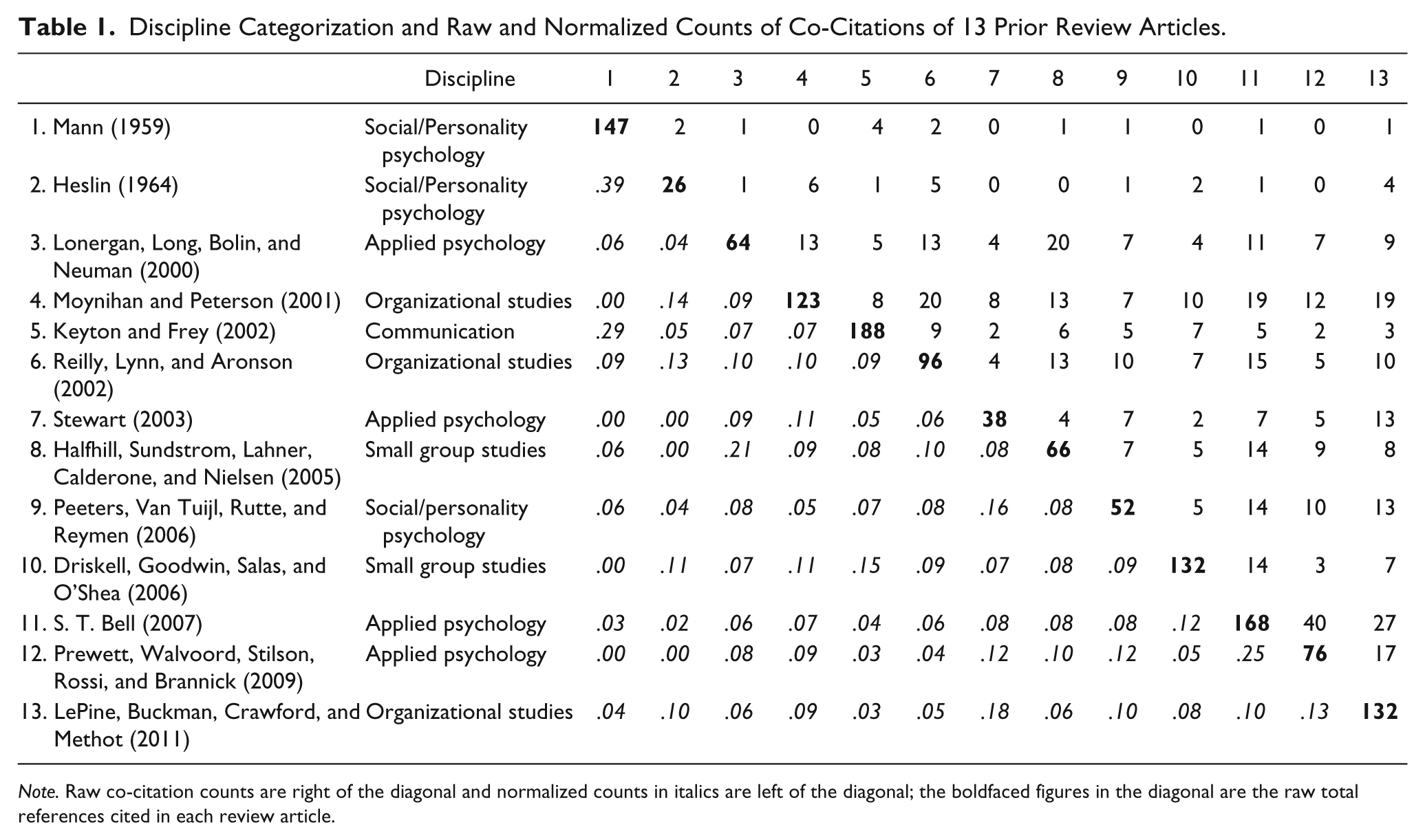
Note. Raw co-citation counts are right of the diagonal and normalized counts in italics are left of the diagonal; the boldfaced figures in the diagonal are the raw total references cited in each review article.
Network Analysis of Co-Citations Between 13 Review Articles
We created a master list of all the references contained in the 13 reviews, eliminating only references that were strictly methodological (e.g., Cohen, 1992). This resulted in a list of 1,008 unique citations. 3 After initial examination of the list, we trained a team of research assistants to categorize each cited reference into one of the following disciplines, defined by the Web of Science classification of the publication outlet: communication (e.g., Communication Monographs), education (e.g., Review of Educational Research), information systems/technology (e.g., Journal of Engineering and Technology Management), organization studies (e.g., Human Resource Management), applied psychology (e.g., Personnel Psychology), social/personality psychology (e.g., Journal of Personality and Social Psychology), small group studies (e.g., Small Group Research), and sociology (e.g., Sociometry/Social Psychology Quarterly).
Figure 1 presents a graph of the volume of citations within each discipline over time. The most striking feature of the graph is the peak of citations in the 1950s followed by the precipitous drop in the 1960s and a second peak in the 1990s. Although this pattern is most obvious within the field of social/personality psychology, the basic pattern holds across nearly all of the disciplines. The 1950s peak aligns with what has come to be widely recognized as the golden age of research in small groups (McGrath, 1997; Moreland, Hogg, & Hains, 1994), and the second peak in the figure reflects the growing confidence and interest in the FFM, especially in the organization studies and applied psychology disciplines. 4
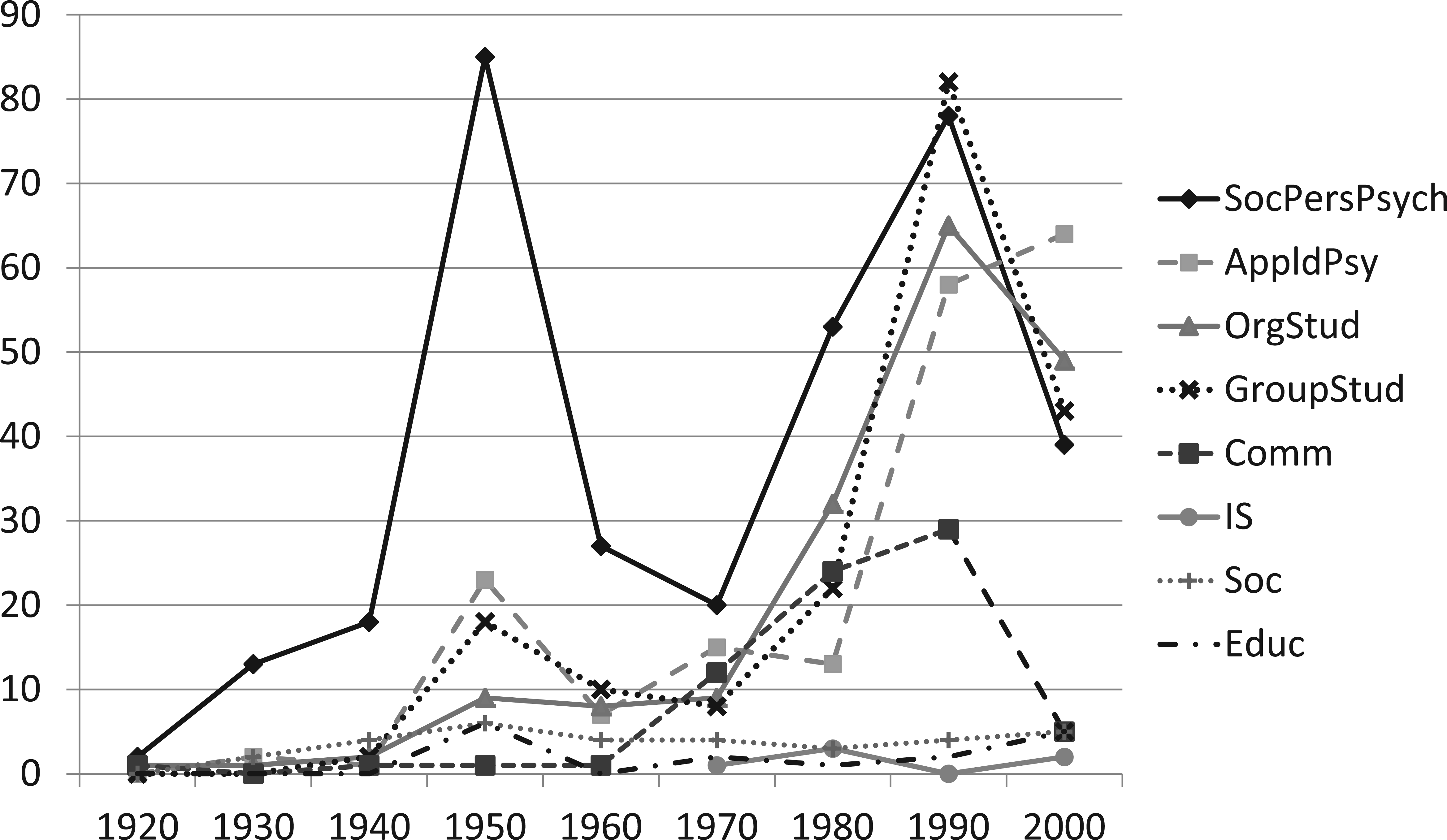
Number of citations in previous 13 review articles by discipline over time.
We used UCINET (Borgatti, Everett, & Freeman, 2002) to conduct the network analysis of the co-citations in the 13 review articles. We developed a bi-modal Citation by Review 5 matrix comprised of the unique citations across all the reviews in which each X i,j cell entry represents a binary variable, whether or not each citationi was cited in each reviewj. A visualization of the resulting network (displayed in Figure 2) was created by using geodesic distances between nodes (based on the shortest path between each node), with the additional criteria of avoiding nodes appearing on top of each other and equalizing line length, as far as possible. 6 Finally, we added each citation’s discipline as an attribute to the network matrix.
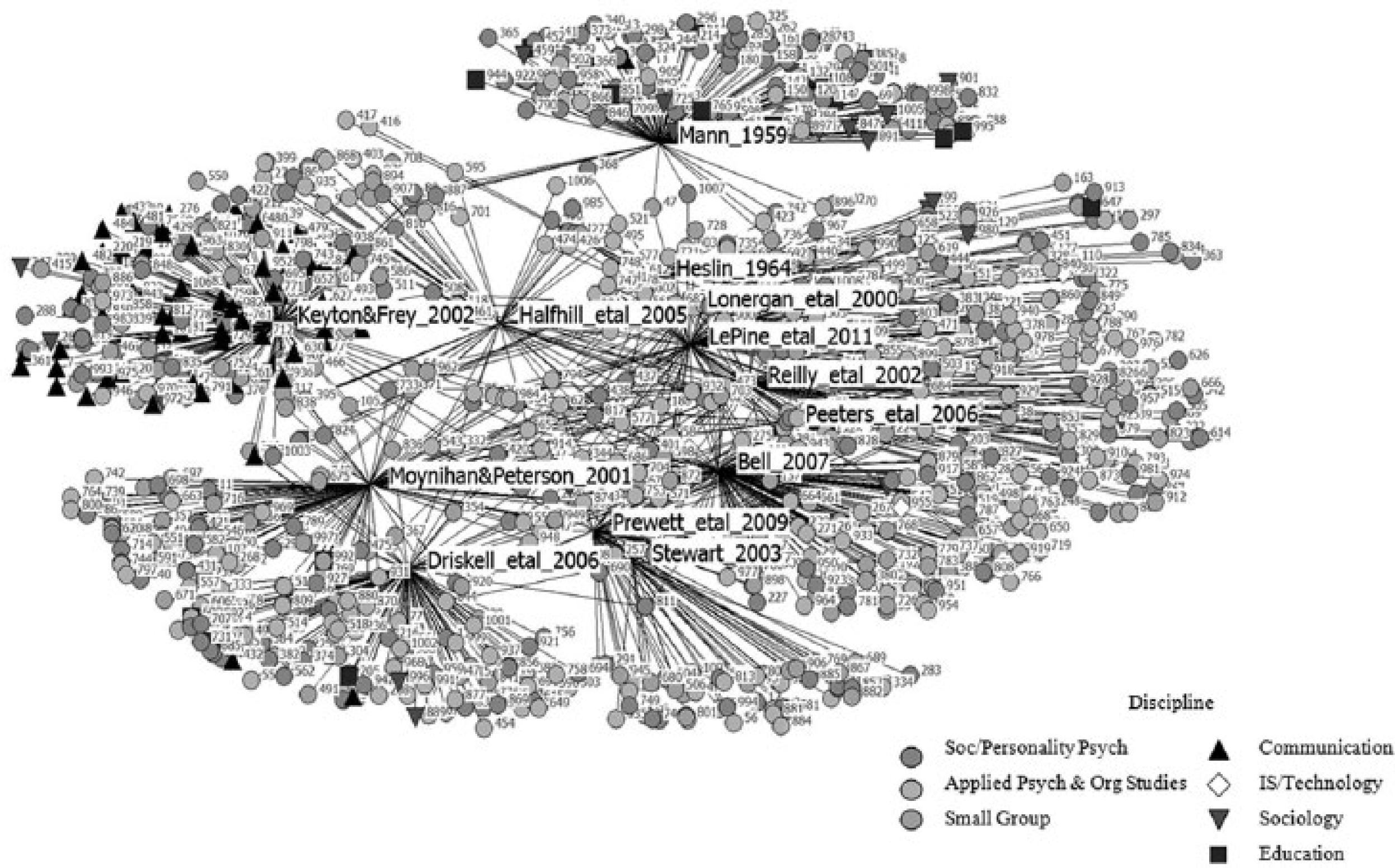
Network diagram of 1,008 unique citations by publication discipline in 13 review articles on personality and groups.
Each review node in Figure 2 is labeled with its reference and each citation node is labeled with its number on the alphabetic master list. The citation node shapes and grayscale shading indicate their disciplines. The edges show which Citations appeared in each review. Frequently cited works are oriented toward the center of the diagram, and those cited in only one or two of the reviews are arrayed around the perimeter. Similarly, reviews closest to the center shared the highest overlap of citations. Table 1 shows the co-citation counts among the reviews: On the right side of the diagonal are the raw number of joint citations between each review and the normalized counts are on the left side of the diagonal. The diagonal contains the raw total of references in each review.
This network diagram reveals a number of structural aspects of the research literature on personality and small groups. First, the overall fireworks pattern, with each review at the center of its starburst, suggests low overlap in the literature considered across these reviews. The diagram shows that the vast majority of the citations (N = 951; 94%) are tied to just one review, a scant handful appear in more than five reviews (N = 13; 1%), and no citation appears in all of the reviews. Moreover, the percentage of citations common between any two reviews is very low overall, about 8% on average, while between 33% and over 90% of the citations in a particular review appear in that review only (see left half of Table 1). It thus appears that each review cut a distinct swath through the literature on personality and groups.
It is helpful here to discuss the specific highly cited articles lying within the central cluster in the diagram because they in essence represent the intellectual core of the research area. The four highest cited articles were cited in 9 or 10 of the reviews; the next highest number of citations received by any article was six. These four most highly cited articles (and their node #s in the diagram) were: Barrick & Mount, 1991: #58; Barrick, Stewart, Neubert, & Mount, 1998: #62; Barry & Stewart, 1997: #65; and Neuman & Wright, 1999: #704. All four were written by scholars housed in business schools and published in leading applied psychology journals. They each examined the relationship between Big Five personality factors and task performance in organizational teams, either with single studies (Barrick et al., 1998; Barry & Stewart; Neuman & Wright, 1999) or meta-analysis of like studies (Barrick & Mount, 1991). These articles represent not only the intellectual base of the research in this area but also its archetype.
The second characteristic to observe about the network diagram is the varying distances between the starbursts. These distances roughly approximate the proportion of common citations between each pair of reviews. Most notable is the separation between the Keyton and Frey (2002) and the Mann (1959) reviews from the other reviews. The vast majority of the citations in these two reviews were not cited in any of the other Reviews (87% in Keyton & Frey; 92% in Mann). Furthermore, the left half of Table 1 shows that the proportion of citations that either of these reviews has in common with the other Reviews is generally low. In fact, the highest overlap the Keyton and Frey Review has (29%) is with Mann (Mann’s highest overlap is with Heslin, 1964). The separation of these two Reviews is even more striking considering that the Keyton and Frey article contains the highest number of total references (N = 188) and Mann the third highest (N = 147).
Further explanation for the separation of Keyton and Frey (2002) in particular comes in considering the third aspect of the network diagram, namely, its disciplinary structure. The disciplines of the citations are represented by the node shapes and shading. Nearly all (77%) of the Citations from the communication discipline (upward triangle nodes ▲ in Figure 2) appear once, in the Keyton and Frey review. The separation of Mann (1959) can be explained by the era in which it was published and that a high percentage of the literature from sociology (47%; downward triangle nodes ▼) and education (69%, square nodes ■) was only cited there.
Several conclusions can be drawn by considering the previous reviews collectively. Scholars have been interested in personality throughout the history of research on small groups, though the level of interest has waxed and waned. Furthermore, the trends over time are tied to disciplines. The mainstream of research on personality has moved decidedly toward applied psychology and organization studies, leaving by the wayside other disciplines like sociology, education, and possibly communication. The entry of information systems and technology as a new discipline in this research area is also tightly coupled with applied psychology and organization studies.
Despite the concentration of work into this small number of disciplines, the network analysis revealed an astonishingly low degree of overlap in the literature cited across the previous reviews, even when taking into account differences in publication date. It must be noted of course that differences in the slices of literature carved by each review are due in part to differences in the authors’ objectives. It is nevertheless important to consider what the pattern implies. We believe it signals a certain degree of fragmentation within this research area that may hinder the accumulation of findings and hence the forward progress of the area.
Substantive Content of the Prior Review Articles
The trait approach—FFM primarily—is the exclusive model of personality found in the literature cited in the previous reviews, despite substantial research based on other models within the wider personality literature. For example, Funder (2001) describes additional paradigms of personality research including psychoanalytic (e.g., Cramer, 2000), social-cognitive (e.g., Dweck, 1996; Mischel & Shoda, 1995), humanistic (e.g., Maslow, 1987), and biological (Kenrick, 2001; Plomin, Chipuer, & Loehlin, 1990). Consistent with reliance on a single model of personality and the relatively narrow disciplinary base, the range of topics considered in these review articles was also narrow. For the most part, the main topic was the relationship between group personality composition and task performance quality, though the reviews differ somewhat in their specific foci. For example, Reilly et al. (2002) focused on the interaction between personality and group task type; Moynihan and Peterson (2001), S. T. Bell (2007), and Peeters, Van Tuijl, Rutte, and Reymen (2006) examined different methods of aggregating individual member personality traits; and the main goal of LePine et al. (2011) was to develop a model of the cross-level pathways through which member personality affects group process and outcomes.
The Keyton and Frey (2002) and Mann (1959) reviews are again exceptions to this general summary. Neither of these reviews focused on task performance, but rather examined the relationship between individual member personality and interaction behaviors. Mann’s use of the term performance referred to the behavioral styles of individual group members, but his personality measures were precursors to the FFM (e.g., Cattell, 1956). Keyton and Frey made only a passing reference to the FFM and instead examined a wider set of personality traits (e.g., Machiavellianism; self-monitoring) with in-depth attention to several communication-specific traits (e.g., communication apprehension; McCroskey & Richmond, 1992).
What conclusions can be drawn from the content of these reviews, even considering the differences in focus? The evidence reviewed in these articles shows that the personality of individual members does affect group process and outcomes, that differences in combinations of personality traits among members also affect process and outcomes, and that the way the combination of traits is operationalized also makes a difference. Furthermore, the effects of member personality—individually and in combination—are affected by contingencies such as task and study setting. However, it is nearly impossible to state any more definitive conclusions than these because of the very different sets of studies each review cited combined with the differences in specific effects examined. For example, Halfhill, Sundstrom, Lahner, Calderone, and Nielsen (2005) found that variance across all traits (Big 5) was consistently negatively related to task performance; Peeters et al. (2006) found that variance only in conscientiousness and agreeableness was negatively related to performance, whereas S. T. Bell (2007) found that variance in Big 5 traits generally did not predict group performance. Meanwhile, Prewett, Walvoord, Stilson, Rossi, and Brannick’s (2009) review suggested that the effect of variance on task performance depends on task characteristics. Reconciling such conflicting findings is difficult when there are so few studies in common across the different reviews. In short, despite a large volume of individual studies spread over a narrow range of disciplines, the research on personality and groups is relatively non-cumulative, at least in the disciplinary corner represented in these 13 review articles.
Our first recommendation is that in order for research on group personality composition to progress, a unifying framework is needed that can provide the scaffolding to guide systematic accumulation of research findings. One example is the model offered in LePine et al.’s (2011) comprehensive review. Taking a multi-level approach, they describe pathways of how group personality composition relates to group effectiveness, how individual member personality relates to group effectiveness, and cross-level pathways of influence of groups on individuals and individuals on the groups. If researchers examining the relationships between personality and task performance would place their work within a framework such as this one, points of convergence and divergence between different studies could more easily be seen and interpreted.
Expanding the Disciplinary Base
The meta-review of the structural properties and substantive content of the literature on personality and groups reveals that the mainstream of this research area is fed by three major tributaries: psychology, with applied psychology’s presence increasing dramatically over time; small group studies; and organization studies. In this section of the article, we therefore discuss how considering research from disciplines outside of this mainstream can enhance the current state of knowledge and point to new research directions.
Our choice of the new disciplines to include was guided by several considerations. First, we placed some limits on what to include in order to keep the review within reasonable bounds overall and to limit the scope to the likely interests of most readers of this journal. Therefore, we started by considering only disciplines in the social and behavioral sciences, and research on humans. That excluded, for example, biology and medicine (e.g., Cattell, Young, & Hundleby, 1964), the clinical literature on therapy groups (e.g., Boyd, 1991) and the relatively extensive anthropological literature on personality in non-human primates (e.g., Freeman & Gosling, 2010). Then based on consultation with colleagues in different disciplines and our own knowledge of the literature and intuition, we identified a tentative list of social science and human behavior disciplines. An initial literature search for work on personality and groups or teams within databases associated with those disciplines led to an identification of additional disciplines. After examining the yield of these initial searches for relevance to the central topic of personality and small human groups, we settled on the following additional seven disciplines: behavioral economics, communication, cultural and psychological anthropology, education, information systems/technology, legal studies, and sociology.
To search for literature related to personality and groups across these disciplines, we first developed a list of keywords of the primary terms: personality, groups, and teams and then searched the literature in two ways. First, we identified the most highly cited journals in each discipline using the journal citation reports, the discipline-specific databases, and journal publisher. We supplemented this initial list with additional journals that were cited in articles from our initial search steps. Second, we searched in general cross-discipline databases to supplement the first list. 7
Analytic Framework for Comparing Disciplines
Our discussion of the expanded set of disciplines is organized around five core dimensions that we believe reveals points of convergence and divergence between these disciplines and those we have labeled as the mainstream. Table 2 presents the definitions of the dimensions and the description of how each applies to each discipline. First is ontology, that is, assumptions underlying the research in each discipline about personality and the nature and context of groups. Ontological questions we considered included: What are the functions of groups? What activities do groups do? What are the kinds of groups studied? In what settings do groups do these activities? Why is personality important for groups? The next dimension describes theoretical frameworks. This dimension includes consideration of the conceptual models and frameworks that can be found in each discipline that have relevance to the study of personality and groups. Next, we describe the research questions or topics that researchers pursue in each discipline. The fourth dimension, epistemology, describes how knowledge in each discipline is created. This dimension primarily considers the methodological approaches most strongly associated with each discipline. The last dimension describes key findings and contributions of research in each discipline to the understanding of personality and groups. Finally, we have included in Table 2 citations to articles that represent the disciplines. In this section, we aim to present a broader picture of what we currently know about personality and groups in each discipline; therefore, none of the literature we review appeared in any of the previous 13 reviews. We also point to directions for future knowledge expansion. We next turn to a brief review of disciplines guided by these five dimensions.
Analytic Framework for Comparing Disciplinary Approaches to Personality and Groups.

Discipline by Discipline Review
Behavioral economics
Traditionally, behavioral economists assert that behavior is largely situationally determined by constraints and incentives. Moreover, “behavioral economists are not convinced about the predictive validity, stability, or causal status of economic preference parameters or personality traits” (Almlund, Duckworth, Heckman, & Kautz, 2011, p. 9). This could explain why empirical evidence is limited and mixed for how personality traits relate to the key constructs and parameters that behavioral economists typically model to predict group behavior. Baddeley (2010) argues that behavioral economics, in its neglect of perspectives from other social sciences, has limited ability to understand the factors that contribute to individual and collective economic decision-making, and she makes a strong call for interdisciplinary integration. Almlund et al. (2011) also offer a constructive and relatively optimistic discussion of how personality variables could be incorporated into economic models and why it would be valuable to do so.
The overarching theoretical framework within behavioral economics is utility maximization, and research questions related to personality focus on how traits affect decision optimization by individuals and groups. The methods applied to research on personality and groups range from theoretical mathematical modeling to laboratory experimentation. For example, Wang, Zhuang, Yang, and Sheng (2014) using economic modeling showed that the presence of optimistic members in a team suppresses task effort across all members, leading to the counterintuitive conclusion that optimism may have negative effects on group task performance. At the other end of the method range is experimental work on financial decision-making by Baddeley (2010) showing that herding—following the behavior of others in a group rather than acting on the basis of one’s independent information—was positively related to impulsivity and venturesomeness, and negatively related to extraversion and trait empathy.
Communication
Research in this discipline draws heavily from psychological theories and shares similar fundamental assumptions. Personality is positioned as a dispositional factor that affects group interaction and outcomes through the communication style and behaviors of the members. Communication scholars have been primarily interested in topics related to the effects of communication behaviors on perceptions of personality (Scherer & Scherer, 1981), on social influence processes (e.g., Andrews, 1985; Hazel, Keaten, & Kelly, 2014), and, most recently, on communication media use (Sherry, 2001).
The models of personality appearing in this discipline have included the FFM (e.g., McCroskey, Heisel, & Richmond, 2001), but a wider range of traits have been studied. One trait prominent in this discipline, for example, is communication apprehension, “fear or anxiety associated with either real or anticipated communication with another person or persons” (McCroskey & Richmond, 1992, p. 345). This trait has been associated with lower rates of participation and lack of speech fluency, behaviors that have been found to decrease interpersonal influence in group discussion (Mast, 2002).
Also central to the communication discipline is research related to how qualities of individual speech affect personality judgments. The most consistent findings have tended to be for the trait of extraversion, which has been found to be associated with voice pitch, speech intensity, and fluency, but effects for other traits and other speech qualities (e.g., volume) have been mixed (Scherer & Scherer, 1981). Rekindled interest in judging personality from speech indicators has emerged from the computer science discipline. Mairesse, Walker, Mehl, and Moore (2007) and Polzehl, Möller, and Metze (2010), for example, have developed natural language processing algorithms to automate personality classification using models of linguistic cues derived from social psychology of communication (Pennebaker, Mehl, & Niederhoffer, 2003), and they so far have found that these tools perform nearly as well as human raters in classifying speakers along Big Five personality traits.
Since the publication of the Keyton and Frey (2002) review, however, attention to personality and groups has all but disappeared from the communication literature. Our search in individual communication journals (e.g., Human Communication Research, Media Psychology, Communication Monographs) and the Communication and Mass Media Complete database revealed few studies of personality and groups published since their review. The recent literature on personality and groups focused on communication issues now appears primarily in the psychology, technology/media, and management-oriented outlets (e.g., Xia, Yuan, & Gay, 2009).
Cultural anthropology
Like sociology (see below), the early study of personality within anthropology was marked by strong interdisciplinary ties with other social sciences. Interest among anthropologists gradually faded due in part to philosophical and professional differences among scholars and in part to the increased disciplinary specialization within social sciences overall (LeVine, 2001). Today, work related to personality, commonly labeled culture and personality studies, is found mostly in the cross-cultural psychology literature with scholars publishing in both psychology and anthropology outlets (e.g., Shweder, 1975; Shweder, Casagrande, Fiske, Greenstone, Heelas, & Lancy, 1977). Furthermore, recent calls for increased integration between personality psychology and anthropology are coming more from prominent voices in psychology (McCrae, 2000) or from scholars who already span these disciplinary boundaries (LeVine, 2001), than from within anthropology.
Research in this area emphasizes the interactions among personality, genetics, environment, and culture (Triandis & Suh, 2002), and among the central research questions are cross-cultural comparisons of personality traits and personality descriptions. For example, a great deal of work has examined the cross-cultural equivalence of the FFM (McCrae & Allik, 2002). Hofstede and McCrae (2004) reported a re-analysis of Hofstede’s (1984) original data showing predictable correspondence between cultural dimensions and the FFM (i.e., individualism correlates with extraversion; emotional stability correlates with uncertainty avoidance; conscientiousness correlates with power distance). Meanwhile, the issue of the universality of traits has sparked considerable debate (Marsella, Dubanoski, Hamada, & Morse, 2000), including contentions that personality is not a real construct (Shweder et al., 1977; Shweder & D’Andrade, 1979) and is merely “an expression of the Western ideal of individualism” (Hsu, 1985, p. 24).
The research in this field is done at the individual and cultural or societal levels of analysis, and the small group has not received much research attention from those interested in culture and personality. We nevertheless believe that conceptual perspectives from this discipline have much to offer to group researchers.
Education
In this discipline, personality is thought to affect students’ enjoyment of teamwork and the nature of group interaction processes, and learning outcomes (e.g., French & Kottke, 2013; Walker, 2007). Our review did not reveal a reliance on any particular theories other than those associated with the mainstream disciplines, or theories associated with the questions guiding a specific study (e.g., Forrester & Tashchian, 2013).
The model of personality most frequently used was the FFM. For example, Walker (2007) showed that extraversion was positively related to students’ evaluations of their teamwork experiences; Schippers (2014) found high conscientiousness and high agreeableness could compensate for social loafing and maintain high group performance; and Forrester and Tashchian (2013) found that all of the factors with the exception of neuroticism predicted conflict resolution styles (i.e., avoiding, compromising, dominating, integrating, obligating). Traits other than the Big Five have included disposition toward teamwork, which French and Kottke (2013) found to have a positive effect on member satisfaction when there was high extraversion dispersion, and a related trait, labeled lone wolf tendency (preference not to work in groups), which has been found to negatively affect task performance quality (Barr, Dixon, & Gassenheimer, 2005).
Another line of research concerns team composition and its impact on team interaction and satisfaction with team learning. Personality heterogeneity based on the Myers–Briggs Type Indicator (MBTI) was found to foster group discussion and satisfaction with the team learning experience (e.g., Lee & Lee, 2006), especially when students were given exercises to make them aware of team personality diversity (Lancellotti & Boyd, 2008).
Information systems/technology
Information systems is inherently an interdisciplinary field, drawing from roots in management science, organizational studies, computer science, communication, and psychology (Alavi & Carlson, 1992; Culnan, 1986), and the philosophical traditions related to groups and personality lie close to the traditions of these root disciplines. Research within this discipline largely accepts the view of personality as a relatively stable characteristic of individuals that is subject to situational constraints and research assumes that teams are task-oriented and in organizational settings.
The research interests fall into two broad categories—personality within technology project teams and personality within virtual teams. The first category is represented by research on teams within the technology sector engaged in tasks such as software development. This research closely resembles traditional research within psychology and organizational studies on the effects of individual member traits and group composition on team task performance and interpersonal processes. Kichuk and Wiesner (1997), for instance, studied teams of engineering students working on a design task and found that mean levels of extraversion, agreeableness, and conscientiousness were positively related to task quality, whereas Trimmer, Domino, and Blanton (2002) found that variance in conscientiousness, agreeableness, and openness were negatively related to interpersonal conflict among information systems student teams engaged in a systems analysis project. Interestingly, the MBTI has been more widely used than the FFM, until very recently (Balijepally, Mahapatra, & Nerur, 2006).
The second broad category is research on virtual teams, defined in terms of the extent to which interaction is mediated rather than face-to-face, including the degree of geotemporal dispersion among team members (Fiol & O’Connor, 2005; Ortiz de Guinea, Webster, & Staples, 2012). The theoretical frameworks used within these studies are generally borrowed from the root disciplines, and the FFM is the predominant model found. An exception to this trend is a conceptual article by Brown, Poole, and Rodgers (2004) that uses Leary’s (1957) interpersonal circumplex model of personality to develop research propositions about the development of trust in virtual teams. The research topics generally involve an implicit or explicit comparison between personality effects in virtual and face-to-face settings. Specific examples include a survey study by Luse, McElroy, Townsend, and DeMarie (2013) on the relationship between personality traits and preferences for working in virtual teams, face-to-face teams, or working alone. They found that openness predicted preference for working in virtual compared with face-to-face teams within a sample of students. Turel and Zhang (2010) studied the impact on task quality of naturally occurring personality configurations of virtual student teams working on a case analysis. Within-team heterogeneity of conscientiousness negatively affected task quality, but only when variance on extraversion was also low. Consistent results for extraversion were also reported by Balthazard, Potter, and Warren (2004), who found a curvilinear relationship between naturally occurring extraversion variance and task performance quality in a field study of executive MBA teams. Finally, Whelan, Aiman-Smith, and Kimbrough (2009) conducted a field study in which they assigned MBA students to groups based on personality profiles, in which they found no effects of agreeableness and conscientiousness, but negative effects of mean extraversion on task performance.
The rise of the virtual team environment raises important implications for research models based on the assumption of face-to-face and real-time interaction, and we believe that consideration of these implications points to important directions for future research on personality. We return to a fuller discussion of virtual teams in the next major section of the article.
Legal and political studies
The study of groups within these disciplines focuses on the relationship between deliberative processes and individual differences, and, as such, has been largely influenced by the field of psychology (Iyengar & McGuire, 1993). The context for this research has primarily considered the relationship between personality and political attitudes, political ideology (e.g., Gastil, Black, & Moscovitz, 2008), and political/jury decision-making, jury selection (e.g., Clark, Boccaccini, Caillouet, & Chaplin, 2007), deliberation (Devine, Clayton, Dunford, Seying, & Pryce, 2001), and political participation (e.g., A. S. Gerber, Huber, Doherty, & Dowling, 2012). The composition of juries, one of the main topics within this discipline, is studied primarily through mock jury experiments (Wiener, Krauss, & Lieberman, 2011).
Research within this domain has examined several broad questions. First is how panelists’ personality affects the way they process information. For example, Berg and Vidmar (1975) found that individual jurors’ authoritarianism affected the kind of trial information they remembered. A second set of questions is focused on how individual panelist personalities and personality composition affects how panels deliberate. In studies of mock juries, for example, Shestowsky and Horowitz (2004) found that individuals’ need for cognition was positively related to amount of speaking time and being perceived as persuasive, and Bray and Noble (1978) reported that group mean authoritarianism was positively related to deliberation polarization. A final set of questions relates to the outcomes of deliberations. Clark et al. (2007), for example, found that jury foreperson extraversion was associated with longer deliberation times, which tended to result in verdicts favoring the defendant; in a study of political deliberation Gastil et al. (2008) reported post-deliberation changes in individual members’ ideology as a function of average group scores on extraversion and conscientiousness.
Sociology
The philosophical distinction between sociological and psychological views of personality and groups is best expressed perhaps by George Herbert Mead:
We are not . . . building up the behavior of the social group in terms of the behavior of the separate individuals composing it, rather we are starting out with a given social whole of complex group activity, into which we analyze (as elements) the behavior of each of the separate individuals composing it. (cited in House, 1977, p. 165)
From the sociological viewpoint, personalities of group members are characteristics of and even emergent from the group (Burt, Jannotta, & Mahoney, 1998; White, 1995).
Sociologists’ primary interest is the relationship between individual member personality and social structure position, defined in terms of degree of inclusion in the structure, occupation of a particular role in the structure, or the nature of relationships (social ties) with other elements in the structure. Selection on sociometric surveys was the main outcome examined in the earliest sociological studies of personality in groups, and researchers were primarily interested in whether personality measures (Rorschach, Minnesota Multiphasic Personality Inventory [MMPI], and Thematic Apperception Test [TAT] at that time) could differentiate between which members in a group were selected (i.e., most popular) or rejected (i.e., least popular) by their peers (Mill, 1953). The legacy of this work is evident today in the growing interest in the relevance of personality to social networks (Fang et al., 2015; Landis, 2015). For example, Burt et al. (1998) identified a cluster of personality items on a commercial personality inventory associated with the degree of structural holes in social networks that defined a network entrepreneur. More recently, Burt (2012) suggested that personality partly explains the tendency for people to form structurally similar networks across different contexts.
Another major theoretical tradition in sociology that has relevance to personality and groups is based on expectation states, status characteristics, and status construction theories (Ridgeway, 1991; Ridgeway & Berger, 1986; Webster & Hysom, 1998). These theories are based on the premise that characteristics expected to contribute positively to group task accomplishment will be afforded high-status, and the resulting status hierarchies shape social behaviors in groups. Sex is a frequently studied status characteristic (e.g., Ridgeway, Backor, Li, Tinkler, & Erickson, 2009), and the potential for personality to act as a status characteristic has also been considered. Webster and Hysom (1998) discuss how status can be ascribed to a trait like extraversion, and this trait then becomes the basis for the creation of a status hierarchy. In a sample of police officers, G. L. Gerber (1996) found that high-status members (i.e., males) of mixed-sex pairs were perceived as having more dominant personalities than were the low-status (i.e., female) members. Research on personality and status characteristics in groups has not been limited to sociologists. In psychology, Anderson, John, Keltner, and Kring (2001), for example, found that extraversion predicted high status for both men and women, whereas neuroticism predicted low status for men only.
Conclusion
Our review of the expanded set of disciplines illuminates four observations. First, there is a strong interest in the study of personality and groups across multiple disciplines, and growth in interest is coming from outside of the mainstream disciplines—most notably from information systems, sociology (social networks), and behavioral economics. Second, there is nevertheless considerable variance across the disciplines regarding the assumptions, prominence, legitimacy, and history of interest in the topic of personality. Third, despite this variance, the research in this expanded set of disciplines tends to adhere to the assumptions and theories within the mainstream disciplines, namely taking a trait approach based on the FFM.
The fourth observation is we found good evidence of strong interest in interdisciplinary integration. Psychologists have examined processes underlying status characteristics dynamics (e.g., Anderson et al., 2001) and have urged for integration with cultural anthropology (e.g., McCrae, 2000), while sociologists are returning to an interest in personality (e.g., Burt, 2012) and have decried past disciplinary segregation (e.g., Emirbayer, 1997). Behavioral economists, despite rigorous critique and skepticism over methodological issues, have declared that their understanding of decision-making behaviors would be enhanced by consideration of personality (e.g., Baddeley, 2010). Computer scientists are using communication behaviors to create language processing algorithms for automated personality judgments (e.g., Mairesse et al., 2007). We contribute to this trend in the next section by offering suggestions for new interdisciplinary directions for research on personality and groups.
Interdisciplinary Pathways to New Research
Our objectives in this section are to discuss three specific directions for future research that emerged when we considered what we learned about research on personality and groups from examining all the disciplines together, and to illustrate the contributions of multiple disciplines to each of the topics. These objectives arose from our observation that the strong debates about the very nature of personality that have been waged both within and across disciplines (e.g., Costa & McCrae, 2006; Emirbayer, 1997; Lucas & Donnellan, 2009; Mischel & Shoda, 1994; Shweder et al., 1977) have not touched the literature on groups and personality. Research has thus proceeded (a) as if traits of individual group members remain fixed over time and that group personality composition also remains fixed, (b) as if personality is antecedent to group process and outcomes, and (c) is based on theories of personality that assume interpersonal interaction occurs face-to-face. We next discuss interdisciplinary approaches to the research questions that arise from a reconsideration of each of these three assumptions.
Assumptions About the Temporal Nature of Personality
A long and widely acknowledged need within the small group research literature is greater attention to temporal processes (Arrow, Poole, Henry, Wheelan, & Moreland, 2004). Our review uncovered that a temporal perspective is especially lacking in the research on personality, with the exception of the work on attributions of traits from speech rate and fluency (Scherer & Scherer, 1981). Otherwise missing from this research area is attention to temporal issues such as changes over time in individual traits, changes over time in group trait composition, changes across stages of group development in effects related to personality, and how personality judgments affect subsequent interactions among group members. The absence of attention to temporality characterized all the disciplines we reviewed. We will take two of these examples—changes in member traits and in personality composition—as an illustration of interesting new research directions that come from applying multiple disciplines to the issue.
The extent to which personality traits change over time has been the subject of considerable debate within psychology (Costa & McCrae, 2006; Mischel, 2009), and has spilled over to other disciplines (e.g., Borghans, 2008). The literature on personality related to groups has not directly engaged in this debate, and the person–situation interaction perspective (Mischel, 1977) is absent from this literature. Rather, work has proceeded as if traits are fixed, and has ignored the dynamic and socio-cognitive theories of personality. Meanwhile, strong evidence from psychology has shown that personality continues to change further into adulthood than has been traditionally thought (Roberts & Mroczek, 2008), and, critical for our discussion here, that personality can change in response to specific life situations such as one’s work environment (Roberts, 2006) and through one’s relationships (Mund & Neyer, 2014). For example, Roberts, Caspi, and Moffitt (2003) showed that job prestige during young adulthood predicted increases in the traits of interpersonal warmth and sociability in later adulthood, even after controlling for those traits measured in adolescence. An important question implied by this research is how group personality traits, not just behaviors, can change as a function of group interaction, and over what kind of time frames.
Change in individual member personality implies that group personality composition also changes over time. The particular aggregation of trait scores measured at one point in a particular research study may not match the composition in effect at the time the dependent variables of interest are measured. Some past research has suggested that personality composition in groups and organizations becomes more homogeneous over time (Halfhill, Nielsen, & Sundstrom, 2008), and this effect has been explained by the attraction-selection-attrition model whereby people join and remain in groups whose members have similar personalities to themselves, and leave groups whose members do not (Schneider, Smith, Taylor, & Fleenor, 1998). A fruitful direction for future research would involve exploring the alternative explanation, based on an interactionist approach, that group personality composition becomes more homogeneous over time because, through interaction, members’ personalities change to become more similar to each other. To our knowledge, this question has not been pursued in any systematic way in the research on personality and groups.
To pursue such a question would require a focus on how interaction processes could exert such effects on group members. One example of taking an interdisciplinary approach to address this question would call on insights from the discipline of communication. Specifically, we have in mind communication accommodation theory, which explains when and how people match each other’s speech styles and patterns (Giles, Coupland, & Coupland, 1991). Speech accommodation is motivated (though not necessarily consciously) behavior aimed toward achieving interpersonal interaction goals (Giles et al., 1991), such as group cohesion and harmony. Recent research by communication scholars has shown that communication style matching does occur in groups (Gonzales, Hancock, & Pennebaker, 2009). An integration of the findings from Roberts et al.’s (2003) psychological research would suggest that over time the interaction environment resulting from behavioral accommodation would eventually come to affect group members traits associated with that behavior. We believe that the topic of change over time in member traits and the implied change in personality composition is intriguing and would generate fruitful new research as the complexities implied by the topic are explored.
Assumptions About the Causal Nature of Personality
The discipline of sociology offers perhaps the most vociferous challenge to the perspective of personality being the cause of social behavior. Harrison White (1995), for example, baldly claimed, “Traits of actors are byproducts more than causes” (p. 68). We argue that incorporating the perspective of personality as a product of social interaction and a feature of social structures represents an important direction for future research on personality and groups. A basic tenet of the sociological work on structuration theory is that social institutions come to form structures defined by social roles, ties between those roles, and expectations associated with the roles (Giddens, 1979). These structures guide interaction patterns and are in turn reinforced by those patterns (Poole, Seibold, & McPhee, 1985). Within this perspective, personality is defined by the ties and positions one has within a social structure. One promising future research direction would involve integrating work like Roberts et al. (2003) to help provide a complementary psychological explanation for the effects of social structures on individuals’ personalities.
The question of the causal direction of personality effects is also very important in research on social networks. Recent interest in personality among social network scholars has grown to the point that two major review articles of this work have been very recently published in prominent organization studies journals (Fang et al., 2015; Landis, 2015), and the LePine et al.’s (2011) review article also called for future research attention to this area. As already briefly discussed, a number of studies have found relationships between personality traits (primarily the FFM) and social network characteristics, but as Fang et al. pointed out in a meta-analysis, the direction of causality of these studies cannot be established because they mostly use non-experimental designs. Do people get into central positions because they are agreeable and conscientious, or are people in central positions seen as being agreeable and conscientious and, perhaps through behavioral confirmation processes (Snyder & Swann, 1978), come to behave and to perceive themselves as having those traits? We echo Fang et al.’s call for much needed research to better understand how personality affects where someone lands within a social structure, and how in turn where they land affects that person’s personality.
Assumptions About the Locus of Interpersonal Interaction
All the major theories of personality were developed in a world where face-to-face synchronous interaction between people was the default mode, and the current empirical literature on personality and groups is based on groups interacting in this mode. That world no longer exists. The explosion of virtual teamwork has led to much rethinking of theories related to groups (e.g., Tannenbaum, Mathieu, Salas, & Cohen, 2012), and we call for a similar reconsideration of ideas related to personality. As already noted earlier, the interest in personality in virtual teams is a growing area, and to date the research has pursued questions that primarily have implications for personnel selection (e.g., D’Souza & Colarelli, 2010). We believe this research area has not yet given attention to two interpersonal aspects of personality that are critical to virtual teams: (a) situational contingencies on personality expression and (b) accuracy in personality judgment among virtual team members. We will rely on perspectives drawn from cultural and psychological anthropology, social psychology, and communication to develop research questions related to these two topics.
Advancements in technology combined with economic pressures have led to more and more virtual teams that are global, in which the members often are from varied cultural backgrounds (Maloney & Zellmer-Bruhn, 2006). Although there are differing perspectives over the question of whether individuals in a culture develop a personality structure which is common among them (Bock, 2000; Marsella et al., 2000), there seems little disagreement that personality is best understood through the examination of the interactions between individuals and the context. Such a perspective is inherently interdisciplinary requiring attention to psychological factors related to individual trait expression (e.g., Tett & Burnett, 2003), personality judgment accuracy (e.g., Rouse & Haas, 2003), and cultural norms governing communication behaviors (Cook, 2004; Wasson, 2006). We develop a set of research questions related to virtual teams that result from integrating these perspectives.
Tett and Guterman’s (2000) trait activation theory argues that different task, social, and organizational situations can provide cues which serve to trigger the expression of different personality traits. This theory was developed, however, under the assumption of traditional face-to-face teams in which the members would all be facing the same situational cues. In a virtual team, members are subjected to different local cultural contexts simultaneous with the virtual context shared by the team (Cramton, 2002). Moreover, local contexts may not map directly onto team members’ cultural identities. The salience of the team’s culture relative to the members’ respective local cultures (B. S. Bell & Kozlowski, 2002) leads to important research questions related to how members negotiate the personality expression norms and cues between cultural contexts. Time orientation, for example (polychronicity vs. monochronicity), has been linked to cultural differences and personality (Todd, 2009), and such differences may be reflected in team-relevant behaviors associated with deadlines and multi-tasking (Voorveld, Segijn, Ketelaar, & Smit, 2014). Even a seemingly simple issue of how to provide feedback to teammates can become fraught if the wrong situational cues are applied (Diamant, Fussell, & Lo, 2008; Ruhleder & Jordan, 2001).
Personality expression is related to accuracy in personality judgment. Accuracy depends on quality and amount of information available, the ability of people to perceive cues, and differences in cue visibility (Funder, 2012). Data regarding the basic question of whether personality judgment accuracy differs between virtual and face-to-face teams are limited, but the available evidence suggests that face-to-face judgments are more accurate (Purvanova, 2008; Rouse & Haas, 2003). Still less information is available on cross-cultural personality judgment in the context of social interaction. Albright et al. (1997) found consensus on Big Five judgments between American and Chinese participants (both within and between culture ratings), but Matsumoto and Kudoh (1993) found low cross-cultural accuracy in personality attributions between Japanese and American participants. It should be noted, however, that both of these studies involved judgments made from non-verbal behaviors and did not involve social interaction. We believe that understanding how culture affects possible differences in the processes of personality judgments between virtual and face-to-face settings is a promising area in need of research attention, requiring insights from information systems, cultural personality studies, and social psychology.
Conclusion
Our review, spanning more than 80 years of research on the study of personality and groups, found that theories and methods for this research has largely drawn from the three main disciplines of psychology, small group studies, and organization studies. Our structural analysis further confirmed this trend but also identified a high degree of fragmentation within this research area. The juxtaposition of these two findings suggests that much can be gained from an interdisciplinary perspective on research on personality and small groups. Next, the five dimensions of our analytic framework highlighted the widespread cross-disciplinary interest in the study of personality and small groups. Notwithstanding the diversity in philosophical traditions and inquiry approaches, this review leaves us in little doubt that individual personality is an important element for group research.
We reiterate briefly the promising avenues for research that we have identified and close by outlining some of the implications our review has for research practice. We ask personality and group scholars to reconsider the assumptions about (a) the temporal nature of personality, which includes changes over time in individual traits, group trait composition, and across stage of group development; (b) the direction of personality causality, that is, whether personality is cause or a product of social interaction, and (c) face-to-face group interaction as the default. We arrived at these three ideas through the influence of our engagement with the range of disciplines we have discussed here (as well as others we did not include, like ethology), and we think these three ideas each offers a complex set of questions and research challenges that requires seeking insights across disciplines. Although we do not claim the paths suggested by these questions are the most important ones for research in groups and personality, we do claim that they are important and that pursuing them will move the field forward.
What do our exhortations require of researchers? We mention two things. First, our ideas imply that we must expand our repertoire of personality assessment procedures. We need more study designs involving assessment at multiple times, multiple places, and by multiple sources. Researchers can avail themselves of increasingly sophisticated and accessible technologies to support more effortful but richer data collection and analysis. Wearable sensing devices (Olguín Olguín, 2007) and automatic language recognition and classification tools (Mairesse et al., 2007) are some examples. Second, we urge scholars of personality and groups to read across disciplines. For example, it may surprise you (and be useful to know) how many times in how many disciplines your study of mean versus variance in extraversion within student software development teams has been replicated. Besides fostering collegial scholarly exchange and accumulation of knowledge, the stimulation of exposure to alternative conceptualizations ultimately benefits the field as a whole.
Footnotes
Acknowledgements
The authors thank Ed Lawler for helpful advice; Drew Margolin for assistance with the network analysis; David Funder, Franccesca Kazarooni, and Barry Markovsky for comments; and Travis Cabbell, Sara Cheong, Amylisa Christophe, Rebecca Mosner, Olivia Poglianich-Soria, and Elijah Weber-Han for assistance in compiling, coding, and reading articles.
Authors’ Note
Order of authorship is alphabetical. The authors contributed equally to the article.
Declaration of Conflicting Interests
The author(s) declared no potential conflicts of interest with respect to the research, authorship, and/or publication of this article.
Funding
The author(s) received no financial support for the research, authorship, and/or publication of this article.