



Abstract
Teams with strong faultlines often do not achieve their full potential because their functioning is impaired. We argue that strong diversity beliefs held by team leaders mitigate the negative impact of socio-demographic and experience-based faultlines on team functioning. In a heterogeneous multisource field sample of 217 employees nested in 44 teams and their leaders, we tested our assumptions. Results of a path-analytic model showed that socio-demographic faultlines were negatively related to perceived cohesion and positively related to perceived loafing. The impact of socio-demographic faultlines on team functioning was less detrimental when leaders held strong diversity beliefs. Against our expectations, we found no support for an impact of experience-based faultlines on perceived cohesion or a moderating role of leaders’ diversity beliefs in this context. Potential explanations for these results and implications for organizations and team leaders are discussed.
Beyond doubt, establishing conditions that increase the benefits of workplace diversity in teams is one of the major challenges of modern organizations (Jackson & Joshi, 2004). Due to the rising demand for the integration of diverse and highly specialized knowledge, the indispensability of well-functioning teams continues to gain in importance (Mell, van Knippenberg, & van Ginkel, 2014). At the same time, the likelihood of inter-individual differences among colleagues rises as demographic changes, globalization, and growing workforce mobility and specialization proceed (Meyer & Glenz, 2013). In response to these challenges, researchers have turned toward analyzing the impact of diversity faultlines in teams. Faultlines are “hypothetical dividing lines that may split a group into subgroups based on one or more attributes” (Lau & Murnighan, 1998, p. 328). In contrast to traditional research on diversity, this approach enables the simultaneous consideration of several diversity attributes (van Knippenberg & Schippers, 2007). Research demonstrated an overall negative impact of diversity faultlines on team functioning and outcomes (Thatcher & Patel, 2012).
Leaders play an important role in teams through their power to intentionally influence team members’ behavior and experiences (Yukl, 2013). A few studies have identified the impact of leaders’ behavior—transformational leadership in particular—on the utilization of the potential of team diversity. When leaders exhibited strong transformational leadership behavior, a positive relationship between educational specialization heterogeneity and team creativity emerged (Shin & Zhou, 2007). In addition, the impact of diversity in age, nationality, and educational background on team performance was positive when transformational leadership was high (Kearney & Gebert, 2009). Faultline research found that the negative impact of faultlines on productive energy was buffered by strong transformational leadership (Kunze & Bruch, 2010). In an attempt to extend these findings on leaders’ behaviors, we propose that their attitudes toward diversity alter the consequences of faultlines in teams as well. Whereas the faultline literature provides support for the beneficial effects of positive attitudes toward diversity held by team members (e.g., Homan, van Knippenberg, van Kleef, & De Dreu, 2007; Meyer & Schermuly, 2012), leaders’ attitudes have been neglected until now. We may thus have missed an opportunity to explain differences in the consequences of faultlines between teams depending on their leaders’ attitudes. This is an important shortcoming because leaders with negative attitudes toward diversity may activate faultlines, evoke perceptions of identity threat, and thus intensify the negative impact of faultlines on team functioning.
Moreover, the literature provides no consistent conclusions as to whether the consequences of faultlines differ depending on the combination of attributes used for faultline calculation (Thatcher & Patel, 2012). More specifically, we do not know whether faultlines based on education level and team tenure (i.e., experience-based faultlines), have the same detrimental effect on team functioning as faultlines based on gender and age (i.e., socio-demographic faultlines). We argue that unless several faultline types are considered simultaneously, investigations of the effects of faultlines on team functioning may lead to incomplete conclusions.
To disentangle the effects of different faultline types and the moderating impact of leaders’ attitudes toward diversity, we turn to two indicators of team functioning: perceived cohesion and loafing. Team functioning is an important antecedent of team outcomes and both indicators of team functioning have been shown to impact outcomes such as team performance (Greer, 2012; Karau, 2012). Team cohesion is one of the most widely studied variables in small groups and in faultline research (Greer, 2012). It refers to forces binding team members to one another and to their team as a whole (Guzzo & Shea, 1992). Meta-analytic research yielded support for the negative relationship between faultlines and cohesion (Thatcher & Patel, 2011). Social loafing has only recently been introduced to the faultline literature (Meyer, Schermuly, & Kauffeld, 2016). It describes the “reduction in motivation and effort when individuals work collectively compared with when they work individually” (Karau & Williams, 1993, p. 681). In a sample of 45 blue-collar teams, members were most likely to loaf if faultlines were strong, members had low levels of social competence, and belonged to a larger subgroup (Meyer et al., 2016). These results indicated that social loafing occurred in teams with strong faultlines under certain conditions related to members and subgroups. It remains unclear, however, whether these effects differ in magnitude depending on the attributes considered for faultline calculation and whether they are contingent on leaders’ attitudes toward diversity.
In sum, we aim to advance the current faultline literature in several ways: First, we introduce the leaders’ perspective and examine their attitudes’ impact on the relationship between faultlines and team functioning. Second, we simultaneously compare the effects of experience-based and socio-demographic faultlines on team functioning as reflected by perceived cohesion and loafing. We thus mean to disentangle the effects of different attribute combinations used for faultline calculation. Third, we replicate existing findings concerning the relationships between faultlines, cohesion, and loafing in a heterogeneous multisource field sample. Our complete research model is displayed in Figure 1.
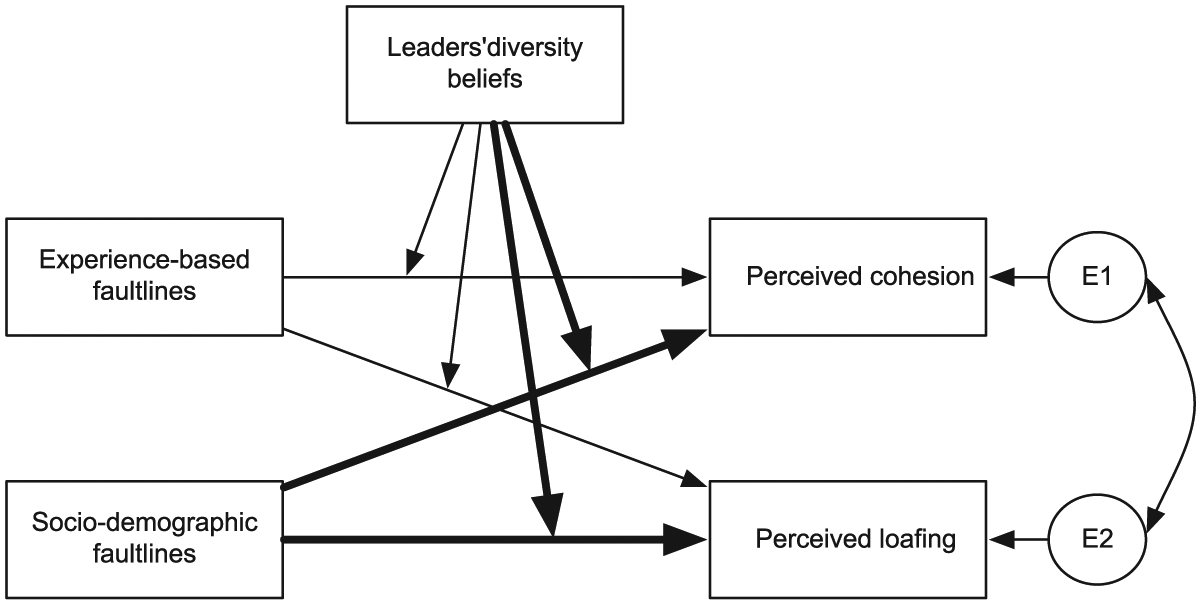
Proposed research model.
Impact of Experience-Based and Socio-Demographic Faultlines
The effects of faultlines depend on the attribute combinations used for faultline calculation (e.g., Bezrukova, Jehn, Zanutto, & Thatcher, 2009; Carton & Cummings, 2013; Choi & Sy, 2010; Molleman, 2005; van Knippenberg, Dawson, West, & Homan, 2011). However, there is limited consensus regarding the attribute combinations that are relevant for specific aspects of team functioning and magnitude differences in the effects of different faultline types (Bezrukova et al., 2009; Thatcher & Patel, 2012). The theory of subgroups (Carton & Cummings, 2012) may provide a first remedy in this regard. It distinguishes between the consequences of faultlines that result in identity-based subgroups, which differ in values or demographic attributes essential for social identity, and faultlines that create knowledge-based subgroups, which differ in information processing or mental models of task-related constructs. Each subgroup type is associated with specific inter-subgroup processes. To better understand the impact of specific faultline types on team functioning, we aim to examine the effects of two faultline types simultaneously. For the sake of comparability, we focus on faultlines and subgroup types that have already been examined in previous research (e.g., Bezrukova et al., 2009; Carton & Cummings, 2013).
In our research, experience-based faultlines yield knowledge-based subgroups by taking into account members’ education level and team tenure. These attributes are not necessarily salient (i.e., it is hard to guess a person’s education level or team tenure by merely looking at them). They are, however, directly related to a team’s task and may shape members’ approaches to specific problems. Members of teams with subgroups based on education level and team tenure may have communication problems across subgroups due to incompatible mental models that lead to different working styles (Carton & Cummings, 2012). In contrast, socio-demographic faultlines create identity-based subgroups by considering the alignment of team members’ gender and age. Gender and age are relevant in the team context because they influence members’ perceptions and behaviors through categorizations or stereotypes (Messick & Mackie, 1989). They are likely to covary with differences in values, beliefs, attitudes, and social ties (Kearney & Gebert, 2009). Because gender and age are highly salient, faultlines based on these attributes are more likely to be activated and create intergroup bias than faultlines based on education level and team tenure. Intergroup bias may turn into in-group favoritism and out-group hostility and impair team functioning. Despite the fact that we expect a negative impact of both faultline types on team functioning moderated by leaders’ diversity beliefs (see Hypotheses 1-3), we assume that the impact of socio-demographic faultlines is stronger (see Hypothesis 4). The development of our hypotheses will thus be guided by the following research question:
Different Faultline Types and Perceived Cohesion
We first turn to perceived cohesion as an indicator of team functioning. Cohesion is closely linked to interpersonal attraction and depends on the extent to which members of a team are similar to one another (Hogg, 1992). It immediately indicates disturbances in team functioning, for instance due to intergroup bias. The theory of subgroups states cohesion as one of the main team outcomes that is influenced by inter-subgroup processes elicited by strong faultlines (Carton & Cummings, 2012). According to the theory, strong faultlines are related to low team cohesion because intergroup biases negatively influence members’ affective-evaluative reactions toward members of other subgroups. Integrating the findings of 16 studies on faultlines and cohesion, a meta-analysis provided a firm empirical base for the negative impact of faultline strength on team cohesion (Thatcher & Patel, 2011).
We assume a negative relationship between experience-based faultlines and perceived cohesion. According to the theory of subgroups, this faultline type yields knowledge-based subgroups, which may not only enhance the consideration of alternative knowledge resources but also inhibit the convergence of mental models within a team (Carton & Cummings, 2012). When subgroups emerge based on education level and team tenure, their members are likely to differ in their mental models, ways of information processing, and interpretation of problems. Members of a subgroup who share the same education level and work in the team since several years may have adopted the same ways of working, shared norms, and similar values. In contrast, members of another subgroup who share a different education level and just began to work in the team may prefer to carry out tasks in a different way and hold different values. Members of both subgroups may thus not perceive many similarities across subgroups. We argue that because cohesion is closely linked to the perception of similarities, members of teams with strong experience-based faultlines are less likely to identify with the team as a whole and perceive lower levels of cohesion.
Next, we propose that socio-demographic faultlines are also negatively related to perceived cohesion. The theory of subgroups postulates that strong socio-demographic faultlines create identity-based subgroups, which may trigger inter-subgroup processes such as threats to the subgroups’ identities or fragmentation of the teams’ identity (Carton & Cummings, 2012). Identity threats are subtle cues that indicate less favorable treatment of team members simply because of their subgroup membership (Chrobot-Mason, Ruderman, Weber, & Ernst, 2009). They may be elicited by competition for status and prestige or discrimination within the team (van Knippenberg, De Dreu, & Homan, 2004). Because gender and age are highly salient in the team context and associated with stereotypic beliefs (Fiske, 1998), the negative impact of socio-demographic faultlines may exceed that of experience-based faultlines. The differences between subgroups are likely to hamper interactions on an informal basis and make it more difficult for members to consider members of other subgroups as members of the same collective entity that they belong to. Consequently, the likelihood that members of different subgroups feel like they are a part of the entire team decreases (Carton & Cummings, 2012).
Different Faultline Types and Perceived Loafing
So far, we argued that experience-based and socio-demographic faultlines are negatively related to perceived cohesion. Next, we outline why we believe that these faultline types also influence the motivation of team members to go the extra mile for their team. Early research showed that individuals pulling a rope in a team exhibited a smaller individual pulling force than they did when pulling the rope alone (Ringelmann, 1913, as cited in Kravitz & Martin, 1986). Whereas Ringelmann attributed this phenomenon mainly to coordination losses, researchers later focused more on the motivational aspects of the reduced effort, also called social loafing (Kerr, 1983; Latané, Williams, & Harkins, 1979; Liden, Wayne, Jaworski, & Bennett, 2004). Social loafing has a negative impact on performance (Ellis, Mai, & Christian, 2013; Karau, 2012). It is a particularly relevant phenomenon today because the spread of electronic workplaces and the increased importance of knowledge work and team-based structures provide new ways for team members to loaf (Kidwell, 2010). A recent study showed that strong faultlines based on gender, age, and educational background were related to increases in team members’ loafing behavior if they were part of a larger subgroup and had low levels of social competence (Meyer et al., 2016). However, the effects of different faultline types on social loafing were not considered until now.
We turn to the collective effort model (Karau & Williams, 1993) to explain the relationships between different faultline types and perceived loafing. The model provides a framework for the motivation of individuals in a collective setting. It states that the team members’ willingness to exert effort on a collective task depends on several conditions: Members must be convinced of the fact that their performance relates to the team’s performance and that favorable team outcomes are related to favorable individual outcomes.
As argued above, strong experience-based faultlines elicit knowledge-based subgroups, which are likely to impair the convergence of mental models in the overall team (Carton & Cummings, 2012). Members of subgroups that differ in the combination of education level and team tenure may thus have different ways of approaching problems and differ in their norms and values. When experience-based faultlines are strong, members of one subgroup may be less convinced that their individual performance is important for the overall team’s performance. An important condition for members’ willingness to exhibit high effort is thus unfulfilled (Karau & Williams, 1993) and these members are likely to be less motivated to contribute toward the team’s task. Moreover, members of one subgroup that differs in education level and team tenure from others may fear that members of the other subgroup reject their ideas, and are thus reluctant to fully contribute toward the team’s task. The overall perception of loafing in a team will be even stronger when members perceive that members of other subgroups withdraw effort, and choose to lower their efforts to avoid exploitation (Comer, 1995; Liden et al., 2004; Mulvey & Klein, 1998). Consequently, we assume that in teams with strong experience-based faultlines, members perceive high levels of loafing.
According to the theory of subgroups, identity-based subgroups are likely to emerge in teams with strong socio-demographic faultlines (Carton & Cummings, 2012). This subgroup type elicits inter-subgroup processes such as identity threat or identity fragmentation, which may decrease the overall group valence. When group valence is high, the team context provides an important source of information relevant to team members’ self-evaluation (Karau & Williams, 1993). In these teams, favorable team outcomes are closely linked to favorable individual outcomes. In contrast, when group valence is low, members perceive a weaker relationship between favorable team outcomes and their individual outcomes. The second precondition for individuals’ willingness to exert strong effort in collective tasks is thus violated (Karau & Williams, 1993). Team members are likely to lower their effort because they do not consider it as useful to avoid negative individual outcomes. Because gender and age are visible at first sight, these processes are particularly likely to be activated and impair group valence in teams with strong socio-demographic faultlines. As stated above, the overall perception of low effort or strong social loafing within a team will be amplified when members additionally lower their efforts to avoid exploitation. Therefore, we expect a positive relationship between socio-demographic faultline strength and levels of perceived loafing.
The Moderating Impact of Leaders’ Diversity Beliefs
To explain why two teams with the same combination of members’ attributes can differ in the extent of perceived cohesion and loafing, we focus on a specific component of leaders’ attitudes toward diversity—diversity beliefs. Diversity beliefs refer to the cognitive component of a person’s attitude toward diversity and describe “the extent to which individuals perceive diversity to be beneficial for or detrimental to the group’s functioning” (van Dick, van Knippenberg, Hägele, Guillaume, & Brodbeck, 2008, p. 1467). Based on stereotypes, expectations, or prior experiences, some leaders have strong diversity beliefs (i.e., they are convinced that diversity is associated with a larger pool of knowledge and perspectives that is beneficial for team functioning), whereas others have weak diversity beliefs (i.e., they prefer to work with a team that consists of members with similar attributes; van Knippenberg, Haslam, & Platow, 2007).
Strong faultlines are most likely to elicit social categorization processes and intergroup bias when identity threat occurs within the team. Identity threat can also be operationalized as weak diversity beliefs held by team leaders (Homan et al., 2007; Meyer, in press). More specifically, weak diversity beliefs may evoke leaders’ categorization tendencies—the tendency to see the teams’ diversity in terms of subgroups rather than individual differences (Greer, Homan, De Hoogh, & Den Hartog, 2012; Homan, Greer, Jehn, & Koning, 2010). Strong categorization tendencies increase intergroup bias because they encourage leaders to treat team members in terms of subgroups. We argue that strong diversity beliefs held by team leaders can mitigate the negative impact of both experience-based and socio-demographic faultlines because they reduce the occurrence of intergroup bias. Leaders with strong diversity beliefs encourage interactions and the exchange of information between members of different subgroups, and thus support the convergence of mental models. Moreover, they avoid to treat members based on their subgroup membership. Instead, they appreciate individual differences and treat members based on their membership in the overall team, which can help members of all subgroups to feel connected to the team (Meeussen, Otten, & Phalet, 2014). When leaders hold strong diversity beliefs, members will thus be less likely to perceive subgroups despite strong experience-based or socio-demographic faultlines and team functioning will be less impaired (Homan & Jehn, 2010). These leaders may prevent the occurrence of identity threat, identity fragmentation, and faultline activation and facilitate the perception of an overall team identity. We thus postulate that leaders with strong diversity beliefs can mitigate the negative impact of experience-based and socio-demographic faultlines on perceived cohesion.
In contrast, leaders with weak diversity beliefs may, for instance, take one subgroup’s side in a conflict, meet with subgroups separately, or allocate tasks and resources to the detriment of one or more subgroups. Differential treatment of subgroups is likely to elicit perceptions of identity threat. In addition, it is one of the main triggers that activate dormant faultlines (Chrobot-Mason et al., 2009). The negative impact of faultlines on team functioning is stronger when faultlines are active (Thatcher & Patel, 2012). Therefore, we argue that if leaders do not value diversity, they are likely to treat subgroups differently, create cues that indicate identity threat, and thus reinforce the detrimental impact of experience-based or socio-demographic faultlines on team functioning.
Several studies in the diversity literature provide support for the impact of members’ diversity beliefs on the relationship between diversity and team identification (Hentschel, Shemla, Wegge, & Kearney, 2013; van Dick et al., 2008; van Knippenberg et al., 2007) and for the effect of leaders’ categorization tendencies or diversity beliefs on the consequences of diversity in general (Greer et al., 2012; Grütter & Meyer, 2014; Meeussen et al., 2014). In addition, faultline research yields results regarding the impact of members’ diversity beliefs on different consequences of faultlines (Homan et al., 2010; Homan et al., 2007; Meyer & Schermuly, 2012). The moderating impact of leaders’ diversity beliefs, however, has not been considered in the faultline literature so far.
We further assume that strong diversity beliefs held by team leaders can attenuate the impact of experience-based and socio-demographic faultlines on perceived loafing. Leaders with strong diversity beliefs may often emphasize that diversity is beneficial to solve the team’s tasks. They may particularly call for members’ different perspectives and stress the fact that the team can only succeed when every member contributes toward the team’s goal. Even when experience-based faultlines are strong, all members may thus be convinced that their individual effort and performance is important for the team’s performance, which increases their motivation. Moreover, leaders with strong diversity beliefs try not to treat team members in terms of subgroups, which makes faultline activation less likely (Homan et al., 2010). Consequently, members of different subgroups based on strong socio-demographic faultlines will be more likely to perceive a high overall group valence. The team context is thus an important source of information relevant to team members’ self-evaluation (Karau & Williams, 1993). In these teams, members are likely to perceive a link between team outcomes and individual outcomes. Despite strong socio-demographic faultlines, they may thus be more willing to exert effort toward a favorable team outcome. In consequence, we postulate that strong diversity beliefs held by team leaders attenuate the detrimental effects of both faultline types on perceived loafing.
Differences in the Effects of Experience-Based and Socio-Demographic Faultlines
The faultline literature distinguishes between dormant and active faultlines. Whereas dormant faultlines are potential faultlines that are not necessarily perceived by team members, active faultlines exist when team members are aware of the subgroups based on diversity attributes within their team (Jehn & Bezrukova, 2010). Research showed that the presence of faultlines impacts team functioning even if they are not activated (Chrobot-Mason et al., 2009). Nevertheless, their impact on team functioning is stronger when they are activated and actually perceived by team members (Jehn & Bezrukova, 2010). In contrast to education level and team tenure, gender and age are highly salient attributes that are associated with widely shared stereotypic beliefs (Fiske, 1998). Faultlines based on these attributes are more likely to be activated and create intergroup bias, which turns into in-group favoritism and out-group hostility and impairs team functioning. We thus expect socio-demographic faultlines to be stronger related to perceived cohesion and loafing than experience-based faultlines.
We further argue that the moderating effect of leaders’ diversity beliefs is stronger for socio-demographic than for experience-based faultlines. Due to high salience, faultlines that yield identity-based subgroups are more likely to be activated and are prone to elicit identity threat within the team (Carton & Cummings, 2012). Therefore, additional identity threat and activation potential related to weak leaders’ diversity beliefs would particularly aggravate the negative impact of socio-demographic faultlines.
Method
Procedure and Sample
Between March and August 2014, the first author recruited participants from her network of contacts and social networks for business professionals (e.g., LinkedIn) in Germany. In addition, students working on their bachelor thesis and an empirical research project supported the recruitment during this period under the supervision of the first author. We contacted team leaders via email or phone with requests containing information about a survey on collaboration in teams, conducted by a German university. We asked team leaders to complete an online or paper–pencil questionnaire and to subsequently distribute separate questionnaires to their team members. In total, we sent out 202 online questionnaire links and 50 versions of the paper–pencil questionnaire to leaders of different teams.
Eventually, 80 team leaders (response rate = 32%) and 276 team members completed the questionnaire. We wanted to ensure that team members had been working together for a considerable amount of time and were not working independently from each other. Therefore, we excluded teams that indicated that they worked together in their current composition for less than 3 months or reported that members did not have to collaborate at all to complete their tasks. In addition, we excluded teams that did not provide sufficient information to calculate faultline strength. Corresponding to the standard in current team research to obtain valid measures of team-level constructs (Kunze & Bruch, 2010; Leslie, 2014; Ries, Diestel, Wegge, & Schmidt, 2010), we also excluded teams with less than three participating members.
The final data set included responses of 44 team leaders and 217 team members. Twenty-six teams completed the online version and 18 teams completed the paper–pencil version of the questionnaire. Average team size was 6.50 members (SD = 2.78 members). Seventy-six percent of the teams worked in small to medium-sized businesses (up to 249 employees), 7% in large businesses (250-999 employees), and 17% in large enterprises (1,000 or more employees). The main industry sectors included crafts and trades (20%), food service industry (16%), health care (14%), industry (9%), and consulting (5%). The most frequently indicated main functional areas were services (34%), medical care (14%), human resources and training (9%), and manufacturing (7%).
Thirty-six percent of the team leaders were female and the mean age was 46.20 years (SD = 10.59 years). Each team leader provided demographic information of all members of his or her team (n = 286). Sixty-two percent of the team members were female (n = 176) and the average age was 37.50 years (SD = 12.16 years). Thirty-six percent had a university degree, 17% a high school diploma (12 years of schooling), 29% a higher secondary school degree (10 years of schooling), 17% a lower secondary school degree (9 years of schooling), and 1% did not complete any educational degree. The average team tenure was 6.18 years (SD = 7.53 years).
Measures
As stated above, team leaders provided demographic attributes of all members and rated their own diversity beliefs while team members rated perceived cohesion and perceived loafing. All items were presented in German and rated on a 5-point Likert-type scale ranging from 1 = not true at all to 5 = very true.
Faultline strength
We determined faultline strength using the average silhouette width (ASW) measure, a cluster-based approach that sorts team members into subgroups according to their similarity to obtain subgroups with maximum internal homogeneity and maximum between-subgroup heterogeneity (Meyer & Glenz, 2013). It is designed to work with small and large teams and with categorical and continuous data alike. In a comparison of several faultline measures, ASW had the most favorable attributes and accurately determined subgroup membership in the presence of more than two subgroups (Meyer & Glenz, 2013; Meyer, Glenz, Antino, Rico, & Gonzalez-Roma, 2014). An ASW value of 1 indicates a strong faultline, separating a team into two or more homogeneous subgroups based on perfect alignment of attributes. A value of 0 indicates that no faultline exists, either due to no variation in attributes or extreme variation so that attributes do not align at all. We scaled continuous attributes (i.e., age and tenure) by their standard deviation. Categorical attributes (i.e., gender and education level) were dummy coded and multiplied by 1 / √2 to make differences in categorical attributes comparable with those in continuous attributes (Thatcher, Jehn, & Zanutto, 2003).
Perceived cohesion
To measure perceived cohesion, we used six items of the Perceived Cohesion Scale (Podsakoff, Niehoff, MacKenzie, & Williams, 1993). Three researchers independently translated the items into German and resolved differences in discussions. An item example is, “Members of my group work together as a team.” The items yielded a good internal consistency (α = .87). 1
Perceived loafing
We adapted eight items to measure perceived loafing (George, 1992; Vogt, 2004). The scale had originally been developed for employees in the sales context. We modified the wording and deleted two items because they specifically referred to tasks completed by salespeople. An example item is “Some team members defer responsibilities they should assume to other members.” Items yielded an excellent internal consistency (α = .92).
To test whether perceived cohesion and loafing could be treated as distinctive constructs in this data set, we conducted confirmatory factor analyses (CFAs) on the team level. As in the preliminary study (Note 1), the two-factor model (χ2 = 116.55, df = 76, p < .01; confirmatory fit index [CFI] = .93, root mean square error of approximation [RMSEA] = .11, standardized root mean square residual [SRMR] = .07) fitted the data better than the one-factor model (χ2 = 177.16, df = 77, p < .01; CFI = .84, RMSEA = .17, SRMR = .08, Δχ2 = 60.61, p < .01).
Leaders’ diversity beliefs
We used five items to assess leaders’ diversity beliefs (Meyer & Schermuly, 2012; van Dick et al., 2008). Item examples are “In a work group like this, diversity is a great benefit” or “The more people that differ from each other in a group like this, the better for the group.” The scale yielded an acceptable internal consistency (α = .75).
Control variables
Several other variables may influence the relationships postulated above. First of all, team size is positively related to social loafing (Karau & Williams, 1993) and was thus controlled for in our analyses. Moreover, the impact of faultlines depends on the number of subgroups that they create (Carton & Cummings, 2012). Therefore, we controlled for the number of subgroups created by experience-based and socio-demographic faultlines. To observe the unique impact of faultlines as opposed to traditional diversity measures, we controlled for diversity effects of all attributes used for faultline calculation (Lau & Murnighan, 2005). Consistent with previous faultline research (Homan et al., 2008; Spell, Bezrukova, Haar, & Spell, 2011), we used Blau’s (1977) index as an indicator for heterogeneity in gender and education level and the group-wise standard deviation as an indicator for heterogeneity in age and team tenure. We standardized and averaged heterogeneity in education level and team tenure to create the control variable for experience-based heterogeneity. In the same way, we standardized and averaged heterogeneity in gender and age to create the control variable for socio-demographic heterogeneity.
Results
We used the open-source statistical environment R (R Core Team, 2014) for our statistical analyses. Table 1 displays means, standard deviations, correlation coefficients, and internal consistencies for all measures on the team level. In line with our assumptions, both faultline types were negatively correlated with perceived cohesion and positively correlated with perceived loafing. We conducted one-way ANOVAs for all variables to check for differences between teams that completed the online questionnaire or the paper–pencil version. We found no such differences and, therefore, report results of the complete sample.
Descriptive Statistics, Pearson’s Correlations, and Internal Consistency Values for All Variables (n = 44).

Note. Internal consistency values (Cronbach’s αs) appear across the diagonal in parentheses. exp = experience-based; dem = socio-demographic.
p < .05. **p < .01. ***p < .001.
Subsequently, we examined the intraclass correlations (ICCs) and interrater agreements (rwg) of perceived cohesion and perceived loafing to assess whether an aggregation of individual responses on the team level was justified (Klein & Kozlowski, 2000). ICC(1) values indicate an estimate of the amount of total variance of a measure that is explained by group membership, while ICC(2) values indicate the reliability of the group means (Bliese, 2000). ICC(1) values should not fall below .12 (James, 1982) and ICC(2) values should exceed .60 (Glick, 1985). Our indicators of team functioning corresponded to these criteria, ICC(1): perceived cohesion = .36, perceived loafing = .35; ICC(2): perceived cohesion = .74, perceived loafing = .72. The extent of agreement among members of the same team is indicated by rwg values (Klein & Kozlowski, 2000). The average rwg values of our measures were above the standard cutoff of .70 (perceived cohesion = .92, perceived loafing = .90). In sum, these results justified data aggregation to the team level.
Hypothesis Testing
We tested all hypotheses in a single path model using the R package lavaan (Rosseel, 2012). This approach enabled us to simultaneously examine the direct effects of two faultline types on perceived cohesion and loafing as well as the moderating effects of leaders’ diversity beliefs. Moreover, by this means we were able to control for common method variance by allowing for the correlation of the error terms of perceived cohesion and loafing in our model (Shaver, 2005). The path-analytic results of the proposed research model are presented in Table 2. We report the standardized path coefficients. H1a assumed a negative relationship between experience-based faultline strength and perceived cohesion. Our data did not provide support for this assumption (b = −.08, p > .05). In H1b, we proposed a negative relationship between socio-demographic faultline strength and perceived cohesion. This was supported by our results (b = −.39, p < .01). H2a postulated a positive relationship between experience-based faultlines and perceived loafing. We did not find evidence for this assumption (b = .24, p > .05). In line with H2b, the relationship between socio-demographic faultline strength and perceived loafing was positive (b = .34, p < .01).
Path-Analytic Results of the Proposed Research Model (n = 44).

Note. exp = experience-based; dem = socio-demographic; FS = faultline strength; LDB = leaders’ diversity beliefs.
p < .05. **p < .01. ***p < .001.
Next, we examined the moderating impact of leaders’ diversity beliefs. H3a stated that the relationship between experience-based faultlines and cohesion is contingent on leaders’ diversity beliefs. Contrary to H3a, we did not find an interaction between experience-based faultline strength and leaders’ diversity beliefs on perceived cohesion (b = −.20, p > .05). As postulated in H3b, leaders’ diversity beliefs did, however, moderate the relationship between socio-demographic faultlines and perceived cohesion (b = .42, p < .001). In line with our expectations, strong leaders’ diversity beliefs attenuated the negative relationship between socio-demographic faultlines and perceived cohesion (see Figure 2). We further assumed leaders’ diversity beliefs to moderate the relationship between experience-based faultline strength and perceived loafing. We found no support for this idea (b = .20, p > .05) and rejected H3c. In support of H3d, our data showed an interaction effect of socio-demographic faultline strength and leaders’ diversity beliefs on perceived loafing (b = −.39, p < .001). As expected, team members perceived less loafing in teams with strong socio-demographic faultlines when leaders held strong diversity beliefs (see Figure 3). Subsequently, we compared the magnitude of the faultline types’ effects. As predicted in H4, our findings revealed that socio-demographic faultline strength had a stronger effect than experience-based faultline strength on both perceived cohesion and loafing. Moreover, our data showed the moderating effect of leaders’ diversity beliefs only for socio-demographic faultlines.
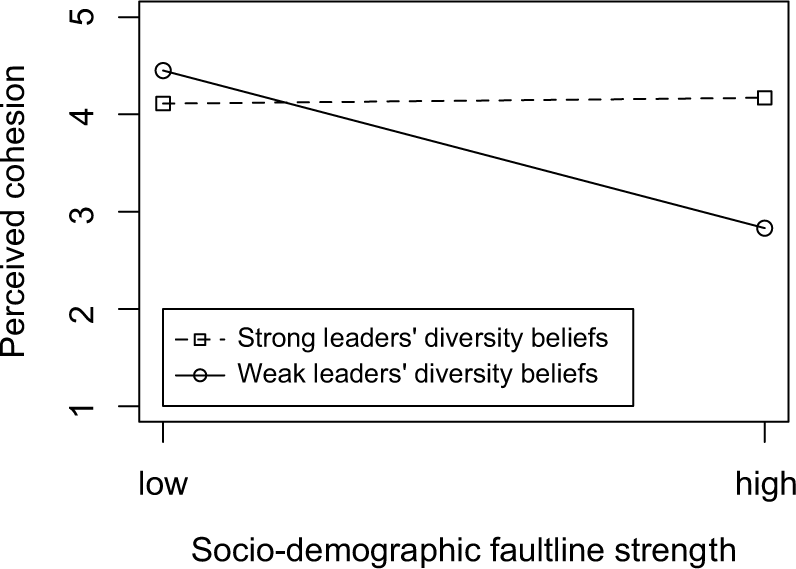
Perceived cohesion as a function of socio-demographic faultline strength and leaders’ diversity beliefs.
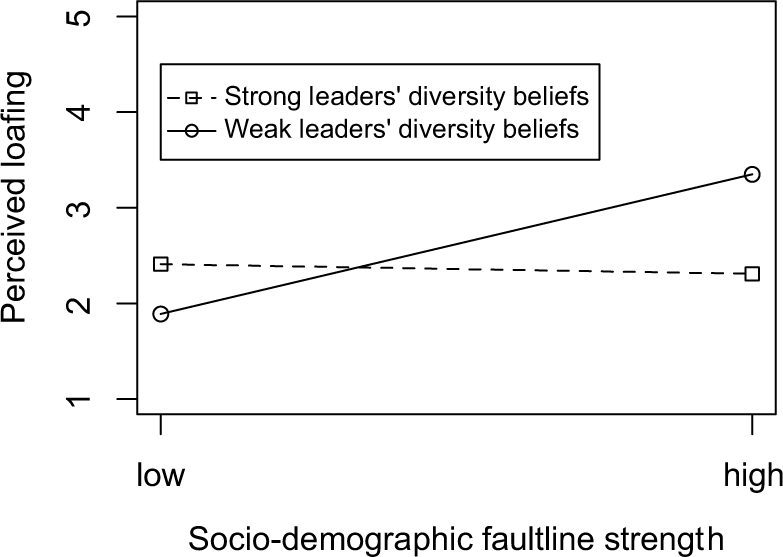
Perceived loafing as a function of socio-demographic faultline strength and leaders’ diversity beliefs.
The proposed research model explained 50% in the variance of perceived cohesion and 52% in the variance of perceived loafing. The covariance between perceived cohesion and loafing was −.59 (p < .001). However, because the model was just identified, we were not able to assess its fit (χ2 = 0.00, df = 0, p < .001, CFI = 1.00, RMSEA = .00, SRMR = .00). Results showed that experience-based faultlines were not related to perceived cohesion. Moreover, their interaction with leaders’ diversity beliefs was related neither to perceived cohesion nor to loafing. We thus modified the proposed research model by deleting these paths and removing the respective control variables (i.e., heterogeneity and number of subgroups for experience-based faultlines; see Figure 4). The revised research model fitted the data well (χ2 = 3.04, df = 3, p = .39, CFI = 1.00, RMSEA = .02, SRMR = .02). In this model, experience-based faultlines were positively related to perceived loafing (b = .23, p < .05), thus providing partial support for H2a. Other than that, there were no differences regarding the results of our hypotheses tests between the proposed and the revised research model. The revised model explained 43% of the variance in perceived cohesion and 45% of the variance in perceived loafing. The covariance between perceived cohesion and loafing was −.62 (p < .001).
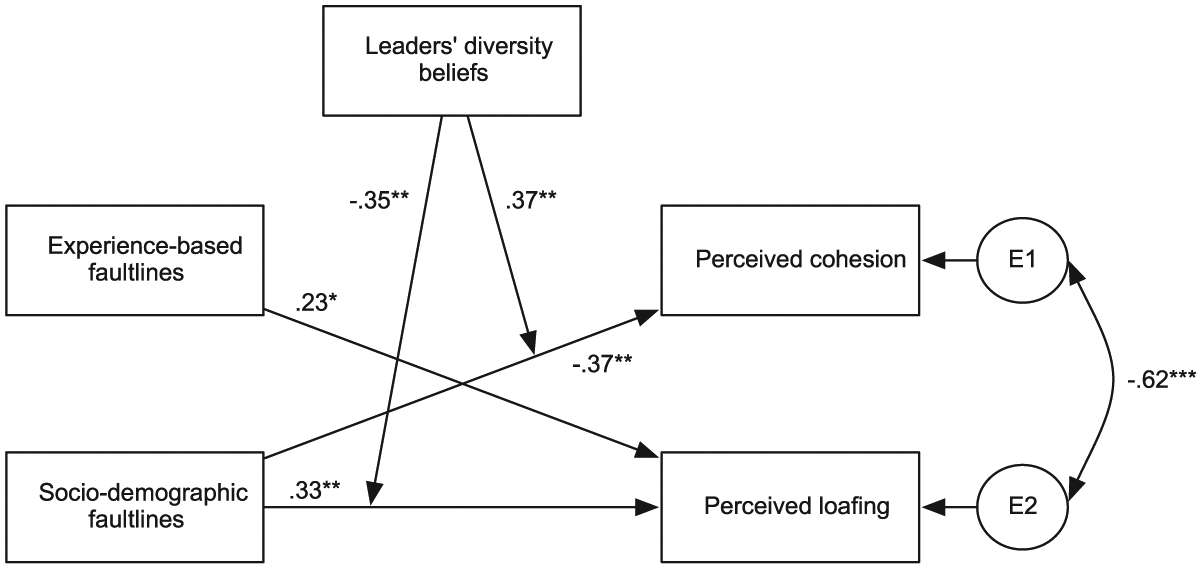
Revised research model.
Discussion
In a multisource field sample, we compared the impact of two of the most prevalent faultline types (i.e., experience-based and socio-demographic faultlines) in interaction with leaders’ diversity beliefs on perceived cohesion and loafing. Results of a path-analytic model showed that the detrimental impact of socio-demographic faultlines on perceived cohesion and loafing was mitigated when leaders had strong diversity beliefs. Experience-based faultlines were positively related to perceived loafing, but we found no evidence for their postulated impact on perceived cohesion or their interaction with leaders’ diversity beliefs.
Theoretical Implications
Perhaps the most important result of our research is that we found support for the assumption that the impact of socio-demographic faultlines on team functioning is less detrimental when team leaders hold strong diversity beliefs. Results of the present study add to the knowledge regarding the attenuating effect of diversity beliefs in the faultline literature, this time by focusing on team leaders rather than members. In teams with strong socio-demographic faultlines, members reported higher levels of cohesion when leaders had strong diversity beliefs. This may be due to the fact that leaders with strong diversity beliefs do not treat their team members in terms of subgroups, and thus reduce the chances of faultline activation and identity threat or fragmentation. In addition, members perceived less loafing when socio-demographic faultlines were strong and leaders held positive diversity beliefs. As leaders may have emphasized the importance of each member’s contribution and the value of diversity in these teams, members perceived a stronger link between team outcomes and individual outcomes despite strong faultlines. Consequentially, they may have been less likely to withdraw effort and to perceive effort withdrawal by other members. From this point, it would be interesting to find out more about the determinants of weak or strong leaders’ diversity beliefs in teams with strong socio-demographic faultlines and how leaders’ beliefs are related to team members’ beliefs. Including team leaders in the faultline calculation may yield important insights in this regard (Meyer, Shemla, Li, & Wegge, 2015). Perhaps leaders share their diversity beliefs more with members of the subgroup that they are part of than with members of other subgroups. It would also be interesting to analyze whether leaders’ diversity beliefs impact the relationship between faultlines and team functioning differently depending on which subgroup the leader is included in.
The current study further refines the view on the impact of faultlines on team functioning by distinguishing between experience-based and socio-demographic faultlines. This distinction may enable researchers to examine more specific mediating and moderating variables of the impact of faultlines on team functioning. As expected, socio-demographic faultlines were negatively related to perceived cohesion and positively related to perceived loafing. In line with the theory of subgroups, these findings support the idea that socio-demographic faultlines elicit identity-based subgroups, which enhance processes such as identity threat and fragmentation, and thus have a detrimental impact on team functioning (Carton & Cummings, 2012). Corresponding to our assumptions, socio-demographic faultlines had a stronger impact on team functioning than experience-based faultlines. This may be due to the fact that in contrast to attributes included in experience-based faultlines, the attributes used to calculate socio-demographic faultlines are highly salient and faultline activation is thus more likely.
Contrary to our expectations, experience-based faultlines were not related to perceived cohesion and this relationship was not contingent on leaders’ diversity beliefs. These results may be explained by the fact that both attributes used for determining experience-based faultline strength—team tenure and education level—are not visible at first glance. Consequently, they may be less likely to result in activated faultlines and have a smaller impact on subgroup formation than the alignment of socio-demographic attributes. Whereas subgroups based on socio-demographic faultlines emerge immediately and influence the social relations between team members, it may be less relevant for individuals to find out later that other members of their subgroup differ from them in education level or team tenure. Moreover, team tenure is restricted in teams that have been working together for a few months only. In these teams, experience-based faultline strength will depend mostly on the members’ education level. To avoid the dominance of a single attribute, future studies may thus consider more than two different attributes to calculate experience-based faultline strength. Our results are similar to those of Molleman (2005), who only found a negative impact of ability-based faultlines on cohesion when team autonomy was high. Subgroups created by experience-based faultlines may thus impact perceived cohesion only under conditions other than leaders’ diversity beliefs. An interesting starting point may be the consideration of the number and variation of subgroup size. The theory of subgroups predicts that for knowledge-based subgroups, the convergence of mental models is least likely when the number of subgroups is high and the variation in subgroup size is low (Carton & Cummings, 2012). Exploring these boundary conditions could be a worthwhile focus for future research.
Based on our data, we found partial support for the impact of experience-based faultlines on perceived loafing. This relationship reached a significant level only in the revised research model and was not contingent on leaders’ diversity beliefs. We thus cannot draw a stable conclusion of whether strong experience-based faultlines lower the chances that members of certain subgroups perceive a weaker link between their individual performance and the team’s overall performance, which is likely to increase the levels of perceived loafing. Future research may replicate and particularly focus on processes that drive this relationship. For instance, information elaboration may be interesting in this regard. It refers to the exchange and processing of information (van Knippenberg et al., 2004). We would expect that strong experience-based faultlines have a specific detrimental impact on information elaboration on the team level. In a similar vein, the level of transactive memory within the team may also be an important driver of the impact of experience-based faultlines on perceived loafing. Team members need to know who knows what for effective functioning and performance (van Knippenberg, van Ginkel, & Homan, 2013). When experience-based faultlines are strong, the chasms within subgroups may hinder interactions between team members in which they learn about one another’s expertise roles. We would thus assume a negative relationship between faultlines and the level of a team’s transactive memory.
Practical Implications
Our findings showed that socio-demographic faultlines have detrimental effects on team functioning, which are mitigated by strong leaders’ diversity beliefs. Organizations can foster strong diversity beliefs among their leaders by means of personnel selection and development. Within the scope of personnel selection, organizations may attract future leaders with strong diversity beliefs by publicly emphasizing the value of diversity and considering diversity beliefs, stereotypes, and expectations in their selection procedure. As part of their personnel development efforts, organizations can offer specific coaching or training programs that focus on stereotypes and expectations. These programs may encourage leaders to reflect their personal diversity beliefs and to adapt them accordingly.
Besides strong leaders’ diversity beliefs, other factors may affect the consequences of socio-demographic faultlines as well. To begin with, members’ diversity beliefs also have the potential to counteract the negative impact of faultlines (Homan et al., 2010; Homan et al., 2007). Leaders should thus encourage their team members to reflect and enhance their diversity beliefs. Moreover, establishing shared norms, focusing on objectives that are important for the team as a whole, or establishing trust between team members can increase team cohesion (Podsakoff et al., 1993). Team coaching or development focusing on diversity beliefs, a shared identity, and trust may be a worthwhile approach in this regard.
The knowledge about faultlines may encourage organizations to change their teams’ compositions and create homogeneous teams. We believe that this option should be considered with caution. Not only would it limit organizations in their effort to select the most qualified employees for a specific task, it would also prevent teams from benefiting from their members’ various experiences, perspectives, and task-relevant informational resources (Pieterse, van Knippenberg, & van Dierendonck, 2013). A better option would be to manage faultlines when they are present (van Knippenberg et al., 2011). If organizations can choose between several qualified employees, however, they may select the person whose attributes do not particularly align with those of the present team members to create an option of crosscutting potentially dividing faultlines (Molleman, 2005).
Limitations
Our research was not without limitations. One may argue that the measures of perceived cohesion and loafing can be confounded due to common method variance. We thus verified the distinction of both variables in CFAs in the preliminary and main study. Moreover, we allowed the error terms of both variables to correlate in our research model (Shaver, 2005). Common method variance thus did not seem to be a severe issue in our analyses.
Second, our measures of perceived cohesion and loafing related to the team level only. Both variables may, however, be perceived differently on the subgroup level. In teams with strong faultlines, members may perceive high cohesion and low loafing on the subgroup level. To control for this effect, we included team size and the number of subgroups into our models. A different option, however, would be to examine perceived cohesion and loafing both on the subgroup and the team level. On the individual level, it would further be worthwhile to distinguish between effort withdrawal due to low motivation, and effort withdrawal due to lack of relevant information.
Third, our findings are based on data from a convenient sample (i.e., teams from different organizations that were willing to participate). Controlling for all relevant influences in such a sample is difficult if not impossible. For instance, we do not know whether our conclusions also pertain to teams that were not willing to participate. Future research may thus replicate our findings in teams working in the same organization or in an experimental setting.
Moreover, our findings acknowledge that faultlines differ in their effects on team functioning depending on the combination of attributes considered for faultline calculation. However, researchers often do not verify whether they made the correct choice of attribute combination for faultline calculation. Future research may thus focus on determining which combination of attributes is most meaningful or relevant for teams in a specific context. We believe that the specification of the appropriate set of faultline attributes is one of the biggest challenges that faultline research faces at the moment.
Adding to the problem stated above, there is no clear consensus regarding the optimal weighting of diversity attributes when calculating faultline strength. Despite existing recommendations (Bezrukova et al., 2009), it seems logical that perceived distances between team members are not always well reflected by the standard deviation of continuous attributes or the distance between categories of categorical attributes. More specifically, team members with a university degree might perceive less distance toward members with a high school diploma than toward members with a lower secondary school degree. The nature of attributes further enhances the possibility that some attributes influence faultline strength more than others (van Knippenberg et al., 2011). A variable with two categories (e.g., gender) is more likely to result in strong faultlines than a continuous variable (e.g., age). Future research should thus aim to clarify the perceived distances between different attribute levels and their specific influence on faultline strength.
Conclusion
We combined research on faultlines and social loafing to answer the question of why diverse teams sometimes do not fully benefit from their members’ different perspectives and experiences, and consequently do not achieve their full potential. Our results suggest that teams with strong socio-demographic faultlines are less likely to achieve their full potential, because team members of different subgroups do not feel as a part of the entire team and consequently are not motivated to expend great effort on the team’s task. In addition, we found that the detrimental impact of socio-demographic faultlines on perceived cohesion and loafing was mitigated when leaders held strong diversity beliefs. Strengthening leaders’ diversity beliefs may thus increase the benefit of members’ different perspectives.
We found partial support for the positive relationship between experience-based faultlines and perceived loafing. Further research, however, is needed to identify relevant mediator and moderator variables of this relationship. We mean to encourage future studies that focus on the intersection of research on faultlines and social loafing. Moreover, we hope that our results are helpful to enhance efforts of effective faultline management in organizations.
Footnotes
Declaration of Conflicting Interests
The author(s) declared no potential conflicts of interest with respect to the research, authorship, and/or publication of this article.
Funding
The author(s) received no financial support for the research, authorship, and/or publication of this article.