



Abstract
This article introduces and conceptually underpins an instrument to measure group functioning in child care groups, the Group Functioning Instrument for Child Care (GFI-CC). This instrument was applied in 44 Dutch child care groups (0- to 4-year-olds). The results of this first explorative investigation with the GFI-CC provided initial support for an underlying conceptual model of group functioning in child care centers based on cohesion (network structure, action coordination, and involvement) and emotional climate. The relation between group functioning and structural group characteristics was also examined. Mean age and group continuity (i.e., how long the children have already been attending the group) predicted group functioning, with higher group functioning in groups with older children and in groups with greater continuity. Group size and group constancy (i.e., how many days a week children attend the child care group together) did not independently contribute to the prediction of the group functioning variables.
Group functioning is often mentioned as an important characteristic of child care groups by caregivers in child care practice, but empirical research underpinning this is lacking. Until now the functioning of child care groups has mainly been described and examined at the level of dyadic interactions and relationships between individual children (e.g., Fabes, Hanish, & Martin, 2003; Selby & Bradley, 2003; for an overview, see Hay, Caplan, & Nash, 2009). Yet dyadic interactions and relationships are also embedded in a group context, and the child care group as a whole may have characteristics and effects beyond those at the dyadic level. Given that little is known about the functioning of groups of very young children, more research on this topic is needed.
Starting research on this topic first of all requires a theoretically based instrument to assess group functioning. Until now, however, instruments for measuring group functioning in early child care groups are lacking, just as a sharp definition of the concept that should underlie such an instrument. The present article addresses this gap by introducing and conceptually underpinning an instrument, the Group Functioning Instrument for Child Care (GFI-CC). The conceptual model underlying the GFI-CC will be elaborated in a separate section of this introduction.
This article also presents the results of a first explorative study applying the instrument to groups of young children in Dutch child care centers. This study provides an initial description of group functioning in child care centers and examines the relation between group functioning and other, more structural characteristics of the child care group, namely, age composition, group size, group continuity, and group constancy.
In this study, a child care group is defined as all the children who attend child care together in the same classroom. Based on Hinde’s seminal model (Hinde, 1997), we define group functioning as a relatively stable pattern of relationships, emotions, and cognitions, which develop as a result of repeated interactions among children in the group. To measure group functioning in early child care groups, we developed an instrument that is based on the two-dimensional conceptual model outlined below.
Two-Dimensional Model of Group Functioning in Child Care Groups
After reviewing the relevant literature on small group research with adults and school classrooms (Brown, 2000; Levine & Moreland, 1998; Poole & Hollingshead, 2005; Tobin, Ritchie, Oakley, Mergard, & Hudson, 2013), two main dimensions of group functioning seem applicable to characterize the pattern of relationships and emotions in groups of very young children: cohesion and emotional climate. In the next paragraphs, these dimensions and accompanying constructs, summarized in Table 1, are further elaborated.
Conceptual Model Underlying the Group Functioning Instrument for Child Care.

Cohesion, the first main dimension of group functioning, has been defined and measured in numerous ways. In small group research with adults and in research with classrooms, cohesion refers to the group members’ perceptions, for instance, to their sense of belonging to a particular group (e.g., Bollen & Hoyle, 1990), to their perception of the group as a whole (e.g., Carron et al., 2003; McMahon & Wernsman, 2009), or to their perception of “kids in the class who hang together a lot” (e.g., Cairns, Leung, Buchanan, & Cairns, 1995; Kindermann, 1993). In child care groups, however, cohesion cannot be assessed in terms of these concepts given the young age of the children, which confines measurement possibilities to observations at the behavioral level. We therefore defined cohesion in child care groups as the mutual connection between children in the group, as reflected in their behavior. To do justice to the complex and multidimensional nature of cohesion, we described cohesion in terms of three complementary constructs, namely, network structure, action coordination, and involvement (see Table 1).
The first cohesion construct, network structure, refers to the pattern of dyadic relationships between group members. As further elaborated in the “Method” section, dyadic peer relationships are defined here in terms of observed interaction preferences between children, as usual in other studies with very young children (e.g., Howes, 1983; Strayer & Santos, 1996; Whaley & Rubenstein, 1994). In the present study, the network structure is expressed in terms of three characteristics commonly used to describe social networks, namely, density, inclusion, and strength (Wasserman & Faust, 1994; see Table 1). Network density describes the relative number of dyadic relationships among group members. Network strength reflects the degree of connectedness among children in the group and is defined as the average number of relationship paths (intermediaries) connecting any two group members. Inclusion refers to the number of children that have at least one relationship with another child in the group.
The two other cohesion constructs, that is, action coordination and involvement, are analogous to the constructs task cohesion and social cohesion, which are regularly distinguished in studies with older children in elementary school (L. J. Martin & Carron, 2012; Rabaglietti, Vacirca, Zucchetti, & Ciairano, 2012) and in the adult literature (Carless & De Paola, 2000; Carron et al., 2003; Chang & Bordia, 2001). Action coordination reflects the extent to which children in the group spontaneously coordinate their behavior with that of one or more other children, focus their behavior on the same theme or object, or show a shared goal or meaning in their behavior (Brenner & Mueller, 1982; Verba, 1994). Examples of action coordination are imitating one another and showing parallel play or complementary behavior like give and take (Camaioni, Baumgartner, & Perucchini, 1991; Eckerman, Davis, & Didow, 1989; Ross, 1982).
The degree of involvement among group members is the third cohesion construct. Examples of young children’s behavioral expressions of involvement are showing positive interest in each other, seeking proximity with each other, looking and listening to each other (Ishikawa & Hay, 2006), helping each other, and showing affection (Singer & de Haan, 2007). To summarize, cohesion—the first dimension of group functioning in our model—is described in terms of three constructs: network structure, action coordination, and involvement.
Emotional climate is the second broad dimension of group functioning in our model (see Table 1). Similar to cohesion, emotional climate has been defined in different ways, depending on the research field. In small group research, for instance, emotional climate refers to shared perceptions about collective emotions (e.g., Liu, Härtel, & Sun, 2014) or about the feelings of most of the group members in the group (e.g., Yurtsever & de Rivera, 2010). Within classrooms, emotional climate is often described in behavioral terms, namely, the extent to which teachers are observed to provide emotionally supportive and responsive instructions (La Paro, Pianta, & Stuhlman, 2004; Li Grining et al., 2010), and the affective tone of the interactions among teachers and students in the classroom (e.g., Avant, Gazelle, & Faldowski, 2011; La Paro, Williamson, & Hatfield, 2014; Roorbach Jamison, Cabell, LoCasale-Crouch, Hamre, & Pianta, 2014). In the present study, where the teacher is not included in the definition of a child care group, emotional climate is defined as the affective atmosphere in the group as reflected in the predominant affective tone of the behavior of children in the group. In groups with a positive emotional climate, interactions are characterized by enthusiasm, playfulness, fun, and laughter (Gazelle, 2006; Rimm-Kaufman, La Paro, Downer, & Pianta, 2005); and in groups with a negative climate, the interactions are characterized by anger, hostility, aggression, and harshness (Gazelle, 2006; Pianta, La Paro, Payne, Cox, & Bradley, 2002) or by tension, anxiety, and distress (DeRosier, Cillessen, Coie, & Dodge, 1994).
Aims and Hypotheses
Based on the two-dimensional model of group functioning described above, we developed the Group Functioning Instrument for Child Care (GFI-CC), which is described in the “Method” section. In the empirical study that is reported in the next part of this article, we applied the GFI-CC to a sample of care groups in Dutch child care centers.
The study had two aims. The first aim was to examine the extent to which the observed data support the conceptual model. This was accomplished by inspecting the correlations among all group functioning measures. It was expected that the three cohesion measures, network structure (density, inclusion, and strength), action coordination, and involvement would be moderately intercorrelated (Wasserman & Faust, 1994). It was also expected that these measures of cohesion would be positively associated with emotional climate (Barsade, 2002; George, 1990; Howes, 2000).
The second aim was to examine how group functioning is related to a number of theoretically relevant structural characteristics of the child care groups. The first structural group characteristic examined was age composition. As older children have more sophisticated social skills, enabling them to develop more and more complex peer relationships, we expected groups with older children to score higher on measures of cohesion. Furthermore, we expected group size, group continuity (how long the children in the group have already been attending this group), and group constancy (how many days a week children attend the child care group together), to be related with group functioning. These three group characteristics affect the opportunities for children in the group to become familiar which each other and consequently the development of peer relationships in the group. We expected higher group functioning scores to be associated with smaller group size, greater group continuity, and greater group constancy.
Method
Participating Groups
A total of 160 Dutch child care centers were asked to cooperate in this study. In each center, one group could participate. Participation criteria were the presence of at least eight children on the observation day and the written permission for the video recording of all the children’s parents and the caregivers of the group. Fifty-three centers (33%) agreed to cooperate, with high work pressure as the most commonly mentioned reason to refuse participation. Eight groups did not meet all participation criteria. Because the sample eventually contained only one toddler group (1-2 years), we excluded this group from the statistical analyses. The final sample consisted of 44 groups: 30 mixed age (0-4 years) and 14 preschool (2-4 years) groups. In these groups, a total of 521 children were observed (M age 30.3 months, 47% girls), who attended their child care group on average 2.5 days a week.
Procedure
Each group was visited by the first author for an entire day (from 9:00 a.m. to 5:00 p.m.). The caregivers were asked to keep their usual daily schedule. At the beginning and halfway through the observation day, the visiting researcher recorded the number and names of children present. Caregivers were asked to fill in a form with characteristics of children present during the observation: name, age, and the period and days of the week the child attended the targeted child care group.
The children present in the classroom during at least 4 hr during the observation day were regarded as the group. All scores on the group functioning variables were derived from video recordings of the group.
Below the filming procedure and the coding procedure and measures are elaborated. Decisions concerning these procedures were based on a pilot study involving observations in 20 child care groups, each lasting an entire child care day. In the first eight groups, the observations were written down on paper; in the remaining 12 groups, video recordings were made. Based on these preliminary observations decisions were made regarding the duration and the number of video-episodes that could be filmed on a child care day. Because it was noticed that often part of the children in the child care group were not present in the classroom, for instance, because they were taking a nap, we also decided on the minimal number of children who should be present for the filming to take place. Furthermore, the pilot-observations provided material for the description of the children’s behavior in the rating scales for action coordination, involvement, and emotional climate (see below).
Filming procedure
Criteria for where, when, and what to film
The children in the group were filmed inside, during free play and waiting situations. Free play is play during which children can choose what, where, and with whom they play. Waiting situations are transitional situations, in which caregivers are busy with organizational tasks like setting the table. Both kinds of situations typically provoke spontaneous interaction among peers. Because we not only wanted to film who interacted with whom (the network structure), but also the content of these peer interactions (for rating action coordination and involvement), we used a handheld video camera that offers the possibility to respond to situations in the group in a flexible way and to film the children close-by.
The filming took place when at least five children were present in the classroom. An exception was made for situations after lunch, when three children present was the minimum. After lunch, most children in the group take a nap, but often the babies are awake, which provided opportunities to film situations in which babies were visible and accessible to other children.
Every 3 min, all children present in the classroom were filmed in random order. Each child was filmed long enough to get an impression of what he or she was doing and with whom. Depending on the number of children involved and the complexity of the situation, this ranged from approximately 15 to 90 s; for example, a situation in which a child is playing alone in the corner of the room, or is sitting in a chair at the table looking at the caregiver, is less complex and takes less time to observe than three children doing a role-play. When the group of children was divided across several rooms (e.g., some children played for half an hour in the hall, while the other children stayed in the classroom), the two subgroups were filmed alternately. Situations in which (part of) the group played with children of other groups were not filmed.
Duration of filming
Each group of children was filmed as often and as long as possible, but in total at least during 72 min. This time span seemed sufficient to get an impression of daily group functioning and appeared attainable, based on the earlier described pilot study.
Preparation for scoring
For observation of the group functioning, the video recordings were divided into 3-min intervals. The pilot-observations showed that this interval was long enough to get an impression of group functioning, both during free play and waiting situations. For the description of group functioning in a child care group, we aimed to obtain in total 24 intervals per observation day: 18 free play intervals and six waiting intervals. Per group, we included at the most four intervals in which less than five children were filmed. For 21 groups, we succeeded in obtaining the full 24 intervals. There were three groups where 23 intervals were obtained, 12 groups with 22 intervals, three with 21 intervals, and six groups with 15 to 20 intervals. The missing intervals concerned both free play and waiting situations. The most common reason for not obtaining 24 intervals was that children were playing outside most of the time because of nice weather, while they should be filmed only inside. Groups where 24 intervals were filmed did not significantly differ from groups with fewer intervals on any of the study variables, except for the mean score on action coordination, which was significantly higher in groups with 24 intervals (M = 3.00, SD = .51) than in groups with fewer intervals (M = 2.67, SD = .52), t(42) = 2.12, p = .04.
Coding procedure and measures
Two observational coding systems were created to code the videotapes. Event sampling was used to assess the network structure. Action coordination, involvement, and emotional climate were measured using rating scales. Table 2 provides an overview of the coding systems and scoring of the group functioning measures.
Coding System and Scoring for Each of the Group Functioning Variables.

Network structure
Measurement of the network structure was based on the total number of observed peer interactions between all possible dyads across all 3-min intervals of each group (event sampling). An interaction was defined as an exchange of mutual or complementary verbal or non-verbal behavior of two children. For each dyad, we coded whether or not an interaction occurred during each interval; if an interaction continued into the next interval, it was coded as an occurrence in that interval too. An interaction that exceeded the boundary between two intervals was scored again the next interval. Videos of the observed interactions for 10 groups (590 interactions) were initially scored by the first author and a trained research assistant. Interrater reliability was assessed with an intraclass correlation (ICC) which indicated almost perfect agreement (.97). The research assistant coded the interaction matrices for the remaining groups.
The event-sampling coding scheme resulted in the identification of a total of 3,922 interactions observed between children during all intervals, ranging from 0 to 21 interactions per dyad. The number of interactions in each dyad was then converted into a dichotomous relationship measure (0 = absence of relationship, 1 = relationship). To distinguish interactions between relationship partners and interactions that could be attributed to chance, a relationship was inferred when the number of observed interactions within a dyad was greater than expected by chance, in other words, if the number of interactions Child A had with Child B divided by the total number of interactions of Child A with group members was greater than 1 divided by the number of children in the group minus 1 (Schaefer, Light, Fabes, Hanish, & Martin, 2010). A total of 1,111 relationships were identified, on average 25.3 relationships per group. These relationships form the basis for the calculation of the three network structure measures (density, strength, and inclusion; see Table 2). Together, these three measures reflect different patterns of relationships in a group. This is illustrated in Figure 1, which presents four sociograms of groups that differed in terms of network density and strength.
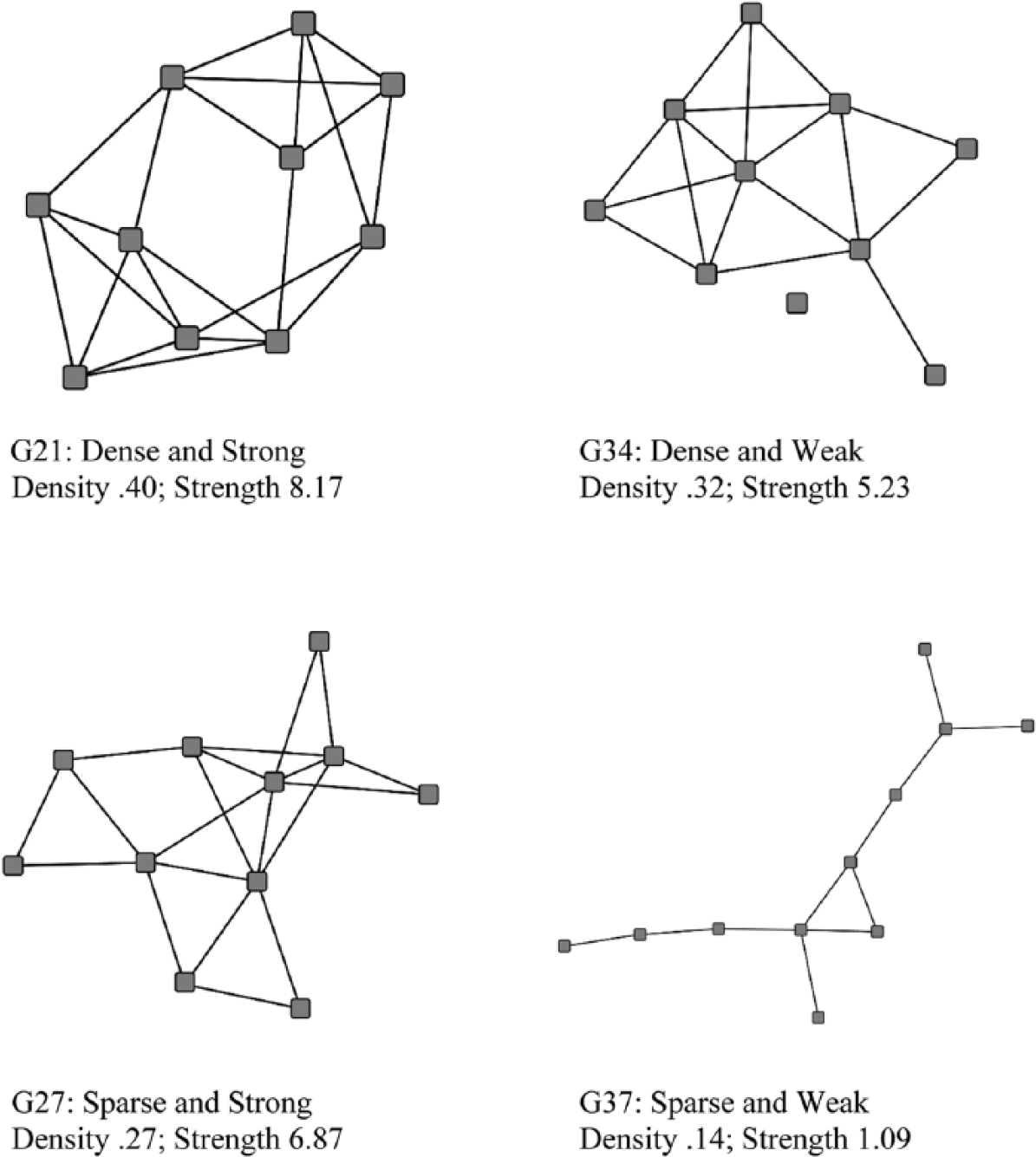
Sociograms of four child center groups differing as a function of network density and network strength.
Action coordination, involvement, and emotional climate
The second coding scheme involved ratings of action coordination, involvement, and emotional climate in the group. Each of these constructs was rated on a 5-point Likert-type scale (see Table 2). Each rating scale included a definition of the construct and an extensive description of the relevant behavior. Detailed behavioral descriptions were given for each separate scale score, including examples. The scale descriptions were based on the pilot-observations. The first author and a trained research assistant, who was blind to the network structure scores and other data, independently rated the children’s behavior in each group on the three scales for each of the 3-min intervals. The ICC (two-way absolute agreement single measures) based on 214 three-minute intervals (10 groups) was .63, .53, and .65, respectively, for action coordination, involvement, and emotional climate, which is regarded as a moderate degree of interrater reliability (Landis & Koch, 1977). The internal consistency of the scales across the 214 three-minute intervals was good, namely, .86 for action coordination, .90 for involvement, and .82 for emotional climate. When computed across 15 intervals, which was the lowest number of intervals observed in a group in the present study, the internal consistency was still sufficient, namely, .85, .78, and .74, respectively.
Structural group characteristics
Age composition of a group was based on the caregiver’s information and defined as the mean age of the children present in the group. Group size was defined as the largest number of children that was present in the group at the same time during the observation day, as recorded by the researcher who visited the group. Group continuity was defined as the proportion of children present in the group who had been attending the group for 6 months or longer, based on the caregiver’s information. Group constancy was defined as the proportion of days per week on which children in the group attended the group together (see Pennings & Meij, 2012).
Results
Descriptive Statistics and Correlations Among Group Functioning Variables
Table 3 presents the means and standard deviations for the six group functioning variables. All group functioning variables were normally distributed, except for inclusion (which was dichotomized). As also shown in Table 3, the three network structure variables, density, strength, and inclusion, were moderately and significantly interrelated (rs between .50 and .75). Action coordination and involvement were highly correlated (r = .90). Both were significantly and moderately correlated with network density (r = .41 and .39, respectively), but were uncorrelated with the network strength and inclusion (rs between .10 and .18). Emotional climate was moderately associated with all five cohesion measures, although the magnitude of these associations only reached statistical significance for network strength and action coordination (r = .30 and .41, respectively) and not for density, inclusion, and involvement (r = .20, .21, and .22, respectively). To summarize, returning to the first aim of this study: The correlations among the group functioning measures were generally consistent with our conceptual model (see Table 1). Exceptions to this pattern involved the lack of association between two of the network structure measures (strength and inclusion) on one hand, and the very strong association between action coordination and involvement, on the other.
Mean Scores, Standard Deviations, and Correlations Between Group Functioning Variables and Structural Group Characteristics (N = 44).

Higher scores indicate higher strength.
p < .05. **p < .01 (one-tailed).
Group Functioning in Relation to Structural Group Characteristics
The second aim of this study was to examine the relation between group functioning and structural group characteristics (age composition, size, constancy, and continuity). The means and standard deviations of these characteristics are presented in Table 3. The measures were normally distributed, except for group continuity, which was negatively skewed and positively kurtosed. As can be seen in Table 3, the bivariate associations between group functioning measures and structural group characteristics varied substantially. Compared with the other structural variables, mean age had the strongest association with group functioning. As expected, groups with older children were denser, stronger, more inclusive, and exhibited more action coordination, more involvement, and a more positive emotional climate than groups with a lower mean age. Group size was significantly and negatively related to density, action coordination, and involvement, with larger group sizes being related to lower density, less action coordination, and less involvement. Group continuity was significantly associated with action coordination and involvement, indicating that groups having a higher proportion of children attending the group for more than 6 months exhibiting more coordinated action and involvement. Group constancy was not associated with any of the group functioning measures.
To explore the relative contribution of the structural group characteristics to the prediction of group functioning, five multiple linear regression analyses were conducted, one for each of the separate group functioning measures, except for the dichotomous variable inclusion, for which a logistic regression was used. The regression results are summarized in Table 4. Collectively, the structural group characteristics predicted a statistically significant amount of variance on all of the group functioning variables. Mean age was a significant predictor of all group functioning measures except for involvement. Group continuity contributed significantly to the prediction of action coordination and involvement. Group size and group constancy did not independently contribute to the prediction of any of the group functioning variables.
Multiple Regression Outcomes for the Prediction of Group Functioning Variables From Structural Group Characteristics (N = 44) and Logistic Regression Outcomes Used for the Prediction of the Dichotomous Variable Inclusion.

Higher scores indicate higher strength.
Discussion
In this article, we introduced the GFI-CC, an instrument to measure group functioning in child care groups, based on a conceptual model. We also presented the results of the first study applying the instrument in a sample of 44 child care groups. The results of this explorative investigation suggest that group functioning can be reliably assessed using the GFI-CC. The majority of the correlations among the group functioning measures represented in the GFI-CC were statistically significant and in the expected direction, which provides initial support for the underlying conceptual model. We also examined how group functioning was related to structural characteristics of the child care groups. Taken together, the structural characteristics predicted all group functioning variables. Mean age and group continuity were independent predictors of group functioning, with higher group functioning scores in groups with older children and in groups with greater continuity. Although group functioning scores were higher in smaller groups, group size did not independently contribute to the prediction of group functioning, and neither did group constancy.
Group Functioning and the Conceptual Model
Overall, the pattern of correlations among the dimensions and constructs supports the conceptual model (Table 1). The correlations between the two main dimensions cohesion (reflected in five measures) and emotional climate were in the expected direction, but three of the five correlations failed to reach conventional levels of statistical significance, which may be due to the small sample size in the present study. These results suggest that cohesion and emotional climate are related but distinct dimensions of group functioning, which is in accordance with the conceptual model.
With regard to the correlations among the five cohesion measures, it can be concluded that the three network structure measures, density, strength, and inclusion, were moderately and significantly interrelated, and that action coordination and involvement (both measured with rating scales) were strongly interrelated. The correlations between the network structure measures and the ratings of action coordination and involvement were all in the predicted positive direction, but only two of the six correlations were statistically significant; network density was significantly correlated with action coordination and involvement, but network strength and network inclusion were not. So, of the three network structure measures, network density appears to be the measure that fits best in the conceptual model. An explanation for the relatively weak associations between network strength and inclusion and the ratings of action coordination and involvement is that the global ratings reflect the behavior of all children in the group, whereas the measures of inclusion and network strength are affected by the relatively few isolated children (i.e., those who were observed to have no peer relationships) in the sample. Specifically, there were a total of 25 isolated children (5% of individuals) identified in 17 (39%) of the groups. As a result of the low prevalence of isolated children, we elected to dichotomize the inclusion measure to indicate groups that did and did not include any isolates and to include the isolated children when calculating network strength for each group. To address this issue in future studies, alternative measures of network strength and inclusion might be considered. For instance, network strength might be calculated so that isolates are not included in the calculation of this measure (Newman, 2003).
Another correlation among the group functioning measures that was not consistent with the conceptual model was the correlation between action coordination and involvement (.90), which was much higher than expected given that they were assumed to measure different aspects of cohesion. The high correlation suggests substantial overlap between the two measures, which is confirmed by the similarity of their associations with the other group functioning measures and structural group characteristics (see Tables 3 and 4). In this study, the constructs action coordination and involvement were based on the distinction between task cohesion and social cohesion, respectively, which is regularly made in small group studies with older age groups (Carless & De Paola, 2000; Chang & Bordia, 2001; L. J. Martin & Carron, 2012; Rabaglietti et al., 2012). Knowing that children’s peer relationships become more diverse and complex in the course of time (for an overview, see Rubin, Bukowski, & Parker, 2006), it is likely that action coordination and involvement are not as clearly differentiated with very young children as compared with older age groups. Future studies utilizing this instrument might further examine the relation between action coordination and involvement in child care groups. In case the results of the present study are confirmed, researchers may elect to aggregate the action coordination and involvement scores. Another possibility is to simplify the conceptual model of group functioning in early child care groups by including only one of the two ratings. If a choice has to be made between these two measures, based on these data, action coordination is the most likely candidate to be selected because of its slightly stronger correlations with the other group functioning variables and the structural group characteristics.
In addition to the exclusion of one of the rating scales, could the conceptual model be further simplified based on the results of the present study? As indicated earlier, the results suggest that the two main dimensions, cohesion and emotional climate, should both be retained because they reflect somewhat related but distinct dimensions of group functioning. However, simplification could be realized by further reducing the number of variables to measure cohesion. As indicated above, of the three network structure variables that measure cohesion, network density appears to fit best in the conceptual model. Given that network density was also more consistently related with the structural group characteristics than the other two network structure variables (see Table 3), network density appears to be the best choice to be kept in the conceptual model in case of further simplification.
Taken together, if we had to simplify the conceptual model (see Table 1) based on the empirical evidence resulting from this very first study, our simplified model would still include the two dimensions of cohesion and emotional climate, but the cohesion dimension would be represented by only two of the original five measures, namely, network density and action coordination. We would retain both of these cohesion measures because they represent theoretically different aspects of cohesion: Network density is a quantitative measure focusing on the relative number of relations between children in the group, while action coordination is a more qualitative measure reflecting the how of the interactions between the children. The resulting simplified model would be consistently supported by the correlations between the three remaining measures. The correlation between the two cohesion measures is moderate (r = .41), while their correlations with emotional climate are the same or somewhat weaker (rs = .20 and .41 for network density and action coordination, respectively), which can be expected given that they represent distinct dimensions.
Finally, we want to emphasize that the simplified model above is only tentative, and that decisions to simplify the model should be based on much more empirical evidence—not only replications of the present study in other—preferably larger—samples, but, more importantly, studies examining the predictive validity of the GFI-CC, to show how the various group functioning measures may contribute to the children’s functioning and development.
Reliability and Validity of the GFI-CC
As argued above, the pattern of bivariate associations between the dimensions and constructs represented in the GFI-CC provides initial support for the underlying conceptual model, which can be viewed as evidence regarding the construct validity of the GFI-CC. Furthermore, the correlations between the structural variables and group functioning measures provide initial evidence for the predictive validity, strengthened by the results of the multiple regression analyses. The internal consistency of the global rating scales action coordination, involvement, and emotional climate of the GFI-CC across the 24 three-minute intervals was good (between .80 and .90), which provides additional support for the reliability of these scales. To obtain information about how much observation time is necessary to acquire reliable results, we also computed the internal consistency of these three scales across 12 intervals (half the number of intervals we aimed to obtain in the present study). Over 12 intervals, a reliable picture of the global ratings was still accomplished; the internal consistency was .82, .75, and .70, respectively. This result suggests that a total observation time of 36 min (12 × 3 min) suffices for a reliable impression of group functioning in a child care group. However, we have to keep in mind that the internal consistency of the network scores could not be calculated because these scores were based on the total number of interactions observed across all 3-min intervals of a group. As it is not possible to separate the interactions observed in the individual 3-min intervals, we do not have an indication of whether half of the observation time would suffice to also obtain a comparably reliable picture of the network structure. This will be an interesting question for future research.
Another question about the observation time concerns the length of the 3-min intervals we used to observe the interactions between children; as described in the “Method” section, we coded whether or not an interaction occurred for each dyad interval during each interval. For feasibility reasons, we chose to use the same 3-min intervals that we also used for applying the rating scales. For scoring a rating scale, an observation period of 3 min is the minimum, as shown by the pilot-observations and in other studies using rating scales. However, for coding interactions between children, 3-min intervals are relatively long and may have restricted the variation in interactions between dyads. The meaningful results with regard to the network structure scores in the present study, which were based on the observed interactions between dyads, support the validity of the interaction measures. Nevertheless, exploring the effect of using shorter intervals for observing the dyadic interactions remains an interesting topic for further study.
What Distinguishes the GFI-CC From Other Early Peer Group Measures?
The most distinctive characteristic of the GFI-CC is that it focuses on the group of children as a whole, in contrast to other measures for young children in the context of the peer group or classroom. For instance, studies examining early peer relationships within peer groups or classrooms mostly focus on subgroups or dyads, while the GFI-CC reflects the structure of the group as a whole. Peer acceptance studies also examine children in classrooms, but the sociometric measures they use are also not meant to characterize the peer group as a whole. Instead these measures, such as acceptance, rejection, and popularity, characterize individual children’s position or reputation in their peer group, reflecting an individual focus and not a group focus like the GFI-CC. Studies measuring the emotional climate in classrooms do focus on the classroom as a whole. However, the most frequently used instruments to measure the emotional climate in early classrooms, such as the CLASS, Classroom Assessment Scoring System (e.g., La Paro et al., 2014), include the teacher as part of the classroom, while the GFI-CC characterizes the peer group by itself, without the teacher. So, compared with other measures for young children in early classrooms, the GFI-CC is unique in its focus on the peer group as a whole.
Group Functioning and Structural Group Characteristics
The second aim of this study was to examine how group functioning is related to the structural group characteristics age composition, group size, group continuity, and group constancy. Of these structural group characteristics, age composition, or the mean age of children in the group, was most clearly related to group functioning. Groups with older children had higher scores on every group functioning measure. This is in accordance with our expectation that older children with more sophisticated social skills would score higher on variables that reflect cohesion. Age composition was also moderately and positively correlated with emotional climate. We did not formulate a hypothesis for this relationship, but we think this positive correlation can be explained in two ways. First, a child care group is stressful for most children, especially for infants and toddlers (Watamura, Donzella, Alwin, & Gunnar, 2003). Infants and toddlers utter their negative affect by fussing and crying, so groups with (more) infants and toddlers will have a greater chance to have a more negative emotional climate. The second explanation focuses on the older children in the group. The results indicate that older children, on average, are more positively connected with other children, they are less isolated, and show more coordinated and involved behavior in a child care group than younger children. These positive peer interactions may be related to higher well-being (Gevers Deynoot-Schaub & Riksen-Walraven, 2006), which in turn might be reflected in a more positive emotional climate.
Group continuity or the proportion of children who have been attending the child care group for at least 6 months was also related to group functioning. It reflects the opportunities children have had to interact with each other. Continuity uniquely predicted action coordination and involvement, but unexpectedly, it was not associated with network structure or emotional climate. Apparently, in child care groups children develop dyadic relationships (reflected in the network structure) more or less independent of how long the children know each other. More advanced interactions and more complex triadic relationships, reflected in more and higher levels of action coordination and involvement in the group, take more time to develop (Schaefer et al., 2010) and are consequently associated with higher group continuity.
Like continuity, constancy (referring to the time children presently spend together in the child care group per week) is an indicator for the opportunities the children have had to interact with each other. Surprisingly, constancy was not associated with any of the group functioning measures. In the present study, constancy was relatively low, reflecting the typically Dutch situation of part-time child care attendance by young children. The constancy scores indicate that most children meet half of the other children in their group only during 1 day a week. Although this low frequency does not necessarily hinder the development of peer relationships (Ross & Lollis, 1989), it is possible that the time children spend together is too confined to explain differences in the development of more advanced relationships, as reflected in higher levels of action coordination and involvement. Another possible explanation for the lack of an association between constancy and group functioning is the definition of constancy used in the present study. Our definition did not take into account interaction preferences for specific interaction partners that even young children show (Maccoby, 1990; C. L. Martin, Fabes, Hanish, & Hollenstein, 2005; Sanefuji, Ohgami, & Hashiya, 2006). The development of more advanced relationships may require more frequent interaction possibilities, not between any dyad in the group (reflected in constancy as measured in this study), but between specific combinations of children. To test this hypothesis, future studies would have to measure group constancy while also taking into account interaction preferences of children in the group.
Limitations and Directions for Future Research
This study has several limitations. First, this initial study on group functioning in child care has a preliminary explorative character. Therefore, conclusions can only be drawn with caution and replication is needed.
Another limitation of this study is the selective sample. Possibly, groups that did not want to participate would have achieved different results, especially given that high work pressure was a common named reason not to participate. The response rate was relatively low (33%), but is comparable with other recent Dutch child care studies (e.g., Helmerhorst, Riksen-Walraven, Vermeer, Fukkink, & Tavecchio, 2014). Furthermore, given the specific characteristics of the Dutch child care context—with, for instance, mixed age groups as the most prevalent type of group, and an over-representation of children of higher educated parents in child care centers (Veen, Roeleveldt, & Heurter, 2010)—the results of this study may not generalize to other countries. Replication of this study in a larger sample and in other countries is needed.
In this study, we observed the groups during a whole day to get an appropriate reflection of functioning of the group during the observation day. However, we have defined group functioning as a relatively stable pattern of relationships, emotions, and cognitions. An indication that group functioning is not a coincidental pattern is the association with several structural, and thus relatively stable, group characteristics. However, more definitive evidence concerning the stability of group functioning can only be obtained by repeated observations of group functioning in the same group.
Although this study provides preliminary support for the Group Functioning Instrument for Child Care, it is necessary to further examine the validity and usefulness of the GFI-CC. Therefore, it would be worthwhile to explore the relation between group functioning measured by the GFI-CC and other measurements at group level, such as perceptions of the caregivers about the child care group.
Another interesting issue to examine in future research is whether and how gender composition and gender preferences in play behavior affect group functioning in child care, given that young girls’ and boys’ social behavior appears to differ (e.g., Hay et al., 2009) and same-sex play preference appears to arise from age 3 (Corsaro, 2005; Fabes et al., 2003; Maccoby, 1990).
In the present study, we examined how group functioning is associated with the structural group characteristics, which are considered as global indicators of the quality of child care. A next interesting step could be to examine group functioning in relation to more proximal indicators of the quality of care, especially the quality of caregiver–child interactions and characteristics of the immediate physical environment of the group. Both are generally recognized to affect the quality of children’s peer interactions (Kantrowitz & Evans, 2004; NICHD Early Child Care Research Network, 2001), and might therefore also influence various measures of group functioning.
Finally, we want to emphasize that we realize this study represents a first step in obtaining more knowledge about group functioning in child care centers. Our interest in this topic was triggered by observations that caregivers in practice frequently refer to differences in group functioning between child care groups. Many experienced caregivers are convinced that group functioning affects children’s behavior and development, and are eager to know how they might improve group functioning. In the present study, we took the initial step in examining these questions by introducing a definition of group functioning and, based on this, an instrument to measure group functioning in groups of young children—the GFI-CC. Our first application of this instrument in a sample of 44 child care groups demonstrated that differences in group functioning could indeed be observed, and that these differences were associated with structural group characteristics. Many important questions concerning group functioning and its potential determinants and consequences for children’s behavior and development remain unanswered. To answer these questions, further research is certainly needed.
Footnotes
Authors’ Note
Both KION Child Care, Nijmegen, The Netherlands, and Child Care Cooperative Association KINDwijzer, Breda, The Netherlands, were not involved in the study design, data collection, analysis, and interpretation of the data, the writing of the paper, or in the decision to submit the paper for publication.
Declaration of Conflicting Interests
The author(s) declared no potential conflicts of interest with respect to the research, authorship, and/or publication of this article.
Funding
The author(s) disclosed receipt of the following financial support for the research, authorship, and/or publication of this article: This study was in part supported financially by KION Child Care, Nijmegen, The Netherlands, and by Child Care Cooperative Association KINDwijzer, Breda, The Netherlands.