



Abstract
Teamwork pedagogy has received considerable attention across a wide range of academic literature. Yet employers continue to argue that universities need to do more to better prepare graduates to work in team-based environments. Grounded in the social constructivist paradigm, this article uses a two-phase systematic literature review methodology to explore the conditions and influences affording or constraining teamwork pedagogy. A complementary thematic analysis of the articles revealed two broad themes: pedagogy and transaction costs. In almost all 57 articles, a range of factors influencing teamwork pedagogy were elaborated. Temporal, fiscal, and human resource transaction costs were identified as constraints in the application of teamwork pedagogy. An overlap of educator, student, and institutional factors are discussed as contributing to the transaction costs of implementing process-oriented teamwork pedagogy. However, the interdependent interactions among educators and students, within and across institutions, remained largely underexplored and are presented as part of a future research agenda.
In the 21st-century employment market, being able to work effectively and productively with others in teams is no longer considered desirable, but rather essential. The importance of teamwork capability is repeatedly highlighted in reports from Western and other economies. Teamwork capability can be developed, supported, and improved through effective teamwork pedagogy. Teamwork pedagogy comprises approaches to teaching that aim to address the dynamic interactions inherent within the teamwork process (organization oriented), and approaches that are not product/artifact oriented, but rather those pedagogies that focus on developing students’ psychological and communication oriented capabilities, “accountability, open discourse, team dynamics, and collaborative problem solving” (Ding & Ding, 2008, p. 5).
Reports from the United States (Hart Research Associates, 2015), Canada (Harder, Lane, & Jackson, 2014), the United Kingdom (Confederation of British Industry, 2009), Australia (Australian Industry Group and Deloitte, 2009), Eastern Europe (Sondergaard & Murthi, 2012), and China (Zhang & Zou, 2013) express the view that teamwork and related interpersonal skills are equally or more important than graduates’ technical skills. These views have been further emphasized in surveys of graduate employers (e.g., Australian Association of Graduate Employers, 2014; National Association of College Employers, 2014). Teamwork is a social construct that describes the working relationship between people (Volkov & Volkov, 2007), influenced by the nature, intensity, and depth of interactions among psychological, communicative, and organizational factors. Given that teamwork is a dynamic, multidimensional construct with a multitude of definitions, depending on the aspects studied (cf. Salas, Burke, & Canon-Bowers, 2000; Tannenbaum, Mathieu, Salas, & Cohen, 2012a), in this article teamwork is defined as a process involving two or more students working toward common goals, through interdependent behavior with individual accountability.
University graduates today now work in environments wherein teamwork is considered the norm (Stone & Bailey, 2007). This assumes that graduates will be able to work collaboratively and productively in teams as soon as they enter the professional workforce. Therefore, there is now a more explicit expectation among employer groups and governments that higher education (HE) institutions will provide students quality training in teamwork skills and capabilities to ensure graduates are better prepared to work in teams when commencing employment (Archer & Davison, 2008; Lowden, Hall, Elliot, & Lewin, 2011). Training in the HE context refers to the application of instructional strategies to enhance the development of teamwork theory, tools, and guided practice (Stout, Salas, & Fowlkes, 1997) to assist students to develop application of the various behaviors associated with working in teams.
Yet while many universities have been addressing teamwork skills for decades across a wide range of academic programs, teamwork pedagogy, as we explicate in the following, is afforded or constrained by a range of interrelated and dynamic interactions. These include how teamwork pedagogy is conceptualized in the institutional context, the degree of experience and proficiency educators bring to teamwork pedagogy, and the perceptions of students concerning teamwork in the learning context. For example, how educators conceptualize teamwork pedagogy and implement learning activities intended to support the development of teamwork capability in students varies widely. What this means is, educators may place more emphasis on product or artifact production (outputs), rather than on the processes, skills, and dispositional attributes required to work collaboratively and productively within a team (inputs). The experience and skills of the educator in the content development of teamwork projects are expected; however, the implementation of teamwork processes is considered a challenge. Burbach, Matkin, Gambrell, and Harding (2010), recognizing the importance of professional development for teamwork pedagogy, argued that “instructors must be trained in the pedagogies of teamwork and actively employ these pedagogies in the classroom” (p. 754). The provision and uptake of educator training and professional development, however, also varies widely and is influenced by institutional and educator commitment to teamwork pedagogy.
In addition to the definitional challenge and the educators’ competency in teamwork pedagogy, negative perceptions and feedback from students assert a strong influence on teamwork pedagogy, and its planning and implementation in learning contexts. For example, a significant body of work documents students’ concerns about the distributive justice of grading team projects (Clarke & Blissenden, 2013; Kidder & Bowes-Sperry, 2012), working in multicultural teams (De Vita, 2002), social loafing of one or more team members (Jassawalla, Sashittal, & Malshe, 2009; Kouliavtsev, 2012; Maiden & Perry, 2011; Pieterse & Thompson, 2010), inability to deal with intragroup conflict (Curseu, 2011), and HE student workload (Pfaff & Huddleston, 2003), balanced with students’ external part-time work (D’Alessandro & Volet, 2012).
In this context, and recognizing that a significant body of literature and empirical studies have explored teamwork in organizations (e.g., Mathieu, Maynard, Rapp, & Gilson, 2008; Rasmussen & Jeppesen, 2006; V. Rousseau, Aubé, & Savoie, 2006; Tannenbaum, Mathieu, Salas, & Cohen, 2012b), we determined to undertake a literature review to explore the following research question:
The purpose of the review is to critically analyze research reported in scholarly academic journals, identifying how educators approach and investigate teamwork pedagogy and how what they report in their research is understood to either afford or constrain their practice. The outcome of the review is to provide educators with an overview and critical insight into the factors influencing effective teamwork pedagogy.
The following first, sets out the epistemological underpinnings and conceptual framework employed in this article. Then, the review methodology, strategy, and analysis processes are elaborated, followed by the presentation of results and discussion.
Conceptual Framework
This article is grounded in the social constructivist paradigm and employs an interpretive framework to better understand what factors are perceived to afford or constrain teamwork pedagogy in HE. We understand learning to be a social and collaborative activity and, consistent with Vygotsky (1978), shaped by one’s experiences and background (sociocultural context). This extends to educators engaging in teamwork pedagogy through their interactions and experiences with students and others within the HE context.
Systematic Literature Reviews
D. Rousseau, Manning, and Denyer (2008) advocated for the use of systematic syntheses of research findings in the management and organization sciences. Advocates of the use of systematic literature reviews believe the method can go some way in alleviating concerns around the “misuse of existing literature, the overuse of limited or inconclusive findings, and the underuse of research evidence” (D. Rousseau et al., 2008, p. 477). The systematic review differs from a traditional literature review in several significant ways. For example, this systematic review is focused on a single question, details the process for selecting articles through the use of search protocols, and outlines specific inclusion and exclusion criteria that guided the literature search. This approach means that the design of the literature review takes on characteristics of a robustly designed research project, which is replicable and which can facilitate interpretation of studies based on the research question.
Methodology
Guided by a set of principles discussed by Briner and Denyer (2012), the literature review process used in this article seeks to identify and map the dominant themes emphasized in publications exploring teamwork pedagogy in the HE context. The review is undertaken in two phases and is described next.
Pickering and Byrne’s (2014) systematic quantitative literature review (SQLR) method framed and informed the systematic review. According to Pickering and Byrne (2014),
this type of review is systematic because the methods used to survey the literature, and then select papers to include, are explicit and reproducible. . . . The review is quantitative because it quantifies where there is research, but also where there are gaps. And the review is comprehensive because it assesses which different combinations of locations, subjects, variables, and responses have been examined by researchers, and what they have found. (p. 538)
The first five steps in the SQLR method involve (a) defining a topic, (b) formulating a research question (addressed in the preceding), (c) identifying key words to be used in the search string, (d) identifying and searching databases, and (e) reading and assessing publications. Steps 6 through 9 involve (f) structuring a database, (g) entering critical information about the journal articles, (h) testing, and (i) revising categories. Step 10 requires producing and reviewing summary tables.
The sheer body of work related to teamwork in organizations and the plethora of studies across health, engineering, psychology, sport science, arts, and other disciplines in HE required that the context for the review be refined. A number of considerations were explored: first, the increasing concerns of employers and their requirements for work-ready graduates who can demonstrate teamwork skills; second, that the authors are academics actively engaged with business student research; and third, that business students are not fully engaging with HE teamwork projects. As such, it was determined that the review would be conducted in two phases. The first phase would focus on research in business disciplines. As teamwork is considered an interdisciplinary skill; however, the decision to include additional HE subject areas was addressed as part of the broader research design and second phase of the study.
Prior to the search, the authors clarified and agreed inclusion and exclusion criteria employed for the systematic review. The review focused on articles published in peer-reviewed journals in English between January 1995 and September 2015 that explored teamwork pedagogy. In addition, the studies had to apply to undergraduate or postgraduate students in HE. Studies from the secondary education, vocational education and training, and workplace sectors were excluded. Studies also had to propose a range of evidence-based processes or recommend pedagogical approaches to teaching teamwork skills to HE students.
The library database search
To enable the systematic review of titles, abstracts, and keywords, a search string of keywords was developed. The keywords were inductively derived by two of the authors who completed an initial traditional literature search examining teaching teamwork in HE. The search string concentrated on the broad concept team and included synonyms. Within the set returned for the concept team, the next search string focused on the context higher education (and synonyms). The search was then further refined by concentrating on the construct teaching, then individual, skill, and discipline area. In the second phase of the review, the same search strings were used; however, to allow for the inclusion of nonbusiness-related disciplines, the narrowing down process did not include discipline area (see Figure 1).

Library database search.
The library database search was conducted in two search phases and employed a combination of database and manual coding methods. The first phase of the systematic review concentrated on searching the databases: PsycINFO, ProQuest (see Appendix A for full list), ERIC, Scopus, Web of Science, and Google Scholar to ensure a wide range of journal articles were identified. A second search using the EBSCOhost database was then used as it captured a different range of databases (including CINAHL Plus, Business Source, Communication Source, Education Source, and Medline) and broadened the scope to also include nonbusiness-related HE subjects.
All articles were screened using the following protocol noting: number of records identified through initial database searching and number of records identified through further database searches, screening for duplicates and exclusions, eligibility based on abstract and then full article review, ending with total number of journal articles included for the review. This process is captured in Figure 2. From the first phase, 30 articles were retained, with a further 27 articles from the second phase, resulting in 57 articles.
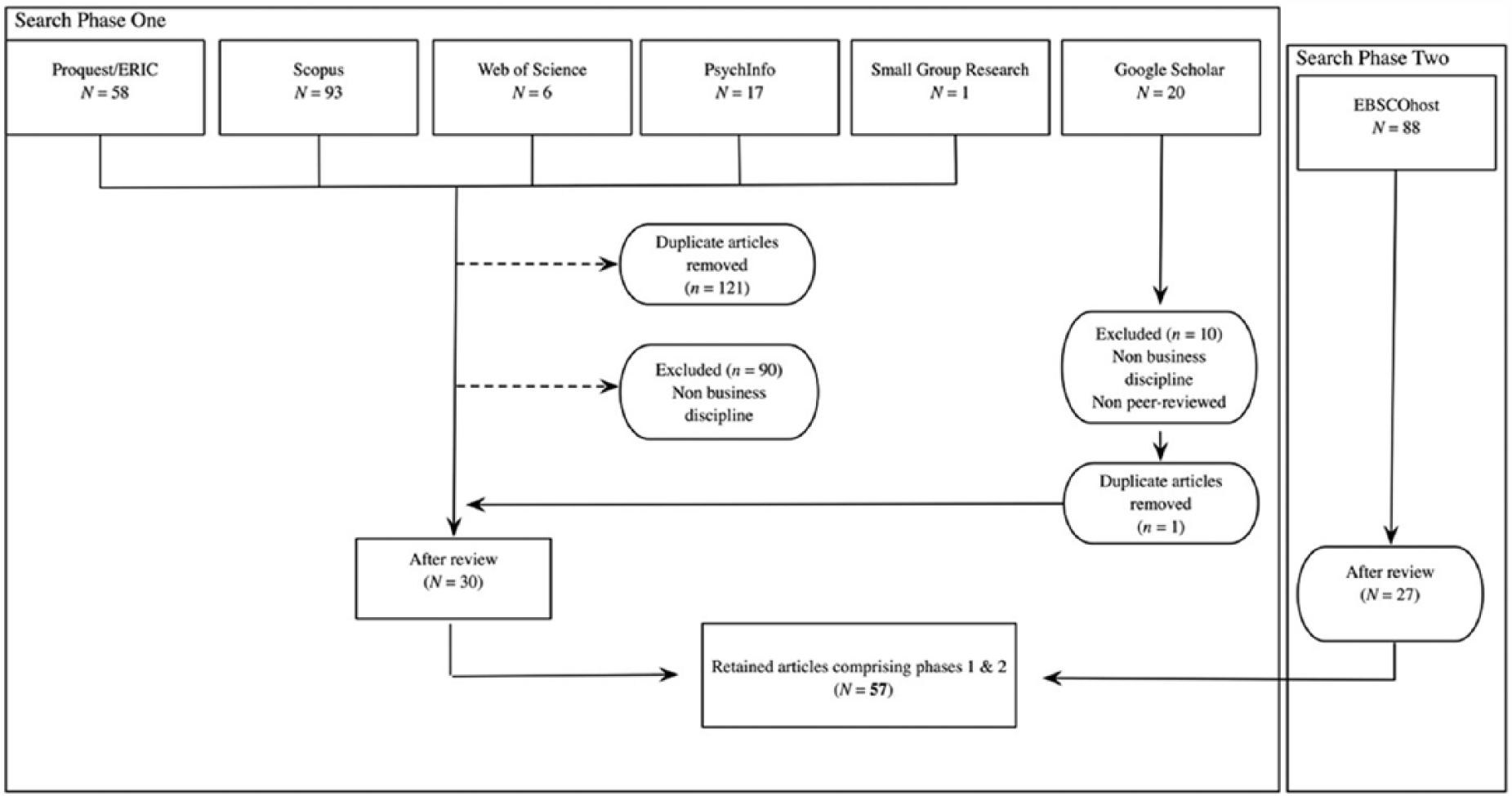
Database search protocol.
Data analysis
A database was established, following the SQLR method, to enable detailed mapping for each article retained that included author(s), year of publication, title of the article, journal, discipline/subject area, geography, method, participants (number, undergraduate, postgraduate), results, gaps, and salient factors affecting teamwork pedagogy. In total, 57 journal articles were retained, screened, and placed in the database (see Appendix B for an extract of this database). Each article was allocated a unique number (first phase search) or letter (second phase search) identifier, which is used in Appendix B and subsequent analysis and discussion. Descriptive and univariate statistical processes were applied to detect patterns and themes in the literature surveyed (see Tabachnik & Fidell, 2013). As well as being able to report on the descriptive characteristics of the studies, the journal articles were analyzed using interpretive synthesis. This involved “translating and comparing data across the studies to develop categories and higher-level themes” (Briner & Denyer, 2012, p. 123).
Two broad themes emerged that related to teamwork pedagogy and transaction costs associated with investment in teamwork pedagogy. These themes were evaluated by all authors to ensure consistency of judgment and theme relevance to the research question. Categories in the first theme were coded by the first author, and reviewed and confirmed by the second and third authors to come to an agreement about category terms (instruction, curriculum design, team composition, assessment) representing factors emerging from common course content descriptions across all journal articles. Factors were then coded to these categories:
Instruction: training in team skills, collaborative/cooperative/experiential learning, tools introduced, process of teamwork, mentoring/coaching/modeling, Tuckman’s stages, and team-based learning.
Curriculum design: learning outcomes and constructive alignment.
Team composition: team size, team diversity, and team formation.
Assessment: self/peer assessment, social loafing, giving/receiving feedback, and grading.
The same process was followed to determine categories for the second theme of transaction costs, informed by educator, student, and institution factors. The synthesis focused on collating the information gleaned from the studies in a way that was not necessarily apparent from the individual studies alone. An iterative approach was used by the research team to facilitate the review.
Furthermore, the journal articles were appraised for quality using quality appraisal scoring criteria (Hawker, Payne, Kerr, & Hardey, 2002). Each article was reviewed against a list of nine specific questions (see Hawker et al., 2002, Appendix D) and scored along a 4-point scale that ranged from 3 (good), 2 (fair), 1 (poor), and 0 (very poor) for a maximum possible score of 27 points. The nine questions related to abstract and title, introduction and aims, method and data, sampling, data analysis, ethics and bias, transferability, and implications. Of the 57 articles reviewed, 46% were judged as good, 25% as fair, 26% as poor, and 3% as very poor. Debate on scoring for methodological rigor is ongoing in the social sciences. However, interpretive synthesis allowed the authors to make judgements about inclusions. For instance, conceptual articles not based on primary research scored lower on the scale but were deemed by the authors as appropriate sources of information being fit for purpose in relation to the research question and were thus retained.
Results and Discussion
The quantitative characteristics of the retained articles are presented first in the quantitative findings section. This section is then followed by results and discussion arising from the two broad themes emerging from the thematic coding, under the headings Theme 1: Teamwork Pedagogy and Theme 2: Transaction Costs.
Quantitative Findings
Over the search period and across the articles retained, interest in teaching teamwork in HE courses was more prolific in the most recent decade (n = 45; 2005 through 2015) than in the previous 10-year period (n = 12; 1995 through 2004). Seventy-five percent of articles originated from authors based in the United States. This outcome may be a function of the keyword strings and criteria applied to the search, but may be because of the greater representation in general of publication outlets as well as educator numbers in the United States. Furthermore, of the retained articles across the two phases, 75% related to research across a variety of business subject areas, suggesting that developing teamwork of business students is highly prioritized when compared with other disciplines.
Table 1 aggregates the research methods employed across the journal articles. Notably, 19 articles (33%) used quantitative methodologies while seven (12%) used qualitative research approaches. Fifteen articles (26%) were categorized as conceptual, describing pedagogical interventions or tools for teaching teamwork skills, but not empirically examining such strategies.
Methods Used in the Studies.

These results show that quantitative methods remain a popular approach when investigating the efficacy of teamwork pedagogies and the affordances and constraints influencing design and implementation processes. There is a marked absence of mixed-methods approaches in the review, despite most researchers recognizing the value of using both quantitative and qualitative frameworks in the one study to expand understanding (Onwuegbuzie & Leech, 2005). Johnson and Onwuegbuzie (2004) noted mixed-methods research presents a unique opportunity for researchers to understand educational activities. However, a review by Truscott et al. (2010) suggested that although mixed-methods research is better suited to educational research, its use has not been as prevalent as expected. In the future, research designs that take advantage of mixed-methods approaches would be useful in addressing issues around methodological rigor and generalizability of work examining teamwork pedagogy. Application of this methodology would additionally provide an opportunity for better understanding how dynamic interactions between educators, students, and institutional norms influence teamwork pedagogy.
Of the empirical research reported, just over half (58%) are cross-sectional in design, with students or educators comprising the sample. Samples reported in the journal articles are considered small scale, with 26% reporting sample sizes smaller than 100 individuals; a further 28% report on studies with sample sizes between 100 and 1,000 individuals. Sample size was not reported in 24 (42%) articles. Across the 33 journal articles referencing sample size, 58% used quantitative methods with sample sizes greater than 100. Qualitative or mixed-methods designs were used in 15% of journal articles stating sample size. Furthermore, analysis of the sample sizes in this review indicate that large-scale studies on HE teamwork pedagogy are infrequent, with two studies containing sample sizes over 1,000 (e.g., Oakley, Hanna, Kuzmyn, & Felder, 2007; Takeda & Homberg, 2014). While access to large samples plagues much primary research, the variance in sample sizes reported in these studies does question the generalizability of the findings and is therefore to be considered in any future interpretations. Future research using larger sample longitudinal designs would contribute to rigorous, evidence-based knowledge of the implications of HE teamwork pedagogy.
The quantitative analysis of the journal articles did not easily lend itself to addressing the research question: What factors are identified in academic publications that are perceived to afford or constrain teamwork pedagogy in HE contexts? Therefore, additional thematic analysis (as described above) was undertaken.
Theme 1: Teamwork Pedagogy
The first substantive theme to emerge out of the thematic coding and analysis of the literature reviewed related to teamwork pedagogy. Table 2 represents a count of the categories associated with teamwork pedagogy. The identifiers in the table relate to the articles in Appendix B.
Theme 1 Pedagogy—Categories and Codes.
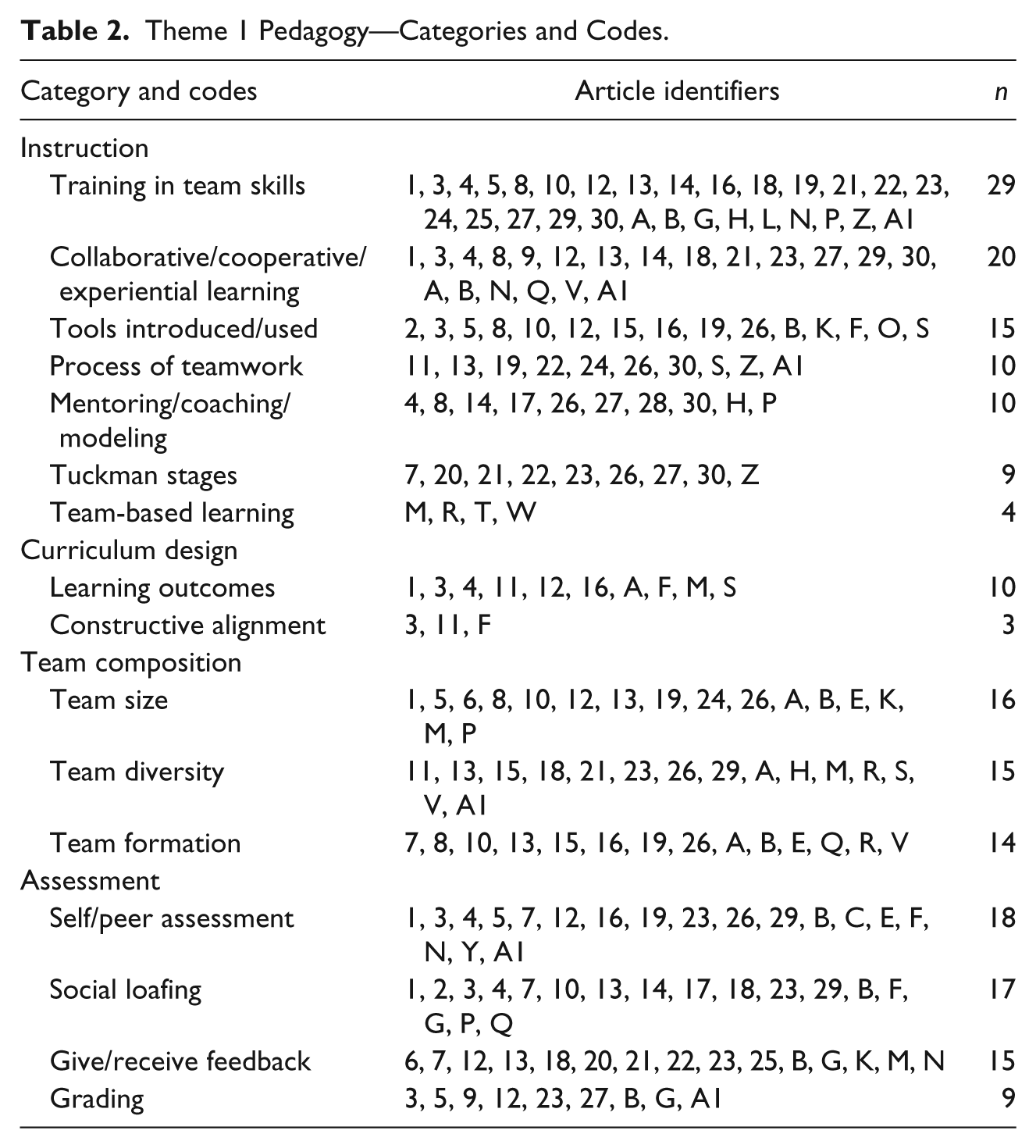
A wide range of approaches to, and implementation of, teamwork pedagogy were revealed across the retained journal articles. Instructional strategies received the most attention, with just over half the articles (51%) iterating the need to train students in team skills and the need for direct instruction in teaching teamwork knowledge, skills, abilities, and other factors (KSAOs; Bacon, 2005; Delaney, Fletcher, Cameron, & Bodle, 2013; Pineda & Lerner, 2006; Rapp & Mathieu, 2007; Snyder, 2010). Researchers contend that training HE students in teamwork can lead to higher academic achievement (Rapp & Mathieu, 2007), further enhanced by collaborative activities undertaken during teamwork (Prichard, Stratford, & Bizo, 2006; Sabal, 2009).
Although a range of instructional strategies were recommended across the articles, only 35% emphasized teaching collaborative and cooperative learning. Prichard et al. (2006) observed that there is an assumption that educators and students have had some prior experience with collaborative or cooperative learning. But Ahern (2007) and Burke (2011) noted that this is not always the case, which may explain the low percentage of articles reporting on these strategies. Some educators are challenged by the transition from teacher-centered to collaborative/cooperative teaching methods or, as in Holt, Michael, and Godfrey’s (1997) case, view cooperative learning as an inefficient allocation of time. Such views may constitute a significant psychological constraint when it comes to adopting collaborative instructional strategies.
Other instructional strategies included the introduction of team-training tools for students (Hogarth, 2008; Hubbard, 2005; Rapp & Mathieu, 2007), such as simulations (Gilson, Maynard, & Bergiel, 2013), role-play (Crumbley, Smith, & Smith, 1998), and self and peer assessment (Delaney et al., 2013). Ten articles (e.g., Hansen, 2006; Page & Donelan, 2003; Rafferty, 2012; Snyder, 2010) referred to the use of Tuckman’s (1965) model to introduce students to the stages of teamwork.
The process of teamwork was discussed in 10 (17.5%) journal articles. Three articles (Kirby, 2011; Pineda & Lerner, 2006; Rapp & Mathieu, 2007) specifically explained and grouped team processes into three main processes: transition, action, and interpersonal. Kirby (2011) related team formation to the transition process, Pineda and Lerner (2006) discussed team goals as a team transition process related to planning, while Rapp and Mathieu (2007) focused on the establishment of team member roles and responsibilities and team charters.
Action process factors focused on implementing good communication skills (Considine, 2013; Gilson et al., 2013; Hershey & Wood, 2011), both in face-to-face and asynchronous communications. Making decisions as a team (Rapp & Mathieu, 2007; Shaw, 2004) and giving and receiving feedback (Goldfinch, Laybourn, MacLeod, & Stewart, 1999; Hansen, 2006) were also linked to the teamwork action process.
There was considerable discussion across the articles on the interpersonal relationship dimensions of team processes. Aspects elaborated included intrateam conflict resolution (e.g., Paulus, Horvitz, & Shi, 2006; Rafferty, 2012; Staggers, Garcia, & Nagelhout, 2008). Jackson, Sibson, and Riebe (2014) observed in their findings that students, academics, and industry rated conflict resolution behaviors poorly. Some articles in this review (e.g., Schullery & Gibson, 2001; Shaw, 2004) specifically included suggestions for dealing with teamwork conflict, while others researched how team conflict impacts on self-efficacy (Stone & Bailey, 2007).
If the development of teamwork skills is a learning outcome in a course or program of study, then relevant training and instruction in teamwork must be incorporated into its design at the planning phase. For this to be realized, understandings of curriculum design and development and teaching strategies that have the best potential for delivering the desired learning experiences and outcomes are necessary. Over one third of the journal articles referred to collaborative, cooperative, or experiential learning strategies as essential to teamwork pedagogy. Across the articles reviewed, curriculum design considerations were only superficially addressed with limited attention to issues related to curriculum design and the application of constructive alignment or other pedagogical frameworks (e.g., Frazer & Bosqanquet, 2006; Trigwell & Prosser, 2014). For example, constructive alignment, popularized by Biggs (1999), is widely regarded as a seminal model for curriculum design and development. The model asserts approaching curriculum design by starting with a focus on learning outcomes and then aligning these with assessment, content, and learning activities. This process is demanding and whether working individually, or with learning/instructional designers, designing a curriculum requires a considerable investment in time and cognition. As well as the temporal cost associated with this approach, the limited attention focusing on constructive alignment may be a product of the geographic spread of literature reviewed, given that Australian literature accounted for less than 10% of the reviewed journal articles (e.g., Delaney et al., 2013; Jackson et al., 2014).
Most notably in the literature reviewed was the focus on team composition factors, which is discussed in more than 50% of articles. Team size is outlined in 16 articles, team diversity in 15 articles, and team formation in 14 articles. The reviewed journal articles indicate that educators often place students in teams with little or no instruction on how to work in teams (e.g., Hansen, 2006; Page & Donelan, 2003; Rafferty, 2012; Sashittal, Jassawalla, & Markulis, 2011; Shaw, 2004) prior to assigning complex team projects. Lancellotti and Boyd’s (2008) research indicated that students perceived development of teamwork skills as being affected by compatibility and personality type, but they debate the wisdom of manipulating student team composition, as it is not considered reflective of real-world situations. Another aspect of team composition noted in the journal articles was that of team diversity. Shaw (2004) found that consideration of diversity (gender, age, nationality, position) within a group structure could place some students at a disadvantage to others in the group. The multicultural nature and diversity of individuals required to work together on team projects at university have variously contributed to negative student perceptions of teamwork productivity. This has been aligned with misunderstandings arising from individualistic and collectivist cultural norms affecting team collaboration (McCorkle et al., 1999). Shaw (2004) made a number of suggestions for ameliorating adverse aspects of the multicultural and diverse nature of HE student teamwork. However, cultural dimensions were not studied in great detail in the reviewed journal articles. This may be because the majority originated from culturally similar contexts; however, increased attention to this phenomenon in the context of effective teamwork pedagogy should be considered in future research.
Student perceptions about team composition is less dependent on procedural justice and more dependent on their perceptions of distributive justice and what will afford the best return for their participation in teamwork. This is perhaps why social loafing, which occurs when one or more team members fail to contribute their fair share to a team project, benefitting from the work of others, and causing resentment (McCorkle et al., 1999), was identified as a salient concern of students. What was recommended in the reviewed journal articles to mitigate against this phenomenon is for educators to focus on action processes. For example, offer a clear proviso for individual accountability in assessment procedures (Bacon, 2005) and use team contracts or a divided mark team contract, which offers teams the ability to divide up the number of marks for each team member as a percentage of the final grade (see Maiden & Perry, 2011) and act as a deterrent to social loafing. In these articles, there is less of a focus on the teaching of interpersonal competence building for students to be able to address issues of social loafing of team members. Again, this may be a function of a focus on team artifacts or outputs, rather than building competence around team process.
It is not surprising to find that 63% of journal articles refer to some element of assessment as part of teamwork pedagogy discussions, as this is an integral element of any curriculum. Grading issues were identified in 16% of articles, with some articles particularly focused on strategies to address individual grading of team members (Burke, 2011; Gueldenzoph & May, 2002).
Seventeen (30%) journal articles acknowledged social loafing as an assessment concern for students when the whole of team grading is applied and individual team members are perceived as not contributing equitably to the final product being assessed. Maiden and Perry (2011) outlined, for example, several approaches adopted to deter free-riding/social loafing and presented results of student responses on these interventions. Student responses to educator efforts to intervene with the ability to grade individual team members has been viewed positively by students as reflecting distributive justice. Behavioral contracts (Frederick, 2008; Hubbard, 2005) between students to mitigate the impact of social loafing and to establish team norms were discussed; however, relatively little information on establishing contracts was noted across the journal articles reviewed, indicating an area for future research.
The use of self and/or peer assessment (Delaney et al., 2013; Freeman & McKenzie, 2002; Loughry, Ohland, & Woehr, 2014; Ohland et al., 2012) to assist with grading teamwork was presented in 26% of articles. The articles demonstrated that giving and receiving feedback can be used constructively as a collaborative peer assessment method, allowing students to participate in the grading process (Gueldenzoph & May, 2002). How and what aspect of teamwork is assessed (i.e., artifacts, completed tasks, teamwork process, individual vs. group contribution) are presented as constraints across many of the journal articles reviewed.
Table 2 shows that much of the research on teamwork pedagogy is focused on very similar concerns. Although there is a proliferation of information available to educators on teamwork pedagogy, the same types of practices are presented, with no real discernible innovation or advancement in the teamwork pedagogy domain. This may be because the issues faced by educators using teamwork pedagogy are common, and there are a variety of strategies providing evidence of good practice (as is supported in this review). It may also be because educator motivation to introduce teamwork process and teamwork projects relies on discretionary effort and is a function of educator confidence and willingness, which is not uniform (Sashittal et al., 2011). Student perceptions and the valence they afford teamwork also influence these outcomes. It may be, however, that educators are implementing additional instructional strategies and tools in the HE classroom, but simply not publishing on teamwork. As teamwork is an interdisciplinary skill, HE educators may be more focused on publishing findings that are discipline content related, as this is generally an institutional requirement, and therefore may be considered an undue cost for academics. The outcomes do support, however, that there is interplay among educator, student, and institutional expectations, which may be influencing research on teamwork pedagogy.
Theme 2: Transaction Cost
The second substantive theme to emerge from the analysis of the journal articles clustered around factors identified as transaction costs which afford or constrain teamwork pedagogical activities and decisions. Table 3 represents the types of transaction costs that resulted from the thematic coding process. Although not explicitly identified, in many of the articles it was evident that costs applied to undertaking the design, development, and maintenance of effective teamwork pedagogy were impacted and influenced by institutional, educator, and student factors.
Theme 2 Transaction Costs.
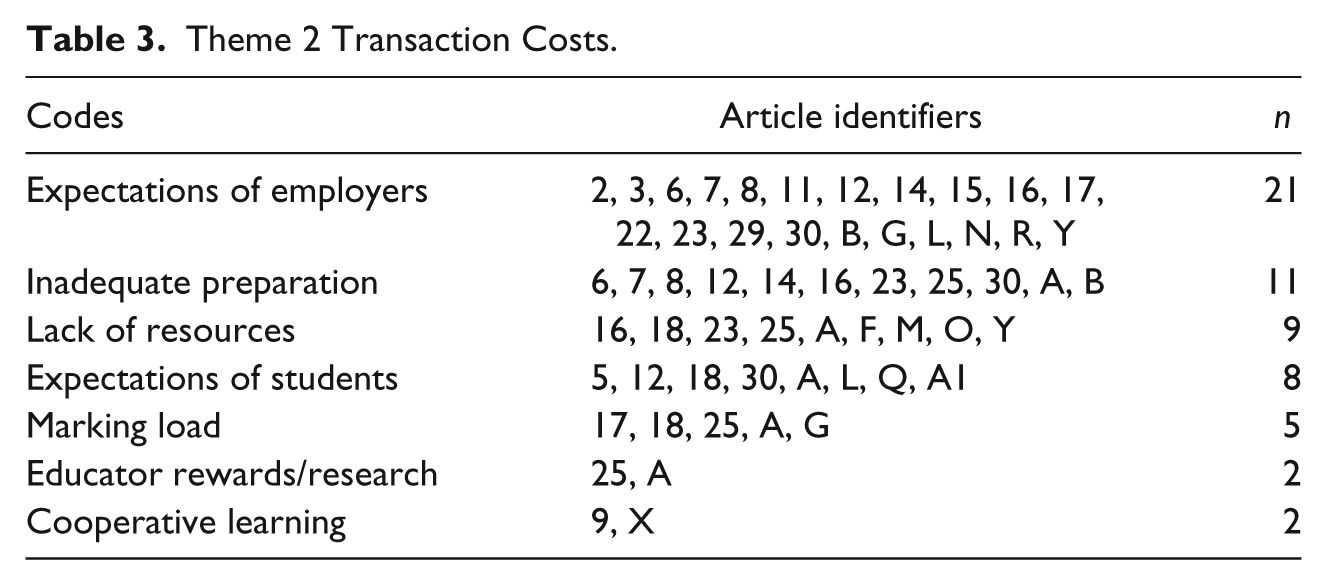
To better understand the affordances or constraints influencing teamwork pedagogy, transaction cost theory (Williamson, 1979) was appropriated and applied as a heuristic lens. The prediction made about engaging in teamwork pedagogy using transaction cost theory assumes that engagement will depend on the benefits or costs derived from developing, coordinating, monitoring, participating in, interacting with, and evaluating teamwork pedagogy. This is represented in Figure 3.

Transaction cost interactions.
When applied to teaching teamwork skills, transaction costs represent the return on investment or costs incurred when undertaking the design, development, and maintenance of effective teamwork pedagogy. Some of these transaction cost interactions can be imposed, for instance, by attempting to meet employer expectations (Burbach et al., 2010); can be considered a function of educator preparedness to develop resources (Albon & Jewels, 2014), devise strategies and interventions (Kedrowicz & Nelson, 2007), and teach teamwork skills (Jackson et al., 2014); the readiness of students to willingly participate in teamwork learning activities (Bacon, 2005); and the resources available to institutions which precipitate a focus on the teaching and learning of teamwork (Ahern, 2007).
The most frequent transaction reported across the journal articles related to employer expectations. This constituted a major affordance when it came to the importance placed on addressing graduate teamwork skills in programs and instructional design. Employer expectations regarding the importance of work-ready graduates have asserted a strong influence on teamwork training and assessment (Hobson, Strupeck, Griffin, Szostek, & Rominger, 2013; Kemery & Stickney, 2014) across the HE sector. This is evident in more than 50% of the journal articles reviewed. For example, Hobson, Strupeck, Griffin, Szostek, Selladurai, and Rominger (2013) and Kliegl and Weaver (2013) observed that employer expectations and those of professional bodies reflected through their accreditation standards (Kemery & Stickney, 2014; Rakestraw, 2014; Reinig, Horowitz, & Whittenburg, 2011) have influenced HE institutions to emphasize the development of collaborative skills, teams, and teamwork in programs of study. This has implications for established curriculum where the focus has not been facilitated through institutional strategies.
Many of the articles (e.g., Gilson et al., 2013; Kirby, 2011; McCorkle et al., 1999; Snyder, 2010) reported that for some educators it is not always clear how they should teach teamwork skills, and therefore, educators may be inadequately prepared (Tombaugh & Mayfield, 2014) to take on the task. This has an impact on both educators and students. According to Kirby (2011, p. 36), “there has been little consensus amongst academics about how best to teach teamwork.” Many educators are discipline-based scholars and because of this, they may not have had any formal training in teaching methods or be familiar with resources or collaborative approaches to develop students’ teamwork skills (e.g., Hansen, 2006; Kliegl & Weaver, 2013; Sashittal et al., 2011). This is compounded in cases where educators have not themselves experienced adequate teamwork training while completing their own degrees. The provision of training to HE educators is a significant, specific, albeit infrequent, fixed cost that is, on the one hand, determined at the individual level, while on the other hand, determined by the degree to which the educator feels the need for training. If there is a lack of institutional support for educators to take time away from teaching and research to attend professional development to enhance the depth of knowledge associated with developing sound teamwork pedagogy, this may be considered a constraint. Alternatively, where institutional support is provided, a human resource transaction cost is incurred if there is a requirement for replacement staff.
Associated with implementing collaborative/cooperative learning is the time cost of providing students with opportunities to practice these strategies, thereby reducing time available for teaching discipline-specific content and skills in a course (e.g., Bacon, 2005; Kliegl & Weaver, 2013; McCorkle et al., 1999). The literature reviewed strongly advocated emphasizing the importance of teamwork and providing training and practice of teamwork skills through educator modeling, support, and reinforcement (e.g., Frederick, 2008; Page & Donelan, 2003; Shaw, 2004; Snyder, 2010), all of which impose temporal, human, and fiscal cost. For example, although group work may provide a foundation learning opportunity, and some teamwork behaviors may develop through group work, Myers and Goodboy (2005) argued that simply participating in group work was not the same as learning about the process of teamwork. This was supported by Palit and Stein’s (2009) results, which indicated that just grouping students into teams will not in itself make them better at teamwork, leading them to recommend explicit instruction in teamwork KSAOs be included in the curriculum. Participation in teamwork activities implies a further transaction cost for educators, in relation to not only the distribution and allocation of time taken from teaching discipline content but also consideration of assessment of the process (inputs) elements of teamwork and not just the product (outputs) element.
Assessment is a critical facet of curriculum design (Jackson et al., 2014), yet educators may have little experience in assessing the process of teamwork as opposed to just the product outcomes (Goldfinch et al., 1999). The crowded curriculum of discipline-specific subjects may induce educators to introduce team assignments to reduce grading (or marking) load (Sashittal et al., 2011), without considering effective design (Kidder & Bowes-Sperry, 2012) or how the assessment aligns with teamwork learning outcomes. Although the use of teamwork assessments may act as a mechanism to reduce marking load (Maiden & Perry, 2011; McCorkle et al., 1999; Sashittal et al., 2011), educators may incur greater hidden costs especially in terms of managing high student dissatisfaction with this form of assessment (Jassawalla, Sashittal, & Malshe, 2010), and mitigating concerns around social loafing and distributive and procedural justice perceptions (Maiden & Perry, 2011). The giving of formative feedback, for instance, is an intervention noted in over one quarter of the reviewed journal articles. However, the high level of commitment involved in giving feedback to students and incorporating a formative feedback process in course redesign (Kirby, 2011) is an additional transaction cost to the educator, potentially for little return. In the review, several alternatives were presented which could reduce these temporal and efficiency-related costs. For example, the use of self and/or peer assessment (Hansen, 2006; Page & Donelan, 2003) procedures in class, or implementing the use of online team tools (Delaney et al., 2013; Ohland et al., 2012), to provide feedback on team member effectiveness are less time-consuming for the educator. Less well developed were interventions around the use of student contracts related to allocation of individual team member grades, although behavioral contracts between students and the establishment of team norms were advocated in several articles. If, as reported, assigned grades do not reflect students’ notions of distributive justice, and/or are incongruent with the transaction costs students associated with their contribution to and participation in a team, there is the potential of negative feedback by students in educator evaluations. This in turn may influence educators’ decisions concerning the use of teamwork as a learning experience in future iterations of the program of study.
The redesign of a program of study to incorporate teamwork pedagogy represents a significant investment in time and fiscal resources for institutions and educators responsible for the design and ongoing development of curricula. This cost is compounded by a focus on research outputs as a key performance indicator (Pickering, Grignon, Steven, Guitart, & Byrne, 2014), which may detract from focusing on teamwork pedagogy as a priority (David, David, & David, 2011; Fleming, 2008). Other potential costs, at the institutional level, reside in the development and utilization of learning spaces that are intentionally designed to afford constructivist approaches to teamwork pedagogy. As Mourshed, Farrell, and Barton (2015) and others (e.g., Sondergaard & Murthi, 2012) have observed, fiscal and/or human resource constraints have the potential to limit how well institutions adapt and respond to changing employer expectations concerning the capability (work readiness) of new graduates. Several articles drew attention to the need to consider workload and time required for educators to learn collaborative/cooperative teaching strategies prior to implementation (Bacon, 2005). However, in stark contrast, Holt et al. (1997) specifically built a case against introducing cooperative learning in accounting classes on the basis that student time is a scarce resource and an imposed transaction cost.
Across the journal articles reviewed, a significant range of student-related determinants and factors that afford and/or constrain what educators can do to facilitate teamwork learning were discussed. These include student perceptions of teamwork learning, team composition, managing social loafing, and considering student workload.
Student perceptions of teamwork learning are reported across a range of articles, influenced by the degree to which teamwork skills development is incidental or intentional within the framework of the program of study or course. Where educators have utilized constructive alignment to incorporate a focus on teamwork processes, for example, it was reported that this promoted more positive student perceptions concerning how team working skills are developed (Jackson et al., 2014). Such an outcome has implications for educator preparedness, as inadequate preparation can evoke or intensify negative perceptions of teamwork among students (Tombaugh & Mayfield, 2014). The costs incurred due to poor instructional planning and delivery, as Sashittal et al. (2011) observed, can encourage students to retreat or disengage from teamwork.
Student expectations, when it came to participation in team-based learning activities, likewise asserted an influence on how and to what degree team-based learning was structured into a program of study. These expectations were considered as moderating the emphasis placed on teaching teamwork skills and successful outcomes and were featured in 18 of the articles. In 11 journal articles, the costs associated with ensuring educator readiness to teach teamwork skills were discussed. Specific educator costs associated with teamwork pedagogy were discussed, for example, in relation to the temporal cost of the application of collaborative/cooperative learning approaches (Holt et al., 1997; McCorkle et al., 1999) and opportunity costs for students (Bacon, 2005).
What is largely absent in the literature reviewed is recognition that students have a significant role to play when it comes to the achievement of teamwork learning outcomes. As individuals and as a cohort, students can and do exercise their agency to engage in the learning enterprise. The level of discretionary effort exerted by students to engage in teamwork learning is moderated by the value they afford teamwork as part of their learning experience and the relevance of teamwork skills for their future employability. Delaney et al. (2013) maintained that when it comes to developing teamwork skills, curriculum design that incorporates both process and product outcomes may better engage students to see a benefit to their teamwork learning and, therefore, contribute to future employability.
Whereas much of the discussion examining how to better engage students in learning teamwork skills has focused on minimizing negative perceptions, the tangible temporal cost of working in teams was given less attention in the reviewed journal articles. Consideration of reasonable workload was mainly addressed in those journal articles making recommendations (Hansen, 2006; Snyder, 2010). Assigning class time for meetings, for example, was an intervention suggested by Page and Donelan (2003), as a way to counteract the transaction cost of additional workload required by organizing team meetings outside of class and impacting on student work–life balance (Rafferty, 2012). Student workload, both within and outside of the educational context, is a significant determinant of negative student perceptions for participating in teamwork. However, to balance such demands is often outside of educators’ control and relies on students’ ability to manage workload. Such an observation reinforces the need to give due consideration to the interaction of student perceptions and the role of the educator in balancing out the costs versus gains of participating in and teaching teamwork, respectively.
In the journal articles reviewed, the dynamic interaction of educator, student, and institutional costs, although not explicitly addressed, is often implied. Most of the articles focused on the educator dimension of Figure 3 and the strategies and interventions introduced. Similarly, journal articles looked at educator motivations and student perceptions about the introduced strategies and interventions. Likewise, several journal articles noted the institutional dimension. However, what is missing from a constructivist perspective is the dynamic, multilevel interactions between student, educator, and institutional factors as moderated by perceived and real transaction costs and how this influences teamwork pedagogy.
Conclusions and Future Research
The purpose of this review was to identify factors in academic publications perceived as affording or constraining teamwork pedagogy in HE. Grounded in the social constructivist interpretive paradigm, this review employed a two-phase approach in the literature search of social science databases. The analysis incorporated both qualitative and quantitative methodologies, and the findings and discussion sections were organized to reflect both perspectives. The results identified that educators prioritized instruction, curriculum design, team composition, and assessment factors when researching teamwork pedagogy. The interactive effects of educator, student, and institutional factors and their influence on transaction costs were presented as affordances and constraints shaping the uptake of teamwork pedagogy, thereby providing a critical insight for educators engaged with teamwork as part of their course design.
A review of this nature does not provide best practice advice; instead, it offered an overview of the current state of play in regard to the research question, and avenues for further investigation. One potential limitation of this methodology relates to the keywords selected and how the search strings are applied. This does influence the number of journal articles retained and is a consideration when interpreting and generalizing the results of this review. To address such a concern, we adopted a methodology that used broad as well as a specific set of search criteria, and we completed the search as part of a sequential two-phase design. In addition, interpretive synthesis provided the opportunity to make judgements about the inclusion of conceptual journal articles fit for purpose in addressing the research question.
Of the 57 journal articles included in this review, the majority focused on teamwork pedagogy as it relates to the introduction of strategies intended to facilitate enhanced learning outcomes for students or to better understand student/educator motivations relevant to teamwork participation. The majority of the journal articles were aligned to the business discipline context and confirmed the importance of teamwork as part of business curriculum.
The empirical journal articles were dominated by quantitative, cross-sectional studies; focused on single dimensions such as examining perceptions relating to a newly introduced teaching strategy. As noted, only two studies included a sample size larger than 1,000 individuals and longitudinal research designs were infrequent. The emphasis on quantitative research, while offering some significant insights into teamwork pedagogy, is constrained as it does not have the capacity to illuminate a fuller understanding of situational or contextual dynamics, interactions, and factors that may assert an influence on the study phenomena. This suggests future research should look to employ methods that are capable of capturing more nuanced interactions, such as mixed-methods designs, which are focused on addressing macro- and microlevel dimensions of social phenomena such as, teamwork pedagogy.
Teamwork pedagogy is a situated and transactionally oriented activity wherein perceptions concerning value and return on investment are significant affordances and constraints influencing design and implementation, and the willingness to engage in this form of teaching and learning. Transaction costs, including temporal, fiscal, psychological, and human resources, were implied as constraints in the application of teamwork pedagogy. Few studies, however, explicitly recognized or tested the significance of the interactions between students, educators, and institutions in the situated context; nor did they further explore the moderating effects of transaction costs associated with developing, coordinating, monitoring, participating in, interacting with, and evaluating teamwork pedagogy (as depicted in Figure 3). An empirical investigation that begins to unpack these multilevel interactions is required.
As such, this review calls for more focused research that explores these dynamic interactions which places transaction cost at the nexus of educator, student, and institutional interactions with teamwork pedagogy. Better understanding how transactionalism and perceptions pertaining to transaction cost influence teamwork pedagogy has implications for educators and their curriculum design, students engaging with teamwork as part of their learning journey, and institutions meeting employer expectations about graduate capability when it comes to working in team-based environments.
Footnotes
Appendix A
Appendix B
Journal Articles Included in Review (Alphabetical Order by Lead Author).

| ID | Author(s)/year | Article title | Location of study | Research design/number of participants | Subject area | Findings |
|---|---|---|---|---|---|---|
| A | Ahern (2007) | What are the perceptions of lecturers towards using cooperative learning in civil engineering? | Ireland | Qualitative N = 20 students |
Engineering | Research found that group work is widely used in civil engineering but that lecturers do not focus on structuring group work to ensure skills are developed and do not check if they have been learned. Group work was often used to mitigate transaction costs such as assigning resources more effectively and reducing marking load. |
| 1 | Bacon (2005) | The effect of group projects on content-related learning | USA | Experimental N = 233 students |
Business (Marketing) |
Students learn more course content through individual projects than group projects. Course designers should make explicit decisions about whether a group project is intended to enhance content learning or learning about teams. If the latter, then more team exercises should be included. Business schools may be able to facilitate more learning while improving student satisfaction through careful group project design. |
| B | Burke (2011) | Group work: How to use groups effectively | USA | Conceptual | Multidisciplinary | Offers suggestions on how to use small groups to facilitate and enhance group learning. Advantages and disadvantages of group work are outlined. The author finds that group work can yield positive results, and if the instructor is properly prepared, can ameliorate group hate. |
| C | Clews (2003) | Imaging in education: imaging in preliminary-level studio design technology projects | UK | Architecture | The author compares problem-based learning with experiential learning in a technology project. Feedback on teamwork from students indicated they thought that they needed help from tutors to learn how to work as a team; teamwork capabilities should be assessed, peer evaluation would encourage more responsibility, and staff members should learn how to teach team-based projects. | |
| D | Considine (2013) | What do students really do in learning groups | USA | Conceptual |
Communication | The author discusses an approach to analysis of group projects in communication classes through the use of audio recordings of team meetings and reflections. Interaction process analysis is suggested as an analysis framework for how group members contribute. Results suggest audio recording of meetings can assist students and instructors to assess more accurately. |
| E | Cox and Friedman (2009) | The team boat exercise: Enhancing team communication midsemester | USA | Qualitative | Business |
The authors report on an intervention used mid-semester to enhance team communication, reflection, and goal setting. The activity encourages students to engage in positive behaviors that should increase team performance and satisfaction going forward. The exercise and goal setting lecture notes are outlined in the appendices. |
| 2 | Crumbley, Smith, and Smith (1998) | Educational novels and student role-playing: A teaching note | USA | Qualitative |
Business |
The authors describe the use of novels in accounting courses as an instructional tool, leading to an assessment involving videotaping role-playing of a scenario. The stated primary goal of using role-playing is to enable students to practice teamwork skills. The use of these teaching devices was found to be highly rated by students and educators. |
| 3 | Delaney, Fletcher, Cameron, and Bodle (2013) | Online self and peer assessment of team work in accounting education | Australia | Case study |
Business |
Study prompted by calls by professional accreditation bodies for universities to recognize the importance of generic skills in accounting education. The introduction of an online model—using the SPARK+ tool—was a means to formally grade students on their teamwork skills. The study provides a foundation for improving the design and assessment of group work activities to achieve generic skills outcomes. |
| 4 | Frederick (2008) | Facilitating better teamwork: Analyzing the challenges and strategies of classroom-based collaboration | USA | Qualitative | Engineering & Professional communication | The author concludes that providing more collaborative experiences for working in teams is important for students. Teachers need to recognize challenges students face with asserting authority and managing conflict and should actively facilitate team projects. Strategies for effectively facilitating student teamwork are suggested. |
| F | Freeman and McKenzie (2002) | SPARK, a confidential web-based template for self and peer assessment of student teamwork: Benefits of evaluating across different subjects | Australia | Conceptual | Multi-disciplinary | The authors describe the establishment of a SPARK for calculating and assessing student teamwork. SPARK was developed as a generic web-based template tool. The authors implemented the tool and evaluated its use through a number of case studies and believe that it has the potential to improve TBL. |
| 5 | Gilson, Maynard, and Bergiel (2013) | Virtual team effectiveness: An experiential activity | USA | Experimental |
Business | The article describes a simulation activity and challenges faced by virtual teams in the use of technology to communicate. Refinements were made to increase the range of ICTs students could use to communicate outside of Blackboard. |
| 6 | Goldfinch, Laybourn, MacLeod, and Stewart (1999) | Improving groupworking skills in undergraduates through employer involvement | UK | Action research |
Business |
The study involves a method of involving employer observers in student teamwork projects. Findings indicate that good preparation and training of observers played a key part in the success of the project. Anecdotal evidence supports the conclusion that students learned from the experience and raised their confidence in their ability to work in groups. |
| G | Gueldenzoph and May (2002) | Collaborative peer evaluation: Best practices for group member assessments | USA | Conceptual | Business Communication | The authors outline strategies for implementing collaborative group learning, including the introduction of peer evaluations as formative feedback prior to the summative evaluation. The appendices provide a sample peer evaluation form that can be used and a checklist for educators on effective peer evaluation. |
| H | Gueldenzoph (2007) | Using teaching teams to encourage active learning | USA | Conceptual | Business Communication | The article provides a description of how the author organizes team development through a variety of active learning activities. |
| I | Gueldenzoph-Snyder (2009) | Teaching teams about teamwork: Preparation, practice and performance review | USA | Conceptual | Business Communication | The article suggests that students who do not receive instruction in teamwork skills may perform poorly in collaborative projects. In order to improve, students need to be prepared through team coaching, adequate skills practice, along with reviewing and revising performance based on feedback and self-reflection. |
| 7 | Hansen (2006) | Benefits and problems with student teams: Suggestions for improving team projects | USA | Meta-analysis | Business | Provides 10 suggestions for faculty who seek to improve the performance of student teams as well as the satisfaction of the students in those teams. |
| J | Hershey and Wood (2011) | Using the Blackboard CMS to develop team work skills in undergraduate Marketing Principles class | USA | Conceptual | Business (Marketing) | The authors outline the features of the Blackboard CMS suggesting that utilizing asynchronous communication for collaboration can alleviate time constraints associated with coordinating individual meeting schedules in group work. The CMS also allows the educator to track individual participation rather than relying on self-reporting. |
| 8 | Hobson, Strupeck, Griffin, Szostek, and Rominger (2013) | Assessing and teaching team leadership capabilities: Field testing a behavioral roles approach with business undergraduate students | USA | Quantitative |
Business | The use of the two-factor theory of team leadership and evaluation to assess student behaviors worked well. Major findings revealed a statistically significant increase in mean overall team leadership skills; improvements in 8/10 specific task leadership roles and 3/6 social leadership roles; and no significant differences in student improvement as a function of sex, age, race/ethnicity or major. |
| K | Hobson, Strupeck, Griffin, Szostek, Selladurai, and Rominger (2013) | Facilitating and documenting behavioral improvements in business student teamwork skills | USA | Quantitative |
Business | The research reports on the introduction of the LGD tool to teach teamwork behavioral skills to undergraduates. LGDs were videotaped and analyzed and coaching/feedback sessions implemented. The authors conclude that findings from the study demonstrate that a teamwork course can be designed to improve student teamwork behavioral skills and is easily transferable to other instructors. |
| L | Hogarth (2008) | Introducing a collaborative strategy for higher education students: Recommendations and the way forward | UK | Mixed method |
Business | The research indicates that university tutors should make students aware of why group work is necessary and why any group based technology is being introduced. Justifying the rationale for these would remove any ambiguity around teaching, learning, and assessment issues. Furthermore, the author recommends introducing a training and guidance model for group work and group-based technology. |
| 9 | Holt, Michael, and Godfrey (1997) | The case against cooperative learning | USA | Conceptual | Business |
The authors believe that cooperative learning as a means to teach teamwork skills may lead to inefficient allocation of student time, hence reducing student content knowledge. They indicate that by participating in teamwork, mean grades may increase reducing students’ ability to signal their quality to potential employers. |
| 10 | Hubbard (2005) | Project management tools that facilitate team projects | USA | Quantitative |
Business | The findings suggest that improvements to team project design and teaching can be improved by incorporating explicit teaching of teamwork skills into existing curricula. Four areas of focus are noted for incorporating the teaching of teamwork skills in business courses. |
| M | Hrynchak and Batty (2012) | The educational theory basis of team-based learning | Canada | Conceptual | Health | The authors link constructivist theory to small group learning and TBL in health care training programs in Canada and the United States. The authors see TBL as an important educational adjunct to existing methods, they acknowledge that implementation of TBL requires buy-in from students and faculty, with both incurring transaction costs in terms of time and resourcing. |
| 11 | Jackson, Sibson, and Riebe (2014) | Undergraduate perceptions of the development of team-working skills | Australia | Mixed method |
Business | The study aligns teamwork with a specific employability skills framework defining overall skills and associated behaviors. Findings indicate that within the skill set of “working effectively with others” some behaviors are perceived as less developed than others, including influencing others, conflict resolution, and social intelligence. The authors suggest scaffolding development of skills across units and making explicit the constructive alignment of learning outcomes with activities and assessments to students. |
| N | Joseph and Payne (2012) | Efficacy of monitoring and supporting college students teamwork: A case study | USA | Case study | Computer Science | The study supported the use of monitoring and supporting teams throughout the teamwork process, with results from trials indicating improved student performance outcomes when this was enacted. |
| 12 | Kemery and Stickney (2014) | A multifaceted approach to teamwork assessment in an undergraduate business program | USA | Mixed Method |
Business |
The study describes the use of the Learning Partner Rating Scale to measure students’ teamwork behaviors. The authors conclude that peer evaluation is a learned skill that must be taught and reinforced. It can reinforce the importance of teamwork, giving students more practice learning a soft skill that employers are demanding. |
| O | King et al. (2010) | Synchronous problem-based e-learning (ePBL) in interprofessional health science education | Canada | Qualitative | Health Science | Conclusions from this study indicate that online team-based collaboration that requires real-time synchronous interaction needs to be understood in an instructional context. Transaction cost of time taken to learn the technology creates challenges. Students should be given tip sheets on how to use features of online applications to express responses typically addressed in nonverbal communication in the face-to-face environment. |
| 13 | Kirby (2011) | “No one can whistle a symphony. It takes an orchestra to play it” | Australia | Case study |
Business | Innovative teamwork training module was developed for business students as part of a grant project supporting the acquisition of generic skills. The study reports on the methodology for teaching teamwork skills and processes related to the principles of team effectiveness. Students reported satisfaction with the team training pedagogy. |
| 14 | Kliegl and Weaver (2013) | Teaching teamwork through coteaching in the business classroom | USA | Case study | Business | Faculty coteaching is used as an approach to model team behaviors to students in a positive context. Recommendations for implementing coteaching as an alternate approach to teaching teamwork are outlined for educators, including establishing shared values and trust, complementary expertise, and a willingness to experiment. |
| 15 | Lancellotti and Boyd (2008) | The effects of team personality awareness exercises | USA | Quantitative |
Business |
Authors propose that using a humorous approach to team exercises can increase student satisfaction and performance in teams. Results suggest that such exercises positively impact both the team and individual learning experiences. |
| 16 | Loughry, Ohland, and Woehr (2014) | Assessing teamwork skills for assurance of learning using CATME team tools | USA | Conceptual | Business | Describes the development of a web-based team tool to assist with the analysis of data related to the assurance of the development of team skills in undergraduate students to meet HE accreditation standards and employer expectations. |
| 17 | Maiden and Perry (2011) | Dealing with free-riders in assessed group work: results from a study at a UK university | UK | Mixed method N = 251 |
Business | Authors signal the importance of discussing free-riding issues at the start of any team-working module. An approach that attempts to address free-riding may be considered a positive deterrent and students should be involved in choice of deterrent chosen. |
| 18 | McCorkle et al. (1999) | Undergraduate marketing students, group projects, and teamwork: The good, the bad and the ugly? | USA | Quantitative |
Business |
The authors conclude that group projects can be affected by problems of specialization of labor and collective action and offer three potential solutions: (a) reexamine the use of group projects as a pedagogical tool for effectiveness in developing discipline related skills; (b) create a specific course component to address the development of team skills; and (c) departments should consider the appropriate balance between group and individual work and short versus semester long projects. |
| P | Mumford (2010) | Just teams: the relationship between team roles, fairness and performance | USA | Quantitative |
Business | The study investigates team role performance as linked to perceived distributive justice, procedural justice, and interactional justice. Implications of the study suggest that educators should take grater responsibility for training students about team norms, coaching students in team roles, and providing guidance on team formation strategies. Providing requisite training on group processes and monitoring perceptions of fairness may improve student team learning and achievements. |
| Q | Oakley, Hanna, Kuzmyn, and Felder (2007) | Best practices involving teamwork in the classroom: Results from a survey of 6435 engineering student respondents | USA | Quantitative |
Engineering | A large-scale research study over two years was implemented to identify optimal conditions for team working. Main inferences drawn from the results of the study include the widespread use of team assignments, students’ perceived quality of teamwork learning, dealing with uncooperative team members, and importance of receiving guidance from the instructor. |
| 19 | Ohland et al. (2012) | The comprehensive assessment of team member effectiveness: Development of a behaviorally anchored rating scale for self and peer evaluation | USA | Quantitative T1: n = 86 (Fall 2005) |
Business | The authors trial the use of a team rating scale (CATME) for self and peer evaluation. Several studies are conducted and data collected across time on reliability and validity of the scale. They conclude that educators should do more than use teamwork in the classroom, they should teach about teams and teamwork and offer a tool that educators may be able to use to achieve such a goal. |
| R | Opatrny, McCord, and Michaelsen (2014) | Can transferable team skills be taught? A longitudinal study | USA | Quantitative |
Business | The article indicates that prior learning in TBL creates team skills, which can transfer and improve team skills in subsequent courses. |
| 20 | Page and Donelan (2003) | Team-building tools for students | USA | Conceptual | Business | The article provides a guide to developing teamwork skills, which also includes a student team project guidelines handout (Appendix 1) and an outline for educators of a role assignment exercise (Appendix 2). The authors conclude that the team-building package provides aids designed to transition business groups to business teams. |
| 21 | Palit and Stein (2009) | How to collaborate in a virtual world: Teaching teamwork and technology | USA | Quantitative |
Business |
After implementing an interdisciplinary team project, the authors found that their assumption that students would get better at teamwork just by working in teams was not sufficient to build their knowledge of how to collaborate. They recommend incorporating explicit curricula changes to accommodate teaching, practice, and assessment of teamwork to help teams function more effectively. First, provide foundational knowledge on important collaboration skills; second, set norms and guidelines on behaviors; and third, incorporate a weekly formative self-assessment process. |
| S | Paulus, Horvitz, and Shi (2006) | Isn’t it just like our situation? Engagement and learning in an online story-based environment | USA | Qualitative |
Education – Instructional design | An online web-based tool was specifically designed to facilitate teamwork skills. Student engagement and learning with the online story-based environment was mapped onto four learning theories. The tool supported the process of students to probe conflict and engage in reflection with facilitator assistance. |
| 22 | Pineda and Lerner (2006) | Goal attainment, satisfaction and learning from teamwork | USA | Quantitative |
Business Strategy | Results showed that students derived different outcomes when practicing specific team process activities. Transition, action, and interpersonal processes are explained and a model tested to investigate the relationship between team member outcomes and the team activities engaged in to achieve different team outcomes. Findings support a significant relationship between team processes and team outcomes. |
| T | Pogge (2013) | A team-based learning course on nutrition and lifestyle modification | USA | Quantitative |
Pharmacy | The article presents an overview of the implementation of TBL in pharmacy education to address professional competencies required to meet accreditation standards. TBL was found to be an effective teaching method for content delivery and development of communication and teamwork skills. |
| U | Pollard, Miers, and Gilchrist (2004) | Collaborative learning for collaborative working? Initial findings from a longitudinal study of health and social care students | UK | Quantitative |
Health and Social Care | Study based on interprofessional cohorts including nursing, social work, occupational therapy, physiotherapy, radiotherapy, and diagnostic imaging students. Results indicate that students rate their own communication and teamwork skills highly; however, held negative perceptions of interprofessional interaction. Reasons for negative perceptions are postulated. |
| 23 | Rafferty (2012) | Group work in the MBA classroom: Improving pedagogical practice and maximizing positive outcomes with part-time MBA students | USA | Case study | Business (MBA) | Tuckman and Jensens’s (1977) five-stage model was used as an analytical lens through which to understand graduate business student experiences of group work and implications for pedagogical practice. Results from the case study propose a situational group work model for educators who want to maximize positive outcomes for part-time graduate students. Practical implications of situational group work are discussed. |
| V | Rakestraw (2014) | The role of performance feedback in the transfer of teamwork skills | USA | Quantitative |
Business (Management) | Students were supplied with readings and instruction during lectures on teamwork, as well as a set of guidelines (provided as an appendix in the article). The study investigated consensus seeking using specific imaginary scenarios as team-building exercises. Findings suggest that students benefit from classroom instruction on the effective functioning of teams. |
| 24 | Rapp and Mathieu (2007) | Evaluating an individually self-administered generic teamwork skills training program across time and levels | USA | Quantitative |
Business (MBA) | The purpose of the study was to examine the efficacy of an individually delivered, technology-based (CD) teamwork-training program. A commercially available program was trialed as an intervention to improve team-training skills. Findings indicate that alternative delivery formats can be used to effectively train individuals in generic teamwork skills that translate into better team processes and performance; however, for training effects to compile on a team level, time is a consideration. |
| W | Reinig, Horowitz, and Whittenburg (2011) | The effect of team-based learning on student attitudes and satisfaction | USA | Quantitative |
Business (Accounting) | The study examined student perceptions of the use of a TBL component known as the Readiness Assurance Process. Results inferred that student satisfaction relied less on feedback and more on their perception of how the method had enhanced their professional skills. |
| X | Sabal (2009) | The individual in collaborative media production | USA | Conceptual | Media Production | Collaborative group work places heavy demands on faculty and students. Technical knowledge is important, but ultimately it is the responsibility of the educator to highlight group process, collaboration, conflict management, and self-management to train students in those lifelong skills that enable them to develop the ability to work effectively with others. |
| 25 | Sashittal, Jassawalla, and Markulis (2011) | Teaching students to work in classroom teams: A preliminary investigation of instructors’ motivations, attitudes and actions | USA | Mixed method | Business |
Findings arising from the study conclude that more instructors assign team projects than those that provide teamwork-related instruction. Before changes in practice can be implemented, instructor motivations to increase convenience and attitudes toward student empowerment require further investigation. |
| Y | Schullery and Gibson (2001) | Working in groups: Identification and treatment of students’ perceived weaknesses | USA | Experimental design |
Business |
The research identified 10 categories of deficiencies through content analysis of student self-descriptions. Findings indicate that pedagogical interventions to target specific weaknesses through a variety of activities were beneficial, and a systematic approach to classroom groups helped students recognize both the importance and state of their group skills. |
| 26 | Shaw (2004) | A fair go for all? The impact of intragroup diversity and diversity-management skills on student experiences and outcomes in team-based class projects | Australia | Quantitative |
Business |
Results from the study indicate that the structure of groups in terms of gender, age, and nationality differences, as well as the position of students in groups, may place particular students at a significant disadvantage in their ability to perform as well as others. Significant efforts need to be made in tailoring the teaching of group process skills to students. The author makes five recommendations based on the results of the study that used a team-based pedagogy. |
| 27 | Snyder (2010) | The use of pre-group instruction to improve student collaboration | USA | Conceptual | Business | Students can become effective team members if given appropriate tools. The article provides suggestions to educators for preparing and teaching students teamwork skills. |
| Z | Staggers, Garcia, and Nagelhout (2008) | Teamwork through team building: Face to face to online | USA | Conceptual | Business Communication | The authors recount their efforts to translate face-to-face learning of teamwork to an online environment. Team-building exercises are recognized as important to establish collaborative, dialogic participation in the online environment. Tuckman’s stages and Cog’s Ladder are integrated into teaching to enable students to understand and reflect on the team process. Experience demonstrates that stages of team building are recursive and not necessarily linear in occurrence. |
| 28 | Stone and Bailey (2007) | Team conflict self-efficacy and outcome expectancy of business students | USA | Quantitative |
Business | A model was developed linking the antecedents of team conflict self-efficacy to behavioral intentions to use team skills. Results showed that vicarious team experiences and team member support affect behavioral intentions of students to use team skills. Furthermore, instructors may be able to manipulate and influence the antecedents and ultimately student behavioral intentions. |
| A1 | Strom and Strom (2002) | Overcoming limitations of cooperative learning among community college students | USA | Conceptual | Education | This research elaborates on an Interpersonal Intelligence Inventory (III), Collaboration Integration Theory (CIT), and an instructional method—Cooperative Learning Exercises and Roles (CLEAR) to assist students to move into active learning. Findings suggest that students are more likely to gain from cooperative learning groups given the opportunity to practice team roles and engage with peer evaluation. |
| 29 | Takeda and Homberg (2014) | The effects of gender on group work process and achievement: An analysis through self and peer assessment | UK | Quantitative |
Business |
Data were collected over a 5-year period. Results indicated that all male exception groups should be avoided when considering the learning experience, learning process, and achievement. The study supports that instructors assign students into heterogeneous groups or some measure be taken to ensure students form gender diverse groups. |
| 30 | Tombaugh and Mayfield (2014) | Teams on teams: Using advice from peers to create a more effective student team experience | USA | Qualitative |
Business (MBA) | The authors conclude that it is incumbent upon an instructor to create a classroom experience that actively promotes the development of teamwork skills. The study provides advice, derived from the analysis of insights from experienced student teams, as a source of learning and support for novice teams. |
Note. SPARK = Self and Peer Assessment Resource Kit; TBL = team-based learning; ICTs = information communication technologies; CMS = course management system; LGD = leaderless group discussion; CATME = Comprehensive Assessment of Team Member Effectiveness; HE = higher education.
Declaration of Conflicting Interests
The author(s) declared no potential conflicts of interest with respect to the research, authorship, and/or publication of this article.
Funding
The author(s) received no financial support for the research, authorship, and/or publication of this article.
Author Biographies
References
Supplementary Material
Please find the following supplemental material available below.
For Open Access articles published under a Creative Commons License, all supplemental material carries the same license as the article it is associated with.
For non-Open Access articles published, all supplemental material carries a non-exclusive license, and permission requests for re-use of supplemental material or any part of supplemental material shall be sent directly to the copyright owner as specified in the copyright notice associated with the article.
