




Abstract
Social relations are an essential component of group learning online, because through them, the process is managed and controlled. In addition, learning cannot be understood in isolation from its situated nature. To identify patterns of participation and social connections in online group learning, this study analyzes the social network among university students who work in online discussion forums and are required to solve higher order learning tasks. Discussion forums were used, focusing on three types of tasks: analyzing case studies, evaluating websites, and creating WebQuest. The structures of social networks that arose out of 96 discussion forums over three academic years were analyzed. The results demonstrate that as the opening (lower level of structuration) of the learning task increases, so too does the need for social interaction in the group. The social structure of the groups is modulated by the type of learning task. Finally, the educational implications of the results are discussed.
Keywords
There are many studies that show the benefits of online learning in higher education (Hamid, Waycott, Kurnia, & Chang, 2015; S. M. Lee, 2014). Furthermore, the number of students in online higher education courses continues to grow (Henrie, Halverson, & Graham, 2015). The rapid growth of online learning at universities has created the challenge and need to develop and deliver online courses that have the same quality as traditional classes.
Most online courses take place in the context of a learning management system (LMS). Most LMSs provide discussion forum tools. Discussion forums may promote high levels of participation among students and teachers. Thus, the LMS, through discussion forums, performs a social function, where students can interact with others, share ideas, discuss issues, and collaborate to solve tasks (e.g., Akyol & Garrison, 2011; Redmond & Lock, 2006). The learning process, in such contexts, is conducted through the interactions among members of the group; that is, once the learning process starts, the social relations control the knowledge construction process (Aviv, Erlich, Ravid, & Geva, 2003). Knowledge, then, is not a static object acquired but is actively co-constructed through ongoing social exchanges among multiple learners involved in social networks (Cohen & Prusak, 2001; Lave & Wenger, 1991). In learning environments, social networks are a major conduit of resource and knowledge exchange (Cho, Stefanone, & Gay, 2002) and provide social support for learners in an online environment (Haythornthwaite, 2002).
However, the learning process could not be understood without making reference to its situated nature (Gee, 1997; Wertsch, 1991). Previous studies have shown that the effort and strategies for student learning are determined by the task or learning outcome expected (Marton & Säljö, 1976). However, recent studies (e.g., Akyol & Garrison, 2011; Szeto, 2015) emphasize that findings related to the group learning processes that occur in online learning groups for different subjects and types of higher order learning outcomes are limited.
The overall objective of this study is to deepen understanding of the social network structures that facilitates successful online learning when students tackle learning tasks of a higher order. To approach this goal, a collaborative online learning environment was designed and developed with students organized into eight groups, each with their own discussion forum. Second, the authors used Social Network Analysis (SNA) because of its ability to explain the nature of group relations, based on the engagement and connections among the participants. Third, this study took, as reference, Bloom, Engelhart, Furst, Hill, and Krathwohl’s (1956) taxonomy for controlling the learning task, so that each group of students had to perform three levels of learning tasks as characterized by the last three levels of the taxonomy. Fourth, to strengthen the reliability of the results, the study was repeated over three academic years to include 24 student groups in 96 self-directed discussion forums, resulting in 13,501 analytic units.
Theoretical Background
SNA in Online Group Learning
In this study, SNA, as a paradigm, provides useful information and quantitative indicators of the social connections, and a way to effectively analyze the process of co-construction of knowledge in online collaborative learning (e.g., Henrie et al., 2015; Shea et al., 2013; Shea et al., 2010; Toikkanen & Lipponen, 2011; Wang & Li, 2007). The main objective of SNA is to characterize the structure of the group and, in particular, the influence of each member in that group, sustained by the relationships which can be observed in that group. To achieve the main objective of SNA, it is necessary to collect a large amount of data that defines the relationships among participants (e.g., Borgatti & Everett, 2006). Thanks to SNA, relationships among participants can be analyzed through matrices, graphs, and metrics that describe the interaction patterns and characteristics of groups (e.g., Heo, Lim, & Kim, 2010; Nistor et al., 2014; Shea et al., 2013).
Numerous studies have used SNA to attempt to understand the development of online learning (e.g., Heo et al., 2010; Hou, 2011; J. Lee & Bonk, 2016; Y. H. Lee & Lee, 2016; Silva et al., 2016). Some studies focus on analyzing the dynamics of the class as a group (e.g., Martínez, Dimitriadis, Rubia, Garrachn, & Marcos, 2002; Reffay & Chanier, 2002; X. Yang, Li, Guo, & Li, 2015), while others focus on analyzing students individually (e.g., Saltz, Hiltz, & Turoff, 2004). This study focuses on some of the variables most used in SNA, for both individuals and groups: centrality, network centralization, and network cohesion.
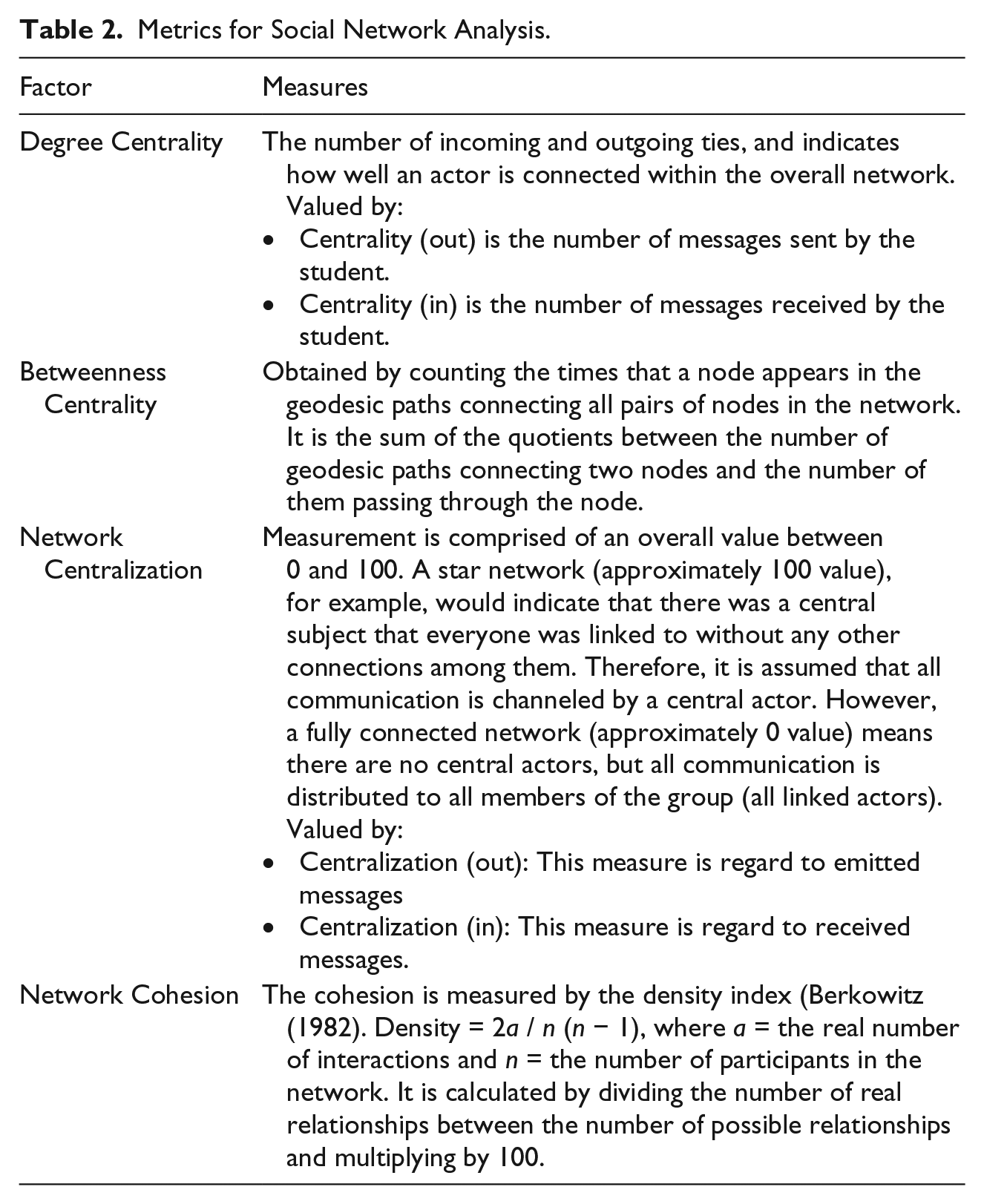
To measure centrality, two basic approaches have been considered: degree and betweenness. Degree centrality is the measure of the interaction considering the directionality of the sending or receiving of messages. The idea is that if a participant is central in their group, then they will be the most popular and get the most attention. Degree centrality is an important measure because previous research has found that it correlates with positive learning outcomes and performances (e.g., Cadima, Ojeda, & Monguet, 2012; Heo et al., 2010; Shea et al., 2010). There are two types of centrality: centrality based on in-degree (centrality [in]) and centrality based on out-degree (centrality [out]). Centrality (in) is indicator of network prestige (e.g., deLaat, Lally, Lipponen, & Simons, 2007), and centrality (out) is indicator of influence (e.g., Borgatti & Everett, 2006). Prestige measures the number of incoming responses directed to a student’s discussion post, and represents the degree to which other students seek out that student for interaction. Students with high prestige are notable because their opinions may be considered more important than others in the network (deLaat et al., 2007). Students with high influence are in contact with many other students because they initiate a large number of discussion posts to others (see Borgatti & Everett, 2006; Shea et al., 2013). Some authors found that students who occupy central positions in the formal network are more likely to put forward ideas and suggestions on teamwork (e.g., Bales, 1951; Paletz & Schunn, 2011; Venkataramani, Zhou, Wang, Liao, & Shi, 2016). Betweenness centrality is a measure of the extent to which a participant is connected to other participants who are not connected to each other. It is a measure of the degree to which a participant serves as a bridge or gatekeeper. Betweenness centrality views a student as being in a favored position to the extent that the student falls on the geodesic paths between other pairs of students in the network (Borgatti, Mehra, Brass, & Labianca, 2009), that is, more students depend on this student to make connections with other students. Participants with higher betweenness can also benefit from access to a wider source of resources, knowledge, and experience (e.g., Cho, Gay, Davidson, & Ingraffea, 2007). Therefore, a member with higher values of betweenness can control and change the communication flow to serve their own interests (e.g., Borgatti et al., 2009).
The use of the properties of the network of interactions for studying group learning is based on findings that show that group performance depends mainly on the interaction structure rather than on individual performance (e.g., Sauer & Kauffeld, 2013). The two most commonly used properties for analyzing the structures of interaction are network centralization and network cohesion.
Network centralization refers to the extent to which a structure of relationships is centered on a participant. Centralization of the network can be of two types: centralization based on in-degree (centralization [in]) and centralization based on out-degree (centralization [out]; Borgatti & Everett, 2006). Centralization (in) refers to the extent to which a group is focused on a participant who most group members directed their interventions toward. Centralization (out) refers to the extent to which a group is focused on a participant who among the group engages in most of the interventions. A positive correlation has been identified between cohesion and centralization (in). In addition, both variables in a discussion forum have direct effects on knowledge construction in communities of inquiry (e.g., Tirado, Hernando, & Aguaded, 2015). However, centralization (out) has also been shown to be inversely related (Thormann, Gable, Fidalgo, & Blakeslee, 2013) to categories (Newman, Webb, & Cochrane, 1995) of critical thinking; numerous studies show the negative effects on group performance in online learning (e.g., Sauer & Kauffeld, 2013).
Network cohesion describes the general level of linkage among the participant in the network (Scott, 2000). Network cohesion is the forces holding participants within their groupings (H. L. Yang & Tang, 2003). In some cases, high levels of cohesion can be a good predictor of teamwork, or the achievement of the learning task (e.g., H. L. Yang & Tang, 2003), and critical thinking phases (Aviv et al., 2003). In addition, the density of the connections in the group is frequently used as a performance indicator (e.g., Daradoumis, Martínez-Monés, & Xhafa, 2004).
So far, it has been difficult to determine the optimal rates of degree and betweenness centrality, centralization, and network cohesion (e.g., Hernández-García, González-González, Jiménez-Zarco, & Chaparro-Peláez, 2015; Lipponen, Rahikainen, Lallimo, & Hakkarainen, 2003) for ensuring that online learning experiences become positive. For example, Lipponen et al. (2003) emphasized the need to find the point of balance between the density and characteristics of the information flow. Another factor that influences the learning process is the type of learning task. Marton and Säljö (1976) studied different learning strategies used by students, and their different learning outcomes. Marton (1988) indicated that the lesson learned and how it is learned are two inseparable aspects of learning. Some studies have taken into account this premise, for example, analyzing the structure of the learning groups considering computer programming tasks (H. L. Yang & Tang, 2003). However, there are few studies that analyze the participation and social connections in learning groups online while systematically considering the learning task.
Bloom’s Taxonomy
Bloom’s taxonomy (Anderson, Krathwohl, & Bloom, 2001) is a well-known and widely used schema to organize learning and assessment of cognitive skills (e.g., Anwar & Sohail, 2014). Also, Bloom’s taxonomy has been used to better understand the systematic classifications and processes of thinking and learning in an online learning environment. Bloom’s taxonomy can be useful in leading a group of students through a learning process that uses an organized structure that contains increasingly complex thinking levels (e.g., Forehand, 2010; Hou, 2011).
For this study, the three highest levels of Bloom’s taxonomy were considered (Anderson et al., 2001): (a) analyzing, or breaking material into constituent parts, determining how the parts relate to one another and to an overall structure or purpose, through differentiating, organizing, and attributing; (b) evaluating, or making judgments based on criteria and standards through checking and critiquing; and (c) creating, or putting elements together to form a coherent or functional whole, and reorganizing elements into a new pattern or structure through generating, planning, or producing.
Considering these three levels of Bloom’s taxonomy, the authors designed an online environment for group learning, supported by the use of an LMS and discussion forums, which will be described in a later section.
Taking into account the background and purpose of this research, if the characteristics of the learning task are associated with the group learning process (e.g., Marton, 1988; Wertsch, 1991; H. L. Yang & Tang, 2003), then the participation and mediation level of students, and the cohesion and centralization level of the group will differ depending on the type of task. Therefore,
In group learning, some participants act as a bridge or communication channel between other participants, and they often coordinate group activity (e.g., Borgatti et al., 2009). The directionality of this intermediation, and to what extent students with high centrality send or receive messages, depending on types of learning tasks, controlling the communication flow is also a concern. Therefore,
On one hand, there is evidence that group cohesion has a positive influence on academic performance (e.g., Aviv et al., 2003; H. L. Yang & Tang, 2003) and group centralization has a negative influence on group performance (e.g., Sauer & Kauffeld, 2013) in online learning environments. On the other hand, there is also evidence that the student’s centrality in the learning group is a sign of prestige and influence on the group (e.g., Heo et al., 2010; Jo, Kang, & Yoon, 2014; Russo & Koesten, 2005; Toikkanen & Lipponen, 2011) and indicates positive results (e.g., Shea et al., 2010). However, there is no certainty of the association of student centrality and group cohesion. Also, there are no conclusive results on the influence of group centralization on cohesion. Therefore,
The study presented here focuses on social networks and on required tasks in collaborative online learning. Specifically, the authors considered that the type of learning task proposed in the learning environment is associated with the characteristics of the social network, at both the group and individual levels, and hence, there are associations among individual and network variables. Given this premise, the purpose of this study is to understand how the nature of the learning task modulates the social structure of the group in a self-regulated online learning environment and, consequently, to identify patterns of social structure suitable for higher learning tasks.
Method
Participants
Throughout three learning years, a total of 206 university students, from different degree areas and from eight universities of Andalusia (Spain), participated in this study. In the first year, 74 students participated in the course, 68 participated in the second, and 64 participated in the last year. Participants were randomly assigned to small groups of eight to 10 students.
Setting
The present study took place at the Virtual Campus of Andalusia, Spain, where students from eight public universities from the Andalusian region of Spain participated in a common online course through Moodle LMS.
The online course is called “Intervention on Risk Behaviors” and has been offered since 2008. It can enroll up to 10 students from each of the public universities of Andalusia; students are from different academic areas (social, engineering, experimental, and health). The course is considered an appropriate case for the following reasons: (a) its high rate of application (100% of places for students from each university are usually covered); (b) the quality academic outcomes, and its low dropout rate (10.6%, 2010-2011; 12.2%, 2011-2012; and 14%, 2012-2013); and (c) the different backgrounds and academic profiles of the students.
Moodle discussion forums were employed to facilitate content delivery and to promote higher order thinking skills among the students. The required tasks were based on the skills that are present in the top three categories of the revision of Bloom’s taxonomy. The course design was inspired by the model of Salmon (2004), because this provides a staged, practical approach to teaching and learning online. In accordance with this model, the course consisted of the following steps:
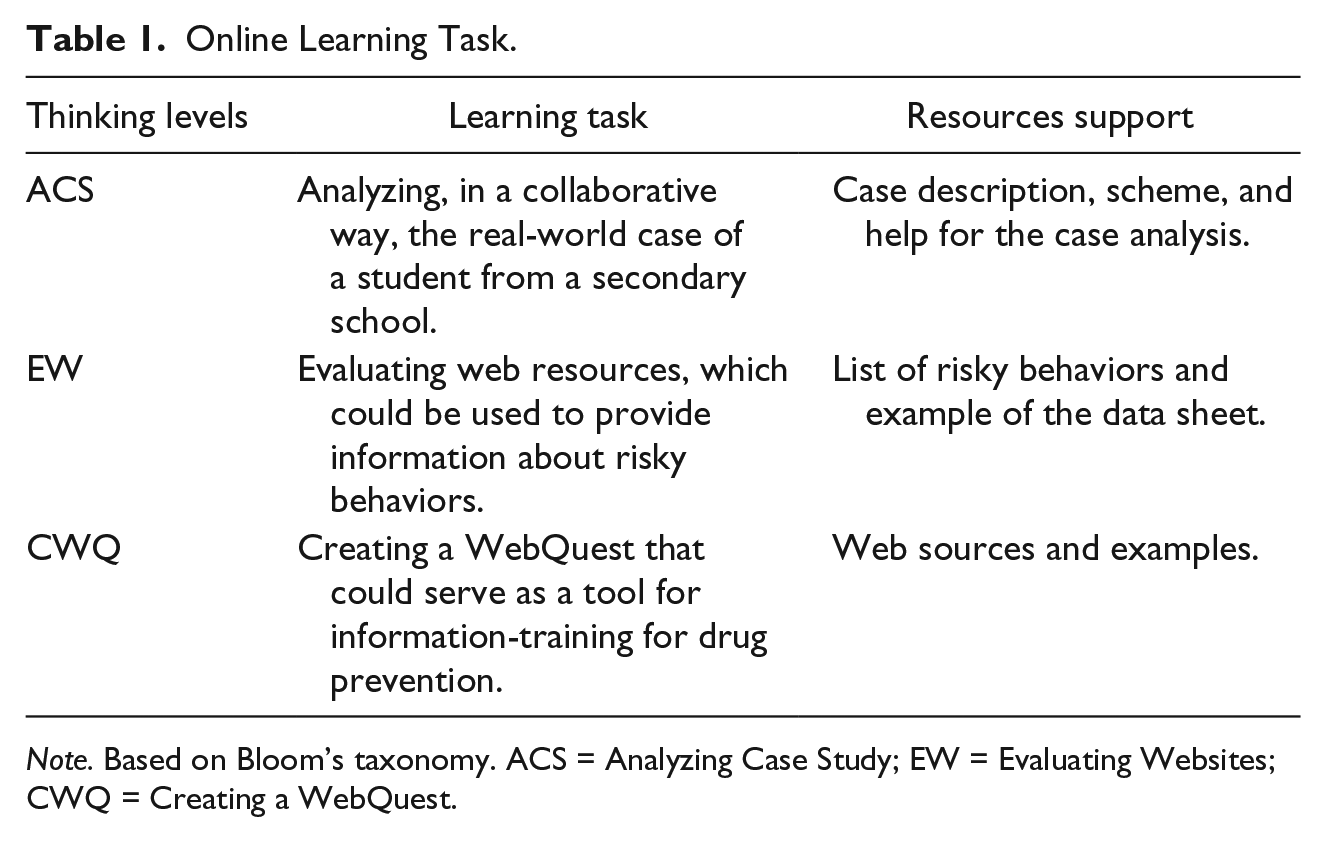
In Step 1, eight working groups were established and each one was assigned to a discussion forum, where students were given directions for how to proceed by the tutor. In Step 2, the first actions were performed, for students to socialize, exchange messages, interact, and learn. In the Step 3, three types of tasks were presented (Table 1), with different levels of cognitive demand that required participants in each group to share information, begin to engage in group work, and share the same learning goal. In Step 4, the learners focused on knowledge development and discussion activities.
Online Learning Task.
Note. Based on Bloom’s taxonomy. ACS = Analyzing Case Study; EW = Evaluating Websites; CWQ = Creating a WebQuest.
The proposed tasks had different levels of cognitive demand. The Analyzing Case Study (ACS) task was designed to engage students in a discussion forum to collaboratively analyze the real case of a problematic student. They received a brief description of the case, a forum of information, and different materials that could be used for analysis.
The Evaluating Websites (EW) task consisted of creating a web resources database, which could be used to provide information to families of adolescents and young people about risky behaviors. To complete this task, students were required to “make” a report of the websites selected, and their evaluation of these websites.
The Creating a Webquest (CWQ) task consisted of two phases. During the first phase, students were required to look for information about how to build a WebQuest. This task required exploring its components, determining what rules must be followed in its construction, and discovering good examples of how this tool has been used. In the second phase, each group was required to design a WebQuest, which could serve as a tool for drug prevention information and training. Upon completion of this task, all the WebQuests were uploaded to the network and shared.
For conducting the assigned tasks, each of the eight working groups was provided a private forum for working together, an open forum for discussion among the groups, and file space for uploading or downloading documents. Groups were offered theoretical and practical resources that could also serve as a reference and support the implementation of the tasks. Two different moderators were selected by the group to coordinate each task. Discussions were led by the moderator students, whose functions included stimulating and summarizing the discussion. One instructor monitored the interaction, becoming active only in case of necessity. As a result, teaching presence was not analyzed in this research.
Measures and Procedures
Data for the study were group discussions among the participating students. A total of 96 discussion forums were conducted: eight groups for three academic years, and for each of four group activities (including the first socialization activity; however, the socialization activity was not included in the analysis). Over the course of the project, participants have developed interesting proposals and resources. In addition, the experience has been evaluated as excellent and recommended by the students.
For SNA, the authors considered individual and group variables associated with the structure of the groups (Table 2). The messages were imported in the chronological order in which they were posted. The originator and recipient of each of the posts were identified. The data were entered into UCINET 6 for Windows (Borgatti, Everett, & Freeman, 2002), where rates of the different variables were obtained for SNA. Finally, data were imported to SPSS v.21 to conduct quantitative analysis.
Metrics for Social Network Analysis.
Regarding RQ1, data analysis was conducted through a descriptive analysis and ANOVA to identify significant differences between mean values. Levene’s test was used to test the condition of homogeneity of the variances. Variances were not equal. The Brown–Forsythe test (Brown & Forsythe, 1974) was then applied because it is a robust alternative to the statistical F test of ANOVA. Therefore, to perform the post hoc test for nonhomogeneous variances, the Games–Howell test is applied.
Regarding RQ2, to identify relationships between scalar variables, Pearson correlation analysis was used across the three types of learning tasks. To increase the visibility of the correlations between variables, scatter plots are used.
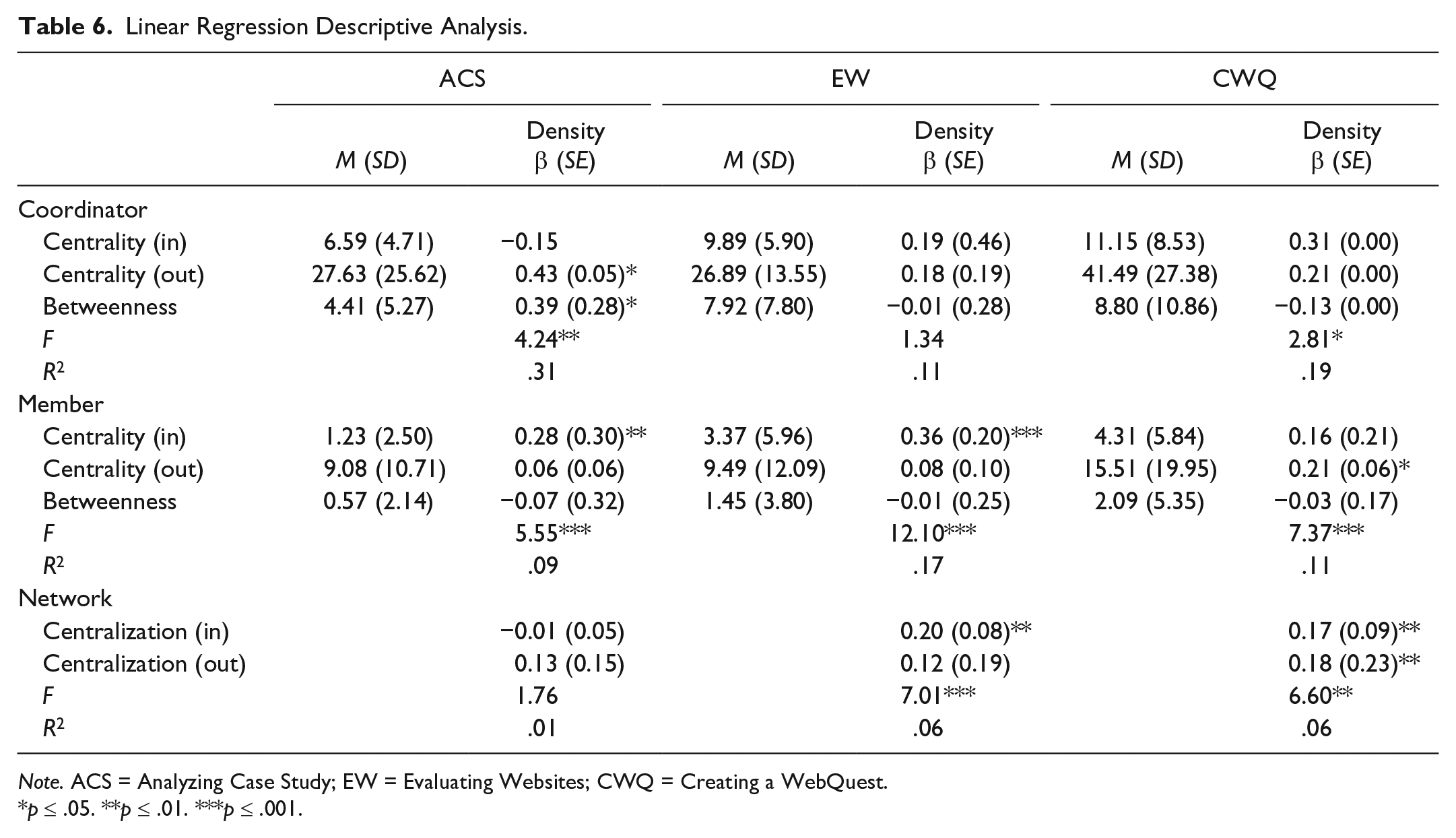
Regarding RQ3, to identify the association between the degree centrality/network centralization and network cohesion, a linear regression analysis was used. The independent variables were degree centrality of the coordinators, degree centrality of the members, and network centralization. The dependent variable was the density index.
Results
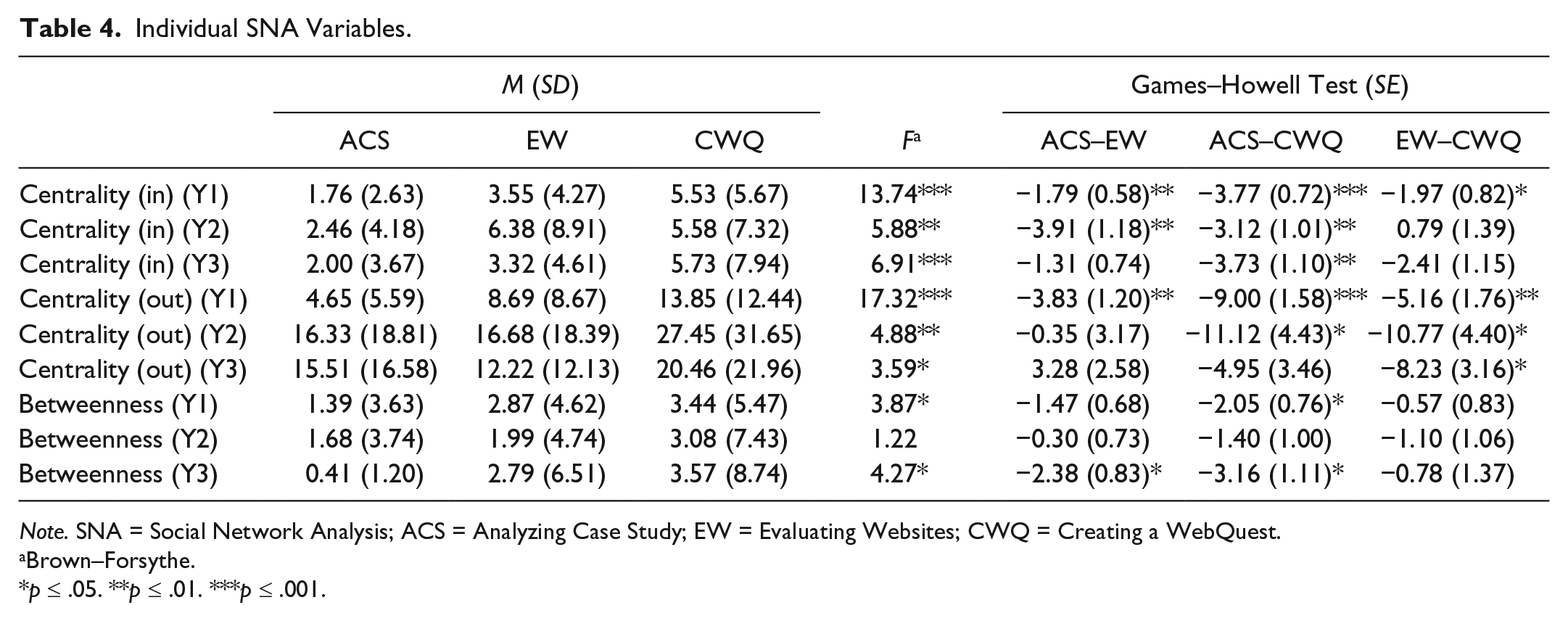
In answering RQ1 about the type of learning task modulating the characteristics of the network, SNA scores for group variables (Table 3) and individual variables (Table 4) are presented. Table 3 shows the variables’ density and centralization (in/out) index in the three tasks and the three learning years analyzed (Y1, Y2, Y3).
SNA Group Variable.

Note. SNA = Social Network Analysis; ACS = Analyzing Case Study; EW = Evaluating Websites; CWQ = Creating a WebQuest.
Brown–Forsythe.
p ≤ .05. **p ≤ .01. ***p ≤ .001.
Individual SNA Variables.
Note. SNA = Social Network Analysis; ACS = Analyzing Case Study; EW = Evaluating Websites; CWQ = Creating a WebQuest.
Brown–Forsythe.
p ≤ .05. **p ≤ .01. ***p ≤ .001.
As shown in Table 3, statistically significant differences are observed in the comparison of means of density across the 3 years. It should be noted that as the complexity of the task increases, the density index of the relationships in the working group also increases. Centralization (in) did not show significant differences between the three types of tasks in any of the three academic years. Regarding variable centralization (out), significant differences were observed in the second and third academic years. Significant differences between the values of the density and centralization indexes were identified through the Games–Howell test.
Regarding the measures of centrality, there were more significant differences between learning tasks in the degree centrality indexes than in the betweenness centrality (see Table 4). In general, in the three academic years analyzed, it was observed that the measures of centrality (degree and betweenness) increased as the opening of the learning task increased. The most significant differences between learning tasks were found in centrality (in). In this sense, centrality (in) was usually significantly lower in the ACS task than in the EW and CWQ tasks. Although in Year 3, centrality (out) in the ACS task was higher than in the EW task, this difference was not significant. With respect to the differences between tasks in centrality (out) and centrality betweenness, the results were not conclusive.
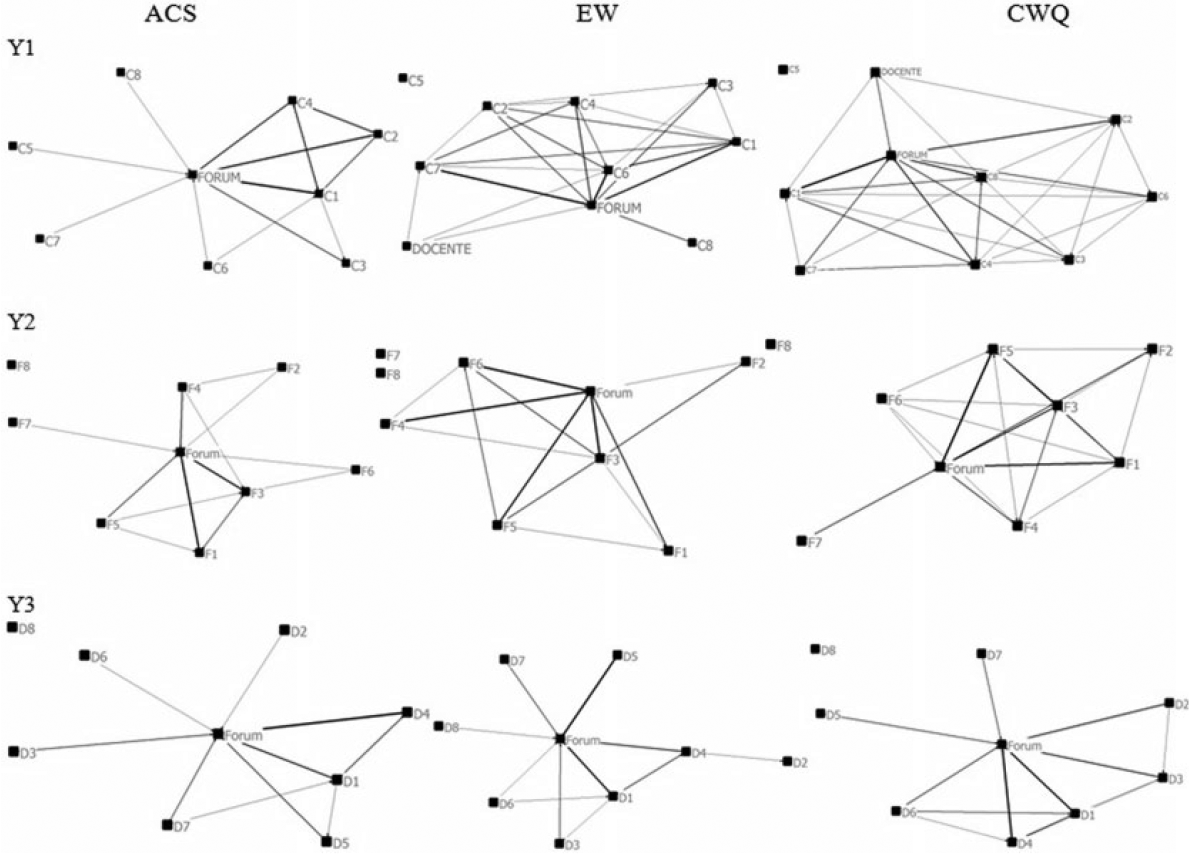
The authors randomly chose three groups to illustrate the network structure of the learning groups while they were performing a specific type of learning task. The chosen groups had a similar number of students (8-10). Figure 1 shows how the structure of the group varied depending on the requirement of the task. It is important to note that the discussion forum was central to the task of ACS across all 3 years, while, for the EW and CWQ tasks, the discussion forum became more displaced when central members in the groups became more prominent.
SNA networks.
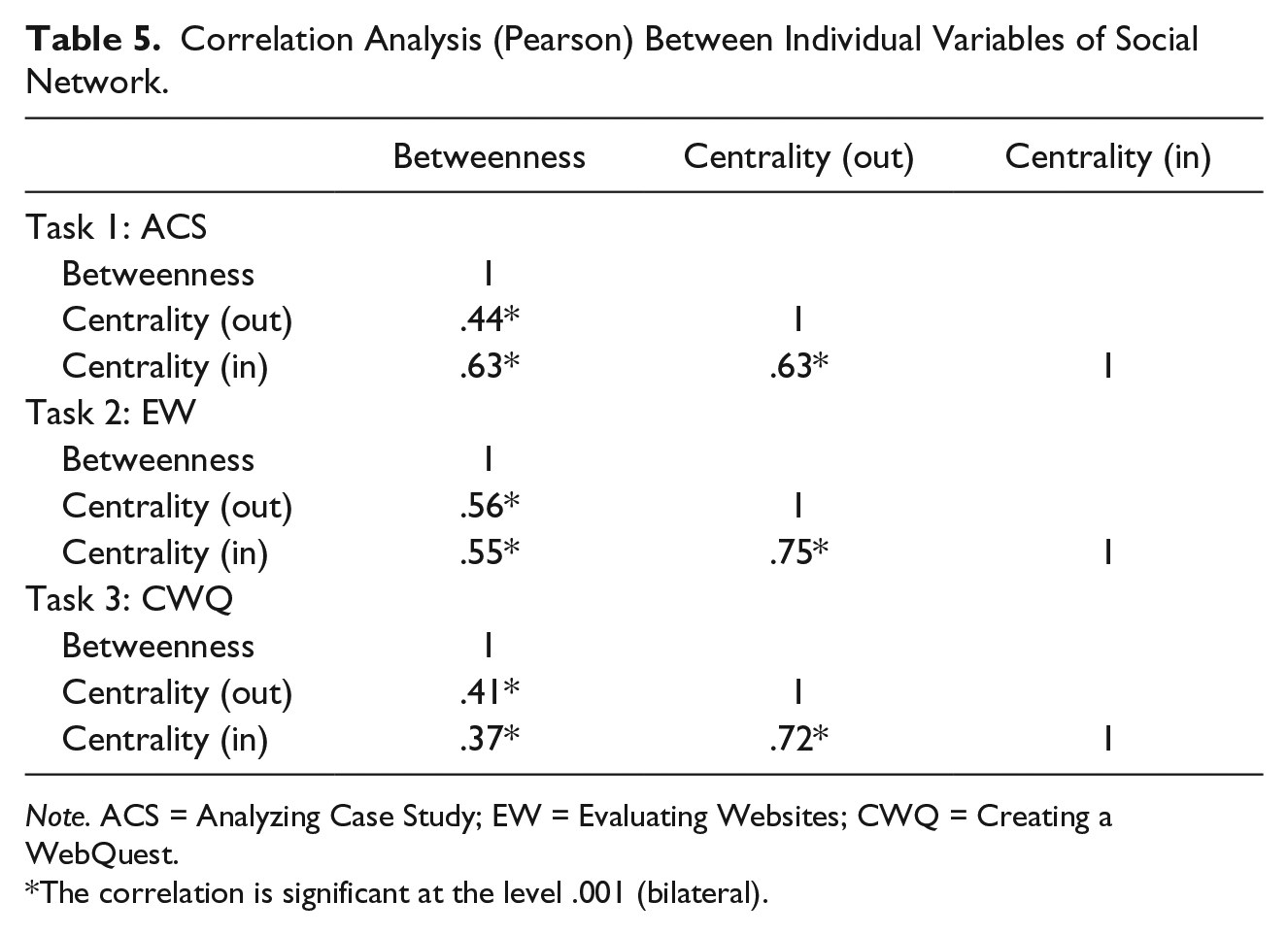
In answering RQ2 about the type of learning task modulating associations between degree centrality and betweenness centrality, it is noted that high correlation exists in every task between centrality (in) and centrality (out) (Table 5). In other words, the more students participated, the more messages they received. Furthermore, in the scatter plots (Figure 2), it is observed that members with a high level of betweenness were usually the coordinators of the task. However, some members have high levels of betweenness without being the coordinators.
Correlation Analysis (Pearson) Between Individual Variables of Social Network.
Note. ACS = Analyzing Case Study; EW = Evaluating Websites; CWQ = Creating a WebQuest.
The correlation is significant at the level .001 (bilateral).
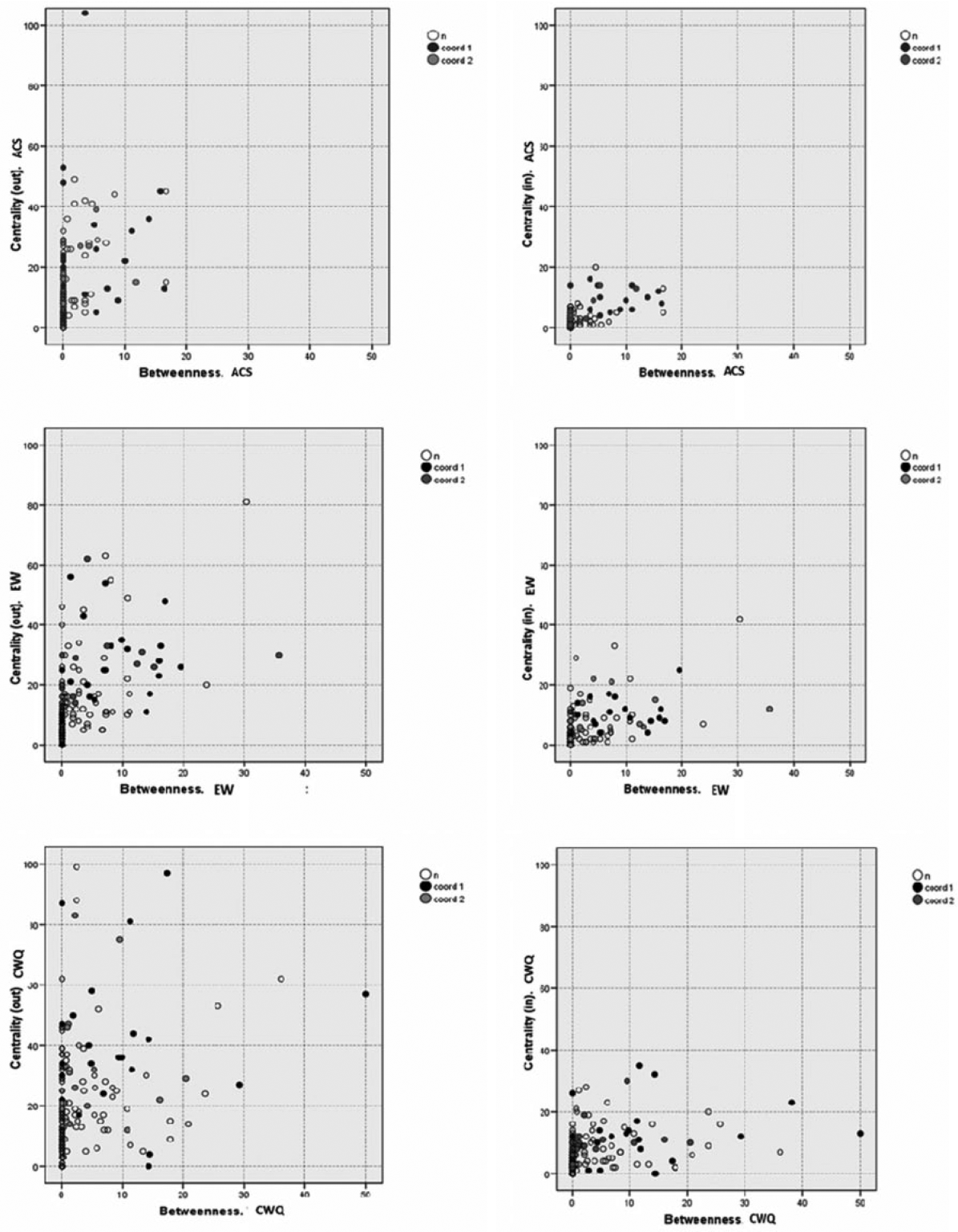
Scatterplots (betweenness centrality vs. degree centrality [out/in]).
Moreover, in the most structured task, ACS, it was more likely that betweenness had a direct relation to centrality (in) (r = .638; p < .001). In other words, the more structured the task, the more likely there was to be an increase in messages that are addressed to the members with higher betweenness. In this sense, in the ACS task, members with high betweenness received numerous messages.
Regarding the EW task, the correlation coefficients between betweenness and centrality (out) (r = .562; p < .001) and between betweenness and centrality (in) (r = .556; p < .001) were very similar. Therefore, members with high betweenness both sent and received messages.
Regarding the task of CWQ, a lower correlation between betweenness and centrality (in) (r = .370; p < .001) than between the betweenness and centrality (out) (r = .415; p < .001) was observed. Therefore, members with high betweenness submitted messages, rather than responding to colleagues messages (see Figure 2).
For RQ3 that asks if the type of task moderates the associations among variables, the linear regression analysis (Table 6) shows that the type of task determines the influence of centrality (degree and betweenness) and network centralization (out/in) on network cohesion. Specifically, in the ACS task there was a greater capacity to forecast the figure of the coordinators (R2 = .31) than other members (R2 = .09) and centralization (R2 = .01), on the density of the network. A positive influence of the coordinators’ centrality (out) (β = .43; p ≤ .05), as well as the centrality (in) (β = .28; p ≤ .05) of the rest of the group, on density was also observed.
Linear Regression Descriptive Analysis.
Note. ACS = Analyzing Case Study; EW = Evaluating Websites; CWQ = Creating a WebQuest.
p ≤ .05. **p ≤ .01. ***p ≤ .001.
However, in the EW task, there was a greater capacity to forecast group members’ influence on the density of the network (R2 = .17) than for the role of the coordinators (R2 = .11) and centralization (R2 = .06). A positive influence of the centrality (in) (β = .36; p ≤ .001) of group members and centralization (in) (β = .20; p ≤ .01) on the density of group relations was observed. Although the interventions by the coordinators positively influence the density of the group, this influence was not significant in this task (β = .19, p ≤ .05).
Regarding the CWQ task, there was a greater capacity to forecast the influence of the coordinator (R2 = .19) than other members (R2 = .11), and centralization (R2 = .06) on the density of the network. A positive influence of the centrality (out) of the group members was observed (β = .21; p ≤ .05). Both the centrality (in/out) of the coordinators and the centrality (in) of group members had a positive influence on the density of the group’s relations, although this influence was not significant. Both centralization (in) and centralization (out) of the group directly and significantly affected the cohesion—density—of relationships.
Discussion and Implications
In this study, SNA was used to analyze the structure of online groups involved in a collaborative learning environment while successfully completing their learning tasks. Three questions were examined in this study. Results for the first question showed that social networks were conditioned by the cognitive/meta-cognitive requirement of the task in online learning groups. Thus, the authors conclude that the CWQ tasks in online learning require a higher level of density than other lower level tasks in Bloom’s taxonomy, such as CSA and EW tasks. These results reinforce the findings of previous studies on communication networks in small groups, which conclude that networks with decentralized structures are suitable for complex tasks (Bavelas, 1950; Cummings & Cross, 2003; Leavitt, 1951; Shaw, 1964).
Moreover, levels of centralization of the group remained constant in all three types of tasks performed. The levels of centralization (out) obtained in the three learning tasks were low. Also, the levels of centralization (in) were higher, although it should be noted that the discussion forum was analyzed as an actor, which included all members of the group. Given that all the discussion forums and groups were highly efficient, these data support the results of studies carried out with small creative groups in companies that found that centralization does not facilitate group performance (e.g., Huang & Cummings, 2011; Sauer & Kauffeld, 2013). These data also support the results of studies in learning contexts in which the groups with the highest number of connections also have higher performance (e.g., Baldwin, Bedell, & Johnson, 1997).
Finally, in terms of individual intervention, it appeared that individual activity increased as the level of opening of the task increased. These results suggested that as the opening and complexity of the task increase, it becomes more necessary for all members to contribute their knowledge and information and thus increase the likelihood of identifying solutions for the proposed learning task (e.g., Larson, Christensen, Franz, & Abbott, 1998; Sauer & Kauffeld, 2013).
Regarding the second question, the results of the analysis of correlations between betweenness and degree centrality suggest that (a) students occupying a central place in the network—that is, greater intermediation—are most involved (e.g., Cho et al., 2007), and (b) interactions among group members change depending on the type of task. In more structured tasks, such as ACS, the most central members received many messages acting as reference members or coordinators. In more open tasks, such as CWQ, the most central members usually were very active in the group. For example, the ACS task requires precise knowledge of the case being studied, and it is reasonable that the coordinator, or the more central actor, acts as a consultant and intermediary among the group members and the case by providing crucial information for the analysis and resolution of the problem. Also, the CWQ task requires the design and development of an educational resource—WebQuest—without the group having previous guidelines; therefore, it is reasonable for the coordinator to participate and activate the group for the organization of the task. However, in the EW task—that is, the recompilation and evaluation of web resources—there is a balance between sending and receiving messages by the most central actor of the group, the coordinator. As it is a task that requires the group to elaborate on common evaluation criteria, it may be necessary for the central actor to activate the group to seek consensus.
Following this line of research, it will be interesting to further investigate the roles of the central actors, or coordinators, according to the group’s type of task. For instance, in one study (Marcos, Martínez, Dimitriadis, & Anguita, 2006), a conceptual framework is developed for the description of roles. In another study, Jo et al. (2014) differentiated between the roles oriented to the content of the task and the process, and associated them with the indexes of centrality. The results of previous studies often associate the decentralized interaction performance of the group, so it was beneficial to know how to integrate the largest number of group members in performing the task. In this sense, and regarding RQ3, the data suggested that the influence on the cohesion (density) of the group’s relations was determined by the learning task; these findings are similar to Sauer and Kauffeld’s (2013) findings.
In this sense, in the ACS task, data suggest that the coordinator was an important figure who promotes the density of relations in the group, through his or her interventions, and acts as a link among group members. These data suggest that for more specific learning tasks, it should be specified, as a task of the coordinator, that all group members contribute to the resolution of the case (Sauer & Kauffeld, 2013).
In contrast, in the EW task, data suggest that the density of connections among group members was mainly defined by the messages received by group members (i.e., guidelines, queries). In addition, the centralization of groups, both in the coordinators’ interventions and in channeling guideline/queries through discussion forum, favored the density of relationships in groups. In this sense, the discussion forum could act as a space for discussion and integration of evaluation criteria and web resources that favored participation of all group members (e.g., Tirado et al., 2015).
Regarding the CWQ task, data suggested that the interventions by group members were particularly significant. In addition, the centralization of groups, both in coordinators’ interventions and in channeling queries/responses through discussion forum, favored the density of relationships in groups. These results support the findings of Huang and Cummings (2011), who studied 177 small creative groups in a multinational company and assert that the increase in the number of connections in the group is associated with an increase in the distribution of information and expert knowledge (e.g., Huang & Cummings, 2011), with the distribution of information and knowledge being a positive predictor of group performance (Mesmer-Magnus & DeChurch, 2009). In the case of complex and unstructured learning tasks, such as the creation task presented in this study, the participation of all group members appeared to be an influential factor in the performance of the learning group.
It may be interesting to carry out studies similar to that of Cho et al. (2007) who analyzed the communication of coordinators with their colleagues, the progress of such interactions, and the ways in which coordinators increase the attention and participation of all group members.
Limitations
While it is possible to access large amounts of data related to online learning, deciphering this data into meaningful results is often complex, especially with regard to improving online learning (Reffay & Chanier, 2002). More studies are needed by the research community to verify the results of this study.
One limitation of this case study is that it focused on three learning tasks that attempt to represent the top three levels of Bloom’s taxonomy (analysis, evaluation, and creation). It should be noted that examples of tasks analyzed (case study, evaluation of websites, and creating WebQuest) are not exact with regard to each respective level. Given that it is difficult to find practical examples suitable for higher education to represent the exact taxonomic levels, it will be appropriate to specify learning objectives in each of the task areas (see Churches, 2008) and to conduct more modular analyses.
The authors believe that considering the timing factor during the process of social construction of knowledge and the SNA (e.g., deLaat et al., 2007) provide important inputs for regulation of the learning processes (e.g., to connect performance to social structure and pedagogy; Goggins, Galyen, Petakovic, & Laffey, 2016). Also, it is recommend that similar studies consider the characteristics of the participation of the individuals (i.e., questions, suggestions, directions) using content analysis. In this sense, structural analysis of social relations through the SNA and content analysis can be an important source for deepening learning processes in online environments (e.g., Jo et al., 2014; Rehm, Mulder, Gijselaers, & Segers, 2016).
Conclusion
This article examines how, in an online and self-regulated learning environment, communication structure and student participation are modulated by the nature of the learning task. To this purpose, 72 discussion forums, consisting of 24 groups of eight to 10 randomly assigned people, were analyzed during three academic years. Data showed that the nature of the learning task modulates the social structure of the group and the activity of the coordinators and group members. Moreover, density is selected as a SNA metric and indicator of cohesion, and it was found that the influence of the centrality and centralization on density depends on the type of learning task. In this sense, the study results suggest that as the task’s openness increases, interactivity should also increase among group members. Likewise, for the most structured tasks, the most central members of the group act as reference members, whereas in the more open tasks, they participate very actively. The data also suggest that in the more structured tasks, such as the case study, the coordinators occupy a central position that activates the participation of group members and their relationships. Also, in the less defined tasks, which require self-organization, the coordinators lead the participation of group members and the discussion forum becomes a favorable channel for exchanging ideas and information and for establishing common guidelines.
Finally, for future research the authors recommend using complementary methods to provide a more comprehensive understanding of the process and to study the content of the interactions while considering the roles of group members and coordinators as well as the nature of the learning task.
Footnotes
Declaration of Conflicting Interests
The author(s) declared no potential conflicts of interest with respect to the research, authorship, and/or publication of this article.
Funding
The author(s) disclosed receipt of the following financial support for the research, authorship, and/or publication of this article: This research was supported by the Ministry of Education, Spain, under research grant FPU-0142.