




Abstract
In this article of the “Interdisciplinary Insights Into Group and Team Dynamics” special issue, we provide guidance for computer scientists and social scientists who seek an interdisciplinary approach to group research. We include how-to guidelines for researchers interested in initiating and maintaining collaborations, and discuss opportunities and pitfalls of interdisciplinary group research. Last, we include a brief case study that portrays some of the complications of creating shared understanding.
As Kettner-Polley (2016) points out, many of the earliest attempts at group research were interdisciplinary in nature. A case in point was the Social Relations Lab at Harvard University, where social psychology, sociology, and cultural anthropology were combined in what was ultimately an effort that splintered in various ways (Kettner-Polley, 2016). Two things were learned from these early efforts. First, group research is not based within a single discipline but originated from several scientific disciplines. Over the years, more and more disciplines have become interested in studying groups. Second, there is not a single best way to study groups, although disciplines tend to have their preferable ways of approaching them. However, despite an early beginning that was quite interdisciplinary, true interdisciplinary group research is still the exception rather than the rule.
Overall, discourse about interdisciplinary research is increasing (Van Noorden, 2015). A recent special issue in Nature from 2015 showcased scientists, policymakers, and funders that believe interdisciplinary research is crucial for innovation. However, encouragement to engage in interdisciplinary research is only recently growing (Rylance, 2015).
Interdisciplinary research collaborations necessitate structures that allow and encourage the sharing of viewpoints and disciplinary assumptions (Klein, 2006; Ledford, 2015). The same is true for collaborative teams composed of computer scientists (or scientists with technical training background) and social scientists (or scholars with social scientific training background in disciplines such as anthropology, communication, organizational behavior, sociology, and psychology). Computer scientists and social scientists often have different approaches to scholarly endeavors, stemming from differences in education, training, and experience. Computer scientists are trained in applying and improving state-of-the-art mathematical algorithms to better extract and understand useful information from data (e.g., sensory data), and they are often inspired, and even expected, to develop direct and tangible real-world applications. Alternatively, social scientists create and test social scientific theory in relation to group dynamics and behavior, with the hope of producing a better descriptive and predictive understanding of how groups perform. Although there are some inherent connections between these two approaches, there also many distinctions between them. For example, social scientists use scientific approaches that do not align with data collection initiatives of computer scientists. Computer scientists generally expect quicker turnaround on publications and model creation, a process that is often in line with various rapid technological advancements (e.g., speedier and more powerful computing). For social scientists, on the contrary, collecting and analyzing group data is tedious and labor intensive (Wittenbaum & Moreland, 2008). Moreover, the publication cycle can be excruciatingly slow. In conjunction with other differences in workflow, incentives, and final goals, these differences can easily cause an interdisciplinary team to become dysfunctional (e.g., DuRussel & Derry, 2005).
To improve the chance for interdisciplinary success, we recommend that interdisciplinary team members have initial and continual discussions before and during collaboration to clarify viewpoints and expectations. Success is often dependent upon members acquiring a sufficient level of knowledge about other team members’ approaches to understand and coordinate team efforts. The purpose of this article is to provide guidance on how interdisciplinary team members can create shared understanding during the initiation and maintenance stages of the team project.
Before continuing, it is also important to consider what success looks like for team collaboration, especially among social scientists (i.e., groupies) and computer scientists (i.e., geeks). Although the purpose behind this essay is interdisciplinary collaboration, sometimes efforts may lead to multidisciplinary efforts instead. The distinction between the two is important. Interdisciplinary work involves combining and synthesizing research approaches from various disciplines to accomplish an integrative purpose (Klein, 1990, 2010). On the contrary, multidisciplinary work is additive instead of integrative, in that “disciplinary perspectives are not changed, only contrasted” (Choi & Pak, 2006, p. 352; see also Huutoniemi, Klein, Bruun, & Hukkinen, 2010; Klein, 2010). Each approach has its own merits, which should align with the purpose of the project. The types of collaborative teams we are promoting in this article are interdisciplinary in nature; our hope is that teams will achieve a greater overarching, integrative output that represents a successful blending of social scientists and computer scientists.
As scholars attempt our suggestions, there are sure to be successes and failures. Any set of guidelines, even when followed, does not guarantee success. However, such collaborative failures may have additional outcomes (e.g., learning new disciplinary assumptions, creating collaborative norms) that are beneficial to future endeavors. Of course, failures are often the first steps to success. As Thomas Edison once said in referring to experiments on creating a new battery, “I have not failed. I’ve just found 10,000 ways that won’t work” (quoted in Furr, 2011). Having such expectations ahead of time may prevent discouragement when proceeding forward on an interdisciplinary project.
Initiating Interdisciplinary Collaboration
One of the overall goals of the initiation phase in interdisciplinary collaboration should be to obtain a general understanding of each other’s research aims and goals (e.g., DuRussel & Derry, 2005; Klein, 2005, 2013). As collaboration teams often have emergent goals, this step may occur across several meetings. This common understanding may be similar to a shared mental model that could guide meeting discussion (DuRussel & Derry, 2005). The desired shared understanding may also be quite complex and multidimensional in nature (for more on multidimensional collaboration, see Mansilla, Lamont, & Sato, 2016). Thus, the initial meeting may be an important starting point for the creation of an interdisciplinary team.
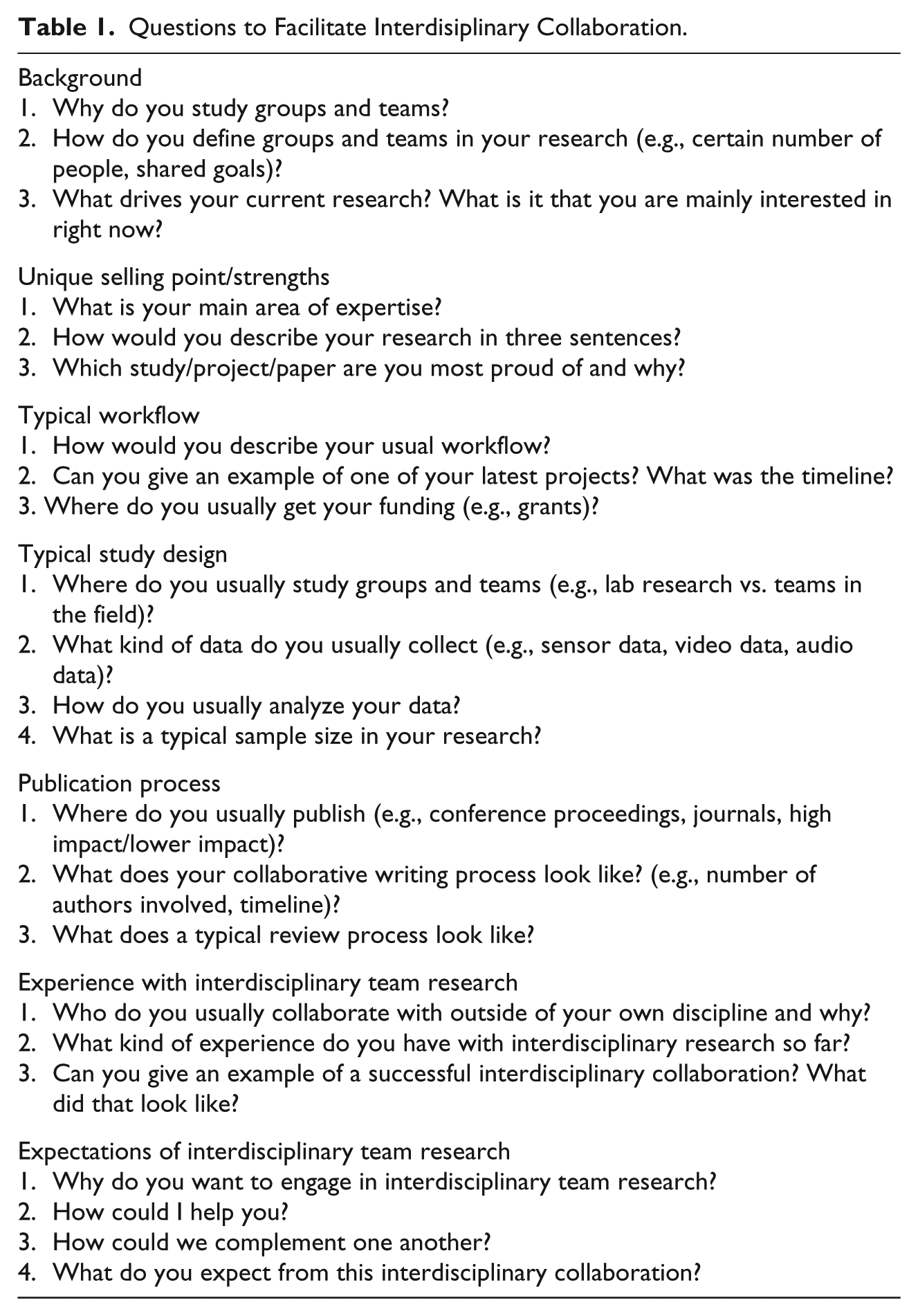
To help facilitate this goal, the premise of any initial meeting involving interdisciplinary collaborators should be centered on two questions: (a) What is it that we need to know about the other discipline? and (b) What do other researchers need to know about us? In this article, we provide suggestions that may be beneficial when starting research collaboration between computer scientists and social scientists. These techniques were developed during a recent interdisciplinary 4-day workshop (Lehmann-Willenbrock, Hung, & Keyton, 2017, in this special issue). In the initial meeting, it may be helpful to put research agendas aside and simply ask about the other group members. These questions should touch on several topics, including educational background and prior experience with interdisciplinary collaboration, strengths of individual members, typical workflow and study design, the publication process, and previous experience in interdisciplinary teams. The questions in Table 1 may be helpful in this discussion.
Questions to Facilitate Interdisiplinary Collaboration.
It may also be helpful to have individuals create 2- to 3-min pitches that quickly provide an overview of past research. Even though short introductions will not reveal the depth necessary to understand assumptions about research design and expectations, it will provide a starting point from which to talk about more specific differences and, more importantly, a starting point for questions. Shorter pitches are beneficial as long expansive presentations may lead scholars to talk past one another as they are coming from different starting points. Importantly, the creation of short pitches will force collaborators to reflect on their own research and how individuals outside of the discipline may view it. Pitches may include (a) research interests and expertise; (b) select papers, slides, and tutorials; and (c) common questions that each collaborator should answer. During these pitches, it is also important for researchers to be explicit about their desired outcomes for the collaboration, as understanding collaboration incentives reveals much about researcher motivations, especially as some disciplines do not privilege publications.
In addition to meetings, it may be helpful to participate in longer shared experiences with other scholars. For both visiting scholars and host research groups, research visits would be beneficial to exchange research ideas, methods, tools, and data. An example of multi-institutional and international exchange programs is InterACT (The International Center for Advanced Communication Technologies; http://interact.anthropomatik.kit.edu/index.php), which allows students to visit other universities in the network and learn about other disciplines and shared tasks.
Of course, such exchanges may not be feasible early on, especially if one of the goals of the interdisciplinary collaboration is to obtain future funding. A simple workshop where individuals can express desires and hopes in a loosely structured environment may likewise be helpful. Online technologies may also be helpful in these initial meetings, but it is important that whatever medium is used allows for the free flow of discussion in a nonjudgmental environment.
Maintaining Interdisciplinary Collaboration
Of course, mutual understanding will need to be maintained as interdisciplinary teams evolve during the research process. As different research questions emerge, assumptions and expertise will need to be revisited. Such an expectation is essential for effective interdisciplinary teams. Of course one advantage will be that later discussions can focus directly on the subject matter at hand, as opposed to initial abstract conversations. But these conversations can likewise be difficult without a predetermined structure for obtaining shared understanding. Moreover, facilitators play a crucial role in ensuring the flow of the information between two disciplines is as smooth as possible. A single facilitator may be helpful if neutral in terms of expertise. However, the idea to create an interdisciplinary project often leads to two emergent facilitators, one representing computer scientists and the other representing social scientists. Facilitators need to not only make sure the information is coming from both sides, but that, more importantly, the information is presented in a way that leads toward fostering of mutual understanding. With differences in assumptions, expertise, viewpoints, and even approach to a common subject matter, shared understanding can be hard to achieve without a key person(s) facilitating such an exchange.
True interdisciplinary collaboration probably cannot be achieved until some shared experience exists. Due to this fact, it may be helpful to focus on a smaller collaborative effort at the beginning. If there is some low hanging fruit, or a research topic that is directly aligned with both sides’ interest, then it may provide researchers with the best opportunity to work with one another. This experience is invaluable, as interaction during a research project will be evidence of the similarities and differences across interdisciplinary researchers. It may also be helpful to start with one discipline heading a smaller research project, or for collaborators to join in a producer–consumer relationship (see Fisher et al., 2017, in this special issue for further discussion of the similarities and differences and development of the producer–consumer relationship). Any joint experience among researchers will help develop shared understanding among collaborators for a future project.
Importantly, any initial joint projects should be intellectually enriching for all scholars. This may require some flexibility on all sides. The excitement of collaborative work emerges as individuals internalize and appreciate the potential of collaborative efforts. Interdisciplinary teams that are caught in bureaucratic busyness and miscommunication are often unproductive and unfulfilled. Such negative experiences put a project at risk, especially as collaborative efforts require more time and energy than disciplinary projects. By focusing on mutual intellectual curiosity, collaborative momentum can be sustained. Also, achieving small milestones as a result of collaborative research is essential in slowly building the momentum and scaling up the interdisciplinary effort. Each party involved is likely to be positively rewarded through even small successes.
It is also beneficial to learn from past success of other interdisciplinary teams. Inviting external individuals to share success stories from their previous collaborations may be helpful. A multimodal communication approach may also help individuals find a medium that best allows them to participate. As it may not be feasible to meet face-to-face on a regular basis (although we encourage it at least occasionally, and especially initially), online technologies allow teams to adapt communication for the discussion, data storage, and coordination needs of the team.
Perhaps most importantly, interdisciplinary teams should strive to create an assessment process to evaluate team processes during the project. Such a structure creates the expectation of assessment and critical evaluation of one’s own and others’ contributions. As literature on groups has pointed out, too often, teams are unaware of dysfunction in team dynamics until problems arise (e.g., Janis, 1972). Even brief discussions where team members mention ways that communication can be improved or discuss gaps in member knowledge can go a long way toward establishing effective team interaction processes. The establishment of an assessment structure should transpire early on in the process, as attempting to create one during collaboration can cause group members to be defensive. In addition, rotating the assessment facilitator may prevent feelings that a certain discipline holds more weight in the group. These assessment processes can be a strong source of unveiling assumptions and creating shared understanding.
Case Study: A Lesson Learned
The workshop that was the foundation for this special issue displays evidence of the suggestions in this essay (Lehmann-Willenbrock, Hung, & Keyton, 2017, in this special issue). Below is a brief description of the initiation and maintenance stages of the workshop. In addition, a few things we learned through the experience are also highlighted.
Initiation Stage
Twenty-five scholars equally distributed between social scientists and computer scientists attended the “Interdisciplinary Insights Into Group and Team Dynamics” conference (July 10-13, 2016). The first day was designed to build common language and understand the goals of each discipline. In addition, we compared the approaches that each domain (social scientists and computer scientists) usually follows to analyze and model small group interactions. To facilitate these goals, each individual gave a 2-min pitch to introduce ourselves, with three PowerPoint slides that covered the following instructions:
Affiliation: A picture of yourself, your name and affiliation, keywords of what your research is about.
Positioning: Answer a question: “I am a geek/groupie because . . .” Aside from whatever reasoning you want to provide, you can also list up to three of your publications as evidence to support your evaluation.
Research Challenge: State three to five major challenges related to the themes of the workshop with respect to:
a. Research challenges (e.g., what problems are you struggling with in the context of your research topic?)
b. Infrastructural challenges (e.g., what do you perceive as the practical bottlenecks bringing together these research domains?)
c. Multi/interdisciplinary challenges (e.g., what do you perceive as the disciplinary bottlenecks in bringing together these research domains?)
To help individuals become aware of who they were talking to during the workshop, a colored sticker system was used to distinguish between social scientists, computer scientists, and both. According to the pitches, 10 participants (40%) described themselves as social scientists (Groupie), five participants (20%) as computer scientists (Geeks), and 10 participants (40%) as both. Interestingly, participants who indicated that they were both were mostly affiliated with computer science departments. Below are some excerpts from introductions of both participants.
● 90% Geek: I’m a computer scientist and I get excited about how to link sensor data to machine learning methods, 10% Closet Groupie: So far, only tested in multi-party role-play scenarios. Research findings in social science inspire my inner geek. ● More Geek, less groupie (Have started doing research on groups of people in the last 2 years). ● I am fascinated by the possibilities that computer science/algorithms can provide for psychological research. I want to learn more about how behaviors of trainers, leaders, or facilitator impact the behavior of dynamic groups.
These introductions indicate that the distinction between computer scientist and social scientist was often unclear. Although this was not unexpected, and in many respects a desired member characteristic, it did present some difficulties. Many individuals saw themselves in both camps, and their research assumptions reflected both social scientist and computer scientist approaches. Thus, it became apparent and important to realize that a simple distinction between computer scientist and social scientist would not suffice as a starting point while trying to achieve shared understanding.
Maintenance Stage
The majority of the workshop involved plenary sessions with the entire group and smaller breakout sessions of equally distributed computer scientists and social scientists. The plenary presentations ranged from sharing research projects and innovations as well as past interdisciplinary collaboration experiences. In the first session, we took the AMI corpus (Carletta et al., 2006) as an example to discuss research approaches. It was obvious that we were all interested in social dynamics and human behavior, but we found that research approaches across disciplines were quite different. For example, the granularity of phenomena was quite different across the two disciplines. In addition, social scientific approaches involving theory and hypothesis testing could be quite different from computer scientists who were developing autonomous agents; however, these approaches were not mutually exclusive. These conversations also helped scholars to understand common words that were used differently by participants (e.g., theory).
However, the breakout sessions may have been even more important to the overall purpose of the workshop. As it was difficult to achieve shared understanding, breakout sessions of four to five members were organized so that social scientists and computer scientists could interact at a more intimate level. These conversations were incredibly beneficial as it enabled all workshop members to actively participate in conversations about assumptions. Thus, an important lesson workshop members learned was that the ability to truly engage one-on-one with individuals of another discipline was essential to reaching better shared understanding. The progress is these sessions eventually led to better communication when meeting all together and when organizing the various articles for this special issue.
Conclusion
In interdisciplinary team efforts, it is important to generate a shared sense of understating across members. Interactions at the beginning and during team collaboration can help improve shared understanding across group members. To perform truly interdisciplinary efforts, especially between social scientists and computer scientists, the inclusion of systematic processes and procedures is essential. In addition, our case study also demonstrated the importance of considering members who overlap disciplines as well as the importance of one-on-one interactions across disciplines for shared understanding.
Footnotes
Declaration of Conflicting Interests
The author(s) declared no potential conflicts of interest with respect to the research, authorship, and/or publication of this article.
Funding
The author(s) received no financial support for the research, authorship, and/or publication of this article.