



Abstract
Online support groups are a common way for people to receive social support. Utilizing online support sites allows members to connect with people in similar situations, without the need for geographic proximity. Many online groups rely on member-leaders, or individuals with personal experience, to lead groups. These member-leaders are often favored by members over professional leaders but often lack training in leadership. This project explored how member-leaders interact in an online support group. This article uses both interaction process analysis (IPA) and research on leader behaviors to understand how member-leaders communicate in online support groups. Results show that leaders primarily use task messages, with the majority of leader behaviors labeled as meaning attribution and use of self. Member-leaders primarily focused on perspective taking rather than discussion facilitation. An examination of the task and relational interaction profile in terms of leader behaviors is also explored.
Online support groups have become a common way for people to seek and receive social support (White & Dorman, 2001). Support groups provide an opportunity for people to have support needs met by similar others. For example, Kodatt, Shenk, Williams, and Horvath (2014) found online peer-to-peer interactions were useful for people dealing with long-term illness as they could share strategies for improving their health and receive emotional support from others. The need to talk with others who share common suffering is the very reason that these groups exist.
The ability to receive this support online can be particularly important in some circumstances. Many members seek out online support because of the anonymity of those groups. The 24/7 availability of boards allows members to access information whenever they need it, and allows them to construct messages and responses at their own pace (White & Dorman, 2001). Many members who have a stigmatizing illness seek out online support groups because they can avoid the negative judgments associated with their health condition (Beck, Paskewitz, Anderson, Bourdeaux, & Currie-Mueller, 2017). In addition, members who are isolated and unable to attend face-to-face support groups can use online support as a way to connect with others on a global scale (White & Dorman, 2001).
Within online support groups, members interact to gain information and support. The interaction that occurs can be challenging as members may struggle to develop relational intimacy without face-to-face interaction. This is where a leader can help. Many online support groups turn to member-leaders to help facilitate group interaction. Member-leaders are nonprofessional group leaders who often have personal experience with the disorder. Many group members prefer working with member-leaders who have personal experience with the situation versus professional training (Cline, 1999). This personal experience allows members to feel encouraged and supported by a peer with similar experiences. Experienced members are often viewed as more credible than professional leaders (Pomery, Schofield, Xhilaga, & Gough, 2016), and as role models for new members to emulate (Cline, 1999). Using member-leaders has both benefits and costs for groups. Although member-leaders can provide insight from an insider’s perspective on the health condition, they may lack the skills needed to lead the group (Pomery et al., 2016). Member-leaders also face the challenge of facilitating both discussion and support among members of the group. Their experience allows them to be strong mentors for struggling members; however, they must also facilitate support contributions from other members as well (Cline, 1999).
Online social support groups offer many benefits for members, as they can connect with and learn from other people going through similar situations. Although member-leaders can be beneficial for groups (Beck & Keyton, 2014; Cline, 1999), it is unclear what behaviors are used by online member-leaders during group interaction. This research study sought to explore how member-leaders in an online support group community provide leadership to the members of the group. Member-leaders are “members who will be here to help encourage positive member interaction, member involvement, and foster a sense of community” (DailyStrength, 2016, p. 1). To explore member-leadership in this context, two approaches were taken: First, the project explores what leadership behaviors are present in group interaction. Second, the study explores the task and relational messages used by member-leaders, and how those task and relational messages aligned with specific leader behaviors within interaction.
Support Group Leadership
Leadership in support groups can take one of two approaches: professional or member-led. In professionally led groups, the leader has some training in groups or human processes (Rosenberg, 1984). Professional leaders are responsible for facilitating interaction, managing conflict, and fostering a safe space of sharing (Cline, 1999). Historically, professional leaders come to groups as the knowledge owner and are often distrusted by some group members (Balgopal, Ephross, & Vassil, 1986). More recently, some support groups have switched to member-led approaches. In member-led groups, the leader is someone with personal experience with the health condition (Cline, 1999) and is indigenous to the group (Schiff & Bargal, 2000). Online groups tend to rely on member-leaders (Kodatt et al., 2014; Lieberman, Golant, Wizlenberg, & McTavish, 2005). Member-leaders come from the helper principle, where more experienced members become leaders and role models for members of the group (Cline, 1999).
Member-leaders face many challenges in guiding groups. “Group leaders are typically self-selected and motivated by the desire to help others, while at the same time placing themselves into a role they may know very little about” (Pomery et al., 2016, p. 673). Although professionally led and member-led groups are both effective (Lieberman, 2008; Lieberman et al., 2005), member-led groups function differently. For example, Lieberman et al. (2005) found member-leaders responded differently to emotional responses than professional leaders, but were still effective. Peer interactions can be very beneficial for members as they share ways to improve and receive emotional support (Kodatt et al., 2014).
Whether a professional leader or member-leader of a support group, all leaders engage in certain behaviors to guide their group, though they may vary in frequency, intensity, or pattern (Lieberman & Golant, 2002). According to Lieberman, Yalom, and Miles (1973), support group leaders utilize five behaviors that encompass both task and relational concerns. Evoke-stimulate has leaders using techniques to engage with participants and elicit emotional responses (Lieberman & Golant, 2002). Leaders may do this in many ways, including challenging members, asking questions, inviting participation, and confronting member ideas. Evoke-stimulate behaviors are common for leaders to use, but they are often not noted as important by members of the group (Shechtman & Toren, 2009). Meaning attribution refers to behaviors that help group members understand their situation by explaining, clarifying, or offering alternative interpretations (Lieberman et al., 1973). Leaders can be viewed as meaning creators, as they help members understand their situation and move forward with their lives. Using meaning attribution behaviors increases self-disclosure among members and decreases resistance (Shechtman & Toren, 2009). Support-caring behaviors are attempts to offer affection, friendship, or support for members. These behaviors demonstrate care and concern from the leader, can help members feel safe sharing in the group space (Lieberman & Golant, 2002), and facilitate bonding with the leader and with the group (Shechtman & Toren, 2009). Executive management refers to leaders’ attempts to manage group interaction. This can include setting limits, suggesting rules, limits, and norms, and managing time, which provide direction and structure for the group (Polcin, 1991) and can increase group bonding (Shechtman & Toren, 2009). Finally, use of self includes revelations from the leader about their feelings and values which creates leader transparency within the group (Lieberman & Golant, 2002) and can increase bonding among group members (Shechtman & Toren, 2009).
In general, professional leaders tend to use more meaning attribution and executive-management behaviors when leading a group. However, these leaders have facilitation training that member-leaders do not have. It is likely that leadership behaviors differ for online member-leaders. Member-leaders have personal experience with the health condition and may be more sympathetic to the experiences of members, which may distinguish them from professional leaders. For example, Beck and Keyton (2014) found member-leaders used high levels of information giving and agreement statements. These leader behaviors are crucial for supporting group effectiveness and success (Pomery et al., 2016). Given the difference between member-leaders and professional leaders, the first research question explores what behaviors are used by a member-leader:
Task and Relational Group Interaction
The primary goal of support groups is to provide support and care for one another, and such support is generated through group interaction. All group interaction is characterized by task and relational messages, both of which are important in support group settings. Task messages can be characterized by asking for or sharing information, opinions, and suggestions pertaining to the group’s purpose (Bales, 1950b). In contrast, relational messages are those that focus on creating or hindering the relational fabric of a group (Keyton & Beck, 2009). Previous research has noted that task messages tend to dominate discussion, at least in terms of frequency (Beck & Keyton, 2014; Beck et al., 2017; Keyton & Beck, 2009).
Both task and relational messages can be used to accomplish a variety of outcomes. Task messages are common in settings where the goal is instrumental (Peña & Hancock, 2006). In these situations, task messages move the group closer to goal accomplishment (Keyton & Beck, 2009). However, task messages can also provide support to individuals. For example, Beck et al. (2017) found that a depression support group used primarily task messages, and these task messages helped facilitate social support among members. Although affiliation needs are important in groups, at times task talk may dominate given task messages accomplish goals (Keyton & Beck, 2009). Relational messages are also important for all group interaction, and their lower frequency may allow them to have greater influence when they are used. Often, groups rely on task interaction early on in group life to create a therapeutic environment with structure and roles, but later focus on relational messages as the leader becomes a model participant for the group (Kivlighan, 1997).
In support groups, leaders must find ways to balance the various task and relational concerns of members and the group. Scholars have found that leaders must navigate task and relational concerns to improve group effectiveness (Burke et al., 2006). For example, leaders must be able to help change focus and clarify comments (task concerns), while also showing support for group members (relational concerns; Beck & Keyton, 2014). This requires leaders to balance both task and relational concerns to help the group run effectively.
Member-leaders are faced with the challenge of attempting to encourage interaction among a large group of members, while also coping with similar issues themselves. In this role, it is expected they will use more task messages than other members to support group interaction. Specifically, as noted by Kodatt et al. (2014), support group leaders primarily exhibit mentoring/feedback messages to guide the group and moderate discussion. However, as noted by Beck and Keyton (2014), many of these facilitation and caretaking behaviors in support groups occur with task talk, even though the presumption would be relational talk. Task talk can have relational influence and can help accomplish relational outcomes. For example, a message may be coded as gives information, but by receiving that information, the member feels encouraged and empowered. Given the predominance of task talk in previous member-leader studies, the following hypothesis is posed:
Task and Relational Dimensions of Support Group Leadership
Leaders must balance both task concerns (i.e., structuring interaction, clarifying member roles) and relational concerns (i.e., building personal relationships with members; demonstrating genuineness, empathy, and warmth) in the group to reach peak effectiveness (Dies, 1983; Higgenbotham, West, & Forsyth, 1988; Kivlighan, 1997). Dies (1983) notes that leaders focus on task concerns, similar to executive management and meaning attribution, to successfully lead the group, and focus on relational concerns, such as those demonstrated through support caring and use of self, as the group grows and matures. As member-leaders interact with members, they may utilize a variety of task and relational messages (e.g., gives information/orientation; shows solidarity/seems friendly) to meet both task and relational concerns. Therefore, this study explored how member-leaders behaviors (based on the Lieberman et al., 1973 framework) align with task and relational messages (from Bales, 1950a) within group interaction. The project took a process-only view, meaning the focus was on interaction alone, rather than effects of the interaction on members or the intention of member-leaders.
For evoke-stimulate emotion, leaders are attempting to elicit emotions from the group members. In doing so, leaders may ask questions, challenge members, or invite participation from members (Lieberman & Golant, 2002). Through these behaviors, leaders are not only structuring interaction and leading the group (task concerns) but also attempting to engage and connect with participants (relational concerns). Given evoke-stimulate emotion has both task and relational concerns within it, the following research question is posed:
Within the support-caring function, leaders are expected to provide support, affection, and friendship to group members. These represent relational type messages that reflect a general climate of concern for the fellow member. However, previous work has found that relational outcomes are accomplished through task messages as well as relational messages (Beck & Keyton, 2014; Beck et al., 2017). Given the role both task and relational messages play in creating support within a group, the following research question is posed:
The use of self leader behavior focuses on how leaders share personal stories, feelings, or behaviors. For groups with member-leaders, the leaders themselves are also either struggling with or have previous experience with the health condition at hand. These member-leaders navigate the group by taking on a role to guide group discussion, while also attempting to get the needed support themselves. As Lieberman and Golant (2002) note, the use of self behavior is similar to evoke-stimulate emotion as leaders are sharing information that puts them in the forefront. However, as mentioned earlier, evoke-stimulate emotion can meet both task and relational concerns through both task and relational messages. In this situation, the same may be true as leaders share personal stories of their own experiences with the health condition, but also personal opinions and feelings that represent the group climate at the time. Thus, the final research question is posed:
In regard to meaning attribution, leaders focus on helping members deal with tension associated with personal change and growth. Through efforts to encourage understanding and assisting with interpretation of the world, leaders help foster cognitive change to assist in coping with the health condition (Lieberman et al., 1973). With the strong task focus leaders must take to foster understanding and interpreting, the following hypothesis is posed:
For the executive-management function, Lieberman and Golant’s (2002) definition matches with Dies’s (1983) task concerns, wherein leaders focus on structuring the interaction. Within this behavior, leaders are helping to foster a group perspective and facilitating the working of the group as a system (Lieberman & Golant, 2002). Through this work, leaders set rules, make suggestions, manage meeting time, and change topics as needed for the discussion to progress. In doing these things, leaders are facilitating the task outcomes of the group. Therefore, the following hypothesis is posed:
Finally, this study further explores the task and relational message dimensions of leader behaviors. Bales (1950a) broke down task and relational messages into 12 categories reflecting different aspects of communication. Whereas the earlier research questions and hypotheses focus on the broader task and relational distinction, we are also interested in the specific task or relational messages associated with different leader behaviors. Member-leaders may rely on these messages differently depending on the type of behavior they are exhibiting. For example, though multiple leader behaviors may rely primarily on task messages, the specific types of task messages (i.e., gives orientation/information vs. gives opinion) may help further distinguish between leader behaviors. Therefore, the following research questions have potential implications for communicatively distinguishing leadership behaviors:
Method
Sample
The data for this project are part of a larger data set exploring online support group interaction (Beck et al., 2017). The data set consists of discussion boards from DailyStrength.org, a popular website for support groups that has been featured in both the Wall Street Journal and San Jose Mercury News (Landro, 2006). DailyStrength features over 500 support group boards that are all facilitated by member-leaders (DailyStrength uses the term community leaders): “members who will be here to help encourage positive member interaction, member involvement, and foster a sense of community at DailyStrength” (DailyStrength, 2016, p. 1). In this role, member-leaders were expected to greet new members, identify trends, advise members, and find cases of abuse or spam.
This study used the depression support group housed on DailyStrength. Depression affects approximately 7% of Americans each year (Mental Health America, 2017), and DailyStrength defines depression as ranging “from a prolonged period of sadness to an actual mental illness with specific symptoms” (DailyStrength, 2017, p. 1). Although this study is not exploring depression directly, we recognize it may play a role in member-leader behavior and interaction. However, similar to other online support groups, all member-leaders have the same condition as members and may manage the group differently based on their own experiences. Therefore, this study is an initial approach to exploring member-leader behavior and interaction in online depression support groups.
The depression support group page is one of the largest pages on DailyStrength with over 12,000 members (DailyStrength, 2017). To narrow our focus, we selected a sample of the most recent discussion boards. Discussion boards are sorted reverse chronologically on the website, with the most recent post or post with a comment appearing first. We selected 12 pages of 20 discussion boards each, resulting in 240 total discussion boards that ranged in date from the beginning of October 2013 to the beginning of November 2013. As we cleaned and prepared the data, boards with fewer than three members were removed for not meeting group criteria, and entire boards with only weblinks or copied content (i.e., information pasted from other websites) were deleted for not including original group member interaction. This resulted in 200 discussion boards that were used for unitizing.
Unitizing and Coding
For this research project, two coding schemes were used to analyze the discussion boards. To break down the data, discussion boards were unitized into thought units. Thought units are phrases of interaction that can stand alone and be considered a complete idea (Grob, Meyers, & Schuh, 1997). This project’s thought units were primarily short verb phrases. To begin analysis, five discussion boards, totaling 28 pages of data, were unitized to test for intercoder reliability. We first computed Guetzkow’s U, which was satisfactory across the three coders (U = .012-.031). However, as Guetzkow’s U has been critiqued for not indicating what units were unitized appropriately (Folger, Hewes, & Poole, 1984), we conducted a second test using a more rigorous reliability test: 2M / (N1 + N2), where M equaled the number of units coded the same and N equaled the number of total units for each coder. The three coders had satisfactory intercoder reliability (.91-.92). After reliability was achieved, the three coders each unitized one third of the data, with a fourth trained coder checking for coder drift. Any differences were discussed until consensus was reached across the four coders.
As a part of the larger project, 101 random boards were selected for coding with a total of 9,761 thought units. Some of the discussion boards contained usernames and thought units that were copied content (e.g., copy and pasted text from another source), both of which were not included in coding as they were not original content created by the board member. In addition, some emoticons and abbreviations were listed as uncodable (n = 12). This cleaning process left 9,226 thought units. This project focused only on member-leaders; therefore, only discussion boards with a post from one of the two member-leaders were selected (n = 26). This left 26 discussion boards with a total of 3,266 lines, and a total of 274 lines from member-leaders.
Leader behaviors
The first coding scheme involved coding leader behaviors. The five categories of leader behaviors were based on Lieberman et al.’s (1973) work, including evoke-stimulate, support caring, meaning attribution, executive management, and use of self. Three coders began by reading Lieberman et al. (1973) and Lieberman and Golant (2002) to familiarize themselves with the five categories. A codebook was created with descriptions of the codes, examples from the two readings, and later examples from the boards (see Table 1 for descriptions). Coders began by reading the entire leader post to familiarize themselves with the content, then began coding the thought units. The three coders then coded 20% of the data, and achieved acceptable reliability (Cohen’s Kappa = .85).
Leader Behavior Codes.
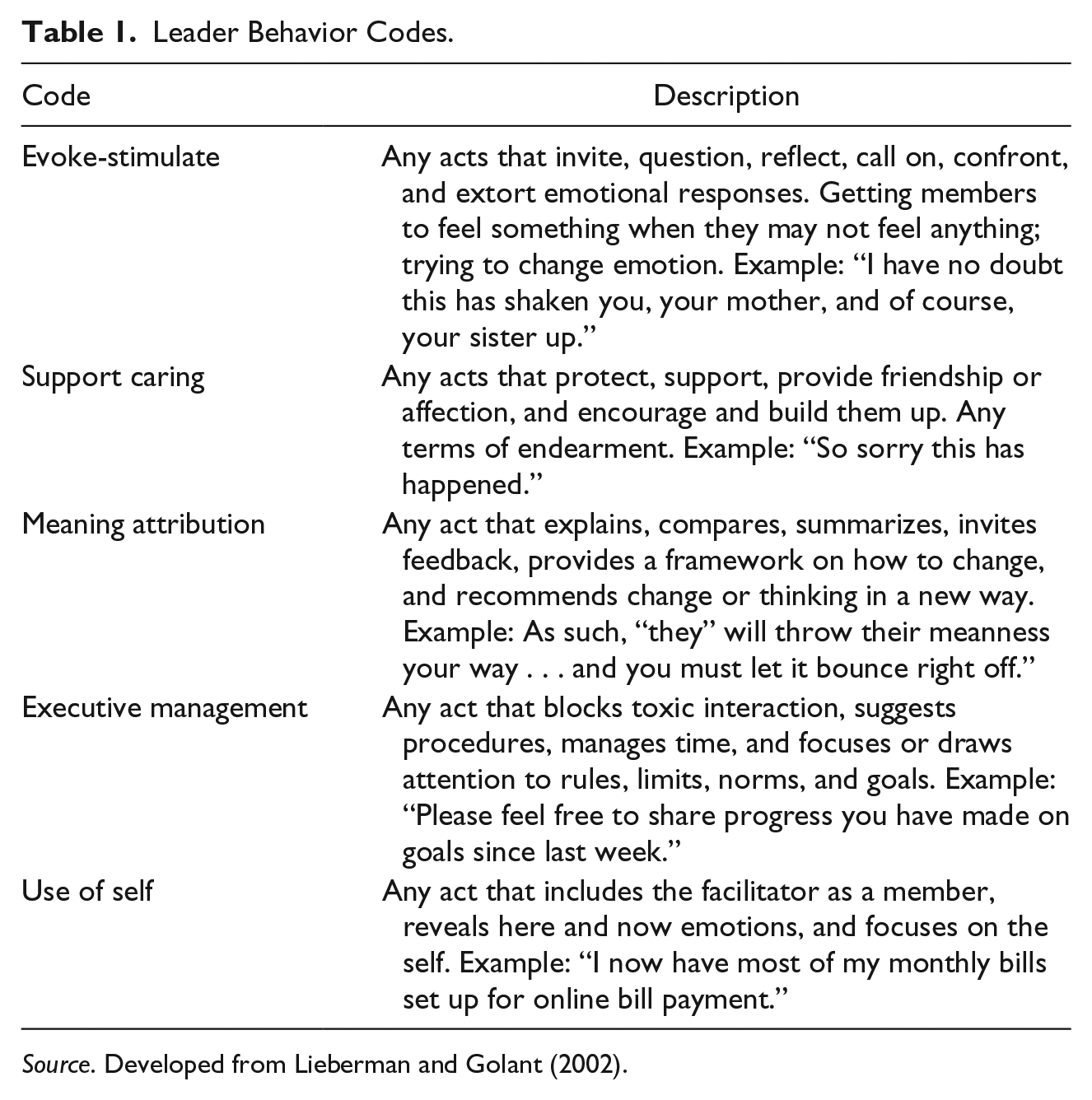
Source. Developed from Lieberman and Golant (2002).
Task and relational messages
The data were also coded using interaction process analysis (IPA) to capture the task or relational nature of messages (see Table 2). Bales (1950a) uses 12 codes that categorize messages into task and relational orientations. The six task codes include gives suggestions, gives opinions, gives orientation/information, asks for orientation/information, asks for opinions, and asks for suggestions. The six relational codes focus on the social fabric of the group, including shows solidarity/seems friendly, shows tension/release, agrees, disagrees, shows tension, and shows antagonism/seems unfriendly. Two trained coders coded 20% of the data and achieved reliability (Cohen’s Kappa = .86). The remaining discussion boards were coded separately, with a check for coder drift at the end of the process.
Interaction Process Analysis Codes.

Source. Adapted from Bales (1950b).
Results
RQ1 explored what leader behaviors were used by member-leaders in an online social support group. Chi-square analysis revealed nearly 60% of messages were meaning attribution (n = 164), followed by use of self (23%, n = 64; χ2 = 307.79, p < .05). Table 3 shows the frequency distribution for the five leader behaviors. H1 sought to determine whether member-leaders used more task messages or relational messages in their posts. Member-leaders used significantly more task messages (n = 173, 63%) than relational messages (n = 101, 37%; χ2 = 18.92, p < .01).
Leader Behavior Message Frequencies.
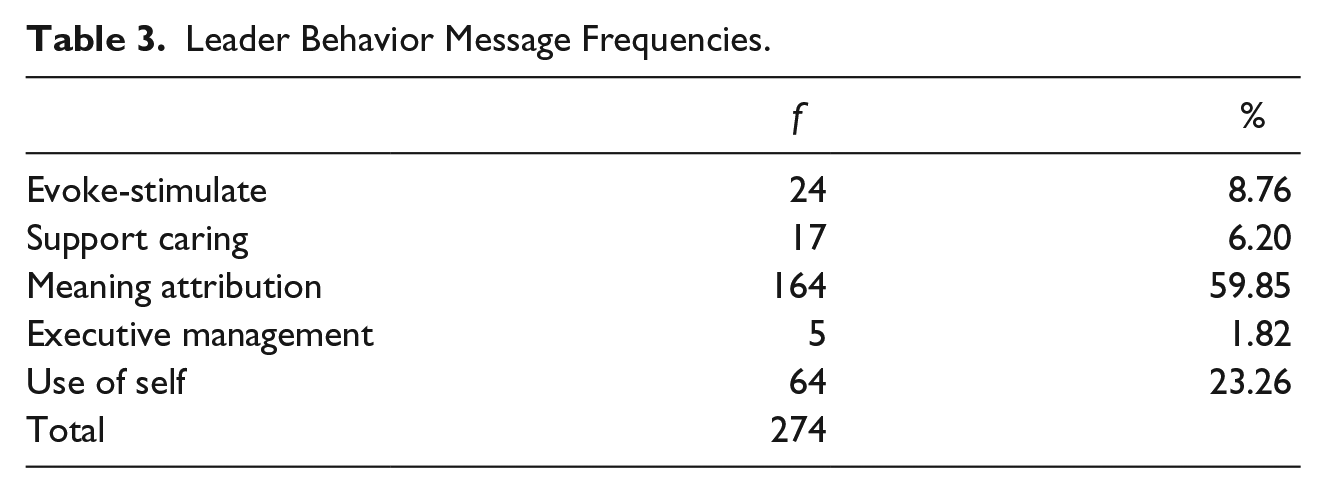
Table 4 summarizes the findings for leader behaviors and message type. RQ2 asked whether evoke-stimulate would use more task or relational messages. Chi-square tests showed no significant difference (χ2 = 0.17, p > .05). Evoke-simulate used similar amounts of relational messages (n = 11, 46%) and task messages (n = 13, 54%). Turning to the overall IPA distribution of evoke-stimulate messages (RQ5a), there were similar amounts of shows solidarity/seems friendly (n = 10, 41.6%) and gives orientation/information (n = 9, 37.5%). For RQ3, we asked whether support-caring behaviors would use more task or relational messages. Results showed that relational messages (n = 16, 94%) were much more common than task messages (n = 1, 6%; χ2 = 13.24, p < .001). The majority of these messages were shows solidarity/seems friendly (RQ5b; n = 15, 93.8%). RQ4 explored whether use of self behaviors would use more task or relational messages. Results showed that task messages (n = 52, 81%) were more common than relational messages (n = 12, 19%; χ2 = 25.00, p < .001). In regard to RQ5c, we found that these messages were primarily gives orientation/information (n = 42, 65.6%).
Interaction Profile for Five Types of Leader Behaviors.
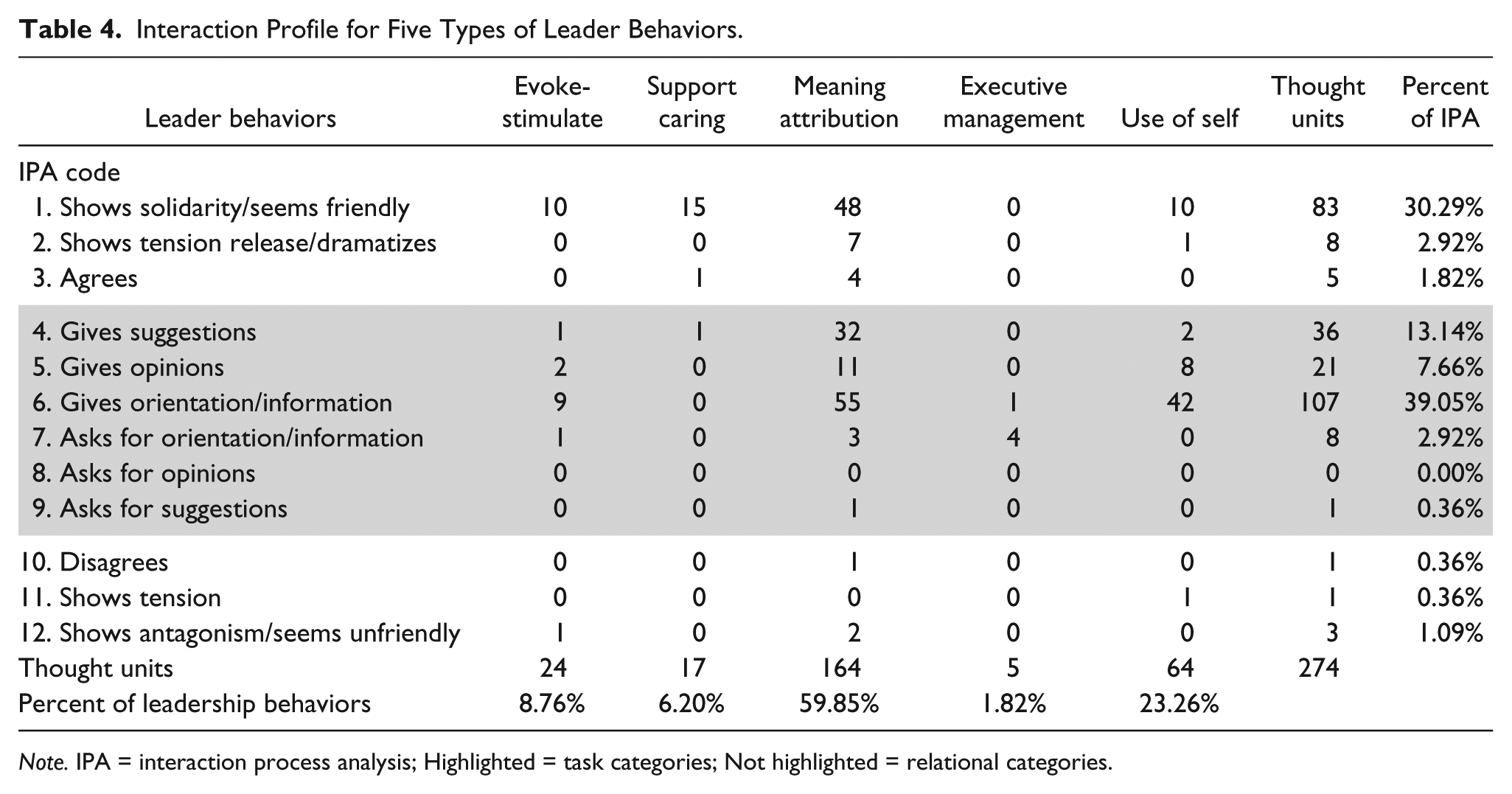
Note. IPA = interaction process analysis; Highlighted = task categories; Not highlighted = relational categories.
H2 posed that meaning attribution would use more task messages than relational messages. This hypothesis was supported (χ2 = 9.76, p < .01). Meaning attribution used more task messages (n = 102, 62%) than relational messages (n = 62, 38%). Looking at the IPA distribution (RQ5d), these messages were primarily gives information/orientation (n = 55, 33.5%), shows solidarity/seems friendly (n = 48, 29.2%), and gives suggestion (n = 32, 19.5%). Finally, H3 stated executive management would also use more task messages (n = 5, 100%) than relational messages (n = 0, 0%). This hypothesis was also supported (χ2 = 5.00, p < .01). Given the low cell counts, a Fisher exact test (FET) was also run and had significant results (FET = .002, p < .01). These five messages were primarily asks for orientation/information (RQ5e; n = 4, 80%).
Discussion
Overall, this study explored how member-leaders facilitate discussion in an online support group. RQ1 highlighted the leader behaviors exhibited in online support group discussions. The majority of behaviors were meaning attribution, followed by use of self. Previous research has noted ideal support groups have high amounts of meaning attribution and executive management, followed by support caring and evoke-stimulate (Lieberman et al., 1973; Lieberman, 2008). In this study, messages were primarily meaning attribution, but with low amounts of executive management and support caring. Dies (1983) notes support groups thrive with they possess both a conceptual framework for change, and structured interaction. Increased use of meaning attribution shows the member-leader’s focus on providing a new conceptual framework for members. Meaning attribution behaviors help reframe group members’ perspectives by offering new viewpoints of their situation. Member-leaders in this study were also not as concerned about structure. This may be due to the format provided by DailyStrength itself. The discussion board format is highly structured, preventing the need for facilitative messages. Before joining the group, members are introduced to the policies and expectations for posts and comments, thereby providing structure for interaction. Furthermore, the low amounts of support caring and evoke-stimulate may be because members need more task support than relational. Keyton and Beck (2009) note that support groups may use more task interaction if emotional needs have been previously resolved.
These findings are also in stark contrast to previous distributions of professional support group leader behaviors. Shechtman and Toren (2009) found 65% of messages were evoke-stimulate, while Lieberman and Golant (2002) found support caring (28%), executive management (27%), and meaning attribution (25%) were the primary behaviors. Both of these studies used face-to-face groups, whereas this study focused on online groups. The difference in findings may come down to the support group medium. Online groups take longer amounts of time to develop relational intimacy and find it difficult to communicate emotions to fellow members (Barker et al., 2000). The member-leaders focus in this study on task concerns may be a result of the reduced intimacy and emotional expressiveness associated with online support groups. Furthermore, both Lieberman and Golant (2002) and Shechtman and Toren (2009) used professionally led groups to analyze leader behaviors. In contrast, this study found online member-leaders use different tactics to facilitate support among members. Member-leaders, as noted by Beck and Keyton (2014), respond to members’ messages rather than structuring group interaction. Using more meaning attribution messages and use of self messages allows member-leaders to focus on supporting and encouraging members, rather than the more managerial functions seen in previous studies.
H1 proposed member-leaders would use more task messages than relational messages, which was supported in this study. Member-leaders primarily used task messages, which seems appropriate given the specified description of the member-leader role. As highlighted by DailyStrength, member-leaders help facilitate the group by inviting members to participate and identify trends within discussions. As noted by Beck et al. (2017), the relational goal of the group may mean task communication can lead to relational outcomes, given talk is accomplishing the group goal of supporting one another. This study also found the majority of task messages were gives information/orientation. Member-leaders focused on providing insight for members that can help members cope. Support groups are a common place for information and knowledge sharing (Beck et al., 2017), and many members may have dealt with relational issues before joining the board (Beck & Keyton, 2014).
The ratio between task and relational messages is also interesting to note. Previous studies of face-to-face group interaction have found task messages dominate the interaction. In this study with just member-leaders, the distribution is much narrower. Member-leaders may depend on more relational messages than other members to build members up. Furthermore, Beck and Keyton (2014) found a similar distribution when comparing interaction sequences involving a member-leader (task, 70%; relational, 30%). The increased number of relational messages from member-leaders may be a result of the group moving to more relational messages after being established longer (Kivlighan, 1997). Kivlighan (1997) also notes leaders turn to more relational messages as they become a model participant for the group.
The close distribution may also be a result of the computer-mediated environment. The stigmatized nature of depression may bring people to online groups for anonymity and confidentiality (Coulson, 2005). Members may also come to the group as their only source of social support (White & Dorman, 2001). In this sense, computer-mediated support groups often represent the only source of support for members, where more relational interaction may occur to help cope with the emotional side of their health condition. Furthermore, other studies of relational groups have found more relational messages in discussion. For example, Peña and Hancock (2006) found more relational messages in an online gaming group, given that members are focused on creating relationships. It could be that online groups use more relational messages because of the lack of nonverbal communication (Peña and Hancock, 2006).
Of the five leader behaviors, three of the categories primarily used task messages (meaning attribution, executive management, and use of self), while support caring used primarily relational messages. Evoke-stimulate (RQ2) showed no significant difference in task and relational messages, and primarily consisted of shows solidarity/seems friendly and gives orientation/information (RQ5a). This is an interesting finding, given the general relational undertone to emotional responses (Lieberman & Golant, 2002). However, as noted earlier, these relational goals can be accomplished through task communication. In some cases, evoking-stimulating emotion was focused on encouraging members to feel the emotions they expressed during their original post. For example,
“Best for you to look forward now [IPA shows solidarity/seems friendly]. The past . . . it is behind you” [IPA shows solidarity/seems friendly]
This excerpt shows how messages that give support and encouragement can be used to evoke emotion, while others encourage members to feel a certain way through a direct statement:
“Focus on the good things” [IPA gives suggestion]
The close distribution of task and relational messages demonstrates how both message types can elicit emotional responses from group members.
Although relational messages may not be as common as task messages, they still can carry weight in helping create the group climate. Keyton and Beck (2009) noted relational messages in lower frequency still carry power in creating a supportive group climate. This study found that support caring leader behaviors (RQ3) were accomplished through relational messages, with many shows solidarity/seems friendly (RQ5b). These few relational messages within the broader discussion can help group members feel supported and encouraged:
“Gentle hugs” [IPA shows solidarity/seems friendly] “You’ve got a lot going for you” [IPA shows solidarity/seems friendly]
As noted by Beck et al. (2017), emotional support, similar to support caring behaviors, occurs through relational messages that help set the tone for the conversation. In many situations, both task and relational messages can create a supportive environment for members to talk about their health condition. The sequence of messages, task and relational working together, is what accomplishes support within groups and allows members to feel encouraged (Keyton & Beck, 2009).
Use of self (RQ4) primarily used task messages. Although Lieberman and Golant (2002) note use of self is similar to evoke-stimulate as leaders reveal their own feelings and values, this study found this occurs primarily through gives orientation/information (RQ5c). This likely relates to the nature of being a member-leader. For member-leaders, they are also struggling with the health condition and can provide personal experience to assist members. In this example, a member-leader shares their own struggles with addiction, as indicated by the original poster:
“I think that I have a bit of an addictive personality [IPA gives opinion]. I don’t have trouble with booze or drugs [IPA gives orientation/information], but video games were hell for me years ago.” [IPA gives orientation/information]
Through these task messages, the member-leader is providing information about their own struggles to help aid the member in their journey. Giving information and orientation allows the leader to share their own background with members as a way of facilitating social support.
In regard to meaning attribution (H2), messages were primarily task oriented. Meaning attribution refers to messages that label experiences for members or encourage members to think in new ways about their situation. From these boards, meaning attribution messages are helping members deal with their health condition and sort through the complex emotions and challenges associated with depression. Meaning attribution messages also accomplish social support, meeting the task goal. Lieberman and Golant (2002) note meaning attribution is crucial for helping members “understand their feelings and beliefs” (Lieberman et al., 1973, p. 275), and can help members fare better. It is interesting to note with RQ5d, however, that member-leaders more frequently used gives orientation/information and shows solidarity/seems friendly, one task code and one relational code. Although meaning attribution is largely task oriented, relational messages can be used to help reframe situations for participants. For example, this segment shows how a member-leader moves between both task and relational messages to reframe the situation:
“As such, ‘they’ will throw their meanness your way . . . [IPA shows solidarity/seems friendly] and you must let it bounce right off [IPA shows solidarity/seems friendly]. There is really no other option [IPA shows solidarity/seems friendly]. When you do not let their behavior convince you that you are ‘bad’ [IPA gives orientation/information], or did something wrong, or. or…. [IPA gives orientation/information], their pain cannot be delivered unto you” [IPA gives orientation/information].
In these messages, the member-leader is attempting to reframe the situation for the members and encourage them to think about their concerns in a new way through task and relational messages.
For executive management (H3), the few messages presented were all task oriented, and primarily gives orientation/information (RQ5e). The low frequency of these messages may be related to the nature of online discussion boards. In this setting, posts are primarily directed toward social support. All five of the executive management behaviors occurred in one board, where the member-leader was directing members how to respond to a specific goal check-in post.
“Please feel free to share progress you have made on goals since last week, goals you want to focus on the next week, or even vent about goals that eluded you this week.” [IPA asks for orientation/information]
As Lieberman and Golant (2002) noted, executive management behaviors include making suggestions and managing how the group interacts. However, in this situation, members are provided rules for interaction when joining the group, and the community guidelines are common across all DailyStrength discussion boards. In this case, member-leaders do not have to worry as much about managing member interaction; rather, they can focus on supporting other members and being group members.
Implications
Overall, this study highlighted member-leader behaviors used in online support group discussions. One implication is the difference between online member–led groups and face-to-face professionally led groups. Lieberman and Golant (2002) note ideal professionally led, face-to-face social support groups should use high amounts of meaning attribution and executive management to increase member well-being. However, this study’s member-led online groups primarily used meaning attribution behaviors in interaction. This demonstrates online member-leaders are perspective givers rather than facilitators. The structure provided by the website framework eliminates the need for member-leaders to spend a lot of time focused on facilitation behavior; rather, they can focus on helping members cope with their health condition by reframing situations and offering new perspectives. Part of this may also be member-leaders often lack the training in group facilitation that professional leaders have (Cline, 1999). By relying on meaning attribution messages, member-leaders are helping other members cope with their health condition by providing a framework for understanding things in a new light (Dies, 1983).
In addition, the study found a high amount of use of self messages. DailyStrength asks longtime group members to become member-leaders, meaning they are both a participant and a facilitator for the group. These members experience the daily struggle of depression, and are able to provide insight for members that many professionals may not have. This may explain the increased use of self messages. As Lieberman and Golant (2002) noted, use of self behaviors “reveal here and now feelings, reveal personal values, and use the therapist as the focus” (p. 269). For member-leaders, their experience with the health condition allows them to use their own experiences for other members gain (Cline, 1999). By sharing personal stories and their own experiences, member-leaders are able to build connections with members through similar experiences and stories that relate to current member feelings and experiences. In addition, member-leaders offered primarily meaning attribution messages wherein they assisted members in reframing their perspective of the situation. The combination of their own experience and offering new perspectives allowed member-leaders to create a supportive environment for group members.
Member-leaders play an important role during support group interaction. They can help group members cope with their health condition through conversation facilitation, and build cohesion and structure within the group (Beck & Keyton, 2014). For member-leaders in online groups, the behaviors used to accomplish support function differently than in face-to-face groups. In this situation, member-leaders primarily use meaning attribution and use of self behaviors to facilitate group interaction. Lieberman and Golant (2002) note the important role leaders have to explain and summarize information for members, which is represented by the meaning attribution category. Furthermore, use of self behaviors allow group members to bond together, allowing the member-leader to maintain a member role within the group (Shechtman & Toren, 2009).
Limitations and Future Research
One limitation of this study was the use of only one online support group. Online support groups continue to be a fast growing area of social support for individuals due to the benefits of asynchronous interaction and anonymity (White & Dorman, 2001). DailyStrength continues to be a popular source of social support for people facing a variety of challenges (Landro, 2006), and their use of member-leaders can influence the type of support received by members. Exploring the nature of social support from leaders within online environments can provide further insight into the type of leadership needed for this unique setting. Another challenge with only one online support group was only having two member-leaders. Further work will want to consider how member-leaders in a variety of social support groups manage group interaction, and to consider how members who are not appointed member-leaders may still be leading based on their interaction within the group.
In addition, though online depression support groups have been previously studied (see Alexander, Peterson, & Hollingshead, 2003), the findings here on leader behavior distributions may be unique to depression groups. For example, Alexander et al. (2003) found differences in social support between four online support group situations. Given their findings on social support, it is possible that member-leaders may use different leader behaviors and interaction depending on the online support group topic. Future research may want to continue looking at other types of online support groups and comparing leader behaviors between online support groups. The type of leader behaviors needed may depend on the type of support needed from members based on their diagnosis.
A final limitation of this study was the focus only on messages without an understanding of outcomes or mediators. Lieberman and Golant (2002) note the use of specific leadership behaviors can improve support group member’s well-being. For future studies, researchers may want to incorporate a measure of outcomes. As noted by Keyton (1999), communication is not just about the process but also its relationship to outcomes. By exploring how members feel about the support they received from member-leaders, we can further understand how the balance of task and relational messages can help members meet their needs. Lieberman and Golant (2002) also note the important role of mediators in the leader behavior—outcome relationship (e.g., group conditions). Including mediators through retrospective interviewing (see Beck & Keyton, 2009, as an example) or post interaction surveys may help highlight the helpful communication behaviors from leaders within groups.
Future research should also explore the relationship between members and member-leaders. By exploring member’s perceptions of leader messages, we can understand how member-leaders can better serve members in an online discussion group. The increased use of meaning attribution and use of self behaviors reflects how member-leaders rely more on their personal experience and perspective in guiding members. In addition, further work should look at leader behaviors in other types of computer-mediated discussion groups. The leader behavior distribution from this study may point to some unique challenges facing online discussion leaders not faced by face-to-face leaders.
Footnotes
Declaration of Conflicting Interests
The author(s) declared no potential conflicts of interest with respect to the research, authorship, and/or publication of this article.
Funding
The author(s) received no financial support for the research, authorship, and/or publication of this article.