



Abstract
While the notion of task–media fit is inherent to most theories on communication in virtual teams, past studies have largely concentrated on single, isolated tasks—hence neglecting sequential and contextual effects of media use. Building on project management frameworks, this study abstracts from the task level to the broader and more practical level of project phases, linking these to changes in media use. In particular, the study illustrates the weekly use of communication media within 34 student teams during a 3-month project. In line with team process phase models, results showed differences in media use between project phases: While face-to-face communication decreased, the use of leaner media (i.e., telephone and chat) increased in later project phases. Moreover, the variation of media use within the project phases increased over time, emphasizing the temporal dynamics of task–media fit. Finally, implications especially for project managers and recommendations for further research are discussed.
Research in social and organizational psychology greatly emphasizes the critical role of team processes when it comes to analyzing team effectiveness (e.g., Marks, Mathieu, & Zaccaro, 2001; Mathieu, Maynard, Rapp, & Gilson, 2008). However, even though inherently dynamic in nature, these processes have often been treated as static (Bell & Kozlowski, 2012; Kozlowski, 2015). As teams have to be considered as complex systems evolving over time, temporal processes play a crucial role in understanding team dynamics (McGrath & Tschan, 2004; Salas, Fiore, & Letsky, 2013). Considering their somewhat temporally unstable nature, project teams constitute a group that may demand a particularly detailed analysis of team processes over time (Klonek, Quera, Burba, & Kauffeld, 2016; Leenders, Contractor, & DeChurch, 2016).
In a world characterized by rapid technological advancements, highly capable information and communication technologies (ICTs) have created the possibility of work environments strongly influenced by technology-mediated communication (Dixon & Panteli, 2010; Wajcman & Rose, 2011). This has produced an abundance of virtual teams, which work on interdependent tasks even under conditions of temporal and spatial dispersion; their communication is characterized by extensive media use (e.g., Dulebohn & Hoch, 2017; Gilson, Maynard, Jones Young, Vartiainen, & Hakonen, 2015). The more recent approach to this phenomenon, which has identified virtuality as a multidimensional construct (e.g., De Guinea, Webster, & Staples, 2012; Gilson et al., 2015), decreases the focus on dispersion as a necessity for teams to work virtually, and encourages a perspective that sees virtuality as a concept applying, more or less, to all teams and organizations (e.g., Dixon & Panteli, 2010; Kauffeld, Handke, & Straube, 2016).
A vast number of studies and insights on technology-mediated communication are still based on experiments concentrating on singular tasks (e.g., Hambley, O’Neill, & Kline, 2007; Rico & Cohen, 2005). Considering that both choice and effectiveness of a medium rely on its fit to a particular task (e.g., Daft & Lengel, 1986; McGrath & Hollingshead, 1993), this raises the question on how these findings extend to more complex series of tasks. For instance, experiments with repeated tasks were able to show that groups changed the way they used technology over time, making it more suited to the task (Fuller & Dennis, 2009; van der Kleij, Maarten Schraagen, Werkhoven, and De Dreu, 2009). Looking at projects, rarely do these consist of unrelated tasks, but can rather be described as an interaction of multiple interdependent tasks (McGrath, 1991). Assuming that project team functioning consists of different phases of task execution (cf. Marks et al., 2001), the processes—such as communication—tied to these interdependent tasks can be assumed to vary not only in extent but also in function and modality. Considering the high complexity and variety of tasks they engage in (De Dreu & Weingart, 2003), project teams are particularly likely to alternate in their use of communicate media (cf. Kirkman & Mathieu, 2005). A number of studies demonstrate that perceptions, appropriation, and, thus, effectiveness of communication media are subject to change (e.g., Carlson & Zmud, 1999; Kock, 1998). Accordingly, the use of communication media should be considered as a dynamic process.
As drivers of organizational change and agility, temporary project teams are commonly employed to develop new products (Tannenbaum, Mathieu, Salas, & Cohen, 2012). Considering the complexity of their tasks and coordination demands (cf. Ancona & Caldwell, 1992), as well as their tangible goal (i.e., a product) and the specific requirements tied to it, the present study concentrated on the context of newly founded product development teams to investigate the dynamic use of communication media throughout a project. More specifically, this study examined small (i.e., 3–5 members) self-managed student software development teams, each developing software ready for use at the end of the project. These projects could be described as highly complex, with high task interdependence and overall high coordination requirements (e.g., Dingsøyr, Rolland, Moe, & Seim, 2017; Lee, Espinosa, & DeLone, 2013). Nevertheless, given that their boundary conditions (e.g., their temporary nature) may be considered more or less similar for all kinds of project teams (cf. Gersick, 1988; Meyerson, Weick, & Kramer, 1996), the findings should extend to other types of project teams as well.
The aim of the present study was thus to understand the dynamic aspect of communication media in the context and over the course of a project. To see how these dynamics unfold, the authors proposed a new level of analysis uniting task–media fit and its relation to team process phases with project management: project phases. Tied to different requirements, tasks, and coordination demands (e.g., Hoegl, Weinkauf, & Gemuenden, 2004; Sarker & Sahay, 2002), these can be considered as distinct predictors of change during the project. By concentrating on phases, the authors aimed to provide practical implications for project teams that are more concrete and thus implementable than those concentrating on the single-task level. To link changes in media use to distinct project phases, the authors drew on a sample following pre-determined project phases varying strongly in external requirements. The present study was based on analyses of longitudinal survey data, gathered via weekly self-reports capturing the use of various communication media over the course of 3 months.
Team Virtuality
In the decade around the year 2000, research on virtual teams surged (e.g., Gibson & Cohen, 2003; Martins, Gilson, & Maynard, 2004). The prevalence of these types of teams, which can be defined as “(a) two or more persons who (b) collaborate interactively to achieve common goals, while (c) at least one of the team members works at a different location, organization, or at a different time so that (d) communication and coordination is predominantly based on electronic communication media (e-mail, fax, phone, video conference, etc.)” (Hertel, Geister, & Konradt, 2005, p. 71), has increased drastically and is still doing so (e.g., Gilson et al., 2015; Martins et al., 2004; Schmidt, 2014). This is primarily because rapid technological advances make them possible but certainly also due to the great flexibility, time, and cost reductions (e.g., lower commuting costs, being able to draw on experts all over the globe, lower maintenance costs for office space, etc.) they bring with them (e.g., Martins et al., 2004; Powell, Galvin, & Piccoli, 2006).
Earlier studies reduced virtual teams to physical dispersion and the use of computer-mediated communication, contrasting them against traditional, co-located teams that interacted (solely) face-to-face (e.g., Andres, 2002; Powell et al., 2006). However, more recent research presents a more differentiated picture, examining virtuality as a multidimensional construct (e.g., Dixon & Panteli, 2010; Gilson et al., 2015). For example, Kirkman and Mathieu (2005) defined virtuality as consisting of three dimensions: the extent of reliance on virtual tools, the informational value of these tools, and their synchronicity. Further examples of virtuality dimensions include team member distribution (i.e., spatial and temporal dispersion), workplace mobility (i.e., degree to which employees work in environments other than regular office, for example, teleworking), variety of work practices (i.e., degree to which employees experience cultural and work process diversity on their teams, for example, different ways of using collaboration technologies), configuration (i.e., arrangement of members across sites independent of the spatial and temporal distances among them), and national diversity (Chudoba, Wynn, Lu, & Watson-Manheim, 2005; Gibson & Gibbs, 2006; Hoch & Kozlowski, 2014; O’Leary & Cummings, 2007).
The vast number of virtuality dimensions demonstrate the difficulty in discriminating between purely virtual versus traditional teams. The dimensions have been shown to interact (Gibson & Gibbs, 2006), but there still is a great variability in the nature of this interaction. For instance, team members who all work at the same location (dimension: team member distribution) may just as well call each other, use instant messaging, or write emails to one another (dimensions: virtual tools’ informational value; synchronicity) as if members were working from different locations. Another example could be a team member who voluntarily teleworks (dimension: workplace mobility) to coordinate work and family obligations or to avoid a 1-hr commute to work, even though he or she could just as well be sitting in the same office as the other team members. Or finally, while one team member may prefer to use email solely for documentation purposes, another team member may purposefully use it to give her or his opinion without fearing to be constantly interrupted (dimension: variety of work practices). These are just a few examples that emphasize not only the various different constellations of virtuality dimensions but also their dynamic nature (cf. Dixon & Panteli, 2010; Watson-Manheim, Chudoba, & Crowston, 2012). They also have another thing in common: They describe situations where team members, who are not necessarily geographically dispersed, more or less freely choose to interact using media other than face-to-face interaction (cf. Allen, 2007; Mortensen & Hinds, 2001). This does not have to depend solely on individual preferences or lifestyles but may also lie in the facilitating structure of a virtual medium over face-to-face interaction. Virtual media enable documentation, structuration, and accessibility of information, and moreover, they come without the organizational effort of having to find a meeting time and venue (Braukmann, Schmitt, Duranova, & Ohly, 2018). The present study looked at members of co-located teams that also have flexibility with how they organize their work. Doing so provided the opportunity to concentrate on media use (as one of the primary virtuality dimensions found in almost all definitions) without temporal or spatial restrictions, or more precisely, without temporal or spatial restrictions imposed on the members by anyone else but themselves. Accordingly, media use and its (temporal) dynamics were considered as the virtuality component of interest as it was expected to be the most subjected to change.
Task–Media Fit
Traditional models of media use and effects, such as the commonly cited cues-filtered-out theories, such as media richness theory (MRT; Daft & Lengel, 1986) or social presence theory (SPT; Short, Williams, & Christie, 1976), consider the bandwidth (i.e., the number of communication cues a medium can transport) of a medium as being essential in explaining its effectiveness. SPT, for instance, assumes that greater bandwidth equals greater social presence (the extent to which a medium facilitates awareness, that is, salience, of the other). Accordingly, face-to-face interaction, which is rich in (particularly nonverbal) cues, may be regarded as having the greatest social presence, followed by a combination of audio and video (e.g., video-conferencing), audio-only, and, finally, text-only. Therefore, SPT is highly similar to MRT, which assumes that media vary with regard to their capacity for immediate feedback, utilization of multiple cues and channels, degree of personalization, and language variety. These capacities, in turn, influence the richness (i.e., informational value of the medium). Accordingly, face-to-face communication constitutes a rich medium (Daft & Lengel, 1986), as it provides immediate feedback, enables the use of paralanguage and nonverbal cues such as voice and body language, is highly personal, and uses natural language. Email, on the contrary, is asynchronous and text-based and thus lacks most of the above-mentioned capacities, turning it into a lean medium. Both SPT and MRT consider a medium’s effectiveness to be contingent on the task at hand. Whereas SPT argues with the level of interpersonal involvement of the task (assuming that the lower a medium’s social presence, the more impersonal the messages it transports), MRT considers the task’s equivocality (i.e., ambiguity about how to interpret information) to determine the required capacities the medium should have. The fit between task and medium, which in turn determines communication effectiveness, thus depends on how well the medium’s physical properties match the informational demands of the task. The notion of a task–technology fit is extended and elaborated in other theories, such as task–media fit hypothesis (McGrath & Hollingshead, 1993) and media synchronicity theory (MST; Dennis & Valacich, 1999; Dennis, Fuller, & Valacich, 2008).
A Phased Approach to Media Use
Communication technology is frequently considered as an input factor of virtual team functioning (e.g., Gilson et al., 2015; Martins et al., 2004). Considering the way team members choose the media they communicate with as essentially dynamic, we propose to extend this notion by adopting an Input-Mediator-Output-Input (IMOI; Ilgen, Hollenbeck, Johnson, & Jundt, 2005) approach. This model explicitly invokes the notion of cyclical causal feedback: in the present study, the change in media choice and use as a response to experiences with team, tasks, and the medium itself. While the IMOI model has been validated in the virtual team context (Algesheimer, Dholakia, & Gurău, 2011), newer technologies have not been incorporated as a dynamic input factor of the model.
Team effectiveness is considered to depend on the alignment of team processes and environmentally driven tasks (Kozlowski & Ilgen, 2006). As communication is a primary team process (e.g., Hackman, 1987; Marks et al., 2001), the environment it takes places in (i.e., the medium used to communicate) is also likely to be contingent on the task at hand. 1 Accordingly, in an effort to combine task–media fit theories with models of dynamic team functioning, such as Ilgen et al.’s (2005) IMOI model and Marks et al.’s (2001) recurring phase model, the present study conceives a project team’s media use as an iterative process, where the choice of a communication medium changes as a function of current tasks and prior experiences over the course of the project. Leaning on Marks et al.’s (2001) concept of processes phases, these changes can be regarded as a series of related performance episodes, which vary in dependence of the type of taskwork a team performs during this specific phase.
Project Phases
The increasing recognition of the dynamic nature of group processes is reflected in the wide range of approaches characterizing group development over time (Miller, 2009). In 1965, Tuckman reviewed 50 articles dealing with stages of (small) group development and synthesized these into a model depicting group development as a unitary sequence. This model, comprising the four developmental stages forming, storming, norming, and performing (later extended by the fifth stage adjourning; see Tuckman & Jensen, 1977), is the most widely cited and applied group development model in both research and practice (Bonebright, 2010; Miller, 2009). While the concept of groups following a fixed sequence of stages over time has been supported by a large body of research (e.g., Bales & Strodtbeck, 1951; Wheelan & Hochberger, 1996), many others have criticized hierarchical forms such as Tuckman’s for their lack of complexity (Arrow, Poole, Henry, Wheelan, & Moreland, 2004; Crosta & McConnell, 2010; Gersick, 1988; McGrath, 1991; Sundstrom, De Meuse, & Futrell, 1990). Assuming a universal applicability regarding all teams and contexts, stage-based models consider development to be a linear movement in a forward direction, rather than iterative cycles (e.g., Gersick, 1988; Sundstrom et al., 1990). Moreover, they require a stable context and frame groups as closed systems, thus largely ignoring the significance of externally driven change (e.g., Arrow et al., 2004; Gersick, 1988).
Another way to conceive group development is as a function of team goal attainment (e.g., Marks et al., 2001; McGrath, 1991). In naturally occuring (rather than laboratory) groups, the pursuit of these goals is not based on repetitive, unrelated tasks (as is often the case in experimental settings), but is rather composed of a sequence of complex, interdependent tasks that constitute a larger project (McGrath, 1991). McGrath’s (1991) time interaction process (TIP) model sees projects at the topmost level of a team’s purposeful activities, while the next lower level is constituted by tasks, “a sequence of activities instrumental to completion of a particular project” (p. 151). Most naturally occurring groups will have to face changes in their tasks, technology, and environment at some time during the course of a project. The extent to which group processes underlie dynamics may thus depend on the degree of coordination needed to fulfill changing tasks (cf. Arrow, 1997). The present study proposes that the most relevant changes in tasks are caused by movement from one project phase to the next. Project phases are part of the project life cycle, “a series of phases that a project passes through from its start to its completion” (Project Management Institute, 2017, p. 547). These phases, in turn, appear to be contingent on different behavioral phenoma (e.g., Adams & Barndt, 1988; Pinto & Prescott, 1988). Critical success factors (e.g., project commitment, technical tasks, use of specific tools, and technologies) have been found to change at different points of the project, the location of which may be explained by the project life cycle and its respective phases (Hoegl et al., 2004; Patanakul, Iewwongcharoen, & Milosevic, 2010; Pinto & Prescott, 1988; Somers & Nelson, 2004). The phases themselves are associated with different patterns of communication (Sarker & Sahay, 2003; Swigger, Hoyt, Sere, Lopez, & Alpaslan, 2012) as well as intrateam coordination (Hoegl et al., 2004). While prior studies also adopted a longitudinal approach and looked at teams that communicated using electronic media, they focused on changes in communication behaviors (Swigger et al., 2012), structures (Sarker & Sahay, 2002), or long-term effects of intrateam coordination (Hoegl et al., 2004), rather than on media use itself. Accordingly, the present study built on findings linking the course of the project to changes in communication and coordination demands but then focussed on how this impacted the use of different communication media. The authors specifically looked at project phases, considering them to be a level situated under the project in its entirety, but above singular tasks. They are a conglomerate of tasks, tied to distinctly different requirements (cf. King & Cleland, 1988), and are thus highly likely to impact the form and development of team processes critical to task execution. As opposed to explaining change in terms of relationships among independent variables and dependent variables (e.g., time, media use), the present study adopted a process method explaining how a sequence of events (i.e., project phases and media use) unfold over time and where the ordering of these events was critical (for a comprehensive overview of variance vs. process approaches, see Van de Ven & Poole, 2005). It can thus be considered as a narrative describing a sequence of events on how communication—and specifically media use—in project teams develops and changes (cf. Poole, Van de Ven, Dooley, & Holmes, 2000). While leaning on the project life cycle also constitutes a sequential understanding of group development, the present study aims to extend traditional models such as Tuckman’s by two main aspects: by regarding group processes as (a) contingent on complex series of interdependent tasks which serve to attain a higher level goal (e.g., project completion, cf. McGrath, 1991) and (b) not just internally driven but also dependent on external, environmental influences (cf. Arrow, 1997; Gersick, 1988) such as project demands and ensuing task requirements.
As proposed by channel expansion theory (Carlson & Zmud, 1999), experience with a task and the context it takes place in influence individuals’ media richness perceptions as well as their capability to compensate for a lack of richness. Consequently, task–media fit is also essentially influenced by whether the task has been carried out before or not. Tasks in real-life projects are interdependent, with the course and result of one task depending on what has been done before, at the same time, and subsequently (cf. McGrath, 1991). That is to say, in reality, a task has to be seen in context—from a temporal as well as content-related perspective. Thus, the role of project phases should be pivotal in understanding the dynamics of media choice and use as these order tasks not only from a temporal perspective but also with regard to their relation to the goals of the project.
Life Cycle Phases in Project Management
Throughout its life cycle, a project passes through a series of identifiable and distinct phases, differing in tasks and frequently also divided by “formal decision points at which it is determined if the project has been sufficiently successful in the earlier phases to continue onto the next” (Adams & Barndt, 1988, p. 209). Life cycles propose an overall project logic, thus helping in developing plans, evaluating project progress, and illustrating at which point during the project resources should be allocated, activities performed, and challenges expected (Pinto, 2016). Regardless of the specific work involved, the life cycle structure provides a management framework that can be applied to more or less all projects. Accordingly, projects can typically be mapped to the following life cycle structure: (a) starting the project, (b) organizing and preparing, (c) carrying out the work, and (d) closing the project (Project Management Institute, 2017). These four broad, generic project phases are commonly referred to as (a) concept, (b) definition, (c) execution, and (d) closeout phases (Archibald & Voropaev, 2003; Prabhakar, 2009).
The concept (alternatively: initiation, identification, selection) phase concentrates on the development of goals and courses of action and estimates resources the team or organization is willing to commit. The definition (alternatively: feasibility, development, demonstration, design prototype, quantification) phase includes the preparation of detailed plans, schedules, and final system performance requirements. In this phase, tasks and resources are allocated among team members. The execution (alternatively: implementation, realization, production and deployment, design/construct/commission, installation, and test) phase pertains to the actual taskwork being performed (e.g., construction, production) and also includes updating plans conceived in the definition phase and verifying system production specifications. The closeout (i.e., termination, including post-completion evaluation) phase refers to the project’s termination, the transferral or completion of resources, commitments, and products (Adams & Barndt, 1988; King & Cleland, 1988; Pinto, 2016; Pinto & Prescott, 1988).
In the present study, teams followed the waterfall model, typical for traditional software development (Royce, 1970). This model distinguishes between several consecutive phases: (a) the requirements or analysis phase, where both functional and non-functional requirements of the software (e.g., purpose, functions, quality standards) are defined; (b) the design phase, which refers to planning and problem solving for an adequate software solution (including behaviors such as algorithm and concept design as well as data structure definition); (c) the implementation phase, where requirements and design specifications are realized into a concrete executable program, the testing phase, which refers to final verification and validation (i.e., checking that the software solution accomplishes its intended purpose without any errors, and finally the operation); and (d) maintenance phase, where the product can be used by the customer. In the present study, we were able to observe three phases: analysis, design, and implementation/testing (seeing as the generic project life cycle can be tailored to suit the specific project requirements, for instance, by combining phases, cf. Labuschagne & Brent, 2005). The resulting phases corresponded to (a) concept, (b) definition, and (c) execution (considering that these were student projects, there was no close-out phase, as the projects were directly handed over to the customer after completion) and were separated by three official quality gates marking the transition from one phase to the next. Quality gates resemble generic milestones for all projects following the same process and serve to avoid foreseeable failure in plan-driven projects (cf. Flohr, 2011; Schneider, Liskin, Paulsen, & Kauffeld, 2015) and are comparable to the aforementioned formal decision points (Adams & Barndt, 1988) in general project life cycles.
Assuming that project phases are distinctly different with regard to the tasks and activities tied to them, they should also coincide with the use of different media to carry these out. Rather than matching a medium to a singular task (cf. Daft & Lengel, 1986; McGrath & Hollingshead, 1993), the present study thus pled for an association between media and task conglomerates, in the form of project phases. Accordingly, the authors initially assumed that the project phases should be distinguishable by changes in media use. Based on Hoch and Kozlowski (2014), four of the most commonly employed forms of virtual communication (videoconferencing, telephone, instant messaging/chat, and email) as well as face-to-face interaction were used as the media of interest. Accordingly, the authors assumed the following:
Phase-Specific Influences
Moreover, the present study also had specific assumptions with regard to the nature of this change. To hypothesize on these differences in media use between the project phases, the role of these phases in the context of the project life cycle is described first.
The concept phase in project management concentrates on the development of goals and courses of action (Pinto & Prescott, 1988). In the context of newly formed project teams, team members have just begun their collaboration and have yet to reach a shared understanding of their goals and strategies (Dennis et al., 2008). Without a shared understanding of goals and strategies, team members still lack shared mental models (Mathieu, Heffner, Goodwin, Salas, & Cannon-Bowers, 2000; E. Peterson, Mitchell, Thompson, & Burr, 2000) and will thus rely on explicit coordination processes (Espinosa, Lerch, & Kraut, 2004). Moreover, to develop shared mental models, team members have to reach a convergence on meaning, a process that depends on communication (Kennedy & McComb, 2010). Ideally, convergence processes take place with a high transmission velocity of information for quick feedback and possibilities of negotiation, thus being facilitated by richer media (cf. Dennis et al., 2008). Accordingly, not only do team members have to communicate more with one another, but they should have to do so using richer media. This underlines the assertion that the high cognitive effort imposed by a lack of shared understanding on how to coordinate actions encourages the use of media more similar to face-to-face interaction (Kock, 2004). Moreover, initial phases of team collaboration are defined by a number of other interpersonal processes requiring high levels of communication frequency and media richness, such as socialization (Maruping & Agarwal, 2004) and trust building (Bos, Olson, Gergle, Olson, & Wright, 2002; Peñarroja, Orengo, Zornoza, & Hernández, 2013), which strongly depend on the presence of contextual cues and socio-emotional interactions (Jarvenpaa, Knoll, & Leidner, 1998).
The definition phase is characterized by planning (Adams & Barndt, 1988; Archibald & Voropaev, 2003). In MRT, planning behaviors are situated in the middle of the equivocality scale. Plans themselves help reduce uncertainty, which in turn leads to a decrease in equivocality, and consequently reduced to use richer media (cf. Daft & Lengel, 1986). Moreover, planning activities are considered to be disjunctive tasks (i.e., the group’s outcome is determined by the strongest individual contribution; Steiner, 1972), as it may suffice if only one team member comes up with a plan and/or solution (cf. Stylianou & Andreou, 2016). With effort and responsibility located among just one (or very few) team member(s), this also implies an overall lower level of communication. One can also assume that a generally lower degree of communication is due to an increased amount of time spent on reflecting these plans, as the definition phase “dictates that one stop and take time to look around and see if this is what one really wants before the resources are committed to putting the system into operation and production” (King & Cleland, 1988, p. 194). Consequently, the present study hypothesizes that the definition phase should be associated with a generally lower degree of communication compared to the concept phase, and that the use of all media (even face-to-face communication) would be lower than in the preceding phase.
The execution phase refers to the work being carried out—in the case of software development, the implementation of the program. One of the key behavioral dimensions underlying the execution phase in work teams is coordination (Rousseau, Aubé, & Savoie, 2006), which refers to the synchronization of team members’ actions to ensure successful task accomplishment (Wittenbaum, Vaughan, & Stasser, 2002). Coordination may be explicit, based on overt communication, or more tacit/implicit, based on unspoken assumptions and intentions (Espinosa et al., 2004; Wittenbaum et al., 2002). As team members gain experience and thus knowledge throughout the project with regard to one another and their joint task, they are able to coordinate more implicitly (Klimoski & Mohammed, 1994; Levesque, Wilson, & Wholey, 2001). Furthermore, it should be expected that at this stage, team members would have changed their perceptions of media richness and become more adept at using leaner media to coordinate their actions (cf. Carlson & Zmud, 1999; Maruping & Agarwal, 2004). Consequently, it seems likely that while team members still need to coordinate their actions, they can do so using leaner media to save the time and effort that would have to be devoted to meeting face-to-face. In fact, as Heeren and Lewis (1997) argue, in situations where a shared understanding has already been developed, leaner media are both more effective and efficient than richer media. They further assert that teams transition from more intentional levels of group activity, such as the development of a shared understanding to a functional level, where plans are developed to an operational level, where activities are carried out according to those plans. While activities at the intentional level are most effective using richer media, leaner media appear to be more effective at the operational level. The present study hypothesizes that face-to-face interaction would be lower but that other leaner media would be used more than in the preceding phases.
Media Appropriation
While the analysis of media and its alignment to specific tasks from a richness perspective has advanced our understanding of media choice and effects and strongly influences studies to this day, it gives a fairly static portrait of task–medium fit. Models such as MRT or SPT generally assume that media have inherent properties (i.e., information richness) which will be experienced similarly by all individuals and which will remain fixed over time. While there have been empirical studies in support of these theories (Rice, 1992; Trevino, Lengel, & Daft, 1987; Webster & Trevino, 1995), others yield either no or inconsistent (El-Shinnawy & Markus, 1997; Suh, 1999), or even contradictory, results (Dennis & Kinney, 1998; Markus, 1994). Looking into those affirming the richness perspective, most were based on experimental settings, concentrating solely on short-term use and effects, based on interactions of ad hoc groups or dyads (Bordia, Difonzo, & Chang, 1999; Bos et al., 2002), thus challenging their implications for real-life teams.
These limitations are adressed in theories allowing for both social and individual and temporal influences (e.g., social influence model of technology use, Fulk, Schmitz, & Steinfield, 1990; adaptive structuration theory, DeSanctis & Poole, 1994; channel expansion theory, Carlson & Zmud, 1999; compensatory adaptation theory, Kock, 1998, 2001). For instance, channel expansion theory (Carlson & Zmud, 1999) posits that knowledge-building experiences with a channel (i.e., the medium), communication partner, topic, and context enhance the perceived channel richness. Moreover, next to altering richness perceptions, knowledge-building experiences also enhance individuals’ capacity to interpret messages more richly sent via a particular channel. This can be attributed to individuals having already experienced a variety of different cues or becoming better at encoding messages with richer meaning in a particular context they have experience with. Accordingly, individuals do not passively accept the obstacles that physically leaner media impose on them; instead, they will alter their communication behavior, due to improved encoding and decoding of messages conveyed via the leaner medium, thus compensating for the lack of specific cues (e.g., Kock, 1998, 2001; Straube, Meinecke, Schneider, & Kauffeld, 2018). Corresponding findings show changes in virtual media appropriation over time in the form of longer messages (e.g., Fuller & Dennis, 2009; Kock, 1998) or higher perceived communication intensity (Handke, Schulte, Schneider, & Kauffeld, 2018).
Accordingly, the fashion in which individuals choose and use media may depend less on their inherent, physical properties but more on their appropriation. The appropriation of a medium does not have to be determined by its design but can instead be actively shaped by the user (DeSanctis & Poole, 1994). Once again, this challenges a static task–technology fit perspective. As opposed to physical properties, media characteristics are partly socially constructed (cf. Dennis et al., 2008). Accordingly, if individuals’ experience of media characteristics changes, then there will also be more than one version of an optimal task–medium fit (Fuller & Dennis, 2009; McGrath, Arrow, Gruenfeld, Hollingshead, & O’Connor, 1993).
As project phases can be considered to consist of bundles of tasks, which serve to attain subgoals of the project, the tasks within a phase should be interrelated. That is, tasks in one phase should be more similar to one another than to tasks in another phase. Combining this concept with classic task–media fit theories would imply that media use can be expected to remain fairly constant within and only differ between the respective phases. However, while the present study still considered tasks in these phases to be distinctly different and thus tied to a different media usage—as underlined in
Method
Sample and Procedure
Sample
Participants in the study were 165 students, nested in 34 teams, working on a 3-month software project placed in the last year of the computer science bachelor curriculum at a large German university. The software projects constituted an integral part of the curriculum and had been continuously carried out and improved since 2004. As a prerequisite for the project, students had to have passed exams on software engineering, software quality, and programming in Java. Accordingly, students were assumed to have the necessary background knowledge on requirements, design, and coding techniques. The team members’ age ranged from 19 to 34 years (M = 22.94, SD = 3.21) and about 89.6% of the team members were male.
Task
Within the context of their course, students were to respond to the assignment of developing a software program for a particular client (some of these being professors, but some also being external cooperation partners 2 ). Examples of these assignments included an online shop, a translation tool, or a game. Team members could not choose their teams but were assigned by the instructors to guarantee an even distribution of skills in each team, thus ensuring comparability across teams. Each team had to designate a team leader in charge of documenting the teams’ work (i.e., which documents had been worked on and which tools were employed, see “Project phases and activities” section). Albeit differing in their tasks as well as which customer they were assigned to, all teams followed a similar development process. The projects began with the teams meeting the customer to elicit software requirements and were concluded with an acceptance test session, where the customer tested and evaluated the respective software. The process included the creation of a requirements specification based on a template which ensured that certain aspects are addressed. The specification document required listing the customer’s priorities and non-functional requirements and needed to be accepted by the customer. Accordingly, the document also included the documentation of acceptance tests that were carried out by the customers at the end of the project (cf. Schneider, Liskin, Paulsen, & Kauffeld, 2013).
Project phases and activities
The concept phase consisted of determining functional and non-functional requirements of the software (e.g., purpose, functions, quality standards). The definition phase, in turn, included planning and problem solving for an adequate software solution. 3 Finally, in the execution phase, requirements and design specifications were realized into a concrete executable program. Furthermore, this last phase also included software testing, which refers to final verification and validation (i.e., checking that the software solution accomplishes its intended purpose without any errors).
Data collection
Data were gathered over the course of the entire project (using weekly questionnaires), which lasted for 14 weeks. During the project, teams were expected to organize themselves independently, choosing when, where, and how often to meet as well as which media they wished to communicate with.
Exclusion of holiday period
To justify the exclusion of Weeks 10 and 11, prior to hypothesis testing, the authors compared the mean communication level during the holidays (Weeks 10 and 11) with the mean communication level during the rest of the implementation phase. Communication was significantly lower during the holidays for all communication media apart from chat, where it was only marginally significant—face-to-face: F(1, 33) = 112.47, p < .001; video: F(1, 33) = 9.88, p = .004; phone: F(1, 33) = 4.37, p = .044; chat: F(1, 33) = 2.98, p = .094; and email: F(1, 33) = 8.27, p = .007. Accordingly, values from Weeks 10 and 11 were excluded and the subsequent MANOVAs were performed on data gathered from 12 weeks in total.
Length of project phases
The length of the project phases was determined by quality gates, which marked the transition from one phase to the next. Here, the project teams needed to submit a predefined set of documents and deliverables at each quality gate which were then checked for formal criteria (e.g., version numbers, correct Unified Modeling Language [UML] notation, customer-signed specifications). Accordingly, at the end of the concept/analysis phase, quality gates included checking requirements specifications. In turn, the quality gate at the end of the design/definition phase evaluated design specifications, UML diagrams, and protype documentation. Hence, one could assume that quality gates did in fact mark the end of a particular phase and serve as indicators for the beginning of the next. The latest time point for the quality gates marking the end of the analysis and design phases were Weeks 4 and 8, respectively. Accordingly, with a total of 12 measurement points, each phase consisted of four measurement points (concept: Weeks 1 through 4; definition: Weeks 5 through 8; execution: Week 9 and Weeks 12 through 14).
Measures
Media use was obtained via a communication matrix in which every team member was asked to assess communication between himself or herself and all other team members. Team members received online questionnaires which contained the question “How did you work together this week?” followed by a matrix containing the other team members’ names in the rows and possible media used (i.e., face-to-face, videoconference, telephone, instant messaging, and email) in the columns. There was no specification regarding the technologies participants used for videoconferencing, instant messaging, and email. Face-to-face was operationalized as being physically present together in one room. Participants answered with regard to each team member and medium whether they had used this medium in communicating that week (yes/no matrix). Multiple answers were possible. This approach consequently led to directed communication matrices, that is, matrices containing two values for each communication pair, one from each team member’s perspective. To arrive at the undirected matrix of pairwise communication, the maximum value for each communication pair was chosen (i.e., if team member X had stated to have communicated with team member Y via Medium A, while team member Y indicated that this had not happened, it was determined that this communication pair had communicated via said medium, the assumption being that it was more likely to have forgotten to have communicated than to have invented it; cf. Handke et al., 2018; Schneider et al., 2015). Considering the binary format, the maximum value was 1 for yes.
The matrix approach was derived from social network analysis, which allows analyses of social interactions and, in this case, also the media usage of all involved team members. The final undirected matrices produced a more holistic (and—ideally—objective) representation of an individual’s communication than if individuals were simply asked to report on their overall team communication. To arrive at an individual’s score, all (undirected) pairwise scores were summed (e.g., if a team member had face-to-face interaction with all other team members, her or his value, in a team of five members, for weekly face-to-face interaction would be 1 + 1 + 1 + 1 = 4). This calculation was done for all individuals for all 12 measurement points. A normalized score was calculated at the team level and is explained in the next section.
Data Analysis
Aggregation
Being interested in team processes, the authors initially aggregated all measures to the team level. To justify this aggregation, intraclass correlations ICC(1) and ICC(2) were calculated. The ICC(1) value provides an estimate of the proportion of the total variance of a measure that is explained by unit membership and is calculated as the ratio of between-group mean square (MSB) variance to total variance (sum of MSB and within-group mean square [MSW] variance). A significant deviation from zero means that unit membership is significant in explaining individual variations in a particular measure. The ICC(2) value is a function of ICC(1) adjusted for group size. It assesses the reliability of the group-level means, indicating how reliably the aggregate mean rating (across group members) distinguishes between groups (Bliese, 2000). ICC(2) values are commonly considered acceptable if they equal or exceed .70 (Bliese, 2000; Klein & Kozlowski, 2000). ICC(2) values above .70 are expected to justify analyzing team models. The intraclass correlation coefficients for all media can be found in Table 1. All values significantly deviated from zero. ICC(1) values ranged from .274 to .942 (M = 0.706, SD = 0.142), ICC(2) values from .647 to .987 (M = 0.911, SD = 0.068). As only two values did not meet the .70 cutoff, aggregation to the team level was considered as justified.
Means, Standard Deviations, and Intraclass Correlations.
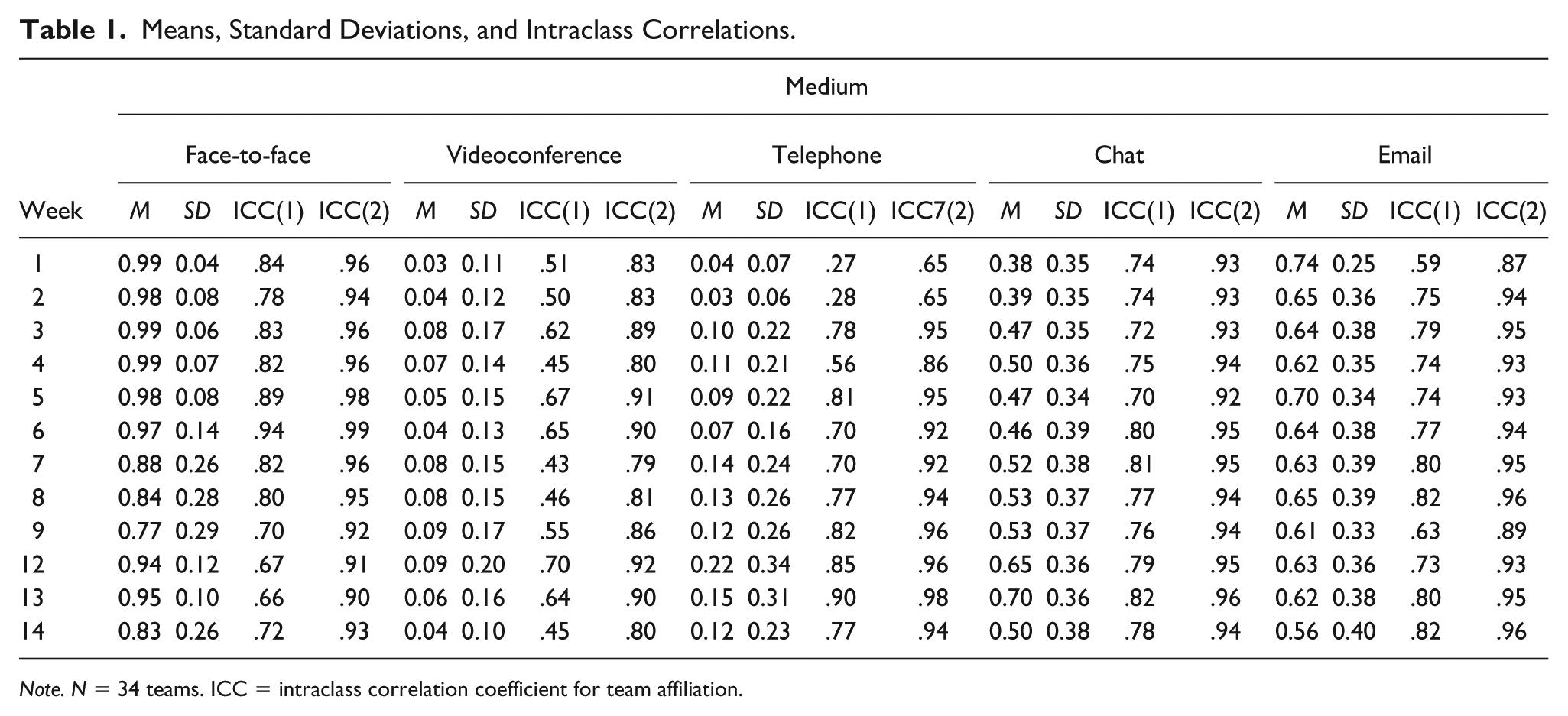
Note. N = 34 teams. ICC = intraclass correlation coefficient for team affiliation.
To arrive at a normalized score of media use for each medium, individual scores were summed for each team. Staying with the example given above, in the team of five members, where everyone had face-to-face interaction, this would have resulted in a team-level value for face-to-face interaction of 20. In a next step, this value was divided by the product of team size and team size minus one. This leaned on the concept of network density to measure intra-team communication (Leenders, van Engelen, & Kratzer, 2003). In the example above, this would have meant 20 / (5 × [5 – 1]) = 1. This score allowed for a comparison between teams of different sizes. 4 This calculation also provided a differentiated picture of media use within the team, as it considered how many members had used the medium in communicating with one another.
Hypothesis testing
Next, a two-factor repeated-measures MANOVA was performed, with measurement points and phases as within-subject factors and the use of the respective media as dependent variables. This approach was taken not to test the overall effects of project phases and measurements points, specifically, but to limit the joint error rates multiple ANOVAs would have produced.
Results
Means, standard deviations, and intercorrelations are presented in Table 1.
Multivariate tests revealed a significant effect of both phase, F(10, 124) = 3.94, p < .001,
The results revealed a significant main effect of project phase on face-to-face interaction, F(2, 66) = 12.94, p < .001,
The within-subject contrasts for the other variables showed that the degree of face-to-face interaction was significantly lower in the definition compared with the concept phase, F(3, 99) = 9.73, p = .004, supporting
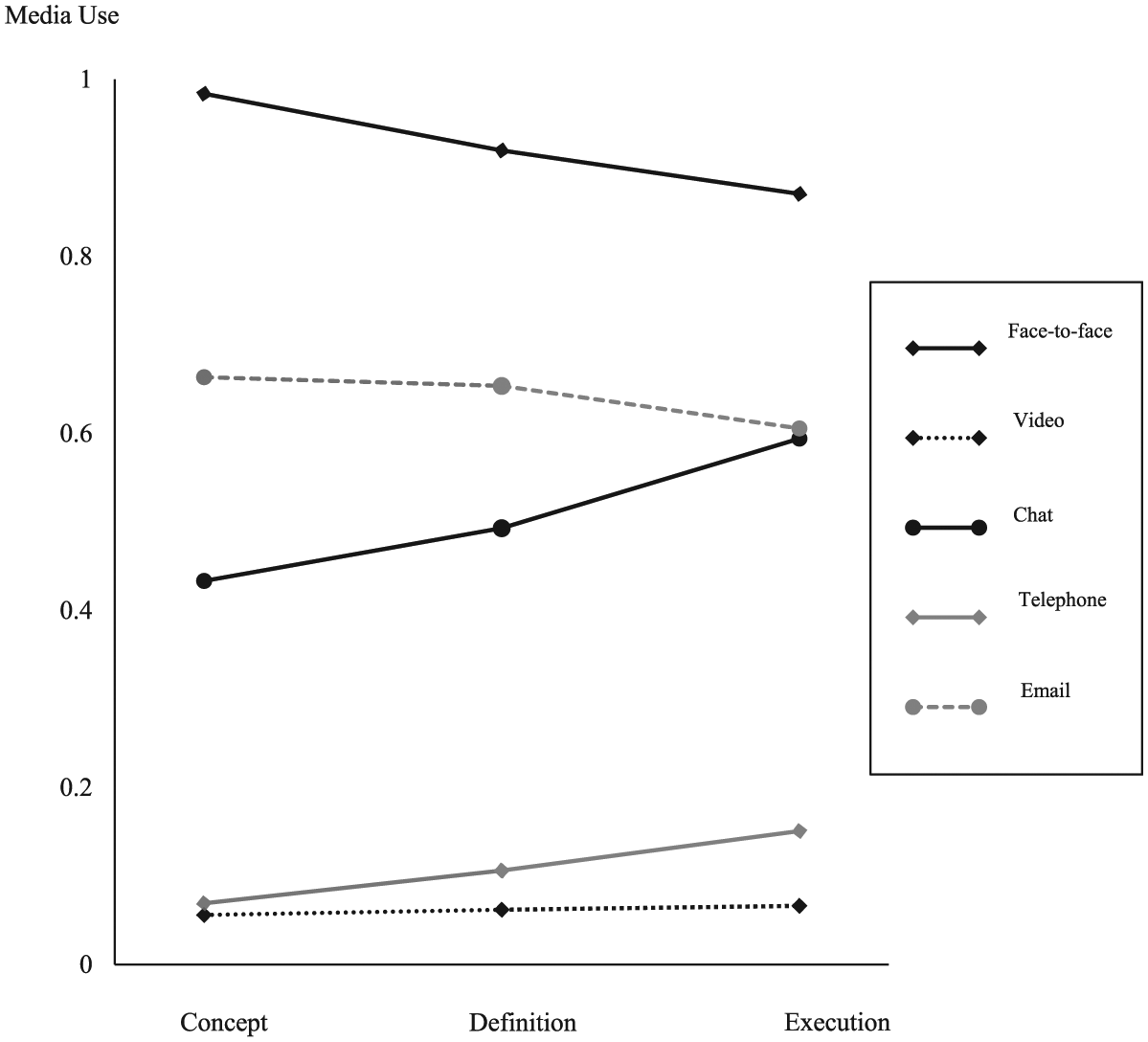
Depiction of change in media use over the three project phases.
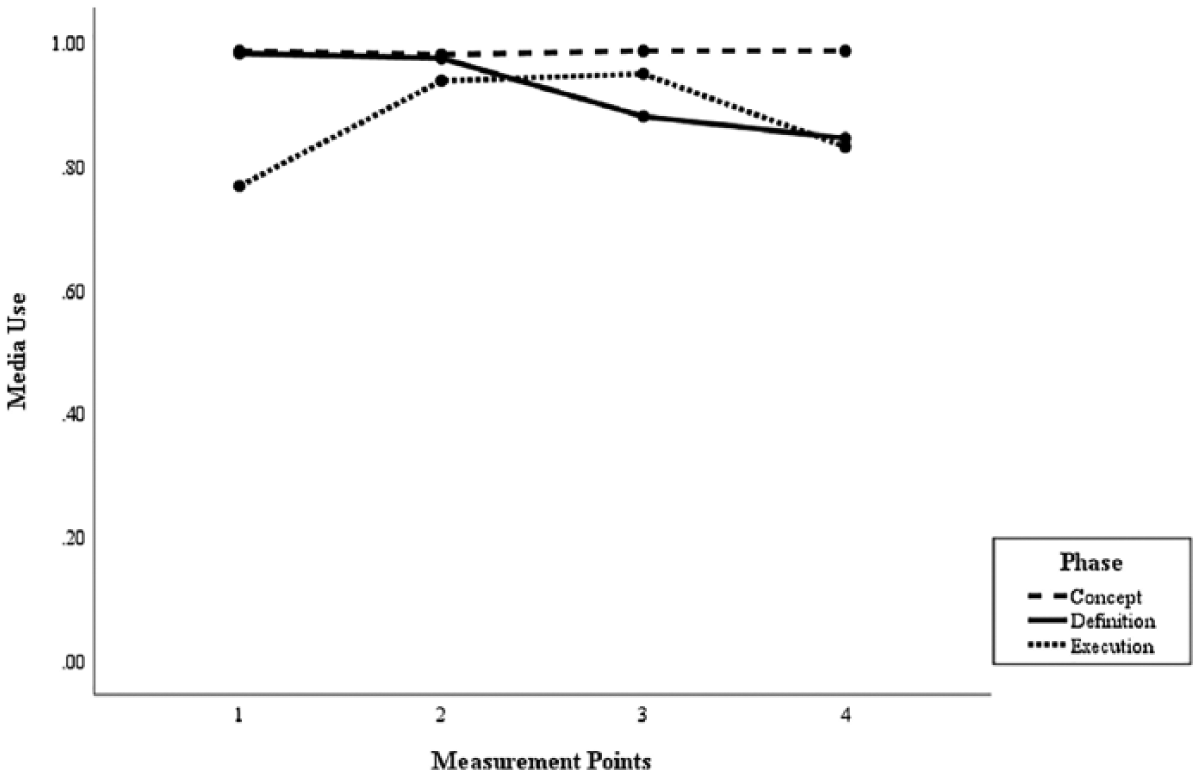
Illustration of the interaction between measurement points and phases for face-to-face-interaction.
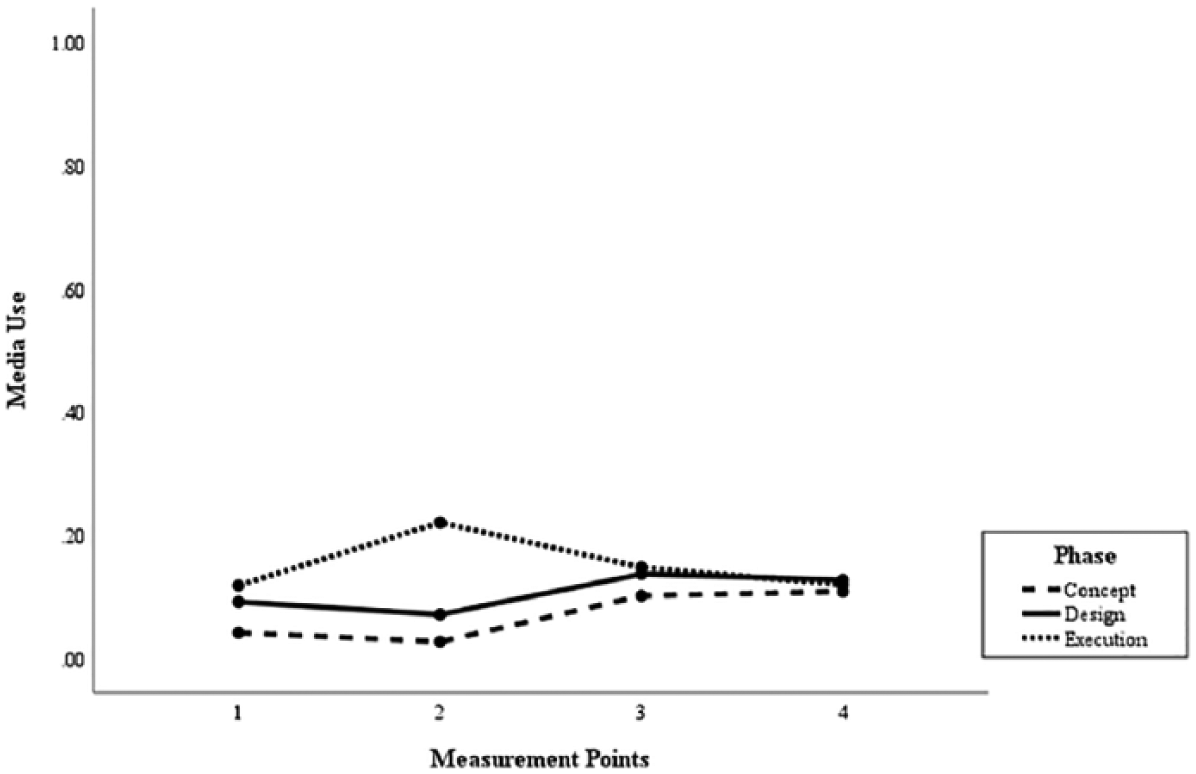
Illustration of the interaction between measurement points and phases for use of telephone.
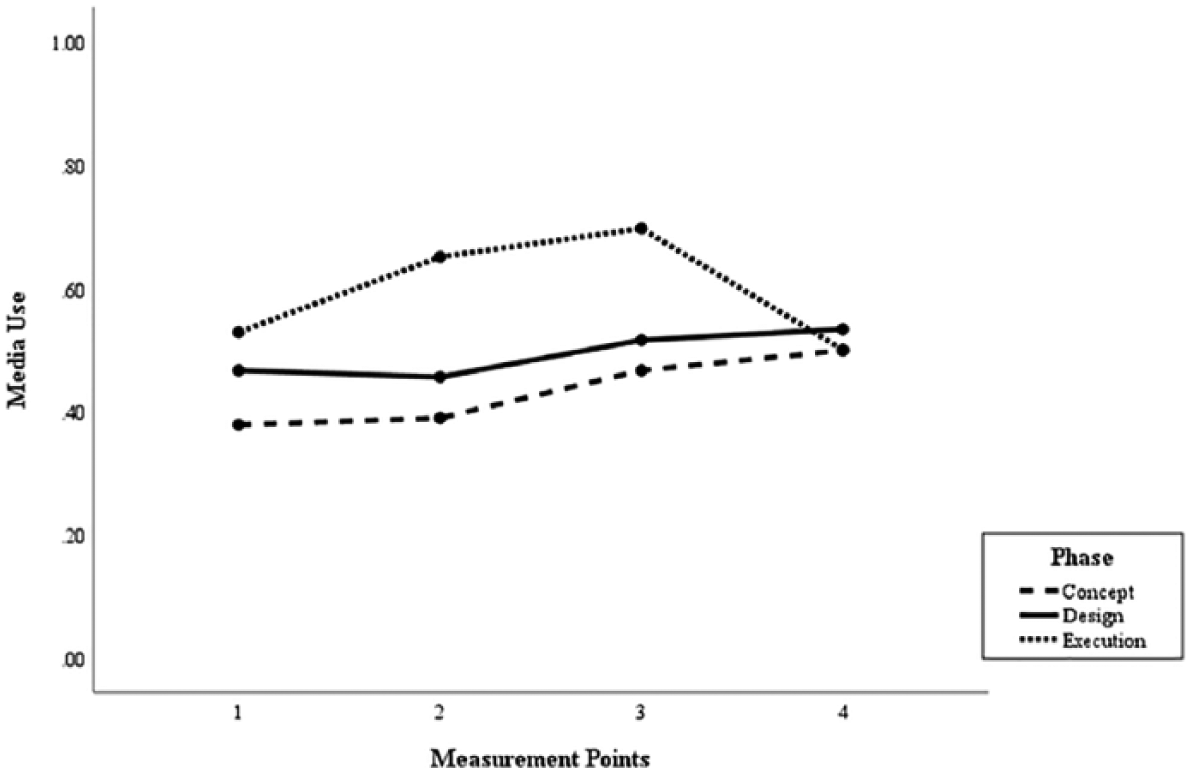
Illustration of the interaction between measurement points and phases for chat.
To achieve an understanding of the nature and comparability of the teams’ tasks, the documents developed by the teams in the three project phases were also evaluated, as were the tools used by the respective teams. Tables 2 and 3 give an overview of the documents and tools in the respective three project phases. These documents and tools were recorded by the project teams’ leaders on a weekly basis. Table 2 demonstrates the influence of project phases on the respective documents, with a higher proportion of requirements specification and use cases in the concept over all later phases; of design specifications and UML diagrams in the design over the concept and execution phases; and of user manual and code in the execution over the earlier phases. These effects were corroborated in a multivariate analysis revealing a significant effect of project phase on used documents, F(11, 23) = 5.25, p = .003. To test the comparability of the teams’ tasks in the respective project phases, intraclass reliability analyses regarding the use of the different document types over all teams were performed. The resulting ICC coefficient of .96, F(116, 3828) = 23.94, p < .001, indicates that teams showed extremely similar patterns regarding the use of the respective documents over the course of their projects. With regard to the tools used during the teams’ collaboration, there was a larger variation, which the authors reduced to seven categories for clarity purposes. The largest category was development environments (e.g., Eclipse), followed by non-interactive documentation (e.g., MS Office Word, LibreWord), software for generating figures/diagrams/mockups (e.g., Dia, Pencil), interactive data management/storage tools (e.g., Google Docs, MS Office OneNote), heuristic requirement assistant (HeRa, program developed and recommended by the university), database management (e.g., MySQL), and interactive communication tools (e.g., Skype, Google Talk). Table 3 shows the proportion of respective tool use over the three project phases. Supported by a multivariate analysis revealing a significant within-subject effect of project phase, F(13, 21) = 3.26, p = .008, tool used appeared to change over time. For instance, while development environments became more important over the course of the project, the opposite appeared true for non-interactive documentation tools and the requirement assistant. To test the comparability the teams’ tool use in the respective project phases, reliability analyses were performed. The resulting ICC coefficient of .85, F(95, 3135) = 6.76, p < .001, indicates that teams showed very similar patterns regarding tool use over the course of the project.
Percentage of Documents Used in Respective Project Phases.
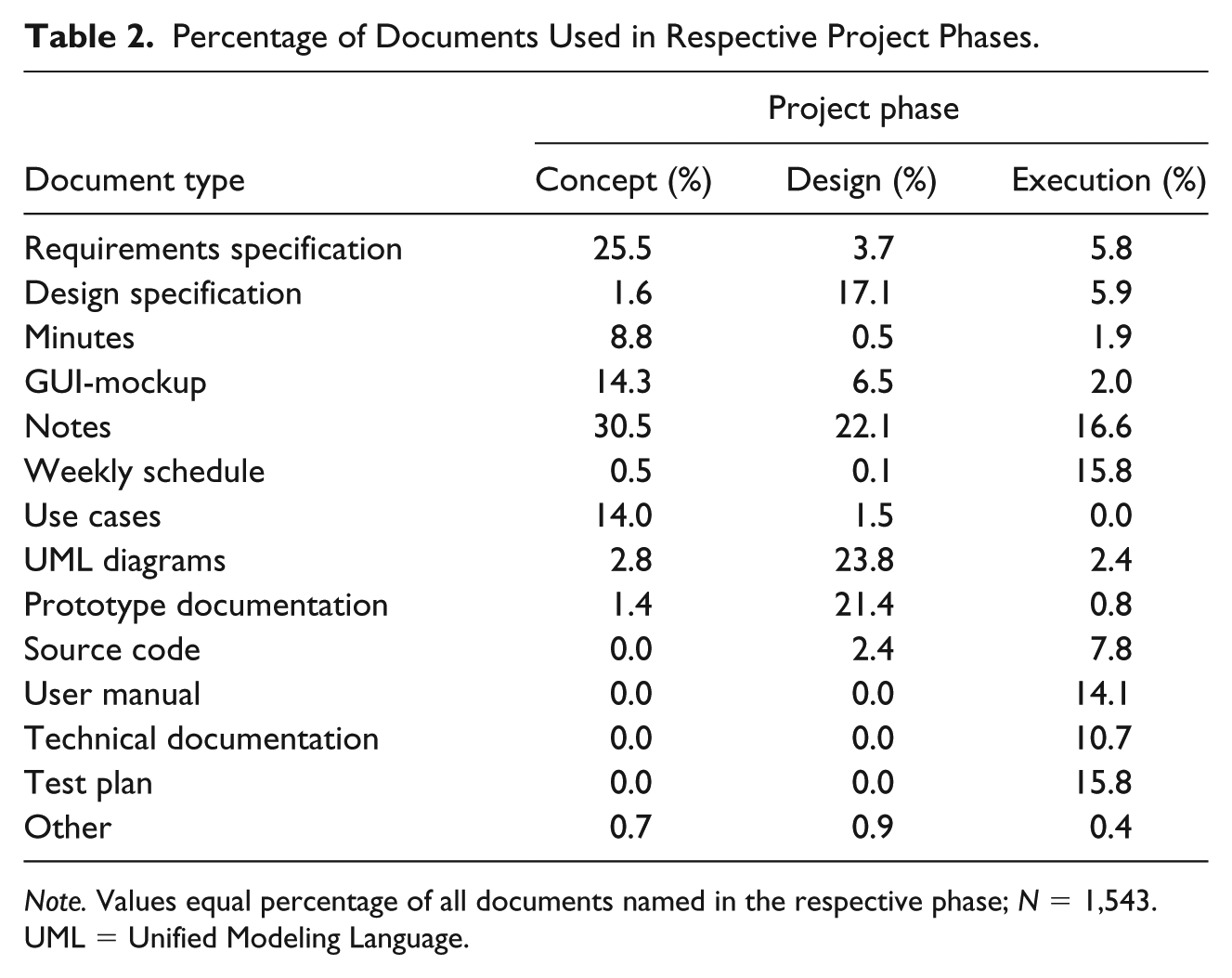
Note. Values equal percentage of all documents named in the respective phase; N = 1,543. UML = Unified Modeling Language.
Percentage of Documents Used in Respective Project Phases (N = 569).
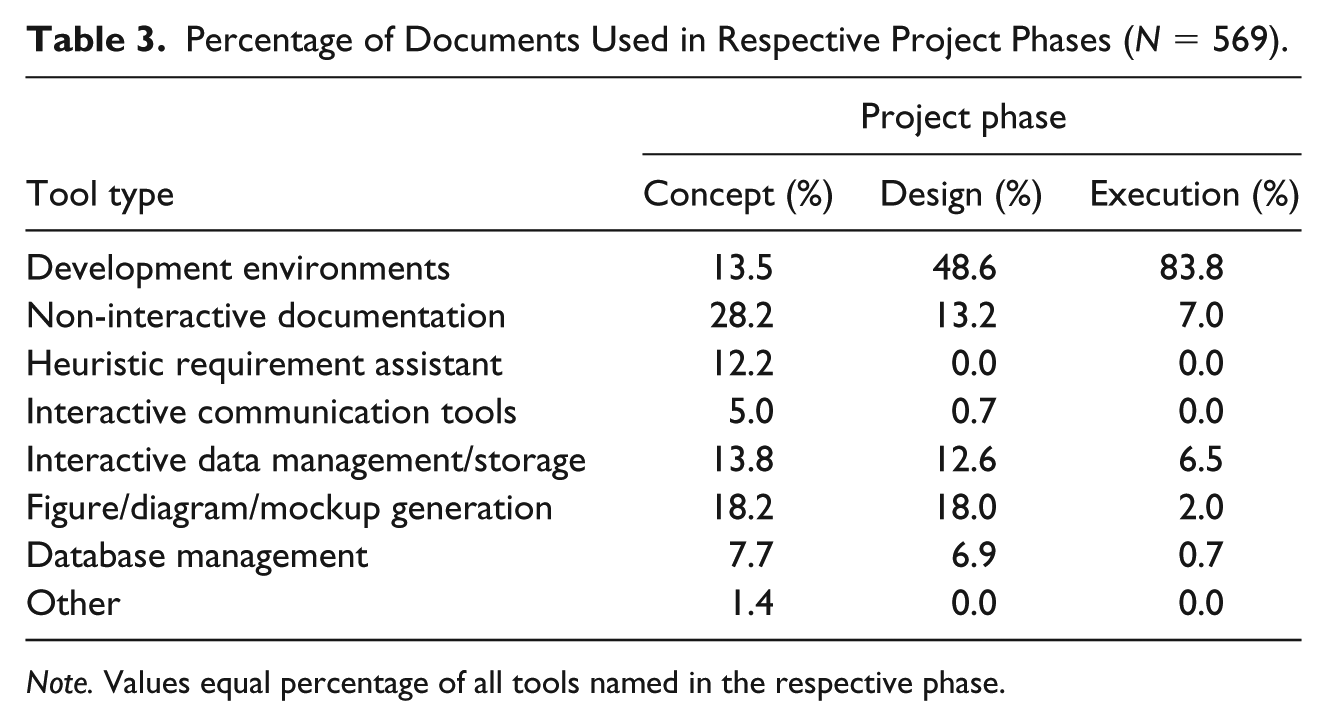
Note. Values equal percentage of all tools named in the respective phase.
Finally, to determine if assignment to different clients affected the comparability of the projects in terms of media use, tools, and documents, MANOVAs were conducted with either assignment to clients in general, or assignment to either external or internal (i.e., professors) clients as between-subject factors. There was no influence of client in general on variations in media use, F(60, 138) = 0.96, p = .563; documents, F(170, 160) = 0.91, p = .720; or tools, F(130, 200) = 1.07, p = .333, over the three projects phases. Assignment to external versus internal clients also did not affect variations in media use, F(6, 27) = 0.30, p = .934; documents, F(17, 16) = 0.52, p = .908; or tools, F(13, 20) = 0.94, p = .535, across the project phases.
Discussion
While the relationship between project phase communication behaviors (Swigger et al., 2012), coordination (Hoegl et al., 2004), and structural demands (Sarker & Sahay, 2002) has been previously discussed, this study systematically linked changes in media use to project phases. By examining media use, team processes, and project phases, the authors provide a new approach of looking at temporal dynamics from a virtuality perspective. Considering the use of communication media to be the most dynamic aspect of virtuality, this study set out to uncover temporal variations of media use in project teams to achieve a better understanding of the dynamics of virtuality. As project phases are both more concrete than entire projects and more tangible than singular tasks, the authors analyzed their influence on variations in media use over the course of a 3-month project. It was assumed that the different project phases were related to different tasks and demands which, in turn, would lead to differences in the use of communication media. The results generally supported the hypotheses, showing changes over the project phases for all media except videoconferencing and email. The authors had also assumed that the distinct project phases would not just generally lead to change in media use but would also lead to the prediction of the nature of change. Consistent with the hypotheses, face-to-face interaction was significantly lower in the last project phase (execution) than in any of the preceding project phases. At the same time, the use of lean media (i.e., telephone, chat) increased over time. This implies that team members became more adept at appropriating leaner media for their intra-team communication. A possible explanation may be that they perceived leaner media as facilitating, rather than hindering, their coordination demands, and as saving them the time they would have had to invest in scheduling and attending face-to-face meetings.
The fact that videoconferencing showed no effect regarding project phases may be attributed to the overall low-usage level. The reason for this may indeed lie in the co-located nature of the teams. Should they really have experienced the need for a more natural (cf. Kock, 1998) medium, they may have opted to just meet up face-to-face. The absence of an effect (even though marginally significant results tend to support the assumed directions of effects) with regard to email use is more surprising and may have multiple reasons. Of media used, being not only text-based but also asynchronous was the leanest. Accordingly, team members may initially have preferred to use quasi-synchronous media, such as instant messaging/chat 5 or telephone, to compensate for less face-to-face interaction. Moreover, it is possible that an increase in email use—especially as a compensation for physically richer media—may have taken a longer duration than 14 weeks to observe.
The hypothesized interaction effect between measurement points and project phases can be considered as highly relevant. Had the present study solely discovered main effects, it could simply be said that media use changes over time. While this surely still holds true and is an important insight, change in media use over time would also imply that the concept of phases, which are tied to specific contents and were thus not arbitrarily chosen, is redundant. That changes in media use between measurement points varied between the three phases—with hardly any change within the concept phase and an increase in the definition and execution phases—speak against a simple linear trend over the course of the project. The results suggest that project phases triggered noticeable shifts in tasks, intra-team communication, and thus media use. Accordingly, team process dynamics, such as changes in communication, may truly be attributed to project phases. Moreover, this underlines the dynamic notion of task–media fit, predominantly as a function of media appropriation and compensation. Over time, individuals became increasingly capable of using media in a variety of ways for a variety of different tasks. Hence, they had the option to use different media even for similar tasks, rather than being restricted to a single medium.
In essence, the findings support the criticism voiced toward traditional cues filtered out (cf. Walther & Parks, 2002) theories such as MRT (Daft & Lengel, 1986), SPT (Short et al., 1976), or the task–media fit hypothesis (McGrath & Hollingshead, 1993). While these theories present a fairly static notion of task–medium fit, the present results were able to show an increasingly dynamic use of various media over time. The increase in the use of leaner media over time supports more recent theories, such as MST. Based on concepts such as channel expansion, MST argues that over time (i.e., with increasing familiarity), team members become less dependent on media with high synchronicity or media richness. In doing so, MST acknowledges the difference between physical media capabilities and media characteristics mentioned in the traditional theories (e.g., feedback, social presence, personalization), which can often be regarded as socially constructed (i.e., their salience is determined by previous experiences and context). Nevertheless, while the current findings fit into the MST framework, the study adopted a different level of analysis. While MST argues that tasks are a too broad level of analysis and suggests focusing on the involved communication processes (convergence and conveyance) required to accomplish a task, this study concentrated on the higher level construct of project phases. This, in turn, enables a focus on project requirements (rather than micro-level communication processes), which can be regarded as tangible enough to allow for concrete interventions, as explained in the “Implications” section.
Implications
Traditional life cycle models of group development, such as Tuckman’s sequential stage model (Tuckman, 1965), consider change to be driven largely by internal cues (cf. Arrow, 1997; Arrow et al., 2004). As an outsider to the group, these changes may not be as easily visible, thus making it difficult to schedule timely interventions (e.g., coaching). The idea of specific time points defined by the overall project duration (e.g., midpoint) has been acknowledged in Gersick’s punctuated equilibrium model (Gersick, 1988) and has further been tested and elaborated in studies on timing of team interventions (Hackman & Wageman, 2005; Woolley, 1998). However, while the project midpoint at least constitutes a distinct external cue, it gives no information on the types of tasks the team is currently working on. Given that team processes are essentially tied to task accomplishment (cf. Marks et al., 2001), it seems crucial to consider the role of tasks when targeting team processes, such as communication and media use.
While singular tasks have been extensively linked to media choice and effects (e.g., Daft & Lengel, 1986; McGrath & Hollingshead, 1993), they usually form parts of complex series, making them difficult to target in practice. Hence, the relevance of project phases—as revealed in this study—allows for more practical implications. Seeing as project phases are located at a broader level than tasks, they appear more concrete and thus influenceable. Accordingly, team member awareness with regard to approaching project phases (potentially even marked by quality gates) enables teams to reflect on communication processes and strategies. Knowing that the extent and informational value of media used in the definition phase may not need to be as high as in the initiation phase allows for more efficient scheduling of meetings. For instance, in organizations where teams are truly geographically dispersed, face-to-face meetings are associated with substantial costs, such as time, money, and effort in general. Accordingly, knowing when to best allocate these resources during the project is pivotal in terms of efficient project planning. Seeing as all teams in the present study managed to fulfill the clients’ requirements with regard to the product (the majority even fulfilling 95% or more of the requirements), they largely appeared to be effective and may thus serve as an indicator of appropriate media choice.
In other projects, transitions between project phases may be subtler than it was the case here. However, the present study also suggests that creating project phase boundaries such as quality gates could act as a guidance in structuring team project work. Not only do they serve the purpose of investigating product quality at a given stage but they can also motivate teams to reflect on their collaboration in past project phases as well as plan for the next stage.
Generally, the present study also serves as a practical reminder that teams can and do use a variety of different media over the course of their project work. Accordingly, it can be a good idea for teams to brainstorm on possible communication media, their use, and effectiveness at the start of their collaboration. Establishing group norms—such as when meetings are particularly desirable (i.e., at the beginning of the project)—can help manage expectations and guide intrateam communication.
Limitations and Directions for Future Research
The present study’s primary limitation lies in the sample of students, who are generally regarded as a fairly homogeneous group—not solely in a demographic sense but also in their response behavior regarding psychometric scales (for a second-order meta-analysis, see R. A. Peterson, 2001). Accordingly, student teams may differ from work teams in ways potentially affecting the present study’s external validity. For instance, the importance of the team’s outcomes to its members is likely to be lower due to the lack of monetary incentives and career goals. Team members will have less experience, not just with regard to software engineering but project work in general. This may also constitute an alternative explanation for the reasonably consistent choice of tools and documents across teams: Teams may not just have worked on the same tasks (reflected in choice of tools and documents) due to the comparability of their projects but because they lacked the experience to opt for more diverse working methods. Their intrateam relationships will also have differed from those between work colleagues (cf. Miranda & Saunders, 2003; Small & Rentsch, 2010). Moreover, the present study could not measure typical project performance data such as start and finish dates of schedule activities, schedule progress, and actual duration (cf. Project Management Institute, 2017) as these were largely predefined, given the course structure. Accordingly, media use between more or less successful teams could also not be compared. Nevertheless, the teams could be considered as typical for temporary project teams: they were self-managed, had no prior history working together, and had a finite duration of collaboration which was in turn tied to a valuable outcome (cf. Meyerson et al., 1996). Moreover, the fact that the present study was conducted in the field may also alleviate some of the general concerns toward student samples, as these are mostly equated to laboratory settings (Bello, Leung, Radebaugh, Tung, & van Witteloostuijn, 2009; Stevens, 2011). Accordingly, while the results may demonstrate less external reliability, the approach chosen in the present study can be considered as a starting point for future research in this area.
Future research should be encouraged to adopt less of a hard systems approach to project management, as the present study did with its fixed phases and quality gates as decision point milestones (e.g., Morris, 2002; Winter, Smith, Morris, & Cicmil, 2006). Doing so followed the traditional Lewinian episodic conception of change processes, rather than modeling them as continuous, evolving, and incremental (Purser & Petranker, 2005). In reality, the definition of objectives and strategies is often somewhat softer and messier, with project team members experiencing and correcting deviations between the conceptual model and their perceived reality (Yeo, 1993). This thought coincides with the notion of agile project management, which adopts an evolutionary rather than plan-driven approach. Considering deviations from original project plans as inevitable, the success in agile project management lies in its flexible scope and continuous design. In light of the excessive rework, risk of customer dissatisfaction, and lack of flexibility in the traditionally rigid development process, especially companies in the IT project environment have adopted agile methodologies revolving around multiple iterations through the product development cycle (e.g., Dybå & Dingsøyr, 2008; Serrador & Pinto, 2015). Given that the present study assumes that team member interactions and particularly media use should be considered as an iterative process (see also Foster, Abbey, Callow, Zu, & Wilbon, 2015; Ramirez & Burgoon, 2004), the project management life cycle may also need to be regarded from a more agile perspective. Building on insights obtained regarding the classic project life cycle, future research could thus analyze iterative group development cycles (cf. Gersick, 1988) in the context of agile projects.
Footnotes
Declaration of Conflicting Interests
The author(s) declared no potential conflicts of interest with respect to the research, authorship, and/or publication of this article.
Funding
The author(s) disclosed receipt of the following financial support for the research, authorship, and/or publication of this article: This work was supported by the Deutsche Forschungsgemeinschaft (German Research Foundation), grant no. KA2256/9-1