



Abstract
An increasing number of people with chronic diseases exchange social support using online support groups (OSGs). However, there is little understanding of group communication mechanisms that underpin the relationship between OSG participation and social support. Drawing on Prentice, Miller, and Lightdale’s common-identity and common-bond framework, we propose and test a theoretical model that explains group communication mechanisms through which members’ participation influences their perceived social support. In the process, we identified and empirically validated a three-factor solution for an OSG participation scale. Based on 356 users across 12 popular OSGs, we find that two group communication mechanisms—identification with the community and interpersonal bonds with other members—mediate the relationship between OSG participation and perceived social support. Specifically, identification has a stronger mediating effect than interpersonal bonds in the relationship between OSG participation and perceived social support. We also discuss theoretical and practical implications.
The Internet has become an indispensable part of the landscape of supportive communication and health. It is revolutionizing how social support is exchanged and perceived, making online support groups (OSGs) a promising research area in communication. Based on a nationally representative survey, about 80% of Internet users in the United States searched for health information online in 2013, and 16% have gone online to find others who have experienced similar symptoms (Fox & Duggan, 2013). For instance, people with chronic or life-threatening diseases use online resources to obtain information about their conditions and ways to cope (Rains & Wright, 2016). In addition, Internet users are not solely passive consumers of online health information; they are also active producers (Nath, Huh, Adupa, & Jonnalagadda, 2016). The massive amount of content they create and share on OSGs has the potential to reach millions of people (Fox, 2011; Fox & Duggan, 2013).
Despite the fact that OSGs have become a major resource for people with health problems, participation in OSGs does not guarantee that users receive the support they need or perceive the support is available during times of need. Some studies find that both posting and lurking in OSGs are predictive of perceptions of social support (Houston & Allison, 2002; Mo & Coulson, 2010), while others find that active posting is not related to perceived social support and even exerts negative impacts on users’ mental health (Smedema & McKenzie, 2010; Tanis, 2008). Scholars have contended that different immersion levels of OSG use can lead to people reporting either beneficial or detrimental effects on their mental health (Batenburg & Das, 2015; Rains & Wright, 2016). Such potential for OSG participation to be ineffective or even counterproductive suggests a need for research that describes, analyzes, and explains the effects of communication processes within OSGs.
In this study, we argue that different group communication mechanisms may offer insights on the mixed findings. Previous studies have suggested that online participation is realized through group communication, which accounts for the majority of users’ personal experiences online (Gritsenko, 2016; Han et al., 2012; Ren et al., 2012; Ren, Kraut, & Kiesler, 2007). Group communication lies at the heart of OSGs and influences how people experience and understand support-related interactions (Cline, 1999). Therefore, investigating group communication mechanisms provides a basis for understanding the link between OSG participation and support-related outcomes. To that end, we offer a theoretical framework for examining the relationship between OSG participation and perceived social support—a potentially robust predictor of beneficial health-related outcomes (Gruenewald & Seeman, 2010). We draw upon the common-identity and common-bond approach (Prentice, Miller, & Lightdale, 1994) to propose and test a mediation model that explains how two group communication mechanisms—common identity (i.e., identification with the group; Cheney, 1983; Scott, Corman, & Cheney, 1998; Tajfel & Turner, 1986) and common bond (i.e., interpersonal bonds with others; Namkoong et al., 2012; Wasserman & Danforth, 1988)—influence the relationship between OSG participation and perceived social support. The following section reviews theories and research that helps create the theoretical model.
Online Support Groups
Online support groups (OSGs) are a specialized subset of online groups that share similarities with other online groups (e.g., financial consulting, gaming, brand loyalty). Generally speaking, online groups enable large, geographically dispersed groups of individuals to converse and enhance common interests (Wasko & Faraj, 2005). Users can build and maintain interpersonal relationships and create a supportive network of knowledge, ideas, and interpretations (Herring, 2008). However, OSGs differ from other online communities because they contain information that matters for life or death (Blank & Adamsblodnieks, 2007).
Research on OSGs starts from the fundamental understanding of online information seeking and sharing behavior (Welbourne, Blanchard, & Wadsworth, 2013), group support interventions (Han, Hou, Kim, & Gustafson, 2014), and beneficial health outcomes (Batenburg & Das, 2015). A variety of information and communication technologies support interactions occurring in online health communities, ranging from email lists to instant messaging, forums, blogs, wikis, and social networking sites (SNSs; for extended review, see Rains & Wright, 2016). These online tools can quickly connect people, forming niche groups that house exchanges of social support and benefit users’ overall health. With thousands of people logging on to share side effects, treatment options, test results, and coping strategies, OSGs have created an online archive for informed decision making and patient empowerment (Johnston, Worrell, Di Grangi, & Wasko, 2013).
Participation in OSGs
Participation in OSGs is manifested by various forms of engaging in online discussions, posting questions, and responding to others’ questions. Researchers have argued that participation is fundamental for group members to develop a sense of belongingness, provide support to others, receive feedback, form interpersonal bonds, and gain recognition for their contributions (Fiedler & Sarstedt, 2014; Ridings & Gefen, 2006). It is widely agreed that successful online groups typically have large volumes of messages posted and group members tend to feel close to each other (Iriberri & Leroy, 2009). These dimensions serve as basic building blocks for understanding and even solving the challenge of participation.
As a specialized subset of online groups, OSGs are faced with similar challenges concerning participation. To date, studies conducted in the context of OSGs have been situated in both highly structured formal groups (e.g., Han et al., 2014; Huh, Marmor, & Jiang, 2016) and loosely structured online groups (e.g., Batenburg & Das, 2015; Huh, McDonald, Hartzler, & Pratt, 2013). A highly structured group means users’ online interaction is mostly scheduled, required, and moderated in an interventional environment (Rains & Wright, 2016). One advantage of these structured intervention groups is that researchers can analyze users’ actions by tracking server log data rather than collecting self-reported data (Boase & Ling, 2013). However, scholars have argued that it is both theoretically and practically challenging to generalize the existing findings generated from those structured groups to the variety of informal and loosely structured OSGs (e.g., The Cancer Forum, HealthUnlocked groups; Rains & Wright, 2016)—the focus of the current study.
In contrast to highly structured group interactions, the development and success of organically formed OSGs solely relies on members’ voluntary contributions. For those OSGs, it is important to maintain a diverse pool of participants who engage in persistent conversations, contribute new information, refute dubious information, and offer social support matching others’ needs. Understanding these group communication processes is crucial for (a) improving participation and retention and (b) increasing OSGs’ utility in helping users match their needs with the social support they receive (Rains & Wright, 2016).
The Common-Identity and Common-Bond Approach
Common-identity is different from a common-bond approach to group membership. Group memberships that are based on sharing a category membership (e.g., breast cancer survivor) are defined as common identity; membership based on the attraction felt toward fellow group members (e.g., groups based on friendships) is a common-bond approach (Prentice et al., 1994). This conceptual distinction allows researchers to predict different functions that each group provides for its members as well as the different processes that occur within each group. Common-identity groups comprise individuals who ascribe group-defining characteristics to the self and take the collective interest to heart (Prentice et al., 1994). More specifically, members of common-identity groups are attracted to the group’s norms, goals, activities, and other defining features. In contrast, common-bond groups comprise members who are attracted to one another as individuals. These two dominant group perspectives pave the way for understanding communication mechanisms in OSGs.
Common-Identity Groups
The theoretical perspective of a common-identity group is rooted in the identification literature. Ashforth and Mael (1989) define identification as “the perception of oneness or belongingness to some human aggregate” (p. 21). People typically have a sense of we-ness with a group or a community and feel connected with its purpose, character, or value (Tajfel & Turner, 1986). For example, members of a community choir (a voluntary leisure organization) may know few other members, but strongly identify with the cause endorsed by the choir, and thus they develop a sense of belongingness with the organization (Meisenbach & Kramer, 2014). Likewise, an OSG can serve as a salient social category for many people’s identity, especially those highly involved in the process of exchanging social support, building ambient awareness of who knows what and who knows who, organizing community events, advocating opinions, and shaping community norms.
Based on a two-way thinking perspective, Cheney and Tompkins (1987) view identification as both product and process. As individuals and the collective (the collective can be an OSG as a whole or groups within an OSG) interact, a person’s and the community’s conceptualization of identity changes; identity, therefore, is created, transformed, and recreated through interaction. Scott and colleagues (1998) build on this perspective to argue that group identification is the process that teaches people the norms, values, and behaviors of a group. Group identification can reinforce an established identity and/or ultimately produce a new social identity, which is expressed primarily through language in our interactions with others (Scott, 2007; Scott et al., 1998). Consistently, group identity is not only a key point of reference but also a practical building block for group-related objectives, activities, and projects (Scott, 2007). Groups can strategically use their established identity programs and identity messages—including values, norms, culture, ethics—to influence members’ stances and behaviors (Stephens & Zhu, 2015). Thus, social collectives such as OSGs can potentially (a) leverage established norms and values to influence members’ behaviors, (b) enhance attachment to the community, and (c) create new identities from group interactions.
Identification can be a major factor in comforting OSG users. This general line of research suggests that the social context of OSGs, with which people identify, may exert influence over their perceived social support in response to stressful situations. Studies have shown that identification is a vital basis for social support that can alleviate depression and stress, benefits people’s psychological and psychosocial health, and boosts well-being (Crabtree, Haslam, Postmes, & Haslam, 2010).
Common-Bond Groups
Interpersonal bonds, or human bonding, refers to the perception of a close relationship formed through supportive interpersonal communications among people who face similar concerns or problems (Namkoong et al., 2013). According to the belongingness hypothesis, humans have a persistent drive to form a certain number of “lasting, positive, and significant interpersonal relationships” (Baumeister & Leary, 1995, p. 497). Such attachment is well manifest in people’s support-seeking behaviors (e.g., expressing distress or seeking comfort or assistance). OSG members can feel they have strong interpersonal bonds by providing support to others, especially when expressing emotional support (Namkoong et al., 2013).
People tend to cohere when they have mutual positive feelings toward one another (Lott & Lott, 1965). This interpersonal attraction provides the basis for the development of human bonds and the formation of groups and group cohesiveness (Hogg & Turner, 1987). When faced with stressful life events, people may treat other OSG users with whom they share strong interpersonal bonds as reliable attachment figures, turning to and seeking contact with them. Many individuals participate in an OSG to reduce feelings of loneliness and social isolation (Barak, Boniel-Nissim, & Suler, 2008). Indeed, compared with other online groups built upon various purposes, OSG users have stronger desires to connect with similar others who are concerned and feel stigmatized (Batenburg & Das, 2015).
In comparison to the identification perspective, opportunities for self-disclosure and self-presentation shift researchers’ attention from the group/community as a whole to individual members, who, online, are often represented by avatars, profile pictures, personal descriptions (e.g., age, gender, ethnicity, hometown, current residence), and personalized signatures (Ren et al., 2007). More recently, the inclusion of contact information such as phone numbers, email addresses, and instant messaging accounts enables members to connect and interact through multiple channels and become real-life contacts. These personalized options can signal a member’s style, personality, and availability, while increasing the likelihood of interaction and bonding. Walther and Parks (2002) suggest that the aggregated personal information available online promotes interpersonal bonds even among people who have not yet interacted.
Researchers have found that interpersonal bonds appear to insert multiple and strong impacts on people’s emotional patterns and cognitive processes (Baumeister & Leary, 1995). According to research conducted by the CHESS (Center for Health Enhancement Systems Studies) group (Han et al., 2012), the level of support exchange and group cohesiveness is usually very high within online intervention groups. Many participants report staying in contact for years after the intervention ended, as the interpersonal bonds formed and reinforced during the online intervention led to many lifelong friendships (Namkoong et al., 2012). Many of them even organized annual face-to-face meetings to maintain these bonds, which is believed to have profound impact on people’s health and well-being (Wen, McTavish, Kreps, Wise, & Gustafson, 2011). Conversely, a lack of interpersonal bonding is linked to a variety of ill effects on mental health, adjustment, and well-being (Kawachi & Berkman, 2001).
Perceived Social Support
At the heart of all studies of OSGs is the discovery and understanding of how supportive online interactions can effectively decrease stress level and bolster an individual’s sense of well-being (High & Dillard, 2012). As a key indicator of one’s well-being, perceived social support refers to the perception that assistance is or could be available from others (Albrecht & Goldsmith, 2003). The perception of being cared for, whether or not this perception is accurate, can promote health (Wethington & Kessler, 1986). Researchers have suggested that positive health outcomes may be linked to the perception of available support within OSGs rather than actualized support (Rains & Wright, 2016). Multidisciplinary research has established that greater perceived support is associated with increased psychological and physical health (Cohen, 2004). Perceived social support not only alleviates stress but also buffers the psychological effects of stress on health and well-being (Rains & Young, 2009). In the context of cancer-focused OSGs, participants have reported (a) an increased sense of social support, empowerment, and self-esteem and (b) a reduced level of stress, depression, cancer-related trauma, and social isolation (Rains & Wright, 2016).
In this study, we chose perceived social support as the outcome of OSG participation for three reasons. First, researchers have argued that perceived social support is a much stronger indicator in predicting people’s psychosocial outcomes in OSGs than received social support (supportive actions received during times of need) and network position (the degree to which a person is integrated in a social network; Rains & Wright, 2016). Second, perceived social support reflects how OSG users consider themselves within a supportive social network (the number and strength of social ties). Such perception may indicate (a) the extent to which OSG users relate to the group and (b) whether they will continue using the group. Third, perceived social support is future-oriented and consistent with the ongoing, open-ended nature of OSGs.
Research Questions and Hypotheses
Although it is not possible to attribute OSG users’ perceived social support solely to participation and the associated two group communication mechanisms (i.e., identification and interpersonal bonds), it is plausible that these three factors can play a substantial role. Next we present a series of hypotheses and research questions that connect these group communication mechanism and perceived social support.
Identification With the Group and Perceived Social Support
Group participation may have cognitive consequences that affect the relative salience of social identities (Kramer, 2011). More specifically, participation in the form of engaging in OSG discussions, posting questions, and responding to others’ questions may foster and reinforce identification with the group. Certainly, one of the clearest points of integration between identification and computer-mediated communication has examined how social identities are socially constructed during online group interactions. As Postmes, Spears, and Lea (2000) argued, “[computer-]mediated groups can develop a meaningful and strong sense of identity through interaction” (p. 344). Some related work in this area has focused on time spent in computer-mediated interactions and how this can predict the emergence of new social identities related to that technology. This identification process is constructed through online interactions and storytelling. Members tend to respond to others’ posts using a collective “we” instead of “you” and “I,” which reinforces group identification and brings consolation (Wentzera & Bygholm, 2013). Therefore, OSG participation may have a direct impact on users’ identification with the group. The following hypothesis is posed:
When people identify with a group, it is likely they will see other in-group members as part of the self (rather than as external to the self); meanwhile, this sense of social categorization can motivate individuals to promote their own well-being and support others with useful forms of help. Identification with OSGs provides a basis for interpreting the quality and quantity of available social support in a constructive way (rather than treating it with suspicion). It is conceivable that when people identify strongly with the group, they are likely to view the group as a helpful resource from which they can draw positive support, particularly when facing health concerns. Thus,
Scholars have agreed that one’s social identity and social connectedness are closely related to their health (i.e., the social identity approach to health; Tarrant, Hagger, & Farrow, 2012; Turner, Oakes, Haslam, & McGarty, 1994). Recently, Haslam and colleagues (2015) argued that “group ties are beneficial for health because they provide a basis for giving and receiving social support” (p. 245). Identification provides a solid theoretical perspective for how OSG participation may relate to members’ perceived social support. Therefore,
Interpersonal Bond With Other Members and Perceived Social Support
Participation may help members establish social ties and close bonds with others. Participating in OSGs is inherently “an interpersonal, transactional process” (Collins & Feeney, 2000, p. 1053) that involves dyadic interactions between support seekers and providers. Online interactions, such as responding to others’ posts, can (a) let the original poster know that people pay attention to his or her questions or comments and (b) signal to others that the group is active, and members are open to forming connections. It builds a strong case that these interactions may eventually build interpersonal bonds and make future interactions more sustained. Thus,
An OSG member’s assessment of his or her relationships with other members serves as a premise for creating, delivering, listening to, and interpreting online supportive communication (Beck & Keyton, 2014; Keyton & Beck, 2009). When people have stronger interpersonal bonds with others, they are likely to not only attribute validity and credibility to social support received, but also perceive that social support is available during times of need. Consequently, it can be expected that strong interpersonal bonds with other group members boost posters’ perceived social support. Therefore,
The immediacy and openness in sharing common concerns (e.g., treatment, medication) and personal details (e.g., body image, lifestyles) foster interpersonal bonds (Orgad, 2005). The formation of such close bonds in a short time and convenient way attracts people to turn to OSGs for social support and new relationships (Beaudoin & Tao, 2007). Given people faced with chronic diseases may not have anyone within their personal networks who shares a similar experience, actively participating in OSGs may be linked to positive support outcomes due to new relationships formed through online interactions. This argument coupled with the previous literature on interpersonal bonds generates the next hypothesis:
Method
Research Site and Participants
Research sites of this project were OSGs dedicated for women faced with breast cancer concerns. Women are avid users of online media channels (Smith & Anderson, 2018), including OSGs, and breast cancer groups rank high in the frequency of active postings compared with other OSGs (Fox, 2014). These environments serve as a medium in sharing cancer information and in forming and maintaining interpersonal relationships among breast cancer patients, survivors, and caregivers.
For this study, we selected and contacted a total of 31 OSGs based on their popularity and prominent presence in search tool results. As OSGs have a variety of community features and functionalities, studying a diverse body of OSGs should provide a comprehensive picture of users’ participation. After negotiating access to those groups (see details of negotiation in the following section), we recruited 371 participants from 12 groups where breast cancer was listed either as the main topic or as a subsection.
Procedures for Pilot Test
After receiving institutional review board (IRB) approval, we conducted a pilot study to investigate whether the proposed instruments were inappropriate, extraneous, or too complicated for the large-scale primary study. A convenience sample of 142 respondents were recruited from a breast cancer subgroup of one forum-based OSG (https://www.cancerforums.net/forums/12-Breast-Cancer-Forum). To be qualified for the pilot study, participants had to be female, over 18 years old, and consider themselves as a user of The Cancer Forums at the time of this study. After inspecting the data, 15 cases were removed due to excessive missing data (only completed two questions out of 34 required questions). Most respondents were 20 to 60 years old (Mage = 37.2 years). About 91% of the respondents identified themselves as non-Hispanic White, 4% as Black or African American, and 2% as Asian, and 3% as multiracial or Others. Most respondents (62%) were married; 21% were single or divorced. Nearly half (49%) reported having an annual household income from US$50,000 to US$74,999; 35% reported income lower than US$50,000. Regarding health, 59% perceived their health as very good or excellent, and only 19% perceived their health as poor or very poor. The results of the pilot study showed that the scales adapted from existing measures maintained their reliability (ranged from .77 to .90; see the “Measures” section for details). Table 1 presents the scale reliabilities from the pilot study, and Table 2 presents correlations between the variables (see the primary study for detailed scale items and related statistical descriptions).
Scale Reliabilities for Pilot Study.

Note. OSG = online support group.
Summary of Bivariate Correlations of Variables in Pilot Study (N = 127).

Note. OSG = online support group.
p ≤ .05. **p ≤ .01. ***p ≤ .001.
Procedures for Main Study
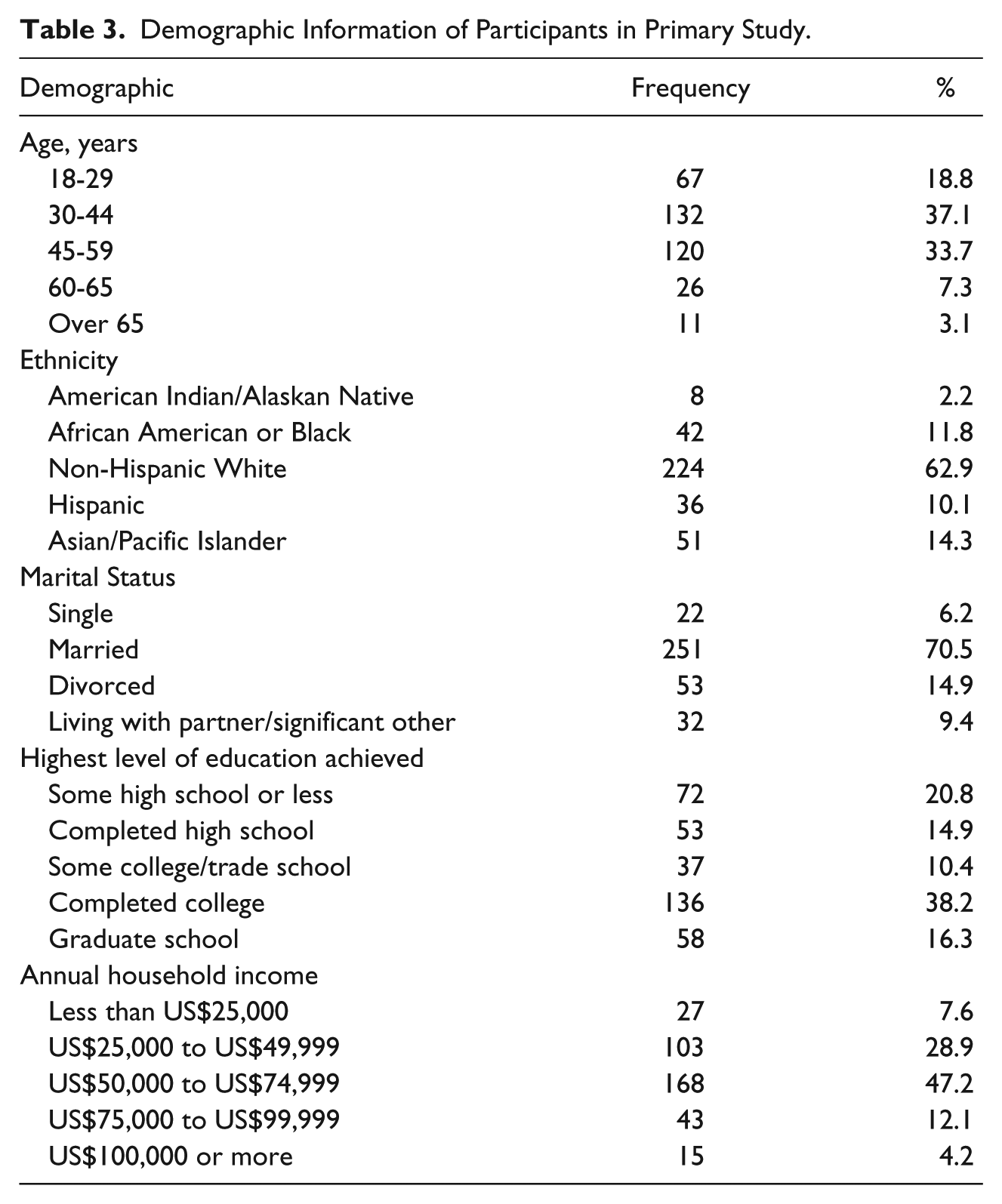
Following the pilot study, the first author contacted the administrators of 31 active OSGs and asked their permission to post a call for volunteers on their websites. Twelve administrators approved the request. All OSGs were English-based and had a section explicitly targeted to people with breast cancer. In each of the 12 groups that approved our study, we first created an account and then posted the recruitment message. A total of 371 participants completed the survey, but 15 respondents were removed for nonrandom missing data, which yielded 356 useful sample for data analysis. Table 3 presents the demographics of the survey participants.
Demographic Information of Participants in Primary Study.
Measures
OSG participation
To assess users’ participation in OSGs, we used a SNS participation scale (Brandtzæg, 2012). Although the scale was not intended for OSGs, we identified 20 items from the original scale suitable for measuring OSG participation: “write contributions,” “update status,” “add arrangements,” “fix user profile,” “upload photos,” “watch photos,” “find useful information,” “find information about friends, “see if somebody has contacted me,” “get in touch with new people,” “read new contributions,” “arrange appointments,” “educational purposes,” “write/chat with close friends,” “write/chat with acquaintances,” “write/chat with unknown,” “discussion/debate,” “follow discussion threads,” “run group(s),” and “profile surfing.”
To further reflect users’ participatory behaviors within OSGs, we added eight items based on the observational data collected in the pilot study: “post questions,” “check announcements,” “give suggestions,” “welcome new members,” “encourage people,” “express empathy,” “send private messages,” and “connect people with others.” In this study, we used the following prompt for the scale: “Think specifically about your participation in the online health community and answer the following questions.” Example items from this scale included, “I read other people’s posts on the site” and “I write/chat with friends.” Each item was answered using a 7-point Likert-type scale ranging from never (1) to every time (7).
To validate the 28-item participation scale, we conducted a series of factor analyses. An exploratory factor analysis (EFA) using principal axis factoring as the extraction method and varimax rotation were first performed. The EFA resulted in a Kaiser–Meyer–Olkin (KMO) measure of sampling adequacy of 0.804, well above the standard of .60 used by most researchers (Sheskin, 2007). Bartllet’s test of sphericity was significant, χ2(142) = 1,013.29, p < .01, thus indicating that factor analysis was appropriate for this set of data. The following four criteria were used to refine the original instrument: (a) removing factor loadings that are less than .32 on all factors (seven items), (b) deleting item-loadings at .32 or higher on two or more factors (four items), (c) maximizing Cronbach’s alpha (e.g., deletion of two items), and (d) having an eigenvalue greater than 1. The full 28-item scale is available from the first author.
Based on the aforementioned criteria, 15 items were retained from the original 28 items that composed the OSG participation instrument. The final factor solution had three factors (eigenvalues ≥ 1.0) and explained 75.62% of variance. Factor 1 contains the following items: 4, 14, 19, and 22. Factor 2 contains Items 3, 5, 12, and 17. Factor 3 contains Items 2, 6, 7, 9, 13, 20, and 24. We performed a second EFA using robust maximum likelihood (ML) with promax rotation to assess the stability of the factor structure. Items 2 and 20 cross-loaded on Factors 1 and 3 and were subsequently removed. There were no cross-loadings in a third EFA.
Overall, the simplicity of the three factors is good and all cross-loadings are relatively small, indicating a parsimonious structure. Factor 1 accounted for 32.24% of the total variance and included four items that were all related to information seeking. Factor 2 accounted for 20.11% of the total variance and included four items that were centered around information giving. Factor 3 accounted for 23.27% of the total variance and included six items. These six items clearly fit together as all items focus on engaging in relational building with other members. Table 4 shows factor loadings of the final 13 items. The Cronbach’s alpha for the refined instrument was 0.83 (95% confidence interval [CI]: [0.779, 0.875]).
Unstandardized and Standardized Factor Loadings for OSG Participation Scale.

Note. Factor 1 (information seeking) contains Items 1, 2, 9, 11, and 12. Factor 2 (information giving) contains Items 3, 6, 7, and 10. Factor 3 (relationship building) contains Items 4, 5, 8, and 13. OSG = online support group.
A confirmatory factor analysis (CFA) was conducted to verify the factor structures identified from the EFA, including a single factor 13-item model and a three-factor model. Following the recommendation of good fit by Hu and Bentler (1999), model fit was evaluated using the ML chi-square statistic, comparative fit index (CFI), Tucker–Lewis index (TLI), root mean square error of approximation (RMSEA), and standardized root mean square residual (SRMR). We used the following joint criteria to retain a good structural testing model: CFI ≥.96 and SRMR ≤.10, or RMSEA ≤.06 and SRMR ≤.10. The 13-item single factor model fits the data adequately: χ2(65) = 1,444.28, p < .05, CFI = .92, TLI = .92, RMSEA = .04, and SRMR = .06. We then conducted the two-factor CFA of these same data and found the model fit improved significantly: χ2(64) = 1,233.54, p < .05, CFI = .97, TLI = .96, RMSEA = .03, and SRMR = .05. We kept the 13-item scale and treated OSG participation as a second-order construct for subsequent analyses.
Mediator Variables
Identification with the group
Adapted from Mael and Ashforth’s (1992) organizational identification scale, a five-item measure was used to assess identification with one’s OSG. This measure has been broadly used in prior identification research (e.g., Dailey & Zhu, 2017; Kreiner & Ashforth, 2003). An example item reads, “When someone criticizes my group, it feels like a personal insult.” The response options ranged from strongly disagree (1) to strongly agree (7).
Interpersonal bonds with other group members
To assess one’s interpersonal bonds with other OSG members, we used a three-item measure adapted from Prentice et al. (1994). An example item reads, “How close do you feel with other members of your OSG?” Participants responded using Likert-type scale where higher numbers corresponded to more positive responses.
Outcome Variable
Perceived social support
Perceived social support was measured with the Social Provisions Scale (Cutrona & Russell, 1987, 1990). The 29-item scale measures five dimensions of social support (i.e., informational, emotional, esteem support, network, and tangible). In addition, the Social Provision Scale also measures a dimension labeled nurturance, which is the general perception that “others rely upon oneself for their wellbeing” (Cutrona & Russell, 1987, p. 38). While nurturance is not a standard measure of social support, it was retained in the current survey to assess how important the opportunity to help others might be to participants. An example item reads, “There is a trustworthy person I could turn to in this group for advice if I were having problems.” Participants rated each item on a 7-point Likert-type scale, ranging from strongly disagree (1) to strongly agree (7). Items were summed with three items reverse scored. Higher scores indicated higher perceived social support. We conducted a CFA to examine how the 29 items loaded onto five distinct factors of social support. Four items were eliminated due to standardized regression weights less than .50, which included the following: “I feel personally responsible for the well-being of another person in this online community”; “There is no one in the online community who really relies on me for their wellbeing”; “There are people in this online community who admire my talents and abilities”; and “There is no one in the online community who really relies on me for their wellbeing.” The item “In this online community, no one needs me to care for them” was removed due to cross-loading on Factor 2 (emotional support) and Factor 4 (network support). The five-factor model fits the data adequately: χ2(132) = 278.71, p < .05, CFI = .92, TLI = .95, RMSEA = .07, and SRMR = .06.
Control Variables
We collected basic OSG usage information, including length of account ownership, group size, number of friends connected through the group, and number of group members they have met in person. In addition, we collected demographic information including age, race/ethnicity, highest level of education obtained, annual household income, and health conditions. Given the influence of demographic characteristics, such as age and education, on information seeking and sharing (Han et al., 2014), it is logical to assume that certain demographic characteristics (e.g., health condition, length of account membership) may have extraneous influences on the relationship between OSG participation and perceived social support.
Results
Before running the primary structural equation model (SEM) for hypotheses testing, we first performed descriptive and frequency analyses to ensure that the data were normal, which included inspecting kurtosis, skewness, and histograms. The zero-order correlations are presented in Table 5. Then, we analyzed the data using a two-step approach that included a measurement model and a structural model. The aim of the two-step approach was to establish the reliability and validity of the measures before assessing the structural hypotheses. Smart-PLS 3.2.6 (Ringle et al., 2015) was used because it allows latent constructs to be modeled as formative or reflective indicators. Partial least squares (PLS) place minimal restrictions on the measurement scales, sample size, and residual distribution (Chin & Newsted, 1999). The second-order constructs (i.e., OSG participation, perceived social support) were approximated using the approach of repeated indicators suggested by Chin and colleagues (2003).
Summary of Bivariate Correlations of Variables in Primary Study (N = 356).

Note. OSG = online support group.
p ≤ .05. **p ≤ .01. ***p ≤ .001.
The adequacy of the measurement model was evaluated on the criteria of reliability, convergent validity, and discriminant validity (Klarner, Sarstedt, Hoeck, & Ringle, 2013). First, all composite reliability values were above 0.7, a commonly acceptable level. Second, we assessed the convergent validity using three criteria: indicator loadings, cross-loadings, and the average variance extracted (AVE), as suggested by Fornell and Larcker (1981). We found that all items exhibited a loading higher than 0.6 on their respective construct and did not cross-load in any meaningful way with any items from other constructs (all differences >.02). In addition, all of the AVEs ranged from 0.69 to 0.75, thus satisfying both conditions for convergent validity. Third, we assessed discriminant validity by comparing the amount of the variance captured by the construct and the shared variance with other constructs. We found the square root of the AVE from the construct is much larger than the correlation shared between the construct and other constructs in the model (Fornell & Larcker 1981). To conclude, the assessment of the measurement model demonstrates that all of the constructs measured in this study are both reliable and valid. Once we established that, we moved to evaluating structural model, along with hypotheses testing.
Figure 1 illustrates the complete structural model of OSG participation, identification, and interpersonal bonds as predictors of perceived social support. As recommended by the leading literature in the area of partial least squares structural equation modeling (PLS-SEM; Hair, Hult, Ringle, & Sarstedt, 2017), bootstrapping was set for 5,000 samples taken from the data set of 356 subjects, and two-tailed significance at the 95% level was acceptable if the path coefficients produced were accompanied by t statistics over the cutoff point of 1.96.

Structural model analysis.
We engaged in a step-by-step analysis of the structural model to provide a detailed picture of our results and to test H1 to H6 comprehensibly. To begin, we only focused on the relationships between OSG participation and perceived social support. Subsequently, in Step 2, we introduced each mediator separately. Finally, we assessed the full PLS path model, and, more specifically, the joint effects of the two mediators. We found OSG participation was significantly associated with identification with the group (H1; β = .33, p < .01) and interpersonal bonds with other members (H4; β = .18, p < .01). Identification with the group was significantly associated with perceived social support (H2; β = .26, p < .01). Interpersonal bonds with other group members were significantly associated with perceived social support (H5; β = .12, p < .01). There was a significant indirect effect of OSG participation on perceived social support through identification with the group (b* = 0.23, p < .001), and interpersonal bonds with other group members (b* = 0.11, p < .01). Therefore, H3 and H6 are supported. The coefficient of determination R2 had a high value of 0.701 for the key target construct of this study (i.e., perceived social support), substantiating the model’s predictive validity. This finding is also supported by the Q2 value of the predictive relevance. After running the blindfolding procedure (Henseler et al., 2009) with an omission distance D = 8, we obtained the Q2 value of perceived social support (0.51), which is well above zero, indicating the predictive relevance of the PLS path model (see Figure 1).
Results also indicate that, although all three forms of participation are significant formative indicators of OSG participation, their importance is not the same. Information seeking is the strongest participation form, followed by relationship building and information giving. For perceived social support, informational support is the strongest source of social support, followed by emotional support, network support, esteem support, and tangible support.
To further compare the two mediating effects, we followed the recommendation of Cheung and Lau (2008) to compare the bias-corrected bootstrap interval for testing the difference between two standardized mediation effects. Specifically, we used the NEW parameter option in Mplus (Muthén & Muthén, 2012), which was defined as DM (DM = M1 – M2), to test the significance of the difference between the two specific mediation effects, where M1 was the first mediation effect (identification) and M2 was the second mediation effect (interpersonal bonds). The bias corrected (BC) confidence interval for DM is between .38 and .72, which did not contain zero. Such finding suggested that M1 was significantly larger than M2. Furthermore, as suggested by Preacher and Hayes (2008), we also conducted a χ2 difference (Wald) test by imposing equivalent constraints on the structural paths. The corresponding Δχ2 value with df = 1 for comparisons represented by DM was 2.12 (p < .01), which demonstrated the same conclusion as the BC bootstrap CI method. We therefore conclude that the mediating effect through identification with the group was significantly larger than the mediating effect through interpersonal bonds with other members.
Discussion
Past research on OSGs demonstrates a need to better understand the complexity of people’s OSG participation, as well as the communication mechanisms underlying the participation–social support link. The primary contribution of this study is to demonstrate the mechanisms through which members’ OSG participation influences their perceived social support. Drawing on Prentice et al.’s (1994) common-identity and common-bond framework, we found that identification bonds with the group and interpersonal bonds with others provide much of the missing explanation. Results support a mediation model that suggests perceived social support flows from both identification and interpersonal bonds engendered by participation in OSGs. Specifically, we identified and empirically validated a three-factor solution for the OSG participation scale. We also found identification has a stronger mediating effect than interpersonal bonds in the relationship between OSG participation and perceived social support.
OSG Participation
This study provides a parsimonious framework for describing how OSG participation relates to group communication mechanisms (identification and interpersonal bonds) and support-related outcomes (perceived social support). More specifically, it extends prior research using Prentice et al.’s (1994) common-bond and common-identity approach (e.g., Ren et al., 2007; Utz & Sassenberg, 2002) by examining the centrality of group communication mechanisms in OSGs, and, in so doing, strengthens the case for using identification and interpersonal bonds to understand how different patterns of OSG participation drive a range of social support outcomes, and how to draw on them as a resource to eventually improve people’s health.
As in previous studies, OSG participation is positively related to perceived social support through identification and interpersonal bonds. Focusing on the mediating effect of identification, this study demonstrates that actively participating in online interactions—through information seeking, information giving, and relationship building—can expedite people’s identification processes, which leads to increased perceived social support. Information seeking is the strongest driving force that facilitates the formation of identification with the group. Past scholarship has posited that when people communicate in a computer-mediated context, their perceptions of group identities are magnified, and perceptions of individual identities are reduced (Walther, 2018). The salience of group identities connotes a psychological connection between self and the collective self, which leads individuals to ascribe group-defining characteristics to the self and take the collective interest to heart. Seeking information helps develop different aspects of we-ness through frequent group engagement and socialization. As a result, OSG members may perceive that social support, especially informational support and emotional support, from the community is available during their time of need.
Mediating Effects
The results suggest that social support is delivered through social relationships (Cohen, Underwood, & Gottlieb, 2000), and OSGs are participatory platforms that thrive on creating and maintaining those relationships (Hether et al., 2014). Interpersonal bonds can be well developed and sustained in online groups through prolonged contact and continued communication (Postmes et al., 2000). As shown in Keyton’s (1999) model of relational communication in groups, such a relationship-building process is iterative and manifested in very personal thoughts or experiences. People might disclose secret identities, emotions, wishes, or fears; they might also provide timely support to others with kindness and generosity. These relational interactions all contribute to the development of interpersonal intimacy and bonding (Barak et al., 2008), and they likely transform online weak-ties into a stronger connection, which consequently help OSG users cope more effectively with stressors (Frost & Massagli, 2008).
Identification as a Driver in Perceived Social Support
More importantly, the findings of this study indicate identification is the primary driving force for users’ perceived social support when compared directly with interpersonal bonds. Furthermore, this study provides evidence consistent with claims from several studies that group ties are better predictors of social support compared with individual ties (e.g., Haslam et al., 2015). Next, we offer two major explanations to elaborate why identification is a stronger path toward perceived social support.
One explanation is that OSGs included in this study were organically formed, voluntary online groups. Due to the voluntary nature, OSGs are different from other groups that demand in-group interdependence (e.g., open-source software groups encourage users to work on team products together and meet team goals). Another explanation adapts an organizational viewpoint: OSGs can be described as an instrument of knowledge-sharing in organizations (Hew & Hara, 2007) or a platform that enables collaborative work on social support exchange (Ramanadhan et al., 2012). This line of research explains how attitudes and behaviors are influenced by the psychological link between an individual and his or her organization (Rhoades & Eisenberger, 2002). OSGs create an organizational setting where users are more likely to form a sense of belongingness through collective environments. As depicted by Flanagin, Stohl, and Bimber (2006), OSGs are salient examples of collective action, a communicative phenomenon which typically includes in-group relationships, shared interests, and the integration, coordination, and/or synchronization of individual contributions.
Furthermore, results from this study also speak to important relationships between key factors for measuring the sustainability of OSGs. We identified three types of participation activities (e.g., information seeking, information giving, relationship building) that jointly explain the antecedents of the formation of community identification, interpersonal bonds, and social support. To enhance the theoretical understanding of voluntary participation in online groups, Preece (2000) proposes a success metric with several dimensions: commitment (affective attachment to the community), participation (number of visits, hits, logins), relationship development (extent of contact between members), and contributions (number of messages posted per period). Similarly, our study extends Preece’s success metric to explicate users’ participation and connect different types of participation with group commitment as well as relationship development.
Practically, this study provides insight into designing identification-based (e.g., community dashboard and trust-building modules) and/or interpersonal bond-based (e.g., private messaging tools and icebreaker games) communication features and activities that could benefit users’ health conditions. Findings of this study can inform the design of OSGs to provide targeted social support to help users achieve better health outcomes, such as reduced stress and depression level, improved quality of life and well-being. The prescriptive nature of the proposed mediation model can act as a powerful, yet parsimonious diagnostic tool for evaluating OSGs.
Limitations and Future Research
This project is not without limitations. First, as there was no available public data regarding the frequent usage and popularity of OSGs, we selected groups based on publicly available information collected for this study, including group descriptions, news reports, peer-reviewed publications, and third-party white papers. The inclusion criteria might limit the generalizability of the findings. Moreover, some groups refused to post the recruitment flyer, and other sites allowed the message to be posted but only in a forum specifically singled out for solicitations, which might impede OSG users from seeing the recruitment message.
Second, survey research has limitations which include self-report bias and lack of representativeness. Respondents who identified with their online group might be more willing to join the research than others. This self-selection could bias the analysis by inflating the effect of identification with the group. In addition, the survey data were collected from users across 12 OSGs, and approximately one third of the participants (n = 107) did not specify with which community they are affiliated. Thus, it is not possible to compare the difference of responses provided by participants from various OSGs.
Finally, it is important to note that SEM cannot predict direction and confirm causal dependencies between endogenous and exogenous variables (Hoyle & Smith, 1994). Therefore, it is possible that the opposite direction is also accurate in the mediation model. For example, we interpreted OSG participation as a factor that positively predicts identification with the group; however, it could be that the sense of belongingness and oneness motivates members to participate in group activities. Similarly, the model may work in a cyclical fashion: perceived social support affects continued participation, which in turn reinforces identification and interpersonal bonding, and so forth. To further understand the complexity in an increasingly fragmented user population, future studies should explore participation patterns that are linked to certain user characteristics (e.g., age, health conditions, digital literacy) and social support outcomes (e.g., types of social support, stress level, perceived quality of life).
In conclusion, this study advances the literature related to OSG participation and social support outcomes by proposing and testing a mediation model to explain the group communication mechanisms underlying OSG members’ daily interactions in exchanging support. It extends our understanding of people’s group experiences from structured intervention groups to organically formed OSGs. Furthermore, it also informs an understanding of the complex role of group communication in empowering health care consumers thereby addressing calls from communication researchers to focus on the multidimensional design and implementation of health information technology (HIT).
Footnotes
Declaration of Conflicting Interests
The author(s) declared no potential conflicts of interest with respect to the research, authorship, and/or publication of this article.
Funding
The author(s) received no financial support for the research, authorship, and/or publication of this article.
