



Abstract
This review study aimed to investigate how team work design shapes the impact of team virtuality on team functioning. Based on 48 studies, we identified key work design variables that influence both team functioning, that is, team performance and intermediary outcomes (i.e., team processes and emergent states), under conditions of high virtuality (or in interaction with virtuality). First, while outcome interdependence showed positive effects on the functioning of virtual teams, particularly via motivational increases, task interdependence showed mixed results. Second, high levels of knowledge characteristics (e.g., task complexity) appear to worsen team functioning within virtual contexts, likely because these characteristics add to the demands of an already demanding context. Third, job resources (e.g., feedback) showed positive associations with team functioning, suggesting these variables might buffer the high demands of virtual work. Given these results, more investigations that explicitly examine the interaction between work design and team virtuality are needed.
In a world characterized by rapid technological advancements, globalized markets, and increasingly flexible work arrangements, modern work environments are more than ever characterized by so-called virtual teams, that is, teams who collaborate toward a common goal under conditions of geographical, temporal, or organizational dispersion, so that communication and coordination are predominantly based on electronic communication media (Hertel, Geister, & Konradt, 2005). Although early research has treated virtual teams as a dichotomous concept (i.e., virtual teams vs. traditional teams; for example, Gilson, Maynard, Jones Young, Vartiainen, & Hakonen, 2015; Hosseini, Zuo, Chileshe, & Baroudi, 2015), more recent perspectives have taken a dimensional perspective in which virtuality is recognized to be composed of various dimensions. Despite a variety of different virtuality dimensions in the literature (Foster, Abbey, Callow, Zu, & Wilbon, 2015), we focus on two core dimensions, namely, technology use and geographic dispersion. Technology use is defined as the extent to which team members use virtual tools of lower informational value and synchronicity than face-to-face communication (cf. Kirkman & Mathieu, 2005). Geographic dispersion is defined as the extent to which team members are working from different locations and are spatially and/or temporally separated (cf. Foster et al., 2015; Schweitzer & Duxbury, 2010). Adopting this two-dimensional approach, even colocated team members fall into a spectrum of virtuality if they strongly rely on electronic communication media (Foster at al., 2015; Kirkman & Mathieu, 2005; Schulze & Krumm, 2017).
The widespread use of virtual collaboration forms can be explained by various benefits for organizations (e.g., being able to draw on experts all over the globe, lower maintenance costs for office space), teams (e.g., the ability to work day and night across time zones), and individuals (e.g., increased flexibility, less time spent commuting, more possibilities of balancing work–family obligations). These benefits, combined with continuing technological advances, have led to a drastic increase in virtual teamwork. For example, in 2012, two thirds of multinational organizations utilized virtual teams (Society of Human Resource Management, 2012). In 2016, one estimation indicated that 85% of global workers were engaged in virtual teamwork (RW3 Culture Wizard, 2016).
However, despite the aforementioned economic advantages and strong proliferation of virtual collaborations, theoretical arguments suggest that team virtuality can lead to performance losses by impeding crucial team processes, such as coordination and communication (e.g., Cramton & Orvis, 2003; Powell, Piccoli, & Ives, 2004). Empirically, too, evidence concerning the link between team virtuality and team performance is not so positive. Indeed, meta-analytic research has reported only very modest (i.e., close to zero) relationships between team virtuality and team performance (Carter, Mead, Stewart, Nielsen, & Solimeo, 2018), with a large heterogeneity in the observed associations between team virtuality and team performance across industries (Carter et al., 2018), research designs (Ortiz de Guinea, Webster, & Staples, 2012), and team types (e.g., student vs. organizational samples, short-term vs. long-term teams; Gibbs, Sivunen, & Boyraz, 2017). Altogether, research in this area has shown that team virtuality has positive, negative, and sometimes no effect on team performance (e.g., Gilson et al., 2015; Webster & Sandy Staples, 2006); these mixed results suggest that various factors potentially moderate (i.e., increase, decrease, or even reverse) the relationship between team virtuality and performance.
One important factor that should be considered is the work design of the team. Team work design refers to the nature and organization of tasks, activities, and responsibilities applied to the team level (Parker, 2014), such as the autonomy of the team and the degree of interdependence among team members (Campion, Medsker, & Higgs, 1993; Carter et al., 2018). Team work design has long been recognized as an important influence on team outcomes, including early studies that developed sociotechnical systems theory (e.g., Pasmore, 1988; Trist & Bamforth, 1951), models of team effectiveness (e.g., Campion et al., 1993), and, more recently, team empowerment models (e.g., Kirkman, Rosen, Tesluk, & Gibson, 2004; Maynard, Mathieu, Rapp, & Gilson, 2012). Consistent with these theories, a recent meta-analytic study on teams by Carter et al. (2018) showed overall positive effects of team work design variables such as autonomy, feedback, and interdependence on team performance.
The consistently positive effects of team work design on team performance, alongside evidence of mixed effects of team virtuality on team performance, raise the possibility that team work design moderates the effect of team virtuality on team effectiveness. Indeed, following their meta-analysis, Carter et al. (2018) called for studies that investigate this possibility, suggesting work design features may attenuate the negative impact of virtuality. For example, there are strong theoretical reasons to suggest that team virtuality might impair team functioning only under specific work design conditions, such as decreased team autonomy, high team workload, or increased team interdependence. If work design does mitigate the effect of virtuality, this would help us to theoretically understand when team virtuality is beneficial for team functioning and when it is detrimental, and it would provide important practical levers for managing virtual teams in a way that maximizes their value.
Our goal in this review of literature is to investigate whether and how team work design shapes the impact of team virtuality on team outcomes. We consider the impact on team processes (e.g., coordination), emergent states (e.g., cohesion), and team effectiveness (e.g., performance); and, we use the term team functioning to capture this broad set of team outcomes. We investigate the effect of team virtuality and team work design on team functioning by synthesizing findings from two different types of studies. First, we include studies carried out within a virtual team context that include an assessment as to whether and how work design affects team functioning. Although these studies are not comparative (they do not consider the effects of work design in teams with low virtuality), and hence do not focus on interactions, these studies are important to include because they identify how different work design options shape team outcomes in the context of virtual teams. Second, we consider studies that assess variance in both team virtuality and team work design, examining the interaction between these variables in shaping team functioning. For these studies, we consider whether the impact of team virtuality on team functioning varies according to different levels of work design or, put differently, how work design leverages the benefits or mitigate the downsides of high team virtuality. By bringing together these studies in a comprehensive review, we aim to contribute toward understanding the interplay between team virtuality and work design.
The remainder of this article is structured as follows. After describing the steps used to obtain the set of studies for review, we outline the framework in which we synthesize key findings. Thereafter, we describe the role of key work design variables in fostering team functioning in the context of virtual teams, and then, to the extent that studies exist, we describe interactions between work design and virtuality. In terms of outcomes, we concentrate not only on team effectiveness per se but also on team processes and team emergent states—on the assumption that such intermediary outcomes have well-established links to team effectiveness (cf. LePine, Piccolo, Jackson, Mathieu, & Saul, 2008).
Review Process
We conducted a multistep literature review integrating research on team virtuality with studies focusing on teamwork and work design characteristics. In the first stage, we searched for literature dating back until 1990 that was published in any of the 30 influential management journals (see Podsakoff, MacKenzie, Podsakoff, & Bachrach, 2008). Within these journals, we searched for the following keywords: virtual*/temporal dispersion/spatial dispersion/geographic dispersion/media use/distributed, AND team*/group* AND work design/job design/job characteristics/task characteristics/autonomy/task variety/task significance/task identity/feedback/job complexity/information processing/skill variety/specialization/social support/interdependence/interaction outside organization/job control/job demands/workload/time pressure/physical demands. 1 In the second stage, we enlarged our search to further group and team journals 2 using the same query. In a third step, we conducted a manual search focusing on team virtuality studies including aspects of work design from journals not listed in Steps 1 and 2.
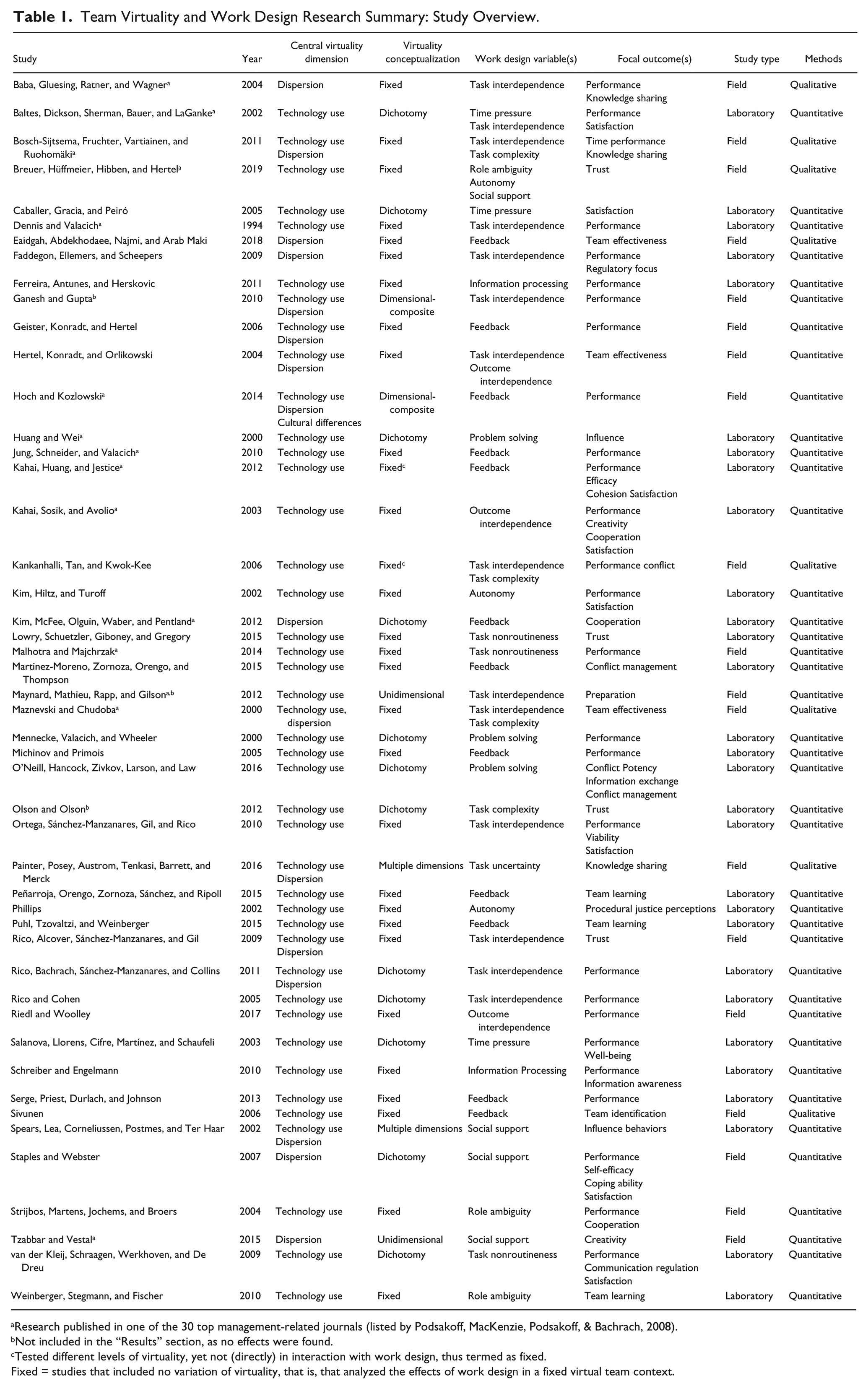
This comprehensive search strategy in Steps 1 and 2 generated 2,207 articles. We then narrowed these preliminary results down to articles meeting all following criteria. First, we included only empirical research (i.e., no conceptual papers). Second, a study had to include topics of virtuality and work design. Third, the studies had to look at the effects of work design within virtual team contexts, that is, variations of work design within virtual teams, or at the interactive effects of virtuality and work design. Fourth, studies had to have an analytical focus on the team level. This process resulted in 34 studies. Enlarging our study pool with a further manual search complying with the abovementioned inclusion criteria led to a final list of 48 studies that formed the basis of our review (see Table 1).
Team Virtuality and Work Design Research Summary: Study Overview.
Research published in one of the 30 top management-related journals (listed by Podsakoff, MacKenzie, Podsakoff, & Bachrach, 2008).
Not included in the “Results” section, as no effects were found.
Tested different levels of virtuality, yet not (directly) in interaction with work design, thus termed as fixed.
Fixed = studies that included no variation of virtuality, that is, that analyzed the effects of work design in a fixed virtual team context.
The 48 studies were published between 1994 and 2019. Of these 48, eight used qualitative methods and 40 used quantitative methods. Of the 40 quantitative studies, 28 were laboratory studies, and 11 were field studies. Of the eight qualitative studies, all were field studies. Also included was a meta-analysis of laboratory studies, which coded the interactions between team virtuality and work design. Although 30 studies looked at work design in the context of virtual teams (which we describe as “fixed” in the conceptualization column in Table 1), 18 studies analyzed interaction effects between team virtuality and work design.
Key Definitions and Overall Framework
Our review showed considerable heterogeneity of key concepts within studies. Here, we note the key ways in which team virtuality has been defined and studied, the different dimensions of team work design, and the various team functioning variables that have been considered. We then summarize this information into an overall guiding framework.
Team Virtuality
Different approaches to conceptualize team virtuality exist in the literature (see also Schulze & Krumm, 2017). While the dichotomy approach contrasts virtual teams with traditional (i.e., face-to-face teams; for example, Andres, 2002; Powell, Galvin, & Piccoli, 2006), the dimensional approach sees virtuality as a continuum, with teams ranging from low to high virtuality (e.g., Mesmer-Magnus, DeChurch, Jimenez-Rodriguez, Wildman, & Shuffler, 2011; Ortiz de Guinea et al., 2012). The multiple dimensions approach considers multiple virtuality dimensions separately (e.g., Chudoba, Wynn, Lu, & Watson-Manheim, 2005; Gibson & Gibbs, 2006). For this review, we slightly refined these approaches (see “work design variables” column in Table 1). Studies that employ a unidimensional approach focus on one of the multiple virtuality dimensions. In other words, researchers either captured virtuality only in the form of geographic dispersion (Tzabbar & Vestal, 2015) or technology use (Maynard et al., 2012). Studies that employ a multiple dimensions approach focus on the effects of multiple virtuality dimensions separately (e.g., Spears, Lea, Corneliussen, Postmes, & Ter Haar, 2002, analyzed the unique effects of technology use vs. dispersion 3 ). Studies that employ a dimensional-composite approach focused on a combination of multiple virtuality dimensions (technology use and dispersion, or even more than two dimensions, were collapsed into a single composite score; cf. Hoch & Kozlowski, 2014). Hence, we coded whether studies used a dichotomy concept, a unidimensional concept, a multidimensional concept, or a dimensional-composite concept of virtuality.
Regarding the different dimensions of virtuality, we distinguished two dimensions (following recommendations by Foster et al., 2015; Gilson et al., 2015; Schulze & Krumm, 2017): that is, the level of (geographical/temporal) dispersion (i.e., not all team members are physically located on the same site and/or in the same time zone) and the level of technology use (i.e., the team has to rely heavily on virtual tools, for example, email, video conferencing, computer-mediated communication, group support systems). Accordingly, we also coded whether the variables from the reviewed studies corresponded to one (or more) of these two dimensions (i.e., dispersion and/or technology use).
Team Work Design
“Team [work] design refers to the specification of team membership; definition and structure of a team’s tasks, goals, and members’ roles; and the creation of organizational support for the team and link to the broader organizational context” (Morgeson & Humphrey, 2008, p. 46). Within this perspective, task, social, and contextual characteristics are applied to a team of workers, rather than to an individual (cf. Morgeson & Humphrey, 2008; Morgeson, Medsker, & Campion, 2006; Parker, 2014). Team work design encompasses various dimensions, such as team autonomy, interdependence, feedback, or task demands (e.g., Campion et al., 1993; Carter et al., 2018). For the purpose of this review, we coded the variables of all studies into 12 different work design variables (see Table 1), that we organized into four broader work design themes: (a) interdependence, (b) knowledge characteristics, (c) job demands, and (d) job resources. We selected the first category because interdependence constitutes a core feature in the definition of teams (and is often used to differentiate teams from other types of collectives; see Barrick, Bradley, Kristof-Brown, & Colbert, 2007; Mathieu, Hollenbeck, van Knippenberg, & Ilgen, 2017). The other categories represent broader themes based on typical clusters of the larger work design literature (Bakker & Demerouti, 2017; Morgeson & Humphrey, 2006; Parker, Morgeson, & Johns, 2017). Thus, we focus on knowledge characteristics (knowledge-related aspects that are required by a job), identified as a key type of motivational work design identified in Humphrey, Nahrgang, and Morgeson’s (2007) meta-analysis of the literature. We also focus on job resources, or those aspects of the job that help achieve work goals, reduce demands, or promote growth from the job demands–resources model of work design (Demerouti, Bakker, Nachreiner, & Schaufeli, 2001). Job resources covers what Humphrey, Nahrgang, and Morgeson (2007) referred to as the task characteristics of motivational work design in their model. Finally, we focus on job demands, or aspects of the job that require sustained effort, which covers the second core dimension of the job demands–resources model and which also encapsulates the notion of role demands present in other work design theories (Parker et al., 2017).
Team Functioning
In accordance with input–mediator–output models of work group/team effectiveness (Campion et al., 1993; Ilgen, Hollenbeck, Johnson, & Jundt, 2005), we differentiated team functioning into either mediating variables or outcome variables. While mediating variables “explain why certain inputs affect team effectiveness” (Ilgen et al., 2005, p. 519), outcome variables are not only the results but also by-products of team activities, which can encompass not only performance but also affective reactions (see Mathieu, Maynard, Rapp, & Gilson, 2008). In terms of mediators, we further differentiated team processes (i.e., “members’ interdependent acts that convert inputs to outcomes through cognitive, verbal, and behavioral activities directed toward organizing taskwork to achieve collective goals,” for example, communication; Marks, Mathieu, & Zaccaro, 2001, p. 357) from team emergent states (i.e., cognitive, affective, or motivational team states “that are typically dynamic in nature and vary as a function of team context, inputs, processes, and outcomes,” for example, trust; Marks et al., 2001, p. 357). In terms of outcomes, we differentiated team performance (e.g., effectiveness, quantity/quality of generated ideas, task completion time) and team member well-being-related outcomes (e.g., team member satisfaction, team viability).
Summary and Framework
We synthesize the key concepts in our review into an overall integrating framework (see Figure 1) that we use to unpack the detailed findings from the review. This framework shows that team virtuality (including its dimensions) as well as team work design affect team functioning (which includes team mediators and team outcomes). Crucially, the framework shows that the effect of team virtuality on team functioning can be moderated by team work design, as we elaborate next.
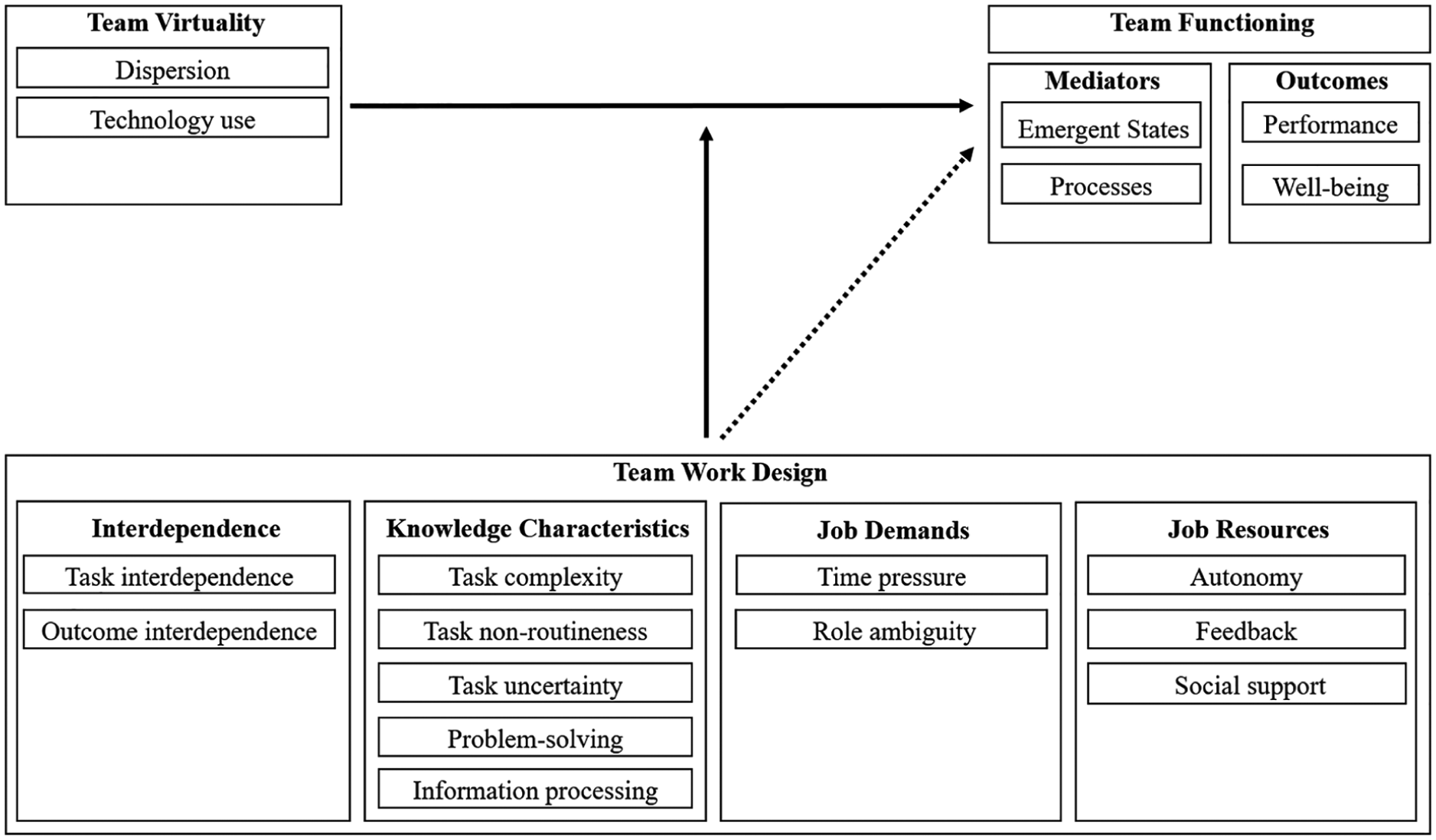
Depiction of review framework.
Results
In this section, we discuss how team work design affects team processes, emergent states, or outcomes within the context of virtuality, as well as how team work design moderates the association between virtuality and team functioning. We consider each construct in the set of work design variable. First, we highlight the nature of the effect (i.e., main vs. interaction) between the work design variables (and virtuality) on team functioning. Second, we present the direction of the effects that were reported in the respective studies. For reasons of conciseness, we speak of negative interactions when work design variables aggravate effects of virtuality on team functioning (see Figure 2, first row for some illustrations with a fictitious example). For example, a zero correlation between virtuality and team functioning turns into a negative association under a specific work design (see first row, left plot in Figure 2). Another example for a negative interaction effect is when a positive association between team virtuality and team functioning becomes less strong (i.e., less positive) under a specific work design (see first row, central plot in Figure 2). A final example for a negative interaction effect is when a positive association between virtuality and team functioning becomes less positive (or even becomes negative) under a specific work design (see Figure 2, first row, right plot). In contrast, positive interaction effects imply that work design variables mitigate negative associations, turn neutral associations into positive associations, or enhance positive associations between virtuality on team functioning (see second row, left plot to right plot in Figure 2).
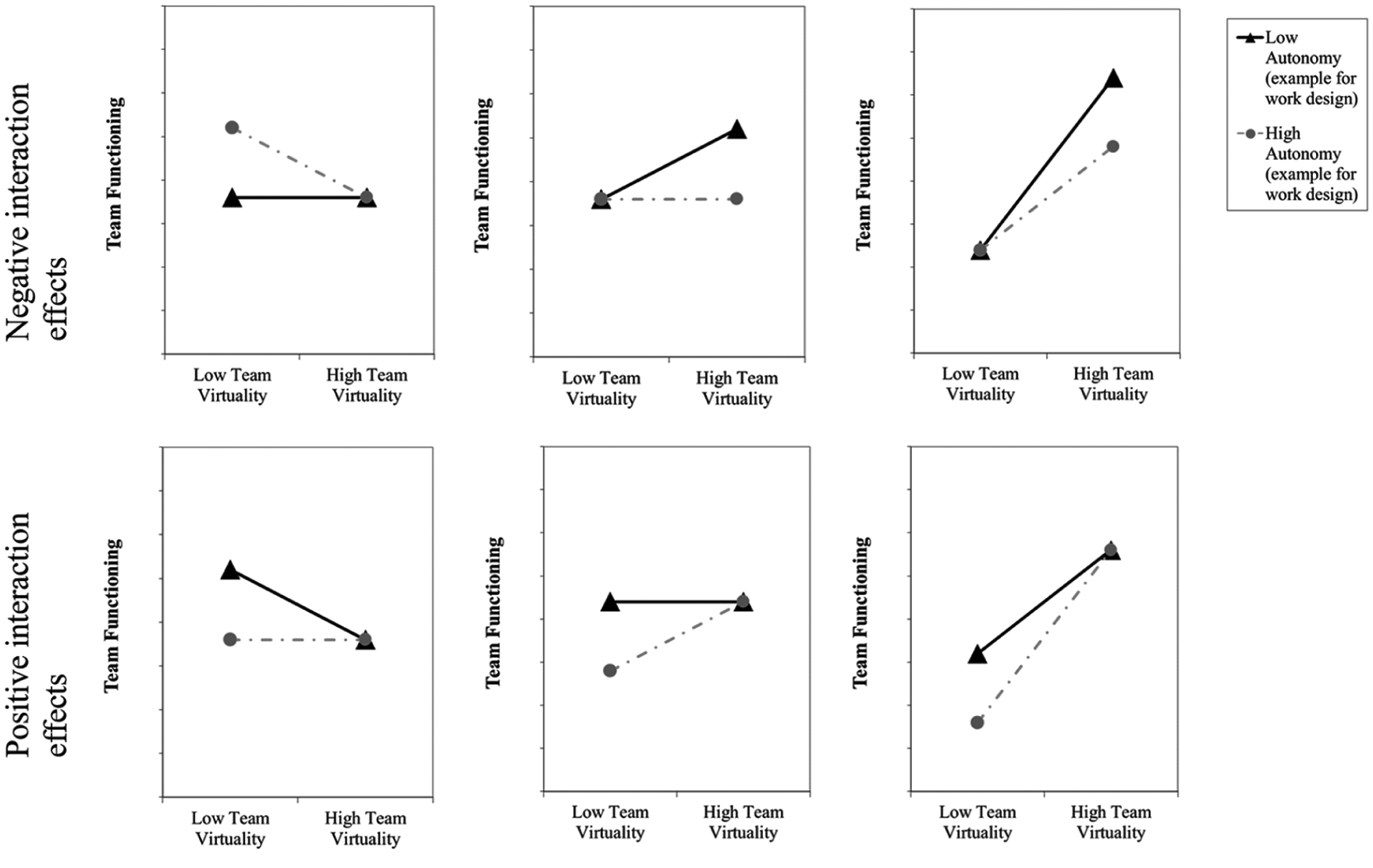
Illustrative examples (fictitious examples) for negative interaction effects (first row) and positive interaction effects (second row) between team virtuality and work design variables (for illustration, we use the example of team autonomy) on team functioning.
Interdependence
Interdependence is a crucial variable in the team context because it is a structural property of teams referring to the interconnectedness of team members through inputs (i.e., depending on one another for critical resources, such as skills or information) or processes (i.e., depending on one another in their workflow; see Courtright, Thurgood, Stewart, & Pierotti, 2015; Wageman, 1999). The following two different types of interdependence were found to have an impact on team outcomes: task interdependence and outcome interdependence.
Task interdependence
Task interdependence can be defined as “the degree to which taskwork is designed so that members depend upon one another for access to critical resources and create workflows that require coordinated action” (Courtright et al., 2015, p. 4).
An initial and important observation from our review is that task interdependence is operationalized in various ways across different studies. Several studies relied on a workflow typology proposed by Thompson (1967), which aligns interdependence on a continuum ranging from pooled/additive workflows (i.e., requiring low interdependence), through sequential workflows (i.e., requiring moderate interdependence) to reciprocal workflows (i.e., requiring high interdependence; see Baba, Gluesing, Ratner, & Wagner, 2004; Maznevski & Chudoba, 2000). Alternatively, different levels of task interdependence can be mapped on disjunctive tasks (i.e., tasks for which efforts of a single member suffice for high team performance, thus requiring low task interdependence) versus conjunctive tasks (i.e., tasks which require all team members equally contribute, thus requiring high task interdependence; see Faddegon, Ellemers, & Scheepers, 2009). Different levels of interdependence can also be captured by comparing nominal, that is, noninteracting, groups (requiring almost no task interdependence) with intact teams (i.e., where all members work collaboratively, which equals higher levels of task interdependence; Dennis & Valacich, 1994). Finally, interdependence has been mapped on McGrath’s (1984) circumplex model, which distinguishes generate tasks (e.g., an idea generation task, which requires little coordination as examples of low interdependence) versus execute tasks (e.g., building a tower, which requires high levels of coordination and interdependence; see Baltes, Dickson, Sherman, Bauer, & LaGanke, 2002).
With respect to the beneficial effects of task interdependence, we primarily identified studies that focused on how different levels of interdependence affect team processes (e.g., team learning) or emergent states (e.g., trust) within the context of high virtuality. That is, the following studies all describe main effects of task interdependence within a fixed virtual context. For instance, longitudinal field research focusing on virtual student project teams showed that high levels of task interdependence indirectly increased team satisfaction and viability (i.e., willingness to work together in the future; Ortega, Sánchez-Manzanares, Gil, & Rico, 2010). In this context, interdependence was important because it facilitated team learning (i.e., the process of reflection and action to detect, understand, and adapt to changes in the environment and to improve team performance; cf. Edmondson, 1999), which, in turn, promoted team satisfaction and viability (Ortega et al., 2010). In other words, virtual teams benefited from high levels of task interdependence because it required them to interact with each other more frequently and gain an understanding of one another, such as by asking questions or seeking feedback. In a similar vein, qualitative field research suggests that task interdependence in virtual teams triggers negotiation processes (i.e., effort to reach consensus), which helps to increase shared cognitions among team members and allows teams to develop better team mental models (Baba et al., 2004). Furthermore, task interdependence in virtual teams was shown to increase team effectiveness through motivational constructs such as perceived instrumentality (i.e., the perception that one’s personal contribution is crucial for the team success; see Hertel, Konradt, & Orlikowski, 2004). That is, when team members experienced high task interdependence, they perceived their own contribution to be more important, thereby motivating them to exert more effort into their (team-)work. High levels of task interdependence in virtual teams also strengthened the relationship between communication and team trust (Rico, Alcover, Sánchez-Manzanares, & Gil, 2009) by stimulating higher levels of social presence (i.e., the perception to be psychologically and relationally close; cf. Short, Williams, & Christie, 1976). Highly interdependent groups have also been shown to generate more ideas than groups with low task interdependence (i.e., participants working in separate subgroups or even in nominal groups, that is, with noninteracting members; Dennis & Valacich, 1994). Although the study by Dennis and Valacich (1994) was only performed within virtual teams (i.e., teams with high technology use), the authors implied that virtuality moderates the relationship between task interdependence and performance, such that teams with high virtuality would benefit (more) from task interdependence than those low in virtuality.
With respect to the negative effects of task interdependence, we identified multiple laboratory studies that investigated how task interdependence negatively moderates the association between team virtuality and team functioning. That is, these studies analyzed the interaction between task interdependence and team virtuality. In particular, task interdependence was shown to worsen the effect of virtuality (i.e., technology use) on team effectiveness when solving an employee performance appraisal task (Rico & Cohen, 2005). That is, under high levels of interdependence, virtuality was negatively associated with objective indicators of team effectiveness, whereas, under low levels of task interdependence, virtuality was positively associated with effectiveness. Further laboratory research showed that task interdependence (under conditions of high team virtuality) canceled out positive associations between person-focused organizational citizenship behaviors (e.g., assisting others in need by listening or offering reassurance) and team performance; that is, the opposite effect was observed under conditions of low team virtuality (Rico, Bachrach, Sánchez-Manzanares, & Collins, 2011). As suggested by the authors, this three-way interaction implies that teams high in virtuality only profit from the exchange of information triggered by these citizenship behaviors when they are not impaired by a high degree of coordination demands (required when task interdependence is high; see Rico et al., 2011). Overall, this line of laboratory research suggests that high task interdependence exacerbates the complexity inherent to highly virtual teams, thereby causing overexertion in team members (Rico et al., 2011; Rico & Cohen, 2005).
One laboratory study stood out as it analyzed the main effect of task interdependence in a fixed virtual setting. Here, task interdependence was shown to negatively influence the likelihood of virtual team members adopting a promotion focus (i.e., attempts to gain optimal team outcomes; see Faddegon et al., 2009). Furthermore, this promotion focus also increased virtual team members’ creative thinking under conditions of low task interdependence—but not when teams had to work in a highly interdependent way (Faddegon et al., 2009). Staying with negative main effects of task interdependence, even qualitative field research indicates that virtual teams have to compensate for higher task interdependence by communicating more with each other (Maznevski & Chudoba, 2000) and by working night hours with team members from different time zones to remain effective (Bosch-Sijtsema, Fruchter, Vartiainen, & Ruohomäki, 2011). Qualitative research also suggests that task interdependence may enhance this negative association between relationship conflict and task performance in virtual teams. When task interdependence is low, relationship conflict is less likely to harm performance because it is easier to ignore others within the anonymity of virtual work settings (Kankanhalli, Tan, & Wei, 2006).
Outcome interdependence
Outcome interdependence can be described as “the degree to which the outcomes of taskwork are measured, rewarded, and communicated at the group level so as to emphasize collective outputs rather than individual contributions” (Courtright et al., 2015, p. 4). Examples for outcome interdependence in the reviewed studies were either monetary (e.g., team-based cash incentives; Kahai, Sosik, & Avolio, 2003; Riedl & Woolley, 2017) or nonmonetary team rewards (e.g., a mutual dinner offered by the team manager; Hertel et al., 2004).
The three studies reviewed here found a positive main effect of outcome interdependence within virtual teams. For instance, a field study with virtual teams showed that outcome interdependence increased team effectiveness through motivational constructs (Hertel et al., 2004). Outcome interdependence in virtual crowd-working teams has shown slight positive effects for team performance, yet no effects on the level of team communication processes (Riedl & Woolley, 2017). Moreover, outcome interdependence seems to foster cooperation when team members can identify their individual contributions (Kahai et al., 2003). In other words, the positive effects of outcome interdependence may be attributed to an increase in team members’ perceptions that their personal contributions are crucial for the team success (e.g., Karau & Williams, 1993; Kerr & Bruun, 1983). However, it appears to be important not only that team members perceive themselves as instrumental for team success but also that their individual contributions can be identified (cf. Slavin, 1983, 1996).
Summary
In the reviewed studies, task interdependence was shown to positively influence both mediators (e.g., team learning, negotiation processes, and trust) and outcomes (e.g., team performance). This research suggests that the increased coordination demands required in interdependent tasks lead team members to increase their interactions, thus improving processes such as team learning (Ortega et al., 2010), negotiation with each other (Baba et al., 2004), generating more ideas (Dennis & Valacich, 1994), promoting trust (Rico et al., 2009), and fostering perceptions of instrumentality (Hertel et al., 2004). However, it is noteworthy that those studies that showed beneficial effects of task interdependence on virtual team functioning were conducted under conditions of fixed virtuality (i.e., solely within virtual teams).
In contrast, experimental studies that specifically tested interactions of virtuality and task interdependence consistently reported negative effects. In other words, high levels of task interdependence seem to worsen the association between team virtuality and team functioning (Baltes et al., 2002; Kankanhalli et al., 2006; Rico et al., 2011; Rico & Cohen, 2005). This research further suggests that high technology use may be the cause of virtual teams functioning less effectively when task interdependence is high (Baltes et al., 2002). This may be explained with task–technology–fit theories (e.g., Daft & Lengel, 1986; McGrath & Hollingshead, 1993), which consider technology high in informational richness (e.g., face-to-face communication) as more suitable tasks high in interdependence (and thus coordination demands). Accordingly, the combination of high levels of interdependence and technology use seems to harm team performance because communication technology does not transport enough social context cues and is less interactive (i.e., synchronous), thus making coordination harder. While high task interdependence may not impair teams from generating ideas under high levels of technology use (as technology use actually causes less production blocking; see Dennis & Valacich, 1994), high task interdependence may be especially detrimental for teams working on tasks requiring a correct solution (such as in the study by Rico & Cohen, 2005). However, it can further be explained by the fact that experimental teams are usually not familiar with one another (including less familiarity with the task itself), which means that they have less capacity to compensate for the increased demands of virtuality (cf. for example, Handke, Schulte, Schneider, & Kauffeld, 2018; Ortiz de Guinea et al., 2012). Hence, the fact that experimental teams performed worse also suggests that teams without a shared history are more likely to experience negative effects of high task interdependence, whereas virtual teams that are familiar with each other may benefit from high levels of task interdependence. As shown in qualitative studies within virtual teams, task interdependence initially compromises team functioning by increasing coordination and communication demands; nevertheless, when increasing their effort, they are highly effective (Bosch-Sijtsema et al., 2011; Maznevski & Chudoba, 2000).
With respect to outcome interdependence, the reviewed studies showed that outcome interdependence in the context of virtuality was positively associated with team functioning by raising team members’ perception that their own contribution is important for the team to succeed (Hertel et al., 2004; Kahai et al., 2003). Given that only two studies looked at the main effects of outcome interdependence within a fixed virtual team context, we cannot infer whether team virtuality and outcome interdependence have an interactive effect on team functioning. Nevertheless, these results are consistent with positive main effects of outcome interdependence on team performance reported in meta-analytic research (which was irrespective of virtuality levels; Carter et al., 2018; Courtright et al., 2015).
Knowledge Characteristics
Building on the classification of Morgeson and Humphrey (2006), we refer to knowledge characteristics as knowledge-related aspects that are required by a job, including, for example, the degree of task complexity, uncertainty, nonroutineness, as well as problem solving and information processing requirements.
Task complexity
Task complexity describes team tasks that are unstructured, complex, and ambiguous (March & Simon, 1958; McGrath, 1984). The opposite of task complexity can be described as task simplicity (Campion, 1988). Examples of high task complexity in the reviewed studies were a high number of (changing) task dimensions (i.e., purposes or functions, for example, decision-making tasks; Maznevski & Chudoba, 2000) or having to perform multiple subtasks with little assistance (Kankanhalli et al., 2006). So far, the effects of task complexity and virtuality have only been investigated from a qualitative field research perspective. Looking at main effects only, these studies suggest mixed effects of task complexity in virtual teams. On one hand, ethnographic studies suggest that more complex tasks require a higher degree of communication (Bosch-Sijtsema et al., 2011; Maznevski & Chudoba, 2000). As task complexity increases attentional demands, teams need more time for reflection to cope with increased complexity, which suggests a negative effect of task complexity (Bosch-Sijtsema et al., 2011). Accordingly, to remain effective even on complex tasks, virtual teams have to increase their communication and exchange more information. On the other hand, further qualitative research showed a positive effect of task complexity in virtual teams (Kankanhalli et al., 2006). Specifically, the authors suggested that task complexity may moderate the relationship between task conflict and virtual team performance; that is, for simple tasks, task disagreements were not beneficial but, for complex tasks, thorough debates among team members seemed to bring out better solutions (Kankanhalli et al., 2006).
Task uncertainty
Task uncertainty has been defined as “unpredictability and dynamism in the team’s task environment” (Cordery, Morrison, Wright, & Wall, 2010, p. 241). An example for high task uncertainty is work where team members know neither the precise task objective nor its implementation (Painter et al., 2016). One qualitative study suggested negative interactions of task uncertainty and team virtuality on team functioning, specifically coordination (Painter et al., 2016). When tasks were certain (e.g., team members knew exactly the task objective and how to operationally achieve it), high levels of the technology use dimension (e.g., screenshots, project management software) were most important for team functioning. However, when tasks were uncertain, low levels of the dispersion dimension of virtuality (i.e., physical presence, visiting each other on site, having meetings) were most important for team functioning.
Task nonroutineness
Task nonroutineness is defined as “the extent to which the process, problem or desired solution is novel for the team” (Malhotra & Majchrzak, 2014, p. 394). Teams that engage in routine tasks are required to work in a highly consistent, repetitive, and predictable way (Rousseau & Aube, 2010). In contrast, nonroutine tasks involve frequently changing task requirements, many exceptions, and are often not easy to analyze (Withey, Daft, & Cooper, 1983). Examples for nonroutine tasks are team tasks that have not been carried out before (van der Kleij, Schraagen, Werkhoven, & De Dreu, 2009) or problem-solving tasks with unknown solutions (Lowry, Schuetzler, Giboney, & Gregory, 2015).
The reviewed studies consistently revealed negative effects of task nonroutineness. Focusing on main effects within virtual (i.e., teams with high technology use), nonroutine tasks were associated with lower levels of trust (Lowry et al., 2015). One explanation why technology use in virtual teams negatively affects team functioning may lie in better understanding how the teams are using technology (and not if they use it or not; Malhotra & Majchrzak, 2014). Considering the unpredictable nature of nonroutine tasks, it may be difficult to maintain adequate levels of task knowledge awareness (i.e., knowledge of what should be done by whom in the team; cf. Espinosa, Slaughter, Kraut, & Herbsleb, 2007). Accordingly, field research has shown that those virtual teams that used technology specifically to increase their awareness for task knowledge (e.g., by using electronic annotations or commenting functions in a team repository) showed higher performance than those virtual teams that did not use technology to update each other on who was working on what within the team (Malhotra & Majchrzak, 2014). Regarding interactive effects, comparisons between high technology use and low technology use showed that those teams that had more routine with a task (which the authors operationalized as task experience) had better intra-team communication flow (i.e., the duration and number of speaker turns; van der Kleij et al., 2009). This implies that with higher task nonroutineness, the disruptive impact of virtuality (i.e., technology use) on team functioning will be stronger.
Problem solving
Problem solving describes the extent to which unique ideas or solutions are needed in a job (Jackson, Wall, Martin, & Davids, 1993; Wall Corbett, Martin, Clegg, & Jackson, (1990). The effects of problem-solving demands have typically been investigated on the individual level (Jackson et al., 1993; Wall, Corbett, Clegg, Jackson, & Martin, 1990; Zhou, Hirst, & Shipton, 2012). In terms of team work design, the level of problem-solving demands can be mapped on to the concept of intellective versus judgmental tasks (Laughlin & Ellis, 1986). Intellective tasks have a correct solution (i.e., high problem-solving demands), whereas judgmental tasks require teams to come to a judgment or make a decision (there is no accepted demonstrably correct answer; hence, problem-solving demands are low).
The reviewed studies showed both positive and negative interactive effects of problem-solving demands and team virtuality (i.e., technology use) on team functioning. With regard to positive effects, higher problem-solving demands appeared to increase team members’ tendency to bring new information into a discussion (called influence behaviors; Huang & Wei, 2000). More specifically, teams with high technology use showed greater influence behavior when problem-solving demands were high and less influence behavior when problem-solving demands were low compared with teams low in technology use. As virtuality increases tendencies to focus on the task, contributing new information may help the team to achieve more accurate decisions (Huang & Wei, 2000). On a negative note, however, high levels of problem-solving demands were shown to worsen the association between team virtuality and team functioning (Mennecke, Valacich, & Wheeler, 2000; O’Neill, Hancock, Zivkov, Larson, & Law, 2016). Specifically, when problem-solving demands were high (but not when problem-solving demands were low), higher levels of team virtuality reduced conflict managing processes (i.e., conflict management, De Dreu, 2011; and constructive controversy, that is, teams staying constructive despite task conflict, Tjosvold, 2008) and team potency (i.e., a team’s collective confidence to perform well (O’Neill et al, 2016; Shea & Guzzo, 1987).
Information processing
Information processing “reflects the degree to which a job requires attending to and processing data or other information” (Morgeson & Humphrey, 2006, p. 1323). The immense quantity of information brought about by technology has drastically increased the information processing demands. Although both of the reviewed studies looked at main effects of information processing demands within a virtual team context (i.e., high technology use), these studies also reported mixed findings. The first study showed a positive effect of offering more information (leading to higher information processing demands) to individuals in a hidden profile team task (Schreiber & Engelmann, 2010). This was done via a collaboration tool that offered visualizations of each of the other team members’ domain knowledge. Compared with a control group, which received only their own as well as the entire group’s visualization, this condition improved knowledge and information awareness, thereby augmenting team performance (Schreiber & Engelmann, 2010). With regard to negative effects of information processing demands, the second study concentrated on developing a collaboration tool that allowed teams to store information in a buffer for later time points (Ferreira, Antunes, & Herskovic, 2011). This tool allowed teams to gradually deliver new information whenever there was a task switch and showed improvements in virtual team performance (Ferreira et al., 2011).
Summary
With regard to beneficial effects in virtual teams, knowledge characteristics initiated better informational exchange (Huang & Wei, 2000), increased information/knowledge awareness (Schreiber & Engelmann, 2010), and moderated the relationship between task conflict and performance, such that task conflict was less detrimental for performance when tasks were complex (Kankanhalli et al., 2006). Overall, however, the reviewed studies largely showed a negative association between knowledge characteristics and virtual team functioning (e.g., conflict management processes, communication, potency, trust, and team performance). Given that a higher degree of knowledge characteristics places more demands on individuals (cf. Morgeson & Humphrey, 2006), it may also negatively affect virtual teams (which already have higher coordination demands). Most importantly, five studies specifically looked at interactive effects of knowledge characteristics and different levels of team virtuality, suggesting that high levels of knowledge characteristics (e.g., task complexity, task nonroutineness, and high problem-solving demands) worsen the relationship between team virtuality and team functioning (Huang & Wei, 2000; Mennecke et al., 2000; O’Neill et al., 2016; van der Kleij et al., 2009). Similarly to high task interdependence, tasks with high problem-solving demands also require technology that is sufficiently high in media richness (e.g., video and audio channels) to successfully exchange information about the problems that have to be solved (cf. Daft & Lengel, 1986; McGrath & Hollingshead, 1993). Because intellective tasks involve a considerable extent of discussion and convergence with respect to problem solving, virtual tools that do not sufficiently allow synchronous communication negatively affect team functioning. Moreover, having to exchange such a considerable amount of information via asynchronous, text-based communication media is likely to induce perceptions of information overload (Ellwart, Happ, Gurtner, & Rack, 2015). Taken together, team tasks with high problem-solving demands can be problematic when virtuality (more specifically, the technology use dimension of virtuality) is high (Mennecke et al., 2000; O’Neill et al., 2016).
Job Demands
Job demands refer to “physical, psychological, social, or organizational aspects of the job that require sustained physical and/or psychological effort and are therefore associated with certain physiological and/or psychological costs” (Bakker & Demerouti, 2017, p. 274). Examples of job demands include constructs such as role ambiguity and time pressure (Gilboa, Shirom, Fried, & Cooper, 2008; Karasek, 1979).
Role ambiguity
Role ambiguity (and its opposite, role clarity) is defined as the degree that jobs provide clear guidance about expected roles and behaviors associated (Kahn, Wolfe, Quinn, Snoek, & Rosenthal, 1964). We identified three team studies that revealed negative main effects of role ambiguity on virtual team functioning (Strijbos, Martens, Jochems, & Broers, 2004; Weinberger, Stegmann, & Fischer, 2010). In a quasi-experimental field study, virtual student teams were either instructed to use functional roles such as project planner, data collector (low role ambiguity), or they received a nondirective instruction (high role ambiguity; see Strijbos et al., 2004). Those virtual teams in the high role ambiguity condition showed lower well-being, lower performance, and impaired team processes (i.e., less satisfaction with group processes, less collaboration quality, and a higher degree of conflict) than teams in the low role ambiguity condition (Strijbos et al., 2004). Similarly, virtual student teams that received scripts specifying and assigning roles and activities to individual team members (low role ambiguity) showed higher knowledge gains than those teams that did not (high role ambiguity; see Weinberger et al., 2010). Finally, an interview study by Breuer, Hüffmeier, Hibben, and Hertel (2019) identified low role ambiguity (which the authors labeled as responsibility assignment and task-related transparency; that is, providing clear information about work and team roles) as a determinant of trust development in virtual teams.
Time pressure
Time constraints can be considered as a source of stress and have, thus, been shown to be detrimental for both decision-making processes and outcomes (Argote, Turner, & Fichman, 1989; Chu & Spires, 2001). We identified multiple studies that tested interactions between team virtuality (in the form of technology use) and time pressure. These studies showed beneficial, negative, and neutral effects of time pressure.
First, with respect to the beneficial effects, for teams with low technology use, time pressure reduced team members’ well-being (i.e., team members’ satisfaction with group process/results and their commitment to the results; see Caballer, Gracia, & Peiró, 2005). That is, although time pressure seemed to be negative for well-being outcomes at levels of low virtuality, it showed no negative effect for high levels of virtuality. Second, with respect to the negative effects, research has shown that time pressure worsens the effect of virtuality (i.e., technology use) on team performance (in Baltes et al., 2002, time pressure was operationalized by comparing timed vs. untimed discussions). That is, when time pressure was low, virtuality (i.e., technology use) did not affect team performance; yet, when time pressure was high, virtuality was negatively associated with team performance (Baltes et al., 2002). Third, with respect to the neutral effects, time pressure has shown to enhance team member’s engagement (i.e., collective dedication and vigor) independently of levels of virtuality (i.e., technology use; Salanova, Llorens, Cifre, Martínez, & Schaufeli, 2003).
Summary
Almost all of the reviewed studies analyzed interactions between team virtuality and job demands on team functioning. Higher levels of demands showed negative associations with team performance (Baltes et al., 2002; Caballer et al., 2005; Salanova et al., 2003), but not with well-being in virtual teams (Caballer et al., 2005; Salanova et al., 2003). The majority of studies reported that job demands worsened the relationship between team virtuality and performance. Because a high level of virtuality can be considered a demand in itself (i.e., members are dispersed and/or they can only communicate via virtual tools), it is likely that additional demands such as time pressure and/or a lack of role clarity further overexert team functioning. Furthermore, studies testing interaction effects were all based on laboratory designs using teams that did not yet have a shared history or collective norms (which can pose additional demands).
Job Resources
Job resources refer to physical, psychological, social, or organizational aspects of a job that help achieve work goals, reduce job demands, or promote personal growth and development (Demerouti et al., 2001). Job resources include autonomy, feedback, or social support (e.g., Bakker & Demerouti, 2007; Karasek, 1979).
Team autonomy
Team autonomy “captures the extent to which the team, as a whole, has the freedom to determine its own tasks and courses of action” (Carter et al., 2018, p. 23). The more autonomous a team, the more it can make decisions and plan work activities at its own discretion and thus adapt to changing work conditions (Stewart, 2006). Team autonomy has been operationalized in various ways. For example, decision control (i.e., the degree of influence team members have on central decisions taken by the team leader) and process control (i.e., the degree of influence that team member recommendations have on the process) can be reflective of team autonomy (Phillips, 2002). Another way to operationalize team autonomy is the extent to which teams have more or less restrictive coordination structures (Kim, Hiltz, & Turoff, 2002): That is, a restrictive (and sequential) coordination structure is “a step-by-step procedure that leaves no freedom to deviate from a system-defined linear interaction procedure” (Kim et al., p. 385) and constitutes low levels of autonomy (because team members have little control on how work is performed, it reflects low working methods autonomy; Morgeson & Humphrey, 2006). In contrast, an unrestricted (also called parallel) coordination structure allows team members to move back and forth between different tasks (Kim et al., 2002) and, hence, constitutes an example of high autonomy.
All studies that we reviewed revealed a positive main effect of team autonomy on virtual team functioning. These suggest that team autonomy (in a computerized decision-making task) increases perceptions of procedural justice (most likely because control about processes and decisions increases perception about social status and one’s personal contribution toward team success; Phillips, 2002). Furthermore, higher levels of team autonomy have shown positive associations with perceived decision quality, satisfaction with decision processes, and communication effectiveness for laboratory teams that worked on a financial investment task (Kim et al., 2002). Finally, a content analysis based on interviews with virtual team members identified autonomy as a crucial determinant of intra-team trust development (Breuer et al., 2019).
Feedback
Feedback consists of information provided to a team to increase performance and can originate from the task itself or from others (e.g., peers or team leaders; Carter et al., 2018; Geister, Konradt, & Hertel, 2006). Furthermore, two types of feedback can be distinguished that we will primarily focus on: outcome feedback and process feedback (Earley, Northcraft, Lee, & Lituchy, 1990). While outcome feedback reflects information about the task performance itself, process feedback reflects how the task was performed. Typical operationalizations of outcome feedback are visualizations of team or individual performance (e.g., Jung, Schneider, & Valacich, 2010; Martinez-Moreno, Zornoza, Orengo, & Thompson, 2015). Moreover, feedback is an important aspect of structural support (i.e., organizational reward management and the quality of information that teams receive about their work; Hoch & Kozlowski, 2014), which is provided to organizational teams. In the reviewed studies, process feedback was largely operationalized by giving reports to the team that contained team members’ evaluations of different group processes (e.g., communication; Geister et al., 2006; Martinez-Moreno et al., 2015). Furthermore, research has investigated the extent of feedback positivity that team members provided to one another during decision-making tasks (Kahai, Huang, & Jestice, 2012).
All reviewed studies revealed positive main effects of process feedback on virtual team functioning. For example, in virtual student teams, process feedback on motivation, satisfaction, or perceptions of group processes (e.g., planning, goal setting, communication) showed beneficial effects for performance (Geister et al., 2006) and conflict management strategies (Martinez-Moreno et al., 2015) in comparison with teams that received no feedback. Furthermore, individuals with low initial motivation benefited from process feedback because they experienced an increase in satisfaction and motivation (Geister et al., 2006). Similarly, providing visual feedback to groups on their patterns of participation and turn taking significantly improved intra-team cooperation only under conditions of high (vs. low) team virtuality (Kim, McFee, Olguin, Waber, & Pentland, 2012). Moreover, team feedback in virtual student teams has also been shown to enhance team learning (Peñarroja, Orengo, Zornoza, Sánchez, & Ripoll, 2015; Puhl, Tzovaltzi, & Weinberger, 2015). The reflection processes triggered through feedback is assumed to increase team members’ awareness that a task requires to exchange and integrate information (Edmondson, 1999). Finally, the extent to which team members expressed positivity in their feedback was shown to promote both well-being and performance (i.e., satisfaction with the team discussion, reduce task completion time) and team emergent states (i.e., perceptions of social presence, team cohesion; see Kahai et al., 2012).
In a similar vein, the majority of studies on outcome feedback found positive main effects on virtual team functioning. Providing student laboratory teams with outcome feedback on task performance has been shown to improve both conflict management strategies (Martinez-Moreno et al., 2015) and team performance (Jung et al., 2010; Michinov & Primois, 2005; Serge, Priest, Durlach, & Johnson, 2013). Outcome feedback can be given both in reference to individual performance and in reference to group performance (or both). Providing a combination of individual and team-level task performance appeared to be most effective for team performance (Jung et al., 2010; Michinov & Primois, 2005), as it enabled to clearly link individual efforts to team performance, thereby reducing free riding effects (i.e., the tendency to let others do the work in groups; cf. Karau & Williams, 1993). Moreover, adaptive feedback (i.e., feedback describing the exact error sources rather than just giving overall performance scores) leads to significantly higher and faster performance improvements (Serge et al., 2013). Qualitative studies further suggest different mechanisms why frequent performance feedback (either by using visual management tools or positive outcome feedback from the team leader) helps increase virtual team functioning: Performance feedback allows teams to better plan their performance, enhances the transparency of operations and structures (Eaidgah, Abdekhodaee, Najmi, & Arab Maki, 2018), and it likely also strengthens team identification (Sivunen, 2006). With regard to positive interactive effects of outcome feedback and team virtuality, a field study by Hoch and Kozlowski (2014) indicates that team virtuality shows more positive associations with team performance when teams receive high levels of feedback (in the form of structural support).
Social support
Social support “reflects the degree to which a job provides opportunities for advice and assistance from others” (Morgeson & Humphrey, 2006, p. 1324). Social support in the reviewed studies has been operationalized as relational strength (i.e., the frequency and intensity of prior knowledge-related collaboration; Tzabbar & Vestal, 2015), team member modeling practices (i.e., vicarious experiences gained by observing others’ performing activities; Staples & Webster, 2007), and support by others for speaking out (Spears et al., 2002).
All reviewed studies found positive interactions between social support and team virtuality. For instance, field research with research and development (R&D) teams has shown that social support (i.e., relational strength) positively moderated a curvilinear relationship between team virtuality (i.e., geographic dispersion) and innovative novelty (Tzabbar & Vestal, 2015). More specifically, the study by Tzabbar and Vestal (2015) revealed that moderate levels of virtuality showed a positive association with innovation novelty (because access to knowledge that originates from different locations helps the team to be innovative), whereas very high levels of virtuality showed negative associations with innovation novelty (because virtuality increases coordination requirements and impedes information exchange). Moreover, the association between team virtuality and team innovation was amplified by the extent of social support in those R&D teams. That is, teams with higher levels of social support showed a stronger positive association at moderate levels of virtuality and a weaker negative association at high levels of virtuality (Tzabbar & Vestal, 2015). Social support also showed positive effects on teamwork self-efficacy (i.e., an individual’s perception that one’s own activities will help the team to be effective; Staples & Webster, 2006). That is, teamwork self-efficacy showed stronger associations with team performance when virtuality was high in comparison with low levels of virtuality. The beneficial effects of social support when team virtuality is high was explained by the importance of team member modeling practices in virtual teams, that is, under high virtuality, team members may have less possibilities to gather information or feedback in informal ways (Staples & Webster, 2006).
Summary
In the reviewed studies, research consistently showed that a higher extent of job resources in virtual contexts was positively associated with team functioning (e.g., processes such as conflict management strategies and team learning, performance outcomes such as innovation and well-being). These positive effects are consistent with research based on traditional teams (i.e., teams usually working under lower levels of virtuality; see Carter et al., 2018). Most of this research has studied the main effects of job resources within a virtual team context, but even the few studies that tested how job resources moderated the association between team virtuality and team effectiveness (interactive effects) showed that feedback and social support were more strongly associated with team functioning under conditions of high team virtuality. We compared our results with meta-analytic studies on teams, which suggest that team autonomy and feedback promote team performance (Carter et al., 2018). Virtuality components such as technology generally make task demands more salient (e.g., Cramton, 2001; Gibson, Gibbs, Stanko, Tesluk, & Cohen, 2011). Accordingly, while job resources such as autonomy and feedback appear to be important buffers against negative effects of task demands in all contexts, the effects appear especially pertinent under conditions of high virtuality.
Discussion
The purpose of this review was to understand how work design shapes the extent to which team virtuality affects team functioning. To address this question, we considered studies looking both at main effects of work design within the context of virtual teams, and studies examining interactive effects of team virtuality and work design.
On one side, our review identified team work design features that are likely to be detrimental for virtual team functioning. Namely, knowledge characteristics (such as complexity, ambiguity, or problem-solving requirements) appear to impair team functioning (e.g., trust but also performance) within virtual contexts. Furthermore, many of the reviewed studies in this category tested interaction effects between team virtuality and knowledge characteristics on team functioning. Hence, we can deduce that high levels of knowledge characteristics worsen team functioning when virtuality increases. Job demands (in particular role ambiguity and time pressure), likewise, largely appeared to impair virtual team functioning. These results suggest that knowledge characteristics, as well as traditional job demands such as time pressure, render high virtuality—already a demanding context in which team members have to coordinate without the benefits of proximity or face-to-face interactions—even more challenging. These effects may be amplified in experimental settings in which team members have insufficient time to cope with the increased demands, as implied from the findings of laboratory studies looking at team virtuality and work design interactions.
On the other side, job resources (feedback, social support, and autonomy) showed positive associations with team functioning (an effect that was even stronger under conditions of high vs. low team virtuality). Once again, this can be explained by higher demands in virtual teams, which may be especially dependent on buffering mechanisms, such as job resources, to remain effective. Moreover, team virtuality may not only require more job resources to compensate for higher demands but also exhibit less resources to start off with. For instance, among some of the core challenges of communication in virtual teams is the lack of interactivity or social context cues inherent to most communication technologies (e.g., Daft & Lengel, 1986; Sproull & Kiesler, 1986). That is, virtual teams are faced not only with less opportunities for feedback (because electronic communication often lacks nonverbal signals) but also have to wait longer to receive feedback (because electronic communication such as emails is less interactive).
Interdependence, by far the largest category with respect to studies that we reviewed, showed the most nuanced findings. While outcome interdependence generally showed positive effects, particularly via motivational increases, task interdependence showed mixed results. On one hand, high task interdependence appeared to increase virtual team members’ motivation, team learning, and creativity. On the other hand, high task interdependence requires more communication (which is difficult to realize when teams have to rely extensively on virtual tools or when they are geographically/temporally dispersed), thereby impeding coordination processes in virtual teams. However, we consider these seemingly contradictory findings as reconcilable. Task interdependence sets the stage for teamwork behaviors to emerge, creates an interconnectedness between team members, and requires these to coordinate their actions (Courtright et al., 2015; Marks et al., 2001). Accordingly, task interdependence is essentially what distinguishes a group from a real team (cf. Mathieu et al., 2008) and constitutes a prerequisite for team processes and states to emerge and evolve (Marks et al., 2001). On one hand, these interactions promote the emergence of a shared understanding (Baba et al., 2004), trust (Rico et al., 2011), and team learning processes (Ortega et al., 2010). On the other hand, increased coordination demands which are associated with high levels of task interdependence are difficult to realize under conditions of high virtuality because it is less interactive, and cues about the social context are often missing (Baltes et al., 2002; Rico & Cohen, 2005). Accordingly, teams exert more effort into coordination processes at the risk of losing focus (cf. for example, Faddegon et al., 2009; Rico et al., 2011) and increasing intra-team conflict (Kankanhalli et al., 2006), which impedes team performance. Time-dependent variables such as team member familiarity and experience may also help explain the contradictory effects, given that all negative interactions between task interdependence and team virtuality relied on experimental data (generally based on short-term ad hoc student groups, thus demonstrating low levels of experience with one another, the task, and the communication technology). Accordingly, under low levels of team tenure, teams may experience only the high extent of coordination demands, rather than the motivational effect of high task interdependence.
Implications
Our review suggests that team work design is a crucial moderating factor for the association between team virtuality and team functioning. Even though team virtuality and work design are both embedded in models of team effectiveness (e.g., Campion et al., 1993; Mathieu et al., 2008), no effort has yet been made to systematically integrate these two concepts.
From a practical perspective, our review aimed to identify which work design features are most important in virtual teamwork contexts and which work design features are likely to impair team functioning. More specifically, job and task demands appeared to impair virtual team functioning. In contrast, job resources (such as autonomy, feedback, and social support) seemed especially helpful when teams operate under increased levels of virtuality. Considering that team virtuality cannot be regarded completely independently from task characteristics (e.g., Martins, Gilson, & Maynard, 2004; Wong & Burton, 2000), our study also highlights the role of job resources. For instance, feedback helps to reduce the negative consequences of lacking interactivity in virtual environments. Team autonomy enables team members to switch between different communication modalities rather than being forced to use a single medium. Social support compensates for the lack of warmth, trust, and cohesion, which is often experienced in virtual collaboration. In addition, albeit not explicitly addressed in the reviewed studies, job resources may buffer the negative effects of other work design variables. For example, the increased coordination demands under conditions of high task interdependence can be alleviated when teams have more control over their collaboration, that is, by having more autonomy. Moreover, outcome interdependence showed consistently positive effects for team functioning. Accordingly, our review informs practitioners to reward the entire team and to make team members more aware of their individual contributions toward common goals.
Research Gaps and Avenues for Future Research
Our review has shown that a vast number of studies on virtual teams are still based on experiments concentrating on single laboratory tasks (e.g., Hambley, O’Neill, & Kline, 2007; Rico & Cohen, 2005). In real-life organizational teams, however, the pursuit of team goals is based on a sequence of complex, interdependent tasks that are part of larger projects (McGrath, 1991; West & Lyubovnikova, 2012). Accordingly, this raises the question on how findings on virtual team functioning extend to more complex series of tasks (van der Kleij et al., 2009). Thus, we see a need for more research moving away from laboratory tasks and experimental designs to a stronger focus on field studies.
Moreover, another crucial factor when understanding team functioning is the time virtual teams have already spent working together (Ortiz de Guinea et al., 2012). Over time, team members gain a better understanding of how to use virtual tools, gain familiarity with other team members, and learn to adapt to changing situational demands (cf. for example, Dennis, Fuller, & Valacich, 2008; Maynard, Kennedy, & Sommer, 2015). These team adaptive processes (which happen with longer team familiarity) may also affect the relationship between team virtuality and team functioning, that is, the longer teams have worked together, the less likely it seems that virtuality negatively affects team functioning (Ortiz de Guinea et al., 2012). Moreover, considering the fact that real-life jobs vary in the amount of different tasks, complexity, and the degree of interdependence between both tasks and team members (e.g., Campion et al., 1993), the fit between team, task, and technology is unlikely to remain static (Hollingshead, McGrath, & O’Connor, 1993; McGrath, Arrow, Gruenfeld, Hollingshead, & O’Connor, 1993). Furthermore, as virtuality is a multidimensional construct, we should not assume that the different virtuality dimensions (e.g., geographic dispersion) are static (Dixon & Panteli, 2010; Watson-Manheim, Chudoba, & Crowston, 2012). In other words, the dimensions of virtuality can change over time (e.g., change in member composition, change in media use, change in work habits such as teleworking). Accordingly, we propose that an input–mediator–output–input (Ilgen et al., 2005) approach may be more suited in describing the complexity of virtual team functioning, which invokes the notion of cyclical causal feedback (in our case, the change in virtuality as a response to work design). We, thus, encourage future research to take a more dynamic perspective, looking at changes in virtuality, work design, and their interactive effects.
A further area for future research that we identified during the review process is the level of analysis. Although we were interested in team-level effects, we identified a large number of studies focusing on individual-level effects of teleworking (e.g., Gajendran & Harrison, 2007; Golden, 2007) or technology use (e.g., Braukmann, Schmitt, Ďuranová, & Ohly, 2017; Day, Paquet, Scott, & Hambley, 2012). This research would constitute another ideal setting to analyze the interaction between virtuality and work design. For instance, research has found that electronic dependence strengthens the positive individual-level relationship between task significance and experienced meaningfulness of a job (Gibson et al., 2011). Although it is possible that these effects are similar for teams, we have to acknowledge that team-level constructs involve more complex higher level emergent phenomena (e.g., conflict, shared mental models; Kozlowski, 2015; Marks et al., 2001), which not only affect further team processes but may also change the effect of work design characteristics on team outcomes. Accordingly, further studies should aim to extend individual-level findings on virtuality and work design interactions to the team context.
Moreover, our review suggests that a large portion of research on virtual teams operationalizes virtuality essentially via technology use, especially in laboratory experiments (Dixon & Panteli, 2010; Gibbs et al., 2017). More specifically, the majority of these studies contrast face-to-face (i.e., traditional) with high technology use (i.e., virtual) teams, thereby reducing the concept of virtuality to a dichotomy based on the concept of technology use versus no technology use (e.g., Hosseini et al., 2015; Ortiz de Guinea et al., 2012). Given that the dichotomy approach chosen in earlier studies largely obtained negative effects on team functioning (Ortiz de Guinea et al., 2012), results obtained in these contexts (i.e., typically experimental studies with ad hoc student teams that communicated either via technology or face to face) may show different results if virtuality was operationalized (multi)dimensionally. It may generally be said that some of this research was conducted more than 20 years ago (e.g., Dennis & Valacich, 1994), where both the prevalence and understanding of virtual teams may have been somewhat different from today. Although the results of these studies can help us to understand how a lack of synchronous communication impedes team process dynamics, we need to acknowledge that both nature and use of virtual tools has substantially changed over the last decades, thereby restricting the validity of this research. For instance, as suggested by the Dell and Intel Future Workforce Study (Penn Schoen Berland, 2016), based on 3,801 employees in small-, medium-, and large-sized organizations distributed across 10 countries and seven industries, 82% of all employees communicate via email at work. This is not restricted to the use of desktop computers, as nearly half of the respondents indicated to use laptops and/or smartphones at work. Moreover, half of global employees currently work remotely at least a few times a week, with a slightly higher percentage (57%) indicating that remote teamwork, coupled with better communication technologies, will make face-to-face communication obsolete in the future. Considering that technology-mediated communication played such a substantial role in the reviewed studies, we also encourage future reviews or meta-analytic research to consider journals beyond the realm of management, industrial/organizational psychology, or social psychology (as we did in this review), such as in the communications domain.
Moreover, as noted in our review, team virtuality has been conceptualized based on a variety of different dimensions (a similar observation was made by Foster et al., 2015, who identified 29 unique conceptualizations of team virtuality in the literature). For example, some authors also include cultural differences as a focal dimension of the team virtuality concept (cf. for example, Foster et al., 2015; Schulze & Krumm, 2017). Although we concur that (in the field) teams that are geographically dispersed (i.e., working from different countries) are most likely also culturally diverse (e.g., Gibbs et al., 2017; Gibson, Huang, Kirkman, & Shapiro, 2014; Kramer, Shuffler, & Feitosa, 2017), we would recommend that future studies consider cultural diversity as distinct from virtuality. However, it would be interesting to test how cultural diversity moderates the effect of virtuality on team functioning (similar to, for example, task complexity).
Finally, the presumably largest gap (and a potential limitation of our review) is the general lack of studies looking at actual interaction effects of team virtuality (or dimensions of virtuality) and work design, as opposed to main effects of work design in a virtual team context. This methodological drawback limits the generalizability of findings to virtual teams and impairs our understanding of exactly whether the association between team virtuality and team functioning is being shaped by team work design characteristics. Accordingly, to truly understand the moderating role of context on the team virtuality–effectiveness link, we advise future studies to measure variations in both team virtuality and work design, and ideally analyze their interactions in a field context.
Footnotes
Declaration of Conflicting Interests
The author(s) declared no potential conflicts of interest with respect to the research, authorship, and/or publication of this article.
Funding
The author(s) disclosed receipt of the following financial support for the research, authorship, and/or publication of this article: This research was supported by funding from the German Academic Exchange Service and Australian Universities.
