



Abstract
This study aimed to understand how leadership effectiveness of the trainer in a leadership development program can influence emerging leaders’ development and effectiveness. We hypothesized that the trainer’s leadership effectiveness would be a boundary condition. In this two year longitudinal field study, military cadets’ leadership effectiveness from their emergence as informal peer leaders during basic training through the officer training course (OTC) to their formal leadership roles as active duty officers was followed. The sample included 854 cadets and their 72 trainers. We found that cadets’ effectiveness during OTC mediated the relationship between informal leadership emergence during basic training and their subsequent effectiveness as formal leaders. Furthermore, trainers’ effectiveness moderated the relationship between cadets’ informal leadership emergence and effectiveness in OTC. Results indicate that informal emerging leaders are more likely to develop into highly effective formal leaders when supervised by effective trainers. Theoretical and applied implications are discussed.
Many managers have made leadership development a top priority for their organizations (Schwartz, Bersin, & Pelster, 2014). In their review of the field of leadership development, D. V. Day and Dragoni (2015) concluded that leadership development is becoming a discipline distinct from traditional leadership studies. Among their recommendations for future research, they indicated the need to identify the kinds of support and conditions required for leadership development. The recommendation comes as no surprise, given the need to better understand how leaders develop and the growing shortage of effective leaders in groups and organizations (Silzer & Dowell, 2010). Many organizations offer formal training courses intended to develop and identify leaders (Chan & Drasgow, 2001; Reilly, Dominick, & Gabriel, 2014) and to provide the knowledge, skills, and competencies required for effective leadership (Yukl, 2012). Ultimately, those trainees receive formal leadership roles (D. V. Day & Dragoni, 2015).
This study follows the leadership development process, testing whether and in what conditions these training programs actually develop effective formal leaders. Given the importance of role modeling in leadership (McCall & McHenry, 2014), we focus here on the trainer in leadership development programs. Specifically, we test how trainers in a military leadership program influence the development of cadets with leadership potential (emergent leaders) into effective leaders. In this longitudinal study, we test the process in which individuals who enter organizations participate in leadership training and eventually become effective formal leaders. Through this, we provide an empirical test of the assumption that those who show leadership potential in early stages of their careers succeed in leadership development programs and eventually perform effectively as formal leaders.
Reviews of the literature indicate the need for longitudinal studies that incorporate real-life groups (Castillo & Trinh, 2018; Kalish & Luria, 2016) and studies that consider antecedents that predict leader effectiveness (Zaccaro, 2007; Zaccaro, Gulick, & Khare, 2008; Zaccaro, Kemp, & Bader, 2004). Here, we report a longitudinal study—following military cadets for two years and capturing their leadership potential before leadership training—to demonstrate how training activated their leadership potential (pretraining ratings) into actual (in training and higher posttraining ratings) leader effectiveness.
Fiedler (1964) suggested that effectiveness is a function of a leader and a situation. Many scholars have since suggested that context and situation should be considered to understand leadership better (Jordan, Dasborough, Daus, & Ashkanasy, 2010; Liden & Antonakis, 2009; Oc, 2018; Schriesheim, Wu, & Scandura, 2009). Studies concerning what makes leaders effective (Foti & Hauenstein, 2007; Nystedt, 1997; Yukl, 2012) focus on variables such as personality (Judge, Bono, Ilies, & Gerhardt, 2002), motive (Chan & Drasgow, 2001), and cognitive ability (Lord, Foti, & de Vader, 1984), which describe the individuals evaluated as leaders or potential leaders and predict leadership outcomes. We suggest that the trainer in leadership development programs is part of the context needed in the development of effective leaders.
Developing Emergent Leaders
Hogan, Curphy, and Hogan (1994) differentiated between emergence and effectiveness in the conceptualization and measurement of leadership (see also Lord, de Vader, & Alliger, 1986; Mumford et al., 2000). Emerging leaders exert significant influence over other members of the group to which they belong, even when assigned no formal authority (De Souza & Klein, 1995; Luria & Berson, 2013). Leadership emergence seems a natural process that occurs even in groups of children (Yamaguchi, 2001; Yamaguchi & Maehr, 2004).
Existing measures of leadership emergence were based on study participants’ responses about whom they perceive as potential leaders in their group (Goktepe & Schneier, 1989; Neubert & Taggar, 2004; Taggar, Hackett, & Saha, 1999). Group members who have not seen a peer’s actual performance as a leader evaluate whether that peer shows leadership qualities, whereas subordinates with behavioral information on which to base a performance evaluation regarding their supervisors’ leadership frequently assess effectiveness. In the current study, informal leader emergence refers to the peers’ perceptions of leadership potential and demonstration of leadership traits prior to receiving a formal leadership training or role.
Social identity and self-categorization theories provide theoretical links between leadership emergence and leadership effectiveness (Ashforth & Mael, 1989; Tajfel & Turner, 1986). A shared in-group prototype (Lord & Maher, 1991)—a cognitive representation of a leader (van Knippenberg & Hogg, 2003)—forms the basis of implicit leadership theory, which proposes that these prototypes comprise the most widely shared features or attributes within specific categories (Lord et al., 1984). Studies on implicit leadership theory suggested that group members whose characteristics fit this prototype emerge as leaders (Kalish & Luria, 2016) and exert greater influence, attraction (Hogg, 1992; van Knippenberg, Lossie, & Wilke, 1994), and leadership effectiveness (Hais, Hogg, & Duck, 1997; Hogg, 2001; van Knippenberg & Hogg, 2003).
For emergent leaders to become formal leaders, they often must participate in leadership development programs now integrated in many organizations (e.g., Arthur, Bennett, Edens, & Bell, 2003). Over the past decade, research has been devoted to describing and understanding programs that help individuals accept leadership roles and internalize leadership identity (e.g., Avolio & Hannah, 2008; Collins & Holton, 2004; D. V. Day, Zaccaro, & Halpin, 2004; DeRue & Ashford, 2010). Such internalization incorporates the leader’s (or follower’s) identity as part of the individual’s self-image (D. V. Day & Harrison, 2007). For example, studies have shown that the number of leadership nominations (from others) influences an individual’s self-view as a leader (Emery, Daniloski, & Hamby, 2011). Furthermore, in the group process known as relational recognition, leader and follower identities are socially constructed—individuals actively claim an identity and others affirm or grant that identity. Claiming refers to asserting identity as either leader or follower, whereas granting refers to bestowing that identity on another person (Bartel & Dutton, 2001).
We hypothesize that group members, whom other members perceive as having the attributes of prototypical leaders prior to attaining a formal leadership role, will also be perceived as effective leaders in leadership development programs. Furthermore, they will internalize, or claim, a leadership role that others will grant in their interactions during the programs. Eventually, those high on emergent leadership will improve their identity during formal training and become effective leaders. This hypothesized process aligns with the view that leadership development is both a formal and an informal process throughout many events and opportunities (Chan & Drasgow, 2001; Luria & Berson, 2013). Therefore, we hypothesize that:
Trainers’ Leadership Effectiveness
Leadership development over the past decade has yielded a broad range of programs (e.g., Arthur et al., 2003; Salas & Cannon-Bowers, 2001), ranging from lectures on theoretical concepts and leadership skills, feedback on leadership style, and outdoor training (e.g., Conger, 1992; Mirvis, 2008; Starkey & Tempest, 2009) to programs in which managers participate in activities that involve play (Jones & Oswick, 2007; Kark, 2011; Petriglieri & Wood, 2005). However, common to all leadership training is the vital support of the trainer or supervisor (e.g., Maurer & Tarulli, 1994; Noe & Wilk, 1993). According to Bandura (1977), trainers can demonstrate how to behave and provide examples from which to learn. Thus, the trainer–supervisor becomes a role model, demonstrating how to engage with followers effectively and to perform the leadership role correctly. Learning by observing is effective because learning from others’ experiences involves no negative consequences (e.g., Ashford & Taylor, 1990).
As an example of evidence for the viability of social learning, developing leaders replicate specific behaviors enacted during leadership development programs (e.g., Decker, 1980, 1982; Latham & Saari, 1979). Followers imitate their trainers’ behavior, be it ethical leadership or abusive supervision (e.g., Mawritz, Mayer, Hoobler, Wayne, & Marinova, 2012; Mayer, Kuenzi, Greenbaum, Bardes, & Salvador, 2009). Dragoni, Park, Soltis, and Forte-Trammell’s (2014) research demonstrated the importance of trainer–supervisors in helping subordinates better understand leadership and time management of leadership tasks. They found that trainers’ modeling of effective leadership behavior accelerated the rate at which emergent leaders acquired self-perceived role knowledge. Our study takes this concept a step further and tests the relation between the trainers’ effectiveness in leadership development programs and the trainees’ actual effectiveness. Effective trainers’ strategies provide an effective behavioral route for emerging leaders (e.g., Bandura, 1977; Manz & Sims, 1981; Weiss, 1977) and demonstrate how to act in leadership situations (Gioia & Manz, 1985). We therefore hypothesize that an effective trainer provides boundary conditions to the development of effective leadership in trainees:
Method
Setting
The present study was based on the two year training period for soldiers in the Israeli Defense Forces (IDF). Unlike most military organizations, which select officers (leaders) based on their potential before recruitment, the IDF adopts a rise-through-the-ranks policy whereby almost all soldiers begin basic training as privates and acquire professional experience as regular soldiers before advancing to the officer ranks. Future officers are chosen to enter the officer training course (OTC) and thus become cadets, based on their proven leadership qualities during the first stages of training and their achievements in the first stages of service.
During the three month OTC, cadets undergo varied leadership exercises that simulate real-life situations inherent to officers in the field. The course encompasses both theoretical and practical leadership models employing work-based learning, action-learning sets, and team facilitation. The OTC trainers follow the cadets closely, serving as coaches, mentors, and role models for leadership behavior. For example, the course is arranged in a structure similar to a military unit, dividing the cadets into platoons within squads, battalions, and brigades. The trainer serves as the platoon officer, whose performance of officer duties sets an example for the cadets. The cadets’ activities include training for missions of type that officers command in their actual units, such as navigation, firing range, military maneuvers using live fire, location defense, military history, and use of necessary weapons and military tools.
For every training mission, one cadet works under the mentor–trainer as the mission commander. At the end of each activity, the trainer provides that cadet with personal feedback and leads a group discussion with the other cadets in the team on aspects of the commander’s leadership and mission accomplishment. Thus, the OTC setting allows cadets to learn from their personal experiences by actually performing leadership tasks and receiving performance feedback from their trainer and other cadets. They learn from watching other cadets perform leadership tasks and by providing feedback to them in group discussions, and from the example of their trainer when leading the type of military activities the cadets will command in the future.
Trainers carefully monitor informal leadership emergence and record objective quantitative measures for each recruit during their first stages of service. Once sent to the OTC, the soldiers’ leadership attributes are again monitored and recorded, providing a reliable score of leadership effectiveness during training. Upon completing OTC, the newly ordained officers enter active duty as commanders, thus receiving formal leadership duties. Their formal leadership effectiveness is monitored and recorded on standard evaluation scales throughout their military service, providing a reliable score of formal leadership effectiveness. Leadership scores are saved in databases for many years, making it possible to retrieve the leadership scores that higher commanders and officer trainers received in their own training processes. These three types of leadership scores for the cadets (informal leadership emergence, leadership effectiveness during training, and formal leadership effectiveness as a commander), as well as the trainer’s leadership effectiveness during training, form the variables upon which this study is based.
Participants and Procedure
Participants in this naturalistic field study were 854 soldiers (cadets) taking part in a three month OTC, divided into 72 teams (average 13 cadets per team). Their ages ranged from 18.3 to 24 years (M = 19.8, SD = 1.21), and their military experience ranged from 0.2 to 5.6 years (M = 1.9, SD = 0.8 years). The data set initially included 24 cadets older than 24 years who were removed as outliers. Of the total participants, 359 (42.0%) were male and 495 (58.0%) were female. Of the 72 teams, 63 were gender heterogeneous and nine were homogeneous (eight groups with only male and one group with only female cadets). The trainers’ ages ranged from 20.3 to 27.0 years (M = 21.9, SD = 1.15). Nearly identical to the trainees, 30 (41.7%) trainers were male and 42 (58.3%) were female.
The soldiers’ peers evaluated their informal leadership emergence level during basic military training (before receiving a formal leadership role or a nomination to leadership training). After a year (during the leadership development training in OTC), their trainers evaluated their leadership effectiveness. More than a year after graduating from OTC and becoming a formal leader, higher ranking officers who served as their commanders evaluated the former cadets’ formal leadership effectiveness. The Army’s Organizational Psychology Department collected the data for internal organizational use. As a part of a project in collaboration with academia, Army psychologists compiled and provided a file of each participant’s information but identifying information was deleted to ensure privacy and anonymity.
Measures
Cadets’ informal leadership emergence
Data were obtained for each participant during basic military training (about 10 weeks after induction). Informal leadership emergence was measured according to existing procedures (Kalish & Luria, 2016; Luria & Berson, 2013; Luria, Kalish, & Weinstein, 2013) in which participants are asked to indicate whom in their group they perceived as potential leaders. No definition of leadership was offered; participants were simply asked to nominate leaders. Using a percentage of the total number of trainees in the group (to control for group size) scores could range from 0 (not selected) to 100 (selected by all members). The mean informal leadership emergence score was 27.65 (SD = 23.2).
Cadets’ leadership effectiveness during training
We used supervisors’ assessments of the cadets’ leadership effectiveness (Luria & Kalish, 2013; Luria et al., 2013). The cadets’ trainers provided an effectiveness score (leadership effectiveness during training) for the OTC on a scale of 0 to 100. The actual scores ranged from 56 to 97 (M = 81.61, SD = 5.8). This grade is a function of the trainers’ evaluations of the cadets, as well as scores on leadership exercises, simulations, and other tests related to military command during training. It has been validated and found to predict leadership success, and the Army uses it to select commanders for promotion to officer ranks. The trainers worked closely with the individual cadets during the course (monitoring, rating, grading, and documenting each soldier’s performance over the three month period) and were familiar with their leadership effectiveness.
Cadets’ formal leadership effectiveness
Once the cadets graduated from OTC and began their roles as commanders, their direct supervisors in the field assessed the former cadets’ in-role formal leadership effectiveness. That is, after the cadets graduated, became officers, and served at least a year under their superior commanders (higher ranking officers), those commanders assessed the graduated cadets’ effectiveness with a reliable quantitative measure, using a Likert-type scale ranging from 1 (very low) to 7 (very high).
Trainers’ leadership effectiveness
Leadership effectiveness scores during OTC are also saved in a database. Thus, we were able to retrieve the leadership scores that the trainers received when they themselves had attended OTC several years previously. These scores were based on the same procedure to assess the trainers’ leadership effectiveness scores based on their OTC supervisors’ assessments. These trainers’ leadership effectiveness scores ranged from 66 to 89 (M = 77.73, SD = 5.6).
Results
Descriptive Statistics
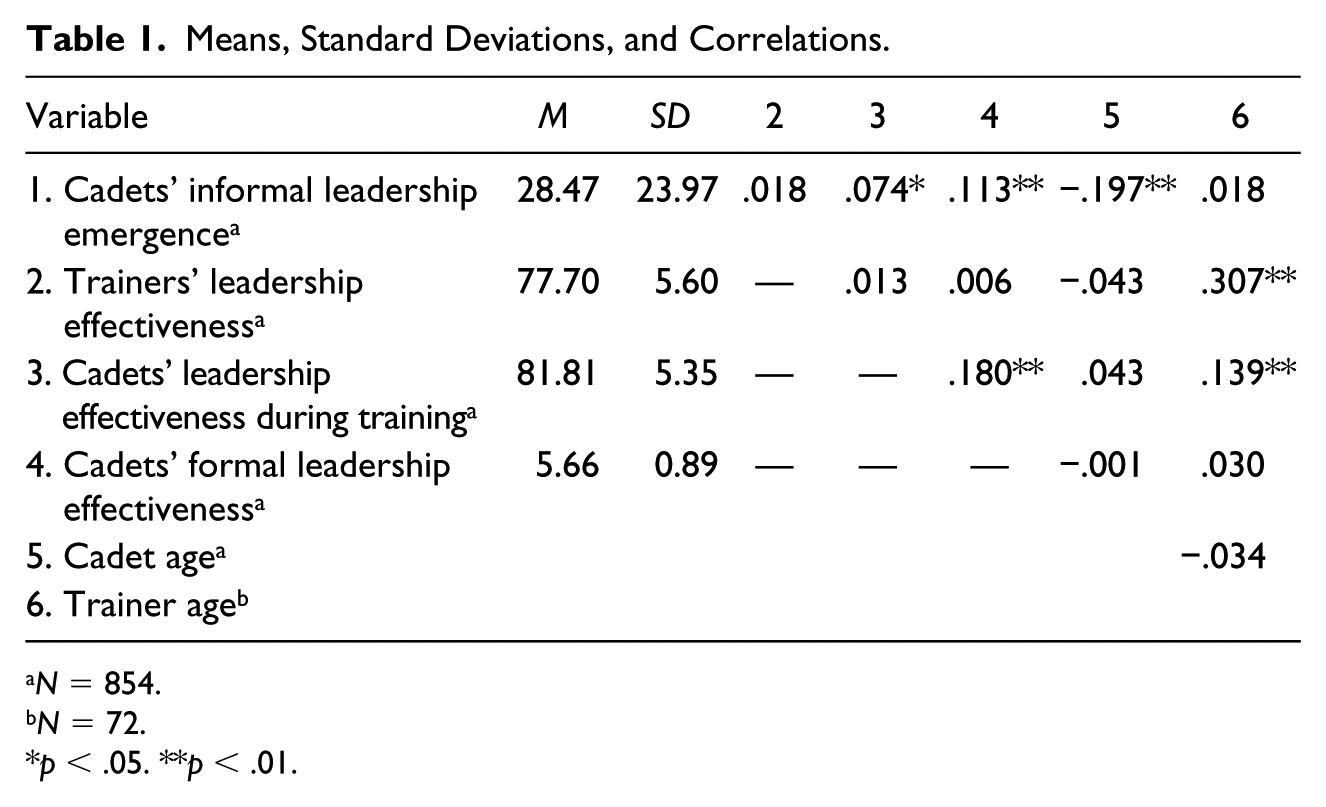
Descriptive statistics and correlations of all variables are presented in Table 1. Informal leadership emergence was positively, although weakly, correlated with leadership effectiveness during training (r = .074, p < .05) and formal leadership effectiveness (r = .113, p < .01; see Table 1).
Means, Standard Deviations, and Correlations.
N = 854.
N = 72.
p < .05. **p < .01.
Hypotheses Testing
H1 suggests that cadets’ effectiveness during the training stage mediates the effect of informal emergent leadership on the cadet’s formal leadership effectiveness in leadership roles, as demonstrated in Figure 1 (Figure 1 presents the research model with summary of the results). We used the bootstrapping procedure recommended by Preacher and Hayes (2004, 2008) and Hayes (2013). The mediation effect was tested using Hayes’s (2012) PROCESS procedure in the SPSS environment. We controlled for age and gender of the cadets and their trainers. Table 2 presents the results of the mediation analyses. The first row indicates that informal leadership emergence predicted cadets’ leadership effectiveness during training (β = .09, p < .01). The second row indicates the direct effect of informal leadership emergence on the dependent variable, namely, formal leadership effectiveness. The last row indicates a significant indirect effect of informal leadership emergence on cadets’ formal leadership effectiveness (i.e., in formal roles) through their leadership effectiveness during training (β = .015, p < .01), supporting H1. Effectiveness during training produced a significant mediating effect and reduced, but did not eliminate, the effect of informal leadership emergence on formal leadership effectiveness, indicating support for partial mediation.
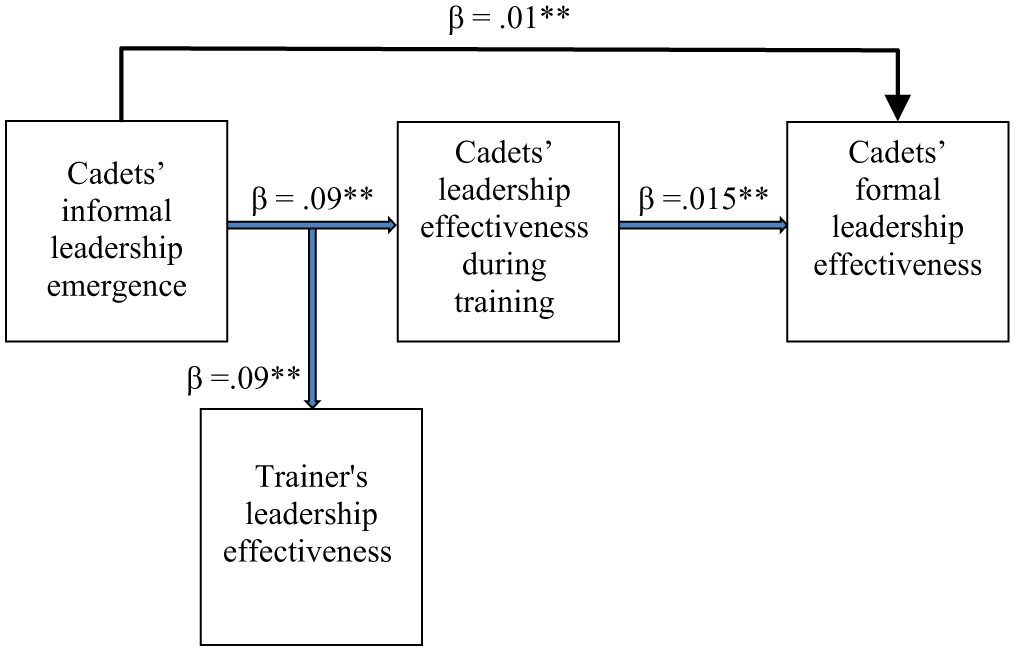
Research model.
Mediation Regression Analysis: Effectiveness During Training on Relationship Between Informal Leadership Emergence and Formal Leadership Effectiveness.

Note. R (direct) = .18, R (indirect) = .213. CI = confidence interval; LL = lower limit; UL = upper limit.
N = 854.
N = 72.
p < .05. **p < .01. ***p < .001.
H2 specifies that the trainer’s leadership effectiveness would moderate the relationship between cadets’ informal leadership emergence and cadets’ leadership effectiveness during training. Because the cadets are nested within groups, we used a multilevel model that considers the variability explained by group affiliation and which can test a model with variables from several analysis levels. The current sample is composed of two analysis levels: (a) Level 1, individual cadet (each cadet’s informal leadership emergence score and leadership effectiveness during training score), and (b) Level 2, group (each cadet, as a part of group of cadets, who was trained by the same trainer with the same level of leadership effectiveness). We conducted hierarchical linear modeling (HLM) full random-coefficient regression model analyses using the mixed-models command in SPSS.
Model building consisted of (a) imposing an unconditional model where no individual or team-level predictors were entered into the model, and (b) building the full model with informal leadership emergence as the individual-level covariate, and the trainer’s leadership effectiveness as the group-level covariate. The results showed significant improvement of fit between the first and second models (–2 log likelihood = 17,461 in the null model, 3,379.38 in the second model, df = 8, p < .001).
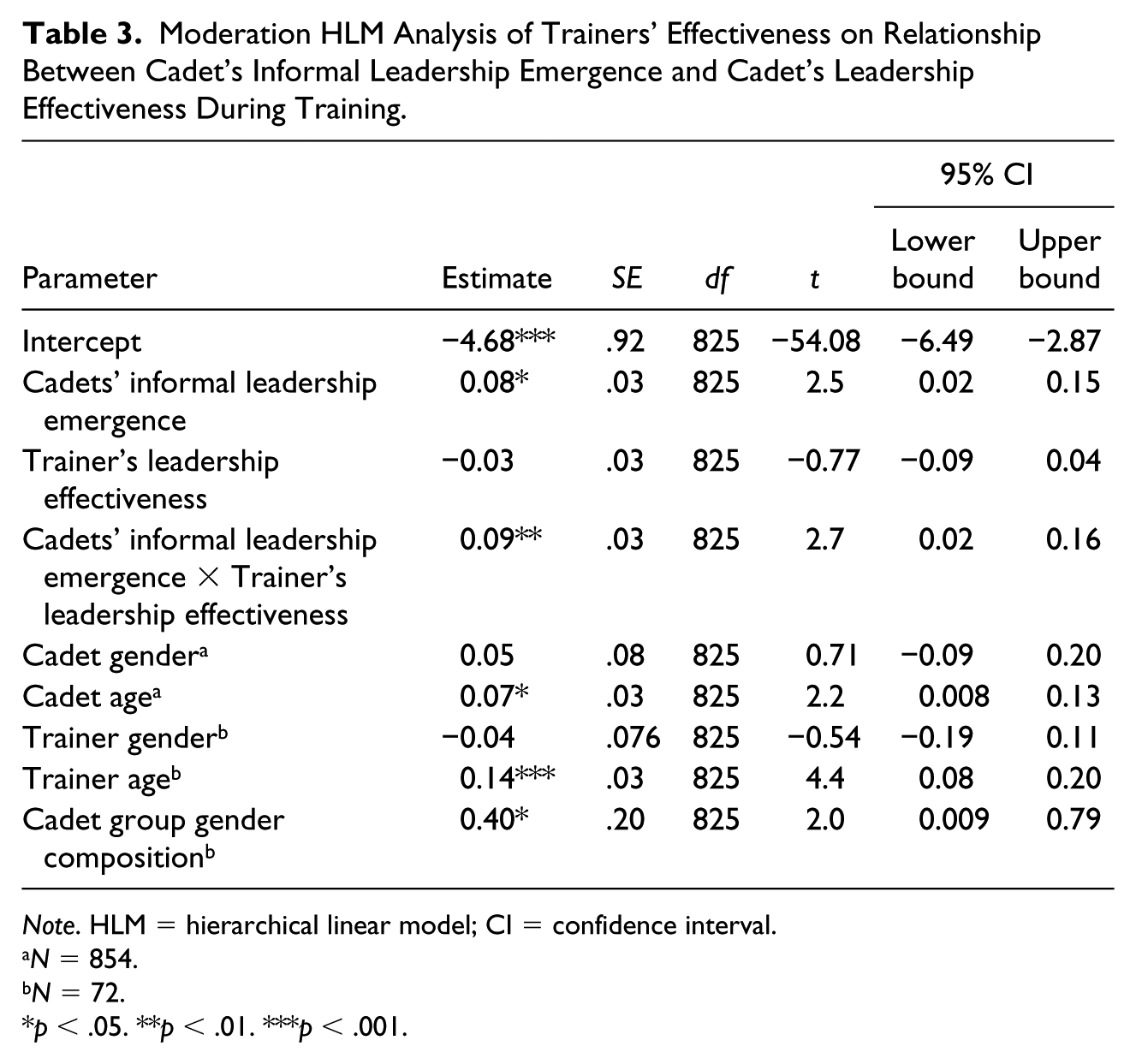
Table 3 shows results supporting H2. The direct effect of informal leadership emergence on cadets’ leadership effectiveness during training was insignificant, whereas interaction between the trainers’ leadership effectiveness and cadets’ informal leadership emergence was significant. That is, differences in the trainer’s leadership effectiveness moderated the relationship between cadets’ informal leadership emergence and cadets’ leadership effectiveness during training.
Moderation HLM Analysis of Trainers’ Effectiveness on Relationship Between Cadet’s Informal Leadership Emergence and Cadet’s Leadership Effectiveness During Training.
Note. HLM = hierarchical linear model; CI = confidence interval.
N = 854.
N = 72.
p < .05. **p < .01. ***p < .001.
The shape of the interaction can be seen in Figure 2, which also demonstrates the direction of the effect. Supporting H2, the figure demonstrates that under high trainer leadership effectiveness, the connection between cadets’ informal leadership emergence and cadets’ leadership effectiveness during training strengthens. That is, cadets who showed high leadership potential before the leadership development training demonstrated higher leadership effectiveness during leadership training when they had a trainer with high leadership effectiveness. In comparison, cadets with a trainer who had low effectiveness demonstrated low levels of leadership effectiveness during training, regardless of their leadership emergence score.
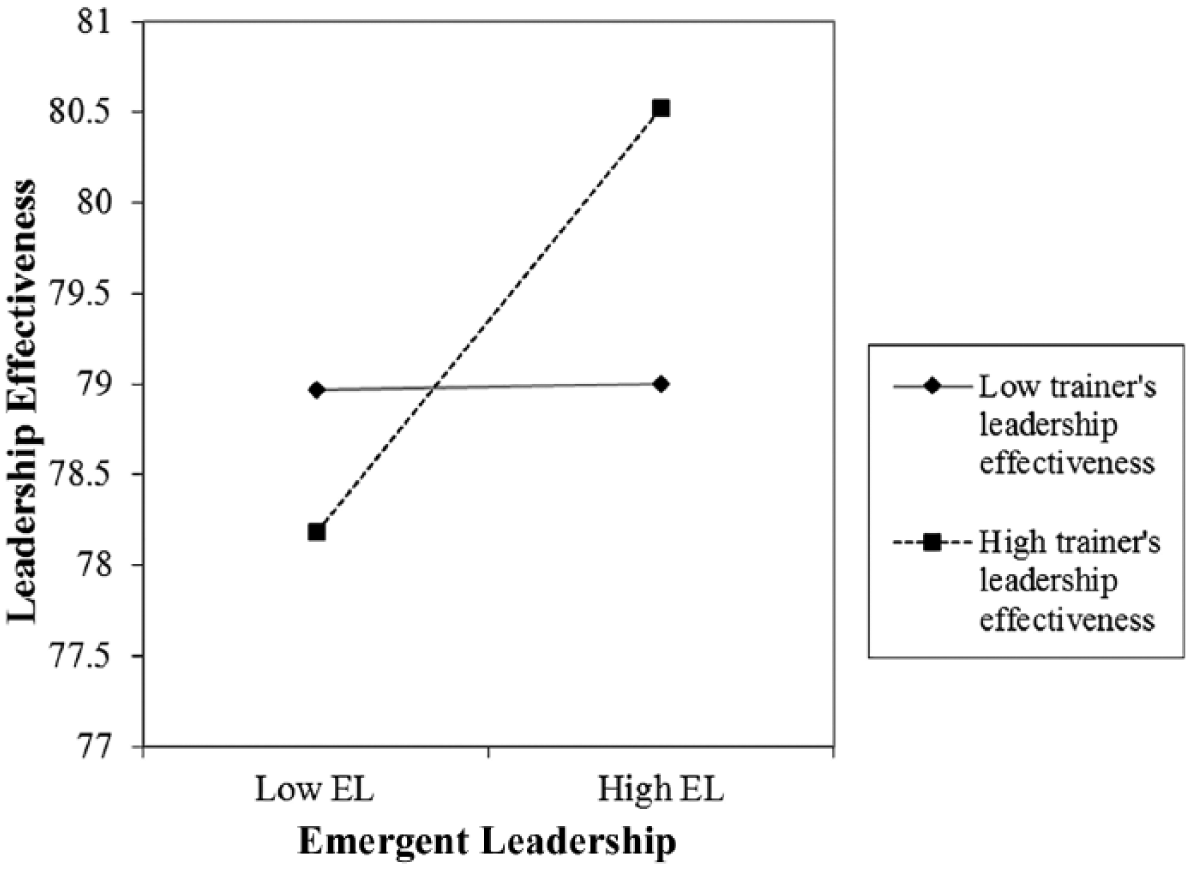
Interaction Between Leadership Emergence and Trainer’s Leadership Effectiveness as Predicting Leadership Effectiveness in Training.
Discussion
Partial mediation occurred, suggesting that individuals who emerge informally as leaders of their peers (before being selected to a leadership training or leadership role) are more effective leaders during their leadership training and eventually become more effective formal leaders (when assigned to leadership roles). The trainer’s leadership effectiveness also serves as a boundary condition for the link between the cadets’ informal leadership emergence and their leadership effectiveness during training. Results show that emerging informal leaders become effective leaders during training only when their trainer is high in leadership effectiveness, whereas those who trained with a trainer low in leadership effectiveness do not demonstrate effectiveness in training—even if they demonstrated high informal leadership emergence.
The research derives from the concept of leadership development as a process of ongoing adult development (C. Day, 2009). Researchers currently view this development not only as the individual process of developing leadership, but also as a collective concept (Van Velsor, McCauley, & Ruderman, 2010). D. V. Day (2000) discussed growth of leadership within a dyad, unit, or larger collective such as an entire organization. Regarding individual differences, researchers noted that some individuals seek situations in which they can demonstrate and practice leadership (Anderson & Kilduff, 2009; Chan & Drasgow, 2001; McClelland & Boyatzis, 1982). Individuals with high leadership potential look for situations in which they can exert influence over others and further develop their skills and identity as leaders. Partial mediation of effectiveness during training on the relationship between leadership emergence and formal leadership effectiveness may indicate that cadets with high leadership potential also found other opportunities to develop their leadership besides the officer leadership development training we monitored.
Results indicate that during the leadership development training period, modeling effective leadership behavior is crucial. Cadets can replicate the overall leadership effectiveness modeled to them in their training. These results support previous research demonstrating that cadets replicate specific modeled leadership strategies (Decker, 1980, 1982). Furthermore, the findings demonstrate that individuals with high emergent leadership better replicate their trainer’s effective leadership. It seems that those who failed to show leadership potential before being in a leadership role (i.e., scored low levels of leadership emergence) gained little from the privilege of having highly effective leaders, whereas those high in leadership emergence, who also had effective leaders, considerably increased their effectiveness during training and eventually as formal leaders.
This research extends previous research on the role of the leader’s support and of social learning in leadership development programs (Dragoni et al., 2014; Maurer & Tarulli, 1994). Previous research mainly focused on the leadership and behavior of the supervisors of future leaders (e.g., Ashford & Taylor, 1990). Dragoni et al. (2014) demonstrated the importance of supervisors helping their subordinates better understand leadership and time management of leadership tasks. They found that effective supervisors of employees transitioning into leadership accelerated the rate at which those transitional leaders acquired self-perceived role knowledge. Our study demonstrates that change and development go beyond that self-perceived role knowledge to influence how others perceive the leader’s effectiveness.
The decision of whom to select as a leader is critical in an organization. One challenge lies in detecting leadership potential in those who are not yet in leadership roles. The results demonstrate the predictive validity of the informal leadership emergence measure as an indicator of future leadership effectiveness. This longitudinal study reveals that early peer perceptions of leadership potential (i.e., after a few months with the organization) predicted two assessments of future leadership effectiveness: (a) cadets’ leadership effectiveness during training about a year later, and (b) cadets’ formal leadership effectiveness after training in an officer role about years after first measuring leadership emergence. Thus, the study demonstrates that peer evaluations of leadership qualities before attaining a leadership role, or even before graduating, predict future performance—even years later—as a formal leader.
Limitations and Future Research
One limitation of this study was the unique sample of young soldiers, which allowed us to control for potential intervening variables but restricted generalizability of the findings. We note that most civilian organizations do not have developmental experiences nearly as intensive as the military. As such, the trainers may have had an unusual influence on the context. However, in most civilian leadership development programs, a trainer, instructor, or mentor who works closely with the trainees is present and active in the program. Future research should include other settings such as leadership development in private and public organizations.
Another limitation is that this study’s cross-sectional design precluded the possibility of determining causality. The design was not a controlled experiment thus we could not definitively conclude that leadership emergence was the reason these individuals were more effective in their training or as formal leaders. Nor could we control for possible intervening variables such as personality, which has been shown to be an important element in leadership (Judge et al., 2002). The quality of the dyadic relationship with the trainer or supervisor plays an important role in the development of the follower (Gerstner & Day, 1997). Future studies should try to investigate how known leadership antecedents affect the development process. Furthermore, because these results point to the importance of the trainer in the cadets’ leadership development process, future studies should focus on who is an effective trainer in leadership development programs. Such research could delve into not only the trainers’ attributes, but also similarities between trainers and cadets. It is possible that there is an individualized effect in which cadets perform better with trainers who are similar or more suited to them.
The study was conducted in a natural setting, using the example of a real organizational leadership development training. As such, we could not precisely isolate what factor in the context or the trainers’ behavior improved the cadets’ effectiveness. The trainers conducted multiple training activities that could have improved the cadets’ effectiveness; they were the cadets’ instructors and mentors and led by example as the cadets’ commanders in military exercises. Future research should try to isolate specific factors in the leadership training activities and the trainers’ behavior that improve the cadets’ effectiveness. Possibly, the trainers’ leadership effectiveness provides a role model for the cadets and thus, their mentoring would be key to improvement (i.e., a trainer could be an effective mentor but not necessarily an effective leader of other military activities).
Implications
Developing leadership effectiveness is crucial to organizations’ need to perform well. The results have implications for the development and selection of employees into leadership roles. Regarding leadership development, results suggest that a highly effective leader as a trainer of future leaders replicates effectiveness in that next generation of leaders; conversely, a trainer who is not highly effective cannot convey effectiveness to trainees. It seems that trainers need to be good leaders themselves to know what good leadership “looks like” and to promote it.
The results also suggest the validity of informal leadership emergence as an indicator of leader selection. Employees can evaluate their peers’ potential in future leadership roles, even before they become formal leaders. In the current longitudinal study, informal leadership potential predicted leadership effectiveness 2 years afterward. Furthermore, the leadership potential that the peers identified before training seems to be a good indication not only of who will succeed in the training, but also of who will gain the most from a highly effective trainer. These results demonstrate that peers are good evaluators of future leadership potential, even in the early career stages.
It also seems that trainees’ performance during leadership training captures their performance as formal leaders, justifying the use of a leadership development program as not only a learning process, but also a selection process. Not all organizations invest in internal leadership development programs and systematically monitor employees’ performance in these programs. These results indicate that investing in such organizational practices and collecting data from them can improve the selection of future effective leaders and the development of employees with leadership potential into effective leaders.
Footnotes
Declaration of Conflicting Interests
The author(s) declared no potential conflicts of interest with respect to the research, authorship, and/or publication of this article.
Funding
The author(s) received no financial support for the research, authorship, and/or publication of this article.
