



Abstract
Although prior research has linked being authentic to individual well-being, little is known about authenticity’s external effects, that is, whether being around those who are authentic is good or bad for us. Integrating authenticity research and social penetration theory, we propose that others’ authenticity facilitates a number of positive intra- and interpersonal processes. Using a sample of 715 employees nested in 109 teams working for a nonprofit organization, we found that teammate authenticity relates positively to focal employees’ work engagement and negatively to their emotional exhaustion. While teammate authenticity explained incremental validity in both outcomes beyond the focal employee’s self-authenticity, it did not moderate the link from self-authenticity to well-being. Thus, instead of further facilitating beneficial intra-individual processes, being around authentic teammates seems to trigger distinct beneficial (social) processes that are neglected when focusing merely on the authenticity of the individual employee.
Just be yourself is popular advice when it comes to dealing with conflicts, behaving in a job interview, achieving mental health, or inspiring others (Cha et al., 2019; Kernis & Goldman, 2006). Yet, would it also be good advice to say, “Just surround yourself with authentic people”? Encouraging individuals to express their true selves necessarily leads to being surrounded by authentic teammates. Consequently, given today’s interdependent work settings (Griffin, Neal, & Parker, 2007; Rousseau, Aubé, & Savoie, 2006), it seems premature to promote employee authenticity without knowledge of the potentially manifold ways through which we are affected by the degree of our teammates’ authenticity.
Authenticity, “the unobstructed operation of one’s ‘true, or core’ self in one’s daily enterprise” (Kernis & Goldman, 2006, p. 294) comprises self-knowledge and self-expression facets (e.g., Kernis & Goldman, 2006; Knoll, Meyer, Kroemer, & Schröder-Abé, 2015; Wood, Linley, Maltby, Baliousis, & Joseph, 2008). Self-knowledge refers to (and is achieved by) high self-awareness and unbiased processing of self-relevant information. Self-expression, in turn, refers to the person’s behavioral expressions (e.g., words, actions, facial expression, or attire) that are consistent to the self (i.e., a person’s values, beliefs, motives, and emotions) and showing one’s true self in close relationships (Kernis & Goldman, 2006). As authentic individuals ground their self-expression in elaborated self-knowledge, they have a greater chance to realize their potential, achieve a sense of coherence, and dedicate fewer resources to self-regulation and impression management (Cha et al., 2019; Harter, 2005; Kernis, 2003).
Existing authenticity research focuses almost entirely on the effects of an individual’s self-authenticity (for a recent review, see Cha et al., 2019), but how our own authenticity affects others and, in turn, how others’ authenticity affects us are important questions for both practitioners and research. Managers and human resource departments may hesitate to recommend being authentic if the positive effect that one worker’s authenticity has on their well-being and performance comes at the price of negative outcomes for their teammates. For example, not compromising one’s values or expressing one’s honest concerns regarding a teammate’s performance can be hurtful and, at least in the short run, creates more tension and conflict than compromising one’s values and remaining silent (Argyris, 1993; Ibarra, 2015; Perlow & Repenning, 2003). In addition, being too immersed in one’s striving for elaborated self-knowledge and self-realization might annoy teammates or slow the team’s progress. These and similar external effects of authenticity may reduce engagement within teams and create tensions, which, in turn, take a psychological toll on teammates. However, being authentic can also have positive external effects. Research on authenticity in intimate relationships suggests that authenticity leads to higher degrees of trust and better overall relationship quality (Brunell et al., 2010; Lopez & Rice, 2006; Wickham, 2013). There might be concerns as to what extent findings from romantic relationships should be directly transferred to the work context, because work often involves the need to interact with others that were not voluntarily chosen as social partners, and the work context is much more instrumental than the romantic domain (Cropanzano & Mitchell, 2008; Gagné & Deci, 2005; Schneider, 1987). Yet, first findings in the work context (e.g., on authentic leadership) also support the idea of positive external effects of authenticity (Guenter, Gardner, McCauley, Randolph-Seng, & Prabhu, 2017; Ilies, Morgeson, & Nahrgang, 2005). Not only are authentic leaders supposed to positively affect follower well-being, they are also supposed to increase the positive effects of followers’ own resources. Whether the effects of teammate authenticity are comparable with these found for authentic leadership remains unclear.
Acknowledging that authenticity has external effects suggests approaches that focus merely on individual authenticity need to be complemented by more relational approaches (Berscheid, 1999; Reis, Collins, & Berscheid, 2000) that additionally consider both the effects an employee’s authenticity has on their well-being and also the effects that being authentic has on others’ (e.g., our teammates). Applying a more relational approach, we integrate authenticity research with research from the domain of social relationships to examine how employees’ authenticity does affect not only their own well-being but also their teammates’ work-related well-being. Specifically, we draw upon social penetration theory (Altman & Taylor, 1987) to propose that authentic teammates facilitate a number of intra- and interpersonal processes (e.g., greater availability of resources due to reduced self-regulatory demands or increased mutual trust), which, in turn, decrease their teammates’ exhaustion and increase their work engagement (Christian, Garza, & Slaughter, 2011; Maslach, Schaufeli, & Leiter, 2001). Considering these two indicators of ill health and positive states of work-related vitality allows for theorizing and examining the potentially diverse processes that are responsible for the external effects of authenticity. Moreover, using these criteria allows for examining potentially distinct effects of employee authenticity on teammate well-being because research already established the intra-individual link between employees’ authenticity and exhaustion and engagement (Cha et al., 2019; Kernis & Goldman, 2006).
Our research complements existing knowledge on authenticity at work in three ways. First, the current focus of authenticity research on the effect that focal employees’ authenticity has on their own well-being (see Cha et al., 2019) cannot consider the effect authentic behavior might have on others; this shortcoming is particularly problematic given that work today is mostly conducted in teams (Anderson & West, 1998; Rousseau et al., 2006). We develop theory and provide evidence to better understand the external effects of authenticity on teammates’ work-related well-being. Second, when context was considered in authenticity research, the focus was on employees’ perceptions of whether a particular environment allowed for being authentic (e.g., Grandey, Foo, Groth, & Goodwin, 2012). Our research disentangles (perceptions of) context and effects by linking employees’ well-being with their teammates’ self-reported authenticity. Third, we consider the combined effects of own and other’s authenticity on well-being. Specifically, we examine whether the proposed positive relationship between employees’ authenticity and their well-being is increased or decreased by their teammates’ authenticity. In sum, our research adds a new facet to understanding the role of authenticity in teams allowing for a more comprehensive approach to the processes that inevitably occur in teams and are likely to affect further team features, such as climate, cohesion, and involvement (Kahn, 1990, 1992; Schneider, 1987).
Authenticity at Work
Most of us know coworkers who (a) push for their own agenda and seem insensitive to others’ feelings and opinions, (b) try to manage the impression they make (e.g., to appear friendly and competent), or (c) reflect on and realize their own values and beliefs and accept that getting ahead or getting along are not always possible or desirable (Hogan, 1983; Meyerson, 2003). The last group can be called authentic, as they do not compromise what they define as their values, motives, and beliefs to either outside forces (e.g., majority influence) or inner forces (e.g., impulses; Harter, 2005; Kernis & Goldman, 2006).
Psychological conceptualizations of authenticity are based on the combination of elaborated self-knowledge and self-consistent behavioral expressions (e.g., Kernis & Goldman, 2006; Knoll et al., 2015; Wood et al., 2008). Self-knowledge includes self-awareness (i.e., knowing one’s abilities, motives, and feelings) and being motivated to extend that knowledge as well as unbiased processing of self-relevant information, such as avoiding self-serving biases or denigrating negative feedback. Authentic self-expression means individuals act in accordance with their values, preferences, and needs and that they are open in their relationships (e.g., disclose personal information, including potential weaknesses, and negative traits). Notably, self-knowledge is proposed to be a prerequisite for authentic self-expression (Baumeister, 2019; Kernis & Goldman, 2006).
Two Effects of Authenticity
Psychologists from a broad range of disciplines have linked authenticity to healthy psychological functioning, life and job satisfaction, and well-being both on and off the job (e.g., Cha et al., 2019; Lopez & Rice, 2006; Wood et al., 2008). Notably, of the many social contexts they inhabit, people feel least authentic at work (Robinson, Lopez, Ramos, & Nartova-Bochaver, 2013; Sheldon, Ryan, Rawsthorne, & Ilardi, 1997). The reason might be that the work context is characterized by predetermined norms and rules; it requires socializing into roles and organizational cultures that are not primarily designed for individual expression but for achieving a collective purpose (van Maanen & Schein, 1979). Workplace restrictions might cause tensions when employees strive for being authentic at work (Ibarra, 2015; Pfeffer, 2016; Schrage, 2015). For example, revealing personal weaknesses and uncertainty makes employees vulnerable among teammates and coworkers. Besides, a personal quest for self-realization might hamper fulfilling role requirements that teammates rely on; standing by one’s values might limit one’s own and thereby the team’s flexibility. Although these arguments emphasize the possibility that authenticity might weaken the team or cause additional demands, empirical studies support the idea of a positive relationship between authenticity and well-being. A number of studies confirmed the proposed positive relationships between authenticity and engagement, positive affect and psychological well-being, and negative relationships with irritation, burnout, and depressive symptoms (e.g., Emmerich & Rigotti, 2017; Grandey et al., 2012; Van den Bosch & Taris, 2014).
Employees, authentic or not, are embedded in relationships, which, in turn, are embedded in a team and an organizational context. Consequently, there should be two effects of authenticity at work. One effect is how self-authenticity of an employee (i.e., the authenticity of a focal employee) affects a particular employee’s well-being. Examining these effects dominates existing research. However, as work is conducted mostly in teams, and tasks are mostly interdependent, a second type of effect of being authentic needs to be considered as well, namely, the external effects of authenticity. External effects include how the authenticity of one employee affects the authenticity of others, and how one employee is affected by the authenticity of their teammates. Considering both kinds of effects requires a relational approach (Berscheid, 1999; Reis et al., 2000) that considers mutual influence processes that are situated in the intra- and interpersonal domains. In the following, we review the processes that are proposed to be responsible for the intrapersonal relationship between self-authenticity and well-being. Knowledge of these processes can inform our understanding of the potential external effects of teammate authenticity, but will not suffice. As we will explain later on, further interpersonal processes must be considered to understand that teammate authenticity has effects above and beyond an individual’s own authenticity.
Individual authenticity and well-being
Our first hypotheses focus on well-being in relation to authenticity of individuals. As criteria for employee well-being, we chose work engagement and emotional exhaustion. Both indicators represent important work-related aspects of well-being and are relatively stable on a medium-term level (Hakanen & Schaufeli, 2012), which is important for both investigating variance in well-being and for being able to draw conclusions about well-being at work. In addition, both concepts have been linked to authenticity previously (see review by Cha et al., 2019). We believe using these established relationships is a more rigorous test of whether teammate authenticity has considerable and distinct effects on employee well-being.
Work engagement refers to “a positive work-related state of fulfillment that is characterized by vigor, dedication and absorption” (Schaufeli, Bakker, & Salanova, 2006, p. 701), and has been linked to a number of positive facets of performance and well-being indicators (for a review, see Christian et al., 2011). Being authentic at work is associated with personal involvement, which, in turn, is a precondition for employee engagement (Kahn, 1990, 1992). If an individual can link central aspects of the self to their work, this will lead to higher motivation and greater persistence. Moreover, personally involved individuals will shield themselves from distractions that potentially interfere with engagement, and they should need less enforcement to invest into their work (Kehr, 2004).
Emotional exhaustion denotes a state in which employees feel “they lack adaptive resources and cannot give any more in their job” (Halbesleben & Buckley, 2004, p. 859). As a central dimension of the burnout syndrome, emotional exhaustion has been shown to be an important indicator of work-related well-being, and a reason for turnover and sick leave (Hallsten, Voss, Stark, Josephson, & Vingard, 2011; Lee & Ashforth, 1996). One important antecedent of emotional exhaustion is self-regulatory demands (Baumeister, Bratslavsky, Muraven, & Tice, 1998; Hülsheger & Schewe, 2011). Self-regulation is exercised, for example, when employees suppress or fake emotions (e.g., to fulfill expectations and role requirements; Gross, 2015) and when they withhold their views, ideas, and concerns (e.g., due to fears of retaliation or because they expect an advantage from doing so; Knoll & van Dick, 2013). Self-regulation depletes personal resources, which can eventually result in exhaustion (Baumeister et al., 1998; Gross & John, 1998). Employees who are authentic at work try to realize their potential and express their values consistently, which, in turn, make it less likely that they engage in unhealthy self-regulation, eventually reducing their risk of getting exhausted (Grandey, 2000; Kernis, 2003).
Although engagement and burnout usually are negatively related, they do not merely form opposing ends of a continuum (for a detailed discussion, see Demerouti, Mostert, & Bakker, 2010). Particularly, the burnout dimension emotional exhaustion did not share much variance with engagement in prior studies (e.g., Schaufeli, Martinez, Pinto, Salanova, & Bakker, 2002). Moreover, using engagement and exhaustion allows for examining both facilitating and buffering effects of authenticity. Engagement is an indicator of the higher involvement that characterizes authentic employees, which eventually facilitates well-being. Lower exhaustion, in turn, is an indicator for healthier self-regulation of authentic employees, which eventually buffers against decreases in well-being. In sum, we expect,
How Employees’ Well-Being Is Affected by Their Teammates’ Authenticity
Our research aims at complementing the knowledge that exists on the effects of self-authenticity with insights into the external effects of authenticity. We argue that some of these external effects emerge from the previously mentioned intra-individual involvement effect that explains the authenticity–engagement link, and from the resource-releasing effect of lower self-regulation, which explains the link between authenticity and exhaustion. However, we argue teammates’ authenticity also facilitates a number of interpersonal processes that further contribute to the external effects of authenticity. Social penetration theory (Altman & Taylor, 1987) can function as a general framework describing these interpersonal processes, as it suggests that mutual self-disclosure develops social relationships from superficial to deeper levels. Applied to the work context, this means if one team member discloses personal information or shortcomings and their teammates respond equally by sharing personal information, such dyadic and team relationships will encourage a number of intra- and interpersonal processes that potentially increase team members’ engagement and decrease their exhaustion.
Teammate authenticity and work engagement
As described above, work engagement includes feeling energized, absorbed into, and dedicated to one’s work (Schaufeli et al., 2006). According to Kahn (1990, 1992), such a state of personal involvement is more likely to emerge if employees experience a sense of psychological safety, have the resources available to get involved, and experience their work as meaningful. Drawing on social penetration theory (Altman & Taylor, 1987), we propose that teammates’ authenticity facilitates these three preconditions of personal involvement, which in the end increases employees’ work engagement.
Striving for higher self-awareness, as well as willingness to express their values and further aspects of themselves, motivates authentic individuals to reveal more personal information to their teammates. Social penetration theory (Altman & Taylor, 1987) suggests that revealing personal information encourages others to do the same, thereby facilitating mutual exchange of personal information between teammates. Such exchange not only increases what teammates know about each other, but it also improves the quality of relationship they have with each other. Disclosing personal information and revealing weaknesses provides room for mutual trust to develop (Connelly & Turel, 2016; Liu, Liao, & Wei, 2015; Lusher, Kremer, & Robins, 2014), which, in turn, encourages teammates to feel free (and safe) to express themselves (Edmondson, 1999). If others’ authenticity decreases teammates’ worries about how their personal information and potential uncertainties could affect their image or status (Leroy, Verbruggen, Forrier, & Sels, 2015; Lopez & Rice, 2006), they will experience the safe environment they need to get personally involved in their work—the first precondition for work engagement (Dollard & Bakker, 2010; Idris, Dollard, & Tuckey, 2015; Kahn, 1990).
Working with authentic teammates is also likely to make resources available for personal involvement—a second precondition for engagement (Kahn, 1990). First, teammates who share personal preferences and whose self-actualizing behavior discloses strengths and weaknesses are easier to work with; they also facilitate feedback within the work group and they make critical information available. When, as social penetration theory (Altman & Taylor, 1987) suggests, others are inspired to also disclose respective information, this shared knowledge reduces resource loss, as it makes it easier to allocate tasks among team members and makes information available that is often concealed (Behfar, Friedman, & Oh, 2015; Sohrab, Waller, & Kaplan, 2015). Moreover, authentic employees who clearly express themselves and act according to their values are more reliable and predictable for their teammates (Aronson, 2004). According to social exchange theory (Blau, 1964), which also informed social penetration theory (Altman & Taylor, 1987), relationships that comprise reliable partners are characterized by higher mutual trust and lower needs for monitoring the exchange of a partner’s actions (Mayer, Davis, & Schoorman, 1995; Wang & Hsieh, 2013). In sum, because being among authentic teammates reduces communication and collaboration barriers that potentially drain resources, more resources are available for personal engagement.
Being among authentic teammates is also likely to facilitate the experience of psychological meaningfulness—the third precondition for engagement. Not only do employees experience meaning at work when they feel worthwhile, but they are also able to give to others and feel valuable. Furthermore, they experience meaning when they receive feedback and requests instead of being taken for granted (Kahn, 1990). As described by social penetration theory (Altman & Taylor, 1987), working with authentic teammates facilitates that employees feel known and appreciated. Knowing about others’ views, attitudes, strengths, and weaknesses facilitates one’s sense of belonging (Baumeister & Leary, 1995; Newheiser & Barreto, 2014), which also has been linked to experiencing meaning at work (Lips-Wiersma & Wright, 2012). Finally, the higher quality of relationships and better knowledge of each other’s qualities and shortcomings that emerged through the processes described by social penetration theory facilitate elaboration within teams (Lyubovnikova, Legood, Turner, & Mamakouka, 2015; Schippers, Edmondson, & West, 2014), another precondition for meaning to emerge.
In sum, we propose that working with authentic teammates relates to higher work engagement because authentic teammates facilitate processes that (a) increase experienced psychological safety (through the development of mutual trust), (b) increase resources available for personal involvement (through better allocation of resources and reduction in communication and cooperation barriers), and (c) facilitate a sense of meaning in teams (through the improved mutual understanding of team members and their higher feelings of being known and appreciated). Thus, we expect,
Teammate authenticity and emotional exhaustion
We propose that working with authentic teammates is related to less emotional exhaustion because teammates’ authenticity reduces interpersonal demands and facilitates the development of resources buffering against work demands (Bakker & Demerouti, 2017). One interpersonal demand that has been linked to emotional exhaustion is the need to act in ways that are not coherent with one’s self (Hochschild, 1983; Hülsheger & Schewe, 2011). Although some of these self-regulatory demands are inherent in one’s work role (e.g., when the job requires to display or suppress certain emotions or behaviors; Ashforth & Kreiner, 1999; Grandey, 2000), others result from a workplace climate in which employees need to create a façade to get along or get ahead (Hewlin, 2003; Thomas, Olien, Allen, Rogelberg, & Kello, 2017). Due to the effects described by social penetration theory (Altman & Taylor, 1987), working with authentic teammates minimizes the need for the latter and even helps coping with the former. When one’s teammates are authentic, it is less necessary to create a façade, and working with authentic teammates allows for self-regulatory breaks (Grandey et al., 2012). Being able to express one’s true feelings among one’s teammates (e.g., during a coffee break) provides room for recovering from job-related depletion of self-regulatory resources (Baumeister, Vohs, & Tice, 2007).
A second mechanism through which teammates’ authenticity is supposed to reduce exhaustion is based on their positive effect on the emergence and effects of interpersonal conflicts. As Kernis and Heppner (2008) proposed, authentic individuals are characterized by secure (rather than fragile) self-esteem, which also quiets the ego. A quiet ego does not constantly seek to increase or defend own self-worth, but listens to others to promote self-transcendent goals (Bauer, 2008). As a consequence, when it comes to conflict-solving, authentic individuals are more likely to choose strategies considering both their own and others’ needs (e.g., integrating and compromising or responding less aggressively in unfair situations) than assertive and ego- and image-protective strategies (e.g., dominating, avoiding, or verbal defensiveness; e.g., Lakey, Kernis, Heppner, & Lance, 2008; Pinto, Maltby, Wood, & Day, 2012; Tou, Baker, Hadden, & Lin, 2015). Thus, having authentic teammates reduces the likelihood of emerging conflicts and the negative effects that conflicts, which are not always avoidable, have on teams. Both processes reduce strain and eventually exhaustion.
Finally, working with authentic teammates is likely to facilitate the development of high-quality relationships—an important buffer against work-inherent demands (Heaphy & Dutton, 2008). As described by social penetration theory (Altman & Taylor, 1987) and supported by research on romantic relationships, individuals who value openness and sincerity in social relationships more easily establish and deepen mutually beneficial relationships with others (e.g., Brunell et al., 2010; Lopez & Rice, 2006; Wickham, 2013). High-quality relationships, in turn, are associated with better well-being and psychological health because they satisfy basic human motives, such as the need to belong (Baumeister & Leary, 1995), and they increase the likelihood that one receives support when needed (Heaphy & Dutton, 2008). Social support, in turn, is one of the most important factors buffering against the health-impairing effects of workplace stressors (Bakker, Demerouti, Taris, Schaufeli, & Schreurs, 2003).
In sum, working with authentic teammates is proposed to reduce interpersonal stressors, such as self-regulatory demands and strains that follow from interpersonal conflicts, and is proposed to increase relationship quality, which, in turn, functions as a buffer against work demands. Thus, we expect,
Interactive Effects of Individual and Teammate Authenticity
Developing a more relational approach (Berscheid, 1999) to authenticity at work requires not only complementing an individual’s authenticity by additionally considering teammates’ authenticity but also considering their potential combined effects. While both self- and teammate authenticity are proposed to have positive effects, questions remain whether they facilitate each other or get in each other’s way. There are several reasons for why teammate authenticity should strengthen the proposed relationships between self-authenticity and both work engagement and exhaustion.
A first reason is that the processes that are proposed to cause the positive effects of individual authenticity on well-being are supported if appearing in the presence of authentic teammates. When working among authentic teammates, authentic employees are not only provided with the discretion (and safety) to immerse themselves into their work, they also receive honest feedback on their behavior, which is a source of meaning and an additional resource (Cha et al., 2019; Kim, Lin, & Kim, 2017). Moreover, authentic employees’ tendency to express concerns and ideas does not raise eyebrows because their authentic teammates do not meet feedback with defensiveness but perceive others’ views as an opportunity to verify their self-views (Swann, De La Ronde, & Hixon, 1994; Tesser, 1988). Thus, being authentic and working with authentic others facilitate mutual self-verification and exploration, which then provide the security, meaning, and resources to further facilitate work engagement (Kahn, 1990).
Less authentic teammates, in contrast, will not appreciate an authentic employee’s openness (e.g., their feedback) but will respond with defensiveness or even attempts to exploit the authentic teammate (Argyris, 1993; Lakey et al., 2008). Such behavior leads to resource-exhausting interpersonal tensions and rumination on the side of the authentic employee (Grant, 2016; Ibarra, 2015). Less authentic teammates are also more likely to conceal their own weaknesses and are less likely to provide critical feedback. Withholding leads to fewer learning opportunities, less innovation, and more guessing, which reduces engagement and causes fragile and potentially exhausting working conditions and processes to endure (Knoll & van Dick, 2013). The increased need to ruminate before and after acting makes fewer psychological resources available, interferes with dedication, vigor, and absorption into one’s work and causes stress and strain, eventually resulting in exhaustion (Nolen-Hoeksema, Wisco, & Lyubomirsky, 2008). Based on this reasoning, we propose that teammate authenticity facilitates the positive effects that an employee’s authenticity has on their well-being. Thus, we expect,
Method
Participants and Procedure
The survey was part of a research project conducted between July and September 2013 at a German nonprofit organization for education, youth, and social work. This sector is an interesting context for authenticity research because organizations in this sector employ purpose- and value-driven employees who strive for personal involvement at work and need to be able to connect to their organizations’ values and goals (Chenhall, Hall, & Smith, 2016). Examining how teammates influence each other is relevant as the work conducted in these organizations often requires that members of teams and organizations work together to achieve their aims (e.g., by developing and implementing programs for youth work and educational events). Furthermore, employees in this sector are more prone to stress-related outcomes, such as burnout and depression, due to an ongoing increase in workload, shortage in personnel, and generally deteriorating working conditions (Kosny & Eakin, 2008).
The organization at which data were collected consisted of 80 autonomous subsidiaries spread across Germany. A total of 64 of them participated in the survey, employing between 14 and 337 individuals. The participating subsidiaries covered a variety of occupations and organizations, most of them related to social and youth work, education, training, psychosocial, elderly care, and administration. Although most of the work is conducted in teams, teams differ in the extent to which team members depend on intense mutual cooperation. Some of the teams are characterized by high interaction and interdependence (e.g., taking care of a group of children, teenagers, apprentices, or elderly people). In other units, interdependence is more due to a common goal, as is the case for teachers in a school or employees in administration.
Of the approximately 2,730 employees who worked in the participating sites, 1,110 answered the questionnaire (40.6% response rate). As we aimed at examining teams, we included only employees of teams in which at least three members participated in the study and completed the authenticity and at least one outcome scale. This resulted in a final sample of 715 employees from 43 subsidiaries nested in 109 teams, which had on average 6.56 members participating (range 3 to 30). The final sample consisted of more women (62.7%) than men (37.3%), and the average age of participants was 45 years (SD = 11 years). Of the participating employees, 1.4% had no degree, 56.2% had completed secondary education, and 41.7% had completed tertiary education. On average, employees had been in their current position for 7.69 years (SD = 7.57 years). They were contracted to work an average of 33.17 hr (SD = 8.90 hr). The majority (76.8%) of the participants had a permanent contract.
Participants received an email with a link to the online questionnaire and were able to participate during work hours within a period of 2 weeks. They were informed that the survey was part of a research project about work-related psychological well-being and authenticity. They were assured of anonymity and that reporting would be done for the organization as a whole, and for teams when at least eight members completed the survey. The feedback report included descriptive data on the most important outcomes, such as social support, motivation, and team performance, in comparison with teams in their location and the overall organization.
Measures
Work-related authenticity was measured with a shortened, adapted German version of the 45-item Authenticity Inventory 3 (AI3; Kernis & Goldman, 2006). To create an economic scale more suitable for an organizational setting, we asked five experts in work and organizational psychology to select 25 items out of the 45 original items they thought best represented authenticity in an applied setting. These items were translated into German using the translation-back-translation method (Brislin, 1986) and tested in a pilot study with a convenience sample of 122 participants. The items that constituted our scale were selected based on their loadings in an exploratory factor analysis (EFA). Although some conceptualizations of authenticity comprise dimensions (e.g., Kernis & Goldman, 2006; Wood et al., 2008), authenticity is examined as a unidimensional construct in empirical studies because all of the dimensions contribute to authenticity (see Kernis & Goldman, 2006). Following this approach, we conducted a two-step strategy to achieve a reliable one-factor solution. To ensure all of the dimensions suggested in the AI3 were covered, we conducted an EFA with a one-factor solution and then selected three items from each subdimension with the highest factor loadings. All but one item (.34) exceeded a value of .45 in their factor loading. This resulted in a 12-item scale with Cronbach’s α of .80. Items were answered on a 5-point Likert-type scale ranging from 1 (strongly disagree) to 5 (strongly agree). An example item is, “My work colleagues can count on me being who I am regardless of what setting we are in.”
Teammate authenticity was computed by aggregating the authenticity scores of an individual employee’s teammates excluding this individual’s own authenticity score. For illustrative purposes, consider a team comprised of three employees, A, B, and C. The teammate authenticity score of A is the mean value of B and C’s authenticity scores; the teammate authenticity score for B is the mean value of A and C’s authenticity scores; finally, teammate authenticity for C is the authenticity mean score of A and B. We chose this strategy to clearly disentangle the effects of individual authenticity from teammates’ authenticity and to allow for variance of teammate authenticity within teams. Despite a relatively high consensus of individual authenticity ratings within teams (M rWG = .85), the ICC(1) value of 4% indicates a considerable variation within teams.
Work engagement was assessed with the nine-item Utrecht Work Engagement Scale (UWES-9) by Schaufeli et al. (2006) in the German version that was validated by Sonnentag (2003). Items were answered on a 7-point frequency rating scale ranging from 1 (never) to 7 (always/every day). Cronbach’s α was .93. Emotional exhaustion was assessed with the respective subscale of a German version (Büssing & Perrar, 1992) of the Maslach Burnout Inventory (Maslach & Jackson, 1986). The nine items were answered on a frequency rating scale ranging from 1 (never) to 7 (always/every day). Cronbach’s α was .88.
Control variables
We included tenure in the current position (in years) as a control variable because the hypothesized processes are likely to be influenced by the time an employee spent in a particular position.
Analysis Strategy
Teammates share experiences and are subject to the same environmental characteristics, which influence their attitudes, perceptions, and behavior (Schneider, 1987). Consequently, team data are nested (individuals nested in teams), meaning that responses among individuals from the same team are not independent. Such a data structure calls for multilevel analysis (Nezlek, 2008). Multilevel analysis accounts for the variance components at the different levels. To disentangle the effects of teammates’ authenticity on the focal employee’s well-being from the effects that the focal employee’s authenticity has on their own well-being, our measure of teammate authenticity excluded authenticity ratings of the focal employee (see “Measures” section). Thus, teammate authenticity is assigned to Level 1, as it shows variation among individuals within a team. As we are interested in individual variation of emotional exhaustion and work engagement, leaving variance in teammate authenticity within teams is crucial. If we would have used team climate authenticity (a Level 2 variable that was used by Grandey et al., 2012), only variance between teams could have been explained.
Preliminary analyses justified our approach (Bryk & Raudenbush, 1992): Teams differed in their mean authenticity ratings, F(110, 607) = 1.36, p = .014, indicating that variance in individual authenticity is contingent, to some extent, on team context. Hence, we aggregated data of teammates for the focal employee. Despite the relatively low ICC(1) values for work engagement (.05) and emotional exhaustion (.08), significant variation was evident between teams with respect to work engagement, F(110, 607) = 1.34, p = .017, and emotional exhaustion, F(110, 606) = 1.63, p < .001.
Results
Table 1 shows means, standard deviations, within-level as well as between-level intercorrelations, and internal consistency (Cronbach’s α) values of all study variables. As can be seen, individual-level authenticity was positively correlated with work engagement and negatively correlated with emotional exhaustion at the within level. Due to group-mean centering, individual-level authenticity was forced to be unrelated to the outcome variables at the between level. Considering the within-team level, teammates’ authenticity was slightly negatively correlated with work engagement and slightly positively correlated with emotional exhaustion. At the between-teams level, these correlations were much stronger and in the hypothesized direction.
Descriptive Statistics, Internal Consistency Reliabilities, and Correlations.
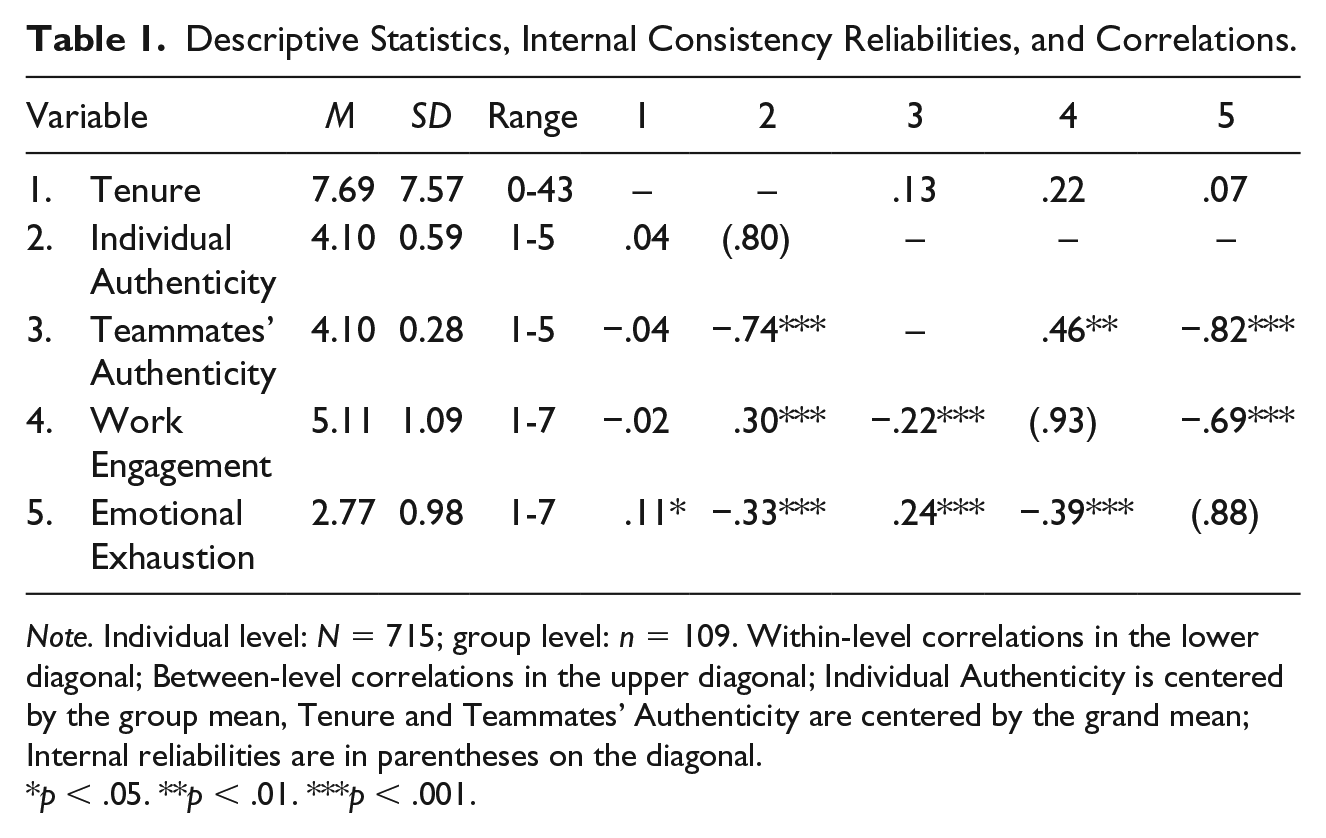
Note. Individual level: N = 715; group level: n = 109. Within-level correlations in the lower diagonal; Between-level correlations in the upper diagonal; Individual Authenticity is centered by the group mean, Tenure and Teammates’ Authenticity are centered by the grand mean; Internal reliabilities are in parentheses on the diagonal.
p < .05. **p < .01. ***p < .001.
Mplus Version 7 (Muthén & Muthén, 1998-2012) was used for hypotheses testing. Table 2 provides an overview of the tested models. As we were not interested in disentangling within- and between-effects in our models, we used the TYPE = Complex command in Mplus. We started with an unconditional intercept-only model (Model 0) to compare with the hypothesized models. Models 1 to 3 comprised individual (group-mean centered) and teammate authenticity and the control variable position tenure (both grand-mean centered; Enders & Tofighi, 2007). Position tenure emerged as a significant predictor for emotional exhaustion (γ = 0.12, SE = .04, p = .007) but not for work engagement (γ = −0.00, SE = .04, p = .918).
Results of Multilevel Modeling.
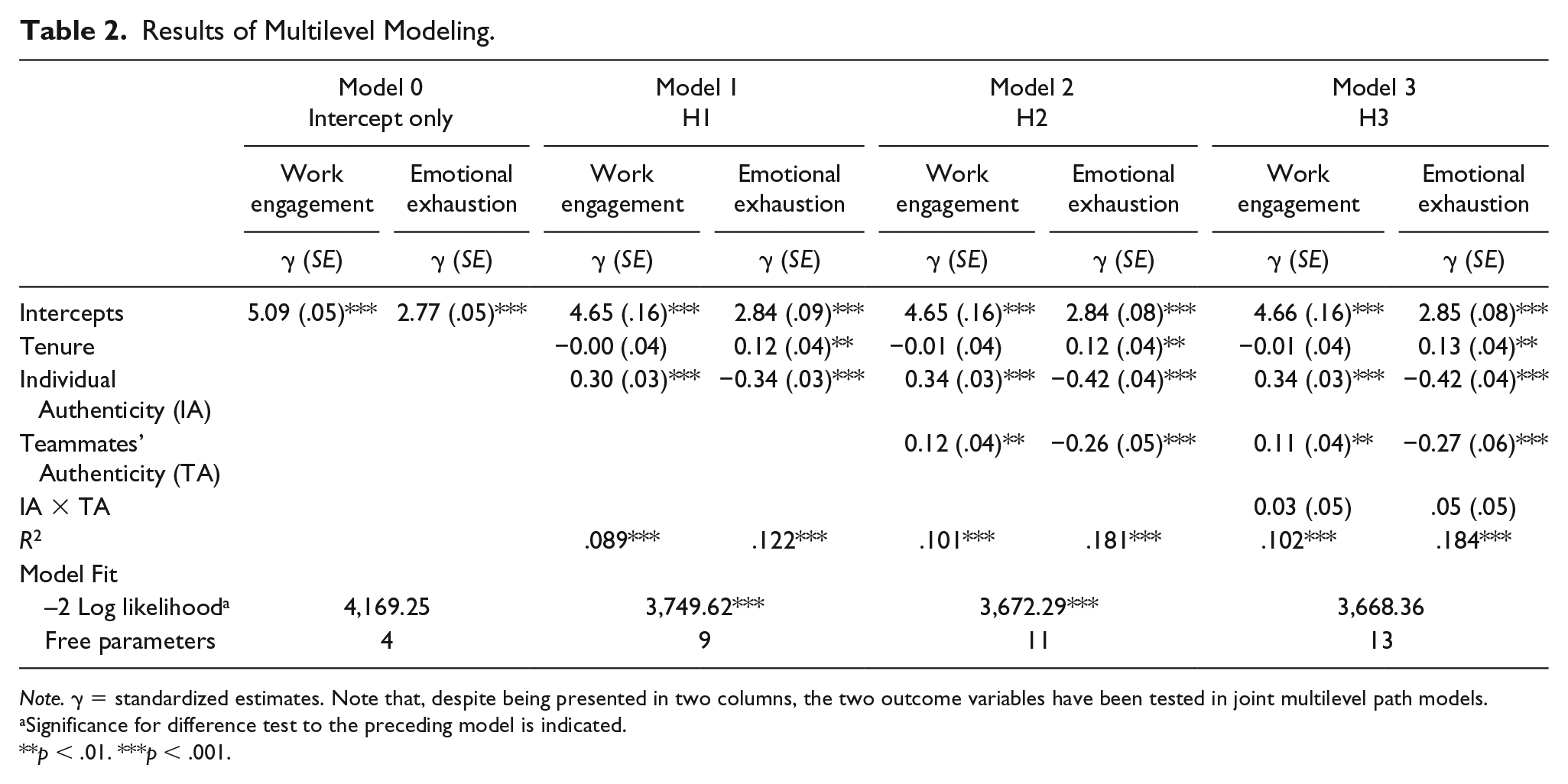
Note. γ = standardized estimates. Note that, despite being presented in two columns, the two outcome variables have been tested in joint multilevel path models.
Significance for difference test to the preceding model is indicated.
p < .01. ***p < .001.
In Model 1, we included individual authenticity and examined whether the established relationship between an employee’s authenticity and their well-being shows in our study. This step is also necessary to identify incremental effects of teammates’ authenticity on the respective focal employee’s engagement and exhaustion. As expected in H1a and H1b, individual authenticity was positively related to work engagement (γ = .30, SE = 0.03, p < .001) and negatively related to emotional exhaustion (γ = −.34, SE = 0.03, p < .001).
Model 2 was used to examine whether adding teammate authenticity explains incremental validity in work engagement and emotional exhaustion beyond the focal employee’s self-authenticity. Supporting H2a and H2b, teammate authenticity predicted work engagement (γ = .12, SE = 0.04, p = .004) and emotional exhaustion (γ = −.26, SE = 0.05, p < .001). Adding the teammate authenticity to the model increased the R² by 1.2% for work engagement and 5.9% for exhaustion. At least, the latter can be considered as relevant increase in explained variance in a field study.
In Model 3, the interaction term of individual and teammate authenticity was added to examine the hypothesized moderation effect. The interaction term failed to reach significance for both work engagement (γ = .03, SE = 0.05, p = .573) and emotional exhaustion (γ = .05, SE = 0.95, p = .287). Consequently, H3a and H3b had to be rejected.
Discussion
In today’s workplace, employees fulfill interdependent tasks working mostly in teams (Griffin et al., 2007; Rousseau et al., 2006). Authenticity is widely viewed as a desirable employee characteristic with a large scale of studies supporting the positive relationship between employees’ authenticity and their well-being. However, given that employees are embedded into a network of relationships at work, it seems premature to evaluate the role of authenticity solely on its effect on the individual employee neglecting the potential external effects an employee’s authenticity might have on their teammates. Whereas conceptual articles and anecdotal evidence are ambiguous in their estimations (Erickson, 1995; Ibarra, 2015; Taylor, 2003), our study shows that authenticity not only positively affects authentic employees’ own well-being but also the well-being of their teammates. Specifically, we found that teammate authenticity explained variance in a focal employee’s work engagement and emotional exhaustion above and beyond the effects that this focal employee’s own authenticity has on these two important criteria of work-related well-being. Our second assumption was not supported, as teammate authenticity did not strengthen the relationship between an employee’s authenticity and own well-being. In the remainder of the article, we elaborate on the implications our research has on the development of more relational approaches (Berscheid, 1999) and the effects of authenticity at work. We conclude with a discussion of our study’s limitations and directions for future research.
Theoretical and Research Implications
If work is done in teams and task completion requires cooperation and collective sense-making, research and theories of employee well-being cannot be adequate if they merely focus on the isolated individual. Relational (Berscheid, 1999) and, more broadly, contextualized approaches (Johns, 2006; Van Veldhoven & Peccei, 2010) allow for considering the potentially manifold external effects that an employee’s behavior might have on those around them. Our research contributes in at least four ways to the development of a more relational approach to authenticity at work—a feature that is deemed promising for protecting and facilitating employee well-being and health in our demanding times—and teamwork in general.
First, a range of research could potentially inform a more relational approach to authenticity at work, but this research is scattered across disciplines and domains (see Cha et al., 2019). Examples include research on authenticity in intimate relationships (Lopez & Rice, 2006; Wickham, 2013), externally perceived authenticity (e.g., of leaders by others; Gardner, Cogliser, Davis, & Dickens, 2011), and climate of authenticity (Grandey et al., 2012). We suggest that conceptually distinguishing (and empirically separating) between the internal effects of authenticity on the authentic individual and its external effects on those surrounding the authentic employee can function as a useful framework to organize existing knowledge and orient future research. Understanding the external effects of authenticity then requires identifying theories that explain why these effects occur. We propose that theories explaining the intrapersonal effects of authenticity (e.g., Deci and Ryan’s, 2000, self-determination theory; Kahn’s, 1990, theory of engagement; and Baumeister et al.’s, 1998, self-regulation theory) have some value as these internal effects (e.g., involvement, basic need satisfaction, and reduced self-regulatory demands) may spill over to others and thus increase team resources and reduce team demands. However, we also propose that there might be specific interpersonal processes that cannot be explained by the formerly mentioned theories. To enrich understanding of these interpersonal processes, we introduced social penetration theory (Altman & Taylor, 1987) as a theoretical lens that focuses on interpersonal processes (i.e., the positive effects of authenticity on relationships, namely, increases in trust and mutual self-verification and more constructive conflict management).
Second, our study shows, for the first time, that the external effects of authenticity are not reserved for romantic partnerships (Wickham, 2013) or for leader–follower relationships (Avolio & Gardner, 2005) but also occur among teammates. Focusing on effects among teammates is important as there are many differences between the leader-follower relationship and the relationship between teammates, and these differences might alter the external effects that can be expected from leader versus teammate authenticity. For instance, there are differing expectations regarding the roles of leaders and teammates, there is usually more frequent contact between teammates than between leader and follower, and the relationship between teammates is normally less directed and richer than the leader–follower relationship (Salancik & Pfeffer, 1978). Our findings show that the positive external effects of authenticity are not reduced to a relationship that is directed and based on influence attempts but occur in more balanced work relationships as well.
Third, our research emphasizes the value of empirically isolating the external effects of authenticity. Prior research that went beyond internal effects usually failed to separate perceptions of antecedents and their effects, potentially leading to biased results. This is the case in research that focused on how individual employees perceive their context (e.g., as open for authentic emotional expression; Grandey et al., 2012). It is also the case in research on perceived authenticity, as it is common in authentic leadership research (Gardner et al., 2011) where a rater (e.g., a follower) perceives a target’s (e.g., a leader’s) authenticity and this perception is linked to the rater’s well-being. We separated perception from effects by asking the target (i.e., teammates) about their authenticity and assessed its effects on other teammates’ ratings of their well-being.
Fourth, team research might benefit from our theoretical and research insights as these add to the understanding of relationship-building within teams. Being authentic seems to be beneficial for teams as the facilitated exchange of personal information that is associated with authenticity deepens relationships among team members. Our study thus adds to the understanding of how team composition (e.g., regarding particular traits such as authenticity) facilitates or inhibits exchange processes within teams eventually emerging toward specific team climates (Allen & O’Neill, 2015; Kozlowski & Chao, 2012; Liu, McLeod, & Moore, 2015; Pirola-Merlo & Mann, 2004).
Practical Implications
As prior research focused on authenticity merely at an individual level, team managers and human resource management representatives might hesitate to encourage authenticity thinking that employees’ authenticity might have negative effects for collective goal achievement and may cause unnecessary conflicts. Such a view is visible in some organizations’ socialization programs aiming at training newcomers to use appropriate behaviors and nurturing organizational identities at the expense of worker authenticity (Alvesson & Robertson, 2006; Cable, Gino, & Staats, 2013). Our research shows that employees do benefit not only from being authentic but also from the authenticity of their teammates. We do not think that authenticity should be demanded because employees differ in their willingness to disclose information about themselves, and we do not deny that there are contexts in which being authentic can cause harm to employees. However, our findings suggest that at least in the context that we investigated, authenticity is not only beneficial to the authentic employee, but has external effects on teammate engagement and exhaustion.
Our findings might be particularly relevant for those concerned with the nonprofit social sector. In the social work domain, being authentic is considered to be of crucial importance to building personal relationships and, hence, doing one’s job well (Gullo, Lo Coco, & Gelso, 2012; Seno, 2010). At the same time, too much personal involvement (which is associated with being authentic) is seen as a potential threat to one’s well-being, as visible in the concept of detached concern (Lief & Fox, 1963). Our research strengthens the position of authenticity by showing additional external effects, both motivating and buffering. Linking teammate authenticity to both exhaustion and engagement furthermore allowed us to show that the effects of teammates’ authenticity are not limited to the expression of negative feelings and as a buffer against detrimental effects (which was central in prior studies; for example, Grandey et al., 2012) but can affect motivational states as well. We thus extend the scope of psychological processes that might be responsible for the beneficial effects of authenticity at work and extend the scope of areas where our findings might apply. In more general terms, authenticity might function as a starting point for applying further insights from the domain of positive psychology (Donaldson & Ko, 2010; Seligman & Csikszentmihalyi, 2000), as these might inspire additional ways to improve working conditions for those employed in the nonprofit social sector.
Limitations and Directions for Future Research
This section focuses on our study design, the nonsignificant moderation effect, and potential alternative explanations for the hypotheses that were supported by our data. Our study is based on an employee survey, which implies the occurrence of the known liabilities of self-report and cross-sectional data (Podsakoff & Organ, 2016). Notably, the nested nature of our data allowed us to examine interindividual effects, particularly the effect of self-rated authenticity on other teammates’ well-being. As not all members of an organization take part in employee surveys, we also did not have data available from all team members. Consequently, our results could represent the authenticity of a subgroup within the teams we investigated. We tried to limit the effect of this potential liability by including only teams with at least three members providing data. As we have a rather large sample on Level 2, and teams on average had more than six respondents, our results should be rather robust. In addition, another limitation is that we do not have information about the sizes of the participating teams and thus the response rate within teams. Although we speculate the average response rate within teams should be slightly above the overall response rate of 40.6%, we cannot state for sure that a certain percentage of team members of each focal employee participated. Because our data are cross-sectional, we cannot rule out that reverse effects exist from teammates’ well-being on other teammates’ authenticity: Employees who are high in well-being could provide a positive work context where employees are more likely to behave authentically (e.g., because they feel appreciated and experience positive emotions; Waterman, 1993). Furthermore, teammates with higher well-being might have more resources available to, for instance, express themselves and give feedback, which fosters the self-awareness and authenticity of others. Drawing on these elaborations and research that found reciprocal effects between individual authenticity and well-being (Emmerich & Rigotti, 2017; Knoll et al., 2015), longitudinal studies could investigate potential reverse or reciprocal effects.
Another potential limitation is the context in which we conducted our study. Our sample comprised teams from the nonprofit sector concerned with social and educational work. Although our findings (e.g., high mean scores for authenticity) support prior research that emphasized the importance of authenticity for workers in the social sector (Aranda & Street, 1999; Renard & Snelgar, 2018; Seno, 2010), it is possible that authenticity is particularly accepted and even encouraged in this context while denigrated elsewhere, for example, in sales, marketing, or consulting (Alvesson & Willmott, 2002). Conducting a study like ours in the latter sectors might not only inform whether our findings are generalizable but also provide a chance to reconsider our rejected interaction hypothesis. Employees who already embrace a high authenticity level may not benefit from authentic teammates in a context that encourages authenticity anyway. Relationships may differ when examined in contexts that demand conformity and surface acting (Hewlin, 2009). Thus, examining branches and cultures where authenticity is less valued (see English & Chen, 2011; Robinson et al., 2013; Slabu, Lenton, Sedikides, & Bruder, 2014) might lead to different results regarding the proposed moderating role of teammate authenticity.
Examining moderation effects using context and person factors could enrich our knowledge on relational and context effects of authenticity. Context factors that could facilitate the external effects of authenticity are autonomy and social support (Deci & Ryan, 2000; Van den Bosch & Taris, 2014), safety climate (Edmondson, 1999), person-environment fit (Chen, Langner, & Mendoza-Denton, 2009; Kim et al., 2017), and authentic leadership (Hannah, Walumbwa, & Fry, 2011). Even more interesting are individual difference factors as moderators. Authentic individuals and teammates are not necessarily all positive. There may be authentic teammates who also have less desirable characteristics, such as bad manners or low competence. We do not know, yet, whether the effects of teammate authenticity differ depending on whether the authentic teammate is also kind and competent or embodies undesirable features. Furthermore, the effects of teammate authenticity may differ depending on that teammate’s level of extraversion. An extraverted teammate’s authenticity might show greater effects than the authenticity of the introverted.
Despite the generally high mean scores in authenticity, we found significant between-team variance in authenticity, which supports the idea that authenticity may be treated as a team-level construct. However, given that our design was cross-sectional, we cannot rule out that context conditions, such as meaningful work or work autonomy, cause both one’s teammates’ authenticity and one’s own well-being. Examining third factor effects could provide information on potential differences in the antecedents of individual and shared authenticity at work as well as which factors facilitate or inhibit mutual adjustments in authenticity among teammates. Within-team-level similarity in authenticity might be based on mutual adaptation (Cannon-Bowers & Salas, 2001) or processes that are described in the attraction-selection-attrition model (Schneider, 1987). Longitudinal studies could show whether teammates encourage each other (implicitly or explicitly) to adjust their authenticity level and whether employees are attracted to or put off by teammates depending on their authenticity level.
Finally, our study showed that when a focal employee’s individual well-being is used as a criterion, teammate authenticity seems not to increase the positive effect of this focal employee’s individual authenticity. Results may differ, however, when collective indicators of well-being or effectiveness are used as criteria, for example, cooperation, conflict resolution, and the development of shared mental models (Ilgen, Hollenbeck, Johnson, & Jundt, 2005; Schaubroeck, Lam, & Xie, 2000). Although our proposed moderation effect of individual and teammate authenticity on exhaustion and engagement was not evident in our data, further research is needed to disentangle the intra- and interpersonal processes that drive the relationship between authenticity and well-being at the individual level and among teammates. We believe that processes might operate at the individual level (e.g., basic need satisfaction), at the team and dyadic levels (e.g., higher social support or more constructive conflict management), and on more than one level (e.g., self-development through mutual self-verification and reduced collective self-regulatory demands).
Conclusion
Attempts to understand authenticity (and other behaviors) in organizations and teams remain incomplete when the focus is on the individual employee alone. This is particularly problematic when the aim is to understand behaviors that are relational in nature and potentially affect well-being and psychological health through the social relationships people have at work, which is the case for authentic behavior. By applying a relational approach to authenticity, we provide a more comprehensive picture of the effects of being oneself at work. Our findings that teammate authenticity positively affects others’ work-related well-being enrich the debate on whether expressing one’s true self at work is to be recommended (Cable et al., 2013; Ibarra, 2015). We also extend the theoretical approaches that might inform this debate. Whereas intrapersonal processes of involvement and self-regulation are likely to spill over into team-level effects, genuinely interpersonal processes as they are described in social penetration theory (Altman & Taylor, 1987) seem to explain unique variance in positive and negative criteria of work-related well-being. We hope our theoretical and methodological contributions inspire more comprehensive approaches to understanding the potential effects of individual and collective authenticity on the well-being of individuals and groups.
Footnotes
Declaration of Conflicting Interests
The author(s) declared no potential conflicts of interest with respect to the research, authorship, and/or publication of this article.
Funding
The author(s) received no financial support for the research, authorship, and/or publication of this article.
