



Abstract
Transactive memory systems (TMS) facilitate the utilization and coordination of diverse knowledge inputs, and therefore TMS should be particularly important for teams with expertise diversity. However, TMS in diverse teams may be inhibited by conflict. Adopting a conflict perspective, this study examines whether expertise diversity fosters or inhibits TMS in creative teams. Using longitudinal data, TMS was inhibited when team members engaged in relationship conflict. In contrast, task conflict fostered TMS. Furthermore, the results showed that expertise diversity affected TMS through task conflict and relationship conflict. I discuss the implications for management theory and practice.
In current organizations characterized by increasing diversity and growing specialization, the management of diverse teams still fails on a frequent basis (Burrell, 2016; Dobbin & Kalev, 2016). While managers increasingly use teams composed of experts in different functional areas to generate more creative products (Furr & Dyer, 2014), in a study of 95 cross-functional teams in 25 leading companies, Tabrizi (2015) found that 75% of the teams were dysfunctional. Collaboration in teams with expertise diversity, such as teams composed of different functional experts, may be particularly problematic, and diverse expertise often isn’t utilized and coordinated (Edmondson & Harvey, 2018; Gardner, 2016). The development of transactive memory systems (TMS) in teams with expertise diversity represents a powerful potential solution because TMS may help produce effective and efficient utilization and coordination of diverse knowledge (DeChurch & Mesmer-Magnus, 2010; Lewis & Herndon, 2011; Reagans et al., 2016).
TMS has been defined as a system for cognitive division of labor where team members who specialize in different knowledge domains share an understanding of who knows what and engage in efficient utilization and coordination of that specialized knowledge (Liang et al., 1995; Ren & Argote, 2011; Wegner, 1987). In teams with expertise diversity, it is essential to achieve coordination and utilization of different specialized knowledge. For example, Oscar-winning director Brad Bird states that when making a film, it is crucial to put together experts from different departments: “What you’re trying to do is find a way to get them to put forth their creativity in a harmonious way. Otherwise, it’s like you have an orchestra where everybody is playing their own music” (Rao et al., 2008, p. 3). The successful coordination and utilization of diverse knowledge is more likely to be achieved if team members develop TMS (Gino et al., 2010; Zhang et al., 2007). Therefore, a system that coordinates and harmonizes the knowledge utilization of diverse experts such as TMS seems to be critical for teams with expertise diversity.
Paradoxically, teams composed of diverse experts might be less likely to develop TMS than homogenous teams because of conflict. Bachrach et al. (2019) provided evidence that information diversity, a construct that included expertise diversity, knowledge diversity, and informational diversity, was negatively associated with TMS in a recent meta-analysis. While they speculated about interesting possible theoretical explanations, they encouraged more theoretical and empirical work that would help explain the surprising finding. Theory and research on expertise diversity and conflict suggest that teams composed of diverse experts are often plagued by conflict (Cronin & Weingart, 2007; Jehn et al., 1999; Pelled et al., 1999). Therefore, a conflict perspective might shed light on the relationship between expertise diversity and TMS.
The objective of this article is to build and test a theoretical model about the conflict mechanisms linking expertise diversity with TMS. While the dominant learning perspective on TMS predicts that learning from experience working together facilitates TMS (Lewis, 2004; Lewis & Herndon, 2011; Wegner, 987), theories on diversity and conflict predict that differences in expertise engender tensions, disagreements, and hostilities that might disrupt team learning and collaborative processes and thus inhibit TMS (Cronin & Weingart, 2007; Pelled et al., 1999; van Knippenberg & Mell, 2016). Extending prior theories on TMS, I propose that expertise diversity influences TMS via its effects on task and relationship conflict. While task conflict might foster learning about who knows what and TMS processes because it involves disagreements and debates about the content and goals of the task (Jehn, 1995), relationship conflict might harm the shared system for knowledge storage and retrieval because the interpersonal hostilities, tension, and clashes might pull team members apart (De Wit et al., 2012; Jehn, 1995; Jehn & Mannix, 2001). The relationships between expertise diversity, conflict, and TMS are tested using longitudinal data of student teams engaged in new product development projects that require the coordinated use of art, technology, and science expertise.
The current research offers important contributions to the literatures on TMS, conflict, and team diversity. First, the current study provides important insight into the conflicting roles played by expertise diversity in predicting TMS. It empirically investigates the link between expertise diversity, conflict, and TMS, thus shedding light on the roles of task conflict and relationship conflict in understanding how expertise diversity influences TMS. Second, this study contributes to the literature on team diversity by examining the relationship between initial team diversity and distributed team cognition. Van Knippenberg and Mell (2016) call for new research on how diversity in team composition may result in diversity in team processes and emergent states. The study provides new insights about the impact of expertise diversity, a type of initial diversity in team composition, on TMS, a type of emergent diversity (Kozlowski et al., 2013). Third, the current study extends research on the proximal outcomes of team conflict by exploring a new proximal outcome, namely TMS, and thus contributes to better understanding of the paradoxical effects of conflict on team outcomes (De Wit et al., 2012). Examining the effects of team conflict on TMS provides new insights into why conflict can both benefit and harm teams.
Theoretical Background and Hypotheses
In this section, I trace the development of the theoretical model by first elaborating on the construct of TMS and how expertise diversity relates to it. I next discuss how expertise diversity influences task and relationship conflict as delineated by Jehn (1995), and how task and relationship conflict in turn affect TMS. Integrating these arguments, I then propose that task conflict and relationship conflict represent key mechanisms that transmit the effects of expertise diversity on TMS. The hypothesized model is depicted in Figure 1.
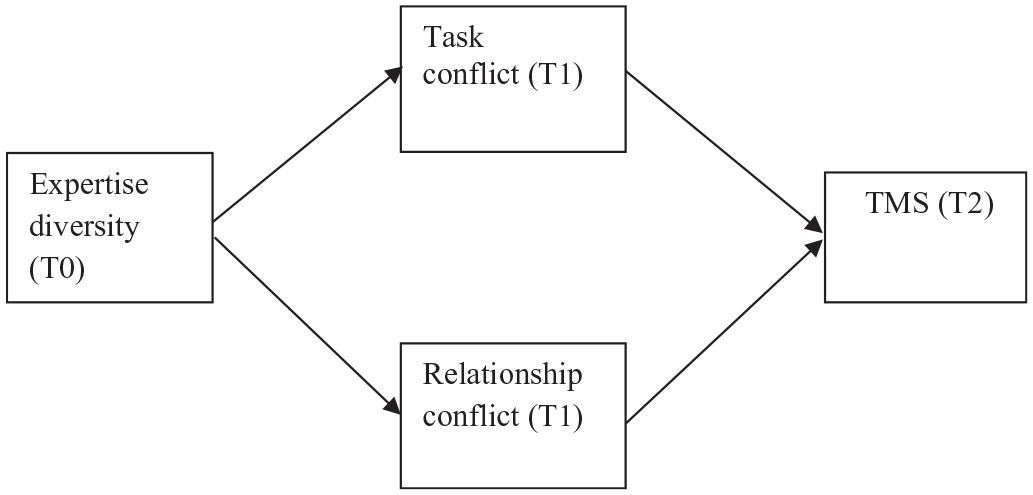
Model of hypothesized team-level relationships.
The Effects of Expertise Diversity on TMS
One of the characteristics of the cognitive structures of TMS that distinguishes it from other types of group cognition is that it has both shared and differentiated knowledge components (Brandon & Hollingshead, 2004; Lewis & Herndon, 2011; Wegner, 1987). Differentiated group knowledge leads to specialization within the team and it is created from the division of knowledge responsibilities within the team. While expertise diversity represents a characteristic of the initial team composition, specialization is developed as team members work together and it refers to knowledge responsibilities that are specific to the task. Expertise diversity is distinct from the knowledge specialization components of TMS structures because it reflects the broad area of skills, knowledge, and training of each team member before they start to work together (Cronin & Weingart, 2007). Furthermore, the emergent knowledge division and specialization within the team as an aspect of TMS is also tightly related to knowledge of who knows what while the knowledge of who knows what may not be present in teams with expertise diversity (Bunderson, 2003). Finally, teams with expertise diversity may develop division of knowledge responsibilities but if they don’t develop appropriate knowledge of who knows what or transactive processes that allow for coordinated knowledge search, encoding, and retrieval, teams will not have TMS.
Another important aspect of TMS is that it consists of both cognitive structures and transactive processes (Lewis & Herndon, 2011). We might expect that initial team composition where individuals have expertise in different knowledge domains might facilitate the building of TMS (Hollingshead, 2001; Lewis, 2004). The initial differences in skills, knowledge, and training might allow team members to settle more quickly in the specific cognitive structure as well as in the transactive processes that underlie TMS. Existing research suggests that members of diverse teams who rely on their initial perceptions of information distribution are more likely to use their interactions to learn and build TMS processes and structures (Lewis, 2004).
Expertise diversity, however, may be a catalyst for both advantages and problems: diverse experts may settle more easily in a system of distributed group cognition such as TMS if they debate their differences, thus engaging in task conflict, but expertise diversity may also disrupt TMS because deep-level differences such as opposing beliefs, perspectives, and values disrupt the work interactions and stimulating dysfunctional conflict (Cronin & Weingart, 2007; Harrison et al., 1998). Diversity theories argue that diversity has the potential to invite disruptive intergroup biases as well as synergetic benefits, and this was true for all dimensions of diversity—demographic, functional/educational, and otherwise (van Knippenberg & Schippers, 2007). The dysfunctional interaction due to conflict may harm the TMS cognitive structures of knowledge division and/or disrupt the TMS transactive processes. Integrating diversity and conflict theories, I next develop theoretical predictions about both the positive and the negative aspects of the relationship between expertise diversity and TMS.
TMS building and strengthening has been shown to be fostered by learning through group training (Moreland et al., 1998), through role identification (Pearsall et al., 2010), by prior experience working together in terms of familiarity (Lewis, 2004), or via the use of work experience for the development of information distribution networks (Lee et al., 2014). Theories and research on diversity and conflict (Cronin & Weingart, 2007; Pelled et al., 1999; van Knippenberg et al., 2004) would predict that high diversity—particularly deep-level differences such as differences in expertise—leads to disagreements, hostilities, and tensions between teammates with diverse training, preferences, and background (Cronin & Weingart, 2007; Jehn et al., 1999; Harrison et al., 1998). Differences in preferences, goals, and perspectives of diverse experts is likely to foster conflict in terms of disagreements, debates, and fights (Cronin & Weingart, 2007; Weingart et al., 2010) and different conflict types are likely to have different effects on TMS. More specifically, expertise diversity may stimulate TMS because of task conflict or disrupt TMS because of relationship conflict.
The Mediating Role of Conflict
In diverse teams, both task conflict and relationship conflict are ubiquitous (Cronin & Weingart, 2007; Jehn, 1995; Pelled et al., 1999). While prior research on TMS and conflict focuses on how conflict affects the relationship between TMS and team outcomes (Hood et al., 2014; Rau, 2005), I argue that conflict plays a pivotal role in predicting and shaping TMS in diverse teams. Scholars encourage research on conflict as one of the antecedents of TMS (Lewis & Herndon, 2011; Peltokorpi, 2008). In this section, I focus on the relationships between expertise diversity, conflict, and TMS.
Conflict involves the discussion of disagreements among team members. Prior research has differentiated between two types of conflict: task conflict and relationship conflict (De Dreu & Weingart, 2003; De Wit et al., 2012; Jehn, 1995). Task conflict involves disagreements about the content and the goals of the task at hand. Relationship conflicts tend to focus on more personal issues. Other types of conflict, such as process and status conflict (Behfar et al., 2011; Bendersky & Hays, 2012), have been recently identified, and research on these is still limited. My focus on task and relationship conflict is based on the existing literature on diversity and conflict (De Wit et al., 2012) that has focused predominantly on the effects of task and relationship conflict on team processes and outcomes (De Wit et al., 2012). At present, theories and research on the effects of diversity on process and status conflict are not advanced sufficiently to develop predictions about their relationships with TMS. Furthermore, my focus is on the role of task and relationship conflict in teams with expertise diversity in order to reduce the complexity of the theoretical model.
Expertise diversity should increase task conflict because members with different knowledge are likely to disagree about important aspects of the group’s task (Dougherty, 1992; Jehn et al., 1999; Pelled et al., 1999). Team members who have different perspectives, approaches, and languages engage in disagreements and debates about assumptions, goals, and processes in an attempt to complete a joint task (Cronin & Weingart, 2007; Pelled et al., 1999; Weingart et al., 2005). Prior research provides evidence that expertise diversity leads to task conflict (Lovelace et al., 2001) as a result of incompatible viewpoints (Jehn et al., 1999; Pelled et al., 1999).
Expertise diversity should also increase relationship conflict. Relationship conflict is likely to occur between people with different expertise training and background because of low liking, ingroup biases, and stereotypes (van Knippenberg & Schippers, 2007; Williams & O’Reilly, 1998). Diverse groups experience more relationship conflict than homogenous groups (Jehn et al., 1999). Biases and tensions between subgroups based on expertise areas affect social interaction and workflow on the common task (Abrams & Hogg, 1990; Randel & Jaussi, 2003). Diverse experts have different beliefs, attitudes, and perceptions (Cronin & Weingart, 2007; Dougherty, 1992; Weingart et al., 2010), and studies show that these deep-level types of diversity, similar to demographic or surface-level diversity, are related to lower social integration and less liking between team members (Harrison et al., 2002). Therefore, difficulties during interactions between diverse experts will often be related to personal tensions, clashes, and conflicts. Because of this, diverse experts are likely to engage in relationship conflict. In sum, expertise diversity is likely to engender both task and relationship conflict in the team. Taking all of these factors into consideration, I hypothesize:
Conceptually, a case can be made about a close relationship between conflict and TMS. According to TMS theories and research, TMS formation involves two processes: the development of TMS structure and the creation of efficient transactive processes (Lewis & Herndon, 2011). Task conflict and relationship conflict are likely to affect both processes, but while task conflict facilitates TMS, relationship conflict hinders it.
Task conflict is likely to facilitate TMS because it expedites the expertise recognition process in teams. As prior research shows, expertise on the team is not always recognized and is therefore not always utilized (Bunderson, 2003). Differences in expertise will surface during task disagreements and debates (Cronin & Weingart, 2007). Discussions of disagreements about how the task should be accomplished help reveal the distinct views, perspectives, and approaches of expertly diverse team members (Pelled et al., 1999; Weingart et al., 2005, 2010). If team members know more about the unique knowledge and perspectives of other team members, they can develop shared representations of who knows what. Engaging in task disagreements and debates facilitates expertise recognition and increases the consensus about each individual’s knowledge base (Austin, 2003), thus facilitating TMS. Therefore, I hypothesize:
Conversely, relationship conflict should hinder TMS. Relationship conflict might lead to hostilities as well as changes in the focus of attention that disrupt work interactions and thus disrupt TMS. First, relationship conflict engenders negative emotions (De Wit et al., 2012), and negative emotions have been shown to hinder TMS (Hood et al., 2016). Team members are not likely to engage in the learning behaviors of seeking and sharing information if they feel afraid or anxious (Hood et al., 2016). Therefore, relationship conflict is likely to harm TMS via its effects on negative affect.
Second, relationship conflict limits and disrupts the information processing in the group—and thus the TMS processes—because group members spend time and energy focusing on each other and their interpersonal problems rather than on task-related interactions and problems (Evan, 1965; Jehn & Mannix, 2001). Because of relational problems, team members may not invest in retrieving and using information from experts and thus fail to participate in TMS processes. TMS processes are likely to be disrupted and weakened.
Finally, relationship conflict may harm TMS structure and processes because it renders expertise less credible. Team members are not likely to trust and rely on the experts with whom they have low-quality relationships. Relationship conflict engenders hostility and negative attributions and lowers trust (De Wit et al., 2012; Jehn et al., 1999; Peterson & Behfar, 2003). Thus, team members who engage in relationship conflict will find other team members less trustworthy and judge their competence less favorably (McAllister, 1995). The effective encoding, storage, and retrieval of information will be impeded when expertise is less credible. In sum, relationship tensions and clashes may disrupt TMS through negative affect, change in the focus of attention, and decrease in credibility of expertise on the team. Therefore, I hypothesize:
Taken together, hypotheses 1a & 1b, hypothesis 2, and hypothesis 3 predict that task conflict and relationship conflict mediate the relationship between expertise diversity and TMS. Expertise diversity is likely to affect TMS via two opposing paths: a positive path that functions via task conflict and a negative path that functions via relationship conflict.
Method
Setting
Data were collected from members of teams of graduate students who developed new entertainment and technology products as part of their master’s program. The goal of these new product development projects was to have technologists and fine artists work together on projects that produce artifacts intended to entertain, inform, inspire, or otherwise affect customers. The master’s program focus was on interdisciplinary work and gaining hands-on experience with innovation. All participants in the program had work experience in their area of expertise. The teams presented their work in front of the faculty and the other students on four separate occasions. The data were collected before the project presentations in order to avoid the effects of feedback on the respondents. Each team had two faculty advisors but received feedback from all faculty members.
The conditions were similar to those experienced by real-world new product development teams. When students were informally asked how their project team experience compared with their internship experiences, the general consensus was that they were very similar. This view was affirmed by faculty members who indicated that the team project experience was designed to replicate the dynamics and pressures of working in an interactive media team in an organizational setting. Furthermore, the research settings were appropriate for the study of conflict and TMS in expertly diverse teams with creative tasks. Each team project involved producing new high technology products for various applications such as entertainment (e.g., videogames), education (e.g., interactive museum exhibits), military (e.g., new applications for control), and aesthetic appeal (e.g., interactive art).
Team members completed a web-based survey at two points in time (week 10 and week 15). To increase the response rate, participants received a $5 Amazon gift. Pizza was provided to each team in which all members completed the survey. The teams consisted of 2 to 11 team members and developed new products together over the period of 15 weeks. Team members with the following educational backgrounds are included in the sample: computer science, engineering, business administration, cognitive science, sociology and history, art (film, theater, literature, music), and design. Thirteen teams were removed because their response rate was lower than 50% during at least one of the data collection phases. Three teams with only two members were also removed (Moreland, 2010). Thus, the current sample used in this paper consists of 273 students in 60 teams. The average age of team members was 25 years (SD = 3.23). The sample consisted of 84 females and 189 males, of whom 46% were Caucasian, 44% were Asian, 4% were Hispanic, 2% were black, and 3% did not report their race. Team members had on average 2.4 years of work experience (SD = 3.47).
Data were collected from the master’s program across 3 years. The master’s program was taught by the same faculty using the same team selection criteria and same course requirements across this time span. To gain a better understanding of the context, I observed the team meetings of two teams and the presentations of all teams.
Measures
I collected the measures of task conflict and relationship conflict before the TMS measure because task conflict and relationship conflict were proposed to be the processes through which expertise diversity affects TMS. These two measures were collected 10 weeks after the beginning of the project work, whereas the measure of TMS was collected 15 weeks after the beginning of the project work. It was collected at the end of the project, but before the final presentation and the faculty evaluations of the teams. Demographic data on educational background, age, gender, race, and work experience was collected at the beginning of the project. The self-report scales in the surveys consisted of 5-point Likert-type scales ranging from strongly disagree (1) to strongly agree (5).
Expertise diversity
Expertise diversity was conceptualized as a variety type of diversity (Harrison & Klein, 2007). It was measured in terms of team members’ major area of study associated with their most recent educational degree, because graduate students’ expertise is typically derived from prior educational programs. Expertise diversity, similar to functional diversity, is related to differences in perspectives, languages, and values of the team members. In the sample, team members had 12 unique majors. The most common majors were computer science, design, and engineering. Since the data were categorical, I calculated diversity using Blau’s (1977) index
Task conflict
To assess the amount of disagreements, arguments, and debates over differing opinions and ideas, a four-item scale developed and validated in prior research was used (Behfar et al., 2011; Jehn, 1995). The reliability of the scale was satisfactory, α = .87. I aggregated the scale of task conflict to the team level after testing for homogeneity of responses in the groups, Mdn rwg = .89, M rwg = .84, ICC(1) = .15, F(59, 207) = 1.68, p < .01; ICC(2) = .41 (Chen et al., 2005).
Relationship conflict
To assess relationship conflict, I used a four-item scale developed and validated by Jehn (1995). The reliability index was satisfactory, α = .77. I then assessed the agreement among team members about the level of relationship conflict in the team, Mdn rwg = .85, M rwg = .82, ICC(1) = .47, F(59, 206) = 3.83, p < .001, ICC(2) = .78, and aggregated relationship conflict to the team level (Chen et al., 2005).
Transactive memory system
TMS was measured using the 15-item scale developed and validated by Lewis (2003). The TMS scale consists of three subscales: specialization, coordination, and credibility. The results from second-order confirmatory factor analysis (CFA) showed that the three subscales, that is, specialization, coordination, and credibility, represented components of a higher order factor, χ2 [232] = 55.21, p = .14; CFI = .98, RMSEA = .06. The factor loadings for the subscales were above .70. Consistent with the CFA results and prior research, the subscales were aggregated into a single construct of TMS.
The reliability of the TMS scale was satisfactory, α = .72. Before aggregating the items to the team level, I tested statistically whether the team member responses were similar enough to be aggregated into a team score, Mdn rwg = .91, M rwg = .84, ICC(1) = .42, F(59, 184) = 4.28, p < .001; ICC(2) = .75.
Control variable: Team size
To capture the possibility that team size may be driving the team process effects (e.g., Austin, 2003; Farh et al., 2010), I controlled for team size, M = 4.37, SD = 1.91, range = 3 to 11. Team size is commonly controlled in group research (e.g., Pelled et al., 1999). For example, larger teams might have more potential for conflict, which may influence group processes and performance (Ancona & Caldwell, 1992).
Results
Table 1 presents the means, standard deviations, and correlations for all the variables in the study.
Descriptive Statistics and Correlations for Study Variables.

Note. N = 60.
p < .05. **p < .01.
Hypotheses Testing
In order to test the hypotheses, I tested for mediation by using the PROCESS macro for SPSS (Model 6) (Hayes, 2017; see also Edwards & Lambert, 2007). The indirect effects were assessed through bootstrapping, which represents a component of the PROCESS macro. The bootstrapping technique does not require normal distribution. It treats the sample as a population and then computes the relevant statistics by resampling with replacement a number of times (Shrout & Bolger, 2002). Using the bootstrapping technique and 10,000 replications, I computed the bootstrapped confidence intervals for the indirect effects. This model included both task conflict and relationship conflict as two mediators of the effects of expertise diversity on TMS. In the test of the mediation hypotheses, a partial mediation was tested for. Therefore, I also included the direct effect of expertise diversity on TMS in the tests of mediation.
The results of these analyses are presented in Tables 2 and 3. First, hypothesis 1 predicted that expertise diversity would be positively related to (a) task conflict and (b) relationship conflict. The results obtained showed that expertise diversity was significantly and positively related to task conflict (β = .24, p < .05), and relationship conflict (β = .26, p < .05). Therefore, hypotheses 1a and 1b were supported. Hypothesis 2 further predicted that task conflict is positively related to TMS. In support of this hypothesis, the results revealed that task conflict was significantly and positively related to TMS (β = .28, p < .01). Hypothesis 3 predicted that relationship conflict is negatively related to TMS. In support of hypothesis 3, the results showed that relationship conflict was significantly and negatively related to TMS (β = −.61, p < .001).
Regression Results for Task Conflict, Relationship Conflict, and TMS.
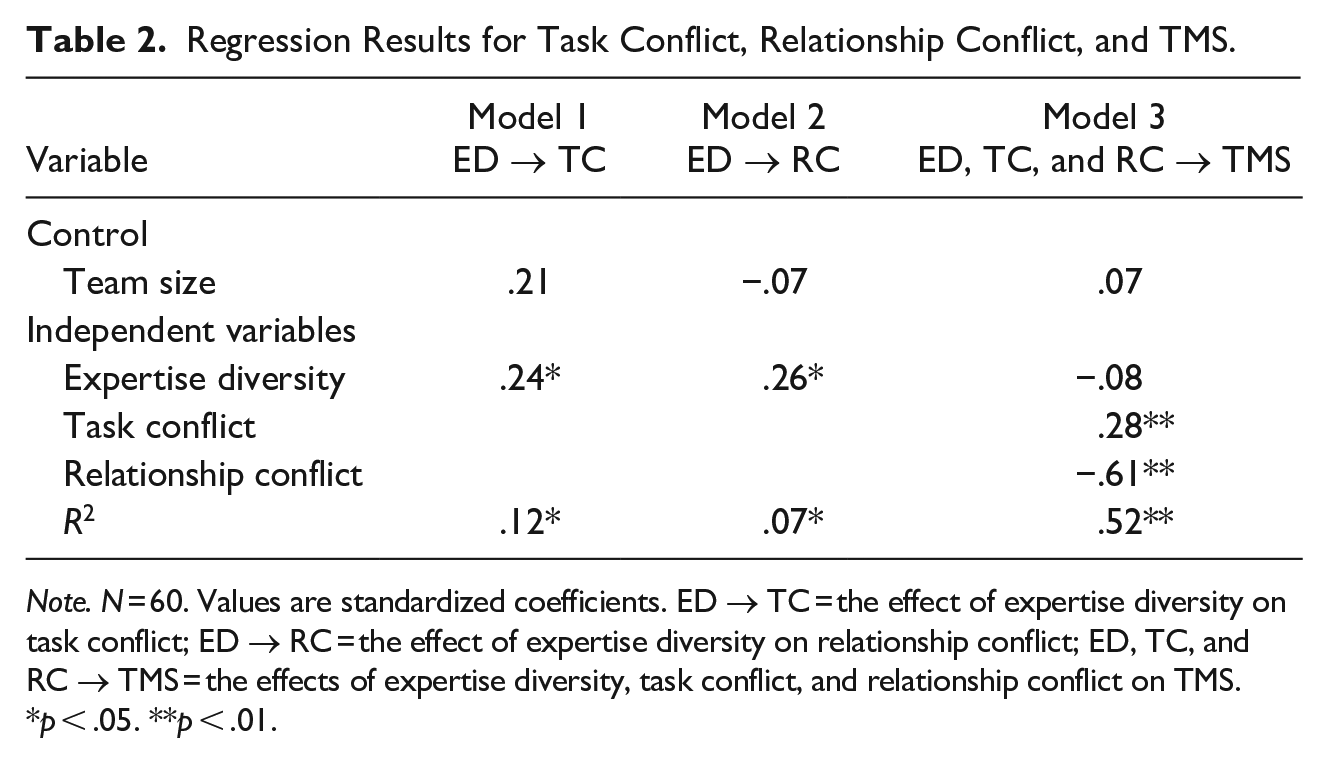
Note. N = 60. Values are standardized coefficients. ED → TC = the effect of expertise diversity on task conflict; ED → RC = the effect of expertise diversity on relationship conflict; ED, TC, and RC → TMS = the effects of expertise diversity, task conflict, and relationship conflict on TMS.
p < .05. **p < .01.
Mediation Results.
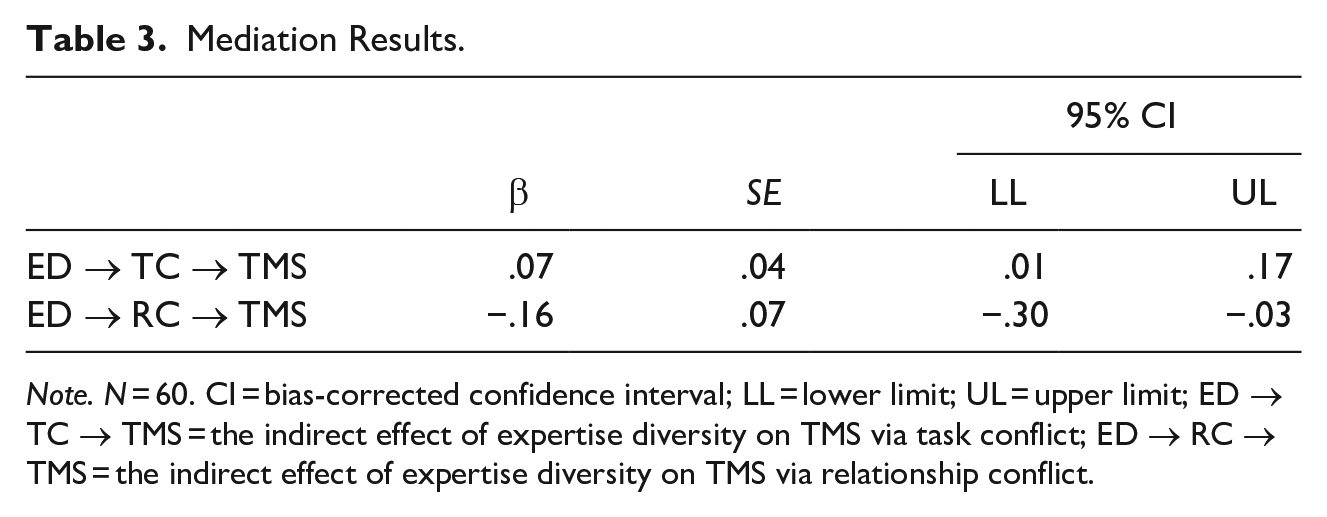
Note. N = 60. CI = bias-corrected confidence interval; LL = lower limit; UL = upper limit; ED → TC → TMS = the indirect effect of expertise diversity on TMS via task conflict; ED → RC → TMS = the indirect effect of expertise diversity on TMS via relationship conflict.
Hypotheses 4a and 4b predicted that the relationship between expertise diversity and TMS would be mediated by (a) task conflict and (b) relationship conflict. Establishing mediation requires two conditions: first, that the predictor (expertise diversity) be significantly related to the mediators (task conflict, hypothesis 1a; relationship conflict, hypothesis 1b) and second, the mediators should be related to the outcome (in this case, TMS; hypotheses 2 and 3). Both conditions were met in hypotheses 1a, 1b, 2, and 3. I tested for the indirect effect of the relationship between expertise diversity and TMS through task conflict and relationship conflict by using bootstrapping analysis and the PROCESS macro for SPSS (Model 6) (Hayes, 2017). Table 3 summarizes the results from the bootstrapping analysis. The results show that both indirect effects are significant and thus provide support for hypotheses 4a and 4b.
Auxiliary Analyses
The test of hypotheses 2 and 3 was supplemented with a test of whether task conflict and relationship conflict had curvilinear effects on TMS. 1 Prior research provides evidence for curvilinear effects of task conflict on team outcomes (e.g., De Dreu, 2006; Farh et al., 2010). To test for curvilinear effects of task conflict and relationship conflict on TMS, I entered the squared terms of task conflict and relationship conflict in the regression of TMS on expertise diversity, task conflict, and relationship conflict. The squared terms of task conflict and relationship conflict were not statistically significant (β = .23, p = .15, and β = .01, p = .97, respectively). Therefore, there is no evidence in this study that task conflict or relationship conflict have curvilinear effect on TMS.
Discussion
In this study, I examined TMS from a conflict perspective to gain new insights into the relationships between expertise diversity, conflict, and TMS. As prior research shows, TMS enables the smooth utilization and coordination of specialized knowledge (Lewis & Herndon, 2011; Ren & Argote, 2011; Wegner, 1987). Therefore, TMS is essential for expertly diverse teams where team members benefit from the successful utilization and coordination of diverse expertise. Starting with this premise, I examined whether expertise diversity is positively or negatively related to TMS.
While prior research on the group cognition examines the predictors of TMS from a learning perspective (e.g., Gino et al., 2010; Lewis et al., 2005) and overlooks the role of conflict, this study focused on the mediating effects of task and relationship conflict on the relationship between expertise diversity and TMS. Expertise diversity stimulated TMS via task conflict. In contrast, expertise diversity harmed TMS via relationship conflict. Thus, the study provided insights into why expertise diversity may both stimulate and harm TMS.
Theoretical Contributions
Although a number of studies of the antecedents of TMS have drawn on the learning perspective of TMS and investigated relationships between gaining experience working together and TMS (Gino et al., 2010; Lewis, 2004; Moreland et al., 1998), task and relationship conflict has been surprisingly absent from consideration (Peltokorpi, 2008; Ren & Argote, 2011). It can be argued, however, that conflict represents an integral part of work in teams with expertise diversity, a contention that I have empirically supported here. The current study draws on a conflict perspective. It is unique in that it shows for the first time that both relationship conflict and task conflict explain the effects of expertise diversity on TMS. It addresses calls to further explore the role of member diversity as an antecedent of collective cognition (Peltokorpi, 2008; Ren & Argote, 2011) and sheds light on the recent meta-analysis findings about the negative association between information diversity and TMS (Bachrach et al., 2019). Since relationship conflict is fraught with hostilities and negative affect (De Wit et al., 2012), it transforms the affective aspects of team interactions and renders difference in expertise harmful. This finding on the damaging effects of relationship conflict on TMS extends current research on the disruptive effects of negative affect on TMS (Hood et al., 2016).
This study fills a gap in our knowledge about the impact of compositional diversity on the emergent diversity of team processes and states (van Knippenberg & Mell, 2016). Transactive memory systems represent a type of emergent distributed cognition in teams. Consistent with prior studies on team compositional diversity and conflict (Jehn et al., 1999; Lovelace et al., 2001; Weingart et al., 2010), I found that expertise diversity affected TMS through the team members’ interactions: task conflict and relationship conflict. Task and relationship conflict represented mechanisms of the effects of expertise diversity on TMS and those two mechanisms functioned in the opposite directions. Thus, they exemplified the tensions in team processes in teams with diverse composition and showed how they are related to emergent diversity. Team processes in diverse teams represented both positive and negative paths in the relationship between initial team diversity and emergent diversity such as the distributed collective cognition of TMS.
Furthermore, as my findings suggest, not all conflict in diverse teams needs to be stifled. Task conflict, for example, was shown to enhance TMS. As prior theories and research have suggested, task conflict helps identify and recognize differences in expertise (Cronin & Weingart, 2007; Pelled et al., 1999; Weingart et al., 2010). I suggest that task conflict helped expert recognition and facilitated the learning that leads to more refined TMS structures and more efficient TMS processes. Strengthening the link between expertise and task conflict is likely to enable diverse teams to benefit more from their differences in knowledge and information. Therefore, future research could examine contingencies of the effects of expertise diversity on task conflict and of the effects of task conflict on TMS. For example, theories on representational gaps in functionally diverse teams (Cronin & Weingart, 2007) suggest that cognitive integration enables team members with different expertise to engage in productive task conflict because it helps them find a common understanding of the problems they face and build common ground.
Prior TMS research has focused mostly on teams with routine tasks and objective outcomes (Lewis & Herndon, 2011). However, teams are increasingly used for complex ill-structured tasks such as creative tasks, which expertly diverse teams are often recommended for (Dyer, 2015). Scholars recently began investigating what predicts TMS in teams with creative tasks in a laboratory setting (Gino et al., 2010), and influential reviews of TMS literature encourage these studies (e.g., Lewis & Herndon, 2011; Ren & Argote, 2011). Our setting allowed us to study predictors of TMS in new product development teams. Therefore, the current study provides an opportunity to further our understanding of the antecedents of TMS for teams with creative tasks.
An interesting extension of this research could focus on the multilevel processes of emergence of TMS in order to provide more nuanced understanding about how the interactions of individuals with different expertise influence the emergence and strengthening of team level TMS. This study investigated the team level antecedents of TMS and thus addresses the question of what aspects of team composition and team interactions predict TMS (see also Bachrach et al., 2019). Future research can examine the specific individual level characteristics or behaviors as antecedents of TMS (Cronin et al., 2011; Waller et al., 2016): for example, how individual conflict behaviors influence TMS.
Practical Implications
The study offers important practical implications about conflict and TMS in diverse teams with creative tasks. To foster team creativity, managers increasingly use teams composed of diverse experts, such as cross-functional teams. However, conflict is ubiquitous in diverse teams (Weiss & Hughes, 2005). My findings suggest that managers interested in improving teamwork in diverse teams should actively manage conflict in order to foster TMS.
This study suggests that the use of teams with high-expertise diversity may harm TMS because of high relationship conflict. Managers should actively foster the formation and strengthening of TMS structures and processes in expertly diverse teams. One way to accomplish the task would be to improve conflict management in their teams (DeChurch & Marks, 2001; DeChurch et al., 2013), or managers may provide training for employees to help them effectively manage relationship conflict or intervene as a third party in cases of relationship conflict. Managers can also intervene to help team members reduce relationship conflict following the conflict management intervention model developed by Wageman and Donnenfeld (2007).
Furthermore, it is important to stimulate task conflict during team member work interactions. Task conflict is instrumental to team success because it fosters the building and strengthening of the much-needed systems for information encoding, storage, and retrieval in diverse creative teams. Lack of awareness about the initial distribution of knowledge may stifle TMS. If team members engage in team conflict, they become more aware of their differences in knowledge and information. To foster task conflict, managers could design conflict cultures that support collaborative debates and disagreements about the task (Gelfand et al., 2012) and/or a team climate that values diversity (Homan et al., 2007). Instilling and maintaining appropriate diversity norms (Homan et al., 2007), stimulating interdependent work (Joshi & Roh, 2009), or bringing in outsiders (Price, 2014) may also help achieve the goals of stimulating task conflict. Team members with different expertise may fail to engage in task conflict because of lack of common ground and thus fail to participate in TMS. Building superordinate team identity (Kane et al., 2005) or increasing familiarity may help team members with different backgrounds to develop common ground and then engage in task conflict. These conditions can enhance the debates and discussions of task-related differences in teams, and in turn help team members engage in the valuable group cognitive structures and become more creative.
Limitations and Future Directions
These contributions should be qualified in light of several limitations. The sample consisted of students involved in new product development projects working over the span of a 15-week semester. Although this approach allowed me to avoid variation in the external context and team inputs (e.g., differences across organizational settings, team tenure, incentives, etc.) and to control the team selection process, it may raise questions about the generalizability of the findings to organizational settings. Despite these differences in context, many proxies for organizational realities were in place. Students came from diverse educational backgrounds and had different expertise (majors). Furthermore, they were accountable to multiple constituents (professors and sponsors), worked under time pressure with no possibility of deadline slippage, and were working on other projects (courses) simultaneously. Finally, our sample consisted of graduate students who had on average 2.4 years of work experience. To increase the external validity of the findings, future research should test the model in an organizational context.
The choice of field research design did not allow a direct test of causality. The longitudinal data, however, allowed me to provide evidence for temporal precedence in the predictive relationship between task conflict, relationship conflict, and TMS. My research approach also allowed me to keep characteristics of the context constant, to use statistical controls, and to randomly assign individuals to teams in order to increase the internal validity of the results. Furthermore, it allowed me to study teams that interact over a long period of time, work on a realistic complex creative task, and have different expertise backgrounds. Subsequent research could sharpen the internal validity of the current findings by further examining these relationships using experimental methods.
In the theoretical arguments, I considered the two different aspects of TMS: the cognitive structures and the transactive processes. The cognitive structures and transactive processes are interdependent and interwoven and they are both necessary for the successful functioning of TMS. In field research, the existence of TMS cognitive structures and transactive processes are assessed by the behavioral indicators of specialization, credibility, and coordination (Lewis & Herndon, 2011). Lewis and Herndon (2011) argue that three behavioral indicators cannot be meaningfully analyzed and interpreted in isolation. Therefore, the self-report measure of TMS comprises all three behavioral indicators. Direct measures of cognitive structures and transactive processes have been developed for experimental settings (Hollingshead, 1998a, 1998b; Wegner et al., 1991). Future research can use experimental design where observations and other types of measure can be used to capture directly the effects of conflict on the cognitive structures and transactive process.
In addition to the possibilities noted above for future research, there are many questions related to TMS that are worth exploring. Since we now know that conflict is an important team process ensuing from expertise diversity and predicting TMS, it is worthwhile to delve further into the link between expertise diversity and TMS. Other mechanisms, such as communication difficulties because of the lack of common ground, may be relevant. Communication difficulties because of lack of common ground may explain why some diverse teams do not have functioning TMS. These difficulties can explain why some teams with expertise diversity don’t engage in constructive discussions of their different approaches, values, and goals, that is, why some teams do not engage in constructive task conflict. Consistent with the possibility for other mechanisms, in my tests of hypotheses 4a and 4b, I include a direct effect between expertise diversity and TMS, thus allowing for the possibility that task conflict and relationship conflict partially mediate the effects of expertise diversity on TMS.
While task conflict and relationship conflict represent two distinct conflict types, often one conflict type, for example, task conflict, can get transformed into another conflict type, for example, relationship conflict (Greer et al., 2008). In the current study, the correlation between task conflict and relationship conflict was small and not statistically significant (r(58) = −.09). Future research should examine conflict transformations over time and how conflict transformations may change the relationships between expertise diversity and TMS. In addition, future research that assesses conflict and TMS at multiple points of time during a team project could provide new insights about the trajectories of conflict and TMS over time.
In the current study, expertise diversity was measured in terms of team members’ major area of study associated with their most recent educational degree and it represented a categorical variable. While this type of measure captures the variety in teams (Harrison & Klein, 2007), there are interesting questions about the depth of expertise of each of the diverse team members and how the depth of expertise can impact TMS. For example, team members who have deeper expertise within a specific area might be more creative (Amabile, 1983) but their jargon and taken for granted assumptions may create more difficulties in debating their ideas and approaches with team members with different area of expertise (Weingart et al., 2005). Future research should examine how depth of expertise in teams with expertise diversity influences TMS.
Conclusion
Adopting a conflict perspective, my research provides new insights about expertise diversity and TMS in teams with creative tasks. The study helps identify effects of expertise diversity and team conflict on TMS, thus extending extant research based on the learning perspective on TMS predictors. Understanding the barriers to TMS building and functioning requires the study of the important but neglected role of conflict in predicting TMS in diverse teams. The current study sets the stage for further research and theoretical progress in understanding the connections between diversity, conflict, and TMS.
Footnotes
Acknowledgements
I would like to thank Laurie R. Weingart and Kenneth Goh for valuable suggestions and for their assistance with the data collection.
Declaration of Conflicting Interests
The author declared no potential conflicts of interest with respect to the research, authorship, and/or publication of this article.
Funding
The author received no financial support for the research, authorship, and/or publication of this article.
