



Abstract
The role of group bonding (friendship ties among group members) and the relationships between group members and the formal leader in the prediction of effectiveness was studied. A theoretical mediated-moderation process model was tested. The model was examined through a longitudinal research with 91 natural groups, that included social network analysis to capture the relationship between group members and a leadership differentiation measure to revel their relationship with the leader. As hypothesized, group bonding predicted group effectiveness, group cohesion mediated only one dimension of group effectiveness, and leadership differentiation moderated this process.
In today’s complex world, organizations often perform their tasks based on work groups. This tendency calls for a deeper understanding of the social processes that lead to more effective groups (Mathieu et al., 2017). Search the index of any textbook in the field of organizational behavior, and it is unlikely that the terms friendship or group bonding (friendship at the group level) will appear; spend some time with work groups, and it is very likely that you will observe friendships between many of the group members (Grey & Sturdy, 2007). The influence of friendship on group performance has been exhibited, but only in some facets of group research (Jehn & Shah, 1997). Much of this research is based on the assumption that good interpersonal group relations produce high performance (Shah et al., 2006). Accordingly, work group leaders invest efforts in conducting social and team-building activities to cultivate and nurture friendship ties among group members in order to increase performance (Klein et al., 2009). While the link between interpersonal relations and performance is known, the question remains whether friendship contacts within work groups do, in fact, influence a wider variety of desired group outcomes, such as those captured by the multidimensional concept of group effectiveness.
Friendship among individuals within a group is defined as group bonding (Henttonen et al., 2014). Some existing literature claims that group bonding increases group performance, even though the psychological mechanism by which group bonding affects group performance is still unclear (Balkundi & Harrison, 2006). In the current study we wish to introduce, group cohesion, a known affective group-related psychological mechanism as a mediator of the relationship between group bonding and effectiveness.
Several studies refer to group bonding as a proxy for group cohesion (see e.g., Kratzer et al., 2005). Theoretically, group bonding is a structural concept that refers to relational togetherness, while perceived cohesion is a psychological concept that refers to the sense of togetherness that people express. It is therefore important to differentiate between these constructs and to study their interrelations (Jehn & Shah, 1997; Moody & White, 2003).
Since the influence of group bonding on group effectiveness may also be influenced by the group leader (Gerstner & Day, 1997), it is important to include leadership when investigating whether group bonding leads to more effective groups (Bolino & Turnley, 2009). The focus of this study is on the differentiation of the relationships the leader has with group members (LMXD), which captures a group’s perspectives regarding its members’ relationships with the leader (Liden et al., 2006), to understand the way leadership may be a boundary condition of the relationship between group bonding and group effectiveness (Martin et al., 2018).
To understand these process and boundary conditions in the relationship between group bonding and effectiveness, the study will integrate social network theory and leader-member exchange theory (LMX theory). Social network research highlights the importance of investigating the relationships and connections between social actors (Wasserman & Faust, 1994). Unlike traditional group research, which examines attitudes and behavior, social network research examines the relationships between the actors, and how these relationships are connected to attitudes and behavior.
Sparrowe and Liden (2005) focused on the individual-level analysis of social networks and LMX and demonstrated that these theories complement each other. For example, they noted that “These perspectives—one focusing on emergent or informal networks of relationships and the other focusing on the formally constituted vertical dyad—speak to the processes whereby individuals are integrated into organizations as influential players” (p. 506). Social network theory focuses on social ties within the group (between group members) and suggests that social ties are channels through which resources and influence flow (Podolny & Baron, 1997), and therefore have the potential to predict performance. LMX theory focuses on the quality of the ties between the formal leader and each of the group members (Graen & Uhl-Bien, 1995), which also predict performance. By integrating those two types of ties, a better understanding of how relationships within the group predict performance emerges.
The current study follows the body of research that integrated two theories (LMX and social networks) on individual level ties (Sparrowe, 2014; Sparrowe & Emery, 2015; Sparrowe & Liden, 2005), and takes a step forward by examining the group level and deriving new meaning for the understanding of group dynamics. For example, on the individual level, LMX indicates how close the relationship between a specific group member and the formal leader is, which may influence the motivation and satisfaction of the group member. In comparison, LMX differentiation points to differences in the relationships between group members and the formal leader, which may influence all group members.
By studying the relationship between group bonding (via social networks) and work group effectiveness. This study aims to identify group cohesion as a mediator through which group bonding affects group effectiveness, to differentiate between group bonding and group cohesion, and to introduce leadership differentiation as the boundary condition between bonding and cohesion.
Group Bonding
Most studies of informal relationships among group members tend to focus on instrumental relations such as advice and information (Kratzer et al., 2005). Relatively little research has been carried out on friendship contacts and their effects on group-level functioning, although there is evidence that friendship contacts affect group processes (Ibarra & Andrews, 1993). The results of such research on friendship ties and group outcomes are, however, inconclusive (Balkundi & Harrison, 2006).
Friendship is defined as a close interpersonal tie with positive, amicable relations (Jehn & Shah, 1997). Friendship relationships are frequently categorized as communal relationships in which individuals are concerned about the welfare and fulfillment of other’s needs, and hope for the same responsiveness toward their own needs (Clark & Mills, 2011). At the group level, groups may vary in the extent of close friendship ties among their members. Thus, work groups differentiate from one another in their group bonding: the number of internal friendship relationships that exist among group members (Henttonen et al., 2014).
To measure and examine the effect of group bonding on group effectiveness, the current study uses a social network approach. Accordingly, it is possible to measure the structure of relationships in groups; this group network structure has important indications for each network member as well as for the entire group. A basic assumption is that social network ties serve as pipelines that enable the flow of resources. The extent to which network members are connected to one another determines the capacity of resources that can flow through the network (Balkundi & Harrison, 2006). For example, a group of individuals who have few or no ties with each other tend to experience difficulty when exchanging or establishing resources because no established patterns of ties exist for conveying them. In contrast, a group of tight friends in which everyone is connected to everyone else tend to share resources, and so all group members share the same information, trust each other, and have similar attitudes (Krackhardt, 1999).
Group Bonding and Effectiveness
One of the propositions introduced in the social network literature is that dense ties between individual members increase group performance (Grund, 2012). This proposition has been supported by numerous studies. Moreover, a recent meta-analysis (Chung et al., 2018) integrated the results of 26 studies and found significant positive effect of friendship ties on performance (Cohen’s d = 0.31). In this study we distinguish between group performance and group effectiveness (see Salas et al., 2007). Group performance accounts for the outcome of a group’s actions, regardless of how the task may have been accomplished. Conversely, group effectiveness takes a more holistic perspective and considers not only whether the group performed (e.g., completed the group task), but also how the group members interacted to achieve the outcome (Salas et al., 2005).
A meta-analysis by Balkundi and Harrison (2006) expanded the discussion about team processes from performance to effectiveness. The study found evidence that density of friendship networks (between group members, including their leader) was positively and moderately related to team task performance (e.g., speed and quality) and positively and strongly associated with team viability (e.g., commitment). Henttonen (2010) claimed that there is no single, uniform measure of group effectiveness and recommended regarding effectiveness as a multi-dimensional concept. Cohen and Bailey’s (1997) approach comprised various outcomes that are important in organizational settings onto three dimensions of effectiveness: performance, member attitudes (measures such as employee commitment), and behavioral outcomes (measures such as turnover). As there are many attitudinal and behavioral variables used in the study of effectiveness we selected the measures that were applicable to our study, and which Cohen and Bailey refer to as the “most common” (p. 248) measures, which are commitment (attitudes dimension) and turnover (behavioral dimension).
Most studies that explored the effect of dense networks on performance were conducted on advice networks rather than friendship networks. Although friendship networks and advice networks are significantly correlated, they do have different characteristics (Shah, 2000). Advice ties are instrumental ties, whereas friendship ties are expressive ties that promote candid information exchange and are characterized by affect-based trust (Ibarra, 1993; Jehn & Shah, 1997). Hence, information exchange should increase in friendship networks. The few studies conducted on friendship networks in work groups found that denser relationships within the group lead to better performance (see Jehn & Shah, 1997; Kratzer et al., 2005; Shah et al., 2006).
Researchers have provided different theoretical explanations for the link between bonding and performance as one dimension of group effectiveness, and suggest that bonding creates structures that allow better cooperation between group members, which is an important contributor to group performance. For example, Molm (1994) claimed that interdependence between members calls for cooperation and coordination of effort. Littlepage et al. (1997) suggested that dense networks encourage information sharing and increase knowledge about other members of the network. As a result, members of such networks are more aware of the potential and resources of other group members, and the tightly connected structures help mobilize those resources. Finally, Sparrowe et al. (2001) suggested that when group members have strong relationships with many other group members, mutual interdependence increases.
Some of the explanations also point to a link between bonding and the two other dimensions of effectiveness (commitment and turnover). Regarding commitment, researchers suggest that the more friendships there are among the group members, the greater concern is expressed for the welfare and need satisfaction of group members and of the group as a whole. For example, Granovetter (1985) showed that dense network structures increase trust and dependence within the group and should, therefore, be related to commitment to the group. Some explanations focus on behavioral outcomes and suggest that greater group bonding decreases negative behavioral outcomes (e.g., turnover). Further, Wagner (1995) suggested that dense networks are effective in reducing social loafing, since members can be held responsible more effectively. Therefore:
Cohesion as a Mediator of Group Bonding and Effectiveness
The meta-analysis conducted by Balkundi and Harrison (2006) provided support for the important effect of group bonding on group outcomes. However, as the researchers claimed, their study did not reveal the mechanisms through which these relations make their impact. The goal of this study is to reveal the emergent state through which numerous friendships in work groups influence group effectiveness. An affective group-related psychological variable is explored as a mediator, namely group cohesion.
Group cohesion is a well-known traditionally unitary construct (Mullen & Copper, 1994) that generally describes the tendency of group members to form social relationships that result in sticking together (Carron & Brawley, 2000). The extensive literature on group cohesion (also known as social cohesion) offers a wide range of operational definitions for this construct (Casey-Campbell & Martens, 2009). This study adopts the definition presented by Bollen and Hoyle (1990) that defines perceived cohesion as “an individual’s sense of belonging to a particular group, and his or her feelings of morale associated with membership in the group” (p. 482). Two dimensions of perceived cohesion are highlighted in this definition: (a) a sense of belonging, which refers to the desire of group members to associate with their colleagues, and (b) feelings of morale, which provide motivation to achieve organizational goals and objectives. It is therefore reasonable to hypothesize that members of high cohesive groups are committed to their group (attitude outcomes), and are motivated to associate with one another (behavioral outcomes) and to achieve shared group goals (performance).
Friedkin (2004) insisted that interpersonal ties are the basis of cohesion, an argument that was voiced by many other researchers in this field as well years ago (Lott & Lott, 1965). Indeed, it has been claimed that social relationships provide group members with opportunities to exchange resources (e.g., communication, social support), which shape their sense of belonging and identity with the group (Podolny & Baron, 1997). It can be therefore suggested that the more friendship contacts there are between members of a group (group bonding), the more group participants will want to belong to that group.
The assumption that group cohesion increases with the increase in the proportion of group members that have social ties to one another has prompted researchers to focus on measuring relation density within groups (Alba, 1973; Fershtman, 1997; Frank, 1995). Even though there is no empirical evidence relating friendship contacts to density and cohesion, some studies used the density-of-friendship network as a proxy for group cohesion (e.g., Kratzer et al., 2005). Jehn and Shah (1997) emphasized that, although group cohesion and group bonding both focus on interpersonal relations among group members, they are two separate constructs. Moody and White (2003) expressed the importance of social network studies to analytically differentiate the relational togetherness of a group (e.g., group bonding) from the sense of togetherness that group members express (e.g., perceived cohesion). Moreover, Friedkin (2004) claimed, following her review on group cohesion, that the quantity and quality of social relationships in the group are an antecedent to the formation of social cohesion.
Based on the assumption that the more group members share expressive ties with one another, the stronger the psychological connection they develop to the group (i.e., group cohesion), it is suggested that dense friendships among group members should be related to cohesion. Moreover, dense friendship ties among group members are expected to help them stick together and increase their sense of belonging to the group as well as their feelings of morale, thus increasing their group effectiveness. Accordingly, group bonding creates group cohesion, which in turn influences group effectiveness. Therefore:
The Moderating Effects of Leadership Differentiation
The assumption that group bonding is positively related to group cohesion should account for the possible influence of the group leader. In leadership studies that focused on the relationship between leaders and their followers, leader-follower relationships have a critical influence on the work experiences of followers (employees) in the workplace (Brower et al., 2000). The quality of such relationships has been studied with LMX theory (Harris et al., 2009), which defines leadership according to three dimensions: leader, followers, and their relationship (Gerstner & Day, 1997). This theorizing shifts the focus from the leaders to the relationships between the leaders and their followers (Howell & Shamir, 2005).
According to LMX theory, leaders treat each of their followers differently due to limited resources and time (Dienesch & Liden, 1986) resulting in higher quality LMXs for some and lower quality LMXs for others (Graen & Uhl-Bien, 1995). Thus, complexity emerges when the effects of differential leader–member exchange (LMXD) are considered at the group level of analysis.
Leadership differentiation is an important group-level concept that captures the structure of relationships between group members and their formal leader (Martin et al., 2018). Bolino and Turnley (2009) noted that LMXD may cause negative group-level effects due to unfairness perceived by members who have relatively low LMX relationships with their leader. Several studies reported that LMXD is negatively associated with perceptions of fairness due to evaluations made by group members concerning their relations with the leader compared with others (see Martin et al., 2018 for a review). For example, Han and Bai (2014) reported that LMXD was negatively associated with perceptions of distributive and interactional justice.
Since comparisons of the relationships group members have with their formal group leader cause negative feelings among group members when the relationship differs from one group member to the other, a high level of bonding within the group should be essential to form group cohesion. We assume that in groups with high differential leader-follower relationships in which group bonding is high, these comparisons occur less frequently and their negative effects are compensated for by the dense friendships among group members. Therefore, under high LMXD conditions, bonding will be positively related to cohesion. On the other hand, groups with low differential leader–follower relationships, since the leader develops similar relationships with group members, these comparisons will not introduce negative feelings into the group and will even promote the feeling of togetherness and cohesion. Thus, groups are expected to form cohesion even when group bonding is low thanks to the equal relationships’ members have with their leaders.
It is predicted that under conditions of high leadership differentiation, a strong positive relationship will exist between group bonding and group cohesion, since group cohesion is more dependent on friendship ties in the group. Under conditions of low leadership differentiation, however, the leader develops similar relationships with group members, Thus, cohesion should be less affected by the level of group bonding. Therefore:
In groups with high differential leader-follower relationships, a stronger relationship exists between group bonding and group cohesion compared with groups with low differential leader–follower relationships.
Method
Participants and Procedure
Boot camp training is the first several months of service in the Israeli military. Within this period of time, young recruits transform from high school graduate to infantry soldiers. The soldiers are divided into small organic groups, called squads, that will be their combat groups throughout their entire military service. The squad is trained under the supervision of a squad commander, who is the squad members’ immediate and primary leader. Squad commanders interact with their soldiers all day, as tasks are performed together (soldiers and their commander) at the squad level. These tasks include morning fitness exercise, theoretical and practical class learning, field training and meals, and sleeping arrangements. Since boot camp is very intensive and harsh, squad commanders are expected to help soldiers cope emotionally and encourage friendships among squad members.
The study was conducted on a sample of 91 Israel Defense Force (IDF) squads (which were all the squads training at the infantry training camp at the time of the research) over 4 months of military boot camp training (from initial establishment of squads to graduation as a combat group). This time frame is sufficient for the creation of stable friendship ties and networks. The sample included 1,039 who were soldiers fulfilling their mandatory military service after graduating from high school (M age 19.3 years, SD = 1.2). IDF infantry units are mostly male. Only since 2004 has the IDF began recruiting females to the role of infantry soldiers, but only in specific infantry combat units. To maximize gender diversity, we included 17 mixed-gender squads from those specific units (the remaining 72 squads in our sample included only male soldiers).
Data collection occurred through questionnaires and performance data. The data were collected at several time points: T1 (Week 6), group bonding, leadership differentiation variables; T2 (Week 12), group cohesion, group attitude variables; and T3 (Week 16), group performance and behavioral outcome variables. Short versions of questionnaires were used to make it easier for the military units to devote time to data collection and for the soldiers to participate.
Group cohesion, leadership and social network questionnaires were carried out on site, during group sessions supervised by members of the research team. Participants were offered the option of not attending the sessions or returning a blank or unsigned questionnaire. Since the social network items require individual names, the questionnaire included the first name of the squad members; participants were requested to identify themselves using their ID number. To ensure complete confidentiality, completed questionnaires were collected by the research team and sealed in envelopes. The study was approved by the Ethics Committee of the University of Haifa (approval number 311/15).
Measures
Group bonding
Network data were collected using a roster form for each group. Each participant was provided with a copy of the roster listing all members of his or her squad, and was asked to describe his or her relationship with each squad member on a 5-point scale: 0 = not at all a friend, 1 = not really a friend, 2 = friend, 3 = close friend, and 4 = best friends. This scale was dichotomized to indicate the presence or absence of friendship ties: 0 = values less than 3 and 1 = values greater than or equal to 3 (see Ellwardt et al., 2012; Selfhout et al., 2010). The average response rate was 91%. The minimum response rate was set at 80% of the group (Sparrowe et al., 2001); thus, four groups with lower response rates were excluded. Group bonding was measured using a network density measure calculated from the collected network data by means of the igraph software package for complex network research (Csárdi & Nepusz, 2006).
Network density, the degree of connectivity within a network, is measured by the ratio of the number of actual ties in a network divided by the number of all possible ties (Wasserman & Faust, 1994). For an undirected network with n actors, the number of possible ties is n(n–1)/2. For example, if Group A and Group B each have 10 members, then there are 45 possible friendship ties within each group. If Group A has 30 pairs of friendship ties and Group B has 15 pairs, then Group A’s social network is denser (0.66) than Group B’s (0.33). Density, which is perhaps the preferred way to index network structure as a whole, reflects the level of interrelatedness or reticulation among all possible social ties (Balkundi & Harrison, 2006; Henttonen, 2010).
Group cohesion
Cohesion was measured by the Perceived Cohesion Scale (Bollen & Hoyle, 1990). 1 This scale is a general and broadly applicable measure that is useful for both small interacting groups as well as for larger ones in which members know some, but not all, of the other members (Dion, 2000). The items were pretested and were found as having a good fit to the military context. Respondents were asked to rate items describing two underlying dimensions of cohesion, namely: number of items for belonging and number of items for feelings of morale on a 7-point Likert scale ranging from 1 = strongly disagree to 7 = strongly agree. Sample items included: “I feel that I belong to this squad,” and “I am happy to be part of this squad.” Scale reliability: Cronbach’s alpha = 0.94 for the entire scale; 0.92 and 0.89 for belonging and morale, respectively.
Group effectiveness
Based on Cohen and Bailey’s (1997) approach, three effectiveness dimensions were measured: variability in physical performance for the performance dimension, commitment to the group for the attitudes dimension, and turnover for the behavioral dimension.
Group performance
Since participants were soldiers in military training, a highly relevant effectiveness dimension was physical performance. Performance was measured based on the participants’ scores on an end-of-training combat fitness examination. The Track Exam includes running 1,400 m in full military gear and is divided into three parts: a 400-m run, a 500-m long obstacle course (wall climbing, rope climbing, crawling, walking on a beam, stairs, etc.), and a final 600-m run. The track must be completed in full uniform and rifle within the maximum allotted time (10 minutes and 10 seconds), and is graded on a 1 to 100 scale, whereby 1 point is awarded for completing the exam in 10 minutes and 10 seconds, and an extra point is awarded for every second under that time; thus, the full 100 points are awarded for completing the exam in 8 minutes and 30 seconds. The exam is performed individually but it is carried out as a group since most infantry tasks are performed as a group, and the squad is the basic group unit. Squad performance is achieved by the success of all its members passing the exam. In Track Exam, it is common for stronger soldiers to run near weaker soldiers and motivate them (they are forbidden to physically touch) although this clearly reduces the stronger soldiers’ individual exam scores To reflect the group effort, each group’s performance was calculated as the within-group variation of Track Exam scores, as measured by the standard deviation. Most of the deviation in the group scores stemmed from low scores of soldiers who were unable to pass the obstacles or who failed the exam since they did not complete the track within the allocated time. We focused on the variability in the soldiers’ performance, since the military maneuvers are performed in group formation, and squads need all of their members to be able to cope with the physical challenges of their tasks. Thus, a soldier who is physically weak, may create a weak link that may affect the entire squad’s ability to perform the task.
Group commitment
This dimension was measured using three items selected from the Commitment Questionnaire (O’Reilly & Chatman, 1986): “I talk up this squad to my friends as a great group to act in,” “I am very committed to my squad,” and “I am proud to tell others that I am part of this squad,” Respondents ranked the statements on a 5-point Liker t scale ranging from 1 (strongly disagree) to 5 (strongly agree). Cronbach’s alpha coefficient = 0.87.
Turnover
The group turnover rate was based on data from the organizational records of individuals who had left their groups (during weeks 4–16). The turnover ratio was calculated as the number of group members who left the group divided by the initial number of group members.
Leadership differentiation
This variable as measured using the LMX7 Questionnaire (Graen et al., 1982), which measures the quality of the leader–follower relationship and is the most common and recommended measure of leadership LMX (Gerstner & Day, 1997). Respondents were requested to rate seven items describing their leader and their mutual relationship, using a 5-point Likert scale ranging from 1 = strongly disagree to 5 = strongly agree. A sample item is, “How well does your squad leader understand your duty-related problems and needs?” (Cronbach’s alpha = 0.86). Similar to the approach used by Ma and Qu (2010), each group’s leader-member exchange differential (LMXD) was calculated as the within-group variation of individual-level LMX scores, as measured by the standard deviation.
Group size
Group size was included as control, as it has been posited as one of the main variables influencing group effectiveness. Previous research has consistently shown that group size affects group dynamics and performance (Brewer & Kramer, 1986). The number of persons in each group was retrieved from organization data and confirmed by the group leaders.
Results
Aggregation Procedures
All variables were operationalized at the group level, as was the data analysis. A composition model was used to aggregate the mediator variable (i.e. group cohesion, to the group level; Chan, 1998; Kozlowski & Klein, 2000). Following Bliese (2000), Chan (1998), and Kozlowski and Klein (2000), within-group agreement was tested considering the Rwg(j) and the ICC(1) indices (James et al., 1984). The test results showed a median Rwg(j) value of 0.91 and an ICC(1) value of 0.09. In general, these tests indicated that aggregation to the group level is justified for group cohesion (i.e., Rwg(j) > 0.70; a suggested ICC(1) range of 0.05 to 0.20). Moreover, F test results also exhibited significant variability among groups [F(90,822) = 2.16, p < .01]. Scores for group cohesion were, therefore, aggregated to the group level, considering the results presented above regarding within-group agreement, intra-group consistency of responses, and inter-group differentiation.
Descriptive Statistics and Correlations
Table 1 presents the descriptive statistics for the study’s variables. Group bonding was correlated with the mediator, group cohesion (r = 0.29, p < .01) and with all group effectiveness variables: positively correlated with group commitment (r = 0.41, p < .01), and negatively correlated with group performance (r = −0.26, p < .05) and turnover (r = −0.35, p < .01). Group cohesion was positively correlated with commitment (r = 0.85, p < .01) which indicates a high overlap between the two variables (and prevented testing the mediation of cohesion between bonding and commitment), negatively correlated with turnover (r = −0.23, p < .05), but not correlated to group performance (r = −0.15, NS). Group size, the control variable, was positively correlated with turnover (r = 0.25, p < .05) and group performance (r = 0.47, p < .01).
Means, Standard Deviations, and Correlations.
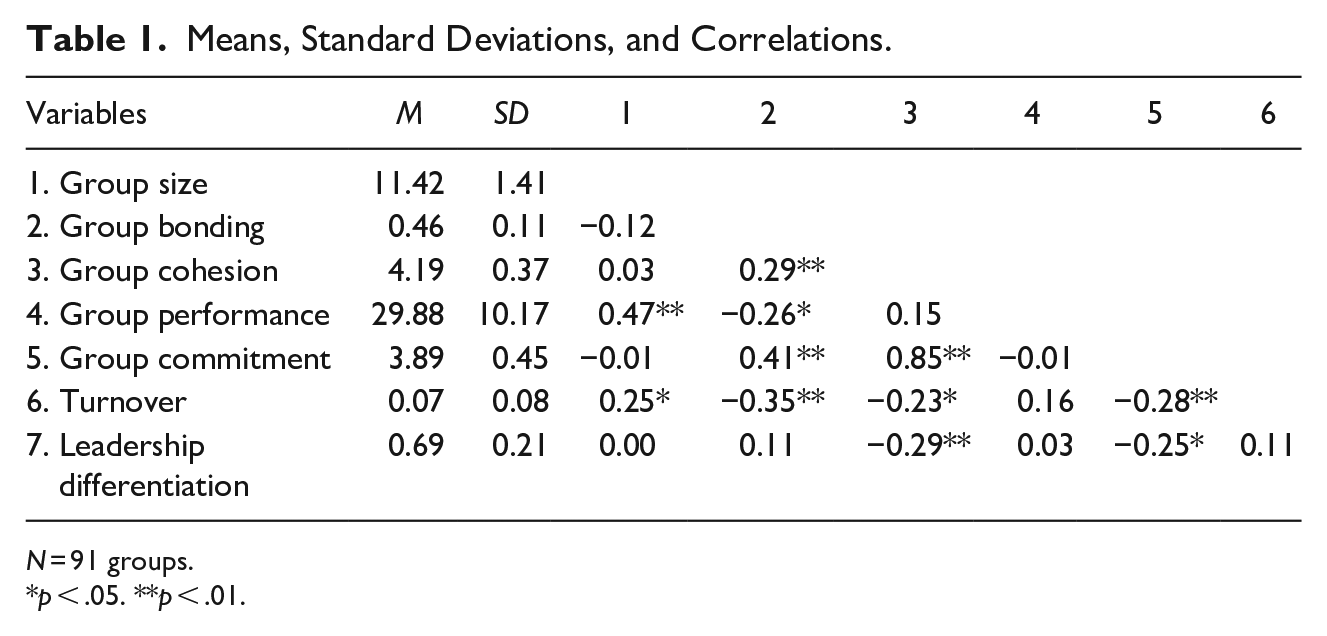
N = 91 groups.
p < .05. **p < .01.
Hypothesis Testing
To examine the hypotheses, we used the Process software in SPSS (Hayes, 2013). This software uses bootstrap procedure to test the size of the indirect effect (Preacher & Hayes, 2008). This non-parametric procedure estimates effect size and constructs bias-corrected confidence intervals by drawing 5,000 random samples. Model 4, mediation model, was used to test H1 and 2; see Table 2. Model 1 was used to test Hypothesis 3; see Table 3. The full moderated mediation model (Model 7; see Table 4) was also conducted.
Results of Mediation Process Analysis.
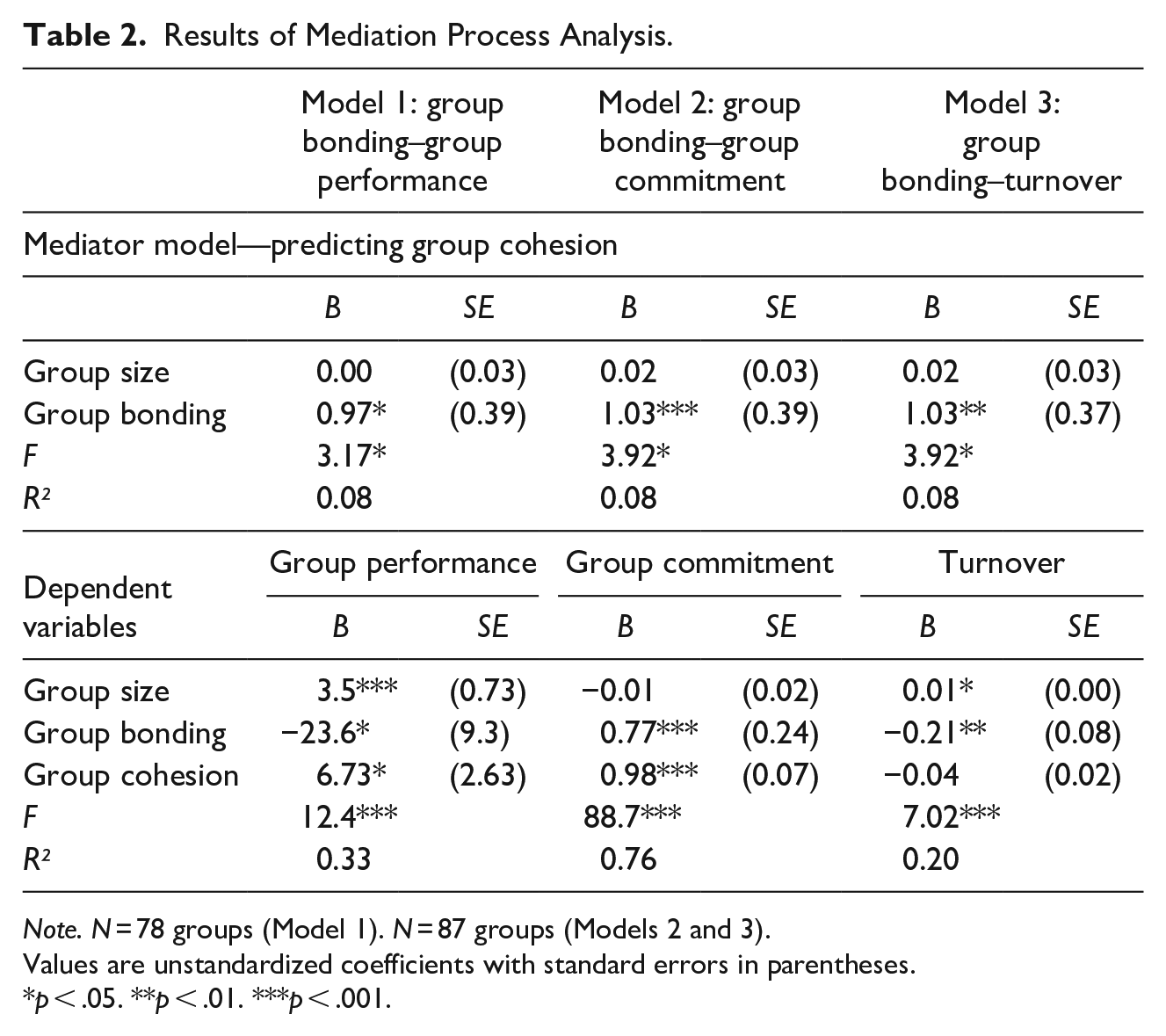
Note. N = 78 groups (Model 1). N = 87 groups (Models 2 and 3).
Values are unstandardized coefficients with standard errors in parentheses.
p < .05. **p < .01. ***p < .001.
Moderation of Leadership Differentiation on the Relationship Between Bonding and Cohesion.
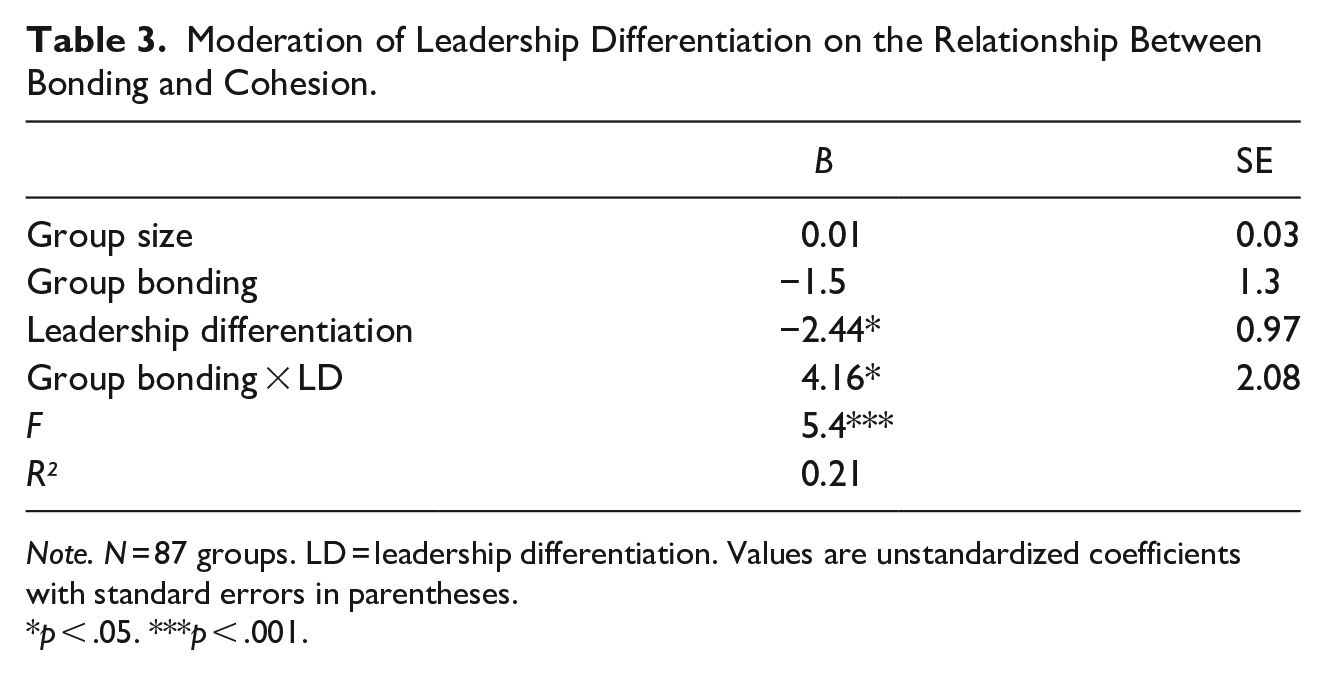
Note. N = 87 groups. LD = leadership differentiation. Values are unstandardized coefficients with standard errors in parentheses.
p < .05. ***p < .001.
Results of Mediated-Moderation Process Analysis.
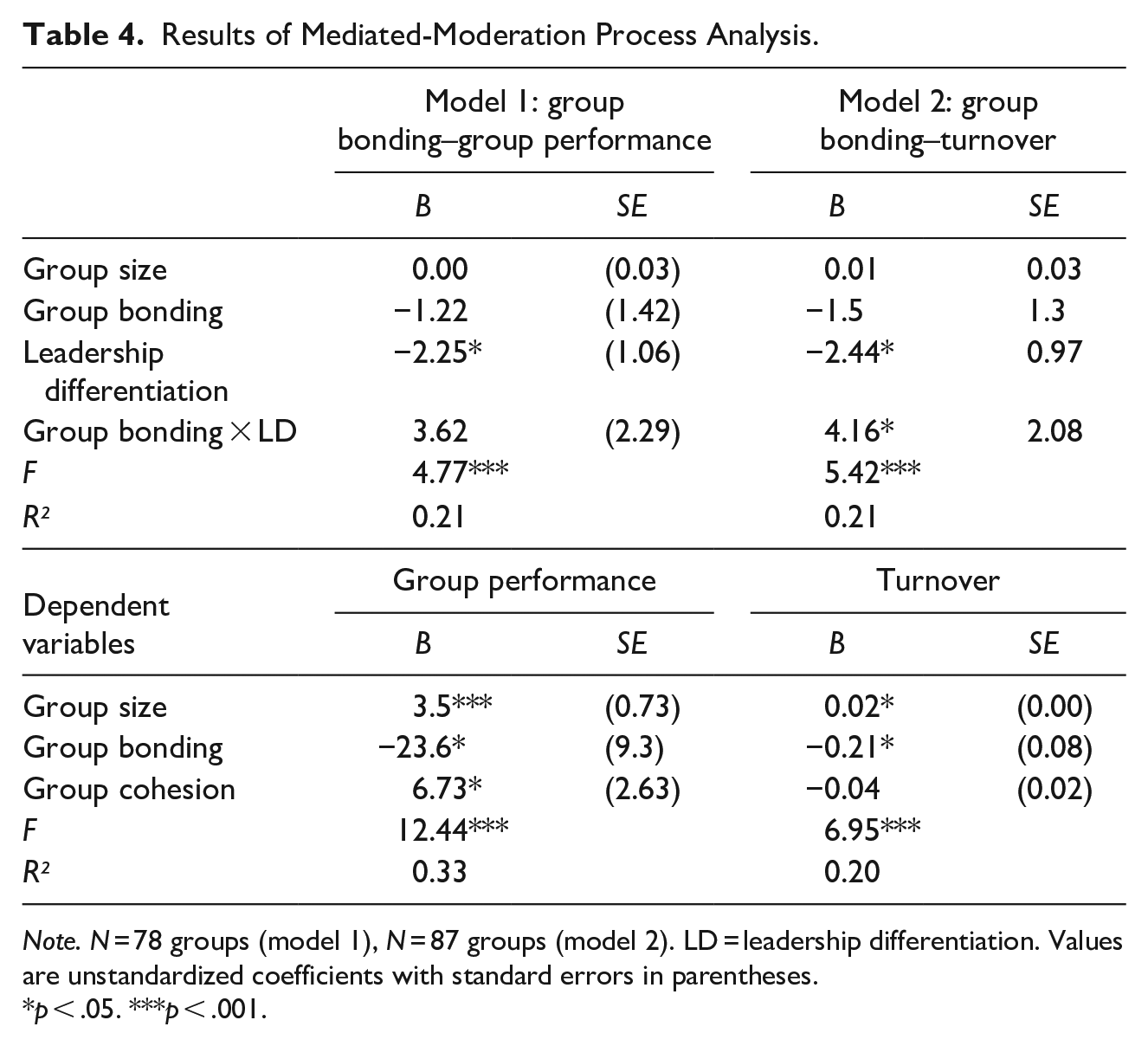
Note. N = 78 groups (model 1), N = 87 groups (model 2). LD = leadership differentiation. Values are unstandardized coefficients with standard errors in parentheses.
p < .05. ***p < .001.
H1, which suggested that group bonding is positively related to group effectiveness, was fully supported (see Table 2). Group bonding was found to have a significant direct effect on the three denmeasures of effectiveness: group performance (H1a; B = −23.6, p < .05), commitment (H1b; B = 0.77, p < .001), and turnover (H1c; B = −0.21, p < .01).
H2, which suggested that group cohesion mediates the relationship between group bonding and group effectiveness, was partly supported: The indirect effect of group cohesion was significant for the relationship of group bonding with group performance (B = 6.73, p < .05; LLCI = 1.05, ULCI = 14.13), and not significant for the relationship between group bonding and turnover (B = −0.04, ns; LLCI = −0.12, ULCI = 0.01). We did not test the mediation of cohesion on group bonding-commitment relationship, due to the high overlap between cohesion and commitment (Table 2 presents the model with commitment, since it was needed in order to test Hypothesis 1).
H3, which suggested that leadership differentiation moderates the relationship between group bonding and group cohesion (see results in Table 3), was supported (B = 4.16, p < .05). As seen in Figure 1, groups with high differential leader-follower relationships exhibited a stronger relationship between group bonding and group cohesion than did groups with low differential leader-follower relationships. Simple slope analysis demonstrated that the relationship between group bonding and significant (t = 1.1, ns).
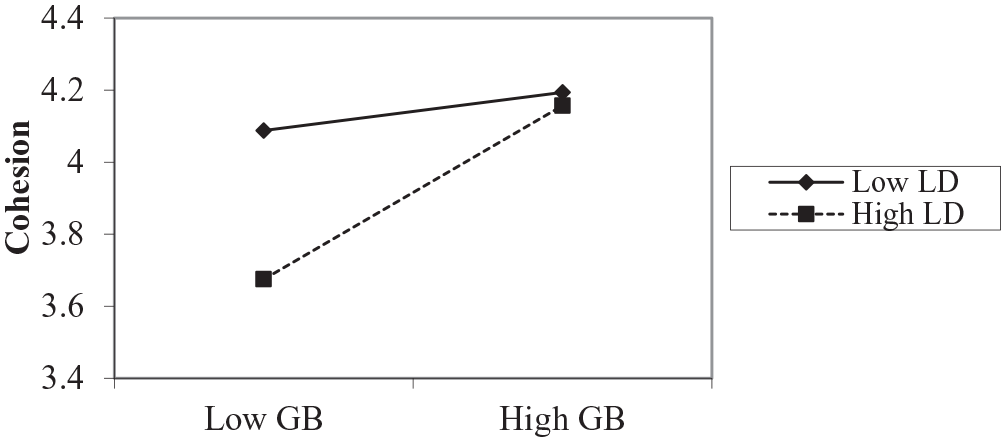
The moderating role of leadership differentiation on group bonding and cohesion.
Finally, a mediated moderation analysis combined all of the hypotheses for two outcomes: group performance and turnover (see results in Table 4). The moderated mediation analysis demonstrated that the indirect effect of cohesion on the relationship between bonding and effectiveness was significant in predicting only the effectiveness dimension of group performance, but not turnover. The analysis showed that the indirect effect of group performance existed at high levels of leadership differentiation (LLCI = 2.3, ULCI = 30.78) but not at low levels of leadership differentiation (LLCI = −2.78, ULCI = 10.7). This proposed process (Edwards & Lambert, 2007) constitutes a mediation process in which group cohesion is a mediator between the interaction of group bonding and leadership differentiation in predicting group performance.
Discussion
The goal of the study was to further demonstrate the important influence of group bonding on work group effectiveness, reveal group cohesion as a mediator of this effect, and establish leadership differentiation as a boundary condition between group bonding and group cohesion. The results show that group bonding relates to the investigated aspects of group effectiveness (turnover, commitment, and group performance); groups with dense friendship ties tend to be more effective. Cohesion mediated only the relationship between group bonding and group performance. The relationship between group bonding and group cohesion was moderated by leadership differentiation.
Theoretical Implications
A key contribution of the study is in its integration of social network research with group research. This provides complementary perspectives on the role of friendship in group performance, which has seldom been investigated to date (Ting & Ho, 2017) and contributes to both areas of research. The social network framework provides a measure for group bonding and a unique view of its outcomes. Cohesion, a central concept in group theory, provides a theoretical framework that links network structure to effectiveness.
First, the study results expand existing studies that found that dense friendship ties between group members (group bonding) is positively related to group performance (i.e., Kratzer et al., 2005; Shah et al., 2006), and to additional dimensions of group effectiveness, including commitment and turnover (Cohen & Bailey, 1997). These findings support and expand the meta-analysis conducted by Balkundi and Harrison (2006), who found evidence that friendship network density in work groups is positively and moderately related to group task performance, and positively and strongly associated with group viability (attitudinal outcomes). However, while Balkundi and Harrison (2006) examined the friendship networks group members formed with their leader, the contribution of the current study is in its examination of both relationships with the leader of the group, and relationships between group members using a social network perspective. Integration of the two common types of ties in the group (leader-group member and between group members) provides a fuller understanding of relationships in groups than provided by research, which focuses on one of these types of relationships.
Second, this study identified group cohesion as a mediating process through which numerous friendships in work groups affect group effectiveness (Balkundi & Harrison, 2006). Group cohesion, a well-known group-related emergent state was explored as a mediator of the process. The study results indicate that group bonding is positively related to group cohesion and that the influence of group bonding on group performance is mediated by cohesion. Since group bonding is based on expressive ties among group members (Ibarra, 1993; Jehn & Shah, 1997), an affective mechanism (group cohesion) would be a natural mediator for this process. Indeed, dense friendship ties among group members (group bonding) help them stick together and enhance their sense of belonging to the group and their feelings of morale (perceived cohesion), thereby group efforts for shared achievement. It is possible that this group effort was reflected in the decrease in variability among the group members’ physical performance (due to stronger group members motivating the weaker ones to improve).
An unexpected finding was that the effect of group bonding on turnover was not mediated by group cohesion. It seems that group bonding is more strongly associated with turnover than with group cohesion in these types of groups. That is, group members would rather be part of bonded groups in which members are tied together in friendships ties, for other reasons than the psychological feeling of cohesion. Group members may feel obligation to their friends and may regard the act of leaving the group as an act of personal disloyalty to their friends.
A third contribution of the study is the introduction of leadership differentiation as moderator of group bonding-cohesion relationships. LMX theory focuses on ties between each group member and the leader and thus complements social network theory. The study continues the body of research that integrated LMX and social network on the individual level (Sparrowe & Liden, 2005) and expands it to the group level.
We suggest that comparisons of the relationships between group members and the group leader cause negative feelings among group members, which may lead to a low sense of group perceived cohesion. In groups with high differential leader-follower relationships, in which group bonding is high, these comparisons occur less frequently and their negative effects are compensated for by the dense friendship among group members and so do not affect group cohesion.
This study demonstrates (Figure 1) that conditions created within a group with a dense structure of friendship between group members can protect its members from negative feelings caused by leadership differentiation. In groups with a high leader-follower relationship differential, group bonding and group cohesion are more strongly related than in groups with a low leadership differential. As noted, high leader-follower differentiation may also cause negative group effects (Bolino & Turnley, 2009), and it is possible that group bonding will moderate the negative effects of leadership differentiation. While the current research focused on the relationship between group bonding and cohesion and effectiveness, future studies should further explore the interaction between leadership differentiation and group bonding.
Finally, the study’s results also show that group bonding predicts group cohesion. This contributes to social cohesion literature by identifying and providing proof that group bonding is an antecedent to group cohesion as claimed by Friedkin (2004), who considered the quantity and quality of social relationships in the group an antecedent to the formation of social cohesion. Moreover, the results emphasize the conceptual differentiation that should be made between group bonding, as a structural concept, and group cohesion, as a psychological concept (see Jehn & Shah, 1997; Moody & White, 2003).
Practical Implications
The study offers a deeper understanding of the variations in group effectiveness resulting from friendship contacts, and has practical implications for organizations, managers, and organizational consultants. Thus, organizations and managers should pay greater attention to building and strengthening the friendship ties within their work groups to promote group effectiveness. Even today, most organizations recognize that informal contacts facilitate learning and advice giving, although they are often reluctant to fund activities that enhance group bonding. Indeed, budgets for social events are often among the first to be cut when times get tough (Mehra et al., 2006). The study suggests that because group bonding affects group effectiveness, which has direct economic consequences, organizations should resist the temptation to cut programs that facilitate the building of friendship ties and group bonding. Moreover, organizations can enhance group bonding by embracing cost-free means, such as adopting group bonding as a company value, using management as a personal example, and creating common workspaces for gatherings (Clegg et al., 2015).
The findings suggest that work group leaders who wish to increase their group effectiveness should ensure that group bonding is on their agenda. Traditional team-building efforts can focus on creating dense friendship ties within the group and can include arranging common spare-time and social activities. Frequent group meetings, social gatherings, and various computer-based social networking systems (e.g., WhatsApp, Facebook, LinkedIn) might engage socially isolated group members and enhance the development of group bonding. Leaders should also be aware of the consequences of differentiation in their relationships with their subordinates and avoid such fractures in the group cohesion.
Limitations
The first limitation stems the selection of a military sample. Moreover, most groups were all-male groups. Use of a homogeneous sample limits the generalizability of the findings. Previous studies (e.g., Dvir et al., 2002) discussed the similarities between civilian and military contexts; as such, there are no expectations for the results to be different on a civilian work group sample. To diversify our sample, we included an infantry unit to which females are also recruited. Nevertheless, the small number of mixed-gender groups did not enable us to compare differences between male groups and mixed-gender groups. Future research should, therefore, expand the examination of group bonding to include non-military settings as well as mixed-gender groups.
A second limitation its nature as a field study within a training course. Even though the course provided rich, unobtrusive information about the participants, responses to the surveys might have been influenced by a social desirability bias. Questionnaires were administered on-site by members of the research team. Reasonable variance was found in the survey scales and other precautions were taken, such as using multiple observers and multiple methods.
A third limitation of our study stems from its design as a field research, which makes it difficult to draw definitive causal connections between group bonding and group effectiveness. Although the study design was longitudinal, it was far from being a controlled experiment. Moreover, some of the variables were measured together, at the same time. Future research should try to separate the time of each variable data collection to better test the order of causal relationships.
One of the explanations of the moderating role of leadership differentiation is that the feeling of unfairness caused by differentiation in leader-member relationships between group member contributes to conflicts within the group and to a lack of cohesion. In the current study we did not measure unfairness and we suggest that future studies check the role of fairness in the relationship between bonding and cohesion.
We found a strong correlation between cohesion and commitment. This high correlation may be the influence of shared measurement time. On the other hand, it may be the result of an overlap in the measures of cohesion and commitment used in the current study. As the current study’s results are based on a specific measure of cohesion, future studies should use other measures of cohesion to examine our process, such as the group environment questionnaire (GEQ). This measure distinguishes between two dimensions of cohesion social and task (Carron & Brawley, 2000).
Future Research
The findings of this study suggest numerous arenas of inquiry. First, this study examined group bonding and group processes at a single stage in a group’s establishment process. Recently developed network analysis techniques, namely models for the co-evolution of social networks (see for example Kalish et al., 2015), can help researchers understand these group dynamics. Second, the current study focused on the positive outcomes of bonding and cohesion. Future research should investigate negative outcomes of group bonding and group cohesion. Finally, this study investigated the group bonding process on one kind of work group, which was relatively traditional. There are many different kinds of work groups (e.g. self-managed, task force, short-term, virtual, etc.), that will be interesting to sample in future research, each of which probably creates its own social structure, which can impact effectiveness.
Conclusion
This study examined whether group bonding in work groups influences effectiveness, and if so, how. The study provides evidence for group bonding as a predictor of effectiveness. It also highlights the process that captures the complex nature of the influence of group bonding on group performance and attitude. Dense friendship ties among group members (group bonding) increase the members’ sense of belonging to the group and their feelings of morale (perceived cohesion), thereby decreasing performance variability (group performance) and increasing commitment (group attitude). The mediation process was found to be moderated by leadership differentiation.
Footnotes
Declaration of Conflicting Interests
The author(s) declared no potential conflicts of interest with respect to the research, authorship, and/or publication of this article.
Funding
The author(s) received no financial support for the research, authorship, and/or publication of this article.
