




Abstract
To solve complex 21st-century global challenges, universities must prepare students to be competent team members. This article presents results from analysis of data collected at a university in four types of undergraduate sociology classrooms using mixed-methods, including social network analysis, student reflections, and an alumni survey. Results showed that learning is a social process. Compared with traditional lecture, fixed teams, and interacting teams, opportunistic collaboration is the most effective structure in teaching team learning through fostering communication, support, and learning networks. Post-secondary education should endorse opportunistic collaboration learning practices to prepare students for workplace success in a global economy.
Keywords
Introduction
Due to the complexity of global challenges, it is impossible for one person or one discipline to have the knowledge needed to solve complex global problems (Fiore, 2008). Solving problems as a team becomes necessary to bring a breadth of knowledge and skillsets to a project, such as the human genome project, one of the world’s largest collaborative biological research projects to date. The project was launched in 1984 with the goal to map the human genome and start “the era of team-oriented research in biology” (National Human Genome Research Institute, n.d.). The research was conducted in 20 universities and research centers in the United States, the United Kingdom, Japan, France, Germany, India, and China.
Solving problems as a team instead of individually marks a shift in how knowledge has historically been created. In the past, knowledge acquisition, adoption, and knowledge creation have been thought of as individual tasks; however, a growing body of literature frames knowledge creation as a social product (Bereiter, 2002; Brown & Duguid, 2000; Csikszentmihalyi, 1999; Love, Cross, et al., 2021; Paavola & Hakkarainen, 2005; Phelps et al., 2012; Sawyer, 2017; Ulibarri et al., 2019; Zhang et al., 2009) Today, literature in business, education, and the Science of Team Science (SciTS) indicate that, to solve global challenges, we will need to integrate knowledge from different disciplines and engage in the social process of learning, and it should start in educational settings. Team learning matters to educators because as global problems increase in complexity, it is imperative that instructors understand how to facilitate team learning so students can graduate with a good understanding of how to work as a member of a team. Instructors need to teach students to create knowledge and work effectively as a member of a team so they enter the workforce ready to focus on 21st-century global health and environmental challenges (Fiore, 2008; Read et al., 2016; Stokols et al., 2008; Wildman & Bedwell, 2013).
Higher education institutions have been called to continue, and in some cases begin, teaching students to learn as members of a team to address global challenges. How do we teach students to create knowledge as a member of a team? How do we teach team learning? Chickering and Gamson (1989) described collaborative learning as a team sport: Learning is enhanced when it is more like a team effort than a solo race. Good learning, like good work, is collaborative and social, not competitive, and isolated. Working with others often increases involvement in learning. Sharing one’s own ideas and responding to others’ reactions sharpens thinking and deepens understanding (p. 1).
Based on Chickering’s description, essentially, each classroom may represent a team endeavor, and instructors have the opportunity to enact and incorporate collaborative or team learning intentionally in lecture halls and classrooms (Wildman & Bedwell, 2013).
Within this article, the researchers refer to the social process of learning as team learning. The purpose of this exploratory study is to contribute to the literature on team learning in higher education by applying theories from the literature on the social process of learning in business, education, and SciTS in examining whether students in the Opportunistic collaborations capstone will acquire team learning skills and apply them in their future careers. This study used mixed methods including social network analysis, student reflections, and an alumni survey. The three research questions are (1) Which classroom formats (traditional lecture, fixed teams, interacting teams, and opportunistic collaborations) created network structures conducive to team learning? (2) How do social connections and the strength of connections influence learning ties? (3) How are team learning skills transferred and accessed by alumni in their professional careers? Overall, this study furthers the research on learning as a social process, provides a framework for exploring and conceptualizing what type of instruction is best for team learning, and makes recommendations for creating classroom structures that facilitates an environment for students to work and learn as a team.
Literature Review
We evaluate theoretical approaches to team learning, social network analysis to understanding the social process of learning, and different approaches to teaching team learning (for an overview, see Table 1). To show that the disciplines provide a theoretical framework of team learning collectively, we discuss differences between the disciplines and provide additional clarification regarding their emphases on the social construction of learning, creation, and innovation through teamwork.
Team Learning Terminology from Different Disciplines.
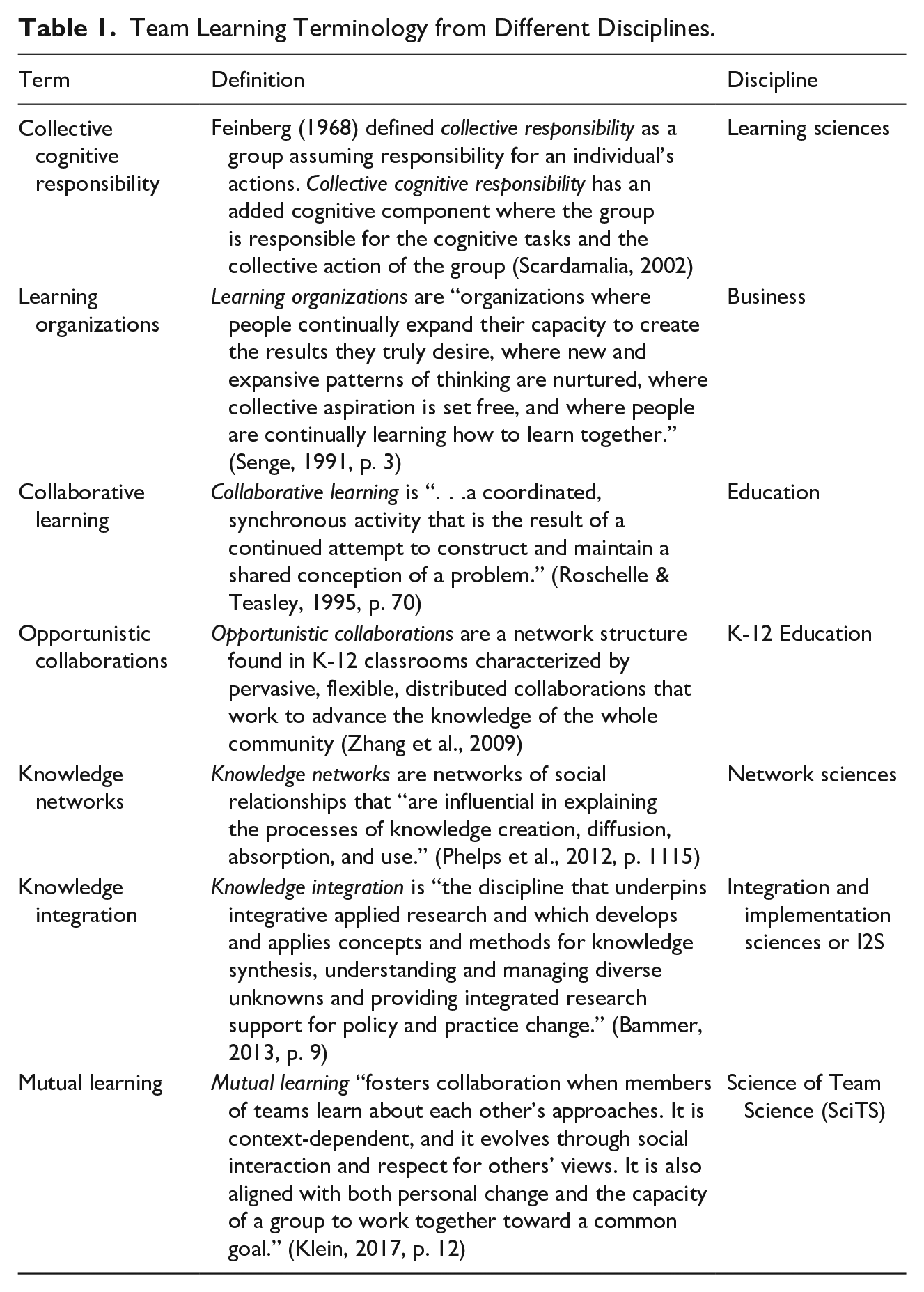
One of the earliest theories about team learning is collective responsibility, defined by Feinberg (1968) as the assumption of responsibility by a team for an individual’s actions. More recently, scholars have added a cognitive component to Feinberg’s definition, such that collective cognitive responsibility is when the team is responsible for the cognitive tasks and the collective action of the team (Scardamalia, 2002). Importantly, collective cognitive responsibility is distributed within the team and is not solely the responsibility of a leader. The distribution of knowledge and responsibilities implies there is a constructivist pattern where everyone iterates, constructs, and contributes to team learning (Scardamalia, 2002; Zhang et al., 2009).
For decades, business and management studies have stated that successful knowledge-based enterprises continually expand their capacity to work and learn together. Senge (1991) coined the term learning organizations to describe “organizations where people continually expand their capacity to create results they truly desire, where new and expansive patterns of thinking are nurtured, where collective aspiration is set free, and where people are continually learning how to learn together” (p. 3). In a learning organization, members build and iterate their existing knowledge to create something new or enhanced. When teams can learn together, they develop a Collective IQ that is higher than an individual IQ (Klein, 2017; Senge, 1991; Woolley et al., 2010). Senge (1991) posited that until there are theories and methods for building teams that learn together, team learning will continue to occur mostly by chance. Arguably, in the 30 years since Senge’s book was first published, the need for learning organizations in the knowledge economy has increased, but few studies about learning organizations have been published.
Similar to collective cognitive responsibility and learning organizations, education literature described the importance of collaborative learning (Kandlbinder, 2015; Roschelle & Teasley, 1995), including studies that explore the connection between social processes and learning (Bereiter, 2002; Csikszentmihalyi, 1999; Duhigg, 2016; Hakkarainen, 2009; Kezar, 2014; Sawyer, 2017; Zhang et al., 2009). Social interactions with peers are critical factors for facilitating learning (Gašević et al., 2013; Love, Valdes-Vasquez, et al., 2021) and social ties are positively associated with academic performance (Tomás-Miquel et al., 2015). It has been hypothesized that classrooms with fully connected communication networks can improve information sharing and better team performance (Curşeu et al., 2012). Most recently, Love et al. (2020) conducted social network analyses in college classrooms and found that different classroom learning activities (active learning, study abroad) created different learning networks, supporting findings in K-12 literature that network structures resulted from different classroom learning activities (Zhang et al., 2009). The key finding of this study was that more collaborative classroom activities produced denser social networks patterns. The first level of network structures was fixed group (herein referred to as a fixed team). The fixed-team model represents the traditional small-group structure in which students were assigned to a delimited team to complete short tasks, assignments, or semester-long projects. A key characteristic of this type of collaborative work was that labor could be divided within the team of students. In fixed teams, students worked independently, and knowledge was combined at the end (within the team) as students put together the final project. The second level structure, the interacting group (herein referred to as an interacting team), was characterized by patterns of collaboration where increasing cross-team interactions and knowledge sharing within the team are characteristics of this type of structure, although division of labor was still possible and the instructor/teacher played a critical role in determining the structure and interactions in the classroom. The third level network structure, opportunistic collaborations capstone, was characterized by pervasive, flexible, distributed collaborative relationships that worked to advance the knowledge of the whole community.
Similarly, SciTS literature has shown the critical role social processes play in collaborative and team learning. Transdisciplinary teams exist in scientific disciplines, with the goal to combine theoretical and methodological knowledge from different scientific epistemologies (Khuri & Wutchy, 2017; Klein, 2017; Stokols et al., 2003). These teams usually engage in convergence research, An approach to knowledge production and action that involves diverse teams working together in novel ways transcending disciplinary and organizational boundaries to address vexing social, economic, environmental, and technical challenges in an effort to reduce disaster losses and promote collective well-being” (Peek et al., 2020, p. 2).
To conduct transdisciplinary and convergence research, teams must practice team learning. SciTS literature has documented team learning, or mutual learning, occurs on transdisciplinary teams when individuals with different disciplinary backgrounds and stakeholders come together to first exchange and share knowledge, and second to learn and create new knowledge together (Klein, 2017; Senge, 1991). Love, Cross et al. (2021) used social network analysis and found an association between interpersonal relationships and scientific productivity on a scientific team, suggesting that mutual learning includes both the disciplinary knowledge and the social elements that help the team create new scientific knowledge.
How do students develop collective cognitive responsibility, learn to build and iterate knowledge in a learning organization, and practice mutual learning through social processes? One pedagogy strategy is knowledge integration, or integration and implementation sciences (IS2; see Table 1). SciTS research has documented case studies on IS2 courses (Borrego & Newswander, 2010; Bosque-Perez et al., 2016; Knowlton et al., 2014), such as a program at The University of Waterloo (University of Waterloo, n.d.).
Research conducted in higher education settings about teaching practical team learning skills in classrooms is limited (Chickering & Gamson, 1989; Wildman & Bedwell, 2013) and little research has examined the influence of network structures on team learning. The present study uses social network analysis, responses from student reflections, and results from analysis of an alumni survey data to understand which classroom formats created network structures conducive to teaching students to work, learn, and build knowledge as members of a team.
Methods
The sample included four classes, and three types of data were collected to evaluate student experiences, including a social network survey administered in each course, student reflections on what they had learned during the course, and a survey completed by alumni on their capstone experience. All data collected followed Institutional Review Board (IRB) protocol.
Sample Selection
This study was conducted on the main campus of a public research university in the western United States. Four sociology courses were selected to represent different learning activities or pedagogical approaches that typically occur in university classrooms (see Table 2) and the three collaborative structures discussed in Zhang et al. (2009). Each course is described below.
Sample Selection Summary.

Traditional lecture
In a traditional lecture-style course, the instructor stands at the front of the room and transfers information to students through lectures and sometimes discussion, with few opportunities for students to collaborate. Universities are architecturally designed to support this format. Large lecture halls situate the instructor in front of students, backed by audio-visual screens and speaker systems, while students sit at immobile desks. The traditional lecture course selected to be the sample in the present study was a required course for sociology majors and a prerequisite for capstone courses, which we explain below. Most students enrolled in the course were sophomore and junior sociology majors who were required to attend lectures 3 hours per week, take exams, and write papers. Based on the course requirements, a student could pass the course without interacting with another student. However, the instructor for this course asked each student to exchange contact information (i.e., name and phone number) with two other students during the first week of the course so they can reach out to the students before emailing the graduate teaching assistant (GTA) or the instructor in case they missed a class. Otherwise, peer interaction was not formalized in assignments, projects, or other course tasks.
Fixed teams
The syllabus and assignments in the Research Methods course were characterized as using fixed teams. Like the traditional lecture course, fixed teams was a required course in the sociology major and a prerequisite for the capstone courses, and therefore, most students were sophomores or juniors. The course design was similar to the traditional lecture format, where students attended class 3 hours a week, listened to lectures, engaged in weekly readings, and participated in course discussions, but there were three major differences between fixed teams and the traditional lecture. First, the instructor held one office hour per week at a campus coffee shop to create a more social and friendly environment. Second, the instructor integrated active learning, reflection, and used small team discussions to apply classroom concepts. Third, students worked in small, fixed teams throughout the semester to write a research proposal. Once students self-selected their team, they could not change teams, and the structure of the course did not encourage interaction or sharing of information between teams. The research proposal assignment used scaffolding, in which teams completed their project in manageable pieces, including a literature review, research description, and a plan for analyses, with opportunities to receive feedback at each stage.
Interacting teams capstone (capstone seminar)
The third type of course was interacting teams capstone, represented by a capstone seminar in the present study. A capstone seminar was an advanced course for students who had completed prerequisite courses in theory and methods (e.g., a research methods course, as aforementioned) and were in their junior or senior year. Structurally, a capstone course created interacting teams with a discussion-based seminar where students were required to complete two semester-long team research projects, for which students were placed into different teams, so they interacted, socialized, and learned from two different sets of classmates. For the first collaborative assignment, small teams of three students selected and read two books for team discussions. For the second collaborative assignment, they were organized into small research teams to conduct independent research on a topic that they chose collectively. Throughout the semester, students gave research updates, and during finals week they presented their research project to the class.
Opportunistic collaborations capstone (community-based research [CBR] capstone)
The fourth type of course was opportunistic collaborations capstone, represented by a community-based research (CBR) capstone by definition, CBR has several distinguishing pedagogical characteristics. First, students to engage in a large project throughout the semester with a community partner (Strand et al., 2003). Second, students engaged in written reflections to process their team learning, and learning is codified through reflections (Mitstfer & Council for the Advancement of Standards in Higher Education, 2012).
In this study, the opportunistic collaborations capstone was an advanced course for students in their junior or senior year who have completed prerequisite courses on theory and methods. The course was designed around a single community-based research (CBR) project and a single CBR research question. Students self-selected into three research teams. Each team tackled a sub research question. The opportunistic collaborations capstone was a four-credit hour course with a lab on Friday afternoons, wherein teams had class time to work and share information with other teams. Even though students were placed in teams to address a specific aspect of the research questions, based on the scope and size of the CBR research question, the teams could not work in isolation. For example, one team conducted interviews to inform the survey design of another team. Then, the interviews and the survey results informed the creation of a brochure. For the final presentation, the teams presented their data, findings, and products to their community partner. A distinguishing feature of the course was that a single grade, worth 25% of the overall course grade, was given to the entire team.
Social Network Survey
Sample
A social network survey was administered at the beginning of each course (pre-survey) and again at the end of the semester (post-survey) to all the students enrolled in the courses. Data were identifiable and cleaned using the course roster to remove students who did not complete the course. The social network surveys for the Traditional lecture course and Fixed teams course were administered in spring 2014, Opportunistic collaborations capstone, spring 2017, and Interacting teams capstone, fall 2018. A total of 129 participants completed the social network survey, including 42 in the Traditional lecture course, 45 in the Fixed teams course, 15 in the Interacting teams capstone, and 27 in the Opportunistic collaborations capstone. The lowest average GPA was 3.17 in the Traditional lecture course, and the highest was 3.57 in the Interacting teams capstone, with the Opportunistic collaborations capstone and fixed teams course in between, with an average GPA of 3.47 and 3.36, respectively. The classes primarily comprised juniors and seniors, with only one sophomore in the traditional lecture and no freshmen (for details, see Supplemental Table 1).
Survey measures
A connection in a social network is a directed relation from one individual to another. In network graphs, individuals are referred to as nodes, and connections between individuals are referred to as edges or ties. This study presents data from 10 social network questions, which were combined into three network diagrams: communication, support, and learning. Communication network diagrams were a combination of three social network survey questions: Who do you connect with via social media, phone, and email? A “yes” response to a survey question creates an edge (or a connection) in the network diagram. Since the diagram is a combination of three questions, each edge in the communication network was an integer between 0 and 3, indicating the number of contact methods between individuals in the network. The communication network was the only pre- and post-network included in this study, the pre-test assessed the level of existing social ties between students and the post-survey assessed social ties students built during the semester. Support network (post-survey only) was a combination of six social network questions: Who you could go to for lunch money, for a ride, for school advice, for relationship advice, to borrow $50, and for help in a crisis? Each edge in the support network was an integer between 0 and 6 indicating the number of support methods each pair of students had reported. Finally, learning network measured who students learned from during the semester (post-survey only). Each edge in the learning network was an integer, either 0 or 1.
Metrics for social network analysis
We removed the instructor from the networks to focus on student-to-student relationships. The following social network metrics were selected to understand the team experience. Each of these metric measures shows a unique aspect of the entire network. R Studio was used for analysis and visualization (R Studio Team, 2020).
Weighted average outdegree
Indegree and outdegree are measures for individual or nodes, which count the total number of relations each student receives from others and sends to others, respectively. When the network (e.g., communication network and support network) consists of multiple relational measures (e.g., Who you could go to for lunch money, for a ride, for school advice, for relationship advice, to borrow $50, and for help in a crisis?) the network is referred to as weighted because each student may have multiple ties with nodes. That is, the total outdegree is the total number of outgoing connections an individual node has with other nodes in a network, where each relationship type counts as a unique connection. The weighted average outdegree of a weighted network is equal to the average total outdegree across all nodes in the network (Hanneman & Riddle, 2005). For example, in the support network, there are six relational questions; therefore, the maximum total number of outgoing ties for each node is six multiplied by the number of other people in the network.
Binary average outdegree
The binary average outdegree is the average number of other individual each node has an outgoing relation to in the network (Giuffre, 2013). This measure ignores the multiple relational measures and defines an edge to exist between two actors if at least one relationship is present.
Fragmentation
Fragmentation provides a measure of the proportion of nodes in a network such that fragmentation exists when there is no path from one node pair to the other node pair in the network (Hanneman & Riddle, 2005). This statistic ranges from 0 to 1, with 0 meaning that the network forms one enormous component where there is a path from every individual, to every other individual and a 1 indicating there are no connections in the network and thus there are no paths between any node pairs. If a network has a high fragmentation score, this suggests that students are not well connected to other students. A low fragmentation score suggests that all or most pairs in the network are connected via a path following the network edges.
Number of isolates
Isolates are students that do not have any connections (in or out) with any other individuals in the network.
Average clustering coefficient
The average clustering coefficient quantifies the degree to which nodes are in tightly connected teams in the network. This statistic ranges from 0 to 1, with low values indicating little clustering and high values indicating there is a high density of ties surrounding those connected in the network. This statistic is calculated by a local clustering coefficient for each node measuring the density of ties among the neighbors of the given node. This node-level measure is averaged across all nodes to obtain the average clustering coefficient.
Network association
In social network analysis, the Pearson correlation is generated by using a permutation -based method, known as quadratic assignment procedures (QAP), to estimate the standard errors to test for the significance of associations between two networks (Hanneman & Riddle, 2005). If learning is a social process, then communication and social support networks would be associated with the learning network.
Visualizations
In the figures, each student was represented with a circle, sized proportionally to their indegree. Figures are shown without the instructor/GTAs because they are excluded in analysis. For figures that include the instructors/GTAs, represented by triangles, see the Supplemental Materials.
Student Reflections
The Opportunistic collaborations capstone was the only course that required student reflections. A total of 214 student reflections about the course were collected from six course sections between 2004 and 2012. Reflections were coded using NVivo (QSR International’s NVivo 12, 2012) twice by the lead author. The first round of coding was done by comparing the reflections to the literature on capstone courses using five codes from the Council for Advancement of Standards (CAS) in higher education for service-learning: knowledge acquisition, integration, construction, application, and cognitive complexity (Mitstfer & Council for the Advancement of Standards in Higher Education, 2012). Coders noticed students were learning from peers in the first round of coding, so in the second round, to refine themes and understand how knowledge was created, data were coded using three knowledge network codes, including knowledge creation, knowledge acquisition, and knowledge adoption (Phelps et al., 2012).
Alumni Survey
The alumni survey was administered to the two types of capstone classes because capstones represent the culmination of learning in a student’s degree program and the majority of institutions have implemented capstone classes (Durel, 2006). Survey questions were designed to capture the application and transfer of skills from the capstone into a professional setting.
Sample
The alumni survey was administered online using Qualtrics (Qualtrics Labs Inc, 2005) to 552 graduates of the sociology program with a recorded email address between 2004 and 2014. There were 102 completed surveys (response rate = 19.5%). The median graduation year was 2009, average age was 28.5 (median = 27.5). There were 60 women, 39 men, 1 pangender person, 1 person who identified as transgender, and 1 person preferred not to answer. A total of 41 alumni reported participating in one of the Opportunistic collaborations capstone sections. The average overall GPA was 2.66. There were 35 participants from the capstone seminar, with an overall average GPA of 2.82. Fifteen alumni reported participating in two capstones, and other alumni reported participating in capstones not assessed in this study (Supplemental Table 2).
Measures
The survey was part of a larger, prior study (Love & MacIlroy, 2021), from which 5 of a total of 18 Likert-scaled questions on a 5-point scale from strongly agree to strongly disagree were analyzed in the present study. In addition, open-ended questions were analyzed to understand how alumni adopted knowledge from previous courses to their capstone courses and from their capstone courses into their life.
Data analysis
Data from the Interacting teams and Opportunistic collaborations capstones were analyzed separately. The Likert items, “strongly agree” and “agree” were combined in analysis. The open-ended questions were coded twice using the same methods as the student reflections, with QSR Nvivo (QSR International’s NVivo 12, 2012) and knowledge network (Phelps et al., 2012).
Results
The results are divided into three sections to answer each research question. Section one presents results from the social network analysis and student reflections to answer the first research question: Which classroom formats (traditional lecture, fixed teams, interacting teams, and opportunistic collaborations) created network structures conducive to team learning? Section two presents results of network association analysis and answers the question: How do social connections and the strength of those connections influence learning ties? The third section presents results from analysis of the alumni survey data to answer the third research question: How are team learning skills transferred and accessed by alumni in their professional careers?
Learning Activities With Evidence for Team Learning
This first section presents data on three different social network diagrams: communication, social support, and learning.
Communication networks
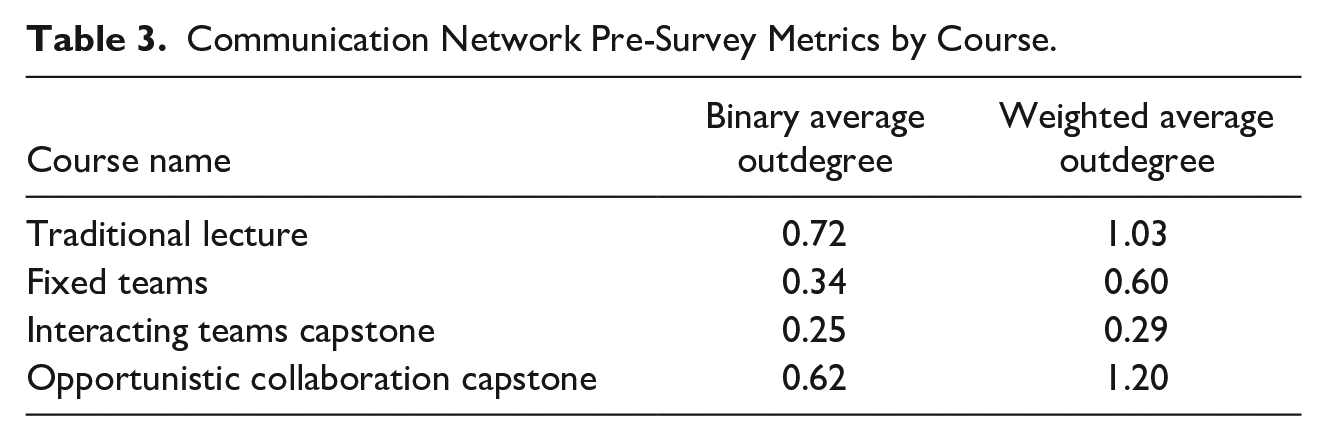
Analysis showed how students co-constructed social networks in the courses. The pre-survey results (Table 3) demonstrate that all courses in the study had similar network metrics at the beginning of the semester. Students in all four courses began the semester communicating with an average of fewer than one other student, and the weighted average degrees indicated students communicated using very few measures (i.e., email, social media, or phone).
Communication Network Pre-Survey Metrics by Course.
Results of the post-survey communication network are shown in Table 4 and Figure 1. In the Traditional lecture course, both average outdegree measures increased by less than one. Without the instructor or teaching assistant in the analysis, the student communication network in this course was highly fragmented (0.95), and 28% of Traditional lecture students reported they did not communicate with anyone (11 isolates). In the Fixed teams course, students built more connections than in the Traditional lecture class, although four students did not connect to any network. In addition, the network was fragmented (0.57) and had a low clustering coefficient (.14), indicating that communication did not occur throughout the whole network. In the interacting teams capstone structure (i.e., capstone seminar), students’ communication networks grew by two connections (0.29–2.29), no students were isolated, but the fragmentation (0.56) and clustering coefficient (.58) indicated communication primarily occurred in the core of the network and was not distributed throughout the network.
Communication Network Post-Survey Metrics by Course.

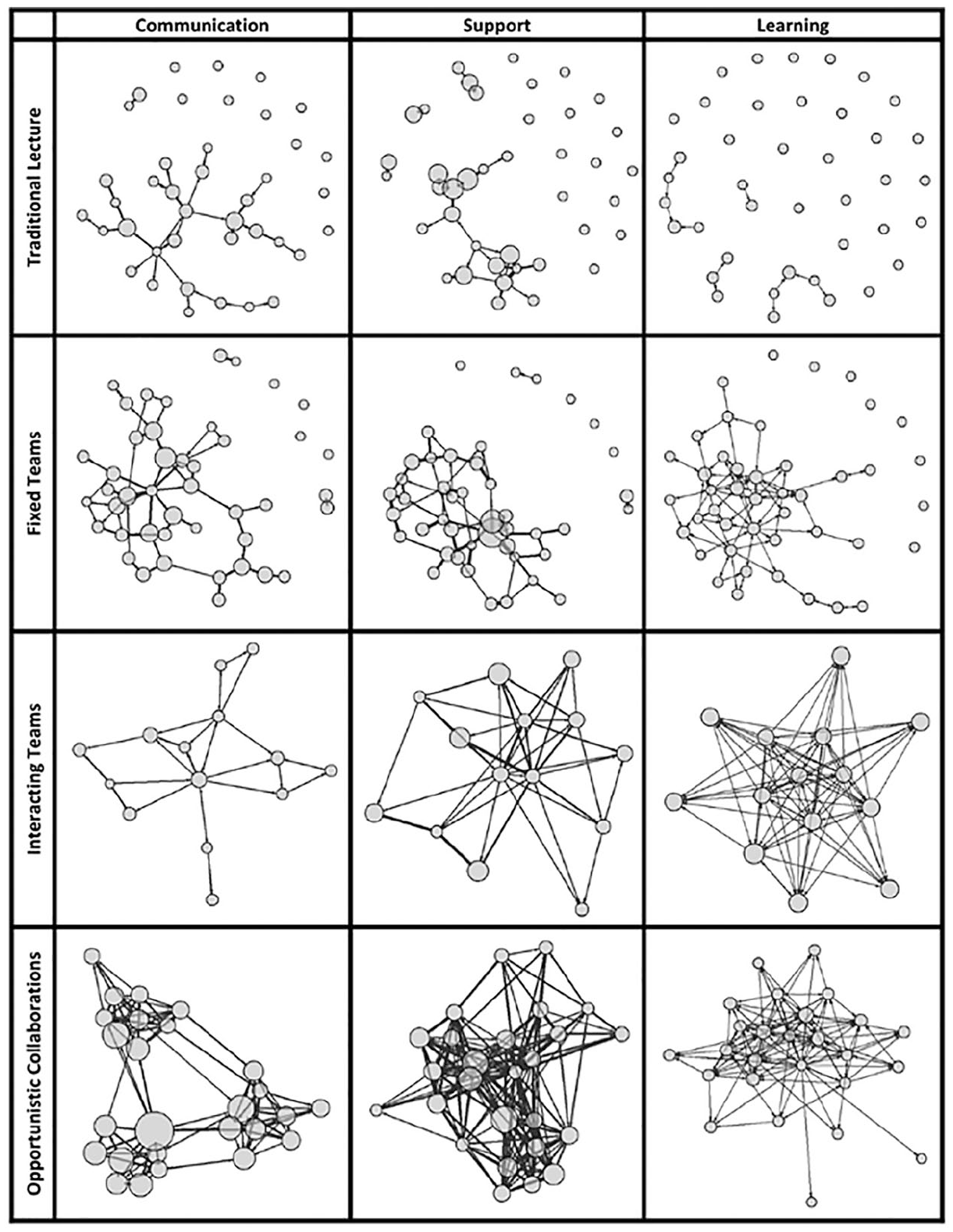
Social network diagrams (analyzed) without the instructors.
The greatest change in the communication network was in the Opportunistic Collaborations Capstone. On average, students reported communicating with 5.58 other students in the course using 11 different formats. The course had no isolates, and its high clustering coefficient (.75) indicating communication happened throughout the whole network rather than in a small cluster. In summary, all four courses began the semester with few previous communication ties, and the different learning activities (Table 2) in each classroom produced notably different social network patterns in the post-survey communication networks. For example, students in the Opportunistic collaborations capstone were divided into teams to complete their CBR projects, and the team structure is observable in the communication network.
Support networks
To examine social cohesion formed between students, the support network and accompanying metrics for each course were examined at the end of the semester (post-survey; Figure 1 and Table 5). In the Traditional lecture course, the instructor and GTA were the center of the network, and the students were dispersed around the instructor (Figure A1 in Appendix). When the instructor and GTA were removed from the network analysis, there were 15 isolates and few ties between students. Students were going to an average of 0.72 other students for support (binary average) and receiving 2.4 different types of support (i.e., school advice, relationship advice, etc.) from individuals (weighted average). Students in the Traditional lecture comprised a highly fragmented network (0.97), indicating nearly no pairs were able to reach other pairs in the network through social support ties, and clustering coefficient (.25) was low, indicating that the whole network was not experiencing support.
Support Network Metrics Post-Survey Metrics by Course.

In the Fixed Team support network, four students were isolated, and four other students were connected to only one other student in the network (Figure 1). The average degree measures indicate each student received support from 5.59 members of the course (Table 5). The network fragmentation (0.76) indicates that three-fourths of the pairs could not reach other pairs in the network, and students did not receive support throughout the whole network. A low clustering coefficient (.13) indicates strong relationships were not formed in the network.
In the Interacting Teams Capstone, a few students, and the instructor, who was in the center of the network, reported high levels of support (Figure A1 in Appendix). When the instructor was removed for analysis, the network maintained its structure, but the cluster in the center indicated some students reported a lot of support whereas other students reported little support (Figure 1). The average degree measures indicate each student was going to 3.21 other students for support, and the network fragmentation (0.50) indicates that half the pairs could not reach other pairs in the network.
In the Opportunistic collaborations capstone, students were divided into teams to address a research question (Table 2). Based on the scope and size of the community research project’s goals and research questions, the teams could not work in isolation. In the support network analysis, the three Opportunistic collaborations capstone research teams are no longer observable, unlike in the communication network (Figure 1). There are no isolates, indicating that everyone in the course reported having people they could go to for support (Figure 1 and Table 5). This binary average degree measure indicates that students were connected to eight others for multiple types of support. The low fragmentation score (0.08) and high clustering coefficient (.73) show that students had access to other students in the network (fragmentation) and that support was distributed throughout the network via interacting sub-teams (clustering coefficient).
The qualitative reflections from students in the Opportunistic collaborations capstone offer more detailed insight into how collaborative work contributes to learning. One student described how learning happened through interaction with others: As far as what aspects contributed to new learning for me, there were several. I grew up in a middle-upper class family and really had not been familiar with welfare and subsidized housing. Through my research and that of my group members, I have a better understanding of the lower class. Also, as with any group project, new learning occurs from simply working with other people and trying to collaborate ideas, schedules, and different personalities (Student 1).
Students also wrote in their reflections about how the challenging team project helped them develop communication skills that they would use in life and work: Relating once again to communication, building these skills is essential and necessary for life in general. Employers see communication skills as one of the most important qualities when hiring an applicant and it would be silly of me not to continue these skills and the improvements that have come with them (Student 2).
These quotes from student reflections in the Opportunistic collaborations capstone provide further evidence about how learning was occurring in the network. The following section explains how the activities and classroom structures impacted the learning in the network.
Learning networks
To investigate the learning connections between students, this section reports the learning network and accompanying metrics for each course at the end of the semester (post-survey) with the instructor removed for analysis (Figure 1 and Table 6).
Learning Network Post-Survey Metrics.

Binary and weighted are the same in this network.
In the Traditional lecture course, when the instructor and GTA were removed from the analysis, the entire network fragmented into a few pairs and triads. Without the instructor and GTA, there were more isolates than connections in the network. On average, students reported that they learned from 0.32 classmates in the course.
In the Fixed teams course, when the instructor was included in the network (Figure A1 in Appendix), results were similar to those of the Traditional lecture, with the instructor in the center of the network, surrounded by students. When the instructor was removed from analysis, the learning network remained connected, with eight isolates, and fragmentation was 0.66, with a clustering coefficient of .20.
The interacting teams capstone network was formed by two different team activities, with different teams. The network with the instructor, had a star-like pattern (Figure A1 in Appendix), and when the instructor was removed, the structure barely changed (Figure 1). Students reported learning from, on average, 6.86 other students in the network which was half the network. However, a more in-depth analysis shows that the high average degree was only present in the core of the network, made up by a team of seven students, who reported learning from everyone in the network and having ties with every student in the course, whereas the six students in the periphery of the network indicated no ties with students who were not on their team. Six out of fourteen students in the interacting teams capstone reported that they did not learn from anyone else in the course. This indicates that team learning only occurred in the core and was not evenly distributed in the network. No students were isolated, but fragmentation was 0.29, indicating that nearly one-third of the pairs in the network could not reach other pairs in the network. The clustering coefficient was the highest of all the courses (.87).
In the Opportunistic collaborations capstone, research teams interacted with other teams, sharing information, and conducting research for the community partner. When the instructor and GTA were removed from the analysis, there were only small changes in the network structure, indicating that students learned from the whole team (Figure 1 and Figure A1 in Appendix). Notably, the Opportunistic collaborations capstone was nearly twice the size of the Interacting teams capstone, but had a lower fragmentation score (0.23). There were no isolates, and the clustering coefficient was .71, suggesting that learning was distributed throughout the network.
One student in the Opportunistic collaborations capstone wrote in their reflections that they were “learning from other members of the class about their lives and experiences” and that “listening to their attitudes and catty comments taught volumes” (Student 3). Another student described: I will take this whole experience into the future. Hopefully, I can remain more patient, relaxed, and confident. I also hope that I can retain the new interviewing skills that I have developed through talking with the survey respondents. I plan on using my new and/or improved skills in helping me get a career and to be a good employee and colleague. I also think that it has helped me be a nicer, more tolerant person in general (Student 4).
These quotes further emphasized how students were learning as part of the network and how they intended to use their skills as future employees.
Social Cohesion Influences Learning Ties
This section investigates the connection between social cohesion and learning to answer the second research question. Pearson correlations were calculated between the communication, support, and learning networks, without the instructor (see Table 7).
Social Cohesion Influences Learning Ties.
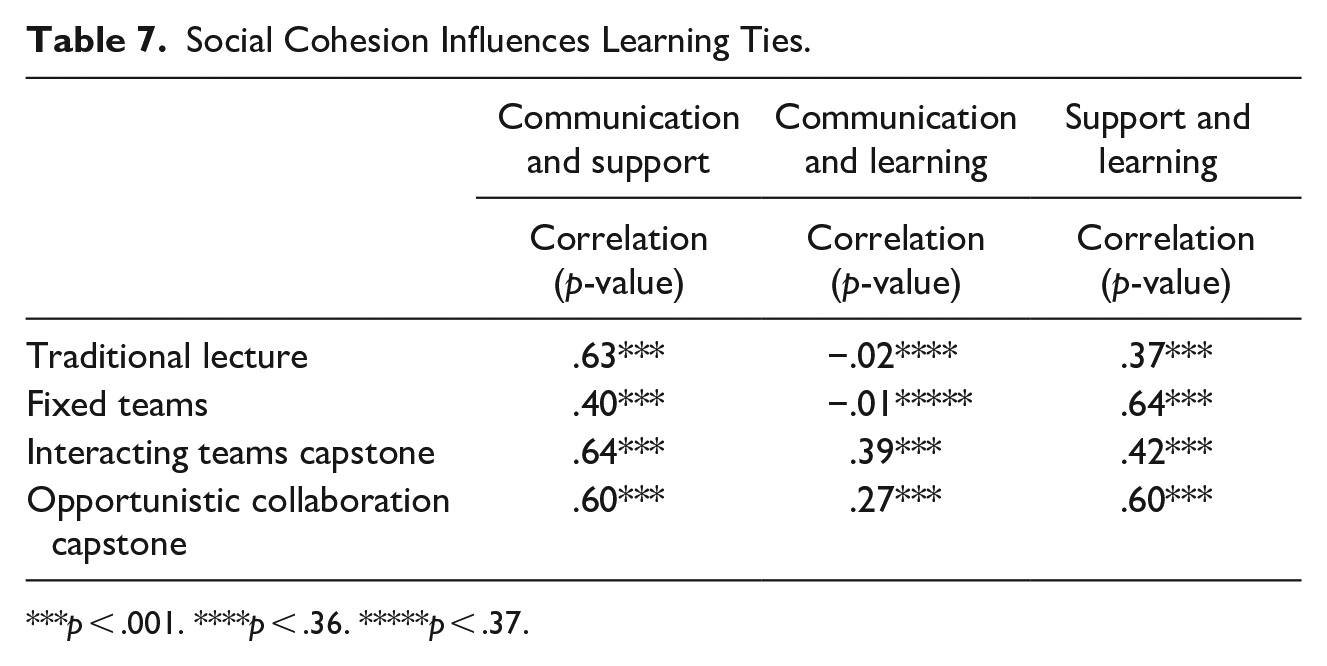
p < .001. ****p < .36. *****p < .37.
For all four courses, the communication and support matrices were highly correlated, so were the support and learning matrices, indicating an association between social cohesion and collective learning, showing that students communicated and received support from the same students with whom they were learning. The communication and learning matrices were not correlated in the Traditional lecture or Fixed teams courses, where networks were highly fragmented with numerous isolates.
Alumni Report Using Team Learning Skills
Data from the alumni survey were analyzed to understand long-term learning outcomes and answer the third research question: How are team learning skills transferred and accessed by alumni in their professional careers? Thirty-eight percent of Interacting teams capstone alumni reported that their capstone course enhanced their ability to work as a member of a team, compared to 98% of Opportunistic collaborations capstone alumni. Eighty-three percent of alumni from the Opportunistic collaborations capstone reported that the course allowed them to develop meaningful relationships with classmates compared to 35% in the Interacting teams capstone.
Alumni from the Opportunistic collaborations capstone highlighted their ability to apply knowledge from previous sociology theory and methods courses, such that they were able to understand the relevance of theoretical concepts learned from academic classes to real-world issues. Their comments described a variety of ways in which they integrated classroom knowledge into workplace. One alumna wrote about what she learned in the Opportunistic collaborations capstone, describing that she learned “so much” and “completing a true research project from start to finish was the best learning to solidify the process and have experience for future endeavors” (Alumni 1). Another Opportunistic collaborations capstone alumna listed various skills she practiced and mastered, such as “how to transform statistics into actionable behavior, how to maintain proper research ethics [when conducting] qualitative methodological practices” (Alumni 2). In contrast, in the Interacting teams capstone, 15 respondents could not remember their specific research projects and 13 respondents reported that they did not learn anything about research methods.
To further understand the application of skills, alumni were asked if they agreed that they used skills or insights from the class in their professional life. Eighty-three percent of Opportunistic collaborations Capstone alumni agreed or strongly agreed, compared to 40% in the Interacting teams capstone. In addition, Alumni were asked an open-ended question, “How have the knowledge, skills, or experience you gained from your capstone benefitted you professionally?” The Opportunistic collaborations capstone alumni articulated that they were able to apply team learning skills and theoretical concepts in their professions, which helped them become a more effective member of a team. One alumnus said, “I took my knowledge of restorative justice and implemented different techniques within my office now that are helping students at the university” (Alumni 3). Another described their collaboration experience, saying, . . .As a member of an organization like the Alaska Air National Guard my experiences in [the course] have given me a unique perspective on my organization as not just a large government branch but rather as a community consisting of individuals with their own ideals and needs. The interview and focus groups conducting skills that I learned have been particularly useful in terms of learning what it is my team needs to accomplish a task or goal, as well as for better understanding how my organization works, and to identify factors that help the Guard to accomplish its mission as well as to identify and nullify factors that hinder our performance (Alumnus 4).
This quote illuminates that the alumnus was able to apply what he learned to analyze issues at the workplace. Another alumna described how she applied what she learned when working with a business team.
Recently the department that I work for went through a business process change. My supervisor asked me and two other employees with the same job title as me to sit in on these meetings with upper management and give our input for certain processes in the department. This process took months to implement, and we recently finished our first month of implementation. I used several theories that [the professor] taught us in this class to make decisions and talk in discussions with my fellow employees. The transition into the new business process has been chaotic, but we have been able to successfully implement the new process. I believe that the knowledge and skills that [the professor] taught me helped me participate, be a true asset to the team, and make a real difference in this process change (Alumna 5).
This alumna’s reflection shows that she was able to apply the specific knowledge and team skills she learned in her work setting.
Discussion
To solve 21st century global health and environmental challenges, higher education must teach team learning. Literature from business, education, and SciTS have documented the phenomenon of team learning, including the social process of knowledge creation. This study provides further evidence in a higher education setting that team learning is a social process, as well as insights into effective pedagogy for teaching team learning in the classroom.
In the present study, it was found that the communication and support networks were associated with the learning network in the courses that featured collaborative structures (p < .001; Table 6), showing learning is a social process. Further, analysis of alumni survey data showed that students, particularly those from opportunistic collaborations capstones, applied the team learning skills they learned to their careers, and most importantly, as members of a team. Our study did not find team learning in each classroom network. Many university classrooms are not collaborative and therefore do not teach team learning. The instructor stands at the front of the course to lecture; thus, learning outcomes are based on individual knowledge and skill mastery (Brew, 1999). In these courses, the learning network is centered around the instructor and/or GTA, and when these individuals are removed, the communication, support, and learning networks fall apart (Figure A1 in Appendix). If learning is a social process, then this type of classroom structure fails to create social cohesion and arguably does not support team learning.
Theoretical Implications
This study mirrors a growing body of empirical research in SciTS, business, education, and more which finds interpersonal relationships are influential in the process of knowledge creation (Love, Cross et al., 2021; Phelps et al., 2012), and learning is a social process (Bereiter, 2002; Csikszentmihalyi, 1999; Duhigg, 2016; Hakkarainen, 2009; Paavola & Hakkarainen, 2005; Sawyer, 2017). If knowledge is being created through social interactions and relationships, it suggests there should be a paradigm shift in learning assessments, where social network analysis to measure social interactions and assessment of long-term learning outcomes should be used, as demonstrated in the present study with the use of social network analysis and analysis of alumni survey data.
Currently, most studies on learning outcomes ask students immediately after the intervention, “what did you learn” (Love & MacIlroy, 2021). By using both a social network analysis approach and administering an alumni survey, we were able to obtain a deeper understanding about teaching team science. The use of mixed methods provided insights into how the traditional lecture-style classroom does not support team learning. Results of social network analysis showed that the intensity, duration, and level of collaboration in the Interacting teams capstone were greater than those in the Traditional lecture and Fixed teams courses. Furthermore, results of the alumni survey data analysis showed alumni from the Opportunistic collaborations capstone were able to use team learning skills in their careers.
Team learning is an essential skill for the knowledge economy, and higher education should foster team learning so students can learn the skills needed to collaboratively build knowledge as a member of a team. One person or one scientific discipline alone cannot solve complex societal challenges like water shortages, climate change, virus outbreaks, and violent crime facing today’s world (Fiore, 2008; Read et al., 2016; Stokols et al., 2008). To tackle these problems, teams will have to work together, create new knowledge, and innovate to develop new solutions (Barge & Shockley-Zalabak, 2008; Fiore, 2008; Scardamalia, 2002; Zhang et al., 2009).
An increasing body of research in the field of SciTS has documented the impact of teams and their key role in solving complex problems facing our world (Table 1). This level of complexity and coordination requires a fundamental shift in science and how knowledge is created because creating the best team is not about having the top athletes or best scientists, but the key is effective team development and processes such as building relationships, creating a shared vision, and doing meaningful work collectively (Duhigg, 2016; Love, Cross et al., 2021). The results of this study challenge universities to cultivate and teach team learning skills to students in classroom settings to prepare them to contribute to the global economy as a member of a team.
Team learning takes place when students build networks (Phelps et al., 2012), learn from others (Hattie, 2015; Kandlbinder, 2015), and practice working with others in teams (Senge, 1991). Students with the ability to learn with a team will be more likely to thrive when they enter the workforce because the knowledge economy requires people to create and iterate knowledge in teams. Thus, post-secondary students must engage in team learning opportunities to prepare them for careers, especially in a global economy where they will need to help solve complex global problems.
Practical Implications
An increasing body of research in the field of SciTS has documented the impact of teams and their key role in solving complex problems facing our world, such as climate change, food shortages, and pandemics (Table 1). This level of complexity and coordination requires a fundamental shift in science and how knowledge is created because creating the best team is not about having the top athletes or best scientists, but the key is effective team development and processes such as building relationships, creating a shared vision, and doing meaningful work collectively (Duhigg, 2016; Love, Cross et al., 2021). Scientific teams and other jobs in the 21st century knowledge economy require employees who can adapt to team environments and create and adjust knowledge to solve complex, urgent, and critical problems. Scardamalia (2002) described how expert medical teams, flight crews, and sports teams serve as models for the kinds of groups that are expected to work as a team in knowledge-based enterprises. Higher education should foster team learning so students can learn the skills needed to collaboratively build knowledge as a member of a team. We provide practical recommendations detailed below that focus on how instructors can begin or continue to teach students team learning skills so students can be prepared to contribute to the global economy as a member of a team.
Faculty and universities should create coursework expectations where students work and learn together as peers and participate in collaborative learning activities that are implemented in classes of every size and with students at all levels. Examples of learning activities that catalyze learning ties and thus team learning include collaborative research projects, small discussion groups, CBR, and group reflective conversations. Particularly, instructors should consider integrating CBR experiences into courses. This study provided evidence of team learning in the Opportunistic collaboration capstone course, where a CBR principles effectively supported teams of students to interact and share knowledge. The opportunistic collaboration capstone structure produced substantively more effective student networks for team learning than the other courses, including the Interacting teams capstone, which also used teamwork, had fewer students but did not focus on CBR principles and service-learning pedagogy (Figure 1). The core principles of CBR are that research occurs with not on the community partner, and the use of student and groups reflections to help link their team experiences with course material and concepts. Through reflection, students develop an awareness of what they do or do not know and what they need to know to move the team forward (Flavell, 1979; Strand et al., 2003). These core principles provide a structure where students are adjusting their learning and expectations to be responsive to the community (Mitstfer & Council for the Advancement of Standards in Higher Education, 2012; Strand et al., 2003). Ultimately team learning takes place when students build networks (Phelps et al., 2012), learn from others (Hattie, 2015; Kandlbinder, 2015), and practice working with others in teams (Senge, 1991) all of which are occurring in CBR team research projects.
We thus advocate for the need to create opportunities for all university students to have a culminating experience, such as capstone courses that uses an opportunistic team structure to foster team participation where students work with and learn from their peers to better prepare themselves for team membership. For this to occur, university administrators must support instructors as they create courses based on building teaming skills for students to connect and interact. Universities should acknowledge these professional efforts via campus media, in college meetings, newsletters, and during relevant student and instructor meetings and events. Universities may also need to change policies and provide professional development opportunities and incentives for interested instructors, such as modifications in instructor teaching, service, and research loads to allow time for the development of new opportunities and partnerships. Although these changes may be challenging, universities need to address 21st century employer needs. Academic staff across the disciplines should also engage in research that will continue the exploration into learning as a social process.
One person or one scientific discipline alone cannot solve complex societal challenges like water shortages, climate change, virus outbreaks, and violent crime facing today’s world (Fiore, 2008; Read et al., 2016; Stokols et al., 2008). To tackle these problems, teams will have to work together, create new knowledge, and innovate to develop new solutions (Barge & Shockley-Zalabak, 2008; Fiore, 2008; Scardamalia, 2002; Zhang et al., 2009). Team learning is an essential skill for the knowledge economy and the results of the present study challenge universities to cultivate and teach students team learning skills in classroom settings. Students with the ability to learn with a team will be more likely to thrive when they enter the workforce because the knowledge economy requires people to create and iterate knowledge in teams. Thus, post-secondary students must engage in team learning opportunities to prepare them for careers, especially in a global economy where they will need to help solve complex global problems.
Limitations
There are multiple limitations to this exploratory study. First, the researchers did not document the internal classroom activities, such as classroom dialogues, or immediate, short-term learning outcomes. Second, reflection data were only collected and analyzed from CBR courses because the reflection activity was not designed as a pedagogical strategy in the other courses. Third, there were several methodological limitations. Several variables, such as temporal differences, class sizes, and course level differences, as well as other potentially confounding factors, were not considered during this research due to the sampling approach. Furthermore, official class rosters from the university did not include demographic data for gender and race/ethnicity. Fourth, the capstone courses were smaller: the Traditional Lecture had 42 students and the Opportunistic Collaborations capstone had 27 students. The Opportunistic Collaborations capstone also had more senior students. These differences alone may have caused higher levels of interaction in the social networks. However, without opportunities to engage with fellow students during class time, it is also plausible the class size difference had little impact on the network development. In addition, we acknowledge the limitation that course data were collected across multiple semesters, which has the potential to introduce bias. Ideally, all data would be collected during the same academic year to avoid confounding from historical events or policy changes at the university. Although there are limitations to this study, the results contribute to the literature and provide a foundation for future research on the impact of social processes on learning.
Future Research
Scholars should continue to conduct studies that examine the connection between social processes and learning outcomes in university classrooms, as well as in other higher education settings such as community colleges. Expanding research into other disciplines (e.g., engineering, materials science, etc.) and other areas of higher education (e.g., student affairs, learning communities) would provide instructors with discipline-specific information needed for course designs. Also, researchers should consider investigating learning outcomes when students participate in more than one course that teaches team learning skills to provide data on the influence of multiple courses on students’ knowledge development. Finally, researchers should consider conducting longitudinal studies to explore the long-term impact of teaching team learning on alumni’s professional lives and on their ability to participate in solving societal problems in the 21st century.
Conclusion
Senge (1991) argued for more team learning to support the knowledge economy. Today, the need is greater than ever. Nearly every sector of the global economy needs a workforce trained for team collaboration. Specifically, for team science, it is impossible for one person or one discipline to have the knowledge needed to solve complex problems (Fiore, 2008). It is imperative that students develop collective cognitive responsibility, learn to build and iterate knowledge in a learning organization, and practice mutual learning because “the era of team-oriented research. . .is here” (National Human Genome Research Institute, n.d.).
Supplemental Material
sj-docx-1-sgr-10.1177_10464964221121349 – Supplemental material for Teaching Team Science: The Key to Addressing 21st Century Global Challenges
Supplemental material, sj-docx-1-sgr-10.1177_10464964221121349 for Teaching Team Science: The Key to Addressing 21st Century Global Challenges by Hannah B. Love, Jennifer E. Cross, Bailey K. Fosdick, Elizabeth Tofany and Ellyn M. Dickmann in Small Group Research
Footnotes
Appendix
Acknowledgements
A special thank you to Ellen Fisher, my postdoc advisor, for providing support, feedback, and editing to make the article a success.
Declaration of Conflicting Interests
The author(s) declared no potential conflicts of interest with respect to the research, authorship, and/or publication of this article.
Funding
The author(s) received no financial support for the research, authorship, and/or publication of this article.

Supplemental Material
Supplemental material for this article is available online.
Author Biographies
References
Supplementary Material
Please find the following supplemental material available below.
For Open Access articles published under a Creative Commons License, all supplemental material carries the same license as the article it is associated with.
For non-Open Access articles published, all supplemental material carries a non-exclusive license, and permission requests for re-use of supplemental material or any part of supplemental material shall be sent directly to the copyright owner as specified in the copyright notice associated with the article.
