



Abstract
During the last 5 years, the similarity between role-playing games and rituals has been mentioned in numerous articles and online discussions. This article examines that connection by using data gathered over several decades in library and information science, studies of religion, and the cognitive sciences. The authors place particular emphasis on the similarity between social information phenomena present in both ritual and pretence, and the way those affect cognition—the seemingly “magical” interface that makes shared experiences possible. The authors show the implications of that pattern to the design of games and discuss its uses and limitations in games and experiences created for educational purposes.
Keywords
In this article, we illustrate and explain the paradoxical nature of alternate reality, pervasive, and pretence games (PGs), as they hover at the brink of reality. An information-based view allows us to analyze how participants collectively seek to make sense of and interact with such ambiguous play situations—be they spontaneous games or meticulously tailored experiences meant to facilitate learning. In addition to insights from information science, we borrow analytical tools from cognitive theories of religious rituals.
Games are interesting because we—the participants and spectators—choose to look at them in a special light. We create a special frame of mind, where particular things are important. A football crossing a line is not remotely exciting unless you know that this will score the home-team another point. Likewise, pixels moving on a screen are barely entertaining, unless you are a cat or accept them as an orc which can be gutted for loot and experience points. In other words, games rely on highly specific information to describe significant events and offer participants opportunities to interact with the game space. In this way, game participation depends on the information environments and social contracts—that is implicit consensual agreements between participants stating their shared interpretation and interest. 1 As such contracts regulate factors ranging from shared intentionality to how the activity can be safely and honorably played out, it is imperative to communicate their core principles sufficiently to all participants (Salen & Zimmerman, 2004). Otherwise, not everyone would be able to enjoy the new challenges posed by the shared game.
This is commonly achieved through the creation of fixed interfaces like sports fields, game boards, and computer game screens. As seen in children’s pretence and religious rituals, however, information environments can also be created on a social level, delimiting game spaces (as per Aarseth, 2001; Letcher, 2001) in the middle of everyday life. Such magic circles turn the meaning, significance, and relevance of small things upside down for a select group of participants (Huizinga, 1939). This poses a challenge to our contemporary science of (mainly digital) games, occupied as it is with fixed and measurable interfaces.
Like rituals, PGs—games based on the idea of an altered or fictional reality—take place in settings that are isolated by physical and social means, creating temporary “tribal” zones (TTZ; Letcher, 2001). Certain barriers and cognitive authorities hold the shared game reality in check, as people are expected not to access information from the outside. Cognitive and psychological changes during the activity may be profound but rarely last afterwards, unless properly anchored by social or symbolic means that reach beyond the play situation. Cognitive theories on how rituals enhance cultural adherence help us answer the question of how experiences like educational role-play (e.g., Henriksen, 2009) can sway attitudes and beliefs, and how this may be applied in game design.
Finally, viewing socially created information environments as a form of game interface offers library and information science an extraordinary look at the significance of highly controlled information environments to participant cognition (as per Ingwersen & Järvelin, 2005).
The main question we will ask is, how can PGs with their immaterial interfaces engage people in the way that they do, and how might this carry over to life outside the games? To answer, we turn to the connection between games and rituals, which is particularly visible in alternate reality games (ARGs), pervasive games, and live-action role-play (LARP). We aim to lay a theoretical groundwork for future empirical research. Our task is therefore to identify the significant commonalities and differences between game and ritual, and from there, the social information effects at play in play.
Pervasive Games—At the Brink of Reality
In 1939, Johan Huizinga suggested that games and rituals are fundamentally alike. This link can be hard to sell, as little resemblance exists between a Lutheran mass and consecutive nights of HALO in a dorm room. The discussion was given new life in 2004, when Ericsson (2004) and Lehrich (2004) suggested a deeper connection between rituals and role-play, an idea that was picked up by other researchers (see Bowman, 2010, for a good example). However, none delved beyond the most obvious similarities. We attribute this to a lack of well-defined exploratory platforms in their studies and attempt to narrow down the analysis, by committing to cognitive and informational aspects alone.
LARP is a form of structured drama play based on character immersion and preplanned plots that the characters live out. It first emerged from medieval reenactment and table-top role-playing games (Morton, 2007) but has come a long way since. As LARPs are usually limited to closed settings, pervasive games and the digitally mediated ARGs intentionally blur the line between game and life (see Montola, Stenros, & Waern, 2009, for extensive discussion on both). ARGs are games in which a narrative element, such as a fictional storyline with featured puzzles, is played along with one’s normal life. Pervasive games, in turn, are games that blend in with ordinary life and are not bound by traditional limits such as a fixed place or time of play, knowing who is a game participant or what is or is not a part of the game. Examples of the former include THE BEAST (2001) and of the latter the two Swedish PROSOPOPEIAs. Together, these game genres can be viewed as highly institutionalized versions of adult pretence play. Let us refer to them as PGs for short, underscoring their paradoxical proximity and distance to everyday life. P stands simultaneously for “proximity”, “pretence,” and “pervasive”.
Live role-play is usually limited to closed locations and requires a high level of cognitive engagement to keep players immersed in the fictive reality. Pervasive games, in turn, can be widely distributed across time and places, and may accommodate a potentially infinite number of casual participants. The forms are not exclusive—a pervasive game can also be a LARP, for instance. They can be viewed on a shared continuum, including sibling phenomena like children’s pretence play (see Figure 1).
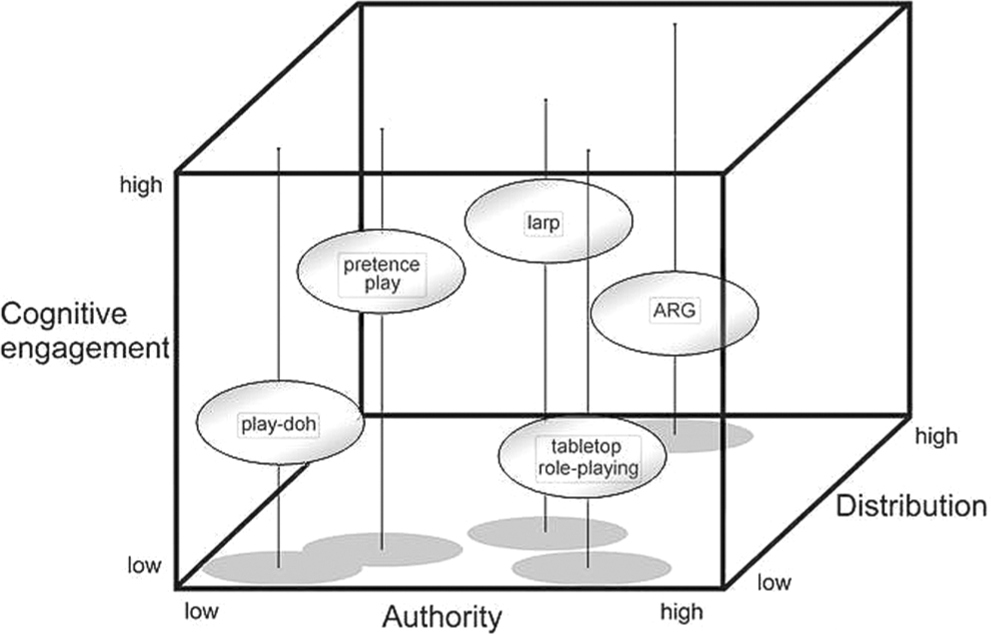
Continuum of different pretence games and other games as functions of authoritative constraint, cognitive engagement, and distribution across time and place
Apart from formal similarities, adult PGs also have cognitive features in common with children’s pretence play and, as we will suggest later, even religious rituals. For instance, LARPs often redefine identity (Harviainen, 2006), turning you into an orc, a house into a city, or a toy knife into a real one. ARGs and some pervasive games, in turn, add new significance or content into everyday events, even if the participants’ identity stays the same. The participants manage this through the ongoing social negotiation, for instance, by cementing the meaning of pretence elements or introducing new ideas along the way (Harviainen, 2007a; Lieberoth, 2007). Contrary to children’s pretence play, however, PGs institutionalize their social contracts through preexistent expectations, rules, and formal boundaries (Lieberoth, 2008). They usually rely on some sort of authority to mediate the game—for instance, a game master who writes the characters gives instructions and/or introduces plot devices.
In learning games, the balance between fun and reality, motivation and challenge, become a measurable didactic issue (Wilson et al., 2009), moving the phenomenon in the direction of training simulations (e.g., Hsu, 1989) but retaining ludic elements. Henriksen (2008) has, for instance, suggested that to keep social stakes high and discourage participants from dismissing the game as silly, educational games should be neither too fun nor too easy.
Ritualistic Games
Games share many structural and psychological features with ritual (i.e., Burghardt, 2005; Huizinga, 1939; Lieberoth & Harviainen, IN PRESS). We opt to focus on the social flow of information.
The emergence of bourgeois culture and later postmodern religiosity saw rituals, such as the Black Mass or spirit séances, performed purely for entertainment (Evans, 2007). Many of the “Hell-fire” clubs in 18th century Britain, for example, had a penchant for role-playing and—at least allegedly—pagan or Satanic rites (Lord, 2008). Practices such as exegetical bibliodrama (i.e., the study of Biblical passages by way of role-play) also de- and reconstruct religious rites and texts to analyze their properties outside a traditional context (Räisänen, 2008).
Play has recently been applied into religious rituals. An example of such is the development of a magical school of thought (chaos magic) that uses the temporary assumption of belief systems, also ones known to be completely fictional, as a central technique (Evans, 2007). Furthermore, the 2000’s have seen the development of PGs that use the shape of religious rituals in making their magic circle as strong as possible. Some even include attempts at reproducing the terror of high-emotion rituals (see Stenros, Montola, Waern, & Jonsson, 2007, for examples with research data).
LARPs are a particularly good example, as many have already intentionally blurred the line between ritual and game: A SERPENT OF ASH (2006-2008) and PRAYERS ON A PORCELAIN ALTAR (2007-2008) are structured to use information barriers in a pattern similar to ritual spaces. 2 The European Union-funded research-project games PROSOPOPEIA BARDO 1: DÄR VI FÖLL (2005) and PROSOPOPEIA BARDO 2: MOMENTUM (2006) mixed ritual elements with pervasive game play to intensify the game experience. 3 Similarly, the Danish LARP PERSONA (2005) deliberately staged rites of passage where participants literally changed masks. The designers even based the overall game structure on van Gennep’s (1909) three stages of ritual separation, transition, and (re)incorporation (Hansen & Krone, 2006). Such PG projects have demonstrated that the applications of the information restrictions traditionally inherent to religious ceremony work quite well in a game context. The similarities, however, need not be this explicit. Do similar social information effects take place in all PGs and rituals? We believe so.
The Challenge of Immaterial Boundaries
Information interaction is commonly analyzed in terms of the affordances and constraints created by a particular interface (Norman, 1993), such as a computer game screen or a sports-arena. In the social worlds of rituals and PGs, however, the technology is more open ended and the range of playing fields potentially infinite. This makes analysis of how social circumstances influence situational cognition a fruitful approach, as immaterial boundaries are created mainly through social contracts between participants.
Situational boundaries can be difficult to distinguish when pretence activities take place outside a well-defined playing field. Letcher (2001) called this a TTZ: a “bubble” of temporary space imposed on a real place (as per Aarseth, 2001; Apter, 1991). 4 While still in temporal continuity with reality, activities within a TTZ are experienced as isolated. This means that a social information barrier (as per Wilson & Walsh, 1996) delimits a narrowly shared understanding of the situation 5 ; it establishes what Bateson (1955/2000) calls a cognitive frame. Instead of a fixed interface, social sensibilities serve to define the TTZ, attract attention, and present participants with interaction opportunities. In the following sections, we explain how.
Reasons for participating in rituals and games range from momentary excitement to obligation and the enjoyment of social occasions. The cocreation of fiction can be a pleasurable and motivating experience (Apter, 1991), but the object of interaction is not key here. Social pleasure can come from a sense of belonging (Turner, 1969), shared experiences (including ordeals), or even a feeling of shared secrets (Galanter, 1999; Harviainen, 2006). The promise of such rewards may turn the maintenance of an otherwise meaningless or unpleasant experience (such as a scary initiation rite or a discomforting, yet interesting, LARP) into a kind of pleasure in itself. In anthropology, the feeling of communitas has been described as a shared experience of profound engagement and equality (Turner, 1969), which furthers belief in the superhuman efficacy of rituals (Lawson & McCauley, 1990). One core feature of participation in cultural spectacles is the social signaling of commitment (Bulbulia, 2008), which may also be duplicated by games (Pohjola, 2004). This is very visible in football hooliganism, where individual identity is momentarily reduced to the team a person is rooting for, anchored in the progress of the game below.
What makes football hooliganism unsettling is the fact that it sometimes spills beyond the confines of the arena and may color participants’ interpretation of things in real life. Although most games stay within closed limits, some PGs also carry their magic circles into the real world, to produce what Jane McGonigal (2003) eloquently called the “Pinocchio Effect”—the little game that wants to be real. By deliberately mixing game thoughts and game actions with nongame reality, everything feels like part of pervasive games and ARGs, if the players opt to sublimate them as the primary frame of interpretation (i.e., Bateson, 1955/2000; Goffman, 1974).
In the collective framework, players assume that their peers retain a similar in-game attitude (Rakoczy, 2007). Unsuccessful performance of social participation can disrupt the experience, producing what might, with a courteous nod to McGonigal, be called the “Emperor’s New Clothes Effect”: a moment where social and individual immersion breaks down because participants are not completely engaged in the game and also realize that neither are their peers. Incomplete performances due to lack of skill, information, motivation, or action affordances can therefore be very disruptive. The effect is particularly visible in some role-playing traditions (see Pohjola, 2004, for an example), where the direct experience of identifying with the character is a major goal. Luckily, however annoying disruptions may be, players are usually able to skip back into the right frame of mind with minimal effort (Harviainen, 2006). This is contrary to rituals, where participation must come with a potential social cost, to signal real commitment on the part of adherents (Alcorta & Sosis, 2005; Bulbulia, 2008). The risk posed by the Emperor’s New Clothes Effect is inherent to reliance on social and cognitive boundaries instead of fixed interfaces but rarely of catastrophic consequence.
A social information environment attunes multiple imaginations to the same objects, as participants picture something that is “not really there,” or envision new, situationally relevant affordances to things already existing within the environment. Frame-relevant elements such as artifacts, actions, narrations, verbal negotiations, and instructions are introduced to serve as anchors for attention (Mithen, 1998). They help control the flow of imaginings over a prolonged period of time. A study conducted with adult role-players (Lieberoth, 2007), for instance, showed how details in personal experiences differed but were continually adapted through verbal negotiation and adherence to cognitive authority (see below). This adaptation maintained a shared frame, inviting to further play (see Brenne, 2005, on LARP; Schick, 2008, on educational role-play; and Stenros, 2008, on pervasive play). This is also seen in religious rituals, where central superhuman forces may be present only in the mind’s eye or highly symbolic anchors such as statuary (McCauley & Lawson, 2002).
A consistent information environment can thus both shape unfolding actions into a narrative unity (Lieberoth, 2007; Wilson, 1977) and invite participants to search for their own personal meaning within that particular framework (Whitehouse, 1996).
Information and Cognition in Games
While a player is aware of the real world during a PG, the local information environment determines what parts of the real world are allowed to affect his senses. From these bits of information, he pieces together a whole picture of the situation, supplemented by active information appropriation when needed (Todd, 1999).
From an informational point of view, three key features make such a separation possible: resignification of elements within the situation, increased attention to shared intentionality, and the fact that during such activities, access to information outside of the activity is limited. The key to our analysis is therefore the effect of social interfaces on information behavior: the interaction of user with information environment in the social context (Grešková, 2006).
Many physical environments are designed to constrain and enhance information, for example, games being played in nonnegotiable sports arenas (Lave, 1988). Such fixed interfaces supply obvious cognitive anchors for shared intentionality (e.g., all spectators and players keeping their eye on a ball). Mobile technologies have recently also begun to support distributed games, breaking down the need for temporal and spatial proximity between players, moving the socially shared anchors onto the information superhighway. Social computer play has thus become less situated over the last 10 years and can now support more flexible structures than traditional games. Such games merge social and technological information environments.
Formal Resemblances and Differences Between Games and Rituals
Actions, topographical features, physical artifacts, social roles, and other elements of the situation are socially redefined in games and rituals (Crookall, Oxford, & Saunders 1987; Harviainen, 2006). This constitutes a shared information environment. A prime example is children’s pretence play, where a banana may become a gun or a phone. This is done on the basis of either prior knowledge or explanations gained during the activity itself (Lawson & McCauley, 1990; Loponen & Montola, 2004). For example, realizing that the consecrated wine in a Roman Catholic communion is supposed to be the blood of Christ is not possible without knowledge of Catholic dogma. To comprehend and be able to fully participate in a ritual, participants need to understand its reference to an underlying belief system. Otherwise, the ceremonial actions are at worst perceived as meaningless (Staal, 1979) or taken at face value (i.e., the wine is understood as a refreshment).
Both modern sports and religious rituals are taken seriously due to contracts of shared intentionality. In anthropological thought, ritual situations are traditionally described as liminal (van Gennep, 1909), denoting their removal from everyday reality. Although removed, they are still in continuity with mundane life and have the capacity to facilitate social and cognitive changes (e.g., marriage and other life transitions; the transmission of secret knowledge). Accordingly, we find it fruitful to refer to social situations with high levels of shared engagement, which also challenge existing attitudes as liminal.
In this typology, sports are defined as liminoid as they represent a step beyond the mundane but lack transformational power (Ericsson, 2004; Turner, 1982). Rather than working toward a perceived practical goal, as do ritual actions, sports and games instead require a shared lusory attitude, where participants accept voluntary obstacles (e.g., rules, goals, and skill challenges) to make an activity enjoyable in itself (Apter, 1991; Suits, 1978): A ball entering a goal outside of a match is insignificant, but during a game it is extremely important.
Many types and variations of ritual exist; however, like games, they constitute an obviously distinct class of behavior (Lieberoth & Harviainen, IN PRESS). Some are highly personal, unique, and involving, whereas others are formalistic, repetitive, and do not require much engagement. All, however, seem to increase participants’ motivation, information, and momentary credulity toward frame-relevant elements in some way.
To address the differences, McCauley and Lawson (2002) suggested variable dimensions of arousal and frequency. Whitehouse (1996), in turn, envisioned two distinct modes of religiosity, where rituals are either “doctrinal” or “imagistic”—that is either affirming, low-impact, and frequent (e.g., the Eucharist at Sunday Mass), or rare, emotionally powerful, and life-changing, sometimes called rites of terror (e.g., tribal initiation). A very similar range exists in PGs, on frequency and intensity (see Montola et al., 2009, for examples). Both theories assume that ritual systems survive in culture by transmitting themselves as vessels for information through effective memory imprints.
In rituals, ordinary actions can become magical through supernatural intermediaries (e.g., Lawson & McCauley, 1990; Sørensen, 2006). In a like fashion, in PGs, actions, objects, and persons may be assigned momentary play roles and play functions (Burghardt, 2005; Loponen & Montola, 2004; Rakoczy, 2007). These transformations and substitutions are easily understood by all involved and may symbolically enable liminal changes (e.g., the washing during a baptism makes a child pure), servings as long-term anchors for shared understanding.
TTZs, regardless of whether they are created for rituals or for fun, depend on shared information. Liminality and lusority, frequency and arousal, are all essentially secondary properties. They define the type of ritual or pretence and create a sense of significance, but the process itself rests on another—perhaps deeper level: the social information environment created between participants.
PGs and Rituals Create Similar Information Environments
An information environment is defined by physical and social features that influence the availability of information and attitudes to available inputs (Wilson & Walsh, 1996). When the Greek mystery cults led blindfolded initiates into dark cellars under superhuman pretexts, they had great control over expectations and perceptual inputs. They were thus able to create vivid and emotionally tantalizing imageries of the underworld using very simple means (Martin, IN PRESS). Rituals form a good basis for understanding the socially constrained information environments seen in PGs.
The most efficient information constraints simply keep information to a minimum, placing some inputs in a privileged position. Physically segregating the situation or numbing the senses through blindfolds, drugs, deafening drums, and similar means can forcefully filter outside information away. Another common technique is occupying participants’ working memory with a variety of ongoing cognitive tasks (e.g., reciting complex prayers or mantras; Galanter, 1999).
The similarities between PGs and rituals are clearer on a social level, as ritual information environments are usually constituted by a body of peers. They all serve as sources of information, through their actions and ability to share knowledge, just like other players in a massively multiplayer online role-playing game or fellow spectators at a sporting event. These sources, however, work within restrictions.
In addition to possible physical constraints, participants isolate their information environment through social contracts of interest, creating a high level of attention to the experiences of others (i.e., Rakoczy, 2007). This has been described in terms of LARP interimmersion (Pohjola, 2004), representational negotiation (Lieberoth, 2007, 2008), and religious communitas (Turner, 1969). The social group is not only granted an informational function but also invested with cognitive and emotional salience.
In such socially constructed information environments, cognitive authority (the framing of some people, or predetermined sets of ideas, as more reliable sources of information than others) becomes central. This type of authority is a matter of degree, and it is always relative to a sphere of interest (Wilson, 1983). The role often coincides with that of a referee or ritual expert but is not necessarily based on actual expertise. A cognitive authority’s comments are treated as if they were knowledge, not just information, and serve as public anchors for shared interpretation.
Through these social information effects, the magic circle surrounding a TTZ acts as a barrier. It not only lessens the likelihood of accessing or encountering information from outside but also affects any information that crosses it. It makes information either fit within the frame or disqualifies it before it can properly enter. In this, both ritual and pretence play situations are an excellent example on how Shannon’s (Shannon & Weaver, 1949) theory on signal and distortion also functions in social environments: Stimuli are either accepted in a frame-relevant form or not at all. This is consistent with the concept of cognitive dissonance, derived from Festinger’s (1957) famous study of a high-involvement alien-contact cult. The cult’s adherents would accept a thinly varnished repair of their threatened worldview after an absent apocalypse, rather than suffer the emotional distress of having their personal investments in the movement rendered futile. Information harmful to the experience never truly settles within a magic circle but may disrupt its boundaries slightly or destabilize it in the long term.
Shared understandings are often mediated by a directive source, such as a game master (Harviainen, 2007a), in a manner similar to leaders of charismatic cults (Galanter, 1999; the game master’ power, however, is less pervasive). This special form of cognitive authority is given the right to overwrite any other information source, including preconceived and even physically anchored knowledge. Directive sources typically supply guidance, making the activity progress seamlessly. In children’s pretence play, authority is a little more fluent, as content can be negotiated by anyone. Social status often nevertheless gives some participants more reign than others (Lieberoth, 2008).
In a traditional religious environment, the directive source is a conduit for the social authority invested in the congregation as a whole and can even convey the will of supernatural forces (e.g., through divination) or declare the transformative effects of ritual actions. To use our earlier example, the celebrant at a Roman Catholic mass confirms that the communal wine is now indeed also physically the blood of Christ, despite its taste and other chemical properties. This is possible because a directive source—in this case, Catholic dogma accepted by the believers and supported by the actions of the priest—invests the ceremonial form with the power to enact change. In the same way, when a game master in a LARP says that a building is on fire, within the TTZ’s reality it really is aflame (Harviainen, 2007a). Although the credulity of the participants is not as strong in such a case, the social contract of the game effectively forces them to act as if it were.
A magic circle with the power to act as an information barrier is thus based on a combination of three factors: the participants’ conception of what objects and information elements are situationally relevant (as per Bartlett, 1932; Wilson, 1973), their shared wish to preserve the TTZ (Fine, 1983; Letcher, 2001), and the attribution of cognitive authority to certain information sources (Galanter, 1999; Wilson, 1983). 6
Making Sense of Games
The need for a shared understanding in the TTZ requires small changes in attitude as well as the aquisition of new information. This process functions smoothly because people tend to familiarize themselves with a subject by inserting and appending small bits of information, rather than changing major bodies of knowledge (Todd, 1999). This fits our active view of cognition and reflects Dewey’s early notion that “an organism does not react to a stimulus, but acts to incorporate it” (cited in Fingelkurts & Fingelkurts, 2004, p. 850).
Change processes can be directly controlled in information environments where cues are restricted and strategically applied by the authorities (Harviainen, 2007a). A typical progression is from seeking “a complete picture of things” to seeking “a perspective or position” (Todd, 1999). “Things,” in this case, are restricted to the game- or ritual-frame at hand. A typical way of making more sense of rituals or new games is thus the acquisition of bits and pieces of information during the activity, appended with direct questions/searches (e.g., from peers, tacit knowledge, or a manual) when necessary. This minimizes potential disturbances to the activity at hand and thus the social risks associated with causing such disturbances. 7 Under ritual circumstances, the supernatural can also be accessed directly as a potential information source (Kari, 2001). In PGs, a continuum from game masters (e.g., A SERPENT OF ASH) to fixed technological interfaces (e.g., THE BEAST, 2001) fills the function, which means that significant variability in direct access exists.
Furthermore, the information environments of TTZs are not created from scratch, and even new computer games presuppose some knowledge of the real world on which they are based. As Ingwersen and Järvelin (2005) noted, information behaviors are influenced by long-term exposure to prevailing paradigms of belief and tradition. Participants bring these influences and values into the magic circle but suspend some of them to fit the fictional reality. This is the transformative information effect of liminality in action and exemplifies Brookes’ (1980) Fundamental Equation of Information Science on a social and situational level: What people know is changed by how they selectively take in information. Information is not simply added as new knowledge. It is appropriated so that it fits with the person’s expectations and emotional values (Modell, 2003). For a believer within a liminal environment, this creates a feedback loop where the available information supports the ritual—or game—experience. That, in turn, makes the participant more likely to get involved with the activity, appropriate information from within, and act as an information source for others in a manner that supports it. The tension created by the suppression of some knowledge brought into the TTZ—required by the social contract of a PG (Montola et al., 2009)—may either strengthen the sense of liminality for a participant or severely disrupt it, depending on personal disposition (Galanter, 1999).
New pieces of knowledge may work smoothly within the TTZ but are usually subject to reevaluation once people return to the real world. In cases of games, they are simply dropped. In liminal rituals, they are likely to remain, as supernatural elements are taken seriously in the host culture. They are also often anchored (Mithen, 1998) through stable elements such as artifacts (e.g., a wedding ring), the peer group (e.g., other players), or an ongoing need for active commitment (e.g., a series of subsequent ritual offerings thanking the spirits for a successful transition). This reevaluation poses a challenge to the design of educational games, as those do not normally have a host culture to anchor them the way a religious community does. Should the social contract be sufficiently strong and conductive to learning, however, players may themselves create the necessary anchors (Henriksen, 2009). As such self-initiated anchoring already takes place in similar religious and magical contexts (Sørensen, 2006), we believe that a game with the right type of build-in social contract is very likely to accomplish similar results.
Engaging the Mind
Apart from controlling information and influencing appropriation into knowledge, rituals and games often mobilize emotions. This creates special cognitive circumstances and makes information cognitively and socially sticky—like certain ideas and images that just seem to stay with us, and beg gossip around the campfire or water cooler. This effect has been the focus of teachers, advertisers, and politicians for almost a century (Gladwell, 2000; Heath & Heath, 2007) but seems to come natural to art and religion (Boyer, 2001).
One premise of classic library and information science is that users are usually rational agents who are fairly clear about what information they search for, once they have an inkling of what they might need (Kuhlthau, 2004). Imagistic rituals turn this premise on its head, by creating situations that beg a search for meaning but refuse to supply the needed information directly (Whitehouse, 1996). They therefore prolong the initial “anomalous state of knowledge” (ASK)—the uncertainty from which information seeking progresses (as per Belkin, Oddy, & Brooks, 1982). Indeed, unexpectedness and emotions are keys to making information stick in any case (Heath & Heath, 2007).
By creating distressing situations, restricting action opportunities, overloading working memory, and dealing with matters of great cultural importance, imagistic rituals undermine calm, reflected information seeking. In stressful situations, information appropriation becomes more erratic, as novelty becomes distressing (Wilson & Walsh, 1996), the scope of cognition narrows to few working-memory items (Wickens & Hollands, 1999), and secondary process thoughts are usually eliminated from consciousness. Reliance on immediate sources, supported by emotional salience, including feelings of trust and belonging, increases. Such reliance even extends to shared symbols and narratives, which are usually already present in the foreground of rituals and games. Such experiences feed the magic circle and the sense of liminality, and may be the main attraction of ritual-like designs in learning games and leisure PGs.
As culturally constructed spaces of action and sociality, rituals thus not only call attention to but also emotionally sublimate certain aspects of reality. They bestow added salience on “sacred” objects, stories, and people as sources of information. At the same time, by reducing secondary process thought, arousal can suspend the protective quality of a frame, making trauma seem more immediate than the situation actually warrants (Apter, 1991). It has also been experimentally documented that, like any computer-interface, high-emotion communications work best when presented with clear-cut invitations to action (Lewenthal, Singer, & Jones, 1965). High emotional salience coupled with consistent information and interaction opportunities may thus “suck us in” to the magic circle and probably facilitate the transfer of information from the TTZ into real life.
This is why the most ritual-like PGs, such as MOMENTUM, resemble rituals of the imagistic type. In them, liminality is more visible, as game breaks are rarer and the game structure itself contains ritualistic elements, up to and including genuine fear. Observed more closely, however, more doctrinal rituals too find their counterpart, in long-term role-playing campaigns. In those, players enforce their vision of an imposed world, and gain pleasure and affirmation by repeated low-key exposure to the game world and its community of players. In such games, just as in dogmatic rituals, the ASK state is not prolonged. Instead, the game rite offers a repetition of what is already known, combined with new elements, which are easily appendable because they are presented in the immediate company of old information (as per Todd, 1999). Although extremely significant in both religion and game contexts, such repetition rarely carries the immediate impact of imagistic rites or imagistic-style LARPs.
Without a hint of emotional investment, phenomena like horror games and action sports would not be as alluring, and ritual participants would be less open to liminal change. Nor would these events be pleasant without a clear-cut strategy for dealing with those emotions—either through personal engagement or by proxy (e.g., identification with a fictive hero, special ritual agents, and scapegoating). The creation of arousing information environments generates a thirst for meaning and action opportunities, which well-made rituals or PGs can readily supply through their design.
Readdressing the Challenge of Immaterial Boundaries
With the combined knowledge of PGs, rituals, and their information effects, we readdress the primary research question in another fashion: What seemingly magical interface found in PGs creates shared information environments without the aid of any fixed interfaces? How does this create socially and cognitively sticky information? And how can this be translated into better game designs for fun or for serious purposes?
To sum up, activities within a liminal frame can easily refer to everyday reality, but the link is strained if games require the use of an artificial platform (e.g., a first-person shooter) or if they deal with highly peculiar content. High likeness to everyday frames facilitates easy transfer of elements between game and reality. It can, however, also weaken the stickiness of tailored experiences, by blending too much with the buzz of everyday experience. What makes liminality special is the shared separation from everyday rules and realities, and the feeling of personal change. THE BEAST (2001), like other pervasive games, was played in continuation with mundane life. By replacing a complete magic circle with a shared interpretative frame and lust for exploration, it reached for a level where everything was potentially a part of the game (as per Harviainen, 2007a).
Here we see how much rituals and games have in common. They share a willingness to leave reality behind but keep relevant links open. The participant needs to be different from his everyday self but also the same. A fine line emerges via social and cognitive information barriers inherent to the magic circle, supported by emotional arousal, social attunement, and more conventional means of affecting information. A temporary reality emerges, with its own rules and truths.
Therefore, from an information perspective, PGs and rituals are practically identical. Similarly, a charismatic cult, if analyzed as an information phenomenon, establishes a constant state of ritual liminality for the believers, in a manner similar to that used in pervasive games such as PROSOPOPEIA BARDO 2: MOMENTUM (2006). That state, however, cannot survive indefinitely, due to its reliance on effective information barriers and a clear, singular authority that is threatened by any significant change (Galanter, 1999). This observation of limits is also consistent with Lifton’s (1961) findings on Chinese thought reform: cognitive changes rarely persist if they are not constantly supported by the social environment. Rituals and games remain stable because their TTZs are generally designed to exist for only a limited time, and they do not attempt to prolong their participants’ ASK states indefinitely.
Our combination of approaches thus points to an equation where information relevant to the frame is enhanced and becomes sticky (as per Heath & Heath, 2007, or for a cultural approach Boyer, 2001) due to a posy of information factors: the structure of the situation (in the case of PGs, usually social negotiation) and the expectations, stories, and prior knowledge carried into the experience. Likewise, significant is the way these stimulate our inherent tendencies to search for meaning through local information, parse reality into frames to avoid overloading working-memory, and adhere to social norms. Together, they create socially generated information environments, which in their totality are easier to accept than the information presented on its own. The effects are powerful but, just like fixed interfaces, they hold only momentary sway over the minds of participants and spectators.
Implications and Application
So, with our newfound knowledge of information environments and liminal states, should games deliberately be made to resemble rituals? Would this enhance fun, engagement, or the practical usefulness of games for purposes like education? Or are the phenomena described in the previous sections merely circumstantial resemblances of interest to ivory-tower academics only?
We believe that the overlaps between ritual and PGs hint at a distinct design advantage at the level of information. Experiences from ludology show how shared engagement can be simultaneously playful and serious (e.g., Apter, 1991; Huizinga, 1939), and distributed across space and time (Montola et al., 2009). Contemporary theories on religion (Lawson & McCauley, 1990; Whitehouse 1996) offer a glimpse at the cognitive processes that create engaging mental magics and make items stick in people’s minds.
For games designed to enhance learning or alter attitudes, the implications of this combination are clear: As studies of rituals, cults, and thought reform have shown, shared liminal experiences have a strong impact on participants during the activity but that impact rapidly dwindles when they leave the tailored situation behind (Lifton, 1961). This means that under most circumstances, games creating a strong sense of liminality can be used to motivate momentary viewpoints and experiences, but they will rarely generate significant cognitive changes in the long term (Lieberoth & Harviainen, IN PRESS). Rather, they may aid the appending of local information (Henriksen, 2009). They may also, with reference to Whitehouse’s modes theory of ritual, serve as autobiographical anchors for retrieval of autobiographical memories (i.e., Addis, Wong, & Schacter, 2006), which may serve as gateways to tacit knowledge acquired during the experience.
Tailored game situations are very good at shaping engagement and information flow, but if they are to achieve a resemblance to the transformatory power of rituals, the key is not to be found in structural likeness. It will be found in how experiences make people search for information, which can take root in minds and daily social practices alike (i.e., Henriksen, 2008). That simulations and LARPs can teach practical and social skills has been known for a long time (for very good examples of the range, see Balzer, 2009; Hsu, 1989), as has that these skills may sometimes enable long-term changes as they are processed. This, however, is not the same thing as enacting a true transformation through a simulation or a LARP.
Games may be applied in social change processes because they can generate motivated information searches, along with strategic feedback, in a highly controlled environment. Drastic alterations of preexisting attitudes or knowledge structures, however, are not an expectable outcome. It is unlikely that a game would succeed where even rigorous regimental thought control does not (Galanter, 1999; Lifton, 1961). For changes to persist, cognitive and physical anchors, such as imposed routines, achievable commitments, salient autobiographical memories, the presence of the peer group or physical monuments to the shared experience, must be transferred into everyday practice. They serve to reactualize not only new knowledge but also the social information phenomena shared during the experience. This same conclusion has been reported on educational role-playing by researchers such as Henriksen (2008). It also fits with Pitkänen’s (2008) findings on teaching historical empathy through LARPs, Balzer’s (2009) observations on the effects of an imposed temporary reality on learning new skills and social competencies in LARP, and the documented effects of the political propaganda LARP SYSTEM DANMARC (2005). 8
Just like games do not feature certain experience-intensifying traits of rituals, they do not contain all their restrictions either. As seen in pervasive games, tailored experiences do not require prior belief in epistemic relevance and need not be confined to an isolated time or location. Because of this relative freedom, they can distribute the traits of liminal information environments into everyday practices, possibly even creating enough ongoing engagement to ensure sensible memory consolidation and transfer beyond the limited experiences set by fixed-interface games. Educators have always appreciated the need for reflection and transfer into real practice. With these design considerations in mind, well-designed games can become anchors for prolonged social learning processes.
With this knowledge of rituals and PGs, game creators have an opportunity to reach beyond the traditional limitations of play and learning. The game does not need to end, and the social group can become a part of an ongoing information environment for this purpose. PGs can transcend the narrow confines of fixed game situations, but they still need skilled game programmers to make information environments and the magical interface come alive.
Conclusions
The information environments that feed PGs pervade all leves of social reality—up to and including the political and educational. In games and rituals, we see microscopic versions of the social and institutional information constraints influencing public opinion. They affect participants because the socially accepted liminal setting enhances some information sources while blocking others.
The “magical” interface of rites and PGs rises from these social information properties. Knowingly or not, the designers of such events manipulate those properties, creating various sorts of tools and constraints. In rites of terror and strongly emotional PGs, the uncertainty of participants (their ASK state) is intentionally prolonged, making the participants highly reliant on information sources and authorities present in the activity at hand.
The magical interface works through a feedback loop, which starts with the social contract to engage with the TTZ and to keep it isolated. Social and physical information constraints can keep external information from getting through, or sometimes strengthen it, in cases where it supports the emerging shared experience. Encountered stimuli must be perceived as situationally relevant to be noted at all. Stimuli that are not received because people are focused on other things cannot play a role in the information environment. And once information is received, it must settle within the shared experience. If social, cultural, or psychological factors reject information as invalid, it may visit the information environment briefly but will then be dismissed.
The special social contracts surrounding rituals and PGs establish meaning and relevance criteria. This creates a barrier to the outside world, telling us that “what happens in the woods stays in the woods.” The formal delimination is supported by special acts and goals within the activity, which separate it from everyday experience. These factors, when combined, enable the emergence of cognitive frames that invite players to perceive a more malleable reality beyond everyday practice. Participants may be aware of real life as well but make sense of the primary, liminal framework because of the invitation to share a fantasy.
These phenomena may apply to other games as well, but the lack of a fixed interface in PGs is what makes them particularly similar to rituals. The social contracts on which games and rituals are based may differ, with one being built on faith or social obligations and the other on lusory intent, but the activity itself is highly alike—especially at the level of information properties. PGs, furthermore, require the same sort of anchoring as rituals do, to make their content cognitively “sticky,” that is, able to persist outside the game environment.
This article is a start. By looking at the connection to rituals, it aims to show how certain game processes function, processes the understanding of which is vital for the creation of more effective PGs and training simulations. Further testing is certainly required, to understand the nature of the underlying social contracts, to identify the specific tools and factors affecting information behavior in TTZs, and to improve the anchoring of things learned during play. The next step could be designing learning games with this theory in mind, to generate sets of quantitative data, which can then be tested using more conventional methods.
From an information point of view, it appears that rituals and PGs are facets of one singular phenomenon. Understanding one therefore also extends our knowledge of the other. As game designers and researchers, we may thus in turn implement liminality for our own sinister purposes.
Footnotes
Authors’ Note
The authors would like to thank Joe Bulbulia, Mirka Grešková, Guy Shalev, Jaakko Stenros, Annika Waern, and the Simulation & Gaming reviewers for their assistance and helpful comments at various stages of this article. Multidisciplinary work must always rely on critical feedback from authorities in the fields as well as interested lay people.
Declaration of Conflicting Interests
The authors declared no conflicts of interest with respect to the authorship and/or publication of this article.
Funding
The authors received no financial support for the research and/or authorship of this article.
Notes
Bios
Contact:
Contact: