




Abstract
NEGOTIATING ON POVERTY is a collective game that allows participants to discover the concrete difficulties in assessing the multiple dimensions of poverty Participants are divided into groups of seven to simulate a participatory poverty assessment (a social wealth-ranking exercise) that takes place in an imaginary small village in some developing country. The game allows participants to gain an insight into the ways in which power asymmetries, economic interdependencies, gender relations, and personal affinities at the local level shape perceptions on poverty.
Keywords
Basic Data
Learning objectives: To illustrate the complexity of assessing the multiple dimensions of poverty and the negotiation process involved in participatory approaches measuring poverty—participatory poverty assessment (PPA)
Simulation-game objective: Each participant represents a household head with a particular livelihood profile in a rural village located in some developing country. The participants must engage in a participatory process to divide the households into broader socioeconomic categories and must agree on a social ranking from least to most poor. Each participant has to make an effort to be ranked as poor as possible
Debriefing format(s): Open discussion, with possible individual written assessments
Target audience: Students of and persons interested in social sciences, economics, development studies, and similar disciplines
Preparation and setup time: 15 minutes
Playing time: About 60 minutes (including 10 minutes to absorb the information)
Debriefing time: 30 minutes for collective debriefing, plus 30 minutes for written assessment prior to collective debriefing
Number of participants: 6 to 28, divided into groups of 6 or 7
Introduction: Poverty as a Multidimensional Process
In the economic literature, poverty is traditionally conceptualized by comparing income or consumption of a household with a standard poverty line (see, for example, Deaton, 1997). The input of other social sciences (e.g., sociology, anthropology), however, has led to a focus on the multidimensionality of poverty (see, for example, Kakwani & Silber, 2008). Such approaches highlight the importance of measuring noneconomic (see, for example, Wagle, 2008) and even subjective dimensions of poverty (see, for example, Van Praag & Ferrer-i-Carbonell, 2007).
Poverty has increasingly been conceptualized within its institutional environment. The poor can be defined as “essentially those human beings who, for one reason or another, almost systematically end up at the losing end of the multiple bargains that are struck around available resources and opportunities” (Bastiaensen et al., 2005, p. 981). In fact, the poor are those who are constrained in their agency freedom, defined as “what the person is free to do and achieve in pursuit of whatever goals or values he or she regards as important” (Sen, 1985, p. 206). The notion of agency is relevant in all social experiences, even in case of extreme coercion. Agency determines and is determined by the person’s access to strategic resources; it is embodied in social relations, closely linked with power relations and shaped through institutional structures (Long, 2001).
This broader conceptualization of poverty increased the interest in participatory approaches to measure poverty. A PPA involves an “active” engagement of the poor respondents, giving them the opportunity to raise their own concerns. The researcher typically adopts open-end methods, such as unstructured interviews, discussion groups, participatory wealth ranking, and so on. Furthermore, a PPA also implies an element of “empowerment” of poor participants, while “taking into account power asymmetries both within the household and within communities” (Narayan, 2000, p. 17).
Simulation games are defined by Dorn (1989) as “any contest or play among adversaries or players operating under constraints or rules for an objective or goal” (p. 2). Coleman (1989) describes simulations as “an intermediate stage between observation and conceptualization” (p. 146). Simulation games indeed represent parts of reality—in a simplified way (Dorn, 1989). In addition, they also imply an active engagement of participants to put themselves into positions that they would—in the real world—often only observe from a distance. Simulations expose participants to a direct confrontation between theoretical insights and practical applications (Druckman & Ebner, 2008). They stimulate the capacity to empathically assess de facto implications of more theoretical debates. Likewise, they promote skills to make a detached analysis and to call into question so-called common-ground knowledge (Bredemeier, 1978).
NEGOTIATING ON POVERTY encourages participants to experience the concrete difficulties in assessing the multiple dimensions of poverty. At the same time, the simulation gives participants an insight into the way in which power asymmetries, economic interdependencies, gender relations, and personal affinities at the local level shape perceptions on poverty. The materials here include the following:
Facilitator’s Guide
Participants’ Guide (in two sections) and
Debriefing Guide
Facilitator’s Guide
Our PPA simulation presents a situation in which six or seven household heads, living together in one village, have to make a “social ranking.” The objective is to rank all households from rich to poor in a participatory process. The assessment of who is rich and who is poor will be the result of a group discussion.
Role Profiles
Each participant plays a household head with a given identity; she or he owns assets and engages in livelihood activities (e.g., farmer). The profiles represent a variety of situations that one may come across in a typical rural village in a developing country. Only one of the seven, or six, household heads is able to read and write, so that person coordinates the process.
Logistics
The simulation can be conducted in less than an hour, with additional time for debriefing. No minimum or maximum number of participants is required, as long as they can all be divided into smaller groups of six to seven participants. Each group should have the space to sit together, apart from the others, for a group discussion.
Materials
The following materials are needed:
all household heads get a personalized
Identities—Profiles
The participants sit together in small groups of seven (or six) and get assigned to one of the seven available household head identities (additional profiles may be defined by the coordinator). The identities are assigned at random, letting participants pick a card on which the color of their identity is mentioned. Each participant gets a personalized sheet with full details on his or her own profile, along with limited (and sometimes inexact) information on other household heads’ profiles. This represents a real-life situation in which perceptions of others’ well-being are based not only on factual data, but also on personal relations, misperceptions, gossip, and so on.
Background
The participants also hear a rumor that researchers collecting the information on their social rankings are linked to a nongovernmental organization (NGO) that plans a development project in the village. This could mean that the NGO would use the social ranking as a tool to select potential beneficiaries of aid. As Brown (2009) states, “researchers often forget that while we conduct fieldwork, we are ourselves the object of other people’s research. A variety of actors are constantly gathering different types of information on us” (p. 213). The opinions based upon these perceptions have a strong impact upon the research process.
The incentives of local actors in a wealth-ranking exercise may totally change when they link this purely theoretical exercise to a potential source of aid. To simulate this aspect in the game and to give participants a firm incentive to negotiate well, they are told that the Facilitator will, at the end of the game, inform them about the true ranking of all households. They have to make an effort to be categorized poorer than the “objective” reality (see Table 1).
Proposed Rankings Based On Livelihood Assets and Strategies.
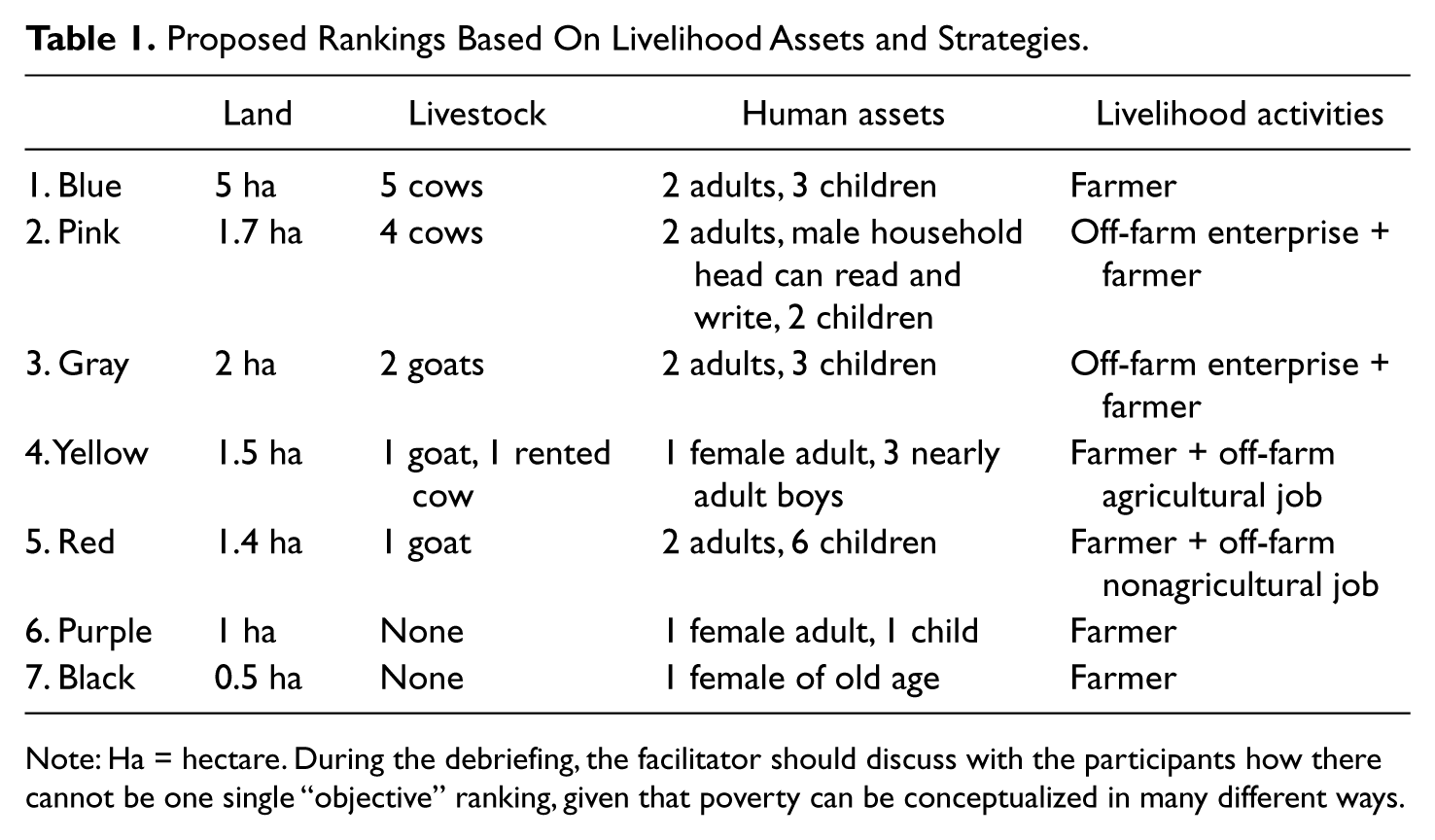
Note: Ha = hectare. During the debriefing, the facilitator should discuss with the participants how there cannot be one single “objective” ranking, given that poverty can be conceptualized in many different ways.
Preparation and Play
Once seated in their group, identified by their colored tags, the participants have 10 minutes to identify with their own profile and to absorb the information on the profiles of their village neighbors. They then engage in the collective process of ranking themselves and the other household heads from richest to poorest.
The Participants’ Guide contains two types of information: common and specific. Common information is to be given to all participants. Each person is also given a specific profile, outlining his or her basic identity.
Participants’ Guide
This PPA simulation presents a situation in which household heads, living together in one village, have to make a social ranking. This part of your guide contains information given to all participants in this exercise. Everyone in this exercise gets information on four aspects:
an outline of your
an outline of household
additional
Your Village and Household
Welcome to this PPA. You live in a village of seven (or six) households. You are all household heads. You will be called to a meeting in which you will make a “social ranking” of all households living in your village. The families all have a certain amount of land, some own cattle or other livestock, and all families have some source of income. You have an idea of the identity, assets, and livelihood strategies of other households, although some of your information may be inaccurate. You can question the others, but they are not obliged to answer accurately.
Your Objectives and Steps of Play
You will have to do the following things:
subdivide the seven (or six) households into
PINK will
You have 10 minutes to The group The group
Profiles—Public Information—Available to All
All households get the information provided in Table 2 about the household head.
Information Available on Each Household Living in the Village.

Note: PPA = participatory poverty assessment.
Profiles—Private Information—Available Only to Each Head
This section contains private information on each head—not initially disclosed to others.
BLACK
Private information—available only to you. You may keep this information private or you may share some of it.
You are a female of 70 and your husband died last year. You have three children, one died, two now have their own households. Your daughter lives far away and you rarely see her. Your son lives in a village nearby, but unfortunately he comes by only rarely and he does not help you financially. You are ashamed of this and you try to hide this from the other villagers. What makes it even worse is that you did so much for your children. In the past, your husband had two hectares of land, which was above the village average. When your son married, he got 1.5 hectares. You and your husband counted on him to help you in your old age. However, you were left with 0.5 hectares and no help at all, not even when your husband got sick last year. You have no livestock. Because of your old age, you are not able to work as agricultural labor force for someone else. You do not understand entirely why this social mapping exercise is important. You are convinced that you are the poorest family in the village, but you are an old woman with a low social status.
PINK
Private information—available only to you. You may keep this information private or you may share some of it.
You are a male of 36 years, married to a female of 32. Together, you have two children: one boy of 8 and one girl of 6. You try to stay in contact with the outside world beyond village borders. You have been to the capital city several times in your life, looking for employment before you were married. You are able to read and write, therefore, you will be responsible for coordinating the social mapping exercise. You have 1.7 hectares of land, which is a bit above the average landholdings of 1.5 hectares. However, you clearly do not consider yourself the largest landowner in the village. You have four cows. You earn most of your money through a small factory that you set up 5 years ago, an oven to bake bricks. You employ other people of your own and nearby villages on an occasional basis, for example RED. On those days that they work for you, you pay them a decent wage, 50% more than what they could earn working as agricultural laborer. Other people think that you are quite well-off; however, they forget that your landholdings are not large in comparison with other people in the village. They always refer to your business as a source of wealth, but they forget that you had to take a large risk when setting up this business and that the price you get for your bricks may fluctuate a lot. Nothing in life is sure!
YELLOW
Private information—available only to you. You may keep this information private or you may share some of it.
You are a female of 35. You have a husband who left to look for work in the city. However, it is unsure whether he will return because he started up a new life with a second wife there. You have three children, boys between 15 and 18 years old. You have 1.5 hectares of land, which is the average in the village. You own one goat. You occasionally work for BLUE on his land. You maintain good relations with most people in the village. In general you are liked by everyone, although RED, your next-door neighbor, has some resentment because his son and yours got into a serious fight last year. You rent a cow from BLUE, who did this for two reasons: first because he likes you, and in fact his wife is a bit jealous, and second because he wants to hide the true extent of his wealth. The rest of the village does not know that the cow is actually owned by BLUE. This puts you in a slightly difficult position because others might raise the fact that you own a cow during the social mapping exercise. You are in a tontine (rotating savings association), in which PURPLE (female) also participates. Last month, she had some problems in finding the money to contribute and you lent her the amount. She is grateful for it.
BLUE
Private information—available only to you. You may keep this information private or you may share some of it.
You are a male of 58, married to a female of 42. Together you have three children, two boys and one girl between 10 and 15 years old. You have 5 hectares of land that you have accumulated through hard work throughout your life. Because you have so much land, you regularly employ other people in the village, especially YELLOW and PURPLE. You have five cows, but you lend out one cow to YELLOW. You did this for two reasons: first because you want to hide the extent of your property and second because you like YELLOW (in fact, your wife is a bit jealous). YELLOW knows this. People often refer to you as wealthy in the context of the village. However, they tend to forget how hard you worked to acquire this wealth. They also forget that you are getting old and that you will have to distribute part of your property among your children when they marry.
PURPLE
Private information—available only to you. You may keep this information private or you may share some of it.
You are a female of 40, second wife of a male who lives in a nearby village. You have one child, a boy of 12. You consider yourself destitute. You have 1 hectare of land, and you own no small or large livestock. Your husband has another first wife and he does not care a lot about you, although very rarely he comes by and gives you some money. Some people in the village think that he allows you to exploit a small plot of land in the neighboring village where he lives, but this is not true. Your child is not welcome in the house of the first wife, and you are pretty sure that he will never inherit part of his father’s property. You occasionally work on BLUE’s land; however, you do not earn a lot. You are in a tontine (rotating savings association) in which YELLOW also participates. You face a lot of difficulties to find the money each month, you want to stay in the association because it may provide you with a loan in the near future to buy a goat. Last month, you had some trouble in finding the money to contribute. You know that if you do not contribute, you may be expelled. YELLOW was so nice to lend you this small amount of money. You still have to pay her back.
RED
Private information—available only to you. You may keep this information private or you may share some of it.
You are a male of 43 years, married to a female of 40. You have six children between the ages of 3 and 16. You own one goat, and you have 1.4 hectares of land, which is only just below the average in the village. This is not enough however to live on, also considering that you have 6 children. You work occasionally in PINK’s brick factory. It is hard work, but on those days you work for him, PINK pays you a decent wage that is 50% more than what you could earn working on the land. The cash you earn in this way is very important for the survival of your family. You are therefore very dependent upon PINK, so you must be careful in disagreeing with him during the ranking exercise. You live next to YELLOW. You know that she is liked in the community, but her son and yours have been in a very serious fight last year. YELLOW has set up some people in the village against your son. Since then, your son is difficult to handle. You resent what YELLOW did to your family.
GRAY
Private information—available only to you. You may keep this information private or you may share some of it.
You are a male of 42 years, married to a female of 40. You have three children: two girls and one boy between 14 and 9 years old. You have two hectares of land, which is above the average holding of 1.5 hectares. You own two goats. You live in the center of the village. You sometimes earn extra money by making and selling banana beer to the rest of the community. Although these earnings are limited, other people sometimes think that you make quite a lot of money with your business. This is because most people are entirely dependent upon their agricultural activities and they assume that those with some extra revenue are by definition well-off. You know that your earnings are limited because, to be honest, you drink a lot yourself. However, in your opinion, you live your life not only to work, but also to have fun and you certainly have things under control. Your wife bothers you a lot about your alcohol consumption, and she is sometimes so annoying that you beat her.
Debriefing Guide
The debriefing is organized in two phases. In a first individual written debriefing, participants write about their reflection on their experience in the game. Topics may include the following:
the consensus that the households of the village reached on the social ranking, whether or not they agree, and why (not)
the evolution of the negotiation process and the way in which the consensus was reached
their own strategy during the negotiation
the usefulness of the simulation exercise
No right or wrong answers are expected; the purpose of this exercise is to stimulate participants to analyze their experiences during the simulation and to put them in a broader perspective. Ideally, the facilitator should take the time to read the individual debriefings, and to use them as an input for the next debriefing phase.
In a second phase, an oral debriefing is organized with all participants of different groups. The following are some of the topics you should look at in debriefing.
The Outcome of the Social Ranking
Overview of the outcome of the social ranking for each group. There will probably be differences between groups. Discuss these differences in more detail.
Ask each team to summarize in a few words the criteria upon which the ranking was based.
Ask participants what—based upon the additional information and the rankings in other groups—they think the real ranking is. Show them the table of proposed rankings and compare this with the ranking outcome of each group. Identify the “winners” of the game, being those participants who managed to be ranked poorer than the ranking proposed.
However, to contextualize the previous discussion, remind the participants that the ranking used in the game is not an absolute fact, as poverty can be defined in many different ways. Given that the ranking of people according to their well-being may be based on many different criteria, one cannot truly speak of one single objective ranking.
Power Relations and Interdependencies in the Negotiation Process
Explain to all players how some of the information they received was flawed. Discuss how this relates to real-life situations in which perceptions on poverty are shaped not only by factual information, but also by misperceptions, gossips, and so on.
Ask each team to shortly summarize the negotiation process in the exercise. How did they begin the discussion? How long did they negotiate over criteria? Did they reach a consensus or was the ranking the result of a vote or of a decision by village leaders? What were the reasons for disagreement?
How did power relations impact upon the negotiation process? Did the broker role given to PINK allow him to dominate the process?
How did economic interdependencies impact upon the negotiation process? Indeed, YELLOW and PURPLE are employed by BLUE; RED is employed by PINK, BLUE rents out a cow to YELLOW; YELLOW lent money to PURPLE. Did these facts influence in some way the negotiation process?
How did social relations play a role? In which ways did gender play a role in the negotiation process? In which ways did age (e.g., BLACK) or social embeddedness (YELLOW’s popularity, except for a dispute with RED; GRAY has an alcohol problem) play a role in the negotiation process?
How did the rumor of the NGO’s project (potentially linking rankings to aid) influence the bargaining process? How are findings affected by the perceptions people have of the (potentially flawed) purpose of a research project?
Difficulties in Assessing the Multiple Dimensions of Poverty
Ask participants what the game has brought out on the difficulties of assessing the multiple dimensions of poverty. Discuss the importance of considering noneconomic and even subjective dimensions of poverty.
Discuss with participants whether and how poorer households were able to exercise agency in the PPA exercise. Discuss whether, and how, the PPA experience involved an element of empowerment of poorer categories.
Discuss the strengths and weaknesses of this method of PPA, and compare them with the strengths and weaknesses of other methodologies.
The purpose of the oral debriefing is to analyze the simulation game and to translate these simulation experiences in an abstract game environment toward a complex reality.
Conclusion
Throughout the debriefing in a class of governance and development (University of Antwerp, February 2009), two groups of seven students appraised the difficulties of assessing and weighing the multiple dimensions of poverty, both qualitative and quantitative, both objective and subjective. They also acknowledged how power relations had an important impact upon the negotiation process. The role of PINK as a broker was heavily discussed. In Group A, PINK had a dominant position in the beginning (holding the pen and paper to write down the ranking), but his broker role was undermined when someone made little pieces of paper (each representing a household), which everyone could reach and touch. In Group B, PINK was identified as the broker because he was assigned by the NGO and “spoke the donor’s language.” However, his authority was attacked by others throughout the negotiation process given the stakes of the social ranking. A student mentioned, “Everyone realized that they should be ranked as low as possible to get the most benefits from the NGO.” Indeed, both groups acknowledged that the final ranking was the result of a heavy negotiation, rather than based upon a genuine assessment of the participants’ livelihoods (assets, opportunities).
Economic interdependencies played a large role in the bargaining process. In Group A, YELLOW reflected how “Blue was someone with a lot of resources, but he rented a cow to YELLOW and employed many of us. For this, he was respected in the community and this is why we accepted his statement that he was only the second richest inhabitant of the village. No one dared to resist his opinion during the negotiation process.” In Group B, Red considered himself as “the puppet of Pink” in the negotiation process “as I depended upon his mercy.” YELLOW managed to be classified poorer than Purple, despite the obvious fact that YELLOW was considerably better-off. She used her communication capacities and her power over PURPLE (who still owed her money) to defend her own interests.
Gender relations were another important factor in the negotiation process. Indeed, the lack of a male worker in female-headed households was considered to be an important social and economic constraint. All three female-headed households were ranked at the bottom end of the societal scale in both groups. However, in their individual reflections, several students expressed their dissatisfaction with this result. One student (GRAY, Group A) suggested that the ranking exercise had suffered from positive discrimination. He claimed that RED had to be poorer than PURPLE (with her hidden “husband”) and YELLOW (with “all the activities she was engaged in”). RED (Group A) added that “YELLOW succeeded in convincing everybody that she was poor, using her talkative capacities and her spell.” In Group B, RED suggested that PURPLE tried to hide the support of “her caring husband,” but “we knew that her husband liked her and even offered her a piece of land.” In the debriefing phase, we discussed on the vulnerability of female household heads, often exposed to rumors related to their status of single women.
Students learned that a multidimensional participatory assessment of poverty is a difficult process. In the debriefing, they pointed to the way in which the final ranking was the result of a fierce negotiation process where power relations and strategic considerations played a larger role than more objective criteria. In their individual reflections, students also elaborated on this finding. A student noted that he accepted the ranking as it was the result of a participatory negotiation. “However, the fact that the end-result was not based upon objective and verifiable criteria might raise frustrations in the community in the near future.” Another student rose how the simulation “gave us a glimpse on the possible difficulties that can arise during such a participatory process.” One student concluded, “Poverty can not only be assessed in terms of assets, but should also be linked to power, opportunities, chances, influence, ability and capability (disability). In our daily life, in politics, in development discourses, these factors should as well be included.”
Footnotes
Acknowledgements
The author would like to thank Pierre Corbeil (Ready-to-Use Simulation Editor of Simulation & Gaming) for his extremely valuable comments and ideas on how to improve the game.
Declaration of Conflicting Interests
The author declared no potential conflicts of interest with respect to the research, authorship, and/or publication of this article.
Funding
The author received no financial support for the research, authorship, and/or publication of this article.
Author Biography
Contact: