



Abstract
Playing With Conflict is a weekend course for graduate students in Portland State University’s Conflict Resolution program and undergraduates in all majors. Students participate in simulations, games, and experiential exercises to learn and practice conflict resolution skills. Graduate students create a guided role-play of a conflict. In addition to an oral debriefing, students wrote a debriefing report following the Description, Interpretation, Evaluation (DIE) model of debriefing. The written debriefing report gave all students an opportunity to reflect, analyze, and evaluate their experience in depth. The use of two facilitators allows one to facilitate while the other observes and rests, makes 2 points of view available for the debriefing, and offers a model for resolving minor disagreements between them. Trust among students increased across the weekend as evidenced by an increase in cooperative choices and estimates of the likelihood that others would cooperate in the TAKE-A-CHANCE game, a version of PRISONER’S DILEMMA. Most reported having fun while they learned about themselves, interpersonal conflict, and some large-scale social conflicts.
Keywords
Playing With Conflict is a weekend course modeled after the Alternatives to Violence Project (AVP), USA, workshops. 1 The course uses simulations, games, and experiential exercises to teach basic conflict resolution concepts and skills to undergraduate and graduate students at Portland State University. The course is co-facilitated by Richard B. Powers (R.B.P.) who has used simulations and games in educational settings since 1975 and Kat Kirkpatrick (K.K.), a graduate of Portland State’s Conflict Resolution program with a background in experiential education on challenge courses. This article will describe the games we use and why, the advantages of two facilitators, an extended debriefing model, and what we have learned.
Course Learning Objectives
The objectives of this course are as follows:
to teach basic conflict resolution skills, such as learning to listen actively, speak up for yourself while respecting others, take responsibility for one’s role in a conflict, and question one’s assumptions about others and their intentions
to encourage students to examine their habitual response to conflict and to try an alternative response
to familiarize students with some large, social conflicts, such as the difficulties of being a newcomer in a different culture or the difficulties of controlling overexploitation of a commons resource
to provide a model for conducting safe, but effective role-plays for graduate students, some of whom will become educators
to demonstrate to potential educators the power of simulations, games, and exercises to engage students and to motivate them to become active learners
The Playing With Conflict course was modeled after the AVP program, but important differences exist between the AVP model and our course. One difference is our use of a written debriefing report in addition to an oral debriefing. Another difference is that we include more lengthy and complex simulations and games in order to introduce students to global conflicts, whereas the AVP model focuses solely on interpersonal conflicts. A final difference is that AVP insists its participants and facilitators be volunteers while our students earn credits and grades and the facilitators (instructors) are paid.
Important Components of the Course
Grounding
We ask students to give their full attention to the exercises, so each session starts with exercises that encourage them to set aside the regrets of yesterday and the anxieties of tomorrow in order to be in the present. Each of the five sessions begins with a 3- to 5-minute meditation, followed by a 2- to 3-minute reading of an excerpt on meditation, being in the moment, or being authentic from one of the following books: Jon Kabat-Zin’s (1994) Wherever You Go There You Are, Eckhart Tolle’s (1999) The Power of Now, or Sidney Jourard’s (1971) The Transparent Self. The ritual of starting each session by being quiet for several moments and then hearing a passage about being fully present grounds both students and facilitators.
The Necessity of Debriefing
Crookall (2010) is concerned, we believe rightly so, by the neglect of debriefing by some in the field. It is important to note that simply playing a game does not automatically result in learning or skill building. A game may bring up new and difficult ideas along with confusing emotions. A skillful facilitator is necessary in the debriefing to bring out a variety of experiences and to ensure that the minority opinion is heard as well as the majority. A planned set of questions with which facilitators can prompt students during the debriefing is helpful. However, we do not hesitate to deviate from the planned questions when a discussion leads to stimulating and productive byways. Sometimes, it is useful to bring up observations from students in past classes to stimulate current students to think more deeply about a topic.
Oral Debriefing
Oral debriefing involves discussing what happened in an exercise, how students felt, what they noticed about interactions among the group, what they learned, and how it applies to their lives or to society. Discussing an experience immediately allows students to vent emotions and to think through what they learned. They may also be inspired or enlightened to hear what other students learned. The observations shared in debriefing help students clarify thinking later when they reflect and integrate what they learned in preparation for the written debriefing report. In some exercises, small groups debriefed among themselves before the entire class debriefed.
Taking Notes After the Oral Debriefing
It is important that students take notes immediately after the oral debriefing since we play 10 to 12 simulations, games, and exercises within two and a half days. We have learned that if they do not take notes, some could not recall important events in a game or confused events in one game with those in another. Students had 10 minutes to take notes after an oral debriefing. We suggested they name the exercise, write a brief summary of the rules, and tell what happened during play, including any emotions they experienced. Students could refer to these notes when writing their debriefing reports.
Written Debriefing: The Description, Interpretation, Evaluation (DIE) Model
The DIE debriefing guidelines are based on a model developed by Bennett and Bennett (2008). Students
Organization of the 2011 Class
We have a large menu of simulations, games, and exercises from which to select each year, and this article would be too long if we described all of them. Instead, we concentrate on the exercises used in 2011 to illustrate the flow of the course over the weekend.
Session 1
Students arrived, filled out a name tag, sat in a circle of chairs, and then selected a DISCOVER ME card (Powers, 1995). The purpose of this exercise is to ease students into talking about themselves and what they believe on a variety of topics. Participants drew a card, read it aloud, and responded with a brief free-association to the word. The words on the cards were simple nonthreatening nouns, such as moon, shovel, and carrot. Others listen, but do not comment. Play continues through the circle 2 or 3 times, depending upon the time available. While most students’ initial response to their word was brief and safe, later responses were more detailed and interesting.
After a short breathing meditation and reading, we played a name game. Next, we discussed the syllabus, which listed the course requirements, grading, and the guidelines for the written debriefing report. We handed out a debriefing report from a previous student (with identifying information removed) to serve as a model.
Measuring the trust level: Next, we played the TAKE-A-CHANCE game, an n-person variation of the classic PRISONER’S DILEMMA (Flood, 1958). We used this game to measure changes in the level of trust among class members from the first to the last session of class.
Table 1 shows the payoff matrix (in class points) for the X and Y choices.
Payoffs for X and Y Choices in the TAKE-A-CHANCE Game

Players could also choose No-Play, opting out of the X and Y choices, while still earning 4 points. If players chose No-Play in both games, they would earn eight class points or full credit for the exercise. Students were quizzed about the payoffs for various plays until the facilitator was satisfied that students understood the payoff matrix. Players were told that their classmates would not know what any individual chose and were given 2 minutes to discuss strategy or to reveal their intentions. Players then circled the chance that all players would choose X on an 11-point scale from 0% to 100%. This question permitted a quantitative assessment of change in the level of trust from Game 1 to Game 2. Players then chose either X, Y, or No-Play, their papers were collected, and the results posted on the blackboard.
We played the second TAKE-A-CHANCE game the last session Sunday afternoon. Table 2 shows the choices players made for Game 1 and Game 2 in both 2010 and 2011.
The Number of X, Y, or No-Play Choices in the TAKE-A-CHANCE Games
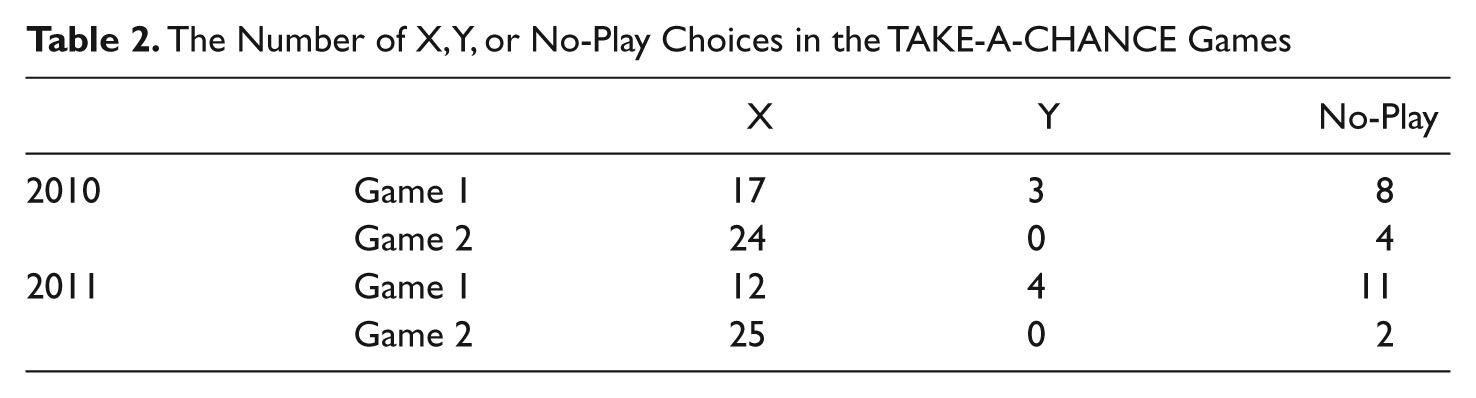
In Game 1 of 2010, players who chose X earned 0 points, those who chose Y earned 2 points, and those who chose No-Play earned 4 points. In Game 2, no Ys were chosen, so those choosing X earned 8 points while those choosing No-Play earned 4 points. The payoffs in 2011 were identical to those in 2010 in both games. In both years, students cheered and applauded when the results for Game 2 were announced.
In 2010, 25 players provided estimates in Games 1 and 2 of the likelihood that all would choose X, which allowed for a matched t test. The mean estimate that all players would choose X in Game 1 was 64%, which increased to 87% in Game 2, a significant increase (t = 3.90, df = 24, p < .01). In 2011, the mean likelihood estimate of the 23 players in Game 1 was 39%, which increased to 78% in Game 2, a significant increase (t = 5.29, df = 22, p < .01).
Since we ask students to try new ways of dealing with conflict in this course, we are asking them to expose themselves emotionally, which is difficult. The level of trust among students needs to be high if students are to feel comfortable experimenting with new strategies. Before developing the TAKE-A-CHANCE game, I (R.B.P.) assumed that trust among students did develop over the weekend. When a colleague 2 challenged my belief, I realized that I did not know whether trust increased or not. If it turned out that the level of trust had not changed or had decreased, then we should not do exercises that required a high level of trust.
The TAKE-A-CHANCE game showed that in both 2010 and 2011, the level of trust increased among students as evidenced by the increase in cooperative choices, the decrease in No-Play choices, and the elimination of defection choices from Game 1 to Game 2. The significant increase in the estimates that all players would choose X (cooperative choice) from Game 1 to Game 2 further supported the inference that the level of trust increased. These results suggest that students learned to trust others enough to cooperate in a situation where they risked losing grade points for cooperating.
The following is from the written debriefing report of an undergraduate detailing how her experience in the game applied to past situations:
Trust is a difficult thing for me and any game that shows me it is quite possible for me to trust is an eye-opening experience. This game basically reminded me of just about every situation I come across where I am required to trust and the difficulties I face in doing so. Yet, throughout this game, from the first round to the second, I evolved. I began to trust my classmates and wanted to contribute to that trust. During the first round, I had no trust and had no interest in helping that trust. Yet, at the second round of the game, I proved that my trust did develop.
Next, we played CONCENTRIC CIRCLES, an exercise that allows participants to become acquainted, demonstrates the value of active listening, and encourages the sharing of feelings and beliefs (Alternatives to Violence Project/USA, 2002a, p. E-19).
Half the class sat in a tight circle in the center of the room facing out while the other half sat in an outer circle facing in. The facilitator read a statement for which the respondent, A (inner circle), had 2 minutes to respond. Partner B (outer circle) listened attentively, but did not speak. After A finished, B responded to the same statement while A listened. After both spoke, the outer circle moved one chair to the right and another statement was presented to the new pair. The exercise continued for five or six statements and each statement asked for increasingly personal information. For instance, a first statement asked participants to tell of “someone I admire and why” while a later statement asked them to tell about “some things I do to show I respect myself.”
This exercise helps students in several ways: The five or six pairs learn things about each other they would not typically learn in a class; the pairs discover that in spite of some reluctance to speak about personal issues to strangers, they do speak up; and they discover that others have ideas and problems similar to their own. Most report that they enjoyed the experience, once their initial anxiety diminished.
Here is an excerpt from a shy female student who rarely volunteered to speak in the oral debriefings:
While I didn’t like this exercise at first because of fear, I think this was a great exercise! Due to the fact that the class was centered around talking with other people and in some cases telling personal stories. I think it was very wise of the instructors to do this exercise in the beginning of the class. I know I, and I’m sure most of the class, felt more relief after the exercise was over. Never have I talked so much to other people in my classes while at PSU than I did in this class and I think it had a lot to do with this first exercise. We were all able to get to know each other on a more personal level and because we were all forced to talk to each other in the beginning, it made other conversations easier and more relaxed as the class went on.
We conducted the DIE exercise next since the written debriefing report required students to follow the DIE model of debriefing. This exercise asked students to write a description, interpretation, and evaluation of two figures without muddling categories, such as interpreting when attempting to describe. Two 10-inch plywood figures, a male and a female, were placed on a table at the front of the room. The figures can be fitted together so that the male bends over the standing female who looks up at him as they kiss on the lips (Accorsi, 1979). However, we separated and turned the figures so that they faced each other. In this arrangement, the female looks up at a slightly taller male who appeared to stare at his shoes.
The students’ descriptions were laden with interpretation, analysis, and judgment, while important details were omitted. For instance, the female figure was described as haughty or arrogant and scolding the man for doing something dumb. The male figure was described as being humiliated by her or that he was apologizing. No description read to the class reported that the figures were only 10 inches tall. The exercise helps students learn important distinctions, such as that description is about facts so can be right or wrong and that some descriptions are more complete than others. On the other hand, interpretation and evaluation are subjective and cannot be judged right or wrong.
Simple exercises, such as DIE, often generate powerful effects. Here is a graduate student’s evaluation of a game she initially saw as silly and only worthwhile for undergraduates:
I learned more from this game than any other. I was absolutely blown away at how far off I was from what it was that I was seeing. I did not even see the potential for what it ended up being. This was another invaluable lesson on withholding judgment and the importance of the belief in the impermanence of our evaluations and maintaining an openness to being wrong and therefore, being teachable.
Importance of LIGHT AND LIVELIES (L&Ls)
A difficulty in a short workshop that uses more than a few simulations, games, and exercises is that students have little time to let go of lingering feelings or thoughts before another exercise is introduced. Our course relies on one of the successful strategies used by the Alternative to Violence Project, USA, which is that after participants experience a lengthy or emotional exercise, AVP workshops play a short, energizing exercise called a LIGHT AND LIVELY (Alternatives to Violence Project/USA, 2002b).
An example of a physical L&L is THE BIG WIND BLOWS, a variation of musical chairs. Players sit in a circle and the player who is it calls out, for example, “The big wind blows for everyone wearing glasses,” and all those wearing glasses must get up and find another chair. The last one standing is it for the next round and must call out a different big wind blows.
An example of a nonphysical L&L is MRS. MUMBLY. Players sit in a circle and take turns asking the person next to them whether they have seen or talked to Mrs. Mumbly. The catch is that if either speaker or listener laughs, smiles, or shows their teeth when speaking, they are out. L&L’s generate lots of laughter with a consequent release of tension.
After the debriefing and note taking for the DIE exercise, we played an L&L and followed that by reading A Soft Answer (Dobson, n.d.). In this story, an old man stopped a potentially violent fight between a drunk and an aikido expert. The aikido expert was ready to fight the drunk when the old man transformed the conflict by listening to the drunk’s problems empathetically. We used this story to encourage the students to look for ways to transform the conflicts in their role-plays (Alternatives to Violence Project/USA, 2000d). We then excused the undergraduates so that we could work with the graduate students on their role-plays.
Preparing for the role-plays
We distributed guidelines and helped graduate students create scenarios for their Sunday role-plays. Because the role-plays are unscripted, there is no guarantee that they will be seen as instructive for the audience. In 2009, for instance, graduate students had difficulty creating role-plays of actual conflicts, so we informed graduate students in 2010 and 2011 that a conflict means that one person’s goals seem to be at odds with another’s. We also gave examples of typical interpersonal conflicts until convinced that they understood.
Session 2
In the morning sessions of our course, we played longer, more complex simulations/games when students were fresh. After our grounding session on Saturday morning, we played THE NEW COMMONS GAME (Powers, 1993) with 10, three-player teams. In this game, players experience the “Tragedy of the Commons” (Hardin, 1968) and discover that trust, while important in maintaining relationships between players (agencies, nations), needs the support of group-imposed sanctions to control the overexploitation of a commons resource.
If teams cooperate on every trial, the payoff matrix (simulating a biological resource) remains rich and teams earn many points. However, if some teams overexploit for even a few trials, the matrix decreases (simulating a decline in the resource) for both cooperators and exploiters.
Our game lasted 22 trials and ended with an all-cooperate play that earned only a small percentage of what an all-cooperate play earned in the beginning matrix. One team attempted to persuade other teams to adopt a strategy of fining defectors in early conferences, but was outvoted. This team continued to play the fine card, which eliminated any gain for the defecting teams, but at considerable cost to themselves. They persisted in this strategy across most trials, which helped keep the matrix from sinking further.
Halfway through the game, a majority of teams consistently voted against having the scheduled 2-minute conference. The failure to conference is a good indicator that the collective will not solve the dilemma. On the last two trials, the collective did confer and two teams agreed to take turns playing the fine card. On the next to last trial, the collective played as promised and the nine cooperating teams received the best possible payoff for that matrix. On the last trial, the team that should have played the fine card played a triple defection card, earning 3 times the pay of a single defection. This team earned the most points and won the game, but the protests at their betrayal were loud and long. The following is an example from a graduate student:
First, I was annoyed that, as I had a special card that allowed me to ask questions to any team at any time, I found that one team in particular was in it to for themselves and a perfect example of why resources are in the deplorable state they are in today. I was angry and disgusted with their answers to my pointed questions about their actions as they repeatedly answered my questions indicating they were not interested in a coalition and wanted only to win points for themselves—they were not interested in conserving resources! They wanted points and I asked them what they thought they were going to purchase with those points if all resources were gone! Undoubtedly they would have to take that money to build up their military to go after those resources that they will have become so dependent on. Additionally I was disappointed that, in this Conflict Resolution class, there was not a consensus on focusing on increasing the resources. I was angry that anyone dare come into the domain of CR and want to do anything different. Finally, I was blown away by Team O and their deplorable trickery!
Villains, victims, and heroes
After a break, we played an exercise based on Gary Harper’s (2004) model of interpersonal conflict called the DRAMA TRIANGLE described in The Joy of Conflict Resolution. The exercise illustrates the roles of villain, victim, and hero that the parties to a conflict tend to adopt. It helps students see that, in any extended conflict, we play more than one role, and sometimes all three roles.
Students were asked to record an interpersonal mistake they had made without explaining or justifying it (Tarvis & Aronson, 2007). A large triangle was then taped to the floor with the words villain, victim, and hero taped at the corners. To demonstrate the exercise, a facilitator (R.B.P.) stood on the appropriate angle and read a short account of his mistake. He started as a hero, became a victim, and ended as a villain.
The mistakes read to the class by six volunteers were riveting and illustrated how ineffective each role was in dealing with conflict. Several shy students discussed the value of this exercise in their written debriefing reports. Here is an example:
I felt shame when writing down my mistake. It was the first time I had written it down and in my doing so I solidified the fact that it was indeed a mistake. I was the sole person responsible for the mistake to happen and I felt weighed down. Watching and listening to my classmates go into the drama triangle and share their mistakes, I felt a bit inspired and relieved. They were people too, who had made a variety of mistakes and I didn’t suddenly see them in a negative light. Part of me wanted to enter the triangle to release some of the stress I was causing myself, but I clam up in large groups and find that my speech becomes garbled. I didn’t want to share a personal story and then feel foolish for messing it up.
Session 3
After lunch, we went through the grounding exercises and then played GROUP, GRIPE, GROPE, an exercise in which participants examine the ways they contribute to a conflict and are encouraged to assume responsibility for it (Kimball, 1997). Students first described all the bad things a person could do that would sabotage group work (GROUP). Next, they described their worst conflict in a work setting (GRIPE). After this, they told a partner how they contributed to the conflict they just described (TRUTH TELLING).
We did not have time to complete the last phase (GROPE), in which players reflect on what they have learned, write down what they could do to change behaviors that contribute to a conflict, and then confide their plans to their partner.
This exercise was a follow-up to the DRAMA TRIANGLE, reinforcing the idea that in every conflict the parties share responsibility for creating and maintaining a conflict. After we debriefed, we did an L&L and took a break.
Learning to be assertive
The assertiveness section instructed students on the difference between assertive, aggressive, and passive behavior; how to use I-statements; and the concept of a win-win solution. The short lecture was followed by several exercises to develop skill in assertive behavior (Alternatives to Violence Project/USA, 1996). Assertiveness skills are helpful in conflict resolution because
Assertiveness means asking directly for what one wants or needs in a way that respects others.
Assertive communication often produces an assertive, respectful response in return.
How one asks for something affects the relationship between the respondents as well as the outcome.
Learning to be assertive helps those who are too aggressive as well as those who are too passive.
Saying no to a request without feeling guilty is an assertiveness skill that many students recognize they need to learn. One exercise asked students to mill about the room and ask a favor from each person they met such as, “Will you feed my dog while I’m gone?” and “Will you give me a ride to the airport?” Students were directed to say no to each request. Many students felt uncomfortable about saying no and felt the need to apologize. In two instances, males were able to talk females into saying yes to their requests, in spite of the clear instructions to say no.
Students were given handouts with scenarios (and invited to create their own) to practice saying no and other assertiveness skills. An example of a prepared scenario was “Your roommate is having a long, and loud phone conversation while you are studying for an exam.” An example of an assertive response is “I have a big exam tomorrow and I cannot concentrate while you talk on the phone. Would you be willing to go elsewhere to talk?”
Students took turns responding to each of the scenarios passively, aggressively, and then assertively. We asked them to role-play each style so that they could feel the differences in their voices and body language. We also asked them to note the difference in the response of their partner to each style. Some students realized that they had been aggressive in the past when they thought they were being assertive. Others reported that they were usually passive, but found it freeing to practice both aggressive and assertive responses and said that they were going to act more assertively in the future.
Session 4
The UNFAIR GAME (Powers, 2005) demonstrates some of John Rawls’ ideas about justice as fairness (Rawls, 1971) and encourages players to examine their beliefs about how a just society might respond to the benefit of disadvantaged people.
The class does not know which of three short games they are about to play (Rawls’ original position) and are given an opportunity, first as individuals and then as a group, to adjust the games so that they are a little more fair (or more to their liking). In the CLUB game, for example, 10% of the class are randomly assigned to the A category, which has the potential to earn 4 times that of the C category (70% of players). The B category (20% of players) has the potential to earn twice that of the C category. The number of chips players earn over the course of the games determines players’ life status at the end of the games on a continuum of The Good Life, The Getting by Life, The Struggling Life, or the Don’t Ask Life.
Before any of the games were played, players had the opportunity to adjust inequalities among categories by adding or subtracting a few points to one category in each game. The reasons players gave for the changes they made revealed their thinking about economic justice. For instance, in the CLUB game, players might add points to the C group because that benefited most players (utilitarian principle) or because they believed they were most likely to end up in the C group (looking out for number one). In the HEART game, 70% of players were in the A category and 10% in the C category. Here the utilitarian principle favored giving the points to the A category. However, if players followed Rawls’ reasoning (Rawls, 1996, p. 291), they would always add points to those in the C group regardless of how many players were in this group (allocating the most benefit to the least advantaged in a society).
One graduate student, who was put in the C group in the first game, turned to crime to better his position. He analyzed his emotions, their triggers, and his crimes in detail:
In the first round, I drew the 2 of spades, which was the lowest card in the whole deck. I felt angry and bitter. When I saw how the groups were divided [there were 20 C’s], I felt a little better because there were a lot of other people who were in my same group. But I was still bitter that it was so unfair and the A’s had such an advantage. The triggers included the whole structure of the game, but also the people who were A’s had these obnoxious, proud looks on their faces, and I really HATED seeing that. Richard actually “talked up” the A’s at one point and said how wonderful they were. That was a trigger too. When I started committing “crimes” [he slipped an ace into his back pocket and stole chips] to try and get ahead in the game, my emotions changed. I started to feel guilt and/or remorse. But I came up with ways to justify these criminal behaviors in my mind. “This game is unfair” I kept telling myself. I thought about confessing my crimes during the game [he confessed in the oral debriefing] and kept thinking about if I should commit more crimes or stop. The crimes were really interesting, because they really changed my emotions and thought processes. They led to a lot of confusion and mixed emotions.
The debriefing following the UNFAIR GAME extended into the time allocated for another game, so after a break, we played RAISING CANE, also know as HELIUM STICK, a short game that explores group formation and leadership (Kirkpatrick, 2010). The game also demonstrates how quickly blame follows misperceptions when a group encounters difficulty.
The class was divided into two groups, each with a tent pole, and although the groups were not told to compete, they did. Students lined up shoulder to shoulder on each side of the tent poles and extended their index fingers, creating a zipper-like pattern with the fingers of the players across from them. The facilitators placed the stick on top of the zipper of fingers, held waist high. The objective was to lower the pole to the ground as a group. The players had to be touching the underside of the pole at all times and they could not grab the pole.
When play began, the pole exhibited its natural tendency to go up instead of down because of the uncoordinated pressure of all the fingers. Both groups had trouble and had to start over. Some in each group blamed others for their failure. Success only came when leaders emerged and urged individuals to work as a team.
Session 5
After the lunch break, we repeated our grounding session and then the graduate students performed their role-plays. These role-plays used the structured model of role-play developed by the AVP, which emphasizes the importance of de-roling and transforming power in creating a safe and effective experience for the participants. The role-plays were performed once as the conflict might typically play out and a second time after the players had been encouraged to look for a transforming moment where humor, empathy, or some other strategy could be inserted to defuse the tension in the conflict. A process of de-roling is used in which the facilitators ask each character what they would like to say to the other characters, if they are finished acting as that character, then what each actor wants to say to his or her character in the role-play.
After the players had been de-roled, the class discussed the role-play and suggested possible actions that might have led to a better outcome (for more details, Alternatives to Violence Project/USA, 2002c, Section G on de-roling players and debriefing role-plays).
One team of three graduate students created a role-play involving a 15-year-old girl brought home intoxicated late at night by a policeman who was a friend of the family. The father, recently widowed, loved his daughter, but had been inattentive to her since the mother’s death. The graduate student who played the young girl was surprised by the strength of her emotions during the role-play:
I experienced a deluge of emotions during this exercise, but at the center of my being I felt hurt, mad, and lonely. If I were to use blame words, feelings dependent on others’ actions and their effect on me, I would say I felt: embarrassed, humiliated, disrespected, dehumanized, misunderstood, and unloved. As our role-play was unscripted, I was unprepared for the way in which my teammates would play their parts. There were big triggers, which were the strong words I heard used toward my character: “What happened? You used to be such a good girl,” “you need to control her,” “put a lid on her,” “put a leash on her,” “out of control.” When I heard these phrases I felt wounded, attacked, and I was immediately on the defensive. I was frustrated and taken aback by the way in which my group mates communicated with me in the role-play. I expected the second role-play, where transformative power was supposed to be used, to be like three conflict resolution graduate students using their skills in a role-play situation. I was unhappy because I felt as though I was alone in my attempts to transform the second role-play. I felt like I had landed in the middle of a boy’s club and was looked down upon like a smashed slug in the middle of a dance floor. It was definitely a learning experience for me, and I feel as though I need to look into why I was so involved and affected by the role-play. I am going to spend time sitting with my discomfort and frustration, in hopes of learning about why I was affected, and hoping to grow from the experience.
After the three role-plays, we played an L&L and took a break. Following the break, we conducted the APOLOGY/FORGIVENESS exercise to develop skill in making an effective apology and to gain some understanding of forgiveness.
We gave students a handout describing an effective apology (Lazare, 1995) and then we asked them to think of a situation in which they needed to apologize to a person they had hurt or ask for an apology from someone who had hurt them. They also had the option to forgive or ask to be forgiven. Students wrote their apology or request on one side of a card and on the back they wrote what they would like to hear in response from the other party. We cautioned them not to choose a conflict that was highly emotional because some students who did so in the past either could not begin the exercise or could not complete it.
Groups of four then retreated to a private spot and took turns as they read what they had written and listened to the response from their partner. They were instructed to allow a period of silence after each person’s turn. After all in a group had read their cards, individuals discussed his or her experience and any benefits of the exercise with teammates. After all teams had finished, we reconvened the class and debriefed.
Although this exercise appears simple and easy to take part in, it can elicit strong emotions. In spite of our caveats about not choosing highly emotional conflicts, some students did. In one instance, a student benefited from choosing a highly emotional topic. She had been an intravenous drug user for several years and chose to apologize to and ask for forgiveness from herself for all the pain she caused herself. Here is her response to the other things learned question in the debriefing report:
I learned what next step I will take in resolving this internal conflict that tortures me. I am going to call an old counselor whom I saw from thirteen to nineteen years old and attended many a workshops with at _________. I am going to call her, explain to her where I am and ask that she see me. I think that processing some of this with her will help me forgive myself. It will be like going back in time to seeing myself before I made these choices that lead to so much trauma. I just put her phone number in my cell phone and will call her some time later today. Thank you for a wonderful class and this opportunity to transform this personal conflict.
After the APOLOGY/FORGIVENESS exercise, we played the second TAKE-A-CHANCE game (discussed earlier). After that game, we gave out the course evaluations and closed the course with a Texas hug (a group hug).
What We Have Learned: Good Practices
Oral Versus Written Debriefing
Almost two decades ago, Lederman (1992) called attention to the importance of debriefing in a special edition of Simulation & Gaming. With the exception of Petranek, Corey, and Black (1992) in that issue, the emphasis was on oral debriefing. While oral debriefing is necessary, it is not sufficient for effective learning, especially in a weekend class of 25 to 30 students playing more than 10 simulations and games. It was sometimes difficult to find time in the oral debriefing to do more than allow the venting of emotions, especially after a long and intense exercise. At times, discussions were cut short before everyone had a chance to speak, due to time constraints or the obvious need for a break.
Petranek et al. (1992) discuss two assumptions teachers make about the extent of learning from the oral debriefing that may be unwarranted. The first is that all students understand an idea or interpretation once it has been discussed. The second is that all students have shared all they felt and thought during the debriefing. They conclude, “In reality, the professor has very limited knowledge of these learning processes on an individual basis” (Petranek et al., 1992, pp. 178-179).
Petranek et al. (1992) cite the following benefits of keeping a journal, which we believe apply to the written debriefing report as well:
Writing forces the student to organize the material in terms of personal experience, for example, the student who confessed to cheating in the UNFAIR GAME majored in Criminal Justice and, as a result of his experience, better understood at an emotional level why people who believe life is rigged against them will turn to crime as a means of surviving.
Writing allows private communication with the teacher about a difficult problem, for example, the female in the DRAMA TRIANGLE exercise who could not share her mistake in class because she was “afraid of making a fool of herself.”
Writing allows a shy student to report thoughts and feelings that would otherwise not be heard, for instance, the female in CONCENTRIC CIRCLES who reported talking to fellow students more in this class than any other class, in spite of her fear.
Writing allows students to offer thoughtful, personal feedback about teacher mistakes and to do so privately. Such feedback helps improve teaching. (pp. 180-181)
For all of these reasons, the written debriefing report is an integral part of our course and we believe it essential to help students meet the learning objectives. The majority of debriefing reports provided an in-depth analysis and interpretation of experience that was rich in detail and forthright in disclosing fears and shortcomings. Insights about the self and personal relationships were common. This level of detail and insight did not occur in the oral debriefings.
Student Evaluations
Table 3 shows student ratings of the course on a 7-point scale with seven being high. Over the 4 years, 86 of 112 students (77%) rated the course a six or seven.
Students were also asked what they liked or found valuable about the course and in 2010 (the highest rated course), the comments were as follows: 12 commented that they were actively engaged while having fun, 9 found the interactions and building of a community most valuable, and 9 liked that the information could be applied or that we dealt with real-world problems.
Mean Student Ratings of the Course on a 7-Point Scale Across 4 Years
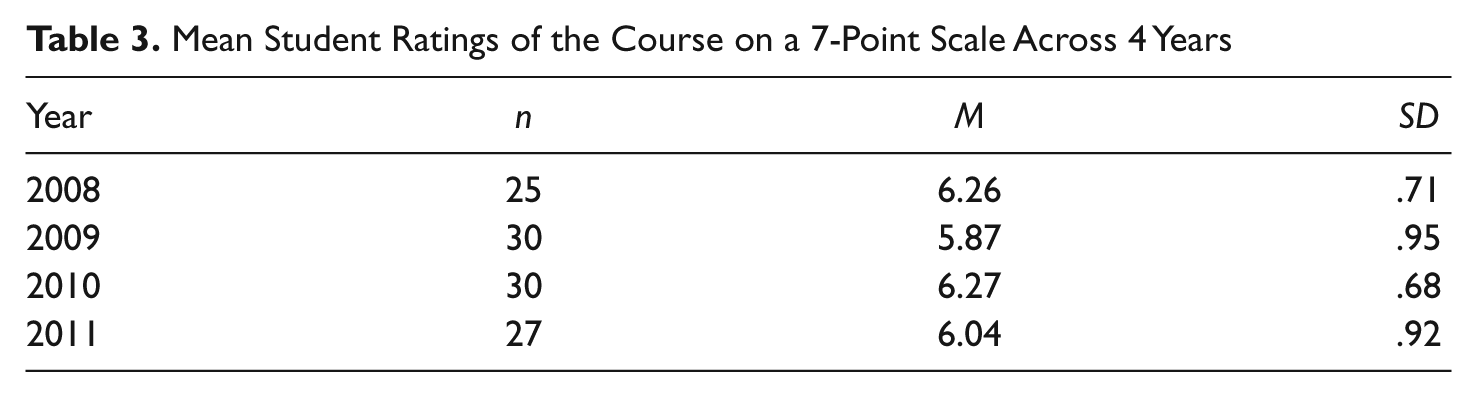
Student comments in 2009 (the lowest rated course) as to what they did not like or find valuable were as follows: six said they did not learn much from the role-plays; six complained about a specific game, with the TAKE-A-CHANCE game receiving three complaints; six said that the instructions to the games were not clear or that the games were confusing; three said they needed more breaks or that the breaks were not long enough; two said some games were too complicated; one was uncomfortable hearing intimate personal details from strangers; and seven had no complaints, saying they liked everything.
Advantages of two facilitators
Two facilitators are better than one in several ways:
Two facilitators help maintain energy levels. To facilitate and debrief a long and intense simulation or game is physically and mentally wearing. It would be difficult for one person to maintain the physical energy and mental acuteness required to conduct an entire 4-hour session. However, two facilitators can switch roles with one serving as facilitator while the other takes a break and observes the interactions among players and between players and the facilitator. In a complex game, such as THE NEW COMMONS GAME, so much goes on within and between teams that a single facilitator would miss any number of critical moments. Furthermore, some simulations, such as BAFA BAFA (Shirts, 1970, 2011), require two facilitators, one for each culture.
A broader facilitator perspective is achieved with two facilitators. Our course has male and female facilitators, which ensures a broader perspective on gender issues. For instance, our female facilitator brought feminist-based assertiveness training to the course while our male facilitator brought his knowledge of large-scale simulations. Regardless of gender, a second facilitator brings different knowledge, interests, and experience to the course.
Two facilitators can play off each other and provide a richer learning environment than one. An example comes from the 2010 course. We had finished the assertive training section and were taking a break when a female student approached me (R.B.P.) and asked if she could be excused early. I asked her to stay so that we could do a last, short exercise. She said no, and repeated her request. Once again I asked her to stay and, though she hesitated, she said no. I gave up and let her leave. It turned out that K.K. had been standing behind me and coaching the young woman to say no. We laughed and realized that we had just provided the student with an opportunity to practice her assertiveness skills in a real-life situation, something that would probably not have happened had I been the only facilitator.
Modeling communication is easier with two facilitators: For a conflict resolution class especially, it is important for students to observe how the co-facilitators work together. Disagreements between facilitators are inevitable over the long weekend, but how they are handled serves as a model for how students could deal with conflict. How does a facilitator correct the partner when the partner omits an important step in the instructions? Does either get annoyed or concerned about protecting the ego when corrected? Does the one who corrects assume a superior tone or posture, either consciously or unconsciously? Do they interrupt each other? How do they make joint decisions? Over the 4 years we have taught this course, we try to be there for each other as situations occur and to thank each other when corrected. In 2011, a graduate student volunteered privately that she was impressed with how well we worked as a team, and some students have mentioned this in the course evaluations.
Thorough planning
We like to stay flexible in the moment to make the best use of the learning opportunities in games and simulations. Although we use a foundation of careful planning, we incorporate alternate plans in case of unexpected outcomes. For example, in 2011, our debriefing extended too long to play the next scheduled game, so we inserted RAISING CANE, a shorter game.
Creating a safe environment
Simulations, games, and experiential exercises promote an active atmosphere in the classroom. Since most students are accustomed to assuming a passive role in class, our teaching methods initially produce insecurity and anxiety for some. To help create an emotionally safe environment, we inform students that any highly personal information disclosed in class should be respected and kept confidential. We also ask students to refrain from judging classmates and to hear minority opinions with an open mind.
In the role-plays, students do not use their own names and we de-role players so that roles are dissociated from the real person. As in the role-plays, it is important to encourage those holding the majority opinion to separate the person from the minority opinion being expressed.
We ask students to stretch themselves, to go outside of their comfort zones, and we make that more probable by creating a large comfort zone for experimentation. Trust among students grows over the weekend and the atmosphere in the classroom becomes safer with each session. As a result, students are willing to try alternative ways of behaving; they can be bolder, more creative, and experience the consequences of their choices.
Creating and working with uncertainty
Our class experience is different with every group of students, mainly because of the variety of students’ level of maturity and background. No guarantees exist as to what will emerge from a given exercise for a particular group and we can never be prepared for all outcomes. If students respond to an exercise in a way that is new to us, we use it as a learning opportunity, trusting that the fruits of the discussion will benefit everyone. For instance, in the 2011 class, although we did not plan an activity around race, an earnest and intense discussion of race occurred after a role-play. We could have stopped the discussion; instead, we explored the issue because of the importance of the topic for students and it fit into our objective of exploring large, social conflicts.
What We Have Learned: Mistakes
Judging Others
I (R.B.P.) made a major mistake while teaching a class prior to this course when I conducted an experiential exercise that involved judging participants at moments when they exposed deep, personal thoughts and feelings. I have learned from this and other games that judging others or their work, even in a trivial context, usually elicits a negative evaluation of the experience and hostility toward the judges. As a result, I have removed a judging component from one of my games and no longer use games that involve judging others.
Not Trusting One’s Own Judgment
When teaching assertiveness, I (K.K.) included the strategies of fogging and broken record because they are generally included in assertiveness training. Fogging involves diverting the other party, while broken record is simply repeating one’s statement while refusing to engage in argument. Although these strategies may be useful in some situations, they are evasive and somewhat deceitful, which does not lead to productive interpersonal connections. My mistake was in automatically including them because they are usually taught, instead of trusting my own judgment. I recognized my mistake when a student complained about those techniques and I could not defend them. I did not include them in the following year’s class.
Quick Decisions Are Not Always the Best
Decisions made without prior planning do not always turn out well. We have learned that when that happens, the best course of action is to be honest and transparent while getting the class back on a productive path. Protecting our egos is not as important as creating a useful teaching moment through transparency. While facilitating CONCENTRIC CIRCLES in 2011, I (K.K.) tried a new way of switching pairs of participants that did not work and created confusion. I quickly returned to the planned method while openly explaining my mistake.
Creating Too Much Risk
The TAKE-A-CHANCE game challenged students’ trust of others with the possibility of losing class points. The 1st year we played this game (2009), the potential point loss was too great and a student’s grade could drop from A to B, for instance. Although the potential point loss generated a lively discussion, the greater learning was obscured by students’ insecurity about their grades. The following year we reduced the risk while keeping the incentives high enough to maintain motivation.
Summary and Conclusion
The Playing With Conflict course used games, simulations, and role-plays to teach basic conflict resolution concepts and skills. Educating through direct experience helped students try out behaviors in a conflict and in a safe learning environment. For example, students practiced listening effectively and communicating assertively, not aggressively, in an environment where no one judged their awkwardness or lack of skill. The simulations, games, and exercises required that students shift from passive to active learners. Using experiential exercises often produced deep reflection and a rethinking about how to deal with a significant personal conflict. Students explored various consequences of a new behavior and wrote about how an experience felt and what it meant to them.
Immediately after a major experiential exercise, an oral debriefing was held followed by 10-minute period in which students took notes. After the weekend part of the course ended, students wrote a debriefing report following the DIE debriefing model. The written debriefing report asked students to apply the meaning they found in the exercise on three levels: to themselves personally, interpersonally, and to larger social conflicts.
The written debriefing report has several advantages:
It forces students to organize their thoughts and to integrate their game experience with their life experience.
It gives shy students the opportunity to express their feelings and thoughts.
It allows teachers to hear the feelings and thoughts of all students.
It provides private, critical feedback to the teacher, leading to improved teaching.
Two procedures used at the beginning of each session, a short meditation followed by a reading about being fully present, grounded both students and facilitators by helping them put aside outside thoughts and enter fully into the class experience. Because the course is highly interactive and constantly changing as the exercises and group dynamics change, the full presence of the participants is essential.
We believe that the L&Ls were another essential element that made for a successful course. These short, fun, and often physical exercises were inserted between longer or intense games to shift the emotional energy of the class. After THE NEW COMMONS GAME, for instance, some teams were angry with a team that broke an agreement to cooperate, and their anger was slow to cool in the debriefing. An L&L allowed the anger and tension to dissipate so that we were able to introduce the next exercise with all students ready to participate. The L&Ls were also used to break up long periods of sitting.
Two facilitators made 2 points of view available in designing the course, in the oral debriefing, and provided a model of teamwork for students. They also allowed one facilitator to rest and observe while the other facilitated.
In 2010 and 2011, the level of trust among students increased over the weekend as measured by improved cooperation and an increased belief that others would cooperate in the TAKE-A-CHANCE game. Most students (77%) evaluated the courses positively and most reported they liked most of the games played and appreciated the opportunity to create a community. They also reported that they learned valuable lessons about themselves and developed some skills that would help them better navigate interpersonal relationships.
Footnotes
Acknowledgements
The late Artis van Rassel, a wise woman and talented facilitator, was invaluable as my (R.B.P.) co-facilitator and codeveloper of the curriculum for the current course.
Declaration of Conflicting Interests
The authors declared no potential conflicts of interest with respect to the research, authorship, and/or publication of this article.
Funding
The authors received no financial support for the research, authorship, and/or publication of this article.
Notes
Bios
Contact:
Contact: