



Abstract
A growing literature exploring large-scale, identity-based political violence, including mass killing and genocide, debates the plausibility of, and prospects for, early warning and prevention. An extension of the debate involves the prospects for creating educational experiences that result in more sophisticated analytical products that enhance preventive policy action. This article details an attempt to bridge the theory to practice gap. It describes the role of a simulation COUNTRY X within the educational contexts of both a graduate course in prevention of mass killing and genocide at Columbia University’s School of International and Public Affairs (SIPA), and a practitioner training workshop designed for regional conflict early warning analysts in Africa. The authors review educational theory describing problem-based learning and apply it to a web-based educational simulation. Using a recent training of professional conflict early warning analysts as their case study, they explore several assumptions regarding the utility of simulated environments as educational tools in moving from theory to practice. Use of the simulation resulted in active and engaged participation by learners, increased capacity for well-reasoned perspective taking, and improved analytical confidence in complex scenarios.
Keywords
A growing literature exploring large-scale, identity-based political violence against civilians and noncombatants, including mass killing and genocide, debates the plausibility of, and prospects for, early warning and prevention (Harff, 2003; Kiernan, 2007; Semelin, 2007; Valentino, 2004). Although these phenomena generally occur during war, this subset of political violence traditionally garnered less attention in the social sciences during most of the 20th century. Theoretical neglect ended, however, with the political upheaval following the cessation of the Cold War. Scholars began to explore the complex dynamics of mass killing as a comparative venture with cases in the Balkans and Great Lakes of Central Africa garnering significant attention in the 1990s (Semelin, 2007). A small community of scholars, including historians, social psychologists, anthropologists, political scientists, and international law experts, debated the social, economic, and political dynamics fueling mass atrocities including war crimes, crimes against humanity, ethnic cleansing, and genocide.
As the body of literature exploring mass atrocities has increased over the last 15 years, and social and political processes become better understood, the prospects for prevention have moved to the forefront of theoretical and policy debates. Proponents of preventive action underscore the importance of capacity building as a primary concern with the education of future practitioners from governmental, nongovernmental, regional, and security organizations taking policy priority (U.S. Holocaust Memorial Museum, American Academy of Diplomacy, and U.S. Institute of Peace, 2008). Complicating current classroom efforts to understand and address the complex phenomena are pedagogical challenges that exist in moving from a synthesis of the burgeoning theory in the classroom, into preventive policy and practice in the field. An extension of the debate involves the prospects for creating educational experiences that highlight the complexities and challenges of early warning and prevention of mass atrocities and mass killing, while also creating opportunities for the learner to identify actionable solutions. The challenge for educators is designing experiences that, while remaining true to the underlying theories and studies that describe the complex phenomena, also prepare learners for using what they know in actual decision making.
This article details an attempt to bridge the theory to practice gap in an educational environment. Our research explores the extent to which web-based learning environments can influence the performance of early warning mechanisms for mass atrocities, the challenges in educating students at the academy and practitioners in moving from theory to practice, and the prospects for using similar tools in future capacity building initiatives. The article describes the impact of an educational computer simulation called COUNTRY X within the contexts of both a graduate course called Early Action: Preventing Mass Killing and Genocide at Columbia University’s School of International and Public Affairs (SIPA), and a policy-practitioner training program designed for conflict early warning analysts in Africa. We explain the impetus for the simulation first to address a pedagogical challenge in the course at SIPA, detail the iterative development of the web-based environment, and finally describe its deployment in training of conflict early warning analysts from an African regional organization. 1 We use evidence from the analyst training to explore several assumptions about problem-based learning (PBL) regarding the utility of simulated environments as educational tools in moving from theory to practice.
A Note on Preventing Mass Atrocities
Understanding the dynamics that lead to mass atrocities is not only a matter of intellectual interest. The horrors of mass killings in the Balkans and Great Lakes region of Central Africa in the 1990s resulted in unfathomable human suffering, presenting grim lessons for scholars and policy makers, alike. However, more than 15 years later one observes a sustained tempo of identity-based political violence in such diverse conflict environments as Sri Lanka, Sudan, South Sudan, Iraq, Democratic Republic of Congo, Kyrgyzstan, Guinea, Côte d’Ivoire, and Afghanistan to name a few, with new crises erupting in Libya, Yemen, and Syria linked to the so-called Arab Spring. While Rwanda in 1994 is not Afghanistan in 2010, and Sri Lanka in 2009 is not Côte d’Ivoire in 2011, these individual cases lead us to question the collective lessons-learned by those domestic and international actors tasked with the analysis and prevention of mass killing, with the implications of potential and real-mass atrocities continuing to underscore the vulnerability of civilian and noncombatant populations. Statements on the situation in Syria and South Kordofan State, Sudan, Office of the Special Advisor on the Prevention of Genocide [OSAPG], 2011.
As this article was being prepared, the uneven international response to burgeoning violence in Côte d’Ivoire, Libya, Syria, and Southern Kordofan—and their incongruous official justifications: the United Nations (UN) and French intervention and regime change to uphold a democratic electoral result in Abidjan despite wide-spread targeted violence against civilians; the North Atlantic Treaty Organization (NATO) intervention to protect civilians from mass atrocities in Benghazi while refraining from the same in Syria and Southern Kordofan—laid bare the contradictions and complexities of international late-stage prevention policy in practice, while underscoring the self-interest of political will. In fact, rather than late-stage prevention, one may persuasively argue failed prevention triggering intervention in these cases. The Côte d’Ivoire end game, in particular, represented a failure of a decade of international stewardship according to regional observers, with the postelectoral stalemate resulting in conservative estimates of over 3,000 civilian dead including reports of mass graves, over 1 million displaced (Yabi, 2011), and regime change through an international military intervention.
The tasks of predicting and preventing episodes of mass atrocities therefore remain fraught with challenges. Despite promising conceptual and technological advancements in global crisis early warning including the institutionalization of sophisticated conflict mapping (Zenko & Friedman, 2011) and development of open-source geographic information system (GIS) applications and platforms (Ushahidi, Swiftriver, and the Satellite Sentinel Project are examples of the more publicized recent efforts), fitful normative endeavors in the last decade continue to underscore the political challenges associated with preventive action (Report of the Secretary General on Early Warning, Assessment and the Responsibility to Protect, 2011). For analysts and policy makers alike each conflict system and specific outcome relies on the complex interaction of numerous independent variables. Scholars have isolated independent variables as complex and dynamic as regime type, regime loyalty, political objectives, military capabilities, actor intent, and escapability of potential victim groups (Harff, 2003; Valentino, 2004) to define the mass atrocities landscape.
While various models in political science attempt to predict the onset of interrelated phenomena ranging from civil war (Collier, Hoeffler, & Sambanis, 2005; Fearon & Laitin, 2003; Kalyvas, 2006), to genocide and mass killing (Harff, 2003; Valentino, 2004), the limitations of these models to predict future conflagrations accurately and consistently serve as a warning to analytical hubris. While Kenya had a relatively recent history of identity-based electoral violence dating back to at least the 1990s, the international community was unprepared to respond to the burgeoning targeted violence following disputed elections at the end of 2007, despite a massive international presence in the country with Nairobi serving as a longtime hub for East African aid and developmental work. This gap between timely warning and preventive action underscores the theme that these phenomena are complex, dynamic, and the result of interacting forces that hamper the reliability of predictive models for practitioners. We are explicit from the outset regarding the role of our educational simulation, COUNTRY X, not as a model for predicting mass killing, but as an educational environment aimed at capacity building and designed to incorporate theory and case history to better understand the interaction of social, economic, and political structures with complex dynamics that could lead to mass atrocities.
Foundational Assumptions
Despite the formidable challenges to analysis and prevention of mass atrocities discussed above, in our mapping of strategies we were intrigued by the role education can play in prevention. Our educational intervention, COUNTRY X, is a multiactor, role-playing environment designed to educate current and future analysts and policy makers in the dynamics of mass, identity-based violence against civilians and noncombatants including mass atrocities, mass killing, and genocide. We do not take on definitional debates in this article. For more on nomenclature and the politics of naming, see Harff (2003), Valentino (2004), Semelin (2007), and Mamdani (2009). For the purposes of our work with COUNTRY X, we utilize Valentino’s definition of mass killing as a springboard for discussion: “The intentional killing of a massive number of non-combatants” (Valentino, 2004, p. 10). This attempt to move from theory to practice is guided by four underlying assumptions:
Prevention (of mass atrocities and related phenomena) relies on three ingredients established in the theoretical literature: actionable early warning, operational capacity to respond, and political will (Woocher, 2001).
Historical cases of mass killing illuminate the necessity of organization, planning, and relatively well-trained manpower (Straus, 2006; Valentino, 2004; Einsatzgruppen, Interahamwe, Arkan’s Tigers, Janjaweed, and Jeune Patriotes are examples), rendering early warning mechanisms plausible.
Significant progress has been made in the development of global early warning and prevention systems despite two aforementioned challenges: operational capacity and the garnering of political will to respond. For a recent survey of global early warning mechanisms, see Nyheim (2009).
Building operational capacity within regional and subregional mechanisms—including the training of analysts, security personnel, and policy makers—and civil society organizations (CSOs) offers the best investment and opportunity for prevention of mass atrocities due to the challenges of generating political will to respond at the global level (UN Security Council).
The COUNTRY X project is an outgrowth of the first two assumptions above, namely, that the phenomenon of mass killing is preventable. This foundational assumption is vigorously debated by scholars (Semelin, 2007) and policy experts (Evans, 2008) alike and warrants attention from the outset. Our attempt to simulate the complex dynamics of multiple actors and independent variables leading to potential outcomes including mass killing begins with an underlying assumption that, rather than a Black Swan event revealed in hind-site (Taleb, 2010), the phenomena are unique within the broader realm of political violence, capable of being categorized with specific early warning indicators, and preventable once these warnings are recognized and acted upon quickly by relevant regional and international stakeholders.
Political violence is often the result of ongoing conflict exhibiting myriad points of early warning that have gone unaddressed. Mass killing is a singular form of political violence in which potential perpetrators determine that real or perceived threats to their vital interests have become so pronounced that a final solution of mass violence against regime enemies, including civilians, is the most attractive course of action (Valentino, 2004). The development of the content in the environment was directed by multiple theoretical frameworks adapted from the mass atrocities literature, but special mention goes to the strategic logic approach (Valentino, 2004) to mass killing as a primary influence. After setting the context and theoretical lens of our particular focus on mass atrocity prevention, in the following section, we discuss the educational theory buttressing the development of COUNTRY X.
Theoretical Background
The educational position of simulation as tool for teaching has an increasingly vast research base covering many domains. The COUNTRY X environment, however, does not neatly fit into the category of simulation as frequently defined in the literature. Rather, it is a hybrid tool consisting of a few traits typically found in simulations, and others that more closely resemble traits found in the case study method of instruction.
First and foremost, COUNTRY X is a turn-based, multiplayer, role-play educational game in which players must make decisions based on given information, and act on a scenario presented to them. The system presents the results of their decisions after each turn, and each instance of COUNTRY X (a group of four players acting from within roles provided by the system) lasts for four turns. Like most simulations, COUNTRY X does not consist of a full fidelity representation or model of the real world, but rather emulates aspects of it: Real-world variables and details have been included, but certainly not all. This is due either to a perceived lack of applicability to learning objectives, or the prohibitive complexity of their inclusion at the time of development—such as incorporating more (or even all) real-world actors who might be acting on a political scenario, or more of the hundreds of variables that might be influencing certain outcomes. Unlike many simulations, however, COUNTRY X makes no calculations to generate outcomes of player decisions. Rather, the system is completely deterministic: The outcomes of player decision combinations have all been predetermined by the authors of the content (as will be described in more detail). Although a completely deterministic system could be thought of as a sort of “choose your own adventure” in which a player decision necessarily determines a specific outcome, it is important to consider the complexity of the mechanism controlling outcomes in COUNTRY X. Outcomes are not determined by individual player decisions, but rather the combination of all four players (in their different roles) acting on a scenario at once. Another layer of complexity is that not all roles have the same decision options at any moment during a run of COUNTRY X. The options are unique to both the scenario being presented at a particular turn, and unique to the individual role, and players are unable to see each other’s decision options. Because of these complex combinations of variables, options and people, outcomes are highly unpredictable.
This article is focused on the educational intervention overall, including its outcome, rather than on testing specific elements of COUNTRY X, its features or technologies, all of which are less important than the instructional method driving its use. The COUNTRY X project can be considered an example of PBL. Now a well-established instructional method, PBL falls under the larger and dominant constructivist theory of learning first formally described by Piaget in the 1930s. Constructivism posits that learning occurs as the learner actively constructs knowledge via interaction with the world (Poole, 2000). A key elaboration on the constructivist theory of learning is that new information is integrated into preexisting knowledge structures and understandings, and thus the learner is said to actively build meaning through a process of information and experience integration (Bruner, 1990).
PBL, one of the best examples of a constructivism-based learning strategy (Savery & Duffy, 1996), employs real-world or real-world-based cases, a real or realistic problem to solve, and a collaborative group in which to posit and approach solutions. More specifically, a few components of PBL as found in the literature are (a) smaller learning activities anchored to a larger problem; (b) learners supported assuming ownership of the problem and its solutions, sometimes referred to as “activeness”; (c) an authentic problem to work on; (d) the exercise should challenge learner thinking; and (e) learners participate in active reflection on both the content and problem-solving process (Greening, 1998; Koschmann, Myers, Feltovich, & Barrows, 1994; Savery & Duffy, 1996). The use of the COUNTRY X simulation in the context of our training program meets each of these criteria as will be described in the full description of COUNTRY X in the following section.
PBL as an education approach was first described in the research of Barrows and Tamblyn (1980) and its first implementation in medical education at McMaster University in Canada in the 1960s. The idea was originally based on what came out of their research on clinical reasoning: Medical students learned more by practicing solving case problems than by having problem solutions merely explained or demonstrated. The idea of students learning more from the process of grappling with a problem than from receiving instruction could be said to be part of a larger shift from the traditional teaching paradigm that has dominated classroom education for centuries, to the learning paradigm (Barr & Tagg, 1995) where the focus is on what students experience.
Margeston (1997) highlights that PBL is a way to understand learning as a process that can lead to a kind of expertise that differs from what can be achieved in non-PBL environments. He describes subject-based expertise as knowing all the content, or in education research what is often described as propositional or declarative knowledge—knowing that. In contrast, expertise in a PBL context presupposes the knowing of that, and stresses the importance of using the that for the how to, and specifically how to work with problems. He argues that PBL “requires a much greater integration of knowing that with knowing how” (Margeston, 1997, p. 38). It is precisely with this combination in mind that COUNTRY X was conceived and designed.
The use of simulations and role-playing environments to educate students in international relations is a well-practiced methodology. The literature shows evidence of broad application to simulate topics as diverse as diplomacy (Chasek, 2005), conflict (Sandole, 2003), ethnic conflict (Ambrosio, 2004; Dougherty, 2003), international intervention into conflict (Belloni, 2008), insurgency (Earnest, 2009), postconflict peacebuilding (Mendelhof & Shaw, 2009), negotiation (Boyer, 1999; Kaufman, 1998; Saunders & Lewicki, 1995; Susskind & Corburn, 1999), drug trafficking (Flynn, 2000), and international trade (Peterson & Wallace, 2003).
Curricular Design Research (DR) Problematic
The original target audience for COUNTRY X comprised graduate professional students from SIPA who will be entering the fields of human rights, international law, diplomacy, global security, journalism, and policy making. The secondary audience was professional practitioners from around the world, including regional and subregional organizations in Africa, Asia, the Americas, and Europe, as well as governmental and nongovernmental CSOs from the same regions. COUNTRY X was first tested in a Conflict Resolution course at Columbia in the fall 2008, followed by a first implementation in a SIPA graduate course in the spring of 2010 called Early Action: Preventing Mass Killing and Genocide.
In a prevention course, emphasizing case study allows students to focus on lost opportunities for prevention. It gives students the necessary historical perspective to better prepare them for future scenarios. A class question may be framed as follows: How may what we know about the internal politics of Rwanda from 1990 to April 1994 inform our analysis of actor options in Côte d’Ivoire in 2010? Historical understanding alone, however, does not necessarily lead to improved practice as no two cases are the same: Hindsight lessons do not offer the nuanced perspective of a real-time devolution. In addition to the limited usefulness of focusing on historical knowledge alone, courses on preventing mass atrocities sway heavily into theory. Despite the usefulness of both historical and theoretical knowledge, the result is a lack of opportunity to identify which parts of what knowledge can be put into practice.
In summary, the three central DR problematics in our experience in the Prevention of Mass Atrocity courses are as follows:
heavy focus on historical/theoretical understanding while not enough emphasis on prevention practice
no easy means to move the course continuum from mass killing prevention theory to mass killing prevention application
no systematic way for the students to be trained as practitioners in mass killing prevention
DR Hypothesis
We proposed an early warning simulation that would offer students of the preventing mass killing course an opportunity to explore the intricacies of policy formulation and implementation, as information is made available to them. The resulting course takeaway would be a unique learning experience in the context of moving from mass killing early warning to mass killing early action and prevention. The simulation project became an integral part of the course transformation from a theoretical exploration of mass killing, to an applied course that informs and directs future practitioners. The simulation also enhances the instructor’s capacity to gain further insight into student understanding and depth of knowledge when applying class lessons to realistic scenarios. This insight could support the instructor when preparing and evaluating sessions focused on conceptualizing mass killing prevention systems.
The simulation does not have a winning or losing scenario. It illustrates the complexity of managing and acting upon large volumes of information—complete with the requisite disinformation—related to mass killing and genocidal violence from the perspectives of diplomatic, intelligence, military, and civil society communities. We believed it would improve learning by
enabling students to see that there is no single model that leads to, or prevents mass killing
helping the students purposefully process large amounts of information
increasing the student’s ability to make conclusions on what are situations more, or less likely to lead to mass killing
improving the understanding of the ambiguity involved in early warning detection
repurposing and mobilizing various lessons on historical episodes of mass killing
supporting the professor in preparing and evaluating course sessions around mass killing prevention systems
Process Tracing COUNTRY X: Case Study Content and Method 2
The simulated environment in COUNTRY X covers a narrow range and has deep extension (Druckman, 2005) pertinent considering the complexity and destructiveness of mass killing. The variety of the situations modeled encompasses the unique background and starting condition for COUNTRY X (narrow range), but the detail incorporated into the environment is considerable (deep extension). COUNTRY X is a role-playing simulation designed to accomplish training and policy goals; therefore, real-world relevance is paramount compared with other simulation approaches to models such as game theoretical and computer simulations (Druckman, 2005). COUNTRY X depicts a juridical state embroiled in violent, ethnic conflict. Participants receive a background condition detailing the history of the country with political, economic, social, and security structures animating the state of affairs in the country at the outset of the simulated environment. Participants learn that the ruling regime is engaged in counterinsurgency operations in an environment of a zero-sum political struggle, and rapidly deteriorating security with increasing violence targeting civilians and noncombatants.
After receiving the background condition, participants are introduced to a set of independent variables including violence, political discourse, weapons flow, international awareness, and economic stability. Last, each participant receives a detailed biography on four principal actors within the environment: the President of COUNTRY X, a Western diplomat stationed in the capital, a subregional representative tasked with conflict early warning, and the leadership of the opposition in COUNTRY X (Figure 1).
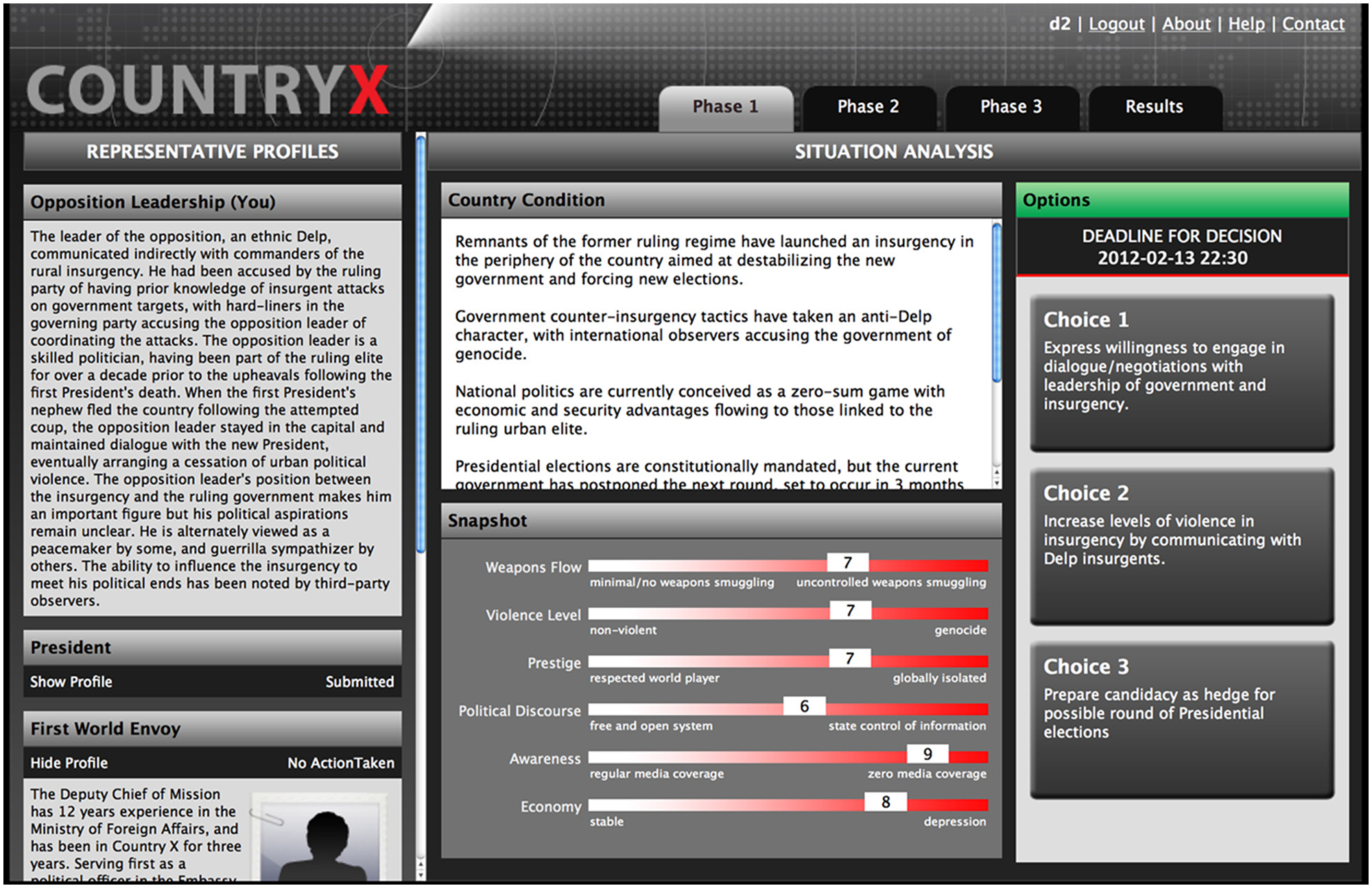
Screen shot of COUNTRY X
Walkthrough of a Turn in COUNTRY X
Once participants log into the site they are randomly assigned one of the four roles by the system, presented with a detailed biographical profile of their role, and then a starting condition to review. Three unique, predetermined decision choices are presented, giving the participant an opportunity to act on the scenario. The decision choices were built into the narrative during the design phase and were guided by course literature, mass killing case history, and learning objectives. These decision choices do not allow for any direct innovation in participant response, as predetermined outcomes for specific combinations of participant decision choices direct each “instance” along one of many possible story arcs. However, after making their strategic choice, a rationale box appears in which each participant justifies the logic driving their choice. It is in this justification that learners explore options presented to them by analyzing the costs and benefits of their options, make predictions about the short-term impact of each choice, and measure the outcomes against strategies other actors may be pursuing.
This learner-driven analysis is a crucial element of the training tool as participants do not initially communicate with each other when making their choices, do not have access to each other’s decision options, and must apply the theory and case history they have learned up to the point of the simulation in the course or workshop. The student rationale text is saved in the system and readily accessible by facilitators throughout each unique simulation “run,” and in the final debriefing that occurs after all turns have been completed. Once all participants have made their choices and saved their rationales in the text section, the participants are given an updated country condition, one resulting from the combination of decisions made by all four actors. Along with a new country condition, the condition of independent variables change as well, moving along a scale that quickly portrays in what direction—better or worse—the situation in the country has moved due to participant actions.
The determining factor behind an updated country condition is the relative weight assigned to each of the four actor’s decision choices and individual positioning at a given time in the simulation story arc. For example, early on in the environment (specifically Turn 1 [T1]), the President’s or opposition leader’s decision carries more significance when compared with the subregional representative. A Presidential choice of increasing violence in response to insurgency, or opposition leader increasing violence in response to counterinsurgency, will largely determine the next outcome state despite the efforts of other actors to decrease violence. But as the simulation continues, decisions carry stronger consequences for specific actors and increased violence may lead to unintended consequences for the architects of such policies. These conditions were designed from the beginning to mirror actual case history from mass atrocities literature, and result from the combinations of decision choices made in the game.
Players, therefore, have control over their decision choices throughout the simulation, but cannot know what outcomes their choices lead to when combined with three other independent actors making choices simultaneously. This unpredictability adds a rich dimension to the debrief that occurs after each decision turn when participants discuss what happened and what choices were made. They are encouraged to challenge outcomes and explore the realism of each new state in light of their decision and the decisions of other actors. Facilitators use these crucial feedback sessions to highlight central themes related to early warning and decision making, as well as a formative evaluation of student progress against learning objectives.
After the simulation is complete, the various outcome states are analyzed and facilitators rely on process tracing with individual participants to revisit seminal moments in the conflict trajectory. It is through this final session of process tracing (Druckman, 2005; George & Bennett, 2005; King, Keohane, & Verba, 1994; Van Evera, 1997) that strategies and policies for prevention become crystallized. This methodology drives the learner-centered experience in COUNTRY X as participants make independent decisions that have stronger or weaker bearing on outcomes at each decision turn. It is not until the final state is revealed, updated after the final decision turn, that learners have a clear understanding of the various outcomes in the environment. The facilitator then traces the process with each group to isolate decisions at each turn, and opportunities (missed and seized) for early action and prevention.
The process tracing method attempts to identify the intervening causal process—the causal chain and causal mechanism—between an independent variable (or variables) and the outcome of the dependent variable . . . Tracing the processes that may have led to an outcome [for our interests, mass killing] helps narrow the list of potential causes. (George & Bennett, 2005, p. 206)
It is imperative to note that many countries in the world exhibit similar starting conditions to COUNTRY X, but cases rarely metastasize into episodes of mass killing. The eight outcomes (dependent variables) at Turn 4 (T4) in COUNTRY X stem from one general starting condition (Turn 1_Start Current Condition) and the causal paths to the different outcomes provide limitless material for group discussion. In all, 26 unique states exist in COUNTRY X (27 states total) emerging from the starting condition (T1) with 9 states in Turn 2 (T2), 9 states in Turn 3 (T3), and culminating in the 8 outcome states of T4 ranging from Elections and Powersharing (T4_S1) to Mass Killing (T4_S8; Figure 2).
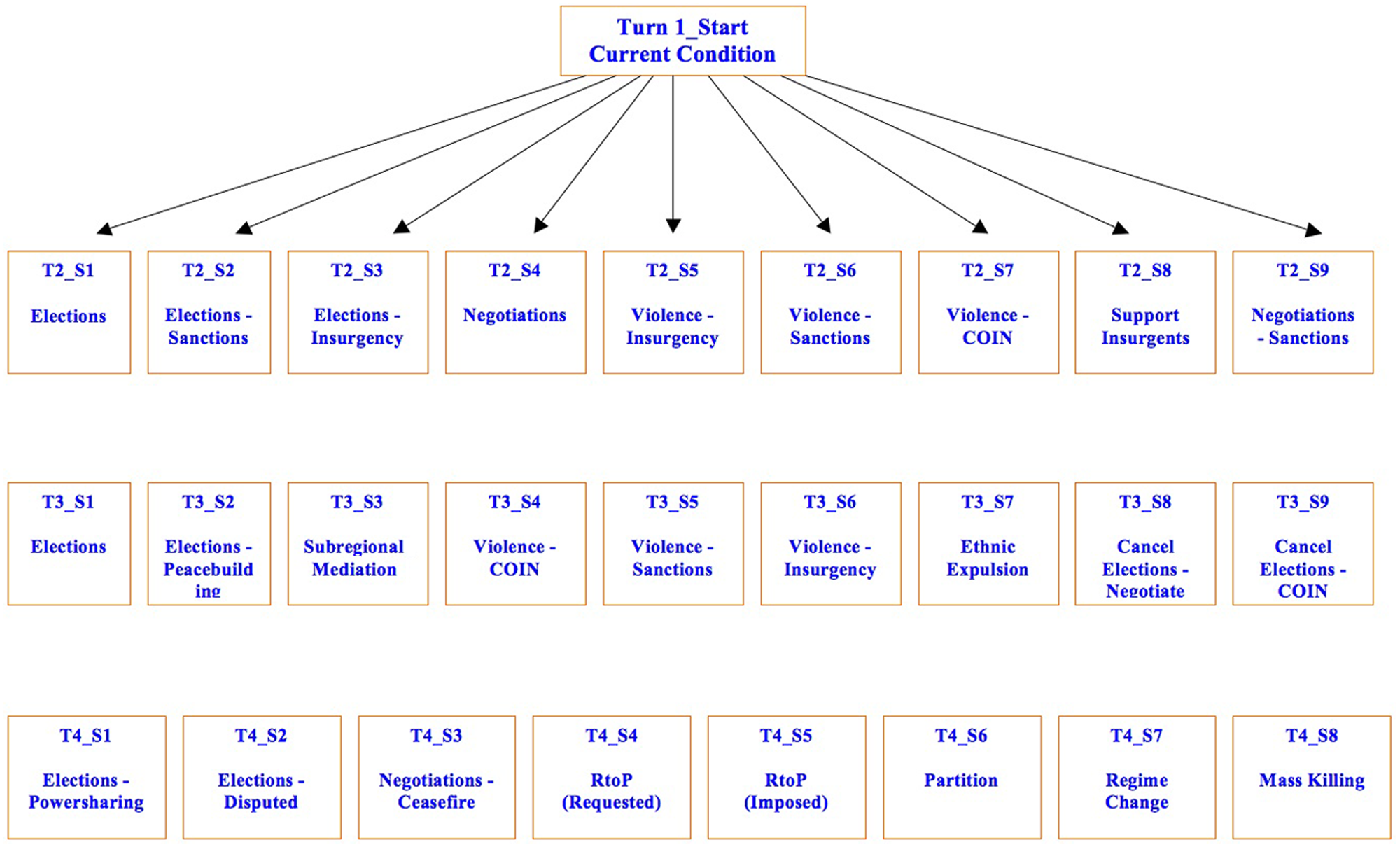
States
Each run of COUNTRY X reveals only one path from T1 to outcomes in T4. For example, a likely scenario that leads to military intervention—a Responsibility to Protect intervention requested by all parties (Turn 4_State 4 RtoP requested)—may include the following arc:
Turn 1 → Turn 2_State 5 Violence-Insurgency →
Turn 3_State 4 Violence-Counterinsurgency (COIN) → Turn 4_State 4 RtoP requested
A strength of the COUNTRY X learning tool is its facility in demonstrating to learners the complexity in deriving an outcome of mass killing given a particular starting condition, when measured against other possible outcomes ranging from elections and powersharing (T4_S1), to de facto status quo (T4_S3), to various forms of military intervention (T4_S4, 5, 7). This is captured in the simulation debriefing for learners when, from the multitude of potential story arcs, it is revealed that there are four possible paths to a mass killing from the T3 state. Depending on the constraints of a particular deployment, counterfactual analysis is applied to each story arc for learners to debate flaws in logic (Van Evera, 1997). Figure 3 shows all possible states linked through all possible story arcs in the simulation. In the final debrief, learners are shown the story arcs produced by their unique runs, and then the four story arcs that leads to mass killing (T4_S8).
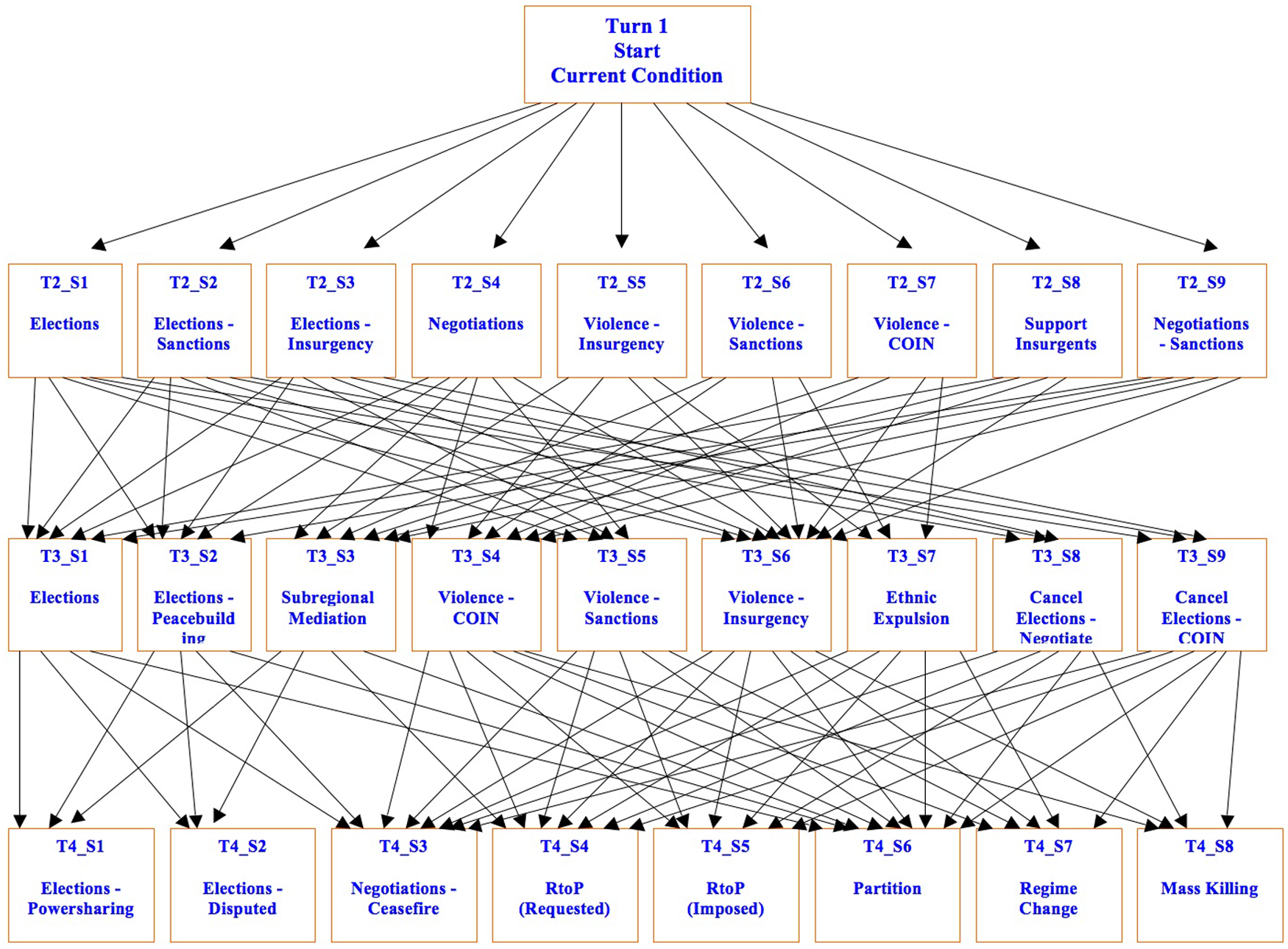
Outcomes
Multiple runs can be conducted simultaneously, depending on the size and learning objectives of each group, with strong differences in the outcomes. To date, we have conducted 17 unique runs of the simulation with five distinct audiences ranging from Columbia SIPA students, to visiting legislators sponsored by the U.S. State Department, to officials from regional organizations focused on conflict early warning and prevention. The results are shown in Table 1.
Simulation Results
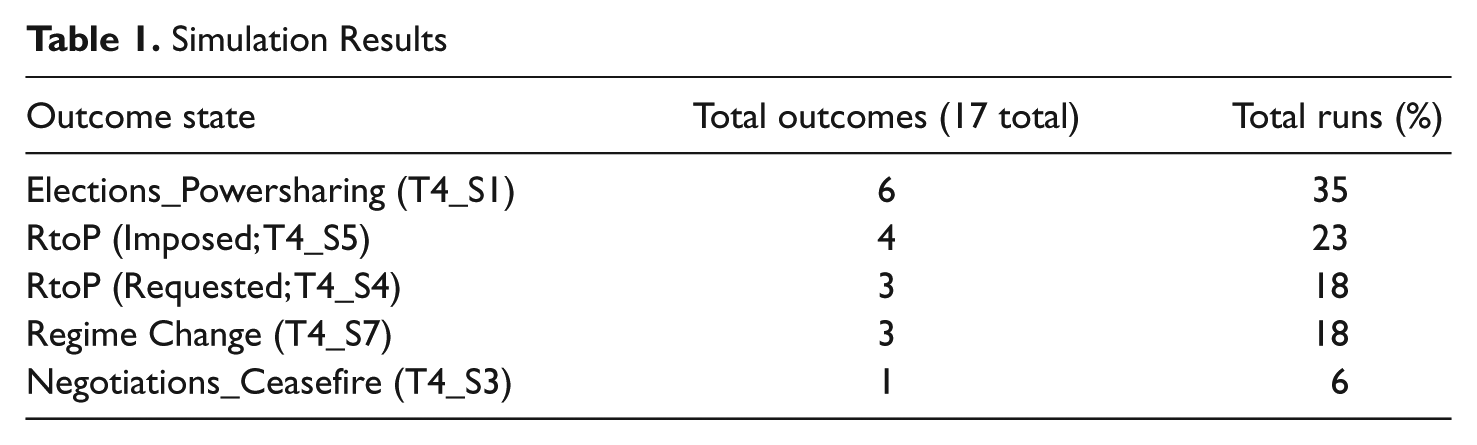
Interestingly, no run has resulted in an outcome of mass killing. In only one of the 17 runs, the President attempted a “final solution” in T3. However, this outcome was prevented by the combination of decisions by other players leading to lively discussion in the final debrief.
The largest simultaneous deployment of COUNTRY X involved five separate runs in a Columbia class setting with 30 graduate students, and five separate runs of practitioners in a field-based training of early warning monitors in Africa. A total of 40 individuals participated in the Africa training. In this workshop setting, each run had eight individuals per table paired to play the role of one of the four actors. This unique setting required pairs to discuss their options and come to an agreement on their decision choice. The smallest deployment of COUNTRY X involved two simultaneous runs with six early warning analysts and represents the case study detailed in the following section.
Research Design and Method
Exploring our theory to practice assumptions about the effectiveness of simulations in educating early warning and prevention practitioners requires systematic data on learners including their prior knowledge, their experiences within the environment, and their analysis and decision making regarding the phenomena in the aftermath of training. As part of an ongoing relationship with an African regional organization tasked with conflict early warning and analysis as part of its security mandate, we had the opportunity to offer a practitioner training in May of 2010. We designed a 3-day training for the organization’s early warning department composed of six professional early warning analysts and accompanying officials to explore the analysis and prevention of mass atrocities in their specific region of work. The first 2 days of our training involved lectures and interactive exercises examining the theoretical and practical underpinnings of the phenomena, with the 3rd day of the training dedicated to immersion in the COUNTRY X environment. Analysts participated in baseline assessments on Day 1 to gauge contextual knowledge and final evaluations upon completion of the training. One year later, we reengaged with the analysts to conduct the research for this article. Their experiences serve as the case study for our work.
Our research design was flexible and to assess the impact of the simulation we surmised depth was crucial through context, therefore choosing a qualitative methodology incorporating a vertical case study of the training with responsive interviewing (Rubin & Rubin, 2005) of the analyst participants. Using this self-reported data, we draw inferences about the effectiveness of our simulation in meeting training objectives, impacting internal communication and analysis downstream, and eventually informing policy-making decisions at regional levels. The interviews were conducted by Skype and phone from New York with the five of the six Africa-based conflict analysts over a 6-week period in June and July 2011. Interviews lasted between 30 and 60 minutes. Due to confidentiality concerns, the names and identifying markers for individual analysts, as well as the name of the specific regional organization, have been withheld by request.
Given the paucity of literature on these types of theory to practice efforts involving simulations, the vertical case study of the analyst training serves as a plausibility probe (George & Bennett, 2005) to determine whether more testing is needed. The conversational partners were asked several open-ended questions regarding their recollections of the training, its content, and their early warning analyst activities in the aftermath. These questions were shaped by review of literature and explored several assumptions within PBL. The questions evolved with each subsequent interview as new concepts and themes emerged (Rubin & Rubin, 2005). We transcribed each interview and coded for concepts and emerging themes. Analysis of the posttraining responsive interviews consisted of abstracting key concepts and themes that were manifest in practitioner memory a year after the training took place.
Data and Results
The most prevalent and salient memory the participants had from the training was the COUNTRY X simulation itself, despite it having been only a small piece of the entire training program. Participants self-reported the simulation as having been the strongest memory, the most useful part of the workshop and they remembered more details about it than any other aspect of the training. Furthermore, when asked about specific benefits of the training that were put into practice in their daily working lives, it was the simulation and its related exercises that were described most clearly and most often. The two primary themes to emerge from the data are role-play as an effective technique for employing perspective adoption to improve analytical skills, and educational trainings alone (with or without simulated environments) do not enhance early warning mechanisms due to the complex linkages between actionable early warning and generating political will to respond.
Regarding the first theme, participants self-reported that the practice of perspective adoption through role-play within COUNTRY X was of great benefit, subsequently leading to improved analytical abilities, improved report writing, and both an improved feeling of legitimacy and confidence within their organization. In our early responsive interviews, the importance of COUNTRY X as a vehicle for role-playing decisions around complex phenomena emerged as a primary concept as the following data excerpt demonstrates:
Analyst 1, Interview 1
It was the role-play in the simulation especially, and the discussion that ensued afterwards when outcomes were displayed. It made one to feel that taking a decision on your own without considering the feelings and sentiments of other stakeholders may not always lead to peaceful settlement of disputes.
From this paragraph, we see Analyst 1 describing a fundamental concept to emerge from our research: role-playing through simulation. We took this initial concept and adjusted subsequent interview questions accordingly. As the responsive interviews proceeded, broader themes related to role-playing began to emerge. An example of this is shown below:
Analyst 4, Interview 1
What I took away what I learned from it [COUNTRY X], I mean we do analysis and we do scenarios, and we try to understand what the different actors are doing, but I think for me that was the first time we had to practically put on the different hats, and going forward I do that in my head every time I have to write a report. You know it’s one thing to analyze and try to build scenarios around the different stakeholders, it’s another for you to practically do that. The simulation exercise I think was really good at doing that, to have us put on those hats, to not think as the analyst in conflict prevention, but actually think the way the different stakeholders would think, and for me that has really helped my analysis.
From this paragraph, we see Analyst 4 again describing the concept of role-playing (“to practically put on the different hats . . . think the way, um, the different stakeholders would think”) building toward the larger theme of role-play as an effective technique for employing perspective adoption to improve analytical skills. All analysts commented on increased confidence in their conflict mapping and scenario building capacities when compared with their prior knowledge, but perspective adoption emerged as a technique that was undervalued or even unknown prior to their use of COUNTRY X.
Analyst 4, Interview 1
It was the first time we had to look at it [the idea of perspective adoption] and now if I need to write a report, I know I have to put on the hats of the different stakeholders. And I think COUNTRY X enabled us to do that. When I have to write my report I’ve had to, more than I would have done before COUNTRY X, put on the hat of the different stakeholders and what their take is and what their decisions might be and I think that has impacted the reports we’ve written. What it has led to is more credibility, and more relevance to our work.
Internal communication was another concept that emerged from the data. Our data indicates that COUNTRY X impacted subsequent internal conversations within the early warning mechanism, with analysts referencing simulation content when analyzing topical events in the subregion. This is an intriguing secondary theme that surfaced in multiple analyst interviews.
The second theme we mentioned is unrelated to education theory and is an unexpected discovery from the data. Referring to our initial research question asking the extent to which web-based simulations enhance the effectiveness of early warning mechanisms for mass atrocities, the data indicates that educational trainings alone (with or without simulated environments) do not enhance early warning mechanisms. Analysts described obstacles impeding the translation of their enhanced analytical capacity to policy impact at the regional level, as evidenced in the following excerpts:
Analyst 2, Interview 1
There is no real interaction [between early warning analysts and political decision makers] even though we are trying to settle it . . . with the directorate which is in charge of the response. You know we have the political affairs directorate and we have the early warning, and we have also the peacekeeping directorate and all three of them are in the same department in [name of regional org omitted for confidentiality] . . . when we write information to decision-makers we don’t know the outcome.
Analyst 3, Interview 1
That is the problem that we have. Because there is a huge gap between [early warning] and . . . response. We articulate the reports and the recommendations for action, but when we pass on the information to the policy makers, it’s left to them to decide on what to do. You see, most recommendations that we make are not taken into consideration.
Analyst 4, Interview 1
because of the reports, how we’ve been writing them, you know whether the political will and the capacity is at that level and can translate to policy, um, in some cases yes in some cases no. Whether that has actually translated to changes in policy, I can’t answer that question, I don’t know. And we don’t have a crystal ball, we just analyze the dynamics of what we see in front of us and sometimes it goes the other way.
From these paragraphs, we see several concepts: early warning, political will, policy formulation and decision making, and unidirectional flow of information. Combining these concepts into a broader theme, we see evidence of a persistent challenge—linking early warning to the political will to respond in the prevention of mass atrocities. Several respondents mentioned the utility of our training in helping analyze two specific cases in the subregion that deteriorated into ethnic violence in the year after our training. This discussion, including the possible impact of COUNTRY X on the situational early warning analysis, is omitted from this article for confidentiality reasons, but reflects a strong belief among respondents that the environment was realistic and pertained to their reality in the subregion.
Discussion and Conclusion
This article focused on an educational intervention involving the training of regional conflict early warning analysts. The intervention included various exercises relating to early warning, conflict, and prevention, and culminated in a special exercise that employed the use of a networked, case study/simulation hybrid tool called COUNTRY X. Our investigation was focused on describing the outcomes of the entire intervention as self-reported by the analysts 1 year after the training. Participants reported the most salient memory from the training to be the COUNTRY X simulation.
The self-reported benefits of the simulation reflected most of what we know to be strong points within a problem-based method of instruction, and throughout the transcripts we see evidence that many of the criteria of the PBL approach were remembered most and also self-reported to be the most beneficial aspects of the training overall. For example, the authenticity of the problem presented in COUNTRY X and that each participant was required to take ownership of the problem from within their role were the predominant characteristics described as beneficial. Assuming the identity of specific actors within the simulation and interacting with the system and with other participants from within their role led to an increased appreciation of role-play and perspective adoption as a strategy for enhancing scenario analyses. Despite the simulation exercise taking place for just a few hours during a single day, participants self-reported a lasting positive impact of their time in COUNTRY X over a year later. They described improved analytic reporting and new, ongoing conversations with other analysts about pertinent themes and concepts that first surfaced in COUNTRY X that apply to their ongoing analyses in the subregion. Participants described having increased confidence in their analytic reasoning, and also felt their training legitimized their work within the larger subregional organization.
Despite the many positive outcomes of the training reported by the analysts, we do not find evidence that improvements in early warning or analysis from our educational intervention translate to prevention policy impact at the subregional level, our primary research question. Rather, our data suggests that while the COUNTRY X environment successfully captures the types of identity-based conflicts monitored in the subregion in this case study, the linkages between early warning and political will represent a primary challenge to preventive policy at the organizational level. This comes as somewhat of a surprise and runs contrary to our fourth foundational assumption mentioned earlier regarding political will at the regional level. The relationship between early warning and the construction of political will was not a primary focus of this article initially; however, its recurrence and uncovering as a central theme from the interviews raise several important questions for further research. One hypothesis that may be testable in future research is that introducing coordinated training programs across all divisions (early warning, peace and security, and political divisions) at the regional or subregional organizational level will lead to improved communication, and a coordinated response. Understanding the construction of political will within an organizational context should be a primary objective of future research to aid capacity building.
Admittedly, these observations emerge from an analysis of a single case. While the type of training we describe is applicable to conflict and mass atrocity early warning monitoring in specific regional contexts—namely, within those bodies that have a security mandate as part of their organizational architecture—the generalizability of our findings is less certain. As the focus of this article was on the intervention as a whole and not an investigation into the specific relationship between features of the technology and training outcomes, an interesting next step would be to experiment with technology variables within the simulation itself in order to better understand causal mechanisms of the positive outcomes described by analysts in our research.
The potential for mass, identity-based violence remains a serious concern in many of the countries and regions mentioned in this article. This unsettling reality reinforces the importance of rigorous early warning mechanisms for mass killing, but also offers an opportunity for implementing education programs to improve the capacities of global actors in the analysis and prevention of mass atrocities. The use of simulations in educating and informing policy makers in this area is novel, and represented the exploratory thrust of this article. Our evidence collected from early warning analysts shows promise for further developing relevant, intellectually rigorous environments that capture the complexities of decision-making processes. Further research into the linkages between improved early warning and the construction of political to respond will serve educators in the development of innovative teaching environments for training students and practitioners in the effort to move from classroom theory to prevention practice.
Footnotes
Declaration of Conflicting Interests
The authors declared no potential conflicts of interest with respect to the research, authorship, and/or publication of this article.
Funding
The authors received no financial support for the research, authorship, and/or publication of this article.
Notes
Bios
Contact:
Contact: