




Abstract
Purpose. The purpose of this article is to introduce
Design/Methodology/Approach. A brief literature review of
Findings. When learning new material or skills, learners sometimes need to be assisted with moving through the
Limitations/Implications. Gaps in the
Originality/Value. Many organizations have implemented
Keywords
Adult learners and health care workers possess a vast store of accumulated experiences from clinical practice and professional development. These experiences serve as frames of reference or ways of knowing (Clapper, 2010). Maria Montessori (1949) and John Dewey (1938) recognized that learners construct their own knowledge by making sense of information via resources provided to them in the learning environment. As no one acquired or processed the experiences in the same manner (Lederman, 1992), learners enter the learning environment with frames of references that are very unique to them. Augmenting this uniqueness is the lack of standardization in health care education and inadequate learning experiences that affect patient safety and learning itself (Barnsteiner, 2011; Clapper, 2013, 2014; Davies & Tales, 2005). As Dewey posited long ago, a problem that we must face is not a lack of experience, but a lack of quality experiences. Facilitators and instructional designers must recognize that learners may enter the simulation center with these unique and sometimes deficient frames of reference.
Simulation is a learning modality that can be used to assess and educate health care providers by allowing them opportunities to practice and acquire new information in the pursuit of expertise in their field. Administered correctly, opportunities are provided to the learner to learn and practice with new, evidenced-based information prior to placing them in a simulated case or scenario (Clapper, 2014). Sometimes, when the new information contrasts with existing frames of reference or the information is not associated with anything the learner currently knows, a state of disequilibrium may occur. This uneasy situation is an internal conflict that occurs as the learners attempt to juxtapose new information with those frames of reference they brought into the learning environment (Piaget, 1928, 1973). Often, the learners need to be assisted by others to work through this conflict to make the new information their own.
This article describes how an understanding of cooperative-based learning and Vygotsky’s zone of proximal development (ZPD) may be used as part of a complete brain-based learning framework for simulation to assist the learner with assimilating and, ultimately, accommodating new skills and information during simulation-based instruction. Individually, these two learning theories are well documented in the education literature. However, gaps in the literature within the simulation community, including ways to implement both of these theories into practice, can contribute to inadequate learning experiences. I begin with an overview of each theory and show how each one complements the other in practice to create better outcomes in simulation-based instruction.
Zone of Proximal Development
Much of Lev Vygotsky’s (1978) work was focused on developmental methods that would explain the “transformation of elementary processes into complex ones” (p. 7). Although his work may be interpreted superficially and isolated to the development of children, Vygotsky was clear in applying his reasoning to psychological processes that included adult learners. One particular concept that came from Vygotsky’s work was referred to as the zone of proximal development (ZPD), which describes the difference between (a) what the learners can learn on their own and (b) what they can learn under the guidance of a facilitator or others in the learning environment. A ZPD is created in the learning process when a learner interacts in cooperation with others, but lags behind in internal developmental (emphasis added) processes (Vygotsky, 1978, p. 90). Providing a brief explanation of the learning process at this point in the article creates an appreciation for the benefits of a ZPD.
Speech and the use of signs accompany and often precede activity in intellectual development (Vygotsky, 1978). The learning process begins internally and individually within the learner. As depicted in Figure 1, internal reflection and speech often facilitate the transformation process that is critical for developing or changing behaviors. In addition, the learner uses tools and resources in the learning environment to problem-solve. When learners face a challenge, and this may include disequilibrium that develops from learners’ conflicts with their current frames of reference, or where they cannot organize the frames to address the problem (e.g., development), they turn to the facilitator or other learners. Among other techniques, the facilitator in the ZPD may use demonstration, discussion, case studies, or real-life examples to assist the learner with solving the problem. In addition, the facilitator may use a reflection process, described in a bit more detail later in this article, throughout the lesson to assist those in the ZPD. As noted by Vygotsky, the learners may also imitate others in the learning environment to assist them with moving past their own limits in the developmental process.
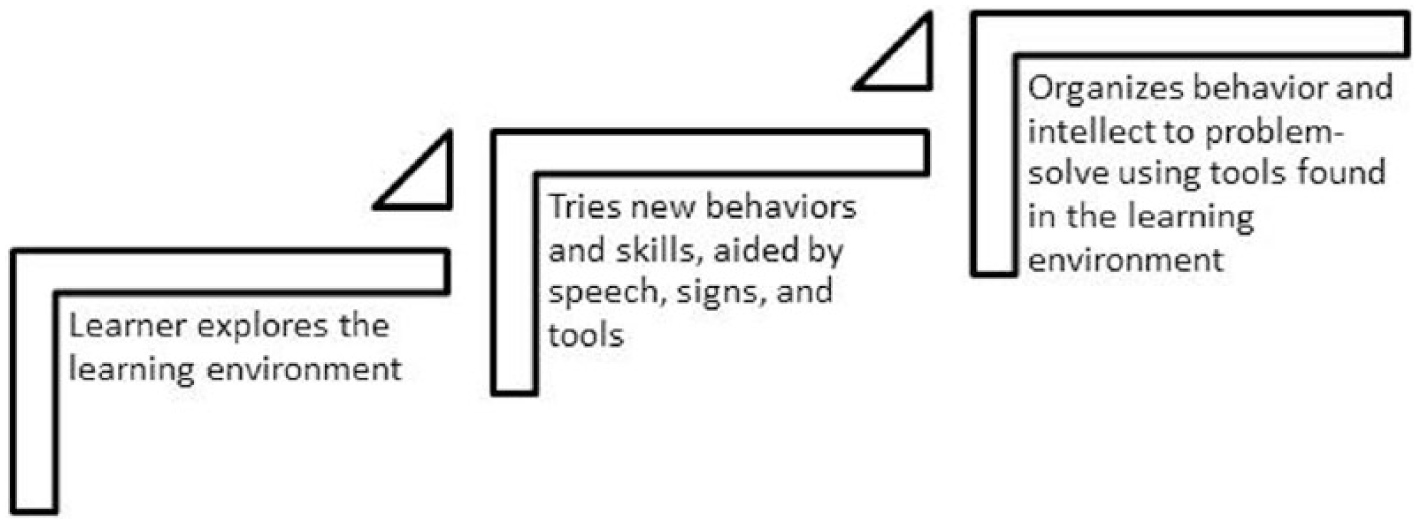
Vygotsky’s learner transformation process.
ZPD should not be confused with scaffolding. Scaffolding can be a part of the activities in the ZPD, but the ZPD does not always involve scaffolding. A facilitator can assist a learner with comprehension by providing additional resources to support or scaffold the learning process, while the learner may use other methods, including imitating others while in the ZPD to move out of the state of disequilibrium. Cooperative-based learning provides a means for accomplishing both imitation and scaffolding in the ZPD as we consider ways that we learn with and from each other to solve problems.
Cooperative-Based Learning
We live in a fast-paced competitive society. In the United States and many other countries, we compare our national education test scores and often attend schools, including medical and nursing programs based on individual test performance. Lecture-filled classrooms and simulation centers that rely on scenarios and debriefing alone hardly facilitate the transformation process described in the section on ZPD. Johnson and Johnson (1975) found that competitive learning environments, among other things, can lead to mutual dislike, communication problems, and low interaction among learners. Furthermore, individual-focused education may contribute to the lack of teamwork and communication that exists in the health care community (Clapper & Kong, 2012). A breakdown in communication is still recognized as a leading factor in the high rate of medical error that has not improved much in the last 25 years, especially during patient handoffs (Clapper, 2013; Clapper & Kong, 2012; Wachter, 2013).
In some form or another, including more than half a century of research, scholars recognize that we learn with and from one another (Barkley, Cross, & Major, 2005). In addition, studies show that from infancy through later stages of life, we genetically empathize and assist others in need (Knafo, 2014). David and Roger Johnson certainly did not originate cooperative-based learning. However, Johnson and Johnson are best known for their pioneering, research-based work on learning, working alone, in dyads, or in groups, that has been field tested in countless classrooms (Johnson, Johnson, & Smith, 1991). Johnson and Johnson based much of their research and application on the theory of competition and cooperation brought forward by Morton Deutsch and Kurt Lewin (Johnson et al., 1991). Cooperative-based learning should not be confused with group work. Putting learners together and assigning them a task do not guarantee that learning will occur. Instead, cooperative-based learning techniques (CoLTs) are those intentional learning activities where learners work together to achieve common learning objectives (Barkley et al., 2005). The cooperative goal structure recognizes that a person may be weak in one area, but can be an asset to another group of learners in a different area (Johnson & Johnson, 1975). Those same experiences and frames of reference that each learner brings to the learning environment become group assets that are useful in the learning process and compliment assistance efforts in the ZPD. As shown in Figure 2, when a state of disequilibrium may occur, cooperative-based learning can create the conditions for a zone to develop that allow the struggling learner to comprehend new information with the assistance of the facilitator or others in the group.
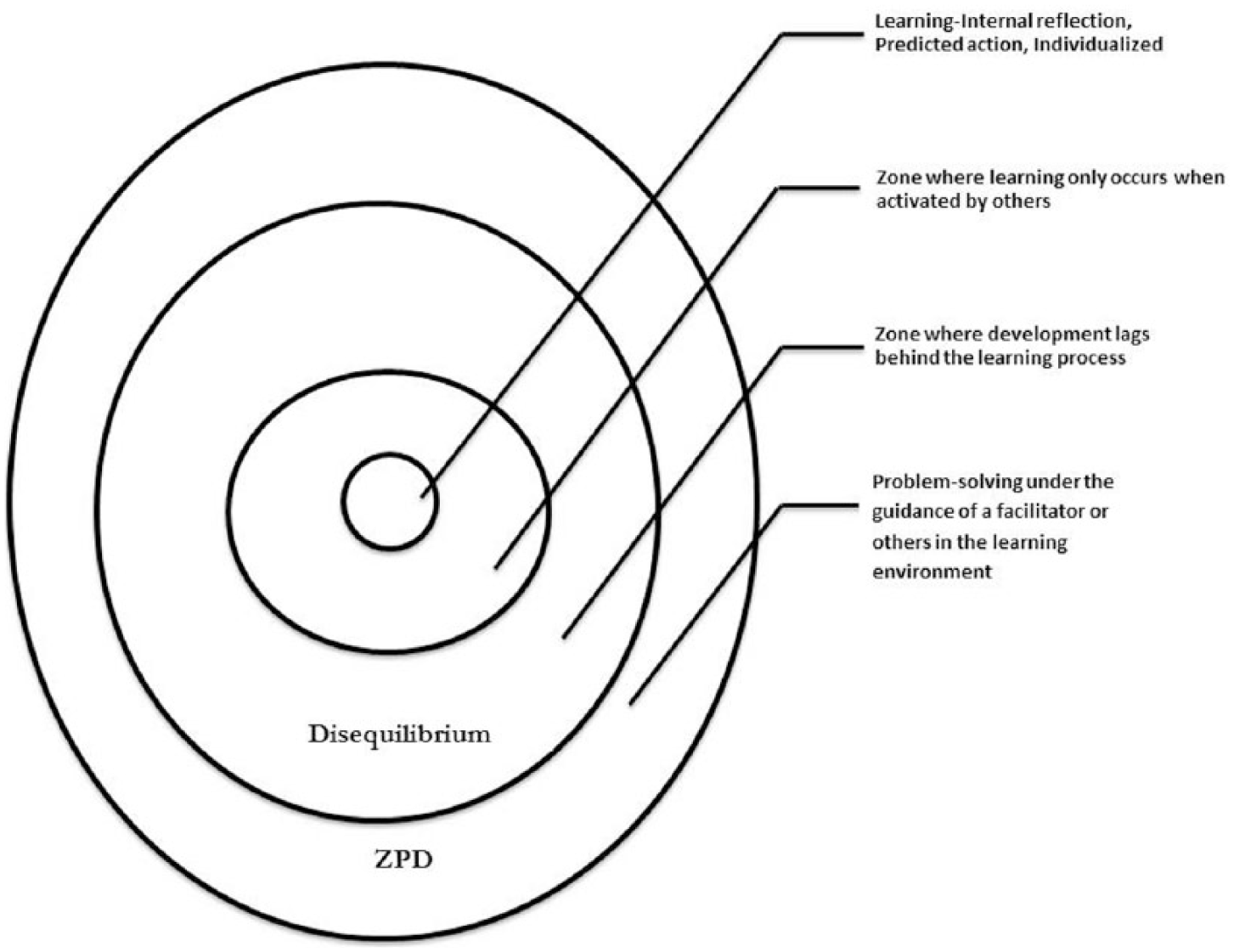
Vygotsky’s ZPD with cooperative-based learning.
An abundance of evidence supports the use of cooperative-based learning and its effects on achievement and motivation (Slavin, 1987). Cooperative learning creates opportunities for reciprocal teaching where learners teach other members of the group. For example, Turan, Konan, Kılıç, Özvarıs, and Sayek (2012) found that students in a surgery clerkship appreciated the use of cooperative learning because it helped them to see other perspectives about the learning activity that they might otherwise have missed. Students in a mental health clerkship, learning adolescent psychopathology through cooperative learning, gained more knowledge of the topic than students who learned through lectures (Bahar-Ozvaris, Cetin, Turan, & Peters, 2006). Other researchers (Tolsgaard, Bjørck, Rasmussen, Gustafsson, & Ringsted, 2013) found that training with another learner improves the effectiveness and efficiency of the training session and has positive effects on a clinician’s confidence in managing patient cases. Consistent with the introductory message of this article, clinicians must recognize the effectiveness of cooperation and working in teams. When learners are engaged with CoLTs, they are learning team dynamics and conflict resolution while learning the content (Bahar-Ozvaris et al., 2006; Hromek & Roffey, 2009; Kayes, Kayes, & Kolb, 2005). Whether moving through the ZPD or not, learners use the same process identified earlier in this article, including speech, signs, and reflection (Vygotsky, 1978) to assist other members of their group with their intellectual development as they strengthen their own understanding. Although the reasons for applying these theories to practice are evident, setting up the learning environment for cooperative-based learning does require additional consideration.
Organizing for CoLT and ZPD
In accordance with good instructional design, cooperative-based instruction used as part of the complete simulation-based experience (described later in this article) must be planned ahead of time and involves an active facilitation process. Johnson et al. (1991) identified five steps in the planning and execution process involved in cooperative-based learning. In addition to these five requirements, the facilitator uses eavesdropping and ongoing reflection to create a ZPD as needed to ensure that learners can achieve the learning objectives and maximize the learning experience (see Figure 3). The facilitator must also conduct an assessment of available resources, including room space, to decide how the groups will be organized.
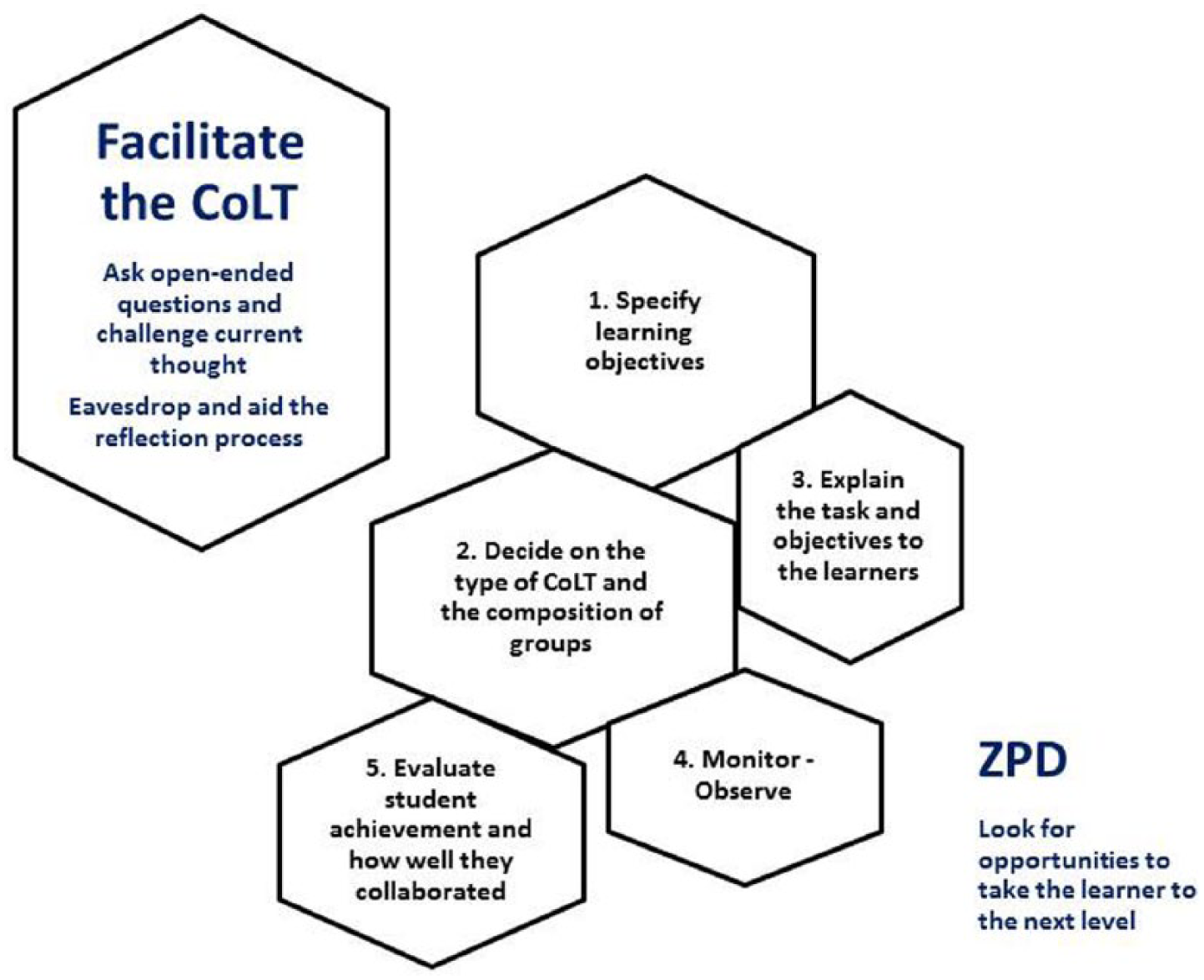
Five steps to cooperative-based learning.
Furthermore, the size of the group and how the learners will be organized must be considered. Larger groups can be useful for brainstorming unique and original ideas (Coskun, 2011), but they can limit individual contribution and participation. Although Johnson et al. (1991) recognized typical group sizes of 2 to 4 learners, they also accepted that random group assignment of 6 to 10 have been useful in collaborative forms of learning (Johnson & Johnson, 1975). In addition to group size, time and adequate space can be factors. Lesson planning must include additional time so that learners can reap the benefits of CoLT and ZPD opportunities. For example, students in a surgery clerkship found cooperative learning very satisfying, but the lack of time allocated to the project did not allow for adequate organization and engagement of the cooperative groups (Turan et al., 2012).
Although they do require a bit more time than some other CoLTs, two that I found extremely beneficial for realizing the advantages of CoLT and ZPD are the jigsaw (Aronson, Blaney, Stephan, Sikes, & Snapp, 1978) and group-investigation techniques (see Figure 4). I use topic sheets in conjunction with these two CoLTs, which are evidenced-based summaries of themes critical to a particular subject.
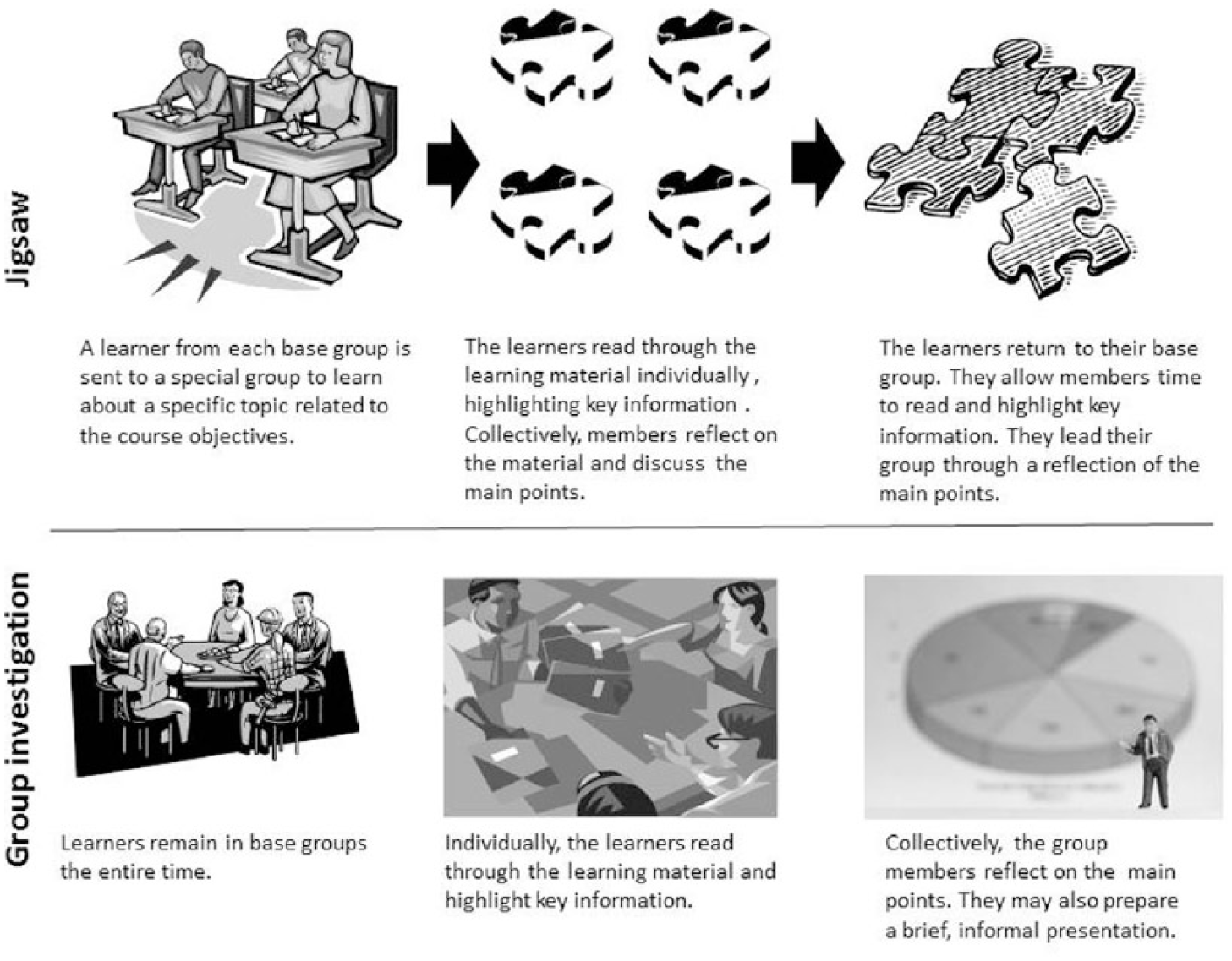
Jigsaw and group-investigation techniques.
The topic sheets are particularly useful for chunking information, which the brain prefers when acquiring and sorting new material. The topic sheets also reduce cognitive load on the learner by sorting vast amounts of information that may otherwise be overwhelming for the learner. The learners are responsible for reading the topic sheets, highlighting information, and making notes in the margins prior to reflecting on the topic(s) with others in their groups. It is often during the open reflection process that conflict arises between what the learner currently understands and what is written on the topic sheet. In line with the concept of Vygotsky’s ZPD, the members of the group and the facilitator can assist those learners with assimilating the new information.
As noted, the facilitator must place himself or herself in a position where he or she can observe and eavesdrop on the group conversation and member contributions (Johnson & Johnson, 1975). The keen facilitator is observant of group dynamics and the balance of participation (Carrier, 1991). Dominant group members can overwhelm passive members, and the facilitator must skillfully ensure that all members are free to express their thoughts. It is important for the person in this role to ask questions that enable all learners to consider application of the new information. For example, when teaching the central venous catheter course, I ask about best sites for line placement. I want the learners to think about the patient situation and not limit themselves to a favorite site based on personal ease of application.
Debriefing and Facilitation
For reasons described earlier in this article, we must move away from incomplete simulation frameworks that provide the learner with a lecture, a simulation experience, and a debriefing (Clapper, 2014). The four-phase, brain-based learning framework for simulation described by Clapper (2010, 2014) is advantageous for facilitating cooperative-based learning and assisting learners in the ZPD. This framework consists of four phases of learning, which mirror the way that the brain acquires and processes information (Williams & Dunn, 2008). It includes an inquire phase, which creates situational interest; a gather phase, where new information is introduced; a process phase that allows the learner an opportunity to practice in a realistic setting; and an apply phase, useful for assisting learners with confirming the new frames of reference and transferring the new knowledge to the actual work environment. This simulation framework recognizes the importance of debriefing in both the reflection-in-action and reflection-on-action processes. As well-known simulationist and author, Fred Goodman, insisted, “Debriefing is too important to be left until the end of the game” (in Crookall, 2010, p. 908). Debriefing after each phase allows the facilitator to assess and further identify/assist those learners who may be in a state of disequilibrium or in the ZPD prior to moving on to the next phase. Although the debriefing following each phase is often much briefer than the debriefing that follows the apply phase at the end of the lesson, it is instrumental for assisting learners with constructing/re-constructing their frames of reference throughout the learning process. In this simulation framework, the message is clear and addresses our opening concern: Why wait until the end of a learning experience to assess and possibly miss an opportunity to assist the learner with developing quality frames of reference and experiences?
The cooperative learning activities occur in the gather phase. Although the learners may enter the ZPD anywhere in the learning process, it is in the gather phase, where the learners may be most reticent to completely let go of their older frames of reference that they began with early in the lesson. Debriefing after the gather phase of learning is especially important as learners (a) discover the learning objectives and (b) clarify any information that came from materials and discussions in the cooperative learning activities prior to placing them into the process phase. Individual and group reflection efforts carry on following the process phase, where members try out the new information and skills during the patient scenario and, subsequently, enter the apply phase, where the facilitator uses the debriefing to help the learners affect transfer to their work environment (Clapper, 2014; Crookall, Oxford, & Saunders, 1987; Williams & Dunn, 2008).
Conclusion
The world is truly a competitive place, but our learning environments do not have to be. When learning new information or solving problems, our natural tendencies include looking at what others are doing or listening to their interpretation of the problem. In addition, our propensity as humans to assist others with solving problems is complimented by both theories and allows us to support those members of our learning community with altering or building new frames of reference that can affect patient safety and lead to better outcomes. Cooperative-based learning and an understanding of the ZPD are valuable tools for the facilitator of simulation-based instruction and should be considered when preparing lessons as part of a complete and stimulating framework.
Footnotes
Acknowledgements
Reviewers cause us to reflect critically on our work, including the accuracy and intent of our message. I am grateful for the anonymous reviewers and their insightful feedback on earlier drafts of this article. Thank you Iris Cornell, my co-editor for this special symposium, and David Crookall for your thoughts and encouragement.
Declaration of Conflicting Interests
The author declared no potential conflicts of interest with respect to the research, authorship, and/or publication of this article.
Funding
The author received no financial support for the research, authorship, and/or publication of this article.
Author Biography
Contact: