




Abstract
This puzzle-building activity, originally created by one of the authors, was designed for supervisory training in amusement park settings. Both authors have used it in management classes, as participants experience the difficulties in giving clear task instructions and feedback in a structured, hierarchical setting. The exercise is based on role-play triads composed of an employee, a supervisor, and a manager, i.e., three levels of hierarchy. The blindfolded employee attempts to complete a simple jigsaw puzzle with limited communication from the supervisor and manager. In the debriefing, the facilitator may raise any number of theories to help participants understand the experience itself, and, through structured debriefing, carry lessons learned into their work life. Theories include leadership style, verbal and non-verbal communication, listening skills, feedback, motivation, problem-solving, collaboration and power dynamics. This activity temporarily places participants in different social roles. Thus it is ideally suited for multi-cultural groups or different departments or groups within the same organization.
Keywords
Basic Data
Instructional (learning) objectives: To understand and develop collaborative problem-solving skills. To develop sensitivity for others within hierarchical relationships. To develop observation and listening skills, and to gain understanding of one’s leadership style and power dynamics while under stress. To develop the capacity to provide useful feedback and clear instructions.
Game objectives: Working in groups (triads), to build a 24-piece puzzle while the puzzle-builder is blindfolded and other players are limited as to when and how they can communicate. Photographs of people participating in this puzzle activity follow in Appendix B.
Debriefing format: Participants in each of three separate roles (employee, supervisor, and manager) group together to discuss their experiences, reactions, and lessons drawn with others in the same role. The appointed spokesperson in each triad shares during a large group discussion.
Alternative: Each member of the group (triad) discusses his or her experience and reaction to the activity. This is helpful if one or two groups (triads) finish the task earlier than other groups, which is often the case.
Target audience: Individuals interested in training, supervision, management, and in improving communication skills. Note: The first author designed this activity to teach trainers how to develop specific and clear instructions, and to increase understanding of the power dynamics involved in hierarchical relationships.
Playing time: 30-40 minutes.
Debrief time: 30-45 minutes.
Number of participants required: This depends on group size, which in turn drives the number of groups or triads. With an uneven number of participants, use the additional people as “consultants” who observe but do not intervene. Consultants help provide peer feedback during the debriefing.
Participation materials: Each group of three participants receives the following: 1blindfold, 1 24-piece puzzle, a situation card and role instructions, and a package of sticky-notes (Post-it Notes). One person in each group (triad) is blind folded. One can purchase blindfolds and 24-piece puzzles in department stores or toy stores. [For example, http://www.amazon.com/Mickey-Clubhouse-Puzzle-Assorted-Styles/dp/B0038FDMPO/ref=pd_bxgy_21_img_y].
Debriefing materials included: Participants and observers need a pen and paper to take notes after the activity. Use the ORID framework for the by-role debriefing. See Appendix A for the explanation of the ORID framework
Computer/Internet: None
Other materials/equipment: Each group (triad) is given four items: (a) 1 blindfold, (b) a 24-piece puzzle*, (c) the situation card and instructions for his or her role, and (d) a package of sticky notes (Post-it Notes) or small pieces of paper. Each participant also needs a pen/pencil with which to write his or her reflections on either the sticky notes or ORID framework. The facilitator will need each of these four items, plus at least one pencil/pen for
This activity features as many triads as are enrolled in your course or training session. It has been used with as many as 75 participants, and with as few as four. Random assignment of participants works best. In each group (triad) the participants will take on one of three roles. The objective of the activity is to build a 24-piece puzzle suitable for very young children (age 3-4 years old).
The task is made difficult in that the builder (employee) is himself or herself blindfolded, and his or her supervisor is restricted to answering only questions with the response yes or no. The supervisor is also forbidden to touch, manipulate, or move the puzzle pieces in any way. The supervisor may encourage, support, or in other ways motivate the employee. The third member, the manager, is allowed to observe the activity, but may not comment or intervene. All members want to complete the puzzle, but structural relationships create barriers to collaboration.
Note: The facilitator may choose to use a different task other than to build a jigsaw puzzle. Alternatives may include building a mirror image of a building block structure or completing a metal, paper, plastic or wooden structure relying on recreating specific shapes from a master.
This article describes a scenario with a total of seven three-person teams participating, and two consultants. The facilitator may choose to add a second blindfolded employee to one triad, or a second supervisor to one or several groups, as the actual number of participants increases.
Facilitator’s Guide
This activity serves as a proxy for situations in which hierarchical relationships are predominant.
Preparation
First determine the number and set up of triads needed and assign participants accordingly. Each team includes one employee, one supervisor, and one manager. Special attention should be given to gender distribution. Some participants may not be familiar with jigsaw puzzles, and thus are at a loss to understand the task at hand. The facilitator can substitute a similar task or different type of puzzle. Encourage each participant to play his or her role as they might in a natural setting.
Flow of the Exercise
The facilitator directs the supervisor and manager not to discuss the task with the employee. The supervisor chooses a blindfold and then returns to the group to blindfold the employee. The manager then chooses a 24-piece puzzle and hands this to the supervisor. Neither discusses the task with one another nor with the employee.
Once each employee is blindfolded, the facilitator announces the following rules:
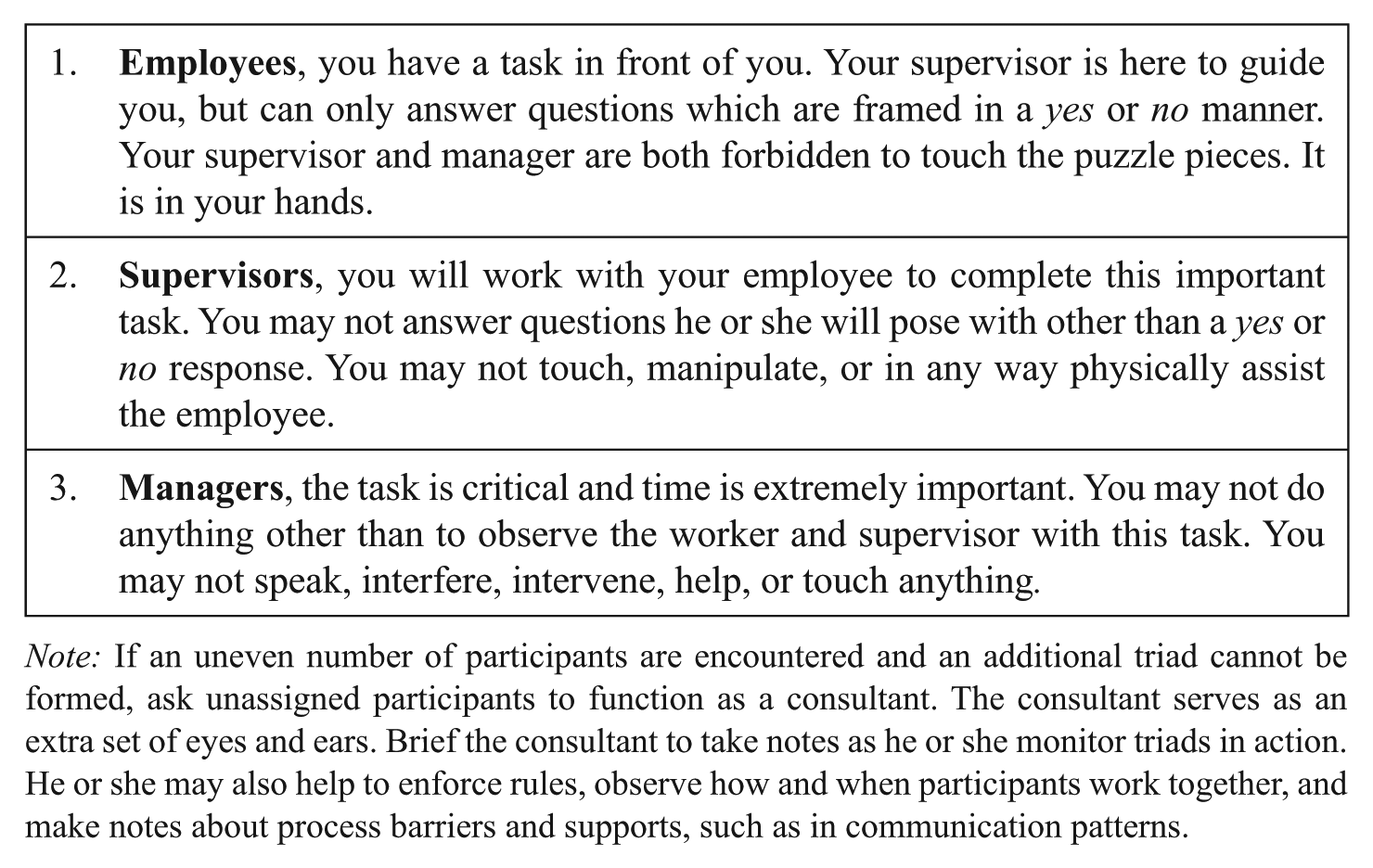
Note: If an uneven number of participants are encountered and an additional triad cannot be formed, ask unassigned participants to function as a consultant. The consultant serves as an extra set of eyes and ears. Brief the consultant to take notes as he or she monitor triads in action. He or she may also help to enforce rules, observe how and when participants work together, and make notes about process barriers and supports, such as in communication patterns.
The puzzle activity begins with the supervisor handing the puzzle box to the employee. Employees and their supervisors then have 20 minutes to struggle with the activity, while the facilitator gently but firmly enforces the rules. The best performing teams will eventually develop a process and language with which they learn to work together. Some teams may never complete the task.
At the 20-minute mark, the facilitator makes the following announcement:

Once two-way communication is allowed, progress escalates. Although this activity is not designed to be a competitive one, each group will come to understand their rate of completion relative to other groups. This builds stress, particularly for the supervisor. You may also notice that a special language develops between supervisor and employee, one where incremental movement and orientation of the puzzle pieces helps the completion of the project. Managers become increasingly frustrated, nervous, and may withdraw.
One or two groups may complete the puzzle within the first 20 minutes. If so, you may ask the group members to silently observe other groups still working to complete the puzzle. Alternatively, the facilitator may provide each participant in those groups that finish first with the ORID questions, and ask them to reflect and jot down their responses.
At the 25-minute mark, the facilitator makes the following announcement:

At this stage, the manager will be very eager to become involved. However, the level of involvement will range from continued observation to firing of the supervisor and taking over the project. The more the manager and supervisor provide simultaneous yet conflicting instructions, the more confused and distressed the employee becomes.
At the 30-minute mark, the facilitator makes the following announcement:

Debriefing
Small Group Debriefing
We recommend that 30-45 minutes be allotted for the combined small group and large group debriefing, depending on the number of triads.
At the beginning of the debriefing session, the facilitator should reiterate the activity was designed to be somewhat stressful, and work with participants to draw forward differences in approach to supervising and being supervised.
Ask each participant to think about two adjectives to describe the experience from his or her role perspective, and then write these words on the sticky notes. (Post-it Notes). These sticky notes will be used during the large group debriefing. Alternatively, use small pieces of paper.
Provide each participant with a copy of the ORID questions. Then ask them to discuss and write down experiences and feelings within their role group (Employee, Supervisor, Manager, and if necessary, the Consultant). Ask participants to use at least two questions from each category (Objective, Reflective, Interpretational, Decisional).
Stop at 15 minutes and continue with the total group debriefing.
Large Group Debriefing
On the whiteboard or the blackboard, write column headings Employee, Supervisor, Manager, and Consultant (if used), with room under each to write down responses.
Invite each person to come to the front of the room to affix the sticky notes with his or her two adjectives. Have them place the sticky notes (or tape the pieces of paper) under the appropriate category. Direct the full large group to view these in preparation for discussion. (5 minutes)
Ask each team representing a particular role to share his or her thoughts, feelings, and perceptions. (5 minutes per role group = 15 minutes)
Help the participants link their experiences to theories of decision-making, collaboration, hierarchical groups and power, the effect of verbal and non-verbal feedback, the utility of non-monetary rewards, and process and problem-solving techniques.
Participant’s Guide Handout
You and your fellow participants represent a traditional vertical (hierarchical) team consisting of an employee, supervisor, and manager. You have a critical task to complete; your success means your work unit will not be laid off.
You will be provided with:
Oral instructions from the facilitator.
A sheet containing specific questions (ORID) to be addressed during the debriefing.
Specific questions following the group activity.
If you feel any details about your role or the task itself have not been provided, you should feel free to make reasonable assumptions to guide your behavior. Keep in mind the only participant who can handle the work of the physical task is the employee.
Once each person in your team is ready, the supervisor and manager will approach the front of the room, select a blindfold, and put the blindfold on the employee. If you are claustrophobic or have an infection in or around your eyes, do not volunteer for the employee role. You will have 20 minutes to complete the task.
Once you are done, you will be asked to sit quietly, complete the ORID questions, and/or observe other teams that are completing the task.
Discussion: Bridging to Management / OB Theory and Practice
The prospects for discussion at the end of this activity are numerous and varied. This activity can be offered at any time during an academic course or in a training program. It is particularly useful in a management course once you have discussed teams, conflict, communication, motivation, and leadership. Similarly, as Ebner and Winkler (2009) suggest, the debriefing session can focus on many different issues as they unfold.
In the discussion, the facilitator may choose to focus on cultural constraints related to direction and hierarchy. For students, this activity offers the interesting opportunity to apply theory to the activity experience itself, as well as to reflect on past experience in the workplace. For those who have supervised or trained others, or who have had the experience of learning new tasks while a supervisor was present, the activity takes participants back in time. It also helps to shed light on ways to improve in those roles going forward. When communication is hindered, each participant, regardless of his or her role, tends to become highly frustrated. Corbeil (2003), in THE HIVE GAME, also limited communication channels and modes to model real-world situations in which problem-solving is hindered.
An Example
In one particular instance, a middle-aged woman who was playing the role of manager discovered her leadership style was ineffective as she first berated, physically moved, and then fired a classmate who was a much younger male, and who was the “supervisor.” She took over the task, citing his ineffective performance, as the employee literally sank in the chair and became very still. During the debriefing session she went on to share with the class that this behavior had in fact been her style as the owner of a small business. She went on to discuss that, being faced with her own behavior, she clearly heard and felt the negative effect she had on others. She later wrote how this puzzle-building activity was a transformative moment in her life.
Learning from experiences requires reflection
The ability to learn from experience is not as simple as mandating it, requesting it, or wishing it to be; it does not happen simply because simulations are conducted (Gentry, 1990). Learning from experience at both the individual and group level of analysis requires a willingness to reflect (Argyris, 1991; Boud, Keough, & Walker, 1985; Daudelin, 2000; Ferry & Ross-Gordon, 1998; Lohman, 2000) and the desire to do so (Argyris, 1991). Reflection itself occurs either
Reflection requires a process
Experiential learning in the context of simulation and classroom exercises must provide learners with basic processes to help relate what they already know to newly acquired knowledge (Dennehy, Sims, & Collins, 1998). In this regard, this particular activity offers the opportunity to tie several concepts together while it also places each participant in a role they have, or may, experience early in their career. To do this, an effective debriefing strategy and technique is advised (Markulis & Strang, 2003). The activity offers both a visceral experience and a powerful form of teaching, one in which participants often acquire more than skills, knowledge, and abilities (Sims, 2002). An added benefit is that the participant immediately experiences how his or her actions affect the “employee” and team productivity. In this respect, the reflective observation process that occurs during debriefing is a critical link between the experience and lessons that can be drawn forward (Sims, 2002). Thus, in conducting the debriefing, the authors suggest using a set of structured discussion questions, buttressed by the “ORID” (Stanfield, 2000) framework (see Appendix), an excellent application of Petranek, Corey, and Black’s (1992) four E’s of debriefing: events, emotions, empathy, and explanations. Doing so helps to ensure participants spend time engaged in thinking about and addressing questions in each quadrant of the Experiential Learning Cycle (Wooden, Baptiste, & Reyes, 1994), thus enriching learning from experience (Kolb, 1976, 1984).
Conclusion
This activity is used primarily to improve the dynamics in hierarchical relationships. More specifically, it emphasizes the stresses and tension in getting the task done while being mindful of the effect one’s behavior has on others.
One of the authors originally designed this activity while working in the amusement industry where training-the-trainer and training new employees was an endless endeavor. The purpose in introducing this activity to new supervisors and trainers was to provide them with the hands-on experience of teaching someone how to do something for which one is clearly the expert (supervisor), and the other was totally dependent (the new employee). The third member (manager) “patiently waited” while the employee was trained to perform, but time was limited and the new employee was needed on the line to fill an immediate staffing vacancy. These real-life pressures worked well to provide three different views of the same situation, and for which the “right answer” was to ensure the employee had the skills to perform safely.
Experience in using this activity in business school classroom settings has proved equally useful.
Footnotes
Appendix A
Appendix B
Acknowledgements
The authors thank the reviewers for their helpful comments in improving this manuscript. Special thanks to the many people who participated in trial runs of this activity, and those colleagues who provided feedback about adaptations. We would like to thank those individuals who appear in the photographs for their support of this work.
Author Contributions
Both authors contributed to this article, in content and in form. KHW designed the activity/simulation and wrote the original manuscript. SWM did the literature review, served as editor, and provided feedback on alternative uses of the activity/simulation in her consulting practice. Both authors have used the activity in various settings and contributed to writing the directions. Both authors contributed equally to the editing of the manuscript.
Declaration of Conflicting Interests
The authors declared no potential conflicts of interest with respect to the research, authorship, and/or publication of this article.
Funding
The authors received no financial support for the research, authorship, and/or publication of this article.
Author Biographies
Contact:
Contact: