




Abstract
Aim. In close cooperation with an international automotive supplier we developed the
Method. In total, 47 students participated in one of six two-day game sessions. They reported
Results. Results from our pre- and post-game self-assessment questionnaires show that the “C2” business simulation game
Conclusion. These results suggest that our business simulation game has the potential to be an
Keywords
The nature of work has fundamentally changed in recent decades. Globalization has led to increased competition because of rising quality standards, higher cost and time pressure. Customer and stakeholder requirements are permanently changing, which results in individualized solutions, error-prone production processes and a high level of stress (Montealegre, 2002). As one consequence of these enormous challenges, projects have increasingly become the dominating form of work organization. This phenomenon is known as “projectification” (Harrington & Voehl, 2014; Hobday, 2000; Lindkvist, 2004; Packendorff & Lindgren, 2014; Sydow, Lindkvist, & DeFillippi, 2004). Therefore, companies need project managers who have significant problem-solving capabilities, are capable of continuously acquiring new knowledge, and, finally, are able to work in cross-functional or cross-disciplinary project teams (Ardichvili, 2003; Ramazani & Jergeas, 2015; Thomas & Mengel, 2008). To be a successful project manager, an individual needs knowledge, tools, and techniques about project management activities, and also the capability to apply them in complex real-life projects (Jeong & Bozkurt, 2014). However, such competencies and particularly reflective skills can hardly, or impossibly, be developed in traditional ways of learning as common in universities and other academic institutions (Brockbank & McGill, 1998; Lainema & Makkonen, 2003). Academic teaching aims at acquiring specialist knowledge and the understanding of theoretical concepts (Brockbank & McGill, 1998). This has led to a lack of practical experience. Furthermore, the development of skills that enable students to meet the challenges of tomorrow is frequently undervalued (Ramazani & Jergeas, 2015; Salas, Wildman, & Piccolo, 2009). This implies the need for a shift from instructional methods towards self-regulated learning (Boekaerts, 1999; Wirth & Leutner, 2008) with “learning environments that actively involve students in problem solving” (Garris, Ahlers, & Driskell, 2002, p. 441). Consequently, teachers should pay more attention to experiential learning (Kolb & Kolb, 2005, 2009) as well as reflective learning (Brockbank & McGill, 1998) with respect to real-world problems and real-work situations (Cressey, 2006; Elmholdt & Brinkmann, 2006).
Against this background, we developed, implemented, and evaluated a business simulation game, in which the participants are able to gain a broad range of project management knowledge and improve their soft skills by working in cross-disciplinary project teams. In our project management game called “C2-Camshaft China”, participants decide on a new hypothetical site location in China and the setup of a factory of a globally acting automotive supplier producing camshafts for engines. This business simulation game is based on a real life case study. Following Karl (2012), we explicitly take into account current and occupationally relevant competency requirements to improve the employability of the participants and the quality of project management education. In our play-oriented learning setting we combine various interactive pedagogical features like role-playing, cardboard writing, discussions as well as group work using the LEGO Serious Play method (LSP; Kristiansen & Rasmussen, 2014). Particularly the latter enables the participants to express individual opinions, exchange knowledge, develop shared understandings and promote reflective thinking (James & Brookfield, 2014; Schulz & Geithner, 2014; Schulz, Geithner, Woelfel, & Krzywinski, 2015). Therefore, one of the most important elements of the “C2” business simulation game is the development of shared mental models for successful collaboration in projects. This refers to topics such as project management, communication, coordination and interaction within the project team as well as leadership.
In the following section we will briefly explain the importance of business games in education. We will also clarify requirements for project management training. Then we will describe the design of the “C2” business simulation game with special focus on LSP and its pilot implementation in different university courses. In the next section we will explain the evaluation concept and discuss the findings of our explorative study. Finally, we will provide some conclusions and an outlook on research directions and further developments of the game.
Business Simulation Games in Education and Training and the Role of Interactive-Learning Environments
At their future workplaces, students will be challenged to work under uncertain and complex conditions and in cross-functional or cross-disciplinary project teams. However, traditional lecture methods prepare them inadequately for these challenges (Lainema & Makkonen, 2003; Lopes, Fialho, Cunha, & Niveiros, 2013; Ramazani & Jergeas, 2015). Ruben (1999) has described these limits as school-based teaching-and-learning paradigm and supports all “forms of interactive, experience-based learning” (p. 500). As an educational tool, business simulation games are particularly valuable because they combine input, application, reflection and feedback. This corresponds with the replacement of learning by listening by an active learning by doing (Williams, 2011). Business simulation games can be seen as an interactive learning environment (Kriz, 2003), where participants are actively involved in experiments, role-plays, simulations of daily work situations, or the developmental scenarios (Rosenørn & Busk Kofoed, 1998).
Business simulation games are theoretically grounded on Kolb’s experiential learning theory (Kolb 1984; Kolb & Kolb, 2010), which emphasizes that learning takes place through a series of phases in a cyclic process: The individual learning process starts by having an experience within a game arrangement and continues with the reflection on experience during the playing of the game, followed by a theoretical conclusion about what the participants experienced. Finally participants try out what they have learned for future actions. With this application stage the learning cycle starts again, while the new-gained experience becomes richer, broader, and deeper (Kolb & Kolb, 2010). This learning cycle covers the significant interrelation between action and reflection and the transition from concrete to abstract (Rosenørn & Busk Kofoed, 1998). The importance of reflection for learning and competence development is also emphasized by Schön (1987), who distinguishes between reflection-in-action (during the game) and reflection-on-action (after the game). In business simulation games it is possible to add a third being anticipatory dimension of reflection, which Cowan (1998) describes as “reflection-for-action” (p. 37): Participants reflect on challenges and problems they hope to be able to solve more successfully or to be well prepared for in the future. Subsequent learning occurs (Rosenørn & Busk Kofoed, 1998). Particularly, the debriefing phase of business simulation games with reflection-on and for-action at the end or after the game offers great learning opportunities (Kolb, Kolb, Passarelli, & Sharma, 2014) because learning results from debriefing and not only from the game activities (Crookall, 2010). In the debriefing, main learning outcomes (for an overview see Kraiger, Ford, & Salas, 1993 and Wilson et al., 2009) and their generalizability for real-work situations can be discussed. The focus of evaluation and debriefing is also on patterns of individual or group behavior (Greco, Baldissin, & Nonino, 2013). A systematic analysis of the strengths and weaknesses per participant helps pave the way for their systematic development of personal skills.
According to Sauaia (2006), typical business gaming activities involve reading the participants’ manual, memorizing facts of the story, identifying management issues, preparing assignments, analyzing the situation with a conceptual framework, attending a presentation, participating in a discussion as well as formulating and implementing plans. The participants are more intensively involved and demonstrate a greater motivation (Garris et al., 2002), in particular if conditions and consequences are close to reality. Games offer space of freedom to make wrong decisions and mistakes without having to fear negative consequences. Participants can reflect on their behavior (Jeong & Bozkurt, 2014; Rosenørn & Busk Kofoed, 1998). Moreover, games are tools for teaching even complex topics: “This hands-on approach allows the subject to practice cognitive or intellectually abstract theories and principles while enabling a feeling of personal responsibility for the experience’s outcomes” (Wolfe, 1993, p. 450). Business simulation games enable the students to act in a fictional setting including organizational and management processes under dynamic conditions (Salas et al., 2009). In addition, role-related behavior can lead to improved professional and interpersonal skills and procedural knowledge (Fortmüller, 2009), for example in the area of project management.
This shift away from lecture-based education to more active learning methods relating in particular to project management can foster knowledge generation and students’ skills development. Project management can be defined as “application of knowledge, skills, tools, and techniques to project activities to meet the project requirements” (Project Management Institute, 2008, p. 6). Successful project managers need skills beyond the purely technical project management component. This involves a specific “mixture of skills” (Pant & Baroudi, 2008, p. 124; see also Ramazani & Jergeas, 2015, p. 44), which are divided into three categories:
organizational and management competencies,
project management or technical competencies, and
human skills, soft skills or behavioral competencies (as suggested by Brière, Proulx, Flores, & Laporte, et al., 2015).
The study by Ramazani and Jergeas (2015) consists of interviews with 29 participants, who rate the quality of project management courses they attend. Its qualitative results from the interesting perspective of working project managers indicate that project management education and training have serious shortcomings in terms of dealing with the complexity of projects, the development of necessary soft skills of project managers and understanding the context of the project. The main points of the study and the derived implications for project management training and education are summarized in the Table 1.
Findings and Derived requirements for Project Management Training and Education.
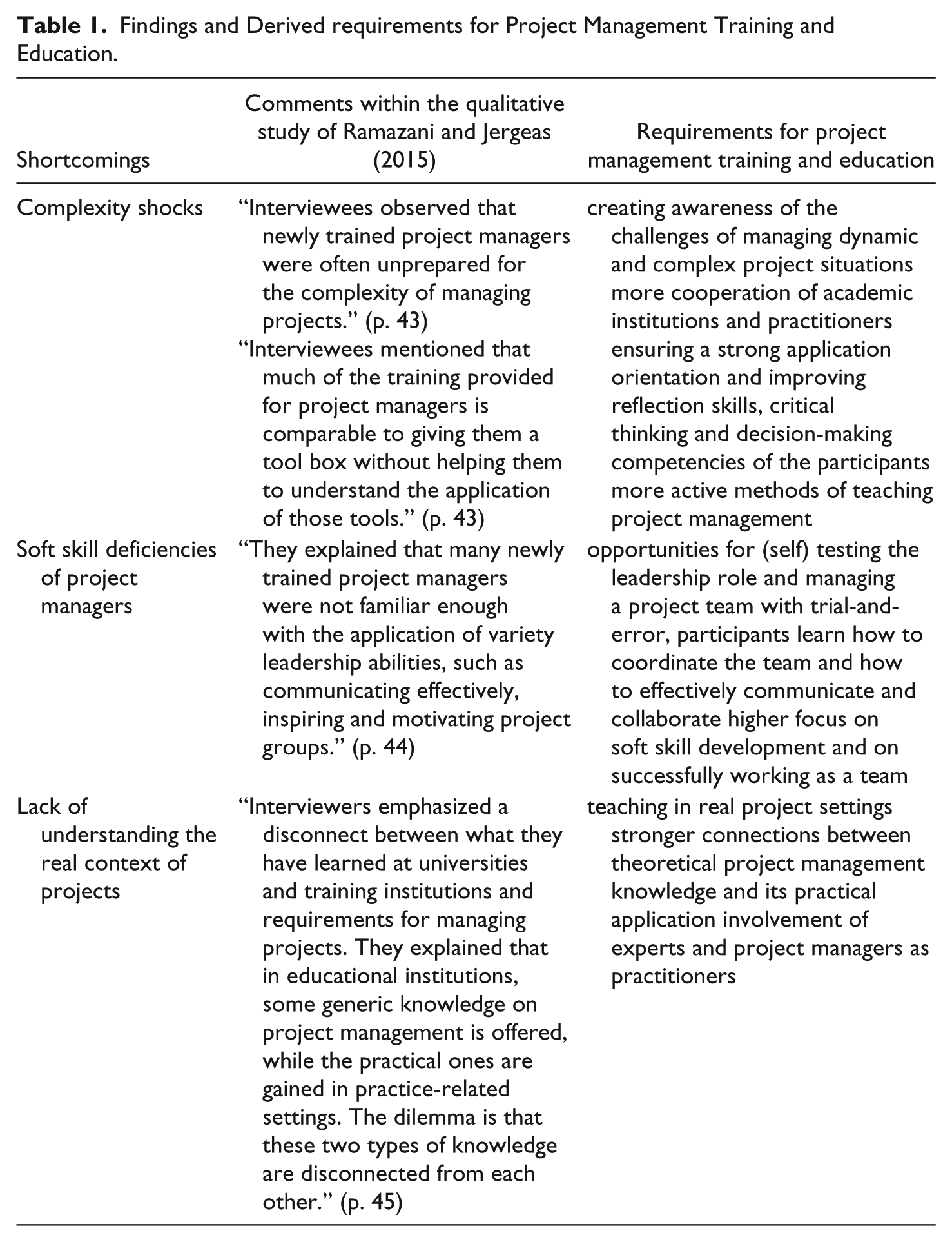
Findings like these address many development needs to overcome lecturing approaches and passive teaching-learning methods. Although business games have a long tradition in education and training (Li & Baillie, 1993) and “used to teach a broad range of business and management disciplines such as strategic management, marketing, project management, economics, and international business” (Williams, 2011, p. 3), they are less common than lectures, discussions, case studies and exercises within university education. A major reason lies in the fact that simulations are extremely time-consuming, have high development costs, and go hand in hand with organizational difficulties such as type and scope of the supervision (Bronner & Kollmannsperger, 1998). Case studies or exercises in classroom settings use to a lesser extent activity-oriented methods, which means they have strong limitations with regard to the development of soft skills of project managers (Pant & Baroudi, 2008). Business simulation games offer trial-and error-experience, working and learning in teams, active role-taking as well as the transfer of theoretical knowledge (Kriz, 2003). Therefore, business simulation games seem to be one of the most important methods to acquire practice-oriented project management skills such as problem solving and critical thinking (Fortmüller, 2009; Ramazani & Jergeas, 2015). The “C2” business simulation game covers the above mentioned required dimensions of project management knowledge and soft skills. The design of the game will be explained in the following.
Design of the “C2” Business Simulation Game for Project Management and Soft Skills Development
Game Content, Learning Goals and Target Groups
Students and other potential participants are supposed to gain experience of how to manage a project, how to coordinate project teams, how to control project processes proactively, and how to deal with problems or challenges. The main learning goal of the “C2” business simulation game therefore was to give the participants some hands-on practice with regard to project management. As the project task of the game, participants had to decide on a location and factory setup in China. In order to develop the business simulation game as realistically as possible, we worked very closely with an automotive supplier during the development stage. This company produces camshafts for the international automotive industry and is located in Europe, North America and Asia. The head office is situated in Germany. Since the main customer set up a new location in China, the automotive supplier also decided to build a new plant there between 2012 and 2014. This real follow-the-customer-case created the basis for our simulation game. The company provided information about the real project, such as project plans, cost overviews, framework conditions in China, photos, construction plans, and the composition of the project team. Additionally, we visited the company several times and interviewed the HR manager and the responsible project manager. In the interviews we focused on the course of the project, the challenges and unexpected events, stakeholder management and obstacles.
We took the above mentioned multifaceted project management skills into account when working out the learning goals of the simulation game. The relevant mixture of skills (for an overview see Brière et al., 2015; Project Management Institute, 2008) for successfully initiating, planning, executing, monitoring/controlling and closing projects consists of organizational and management competencies (such as definition and prioritization of project goals; stakeholder management), project management or technical competencies (such as project planning ability; performing risk analyses; monitoring project time and project management success; expertise in the use of methods and tools), and human skills, soft skills or behavioral competencies (such as goal-oriented leadership; criteria-led decision making; reflecting the role within the team and of the team processes; conflict management; coordinating team building and teamwork; establishing and evaluating communication structures; see also Frey & Balzer, 2003, 2007). All in all, we placed great emphasis on enabling participants, who worked for two days in an interdisciplinary project team, to deal with characteristic and complex project challenges and critically reflect on project management processes, tools and techniques.
However, due to the joint project character, the game is not only focused on a special topic (project management), but also on three special target groups. Firstly, the game was targeted at doctoral students and young researchers from all fields as part of a further educational program. They received attendance certificates stating the content of the training as well as individual feedback talks after the end of the game. Secondly, Master students in business administration, economics, industrial engineering or business education could take part in the game parallel to a lecture. These students were awarded a certificate after successfully passing a written test. Thirdly, another target group included students of mechanical engineering, economics and engineering, systems engineering and automotive production. It was a special offer for the currently best students and was arranged as an additional event within the curriculum. In the winter semester of 2013/2014, the business simulation game “C2” was performed six times.
Methods, Interactivity and Media Used in the Game
The “C2” business simulation game is imbedded in a learning environment because it enables interactions between instructors and players (e.g. reflection rounds, immediate and final feedback). Thus the participants are supported by the game facilitators. Moreover direct face-to-face communication within the project team is the heart of the game. Students and young researchers play live in a seminar room; hence the game is a non-computer game (see Figure 1).

Students while playing the C² Game.
The room is prepared with a whiteboard, presentation walls, flipcharts, cards, and other materials, which the participants can use at their own discretion. The simulation is a single-team game with a small number of six to thirteen players (termed “multiplayer game”, Harteveld & Bekebrede, 2011). The concept allows our participants to learn in a situation that is close to reality of project work. Advantages certainly include the greater dynamic, increased chances for expertise and knowledge sharing, better motivation of the players and interesting interaction outcomes of multiplayer games. In principle, several groups can also play the game parallel to each other. However, this depends on the size of the room and the available facilitators (two for each group). The game uses role-playing activities in order to provide a “relatively safe space to try out new and untested identities, thoughts, and behaviors” (Kark, 2011, p. 512). Participants in different roles within the project team (e.g. general project manager, head of finance, human resource manager) must perform a broad variety of tasks using different types of materials and worksheets in order to decide about the location and the factory setup in China as presented in Figures 2 and 3. As preparation they receive a manual with all important information about the case a few 4days in advance. During the game, few tasks have to be carried out individually; however, most of the tasks and especially decisions have to be made collectively as a whole project team or in smaller sub-teams.
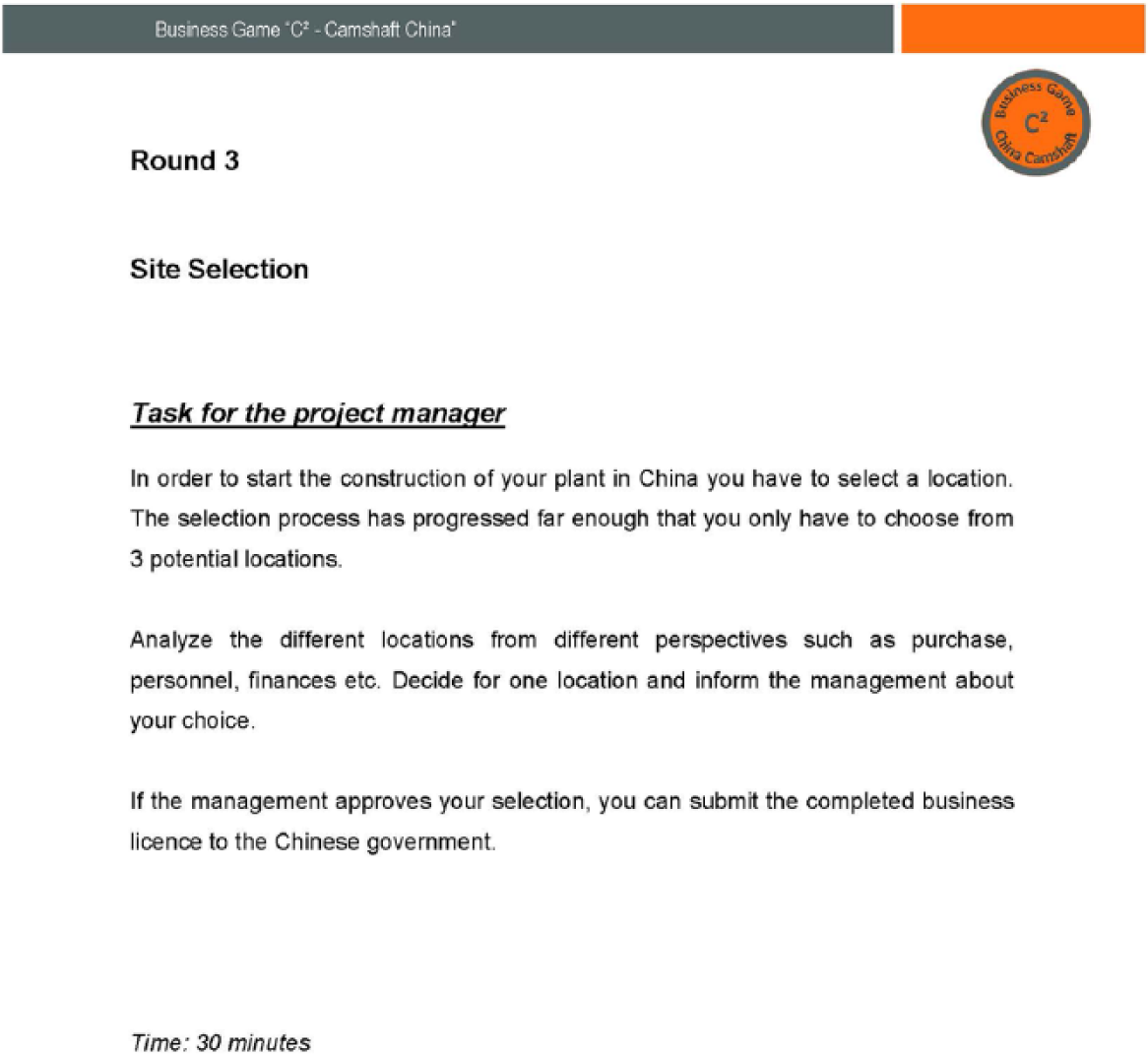
Example of site selection worksheet.
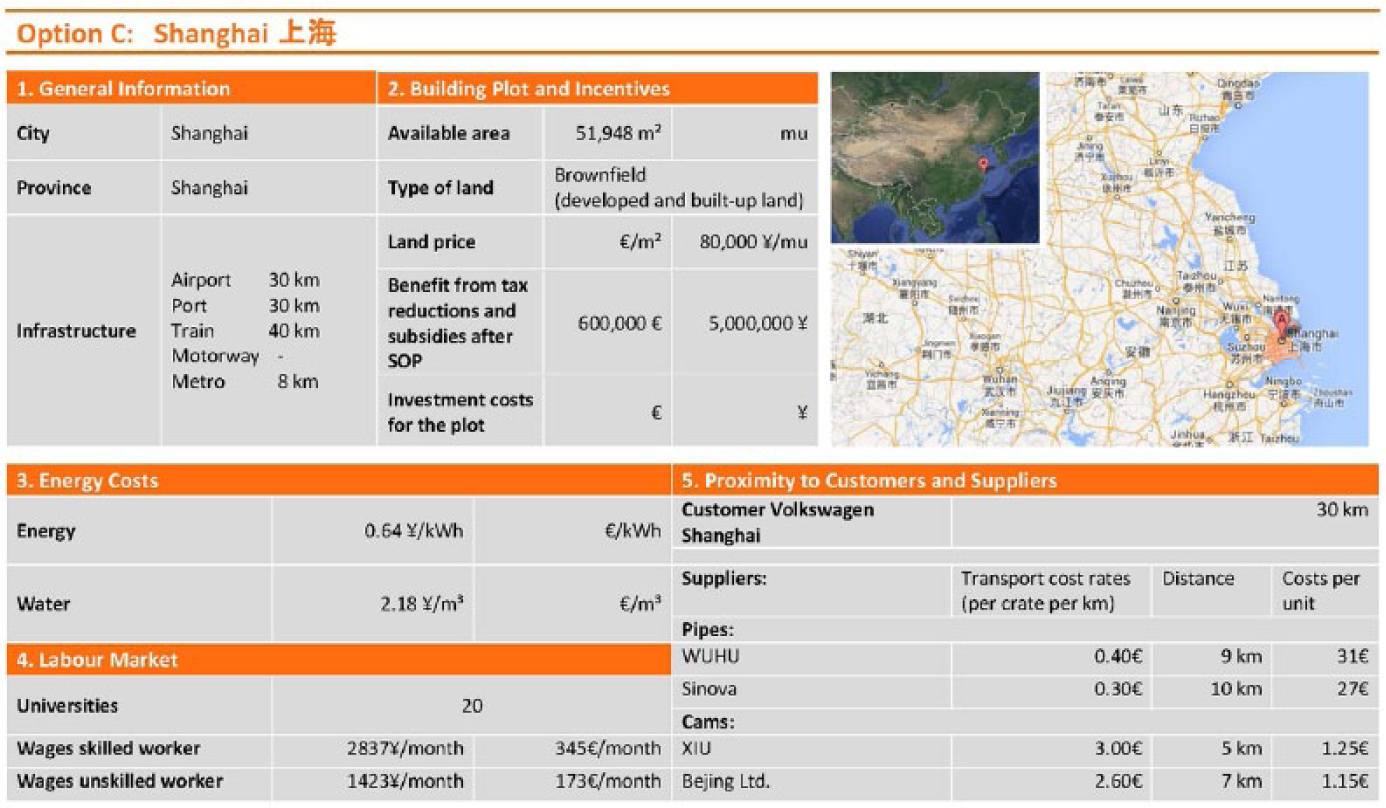
Example of site-location information.
The facilitators of the game take different roles. As coordinators they are responsible for the distribution of the required materials and worksheets. They moderate the LEGO Serious Play process in order to, step by step, build the project landscape. They function as CEOs of the company on the content level to assess the work and progress of the project. The facilitators also represent the environment and stakeholders of the project team and negotiate with delegates of the team.
We use LEGO Serious Play as a creative and interactive learning method (Kristiansen & Rasmussen, 2014; Roos, Victor, & Statler, 2004; Schulz & Geithner, 2014; Statler, Heracleous, & Jacobs, 2011).
In our business game simulation we use LSP with two aims: First, at one workplace, as presented in Figure 4, the participants, step by step, created a model of the new plant with LEGO bricks. With this LEGO-building site they were able to always monitor the ongoing construction progress as in real project stages. Second, the participants at another workplace use LEGO models representing the so called project landscape in Figure 5. The latter corresponds to the original meaning of LSP, which integrates the elements of toolkit based modelling and the principle of serious play. LEGO blocks are used as mediating artefacts to build symbolic or metaphorical representations of abstract concepts or ideas. Participants’ intangible beliefs, conceptions, thoughts and perceptions can be visualized by a three-dimensional model (McCusker, 2014).
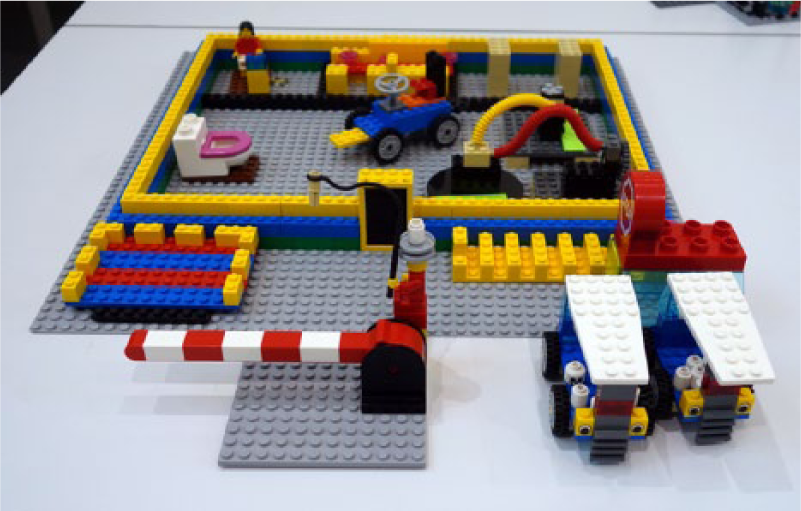
Final factory model (students group 1).
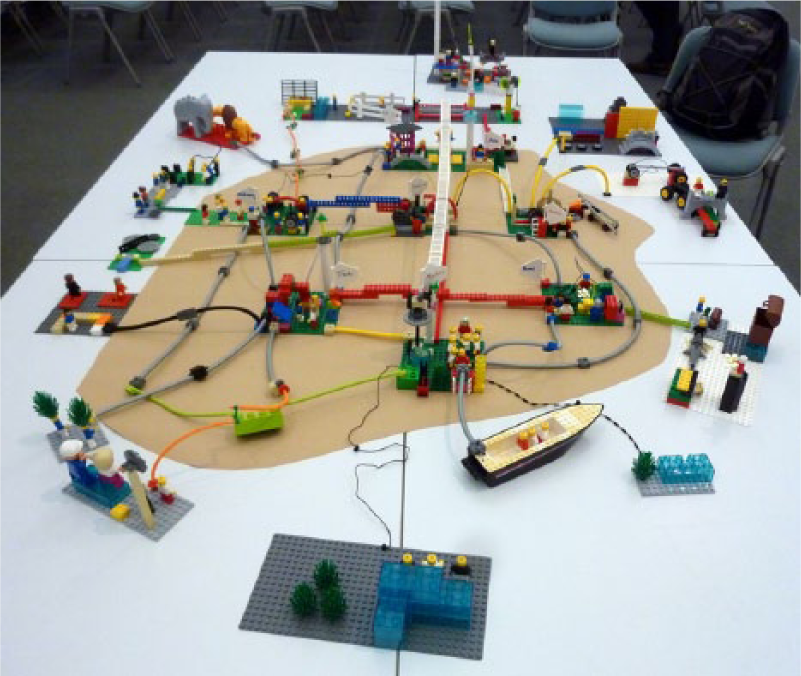
Project landscape (students group 4).
In our case, a common model of the project team with its influencing environmental factors like stakeholders or infrastructure is developed as shown in Figure 5. LSP aims to actively integrate all participants of a team, allowing them to gain awareness, express and exchange their ideas (Schulz & Geithner 2014). It invites them to think with their hands (Roos & Victor, 1999; Sanders & Stappers, 2008). Learning is fostered and knowledge exchange is gained when participants actively construct models (Papert & Harel, 1991). LEGO building blocks can easily be assembled and disassembled without any prerequisites for the user. The built items represent metaphors for meanings. These meanings are then carried out through the story which is told by the creator of the model. Hence, the creation of models is only one part of the LSP process. The more important part is the story-telling, which allows deeper insights (McCusker, 2014). The meanings covered in the model can, thus, be easily grasped by the other members of the team, and encourage reflection and discussion. In addition to the individually created metaphors, the models can be joined to create a collective shared model. The subsequent shared models express both collective connection and diversity between participants (Kristiansen & Rasmussen, 2014).
Within the LSP process participants are invited to reflect beyond their existing assumptions to combine, recombine or develop new ideas or concepts (Schulz & Geithner, 2014). This is based on Kolb’s (1984) and Schön’s (1987) approach of learning as experience, conceptualization, interaction and reflection. The models are metaphors which help to clarify different understandings within a community, as well as enable a common understanding between individuals. The use of LEGO bricks as a creative tool for metaphorical model building promotes reflective thinking (James & Brookfield, 2014).
In comparison with distance learning through computer games or paper/pencil case studies without face-to-face interactions, the participants in the “C2” business simulation game have the opportunity to discover project life, exchange their opinions, interact with an internal and external environment – all this supports reflection-based and experience-based learning concerning project management and soft skill development.
Game Sequences and Challenges
Within the “C2” business simulation game the participants reach a decision on one specific new location in China. After that they setup the new factory. The game lasts two days and has different rounds. One round (between 30 and 90 min) corresponds to one to three months in the company’s life cycle.
Within the business game the participants have to deal with incomplete information and with information overload. They have to cope with a lot of (unpredictable) events and must decide between different opportunities regarding location: Which location should we choose? What criteria are to be considered with regard to the site selection processes? What decision support tools could be used?; and factory setup: What are the steps in building the new factory location? What do we need to consider (e. g. financial and human resource management strategy, machine concept, raw-material suppliers, logistics and quality management)? While these decisions relate to the content of the project, many process-related questions such as how to communicate and cooperate within the project team needed clarification.
The first day of the game starts with a welcome address given by the instructors and a game introduction ritual before all participants receive some briefings. After that, the students or young academics discuss and jointly define the aims of their project based on the manual. Then, the LSP warm-up phase follows, which helps the participants to understand the method and how to use the bricks.
The “C2” is designed as a role-play game. The players can choose their own roles based on their self-reflection of their own skills and personal expertise. It can be assumed that the commitment and identification as well as the learning outcome are much higher than in games without role-playing activities (Greco et al., 2013; Kikkawa, 2014). With regard to the use of LSP, as described above, the participants first built individual models with LEGO bricks representing their personal strengths. In the next step the team members discussed central tasks and requirements of the “C2”-project by using metaplan cards. This means that they created a shared understanding in a discursive process. The underlying idea behind this is that such shared understandings of the tasks, cooperation, and the aims of the project are critical success factors for projects. This allows all tasks to be grouped with different project positions. On that basis, the participants selected their role within the project team, e. g. general project manager, head of production, head of finance, head of logistics, human resource manager or supply-chain manager. This self-determined role-taking process leads to the fact that every game session has its own roles and functions. Hence the roles are similar but not exactly identical between the six game sessions at the three academic institutions.
Afterwards, the participants started working on their project landscape, which covers the main project tasks including the team members who are responsible for specific tasks and the connections between them as shown in the inner circle on the brown frame in Figure 5. A large part of the first day takes the stakeholder and risk analysis into consideration. The focus is on questions such as: Who are important internal and external stakeholders as well as risks of the project?; How do they influence the project?; and how to deal with them? Participants were asked to build individual LEGO models of relevant stakeholders in order to provide as complete a picture of stakeholders as possible (please refer to Figures 6 and 7). Subsequently, these models and more or less powerful connections to the project were positioned in the project landscape that are the models in the outer circle in Figure 5. During the game this project landscape is used to simulate effects of decisions and reflect aspects such as team collaboration, communication processes and structure modifications (see Figure 8).
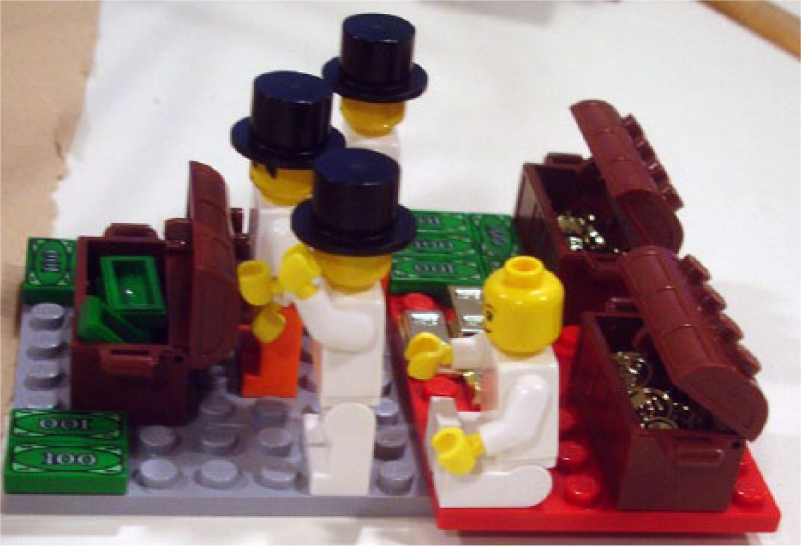
Stakeholder model “Investors” (doctoral students group).
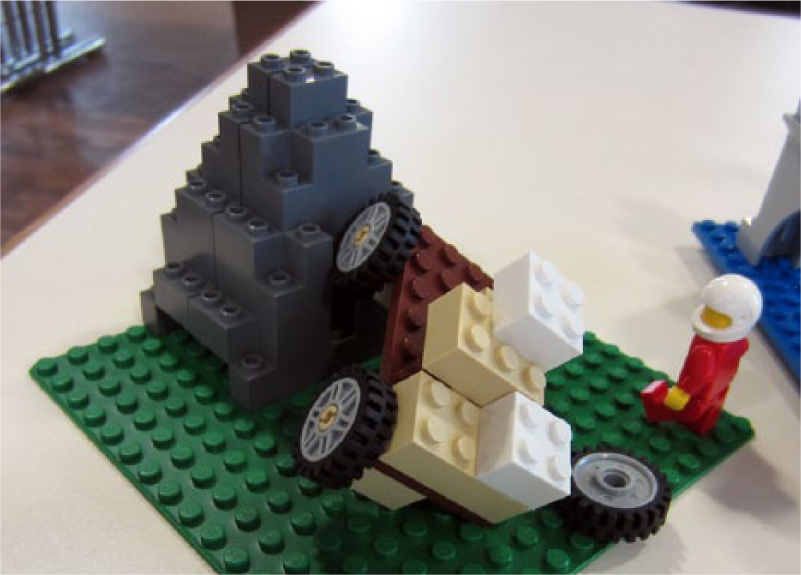
Risk factor model “Delivery Bottleneck” (doctoral students group).
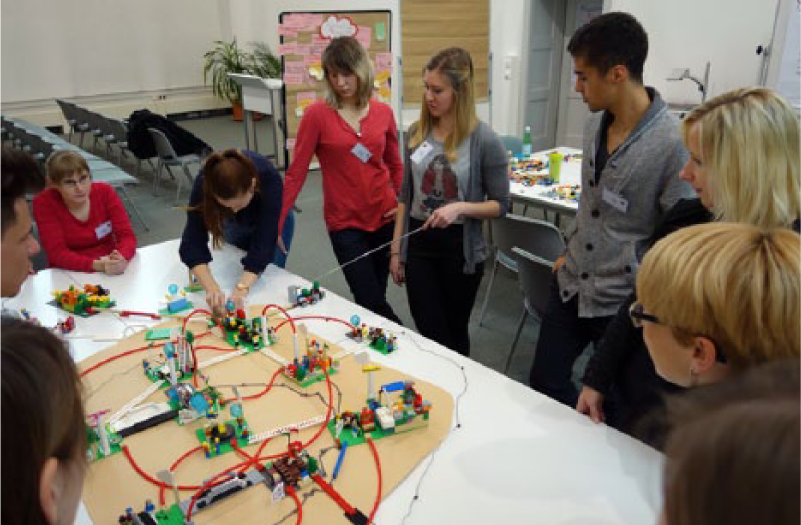
Participants reflecting and discussing their understandings of the project landscape (students group 2).
Subsequently, the team has to complete the project planning in terms of time and then create a work breakdown structure. All outcomes of these steps are documented in different ways (metaplan board, flipchart, and worksheets as in Figure 9) and are presented to the CEOs of the company in role-plays scenes.
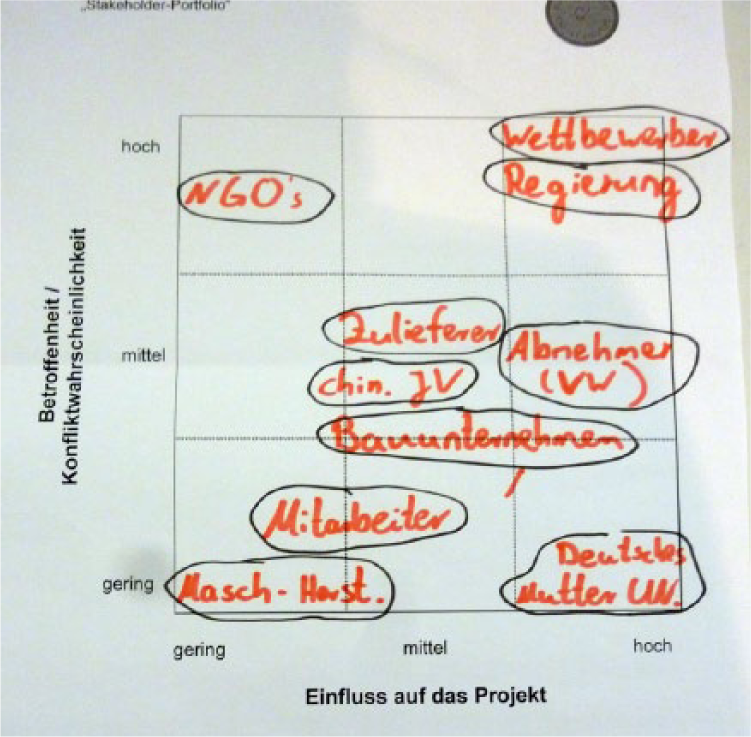
Stakeholder analysis (students group 4).
At the beginning of the second day, the project team chooses one of the three options for the new location in China. For this purpose, they have to agree on which criteria such as infrastructure, land costs, development costs or labor market situation have a higher priority compared to other information. However, every decision will have specific consequences during the game. For example, if the project team chooses the brownfield in Shanghai they also have to demolish a dilapidated storehouse that is still on the land. The group received this information already at the beginning but they may not have considered this as really relevant or problematic and therefore did not think about consequences in advance. This can lead to significant additional costs and can cause further delays down the line. In addition, the project team has to decide about all the equipment and the layout of the factory, the machines, and the employees needed, the infrastructure and so on. Finally, a fully functioning factory is to be built – once again with LEGO bricks (see Figure 4). At the end of each of the two-day sessions the facilitators evaluated whether the project team operated successfully or not.
The overall choreography of the six game sessions was always the same. However, the implementation varied slightly depending on the student group (e.g. faster groups were given some additional tasks, for example conducting an analysis of the Chinese culture to derive the dos and don’ts for the project).
Evaluation Methods and Feedback Tools
In order to assess to what extent the business simulation game contributes to the development of management competencies, technical project management skills and soft skills of the participants and to analyze the overall quality of the game, used for the first time in education and training, a corresponding evaluation concept is necessary. We implement a mixed method approach (e.g. Creswell, 2009; Feilzer, 2010; Teddlie & Tashakkori, 2009) which combines quantitative and qualitative methods (Boud, 1995; Boud, Cohen, & Sampson, 1999; Boud & Falchikov, 2006, 2007). Our evaluation study has an exploratory character (Stebbins, 2001) and employed the following methods:
An online self-assessment of knowledge and skills before and after the game.
Participatory observation during the game.
Sharing and saving the lessons the participants learned.
Participants’ oral feedback at the end of the first and the second day.
Paper-pencil evaluation questionnaires after the game.
A twelve-month follow-up questionnaire.
Online Self-Assessment of Knowledge and Skills Before and After the Business Game
Project management knowledge and social skills of the participants are assessed in the form of self-evaluation. All participants were asked to complete the same online-based pre- and post-game questionnaire. With that before-and-after comparison we were able to evaluate the impact of the game on the learner’s assumed skills development over the two days. The focus lies on the dimensions of project management including the knowledge and methods mentioned above (e. g. stakeholder analysis, project risk analysis, and development of a project schedule and work breakdown structure) as well as soft skills. With respect to the assessment of skills, we refer to the items of Frey and Balzer (2003, 2007) which include relevant skill areas such as analytic ability, flexibility, reflexivity, goal-orientated performance, leadership, communication, conflict handling, team-work and social responsibility.
Participatory Observation During the Game
The game enables the observation of individual and collective behavior in general and, in particular, and the observation of interactions within the project team and of leadership behavior. The supervisors serve as observers and provide feedback in reflection phases during and after the game. Based on an observation manual they observe and document:
game performance: e. g. decision-making quality and dealing with unexpected events, project strategy development and implementation, keeping the project within the budget and time frame;
group interaction: e. g. communication processes, dealing with different opinions, solutions of possible conflicts, participation of all members, division of labor; and
individual behavior: e. g. role taking and role making, leadership behavior (project leader), motivation, individual task performance.
Most of the observed impressions and results were immediately fed back after the rounds or in specific debriefings. This kind of feedback helps the participants to reflect on their game performance and improve the quality of decisions and cooperation as a team even during the game itself.
Sharing and Saving the Lessons the Participants Learned
At the end of the “C2” business simulation game, the participants reflected on what happened in order to derive so-called simple guiding principles of successful project work. Simple guiding principles encapsulated all the insights and experience of the two days and could be seen as lessons learned (Kristiansen & Rasmussen, 2014). They could help the participants to be successful in future project situations since the principles can be easily remembered (reflection-for-action). They guide participants in terms of where to look, what to focus on, how to decide and how to act. Following the idea of LSP, these principles are created with LEGO bricks. The meaning behind is explained by each model builder, who can build as many models as they want. Accordingly, the lessons learned are based on practical experience from the game event and are less derived from theoretical foundations. Many of the lessons the students and young academics learned resulted from errors during the game.
Participants’ Oral Feedback at the End of the First and the Second Day
In the final feedback session at the end of both days, the participants were asked to talk about their feelings, the degree to which their expectations were fulfilled and other statements with regard to the game. Their comments offer important implications for the evaluation of the teaching and learning format.
Paper-Pencil Evaluation Questionnaire After the Game
After the second day, participants were asked to give feedback using a standardized questionnaire which included topics such as the overall satisfaction, the assessment of the LEGO Serious Play method, the evaluation of the content of the game and a self-assessment of the personal knowledge gain.
Twelve-Month Follow-Up Questionnaire
In order to monitor long-term learning effects and skills development after twelve months, the participants of the “C2” business simulation game were asked the following questions: What comes to your mind first and foremost when you remember the “C2” game? Which impact did or does the simulation game have on your professional, student or private life? What skills, knowledge, experience etc. have you taken from the simulation game and used in your professional, student or private life? What were the simple guiding principles of successful project work with your team? From today's point of view, what are your three most important findings from the business simulation game “C2”?
In the following section, and based on these different evaluation methods that were employed, we present and discuss our main findings concerning the effectiveness of reflection- and experience-based learning within the “C2” business simulation game. With regard to the skill development, as specified above, we will therefore focus our analyses on the development of knowledge, project management skills and soft skills. Moreover, we are interested in the learner’s satisfaction and overall evaluation of the “C2” business simulation game as well as the lessons learned and longer-term learning outcomes.
Findings
Sample
The “C2” business simulation game was carried out six times between December 2013 and March 2014 with a total of 47 participants. Sample characteristics according to criteria such as gender, semester, target academic degree or subject are shown in Table 2.
Sample Size and Socio-Demographic Description of the Participants.
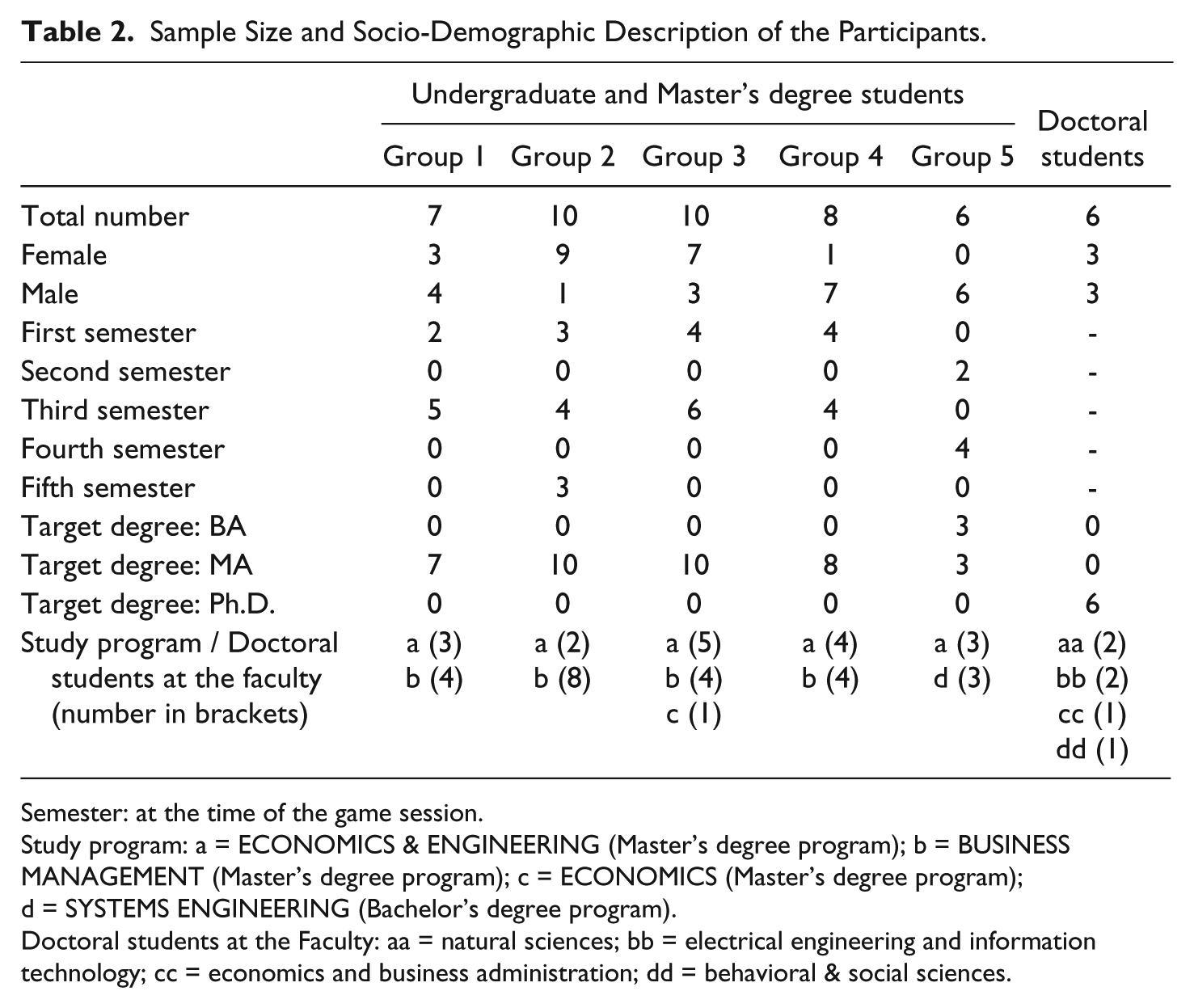
Semester: at the time of the game session.
Study program: a = ECONOMICS & ENGINEERING (Master’s degree program); b = BUSINESS MANAGEMENT (Master’s degree program); c = ECONOMICS (Master’s degree program); d = SYSTEMS ENGINEERING (Bachelor’s degree program).
Doctoral students at the Faculty: aa = natural sciences; bb = electrical engineering and information technology; cc = economics and business administration; dd = behavioral & social sciences.
Development of Knowledge, Project Management Skills and Soft Skills
According to the paper-pencil evaluation after the game, the participants confirmed an increase of knowledge in general. We also noted a high level of support for most statements based on the arithmetic mean value (see Table 3).
Knowledge Gain (n = 47).

Note: Scale questions ranged from 4 “strongly agree” to 1 “strongly disagree”.
The highest level of agreement was given to the learning outcome of finding new ideas for current and future work activities (mean value 3.51). In line with the character of games, the participants stated that the project team had the chance to learn from their mistakes. As our results indicate, the game allows valuable group experience and the recognition of strengths and weaknesses of the team members as well. Even though the items are highly rated (mean value 3.02 to 3.04), the game still has the potential for improvement in terms of learning new things, better appreciation of one’s own skills and of one’s role within a project team.
The participants stated that the contents of the game added to their previous knowledge and that the game has an adequate level of requirements (see Table 4). They had not yet dealt with topics such as a location decision or a factory setup or managed a project from start to finish. Our data also show that the “C2” game has high practical relevance and applicability, with the mean being 3.68 as presented in Table 4.
Contents of the “C2” Game (n = 47).
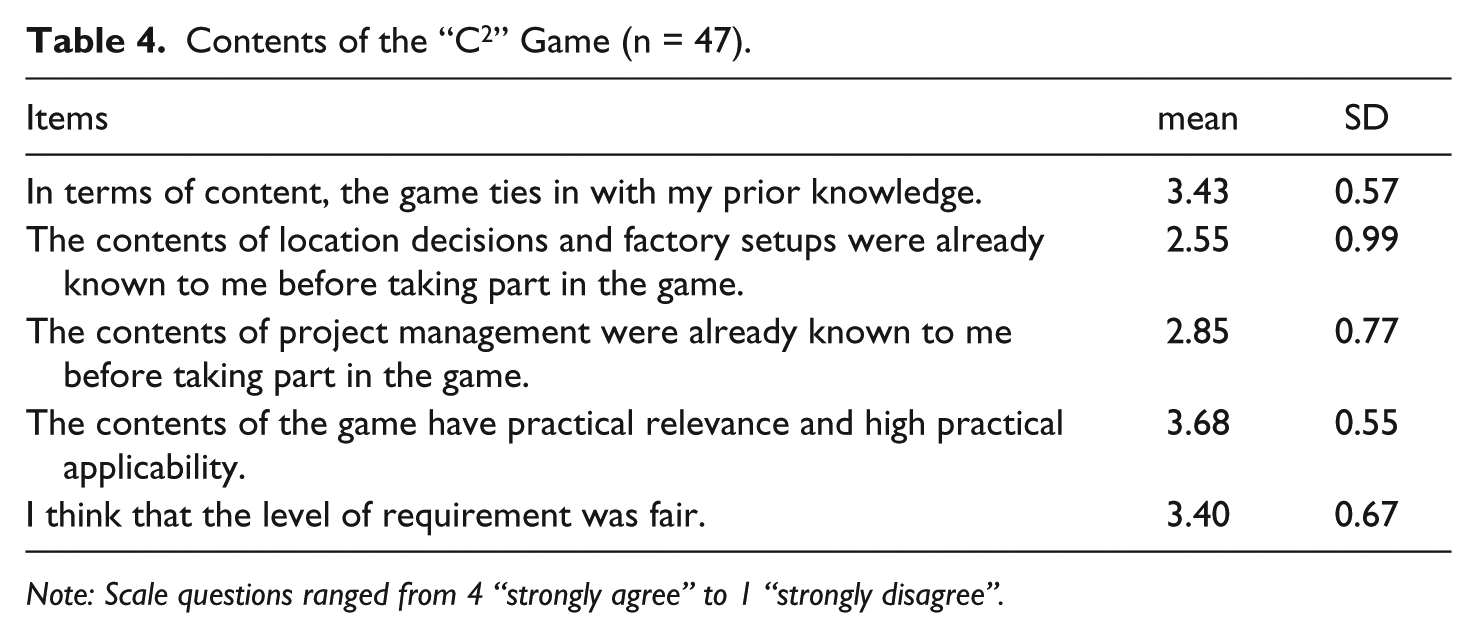
Note: Scale questions ranged from 4 “strongly agree” to 1 “strongly disagree”.
In the paper-pencil questionnaire the participants mostly agreed with the statement ‘I have learned more about my skills.’ (mean value 3.04 with a range from 1 to 4, see again Table 3). Skill-based outcomes, however, are not so easy to evaluate because skills are only clearly visible in the future when acting as project managers and only to some degree during the game, based on systematic behavioral observations. Therefore we depend on self-assessment measurements of soft skills development based on a before- and-after study. These self-evaluation answering options are represented on a four-point scale for all of the analyzed 62 items in Table 5. 33 of the 47 participants of the six game sessions took part in the before-and-after study, which was on a voluntary basis.
Before/After Comparison of Project Management and Soft Skills (n = 33).
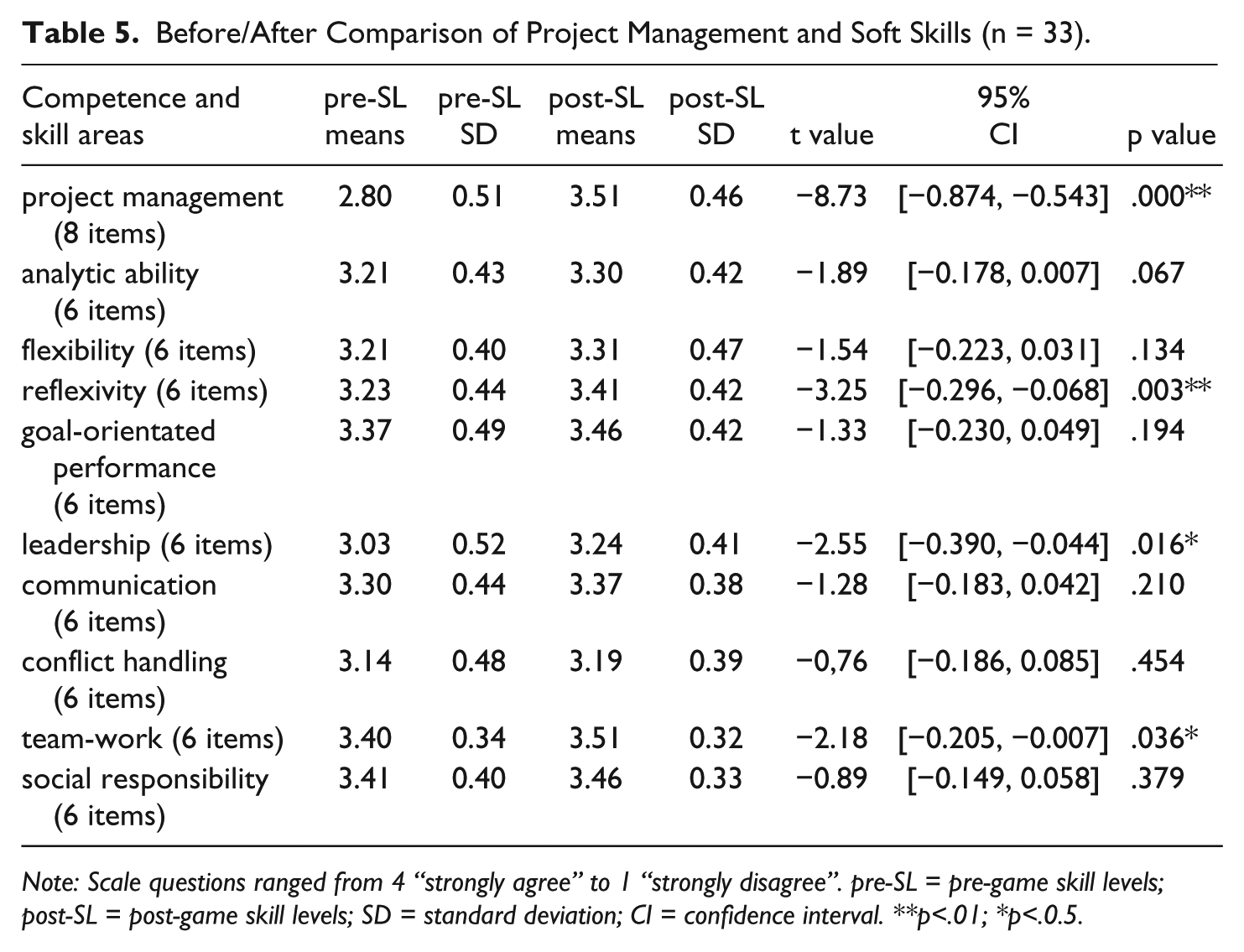
Note: Scale questions ranged from 4 “strongly agree” to 1 “strongly disagree”. pre-SL = pre-game skill levels; post-SL = post-game skill levels; SD = standard deviation; CI = confidence interval. **p<.01; *p<.0.5.
Our data show an impact on all monitored soft skills (mean indicator shows at least small improvements) and, particularly, the strongest increase in terms of project management skills. As shown in Table 5, these results are based on the self-evaluation of skill levels before and after the game. Using the paired two-tailed t test statistics, we analyzed whether pre-game skill levels were equal to post-game skill levels for each of the ten skill areas. The differences concerning project management skills, reflexivity skills, leadership skills and team-working skills, which are in line with our main learning goals, are statistically significant (p value <.01/<.05). That means that these are the four skill areas where the students and young academics could improve their skills most distinctly. The correlation analysis indicates highly positive correlations between pre- and post-game skill levels (correlation coefficients of .478 to .812 with p values <.005). Hence, we noted a significant positive development of skills with regard to project management, reflexivity, leadership and team work. This is an extremely encouraging result particularly in view of the learning goals of the game.
Learner Satisfaction and Overall Evaluation of the Game
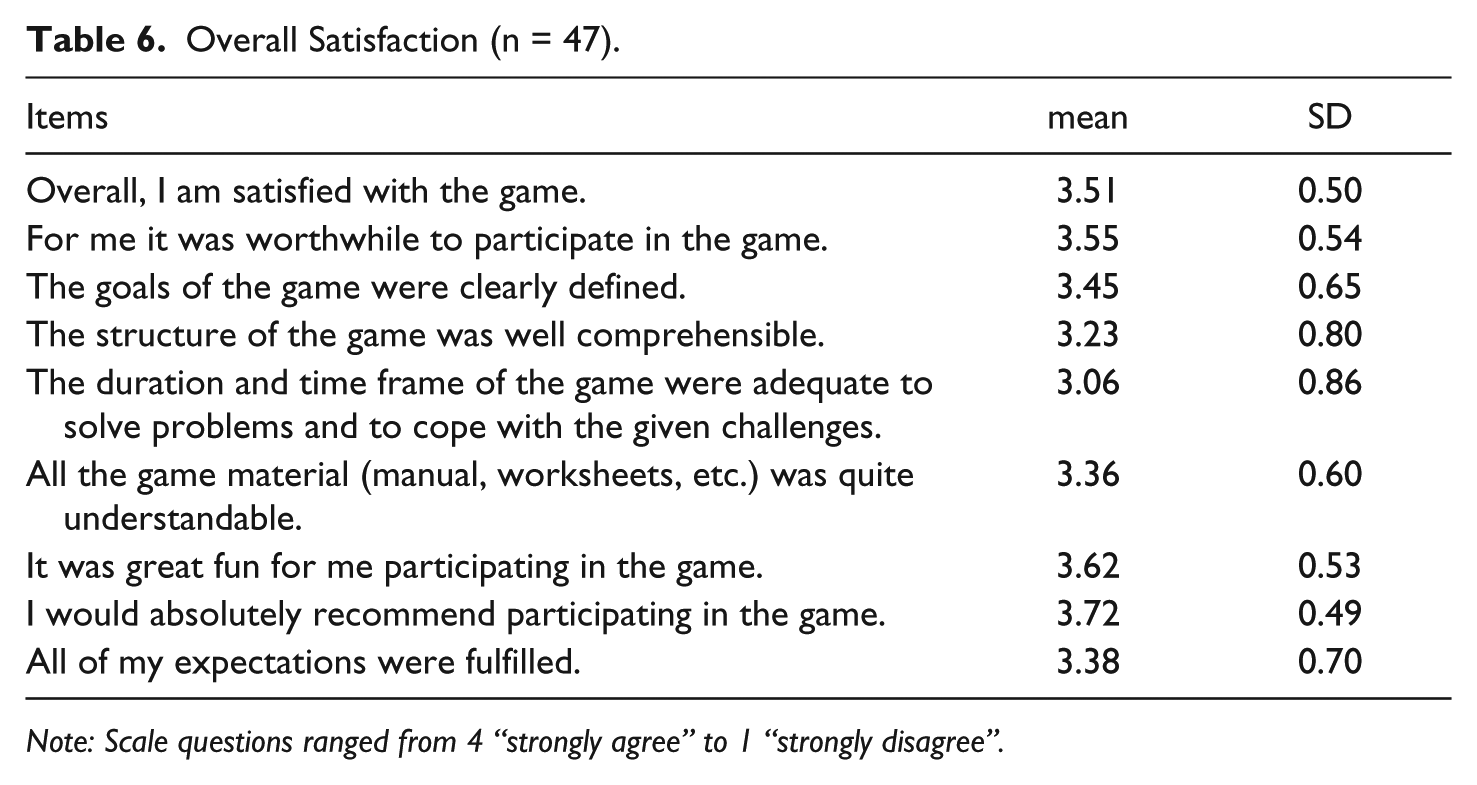
The positive rating of the students and young academics needs to be emphasized due to a high level of satisfaction expressed (see Table 6). The results of the after-game evaluation questionnaires show that the participants had a lot of fun when playing the simulation and would recommend the game to others to a very large extent (mean value 3.72). At the end, all participants agreed that the efforts and attending the event had been well worthwhile.
Overall Satisfaction (n = 47).
Note: Scale questions ranged from 4 “strongly agree” to 1 “strongly disagree”.
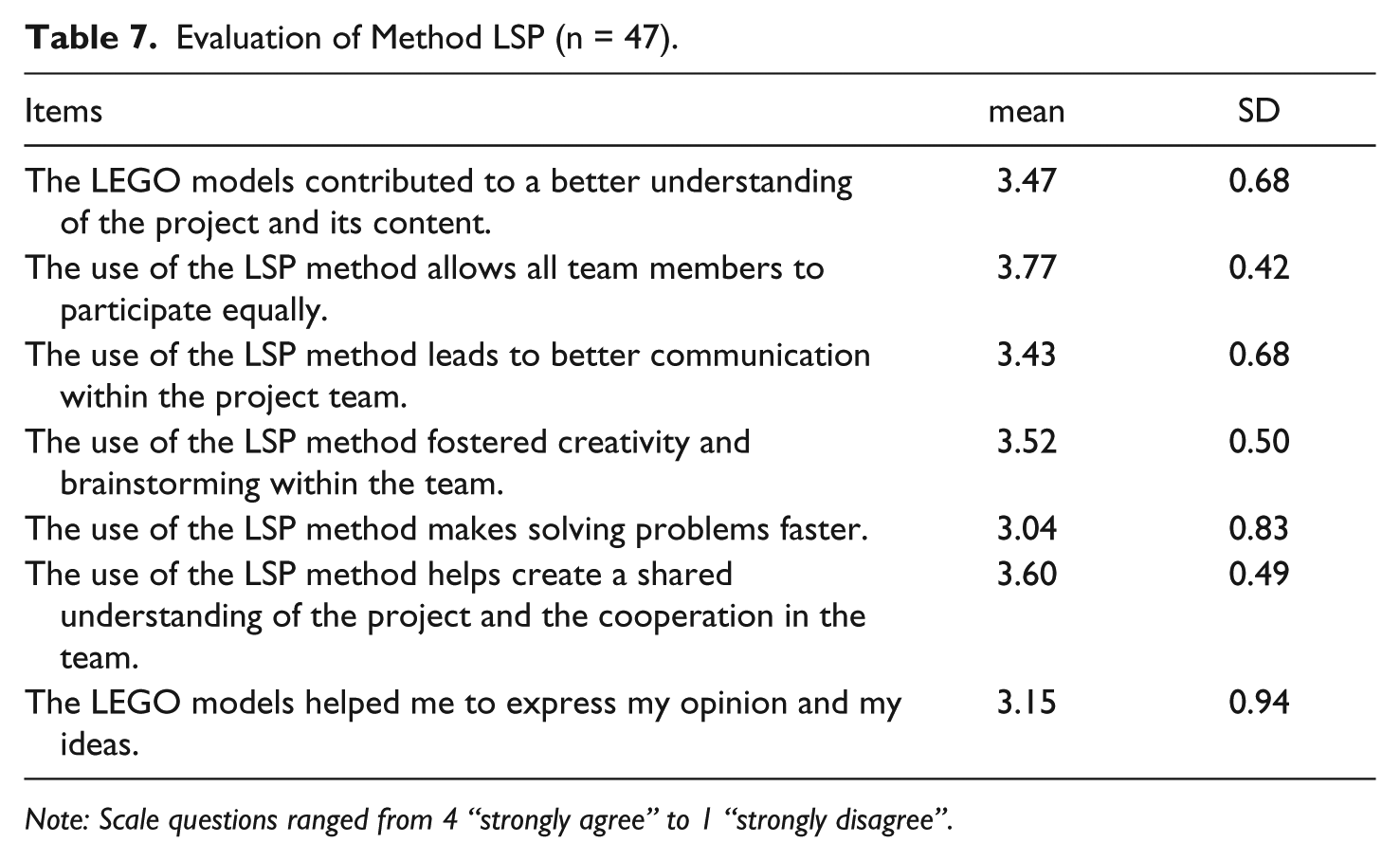
Table 7 shows a similar high participant satisfaction level concerning the learning and reflection method LEGO Serious Play.
Evaluation of Method LSP (n = 47).
Note: Scale questions ranged from 4 “strongly agree” to 1 “strongly disagree”.
The use of the LSP procedure allows fair and equal discussions. Furthermore, it ensures equal amounts of conversation on the part of all team members (no shy, reserved people, no chatterboxes). The participants were convinced about and impressed by that point. Furthermore, they concluded that the characteristic steps of the LSP method – from individual to collective models as common perspectives – led to shared understandings among the players. Another key result of our evaluation data is that all participants reflected that LSP could speed up team communication, problem-solving and creativity processes. During the game the project landscape designed with LEGO bricks, as previously shown in Figure 5, is used to reflect and discuss aspects such as team collaboration or communication processes. After three game rounds, participants use green flags to mark what is going well and red flags to indicate problems and difficulties within the team. For example, in the doctoral students session the team was strongly dissatisfied with their general project managers’ leadership style, which has direct consequences for the project progress and the results. This situation led to personnel changes within the team.
At the end of every game day, the participants could provide feedback about the strengths and weaknesses of both the business game and the LSP method. The following comments underline the learner satisfaction immediately after the game-playing activities.
I came here without any expectations. I had no idea of how LSP works. But then the game brought a lot of fun, in particular the LEGO sessions. In my eyes, the complexity and the factors influence the overall project success. I was pleasantly surprised by the game. I had some problems with our tasks because there was a wide range of them and there was unspecific, imprecise or missing information. However, I think this is all created on purpose according to real-life projects. The team work and the atmosphere in the team were great. The game was extremely interesting and challenging. It is great that the case is from a real business company. Maybe we should have had more time.
From the participants’ perspective, practical relevance, hands-on learning, interactive teaching design, visualization by LEGO bricks as well as the encouragement of imagination and discussion or the possibility to break out of rigid patterns of thinking and routines are among the strengths of the business game. However, they also stated some weak points such as the time frame with two days not being enough time and some confusion at the beginning due to some missing information or creativity being affected by quite challenging tasks. According to the students and young researchers, some scenarios or extremely complex situations cannot be represented in simplified LEGO models. Overall, the positive assessments predominate.
Lessons Learned and Longer-Term Learning Outcomes
The lessons learned are built in the form of LEGO brick models. At the end of the second game day, each group built the most important simple guiding principles of successful projects in a discursive process. Figure 10 shows some examples.
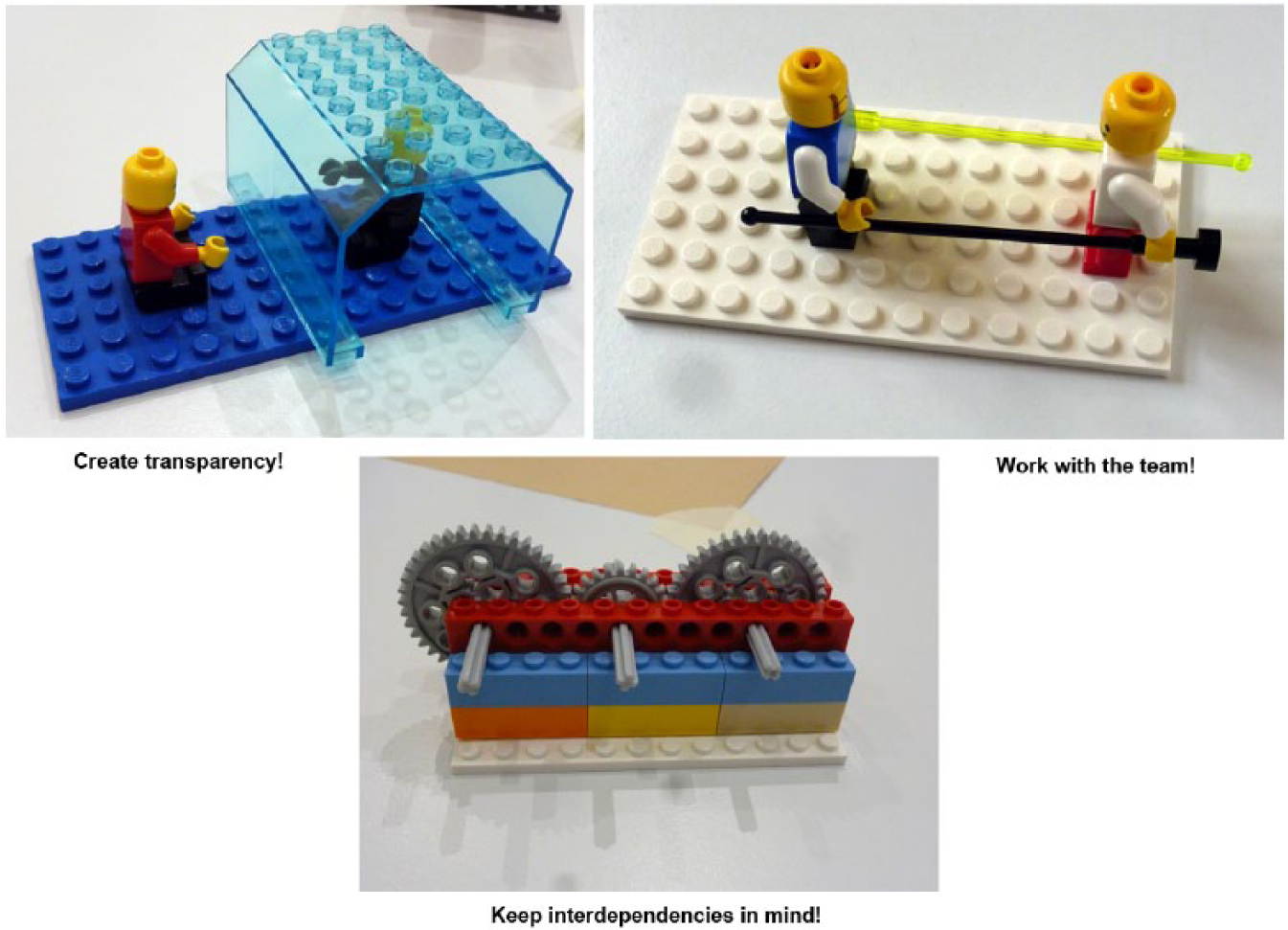
Simple guiding principles of successful project work.
One major learning interest of the game was to develop shared mental models regarding project work. The participants recognized that such shared understanding forms the basis of successful projects. Hence, team members had to talk continuously about their individual and common understanding of the project task, aims, project management, communication and leadership, for example. Although the simple guiding principles were specific for each group, they shared some commonalities. For example, all participants emphasized the importance of communication within the group, the advantages of teamwork and the relevance of keeping the goal of the project in mind. Simple guiding principles such as keep an overview! or formulate achievable goals! can therefore be considered as key lessons learned about managing cross-functional projects.
Furthermore, a year later, the participants were asked five open questions to assess the longer lasting effects of the “C2” business simulation game. We received 12 responses. Therefore, we cannot draw any conclusions about sustainable learning effects in general. However, the majority of those twelve participants in the survey one-year-later state that they learned more about their role in a team and the difference between awareness of others and self-perception as well as about working in an interdisciplinary project team. One participant stresses: Yes, especially regarding teamwork I have learned several things and applied them in my professional life and also to my personal workflows. In particular, the reflection of my own role within a team helps me to better integrate myself into teams and bring out my strengths. The awareness that complex tasks and unexpected effects can only be met with the whole team was also strengthened. Similarly, the hands-on understanding of limited resources (staff, time, and money) has become very clear through this simulation. In addition, I’ve learned the practical relevance of production in Asian countries (presence and cost savings) and also the complexity of an expansion to China (legal restrictions). This may help me in my future career.
Another participant states that he learned to trust other team members and develop more self-confidence. Particularly the general project managers point out that they developed their leadership skills. One says that he learned: …how to structure projects (time, tasks, and responsibilities) and many things about the importance of open and direct communication.
Two participants highlight that the experience in the business simulation game was helpful for their job applications as a project manager and as a consultant.
All respondents remember the LEGO serious play method and mention that they very much liked the business simulation game. They enjoyed the playful learning with such a creative learning method. One participant points out:
Simple tools such as LEGO blocks can help to reify complex relationships and uncover dependencies.
One of the students states that the project landscape shown in the model in Figure 5 encouraged reflexive thinking of both one’s own and the team’s activities. Finally, a student highlighted that she remembers a lot more topics from the business simulation game compared to those delivered as theoretical lectures. These results cannot be generalized due to the low response rate of 26 per cent and the small sample size; but they can be interpreted towards longer lasting learning outcomes of the game.
Conclusion and Future Research
The aim of this article was to explain the design, implementation and evaluation of the “C2” business simulation game, which was developed in order to improve both project management skills and soft skills of the participants. We assume that these skills are required in today’s working environment, but can hardly be developed through traditional forms of academic learning such as passive lecture and text-based methods. Business games – especially with authentic business contexts where participants are actively involved in role-plays and simulations of daily work situations – are an excellent way to train necessary skills. In our “C2” business simulation game the participants decide about a site-location and factory setup of an automotive supplier in China. This example is based on a real case study. Furthermore, the game combines interactive learning with LEGO Serious Play. LSP emphasizes the importance of play, hands-on model building, storytelling and reflection for learning.
As our evaluation results indicate, the “C2” business simulation game contributed to the development of soft skills and helped to increase knowledge in project management. Our results show that the participants were highly satisfied with the business game especially with their active involvement, its practical relevance and the relation to real-work situations. LSP seems to be an appropriate learning method to express diverse understandings, exchange knowledge, develop ideas and facilitate reflection on complex projects. The mixed learning techniques used in the game seem to lead to a higher motivational level of the students. They tend to strongly identify with their role, which they selected themselves on the first of the two days. Participants become aware of their skill level through self-reflection initiated by the pre-after measurement and an external assessment based on observations. In addition, one of the major advantages of the simulation game is that participants can make mistakes without real consequences and therefore learn from failure and by trial and error. Reflection-in-action, on-action as well as for future action are encouraged through our business simulation game. This kind of reflection and experience-based learning does not only prepare students and young academics for future work challenges, but also enables them to become project managers and team leaders or team players. All the evaluation findings are promising in terms of long-term effectiveness of the learning outcomes. It can be stated that the “C2” game leads to higher reflectivity and participants gained experience in project management and teamwork. Hence, the game as an active learning environment also positively impacts the development of leadership and team-working skills. The participants were able to improve their basic knowledge in managing projects and some soft skills, which are not only particularly difficult to develop in traditional classroom settings but are also still heavily underrepresented in project management education and training. However, these findings emerge from both our behavioral observations during the game and more importantly from the self-analyses of the participants themselves, and finally the survey conducted a year later. The explorative approach with its presented plurality of evaluation methods and its absence of research hypotheses helps us to explore and evaluate our new way of preparing project managers. It can therefore be assumed that games like the “C2 – business simulation game” are more effective regarding soft skill development and more enjoyable than traditional learning by instruction. The next step must be the validation of the results by means of an empirical hypothesis study.
We also want to analyze the gathered data in more detail with respect to between-group statistical comparisons, for instance regarding the pre- and post-game skill levels. Furthermore we want connect the parametric t-test data with the obvious differences between the game sessions. It would also be interesting to see whether the knowledge increase depends on participants’ previous knowledge and experience. Hence, planned steps for further investigations include intra-group comparisons for novices and experts as well as inter-group comparisons between students (mostly Master’s degree students) on the one hand and doctoral student on the other hand.
Since our previous analysis focused on the individual level, we intend to more accurately compare the collective project landscapes of the different groups in terms of their cognitive maps about their understandings of team collaboration and project management. We are interested in analyzing whether the team composition and the diversity of the participants (e.g. age, sex, academic background, work experience) of the six groups lead to different results (e.g. model complexity, individual or shared understanding of team work and project management); whether and to what extent the mental models change during the business game and how and to what degree the individual LSP models were integrated into the shared model of project life. We are also interested in the effects of LSP on team performance and the degree of interaction. Important research questions are: How does LSP help to express individual understandings of the project? How has model building developed during the game? How does LSP facilitate the development of a shared understanding and mental models among the participants? How does LSP interact with the other methods and which strengths and weaknesses does this method have?
Besides, we can use the participants’ feedback to further improve the “C2” business game and we are continuously searching for new applications. In this respect, the game is well-suited for coaching processes with real-life project teams. We have considered developing and playing a competitive version with two teams as well, which would make intergroup competition possible.
Footnotes
Acknowledgements
This article is a considerably augmented and enhanced version of a paper entitled, Team processes in interdisciplinary projects: The C2-Business Game for Project Management and Soft Skill Development, which was presented by the two authors and Stefan Donath at the 45th annual international conference of the International Simulation and Gaming Association (ISAGA), Dornbirn, Austria, July 7-11, 2014. We thank Stefan Donath and David Jentsch for the joint development of the “C2” business game, and, not least, for the supportive and trusting atmosphere during the years that we worked together. We would also like to express our thanks to the anonymous reviewers for their valuable comments on our manuscript.
Author Contributions
All authors contributed to this article, both substantively and formally. SG and DM did the literature search, the conception and development of the study design and the theoretical basis. All authors contributed equally to the editing of the manuscript and discussed the main findings together, whereby SG was responsible for the qualitative data analysis and figures, and DM handled the quantitative data analysis, interpretation and the tables of this article.
Declaration of Conflicting Interests
The authors declared no potential conflicts of interest with respect to the research, authorship, and/or publication of this article.
Funding
The author disclosed receipt of the following financial support for the research, authorship, and/or publication of this article: The development of the “C2” business simulation game was funded by the German Federal Ministry of Education and Research between April 2013 and March 2014. The authors received no financial support for the authorship, and/or publication of this article.
Notes
Author Biographies
Contact:
Contact: