



Abstract
Background
Aim
This article aims to present the design and development of
Results
Results from the mixed-method pilot study show that
Results
Conclusion. As a combination of logical thinking practices and a serious game,
Keywords
Serious games are computer games that aim towards learning or training purposes (Crookall, 2010). They have many advantages over other instructional tools (Prensky, 2003, 2007). One of the advantages is that serious games are self-engagement tools that represent the learning pedagogy through a virtual world (Annetta, Lamb, & Stone, 2011; Luealamai & Panijpan, 2010; Prensky, 2003).
This article presents the use of serious games’ advantages to enhance logical thinking. We developed the game called BLOCKYLAND based on cellular automata (CA) concept. CA is an algorithm that generates a system of cells which are able to change state according to the surrounding cells. It is used to simulate natural phenomena in many professional fields. We studied CA procedure and found that it has a potential to be applied as a logical thinking practice. The logical procedure in CA is originally executed by a machine. However, we inverse the roles of the human and machine in CA to provide a logical thinking practice in BLOCKYLAND. Even though our game challenges players to apply logical thinking through CA procedure, the prior knowledge about CA is not required. The design and structure of the game were described along with the details of the game mechanisms.
A pilot study was conducted to assess the effectiveness of the learning unit in enhancing logical thinking of the target audiences. The outline of the learning unit and debriefing guideline are also mentioned in this article. Moreover, the results of this study were reported with the implications for practice.
The first section of this article describes the rationale behind the origins of BLOCKYLAND. The second section reveals the design and structure of BLOCKYLAND. Finally, the final section presents the results from the pilot study. We begin with a description of CA and how CA was used to design BLOCKYLAND. In addition, we show how CA can serve as an instructional tool to enhance logical thinking.
CA and Rationales for BLOCKYLAND Development
A cellular automaton (CA) is an invention of John von Neumann and Stanislaw Ulam that produces complex dynamics from an intuitive algorithm. CA is a spatial and temporal discrete system, which consists of homogeneous cells. The cells are assigned a state that is updated from a set of predefined states synchronously. Updating the state of cells is an important procedure of CA. This procedure considers the current state of the cell and its neighboring cells. The cell, then, looks for a rule that matches its situation from a set of transitional rules. Thus, for an update to occur, a different cell in the same lattice applies a different rule locally.
The Game of Life or Life by John Convey is one of the most famous CA applications that simplifies the ideas of von Neumann into a game about the life of cells on an infinite squared board (Berlekamp, Conway, & Guy, 1982). Life is a no-player game, in which the roles of human-player are determined in the first generation of Life and observing how it evolves (Sigmund, 1993). Cells can have either one of two states; alive or dead. If any alive cell has two-three alive neighbors, then that cell will remain alive in the next generation; otherwise, it will become dead in the next generation. However, if any dead cell has exactly three alive cells in the neighborhood, then that cell will be come alive in the next generation. Cells evolve upon the eight surrounding cells of the specify cell called Moore neighborhood that was named after Edward F. Moore, the CA pioneer who invented it. The Game of Life is an example of complex behaviors that CA can generate from the simplest rules.
One of the reasons that CA is widely studied is because it is able to produce several complex behaviors from a set of simple rules. The rules determine CA behaviors because they define the update of every cell (Schiff, 2011). This concept is similar to logical thinking, which is a process of sequential thought that comprehends the validity of an argument from facts and supporting information (Griffin, 2003; Payne, Bettman, & Johnson, 1993).
Logical thinking process is required in solving problems or making decisions in our daily lives. Logical thinking refers to formal reasoning, which is an examination of the truth value of supporting assertions to establish the truth value of conclusions (Griffin, 2003). The similarity between CA state updating procedure and logical thinking process is that both processes rely on deductive reasoning. Cells in CA determine their next state by applying a rule that matches their current state and their neighbors. People apply logical thinking to make a decision by determining the relevance of facts and information before making a justification. However, adolescents were found to be lacking in logical thinking, due to a weak relationship between their reasoning skills development and the school curriculum (Griffin, 2003). Hence, CA has the potential to be used as an instructional media to enhance logical thinking.
CA was applied as an instructional tool in educational research for various specific purposes. Wu-Pong and Cheng (1999) developed a CA model to illustrate and simulate kinetic processes for pharmacy students. Later, Faraco, Pantano, and Servidio (2006) used CA simulation in the learning of emergence in Mathematical Methods for an Engineering course. Bardzell and Spickler (2011) also described positive feedback in their developed CA software to visualize abstract algebra. Although these studies reported positive results of using CA as an instructional tool, their objectives only focused on the learning outcomes of specific subject matter. In this article, we emphasize the potential of CA as an instructional tool to enhance logical thinking.
We included logical thinking practice in a CA-based serious game, because serious games can add a level of engagement to the learning process by embedding learning content into computer games. Used in this manner, serious games have an advantage over traditional methods by motivating their audiences (Garris, Ahlers, & Driskell, 2002). Serious games also provide interactive learning, which assists learners with progressing toward the learning objectives (Prensky, 2007). Moreover, the interaction with the virtual objects allows learners to enhance understanding of the logic behind the games rules (Annetta, 2008). The incorporation of learning content and serious games can lead to effective learning and a better retention (Garris et al., 2002).
Serious games seem to be an appropriate platform to present CA to adolescents. Previously, Wainer, Liu, Dalle, and Zeigler (2010) presented CA in serious games applications. However, those applications merely simulated natural phenomena from predefined structures and variables. The players’ role is passive as they are only observing the simulations that are generated from a predefined structure and rules through the provided interface. The procedure that requires logical thinking is processed by a computer. Therefore, we invented the CA-like processes in BLOCKYLAND that inverted the roles of players and machines in original CA. CA-like processes highlight CA construction that is able to enhance logical thinking. The following section describes the similarities and differences between the processes of general CA simulations and BLOCKYLAND.
CA Processes vs CA-Like Processes
CA-like processes are CA processes that allow humans to participate more in the CA application. The processes follow CA concept but switch the performer in each process. CA-like processes is a backbone of BLOCKYLAND. Figure 1 illustrates the comparison between general CA processes and BLOCKYLAND CA-like processes. The similarities and differences are described, as follow:
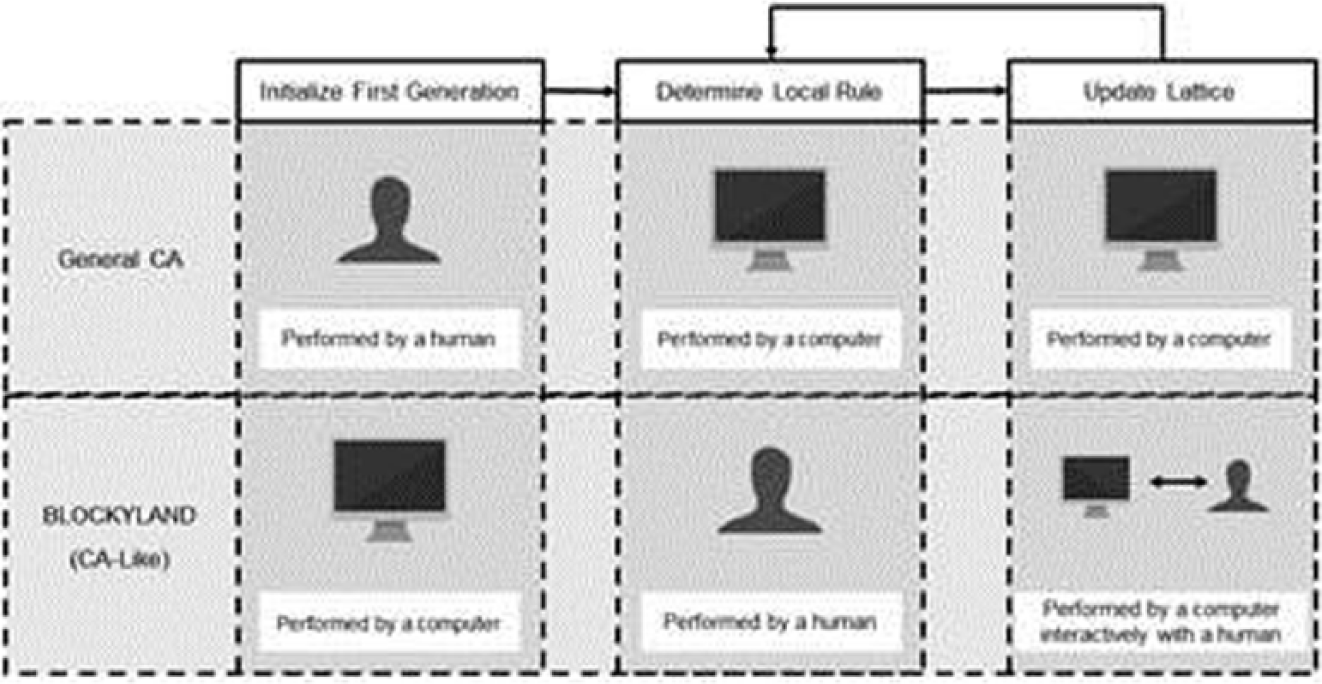
Comparison of CA processes and BLOCKYLAND CA-like processes.
The following section describes how BLOCKYLAND was designed to enhance logical thinking and discusses how it can be used as an instructional tool by describing the game’s mechanisms.
BLOCKYLAND Design and Structure
BLOCKYLAND is a city building game that aims to provide channels to practice logical thinking under a stochastic scenario based on the CA concept. The game can be accessed via www.BLOCKYLAND.com. The target audience for BLOCKYLAND is adolescents, because as noted by Inhelder and Piaget (1958), they are developing formal operational reasoning skills in that stage of development. More specifically, the target audience is secondary school students who are unlikely to have prior knowledge of CA. Therefore, a game story to cooperate with CA must be a familiar metaphor for the audiences.
In the CA context, a neighborhood means multiple cells surrounding a single cell. Similarly, a neighborhood is a group of buildings that forms a community in real-life. Therefore neighborhood is an appropriate connection that links CA to a real-life application. Hence urban development was selected to be the background story of the game. This thought also inspired the scenery of BLOCKLAND to be blocks of land that players can build upon to form a community.
BLOCKYLAND is expressed through a bounded two-dimensional cellular space of square-shaped cells. Each cell represents a plot of land, that is referred to as block of land in the rest of this article. Land is one of the finite states of each block, which can be changed according to provided rules. The rules in BLOCKYLAND are nearest-neighbor based that urbanization is influenced by a number of urbanized neighbors in Moore neighborhood.
Game Sequence and User Interface Functions
BLOCKYLAND begins the tutorial with a background story in which players inherit 25 blocks of land with four specific houses and 5,000 game currency units. The mission is to maximize profits from the given properties by constructing more buildings to earn more income. Game instructions aid players in accomplishing the mission following CA process without mentioning the word CA. The tutorial scene can be seen in Figure 2.

Illustration of the game interfaces from the tutorial.
The rules are displayed by descriptions and figures, which can be accessed from the Rule tab under the Guide button. Players have to choose the rule that matches the current state of each block and its neighborhood. Regarding the selected rule, players mark the predicted block with the building icon from the Building selection. This building will appear in an orange bobble to differentiate it from the existing buildings, as shown in Figure 2. This procedure is the crucial part that allows players to apply logical thinking and decision making. Thus, players are allowed to correct the prediction until they are satisfied with every prediction in the town.
Each building has a fixed cost and income. Players can access buildings’ information from the Building tab under the Guide button. After each prediction is made, the construction cost is calculated and displayed under the total amount of money to aid budget management as shown in Figure 2.
BLOCKYLAND follows the CA concept in that every cell in the cellular space updates synchronously. However, players require time to predict the next generation of their town. Therefore, the update will proceed only after the players command the game to do so by clicking Build. Then the game mechanisms execute the update; check the validity of the plan, update the lattice and provide feedback. Buildings are built on the blocks that were predicted correctly. Players then receive money and experience point or XP from every existing building. Players can spend the received money to build or upgrade buildings. XP is a quantity that represents players’ progress in the game. Players must obtain the minimum required XP in order to pass the current level and unlock the new level.
On the other hand, players are charged with the construction cost for wrong predictions without obtaining those buildings. Furthermore, a life point is deducted after each turn in which a wrong prediction occurred. Life points indicate the life span in one level. Additionally, indicators are displayed on each block regarding the cause of each wrong prediction as illustrated in Figure 3. A block that has a brown background instead of the regular color is an over prediction; it has fewer numbers of required neighbors or does not have the required current state for the building that the players planned to build. A bright green block indicates an under prediction; i.e. the players should have constructed a building in the previous turn. Finally, a warning sign is displayed for any construction that happened on any highway block. Players can access indicator information from the Indicator tab under the Guide button.
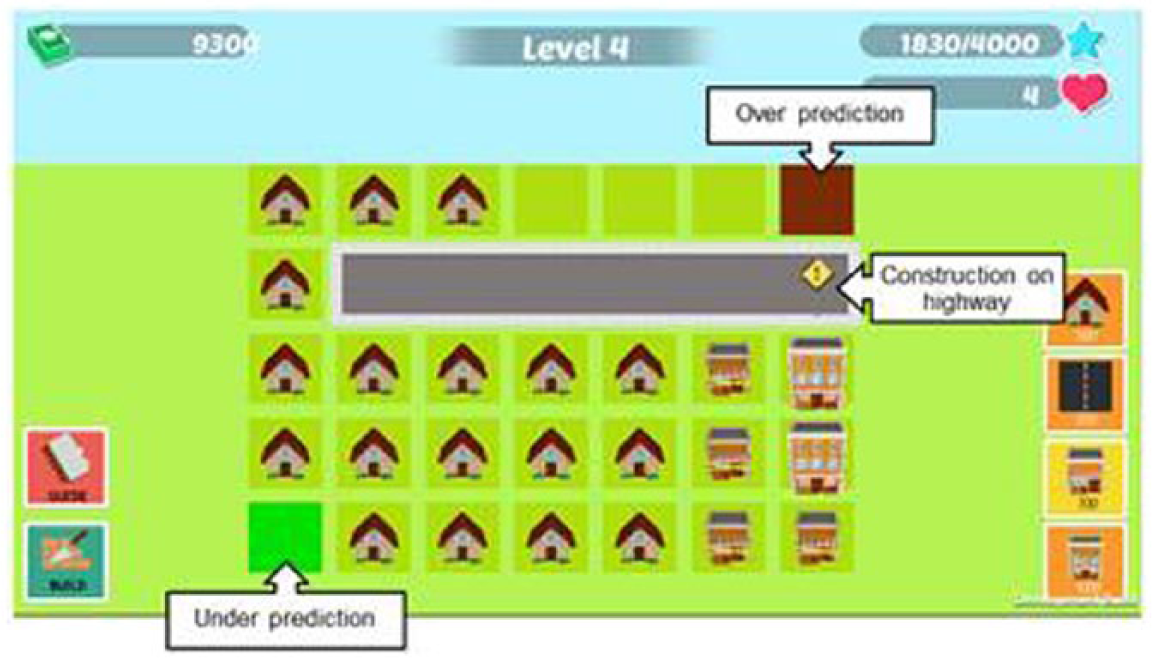
Indicators display the cause of each wrong prediction.
BLOCKYLAND challenges players not only with CA concept but also with game attributes such as money, XP, and life points. The game is over when players run out of life points or money before XP reaches the requirement. However, when a level is completed, the remaining life points are calculated as a bonus and added with the money as a total score. These attributes are the hidden rules that control the gameplay aside from the CA concept.
Levels and Rules
The characteristic of each level is defined by the available rules. BLOCKYLAND rules consist of two urban-CA rules adopted from Liu (2008) and five tailor-made rules. The game sequence and how the rules can be applied are described in the tutorial.
Tutorial
The tutorial is an embedded level that players must pass before moving into the first level of the game. It is used to provide sufficient information about how to play the game and an awareness of CA. The tutorial also offers a preview of level 1 that includes the background story, walk-through guidelines, and hints.
In this level, the only factor that can differentiate each block is the urbanization; land is nonurbanized, houses are urbanized. Thus, the first rule defines the growth of the new buildings by the urbanization of their neighbors in Moore neighborhood (Liu, 2008). This rule is based on the Game of Life rule that a dead cell becomes alive in the next generation if it has three live neighbors. The first rule is represented by IF-THEN statements below: If any land has three or more houses in the neighborhood, Then a house should be built on that land.
Level 1
This level is extended from the tutorial to ensure that the rule is followed correctly. Using the same rule, players build their town on the same size of land as the tutorial, on the 5 x 5 blocks. However, the first generation of level 1 is stochastically initialized. Moreover, level 1 requires more XP to complete the level. It increases the chances of making a false move; players have to manage the budget and life points as they proceed until the level is complete.
Level 2
As the town grows bigger, transportation to commute between communities is needed. The main channel of transportation, the highway, draws attractions to adjacent areas (Liu, 2008). The transportation influence is governed by the following rule: If any land has one or more houses in the neighborhood with a highway running through it, Then a house should be built on that land.
Regarding the above rule, the highway is another factor that controls the development of the town. The game, then, allows players to manipulate this factor. Players can build an additional highway on land that has a highway running through a specific neighboring position as follow: If any land has one or more adjacent highways on the north, east, west, or south, Then that land is qualified to build a highway.
This rule is based on von Neumann neighborhood that is a group of neighboring cells on the north, east, west, and south of the specify cell. Every rule in BLOCKYLAND is based on Moore neighborhood except highway construction in rule 3. Although the highway has the least income compared to other buildings, it favors the town in that players can build more houses compared to level 1. Moreover, it provides a bonus for every building constructed alongside the highway.
Level 2 provides 6 x 5 blocks of cellular space. The first stochastic generation of level 2 and above includes a block of highway along with a cluster of houses for players to construct additional highways. Highway construction is optional. In some scenarios, one block is qualified to construct both a house and a highway at the same time. In that case, players have to apply not only logical thinking but also decision making to decide whether a house or a highway should be constructed.
Level 3
The bigger the society, the bigger the demand considerations are. As every household requires live consumption, it is an opportunity to run a supply chain in the community. The location is a factor of concern. The development of a commercial area is governed by the following rule: If any house has three or more houses in the neighborhood, Then it can be upgraded to a shop.
However, the higher the number of shops, the more competitive it is. A shop in a competitive area, which has fewer consumers than its competitors, may not be successful. Therefore players should balance the number of shops and houses in the neighborhood to keep the business going. Otherwise shops will automatically become bankrupt. The situation is represented by the following rule: If any shop has fewer houses than other shops in the neighborhood, Then it will be forced into bankruptcy.
Level 3 provides 7 x 5 blocks of cellular space. More optional rules are available to test players’ decision making. Shops return more income than houses or highways. However, upgrading a house to a shop reduces the number of houses in neighborhoods, which affects the development of the town. Additionally, shops can be bankrupted if they are surrounded by too many competing shops.
Level 4
A new business channel is introduced. Instead of letting the business collapse, players may upgrade a specified shop to a mini-mart and earn more income. The following rules presented the development of a mini-mart: If any shop has fewer houses than other shops in the neighborhood, Then it qualifies to be upgraded to a mini-mart. If any shop has one or more mini-marts in neighborhood, Then it qualifies to be upgraded to a mini-mart.
Level 4 provides the same sized cellular space as level 3. Rule 6 overrides rule 5; the condition to construct a mini-mart is as same as the condition that sends a shop bankrupt. Logical thinking and decision making are thoroughly tested at this level.
Logical thinking exercises are embedded into the four levels and seven rules. Levels are related to their prior level; therefore, players have to accomplish the lower level to unlock the higher level. In every unlocked level, players are given extra blocks of land and a new building along with the rules that govern the changes of the building. Higher levels are more challenging with a more intense game story, items, and rules. A summary of cellular space, rules, and states available in each level can be seen in Table 1.
Levels’ Cellular Space, Rules, States Summary.

BLOCKYLAND Rule Categorizations
One of the points that make BLOCKYLAND different from general CA simulation is that BLOCKYLAND rules are processed by human players. Thus, the rules are displayed in natural language using If-Then statements and a set of four figures. These figures illustrate the scenarios where the rule is applied along with the description of the current state and neighborhood. Furthermore, these figures illustrate the characteristics of the two classifications of BLOCKYLAND rules. The following are the explanations of rule classifications:
Logical rules
The preset logical rules control the amount of buildings in the town. Players are rewarded when they apply these rules correctly. Otherwise, a notification is displayed and a life point is withdrawn for a wrong prediction. Logical rules are rule 1, 2, and 5.
Figure 4 is one of the logical rule figures that explains rule 2. It also displays the effects of rule 1 in comparison; since, both the rules control the number of buildings in the town. It displays rule 2 on the right hand side of the highway, and rule 1 on the other side. On this figure, the specified blocks are linked to their descriptions with a white thick line. A tick and a cross notify a block on which a house can or cannot be built. These characteristics are similarly illustrated in every logical rule.
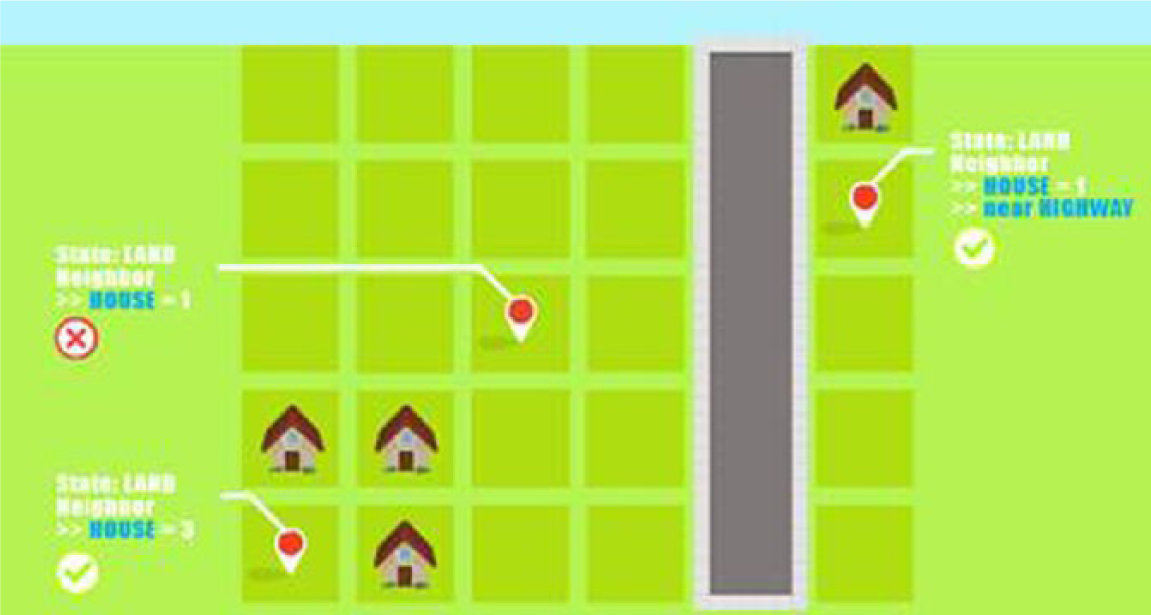
Illustration of a logical rule figure.
Optional rules
The set of optional rules controls the upgrade of buildings. They allow players to decide from all available options. A reward is given for a correct prediction. However, players do not get any penalty from neglecting to upgrade a building that qualifies to be upgraded, since this is optional. Yet, upgrading an unqualified building reflects as a wrong prediction. Optional rules are the rule 3, 4, 6, and 7.
Figure 5 is one of the optional rule figures that explains rule 4. The scenario that this rule can be applied to is displayed on the left side; whereas, the scenario where it cannot be applied is on the right side. From this figure, the specified blocks are linked to their descriptions with a white dashed line. A tick and a cross only indicate the blocks where an upgrade is available or unavailable respectively. These characteristics are similarly illustrated in every optional rule.
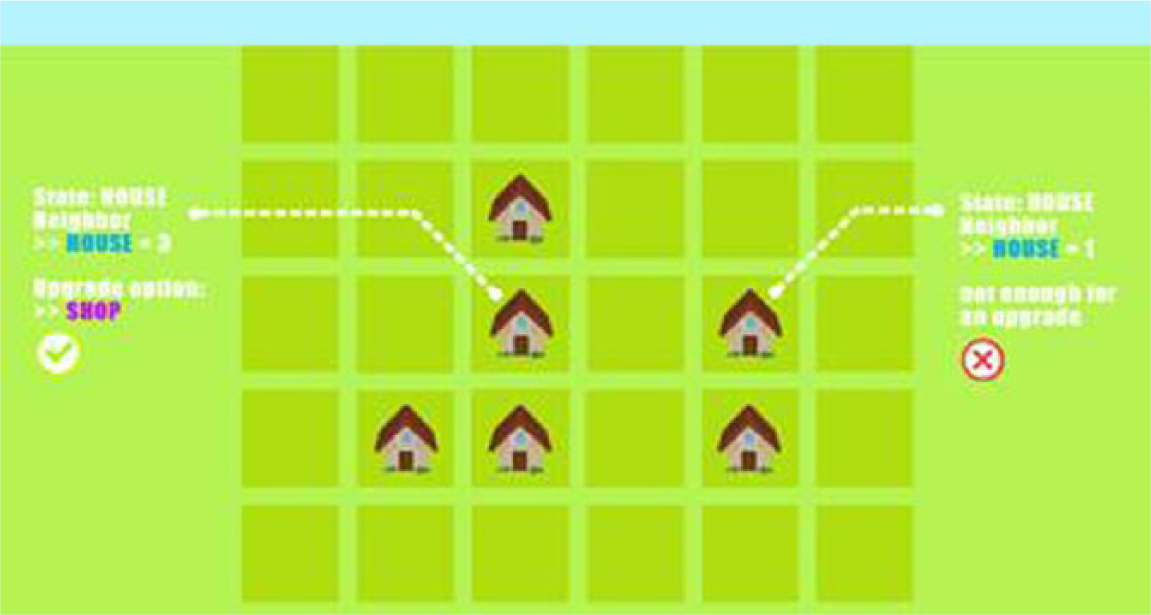
Illustration of an optional rule figure.
BLOCKYLAND provides optional rules for practicing decision making. These rules also represent a real-life scenario, whereas problems can be solved by more than one solution. Moreover, they represent stochastic rules in CA simulations, in that events are not always affected by certain factors but rely on probability.
Game Mechanisms
Generally, CA is applied as a modeling technique to simulate complex natural phenomena from predefined parameters and rules. Unlike those simulations, BLOCKYLAND aims to provide a channel to practice thinking skills. To succeed in that goal, BLOCKYLAND inverts the processes of CA into CA-like processes. These processes not only make the role of players in BLOCKYLAND different from the Game of Life and other CA simulations but also allow players to practice their thinking skills via the CA concept. The game mechanisms, which allow players to apply logical thinking through a CA-based game, are described as follows;
Creating the first generation
In the Game of Life, players define how the game should start. On the other hand, BLOCKYLAND stochastically initials the first generation for players. The first generation of the town consists of a cluster of five houses or above. This procedure is to avoid the stable Block or Scatter pattern in which no building can be built in the next generation. The stable Block and Scatter pattern are illustrated in Figure 6.
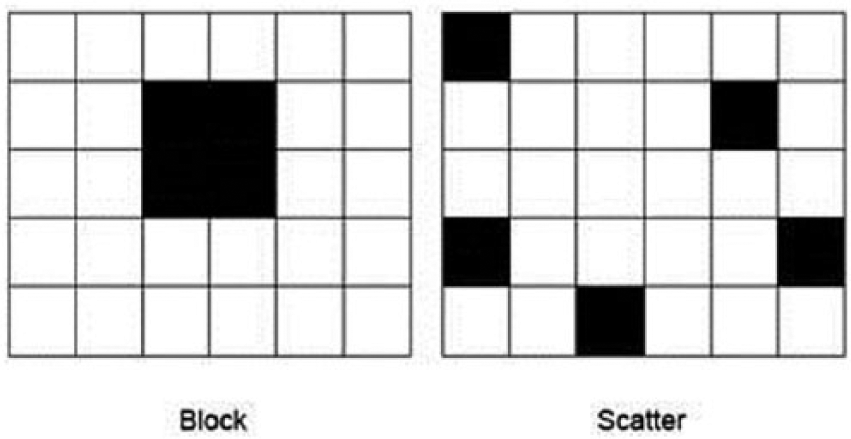
Left: Block of four cells, Right: Scattering of cells.
BLOCKYLAND rules are based on the Game of Life birth rule, in which a dead cell comes alive in the next generation when it has three live cells as its nearest-neighbor. Blocks of four live cells remain without any changes throughout the game in the Game of Life (Berlekamp et al., 1982). Likewise, a block of four houses is also a stable pattern that prevents new construction in BLOCKYLAND. The game would not be able to continue if none of the empty blocks in the first generation has three houses in their neighborhood. Accordingly, scattered patterns where houses are distant from each other prevent players from constructing new buildings.
Processing the rules
This process is operated by the game mechanisms from the Game of Life. We are aware that this process has the potential to provide logical thinking practice. Therefore, we allow players to participate in this process by applying CA rules to predict the next generation.
Regarding the CA concept, cells update their state synchronously at every time step. BLOCKYLAND follows this concept. This is a crucial part of the game that is designed to enhance thinking practices. Therefore, BLOCKYLAND pauses this process for players to think without time limitations. Players then assign a planning icon to determine the predicted state of each block, which can be re-assigned until they are satisfied with every prediction. The game mechanism also estimates and displays the construction costs dynamically after each prediction.
Updating the lattice
CA simulations, including the Game of Life, update the lattice using a machine. This process also controls the game mechanisms in BLOCKYLAND. However, in BLOCKYLAND this process not only updates the cell states but also provides feedback of the players’ individual performance.
After the players command the update, the game mechanism deducts the construction cost and evaluates the prediction. Players get new buildings from correct predictions. Players also earn income from every existing building including those newly built. XP are also granted according to the fixed XP rate. Each building has a fixed income and XP regarding their cost. Therefore, a building with a higher cost returns in more income and points.
On the other hand, a wrongly predicted block remains in the same state with different types of indicators to provide the cause of the wrong prediction. One life point is deducted in each turn where there has been a wrong prediction regardless of the number of the mistakes made.
Like CA, BLOCKYLAND processes continue until the level is completed or the game is over. Players then continue developing their town until their XP qualify them for the next level. BLOCKYLAND has a dynamic setting where players can grow the town based on the latest generation even when wrong predictions exist. Players may build buildings that were indicated as missing from the previous turn, or omit constructing certain buildings to receive more total income.
The final score is calculated from the addition of the total money and the bonus that is calculated from the remaining life points when each level is completed. However, the game might end before the players complete the level if the life points or money reach zero. In that case, players have to restart the current level until they succeed in it. The game mechanisms are shown in Figure 7.
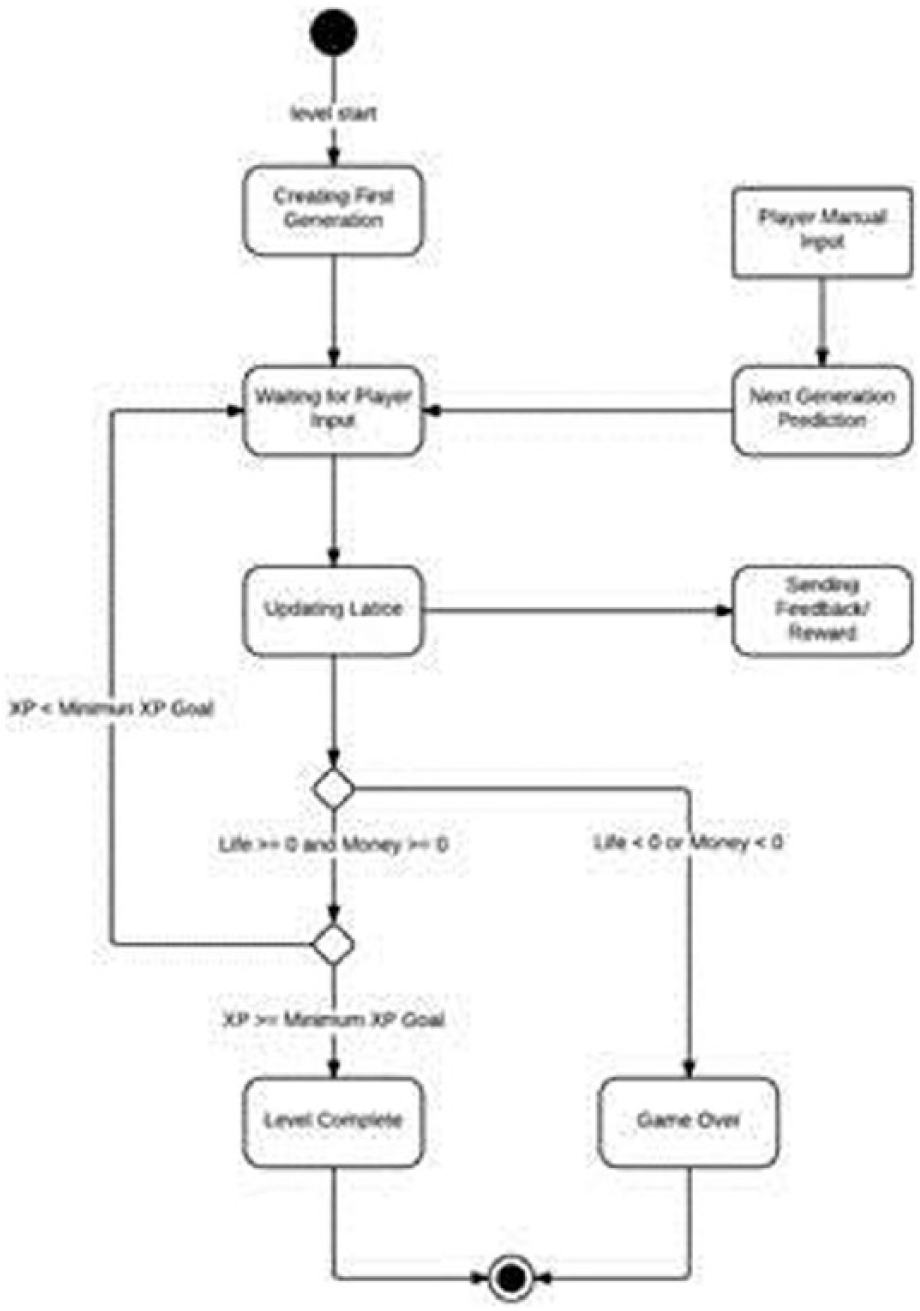
Illustration of CA-like processes of BLOCKYLAND mechanisms.
The next section is a result of the pilot study that was conducted to examine the effectiveness of BLOCKYLAND learning unit in enhancing logical thinking. The details of the learning unit, including the debriefing guidelines, are described.
Pilot Study
A pilot study was conducted (a) to determine whether BLOCKYLAND learning unit can enhance logical thinking and (b) to measure players’ satisfaction towards BLOCKYLAND. Findings and conclusions are reported, along with recommendations for future research.
Research Questions
This study investigated the following research questions:
Does BLOCKYLAND learning unit enhance participants’ logical thinking?
What is the satisfaction of participants towards BLOCKYLAND?
Participants
Participants of this study were grade-10 students who were taking a logic and reasoning course in Mathematics. Grade-10 students were chosen because according to Inhelder and Piaget (1958), they are at the age that develops logical thinking. 50 grade-10 students participated in this study and had no prior experience of CA.
Research Design
This pilot study used a mixed-method approach comprised of a one group, pretest-posttest design and an extensive debriefing following the game. The test of Logical Thinking by Tobin and Capie (1981) was applied to assess logical thinking. It was translated by Sittirug (1997) and revised after the content validity was conducted. The reliability of the test using Cronbach’s alpha was established to be 0.72. The pre-test was conducted to assess participants’ prior logical thinking before the activity and to compare with post-test scores to determine the effectiveness of BLOCKYLAND learning unit on enhancing logical thinking.
The activity was divided into three phases: introduction, gameplay and application. After each phase a debriefing was conducted in a form of group discussion to allow players to reflect and share their gameplay experience and transform it into a learning experience (Crookall, 2010). Furthermore, debriefings were held to ensure that players achieved the goal of each phase and be ready for the next phase. Debriefings were conducted in three phases (Lederman, 1992); systematic debrief, intensive debrief, and general debrief.
Phase 1: Introduction
This phase aimed to introduce the game to participants through the game tutorial. After the tutorial was played, a systematic debrief was conducted to allow participants to reflect on their individual experiences.
Are you aware of the unique processes of the game?
What are the problems you confronted?
How did you overcome those problems?
What are your strategies?
Phase 2: Gameplay
In this phase, participants were playing BLOCKYLAND levels 1-4. Each level asked them to perform logical thinking and decision making. Afterward, an intensive debrief was conducted to emphasize the CA concept hidden in the game.
What are the factors that have to be considered in order to build each building?
How does your town transform when you have different buildings at the higher levels?
How did you encounter new scenarios in higher levels? What is the result?
Describe your strategy in the higher levels?
How do you relate the game scenarios to solve similar problems in real-life scenarios?
Phase 3: Application
Participants brainstormed and presented new item(s) and rule(s). Later, a general debrief was conducted to relate the experiences to real-world applications.
How do(es) the new rule(s) affect the town?
How can you relate the rule(s) to real-life applications?
How can you apply the experiences from this activity to real-life applications?
After this activity, a post-test was conducted to determine their post-activity logical thinking. Later, they were asked to fill in a 5-likert scale satisfaction questionnaire.
Findings
The analysis of the test scores found that the mean pre-test score was 7.48 (SD = 2.86) and the mean post-test score was 9.52 (SD = 3.37). Using a paired-samples t-test showed that the post-test score was significantly higher than the pre-test score at t(49) = 4.96, p < 0.01(see also Table 2). This statistical assessment confirms that the BLOCKYLAND learning unit may enhance logical thinking.
Results of Paired-Samples t-Test.

Additional results from the debriefings show that the learning unit encouraged participants to apply logical thinking. In the Systematic Debrief phase, participants reflected on their experiences after the game tutorial. Common mistakes were also clarified. Participants were aware of the unique rules and processes that required logical thinking and decision making, which many of them struggled with and so they had to redo the tutorial. As a result of the debriefing, they paid more attention to the rule explanations and spent more time reviewing whether their predictions met the required conditions.
In the Intensive Debrief phase, participants reflected on their game-play experience and the problems they overcame. The game was more challenging with the additional factors to consider. Budget and life points were also important to the game’s success. Some participants chose not to upgrade some buildings and had their game lives reduced. However, they preferred to upgrade those later and receive more money than what they could earn from direct upgrades. This shows that the participants were able to perform logical thinking and decision making based on the situation. In addition, we found that many participants used a strategy that was similar to the technique applied to improve the performance of CA simulations where cellular space is very large (Wainer et al., 2010). They realized that some of the given lands could be omitted, because they were far from the building areas and they would not be able to construct any buildings according to the rules. This strategy allowed them to complete the level faster. Subsequently, they noticed similarities between the game scenarios and real-life problems and depending on the causes of the problems, developed creative ways to solve the problems.
Finally, participants reflected on their experiences from previous activities to real-life applications in the General Debrief phase. They discussed the similarities and differences of the new items that they came up with in the previous phase. Some rules were presented to avoid problems related to real-life scenarios on a minimal scale. Additionally, they reflected on experiences from the activities that are useful in real-life applications beyond the curriculum objectives.
Furthermore, results from analyzing the questionnaire revealed that participants reacted with positive satisfaction towards BLOCKYLAND. They strongly agreed that the game had appropriate challenges that commanded their attention and stimulated their curiosity. They agreed that the game experience was useful for them and they were able to relate it to their life applications. In conclusion, they strongly agreed that the game content inspired them to apply and enhance their logical thinking.
Conclusion
BLOCKYLAND is a game that was designed based on the CA concept. However, it applies the concept for a different purpose from other CA simulations, which is to serve as an instructional tool to enhance logical thinking. BLOCKYLAND inverts the role of the human and the computer in CA processes to provide challenges that require logical thinking and decision making.
The pilot study that was conducted with 50 grade-10 students to assess the effectiveness BLOCKYLAND for enhancing logical thinking showed that there was a statistically significant improvement after the gaming intervention. Debriefings results also support the idea that the learning unit engaged them in performing logical thinking and decision making through the game and activities. Additionally, the questionnaire revealed that the participants expressed positive satisfaction towards the game in terms of being challenged and encouraging them to apply logical thinking.
From our initial analysis, including this pilot study, we claimed that BLOCKYLAND may be an effective instructional tool to enhance logical thinking. However, an additional studies are needed to assess the effects of BLOCKYLAND on other variables related to the enhancement of the audiences’ logical thinking.
Implications for Practice
Logical thinking is not only one of the important 21st-century skills but also a requisite life skill. Even though logical thinking is not a distinctive focus in educational research, most serious games aim for cognitive gain (Vogel et al., 2006), whereas BLOCKYLAND may enhance logical thinking using a CA concept that does not stick to one particular subject matter. Since CA is a universal construction and computation, the learning unit can be applied to many other topics. Serious game researchers, educators or teachers can collaborate on CA-based games to simultaneously enhance both the curriculum and logical thinking.
Additionally, BLOCKYLAND focuses on the decision making process. The game provides immediate feedback that responds to individual performance and navigates players to dynamic pathways for success. Furthermore, the debriefing sessions during and following the learning unit aid students in transforming their game experiences into valuable learning experiences to achieve the learning objectives. As a combination of logical thinking practices and a serious game, BLOCKYLAND has several implications for educational stakeholders; both theoretical and practical.
Footnotes
Acknowledgements
The authors would like to thank the reviewers, Prof. Leonard A. Annetta and Sutha Luealamai and for the valuable comments and suggestions for improving this article. We thank our editor, Timothy C. Clapper for his dedication and time spent on this article. Thanks to native-speaking readers, Philip Murray and Kevin Kirk for their proof reading. Moreover, thanks to our colleagues, Aung Thu Rha Hein, Wannapong Triampo, Khajornsak Buaraphan, and Artorn Nokkaew for their suggestions. Lastly, thanks to students and the school for participating in this study.
Author Contributions
All authors contributed to this article, in content and in form. Apinya wrote the manuscript, designed and developed the game, conducted the pilot study and did the statistical analysis. Monamorn gave advice on the design of the game and all the procedures of the study including the Structure of the manuscript. All authors contributed equally to the editing of the manuscript.
Declaration of Conflicting Interests
The authors declared no potential conflicts of interest with respect to the research, authorship, and/or publication of this article.
Funding
The authors disclosed receipt of the following financial support for the research, authorship, and/or publication of this article: This article is partially funded by the Research Assistantships from Faculty of Graduate Studies, Mahidol University, Thailand.
Author Biographies
Contact:
Contact: