



Abstract
Background.Keeping high school students engaged and motivated to learn complex scientific concepts can be difficult and challenging; this is especially true if the task feels daunting and unfamiliar to the students. Incorporating educational technology, such as KAHOOT, into the classroom can help students learn scientific material even when it is difficult.
Aim. Our objective is to determine the effectiveness of
Methods. A presentation on Transcription and Translation was given to a small group of high school
Results. Based on the responses in the Students’ Survey,
Conclusion. The overall activity had a positive impact on the students and teacher as the students enjoyed learning Transcription and Translation through the use of ‘KAHOOT!’.
Keywords
Introduction and Background
Since the start of the 21st century, educational technology has played a major role in students’ academic progress, especially in the area of the sciences in the United States high school education system (Chacko, Appelbaum, Kim, Zhao, & Montclare, 2015; Tarbutton, 2018). The United States government made it a priority that American students have access to adequate resources and programs to motivate more high school students to enter the Science, Technology, Engineering, and Mathematics (STEM) fields as a career option (Gonzalez & Kuenzi, 2012; Kuenzi, 2008). High schools are trying new ways of incorporating technology into the classrooms to support the new environment: The Digital Era (Gros, 2007; Özer, Kanbul, & Ozdamli, 2018). Bennett et al. describe the Digital Era as the time when “Digital Natives”, a generation of individuals, have been exposed to technology since birth (Bennett, Maton, & Kervin, 2008; Dingli & Seychell, 2015). As a result, teachers are trying to find ways to incorporate technology into their classrooms to make their lectures more interesting and relatable to this new generation of learners, so that they are more autonomous about their education (Domingo & Garganté, 2016; Lacina, 2008; Waghid, 2015). With more schools opting out of using traditional teacher-centered methods and electing for student-centered learning, technology has become a forefront in today’s education system in anticipation that it will increase student motivation and engagement (Hoffmann & Ramirez, 2018; Özer et al., 2018). One such example is gamification—the act of increasing student motivation and enthusiasm to learn by using game-thinking and game mechanics to solve problems and to engage an audience (Cunningham & Zichermann, 2011; Nicholson, 2015; Su, 2015; Whitton, 2007, 2010; Yapıcı & Karakoyun, 2017).
‘KAHOOT!’ is an online gamified pedagogical tool that centers on student engagement and motivation. It is a fast paced assessment tool that resonates like a “game-show”, which allows teachers to monitor the progress of their students while they participate in a “game” (Licorish, Owen, Daniel, & George, 2018). In the past, student response systems (known as “clickers”), such as “iClicker” or “ResponseCard”, have commonly been used at higher education institutions (Hall, Collier, Thomas, & Hilgers, 2005; Mu & Paparas, 2015). The goal of these student response systems is to incorporate and promote student engagement in large lecture halls at the collegiate level, ultimately stimulating active learning rather than passive learning in a teacher-centric environment (Hall et al., 2005; Nielsen, Hansen, & Stav, 2013). However, clickers are a less common assessment tool used at the K-12 level, which is partly the reason why ‘KAHOOT!’ is a popular assessment tool among teachers in the United States (Bicen & Kocakoyun, 2018; Plump & LaRosa, 2017). Due to its accessibility, affordability, and its user-friendly capabilities, teachers can feature a fun and unique student response system that is more enticing to the students compared to conventional student response systems (Licorish et al., 2018). Unlike traditional student response systems, ‘KAHOOT!’ gamified elements integrate vibrancy, lightsome music, and competition that keeps the students on their toes throughout the game (Lin, Ganapathy, & Kaur, 2017; Mu & Paparas, 2015). As a result, the students are completely engrossed in the game while they best demonstrate their knowledge on the subject matter their teacher is assessing them on. Although ‘KAHOOT!’ promotes competition, the game is rarely vicious. Instead, the competition develops “metacognitive abilities, promotes empathy, and builds teamwork skills” (Licorish et al., 2018; Lin et al., 2017). Due to its design, ‘KAHOOT!’ gamification accentuates student motivation and engagement, actively helping students learn even the most difficult subjects such as biology.
In New York State, biology, sometimes referred to as Living Environment, is a required STEM course in the public-school system. Students who choose to further analyze the complexities of biology may decide to take the more advanced course: Advanced Placement (AP) Biology (“The Living Environment Core Curriculum,” 2019).
Traditionally, biology is taught in a teacher-centered style, where the students listen to their teachers as they flip through the PowerPoint presentation that is frequently provided by the textbook company (Connell, Donovan, & Chambers, 2016). The students take notes on the subject matter, and often have minimal participation, ultimately leading to the students having to superficially memorize the material without understanding or being able to apply the information (Connell et al., 2016). Biology is a very conceptual course that requires an immense amount of time and effort to learn the material. In addition, biology courses cover an extensive amount of material from molecular biology to the human body system, that can average over 50 chapters in a textbook, compiled into a short nine months of school (Chiappetta & Fillman, 1998; Çimer, 2012). Students need to be motivated to learn the material to gain the plethora of knowledge biology has to offer. However, many students find this subject to be difficult due to the conceptual nature of the content (Çimer, 2012; Waghid, 2015). As a result of these difficulties, biology has gained a reputation of being an overly complex and mundane subject that can cause some high school students to quickly lose motivation and interest in the subject (Bennett et al., 2008; Gros, 2007; Rouse, 2013).
Lack of motivation among students can be detrimental to a student’s overall education as they are more likely to be labeled as “amotivated” (Richter, Raban, & Rafaeli, 2015; Rouse, 2013). These students are more likely to show characteristics of boredom, poor concentration, and high levels of stress in school (Legault, Pelletier, & Green-Demers, 2006; Rouse, 2013). Besides these consequences of “amotivation,” students may feel frustrated that they are not performing at the appropriate level of their peers, which further diminishes satisfaction in education. As a result, teachers must find ways to increase student motivation and interest, especially in a complicated subject like biology (Hanus & Fox, 2015). Traditional educational methods, such as “frontal teaching,” or “chalk-and-talk,” can lead to disinterest as they do not emphasize student-led creativity, leading to boredom (Dişlen Dağgöl, 2013; Hudson, 2007; Roehl, Reddy, & Shannon, 2013).
Gamification in ‘KAHOOT!’ can increase student engagement by incorporating popular video game tactics (e.g., points, leaderboards, and badges), which have been shown to allure and captivate millions of video game users (Cameron & Bizo, 2019; Ismail & Mohammad, 2017; Nicholson, 2015; Przybylski, Rigby, & Ryan, 2010; Su, 2015; Whitton, 2007, 2010). By using these same elements that game developers incorporate into their games to increase and maintain player engagement, gamifying academic, pedagogical tools can also increase and maintain engagement, thus increasing students’ enthusiasm allowing them to reach their academic achievements and goals (Goehle, 2013; Muntean, 2011; Nah, Zeng, Telaprolu, Ayyappa, & Eschenbrenner, 2014).
Overview of ‘KAHOOT!’
‘KAHOOT!’ (https://kahoot.com/) is a free online game-based platform that allows users to curate their educational multiple-choice assessments that turn into an interactive game for their students (Dellos, 2015). The students can use either their smartphone or laptop to participate in the game. The user can make their multiple-choice questions, or they can use other users’ quizzes, that they can access from the overall ‘KAHOOT!’ platform, for their classroom needs. When the user creates multiple-choice questions, they can customize how long they want to give the students to answer the questions and the number of answers they want to have.
Hypothesis
The use of ‘KAHOOT!’ as a supplement to a traditional teacher-centered lecture setting increases engagement by allowing the students to demonstrate their knowledge in a fun and exciting way. It increases the students’ interest to learn and retain information, therefore helping them remember the topic of Transcription and Translation as they input their answer on the mobile device. The gamification elements in ‘KAHOOT!’ can help students measure their understanding of the material in a fun and non-judgmental atmosphere.
Participation and Experimental Design
A presentation on transcription, translation, and DNA replication (https://archive.engineering.nyu.edu/soar/transcriptiontranslation) was given to a small group of AP Biology students at The Urban Assembly Institute of Math and Science for Young Women before the ‘KAHOOT!’ game. The students consisted of a mixture of 18 junior and senior students (n = 18), ranging from 16 to 18 years. In the presentation, the processes of transcription, translation, and DNA replication were covered with the students (Figure 1a).

(a) One of the slides from the presentation on transcription, translation, and DNA replication. (b) Snapshot of the simulation video of the 3D structure of tRNA. The presentation and simulation prepared the students for the ‘KAHOOT!’ Game.
The topic of transcription and translation were presented to the entire class using Microsoft PowerPoint and ‘KAHOOT!’. In comparison to the lectures the students were used to, the technology-based presentation was more interactive than their traditional presentation; the students were presented two videos, which were created using Chimera visualization software (Figure 1b) (Pettersen et al., 2004). Instead of using cartoon representation, the videos were compiled using 3-Dimensional structural data obtained from Protein Data Bank (Berman et al., 2000). The 3D structures have been solved by various biologists and biochemists using X-ray crystallography and NMR spectroscopy and depict the actual conformational states of proteins/nucleic acids. The presentation contained all the necessary information that the students needed to answer the questions in the ‘KAHOOT!’ game and was made by researchers comprised of an upper-level undergraduate student, a master student, and a postdoctoral fellow.
The students use the students’ portal, https://kahoot.it/, to access the game. The students would enter the access code into the portal and create an informal name that would be used throughout the game to have an anonymous identity to the user. The anonymous identification allows the students to play the game at their best potential when their actual identities are unknown throughout the game. Once the students enter the game, the ‘KAHOOT!’ software displays the question-answer page for the students so that they can answer the questions on their smartphone or laptop (Figure 2). Once the 20 seconds elapsed, the ‘KAHOOT! Podium’ displays the results of the game. In addition, ‘KAHOOT!’ list the names of students leading in the leaderboard, as well as the correct answer to the question.
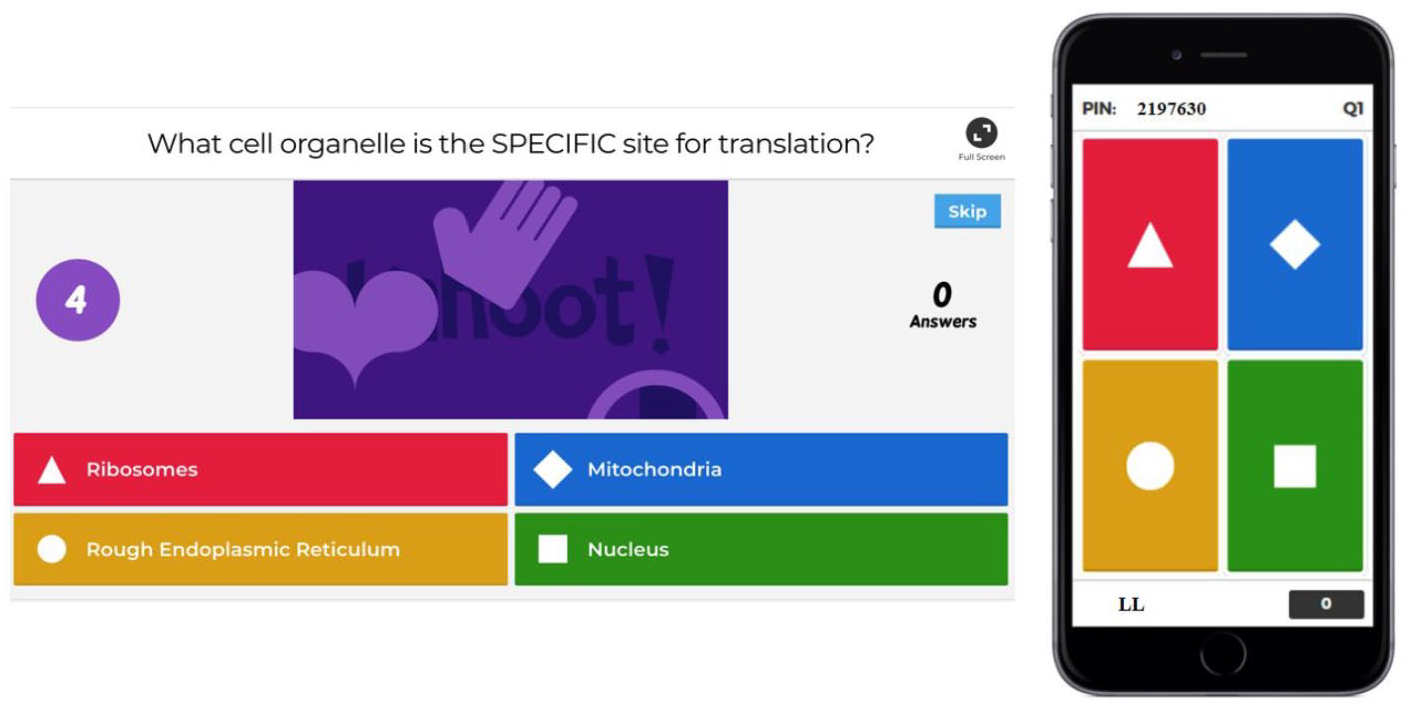
The quiz-answer portal in the ‘KAHOOT!’ Game. The questions appear on the question-answer screen and the students input their answer on their mobile device (or laptop) shown on the right.
After the interactive lesson and game, the students and teacher answered a short post-activity questionnaire. The student’s survey was used to assess the students understanding of Transcription and Translation after using ‘KAHOOT!, to see if they liked using ‘KAHOOT!’ and if they found it to be more engaging compared to their typical lectures. The teacher’s survey was used to evaluate the students’ understanding of Transcription and Translation (from the teacher’s perspective) and if they would incorporate ‘KAHOOT!’ into more lessons plans as an interactive assessment tool.
Experimental Procedure
The students were first given a PowerPoint presentation that covered introductory material called Transcription and Translation. The presentation covered the general concepts of Transcription and Translation and tried to reframe the intricate nuances that tend to bog down students leading to frustration, and in the long run, demotivates them. At the end of the presentation, the students were shown two short 3D visualization structure videos of the steps involved in Transcription and Translation and snapshots of tRNA and nucleosome. These two videos were presented to emphasize the importance of Transcription and Translation, but more importantly, show the students how precise the Transcription and Translation pathway is. In addition, the two visualizations videos were also used to emphasize precision and how mutations can cause structural and cellular disorder—integrating their next unit on Genetics. The videos, which were part of the instructional materials, were prepared by compiling PDB structures in UCSF Chimera software (Berry & Baker, 2010; Gurnon, Voss-Andreae, & Stanley, 2013) (https://archive.engineering.nyu.edu/soar/transcriptiontranslation).
After the researchers presented the instructional material, the students were allowed to use their smartphone device (or computer) to log on to the custom made ‘KAHOOT!’ game (kahoot.biology.lablesson.com). Using their mobile device (or laptop), the students would log in to the ‘KAHOOT!’ portal by entering the Game PIN, which granted them access to the game. Once all the students had entered the portal, the game was started. The students were given 15 multiple-choice questions and were allotted twenty seconds to answer each question in the game. Twenty seconds per question was determined because the teacher had mentioned that the students should be able to answer the multiple choice questions of the AP Exam at an average of twenty seconds.Each question had four answer choices except for question 11, which had three choices. After the 20-second timer expired, the game would present the correct answer and the number of people who selected each option. Once the students finished each round of the game, ‘KAHOOT!’ would present the leader of that particular round. If it was apparent that more than half (≥50%) of the students struggled on a particular question, the researchers would not move on to the next question; instead, they would reinforce why the answer was correct. The students continued to participate in the game until they answered all 15 questions.
After the students played the ‘KAHOOT!’ game, a post-activity survey was given to the students and the teacher. The teacher and students’ responses allowed the researchers to ascertain how well the students comprehended the Transcription and Translation after ‘KAHOOT!’ and their overall interest and motivation to learn while using ‘KAHOOT!’ versus a traditional day in class. The students’ survey consisted of seven questions (Q3 comprised of two distinct parts); five were Likert-like Scale questions using a 1-10 scale where 10 was the greatest and the 1 lowest, the other two questions were “Yes or No” questions, and the seventh question was a free response question (Figure S1). The teacher’s survey consisted of nine questions where six were Likert-like Scale questions using a 1-10 scale where 10 was the greatest and the 1 lowest. Questions 5, 8 and 9 were free response questions that allowed the teacher to verbally express their opinions about the activity and the ‘KAHOOT!’ game (Figure S2).
Data Analysis
The students’ survey data were exported to Microsoft Excel, where data analysis was performed. Descriptive statistics were computed to analyse the demographics of the sample pool. Moreover, maxima, minima, and medians of each Likert-like scale questions were computed. A Pearson product-moment correlation coefficient test was performed to test the relationship between the students’ engagement during the ‘KAHOOT!’ game (Figure S1,
Review: Results
A total of 18 students and a teacher participated in this study. The students consisted of 100% female students with 66.66% African-American, 5.55% Asian, 27.77% Caucasian.
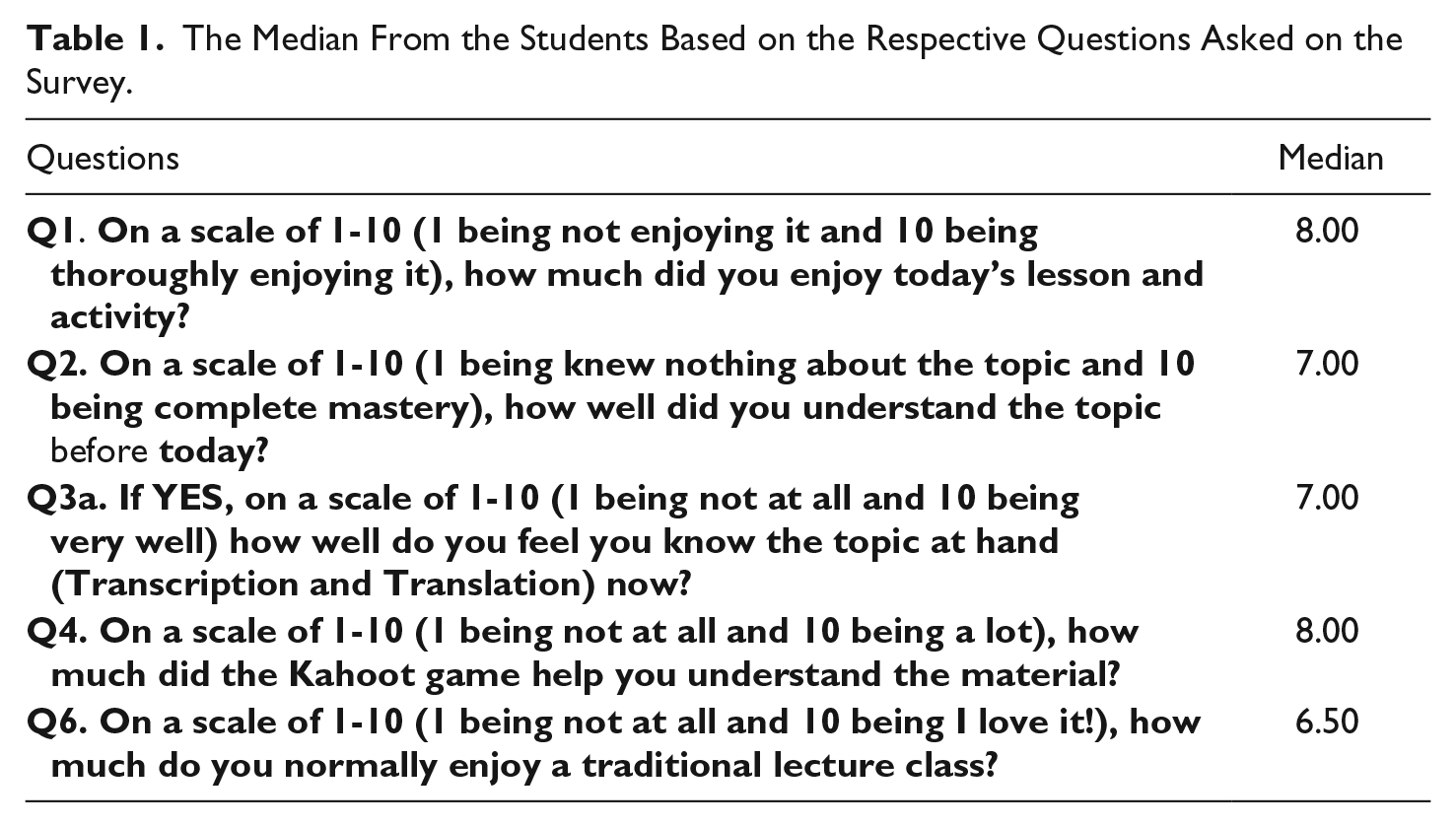
In the Likert-like scale questions for the student’s survey, the students’ responses were evaluated (Table 1). When the students were asked if they enjoyed the lesson and ‘KAHOOT!’ game in
The Median From the Students Based on the Respective Questions Asked on the Survey.
In addition to the scaled questions, the students were given two “Yes or No” questions. After the activity, 78% of the students stated that they enjoyed the interactive technology-based lessons more than the traditional lecture class (
The Number of Student’s Responses and the Percentages Based on the Respective “Yes or No” Questions Asked on the Survey.

A Pearson product-moment correlation coefficient test was computed to further assess the relationship of the student’s responses to
The teacher involved with the study was given the teacher’s survey (Figure S2). The overall experience of the lesson and the ‘KAHOOT!’ game was rated as highly favorable. The overall experience was rated as a ten on a scale of 1-10. More specifically, when asked how well the students knew Transcription and Translation before the lesson and ‘KAHOOT!’, the students’ knowledge was rated as a seven. When asked to rate the students’ knowledge the day after the activity, the students’ knowledge increased from seven (prior to ‘KAHOOT!’) to nine after ‘KAHOOT!’.
Discussion of the Results
Based on the analysis of the results, ‘KAHOOT!’ can increase engagement in high school students learning biology considering that the 14 out of 18 students stated that they enjoyed the interactive activity more than a traditional lecture class with ‘KAHOOT!’ making learning more pleasurable (Ismail & Mohammad, 2017; Ryan & Deci, 2000; Ryan, Rigby, & Przybylski, 2006; Whitton, 2007, 2010). However, due to the relatively small size of the class and the lack of a control group, there is little quantitative evidence to prove if ‘KAHOOT!’ increased motivation leading to an improvement in the learning outcome and understanding of Transcription and Translation. Further tests with a larger sample pool and more precise questions that specifically identify the change in motivation would be needed to see if ‘KAHOOT!’ truly has an impact on students’ motivation.
According to Iwamoto et al., ‘KAHOOT!’ has “the potential to enhance and improve high-stakes examination scores at the college and university level” and “the experimental group felt positive about their experience.” (Iwamoto, Hargis, Taitano, & Vuong, 2017). However, there is still very little research that supports the usage of ‘KAHOOT!’ in high school STEM classrooms. Needless to say, based on our observations in this study, it was found that by using ‘KAHOOT!’ at The Urban Assembly Institute of Math and Science for Young Women’s, the biology topic of Transcription and Translation was taught in a more engaging and rewarding way; yet increased learning outcomes were not statistically proven (Cheong, Filippou, & Cheong, 2014; Leaning, 2015).
The results from this study support other research on gamification that incorporating gamified elements into a learning platform makes learning abstract, and complex topics such as Transcription and Translation more desirable/manageable (Cameron & Bizo, 2019; Özer et al., 2018). In addition, since the game allows the students to create anonymous usernames, the students that were more reserved and originally reluctant to answer questions proposed by the presenters in the beginning of the experiment were observed working with their classmates even when a majority of them would get a question wrong. Student engagement and enthusiasm with the game support the ideology proposed by other groups that students learn the best when what they are learning excites them (Aboudan, 2011; Daniels, 2011; Iwamoto et al., 2017). Hence, education technology can be used, in moderation, in the classroom to help bring students together and challenge each other in a positive and welcoming environment (Bicen & Kocakoyun, 2018). As observed in the class, the students created their own positive environment through playing and laughter throughout the ‘KAHOOT!’ game, which ultimately amplifies their own learning experience.
In response to
However, gamification is not for every student. In response to
Conclusion & Future Research
From the enthusiasm in the classroom, it is clear that the overall activity had a positive impact on the students and teacher as the students learned Transcription and Translation in a fun and exciting manner through the use of ‘KAHOOT!’. As a result, we recommend the incorporation of ‘KAHOOT!’ in high school biology classes as it can help engage the students better learn difficult biological topics. Although Transcription and Translation is an extremely complex and abstract concept in biology, ‘KAHOOT!’ incorporates fun into the lesson plan—transforming a lesson that once seemed daunting and mundane to enhancing the student’s personal achievement through academic reinforcement (Cameron & Bizo, 2019). The young women at The Urban Assembly Institute of Math and Science for Young Women greatly appreciated the activity as it helped them better understand Transcription and Translation. The teacher was delighted about students’ participation in the activity and highly recommends using ‘KAHOOT!’ to reinforce the lecture material to other science teachers and well as implementing it into his own curriculum. Due to the limitations in the data collection and the small sample size, we propose that we conduct and collect data over a longer period of time with a larger sample size (e.g. the entirety of Unit 4: Genes to Proteins outlined by The College Board—Makers of the Advanced Placement Examination (“Pre-AP® Biology Course Guide,” 2018)) versus solely Transcription and Translation to further test student engagement and to see how ‘KAHOOT!’ truly affects the self-determination theory and quantify improvements in academic achievements . We will continue to collaborate with the teachers at The Urban Assembly Institute of Math and Science for Young Women to encourage the STEM field in exciting and interesting ways by providing engaging activities and realistic visualizations that are not supported by their textbooks. Lastly, we will continue our research on the impact of technology and gamification in STEM classrooms.
Supplemental Material
Jones_et_al_Supplementary_info_2019_06_7 – Supplemental material for A ‘KAHOOT!’ Approach: The Effectiveness of Game-Based Learning for an Advanced Placement Biology Class
Supplemental material, Jones_et_al_Supplementary_info_2019_06_7 for A ‘KAHOOT!’ Approach: The Effectiveness of Game-Based Learning for an Advanced Placement Biology Class by Serena M. Jones, Priya Katyal, Xuan Xie, Madeleine P. Nicolas, Eric M. Leung, Damon M. Noland and Jin Kim Montclare in Simulation & Gaming
Footnotes
Acknowledgements
We would like to thank UAI for allowing us to conduct this research activity with their students as well as the NSF for funding this research activity.
Authors’ Contributions
SMJ created the presentation, questions for the ‘KAHOOT!’ Game, the survey questions, and drafted the manuscript. PK developed the Chimera visualizations and videos, assisted in presentation and edited the manuscript. XX assisted in presentation and developing the Chimera visualizations and videos. MPN and EML transferred our content accessible URLs. JKM and DNM conceived this study. All the authors’ read and approved the final manuscript.
Availability of Data and Materials
All materials that were used to develop a conclusion can be found in the links embedded in the manuscript and in the supporting information section.
Declaration of Conflicting Interests
The authors declared no potential conflicts of interest with respect to the research, authorship, and/or publication of this article.
Funding
The authors disclosed receipt of the following financial support for the research, authorship, and/or publication of this article: This work was supported by the NSF-DMREF under Award Number DMR 1728858 and NSF-MRSEC Program under Award Number DMR 1420073.
IRB Statement
This research was approved by both New York University’s Institutional Review Board and New York City Department of Education Institutional Review Board.
Notes
Author Biographies
Contact:
Contact:
Contact:
Contact:
Contact:
Contact:
Contact:
References
Supplementary Material
Please find the following supplemental material available below.
For Open Access articles published under a Creative Commons License, all supplemental material carries the same license as the article it is associated with.
For non-Open Access articles published, all supplemental material carries a non-exclusive license, and permission requests for re-use of supplemental material or any part of supplemental material shall be sent directly to the copyright owner as specified in the copyright notice associated with the article.
