



Abstract
Background. Educational escape rooms are positively received by students,
Aim. This article focuses on detailing an educational escape room that is
Methods. Puzzles are created around the educational objectives of the course or unit. Puzzles include ciphers, jumbles, coded messages, combination locks, rebuses, and data hunts. Students work in teams to solve content-specific puzzles to escape a room. Teams which solve all of the puzzles in the allotted time are considered to have successfully escaped the room. Gameplay can range from 60 to 75 minutes. Facultyled debriefing is an important part of the educational innovation.
Results and Conclusion. This escape room uses collaborative learning to increase
Basic Data
Game objective: To increase participant knowledge of diabetes management through competing in a team-based escape room.
Target Audience:
Number of Players: The game is ideally played in groups of five participants.
Playing time: Participants have 75 minutes to solve five puzzles and escape the room.
Materials Required: Game pieces, props, placebo dosage forms, online medication references, and an online video conferencing platform.
Background and Rationale
Pharmacists play a vital role in the delivery of diabetes management education to patients. To master this topic, students need opportunities to review and integrate course-based knowledge through hands-on meaningful activities (Schank et al., 2009; Šimić et al., 2015). As shown in the literature, educational gaming not only provides this type of learning context, but also stimulates engagement and persistence on task, two critical conditions for deep learning (Cain & Piascik, 2015; Carvalho et al., 2015; Kafai & Burke, 2015; Young et al., 2012). To achieve the goal of fully engaging students in hands-on activities, faculty chose to develop a team-based live game to create a synergy between the educational benefit of hands-on activities and collaborative learning.
Educational escape rooms have been used successfully in a variety of career preparation courses (Adams et al., 2018; Borrego et al., 2017; Eukel et al., 2017; Healy, 2019; Lopez-Pernas et al., 2019; Wise et al., 2018). Educators are using escape rooms in support of traditional education as a gamed based tool to enhance student learning and engagement (Lopez-Pernas et al, 2019). Studies have demonstrated that educational escape rooms are positively received by students, increase knowledge, and serve as a platform for the active application of teamwork and team-based communication (Cain, 2019; Clarke et al., 2017; Eukel et al., 2017; Friedrich et al., 2018; Kinio et al., 2019) Educational escape rooms are effective pedagogical tools used to develop students’ knowledge, skills, and teamwork (Cain, 2019; Clarke et al, 2017; Eukel et al., 2017; Friedrich et al, 2018). The objective of this paper is to provide readers with a description of an educational simulation and all of the materials for delivery. Results of effectiveness of this innovation have been previously published. (Eukel et al., 2017) The North Dakota State University Institutional Review Board and the Washington State University Office of Research Assurance both approved this project.
Educational Game Objectives
Faculty from two separate institutions sought to promote the application of hands-on diabetes-related skills through teamwork, communication, and the use of health records. To fully engage students and build upon previous didactic knowledge, the diabetes escape room, a serious game, was designed and implemented at North Dakota State University (NDSU), and replicated at the Spokane and Yakima campuses of Washington State University. The diabetes escape room was designed to capitalize on the engagement and team-building elements of escape rooms used for both entertainment and business team-building while focusing on instructional tasks associated with the diabetes management skills required in pharmacy practice (Brown et al., 1989). The over-arching objective of the game was to increase student knowledge of the management of diabetes through engaging learners in collaborative learning by doing.(Brown et al., 1989; Schank et al., 2009) NDSU, s shown in Table 1, the embedded objectives of the game were focused on the hands-on application of skills related to the treatment and management of diabetes.
Diabetes Escape Room Learning Objectives.

Implementation
The diabetes escape room was first piloted during the 2015-2016 academic year at NDSU to 84 students. At NDSU, students participated in the diabetes escape room 9 months after receiving traditional didactic content on diabetes mellitus (Eukel et al., 2017). The full implementation was conducted at NDSU during the 2016-2017 academic year with improvements to assessment methods as a result of the analysis of the pilot data with 84 students. The students in the pilot and full implementation at NDSU were third-year professional pharmacy students. Following the full implementation, faculty at WSU collaborated with NDSU to transfer the diabetes escape room to the main and satellite campuses for the 2018-2019 academic year.
At WSU, 127 third year professional pharmacy students at the Spokane campus and 36 at the Yakima satellite campus participated in the diabetes escape room immediately following didactic content coverage. The escape room provided the foundation for a live, team-based game in which the goal of the student players was to solve puzzles and use clues to escape a room in a restricted amount of time. A total of 332 students participated in the diabetes escape room across these three campuses.
Design of the Diabetes Escape Room
Design of the diabetes escape room was influenced by articles from the gaming and digital gaming literature. A review of the gaming and digital gaming literature found that designers must clearly define gaming to participants, gaming and learning objectives must be fully aligned, and embedding assessments are important when attempting to characterize the social relationships and interactions developing during the game (Aburahma & Mohamed, 2015; Cain & Piascik, 2015; Kafai & Burke, 2015; Young et al., 2012). When possible, engaging learners in the construction of the game is also of value (French & Shaw, 2015).
Aburahma et al. described the steps in designing an educational game in pharmacy education. When designing a game in pharmacy education, educators should create clear objectives and instructions, monitor group size to ensure equal participation from students, focus on enhancing existing knowledge, and include feedback to the students (Aburahma & Mohamed, 2015). Cain highlighted similar essential elements of serious games in pharmacy education and added that game rules and flow are important and participation should be voluntary (Cain & Piascik, 2015). Faculty members that developed the diabetes escape room used these strategies when they designed the serious game. For example, the experience was designed to reinforce previously learned didactic content, not to introduce new educational content. Clear instructions were provided to students before the game began and the competitive element of the game was created by using time as a limiter rather than creating direct competition between teams. Specifically, a leader board of escape times was used for all teams to gauge their success. In an attempt to decrease students’ anxiety and improve participation during the game, student performance was not graded, rather all students received participation points(Farland et al., 2013).
We have created detailed documents for the readership to aid in replication of this activity. Appendix A includes detailed information on background, logistics, and gameplay. Appendix B includes detailed puzzle descriptions and guides for facilitators. All materials for activity creation (puzzles, documents, images, simulated health records, etc.) have been included in the Journal’s Supplemental Materials section and are referenced with directions for use in Appendix B.
Overview
Each student team worked in a room with a closed, unlocked door. Live video streaming was used by faculty to observe group interactions, the demonstration of medication consultations, the use of medication administration devices, or diabetic screenings. Students were divided into teams of five players and each team had 75 minutes to escape the room. A 75-minute countdown timer was placed in the room. To aid in game play, students were given a survival kit which included three hint cards and three technology passes. Teams could use these cards to request hints from faculty at any point in the game. The technology passes could be used for three minutes of access to online treatment guidelines or drug information resources, which were otherwise not accessible within the room. Further information and templates for the survival kit are located in Appendix A.
The rooms used for the game were set up to look like a child’s bedroom. To “escape” the room, students had to work together to solve puzzles and earn clues to help them gain access to the lifesaving treatment which was stored in a locked mediation box. Learning objectives for the diabetes escape room were measured through direct faculty observation of students during the game. Students had to demonstrate diabetes-related treatment and management skills to complete the game.
Faculty members developed four complex puzzles focused on treatment and management of diabetes, with a final 5th puzzle that utilized clues awarded by successfully completing the previous four. The topics for each puzzle focused on the hands-on exploration of diabetes- related treatment or guidelines. All puzzles were designed to include a variety of gaming formats to elicit student engagement (Table 2). To solve these puzzles, student teams needed to demonstrate the use of or consultation of a diabetes related medication or device.
Diabetes Escape Room Puzzle Design.
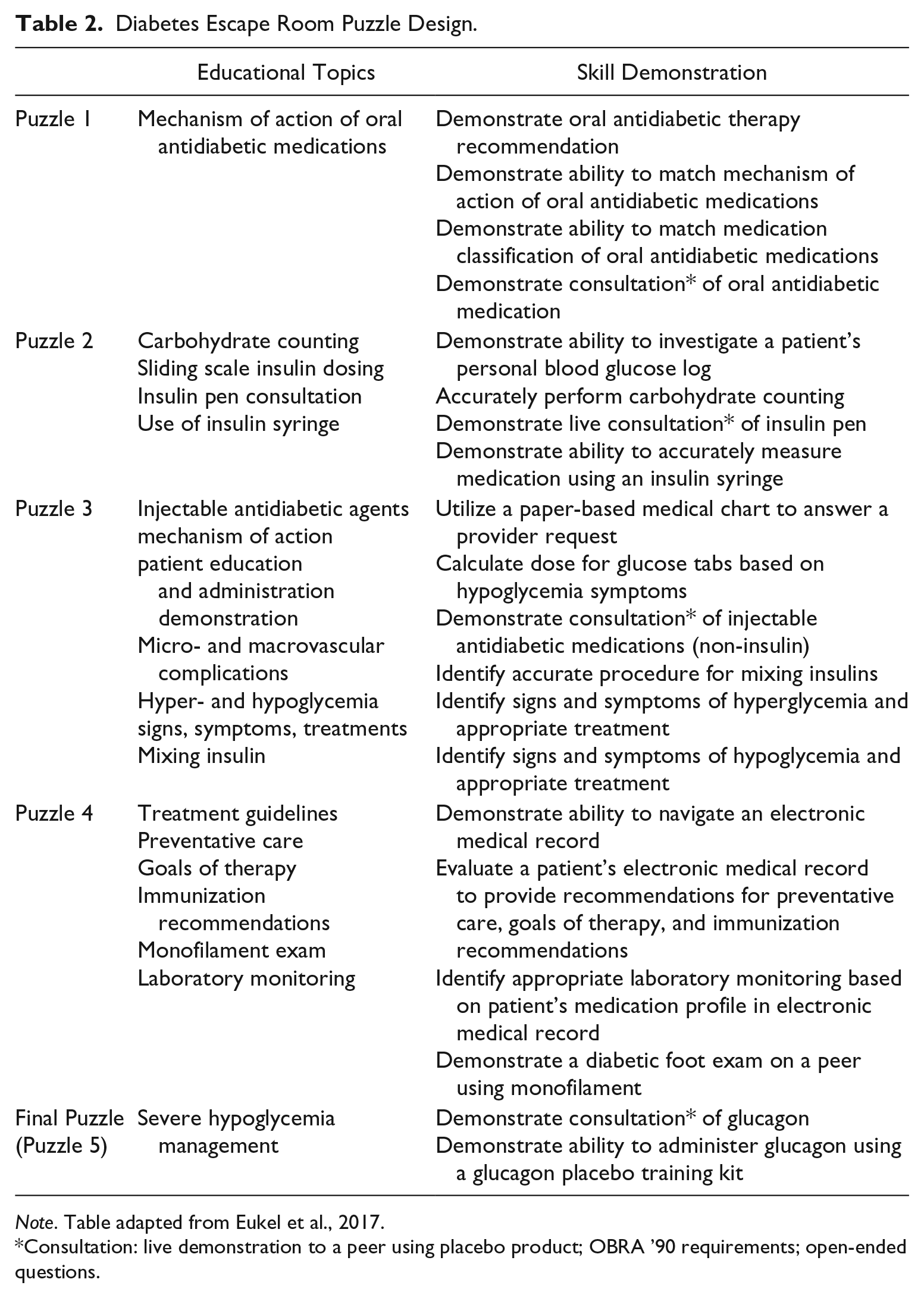
Note. Table adapted from Eukel et al., 2017.
Consultation: live demonstration to a peer using placebo product; OBRA ’90 requirements; open-ended questions.
Structure
Puzzles were presented in a linear fashion where team members worked together to solve a single puzzle, perform the assigned tasks as determined by the solution to that puzzle, and upon successful completion of the task received the next puzzle. These larger puzzles would often have several smaller tasks involved that could be approached at the same time in parallel by different participants (Figure 1). The room contained the patient’s locked emergency medication box and the various props and components of puzzle one. To begin the game, students were introduced to the diabetes escape room through a scripted introduction and invited to enter the escape room (Appendix A, item A). To ensure all or most players were engaged, faculty distributed a colored card to each student. For each puzzle, the color of the card linked team members to specific game tasks. For example, in puzzle one, the color-task combination was “Red counsel on Farxiga.” Faculty designed the colored tasks to stimulate engagement with every student and to support more dynamic team collaboration.
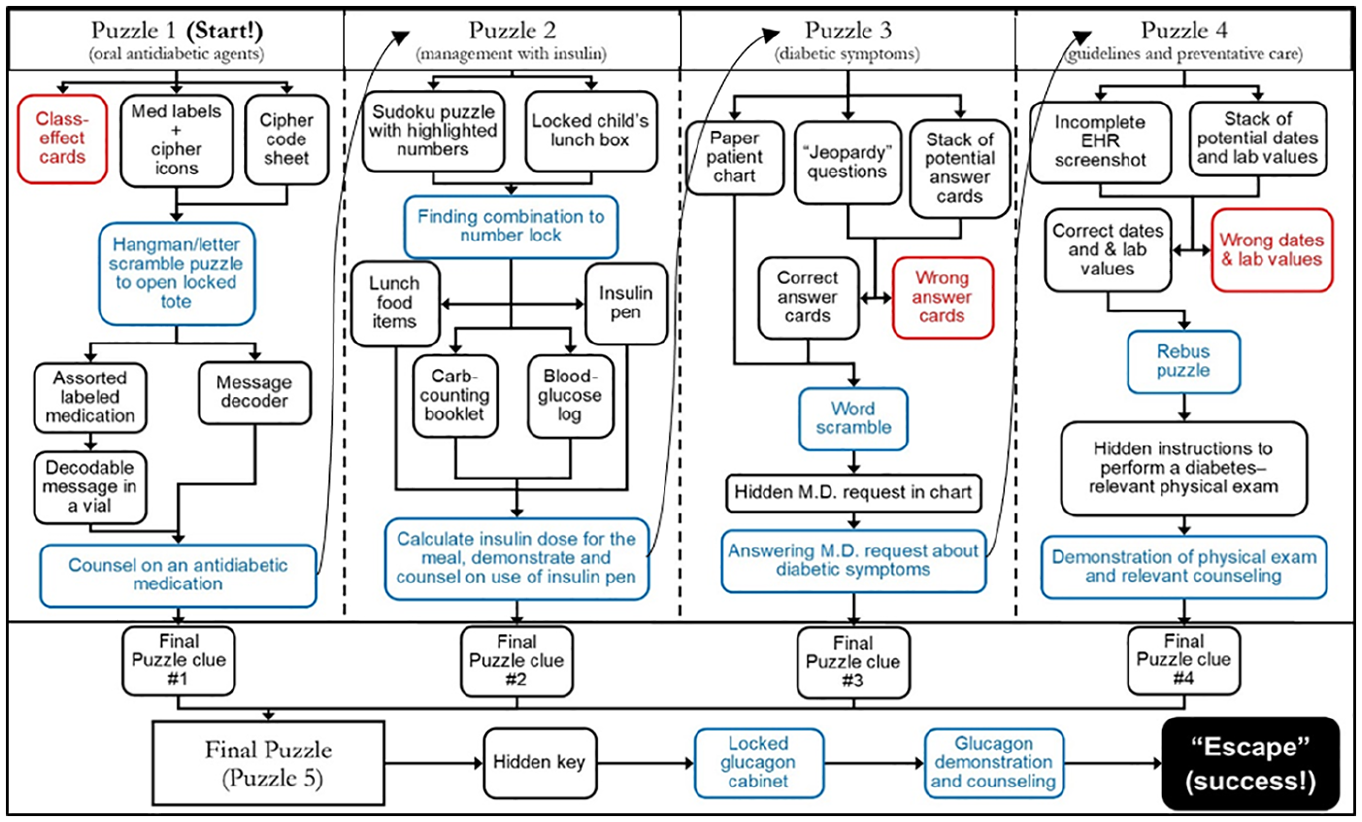
Diabetes escape room puzzle progression structure.
Puzzle 1
To solve puzzle one, the team had to solve a cipher, decode a word, and perform a medication consultation. Students received enlarged images of medication stock bottle labels on the back of which were printed cipher symbols. Using the mechanisms of action of the medications and a cipher code, they had to identify the word monotherapy, which allowed them to access a box containing stock bottles of various antidiabetic medications. Students had to determine that metformin was the only bottle in the box that was appropriate for monotherapy treatment. The metformin bottle contained a coded message. When deciphered, the message instructed students to model a medication consultation to a patient. Upon successful completion of this task (as judged by the observing facilitator), the team received the props/components of puzzle two and the first of four clues needed to solve the final puzzle. Detailed information and game templates for puzzle 1 are included in Appendix B.
Puzzle 2
For puzzle two, teams received a child’s locked lunchbox. To unlock the lunchbox, the team had to solve a Sudoku puzzle with a few highlighted squares, the numbers of which would provide the code to unlock the lunchbox. The lunchbox contained a child’s lunch, blood glucose logbook, an insulin syringe, a carbohydrate counting guide, pen needles, recipe clippings from a magazine, and an insulin placebo pen. Teams used clues from the blood glucose logbook and the units of insulin in the syringe to determine the number of insulin units needed per carbohydrate. Teams then had to calculate the total number of insulin units needed by the child prior to consuming the contents of the lunchbox. By using the live video feed, one team member then provided a comprehensive consultation to a faculty member acting as a proxy for the patient on the use of an insulin pen and calculated insulin units. Upon completion of this task, the team received the third puzzle props/components and the second clue needed to solve the final puzzle. Detailed information and game templates for puzzle 2 are included in Appendix B.
Puzzle 3
To solve puzzle three, the student teams used information found in a simulated patient’s medical chart to respond to a provider information request. A provider note with the question “Which microvascular and macrovascular complications is this patient experiencing?” was present but hidden within the patient’s multi-page medical chart. In order to direct students to this portion of the paper chart, students had to answer questions focused on injectable anti- diabetic medications, complications of diabetes, and signs and symptoms of hyper/hypoglycemia in a game show format. The correct answers lead the teams to a specific page of the paper-based medical chart which documented the patient’s existing microvascular and macrovascular complications. Upon report of the complications, the team received the puzzle four props/components and the third clue towards the final puzzle. Detailed information and game templates for puzzle three are included in Appendix B.
Puzzle 4
To solve puzzle four, teams used information found in an electronic health record to determine recommendations for preventative care, goals of therapy, immunization needs, and laboratory monitoring for an adult patient with diabetes. Correct recommendations for dates of follow-up care and goals of therapy produced a rebus puzzle. The final rebus puzzle, when solved, stated “green foot exam for pink.” To complete the puzzle, the student with the green name badge had to successfully perform a diabetic foot exam for the student assigned to pink card. Upon completion of these tasks, the team received the last remaining clue for the final puzzle. Detailed information and game templates for puzzle 4 are included in Appendix B.
Final puzzle
To solve the final puzzle and “escape” the room, teams had to assemble an interpretive puzzle using the clues awarded from solving the previous four puzzles. The puzzle was an image of the gluconeogenesis pathway with various antidiabetic medications listed. In this puzzle, the following letter combinations IT ON TAB LE were highlighted (Figure 2). The team had to interpret this puzzle to read:
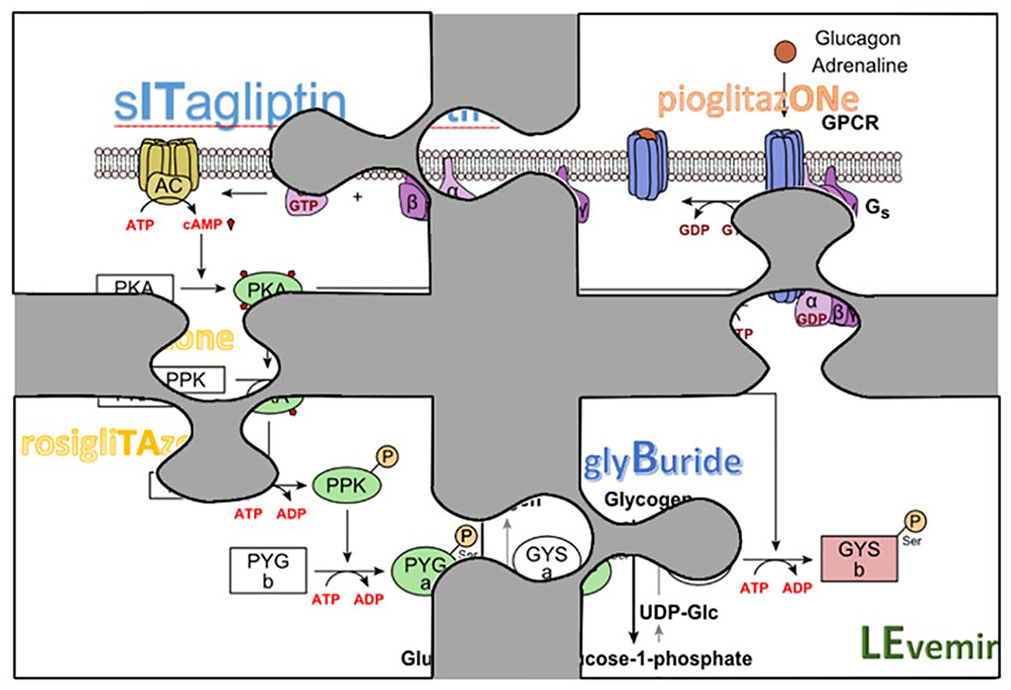
Diabetes escape room interpretive puzzle.
Debriefing
Upon successful escape from the room or elapsed game time, faculty led a debriefing. The debriefing gave students an opportunity to give initial reactions and allow for self and team reflection. Faculty focused the debrief conversation on the educational content’s place in clinical practice, the learning outcomes of each puzzle, and reflection on the impact the simulation had on teamwork and communication. Focusing the debriefing on overall topics rather than specifically performance fostered a healthy learning environment and closed the learning loop. After completing the activity, students signed a confidentiality agreement which stated the educational topics and puzzles could not be discussed with students who had not yet completed the activity. This was used to ensure that all students were naïve to the logistics and solution of the diabetes escape room.
Transferability
The resources used in the design and evaluation of the diabetes escape room included props, technology, placebo dosage forms, online medication references, and printing costs. Online medication references, placebo dosage forms, and the technology used during game play had no associated costs. Once the initial development of materials for the diabetes escape room were constructed, additional resources for subsequent iterations were minimal. Overall cost to implement the activity for each site was approximately $100 for the first year and no cost for subsequent years (excluding faculty time). Faculty capitalized on design affordances to ensure successful implementation and transferability of the diabetes escape room (Table 3).
For the implementation at WSU campuses, a few accommodations needed to be made as the original activity was not designed to meet the constraints of WSU’s specific facilities. Please note that none of the modifications changed the learning objectives or outcomes of the diabetes escape room. The original activity developers provided all materials and were available to provide guidance via email or phone. Both WSU campuses had to employ different accommodations to meet the needs of their learning space, student group size, and availability of facilitators. A considerable amount of time and effort was required to fully understand the many puzzle elements, create the puzzles from templates, and to envision how they would need to be adapted to function within structural, financial, and staffing limitations. We believe that many of these difficulties could broadly apply to any other campus who desires to implement this activity for themselves, and as such, would like to briefly describe a few examples of these transferability issues and how they were resolved:
Design Affordances.

Lunch box lock—In puzzle 2, the players must solve a Sudoku puzzle to find 4 particular highlighted number boxes that will be used as the 4 digits of the number-lock on the child’s lunchbox. This sudoku puzzle originally had only 3 highlighted boxes with the intention to use a 3-digit lock, but since the WSU facilitators already had access to 4 digit locks (but not 3-digit) and did not want to purchase unnecessary materials, the decision was made to simply include a 4th highlighted box in the puzzle.
Environment—the original described environment of the room is set up to “look like a child’s bedroom”, but we had difficulty procuring necessary props to accomplish this and decided to alter the setting by telling students that the child was with her grandmother for a pharmacy MTM visit and the setting was a local pharmacy/clinic.
Time limit—the original activity called for an escape time limit of 75 minutes, but because of schedule limitations, one cohort had to set the time limit to 60 minutes instead. With this reduced time limit, changes were made to the complexity of the Sudoku puzzle, reducing the number of red herrings in various puzzles, and explanation of the diabetic foot screening rather than full exam.
Number of students per team – various team sizes were accommodated with a maximum of 6 students per team recommended. Colored cards (red, blue, green, orange, pink, and yellow) were handed to each student. If there were fewer students than cards, some students received multiple colored cards.
Even if these specific solutions do not apply to other campuses, facilitators should anticipate that some number of adaptations may be required. Best practices would be to allow time for facilitators to plan the activity—at least 4 weeks is recommended. Also, to better understand the activity, we found it useful to produce all the materials needed for the puzzles in the room so we could physically walk through each step of every puzzle. Without having the physical props to handle, it is much more difficult to understand the intricacies of the puzzles.
Limitations
We feel the main limitation for wide adoption of this escape room model is differences in resource availability. While initial cost is not considered to be significant (approximately $100), elements such as physical space, supplies, available class time, and facilitator availability may limit ability to implement this activity at other institutions. To help alleviate these constraints, we encourage thinking outside of the box whenever possible. Many colleges and institutions have access to residents and experiential students who make fantastic facilitators if available. Another example to alleviate space restraint is running the simulation with half the class one week and the other half in a subsequent week or finding multiple rooms to reserve.
Another anticipated challenge is the time required for this activity. First is the initial investment of facilitator time, which takes several weeks for puzzle preparation, participant logistical preparation (scheduling), facilitator training and coordination, and many other organizational details. To address this limitation, authors encourage allowing a significant amount of planning time. Preparation of the physical puzzle elements is best done outside of normal instructional time periods, during summer months, if possible. Authors encourage an overestimation of time required to prepare for this activity and a high level of organization.
In addition to the time required to prepare this activity, many educational courses are limited by the amount of instructional time available. While this activity is intended to be implemented within a two-hour instructional time slot to allow for introduction, simulation, and debrief, as mentioned above authors have suggested accelerated formats of this activity.
Conclusion
The diabetes escape room, a serious game, was developed and implemented in professional pharmacy curricula across three campuses.
Supplemental Material
Blood_Glucose_and_Insulin_Log_Book – Supplemental material for Unlocking Student Engagement: Creation, Adaptation, and Application of an Educational Escape Room Across Three Pharmacy Campuses
Supplemental material, Blood_Glucose_and_Insulin_Log_Book for Unlocking Student Engagement: Creation, Adaptation, and Application of an Educational Escape Room Across Three Pharmacy Campuses by Heidi Eukel, Jeanne Frenzel, Kyle Frazier and Micah Miller in Simulation & Gaming
Supplemental Material
Cipher_Code – Supplemental material for Unlocking Student Engagement: Creation, Adaptation, and Application of an Educational Escape Room Across Three Pharmacy Campuses
Supplemental material, Cipher_Code for Unlocking Student Engagement: Creation, Adaptation, and Application of an Educational Escape Room Across Three Pharmacy Campuses by Heidi Eukel, Jeanne Frenzel, Kyle Frazier and Micah Miller in Simulation & Gaming
Supplemental Material
Class_Effects_Question_Cards – Supplemental material for Unlocking Student Engagement: Creation, Adaptation, and Application of an Educational Escape Room Across Three Pharmacy Campuses
Supplemental material, Class_Effects_Question_Cards for Unlocking Student Engagement: Creation, Adaptation, and Application of an Educational Escape Room Across Three Pharmacy Campuses by Heidi Eukel, Jeanne Frenzel, Kyle Frazier and Micah Miller in Simulation & Gaming
Supplemental Material
Dates,_Words,_and_Values_Correct_Answers – Supplemental material for Unlocking Student Engagement: Creation, Adaptation, and Application of an Educational Escape Room Across Three Pharmacy Campuses
Supplemental material, Dates,_Words,_and_Values_Correct_Answers for Unlocking Student Engagement: Creation, Adaptation, and Application of an Educational Escape Room Across Three Pharmacy Campuses by Heidi Eukel, Jeanne Frenzel, Kyle Frazier and Micah Miller in Simulation & Gaming
Supplemental Material
Dates,_Words,_and_Values_Incorrect_Answers – Supplemental material for Unlocking Student Engagement: Creation, Adaptation, and Application of an Educational Escape Room Across Three Pharmacy Campuses
Supplemental material, Dates,_Words,_and_Values_Incorrect_Answers for Unlocking Student Engagement: Creation, Adaptation, and Application of an Educational Escape Room Across Three Pharmacy Campuses by Heidi Eukel, Jeanne Frenzel, Kyle Frazier and Micah Miller in Simulation & Gaming
Supplemental Material
Electronic_Health_Record_Printout – Supplemental material for Unlocking Student Engagement: Creation, Adaptation, and Application of an Educational Escape Room Across Three Pharmacy Campuses
Supplemental material, Electronic_Health_Record_Printout for Unlocking Student Engagement: Creation, Adaptation, and Application of an Educational Escape Room Across Three Pharmacy Campuses by Heidi Eukel, Jeanne Frenzel, Kyle Frazier and Micah Miller in Simulation & Gaming
Supplemental Material
Food_Cards – Supplemental material for Unlocking Student Engagement: Creation, Adaptation, and Application of an Educational Escape Room Across Three Pharmacy Campuses
Supplemental material, Food_Cards for Unlocking Student Engagement: Creation, Adaptation, and Application of an Educational Escape Room Across Three Pharmacy Campuses by Heidi Eukel, Jeanne Frenzel, Kyle Frazier and Micah Miller in Simulation & Gaming
Supplemental Material
Jeopardy_Question_Cards – Supplemental material for Unlocking Student Engagement: Creation, Adaptation, and Application of an Educational Escape Room Across Three Pharmacy Campuses
Supplemental material, Jeopardy_Question_Cards for Unlocking Student Engagement: Creation, Adaptation, and Application of an Educational Escape Room Across Three Pharmacy Campuses by Heidi Eukel, Jeanne Frenzel, Kyle Frazier and Micah Miller in Simulation & Gaming
Supplemental Material
Medication_Images_correct_answers – Supplemental material for Unlocking Student Engagement: Creation, Adaptation, and Application of an Educational Escape Room Across Three Pharmacy Campuses
Supplemental material, Medication_Images_correct_answers for Unlocking Student Engagement: Creation, Adaptation, and Application of an Educational Escape Room Across Three Pharmacy Campuses by Heidi Eukel, Jeanne Frenzel, Kyle Frazier and Micah Miller in Simulation & Gaming
Supplemental Material
Medication_Images_incorrect_answers – Supplemental material for Unlocking Student Engagement: Creation, Adaptation, and Application of an Educational Escape Room Across Three Pharmacy Campuses
Supplemental material, Medication_Images_incorrect_answers for Unlocking Student Engagement: Creation, Adaptation, and Application of an Educational Escape Room Across Three Pharmacy Campuses by Heidi Eukel, Jeanne Frenzel, Kyle Frazier and Micah Miller in Simulation & Gaming
Supplemental Material
Medication_Labels_with_Ciphers_Cards – Supplemental material for Unlocking Student Engagement: Creation, Adaptation, and Application of an Educational Escape Room Across Three Pharmacy Campuses
Supplemental material, Medication_Labels_with_Ciphers_Cards for Unlocking Student Engagement: Creation, Adaptation, and Application of an Educational Escape Room Across Three Pharmacy Campuses by Heidi Eukel, Jeanne Frenzel, Kyle Frazier and Micah Miller in Simulation & Gaming
Supplemental Material
Message_in_the_Bottle – Supplemental material for Unlocking Student Engagement: Creation, Adaptation, and Application of an Educational Escape Room Across Three Pharmacy Campuses
Supplemental material, Message_in_the_Bottle for Unlocking Student Engagement: Creation, Adaptation, and Application of an Educational Escape Room Across Three Pharmacy Campuses by Heidi Eukel, Jeanne Frenzel, Kyle Frazier and Micah Miller in Simulation & Gaming
Supplemental Material
Mock_Patient_Paper_Chart – Supplemental material for Unlocking Student Engagement: Creation, Adaptation, and Application of an Educational Escape Room Across Three Pharmacy Campuses
Supplemental material, Mock_Patient_Paper_Chart for Unlocking Student Engagement: Creation, Adaptation, and Application of an Educational Escape Room Across Three Pharmacy Campuses by Heidi Eukel, Jeanne Frenzel, Kyle Frazier and Micah Miller in Simulation & Gaming
Supplemental Material
Sudoku_Puzzle_with_Instructions – Supplemental material for Unlocking Student Engagement: Creation, Adaptation, and Application of an Educational Escape Room Across Three Pharmacy Campuses
Supplemental material, Sudoku_Puzzle_with_Instructions for Unlocking Student Engagement: Creation, Adaptation, and Application of an Educational Escape Room Across Three Pharmacy Campuses by Heidi Eukel, Jeanne Frenzel, Kyle Frazier and Micah Miller in Simulation & Gaming
Footnotes
Acknowledgements
The authors would like to thank Chirstina Buchman for her collaboration.
Declaration of Conflicting Interests
The authors declared no potential conflicts of interest with respect to the research, authorship, and/or publication of this article.
Funding
The authors received no financial support for the research, authorship, and/or publication of this article.
Supplemental Material
Supplemental material for this article is available online.
Author Biographies
References
Supplementary Material
Please find the following supplemental material available below.
For Open Access articles published under a Creative Commons License, all supplemental material carries the same license as the article it is associated with.
For non-Open Access articles published, all supplemental material carries a non-exclusive license, and permission requests for re-use of supplemental material or any part of supplemental material shall be sent directly to the copyright owner as specified in the copyright notice associated with the article.
