



Abstract
Background. For uncommon events in medicine, such as
Intervention. Residents were interviewed to understand
Methods. We used a
Results. The inductive framework gradually moved away from gamification and towards that of self-determination. Participating residents reported several types of intrinsic and extrinsic
Conclusion. The motivation to practice CPR among residents aligns with the self-determination theory. By stimulating intrinsic motivating factors, future curriculum design may better motivate residents to practice CPR.
Background
Cardiopulmonary resuscitation (CPR) is a lifesaving technique when applied to patients in cardiac arrest. Outcomes are related to the quality of CPR delivered during these events (Meaney et al., 2013). Unfortunately, high-quality CPR (in terms of meeting American Heart Association guidelines for compression rate, depth, and fraction) does not frequently occur for in-hospital cardiac arrests for both adults and children (Abella et al., 2005; Sutton et al., 2013). However, simulated practice for CPR and chest compressions may improve hospital employees’ compression skills (Niles et al., 2017; Sutton et al., 2011). Due to the rarity of providing CPR to patients, these skills often decay, but frequent, periodic practice using a simulator can prevent skills decay (Bhanji et al., 2015; Niles et al., 2017).
In a single-center pilot study, a healthcare facility utilized a competitive program that included a leaderboard to motivate practice frequently among staff without prompting; subsequently, they improved (MacKinnon et al., 2015). This improvement was absent in a cohort who did not have access to a competitive leaderboard. The implication was that, consistent with gamification and motivation theories, a competitive leaderboard could spur motivation and improve simulated CPR performance (Deci & Ryan, 2008; Landers, 2015).
This hypothesis was supported by theoretical models from the gamification literature such as Landers’ Theory of Gamified Learning (Landers et al., 2015). Landers outlined gamified learning as either mediating (e.g. game mechanisms such as competition lead to learning) or moderating (e.g., game mechanism itself is not educational but moderates the uptake or interest of an educational item).
When this concept was expanded into a multi-center study, however, the results did not support the conclusions of the single center study. This study focused on applying this framework by using the leaderboard as a moderating factor in learning (Landers, 2015). Nine hundred nineteen healthcare staff with ad lib access to a simulator showed changes in neither practice frequency nor performance, despite a clear competitive leaderboard (Chang et al., 2019). Gamification, in this specific context, had no effect in outcome. This spurred on the question, what did motivate high-performing residents to independently practice CPR?
Intervention
This study focused on understanding the reasons behind resident motivation to practice CPR within the context of the QCPR leaderboard study.
Methods
This qualitative research design evaluated the motivational factors that led residents to practice CPR. The aim of this study was thus to understand the driving forces behind motivated CPR practice.
Study Sample
We selected residents as the subject source based on using resident interviews as an exercise of constructivist teaching (Piaget, 1971). A constructivist approach implies that instructors facilitate the active process of constructing knowledge from within one’s own prompting of inquiry. The language of motivation, learning, and pedagogy were not suppressed and instead were interpreted through our prior work by examining the theories underlying game-based learning (Landers, 2015; Sailer et al., 2017). Thus, we aimed to describe the phenomenon of motivation on simulated CPR practice amongst resident physicians who participated in the multi-center study using a competitive leaderboard meant to encourage CPR practice.
Study Setting
This study took place in two pediatric, academic, tertiary care centers. In 2017, we conducted one-on-one, in-person interviews with resident physicians who had previously participated in a randomized control trial looking at the effect of a multi-center competitive leaderboard on self-motivated simulation-based CPR practice among healthcare professionals. This study was approved by the respective Institutional Review Board at each participating hospital study site.
Instruments
An interview guide was developed using a modified Delphi technique with a panel of experts whose combined expertise includes pediatric emergency medicine, pediatric critical care, qualitative medical research, and medical education (Table 1).
Sample Questions From Interview Guide.

Research Protocol
Ten resident physicians who had previously participated in the parent study were chosen based on convenient times for scheduling interviews with two of the authors (IHG, JLS. All interviews were audio recorded for transcription and transcribed verbatim with de-identification. We verified the reliability of the transcription prior to being uploaded to an online software application, Dedoose (v.8.0.42, Los Angeles, CA), for data analysis.
Characteristics of Interviewees
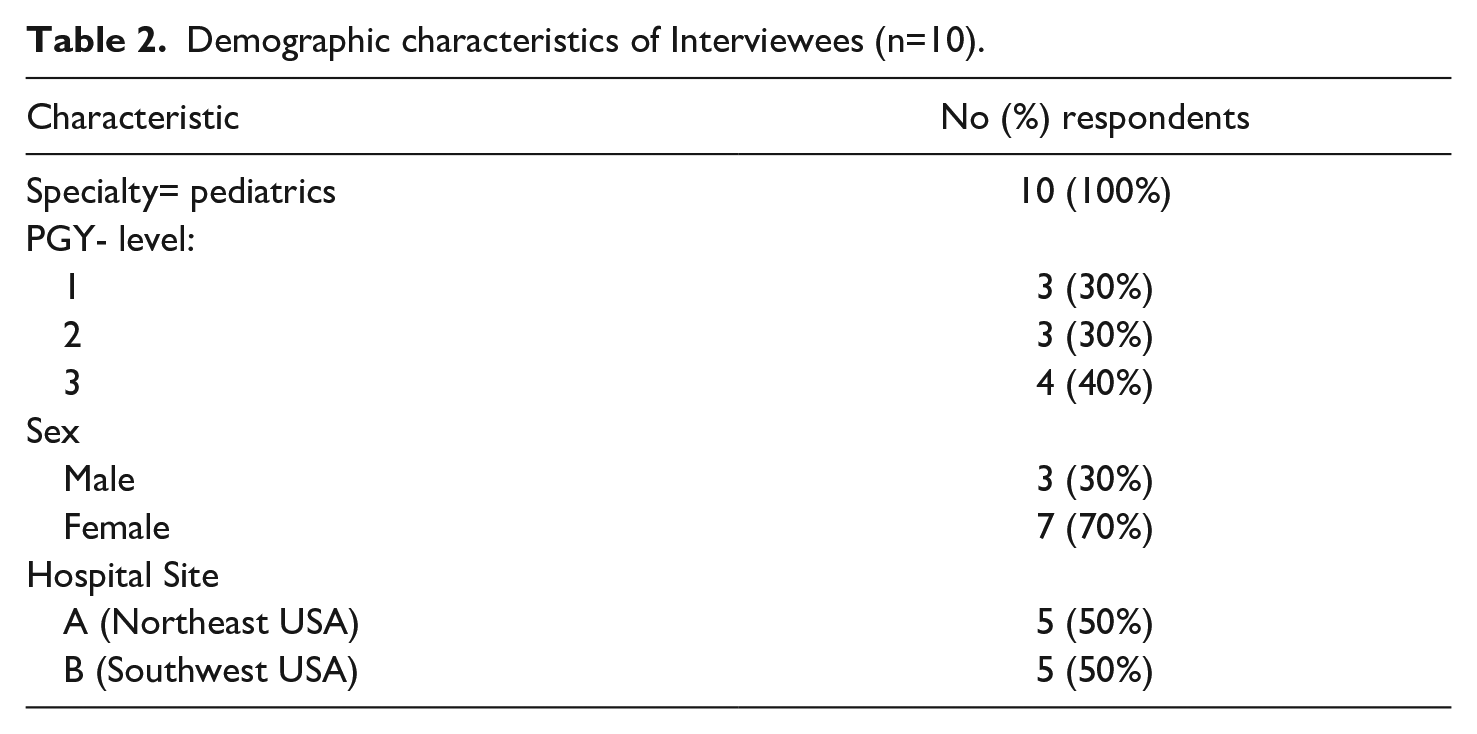
Ten residents in two institutions were consented to and completed the interview process (Table 2). PGY-1 residents comprised 30% (n=3) of the cohort; seven were senior residents.
Demographic characteristics of Interviewees (n=10).
Theoretical Framework
Motivation is defined as the forces that move people to act, and is an important component of learning (Deci & Ryan, 1975, 1985, 2002; Deci & Vansteenkiste, 2004; Rutledge et al., 2018; Ryan & Deci, 2000). Several frameworks exist surrounding motivational theory, and are adapted from different disciplines, including behavioral theory, cognitive psychology, online gaming, and serious games (Brito et al., 2015; Deci & Ryan, 1975, 1985; Deci & Vansteenkiste, 2004; Fogg, 2009; Garris et al., 2016; Hamzah et al., 2014; Huang et al., 2006; Keller, 1987; Landers et al., 2015; Maslow, 1943; Orsini et al., 2015; Wouters et al., 2013; Yee, 2006). Because Landers’ theoretical framework supported the hypothesis that a gamified design would motivate residents to practice CPR, we expected a gamified learning framework to be apparent in resident interviews. However, during data collection and analysis it became apparent that this framework was insufficient to fully explain the motivational drivers discussed by learners. We observed that the leaderboard study or its gamification components were infrequently mentioned. It appeared that a resident’s motivation to practice had thus little to do with gamification components.
Instead, we observed that residents tended to describe their motivation to practice largely by reflecting on factors that had motivated them. Residents frequently used patient stories to serve as a personal connection to their drive to practice. During additional rounds of coding and thematic development, we identified these motivational forces as either internally or externally driven. Further analysis and additional interviews aided in this comparison between internal and external motivating factors, as well as those factors that detracted from their ability to practice (Charmaz, 2006). At this point, the theory of self-determination (SDT) was identified, and thematic analysis was completed using SDT as an analytical framework (Deci & Ryan, 1985, 2008).
Statistical Analysis
Interviews were analyzed using a qualitative methodology of a constructivist grounded theory (an inductive approach to analyzing emerging themes in data (Charmaz, 2006). A constructivist grounded theoretical approach allows the flexibility to understand concepts using an iterative interview approach. It provides more flexibility than pure grounded theory and allows existing theoretical concepts to help understand potential discoveries.
We conducted 10 semi-structured interviews with pediatric residents. Purposeful sampling techniques were used to identify residents who were highly motivated to participate in the leaderboard study (Charmaz, 2006). By choosing these residents, we were able to understand those factors that may underlie high motivation. We worked both independently and collaboratively during each phase of data analysis. Two authors (IHG, JLS) participated in all parts of analysis, and two authors (TC, DB) consulted in areas of disagreement requiring adjudication, and in the last portion of the data analysis. We then cross-checked all codes at all phases of the study.
After coding was completed and cross-checked, a clear narrative was identified - our analysis interpretation were informed principally by Deci et al. which is divided into three main categories: intrinsic motivation, extrinsic motivation, and amotivation (Deci, 1980; Deci & Ryan, 2008). Motivation is graphed almost linearly from amotivation to intrinsic motivation (Deci, 1980; Deci & Ryan, 2008).
Results
The SDT may inform a better understanding of how and why residents are motivated to practice CPR outside of their clinical duties.
Intrinsic Motivation
The theme of intrinsic motivation included several sub-themes, including simulated practice as a connection to patients, practicing to prepare for a future event, and competition/perfectionism.
Simulated practice as a connection to patients
This category was described through several conditions where residents described how simulated practice connected them to both past and future patients through their stories. First, participants frequently alluded to the act of practicing CPR on a manikin as a connection to real clinical practice, with the goal to improve a participant’s overall performance. One resident described the burden of caring for sick patients and their duty to do the best job possible by improving their CPR skills: After the really sick kid my first month [in the PICU], that was such a terrifying feeling every moment every time you were on [call], you were like, ‘oh no’, so [CPR] was one thing I can do. I may not understand the rest of it but that was the one thing I could do.
Practice to prepare
Second, participants spoke of physical factors such as muscle memory, CPR microskills (such as rate, depth, and recoil) as specific reasons they continued to practice. These microskills are collected on the QCPR feedback manikin and used to generate a score. One resident related their drive to practice as a need to be so prepared for chest compressions that it becomes almost automatic: I’ve thought about [muscle memory] a lot. I used to be a pianist. I used to do some theater stuff. And do you know the cliché you don’t rise to the occasion; you sink to your training? I think that’s absolutely true. If you don’t do something the way that you want to continue doing it going forward, then it’s not just going to happen for you naturally later on. So, I wanted to leave my mind [and] my body with that experience of this is what chest compressions should feel like. I got some crap for it from people because you know we worked up a sweat but again, I think if you’re not, then you’re not doing it right.
Another resident discussed the act of deconstructing chest compressions into their microskill components to better understand how to perform high quality chest compressions: [I] wouldn’t been able to say this depth, this rate, this hand placement here, this is the feeling for a kind of the force that I need, I wouldn’t of been able to like seamlessly transition between one person doing compressions and the next, so that was something else we practice, so I guess I came away with it with a clear set of attributes of good chest compressions that came to my more quickly and also were grounded in some kinesthetic experience.
Perfectionism and/or competition
Third, participants spoke of the internal drive to ‘win’; either in the form of a perfect score, or by being ‘better’ than either other peers, or than a prior iteration of themselves. This need to improve overall CPR quality formed the foundation for some participants’ successive practice. One resident discussed how perfectionism and competition acted to drive their return to practice: [Y]ou’re divorced for many clinical outcomes in that period, so I focused on mostly getting the highest score I could out of the machine. And you know so there was a room full of people, and so it felt like a competition, and I think we all thrive off of that a bit.
Extrinsic Motivation
This theme consisted of external forces that helped motivate residents to practice CPR. Residents frequently discussed the need for the manikin to be both accessible and available in both spatial and temporal parameters. In other words, the environment – in both the literal and contextual senses – held sway over a resident’s decision to practice CPR.
Accessibility/availability of manikins
This theme may illustrate the facilitated drive for both autonomy and competence. Several residents indicated that simply being able to see the manikin was enough of a reminder for them to practice CPR during a shift: [I]t was more that when I was back there and I saw [the manikin], I was like, OK, I’ll hop on it for a few minutes and practice. So I think it was more like having it available and it was a perfect time where things get a little slower in the unit, and you had a minute to breathe so when you go to the back and it’s there, you’re like, oh let me practice.
Downtime as extrinsic motivators
The availability of extra time to practice also emerged as a sub-theme, suggesting the convenience of manikin availability, and thus speaking to the need of the participant for autonomy. Many participants felt that although they did not have enough time to practice in general, but that having more time available to them might allow them to choose to use that downtime to practice. One resident discussed how enjoyment in practicing CPR is not enough, but also highlighted this need for downtime to prompt them to practice: If it was there, and we had downtime, yes, because it’s fun, and it’s interesting, and it’s really good, like, an easy teaching thing for like, if you had the manikin thing lying around, I guarantee people would gather around, if there was downtime.
Team or group as a motivating factor
This theme centered on another person (either a peer or a superior) providing the motivational push to practice. Several residents mentioned that having others remind or invite them to practice CPR serves as a potential motivator. For example, one talked about being invited: I think that if someone, like, at all, just offered it verbally, it would be easy to do it. I don’t know that I would go on my own, without any prompting whatsoever.
Amotivation
The theme of amotivation is defined as those forces that act in opposition to motivators (Deci, 1980; Deci & Ryan, 1985, 2002, 2008; Deci & Vansteenkiste, 2004; Rutledge et al., 2018). There were several barriers that participants discussed during interviews that served to detract from their motivation to practice.
Competing priorities
In this study, participants often expressed the internal conflict between practicing CPR in the context of having competing priorities that undermine their ability to practice this skill. This counterpart to downtime highlighted the overload that residents describe feeling when on a shift in the hospital.
It feels like something you could triage and decide not to do you know in the long list of things that you’re thinking about during the day. To do it feels like such a welcome reprieve to be able to say oh, this is not required. I think it was scheduled, then people would feel good about it. I think if it were like, required but you weren’t given time for it, it would be resented.
Additional sub-themes included performance anxiety as an amotivator, even during simulated practice, and the lack of manikin fidelity that degraded realism. A comprehensive listing of themes and sub-themes can be found in Supplemental Information that is part of this article.
Conclusions
The goal of this study was to understand key motivators that drove residents to practice CPR. Although the larger study focused on introducing the gamification elements of points, badges, and leaderboards (PBL) to stimulate motivation, the data and framework did not support PBL as a major motivating factor. Instead, we noted a broader range of motivational factors, explained by the framework of self-determination to explain why residents are driven to practice CPR (Brito et al., 2015; Chen & Jang, 2010; Cook & Artino, 2016; Deci & Ryan, 1985, 2002, 2008; Deci & Vansteenkiste, 2004; Gagné & Deci, 2005; Mekler et al., 2017; Ryan & Deci, 2000; Sailer et al., 2017; Werbach & Hunter, 2015). We subsequently uncovered three major categories of themes that corresponded to these motivational drivers to practice as described by Ryan and Deci (Deci & Ryan, 1975, 1985, 2002; Maslow, 1943; Ryan & Deci, 2000).
The ability of an individual to achieve self-determination is primarily thought to be driven by the need to fulfill Maslow’s three psychological needs of autonomy, relatedness, and competence, thus achieving self-determination. Intrinsic factors most strongly drive an individual towards self-determination. Motivation itself exists on a continuum of different motivational drivers as described in Ryan and Deci’s Self-Determination Theory (SDT) (Deci & Ryan, 1975, 1985, 2002; Maslow, 1943; Ryan & Deci, 2000). Intrinsic motivation is driven by the self and represents the strongest motivational force on a continuum towards self-determination of practice. The theme of extrinsic motivation is also driven by Maslow’s three basic psychological needs but derive from external factors to motivate an individual to practice. Amotivation is considered the furthest position from self-determination, and these factors may detract from the progression towards achieving self-determination. Similarly, they may work to detract from an individual’s ability to achieve autonomy, relatedness, and/or competence.
Intrinsic motivational themes as detailed above focused largely on both preparing for real situations (practice to prepare, perfectionism/competition), and to connect to patients (simulated practice as a connection to patients). These were the most frequent drivers of practice noted in interviews. This is not surprising, as the goal of residency training is to become a competent, general pediatrician who can practice independently. Practicing to prepare for patient encounters is the foundation upon which residency training is built, as it fulfills a need for competence and autonomy. Similarly, the emergence of the need to connect practice to patients was not surprising. Many discussed relating to a prior failure that drove their need to practice. Others tied their practice to a future patient who might need effective CPR, reflected in the theme of ‘practice as a connection to patients.’
Residents also expressed an internal drive towards a perfect score or an improved prior iteration of themselves in the sub-theme of perfectionism and/or competition and fulfilling the need for competence and autonomy. As such themes demonstrated a strong connection to elements of Maslow’s psychological needs (Table, Supplemental Digital 1).
External motivational themes were often focused on particular variables that might be a motivating or non-motivating force for residents. Two important external motivational themes were accessibility/availability of manikins, and downtime. Many residents discussed how these external factors either facilitated their motivation to practice (if the manikin was accessible, and there was sufficient downtime during a shift), or opposed their motivation to practice. These themes largely focused on achieving the need for autonomy and competence.
Interestingly, there was little explicit mention of gamification elements during these interviews, despite being the focus of the original study. The gamification components of points, badges, and leaderboards (PBL) are often considered to be external motivators for practice (Rutledge et al., 2018; Sailer et al., 2017). These components are thought to improve motivation by connecting the gamification principles of goal setting, learner control, and engagement. These extrinsic motivators that may help propel a learner towards internalizing a behavior (Huang, 2011; Orsini et al., 2015). Landers proposed that moderating effects of games in motivated individuals would enhance behaviors that are known to lead to learning improvements (Landers, 2015; Landers et al., 2015). Prior work on gamification had revealed elements, domains, and mechanics exemplified by education in healthcare and in other fields (Garris et al., 2016; Landers, 2015; Landers et al., 2015). Our initial interviews introduced themes of competition and the excitement of a gamified alternative to a classroom teaching environment. However, this data revealed far less insight on the reflection on gamification elements, and more from a personal lens of motivation and amotivation. In other words, the lens in which the participants’ voice was framed revolved more around their own self rather than the leaderboard game systems. Thus, we identified the emergence of self-determination theory (SDT) as a key narrative and framework throughout the interviews.
Finally, amotivational themes such as competing priorities and anxiety were less apparent. This was not surprising, as we had specifically chosen high-performing individuals for this study. Competing priorities may focus on a resident’s autonomy to choose not to practice CPR if there were tasks thought to be more important. Performance anxiety may act in true opposition to fulfilling the needs of competence and relatedness, thus detracting from the motivation to practice.
Limitations and Suggestions for Further Future Research
There were several limitations to our study. It was conducted exclusively in pediatric institutions where cardiac arrests are infrequent. It is unclear if the low prevalence of pediatric cardiac arrest has any effect on motivating factors of participants compared to adult patient practitioners where CPR is a more frequent occurrence. Recall bias may have occurred as participants were interviewed weeks to months after the primary study was completed. In addition, interviews were conducted by senior physicians who were otherwise familiar to the subjects and have had prior influence in their evaluations; this may have introduced a social desirability bias. Given that we had established professional relationships with our subjects as supervisor or educator, we fully acknowledge that our coding and interpretation were framed within this context. Furthermore, our sampling may have introduced a sampling bias given that interviewees were selected based on interview scheduling purposes and not via a purposeful sampling strategy. Lastly, investigator bias in interpretation of the findings is often a vulnerability of the nature of qualitative studies. A multidisciplinary team was recruited, and the findings discussed in an iterative fashion in order to reduce this risk of bias.
Future studies may explore eliminating barriers and identifying optimal environments by which to practice high-stakes, low frequency skills such as CPR. These findings suggest that principles of the Self-Determination Theory may be used as a conceptual framework by which to build a curriculum that encourages self-motivated practice. This framework may be applied more widely within medical education focusing on intrinsic motivation to drive deliberate practice cycles for a particular skill.
Conclusion
Several motivating factors for pediatric residents to practice CPR were identified, including having free time to practice, the ability to relate to real-life clinical outcomes, and an internal desire to achieve competency or mastery. These themes were examined under the lens of the SDT framework, where the psychological drivers of autonomy, relatedness, and competence were highlighted. Factors that detracted from practice motivation included unrelated priorities while on a clinical shift.
Footnotes
Acknowledgements
The authors wish to thank all of the residents who volunteered their time to be interviewed for this study, and Gunjan Tiyyagura for her mentorship.
Authors’ Note
Joo Lee Song is also affiliated with University of Southern California, USA.
Declaration of Conflicting Interests
The authors declared no potential conflicts of interest with respect to the research, authorship, and/or publication of this article.
Funding
The authors disclosed receipt of the following financial support for the research, authorship, and/or publication of this article: This work was made possible by the American Heart Association Western States Grant-in-Aid (15GRNT25030000) (TPC).

Author Biographies
Contact: ilana.harwayne-gidansky@stonybrookmedicine.edu
Contact: BALMERD@EMAIL.CHOP.EDU
Contact: cbdought@texaschildrens.org
Contact: lori.scarlatos@stonybrook.edu
Contact: dr.toddchang@gmail.com
Contact: josong@chla.usc.edu