




Abstract
Objective
Public participation has benefited from innovative engagement tools that facilitate the negotiation between diverse sets of stakeholders with different planning perspectives. Our objective is to test and evaluate the use of a fast Serious Game (SG) to support a participation process in the context of a conference on urban mobility. We also aim to explore how these analogue games engage Player Participants (PPs) and Non-Player Participants (NPPs).
Methodology
We developed an empirical approach where a fast analogue planning game was designed and deployed to support discussions during a conference on sustainable mobility. The game resulted from modding existing modern board games. We combined several game mechanisms and components with an urban map, following the Design, Play, Experience (DPE) framework for SG development. The low-tech game was available to Player Participants (PPs) and displayed in a way Non-Playing Participants (NPPs) could participate indirectly.
Results
The proposed SG engaged PPs and NPPs. PPs immediately started to plan the local transport system establishing a collaborative dynamic. NPPs participated by helping PPs, providing them with their expert and local knowledge. The simplicity of the game and the way it was displayed contributed to the engagement of PPs and NPPs.
Conclusion
Our findings show that layout configurations and facilitation techniques with analogue games can foster the participation of PPs and NPPs. Low-tech analogue SGs can be useful when resources are low, SG experience is reduced, and fast solutions for citizen and stakeholder engagement are necessary.
Background
Can analogue games help foster participation in spatial planning ?
People are eager to participate in spatial and urban planning matters. However, the traditional top-down decision process (Latour, 1987), related to the rational systemic planning approach, may not respond adequately (Dryzek, 2002; Innes and Booher, 2015; Innes and Booher, 2018). Despite many attempts, the effort to make planning more participative and engaging is still ongoing (Ampatzidou, 2019, Margerum, 2002). Planning practitioners feel unpowered to deliver suitable solutions for the growing complexity of contemporary planning problems (Innes and Booher, 2018; Portugali, 2016).
Participative and collaborative planning practices can humanize, constructively address contemporary conflicts, and better address citizens’ and stakeholders’ demands (Amim, 2015; Innes and Booher, 2004; Juraschek et al., 2017). They can generate reasonable solutions (Bächtiger et al., 2018) based on different knowledge and experiences (Berntzen and Johannessen, 2016; Brabham, 2009; Mueller et al., 2018; Parker, 2015). Thus, citizens should have support and see their insights valued (Mueller et al., 2018; Farinosi et al., 2019). We consider participation in planning to be the ability to engage citizens and stakeholders to influence the planning process (Margerum, 2002). Therefore, engagement is the ability for the participants to freely invest and care for the process and its outcomes (Zagalo, 2020).
Unfortunately, public participation gatherings and events might become hate battles between citizens, elected officials, stakeholders, and experts (Innes and Booher, 2018). Citizens may fail to see the purpose and the consequences of their participation (Osmani, 2007; White, 1996). The absence of engaging and consequent participatory opportunities that address citizens’ needs, particularly the youngsters, is a real issue (Cammaerts et al., 2014). We know that traditional planning processes can be overwhelmingly complex for non-experts (Fung and Wright, 2003) and tedious for less engaged participants (Innes and Booher, 2018). There is a need to deal with complexity, uncertainty and promote flexible solutions built on knowledge and shared decision-making (Callon et al., 2009).
Games might provide solutions to prepare citizens, establish collaboration, and foster shared knowledge to integrate rational and collaborative approaches (Ampatzidou, 2019; Mayer, 2009; Sousa, 2020a; Tan, 2016). Games deliver tangible arenas of testing, highlighting the cause and effects of decisions (Salen and Zimmerman, 2004). These relationships can improve communication between experts, citizens, and elected officials (Moore and Elliott, 2016). Levelling the power structures is automatic when players follow the same rules (Ansell and Gash, 2008; Thiel et al., 2016). Game progress should enable participants to negotiate, share and build collective knowledge (Ampatzidou and Gugerell, 2018; Gordon and Baldwin-Philippi, 2014).
Serious Games (SGs) are powerful tools because they provide engagement (Zagalo, 2020), pleasant experiences (Sicart, 2014), and the content and simulation dimension (Winn, 2009; Dörner, 2016). Yet, SGs are hard to implement due to the balance between playability and simulation. Facilitators can support the SG experiences and guarantee the necessary debriefing (Crookall, 2010; Lederman, 1992). Game facilitators are also needed when learning analogue game (Sato and de Haan, 2016; Sousa, 2020a; 2020b). However, overcoming the prejudices that games are useless can be the biggest challenge (Koens et al., 2020; Thiel et al., 2016).
Adopting analogue games seems promising because they are simpler to build and learn, and are flexible to adapt (modding) to almost any circumstance and purpose (Abbott, 2018; Castronova and Knowles, 2015). Analog games with their physical and mechanical dynamics foster collaboration among players (Zagal et al., 2006, Zagal et al., 2020), producing unique forms of engagement (Xu et al., 2011; Rogerson et al., 2016) and social conscience (Lee et al., 2011). These games rely more on the players’ autonomy and have lower barriers of entry due to the absence of interfaces beyond the game components (Booth, 2020). It also allows adaptations to introduce newcomers to complex planning problems (Ampatzidou et al., 2018).
These games can foster participation even when people are not playing them directly, allowing the emergence of Non-Player Participants (NPPs). We present in this paper the testing and evaluation of the use of a fast SG to support a participation process (including NPPs) in the context of a conference on urban mobility. The case study we developed there allowed us to consider three levels of engagement: the Playing Participants (PPs) that experienced directly the decision-making process involved in the game; the NPPs that participated in the game by interacting with the PPs; and general attendants (from now on simply called attendants) that observed without participating or interacting with the game.
Intervention
We tested our game approach during a public conference about sustainable mobility. It was the context for testing the role of fast analogue games as tools for collaborative planning with public participation. We acted as a game facilitator and deployed a fast analogue game tailored for a case study located at Marinha Grande municipality (Portugal). During 30 minutes, it was possible to verify the engagement of PPs and NPPs, testing different options and game outcomes.
Several speakers discussed the theme of sustainable development and urban mobility. The audience of approximately 90 participants was composed of high school students, local citizens, local planning and transport officials, experts on planning and mobility, and city councillors, including the mayor of the municipality.
After a presentation regarding collaborative planning and SGs, the game facilitator invited the audience to play while planning the local transport system. The game combines several board game mechanisms (Engelstein and Shalev, 2019). Game development followed the Design, Play and Experience (DPE) framework (Ampatzidou and Gugerell, 2018; Winn, 2009), highlighting the effects of changing game mechanisms to achieve SG goals. We adapted the DPE to consider the facilitator role (Sousa, 2020a) and the concept of NPP in a public game session.
The game proposed a simple economic system where infrastructures could be purchased and placed over a city map. PPs could freely use their money to decide where to locate infrastructures, like bicycle ways, bus routes, tramway lines, a new ring road or parking areas. Coloured strings represented the infrastructures. PPs could consult the table of infrastructure costs displayed for all conference attendants. The facilitator was there to invite players and explain the game while managing the money flow. The game map stayed on the theatre's stage floor, strategically placed in front of the first lines of chairs and the speakers at the stage. The conference attendants seated near the playable area should be engaged in the game dynamic, even indirectly.
The expected planning outcome of the game was a new local transport plan.
Methods
The main objective of this research was to test the engagement of different planning stakeholders with a fast, low-complexity, and low-tech (Spagnolli et al., 2016) SG. In particular, we wanted to verify if the game could engage PPs and NPPs, fostering participation and collaboration. The experience also explored if existing modern board games could inspire a playable collaborative transport planning process.
Serious Game Design process
Our game simplified the game experience of Sousa (2020a) and focused only on the transport dimension through simple game mechanisms found in modern board games (Sousa and Bernardo, 2019). The game board was a satellite image map with a scale of 1:5.000 that included the urban centre, printed in an A0 paper format. Although the game complexity was low, the game was still challenging for players due to the context and the limited available time (Dziedzic and Włodarczyk, 2018).
The game delivered a collaborative experience without any formal turn order. There was no clear win or lose condition besides collaboratively generating the best possible plan, with the limited available time and resources. The development process was inspired by other tabletop modding approaches (Abbott, 2018; Castronova and Knowles, 2015), reducing the game complexity to the minimum (only one action: spend resources to add a piece, see Figure 1). The transport routes were the coloured strings from Spaghetti (Gołębiowski, 2016) because they are resistant, flexible, and easily handled. The string-laying mechanic came from String Railway (Hayashi, 2009) but without scoring in order to lower complexity and allow instant play. The string laying mechanism from String Railway allowed the establishment of action costs and effects of network-building over the map. Since the purpose was to consider a sustainable transport system, green strings represented bicycle lanes, highlighting their low environmental impact on the urban system. Yellow strings represented bus routes, red the trains, and black the highways (an analogy to asphalt). The white cubes were easy to see over the map and represented parking. Poker chips represented the money. Each bicycle lane was composed of two attached green strings (80 cm, 4 km in reality). The bus routes (75 cm) resulted from gluing three separate yellow strings pieces. Two red string pieces glued formed a tramway (70 cm). Finally, another three connected black strings represented a highway (135 cm). Previous playtesting allowed to adapt the game’s internal economy (Table 1) to accommodate no more than 20 players and be playable in about 20 minutes. This game design solution relates to a low-tech persuasive approach (Spagnolli et al., 2016). Gluing the available strings was the modding that fitted game components to the city map scale. Limiting the number of new transport infrastructures restricted the players’ behaviour and options, forcing them to generate a transport system with different types of interconnected transports modes. Game process and the different participants involved. DPE adapted the framework to the game session.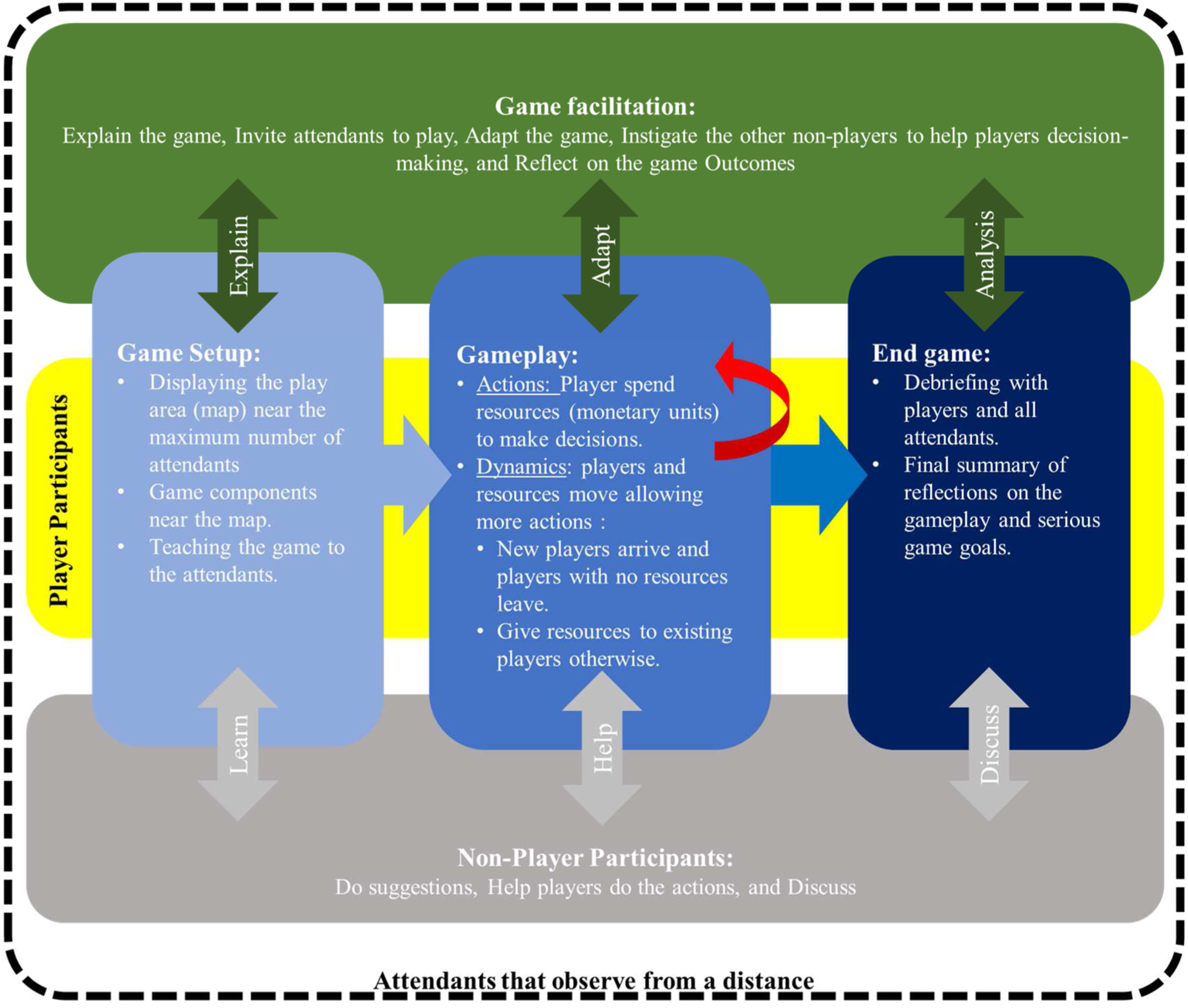

The game experience resulted from the DPE framework (Winn, 2009), simplifying the game mechanisms of String Railways, introducing the map, and allowing dynamics between PPs and NPPs. The DPE model was adapted to consider more roles, the facilitator (Sousa, 2020a), the content creator, and the NPPs. The map was placed near other attendants, allowing the emergent NPPs to share their technical expertise and local knowledge. The facilitator helped players learn the game fast and enforced the rules during gameplay (Sato and de Haan, 2016; Sousa, 2020a, 2020b), supporting player decisions and managing the game state economy. In the experiment, the content and pedagogy creator, the game (re)designer, and the facilitator were the same person. These highlighted roles are directly associated with the DPE global dimensions (first line of Table 1). We considered the game's physical components and the facilitator skills as technologies. Game play with PPs being assisted by NPPs.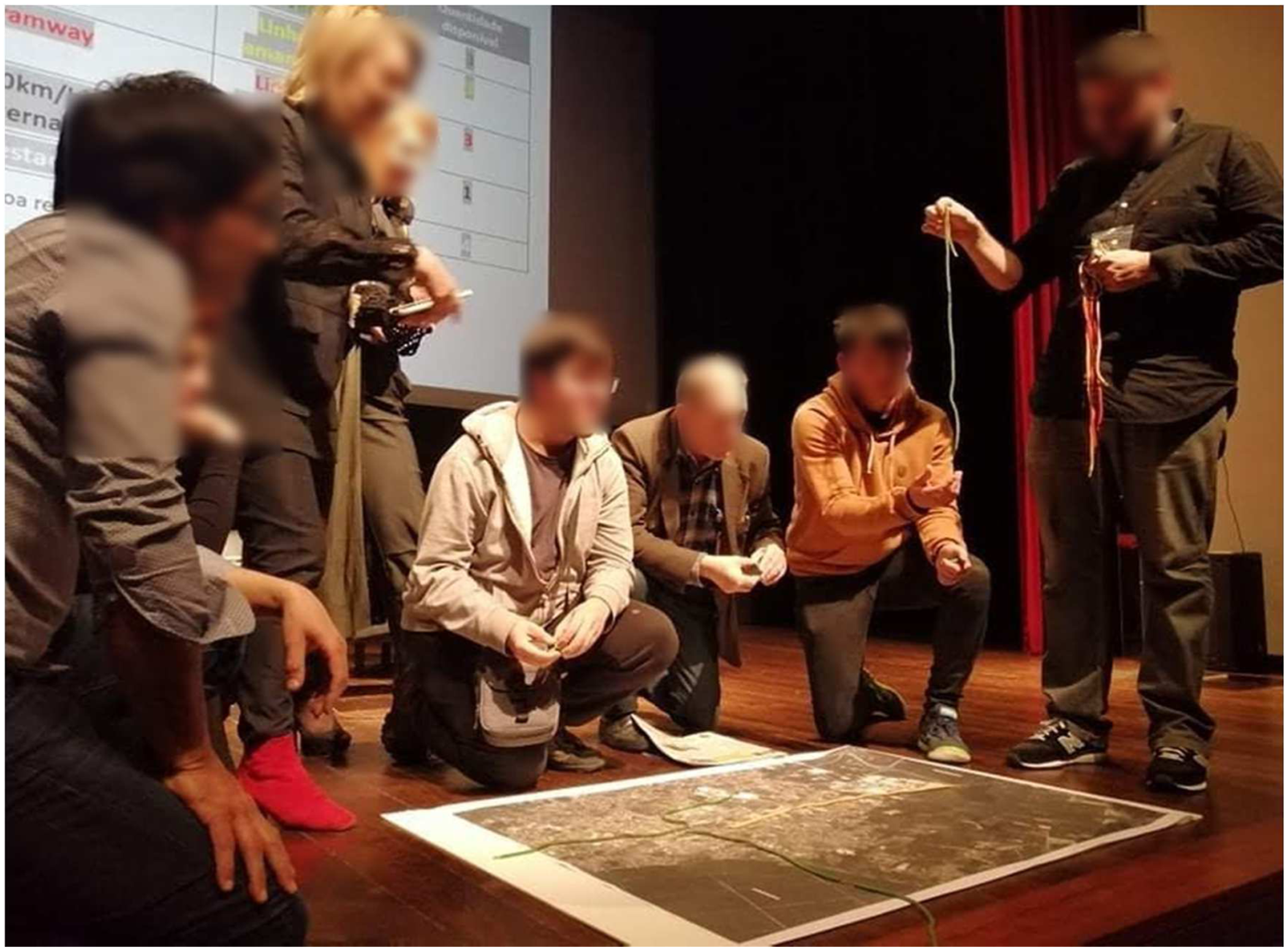
PPs played on the floor of the stage where the conference took place. This display allowed a top-down view of the map and the placement of PPs close to the NPPs. The game map location, displayed between the speakers and the first line of chairs, induced NPP behaviour for the experience (Figure 2).
PPs could freely enter the stage, discuss with other players and spend money resources to define transport solutions. Young players, mainly students, should be incentivized to participate by peer effect (Wang et al., 2016). The facilitator invited students to play the game, stating they were in charge of the decision-making. Nevertheless, they could listen to the advice of the speakers, elected officials, experts, and other conference attendants. PPs should be the only ones actively playing the game (making decisions), while speakers, elected officials, and other participants could become NPPs if they wanted. After the 20 mins of play, the facilitator should analyse the game results during debriefing (Figure 1).
Game economy table to support gameplay.
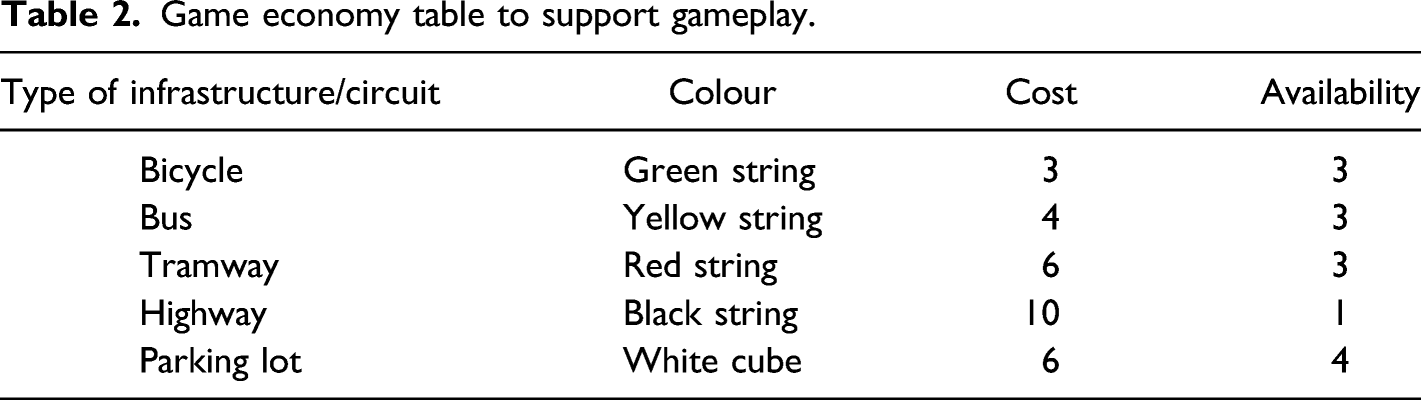
The only option for each player was to agree with other players on using their money together, thus forcing collaboration. The arrival of new players to the stage or giving more money to existing players should maintain the game dynamic. The theatre projector displayed Table 1 to support the decision-making process, showing action cost and components availability Figure 1 presents the setup, facilitation, gameplay (loop between actions and dynamics) and final analysis/debriefing. It also represents the collaborative relationships between PPs, NPPs and the other attendants as observers (not interacting with the game). Figure 1 highlights that NPPs can learn, help, and discuss but not play directly and make decisions as the PPs can. Any attendant could become an NPP or a PP if they like.
Data collection
After the conference NPP answered a survey, with the questionnaire designed following Mayer et al. (2014). We recorded NPP game experiences, expectations, and game outcomes. We collected at least two answers from each type of NPP: speakers, elected officials, experts, teachers, and citizens. The grounded theory approach (Charmaz, 2014; Farkas et al., 2020) provided the method to organize and interpret the answers to the questionnaires. We compared all the answers, grouping them by ideas and concepts, in a gradual, hierarchic, and coded way. This method produced quantitative results to evaluate the SG experience.
Results
Eight individuals played the game. It started with a group of six PPs, all secondary school students. The first four spent their money quickly, defining the first two bicycle lanes, which took less than 5 mins. After spending all their money, these four players left the stage. The two remaining PPs took longer to decide. They kept facing the map with money to spend. They were there alone for two minutes because no other student wanted to go on the stage. But an older citizen joined them, and then also a teacher. The facilitator gave these new players two money units and the same amount as the other players (students), reinforcing the initial budget (total of 20 monetary units). Seeing this impasse, the conference speakers started to help the players, focusing on the most sustainable solutions. The NPP role in the game emerged by supporting the active players’ decision-making. The rest of the audience began reacting to the dynamics by clapping their hands and cheering when players played a piece on the map. The discussion increased and was very vivid at the end of the game. At this point, the game unfolded without additional facilitation. The mayor and the councillors tried to help the PPs.
Players spent a total of 19 monetary units on the local transport system. They chose to place three bicycle lanes, one bus route, and one tramway, leaving one monetary unit unspent. PPs discussed the NPP suggestions for the need to connect the existing train station to the city centre and industrial park, which they did. NPPs even moved the game components to the exact locations on the map when asked by the players. PPs considered that the bicycle network strategy should be a priority. Citizens could travel by bicycle to the coast, located less than 10 km to the West. Although PPs could not connect all these places to form a network during gameplay, they drafted it.
Post-game survey results
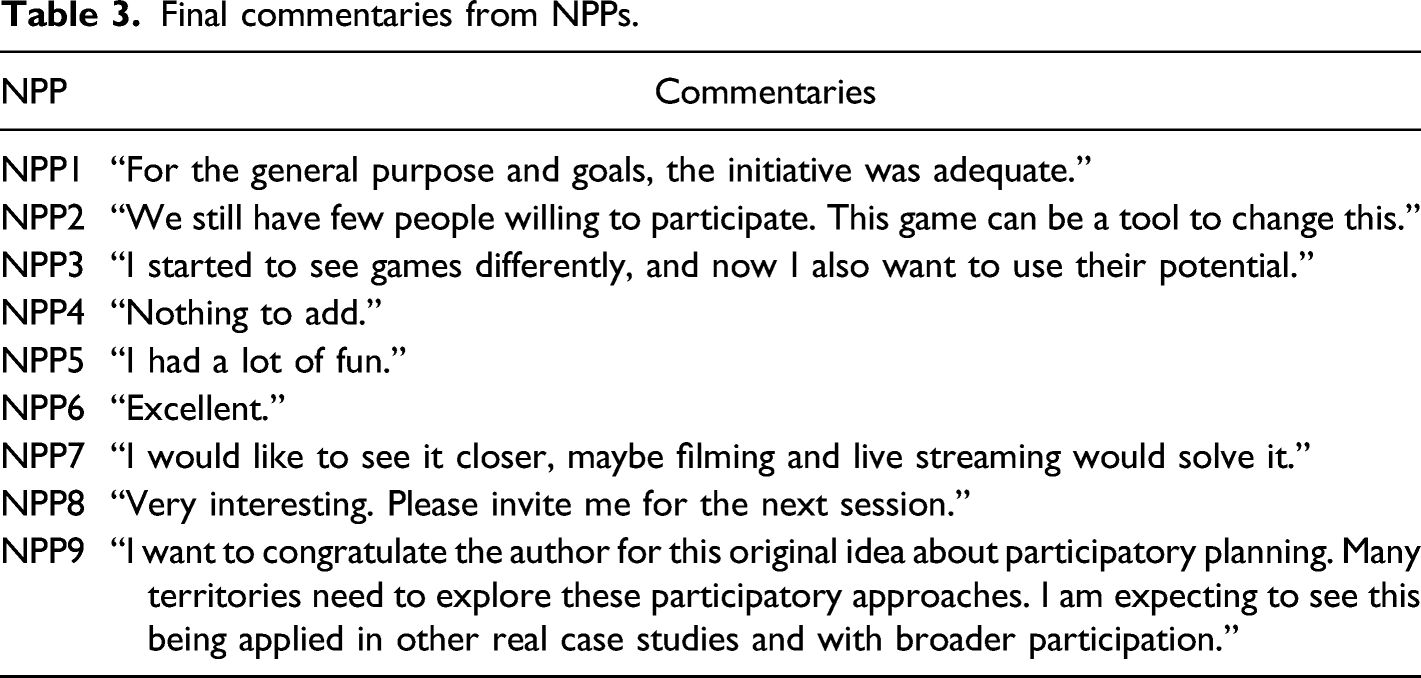
A questionnaire surveyed the NPPs with 14 Questions (Q) (questionnaire in Appendix A). We obtained nine NPP answers, involving roughly 10% of the session attendants. Three were speakers (NPP2, NPP3, NPP9) and two elected officials (NPP 5, NPP 6). Two other NPPs considered themselves experts in the planning and transportation fields (NPP1, NPP8), and the remaining two admitted having no specific knowledge (NPP4, NPP7).
The nine NPPs answering the questionnaires were on average 49 years old and had a higher education degree. Six were female, and three were male. The gaming habits were measured through a Likert scale from one to five, from “never play” to “play daily”. The majority of the NPPs said they played, on average, one time per month or less. Less than half of the participants (NPP1, NPP3, NPP6, NPP7) had never participated in any SG session before.
On their experience in public participation (Q1), only NPP4 said that citizens had some ways to participate in planning processes related to their communities, and another said it not know (NPP2). All the other seven agreed that citizens do not have available or engaging options to participate. The remaining seven NPPs highlighted the boredom and bureaucracy of existing participatory methods (NPP6), the focus on individual issues (NPP9), the lack of follow-up of proposals (NPP3), as well as intangible results (NPP9) to their answers.
On the issue of participation (Q2), NPP referred that increasing the opportunities to participate would increase the general participation levels (NPP3, NPP7, NPP8, NPP9), others stressed the need to have engaging (NPP1, NPP3, NPP4, NPP5, NPP6, NPP9) and innovative (NPP3, NPP4, NPP5, NPP6, NPP9) participatory opportunities. Only NPP8 mentioned the need for more education investment to increase participation. NPP2 said that civic participation should be mandatory. Four NPPs stated that the obligation to address concrete issues and consequent solutions was necessary to increase participation (NPP1, NPP3, NPP8, and NPP9).
On the gaming experience (Q4), NPPs identified several issues that surprised them, as expected, because five NPPs had never experienced SG practice (NPP2, NPP4, NPP5, NPP8, and NPP9) (Q3). Six NPPs (NPP1, NPP5, NPP6, NPP7, NPP8, and NPP9) were amazed by the easiness players generated solutions. Five NPPs were impressed by the immediate PP focus (NPP3, NPP5, NPP6, NPP7, and NPP8). Five NPPs also classified as positive the instant engagement and active participation that the game delivered, highlighting the easiness to foster collaboration among players (NPP1, NPP4, NPP5, NPP7, and NPP9). Keywords like innovation (NPP6, NPP8), equality (NPP3), and knowledge (NPP3) also appeared in some answers.
When asked about game complexity (Q5), NPP7 said it was medium, while the others considered the game easy. Some referred that the game was well explained (NPP3) and was fun and didactic (NPP2). But that the game required knowing and understanding the map and the local reality (NPP9).
The majority of the NPPs were surprised by the engagement level and PP active participation (six answers). But, when asked directly about the players' engagement (Q6), only five considered it to be high (NPP3, NPP5, NPP6, NPP7, and NPP8) while the other four said it was average (NPP1, NPP2, NPP4, NPP9). Four of the answers stressed shyness as the reason for less involvement (NPP1, NPP2, NPP3, and NPP4). Nevertheless, three of them stated that engagement increased as the game unfolded (NPP1, NPP2, and NPP3). One NPP directly said that he also would have liked to play (NPP8).
Five NPPs considered the PP performance to be high (NPP3, NPP5, NPP6, NPP7, and NPP9), and four to be average (NPP1, NPP2, NPP4, and NPP8). Three stated that the time to play was short (NPP1, NPP3, NPP4, and NPP9), contributing to a superficial outcome (NPP1, NPP3, and NPP9).
All NPPs considered the game session useful, teaching planning and civic participation to all attendants (Q8). Four said that it was relevant for learning about collaboration (NPP5, NPP6, NPP7, and NPP9), four for decision-making and solution finding (NPP3, NPP5, NPP6, NPP7), and three for resource management (NPP3, NPP5, and NPP6). All NPPs also considered that the SG allowed PPs to express their ideas while reducing the fears about participation (NPP7, NPP9) and helping understand the effects of collective decisions (NPP2, NPP8).
When asked directly if the game fostered participation among PPs (Q10), all NPP answered “yes” in their perspective. But when asked if the game was helpful to plan the local transport system, six participants said it just had some potential, other two directly said it had no potential (NPP1 & NPP4), while one said it was inconclusive (NPP2).
Concerning game improvements (Q13), six participants mentioned the need for more time (NPP1, NPP3, NPP4, NPP6, NPP8, and NPP9), four stated the need for more preparation from the players (NPP1, NPP3, NPP6, NPP8), while three suggested doing a session dedicated to gaming (NPP4, NPP6, and NPP8). Two NPPs considered it would be better to use a formal planning problem (NPP2, NPP7). One NPP said it would be better without public observation (NPP8), and another one suggested the use of a virtual platform to support the game (NPP9).
Final commentaries from NPPs.
Discussion
Although with only 20 mins of play, it was possible to observe some interesting behaviours. The event’s speakers and even the elected officials helped the game to be played. The adopted design options and game setup engaged NPPs connecting them to the game and the actual PPs. This interaction allows sharing knowledge and experiences related to the issues at stake in the game. These techniques provide a comfortable way out for those participants that distrust SG results or do not have the time to play the whole game. They can participate by giving inputs and watch the game development without being forced to play. It is a way to change perceptions about the results of SGs. This game process can be explored in other practical participative and collaborative dynamics. Facilitators can propose games played over existing maps as a context (i.e., changing land uses, facility locations), adding simple game components and mechanisms to build the interactions that lead to engagement, increasing participation and fostering different forms of collaboration.
The game approach positively surprised the NPPs. The game engaged the PPs, although they demanded help to understand the map and decide their moves. One of the main findings was the influence and importance of the NPPs to deliver informed playability. NPPs acted as informal facilitators and experts. PPs adopted most NPP suggestions, like connecting the city centre to the train station and industrial parks with public transports. The PP fragilities and gaps of technical and local knowledge fostered involvement of the NPPs and the general collaboration between PPs and NPPs.
Despite the many conference attendants, only eight persons played the game: six students, one older citizen, and one high school teacher. Because the game was designed for 20 players, it would become unplayable without a fast adaptation done in real-time (providing more money to players). This analogue flexibility allowed the session to achieve the SG goals. NPPs and PPs were engaged and delivered a collaborative planning solution.
Although the game generated a simple transport system (Figure 3), it supported discussion among PPs and NPPs. It showed how players valued bicycle lanes and the influence of the speakers. Having a limit of three bicycle lanes forced the players to select other transport infrastructure. Adopting this limitation fostered the emergence of a multi-modal transport system, which was one of the SG goals. Game Result: 3 bicycle lanes (Green); 1 bus route (Yellow); 1 tramway line (Red). Locations: City Centre (1); Train Station (2); Industrial Park (3); Coast (4).
This experience demonstrated how unprepared citizens might be to get involved in public participation processes. Just inviting them to play a simple planning game might not be enough to motivate citizens. Finding ways to engage participants in effectively affecting the planning outcomes is one of the goals of participatory and collaborative planning approaches. Allowing attendants to participate how they wish can be a valuable strategy. In the experience, the attendants could become NPP or PP if they wish anytime. The game session highlighted the difficulties that non-experts have to understand complex maps. However, better preparing PPs and NPPs for the game experience would jeopardize the objective of the game experience. In planning practices, due to the lack of time and resources, using low-tech, simple, and speedy games like the one presented before can be relevant to spark more participation in spatial planning processes.
Limitations and suggestions for further future research
Using a camera to project the gameplay on a larger screen in the room for all participants is recommended. Supplementary digital tools like tailored mobile apps could share the game state and rules to increase the overall engagement of all attendants.
Conclusion
Using simplified and adapted analogue games as SGs proved to be viable for the case study. It allowed engaging participants, directly and indirectly, building a growing engagement dynamic even for non-players. A planning facilitator can adopt this analogue game approach to address collaborative planning, having limited time and resources. It also allows benefiting from non-player participants (NPPs) that are experts or have relevant local knowledge about the issues at stake. The NPPs are an active type of participants, even if they cannot play the game directly or the whole time. Attendants can be engaged in different roles: watching the game, indirect support to players, or actively playing the game. Attendants can participate at the level of involvement they feel more comfortable with. Participating without playing is possible, as NPPs contributed to the different game outcomes.
This experiment shows how flexible and efficient analogue game design can be, demanding little time and resources. The proposed game approach proved to be adaptable to an event where the number of participant players (PPs) and NPPs is uncertain at the outset. The game facilitator can easily adapt the approach during gameplay to deal with practical restrictions and uncertainties. Low-level complexity games allow immediate engagement, which also benefits from the knowledge that all participants bring to the game and from the propensity of facilitators and NPP to help players. NPPs that have knowledge and expertise in the subject at stake are naturally incentivized to interact with PPs, helping them more. The feeling that NPPs are providing relevant help is expected to increase NPP engagement in the game. Figure 1 proposes a process that can be applied for other participatory and collaborative dynamics and serve as a guiding framework. Adding some digital tools could have engaged even more participants.
We believe that analogue games can support other processes, profiting from the adaptation of the game according to the context, delivering engaging experiences that foster participation and collaboration.
Footnotes
Declaration of Conflicting Interests
The author(s) declared no potential conflicts of interest with respect to the research, authorship, and/or publication of this article.
Funding
Funded by Fundação para a Ciência e a Tecnologia (FCT), under grant PD/BD/146491/2019
